
Showing 3175 items matching " melbourne age"
-
 Falls Creek Historical Society
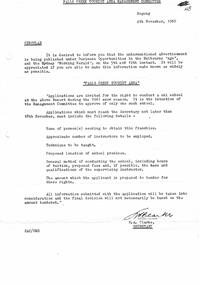
Document - Circular Re Advertisement In Melbourne Age & Sydney Morning Herald
... Circular Re Advertisement In Melbourne Age & Sydney Morning Herald...Circular Re Advertisement In Melbourne Age & Sydney Morning Herald...Circular Re Advertisement In Melbourne Age & Sydney Morning Herald Document Circular Re Advertisement In Melbourne Age & Sydney Morning Herald ...Bob Hymans Collection Bob (Herman) Hymans (a former member of the Royal Netherlands Navy) was born in Bloemendaal, Holland on 30th September 1922. During World War II he fought against the Japanese in the Dutch East Indies (now Indonesia) and was imprisoned in Changi and on the Burma Railway. After gaining qualifications as a Ski Instructor, Bob arrived in Falls Creek in July 1950. Working as an Instructor and Supervisor at Bogong Lodge, Bob decided his future was in accommodation. He was successful in negotiating an indenture for land from the State Electricity Commission (SEC). It took Bob two years to build his Grand Coeur Chalet but, tragically, it was burned down in August 1961. Bob also built the first Chairlift in Australia. This was a single chairlift and the structure was built from wooden electricity poles. He was constantly full of new ideas and proposals for the village. Bob Hymans died on 7th July 2007. This Collection of documents and letters tells the story of Bob's endeavours to develop Falls Creek into the ski village it is today.This document is significant because it outlines plans for the development of the Falls Creek Tourist Area.A circular from the Falls Creek Tourist Area Management Committee inviting applications to conduct a ski school at Falls Creek Tourist Area during the 1961 snow season. falls creek tourist area management committee, ski lift proposals -
 Eltham District Historical Society Inc
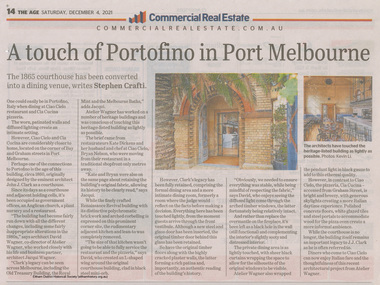
Newspaper - News Clipping, Stephen Crafti, A touch of Portofino in Port Melbourne, The Age, Commercial Real Estate, 4 Dec 2021
... A touch of Portofino in Port Melbourne, The Age, Commercial Real Estate...Clark Newsprint A touch of Portofino in Port Melbourne, The Age, Commercial Real Estate Newspaper News Clipping Stephen Crafti The Age ...Courthouse built in Port Melbourne of similar vintage to Eltham's courthouse (1860). 1865 Couthouse in Port Melbourne converted into a restaurant. The courthouse was originally designed by architect John J. Clark. Since its days as a courthouse and adjacent holding cells, it's been occupied as government offices, an Anglican church, a plant nursery and a restaurant. The building had become fairly run-down with some inappropraite changes according to David Wagner of Atelier Wagner, who in conjunction with partner Jacqui Wagner worked with present owners toi breathe new life intoi the building. In a further synergy with Eltham, Atelier Wagner were the architects who designed the extension to St Margaret's Anglican Church in Pitt Street, Eltham. atelier wagner, st margarets anglican church, pitt street, eltham courthouse, port melbourne courthouse, restaurant, john j. clark -
 Clunes Museum
Newspaper - NEWSPAPER ARTICLE, FAIRFAX
... THE AGE ARTICLE, FRIDAY 16 DECEMBER 1994, GIVING BRIEF HISTORY OF THE SWALLOW & ARIELL FACTORY AT PORT MELBOURNE, WHEN THE BUILDING WAS DEMOLISHED. ......THE MELBOURNE AGE...Newspaper NEWSPAPER ARTICLE FAIRFAX THE MELBOURNE AGE ...THE AGE ARTICLE, FRIDAY 16 DECEMBER 1994, GIVING BRIEF HISTORY OF THE SWALLOW & ARIELL FACTORY AT PORT MELBOURNE, WHEN THE BUILDING WAS DEMOLISHED. THE PHOTOGRAPHS SHOW "TOMMY SWALLOW", PRICE LISTS FROM UNIVERSITY OF MELBOURNE ARCHIVES, TOGETHER WITH DEMOLITION PHOTOGRAPH.NEWSPAPER ARTICLE REGARDING SWALLOW & ARIELL LTD.local history, document, newspaper cutting -
Clunes Museum
Newspaper - NEWSPAPER CUTTING, THE MELBOURNE AGE, GEESE, GOATS AND GIRLS IN OLD CLUNES, 4 SEPTEMBER 1965
... THE MELBOURNE AGE...TAKEN FROM GHOST TOWNS OF AUSTRALIA BY GEORGE FARWELL GEESE, GOATS AND GIRLS IN OLD CLUNES Newspaper NEWSPAPER CUTTING THE MELBOURNE AGE GEORGE FARWELL ...GHOST TOWNS AND GOLD MININGNEWSPAPER CUTTING. THE AGE LITERARY REVIEW SEPTEMBER 4, 1965. TAKEN FROM GHOST TOWNS OF AUSTRALIA BY GEORGE FARWELLclunes, history, mining, ghost towns, george farwell -
Clunes Museum
Document - NEWSPAPER ARTICLE, THE MELBOURNE AGE, 06/01/1979
... THE MELBOURNE AGE...Document NEWSPAPER ARTICLE THE MELBOURNE AGE ...PHOTOCOPY OF AN ARTICLE IN "THE AGE REAL ESTATE" SATURDAY JAN 6, 1979. FEATURING TALBOT & CLUNES. "WHERE CITY FOLK FIND A HAVEN OF PEACE". INCUDES PHOTOGRAPHS OF SOME HISTORIC CLUNES BUILDINGS.real estate, the age, clunes & talbot -
Port Melbourne Historical & Preservation Society
Newspaper - Newspaper clipping, Sale of J Kitchen & Sons site, Port Melbourne, The Age, The Age, 1 Feb 2013
... Newspaper clipping, Sale of J Kitchen & Sons site, Port Melbourne, The Age...Article form "The Age" -Business page 12, placed on Port Focus blog 01.02.2013 entitled "Fishermens Bend 2. Symex sells"; refers to sale of the old J Kitchen & Sons factoy site at Woodruff and Ingles St, Port Melbourne...Industry - Manufacturing Business and traders - Soaps/Candles Built environment - industrial J Kitchen & Sons Pty Ltd Symex Holdings Ltd Article form "The Age" -Business page 12, placed on Port Focus blog 01.02.2013 entitled "Fishermens Bend 2. Symex sells"; refers to sale of the old J Kitchen & Sons factoy site at Woodruff and Ingles St, Port Melbourne Newspaper Newspaper clipping, Sale of J Kitchen & Sons site, Port Melbourne, The Age The Age ...Article form "The Age" -Business page 12, placed on Port Focus blog 01.02.2013 entitled "Fishermens Bend 2. Symex sells"; refers to sale of the old J Kitchen & Sons factoy site at Woodruff and Ingles St, Port Melbourneindustry - manufacturing, business and traders - soaps/candles, built environment - industrial, j kitchen & sons pty ltd, symex holdings ltd -
Port Melbourne Historical & Preservation Society
Article - Newspaper article, "Berth of a Nation. How the world made its way to Port Melbourne", The Saturday Age, Anson Cameron, "Berth of a Nation. How the world made it's way to Port Melbourne.", 25 Jan 2014
... How the world made its way to Port Melbourne", The Saturday Age...How the world made its way to Port Melbourne." from the Satrurday Age Life & Style (parts of 4 pages) by Anson Cameron; dated January 25, 2014....How the world made its way to Port Melbourne", The Saturday Age Anson Cameron The Age ...Newspaper article called "Berth of a Nation. How the world made its way to Port Melbourne." from the Satrurday Age Life & Style (parts of 4 pages) by Anson Cameron; dated January 25, 2014.transport - shipping, immigration, migrants, armed services - army, armed services - navy, piers and wharves - station pier, anson cameron, patris, fairsky, zuiderkruls, the neptunia, world war i, world war ii -
Friends of Ballarat Botanical Gardens History Group
Work on paper - Ballarat Botanical Gardens Begonias. The Age, Melbourne, 27/3/1918, 'Visit Ballarat During the Easter Hols'
... Ballarat Botanical Gardens Begonias. The Age, Melbourne, 27/3/1918....Work on paper Ballarat Botanical Gardens Begonias. The Age, Melbourne, 27/3/1918. ...john garner collection, ballarat botanical gardens, gardens, ballarat, age newspaper -
 Robin Boyd Foundation
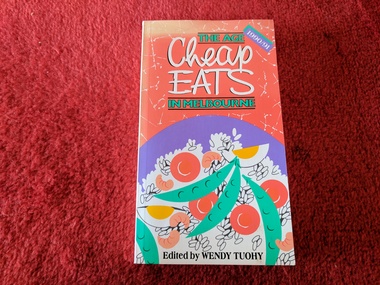
Book, Wendy Tuohy, The Age In Melbourne: Cheap Eats, 1990
... The Age In Melbourne: Cheap Eats...Walsh St library Softcover The Age In Melbourne: Cheap Eats Book Wendy Tuohy Anne O'Donovan Pty Ltd ...Softcoverwalsh st library -
 Melbourne Athenaeum Archives
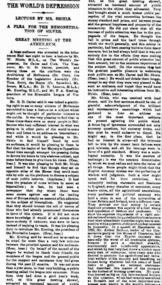
Newspaper Article, The World's Depression, Its Cause and Cure lecture by Mr. W. Shiels at Melbourne Athenaeum Hall - The Age 19 June 1894
... Shiels at Melbourne Athenaeum Hall - The Age 19 June 1894...Shiels at Melbourne Athenaeum Hall - The Age 19 June 1894 Newspaper Article ... -
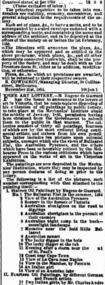 Melbourne Athenaeum Archives
newspaper advertisement, Fine Art Lottery - Eugène von Guérard - Melbourne Mechanics' Institute - The Age January 6 1855
... Fine Art Lottery - Eugène von Guérard - Melbourne Mechanics' Institute - The Age January 6 1855...Fine Art Lottery - Eugène von Guérard - Melbourne Mechanics' Institute - The Age January 6 1855 newspaper advertisement ... -
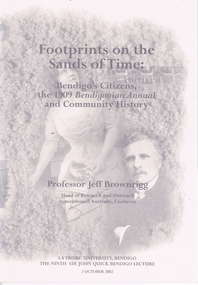 Bendigo Historical Society Inc.
Book - LONG GULLY HISTORY GROUP COLLECTION: FOOTPRINTS ON THE SANDS OF TIME
... ... Melbourne Age...BENDIGO History long gully history group The Long Gully History Group - Footprints on the Sands of Time Professor Jeff Brownrigg Research and Outreach Screensound Australia La Trobe University Bendigo Sir John Quick Bendigonian Annual Bendigo School of Mines British Empire Alfred Deakin Sir William Lyne King O'Malley's Commonwealth Bank Telstra Sir Frederick Holder Robert Garran John McKay The Mirror Henry Gyles Turner Fischer State Library of Victoria Bishop Reville Bendigo Evening News Bendigo Independent Bendigo Advertiser Melbourne University Melbourne Age Richard Twopenny Mr Donald Clarke Esq Bendigo's Butter Factory Madame Carandini Amy Sherwin Nellie Melba Oscar Commetant Shamrock Hotel Constitutional Convention Adelaide Frederick Holder Edmund Barton Catherine Helen Spence Elizabeth Nicholls Women's Christian Temperance Union Mary Lee Rose Scott Susan Margery Maybanke Anderson Vida Goldstein Bendigonian Annual Amy Castles Alice Crawford Edward Allan Bindley Joseph Castles Mercy Conent Freeman's Journal Catholic Press Therese Radic Melba State Library of Victoria Cardinal Moran De Quiros Bulletin John Norton D Headon J Brownrigg Lili Sharp Eileen Castles Mike Sutcliffe Melbourne Argus Frank Cusack David Horsfall Alvin Tracey Melbourne's Advocate Press Amy Sherwin Frances Saville Lalla Miranda Hugo Gorlitz Samuels Family Louis August Samuels Kate (Catherina) Samuels Madame Benda Mathilde Marchesi Emily Dyason Erna (Lovie) Mueller The German Chapter German heritage Society Bendigo Bertha Rossow Hamilton Hill Beatrice English Anthony Palamountain Alfred Bottoms A C Bartlemann Dorothy Penfold Dr Penfold Penfold Gallery Pauline Bindley E A Bindley Willie Murdoch Sister Mary Tarcisia Sisters of Mercy Peter Dawson Bendigo's Chinese Populatin Masonic Hall Ashman's Dry-cleaners Walter Murdoch Lily Baxter Walter Savage Landor Robert Garran Ada Colley Australian Journal of Communication Michelle Matthews Book titled Footprints on the Sands of Time: Bendigo's Citizens, the 1909 Bendigonian Annual and Community History with a grey tone cover with images of Sir John Quick, Amy Castles, Amy and Eileen Castles and Anthony Palamountain on the front and back covers. ...Book titled Footprints on the Sands of Time: Bendigo's Citizens, the 1909 Bendigonian Annual and Community History with a grey tone cover with images of Sir John Quick, Amy Castles, Amy and Eileen Castles and Anthony Palamountain on the front and back covers. La Trobe University, Bendigo The Ninth Sir John Quick Bendigo Lecture 2 October 2002. Lecture by Professor Jeff Brownrigg, Head of Research and Outreach ScreenSound Australia, Canberra. Mentioned in the book is Sir John Quick, Some women of the early 20th Century, Bendigo's singers and opera singers and why communities all over Australia must face up to the challenges of global media by first recognizing the value of their own stories. Mentioned at the back of the book is a brief mention of Professor Jeff Brownrigg's career, John Quick's career and a list of The Sir John Quick Bendigo Lecture Series from 1994 to 2001.bendigo, history, long gully history group, the long gully history group - footprints on the sands of time, professor jeff brownrigg, research and outreach screensound australia, la trobe university bendigo, sir john quick, bendigonian annual, bendigo school of mines, british empire, alfred deakin, sir william lyne, king o'malley's commonwealth bank, telstra, sir frederick holder, robert garran, john mckay, the mirror, henry gyles turner, fischer, state library of victoria, bishop reville, bendigo evening news, bendigo independent, bendigo advertiser, melbourne university, melbourne age, richard twopenny, mr donald clarke esq, bendigo's butter factory, madame carandini, amy sherwin, nellie melba, oscar commetant, shamrock hotel, constitutional convention adelaide, frederick holder, edmund barton, catherine helen spence, elizabeth nicholls, women's christian temperance union, mary lee, rose scott, susan margery, maybanke anderson, vida goldstein, bendigonian annual, amy castles, alice crawford, edward allan bindley, joseph castles, mercy conent, freeman's journal, catholic press, therese radic melba, state library of victoria, cardinal moran, de quiros, bulletin, john norton, d headon, j brownrigg, lili sharp, eileen castles, mike sutcliffe, melbourne argus, frank cusack, david horsfall, alvin tracey, melbourne's advocate press, amy sherwin, frances saville, lalla miranda, hugo gorlitz, samuels family, louis august samuels, kate (catherina) samuels, madame benda, mathilde marchesi, emily dyason, erna (lovie) mueller, the german chapter, german heritage society bendigo, bertha rossow, hamilton hill, beatrice english, anthony palamountain, alfred bottoms, a c bartlemann, dorothy penfold, dr penfold, penfold gallery, pauline bindley, e a bindley, willie murdoch, sister mary tarcisia, sisters of mercy, peter dawson, bendigo's chinese populatin, masonic hall, ashman's dry-cleaners, walter murdoch, lily baxter, walter savage landor, robert garran, ada colley, australian journal of communication, michelle matthews -
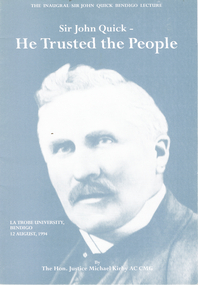 Bendigo Historical Society Inc.
Book - LONG GULLY HISTORY GROUP COLLECTION: THE INAUGRAL SIR JOHN QUICK BENDIGO LECTURE ON SIR JOHN QUICK
... ... Melbourne Age...BHS Collection BENDIGO History long gully history group The Long Gully History Group - Sir John Quick The Inaugral Sir John Quick Bendigo Lecture La Trobe University The Hon Justice Michael Kirby Bendigo Independent Melbourne Age University of Melbourne Australian Natives Association Federal Council of Australasia Bendigo Federation League The Australian Constitution Oliver Cromwell Robert Garran Annotated Constitution of the Australian Commonwealth Federal Arbitration Court Catherine Harris Bendigo Gallery Michele Maslunka John Hirst Australian Labor Party Professor Geoffrey Blainey Weekend Australian 19-20 March 1994 Sir Harry Gibbs King Edward VII King George V King George VI Churchill Atlee Queen Elizabeth II Curtin Chifley Evatt Whitlam Mr Keating Australian Broadcasting Corporation John Maynard Keynes Booklet with a grey and white cover. ...BHS CollectionBooklet with a grey and white cover. It has a picture of Sir John Quick on the front cover. The Inaugral Sir John Quick Bendigo Lecture. Sir John Quick - He Trusted the People. La Trobe University, Bendigo 12 August, 1994. By the Hon. Justice Michael Kirby AC CMG. Mentions Sir John Quick's life, his work and his contrubution to the character of the Australian Constitution. Also mentioned is Republicanism and it's pro and cons.bendigo, history, long gully history group, the long gully history group - sir john quick, the inaugral sir john quick bendigo lecture, la trobe university, the hon justice michael kirby, bendigo independent, melbourne age, university of melbourne, australian natives association, federal council of australasia, bendigo federation league, the australian constitution, oliver cromwell, robert garran, annotated constitution of the australian commonwealth, federal arbitration court, catherine harris, bendigo gallery, michele maslunka, john hirst, australian labor party, professor geoffrey blainey, weekend australian 19-20 march 1994, sir harry gibbs, king edward vii, king george v, king george vi, churchill, atlee, queen elizabeth ii, curtin, chifley, evatt, whitlam, mr keating, australian broadcasting corporation, john maynard keynes -
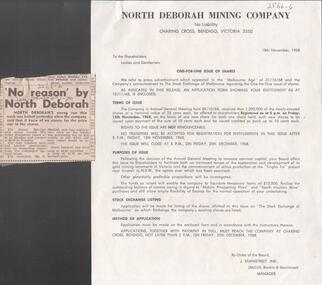 Bendigo Historical Society Inc.
Newspaper - NORTH DEBORAH MINE - NEWSPAPER ARTICLE ON PRICE RISE ON SHARES AT NORTH DEBORAH MINE
... ... Melbourne Age 31/10/68...BHS Collection NEWSPAPER the north deborah gold mine co North Deborah Mine Newspaper Article on price rise on shares at North Deborah Mine Mr C Maskiel The Sun 8/1/70 Melbourne Age 31/10/68 The Stock Exchange of Melbourne Tingha Tin Project Mobile Prospecting Plant North Hustlers Mine J Stanistreet Jnr McColl Rankin & Stanistreet Newspaper article from The Sun, Thursday 8/1/70. ...BHS CollectionNewspaper article from The Sun, Thursday 8/1/70. Article mentions rise in the price of shares. Attached is a letter to the shareholders them newly-created shares of a nominal value of 25 cents each. The funds raised would liquidate temporary loans of $12,500 which was the money owing in regard to ;\'Mobile Prospecting Plant' and 'North Hustlers Mine' purchases. Albert Richardson Collection.newspaper, the north deborah gold mine co, north deborah mine, newspaper article on price rise on shares at north deborah mine, mr c maskiel, the sun 8/1/70, melbourne age 31/10/68, the stock exchange of melbourne, tingha tin project, mobile prospecting plant, north hustlers mine, j stanistreet jnr, mccoll rankin & stanistreet -
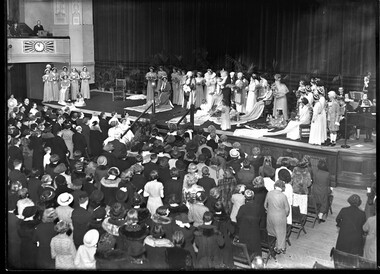 City of Melbourne Libraries
Photograph, Bull, Hugh Jones, 1897-1993, Girls' Friendly Society Concert, Melbourne Town Hall
... Reference: CROWNING THE PRINCESS OF LOVE ON SATURDAY. (1936, November 16). The Age (Melbourne, Vic. : 1854 - 1954), p. 18. Retrieved October 29, 2025, from http://nla.gov.au/nla.news-article205953075 Description: The photograph captures an elaborately staged coronation of a queen, on the stage of Melbourne Town Hall. 25 female attendants in long gowns are holding posies. ......The Age (Melbourne, Vic. : 1854 - 1954)...Glass plate negative Girls' Friendly Society Concert, Melbourne Town Hall Photograph Bull, Hugh Jones, 1897-1993 The Age (Melbourne, Vic. : 1854 - 1954) ...Photographer notations on slide: Town Hall Nov 1936 W.H. Everard [unknown] Friendly Society Concert B117 Published: The Age, Mon 16 Nov 1936 Published title and caption: CROWNING THE PRINCESS OF LOVE ON SATURDAY. Mr. W. H. Everard, M.L.A. , about to crown the winning Princess in the Girls' Friendly Society's competition at the Town Hall. Reference: CROWNING THE PRINCESS OF LOVE ON SATURDAY. (1936, November 16). The Age (Melbourne, Vic. : 1854 - 1954), p. 18. Retrieved October 29, 2025, from http://nla.gov.au/nla.news-article205953075 Description: The photograph captures an elaborately staged coronation of a queen, on the stage of Melbourne Town Hall. 25 female attendants in long gowns are holding posies. There are five flower girls and several wigged male attendants. An audience of mostly women and children is standing from their chairs to view the activities. The Age, Thursday 5 November 1936, page 6: "Princess" Coronation Ceremony. Thirty-eight branches of the Girls' Friendly Society are competing in the Princess competition, which will culmi nate in a coronation ceremony at Melbourne Town Hall, on the evening of Saturday, 14th inst. The princesses are Love, Joy. Youth, Beauty, Courage and Friendship. Mr. W. H. Everard, M.L.A., will crown the winning queen, and Mrs. F. W. Head, president of the G.F.S., will be the guest of honor. A programme of music and dances is being arranged. This is the first time that members of the G.F.S. have organised such a big effort to raise funds, and proceeds will be devoted to the building fund for the new hostel in Spring-street. Reference: "Princess" Coronation Ceremony. (1936, November 5). The Age (Melbourne, Vic. : 1854 - 1954), p. 6. Retrieved October 29, 2025, from http://nla.gov.au/nla.news-article205944373 GFS Australia Inc, https://gfsaustralia.org.au/ Girls' Friendly Society, https://en.wikipedia.org/wiki/Girls%27_Friendly_SocietyPhotographer notations on slide: "Town Hall Nov 1936 W.H. Everard [unknown] Friendly Society Concert B117".melbourne town hall, town halls, dances and balls, societies, 1930-1939, fundraising events, clothing and dress -
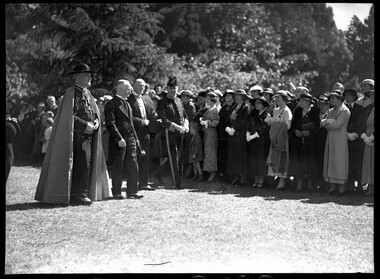 City of Melbourne Libraries
Photograph, Bull, Hugh Jones, 1897-1993, Cardinal MacRory meets "old girls" of Sacre Coeur Convent
... Reference: WOMAN'S INTERESTS (1934, December 6). The Age (Melbourne, Vic. : 1854 - 1954), p. 6. Retrieved January 23, 2024, from http://nla.gov.au/nla.news-article205082619 . ......The Age (Melbourne, Vic. : 1854 - 1954)...Reference: WOMAN'S INTERESTS (1934, December 6). The Age (Melbourne, Vic. : 1854 - 1954), p. 6. Retrieved January 23, 2024, from http://nla.gov.au/nla.news-article205082619 . ...Photographer notations on slide: Cardinal MacRory meets "old girls" of Sacre Coeur Convent Age Dec 6 34 B61 Published: The Age, 6 Dec 1934 Published title and caption: CARDINAL MACRORY MEETS OLD GIRLS OF SACRE COEUR CONVENT. The Papal Legate, Cardinal MacRory, accompanied by Mr. E. L. Kiernan, M.L.C., Mr. T. Gaffney and the Papal Chamberlain, Mr. E. Hollingdale, at the garden party at the Sacre Coeur Convent yesterday. The Cardinal’s sister was at one time Mother Superior of this Convent, and many of the girls she had taught were presented to him. Reference: WOMAN'S INTERESTS (1934, December 6). The Age (Melbourne, Vic. : 1854 - 1954), p. 6. Retrieved January 23, 2024, from http://nla.gov.au/nla.news-article205082619 . Description: The photograph shows Cardinal MacRory in full regalia accompanied by diginaries walking beside a crowd of mostly women in an open garden setting. This event was one of the many that took place during the National Eucharistic Congress which took place from Sunday 2 to Sunday 9 December 1934. An initiative of the Roman Catholic Church, it was their contribution to Melbourne’s Centenary Celebrations. 200,000 Catholics resided in Melbourne at this time – one quarter of the city’s population. While the Congress was aimed at Catholics, and acted as an opportunity to reinforce their living faith and homage, it contained a variety of events of splendour, solemnity and significance designed to appeal to Melbournians, and would additionally provide incentive for people to travel to Victoria, thereby creating an economic benefit to the state. Photographer notations on slide: "Cardinal MacRory meets "old girls" of Sacre Coeur Convent Age Dec 6 34 B61".catholic church, centenaries, 1930-1939, schools, clothing and dress, religious festivals -
City of Melbourne Libraries
Photograph, The Age (Melbourne, Vic. : 1854 - 1954), The Age, Tue 26 December 1933, 1933
... Published: The Age 26 December 1933, page 9 (1933, December 26). The Age (Melbourne, Vic. : 1854 - 1954), p. 9. Retrieved October 10, 2025, from http://nla.gov.au/nla.news-page19054271 Featured in "Newsworthy : Melbourne in photographs 1933-1936" exhibition held at East Melbourne Library from October to December 2023. ...The Age (Melbourne, Vic. : 1854 - 1954)... newspaper photography 1930-1939 christmas Digital file The Age, Tue 26 December 1933 Photograph The Age (Melbourne, Vic. : 1854 - 1954) ...The Age: Christmas 1933 weather pictorial Three photographs from the McKenzie Collection appear in this Age Boxing Day pictorial, documenting the weather conditions in Melbourne on Christmas Day, 1933. In the morning, swimmers flocked to the St Kilda foreshore to cool off during a heatwave. By five o’clock, thunder and a hailstorm were breaking over the city, leaving the streets flooded. Also featured on this page: Important visitors at the Children’s Hospital and The Nurses’ Christmas. Large scale prints of all three images feature below. Discovering this page via the digitised newspapers on Trove was a crucial step in unlocking the provenance of the slides. Published: The Age 26 December 1933, page 9 (1933, December 26). The Age (Melbourne, Vic. : 1854 - 1954), p. 9. Retrieved October 10, 2025, from http://nla.gov.au/nla.news-page19054271 Featured in "Newsworthy : Melbourne in photographs 1933-1936" exhibition held at East Melbourne Library from October to December 2023. The Newsworthy exhibition developed out of a local history digitisation project. Fifty images from a collection of 240 glass plate negatives were selected and printed at large scale for public display at East Melbourne Library. The exhibition was very well-received. The McKenzie Collection of glass plate negatives unlocks glimpses of our city not seen for almost 100 years. In the 1990s, renowned architectural photographer Ian McKenzie (1939-2014) picked up 240 glass plate negatives at a local market. Believed to be from a Victorian news archive, they dated back to the 1930s. The slides lay dormant in a dusty garage until 2020 when Ian’s wife Louise decided it was time to bring them back into the light. Louise McKenzie, and two other history-lovers, Ernie Ward and Fiona Collyer, signed up as City of Melbourne volunteers and joined forces with City of Melbourne Libraries Community Heritage Team Leader, Linda Longley and Local History Librarian, Fiona Campbell. Together, the project team has devoted more than three years to unlocking the mysteries of the collection. What began as a simple digitization exercise swiftly morphed into a wild journey of discovery and kismet. Intensive detective sessions and discussions with fellow historical networks ensued, gradually unearthing our photojournalistic history and technologies, the merits of volunteer work, and astonishing stories from 1930s Victoria. From the domestic to the dramatic, the celebratory to the solemn, these fascinating images capture a fleeting yet significant period in Interwar, Depression-era Melbourne. Above all, the McKenzie Collection project has brought about a powerful and sustained sense of engagement, connection and celebration between people across decades and places.the age newspaper, photography, 1930-1939, christmas -
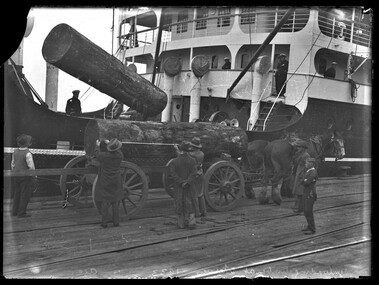 City of Melbourne Libraries
Photograph (item), Bull, Hugh Jones, 1897-1993, Unloading timber at Victoria Dock, 1933
... Photographer notations on slide: "Unloading Timber at Wharves 1933 Age B5" Published: Age (Melbourne, Vic.: 1854- ), Tuesday 15 August 1933 MAHOGANY FROM MANILA. (1933, August 15). ......The Age (Melbourne, Vic. : 1854 - 1954)...Photographer notations on slide: "Unloading Timber at Wharves 1933 Age B5" Published: Age (Melbourne, Vic.: 1854- ), Tuesday 15 August 1933 MAHOGANY FROM MANILA. (1933, August 15). ...Photographer notations on slide: "Unloading Timber at Wharves 1933 Age B5" Published: Age (Melbourne, Vic.: 1854- ), Tuesday 15 August 1933 MAHOGANY FROM MANILA. (1933, August 15). The Age (Melbourne, Vic. : 1854 - 1954), p. 11. Retrieved January 16, 2026, from http://nla.gov.au/nla.news-article204377024 Published title: MAHOGANY FROM MANILA Published Caption: Age Tue 15 Aug 1933 Caption: Unloading Mahogany Logs brought from Manila, Philippine Islands, by the steamer Taiping, which berthed yesterday at Victoria Dock. The vessel discharged twenty logs, each weighing three tons, the first shipment of this type of timber landed in Melbourne. Research by Project Volunteer, Louise McKenzie: This photograph in many ways epitomises Melbourne in the 1930s. It is a time of enormous growth, development and change. But before delving into that, the photo itself is very powerful. The huge mahogany logs being unloaded appear to be so heavy that the ship itself seems to list to port as they are craned over the side. They are being levered into a cart to which two large and sturdy Clydesdale horses are hitched. In contrast to the traditional horses, the wharf is crisscrossed with modern railway tracks. Unloading is both mechanical and manual, and the scene is one of intense interest to a young boy bystander. The ship appears to be squat and solid, but the whole image also gives a feeling of movement and intensity. The mahogany being delivered to Melbourne would be intended for high quality furniture. In the 1930s Australia actually had a growing timber industry, but much of the eucalyptus wood was being utilised for mass produced furniture, and much of this furniture would then have had a veneer applied to it. The fact that it was economic to import this timber from the “Philippine Islands” – not a traditional trading market for Australia – reflects a Victorian economy that was strong enough to support a growing demand for good quality furniture Mahogany was described as a classic, strong hardwood, often used for dark opulent furniture. In the 1930s the importation of timber from Manila (Philippines) to Australia was a notable trade, particularly in Philippine Lauan (often referred to as Philippine Mahogany), which was used as a cheaper alternative to other hardwoods. 1930s furniture, dominated by the art deco style, used a mix of luxurious exotic woods like mahogany, macassar and ebony for high-end pieces, often veneered over less expensive woods such as walnut, birch and poplar, and with plywood, chrome and lacquer also popular for more practical, streamlined designs during the Depression era. By the mid 1930s timber mills were being relocated away from the immediate dock area, but the fact that these logs were being transported by horse-drawn cart implies that the load would not have had to be taken too far for milling. 1885 the Melbourne Harbour Trust Commissioners had decided that land in or near the city was far too valuable to be used as timber yards. Furthermore, large stacks of timber posed a fire risk. The Trust asked the Victorian Government to reserve a site on the east side of the Yarra River opposite Yarraville and Spotswood. Here, in 1889, the Trust began building six jetties and a wharf specifically for the landing of timber. Clydesdale horses were initially brought to Victoria from Tasmania in the 1830s, and with the 1850s gold rush they were imported direct from Scotland. Melbourne was from its earliest years an important centre of horse-breeding from both imported and colonial-bred stock, providing the well-built draught horse for pulling heavily loaded wagons, the harness horse for delivery work and drawing coaches, and the saddle-horse used for riding. Stud breeding facilities were advertised from the early 1840s. By the 1870s the horse export trade was thriving, and the Port of Melbourne was the country's busiest exporter of horses to Indian, Asian and New Zealand markets. Kirk's Melbourne Horse and Carriage Bazaar in Bourke Street first advertised for business in 1840, and by the 1850s Bourke Street West was famed for its horse bazaars and saleyards. The Victorian Clydesdale Horse Society reports that Clydesdale working horses were a vital part of Melbourne's infrastructure and agricultural industry in the 1930s, when they reached the peak of their popularity despite the increasing competition from mechanization. Their main roles and usage at this time were: • City Delivery: Clydesdales were a common sight for metropolitan deliveries, particularly for breweries (such as Carlton & United Breweries), milk runs, and bread deliveries. • Industrial Work: They were heavily used for hauling cargo at the docks, in construction, and at specialized sites like the Truganina Explosives Reserve, where they pulled wagons. • Agriculture: In surrounding rural areas, they were the primary power source for ploughing and agricultural machinery. • Specialization: By the 1930s, the Clydesdale was smaller and more compact than the Shire or Percheron breeds, making them ideal for navigation in urban environments. After the 1930s their numbers decreased due to the onset of WWI and mechanisation. Wartime petrol rationing led to a brief revival for the working horse, as suburban tradesmen, now used to motor delivery, took their old jinkers out of mothballs. By 1947, however, only 1.5% of city traffic was horse-drawn. In 1952 the large horse cartage company A. Kellet Pty Ltd sold its 250 horses and converted its Richmond stables to storage. In the 1950s at Station and Princes piers, wharf labourers refused to work with the six draught horses still being used to haul trolleys and which were soon superseded by the fork lift, semi-trailer and mobile crane. Where carefully trained horses had once shunted trains in city goods yards, a few hundred a week were now being killed at the abattoirs for pet and human consumption. The last MCC dray horse was withdrawn from service in 1958, but some of the few remaining working animals are used by the mounted police for crowd control at demonstrations and football games. The death knell had also sounded for the associated trades of farrier, saddler and blacksmith. Our photo, therefore, showing the wharf with both the haulage Clydesdales and the rail lines, is a strong visual summary of the social and economic changes experienced in Victoria in the 1930s and on towards the 1950s. Our photo is located at Victoria Dock (also known as Victoria Harbour) which is still an active component of Melbourne’s port system. In 1892 the West Melbourne Dock (later Victoria Dock) was opened, downstream and immediately west of the Spencer Street railway shunting yards. It contained a swing basin for ships, replacing the one which had been provided on the south side of the river, later to be the Duke and Orr dry dock, west of the Charles Grimes Bridge. Further west was the South Wharf along the river bank. The history of Victoria Dock is extremely well described by Ashley Smith in his 2 March 2022 article in Docklands News, and its accompanying aerial photo of the Dock taken in 1934. He writes: "In the early 1930s Victoria Dock was one of the biggest sites for trade and export in Melbourne. A constant queue of ships sailed in, unloaded their cargo, recharged and reloaded, then left for the next port. Around the time this photo was taken (found in a 1934 photo book), the trapezium-shaped basin had been through some changes since its construction in the 1890s. The 497-metre-long Central Pier, finished in 1919, now featured six sheds to house the ever-increasing volume of cargo. The entrance had also been widened in the 1920s to allow better access. Some of the berths featured three-ton jib electric cranes to help with loading cargo and a rail network connected to the State Railway service. By the time construction was completed, the dock was 39 hectares and hailed as the second-largest dock in the world (behind Cavendish Dock, Barrow-in-Furness). To further save costs, excavations were dug to a more reasonable seven metres below low water, instead of British engineer Sir John Coode’s recommended 8.3 metres. Even then, the costs were still around £900,000. It was envisaged, with the extra wharfage, that around thirty 90-metre ships could berth inside. On March 22, 1892, Victoria Dock was opened by Victoria’s Governor, the Earl of Hopetoun (later Australia’s first Governor-General) who opened the sluice to let the Yarra in. It took six days to fill the basin with The Leader newspaper estimating that it would take another six months to completely fill (March 26, 1892). In the end, it took nearly a year before the first ship was allowed to enter on February 20, 1893, when the steamer Hubbuck sailed in to unload 1200 tonnes of cargo in 15 hours. The Argus (February 23, 1893) reported that the ship’s captain, J. R. Brodie, called the Yarra “better than the Thames”, and compared Victoria Dock favourably to the Albert Dock (Liverpool)." This would be a good time to move our focus on to the Taiping, which is the transporter of these giant mahogany logs. The Taiping was a steel-hulled, single-screw passenger-cargo Chinese steamer, which today has the dubious legacy of being involved in a collision headlined as “The Chinese Titanic”. It was constructed by the Hong Kong and Shampoa Dock Company at its facility in Hong Kong, with completion in 1926 for service under the Australia Oriental Line. Her gross register tonnage measured 4,324 tons, reflecting her design for inter-island and coastal trade routes, accommodating both passengers and freight. She operated routes connecting Australian ports with East Asian destinations. As World War II approached, Taiping continued predominantly working the trade routes between China and Australia, until December 1941, when she evacuated women and children from Hong Kong to Manila just before Japanese forces overran the region. She then safely reached Australia despite enemy air raids. Taiping was then requisitioned by the Royal Navy and repurposed as a victualling stores issuing ship for the Eastern Fleet, supporting logistical needs in the Pacific and Indian oceans. Returned to the Australian Oriental Line in 1947, she underwent refitting and by mid-1948 was chartered to the Shanghai Shipping Company, and modified for greater passenger accommodation – approximately 500 passengers. In 1948/49 the Chinese Civil War took place. The Taiping departed Shanghai on 26 January 1949 as one of the final vessels evacuating civilians from to Keelung Harbour in Taiwan. Reports indicate that the Taiping carried double the rated capacity of passengers i.e. 1000. The ship carried families, military personnel, civilians, carrying personal belongings, gold and valuables in hope of resettlement in Nationalist Taiwan. It also held heavy cargo in the form of silver and gold bullion loaded by the Central Bank of China. Because of the risk of patrols, and to conserve fuel, the Captain took the ship away from the usual open-sea passage, and instead navigated along the coast. He also extinguished navigation lights to avoid detection. Shortly after midnight on 27 January 1949 the Taiping collided with the smaller cargo steamer Chien Yuan in the East China Sea near the Zhoushan Archipelago. The Chien Yuan was also operating in darkness. The subsequent collision was catastrophic. The Chien Yuan sank with in 5 minutes, with the loss of 72 of its 74 crew. The Taiping sustained severe structural compromise from the broadside strike and initially remained afloat, then made a swift descent into the freezing water, with no attempt at an organised evacuation. No formal recovery process was instigated, however a distress signal went out. 32 survivors were picked up by the Australian destroyer HMAS Warramunga (on patrol nearby), a passing US vessel found 2 more, and local Zhoushan fishermen retrieved others. In the end, only 37 people survived. The event is remembered as a poignant moment in the mass migration to Taiwan, with families tragically separated. A memorial to the disaster exists at the Keelung Harbour naval base on Taiwan. With its total of over 1,500 deaths, it constituted one of the worst peacetime maritime losses. It is sometimes referred to as the “Oriental Titanic” because of the similarly large loss of life and speed of demise with the RMS Titanic in 1912. A fictional depiction of this event appears in the John Woo movies “The Crossing (Part 1) (2014), and The Crossing II (2015), known in Chinese as “Taiping Wheel”. The narrative weaves a story around pre-disaster romances and wartime turmoil among passengers, culminating in the ship’s rapid sinking. “The production, a high-budget Sino-Taiwanese-Hong Kong co-effort, portrays the event as a microcosm of the 1940s Sino-Japanese and civil war legacies, though critics noted the melodramatic style prioritizing spectacle over historical precision.” In conclusion, it is nice to return to our photo, and observe the people involved in this moment. The dockworkers are, so typical of the 1930s, dressed in what looks to us like formal clothing – dark suits or coats, white shirts, and black hats. I am particularly drawn to the young boy, bare-headed, arms crossed, and so intent on the unloading process. He too is wearing a white shirt, black trousers and jacket, and black shoes. This is 1933 Melbourne – but the haircut he is sporting is now very “hipster” and modern in 2026 Melbourne. References: MAHOGANY FROM MANILA. (1933, August 15). The Age (Melbourne, Vic. : 1854 - 1954), p. 11. Retrieved January 30, 2026, from http://nla.gov.au/nla.news-article204377024 Wikipedia, Taiping steamer, https://en.wikipedia.org/wiki/Taiping_(steamer) Wikipedia, Victoria Dock, https://en.wikipedia.org/wiki/Victoria_Dock_(Melbourne) Docklands News, Ashley Smith, 2 Mar 2022, https://www.docklandsnews.com.au/victoria-dock/ Living Histories: Heritage Council of Victoria, Jill Barnard, 2008, Jetties and Piers, https://livinghistories.net.au/wp-content/uploads/2015/11/Jetties-ONL-intro_Part-1.pdf eMelbourne, Wharves and Docks, https://www.emelbourne.net.au/biogs/EM01612b.htm Australian Academy of Technological Sciences – Harvesting Wood, https://www.austehc.unimelb.edu.au/tia/225.html Old Treasury Building, On the Water – The Docks, https://tinyurl.com/3wkbk66m Old Treasury Building, On The Road, https://tinyurl.com/dw44yr3t Port of Melbourne, Victorian Places, https://www.victorianplaces.com.au/port-of-melbourne Docklands Heritage Study - Environmental History, https://mvga-prod-files.s3.ap-southeast-4.amazonaws.com/public/2024-05/docklands-heritage-review-thematic-environmental-history-1991.pdf eMelbourne, Horses, https://www.emelbourne.net.au/biogs/EM00723b.htm Victorian Clydesdale Horse Society, https://www.clydesdalesvic.org.au/history The Crossing, https://letterboxd.com/film/the-crossing-i/Photographer notations on slide: "Unloading Timber at Wharves 1933 Age B5"ships, shipping, timber industry, shipwrecks, horses, docks, wharves, 1930-1939, wars, docklands -
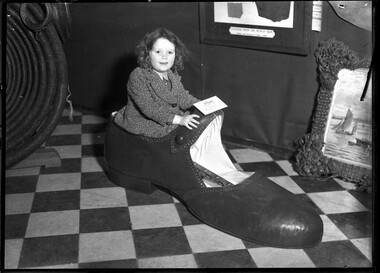 City of Melbourne Libraries
Photograph, Bull, Hugh Jones, 1897-1993, Leather Exhibition, Melbourne Town Hall
... Hall Melb 1933 Age Published: Age (Melbourne, Vic.: 1854- ), 1933 THE EXHIBITS. (1933, September 20). ......The Age (Melbourne, Vic. : 1854 - 1954)...Hall Melb 1933 Age Published: Age (Melbourne, Vic.: 1854- ), 1933 THE EXHIBITS. (1933, September 20). ...Photographer notations on slide: At the Leather Exhib. at T. Hall Melb 1933 Age Published: Age (Melbourne, Vic.: 1854- ), 1933 THE EXHIBITS. (1933, September 20). The Age (Melbourne, Vic. : 1854 - 1954), p. 16. Retrieved January 25, 2026, from http://nla.gov.au/nla.news-article205109730 Published title: THE EXHIBITS. A COMPREHENSIVE RANGE. Curios, Novelties, Working Displays Published Caption: ONE OF THE NOVELTIES – AN OUTSIZE IN SHOES Research by Project Volunteer, Louise McKenzie: Our photo is dated 20 September 1933, and shows a happy, chubby-faced young girl sitting in a very over-sized girl’s shoe. It is labelled – “Shoe, An Out Size, loaned by Messrs Blackman & Rose”. (1) It is an effective way to capture the attention of the readership and alert them to the Melbourne Leather Show 1933. This show was designed to be a drawcard of extraordinary proportion, and there is no doubt that this leather exhibition was a really big deal for Melbourne. It completely took over the Melbourne Town Hall, and was open from 10.30 am until 10.30 pm. It seemed to contain something for everyone – the military, the man about town, the home handyman, the housewife, the child, the sporting types, the domestic workers, the outdoor enthusiasts, the horseracing fans, car enthusiasts, those wishing to show off the latest fashion – both men and women - and those just intrigued by a lot of fascinating and wide ranging exhibits. One of the most comprehensive descriptions of the Exhibition accompanies the photograph, and is worth quoting in full: “PROMINENT among exhibits which first attract attention in the foyer of the Town Hall is a comprehensive display of leather articles used by the defence forces. A conspicuous legend states that leather plays an important part in national defence, being used for saddlery, tool containers, holdalls, range-finding, surveying and signalling equipment, explosives factories, harness accoutrement, bandsmen's equipment and clothing. Three models of horses and several figures of soldiers wearing leather equipment illustrate the lesson, and a great range of leather goods used in military training and work variegate the display. Nearby are Texas cowboy, buckjumping and breaking-in saddles; whips, a walking stick, made of leather and numerous other curios. The general exhibition occupies the whole floor space of the main Town Hall, and is subdivided by partitions running most of the length of the hall. A bewildering variety, of leather goods presses for close and leisured inspection. Here and there operatives in charge of working machinery give practical demonstrations of factory processes in the production of footwear. Polishing materials are well represented. One attractive exhibit includes two bush huts constructed of leather, with wattle bark for roofing. Opossums, rosellas and a kookaburra add touches of bush realism. Adjacent exhibits include bags, fishing boots, leggings, leather covers in all colours. Factory Processes. One exhibitor has installed an automatic cinema apparatus and screen, which projects various factory processes in making a shoe, the operator being shown at work. Elsewhere an interesting exhibit depicts the five stages in the manufacture of sole leather, and the tanning materials employed. "Very handsome effects are achieved in the interior appointments of motor cars, which are attended by figures of smart chauffeurs in leather coats. Motor-trimming leather is said to be more durable and hygienic than fabric materials, and cheaper. The neat finish of the material, its excellent appearance, certainly make a very favourable impression. It takes the hides of three beasts to cover the cushions, squabs and door panels of a full-sized sedan, while to finish the entire interior, including quarter-panels and head linings would take four or even five. Special Exhibits. Amongst the special sections the display arranged by the handicrafts and home industries- committee of the Country Women's Association of Victoria is a notable one. In all there are about 130 entries which are in four classifications, viz., hand-tooled or embossed leathers, suede, hand-made gloves and undecorated leather. The glove section attracted the most numerous entries, a number being the work of members and craft subscribers of the Country Women's Association. In the leathercraft competition, organised by the Country Women's Association, the judges yesterday awarded the first prize for bookbinding (the only prize given in this division) to Miss M. Alston, of South Yarra. There is also a creditable display of exhibits submitted by boys of the orthopaedic section of the Children's Hospital at Frankston. Amongst the novelties on view in other portions of the exhibition were the following: — Leather coats worn by Sir C. Kingsford Smith on his Atlantic flight. Model Wellington boot, Phar Lap's saddle. Melbourne Cup winner's saddle. Longest whip in world, 108 feet long. (33 metres) [See our photo, to left of Girl in Shoe] Diminutive shoes. Pair of shoes 65 years old. Pair of men's working boots 75 years old. Larwood's, Tate’s and Pataudi’s cricket boots. [Three internationally revered cricketers of the day] (2) Picture frame made of leather bought 63 years ago. [See our photo, to right of Girl in Shoe] Leather frame, powder bowl, &c. Saddle used by world's champion buckjumper in U.S.A. Mexican cowboy outfit. Miniature saddle and bridle. A fireman's helmet made of sole leather. (3) Sample of the leather hat worn by porters at the Billingsgate Fish Market, London. (4) From South Australia there have been obtained sets of harness for donkeys, goats and camels, the equipment being displayed to good advantage on stuffed representations of the animals mentioned. Close to the platform is a glass case containing snow shoes and coats which have been used in Antarctic exploration work. Trade Display. Amongst the trade exhibits may be seen in operation a slipper turn shoe sewing machine, with heeling and channelling facilities, and the various stages in the production of ladies' sandals are shown. There is a wide contrast between sole leather of varying degrees of thickness on view in one stall and the choice samples of ladies' footwear in another — footwear, by the way, which could almost be used as ornaments, so dainty in colour and production are they. Again, there are displays of upholstering leathers of such soft texture that they could he readily mistaken for some of the finest cloth. Those who may be particularly interested in the production of chamois leather may gain an insight into the materials and chemicals used in the "working up” of this variety of leather. Supplies of glace kid (5) are tastefully arranged, and there may also be seen bags of all shapes and sizes, including satchels, suit cases and "sporting" cases, and bags for tennis players and golfers. Further variety is given to the exhibition by the display of antique hides, brightly coloured, with punching balls, boxing gloves and batsman's pads. There are crocodile skins and snake skins so cleverly "Worked up" that one could be almost pardoned for betraying an affection for such unpopular creatures.” “ Another wonderful article on this Exhibition, published the same day in one of the opposition daily newspapers, The Argus, is in the weekly article “Women to Women”, entitled “A Great Victorian Industry: Many Uses for Leather”. This weekly column was penned by Vesta, and she writes, with much purpose: “Yesterday afternoon I paid a hurried visit to the Leather Exhibition now being held in the Melbourne Town Hall and I was disappointed to find that the early visitors to the main exhibition were almost all men. Women, I think, should make a point of seeing every exhibition of our great industries, for women are the buyers of household requisites and goods for their own use and their tastes, and opinion influence also, to a large extent, the purchases of men. So, the welfare of industries is more or less in their hands and it becomes a duty for them to inform themselves fully of the extent and the quality of the manufacturing that is done here. The value of the output of the Australian boot and shoe factories alone was in 1930-31, the latest year for which the figures are given, Stg 3,750,000. Fully two thirds of that amount must have been spent by women on boots and shoes for themselves and their children. In a host of other directions, in the purchase of handbags, travelling bags, belts and straps, cushions, furniture coverings, purses, notebooks, spectacle cases, their annual expenditure must be very high. Their interest, therefore, in this industry is practical, and their support of it should be governed by knowledge of comparable values and qualities of the goods they buy. From the point of view of women, however, the exhibition itself is rather disappointing. There is an amazing collection of good stuff on show, but most of it is not displayed in a fashion that attracts attention. I was surprised, for example, at the range and quality of the leathers displayed, the suppleness of the finer qualities, and the varied range of colours and designs. But they are shown in such a fashion that if one set out deliberately to look for them it would be quite easy to miss most of them.” …It was surprising, too, that no one seemed to have taken advantage of the present fashion of wearing coloured gloves, or the cult of glove making, which the Country Women’s Association has fostered so successfully. Outside the collection of chamois leathers I saw no skins which were suitable to glove making. (6) However, it is perhaps a little unfair to be highly critical of the exhibition, inasmuch as it is the first of its kind. The material is there, undoubtedly, for a splendid show of every phase of this enterprising industry, and I am confident that experience will prove to those concerned that it will be worth while next time to devote a great deal of attention of the method of display.” With further research, it transpires that “Vera” is in fact NZ born Stella May Allen (nee Henderson) (1871-1962), a journalist, the first woman in NZ to begin a law course, in 1890-91). She later worked at a law firm while she completed her degree. Study of the law had always been open to women in NZ, but its practice was still barred to them. Her case “…led to amending legislation in 1896 allowing women to practise as barristers or solicitors. However, on gaining her LL.B. in November 1897 she did not apply for admission to the Bar. Instead, she became the Wellington-based correspondent and leader-writer for the Lyttelton Times. Her appointment, the first for a woman, was not welcomed by the all-male Press Gallery, and special permission had to be obtained from a subcommittee of the House before her presence was accepted. In 1900 she married Edwin Allen, a senior leader-writer for the Wellington Evening Post, and they moved to Australia in 1903 when Edwin Allen took up the post of foreign affairs leader-writer and parliamentary man for the Melbourne Argus. As Patricia Keep notes in her excellent entry of Stella Allan in the Australian Dictionary of Biography: “In 1907 The Argus commissioned her to write a series of articles on the first Australian Women's Work Exhibition held in October. They aroused much interest and next year The Argus invited her to join its full-time staff and begin a weekly section on the particular interests of women. She adopted the nom de plume 'Vesta' and called the column 'Women to Women'. Her work was unique in an Australian daily paper at that time. Her pages extended to cover every aspect of women's affairs, children's interests and community welfare, and 'Vesta' became a household word for authoritative information and advice on such matters. An excellent needlewoman and first-rate cook herself, she thoroughly tutored her staff in the work and needs of women in both country and city, as well as providing the usual training for cadet journalists. She conducted interviews and also visited the country to see at first hand the results of bushfires, mouse plagues, droughts and floods. In 1910 she was one of three women foundation members of the Australian Journalists' Association. “…she found time to become deeply involved in community affairs. She was an original committee-member of the Victorian Association of Crèches and of the Free Kindergarten Union of Victoria, and had much to do with the early days of the Victorian Bush Nursing Association, the Baby Health Centres Association and the Queen Victoria Hospital. She was a member of the National Council of Women, first in New Zealand and then in Melbourne, and of the Country Women's Association from its inception. … in 1924 she was appointed substitute delegate for Australia to the fifth assembly of the League of Nations at Geneva and was a delegate to the second Pan Pacific Women's Conference in Hawaii in 1930. A meeting held in the Melbourne Town Hall in 1938 by representatives of all the main Victorian women's organizations paid special tribute to her work and influence. She retired next year to England where she continued to write for the Argus, contributing articles on the experiences of women and children in wartime.” It is little wonder that “Vesta” was unafraid to take to task both the women of Victoria, and those who created the exhibition! One item which appears to have gone unnoticed, or at least unreported, is a framed article in the background of the photo of the chubby girl in the shoe. The display frame is labelled “Leather from the Human Skin, Tanned and Dressed by French artists.” The exhibition was certainly a cabinet of curiosities! A charming article in The Argus is a nice note on which to end. It gives a quick history and overview of the Australian leather industry and its unprecedented, and possibly unexpected, development and success, and states with pride: “Though Victoria is the largest leather producer in the Commonwealth all tanners in the Commonwealth can look back with pride on the long march of progress.” Footnotes: (1) “Blackman and Rose”. Messrs Blackman and Rose were shoe manufacturers, from 1927 located at 200 Noone Street, Clifton Hill. The Melbourne Circle describes their building as a “fine-looking building in the Federation ‘blood and bandage’ style.” It was built around 1912 for Puttifoot and Bloom, boot manufacturers, and today the building is apartments. (2) These cricketers were household names in the day: Tate: Maurice Tate, “English cricketer of the 1920s and 1930s, and leader of England’s Test bowling attack for a long time during this period. The founder of modern seam bowling. “ Larwood: Harold Larwood, “English right-arm fast bowler and the main exponent of the bowling style known as “bodyline”. Used to considerable effect in the 1932-33 Test series in Australia. Pataudi: Iftikhar A K Pataudi, “an Indian prince who in the 1930s played Test cricket for England, and in the 1940s played Test cricket for India (as Captain) – the only test cricketer to have played for both India and England. (3) “sole” leather “… is the thickest and most resistant material existing in the tanning industry … made from vegetable tanned leathers, usually bovine butts, processed in a special way to make them the hardest type of leather in existence.” (4) The hats worn by porters at Billingsgate Fish Market were also known as a “Bobbin” and look quite squat and rather unsophisticated. They were made of wood and tarred leather, with a “flat, hardened top designed to support large rectangular boxes of fish. The upturned brim protected the porter’s head against fish juice draining from the boxes of fish which would be carried on top of the hat. Some hats featured a small drain hole at the rear to allow this collected juice to drain down the back of the carrier. The hats were made using the ‘cuir bouilli’ technique. The leather was immersed in water which was heated until the leather began to shrink. It was then removed and put on a wooden former. The leather was stitched together to make the hat while still wet, and then held in place until dry.” (See article and photo on the London Museum website) (5) Glace kid – described on the Boston Museum of Fine Arts’ Cameo database as “A smooth glossy leather originally prepared from goat or sheepskin. Early glace kid had a shiny surface that was originally prepared by tawing the skin in a mixture of alum, table salt, flour, and egg yolk. Today, glace kid is prepared from many types of vegetable or chrome tanned leathers. The smooth polished surface is obtained mechanically by shaving, glazing, ironing, and/or rolling the dry leather.” (6) In the 1930s, Melbourne’s glovemaking industry was characterised by local manufacturing, with key producers like Simpson’s Gloves Pty Ltd in Richmond and the Stagg Glove Company in Clifton Hill leading the market. These factories produced high-quality leather gloves, handbags, and specialty gear, often employing a clear gendered division of labour and training young, local women. Museum Victoria holds the Simpson’s Gloves Collection, comprising over 1200 items, and the University of Melbourne Archives holds the company’s business records. References: THE EXHIBITS. (1933, September 20). The Age (Melbourne, Vic. : 1854 - 1954), p. 16. Retrieved January 25, 2026, from http://nla.gov.au/nla.news-article205109730 EXPORT LEATHER. (1929, September 17). The Argus (Melbourne, Vic. : 1848 - 1957), p. 17. Retrieved January 19, 2026, from http://nla.gov.au/nla.news-article4037647 LEATHER EXHIBITION (1933, September 18). The Argus (Melbourne, Vic. : 1848 - 1957), p. 10. Retrieved January 19, 2026, from http://nla.gov.au/nla.news-article11693362 (1933, September 23). The Argus (Melbourne, Vic. : 1848 - 1957), p. 21. Retrieved January 19, 2026, from http://nla.gov.au/nla.news-page522766 WOMEN TO WOMEN (1933, September 20). The Argus (Melbourne, Vic. : 1848 - 1957), p. 13. Retrieved January 19, 2026, from http://nla.gov.au/nla.news-article11694034 Australian Dictionary of Biography, Stella May Allan (1871–1962) https://adb.anu.edu.au/biography/allan-stella-may-4998 WOMEN TO WOMEN (1930, January 22). The Argus (Melbourne, Vic. : 1848 - 1957), p. 13. Retrieved January 19, 2026, from http://nla.gov.au/nla.news-article4063888 Museums Victoria, Simpson’s Gloves, 486-496 Victoria Street, North Richmond, VIC, Australia https://collections.museumsvictoria.com.au/articles/2702 The Argus. (1927, October 31). The Argus (Melbourne, Vic. : 1848 - 1957), p. 20. Retrieved February 7, 2026, from http://nla.gov.au/nla.news-article3888451 Melbourne Circle: stories from the suburbs: “Boots and all in Clifton Hill” https://melbournecircle.net/2015/11/20/bootmakers-of-clifton-hill/ Wikipedia, Maurice Tate, https://en.wikipedia.org/wiki/Maurice_Tate Wikipedia, Harold Larwood, https://en.wikipedia.org/wiki/Harold_Larwood Wikipedia, Iftikhar Ali Khan Pataudi, https://en.wikipedia.org/wiki/Iftikhar_Ali_Khan_Pataudi Buy Leather Online Italy, Sole leather: https://buyleatheronline.com/en/blog/outsole-and-insole-leather-n7 London Museum, Porters hats, https://www.londonmuseum.org.uk/collections/v/object-731122/hat-porters-hat/ Cameo Database, Museum of Fine Arts, Boston, Glace Kid, https://cameo.mfa.org/wiki/Glac%C3%A9_kid VICTORIAN LEATHER HAS WON RENOWN (1937, September 22). The Argus (Melbourne, Vic. : 1848 - 1957), p. 31 (March of Progress Supplement). Retrieved February 7, 2026, from http://nla.gov.au/nla.news-article1108704 Photographer notations on slide: "At the Leather Exhib. at T. Hall Melb 1933 Age B5".displays, melbourne town hall, leather, children, shoes, 1930-1939, industry, hats, gloves -
 City of Melbourne Libraries
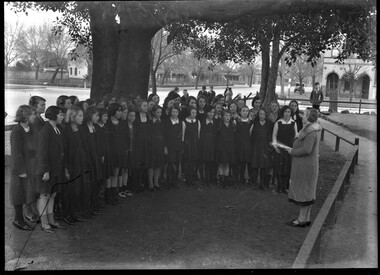
Photograph (item), Bull, Hugh Jones, 1897-1993, Miss Ida Park conducts the North Fitzroy State School Choir
... Melbourne, Vic. : 1885 - 1939), p. 12. Retrieved October 29, 2025, from http://nla.gov.au/nla.news-article149320966 SAVOY THEATRE (1939, June 1). The Age......The Age (Melbourne, Vic. : 1854 - 1954)...Melbourne, Vic. : 1885 - 1939), p. 12. Retrieved October 29, 2025, from http://nla.gov.au/nla.news-article149320966 SAVOY THEATRE (1939, June 1). The Age ...The pupils of Falconer Street Central School No.3918 in North Fitzroy rehearse with conductress Miss Ida Park for their performance at the Temperance Hall, Russell Street Melbourne with proceeds going to the Lord Mayor’s Fund. The house on the right of the photograph is Jubilee House, 126 Michael Street North Fitzroy and is extant. Photographer notations on slide: Choir At Fitzroy State School 1933 B5 While this photograph appears not to have been published, a photograph taken from a different angle of the same event was published in The Age 21 July 1933. SCHOOL CHILDREN SING IN THE OPEN AIR. “A choir of children at North Fitzroy practise their songs for a Pantomime, to be given in the Temperance Hall for the Lord Mayor's Fund on Wednesday next. On the extreme left is the conductress of the Choir (Miss Ida Park).” Reference: http://nla.gov.au/nla.news-article204368572 Research by project volunteer, Fiona Collyer: Children of The Falconer Street Central School Choral Society, trained by conductress Miss Ida Park, along with dance and gymnastics pupils of Misses Dorothy Gibb and Inez Ellis, performed in the “Cinderella” pantomime at the Temperance Hall in Russell Street, Melbourne on 26 July, 1933. The proceeds went to the Lord Mayor’s Fund. Conductress Miss Ida Park (1904- 1952) lived in the North Fitzroy and Clifton Hill area all her life. She was immersed in the music world of Melbourne and was a member of the Musical Society of Victoria. Ida graduated from Melbourne University Conservatorium with a Bachelor of Music degree in 1929 before departing for London where she studied piano and organ at the Royal Academy of Music. Ida returned to Melbourne in 1931, and billed as “The Gifted Young Australian Pianist”, held pianoforte recitals of classical music at Assembly Hall, Collins Street. She also played the organ for services at St Paul’s Independent Church in Delbridge Street, North Fitzroy and later St Luke’s, North Fitzroy. Ida conducted the children of the Falconer Street Central School Choral Society as they competed in the State School Choral Championships and the 85 children of the Fitzroy City Centenary Choir who sang at Melbourne’s Centenary celebrations of 1934/35. In 1945, Ida married Charles Hazeldine, a tenor and returned digger who had served in two world wars. The pair performed together in many concerts over the years. Tragically, both Ida and Charles were badly injured when struck by a car while crossing Queens Parade Clifton Hill in June 1952, with Ida dying from head injuries at St Vincent’s Hospital soon after. She was 48 years old. Charles wrote on Ida’s death notice - “Called home.” The choir were pupils of Falconer Street Central School No. 3918 in North Fitzroy which was built in 1915 to provide upper primary education for grades 5 to 8 for the area. In 1957 it became Fitzroy High School. In 1992, the Kennett Government swept to power, embarking on a program of fiscal austerity and privatisation of government services. 390 government schools were closed, with the land proposed to be sold to developers. 7000 teachers were sacked: 10% of Victoria’s public school teachers. Auxiliary school staff also lost their jobs. Amongst the first to close was Fitzroy High School. Fearful that the land would be sold, hundreds of students, parents, teachers and local residents occupied the building around-the-clock in four hour shifts and overnight for 14 months, sleeping on gym mats in the principal’s office and administrators’ wing. The blockade was lifted when a arrangement was reached to allow Kangan Batman TAFE to use the school from 1993 until 1998. With the election of the Bracks Government in 1999, and construction of new buildings, Fitzroy High School was reopened in 2004 after a 12 year battle. Temperance Hall, at 172 Russell Street, where the children performed “Cinderella”, was built in 1872 by the Melbourne Total Abstinence Society as a venue for lectures, meetings and alcohol-free community concerts and events. From 1934, Temperance Hall was fitted out as a cinema and renamed the Imperial Theatre, showing popular Hollywood films, before closing in 1939 for renovations and reopening as the Savoy Theatre, Melbourne’s first “Continental” talkies cinema. At this time, Australian cinema programming was dominated by American and British films. The lessees, Continental Film Art Theatre began negotiating for theatre properties in Melbourne, Sydney, Adelaide, Brisbane, Perth and Auckland to screen foreign language films, hoping to present the finest productions from France, Germany, Holland and Italy. At the cost of £6000, the theatre was fitted with the latest Mirrophonic sound and projection system and enlarged to seat 800 patrons with luxurious, ultra modern fittings and furnishings in a colour palette of rust and beige. Instead of usherettes, General Manager Peter Dawson, hoping to bring a sophisticated European atmosphere to the theatre, employed attractive, multilingual “Continental hostesses” to assist guests (not patrons) and answer queries relating to the films. Collectively the hostesses spoke English, French, Dutch, German, Russian and Italian. The Age 20 May 1939- “Atmosphere is a very important part of the theatre's scheme. Ushers in the ordinary sense will not be employed; hostesses will look upon patrons as guests. They will be dressed in full evening dress, and the only indication that they are not guests is the little medallion pinned to their evening dress, on which their names are inscribed.” The hostesses were dressed in evening gowns of olive-green velvet, the full skirts embroidered with gold loops, wine velvet bolero jackets and long white kid gloves with silvery tiaras in their hair. For guests worried that they may not understand the plot, the management assured patrons that- “By means of superimposed English translations on the bottom of the screen, the dialogue is perfectly understandable and the whole witty story can be followed with ease.” The Gala opening of the Savoy Theatre, on 31 May 1939 was attended by a “who’s who” of Melbourne Society, the women wearing beautiful gowns, headdresses and furs. Amongst the guests were former premier Sir Stanley Argyle and Lady Argyle, former Lord Mayor Sir Harold Gengoult-Smith and his wife Cynthia, Field Marshall Thomas Blamey and Lady Blamey and Miss Jessie Brookes. The Vice Consul for France, Monsieur Frank Puaux and his wife attended, Madame Puaux dressed in a black satin gown and a musquash fur cape. She was presented with a beautiful bouquet of scarlet carnations and lily of the valley tied with the tricolour of France. In his speech Monsieur Puaux stated that “from the cultural, linguistic and artistic points of view it was excellent that the Australian public should have an opportunity to see foreign film in the original language.” “Letty” writing in Table Talk magazine described the atmosphere of “Continental” gaiety that had permeated Melbourne - “The Letters of Letty”, Table Talk 8 June 1939 “The “foreign influence” is definitely obtruding itself into the even tenor of Melbourne life these days…. but in the pleasantest manner possible! Included in the great number of Continental people who have recently made their homes here, we have stars of the Russian ballet settling in our midst…. and now… we have been presented with our own Continental picture theatre in the attractive shape of The Savoy, which opened its doors on Wednesday night for the exclusive release of foreign films. One could hardly recognise the old Temperance Hall in its adaptation to the smart, comfortable and thoroughly-intriguing Savoy Theatre. Where once this rather draughty old building stood in Russell Street there now greets us an unmistakable “Continental” edifice, living up to its exterior by sustaining within its walls its overseas’ atmosphere. Indeed, one feels as though one has crossed the threshold into a European city, stepping out of the unmistakably Australian street that is Russell into The Savoy lounge to be greeted by polite “messieurs” from the attractive, Continental-looking usherettes and to gaze upon a film as delightfully French in story and presentation as “La Kermesse Heroique.” But successful though “La Kermesse Heroique” proved on its initial presentation inside the theatre, the debut was no more triumphal than that made by the winning and pretty little French lass who had charge of the booking office outside in the foyer. With her attractive accent and Continental flair for making one “feel at home” she was undoubtedly one of the hits of the night-especially with the susceptible males, who spent very much longer in the lounge than is customary, racking their brains for excuses for making conversation with the attractive Parisienne! Those French girls certainly have a way with them!” The opening film, the 1935 French comedy “La Kermesse Heroique”, (The Heroic Sex) starring Francoise Rosay and Jean Murat (film now called “Carnival in Flanders”) was the winner of the Grand Prix du Cinema Francais as the finest picture of 1936 and described in the advertisement as “The Gay French Comedy of Laughter and Romance” The film is set during the 17th century Spanish occupation of Flanders in the Flemish town of Boom at the time of their annual festival. Hearing news of a pending visit to Boom by the commander, the Duke of Olivares and his army, and fearing rape and pillage, the boorish burgomaster feigns his own death, hoping the Spaniards will bypass the grieving town out of respect. The army arrives and the cowardly men of the town flee. The womenfolk decide on a different approach. Lead by the burgomaster’s beautiful wife Cornelia, they set out to to preserve the peace with grace and hospitality only to find the Spaniards attractive and virile, unlike their own husbands. The Sun newspaper described the film as “Mellow as a Stilton cheese, and as ripely suited to adult taste.” Preceding “La Kermesse Heroique” was a Gaumont British newsreel of King George VI and Queen Elizabeth departing for a tour of Canada and the Soviet documentary “Nine Months on a Drifting Ice Floe” During the war “Continental” films became difficult to source, so the Savoy screened Hollywood movies and held fund raisers for the war effort. After World War Two, the Savoy continued to screen “Continental” films, catering to post-war immigrants from Europe and bohemian Melburnians. In 1953, the Savoy had a wildly popular season with queues winding around the block to see Swedish summer romance “One Summer of Happiness” (Hon dansade en sommar) with its nude swimming scenes. The Chief Commonwealth Censor declined to cut the film on the grounds that although it displayed nudity, it was genuinely artistic. According to Wikipedia, film director Fred Schepisi was first exposed to European films such as “Bicycle Thieves”, “Rocco and His Brothers” and “The Wages of Fear” at the Savoy as a teenager, leading to his long career in filmmaking. In 1955, in response to the massive rise in car ownership, the Melbourne City Council recommended that parking stations be built on every block. The Savoy Theatre and adjacent buildings, which included the Golden Fleece Hotel were demolished in 1963 and replaced with Total House, a Brutalist commercial building consisting of a seven storey car park crowned by a four storey office block, shops at street level, and a basement theatre which housed the Lido Theatre Restaurant-Cabaret from 1965. The building was designed by architectural firm Bogle & Banfield Associates and named for the original tenant of the offices, French oil company, Total Oil Products P/L. The Lido Theatre Restaurant was managed by former Tivoli dancer and promoter David Hamilton McIlwraith, presenting dinner and a glamorous cabaret floor show of showgirls, (some topless) to accompany variety acts by local and international actors, singers, comedians and magicians. The interior of the Lido was opulently decorated in deep, lush green with old world gold trim and chandeliers. Handily, patrons could enter and leave via an elevator, straight from the building’s own car park! A four course gourmet dinner with show and dancing cost $8.00 in 1968. The Lido advertised in 1966 that “Every visitor to Melbourne soon discovers the brightest entertainment spot in the Southern Hemisphere with its million dollar decor, dining delights and spectacular stage productions.” Australian Jewish News - 21 April 1967 - “Superb decor and atmosphere, cuisine and service have been readily recognised as the contributing factors to the excellence of stage presentations, staging, costumes, decor and, of course, the actual choice of artists.” The bedazzling ensemble of 40 high-kicking, feathered and sequinned showgirls were advertised as the “Fabulous Lido girls and the controversial Baretop Lido Goddesses” who were described as “Statuesque Beauty as Nature intended” and “…a host of glamorous gals whose favourite shade is flesh pink.” Some of the acts who performed at the Lido were- -Broken Hill’s own - opera singer June Bronhill -1967. -Versatile singer Lovelace Watkins known as “Black Sinatra - 1967. -“Queen of the five-fingered boogie", honky-tonk and rollicking rag-time pianist, Winifred Atwell - 1967. -New Zealand pop duo, Bill and Boyd -1968. -American actress and soprano Kathryn Grayson -1968. -Denise Drysdale in “Say It With Music” -1968. -“Catwoman” Eartha Kitt -1969. -Internationally recognised female impersonator, Sydneysider Tracey Lee, (Maxwell Richie) billed as "controversial impressionist and singing personality from the famous Carousel Nightspot in Paris". -Frances Faye, American comedienne and show-tune singer and pianist-1969. -“Cry Guy” histrionic singer Johnnie Ray -1970. -Risqué revue “Oh Calcutta!” with some segments and the “four letter” words removed-1970. In 1970, under new management, the Lido was renovated with claret and gold wallpaper, midnight blue ceiling and a computerised fountain with fairy lights and relaunched by “The Tigress from Tiger Bay”, Shirley Bassey. The relaunch was short lived however, as later that year the venue became El Toro Espana, a Spanish restaurant and nightclub offering a four course meal for $4.50 while you watched the floorshow. The venue then briefly became the Red Garter Music Hall Theatre from 1972, then in 1974 the site became the 600 seat Total Theatre comprising of a cinema with a stage for live acts. There were also three bars to choose from - the Crush Bar, the Bleachers and the Snake Pit. Total Theatre had the unusual concept of a live music act, or plays, musicals and magicians followed by a film. In 1975 soprano Suzanne Steele featured, followed by the film “The Voyage” starring Sophia Loren and Richard Burton. In 1975, the Total held a rock film festival showing a Jimi Hendrix documentary, “Monterey Pop Festival”, “Pink Floyd in Pompeii” and more. In 1976, 17 year old Chrissy Amphlett, later of rock band Divinyls, played the role of Linda Lips for nine months in the Australian stage production of R-rated “sexual musical”, “Let My People Come” at the Total Theatre. The Total Theatre closed in 1979 and from 1980 to 2014 the venue became Billboard Nightclub, hosting local and international acts, including INXS, Tina Turner and John Farnham, and in 2009, 18 year old Taylor Swift. The venue is now called 170 Russell and presents hundreds of live local and international acts every year. In 2014, after being under threat of demolition, Total House was listed on the Victorian Heritage Register as “a landmark of post-World War II modernist design and…one of the earliest and best expressions of Brutalist architecture in Victoria”. References: RICHARD CROOKS ARRIVES SCHOOL AGAIN VENUE OF ROYAL VISIT (1939, May 31). The Age (Melbourne, Vic. : 1854 - 1954), p. 17. Retrieved November 21, 2025, from http://nla.gov.au/nla.news-article205629696 AMUSEMENTS. (1933, July 27). The Age (Melbourne, Vic. : 1854 - 1954), p. 12. Retrieved September 19, 2025, from http://nla.gov.au/nla.news-article204378853 https://larzra.wordpress.com/origins/ CONTINENTAL HOSTESSES, (1939, May 31). The Sun News-Pictorial (Melbourne, Vic. : 1922 - 1954; 1956), p. 27. Retrieved November 21, 2025, from http://nla.gov.au/nla.news-article278189387 The Letters of Letty (1939, June 8). Table Talk (Melbourne, Vic. : 1885 - 1939), p. 12. Retrieved October 29, 2025, from http://nla.gov.au/nla.news-article149320966 SAVOY THEATRE (1939, June 1). The Age (Melbourne, Vic. : 1854 - 1954), p. 7. Retrieved September 19, 2025, from http://nla.gov.au/nla.news-article205639035 NEW THEATRE OPENED (1939, June 1). The Argus (Melbourne, Vic. : 1848 - 1957), p. 8. Retrieved September 21, 2025, from http://nla.gov.au/nla.news-article12134234 https://en.wikipedia.org/wiki/Total_House Page [?] TOUCH OF SPAIN (1970, December 18). The Australian Jewish News (Melbourne, Vic. : 1935 - 1999), p. 35. Retrieved September 23, 2025, from http://nla.gov.au/nla.news-article262493757 No title (1935, June 11). The Herald (Melbourne, Vic. : 1861 - 1954), p. 27. Retrieved September 29, 2025, from http://nla.gov.au/nla.news-article244840169 Dine, wine, and watch a stage show (1966, November 16). The Australian Women's Weekly (1933 - 1982), p. 6. Retrieved November 9, 2025, from http://nla.gov.au/nla.news-article44025050 http://jonathanbollen.net/2011/02/26/tracey-lee/ LIDO ‘ART’ (1967, April 21). The Australian Jewish News (Melbourne, Vic. : 1935 - 1999), p. 8. Retrieved November 9, 2025, from http://nla.gov.au/nla.news-article263003136 THE FABULOUS LIDO (1965, October 22). The Australian Jewish News (Melbourne, Vic. : 1935 - 1999), p. 17. Retrieved November 9, 2025, from http://nla.gov.au/nla.news-article262983995 No title (1939, May 31). The Argus (Melbourne, Vic. : 1848 - 1957), p. 6. Retrieved November 21, 2025, from http://nla.gov.au/nla.news-article12134144 #NEW THEATRE OPENED (1939, June 1). The Argus (Melbourne, Vic. : 1848 - 1957), p. 8. Retrieved September 29, 2025, from http://nla.gov.au/nla.news-article12134234 https://en.wikipedia.org/wiki/Tracey_Lee_(female_impersonator) https://citycollection.melbourne.vic.gov.au/35b-40h-image-of-a-model-for-the-total-house-offices-and-car-park-on-russell-street/ https://www.theage.com.au/national/victoria/from-the-archives-1990-s-hundreds-of-school-closures-hit-victoria-20190801-p52cwj.html http://jonathanbollen.net/2011/05/29/the-lido-melbourne/Photographer notations on slide: primary schools, schools, music, education, choirs, fitzroy, cars, theatre restaurants, venues, films -
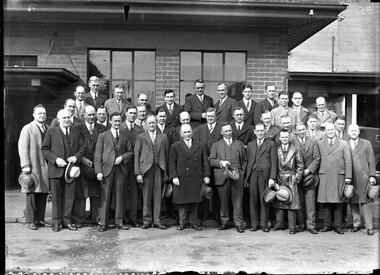 City of Melbourne Libraries
Photograph, Bull, Hugh Jones, 1897-1993, Steel manufacturers, McPherson's Ltd, Melbourne
... Photographer notations on slide: Steel Manuf’rs at McPherson’s Ltd 1933 Published: The Age, 30 August 1933 BUREAU OF STEEL MANUFACTURERS OF AUSTRALIA. (1933, August 30). The Age (Melbourne, Vic. : 1854 - 1954), p. 11. Retrieved January 25, 2026, from http://nla.gov.au/nla.news-article204372874 Published title: Bureau of Steel Manufacturers of Australia Published caption: A group of Inter-State Visitors, from the Bureau of Steel Manufacturers of Australia, on a tour of inspection at the Bolt Works of McPhersons Pty. ......The Age (Melbourne, Vic. : 1854 - 1954)...Glass plate negative Steel manufacturers, McPherson's Ltd, Melbourne Photograph Bull, Hugh Jones, 1897-1993 The Age (Melbourne, Vic. : 1854 - 1954) ...Photographer notations on slide: Steel Manuf’rs at McPherson’s Ltd 1933 Published: The Age, 30 August 1933 BUREAU OF STEEL MANUFACTURERS OF AUSTRALIA. (1933, August 30). The Age (Melbourne, Vic. : 1854 - 1954), p. 11. Retrieved January 25, 2026, from http://nla.gov.au/nla.news-article204372874 Published title: Bureau of Steel Manufacturers of Australia Published caption: A group of Inter-State Visitors, from the Bureau of Steel Manufacturers of Australia, on a tour of inspection at the Bolt Works of McPhersons Pty. Ltd., Burnley-Richmond, yesterday. Research by Project Volunteer, Louise McKenzie: The photo shows a line up of 36 men, in three rows, in front of a building. They are mostly dressed in dark 3-piece suits, or camel coats. But one gentleman stands out in his full length leather coat! Striped ties are popular, and they are all holding hats. One man, at the rear towards the right, looks a bit younger with his thick, black, brylcreamed hair.. These interstate gentlemen are described in the newspaper caption as representatives of the Bureau of Steel Manufacturers "...on a tour of inspection at the Bolt Works of McPhersons Pty Ltd, Burnley, Richmond." Interestingly, the Bureau of Steel Manufacturers of Australia (BOSMA) still exists, and is the industry body for major Australian steel producers like BlueScope, Liberty, and InfraBuild, representing their interests, engaging with government, and participating in standards setting for the domestic steel market, with a history dating back to 1923. While BOSMA focuses on primary manufacturing, the Australian Steel Institute (ASI) serves as the broader peak body for the entire steel supply chain, from mills to end-users, promoting and supporting the industry. But at the time of this photo, the Australian steel industry was just starting to make headway. As the AST website explains, "Steelmaking in Australia began just a decade prior to the start of the 1851 Gold Rush whilst Australia was still divided into colonies. Iron ore deposits were discovered in 1840 at Iron Knob, South Australia but a lack of equipment meant that the process of producing steel was impossible. Even attempts at smelting the iron ore in a blast furnace to create pig iron were unsuccessful due to the poor quality of iron ore and coke available to the budding industry. In the other colonies at the time, such as Victoria, Tasmania, and New South Wales, there were minor discoveries of iron ore but poor technical expertise and limited quantity meant that the quality of steel was poor. Compared to the far superior steel being imported from Britain at the time, the steel manufacturing industry simply couldn’t compete and was unviable. By the 1870s, almost all steel production in Australia had been abandoned. The situation began to change at the turn of the century. Rapid growth sparked higher demand for industrial machinery made from steel and infrastructure such as rail. It became apparent that there was a need for locally manufactured steel and soon there would be an answer. In 1901, the year Australia united into a federation, the nation’s first blast furnace went into production at Eskbank near Lithgow in New South Wales. The development was spearheaded by William Stafford and his son Esk, and Stafford is known as the father of Australian steel production. In 1915, production expanded with another steel mill in Newcastle that was opened by BHP. It sourced coke from local mines and iron ore from South Australia, creating a domestic loop for steel manufacturing. In the following years, more steelworks opened in Whyalla, South Australia and Port Kembla in NSW. Steel manufacturing in Australia was now underway." The company mentioned in the photo’s notation and in the newspaper caption, was McPhersons, "...an Australian hardware firm, for many years a leading merchant of woodworking and metal-working machinery... [and founded by] Thomas McPherson (c.1823–1888) who had a home "Dudley House" at 142 Dudley Street, West Melbourne. [The] ironmongery business [was located] in 1860 at 149 Spencer Street, Melbourne. Merchandise carried included bells, lathes, horseshoes and steam engines." (Wikipedia - McPherson's Pty Ltd) Anyone who has read Robyn Annear’s excellent award-winning 2014 book Bearbrass – the name for early Melbourne - will remember only too well her description of West Melbourne, from where the city of Melbourne as we know it, emerged. Her book resurrects the village that was early Melbourne – from the arrival of white settlers in 1835 until the first gold rushes shook the town – and brings it to life in vivid colour. The McPherson family, whose arrival in Bearbrass coincides with this period (Thomas arrived in 1852), became intimately involved in the growth and development of Melbourne. Thomas was Mayor of Melbourne (1870-1871); his eldest son Hunter became a successful Sydney businessman; second son Edward and third son William inherited the company, and ran it together until 1896 when Edward killed himself. William had a notable career in politics as treasurer of Victoria 1917-1923, in which year he was knighted. 1928-1929 he was Premier of Victoria, and a noted philanthropist. The family were significant property owners in the city of Melbourne: 149 Spencer Street, 582-588 Collins Street, 554-566 Collins Street, together with a property on Jeffcott Street, West Melbourne, and factories in Sunshine, Tottenham, Kensington and Richmond – all by the mid 1940s. By that time they also had controlling interests in several Australasian industries, including Ajax Bolt and Rivet Pty Ltd of NZ, F W Hercus Manufacturing Co Ltd, manufacturers in South Australia of lathes, guillotines and other heavy machinery, also of Patience and Nicholson (P & N), manufacturers in Maryborough, Victoria, of twist drills and thread-forming tools; also Wiltshire Files on Sunshine Road, Tottenham, manufacturing files and rasps. The Acme Machine Tool Company became a branch of McPhersons, and the company claimed to have supplied, from their own manufacture, all five million rivets (some 3,600 tonnes) used in the building of the Sydney Harbour Bridge – described as a steel through arch bridge, which opened in 1932; the tallest of its kind in the world (Wikipedia – Sydney Harbour Bridge) McPherson’s was also innovative in other ways. It published a comprehensive catalogue, extensively detailed with prices, available free of charge to farmers and other businesses. In 1908 it had 148 pages. By 1937 it had grown to 372 pages. The University of Melbourne’s Archives entry on McPherson’s Limited notes: "After the outbreak of the Second World War, McPherson’s factories worked at full capacity and were crucial to Australia’s war efforts. On 5 December 1944 McPherson's converted to a public company named McPherson's Ltd, with William Edward as Chairman of Directors. By the start of the 1950s the company had a very different Board of Directors; in 1947 the Managing Director Oliver Addison died, and his replacement Marshall Eady died only six months later. Both had been Directors since McPherson’s became a proprietary company in 1913. Another Director, Philip Bevan, died in 1948 and this was followed by the death of William Edward in 1950. S.B Holder, F.G. Thorpe, H.L. Hastie, F. Grassick and D.G. Syme all joined the Board before 1950. The company continued to prosper for many years after the death of William Edward. His son, William David, was invited to join the McPherson’s Ltd Board in 1951. He married Angela Cumming in 1955 and soon after was sent to Brisbane as Director in Charge to oversee the building of a new warehouse. The opening of this warehouse in Queensland meant that the company now had major outlets in five states. As time went on, manufacturing in Australia began to decline and imports of everyday tools began arriving from Asia. These tools were being produced with much lower labour costs and could be sold at cheaper prices. William David retired in 1984 and eventually parts of the company were divested, such as the Richmond Bolt Works which closed in the early 1990s. Since the 1980s, McPherson's has diversified into housewares, printing, and health and beauty care products." This article also contains photos, one of which is a photograph of 'Bolt works picnic' 1920, showing workers in their shirt sleeves participating in a tug of war in a rural "picnic" setting. McPherson’s premises at 554-566 Collins Street more than lasted the test of time and is listed as historically significant. The magnificent art deco building from the 1930s in the heart of Melbourne was first commissioned in 1934 and completed in 1937. It is an imposing building fronting almost a quarter of the city block between Spencer Street and King Street, and was designed to be a warehouse, office and showroom for the hardware empire. International architects Stuart P Calder, and Reid and Pearson designed the four-storey building with a basement level and a stair tower at the centre that provides access to what was a tennis court on the roof. It is considered an example of the streamlined modern style in Melbourne and shows how the McPherson company, protected from taxes after World War I, was able to manufacture goods without being affected by the competition. The building has survived, and its current iteration is as the home to il Mercato Centrale – an Italian style artisan market concept. The University of Melbourne Archives hold a particularly good image of the building from its heyday, complete with Collins Street lamps on the pavement outside the store. And to return to our image, sited at "Bolt Works of McPhersons". Today this segment of McPhersons is still very well known - Ajax. A good summary of the company’s history, and the development of the name and business, can be found on the Mine Suppliers Online website: "AJAX Fasteners can trace its heritage back to 1900, when the Acme Bolt Company was established in West Melbourne, Victoria. In 1909, William McPherson used the company as the basis for establishing McPherson’s Bolt Works – adopting the brand ‘Ajax’ – and moved it to Richmond. Over the years, the company changed many times in response to industry needs to ensure that it remained the premier manufacturer of high quality fasteners in Australia. Many other names in the industry, such as Firth Cleveland, Spurway Cooke and Nettlefolds were merged or acquired into the company. McPhersons ended their 80-year ownership of Ajax in the early 90s when they sold their shares to National Consolidated, which was also a major shareholder at the time. In 1997, Ajax Fasteners moved to new purpose-built premises in Braeside, Victoria. Soon after, National Consolidated was taken over by the diversified manufacturer Austrim. The group soon acquired the iconic Nylex, and adopted the name Nylex Corporation. In January 2007, ACME Operations Pty Ltd acquired Ajax Fasteners and continues to operate the business today from the Braeside plant. The name ACME provides a nostalgic return by the new owners to the company’s heritage, when the Acme Bolt Company was founded in July 1900." REFERENCES: BUREAU OF STEEL MANUFACTURERS OF AUSTRALIA. (1933, August 30). The Age (Melbourne, Vic. : 1854 - 1954), p. 11. Retrieved January 25, 2026, from http://nla.gov.au/nla.news-article204372874 Wikipedia, McPherson’s Pty Ltd, https://en.wikipedia.org/wiki/McPherson%27s_Pty_Ltd Wikipedia, Richmond, Victoria, https://en.wikipedia.org/wiki/Richmond,_Victoria Industry: From the mid-19th century, Richmond was a centre of manufacturing industry, including many large complexes such as the Bryant & May match factory, Jaques Limited engineering works, the Wertheim Piano factory and Pelaco. Wikipedia, Sydney Harbour Bridge, https://en.wikipedia.org/wiki/Sydney_Harbour_Bridge eMelbourne, Manufacturing, https://www.emelbourne.net.au/biogs/EM00896b.htm 'New life for Melbourne's McPherson Building', The Urban Developer, https://www.theurbandeveloper.com/articles/mcphersons-building-melbourne-il-mercato-centrale-food-retail-destination Bureau Of Steel Manufacturers Of Australia Limited, http://www.bosma.org.au/ 'A Brief History of Steel Manufacturing in Australia', AST, https://astraders.com.au/a-brief-history-of-steel-manufacturing-in-australia/ 'Steel manufacturing in Australia: a brief history', Hard Bakka Steel Fabrication, https://www.hardbakka.com.au/component/virtuemart/steel-manufacturing-in-australia-a-brief-history?Itemid=494 McPherson's Limited, University of Melbourne Archives, https://archives.library.unimelb.edu.au/nodes/view/58364 Source of Description: 'Nuts and Bolts: A story of a family and a firm', Barbara Hamer (2006), McPherson’s Printing Group 'Photograph of 'Bolt works picnic' 1920', University of Melbourne Archives, https://archives.library.unimelb.edu.au/assets/display/1287217-max?u=dea2e4d2fd07ac822e624f1e7d39adb3 'Photograph of the exterior of the McPhersons Department store at 546 Collins Street, Melbourne.', University of Melbourne Archives, https://archives.library.unimelb.edu.au/assets/display/1287215-max?u=12430d30453a77059b7d10d49006a521 Robyn Annear, Bearbrass: imagining early Melbourne, Black Inc., 2014 (originally published 1995 by Mandarin) 'Company details', Ajax Fasteners, http://www.minesuppliersonline.com.au/australia/braeside/hardware/ajax-fasteners 'Former McPherson's Building', Victorian Heritage Database, https://vhd.heritagecouncil.vic.gov.au/places/741Photographer notations on slide: "Steel manuf'rs at McPherson's Ltd 1933 B5".1930-1939, industrial workers, clothing and dress, 1930, iron and steel industry, businesses, bridges, industry, melbourne, gold rush, moderne style architecture -
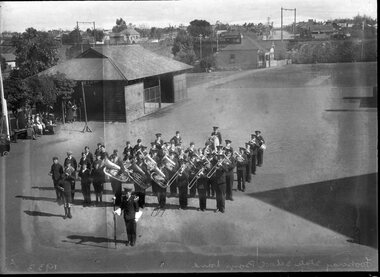 City of Melbourne Libraries
Photograph, Bull, Hugh Jones, 1897-1993, Footscray State School Boys Band
... Photographer notations on slide: Footscray State School Boys Band 1933 B5 Published: JUNIOR BAND CHAMPIONS--BEFORE THE HOLIDAYS--BELGIAN CARNIVAL--A ROYAL YACHTSMAN. (1933, September 1). The Age (Melbourne, Vic. : 1854 - 1954), p. 3. Published caption: “Proud Champions.- The drum-major of the band of the Hyde-street State School, Footscray, leads his players in a march past for visitors during Music Week. ......The Age (Melbourne, Vic. : 1854 - 1954)...Photographer notations on slide: Footscray State School Boys Band 1933 B5 Published: JUNIOR BAND CHAMPIONS--BEFORE THE HOLIDAYS--BELGIAN CARNIVAL--A ROYAL YACHTSMAN. (1933, September 1). The Age (Melbourne, Vic. : 1854 - 1954), p. 3. Published caption: “Proud Champions.- The drum-major of the band of the Hyde-street State School, Footscray, leads his players in a march past for visitors during Music Week. ...Photographer notations on slide: Footscray State School Boys Band 1933 B5 Published: JUNIOR BAND CHAMPIONS--BEFORE THE HOLIDAYS--BELGIAN CARNIVAL--A ROYAL YACHTSMAN. (1933, September 1). The Age (Melbourne, Vic. : 1854 - 1954), p. 3. Published caption: “Proud Champions.- The drum-major of the band of the Hyde-street State School, Footscray, leads his players in a march past for visitors during Music Week. Under Mr. Frank Johnston’s conductorship this band has held the championship for two years.” Trove article identifier: http://nla.gov.au/nla.news-article205116143 Scope and Content: Footscray’s Hyde Street State School Band, led by their drum major, prepare to march past a group of mothers while playing their instruments. The band held the record for winning the most Victorian State Schools Association Championships between 1931 and 1966. Research by project volunteer, Fiona Collyer: Description: A large group of boys, most of whom are dressed in long trousers and peaked band hats, led by their drum major, prepare to march past a group of women dressed in overcoats and hats and an infant in a pram. In the background is a school shelter shed, a railway line, houses and a netball ring on a wooden stand. The Hyde Street State School Band was formed in 1928 as the school band for Hyde Street State School No. 1912 at 10 Hyde Street Footscray (now Footscray City Primary School). Their bandmaster, Francis Charles Johnston,(1880-1953) nicknamed “Massa” as a boy for his love and admiration of southern American jazz music, also conducted the Victorian Police Band, Collingwood Citizens Band, and the Melbourne Metropolitan Fire Brigade Band, amongst others, leading to scores of wins in brass band competitions. Even into his sixties, “Massa” ran three laps around the South Melbourne Oval every morning in order to maintain fitness for his busy conducting schedule. He was a cornetist and horn player, and performed in and lead brass bands for more than fifty years including bands that farewelled Australian troops from the Boer War to the Second World War. The Argus 13 December 1947, described “Massa” - “Bandsmen say he is a genius in brass band music, and the best conductor in the Southern Hemisphere. He still retains the romance and Bohemianism of the old German bandsmen he played with in the streets of Melbourne 50 years ago.” In 1925, a bequest of £10,000 from the estate of the late writer, William Gillies was made to the Education Department of Victoria. It was devoted to three purposes - “1) The encouragement of instrumental music (school bands or orchestras) in the State schools of Victoria, leading, it is hoped, to an increase in the number of village bands and orchestras, and, most important of all, family orchestras; (2) The encouragement of the art of reading aloud, leading, it is hoped, to an increase of the admirable pastime of reading aloud in the family circle; and (3) The encouragement of any branch of nature study, the aim of all three being to make home life, especially in the country, more attractive.” The Director of Education, Mr. M.P. Hansen wrote in his book “Thoughts That Breathe” published in 1932, that, as a result of the Gillies Bequest- “£3,030 has already been made available for the purchase of band instruments, and thanks largely to the encouragement given by this fine bequest, there are now in State schools in Victoria, each under expert tuition, 31 brass bands, 9 orchestras, 13 fife bands and 23 violin classes. That the effect of such work has a significant bearing on the right use of leisure, is undeniable.” By 1937, at least 50 State school bands had been set up in Victoria and the Victorian State Schools Association Championships were hotly contested. Frank quickly and skilfully brought the inexperienced boys of the Hyde Street Brass Band to A grade level, winning their first Victorian State Schools Association Championships in 1931. The band went on to win multiple times, holding the record for winning the most Victorian State Schools Association Championships between 1931 and 1966. The band soon became an integral part of community events. Whenever the Footscray Football Team played a home game at the perpetually blustery Western Oval, (Whitten Oval since 1995) the band performed at half time, marching around the boundary line, belting out the Footscray Football Team theme song- “Sons of the ’Scray” played to the tune of “Sons of the Sea” by British music hall songwriter Felix McGlennon. Volunteers walked behind the band carrying a large tarpaulin to catch the shower of coins thrown by fans from both teams, which helped pay for new instruments, repairs and uniforms. The old footy joke goes- Q. Who played on the wing at the Western Oval for 20 years, but never kicked a goal? A. The Hyde Street Band. Now called the Hyde Street Youth Band Inc, it is a not-for-profit organisation, supported by the City of Maribyrnong. Their aim is to make brass music accessible to young people aged from 5-25 years, by supplying the instruments and lessons for a modest annual membership fee. The traditional British brass band comprises of three musical ensembles according to ability. The Hyde Street Youth Band Inc. play at community events including the AFL Grand Final Parade, ANZAC Day March at the Shrine of Remembrance, Moomba Parade and Yarraville Carols by Candlelight. Their repertoire includes classical, marches, hymns, contemporary music and movie themes. https://bandblastsfromthepast.blog/2018/04/08/victorian-state-school-brass-bands-their-legacy-lives-on/ Massa" and His Musical Firemen (1947, December 13). The Argus (Melbourne, Vic. : 1848 - 1957), p. 2 (The Argus Week-end Magazine). Retrieved May 5, 2025, from http://nla.gov.au/nla.news-article22532344 http://www.hydestreethistory.8m.net/photo2.html MUSIC AND MUSICIANS (1932, March 9). The Mercury (Hobart, Tas. : 1860 - 1954), p. 2. Retrieved May 8, 2025, from http://nla.gov.au/nla.news-article29946674 https://hsyb.org.au/about/history-2/ https://hsyb.org.au/about/ MUSIC AND READING ALOUD. (1925, June 1). The Argus (Melbourne, Vic. : 1848 - 1957), p. 10. Retrieved May 5, 2025, from http://nla.gov.au/nla.news-article2122525 Shake! Narrow Escape From Shark The Birdcage Walk Champion Schoolboy's Band (1931, December 24). The Sun News-Pictorial (Melbourne, Vic. : 1922 - 1954; 1956), p. 14-15. Retrieved April 8, 2025, from http://nla.gov.au/nla.news-article276259073 AROUND THE SCHOOLS: THE ARGUS JUNIOR (1947, September 23). The Argus (Melbourne, Vic. : 1848 - 1957), p. 6 (The Argus Super Comic). Retrieved April 20, 2025, from http://nla.gov.au/nla.news-article22509356 https://bandblastsfromthepast.blog/tag/hyde-street-youth-band/ THE GILLIES BEQUEST (1933, September 2). The Argus (Melbourne, Vic. : 1848 - 1957), p. 22. Retrieved May 5, 2025, from http://nla.gov.au/nla.news-article11688410 https://adb.anu.edu.au/biography/johnston-francis-charles-massa-13009 Hyde Street, Footscray, State School Children (1930, March 8). Weekly Times (Melbourne, Vic. : 1869 - 1954), p. 40. Retrieved May 8, 2025, from http://nla.gov.au/nla.news-article223899955Photographer notations on slide: Footscray State School Boys Band 1933 B5bands, 1930-1939, musical instruments, schools, state schools, uniforms, footscray -
Healesville Sanctuary Heritage Centre
Newspaper - Cutting, The Age, Melbourne, Marauders by night, 18 March 1950
... The Age, Melbourne...Marauders by night Newspaper Cutting The Age, Melbourne Fleay, David H ...Article on three of the animals that hunt and are a danger to the fauna held in the Sanctuary, the fox, Australian goshawk and feral cat. Mentions the [W H and] M A Ingram aviary for Brush turkeys.Photocopy 1 sheet. It has 2 photos . non-fictionArticle on three of the animals that hunt and are a danger to the fauna held in the Sanctuary, the fox, Australian goshawk and feral cat. Mentions the [W H and] M A Ingram aviary for Brush turkeys. 1950s -
Healesville Sanctuary Heritage Centre
Newspaper - Newspaper Cutting, Report, The Age, Melbourne, Feed the Animals for a Day, 29 January 1946
... The Age, Melbourne...This item has an inscription and legibility of the text is fair. photocopy Feed the Animals for a Day Newspaper Newspaper Cutting, Report The Age, Melbourne ...Sanctuary Appeal for Donors to cover feeding costs.photocopySanctuary Appeal for Donors to cover feeding costs.1940s -
Healesville Sanctuary Heritage Centre
Newspaper - Newspaper Cutting, Report, The Age, Melbourne, Fauna Sanctuary at Healesville, 27 August 1947
... The Age, Melbourne...This item has an inscription and legibility of the text is fair. photocopy Fauna Sanctuary at Healesville Newspaper Newspaper Cutting, Report The Age, Melbourne ...The Premier (Mr Cain) to inspect Sanctuary before granting additional funds.photocopyThe Premier (Mr Cain) to inspect Sanctuary before granting additional funds. 1940s -
Healesville Sanctuary Heritage Centre
Newspaper - Newspaper Cutting, Report, The Age, Melbourne, Sanctuary in Need of Funds, 23 September 1948
... The Age, Melbourne...This item has an inscription and legibility of the text is fair. photocopy Sanctuary in Need of Funds Newspaper Newspaper Cutting, Report The Age, Melbourne ...Mr McDonald (Acting Premier) to recommend to Cabinet a grant to the Sanctuary to meet costs of fencing and transport of birds and animals.photocopyMr McDonald (Acting Premier) to recommend to Cabinet a grant to the Sanctuary to meet costs of fencing and transport of birds and animals.1940s -
Healesville Sanctuary Heritage Centre
Newspaper - Cutting, The Age, Melbourne, One Thousand Pounds for Sanctuary, 28 September 1948
... The Age, Melbourne...This item has an inscription and legibility of the text is fair. photocopy One Thousand Pounds for Sanctuary Newspaper Cutting The Age, Melbourne ...State Government grant to Sanctuary.photocopyState Government grant to Sanctuary. 1940s -
Healesville Sanctuary Heritage Centre
Newspaper - Cutting, The Age, Melbourne, Sanctuary, 4 October 1948
... The Age, Melbourne...This item has an inscription and legibility of the text is fair. photocopy Sanctuary Newspaper Cutting The Age, Melbourne ...State Cabinet to grant sufficient money to enable Sanctuary to remain open.photocopyState Cabinet to grant sufficient money to enable Sanctuary to remain open.1940s -
Healesville Sanctuary Heritage Centre
Newspaper - Cutting, The Age, Melbourne, News Sanctuary, 3 February 1949
... The Age, Melbourne...This item has an inscription and legibility of the text is fair. photocopy News Sanctuary Newspaper Cutting The Age, Melbourne ...Mr Leggatt (Chief Secretary) will ask Government to determine the fate of the Sanctuary.photocopyMr Leggatt (Chief Secretary) will ask Government to determine the fate of the Sanctuary.1940s -
Healesville Sanctuary Heritage Centre
Newspaper - Cutting, The Age, Melbourne, Sanctuary Not to Replace Zoo, 26 March 1949
... The Age, Melbourne...This item has an inscription and legibility of the text is fair. photocopy Sanctuary Not to Replace Zoo Newspaper Cutting The Age, Melbourne ...The Sanctuary is to be retained exclusively for native birds and animals. A committee to be formed to take charge of the Sanctuary.photocopyThe Sanctuary is to be retained exclusively for native birds and animals. A committee to be formed to take charge of the Sanctuary.1940s
