
Showing 29 items matching " melbourne bitter"
-
 Greensborough Historical Society
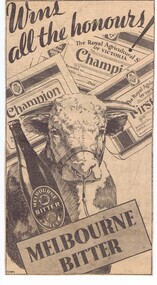
Advertisement - Digital image, The Herald, Melbourne Bitter, 12/09/1935
... Melbourne Bitter...melbourne bitter...This advertisement for Melbourne Bitter is from 1935....Melbourne Bitter Advertisement - Digital image The Herald ...These advertisements were found in a suitcase donated by a GHS member. The case contained newspapers and other items. This advertisement for Melbourne Bitter is from 1935.Although the advertisement not Greensborough based, it came from a local home.Digital copy of newspaper advertisement.melbourne bitter -
 Bendigo Historical Society Inc.
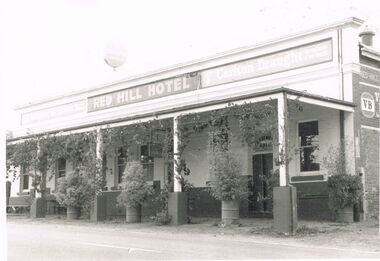
Photograph - PETER ELLIS COLLECTION: RED HILL HOTEL CHEWTON
... ... Melbourne Bitter...The name is on the front of the hotel along with Melbourne Bitter and Carlton Draught. Painted on the bricks on the side is VB....BUILDINGS Hotel red hill hotel chewton Peter Ellis Collection Red Hill Hotel Chewton Melbourne Bitter Carlton Draught VB Black and white photo of the Red Hill Hotel, Chewton. ...Black and white photo of the Red Hill Hotel, Chewton. The hotel has a veranda with wooden posts. The bottom of the posts are concrete at the lower end. There are grapevines growing up the posts and along the front. Between the poles are forty four gallon drums with shrubs growing in them. The name is on the front of the hotel along with Melbourne Bitter and Carlton Draught. Painted on the bricks on the side is VB.buildings, hotel, red hill hotel chewton, peter ellis collection, red hill hotel chewton, melbourne bitter, carlton draught, vb -
 Marysville & District Historical Society
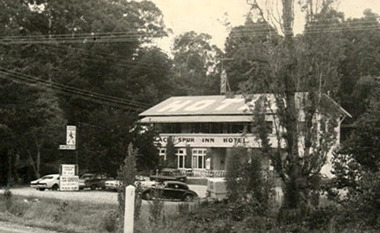
Photograph (Item) - Black and white photograph, Unknown
... ...melbourne bitter...A digital copy of a black and white photograph of the Black Spur Inn Hotel in Narbethong. narbethong victoria australia black spur inn hotel black spur inn black spur hotel blacks' spur hotel blacks' spur inn accommodation photograph melbourne bitter penfolds wine A digital copy of a black and white photograph of the Black Spur Inn Hotel in Narbethong. ...A digital copy of a black and white photograph of the Black Spur Inn Hotel in Narbethong.A digital copy of a black and white photograph of the Black Spur Inn Hotel in Narbethong.narbethong, victoria, australia, black spur inn hotel, black spur inn, black spur hotel, blacks' spur hotel, blacks' spur inn, accommodation, photograph, melbourne bitter, penfolds wine -
 City of Ballarat Libraries
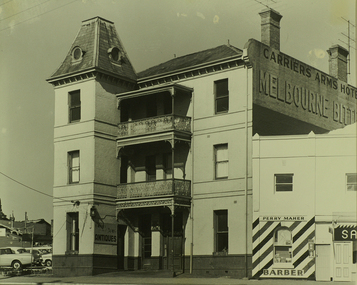
Photograph, Carrier's Arms Hotel, Doveton Street North, Ballarat
... ...melbourne bitter sign...These images were digitally re-photographed by members of the Ballarat Camera Club in September 2006. doveton street north perry maher, barber carrier's arms hotel carrier's arms antiques melbourne bitter sign Carrier's Arms Hotel, Doveton Street North, Ballarat Photograph ...An image from the Herbert Richmond collection, gifted in 1982 to the Ballarat Library. The collection contains approximately 200 photographs of Ballarat and district in the 1940s, 50s and 60s, as well as photo albums, glass negatives and other memorabilia. Herb Richmond was a keen photographer, a foundation member and a life member of the Ballarat Camera Club, and a photographer with the Ballarat Courier during the 1940s. The Ballarat Camera Club named an annual award after him. Mr Richmond died in 1981 aged 79. These images were digitally re-photographed by members of the Ballarat Camera Club in September 2006.doveton street north, perry maher, barber, carrier's arms hotel, carrier's arms antiques, melbourne bitter sign -
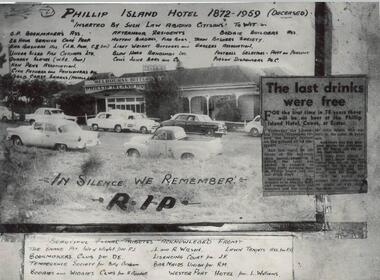 Phillip Island and District Historical Society Inc.
Photograph, Bryant West, 1959
... Melbourne Bitter Phillip Island Hotel. Names of Associations. ...One of a collection of over 400 photographs in an album commenced in 1960 and presented to the Phillip Island & Westernport Historical Society by the Shire of Phillip Island local history photography photographs phillip island hotel hotels motor cars john jenner bryant west Melbourne Bitter Phillip Island Hotel. Names of Associations. ...One of a collection of over 400 photographs in an album commenced in 1960 and presented to the Phillip Island & Westernport Historical Society by the Shire of Phillip IslandBlack & White Photograph of Phillip Island Hotel. Nine cars parked at front. Inserted newspaper clipping, 'the last drinks were free' due to the Licensing Court refusing to renew the license on the ground of its disrepair.Melbourne Bitter Phillip Island Hotel. Names of Associations. 'In silence we remember R.I.P.' Newspaper clipping.local history, photography, photographs, phillip island hotel, hotels, motor cars, john jenner, bryant west -
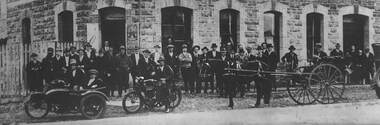 Sunshine and District Historical Society Incorporated
Photograph - Gunn's Braybrook Hotel Ballarat Road Braybrook C1927 Photograph
... Gunn's Braybrook Hotel Foster's Larger Carlton Ale Melbourne Bitter Ale Victoria Bitter Ale...Copied from Glimpses of Earyl Sunshine page 32 Gunn's Hotel Braybrook Hotel Ballarat Road Braybrook Gunn's Braybrook Hotel Foster's Larger Carlton Ale Melbourne Bitter Ale Victoria Bitter Ale Black and white photgraph of the blues stone Gunn's Braybrook Hotel with men standing and sitting on motor bikes. ...Copied from Glimpses of Earyl Sunshine page 32Gunn's Braybrook Hotel Foster's Larger Carlton Ale Melbourne Bitter Ale Victoria Bitter Alegunn's hotel, braybrook hotel, ballarat road, braybrook -
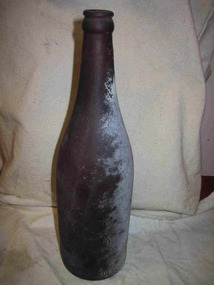 Parks Victoria - Gabo Island Lightstation
Bottle
... They made four beers – Abbotsford Stout (which became Abbotsford Invalid Stout in 1909), Abbots Lager, Melbourne Bitter and Abbotsford Sparkling Ale. Of those, Melbourne Bitter and the Invalid Stout remain largely unchanged and both are now brewed by the South African owned CUB. ...They made four beers – Abbotsford Stout (which became Abbotsford Invalid Stout in 1909), Abbots Lager, Melbourne Bitter and Abbotsford Sparkling Ale. Of those, Melbourne Bitter and the Invalid Stout remain largely unchanged and both are now brewed by the South African owned CUB. ...This dark brown bottle with lip, collar, neck and gently sloping shoulder, was made by the Bottle Co. of Victoria P/L for Melbourne Bitter. The Parks Victoria inventory indicates that the bottle dates to 1925. Still brewed today, Melbourne Bitter has been made since 1904, when the Melbourne Cooperative Brewery in Abbotsford was formed by well known pub owners that included Henry Young of Young & Jacksons, and future Lord Mayor Sir Stephen Morrell. They made four beers – Abbotsford Stout (which became Abbotsford Invalid Stout in 1909), Abbots Lager, Melbourne Bitter and Abbotsford Sparkling Ale. Of those, Melbourne Bitter and the Invalid Stout remain largely unchanged and both are now brewed by the South African owned CUB. The bottle was found in the sea or on the island.Whatever their provenance, they have an association with an event or activity on Gabo Island and for this reason have second level contributory significance for their potential to yield information relating to the cultural history of the lightstation.Dark brown glass bottle, tall with gradual tapering to a narrow opening. Slightly misshapen. White coating on one side.Within a club motif, "M.B.C.V" "The property of the manufacturers. / Bottle co of Victoria Pty Ltd" "6 1925" -
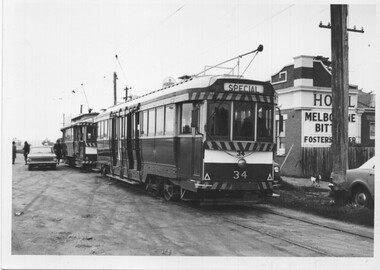 Ballarat Tramway Museum
Photograph - Black & White Photograph/s, Charles Craig, late 1960's early 1970's
... On the hotel is a sign for Melbourne Bitter and Foster's Lager. Photo by Charles Craig? ...On the hotel is a sign for Melbourne Bitter and Foster's Lager. Photo by Charles Craig? ...Yields information about tram operations on the Sebastopol line.Photograph of Ballarat trams (from the rear), 30 and 34 at the Sebastopol terminus - undated - late 1960's early 1970's with the Royal Mail hotel in the background. No. 34 running a special. On the hotel is a sign for Melbourne Bitter and Foster's Lager. Photo by Charles Craig? Has in red ink on rear - "34 and 30 Sebastopol"trams, tramways, sebastopol, tram 30, tram 34 -
 Melbourne Tram Museum
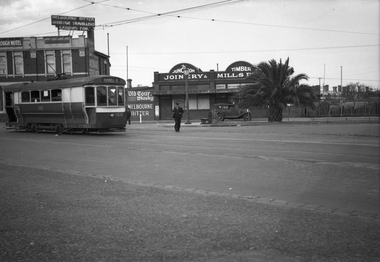
Negative, Wal Jack, 21/04/1945 12:00:00 AM
... Has the Plough Hotel advertising a whiskey and Melbourne Bitter and next door, the Junction Joinery and timber mills. ...Has the Plough Hotel advertising a whiskey and Melbourne Bitter and next door, the Junction Joinery and timber mills. ...Black and white negative, by Wal Jack, of S 166 crossing Geelong Road, in Barkly St with the destination of Russell St. Has the Plough Hotel advertising a whiskey and Melbourne Bitter and next door, the Junction Joinery and timber mills. Based on Reg Item 5182 which is dated in the Wal Jack Melbourne album, the date is likely to be 21-4-1945.trams, tramways, russell st, geelong road, barkly st, footscray, s class, tram 166, mmtb -
 Ballarat Tramway Museum
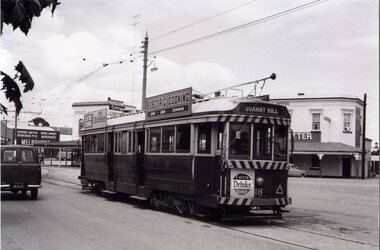
Photograph - Black & White Photograph/s, Ron Hann, Jan. 1963
... In the background are a hotel and a liquor store, both advertising Melbourne Bitter. Printed on Fujifilm, Fujicolor Crystal Archive for Frontier"...In the background are a hotel and a liquor store, both advertising Melbourne Bitter. Printed on Fujifilm, Fujicolor Crystal Archive for Frontier" Photograph Black & White Photograph/s Ron Hann ...Yields information about the interior of Bendigo tram depot, is storage area and two Birney trams.Black and white print on laser print paper - of Bendigo 18 at the Eaglehawk terminus 1/1963. Photo by Ron Hann. Tram has a Cohn's Drink advertisement on the front dash panel, two SEC roof advertisements and the destination of Quarry Hill. In the background are a hotel and a liquor store, both advertising Melbourne Bitter. Printed on Fujifilm, Fujicolor Crystal Archive for Frontier"Has label "Reference 6/214/26 Photo by Ron Hann" and another label "Eaglehawk Bendigo 01.63"trams, tramways, eaglehawk, hotels, tram 18 -
 Ballarat Tramway Museum
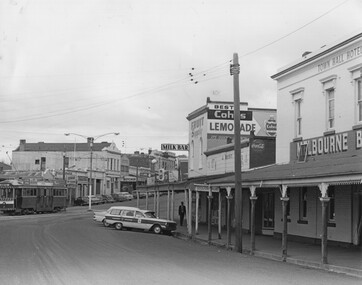
Photograph - Black & White Photograph/s, early 1950's
... In the view is the Town Hall Hotel - Melbourne bitter, J Best's milk bar and fruit shop advertising Cohn's Lemonade, Peters Ice cream, a Holden station wagon with Craven A Filter cigarettes, and Ashman's dry cleaning shop....In the view is the Town Hall Hotel - Melbourne bitter, J Best's milk bar and fruit shop advertising Cohn's Lemonade, Peters Ice cream, a Holden station wagon with Craven A Filter cigarettes, and Ashman's dry cleaning shop. ...Black and white photograph of Bendigo 2 leaving the Eaglehawk terminus on its way to Quarry Hill, late 1960's or early 1970's. In the view is the Town Hall Hotel - Melbourne bitter, J Best's milk bar and fruit shop advertising Cohn's Lemonade, Peters Ice cream, a Holden station wagon with Craven A Filter cigarettes, and Ashman's dry cleaning shop.trams, tramways, bendigo, high st, eaglehawk, tram 2 -
 Melbourne Tram Museum
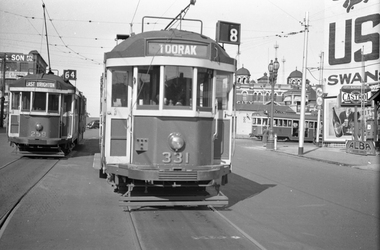
Negative, Wal Jack, c1940
... In the background is the City Baths and a service station on the corner with adverts for Castrol, Alba Motor Spirit, Used Cars and Melbourne Bitter. Photo undated, c1940....In the background is the City Baths and a service station on the corner with adverts for Castrol, Alba Motor Spirit, Used Cars and Melbourne Bitter. Photo undated, c1940. Negative Wal Jack ...Black and white negative by Wal Jack of W2 259 (East Brighton, Route 64), W2 331 (Toorak Road 8) and possibly W2 438 (Glen Iris, route 6). W2 331, has been fitted with a T light, fitted with reflectors. In the background is the City Baths and a service station on the corner with adverts for Castrol, Alba Motor Spirit, Used Cars and Melbourne Bitter. Photo undated, c1940.trams, tramways, victoria st, swanston st, tram 259, tram 331, tram 438? -
 Ballarat Tramway Museum
Photograph - SECV Ballarat - tram 17 - set of 3, Chris Wurr, Jan. 1971
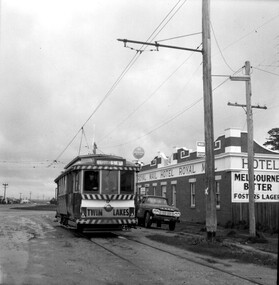
... Set of three photos by Chris Wurr on Jan. 1971 1 - 17 at Sebastopol terminus with Royal Mail Hotel in the background with an advert for Fosters Lager and Melbourne Bitter. Note the bus stop sign on the condemned pole. 2 - 17 inbound in Albert St, Sebastopol. 3 - 17 interior, time exposure....Set of three photos by Chris Wurr on Jan. 1971 1 - 17 at Sebastopol terminus with Royal Mail Hotel in the background with an advert for Fosters Lager and Melbourne Bitter. Note the bus stop sign on the condemned pole. 2 - 17 inbound in Albert St, Sebastopol. 3 - 17 interior, time exposure. ...Set of three photos by Chris Wurr on Jan. 1971 1 - 17 at Sebastopol terminus with Royal Mail Hotel in the background with an advert for Fosters Lager and Melbourne Bitter. Note the bus stop sign on the condemned pole. 2 - 17 inbound in Albert St, Sebastopol. 3 - 17 interior, time exposure.Yields information about the Ballarat tramway system, tram 17 and its operations Jan. 1971.Digital - Black and white image - set of 3tramways, trams, albert st, sebastopol, royal mail, night photo, interior -
 Ballarat Tramway Museum
Photograph - Digital image, 1970s
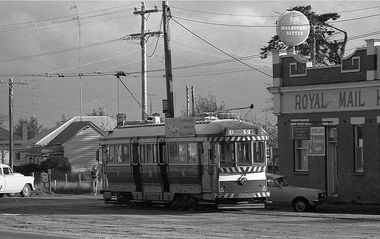
... Shows the stop arrangements. Hotel has Melbourne Bitter and Fosters Lager signs. The tram has the destination of Lydiard St North and a SEC "Everything is fine in my electric kitchen" roof advertisement. ...Shows the stop arrangements. Hotel has Melbourne Bitter and Fosters Lager signs. The tram has the destination of Lydiard St North and a SEC "Everything is fine in my electric kitchen" roof advertisement. ...Yields information about the Sebastopol tram terminus.Digital image of No. 38 at the Sebastopol terminus, with the Royal Mail Hotel in the background. Shows the stop arrangements. Hotel has Melbourne Bitter and Fosters Lager signs. The tram has the destination of Lydiard St North and a SEC "Everything is fine in my electric kitchen" roof advertisement. Photo taken by Peter Bruce 1970's and 1971, prior to the closure of the Ballarat tramway system. Peter's Title of image: "No 38 at Royal Mail Sebastopol"trams, tramways, sebastopol, hotels, tram 38 -
 Ballarat Tramway Museum
Photograph - Black & White Photograph/s, Keith Kings, Apr. 1949
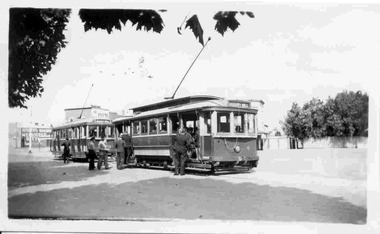
... Has buildings at terminus in background, with Plume and Melbourne Bitter beer signs....Has buildings at terminus in background, with Plume and Melbourne Bitter beer signs. Photograph Black & White Photograph/s Keith Kings ...Black and White photograph contained with Reg. Item 1902 - Photo Album from Keith Kings to Les Denmead 1970. Photograph of SEC Bendigo trams 22 and 4 at the Eaglehawk terminus, Easter Monday April 1949. Notes as both cars in "unaltered" condition. Keith Kings No. B(z)(1) Scanning: i - image file, p - presentation file, b - back of photograph. Has buildings at terminus in background, with Plume and Melbourne Bitter beer signs.Stamp in top left hand corner and handwritten number with "K.S. Kings No. B(z)(1) Copyright reserved". In blue ink "Bendigo / No. 22 - unaltered closed combination car / No. 4 - unaltered open combination car. / Eaglehawk terminus / Easter Monday, 4/49"trams, tramways, eaglehawk, bendigo, tram 22, tram 4 -
 Phillip Island and District Historical Society Inc.
Photographs, 1940
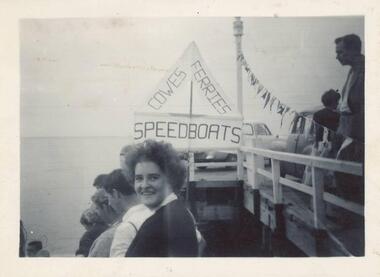
... A large sign shows "ENTRANCE RESIDENTIAL & BAR - MELBOURNE BITTER"...A large sign shows "ENTRANCE RESIDENTIAL & BAR - MELBOURNE BITTER" Photographs ...Four of a collection of 33 photographs donated by Leonie Brennan. The collection belonged to Edward (Ted) Sands, hairdresser.Photograph 215-18. People on the Cowes Pier enjoying an event. A sign reads "Cowes - Ferries - Speedboats" and a string of bunting decorates the pier. There are also cars on the pier. Photograph 215-19. Phillip Island - San Remo Suspension Bridge viewed from Newhaven at very low tide. Photograph 215-20. A couple enjoying a picnic in a bush setting. Photograph 215-21. Three people sitting on the stone fence in front of the Isle of Wight Hotel. A large sign shows "ENTRANCE RESIDENTIAL & BAR - MELBOURNE BITTER"isle of wight hotel, isle of wight hotel phillip island, phillip island - suspension bridge, suspension bridge phillip island, cowes pier phillip island, mr edward (ted) sands, leonie brennan -
 Ballarat Tramway Museum
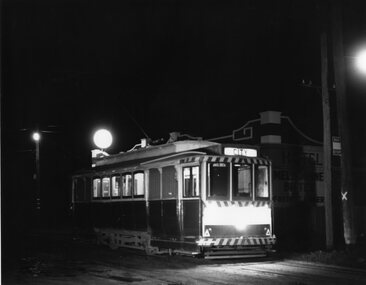
Photograph - SECV Ballarat - 21 at Sebastopol terminus, Chris Wurr, 15/8/1971
... In the background is the hotel, with Melbourne Bitter and Fosters Larger advertised on the wall. ...In the background is the hotel, with Melbourne Bitter and Fosters Larger advertised on the wall. ...Photograph of a single trucker (No. 21 - five windows) at the Sebastopol terminus, Albert St, outside the Royal Mail Hotel, just prior to the changeover from trams to buses. The tram has the destination of City. The pole with the tram stop signage is behind the tram while the new? bus stop sign is on the pole adjacent to the tram. Note that the pole has been condemned by the SEC. In the background is the hotel, with Melbourne Bitter and Fosters Larger advertised on the wall. Photo by Chris Wurr 15/8/1971.Yields information about the streetscape and the trams at night outside the Royal Mail Hotel Sebastopol, the tram terminus.Black and White photograph with photographer's notes on the rear.Stamped on rear in black ink "Donated to BTPS by and Photo By" / "Chris Wurr"tramways, trams, sebastopol, albert st, tram 21 -
 Ballarat Tramway Museum
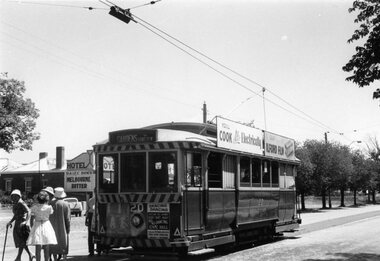
Photograph - Black & White Photograph/s, Ron Hann, Jan. 1963
... The Meagher's Hotel is in the background, with the names DA and FC Dowd on the wall and an advertisement for Melbourne Bitter. 2nd copy - laser print - with date etc on rear - added 22/2/2010, copy from Ron Hann. ...The Meagher's Hotel is in the background, with the names DA and FC Dowd on the wall and an advertisement for Melbourne Bitter. 2nd copy - laser print - with date etc on rear - added 22/2/2010, copy from Ron Hann. ...Yields information about the Victoria St terminus, passengers and the tram liveries in 1963.Black and white print on heavy matt photographic paper of No. 20 at the Victoria St terminus, c1963. Tram has the destination of Gardens, a Cook with Electricity and Ilford Film roof advertisements and one for dancing at the Civil Hall on the front dash panel. A number of ladies, including one using a walking stick, walking away from the tram. The Meagher's Hotel is in the background, with the names DA and FC Dowd on the wall and an advertisement for Melbourne Bitter. 2nd copy - laser print - with date etc on rear - added 22/2/2010, copy from Ron Hann. Printed on Fujifilm, Fujicolour Crystal Archive for Frontier"On rear in pencil "20 Victoria St 1963" 2nd copy has label "Reference 6/113/10 Photo by Ron Hann" and another label "Ballarat 01.63"tramways, trams, victoria st, hotels, tram 20 -
 Ballarat Tramway Museum
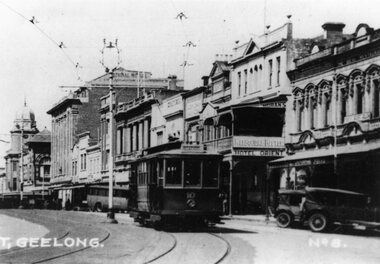
Photograph - MESCo Geelong 10 in Malop St, Peter Duckett, late 1920's, early 1930's
... Tram has the destination of "Station", with the National Mutual, Moran's Hotel Orient in the background. Melbourne Bitter advertisement on the hotel. A number of soft top cars parked in the street. ...Tram has the destination of "Station", with the National Mutual, Moran's Hotel Orient in the background. Melbourne Bitter advertisement on the hotel. A number of soft top cars parked in the street. ...Photo of Geelong No. 10, Malop St, travelling north west to the railway station, during the late 1920s, between Gheringhap and Moorabool St. Tram has the destination of "Station", with the National Mutual, Moran's Hotel Orient in the background. Melbourne Bitter advertisement on the hotel. A number of soft top cars parked in the street. Photo probably from a postcard, has the words "T. Geelong. No. 8" along part of the bottom edge. Photo from the Peter Duckett Collection. For a close up of the tram itself see Reg Item 5822. 4335.1 - Black and White print contained within the Wal Jack Bendigo and Geelong Album, see Reg Item 5003 for more details. Added 7/8/2013. This item is the larger image of the two.Yields information about the appearance of Geelong's tram 10 and Malop St during the late 1920s or early 30s.Black and White Photograph On rear, stamped in black ink "Photo supplied from P.W. Duckett Collection, All Rights Reserved, 69 Howitt Rd. Nth Caulfield 3161." In hand writing on the rear "47)" in top left hand corner. In the body of the photograph "Malop St travelling NW to Station, between Gheringhap and Moorabool Sts." 4335.1 - in ink on rear. "Geelong No. 10 Original Condition, photo about 1930" and "Please Return" trams, tramways, geelong, malop st, mesco, tram 10 -
 Ballarat Tramway Museum
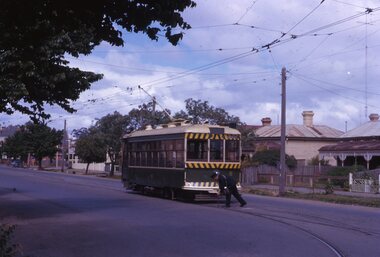
Slide - 35mm slide/s, Noel Simons, 21/11/1962 12:00:00 AM
... In background is the hotel and shops at the terminus, showing ads for "Melbourne Bitter". Tram has two SEC 'Electric Cooking' ads. ...In background is the hotel and shops at the terminus, showing ads for "Melbourne Bitter". Tram has two SEC 'Electric Cooking' ads. ...Set of 17 transparencies taken on 21/11/1962 on Kodak mounts. 1188.1 - Bendigo No. 11 at Depot Junction McCrae and Arnold St. with driver/conductor changing points. 1188.2 - Bendigo No. 4 at Charing Cross, side on photo, with City Club Hotel and Alexandra Fountain in the background. Tram has Castrol and SEC 'Electric Cooking' ads. 1188.3 - Bendigo No. 4 climbing View St. after tram has passed photographer. Tram has Streets Ice Cream and Cohns Soft Drinks ad on rear dash panel. In the background are the buildings in View St., including the Princess Theatre. Tram has destination of Eaglehawk. 1188.4 - Trams 2 and 4 crossing at the California Gully or Thorpe St Loop. 1188.5 - Bendigo 4 in Mt Korong Road. Tram inbound with destination of Quarry Hill, just leaving Garden Gully Loop. 1188.6 - Bendigo 4 and 17 crossing at the Hayes St. or Iron Bark Gully Loop. No. 17 bound for Eaglehawk, No. 4, Quarry Hill. 17 has two SEC roof ads and a white horse whiskey ad. 1188.7 - No. 17 bound for Eaglehawk, soon after leaving California Gully. Has large mullock heap in background. 1188.8 - Bendigo 2 and 17 crossing at the Thorpe St. or California Gully Loop. Has butchers shop in background. 1188.9 - Bendigo 17 at the Eaglehawk terminus. Has destination of Quarry Hill. In background is the hotel and shops at the terminus, showing ads for "Melbourne Bitter". Tram has two SEC 'Electric Cooking' ads. Driver and conductor about to assist two lady passengers with a pram and baby. 1188.10 - No. 17 at Eaglehawk terminus, awaiting departure. Has Eaglehawk Town Hall and Post Office in background. Tram has a Whitehorse Whiskey ad on the front dash panel. 1188.11 - No. 3 in High St. Eaglehawk, with destination of Eaglehawk. Has the shops on the south side of High St. in the background, including the Eaglehawk fish shop. Tram has two roof ads, one an SEC roof ad, and Cohns Drinks and Streets Ice cream ads on front dash panel. 1188.12 - as above, but after tram has passed photographer. Note the centre of the road poles. 1188.13 - No. 2 outbound for Eaglehawk at the intersection of Mt. Korong Road and the Calder Highway. Photo taken after the tram has passed the photographer. Has an Ampol service station in the background. 1188.14 - No. 11 leaving the Bendigo depot, crossing the bridge, with the Scrubber car in the background. 1188.15 - No. 21 at the North Bendigo terminus. Tram has destination of Golden Square and Cohns drink ad on front dash and two roof ads on side. 1188.16 - No. 11 on Golden Square route, in High St. at intersection with Old High St. 1188.17 - No. 11 at the Golden Square terminus, conductor turning the pole. Hotel on the left side of the photo. Note the road works barrier and red flag behind the tram. Slide has an end of roll mark on the right hand side of the image.Information written on in black ink and date stamped on purple ink. 1188.1 - "Birney car No. 11 in McCrae St. at Cnr of Arnold about to run into depot, Bendigo" 1188.2 - "No. 4 at Alexandra Fountain, Charing Cross Bendigo" 1188.3 - "No. 4 climbing the View St. Hill from Charing Cross, Bendigo (Eaglehawk Route)" 1188.4 - "No. 4 and 2 at Thorpe St. Loop, California Gully" 1188.5 - "No. 4 in Mt Korong Rd., Long Gully, Near Havilah Rd. (Bendigo) (Eaglehawk Route)" 1188.6 - "Nos. 17 and 4 crossing on Hayes St. Loop, Ironbark, Bendigo" 1188.7 - "No. 17 soon after leaving California Gully (Eaglehawk Route)" 1188.8 - "No.2 and 17 crossing on Thorpe St. Loop, California Gully (Eaglehawk Route)" 1188.9 - "No. 17 at Eaglehawk terminus" 1188.10 - "No. 17 at Eaglehawk terminus" 1188.11 - "No. 3 in High St. Eaglehawk" 1188.12 - "No. 3 nearing Eaglehawk terminus" 1188.13 - "No. 2 in Mt. Korong Rd., Ironbark. Calder highway on left (Eaglehawk route) 1188.14 - "Birney car No. 11 leaving Bendigo depot. Scrubber car at rear" 1188.15 - "No. 21 at North Bendigo Terminus" 1188.16 - "Birney car No. 11 in High St. Bendigo at intersection with Old High Street (Golden Square Route)" 1188.17 - "Birney Car No. 11 at Golden Square terminus, High St., Bendigo". tramways, trams, bendigo, depot junction, charing cross, view st., eaglehawk, north bendigo, golden square, tram 2, tram 3, tram 4, tram 11, tram 17, tram 21, tram scrubber -
 Ringwood and District Historical Society
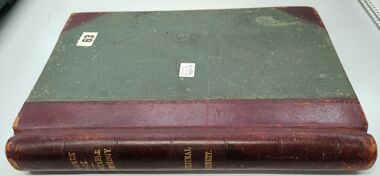
Administrative record, Agricultural Department, Large ledger, dark green cover, red leather spine with inscription. Bitter Pit investigation. Tracking fruit sent to coolstores 3-Jul-1911 to 30-Aug-1916. From Agricultural Department, fruit from all over the state - not just Ringwood. Some is from N.S.W, 1911 - 1916
... Melbourne University from 1884. In 1890 Daniel McAlpine was appointed to the Victorian Department of Agriculture as vegetable pathologist 'to attend to all diseases of plants that might form the subject of inquiry'. In 1911 McAlpine was assigned to the Commonwealth and State governments for four years to undertake researches into bitter...Melbourne University from 1884. In 1890 Daniel McAlpine was appointed to the Victorian Department of Agriculture as vegetable pathologist 'to attend to all diseases of plants that might form the subject of inquiry'. In 1911 McAlpine was assigned to the Commonwealth and State governments for four years to undertake researches into bitter ...From https://researchworks.oclc.org/archivegrid/archiveComponent/1013459255: Australia's first plant pathologist. Lecturer in Biology at Melbourne University from 1884. In 1890 Daniel McAlpine was appointed to the Victorian Department of Agriculture as vegetable pathologist 'to attend to all diseases of plants that might form the subject of inquiry'. In 1911 McAlpine was assigned to the Commonwealth and State governments for four years to undertake researches into bitter pit of apples, a disease he had reported in 1900. Realising the difficulties such an investigation posed, he was reluctant to accept the post but did so 'for the credit of Australia'. He made detailed observations of the disease and published five reports but, unable to discover the cause, found himself arrayed against the Victorian government botanist Professor A. J. Ewart, who mistakenly attributed bitter pit to traces of poison in the soilLarge ledger, dark green cover, red leather spine with inscription. Bitter Pit investigation. Tracking fruit sent to coolstores 3-Jul-1911 to 30-Aug-1916. From Agricultural Department, fruit from all over the state - not just Ringwood. Some is from N.S.W. Only pages 1 & 2 scanned as examples. Specimen Book; Vegetable Pathology; Agricultural Department; Coolstore -
 National Vietnam Veterans Museum (NVVM)
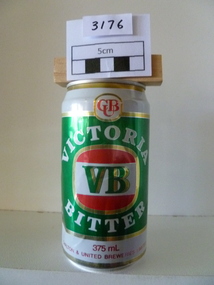
Memorabilia, Beer Can
... Victoria bitter can commemorating Melbourne's Reunion of Vietnam Veterans 1988. ...Melbourne reunion of Vietnam Veterans 1988 International Vietnam Forces CUB VB Victoria Bitter...Beer Can Vietnam veterans Reunion Melbourne reunion of Vietnam Veterans 1988 International Vietnam Forces CUB VB Victoria Bitter Victoria bitter can commemorating Melbourne's Reunion of Vietnam Veterans 1988. ...Victoria bitter can commemorating Melbourne's Reunion of Vietnam Veterans 1988. White can with green, gold and red graphics.Melbourne reunion of Vietnam Veterans 1988 International Vietnam Forces CUB VB Victoria Bitterbeer can, vietnam veterans, reunion -
 National Vietnam Veterans Museum (NVVM)
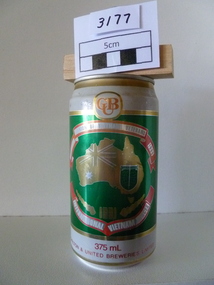
Memorabilia, Beer Can
... Victoria bitter can commemorating Melbourne's Reunion of Vietnam Veterans 1988. ...Melbourne reunion of Vietnam Veterans 1988. International Vietnam Forces. CUB VB Victoria Bitter...Beer Can Vietnam veterans Melbourne reunion of Vietnam Veterans 1988. International Vietnam Forces. CUB VB Victoria Bitter Victoria bitter can commemorating Melbourne's Reunion of Vietnam Veterans 1988. ...Victoria bitter can commemorating Melbourne's Reunion of Vietnam Veterans 1988. White can with green, gold and red graphics.Melbourne reunion of Vietnam Veterans 1988. International Vietnam Forces. CUB VB Victoria Bitterbeer can, vietnam veterans -
 Uniting Church Archives - Synod of Victoria
Colour photo, 1986
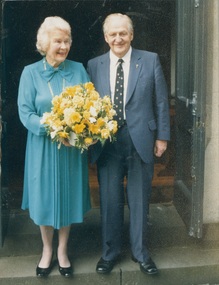
... After another five years at St Stephen's, Gordon returned to Scots Church in Melbourne. It was a time of bitter debates over church union with the Methodists and Congregationalists. ...After another five years at St Stephen's, Gordon returned to Scots Church in Melbourne. It was a time of bitter debates over church union with the Methodists and Congregationalists. ...1911–2005: Gordon George Powell, who has died at 94, was for many years the highly influential minister at St Stephen's Presbyterian Church in Sydney and a popular radio broadcaster and author. He began Wednesday services at St Stephen's in Macquarie Street soon after arriving in Sydney from Melbourne in 1952. They grew to become the biggest regular lunch-hour services in the world, with up to 1300 people crowding the church and the hall below. In 1953, with the help of Vernon Turner of the Christian Broadcasting Association, services were broadcast on radio. The broadcasts continued even when Gordon moved back to Melbourne, so for 30 years he maintained a successful weekly radio ministry. While at St Stephen's, he was also involved in the 1959 Billy Graham Crusade in Sydney, attended by 980,000 people over two weeks. Gordon was born in Warrnambool, Victoria, the son of a dentist, George Powell, and his wife, Louisa (nee Clarke). He went to school at Scotch College. He gave up plans to become an electrical engineer after hearing a call to the ministry and studied arts and then theology at the University of Melbourne, where he formed a close friendship with Edward (Weary) Dunlop. Gordon rowed in the Ormond crew, winning the university's inter-college trophy five times. He was a passionate sports lover all his life. He was awarded a scholarship to Trinity College, Glasgow University, in 1935, and for three months stayed with the great Scottish churchman George (later Lord) MacLeod. While on a cycling trip around Scotland, he stopped by the shores of Loch Ness and saw a long neck appear. The monster swam about 300 metres at great speed; Gordon counted three or four humps. Later, when he saw a skeleton of a plesiosaurus at the Victoria and Albert Museum, he recognised it as Nessie. For the rest of his life, he retained an avid interest in the Loch Ness Monster and its attendant scientific debate. While in Scotland, Gordon wrote a weekly article for The Messenger, the official journal of the Presbyterian Church of Victoria. This led to a life as an author of articles and books. He also wrote long letters home to his mother, a habit that later led to his weekly "Dad's Diaries", which were distributed to the wider family. Failing eyesight put an end to his reading and writing two years ago. On returning to Australia in late 1936, he became assistant minister at Toorak, the second-biggest Presbyterian church in Melbourne. There, at last, Gordon married Gwen Gilchrist, whom he had courted for nine years. They moved from the wealthiest church to one of the poorest, at Port Adelaide, which was still in the grip of the Depression. There, he was finally ordained, in May 1938, and the first two of their four children, Rosemary and David, were born. In 1941, Gordon became assistant minister to Scots Church in Melbourne and the following year, after the birth of his third child, Mardi, he reluctantly volunteered as an RAAF chaplain. He was a pacifist but felt bad at not being in uniform. For the following three years, he was stationed in New Guinea and Australia. His war reminiscences were published as Two Steps to Tokyo and sold 6000 copies in 1945 alone. At 34, by then the father of four children, he was invited to be minister of the Collins Street Independent Church in the heart of Melbourne, now St Michael's Uniting Church Before being inducted, he undertook a lecture tour of the US, speaking to Rotary clubs in 48 centres, from Michigan to Maryland. He met, and was impressed by, the liberal theologian Harry Emerson Fosdick, and the US religious leader and author Norman Vincent Peale, who became a close friend and mentor. Back in Australia, Gordon founded and fostered the first Alcoholics Anonymous group in Melbourne. In 1952, he took up what was to become his happiest ministry, at St Stephen's in Sydney. When Queen Elizabeth and Prince Philip toured two years later, Gordon and Gwen were not only invited to lunch with them, but sat beside them. This was a highlight for Gordon, an ardent monarchist. In 1960, Gordon and Gwen embarked on a world tour that included the US, where he was invited to give the opening prayer in the Senate, with vice-president Richard Nixon presiding. After another five years at St Stephen's, Gordon returned to Scots Church in Melbourne. It was a time of bitter debates over church union with the Methodists and Congregationalists. Gordon was in favour, but Scots ultimately voted to stay out and remain Presbyterian. By then in his mid-60s, he and Gwen moved to New York, where Peale was his neighbour. They had six happy years there before retiring to Melbourne. Gordon is survived by Gwen, and children David, Mardi and Jenny (daughter Rosemary died in 1992), 13 grandchildren and 10 great-grandchildren. [From the obituary in the Sydney Morning Herald, 2005, written by Jenny (Powell)] Gwen and Gordon Powell coming out of the Toorak Uniting Church 50 years after they were married there. Gwen and Gordon Powell coming out of the Toorak Uniting Church 50 years after they were married there.gordon powell; gwen powell; port adelaide; toorak presbyterian church; st stephen's presbyterian church sydney; presbyterian minister -
 Melbourne Tram Museum
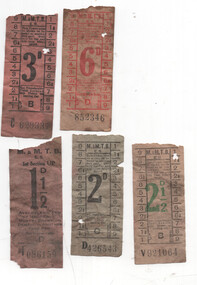
Ephemera - Tickets - MMTB - vertical format - set of 5, Melbourne & Metropolitan Tramways Board (MMTB), mid 1920s
... The tram had been sold to Melbourne Electric Supply Co. in 1928, formally MMTB / PMTT No. 66 1 - 1 1/2d on pink paper No. 086159 - with an advert for Kiwi boot polish on the rear 2 - 2d on green paper No 426543 - with an advert for Victoria Bitter on the rear 3 - 2 1/2d off white paper No 921 064 - with an advert for Fosters Lager on the rear 4 - 3d on light red paper No 629337 - with an advert for Kiwi boot polish on the rear 5 - 6d on off white paper, with fare and details printed in red, No 852346, - with an advert for Kiwi boot polish on the rear...The tram had been sold to Melbourne Electric Supply Co. in 1928, formally MMTB / PMTT No. 66 1 - 1 1/2d on pink paper No. 086159 - with an advert for Kiwi boot polish on the rear 2 - 2d on green paper No 426543 - with an advert for Victoria Bitter on the rear 3 - 2 1/2d off white paper No 921 064 - with an advert for Fosters Lager on the rear 4 - 3d on light red paper No 629337 - with an advert for Kiwi boot polish on the rear 5 - 6d on off white paper, with fare and details printed in red, No 852346, - with an advert for Kiwi boot polish on the rear Yields information about tram tickets printed for the MMTB during the mid 1920s for use on the Eastern System. tickets mmtb tramways Eastern System Set of 5 paper tickets Ephemera Tickets - MMTB - vertical format - set of 5 Melbourne & Metropolitan Tramways Board (MMTB) ...Tickets printed in a vertical format for the MMTB, Eastern Systems. All used. Were recovered from Geelong tram No. 25, later No. 28, during reconstruction work by the donor. The tram had been sold to Melbourne Electric Supply Co. in 1928, formally MMTB / PMTT No. 66 1 - 1 1/2d on pink paper No. 086159 - with an advert for Kiwi boot polish on the rear 2 - 2d on green paper No 426543 - with an advert for Victoria Bitter on the rear 3 - 2 1/2d off white paper No 921 064 - with an advert for Fosters Lager on the rear 4 - 3d on light red paper No 629337 - with an advert for Kiwi boot polish on the rear 5 - 6d on off white paper, with fare and details printed in red, No 852346, - with an advert for Kiwi boot polish on the rearYields information about tram tickets printed for the MMTB during the mid 1920s for use on the Eastern System.Set of 5 paper ticketstickets, mmtb, tramways, eastern system -
 Carlton Football Club
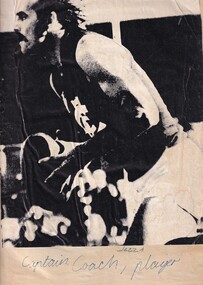
Scrap Book, C1979
... Former Melbourne Lord Mayor Ian Rice issued a challenge to incumbent President George Harris for control of the club. Jesaulenko threw his support behind Harris, who had appointed him Coach the previous season. In a bitter...Former Melbourne Lord Mayor Ian Rice issued a challenge to incumbent President George Harris for control of the club. Jesaulenko threw his support behind Harris, who had appointed him Coach the previous season. In a bitter ...Mainly Pictorial record of Carlton's GF 1979 win over Collingwood by 5 points 1979 Summary After the early season problems with coaching staff in 1978, the Carlton team seemed to really gel under the stewardship of Alex Jesaulenko after he took over as coach early in the season. In fact, Jesaulenko had won 14 of his 18 games in charge. This late season form certainly carried over into the 1979, Jesaulenko's team winning its first 6 matches, before a narrow 4 point loss to North Melbourne in Round 7. Carlton would be the dominant team of the season, losing only two more games, to Geelong by 6 points in Round 12 and to Collingwood in Round 21 by 19 points. Measures of the Blues dominance include being on top of the ladder in 20 of 22 rounds, finishing 2 games in front of second place on the ladder, winning by at least 50 points eight times and having an average winning margin of over 40 points in the team's 21 victories. It topped 100 points in all but 2 matches (one of which was the Grand Final in muddy conditions)- a feat never achieved by any team before. After finishing clearly the best side of the home and away season, the team had a week break in the first week of finals before taking on North Melbourne in the first Semi Final. After a tense first quarter in which both sides kicked only a goal a piece, Carlton started to exert its dominance in the second quarter, but poor kicking for goal left the Kangaroos still in the match, with the Blues having a 14 point half-time lead. Carlton's seven goals in the thrid quarter killed the game as a contest, and 38 point winning margin probably flatters North considering that the Blues had 36 scoring to 18. This victory would give the team a place in the Grand Final and another week break. Collingwood defeated North Melbourne in the Preliminary Final to setup a Grand Final clash between the two old enemies. After a slow start Carlton would trail by 10 points at quarter-time, but would lead by 1 point going into half-time. A 5 goal third quarter gave the Blues a handy 21 point lead going into the last quarter, but poor kicking would again threaten the chance of victory for the team. Kicking 1.4 for the last quarter Carlton hung on to win by only 5 points and claim our 12th Premiership, equalling both Collingwood and Essendon for the most VFL premierships at the time. Coupled with the Premiership was the Norm Smith Medal to Wayne Harmes. Incredibly, the only Carlton goal for the quarter was the infamous Harmes tap to Sheldon, where Wayne Harmes followed up his terrible kick, knocking the ball with an amazing sliding punch to Ken Sheldon in the goal square who kicked the goal to win the match. To this day the debate about whether the ball Harmes tapped back was out of bounds or not. In the final analysis the Blues would win 11.16 (82) to 11.11 (77) in our first Grand Final appearance since 1973 to end our glorious 1970's era as it started, with a Premiership. Jesaulenko now had the enviable record of 35 wins and a premiership from 42 games as coach in less than two seasons in the position. Unbelievably he wouldn't be the Carlton Coach in the following season. Former Melbourne Lord Mayor Ian Rice issued a challenge to incumbent President George Harris for control of the club. Jesaulenko threw his support behind Harris, who had appointed him Coach the previous season. In a bitter and hard fought election, Rice would win and Jesaulenko would cross to St Kilda as their coach. Jesaulenko would again coach the Blues, being appointed after Robert Walls mid season sacking in 1989 until the end of the 1990 season. You may have noticed that the Round orders in this year appear to be slightly out of order. Please click here to find out why. At the lower levels, Carlton also won the Under 19's Premiership for the 6th time in 1979, following on from the Under 19's Premiership in 1978. The team list has been scanned in and can be viewed here. This was Carlton's last Under 19's Premiership with the competition disappearing after 1991. Overall, Carlton with 6 premierships was behind only Richmond with 11 and the Kangaroos with 7.A mainly pictorial record of 1979 Carlton Triumph over Collingwood. Includes an autograph page of many 1970s Carlton Players.A4 Coverless Scrap Book -
 Carlton Football Club
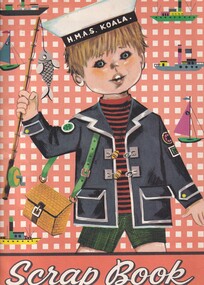
Scrap Book, Dedicated to Carlton Player John Goold
... bitter taste of those defeats was washed away when Barassi’s Blues edged out Essendon by 3 points in the 1968 Grand Final, and ended 21 years of despair at Princes Park. To win Carlton’s ninth VFL flag, the Blues had had to defeat the minor premier Bombers twice during the finals – and did so, thanks to a watertight defence led by Goold, and a dominant ruck division headed by John Nicholls. In round 5, 1969, Carlton hosted South Melbourne ...John Goold double Premiership PlayerA scrap Book dedicated to twice Premiership Player 1968 - 1970 John Goold Career : 1963 - 1970 Debut : Round 7, 1963 vs Footscray, aged 21 years, 338 days Carlton Player No. 754 Games : 108 Goals : 3 Last Game : Grand Final, 1970 vs Collingwood, aged 29 years, 90 days Guernsey No. 11 Height : 184 cm (6 ft ½ in.) Weight : 76 kg (12 stone, 0 lbs.) DOB : June 27, 1941 Premiership Player 1968, 1970 Carlton Hall of Fame All Australian 1966 A brilliant, flamboyant, two-time Premiership player for Carlton during the Barassi years in the ‘swingin’ sixties,’ John William Crosbie Goold became almost as famous for his dapper appearance off the field, as for his exploits on it. At the height of his football career, he was also a prominent ladies fashion designer – which led to him being dubbed ‘Mr Elegance’ by leading football commentator Lou Richards. Supporters and team-mates however, called him ‘Rags’ or ‘Ragsy,’ because of his involvement in the clothing, or ‘rag’ trade. Goold first came under notice as an outstanding junior athlete at Melbourne Grammar School. A true all-round sportsman, he shone at tennis, athletics, football and cricket. He was also a keen horseman who loved the game of polo and the rough and tumble of fox hunting. While at school he was a fervent Melbourne supporter, but strangely, never had much confidence in his football ability. “If I thought I was good enough, I would certainly have gone to Melbourne,” he said many years later. “But I honestly didn’t think I would ever amount to anything in this game. Cricket and tennis were the games that really interested me.’ However, after graduating from MGS, Goold went home to Healesville to star in the Bloods’ 1962 Yarra Valley Football Association Premiership team – an achievement that brought tempting offers from more than one VFL club. “Incentives were offered elsewhere,” he recalled, “but I gravitated to Carlton – partly because the deep blue of their guernsey attracted me, but mostly because of the good advice I got from people who even then were longsighted enough to predict that big things were ahead for this club.” The Blues were confident enough in Goold’s potential to offer him the guernsey number 11 previously worn with distinction by the likes of Jack Hale, Jim Knight, Ron Hines and Laurie Kerr, and his first senior game came in round 7, 1963 against Footscray at the Western Oval. He played on a half-forward flank alongside Brownlow Medallists Gordon Collis and John James on that Saturday afternoon, and kicked his first career goal in an 8-point win. Little did he know though, that it would be another six seasons before he would again experience the thrill of sending a football spinning between the big posts, because his future lay in defence. By his own admission, Goold struggled to find his feet in VFL football during his first two seasons, until the shock appointment of Ron Barassi as captain-coach of Carlton in 1965 began steering his career back on track. “I think you could say that 1965 was my first year of League football,” he said, “That’s the way I felt - that’s the way I reacted to Barassi.” Under Barassi, Goold rapidly developed into a superb running half-back flanker. Tenacious, and an often freakish high mark, he was unmistakable on the field thanks to his mane of dark hair, his loping running style and somewhat awkward kicking action. Furthermore, he had boundless courage. There is no doubt that he would have played many more games had he not been regularly pole-axed under the high ball – a fact he later freely admitted. “I was always getting knocked out,” he said, “and spent half my bloody time in hospital.” In the second half of 1965, an injury to centre half-back Gordon Collis forced Barassi to use Goold in the key defensive post. While it curtailed his rebounding instincts somewhat, ‘Ragsy’ rose to the challenge and rarely lowered his colours. Testament to his improvement, he finished third behind John Nicholls and Sergio Silvagni in Carlton’s 1965 Best and Fairest award, and followed up by being selected in the Victorian team for the 1966 Hobart Carnival. There, he had a superb series in which he was runner-up to West Australian Barry Cable in voting for the Tassie Medal, and capped it off by being named on a half-back flank in the All Australian team. Barassi’s influence at Carlton bore fruit in his third year, when the Blues returned to finals football at last. Richmond, Carlton, Geelong and Collingwood fought out the 1967 Premiership, and Ragsy Goold won the hearts of the Carlton faithful with two lion-hearted performances. Although Carlton was knocked out of contention by successive losses to Richmond and Geelong, Goold was tireless throughout both games, and it was obvious that he thrived on the added pressure of finals football. Precisely twelve months later, the bitter taste of those defeats was washed away when Barassi’s Blues edged out Essendon by 3 points in the 1968 Grand Final, and ended 21 years of despair at Princes Park. To win Carlton’s ninth VFL flag, the Blues had had to defeat the minor premier Bombers twice during the finals – and did so, thanks to a watertight defence led by Goold, and a dominant ruck division headed by John Nicholls. In round 5, 1969, Carlton hosted South Melbourne at Princes Park in a match significant for a number of reasons. As he regularly did, Ron Barassi swung his team around prior to the opening bounce, and Goold found himself in the unaccustomed role of ruck-rover. While the Blues set about establishing a good break on the scoreboard, Ragsy relished the freedom to kick two first half goals - his first majors for 78 games. Just before half-time however, he was flattened in a pack, concussed again, and replaced during the long break by Barry Gill. Alex Jesaulenko was substituted at the same time – by a shy, ambitious youngster named Bruce Doull, making his senior debut for Carlton in guernsey number 4. In September, 1969 the Navy Blues began their third straight finals campaign with an impressive 6-goal Semi Final win over Collingwood in front of more than 108,000 fans at the MCG. A fortnight later, Richmond stunned the flag favourites with a withering last quarter in the Grand Final, and knocked Carlton out of the Premiership race again at the last hurdle. Half-way through the year, Carlton's club doctor discovered that Goold had been playing with shin splints in both of his lower legs. The pain they caused was considerable, but Ragsy soldiered on and held down centre half-back throughout the season. John Goold’s VFL career at Carlton culminated in the fabled 1970 Grand Final triumph over Collingwood. What is not so well known is that Ragsy was only cleared to play in that game on the morning of the match. After narrowly losing to Collingwood in the second Semi Final, the Navy Blues destroyed St Kilda by 62 points in the Preliminary Final, and earned another shot at the Magpies in the decider. But one of Carlton’s problems was that Goold had been kicked on a shin against St Kilda, causing a burst blood vessel and serious swelling. Despite the best efforts of the club medical staff, Ragsy had only a slim chance of playing in the Grand Final right up until game day, when his worried coach reluctantly allowed him to take his place in the side. Later, Barassi justified his decision by saying that in his opinion, a less than fully fit Goold was still worth his place in the team. By half time in the Grand Final however, he was probably questioning that judgement - because Carlton had been totally outplayed, and trailed an impressive, cohesive Collingwood by 44 points. Therefore, Carlton’s magnificent comeback – orchestrated by Barassi, and sparked by the fairytale exploits of 19th man Ted Hopkins – is one of the greatest of all football stories. Against enormous odds, the Navy Blues fought their way back into the contest, and eventually, rolled over the top of the frantic Magpies to snatch victory by 10 points in the last few minutes of the match. Hopkins ended up with four goals, Barassi was hailed a genius, and Ragsy Goold was carted off to hospital immediately after the game to have further urgent treatment. While there, he decided that there was no better time to end his VFL career – especially because his burgeoning business interests were demanding more and more of his time. In the years after his football career ended, John Goold created a remarkably successful business empire. In 1971 he sold his fashion label and took up farming at Mortlake in western Victoria, where he coached the local football team for three seasons. Later, he formed a diversified pastoral company, and purchased a magnificent complex called Ballangeich Run at nearby Ellerslie. While his passion for farming and livestock grew, he began breeding top quality polo ponies, and represented Australia in international competition. During the 1997 and 1998 seasons, John's son Ed Goold played reserve grade football for Carlton. MEMORIES.... Ragsy Goold; the name stirs memories form my long ago childhood. Ragsy, with his unique kicking style, where he'd hold the ball (always a drop punt - in a time when the drop kick and the torpedo punt still reigned supreme) at the point of the ball, elbows bent and he'd lavishly drop the ball, his right arm then flinging back and up dramatically. That was the thing about Ragsy (so named because he worked in the clothing, or 'rag' trade), he was always dramatic. He always ensured his ankle guards and wrist guard were glowing white to match the great white CFC monogram he wore proudly on his chest, and with his long flowing locks, cut a dynamic figure through a young boy's mind. Ragsy was my idol. I loved his dashes from half back, his long accurate drop punts, most of all I loved his flair for the game. Ragsy played the game as an entertainer as well as a sportsman - he leapt high to punch or mark, and always seemed to have a bit of the thoroughbred about him - which is probably why after he retired, he took up fox chasing, polo, and riding his beloved thoroughbreds across the paddocks and over the fences of his property, I think he may have even represented Australia at the sport – really, that’s sort of how he played as a footballer. All sinewy muscle, long legs and famous leaps for the saving punch. Ragsy was part of the great backline that helped revive Carlton's fortunes. Legendary players Wes Lofts, Ian Collins, Kevin 'Racehorse' Hall, Vinnie Waite among them. All great teams have a great defence and the defence that Ragsy was an integral part of was no different. Where others provided the biffo, the muscle or the defensive pressure, Ragsy provided the dash, the flair, the sense of adventure that all great backlines must have. AND MORE.... I have had many favourite players while following the Blues, but there will always be a special spot for Ragsy Goold - running the lines, all long hair and flashing white guards. As a young man I moved to Carlton and began acting in a place called one-c-one. One night after a play, I was walking home. It was winter, and I was wearing my favouritte overcoat, a genuine ankle length tweed affair I had picked up in an Op Shop in Oakleigh for three dollars. As I strutted across Lygon Street, a deep male voice behind me called, 'hey laddie, how much for the overcoat?' I turned, and there was my childhood idol, Ragsy Goold, two beautiful women in tow, smiling and waiting for my answer. I loved that coat too much to part with it, even to Ragsy, so I shook my head - and he smiled, then walked off. I stood for a moment in the middle of the street shaking my head in disbelief. Ragsy bloody Goold had just offered to buy my overcoat! I knew at that point, as a young man of about twenty three, that life was going to be full of surprises and very entertaining - a bit like John ‘Ragsy’ Goold. ONE MORE.... A cold, wet day in the mid 1960's at the MCG and Victoria were playing South Australia (?) The ball that day was like a piece of soap, with players finding it impossible to mark. Just before half time a long kick sailed toward the mud heap that was the centre of the ground, and the pack rose to meet it. From this group of players an arm shot straight up, and the ball instantly came to a dead stop. The footy stuck in the player's palm as if the hand was coated in Tarzan's Grip. After all these years, it's the only recollection I have of that match, and that player was 'Mr. Elegance' John Goold. HUMOROUS HUNGRY.... Former opponent Richmond's Kevin Bartlett on Radio SEN in 2012 received a phone call from John. After the call Kevin told his listeners how "Mr Elegance" would always be dressed in a nice suit, shirt-tie and highly polished shoes. He then cracked a joke saying something like; "You know, John was so 'posh' that he used to play football wearing a cravat!" Milestones 50 Games: Round 15, 1967 vs Melbourne 100 Games: Round 13, 1970 vs Geelong Career Highlights 1965 - Percy Bentley Trophy - 3rd Best & Fairest 1966 - 5th Best & Fairest 1967 - Maurie Sankey Memorial Trophy - 4th Best & Fairest (on count back) 1968 - Premiership Player 1970 - 7th Best & Fairest 1970 - Premiership PlayerFoolscap Scrap Book -
 Melbourne Legacy
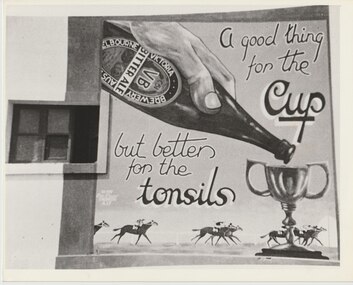
Photograph, A Mural West of Tobruk, 1941
... A photo of a mural in Libya painted by a South Australian Sapper of a bottle of Victorian Bitter Ale being poured into the Melbourne Cup trophy and horses racing. ...Black and white enlargement of a photo taken in Libya of Victorian Bitter Ale for the Melbourne Cup mural....A photo of a mural in Libya painted by a South Australian Sapper of a bottle of Victorian Bitter Ale being poured into the Melbourne Cup trophy and horses racing. ...A photo of a mural in Libya painted by a South Australian Sapper of a bottle of Victorian Bitter Ale being poured into the Melbourne Cup trophy and horses racing. The photo, and two others, were sent to Melbourne Legacy in 1979 by Legatee Syd Wilson of Yamba NSW. He thought Melbourne Legacy might be able to use them to generate money by selling them for advertising or publicity. He said they were enlargements of snapshots he had found in his old army trunk. The text says 'A good thing for the Cup but better for the tonsils'. Legatee Wilson's letter says the murals were: 'painted on three walls of a white concrete Italian block house (Police Check post I think), some 18/20 miles west of Tobruk, between Tobruk and Derna, and near a captured Italian airfield, somewhere about February 1941. Obviously they were painted by a Victorian Sapper. They were very well done, by a competent Sign-writer/artist, in correct and excellent colours (captured Itie paint no doubt - there was plenty in their Naval Stores at Tobruk).' (NB Itie was slang for Italian). 'The photos were there when we were coming back from Western Libya sometime in March 1941, prior to the 6th Division going to Greece.' From the AWM website the signs were painted by South Australian painter, SZ538 Sapper Leslie John “Doc” Dawes, 2/3rd Field Company, Royal Australian Engineers. There are several photos on the AWM site including the building the three murals were on.Photos taken by a Legatee when on active service in Libya in World War 2. They were donated to Legacy when it was thought they could be used for fundraising, which shows that Legatees were conscious of the way Legacy needs to generate funds to continue its work.Black and white enlargement of a photo taken in Libya of Victorian Bitter Ale for the Melbourne Cup mural.tobruk, beer, victorian bitter ale, ale, horse racing, murals, world war 2 -
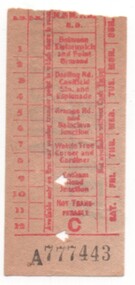 Melbourne Tram Museum
Ephemera - Ticket/s, Melbourne & Metropolitan Tramways Board (MMTB), MMTB Transfer ticket, early 1920's
... Bitter" print on the rear. Ticket number A777443. MMTB Transfer ticket Ephemera Ticket/s Melbourne & Metropolitan Tramways Board (MMTB) ...See notes for further information from Dean Filgate.Ticket - MMTB red printing on light brown paper, with the number in black ink. A transfer ticket matched with Reg Item 5521, listing the various points of transfer between electric and cable trams. Has a "Victoria Bitter" print on the rear. Ticket number A777443.trams, tramways, tickets, mmtb, transfer tickets
