
Showing 35 items matching " metal/cut steel"
-
 Embroiderers Guild, Victoria
Functional Object - Buttons, Late 19th century
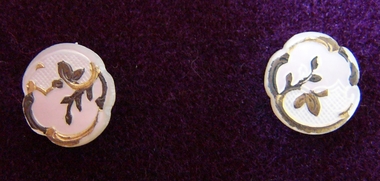
... ... Metal/Cut steel...Buttons Late 19th century Diamente Mother of Pearl Metal/Cut steel B. 7 x small pearl buttons with incised thistle design coloured pink and green. 9 l.5 cm small round carved pearl buttons in Rococo style, gold and black colour. ...B. 7 x small pearl buttons with incised thistle design coloured pink and green. 9 l.5 cm small round carved pearl buttons in Rococo style, gold and black colour. Mounted on purple velvet by Norma Bain.buttons, late 19th century, diamente, mother of pearl, metal/cut steel -
 Embroiderers Guild, Victoria
Functional Object - Buttons, Late 19th century
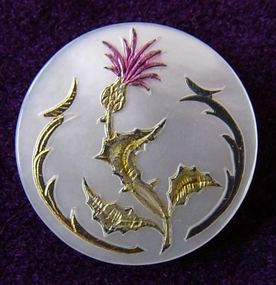
... ... Metal/Cut steel...Buttons Late 19th century Diamente Mother of Pearl Metal/Cut steel C. 9 large 2.5 cm mother of pearl buttons with thistle design with pink and green. ...C. 9 large 2.5 cm mother of pearl buttons with thistle design with pink and green. Mounted on purple velvet by Norma Bain.buttons, late 19th century, diamente, mother of pearl, metal/cut steel -
 Embroiderers Guild, Victoria
Functional Object - Buttons, Late 19th century
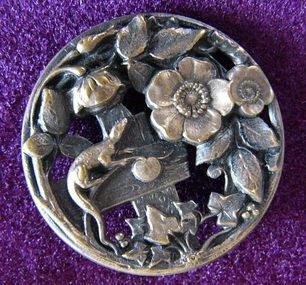
... ... Metal/Cut steel...Buttons Late 19th century Diamente Mother of Pearl Metal/Cut steel D. Metal floral . 4 large bronze alloy buttons with flowers and lizard . ...D. Metal floral . 4 large bronze alloy buttons with flowers and lizard . Mounted on purple velvet by Norma Bain.buttons, late 19th century, diamente, mother of pearl, metal/cut steel -
 Embroiderers Guild, Victoria
Functional Object - Buttons, Late 19th century
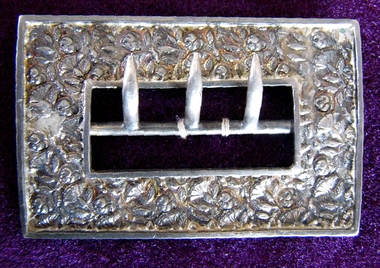
... ... Metal/Cut steel...Buttons Late 19th century Diamente Mother of Pearl Metal/Cut steel E. Shoe or dress buckle - metal alloy with floral design. ...E. Shoe or dress buckle - metal alloy with floral design. Mounted on purple velvet by Norma Bain.buttons, late 19th century, diamente, mother of pearl, metal/cut steel -
 Embroiderers Guild, Victoria
Functional Object - Diamante Shoe Buckle, Late 19th century
... ... Metal/Cut steel...Buttons Late 19th century Diamente Mother of Pearl Metal/Cut steel F. Shoe or dress buckle Diamente Mounted on purple velvet by Norma Bain. ...F. Shoe or dress buckle Diamente Mounted on purple velvet by Norma Bain.buttons, late 19th century, diamente, mother of pearl, metal/cut steel -
Embroiderers Guild, Victoria
Functional Object - Buttons, Late 19th century
... ... Metal/Cut steel...Buttons Late 19th century Diamente Mother of Pearl Metal/Cut steel G. 8 diamond shaped steel cut buttons Mounted on purple velvet by Norma Bain. ...G. 8 diamond shaped steel cut buttons Mounted on purple velvet by Norma Bain.buttons, late 19th century, diamente, mother of pearl, metal/cut steel -
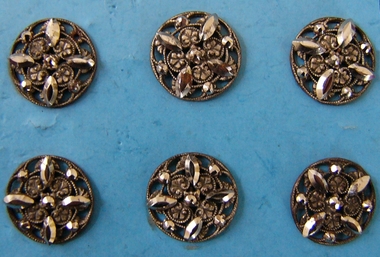 Embroiderers Guild, Victoria
Functional Object - Buttons, Late 19th century
... ... Metal/Cut steel...Buttons Late 19th century Diamente Mother of Pearl Metal/Cut steel A. 14 round steel buttons Mounted on purple velvet by Norma Bain. ...A. 14 round steel buttons Mounted on purple velvet by Norma Bain.buttons, late 19th century, diamente, mother of pearl, metal/cut steel -
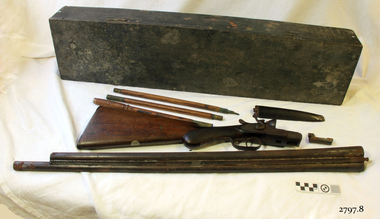 Flagstaff Hill Maritime Museum and Village
Weapon - Shotgun, Double Barrel, ISAAC HOLLIS & SONS, ca. 1904
... STEEL 84245” Paper note included with gun, written in felt tip pen “ENTERPRISE”. This double-barrel shotgun is 12-gauge, complete with a cleaning rod and a wooden storage box. The firearm has been altered from its original configuration: the right barrel has been cut shorter, resulting in sharp edges at the muzzle, and a metal extension has been fitted to the stock. ...The proof marks on the barrels (a crown and letters BV) denote that the shotgun design was made from the year 1904, and that it was nitro-proof tested in Birmingham, England. David Melville Carrison (1895 to 1960) of Port MacDonnell was the previous owner of this Isaac Hollis & Sons double-barrel shotgun. His grandfather, Adam Kerrison Carrison (1833-1903), was an early settler who worked as a fisherman in that once-bustling seaport. His uncle John was a a horse-breaker, a boat hand, and a member of the lifeboat crew, receiving a medal for his part in saving the crew of a French barque. Currently, no connection has been made between the gun, its owner, and the note with the word “Enterprise”: a New Zealand-built, two-masted schooner that was wrecked in Lady Bay, Warrnambool, in 1950. Gun makers, ISAAC HOLLIS & SONS: The Hollis Brothers were first recorded as operating from 11 Weaman Row in 1840, although evidence suggests the business may have commenced before then. Over time, the firm became known as Isaac Hollis & Sons, with claims of its establishment dating back to 1814. This earlier date is supported by records of Richard and William Hollis trading in Bath Street, Birmingham, between 1814 and 1818, which raises the possibility that Isaac and Frederick Hollis were their descendants. The principal brothers involved in the business were Isaac Hollis, born in 1815, and Frederick Hollis, whose birth date remains unknown. Frederick’s life was cut short when he died on 20 December 1839. According to the 1841 census, Isaac Hollis resided in Weaman Row and was listed as a 25-year-old gun and pistol maker. He was married to Emma, who was born in 1821, and together they had two children: Isaac, born in 1837, and Henry, born in 1839. Following Frederick’s death, Isaac continued to operate under the name Hollis Brothers until 1845, after which he renamed the business Hollis Brothers & Co. This entity remained active up to 1848. In 1844, Isaac Hollis entered a brief partnership with William Tranter at 10 & 11 Weaman Row, likely to fulfil a specific contract or to supply parts. This partnership continued until 1849. In 1848, Isaac Hollis formed a partnership with Isaac Brentnall Sheath, establishing the firm of Hollis & Sheath and expanding their operations into 10 Weaman Row. The partnership saw Hollis & Sheath become licensed manufacturers of percussion breech-loading guns, positioning the company as a notable presence in the industry. In 1861, Sheath left the partnership and emigrated to New Zealand, where he conducted several enterprises and was elected as a provincial councillor. He died in Christchurch on 19th May 1897. In 1861, after Isaac Sheath left, the business name became Isaac Hollis & Sons. By approximately 1870, Isaac Hollis and Henry Hollis had assumed responsibility for the daily management of the firm, with Isaac overseeing the overall management and marketing of the company's products, and Henry managing the manufacturing processes. During this period, the company became known for producing large volumes of affordable trade guns and sporting guns, catering to customers in South Africa and the British colonies. In 1870, Isaac Hollis & Sons opened a retail location at 44a Cannon Street in London, and in 1871, it operated at 83 Cheapside Street. Isaac Hollis Jnr passed away in October 1875 in Birmingham at the age of 37, having never married. In 1876/1877, Henry Hollis registered a limited liability company under the name Isaac Hollis & Sons Ltd. However, by 1879, trading resumed under the name Isaac Hollis & Sons, and the London shop moved to 6 Great Winchester Street. From 1932 to 1933, the business operated in London as Hollis, Bentley & Playfair. The final closure of Hollis, Bentley & Playfair occurred in Birmingham in 1953. The shotgun was manufactured by Isaac Hollis & Sons, a firm with a strong reputation for producing firearms. This early 1900s example represents a standard pattern that was produced in large quantities for everyday use. This double-barrel shotgun is 12-gauge, complete with a cleaning rod and a wooden storage box. The firearm has been altered from its original configuration: the right barrel has been cut shorter, resulting in sharp edges at the muzzle, and a metal extension has been fitted to the stock. The cleaning rod consists of three separate segments that screw together for use. The shotgun is housed in a black-painted wooden case with a hinged lid showing inscriptions for the maker and Serial Number. Maker was I. HOLLIS & SONS, Serial Number SN 84245. David Melville Carrison of Port MacDonnell was the previous owner. A handwritten note that had the word 'Enterprise' was with the gun. "I. HOLLIS & SONS". SN on stock “84245”. Badge on both sides “Crown [symbol] / BV”. “Crown [symbol] / NP”, “12G inside Diamond [symbol]”, “NITRO PROOF”, “STEEL 84245” Paper note included with gun, written in felt tip pen “ENTERPRISE”. flagstaff hill, maritime museum, maritime village, warrnambool, great ocean road, shipwreck coast, firearm, gun, double-barrel, shotgun, cleaning rod, gunsmith, smithed, 12 gauge, sn 84245, serial number 84245, david melville carrison, early 1900s, richard and william hillis, herbert & co., herbert & co. london, hollis & sons, isaac hollis & sons, isaac hillis & sons ltd., hollis bentley & playfair., isaac hollis, frederick hollis, isaac brentnall sheath, isaac sheath, william tranter, gun manufacturer, pistol manufacturer, gun and pistol maker, birmingham, military supplies, enterprise, 1904 -
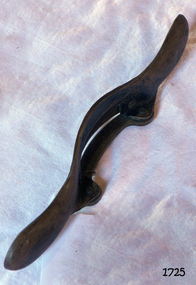 Flagstaff Hill Maritime Museum and Village
Tool - Spokeshave, Sides & Skinner, First half of the 20th century
... steel blades, before being largely superseded by the development of metal-bodied spokeshaves in the latter half of the 19th century, though many woodworkers still use wooden spokeshaves. Due to their widespread use and versatility vintage wooden spokeshaves remain commonly available and relatively low in price. Spokeshaves consist of a blade or iron secured to the body or stock of the tool, which has two handles one for each hand. The bottom surface of the tool is called the sole. The blade can be removed for sharpening, and adjusted to vary the depth of the cut...steel blades, before being largely superseded by the development of metal-bodied spokeshaves in the latter half of the 19th century, though many woodworkers still use wooden spokeshaves. Due to their widespread use and versatility vintage wooden spokeshaves remain commonly available and relatively low in price. Spokeshaves consist of a blade or iron secured to the body or stock of the tool, which has two handles one for each hand. The bottom surface of the tool is called the sole. The blade can be removed for sharpening, and adjusted to vary the depth of the cut ...A spokeshave is a hand tool used to shape and smooth woods in woodworking jobs such as making cart wheel spokes, chair legs, paddles, bows, and arrows. The tool consists of a blade fixed into the body of the tool, which has a handle for each hand. Historically, a spokeshave was made with a wooden body and metal cutting blade. With industrialization metal bodies displaced wood in mass-produced tools. Being a small tool, spokeshaves are not suited to working large surfaces. The name spokeshave dates back to at least the 16th century, though the early history of the tool is not well documented. The name spokeshave reflects the early use of the tool by wheelwrights. The first spokeshaves were made of wood usually beech with steel blades, before being largely superseded by the development of metal-bodied spokeshaves in the latter half of the 19th century, though many woodworkers still use wooden spokeshaves. Due to their widespread use and versatility vintage wooden spokeshaves remain commonly available and relatively low in price. Spokeshaves consist of a blade or iron secured to the body or stock of the tool, which has two handles one for each hand. The bottom surface of the tool is called the sole. The blade can be removed for sharpening, and adjusted to vary the depth of the cut. An early design consisted of a metal blade with a pair of tangs to which the wooden handles were attached, as with a draw knife. Unlike a draw knife, but like a plane, spokeshaves typically have a sole plate that fixes the angle of the blade relative to the surface being worked. There are a wide variety of different types of spokeshave, suited to different trades and applications. A now vintage tool made by an Australian manufacture in NSW who specialised in making pruning shears, hacksaw frames and heel shaves under the Erskin brand name. This tool is now sought after by collectors even though it was probably made in the first quarter of the 20th century. It gives a snapshot of how carpenters work with wood by hand showcasing their craftsmanship. Hollow face Spokeshave, metal body with black enamel finish. Erskin stamped on frontflagstaff hill, warrnambool, flagstaff-hill, flagstaff-hill-maritime-museum, maritime-museum, shipwreck-coast, flagstaff-hill-maritime-village, spokeshave, cabinet makers tools, wood working, cutting tool, shaping tool -
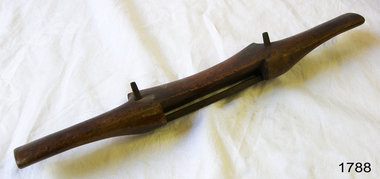 Flagstaff Hill Maritime Museum and Village
Tool - Spokeshave, Mathieson and Son, 1860 to 1910
... steel blades, before being largely superseded by the development of metal-bodied spokeshaves in the latter half of the 19th century, though many woodworkers still use wooden spokeshaves. Due to their widespread use and versatility vintage wooden spokeshaves remain commonly available and relatively low in price. Spokeshaves consist of a blade or iron secured to the body or stock of the tool, which has two handles – one for each hand. The bottom surface of the tool is called the sole. The blade can be removed for sharpening, and adjusted to vary the depth of the cut...steel blades, before being largely superseded by the development of metal-bodied spokeshaves in the latter half of the 19th century, though many woodworkers still use wooden spokeshaves. Due to their widespread use and versatility vintage wooden spokeshaves remain commonly available and relatively low in price. Spokeshaves consist of a blade or iron secured to the body or stock of the tool, which has two handles – one for each hand. The bottom surface of the tool is called the sole. The blade can be removed for sharpening, and adjusted to vary the depth of the cut ...A spokeshave is a hand tool used to shape and smooth woods in woodworking jobs such as making cart wheel spokes, chair legs, paddles, bows, and arrows. The tool consists of a blade fixed into the body of the tool, which has a handle for each hand. Historically, a spokeshave was made with a wooden body and metal cutting blade. With industrialization metal bodies displaced wood in mass-produced tools. Being a small tool, spokeshaves are not suited to working large surfaces. The name spokeshave dates back to at least the 16th century, though the early history of the tool is not well documented. The name spokeshave reflects the early use of the tool by wheel wrights. The first spokeshaves were made of wood usually beech with steel blades, before being largely superseded by the development of metal-bodied spokeshaves in the latter half of the 19th century, though many woodworkers still use wooden spokeshaves. Due to their widespread use and versatility vintage wooden spokeshaves remain commonly available and relatively low in price. Spokeshaves consist of a blade or iron secured to the body or stock of the tool, which has two handles – one for each hand. The bottom surface of the tool is called the sole. The blade can be removed for sharpening, and adjusted to vary the depth of the cut. An early design consisted of a metal blade with a pair of tangs to which the wooden handles were attached, as with a draw knife. Unlike a draw knife, but like a plane, spokeshaves typically have a sole plate that fixes the angle of the blade relative to the surface being worked. There are a wide variety of different types of spokeshave, suited to different trades and applications. Company History: The firm of Alexander Mathieson & Sons was one of the leading makers of hand tools in Scotland. Its success went hand in hand with the growth of the shipbuilding industries on the Firth of Clyde in the nineteenth century and the emergence of Glasgow regarded as the "second city of the Empire". It also reflected the firm's skill in responding to an unprecedented demand for quality tools by shipyards, cooperage's and other industries, both locally and far and wide. The year 1792 was deemed by the firm to be that of its foundation it was in all likelihood the year in which John Manners had set up his plane-making workshop on Saracen Lane off the Gallowgate in the heart of Glasgow, not far from the Saracen's Head Inn, where Dr Johnson and James Boswell had stayed on their tour of Scotland in 1773. Alexander Mathieson (1797–1851) is recorded in 1822 as a plane-maker at 25 Gallowgate, but in the following year at 14 Saracen's Lane, presumably having taken over the premises of John Manners. The 1841 national census described Alexander Mathieson as a master plane-maker at 38 Saracen Lane with his son Thomas Adam working as a journeyman plane-maker. In 1849 the firm of James & William Stewart at 65 Nicolson Street, Edinburgh was taken over and Thomas was put in charge of the business, trading under the name Thomas A. Mathieson & Co. as plane and edge-tool makers. Thomas's company acquired the Edinburgh edge-tool makers Charles & Hugh McPherson and took over their premises in Gilmore Street. The Edinburgh directory of 1856/7 the business is recorded as being Alexander Mathieson & Son, plane and edge-tool makers at 48 Nicolson Street and Paul's Work, Gilmore Street. The 1851 census records indicate that Alexander was working as a tool and plane-maker employing eight men. Later that year Alexander died and his son Thomas took over the business. Under the heading of an edge-tool maker in the 1852/3 (Post-Office Glasgow Annual Directory) the firm is now listed as Alexander Mathieson & Son. By the early 1850s, the business had moved to 24 Saracen Lane. The directory for 1857/8 records that the firm had moved again only a few years later to East Campbell Street, also off the Gallowgate, and that through further diversification was also manufacturing coopers' and tin men's tools. The ten-yearly censuses log the firm's growth and in 1861 Thomas was a tool manufacturer employing 95 men and 30 boys; in 1871 he had 200 men working for him and in 1881 300 men. By 1899 the firm had been incorporated as Alexander Mathieson & Sons Ltd, even though only Alexander's son Thomas appears ever to have joined the firm.A vintage tool made by a well-known firm made for other firms and individuals that worked in wood. The tool was used to shape various items mainly in use by wheel wrights. A significant vintage item from the mid to late 19th century that today is quite sought after by collectors. It gives us a snapshot of how trade people predominately worked materials such as wood by hand and with tools that were themselves hand made shows the craftsman's art of the time. Spokeshave with blade 4 inches wide.Mathieson and Son Glasgow. flagstaff hill, warrnambool, shipwrecked-coast, flagstaff-hill, flagstaff-hill-maritime-museum, maritime-museum, shipwreck-coast, flagstaff-hill-maritime-village, spokeshave, mathieson and son, carpentry tools, wheel wright tools -
 Flagstaff Hill Maritime Museum and Village
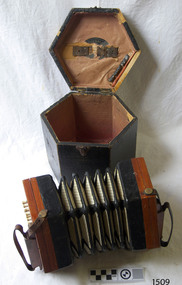
Instrument - Concertina, Lachenal and Co, 1879-1933
... cut-outs and leather straps attached to brass buttons. Five-fold bellows have light coloured sides with reinforced edges and corners. Constructed with steel reeds and bone key-buttons. Wooden, black fabric-covered hexagonal case with triangular metal...Flagstaff Hill Warrnambool Shipwrecked-coast Flagstaff-Hill Flagstaff-Hill-Maritime-Museum Maritime-Museum Shipwreck-coast Flagstaff-Hill-Maritime-Village concertina squeeze box musical instrument London english make trade mark 15222 english-style reed richard ballinger Louis Lachenal concertina manufacturer reed-shoe lachenal anglo lachenal & co lachenal Label within oval cut-out "LACHENAL & Co / PATENT CONCERTINA / MANUFACTURERS / LONDON", Label inside lid " - CHENAL -", Impressed into wood STEEL REEDS", "ENGLAND", "TRADE MARK ENGLISH MAKE [reed-shoe symbol]" , (originally marked with Number "98030" ) Concertina, six sided, 21 buttons, with fitted case. Wooden ends have carved cut-outs and leather straps attached to brass buttons. Five-fold bellows have light coloured sides with reinforced edges and corners. Constructed with steel reeds and bone key-buttons. Wooden, black fabric-covered hexagonal case with triangular metal ...Louis Lachenal manufactured concertinas for C Wheatstone & Co. from around 1848-1858 in a combined home and manufactory in Cheswick, England. He then establish up his own business 'Lachenal's' at 8 Little James Street in London. In 1863 the firm began advertising both 'Anglo and English concertinas, which were more expensive. Lachenal passed away in 1861, so his wife Elizabeth took over the business. The firm was sold to a group of five businessmen in about 1873 and in 1874 the firm became ‘Lachenal & Co.’ A Trade Mark application was made by Richard Ballinger on behalf of Lachenal & Co. on 31st August 1878 and the Number 19,555 was published in the Trade Mark Journal January 8, 1879. The symbol was an English-style reed-shoe with the words 'Trade Mark' and 'English Make'. It was stamped on the right-hand rail (handle) of the Lachenal Anglos, to distinguish them from the German-made ones. It seems that the company ceased business in 1933.This concertina, made in the late 19th to early 20th century, represents the portable musical entertainment of the early settlers in the colony of Australia. Concertina, six sided, 21 buttons, with fitted case. Wooden ends have carved cut-outs and leather straps attached to brass buttons. Five-fold bellows have light coloured sides with reinforced edges and corners. Constructed with steel reeds and bone key-buttons. Wooden, black fabric-covered hexagonal case with triangular metal catch, two brass hinges, leather handle and faded red lining. Inscriptions on label inside lid and on wooden ends of bellows. Lachenal, Anglo design, made by Lachenal & Co. of London. Label within oval cut-out "LACHENAL & Co / PATENT CONCERTINA / MANUFACTURERS / LONDON", Label inside lid " - CHENAL -", Impressed into wood STEEL REEDS", "ENGLAND", "TRADE MARK ENGLISH MAKE [reed-shoe symbol]" , (originally marked with Number "98030" )flagstaff hill, warrnambool, shipwrecked-coast, flagstaff-hill, flagstaff-hill-maritime-museum, maritime-museum, shipwreck-coast, flagstaff-hill-maritime-village, concertina, squeeze box, musical instrument, london, english make, trade mark 15222, english-style reed, richard ballinger, louis lachenal, concertina manufacturer, reed-shoe, lachenal anglo, lachenal & co, lachenal -
 Federation University Historical Collection
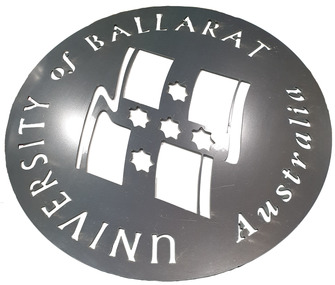
Memorabilia, University of Ballarat Metal Logo, c2004
... University of Ballarat is a predecessor institution of Federation University Australia. university of ballarat university of ballarat logo southern cross flag metal plaque sign marketing Laser cut steel University of Ballarat logo University of Ballarat Metal Logo Memorabilia ...University of Ballarat is a predecessor institution of Federation University Australia.Laser cut steel University of Ballarat logouniversity of ballarat, university of ballarat logo, southern cross flag, metal plaque, sign, marketing -
 Federation University Historical Collection
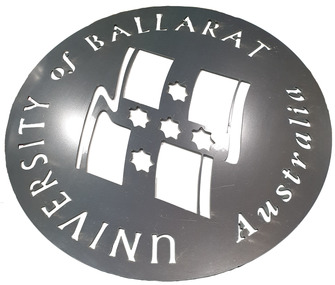
Memorabilia, University of Ballarat Metal Logo, c2004
... University of Ballarat is a predecessor institution of Federation University Australia. university of ballarat university of ballarat logo southern cross flag metal plaque sign marketing Laser cut steel University of Ballarat logo University of Ballarat Metal Logo Memorabilia ...University of Ballarat is a predecessor institution of Federation University Australia.Laser cut steel University of Ballarat logouniversity of ballarat, university of ballarat logo, southern cross flag, metal plaque, sign, marketing -
 City of Moorabbin Historical Society (Operating the Box Cottage Museum)
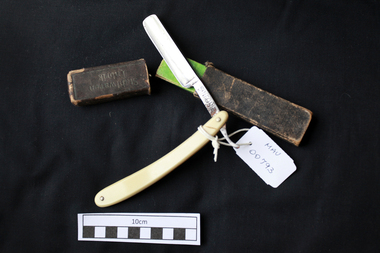
Personal Effects, Cut-throat razor ‘Sinfonie’, c1900 -1930
... metal running transversely at the junction where the main blade attaches to the shank is called the stabiliser. Although straight razors were once the principal method of manual shaving, they have been largely overshadowed by the safety razor, which incorporates a disposable blade. Electric razors of various types have also been an available alternative, especially since the 1950s. Straight razors require considerable skill to hone and strop, and require more care during shaving cut-throat razors, straight razors, shaving equipment, steel ...Gebrüder Stoll, Central-Stahlwarenfabrik Founded in 1889 . Solingen-Foche in 1900- 1930. Names: ‘Gallop’, ‘Pedecor’ (Dedecor?), ‘Sinfonie’, ‘Stoll’, ‘Stoll Brothers’. The parts of a straight razor and their function are described as follows: The narrow end of the blade rotates on a pin called the pivot, between two protective pieces called the scales or handle. The upward curved metal end of the narrow part of the blade beyond the pivot is called the tang and acts as a lever to help raise the blade from the handle. One or two fingers resting on the tang also help stabilize the blade while shaving. The narrow support piece between the tang and the main blade is called the shank, but this reference is often avoided because it can be confusing. The shank sometimes features decorations and the stamp of the country of origin. The top side and the underside of the shank can sometimes exhibit indentations known as fluting, or jimps for a more secure grip. The curved lower part of the main blade from the shank to the cutting edge is called the shoulder. The point where the shoulder joins the cutting edge is called the heel. A thick strip of metal running transversely at the junction where the main blade attaches to the shank is called the stabiliser. Although straight razors were once the principal method of manual shaving, they have been largely overshadowed by the safety razor, which incorporates a disposable blade. Electric razors of various types have also been an available alternative, especially since the 1950s. Straight razors require considerable skill to hone and strop, and require more care during shaving A man's cut-throat razor that folds to protect blade inside handle. with a caseon blade 'SINFONIE' on case; Stahlwaron / Fabrikcut-throat razors, straight razors, shaving equipment, steel blades, stoll gebruder ltd., solingen germany, cutlers, steel manufacturers, ‘sinfonie’ trade mark, early settlers, market gardeners, moorabbin, bentleigh, cheltenham, -
 City of Moorabbin Historical Society (Operating the Box Cottage Museum)
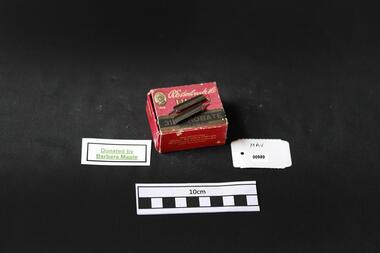
Education, Pen Nibs ' R. Esternbrook Co. Ltd, 20thC
... metal and plastic. Generally speaking, dip pens have no ink reservoir; therefore the user has to recharge the ink from an ink bowl or bottle in order to continue drawing or writing. Birmingham, England was home to many of the first dip pen manufacturers. John Mitchell pioneered mass production of steel pens in 1822; prior to that the quill pen had been the most common form of writing instrument. His brother William Mitchell later set up his own pen making business in St Paul's square. The Mitchell family is credited as being the first manufacturers to use machines to cut...metal and plastic. Generally speaking, dip pens have no ink reservoir; therefore the user has to recharge the ink from an ink bowl or bottle in order to continue drawing or writing. Birmingham, England was home to many of the first dip pen manufacturers. John Mitchell pioneered mass production of steel pens in 1822; prior to that the quill pen had been the most common form of writing instrument. His brother William Mitchell later set up his own pen making business in St Paul's square. The Mitchell family is credited as being the first manufacturers to use machines to cut ...Dip pens emerged in the early 19th century, when they replaced quill pens. They were generally used prior to the development of fountain pens in the later 19th century, and are now mainly used in illustration, calligraphy, and comics. A nib pen usually consists of a metal nib with capillary channels like those of fountain pen nibs, mounted on a handle or holder, often made of wood. Other materials can be used for the holder, including bone, metal and plastic. Generally speaking, dip pens have no ink reservoir; therefore the user has to recharge the ink from an ink bowl or bottle in order to continue drawing or writing. Birmingham, England was home to many of the first dip pen manufacturers. John Mitchell pioneered mass production of steel pens in 1822; prior to that the quill pen had been the most common form of writing instrument. His brother William Mitchell later set up his own pen making business in St Paul's square. The Mitchell family is credited as being the first manufacturers to use machines to cut pen nibs, which greatly sped up the process. Germany 1842 began at the factory of Heintze & Blanckertz in Berlin By 1860 there were about 100 companies making steel nibs in Birmingham, but 12 large firms dominated the trade. Dip pens are rarely used now for regular writing, most commonly having been replaced by fountain pens, rollerball pens, or ballpoint pens. However, dip pens are still appreciated by artists, as they can make great differences between thick and thin lines, and generally write more smoothly than other types of pens. Dip pens are also preferred by calligraphers for fine writing. Richard Esterbrook was a Cornish Quaker from England who saw an opportunity in the United States to manufacture Steel Pens. In 1856 R.Esterbrook traveled to the US to set up shop as 'The Steel Pen Manufacturing Company' where Richard made these steel pens by hand using special tools and machines (mostly that Richard had to invent). In 1858 he was able to establish himself as the sole pen manufacturer in the USA and he changed the company name to 'The Esterbrook Steel Pen Mfg. Co.' The company settled down in Camden, New Jersey. Quality was a key factor in his success. His steel pens were versatile, long lasting, and came in many different styles to fit the varied writing styles of the public. Sadly, Richard Esterbrook didn't see the 'empire' his company was to become as he passed away in Atlanta on October 12th 1895 . in 1896 they started an Esterbrook branch in England to join the ranks of the other main pen manufactures in Birmingham . In 1912 the company had gotten so large that they erected a 5 story building, just to continue manufacturing pens. By 1920 the fountain pen was fast becoming more popular amongst people who were tired of 'dipping.' To meet this demand the company manufactured its first fountain pen. In 1930 the company sought less expensive means of manufacturing pens because gold and 'jewel' tips were too expensive and in this same year they began selling fountain pens in England . The Esterbrook Company began using the metal Iridium which they called 'Durachrome.' To meet the fountain pen demand the company reformed as 'The Esterbrook Hazel Pens Ltd.' In 1940 war had come to strike a blow at the Esterbrook company. On November 19th 1940 their England location was hit by an incendiary bomb destroying half of the location! To make matters worse, when putting out the fire using a human water bucket chain, someone accidentally grabbed a bucket of paraffin and set the place further ablaze. Oddly enough, the company was able to rebuild the structure during the war. However, the government had placed a stipulation that 50% of its capacity was to be used for government related purposes. In 1947 the company bought out John Mitchell and the American branch had already acquired Hazel Pen Co. The company re-formed again as 'The Esterbrook Pen Company.' This is the last company name the dip pen nibs were manufactured under. A box of Steel dipping nibs for writing pensOn Box; Photo of man / R. Esternbrook Co. / PENS / PROBATEsteel nibs, writing pens, education, schools, writing, caligraphy, artists, moorabbin, bentleigh, cheltenham, dip pens, inkwells, fountain pens, mitchell john, birmingham england, esternbrook richard, maple barbara -
 City of Moorabbin Historical Society (Operating the Box Cottage Museum)
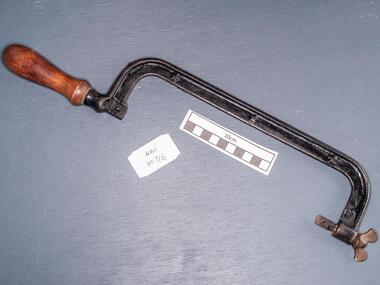
Tools, steel hacksaw with wooden handle, c1900
... metal. They can also cut various other materials, such as plastic and wood; for example, plumbers and electricians often cut plastic pipe and plastic conduit with them. On hacksaws, as with most frame saws, the blade can be mounted with the teeth facing toward or away from the handle, resulting in cutting action on either the push or pull stroke. In normal use, cutting vertically downwards with work held in a bench vice, hacksaw blades should be set to be facing forwards. A steel ...A hacksaw is a fine-toothed saw, originally and principally for cutting metal. They can also cut various other materials, such as plastic and wood; for example, plumbers and electricians often cut plastic pipe and plastic conduit with them. On hacksaws, as with most frame saws, the blade can be mounted with the teeth facing toward or away from the handle, resulting in cutting action on either the push or pull stroke. In normal use, cutting vertically downwards with work held in a bench vice, hacksaw blades should be set to be facing forwards. A steel hacksaw with a wooden handle but without blade -
 Warrnambool and District Historical Society Inc.
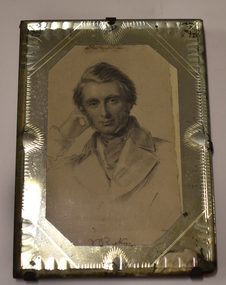
Artwork, other - Framed copy of engraving, John Ruskin, late 19th century
... This is a copy of a steel plate engraving, a black and white sketch of the head and upper body of John Ruskin. It is enclosed in a cut glass frame with a red cardboard backing attached by metal clips. ...Ruskin This is a copy of a steel plate engraving, a black and white sketch of the head and upper body of John Ruskin. It is enclosed in a cut glass frame with a red cardboard backing attached by metal clips. ...This framed copy of a sketch of John Ruskin comes from the original steel plate engraving dating from about 1845. John Ruskin (1819-1900) was a notable English writer, philosopher, art critic and polymath in the Victorian era. He was the first Professor of Fine Art at Oxford University and was a prolific writer interested in the connection between nature, art and society, anticipating the more modern interest in environmental and sustainability issues. This framed item is from the collection of the old Warrnambool Museum which was first established in 1871 by the Warrnambool Mechanics' Institute under the curatorship of a local policeman, Joseph Archibald. This first museum faded away but was revived in 1883 by Joseph Archibald in his retirement years. The Museum continued as part of the Mechanics' Institute until 1963 as an important and much-admired institution. Most of the collection was lost over the years but some items remain, housed at the Warrnambool Art Gallery, Flagstaff Hill Maritime Museum and the Warrnambool and District Historical Society, with the John Ruskin item being part of the latter group's collection.This item is of considerable interest, firstly because it comes from the collection of the old Warrnambool Museum and secondly because it shows the local interest in the 19th century of the notable English writer and philosopher, John Ruskin. This is a copy of a steel plate engraving, a black and white sketch of the head and upper body of John Ruskin. It is enclosed in a cut glass frame with a red cardboard backing attached by metal clips. A section of the backing is torn off and there is damage to the bottom part of the glass frame.J. Ruskinold warrnambool museum, warrnambool art gallery, flagstaff hill maritime museum, warrnambool & district historical society, joseph archibald, john ruskin portrait -
 Kiewa Valley Historical Society
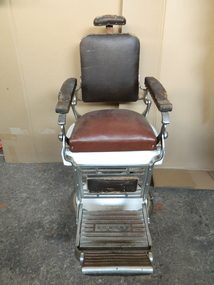
Barber's Chair
... metal and leather and are heavy. Mt Beauty township had a Barber's business during the construction of the Kiewa Hydro Electric Scheme and beyond. ""Sam The Barber" was an original Kiewa character. Probably for 45 years cut the hair of thousands of Kiewa workers with his scissors, hand clippers and cut throat razor." Ref. online: "The Mt Beauty & Murray connection" Barber's chair hair dressing Mt Beauty shops Shaving Embossed on foot rest: "Raynor" Brown leather padded seat, back rest, headrest and armrest. At the front of the arm rest is a wooden section (maybe for a cuppa?). The chair has a steel ...The first factory manufactured chairs date to c1850. With a foot rest in 1878 and with a mechanically raised and lowered chair. Chairs have an adjustable height with foot operated jack or hand operated lever on the side. The chair can also rotate, or lean backwards (for hair washing and shaving) and has a head rest .Old Barber's chairs are made from metal and leather and are heavy. Mt Beauty township had a Barber's business during the construction of the Kiewa Hydro Electric Scheme and beyond. ""Sam The Barber" was an original Kiewa character. Probably for 45 years cut the hair of thousands of Kiewa workers with his scissors, hand clippers and cut throat razor." Ref. online: "The Mt Beauty & Murray connection"Brown leather padded seat, back rest, headrest and armrest. At the front of the arm rest is a wooden section (maybe for a cuppa?). The chair has a steel frame and foot rest. There is a large white enamel disc under the seat and a white enamel stand with a steel perimeter. A metal lever joins from the back of the footrest to the base enabling the chair to be tilted back.Embossed on foot rest: "Raynor"barber's chair, hair dressing, mt beauty shops, shaving -
 Kiewa Valley Historical Society
Sticky Tape Dispensers x2
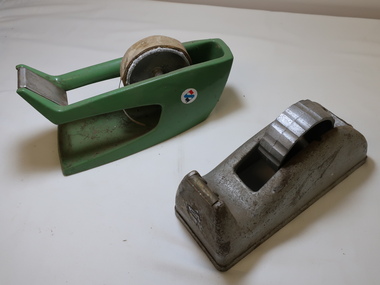
... Heavy green steel dispenser with wheel suspended at the top. A sharp metal piece with serrated edge is at the front enabling the tape to be cut. ...cut sticky tape (sellotape) to the required size. Used by the staff working in the SECV office during the construction of the Kiewa Hydro Electric Scheme. sticky tape dispenser SECV office equipment Sticker on the grey dispenser: 'Another / Sellotape / Product' Heavy green steel dispenser with wheel suspended at the top. A sharp metal ...Used in the office or at home to cut sticky tape (sellotape) to the required size. Used by the staff working in the SECV office during the construction of the Kiewa Hydro Electric Scheme.Heavy green steel dispenser with wheel suspended at the top. A sharp metal piece with serrated edge is at the front enabling the tape to be cut. The second dispenser is grey and also heavy. It has a torn sticker at the centre front. Sticker on the grey dispenser: 'Another / Sellotape / Product'sticky tape dispenser, secv office equipment -
 Kiewa Valley Historical Society
Tool - Cold Chisel
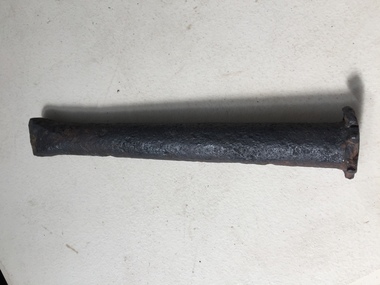
... steel. Used to cut and shear hard materials such as metal and masonry. ...Used by workers in the Kiewa Valley. cold chisel metal work tool Formerly KV110. 3 quarters of an inch diameter and 9 inches long and made of solid steel. Used to cut ...Used by workers in the Kiewa Valley.Formerly KV110. 3 quarters of an inch diameter and 9 inches long and made of solid steel. Used to cut and shear hard materials such as metal and masonry. The descriptor cold means that metal is not preheated before using the tool. It is ideal for cutting through thick metal stock when a hacksaw is unsuitable.cold chisel, metal work, tool -
 Bendigo Military Museum
Equipment - WEBBING KIT, 1911; Post 1911
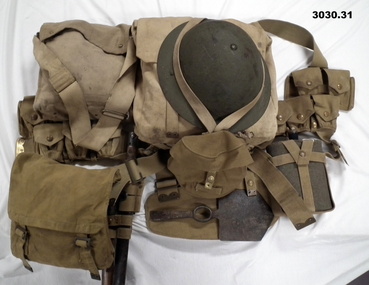
... Refer attached sheet. .1) Waist belt with brass buckles & keepers. .2) Braces x 2, connects to waist belt & large pack. .3) Bayonet. .4) Bayonet carrier. .5) Bayonet scabbard. .6) Entrenching tool carrier [fits to .5)]. .7) Entrenching tool handle, wood & metal [fits to .6)]. .8) Entrenching tool, metal, combination shovel & pick. .9) Entrenching tool carrier [fits inside .8)]. .10) Cartridge carriers x 2, 1 left hand, 1 right hand. .11) Water bottle, metal, blue colour. .12) Water bottle cover, khaki wool. .13) Water bottle carrier. .14) Pack, large. .15) Great coat, wool, [inside .14)]. .16) Helmet, steel with inside liner & chin strap. .17) Mess tin carrier, replica. .18) Haversack, side pack. .19) Carry all, white cotton, for personnel hygiene items [inside .18)]. .20) Razor, cut throat [inside .19)]. .21) Comb [inside .19)]. .22) Toothbrush [inside .19)]. .23) Shaving brush [inside .19)]. .24) Laces, leather, not original, [inside .19)]. .25) Soap [inside .19)]. .26) Tin bully beef x 2, replicas, [inside .18)]. .27) Tin stew, replica, [inside .18)]. .28) Pair socks, khaki wool, not original, [inside .18)]. .29) Field dressing, WWII issue, [inside .18)]. .30) Towel, brown colour, not original, [inside .18)]. .31) Gas mask carrier bag & straps. ...Refer attached sheet. .1) Waist belt with brass buckles & keepers. .2) Braces x 2, connects to waist belt & large pack. .3) Bayonet. .4) Bayonet carrier. .5) Bayonet scabbard. .6) Entrenching tool carrier [fits to .5)]. .7) Entrenching tool handle, wood & metal [fits to .6)]. .8) Entrenching tool, metal, combination shovel & pick. .9) Entrenching tool carrier [fits inside .8)]. .10) Cartridge carriers x 2, 1 left hand, 1 right hand. .11) Water bottle, metal, blue colour. .12) Water bottle cover, khaki wool. .13) Water bottle carrier. .14) Pack, large. .15) Great coat, wool, [inside .14)]. .16) Helmet, steel with inside liner & chin strap. .17) Mess tin carrier, replica. .18) Haversack, side pack. .19) Carry all, white cotton, for personnel hygiene items [inside .18)]. .20) Razor, cut throat [inside .19)]. .21) Comb [inside .19)]. .22) Toothbrush [inside .19)]. .23) Shaving brush [inside .19)]. .24) Laces, leather, not original, [inside .19)]. .25) Soap [inside .19)]. .26) Tin bully beef x 2, replicas, [inside .18)]. .27) Tin stew, replica, [inside .18)]. .28) Pair socks, khaki wool, not original, [inside .18)]. .29) Field dressing, WWII issue, [inside .18)]. .30) Towel, brown colour, not original, [inside .18)]. .31) Gas mask carrier bag & straps. ...The 1908 pattern was used during WWI, made from woven cotton & water proofed. The kit is used for school groups.Webbing kit complete including 1908 pattern webbing, gas mask haversack, personnel items, rations. Refer attached sheet. .1) Waist belt with brass buckles & keepers. .2) Braces x 2, connects to waist belt & large pack. .3) Bayonet. .4) Bayonet carrier. .5) Bayonet scabbard. .6) Entrenching tool carrier [fits to .5)]. .7) Entrenching tool handle, wood & metal [fits to .6)]. .8) Entrenching tool, metal, combination shovel & pick. .9) Entrenching tool carrier [fits inside .8)]. .10) Cartridge carriers x 2, 1 left hand, 1 right hand. .11) Water bottle, metal, blue colour. .12) Water bottle cover, khaki wool. .13) Water bottle carrier. .14) Pack, large. .15) Great coat, wool, [inside .14)]. .16) Helmet, steel with inside liner & chin strap. .17) Mess tin carrier, replica. .18) Haversack, side pack. .19) Carry all, white cotton, for personnel hygiene items [inside .18)]. .20) Razor, cut throat [inside .19)]. .21) Comb [inside .19)]. .22) Toothbrush [inside .19)]. .23) Shaving brush [inside .19)]. .24) Laces, leather, not original, [inside .19)]. .25) Soap [inside .19)]. .26) Tin bully beef x 2, replicas, [inside .18)]. .27) Tin stew, replica, [inside .18)]. .28) Pair socks, khaki wool, not original, [inside .18)]. .29) Field dressing, WWII issue, [inside .18)]. .30) Towel, brown colour, not original, [inside .18)]. .31) Gas mask carrier bag & straps. (Cowley) .32) Water bottle, metal, blue colour, [inside .31)].Items 1 - 13, there are numerous markings all stamped on from, “A.A.O.D”, “L”, “R”, “S”, “M.E.C.O”, “49th INF”, Years examples, “8.12”, “1.13”, “1911”military history - equipment / army, medicine-first aid, personal effects - containers, toilet requisites - shaving -
 Kiewa Valley Historical Society
Sewing Tool - Serrated Tracing Wheel
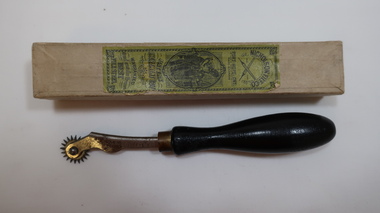
... metal arm holding the cutter is inserted into the wooden handle. The circular cutter has sharp spikes (the serrating wheel) which turn. The box used to store the wheel: Oblong cardboard box with separate lid. Inscription on top part - black on green background: Nicholson File Co. / Port Hope Ont. / Mae in Canada/Patent / Increment Cut / Warranted / and made from / Best / File Steel...metal arm holding the cutter is inserted into the wooden handle. The circular cutter has sharp spikes (the serrating wheel) which turn. The box used to store the wheel: Oblong cardboard box with separate lid. Inscription on top part - black on green background: Nicholson File Co. / Port Hope Ont. / Mae in Canada/Patent / Increment Cut / Warranted / and made from / Best / File Steel Sewing Tool - Serrated Tracing Wheel ...A cutting or serrated tracing wheel with a wooden handle. The metal arm holding the cutter is inserted into the wooden handle. The circular cutter has sharp spikes (the serrating wheel) which turn. The box used to store the wheel: Oblong cardboard box with separate lid. Inscription on top part - black on green background: Nicholson File Co. / Port Hope Ont. / Mae in Canada/Patent / Increment Cut / Warranted / and made from / Best / File SteelCutting wheel: Side 1: B. Humphreys engraved into the metal section holding the spiked wheel. Side 2: Made in England Box: Hand written in black ink on the bottom of the box: "To Betty / with love/ from Gran" On bottom end of box: black on green background: Nicholson / Warding Bastard / 1 doz. 4 and a half inch.sewing tool, ron white -
 Ballarat Tramway Museum
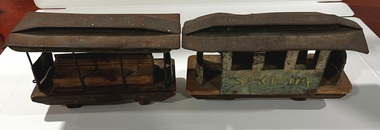
Model - Toy cable tram set, c1900
... metal. Grip car or dummy has remnants of paint (green and gold) on the sides, holes for wheels on the two wood blocks on the underside. Has an eye hook at one end and a hole for another at the other end. Seat made from timber with a steel wire or rod to represent a grip lever. Metal secured to wood base with nails. Has four metal Staunchions on either side. Trailer similar construction with sides stamped or cut...metal. Grip car or dummy has remnants of paint (green and gold) on the sides, holes for wheels on the two wood blocks on the underside. Has an eye hook at one end and a hole for another at the other end. Seat made from timber with a steel wire or rod to represent a grip lever. Metal secured to wood base with nails. Has four metal Staunchions on either side. Trailer similar construction with sides stamped or cut ...Built as a toy, either by a well resourced home workshop or by a toy maker. Have been well used or loved with missing wheels and damaged roof. Possibly dates from the early 1900s. St Kilda was a popular destination for Melbourne cable trams. Demonstrates a toy cable tram set.Cable tram set made from wood and pressed metal. Grip car or dummy has remnants of paint (green and gold) on the sides, holes for wheels on the two wood blocks on the underside. Has an eye hook at one end and a hole for another at the other end. Seat made from timber with a steel wire or rod to represent a grip lever. Metal secured to wood base with nails. Has four metal Staunchions on either side. Trailer similar construction with sides stamped or cut from sheet steel with holes at either end for a eye or hook and wheels. Roof on both items has been pressed and assembled. The trailer has painted on one side "St Kilda" and the remnants of a similar word on the other side.cable trams, toys, trams, st kilda -
 Ballarat Tramway Museum
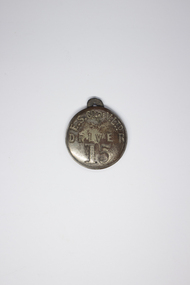
Badge - ESCo driver, Stokes & Sons Melbourne, 1905
... metal uniform badge for ESCo Drivers. Round pressed steel badge with the words "ESCo OF V. LTD." pressed into the badge around the top portion of the badge, the word "DRIVER" and number "15" pressed into the lower half of the badge -with small horizontal lines within the individual letters. Appears to have had a nickel silver finish originally. On rear badge two metal lugs have been soldered onto the badge and a leather strap with a button hole cut...metal uniform badge for ESCo Drivers. Round pressed steel badge with the words "ESCo OF V. LTD." pressed into the badge around the top portion of the badge, the word "DRIVER" and number "15" pressed into the lower half of the badge -with small horizontal lines within the individual letters. Appears to have had a nickel silver finish originally. On rear badge two metal lugs have been soldered onto the badge and a leather strap with a button hole cut ...Yields information about the identification methods used by the ESCo to identify their crews to public and has a strong association with the individuals who wore them over time.Pressed metal uniform badge for ESCo Drivers. Round pressed steel badge with the words "ESCo OF V. LTD." pressed into the badge around the top portion of the badge, the word "DRIVER" and number "15" pressed into the lower half of the badge -with small horizontal lines within the individual letters. Appears to have had a nickel silver finish originally. On rear badge two metal lugs have been soldered onto the badge and a leather strap with a button hole cut into to enable it to be worn on a uniform. Has words "STOKES & SONS" stamped in reverse on the lower rear of the badge. Badges of this type shown on ESCo uniforms of 1905 and through to the 20's. See Reg. item 2900 for Conductors Badge and 5280 for Driver's badge No. 49. tramways, trams, esco, drivers, badges, uniforms -
 National Wool Museum
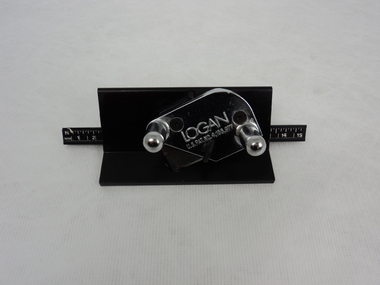
Mat cutter
... metal base/frame with horizontal ruler attached within. Steel handle at front with mounting area for blade. Blade is stored flat within base but can be turned to protrude through the bottom of the frame which allows it to cut carpet. 4 additional unused blades stored in small brown paper envelopes. ...metal base/frame with horizontal ruler attached within. Steel handle at front with mounting area for blade. Blade is stored flat within base but can be turned to protrude through the bottom of the frame which allows it to cut carpet. 4 additional unused blades stored in small brown paper envelopes. ...Purchased in Illinois, USA, in the 1950s. Comes with instruction manual and additional blades, all of which appear unused. Made by Logan brand who are still in operation today. This is model 401 which is not manufactured currently.Black plastic and yellow plastic box with white foam-core base and side walls. Mat cutter is a black metal base/frame with horizontal ruler attached within. Steel handle at front with mounting area for blade. Blade is stored flat within base but can be turned to protrude through the bottom of the frame which allows it to cut carpet. 4 additional unused blades stored in small brown paper envelopes. Faded cream coloured single page paper folded instruction manual. -
 Clunes Museum
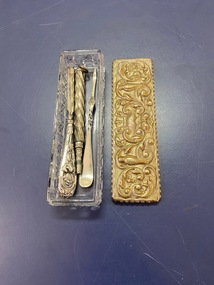
Domestic object - MANICURE SET, PRE 1889
... FAWCETT WAS MARRIED TO THOMAS FAWCETT 1889 FAWCETT FAMILY MANICURE SET "STEEL MADE IN ENGLAND" IMPRINTED ON CUTICLE TOOL CUT GLASS BOX WITH PRESSED WHITE METAL LID. ...OWNED BY MRS A.E. FAWCETT, MRS A.E. FAWCETT WAS MARRIED TO THOMAS FAWCETT 1889CUT GLASS BOX WITH PRESSED WHITE METAL LID. THREE SILVER HANDLED MANICURE ITEMS CONTAINED IN BOX ONE CUTICLE TOOL WITH EMBOSSED FOLIAGE ONE WITH BARLEY SUGAR TWIST HANDLE ONE WITH BARLEY SUGAR TWIST AT THE APEX OF THE TOOL "STEEL MADE IN ENGLAND" IMPRINTED ON CUTICLE TOOLfawcett family, manicure set -
 Mont De Lancey
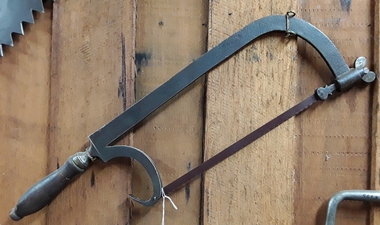
Tool - Bow saw, Unknown
... Could be used to cut steel. saws Carpentry tools Woodworking tools Tools Steel Wood Metal A curved steel shaped wooden handled Bow saw with a curved nail puller near the handle. ...Used in the late or early 20th Century. Could be used to cut steel.A curved steel shaped wooden handled Bow saw with a curved nail puller near the handle. A metal saw blade is attached by a screw at the end where it is fitted. Used in the late 19th or 20th Century.saws, carpentry tools, woodworking tools, tools, steel, wood, metal -
 Mont De Lancey
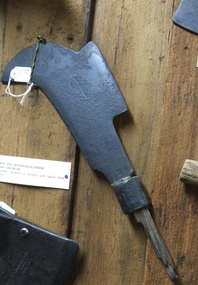
Tool - Bill Hook, Unknown
... metal blade with a strong curved sharp axe like edge and a straight secondary edge on the back. It has a broken wooden handle with steel or a tang which passed through the handle if it were still attached. There is stamped on the blade near the handle join - '2'. The original finish of the blade would have been, 'Japanned' which is baked black enamel. It was used to cut...metal blade with a strong curved sharp axe like edge and a straight secondary edge on the back. It has a broken wooden handle with steel or a tang which passed through the handle if it were still attached. There is stamped on the blade near the handle join - '2'. The original finish of the blade would have been, 'Japanned' which is baked black enamel. It was used to cut ...Used in the 19th centuryA bill hook or axe-handled slasher which is an axe-handled forged metal blade with a strong curved sharp axe like edge and a straight secondary edge on the back. It has a broken wooden handle with steel or a tang which passed through the handle if it were still attached. There is stamped on the blade near the handle join - '2'. The original finish of the blade would have been, 'Japanned' which is baked black enamel. It was used to cut back scrub, small trees and woody vegetation in the 19th century.'2' stamped on the blade near where it joins the handle.slashers, cutting tools, bill hook slasher, gardening tools, agricultural tools -
 Mont De Lancey
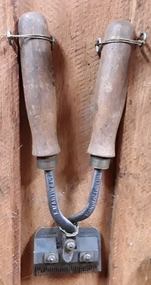
Functional object - Horse Clippers, A. Martin & Co, Unknown
... metal joining the blades - 'A. Martin & Co. Manufacturers' A pair of vintage hand horse clippers with two steel blades, a lower blade or comb and a moving blade or cutter that work together to cut the hair. ...Used in the 20h century.A pair of vintage hand horse clippers with two steel blades, a lower blade or comb and a moving blade or cutter that work together to cut the hair. It attached with screws to two steel handles with wooden grips attached by brass fitments.Imprinted on the metal joining the blades - 'A. Martin & Co. Manufacturers'horse accessories, horses, horse clippers -
 Parks Victoria - Gabo Island Lightstation
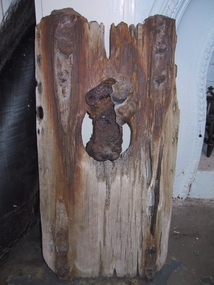
Hatch cover
... steel hatch cover from ship.(wrekage) Rectangular shaped piece of wood with a circular shape cut from centre. Corroded metal...metal fragments, the hatch is undated wreckage from an unknown ship. The remnants of shipwreck fabric have second level contributory significance for their interpretive and historic value as artefacts that highlight the distinctive history of the Gabo Island Lightstation. Timber & steel hatch cover from ship.(wrekage) Rectangular shaped piece of wood with a circular shape cut ...Wreckage from unknown ship. Found on "big beach" at Telegraph Point. 2002. Made of wood with corroded metal fragments, the hatch is undated wreckage from an unknown ship. The remnants of shipwreck fabric have second level contributory significance for their interpretive and historic value as artefacts that highlight the distinctive history of the Gabo Island Lightstation.Timber & steel hatch cover from ship.(wrekage) Rectangular shaped piece of wood with a circular shape cut from centre. Corroded metal fragments have adhered to the wood.
