
Showing 61 items matching " metal thread work"
-
 Embroiderers Guild, Victoria
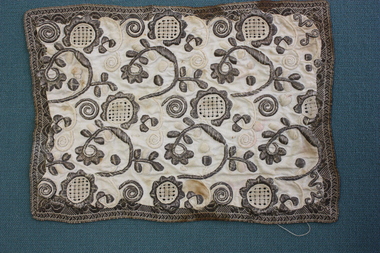
Textile - Metal Thread with Drawn Thread Mat
... thread...Metal work...Natural coloured linen embroidered with heavily padded metal thread work. Flower centres are drawn thread. ...Embroidery Drawn thread Metal work Natural coloured linen embroidered with heavily padded metal thread work. ...Natural coloured linen embroidered with heavily padded metal thread work. Flower centres are drawn thread. Appliqued onto a brown geometric patterned braid border.embroidery, drawn thread, metal work -
 Embroiderers Guild, Victoria
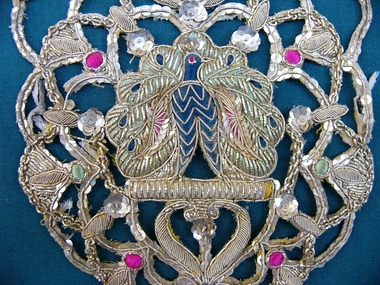
Accessory - Neck piece
... ... Metal thread work...Embroidery Collars Metal thread work India (Cutwork) Gold work, using a variety of bullions and sequins. ...(Cutwork) Gold work, using a variety of bullions and sequins. Peacock motif is the central point at front of collar, composed of bullions, sequins and silk embroidery, also red and blue/green dots of silk embroidery on long over shoulders hands. Collar ties at back of neck with gilt threads and tassels.embroidery, collars, metal thread work, india -
 Embroiderers Guild, Victoria
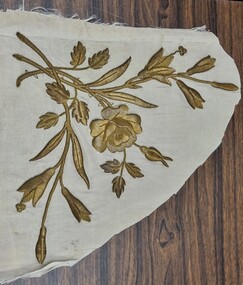
Textile - Gold Work Fragment
... Gold Work fragment - metal thread worked over card, creating floral bouquet....Gold Work fragment - metal thread worked over card, creating floral bouquet. ...Gold Work fragment - metal thread worked over card, creating floral bouquet. -
 Embroiderers Guild, Victoria
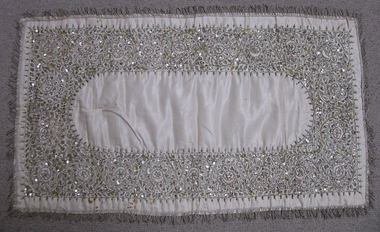
Textile - Indian Mat
... White satin with a wide decorative band of silver metal thread work, sequins and pale floss silks. ...Embroidery Mats India Oriental Metal thread Silk Embroidery White satin with a wide decorative band of silver metal thread work, sequins and pale floss silks. ...White satin with a wide decorative band of silver metal thread work, sequins and pale floss silks. Matching silver fringe.embroidery, mats, india, oriental, metal thread, silk embroidery -
 Embroiderers Guild, Victoria
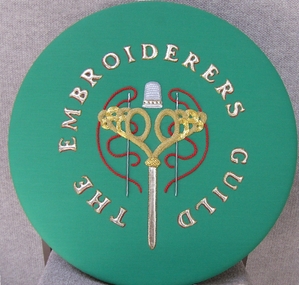
Textile - The Embroiderers Guild Crest, Mrs Edna Wark, 1980-2000
... A circle covered in green fabric with the crest of the Victorian Guild (scissors, thimble and needle) executed in metal thread work. On permanent display in the EGV gallery....Embroidery Metal thread 1980-2000 Australia The EGV Crest is used to publicize the Guild at exhibitions and demonstrations. A circle covered in green fabric with the crest of the Victorian Guild (scissors, thimble and needle) executed in metal thread work. ...The EGV Crest is used to publicize the Guild at exhibitions and demonstrations. A circle covered in green fabric with the crest of the Victorian Guild (scissors, thimble and needle) executed in metal thread work. On permanent display in the EGV gallery.embroidery, metal thread, 1980-2000, australia -
 Embroiderers Guild, Victoria
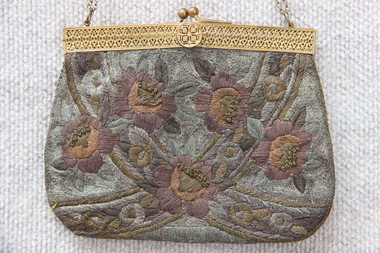
Accessory - Evening Purse, Early 20th C (?)
... work...Metal thread...Heavily embroidered in metal thread work in several shades of gold and brown, in a floral design. ...Embroidery Gold work Metal thread Heavily embroidered in metal thread work in several shades of gold and brown, in a floral design. ...Heavily embroidered in metal thread work in several shades of gold and brown, in a floral design. Both sides of bag are embroidered. open-work gold metal frame and double chain handle. Lined in gold silk.embroidery, gold work, metal thread -
 Embroiderers Guild, Victoria
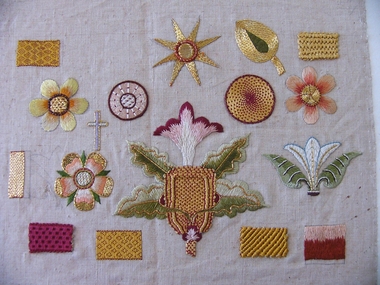
Textile - Royal School of Needlework Metal Thread Sampler, Miss Elizabeth Lewis, 1920-40
... Typical Royal School of Needlework metal thread sampler showing different techniques of metal thread and laid silk work on natural linen....Typical Royal School of Needlework metal thread sampler showing different techniques of metal thread and laid silk work on natural linen. ...One of a number of samplers (see 1205, 1207 and 1208) embroidered by the donors aunt, Miss Elizabeth Lewis while studying at the Royal School of Needlework. She taught and judged embroidery throughout England.Goldwork sampler. Typical Royal School of Needlework metal thread sampler showing different techniques of metal thread and laid silk work on natural linen.goldwork, embroidery, silk embroidery, england, 1920-40 -
 Flagstaff Hill Maritime Museum and Village
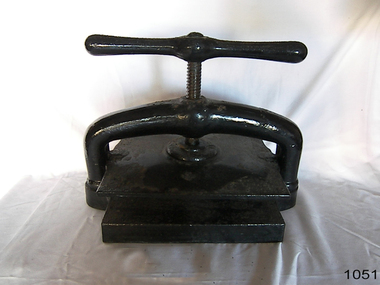
Equipment - Book binding press
... worked to perfect the methods used by their predecessors, and modern book binders are true craftsman with this press as an example of the equipment used in their trade. This item is significant as it is an early example of items used in book gilding and binding. flagstaff hill warrnambool shipwrecked-coast flagstaff-hill flagstaff-hill-maritime-museum maritime-museum shipwreck-coast flagstaff-hill-maritime-village None Book binding press metal with square pressing surface driven by worm wheel thread and turning handle in working order. ...Item used to repair books after their dust jackets, covers, flyleaves or pages had been damaged. These damaged items on a book were replaced and glued. The press allowed the glue to set under pressure until the repair was complete a press is also used for the gilding of books. The first book press has been documented in India around 100 BCE with various types and designs being used though the ages and are still in use today by craftsman to repair antique books.Over the centuries many materials from ivory to glass, have been used to bind books. Gilding has also long been a popular decorative treatment for book bindings and a book press is used in this operation. Since the 1800s, rare book conservationists have worked to perfect the methods used by their predecessors, and modern book binders are true craftsman with this press as an example of the equipment used in their trade. This item is significant as it is an early example of items used in book gilding and binding.Book binding press metal with square pressing surface driven by worm wheel thread and turning handle in working order. Noneflagstaff hill, warrnambool, shipwrecked-coast, flagstaff-hill, flagstaff-hill-maritime-museum, maritime-museum, shipwreck-coast, flagstaff-hill-maritime-village -
 Flagstaff Hill Maritime Museum and Village
Domestic object - Tatting Shuttle, Aero Needles Group Ltd, Mid to late 20th century
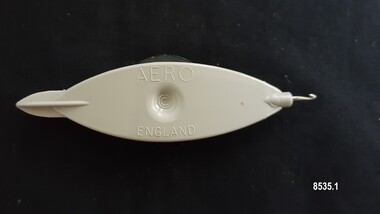
... thread. Tatting is called "schiffchenarbeit" in German, which means "the work of a little boat". There are two popular types of shuttles. The first has closed ends and a removable bobbin where the thread is wound around - often made from metal or plastic (as is item 8535.1). ...thread. Tatting is called "schiffchenarbeit" in German, which means "the work of a little boat". There are two popular types of shuttles. The first has closed ends and a removable bobbin where the thread is wound around - often made from metal or plastic (as is item 8535.1). ...Tatting is a form of knotted lace making using thread and a small shuttle. Twisted threads are tied around or through small, pointed shuttles that can be made of bone, mother of pearl, tortoise shell, steel or plastic. This produces a stable, strong lace using simple knots of two half hitches to make rings and chains embellished with picots.The origins of tatting are not clear but early versions of decorative knotting were used by the Egyptians on their ceremonial dress. Tatting also has elements of fishermen's net making techniques and the decorative knotting that was practiced by aristocratic women from the 15th century.Tatting, as we know it today, emerged in the first half of the 19th century. The new availability of mercerised thread from 1835 encouraged a burgeoning of lace crafts of all sorts. It was known in Italy as "occhi" and in France as "la frivolite". Tatting looks fragile but is both strong and durable. An article in a column named "Wives and Daughters" published in the Star newspaper in May 1910 describes the durability of tatting lace - "there is edging and insertion still in existence that have outworn two sets of pillow slips." In the 19th century and well into the 20th century, tatting was used like crochet and knitted lace for decorative edgings, collars, doylies, tray cloths etc. At first, different tatting patterns were passed along by word of mouth from person to person, however in time, patterns regularly appeared in newspapers and magazines well into the 1950's. A shuttle is a small tool that looks like a small boat "sailing" in and out of the thread. Tatting is called "schiffchenarbeit" in German, which means "the work of a little boat". There are two popular types of shuttles. The first has closed ends and a removable bobbin where the thread is wound around - often made from metal or plastic (as is item 8535.1). The second type has a post in the center where the thread is wound (e.g. item 8535.2). The ends of this bobbin are open but snug. Because it is constructed in two pieces, it can be made from materials like bone, ivory or mother of pearl. Shuttles hold a larger amount of thread (as compared with needles) which means fewer ends to weave in. Fishermen in the past are thought to have used large shuttles to weave cord into certain knots whilst making their fishing nets. Their methods were copied by weavers, who innovated by using threads and smaller shuttles to make lace. One type of tatting shuttle produced by "Aero" from the 1930's to the late 1960's was an anodized grey coated aluminium shuttle with a sharp pick at one end. In the 1970's it was superseded by the grey plastic "Aero" which has a removeable bobbin which you can put on the end of the shuttle to make thread winding easier and an embedded crochet hook for joining picots. The "Aero" company developed in Redditch, England - a town renowned as a centre for manufacturing needles. Firms run by Henry Milward and Abel Morrall were based in Redditch and by the 18th century Redditch was manufacturing one million sewing needles per year. Abel Morrall Ltd launched the "Aero" brand in 1936 and greatly expanded the firm's product line to include tatting shuttles and knitting needles. The classic plastic "Aero" tatting shuttle was manufactured in England from the early 1970's until the 1990's. These items are significant as examples of easily accessible handiwork tools that enabled women in the 1930s -1960s to be able to decorate and personalize their household linen and clothing.Shuttle no. 8535.1 is a beige, boat shaped plastic shuttle with enclosed ends, small round central indentations on both sides and an enclosed black removeable bobbin. The shuttle has a grooved point at one end to hold a bobbin and a small metal crochet hook at the other end. Shuttle no. 8535.2 is a beige, boat shaped metal shuttle with pointed ends that are open but snug, small round central indentations and two smaller circular markings (on both sides) and two internal posts with cream thread wound around.Shuttle no. 8535.1 - "AERO" / "ENGLAND" Shuttle no. 8535.2 - "AERO' / "ENGLAND" "39c" (written in ball point pen)flagstaff hill maritime museum and village, flagstaff hill, warrnambool, shipwreck coast, great ocean road, tatting shuttle, aero company, handwork, handwork tool, craft, handcraft, needlework, tatting -
 Orbost & District Historical Society
vice, c 1950's
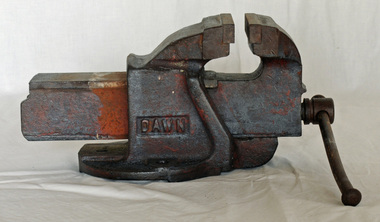
... work to be performed on it. It would have been attached to a workbench. bench-vice Dawn 3 1/2 A large metal bench vice. It has two parallel jaws, one fixed and the other movable, threaded in and out by a screw and lever. vice Dawn Manufacturing Company ...This vice is used to secure an object to allow work to be performed on it. It would have been attached to a workbench.A large metal bench vice. It has two parallel jaws, one fixed and the other movable, threaded in and out by a screw and lever.Dawn 3 1/2bench-vice -
 Ringwood and District Historical Society
Sewing Box and Contents, Small Paisley Patterned Sewing Box, belonged to Maggs Family, Ringwood. C1900, c. 1900
... work as well. Paisley patterned small sewing box with 6 compartments. On top tray and area below for flat objects - two pairs embroidery scissors; three bone threaders; one small cable needle; one brass safety pin; two retracting crochet hooks; seven metal crochet hooks (very fine); three bone crochet hooks with metal end (2 hooks, 1 pointed); and one metal pointer with bone end.; The top tray contains three thimbles (2 plastic, one metal); a tape measure and a book of needles (very fine). ...Belonged to the Maggs family. A craft box for crochet work containing very fine crochet hooks, thimbles, scissors and sewing needles. Possibly used for beading work as well.Paisley patterned small sewing box with 6 compartments. On top tray and area below for flat objects - two pairs embroidery scissors; three bone threaders; one small cable needle; one brass safety pin; two retracting crochet hooks; seven metal crochet hooks (very fine); three bone crochet hooks with metal end (2 hooks, 1 pointed); and one metal pointer with bone end.; The top tray contains three thimbles (2 plastic, one metal); a tape measure and a book of needles (very fine). +Additional Keywords: Maggs -
 City of Moorabbin Historical Society (Operating the Box Cottage Museum)
Tools, steel 'C' or 'G' clamp, c1900
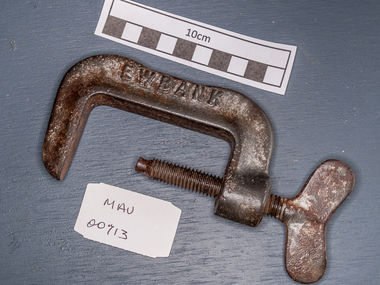
... metal work piece, and often used in carpentry and welding. C-clamps or G-clamps are typically made of steel or cast iron, though smaller clamps may be made of pot metal. At the top of the "C" is usually a small flat edge. At the bottom is a threaded...metal work piece, and often used in carpentry and welding. C-clamps or G-clamps are typically made of steel or cast iron, though smaller clamps may be made of pot metal. At the top of the "C" is usually a small flat edge. At the bottom is a threaded ...A clamp is a fastening device to hold or secure objects tightly together to prevent movement or separation through the application of inward pressure. The tool is for temporary use for positioning components during construction and wood working. There are many types of clamps available for many different purposes. Some are temporary, as used to position components while fixing them together, others are intended to be permanent. A C-clamp or G-clamp is a type of clamp device typically used to hold a wood or metal work piece, and often used in carpentry and welding. C-clamps or G-clamps are typically made of steel or cast iron, though smaller clamps may be made of pot metal. At the top of the "C" is usually a small flat edge. At the bottom is a threaded hole through which a large threaded screw protrudes. One end of this screw contains a flat edge of similar size to the one at the top of the frame, and the other end usually a small metal bar, perpendicular to the screw itself, which is used to gain leverage when tightening the clamp. When the clamp is completely closed, the flat end of the screw is in contact with the flat end on the frame. When the clamp is actually used, it is very rare that this occurs. Generally some other object or objects will be contained between the top and bottom flat edges. A steel ‘C’ or ‘G’ Clamp used to hold a wood or metal work piece, used in carpentry and welding.L.W.BANKtools, woodwork, metalwork, welding, carpentry, pioneers, market gardeners, early settlers, bank w.l., moorabbin, cheltenham, bentleigh, ormond -
 City of Moorabbin Historical Society (Operating the Box Cottage Museum)
Tools, steel 'G' Clamp, early 20thC
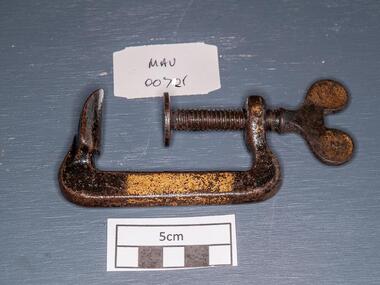
... metal work-piece, and often used in, but are not limited to, carpentry and welding. These clamps are called "C" clamps because of their C shaped frame, but are otherwise often called G-clamps or G-cramps because including the screw part they are shaped like an uppercase letter G. The fixed end is not adjustable so size is not variable. G-clamps are typically made of steel or cast iron, though smaller clamps may be made of pot metal. At the top of the "G" is usually a small flat edge. At the bottom is a threaded...metal work-piece, and often used in, but are not limited to, carpentry and welding. These clamps are called "C" clamps because of their C shaped frame, but are otherwise often called G-clamps or G-cramps because including the screw part they are shaped like an uppercase letter G. The fixed end is not adjustable so size is not variable. G-clamps are typically made of steel or cast iron, though smaller clamps may be made of pot metal. At the top of the "G" is usually a small flat edge. At the bottom is a threaded ...A C-clamp or G- clamp is a type of clamp device typically used to hold a wood or metal work-piece, and often used in, but are not limited to, carpentry and welding. These clamps are called "C" clamps because of their C shaped frame, but are otherwise often called G-clamps or G-cramps because including the screw part they are shaped like an uppercase letter G. The fixed end is not adjustable so size is not variable. G-clamps are typically made of steel or cast iron, though smaller clamps may be made of pot metal. At the top of the "G" is usually a small flat edge. At the bottom is a threaded hole through which a large threaded screw protrudes. One end of this screw contains a flat edge of similar size to the one at the top of the frame, and the other end usually a small metal bar, perpendicular to the screw itself, which is used to gain leverage when tightening the clamp. When the clamp is completely closed, the flat end of the screw is in contact with the flat end on the frame When used some other object or objects will be contained between the top and bottom flat edges. A steel 'G' Clamp tools, g clamp, screws, steel, clamps, metalwork, woodwork, carpentry, early settlers, pioneers, market gardeners, moorabin, bentleigh, cheltenham -
 Flagstaff Hill Maritime Museum and Village
Tatting Shuttle
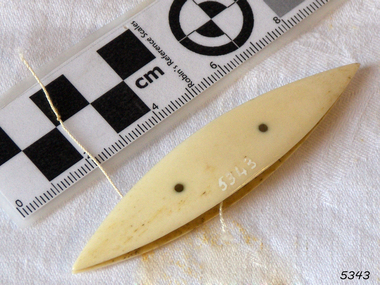
... thread. Tatting is called "schiffchenarbeit" in German, which means "the work of a little boat". There are two popular types of shuttles. The first has closed ends and a removable bobbin where the thread is wound around - often made from metal or plastic. ...thread. Tatting is called "schiffchenarbeit" in German, which means "the work of a little boat". There are two popular types of shuttles. The first has closed ends and a removable bobbin where the thread is wound around - often made from metal or plastic. ...Tatting is a form of knotted lace making using thread and a small shuttle. Twisted threads are tied around or through small, pointed shuttles that can be made of bone, mother of pearl, tortoise shell, steel or plastic. This produces a stable, strong lace using simple knots of two half hitches to make rings and chains embellished with picots. The origins of tatting are not clear but early versions of decorative knotting were used by the Egyptians on their ceremonial dress. Tatting also has elements of fishermen's net making techniques and the decorative knotting that was practiced by aristocratic women from the 15th century. Tatting, as we know it today, emerged in the first half of the 19th century. The new availability of mercerised thread from 1835 encouraged a burgeoning of lace crafts of all sorts. It was known in Italy as "occhi" and in France as "la frivolite". Tatting looks fragile but is both strong and durable. An article in a column named "Wives and Daughters" published in the Star newspaper in May 1910 describes the durability of tatting lace - "there is edging and insertion still in existence that have outworn two sets of pillow slips." In the 19th century and well into the 20th century, tatting was used like crochet and knitted lace for decorative edgings, collars, doylies, tray cloths etc. At first, different tatting patterns were passed along by word of mouth from person to person, however in time, patterns regularly appeared in newspapers and magazines well into the 1950's. A shuttle is a small tool that looks like a small boat "sailing" in and out of the thread. Tatting is called "schiffchenarbeit" in German, which means "the work of a little boat". There are two popular types of shuttles. The first has closed ends and a removable bobbin where the thread is wound around - often made from metal or plastic. The second type has a post in the center where the thread is wound. The ends of this bobbin are open but snug. Because it is constructed in two pieces, it can be made from materials like bone, ivory or mother of pearl. Shuttles hold a larger amount of thread (as compared with needles) which means fewer ends to weave in. Fishermen in the past are thought to have used large shuttles to weave cord into certain knots whilst making their fishing nets. Their methods were copied by weavers, who innovated by using threads and smaller shuttles to make lace.Tatting Shuttle, Ivoryflagstaff hill, warrnambool, shipwrecked-coast, flagstaff-hill, flagstaff-hill-maritime-museum, maritime-museum, shipwreck-coast, flagstaff-hill-maritime-village, tatting shuttle, handcraft, needlework -
 Flagstaff Hill Maritime Museum and Village
Tatting Shuttle
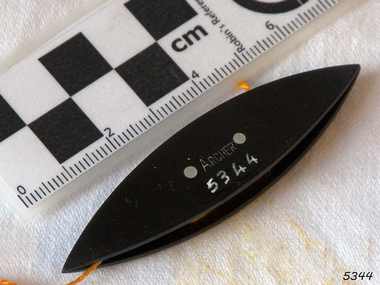
... thread. Tatting is called "schiffchenarbeit" in German, which means "the work of a little boat". There are two popular types of shuttles. The first has closed ends and a removable bobbin where the thread is wound around - often made from metal or plastic. ...thread. Tatting is called "schiffchenarbeit" in German, which means "the work of a little boat". There are two popular types of shuttles. The first has closed ends and a removable bobbin where the thread is wound around - often made from metal or plastic. ...Tatting is a form of knotted lace making using thread and a small shuttle. Twisted threads are tied around or through small, pointed shuttles that can be made of bone, mother of pearl, tortoise shell, steel or plastic. This produces a stable, strong lace using simple knots of two half hitches to make rings and chains embellished with picots. The origins of tatting are not clear but early versions of decorative knotting were used by the Egyptians on their ceremonial dress. Tatting also has elements of fishermen's net making techniques and the decorative knotting that was practiced by aristocratic women from the 15th century. Tatting, as we know it today, emerged in the first half of the 19th century. The new availability of mercerised thread from 1835 encouraged a burgeoning of lace crafts of all sorts. It was known in Italy as "occhi" and in France as "la frivolite". Tatting looks fragile but is both strong and durable. An article in a column named "Wives and Daughters" published in the Star newspaper in May 1910 describes the durability of tatting lace - "there is edging and insertion still in existence that have outworn two sets of pillow slips." In the 19th century and well into the 20th century, tatting was used like crochet and knitted lace for decorative edgings, collars, doylies, tray cloths etc. At first, different tatting patterns were passed along by word of mouth from person to person, however in time, patterns regularly appeared in newspapers and magazines well into the 1950's. A shuttle is a small tool that looks like a small boat "sailing" in and out of the thread. Tatting is called "schiffchenarbeit" in German, which means "the work of a little boat". There are two popular types of shuttles. The first has closed ends and a removable bobbin where the thread is wound around - often made from metal or plastic. The second type has a post in the center where the thread is wound. The ends of this bobbin are open but snug. Because it is constructed in two pieces, it can be made from materials like bone, ivory or mother of pearl. Shuttles hold a larger amount of thread (as compared with needles) which means fewer ends to weave in. Fishermen in the past are thought to have used large shuttles to weave cord into certain knots whilst making their fishing nets. Their methods were copied by weavers, who innovated by using threads and smaller shuttles to make lace.Tatting Shuttle, Black plastic, "ARCHER" inscribed. "ARCHER" inscribed.flagstaff hill, warrnambool, shipwrecked-coast, flagstaff-hill, flagstaff-hill-maritime-museum, maritime-museum, shipwreck-coast, flagstaff-hill-maritime-village, tatting shuttle, handcraft, needlework -
 Flagstaff Hill Maritime Museum and Village
Tatting Shuttle
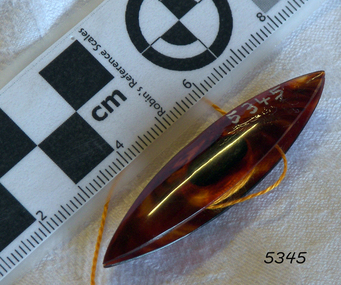
... thread. Tatting is called "schiffchenarbeit" in German, which means "the work of a little boat". There are two popular types of shuttles. The first has closed ends and a removable bobbin where the thread is wound around - often made from metal or plastic. ...thread. Tatting is called "schiffchenarbeit" in German, which means "the work of a little boat". There are two popular types of shuttles. The first has closed ends and a removable bobbin where the thread is wound around - often made from metal or plastic. ...Tatting is a form of knotted lace making using thread and a small shuttle. Twisted threads are tied around or through small, pointed shuttles that can be made of bone, mother of pearl, tortoise shell, steel or plastic. This produces a stable, strong lace using simple knots of two half hitches to make rings and chains embellished with picots. The origins of tatting are not clear but early versions of decorative knotting were used by the Egyptians on their ceremonial dress. Tatting also has elements of fishermen's net making techniques and the decorative knotting that was practiced by aristocratic women from the 15th century. Tatting, as we know it today, emerged in the first half of the 19th century. The new availability of mercerised thread from 1835 encouraged a burgeoning of lace crafts of all sorts. It was known in Italy as "occhi" and in France as "la frivolite". Tatting looks fragile but is both strong and durable. An article in a column named "Wives and Daughters" published in the Star newspaper in May 1910 describes the durability of tatting lace - "there is edging and insertion still in existence that have outworn two sets of pillow slips." In the 19th century and well into the 20th century, tatting was used like crochet and knitted lace for decorative edgings, collars, doylies, tray cloths etc. At first, different tatting patterns were passed along by word of mouth from person to person, however in time, patterns regularly appeared in newspapers and magazines well into the 1950's. A shuttle is a small tool that looks like a small boat "sailing" in and out of the thread. Tatting is called "schiffchenarbeit" in German, which means "the work of a little boat". There are two popular types of shuttles. The first has closed ends and a removable bobbin where the thread is wound around - often made from metal or plastic. The second type has a post in the center where the thread is wound. The ends of this bobbin are open but snug. Because it is constructed in two pieces, it can be made from materials like bone, ivory or mother of pearl. Shuttles hold a larger amount of thread (as compared with needles) which means fewer ends to weave in. Fishermen in the past are thought to have used large shuttles to weave cord into certain knots whilst making their fishing nets. Their methods were copied by weavers, who innovated by using threads and smaller shuttles to make lace.Tatting Shuttle, tortoise-shellflagstaff hill, warrnambool, shipwrecked-coast, flagstaff-hill, flagstaff-hill-maritime-museum, maritime-museum, shipwreck-coast, flagstaff-hill-maritime-village, tatting shuttle, handcraft, needlework -
 Flagstaff Hill Maritime Museum and Village
Tatting Shuttle
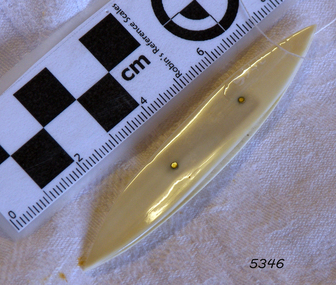
... thread. Tatting is called "schiffchenarbeit" in German, which means "the work of a little boat". There are two popular types of shuttles. The first has closed ends and a removable bobbin where the thread is wound around - often made from metal or plastic. ...thread. Tatting is called "schiffchenarbeit" in German, which means "the work of a little boat". There are two popular types of shuttles. The first has closed ends and a removable bobbin where the thread is wound around - often made from metal or plastic. ...Tatting is a form of knotted lace making using thread and a small shuttle. Twisted threads are tied around or through small, pointed shuttles that can be made of bone, mother of pearl, tortoise shell, steel or plastic. This produces a stable, strong lace using simple knots of two half hitches to make rings and chains embellished with picots. The origins of tatting are not clear but early versions of decorative knotting were used by the Egyptians on their ceremonial dress. Tatting also has elements of fishermen's net making techniques and the decorative knotting that was practiced by aristocratic women from the 15th century. Tatting, as we know it today, emerged in the first half of the 19th century. The new availability of mercerised thread from 1835 encouraged a burgeoning of lace crafts of all sorts. It was known in Italy as "occhi" and in France as "la frivolite". Tatting looks fragile but is both strong and durable. An article in a column named "Wives and Daughters" published in the Star newspaper in May 1910 describes the durability of tatting lace - "there is edging and insertion still in existence that have outworn two sets of pillow slips." In the 19th century and well into the 20th century, tatting was used like crochet and knitted lace for decorative edgings, collars, doylies, tray cloths etc. At first, different tatting patterns were passed along by word of mouth from person to person, however in time, patterns regularly appeared in newspapers and magazines well into the 1950's. A shuttle is a small tool that looks like a small boat "sailing" in and out of the thread. Tatting is called "schiffchenarbeit" in German, which means "the work of a little boat". There are two popular types of shuttles. The first has closed ends and a removable bobbin where the thread is wound around - often made from metal or plastic. The second type has a post in the center where the thread is wound. The ends of this bobbin are open but snug. Because it is constructed in two pieces, it can be made from materials like bone, ivory or mother of pearl. Shuttles hold a larger amount of thread (as compared with needles) which means fewer ends to weave in. Fishermen in the past are thought to have used large shuttles to weave cord into certain knots whilst making their fishing nets. Their methods were copied by weavers, who innovated by using threads and smaller shuttles to make lace.Tatting Shuttle, ivory, flagstaff hill, warrnambool, shipwrecked-coast, flagstaff-hill, flagstaff-hill-maritime-museum, maritime-museum, shipwreck-coast, flagstaff-hill-maritime-village, tatting shuttle, handcraft, needlework -
 Flagstaff Hill Maritime Museum and Village
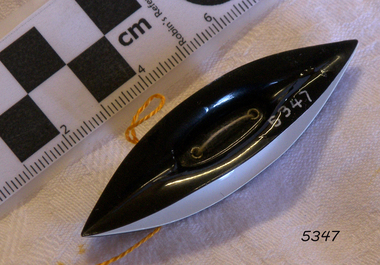
Tatting Shuttle
... thread. Tatting is called "schiffchenarbeit" in German, which means "the work of a little boat". There are two popular types of shuttles. The first has closed ends and a removable bobbin where the thread is wound around - often made from metal or plastic. ...thread. Tatting is called "schiffchenarbeit" in German, which means "the work of a little boat". There are two popular types of shuttles. The first has closed ends and a removable bobbin where the thread is wound around - often made from metal or plastic. ...Tatting is a form of knotted lace making using thread and a small shuttle. Twisted threads are tied around or through small, pointed shuttles that can be made of bone, mother of pearl, tortoise shell, steel or plastic. This produces a stable, strong lace using simple knots of two half hitches to make rings and chains embellished with picots. The origins of tatting are not clear but early versions of decorative knotting were used by the Egyptians on their ceremonial dress. Tatting also has elements of fishermen's net making techniques and the decorative knotting that was practiced by aristocratic women from the 15th century. Tatting, as we know it today, emerged in the first half of the 19th century. The new availability of mercerised thread from 1835 encouraged a burgeoning of lace crafts of all sorts. It was known in Italy as "occhi" and in France as "la frivolite". Tatting looks fragile but is both strong and durable. An article in a column named "Wives and Daughters" published in the Star newspaper in May 1910 describes the durability of tatting lace - "there is edging and insertion still in existence that have outworn two sets of pillow slips." In the 19th century and well into the 20th century, tatting was used like crochet and knitted lace for decorative edgings, collars, doylies, tray cloths etc. At first, different tatting patterns were passed along by word of mouth from person to person, however in time, patterns regularly appeared in newspapers and magazines well into the 1950's. A shuttle is a small tool that looks like a small boat "sailing" in and out of the thread. Tatting is called "schiffchenarbeit" in German, which means "the work of a little boat". There are two popular types of shuttles. The first has closed ends and a removable bobbin where the thread is wound around - often made from metal or plastic. The second type has a post in the center where the thread is wound. The ends of this bobbin are open but snug. Because it is constructed in two pieces, it can be made from materials like bone, ivory or mother of pearl. Shuttles hold a larger amount of thread (as compared with needles) which means fewer ends to weave in. Fishermen in the past are thought to have used large shuttles to weave cord into certain knots whilst making their fishing nets. Their methods were copied by weavers, who innovated by using threads and smaller shuttles to make lace.Tatting Shuttle, black plastic flagstaff hill, warrnambool, shipwrecked-coast, flagstaff-hill, flagstaff-hill-maritime-museum, maritime-museum, shipwreck-coast, flagstaff-hill-maritime-village, tatting shuttle, handcraft, needlework -
 Bendigo Military Museum
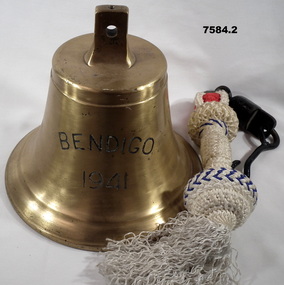
Ceremonial object - SHIPS BELL, HMAS BENDIGO 1941, 1941
... work. At the top of it is a metal ring. Under that is a white and red stylised crown. Under the 'headband' of the crown is a white rope handle with blue inserts. At the bottom is a large rope "Ball" with numerous rope threads...work. At the top of it is a metal ring. Under that is a white and red stylised crown. Under the 'headband' of the crown is a white rope handle with blue inserts. At the bottom is a large rope "Ball" with numerous rope threads ...HMAS BENDIGO (J187) was an Australian made "Corvette" which served throughout WW2 until 'paid off' on 27 September 1946. The Bendigo Military Museum also holds the last ensign of HMAS BENDIGO, it has a large number of auto graphs. We also hold the wooden crest and Battle Honours Board, this is on loan for 5 years. Refer to Cat 4546 Ensign.1. This is a medium size ships bell. It is cast from Brass. It has a protrusion on the top with a hole in it, used for mounting. The words HMAS BENDIGO 1941 are engraved into the side and painted black. The exterior surface has a few pits, but has been polished numerous times. The interior surface is rough cast, with a large quantity of dints, where it has been struck by the clapper. 2. This is the clapper. There is a steel hook under which is a weight of steel. Under that is a ring. Suspended from the bottom ring is the rope handle. This is an excellent example of navy rope work. At the top of it is a metal ring. Under that is a white and red stylised crown. Under the 'headband' of the crown is a white rope handle with blue inserts. At the bottom is a large rope "Ball" with numerous rope threads of about 180mm length.ww2, ran, hmas bendigo -
 Embroiderers Guild, Victoria
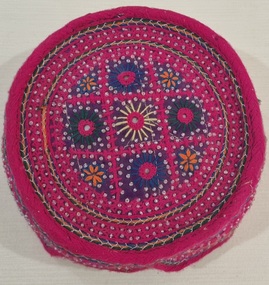
Accessory - Kufi Skull Cap, c 1989
... Silver coloured metal thread herringbone stitch and shisha mirror work....Silver coloured metal thread herringbone stitch and shisha mirror work. Accessory Kufi Skull Cap ...A brimless short rounded cap worn by men in Africa, Middle East and South Asia. Although associated with many Islamic cultures, in the United States it is also worn with people of West African heritage, whether Christian, Islamic or a traditional African religion.Brimless cap hand embroidered with pink, green, blue, orange and yellow coloured highlights. Crystal beads highlight the pattern. Silver coloured metal thread herringbone stitch and shisha mirror work.caps, embroidered -
 Embroiderers Guild, Victoria
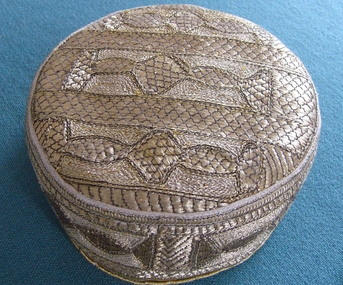
Headwear - Goldwork Pakistani Hat, Early 1970's
... Goldwork Hats Cap Embroidery Hat Pakistan Metal thread Cap (man's) in gold laid work, hand stitched on heavy cream cotton, couching stitched in white and dark brown. ...Bought by donor in 1978 in Pakistan.Cap (man's) in gold laid work, hand stitched on heavy cream cotton, couching stitched in white and dark brown. Assembled by machine.goldwork, hats, cap, embroidery, hat, pakistan, metal thread -
 Embroiderers Guild, Victoria
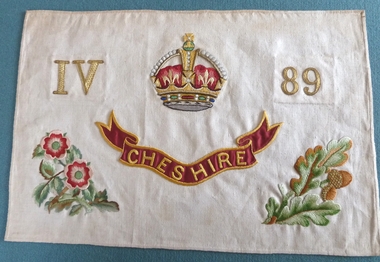
Textile - Royal School of Needlework Cheshire Military Banner, Mrs Hester Hopkins, 1936
... Worked by Hester L. Fairlie Hopkins 1936 probably as a sampler, at the Royal School of Needlework. Embroidery Sampler Banner Silk & gold thread England "Cheshire '89" and "IV" Double sided embroidered banner, cream linen stitched in silk and gold metal thread. ...Worked by Hester L. Fairlie Hopkins 1936 probably as a sampler, at the Royal School of Needlework.Double sided embroidered banner, cream linen stitched in silk and gold metal thread. Crown at centre top, above red scroll, incribed 'Cheshire 89' to one side of crown and 'IV' on other side. Silk oak leaves and acorn in one lower corner, silk roses and foliage in other corner."Cheshire '89" and "IV"embroidery, sampler, banner, silk & gold thread, england -
 Embroiderers Guild, Victoria
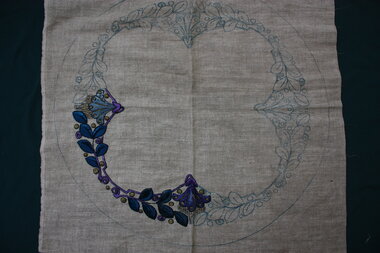
Functional Object - Kit with Threads, Early 20th C
... A quarter of design is worked in purple and peacock worked in rayon threads, gold metal thread and beads. A little over 1/4 stitched. ...A quarter of design is worked in purple and peacock worked in rayon threads, gold metal thread and beads. A little over 1/4 stitched. ...Originally purchased at Read's of Prahran. 2 labels attached - Read's Prahran and Read's 14/11 sale price. Originally purchased by donor in an Op Shop.Partially worked transfer design on dark ecru furnishing linen-like fabric. A circular design incorporating leaves, Prince of Wales feathers, stems and circles. A quarter of design is worked in purple and peacock worked in rayon threads, gold metal thread and beads. A little over 1/4 stitched. Includes a bag of threads Pearsall 'Fibrette' wood pulp yarn (rayon) and Perfecta Floss (rayon) and 1 reel metallic thread.Label - "Read's of Prahran" 14/11 sale price.embroidery, silk, rayon -
 Embroiderers Guild, Victoria
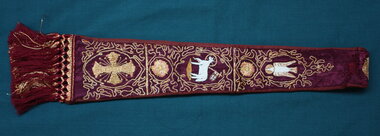
Textile - Ecclesiastical Maniple
... work and silk embroidery. Motifs include dove, lamb, chalice, maltese cross and flowers and latin text. Silk and metal thread...work and silk embroidery. Motifs include dove, lamb, chalice, maltese cross and flowers and latin text. Silk and metal thread ...The maniple is a liturgical vestment used primarily within the Latin Rite of the Catholic Church, and occasionally by Lutheran and Anglican clergy. It is an embroidered band of silk or like fabric that hangs from the left forearm, worn over the alb. It is used only during Mass, and it is always of the same liturgical colour as other Mass vestments. The original purpose of the maniple is unclear, but it probably originated as a cloth that the priest could use to wipe his hands and face. The maniple corresponds to the epimanikia, cuffs worn on both wrists in the Eastern Orthodox, Eastern Lutheran and Eastern Catholic Churches. (wikipedia)Dark red silk damask ecclesiastical stole with gold work and silk embroidery. Motifs include dove, lamb, chalice, maltese cross and flowers and latin text. Silk and metal thread fringes both ends of both pieces.Latin textsembroidery, gold work, ecclesiastical -
 Embroiderers Guild, Victoria
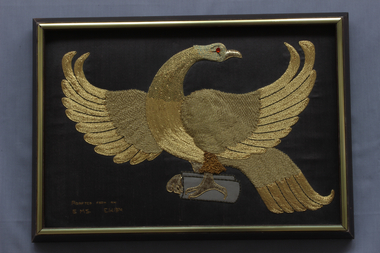
Artwork, other - Picture, Mrs Edna Wark, 1974
... Designed and worked by Edna Wark. Goldwork Metal thread Bird Adapted from an EMS EW1974 Large goldwork bird with outstretched wings on a brown silk backing ground. ...Designed and worked by Edna Wark.Large goldwork bird with outstretched wings on a brown silk backing ground.Adapted from an EMS EW1974goldwork, metal thread, bird -
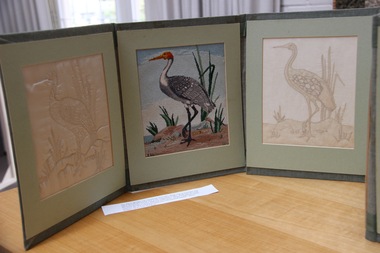 Embroiderers Guild, Victoria
Textile - Folder, Mrs Edna Wark, "The Elegant Brolga", 20th C
... Embroidery Folder Metal quilting Black work Petit point Birds Six panels, each are a brolga in different stitches. Pulled thread ...Edna Wark made the silver brolga while on holiday and Winifred Clayton suggested she repeat the design in different techniques.Six panels, each are a brolga in different stitches. Pulled thread, metal thread, petit point, blackwork and quilting.embroidery, folder, metal, quilting, black work, petit point, birds -
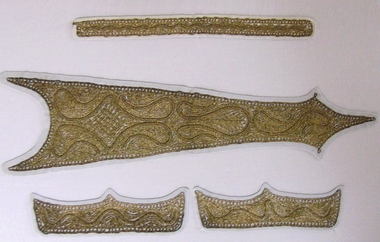 Embroiderers Guild, Victoria
Accessory - Middle Eastern Caftan Front and Cuffs
... Metal thread Probably Middle Eastern. The set consists of 2 cuffs, a front and a neckband, probably for a garment like a caftan, worked on pale grey fabric. ...Probably Middle Eastern. The set consists of 2 cuffs, a front and a neckband, probably for a garment like a caftan, worked on pale grey fabric. The fabric is completely covered with metallic thread in an abstract design. The pieces are mounted on a board.embroidery, garments, middle east, metal thread -
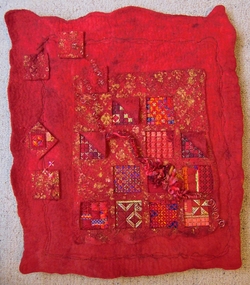 Embroiderers Guild, Victoria
Textile - Contemporary Felt and Embroidered Panel, Amanda (Mandy) Ginsberg, 2000
... Red felt (handmade), canvas work, gold and metal threads, beading, and machine embroidery....Embroidery Canvas work Felt Australia 2000-2020 Panels Red felt (handmade), canvas work, gold and metal threads, beading, and machine embroidery. ...Red felt (handmade), canvas work, gold and metal threads, beading, and machine embroidery.embroidery, canvas work, felt, australia, 2000-2020, panels -
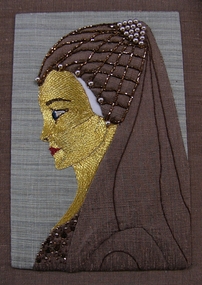 Embroiderers Guild, Victoria
Artwork, other - Metal Thread Embroidery, Edna Wark, "Mistress Mary" Edna Wark, 1975
... Embroidery Metal thread Picture 1960-80 Australia Panel embroidered in gold work (or nue) and embellished with beads. ...Panel embroidered in gold work (or nue) and embellished with beads. "Mistress Mary" is dressed in medieval dress of brown silk on a dull green background.embroidery, metal thread, picture, 1960-80, australia -
 Embroiderers Guild, Victoria
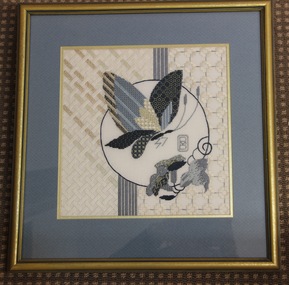
Artwork, other - Picture, Pam Breukhaven, Late 20th early 21st century
... A butterfly worked on white canvas in shades of blue and gold stranded cotton metalic threads mostly in satin stitch. ...Pam made this picture as a result of a class in Dookie in 2003 Designed by Betty Chen Lewis Embroidery Picture Butterflies Satin stitch Gold A butterfly worked on white canvas in shades of blue and gold stranded cotton metalic threads mostly in satin stitch. ...Pam made this picture as a result of a class in Dookie in 2003 Designed by Betty Chen LewisA butterfly worked on white canvas in shades of blue and gold stranded cotton metalic threads mostly in satin stitch. Blue mount edged in gold. Gold frame.Blue threads may be fine wool.embroidery, picture, butterflies, satin stitch, gold
