
Showing 78 items matching " mid 18th century"
-
 Australian Lace Guild - Victorian Branch
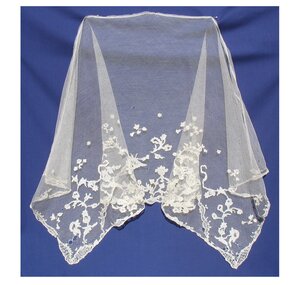
Textile - Bonnet veil with Agentan lace motifs, Argentan motifs - mid 18th century. Bonnet veil mid 19th century
... At this time old lace was highly valued - in this case old Argentan needle lace motifs (mid 18th century) have been reclaimed and appliqued onto machine made cotton net to form this 19th century bonnet veil. ...Mid 18th century Argentan needle lace motifs appliqued onto machine-made cotton net....Argentan motifs - mid 18th century. Bonnet veil mid 19th century...Lace veil Bonnet veil. Mid 18th century Argentan needle lace motifs appliqued onto machine-made cotton net. ...Fashion Item. Bonnet veils were very fashionable during the 19th century. At this time old lace was highly valued - in this case old Argentan needle lace motifs (mid 18th century) have been reclaimed and appliqued onto machine made cotton net to form this 19th century bonnet veil. Probably home-made.Mid 18th century Argentan needle lace motifs appliqued onto machine-made cotton net.lace veil, bonnet veil. -
 Embroiderers Guild, Victoria
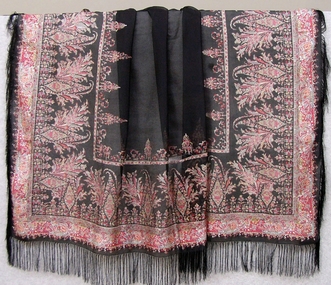
Clothing - Silk Paisley Style Shawl, Mid 18th century
... ... Mid 18th century...Mid 18th century...Embroidery Weaving Shawls Mid 18th century France? Large silk shawl with 130 mm black silk fringe. ...Originally belonged to the wife of William Pitt, first Earl of Chatham, 1708-78, and has been handed down from generation to generation and was the property of the donor.William Pitt, 1st Earl of Chatham (15 November 1708 – 11 May 1778) was a British Whig statesman who served as Prime Minister of Great Britain from 1766 to 1768.Large silk shawl with 130 mm black silk fringe. Black centre with colourful, dense floral or paisley (Jal) patterned border on 4 sides.embroidery, weaving, shawls, mid 18th century, france? -
 Flagstaff Hill Maritime Museum and Village
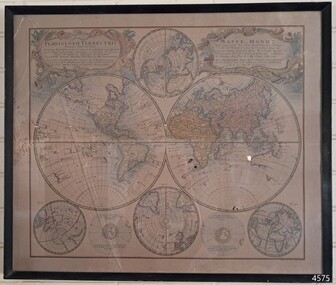
Map - World Map, Mappe Monde [Medieval Map of the World], 1910
... This map from the mid-18th century doesn't include the finer details of land and sea masses that we know today. ...The Coloured hand drawn line drawings show different hemispheres of the known world in the mid-18th century. Beautifully drawn figures and decorative embellishments enhance the map. ...This map from the mid-18th century doesn't include the finer details of land and sea masses that we know today. ...This map from the mid-18th century doesn't include the finer details of land and sea masses that we know today. The map was produced by German cartographer and publisher, Johann Baptist Homann (1663-1724) and published in 1746, after his death. Earlier versions were published, such as 1707 and 1716. The date can be calculated from the Roman numerals on the top left text area. This print of a map is significant for its connection with early world explorers. A comparison of maps over the centuries shows the progression of navigational technology, the countries who claimed the land they explored. The naming of even some Australian locations shows who had already made their mark on Australia in the early 18th century. The print shows the fine details included by the cartographer and the beauty included that makes it attractive and interesting even today. The map is also significant for its connection with German cartographer, Johann Baptist Homann, whose Homann publishing company was renewed in Germany for producing high quality maps and atlases. Map behind glass in dark brown wooden frame on beige paper. The Coloured hand drawn line drawings show different hemispheres of the known world in the mid-18th century. Beautifully drawn figures and decorative embellishments enhance the map. The text on the top right has an explanation of the Figures I, II, III, and IV. This print of the 1746 map was produced in England by Leisure Arts Ltd. "PLANIGLOBIL TERRESTRIS" "MDCCXXXXVI" [1746] "MAPPE_MONDE" [Medieval Map of the World] "LEISURE ARTS LTD" "Printed in England"flagstaff hill, warrnambool, flagstaff hill maritime museum, flagstaff hill maritime village, flagstaff hill maritime museum and village, shipwreck coast, world map, french map, 18th century map, leisure arts ltd, cartography, early exploration, cartographer, johann homann (1663-1724), exploration, naviagtion, 1746 planiglobil terrestris -
 Embroiderers Guild, Victoria
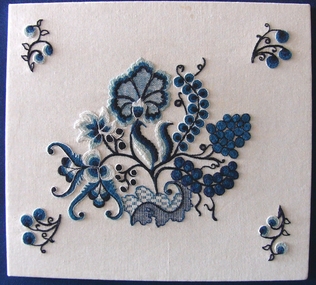
Textile - Panel, Lady Amies, Mid 20th Century
... Design taken from a mid 18th Century Bed Hanging in the American collection of the Metropolitan Museum or Art. ...Embroidery Panel Crewel 1960-1980 Australia America Crewel Embroidery Deerfield Design taken from a mid 18th Century Bed Hanging in the American collection of the Metropolitan Museum or Art. ...Worked and donated by Lady Amies Deerfield in style: Deerfield embroidery is an offshoot of crewel wool embroidery. In 1896 C.E., Margaret Whiting and Ellen Miller formed the Deerfield Society of Blue and White Needlework after having unearthed surviving fragments of wool worked crewel stitching from their local Massachusetts museum that dated back to the 1700s. Design taken from a mid 18th Century Bed Hanging in the American collection of the Metropolitan Museum or Art. Typical crewel design in shades of blue on cream linen. Mounted on blue fabric covered board. embroidery, panel, crewel, 1960-1980, australia, america, crewel embroidery, deerfield -
 Flagstaff Hill Maritime Museum and Village
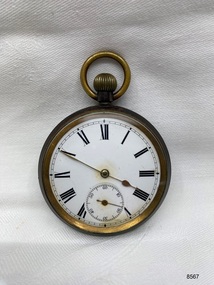
Instrument - Fob Watch, Moeris watchmakers, Early 1900s
... Fob (or pocket) watches were developed in Europe in the 16th century and gained wide usage during the mid 18th century until World War 1 when the wristwatch was invented. ...Fob (or pocket) watches were developed in Europe in the 16th century and gained wide usage during the mid 18th century until World War 1 when the wristwatch was invented. ...Fob (or pocket) watches were developed in Europe in the 16th century and gained wide usage during the mid 18th century until World War 1 when the wristwatch was invented. These watches were designed to be carried in a small pocket and attached through the means of a 'fob' which could be a chain or made from a variety of materials such as leather. Their popularity peaked in the nineteenth century where they were an important part of middle and lower class society as well.This item is of social significance as fob / pocket watches were valued as an essential object in all levels of society in the late 19th century. For some occupations, such as the railroads, it was a necessary tool of the job. Being dated to the early 1900s gives the watch historical significance as possibly being used during the first World War.Pocket watch with possible gunmetal case and brass winder. The white dial has black Roman numerals on the face (note the use of four lines for the number 4 and no markings for the number 6). The face has a circular insert and hand to show the seconds. All hands are gold coloured with the hour hand having a leaf shape. The case has a back cover, which opens to reveal an inner cover, which protects the workings. Both covers are inscribed with the number 877396. The back cover has the words ACIER GARANTI stamped into it, which means steel guaranteed and may refer to the screws used in the workings.Stamped inside the back cover in an oval shape - ACIER GARANTI with N.F. stamped in between the words. The number 877396 is stamped inside the back cover and again inside the middle cover. There is an indecipherable marking near the number inside the back cover and another scratching on the inside of the back cover which may be letters or numbers. The workings are inscribed with the words SWISS MADE and the manufacturer's circular stamp 'MOERIS'. The markings F, S, A and R are on the workings.flagstaff hill maritime museum and village, warrnambool, great ocean road, shipwreck coast, fob watch, pocket watch, watch, 19th century, horology, time keeper, acier garanti, swiss made, moeris -
 Flagstaff Hill Maritime Museum and Village
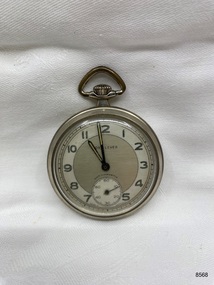
Instrument - Fob Watch, 1940-60s
... Fob (or pocket) watches were developed in Europe in the 16th century and gained wide usage during the mid 18th century until World War 1 when the wristwatch was invented. ...Fob (or pocket) watches were developed in Europe in the 16th century and gained wide usage during the mid 18th century until World War 1 when the wristwatch was invented. ...Fob (or pocket) watches were developed in Europe in the 16th century and gained wide usage during the mid 18th century until World War 1 when the wristwatch was invented. These watches were designed to be carried in a small pocket and attached through the means of a 'fob' which could be a chain or made from a variety of materials such as leather. Their popularity peaked in the nineteenth century where they were an important part of middle and lower class society as well.This item is of social significance as fob / pocket watches were valued as an essential object in all levels of society. For some occupations, such as the railroads, it was a necessary tool of the job. Steel York Lever open face pocket / fob watch dated between 1940-1960. The dial has an inner pewter circle, outer minute divisions and a circular insert and hand to show the seconds. The numbers are finely edged with a black line and the hands are two coloured. The back of the watch is patterned with fine lines and three rectangle shapes. The words 'ANTIMAGNETIC' are on the front of the watch. Anti-magnetic watches began to be made at the beginning of the 20th century as mechanical watches were affected by magnetic fields. The 'lever' set on watches was a requirement for railroad watches. It required a two step process for the hands to be adjusted. The front dial of the watch has the words 'YORK LEVER', 'ANTIMAGNETIC' and 'MADE IN GERMANY'. flagstaff hill maritime museum and village, warrnambool, great ocean road, shipwreck coast, fob watch, pocket watch, watch, horology, time keeper, york lever, anti-magnetic, made in germany -
 Flagstaff Hill Maritime Museum and Village
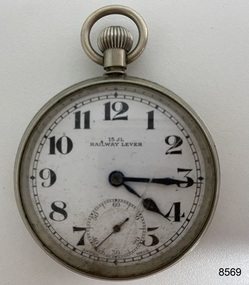
Instrument - Fob Watch, 1920-30s
... Fob (or pocket) watches were developed in Europe in the 16th century and gained wide usage during the mid 18th century until World War 1 when the wristwatch was invented. ...Fob (or pocket) watches were developed in Europe in the 16th century and gained wide usage during the mid 18th century until World War 1 when the wristwatch was invented. ...Fob (or pocket) watches were developed in Europe in the 16th century and gained wide usage during the mid 18th century until World War 1 when the wristwatch was invented. These watches were designed to be carried in a small pocket and attached through the means of a 'fob' which could be a chain or made from a variety of materials such as leather. Their popularity peaked in the nineteenth century where they were an important part of middle and lower class society as well. The inclusion of the word RAILWAY on the face of the watch suggests a possible use by an employee of the railways. This item is of social significance as fob / pocket watches were valued as an essential object in all levels of society. For some occupations, such as the railroads, it was a necessary tool of the job. Steel Railway Lever open face pocket / fob watch dated 1920s-1930s. The white dial has large black arabic numerals and outer minute divisions around the edge. A circular insert and small hand to show the seconds is at the bottom of the watch face. The hour hand is a rounded leaf shape, and the minute hand a thin diamond shape. Both hands and the small rounded end of the second hand reflect a metallic blue sheen in the right lighting. The words RAILWAY LEVER, 15 JL and SWISS MADE are on the dial. The lever set on watches was a requirement for railroad watches. It required a two step process for the hands to be adjusted. 15 JL refers to the movement being a 15 jewel one.The front dial of the watch has the words 15 JL, RAILWAY LEVER, and SWISS MADE. flagstaff hill maritime museum and village, warrnambool, great ocean road, shipwreck coast, fob watch, pocket watch, watch, horology, time keeper, swiss made, railway lever, 15 jl, 15 jewel -
 Warrnambool and District Historical Society Inc.
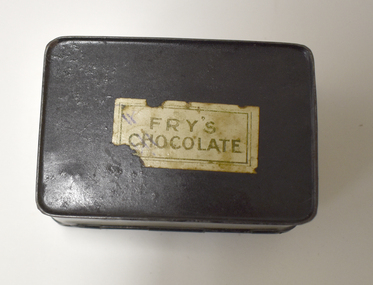
Functional object - Fry's Chocolate miniature cash tin, Fry's Chocolate Company, c. 1970
... The Fry's Chocolate Company was established in Bristol, England in the mid 18th century by Joseph Fry and in the mid 19th century it produced the first mass-produced chocolate bar (1866 - Chocolate Cream, 1913 Turkish Delight). ...The Fry's Chocolate Company was established in Bristol, England in the mid 18th century by Joseph Fry and in the mid 19th century it produced the first mass-produced chocolate bar (1866 - Chocolate Cream, 1913 Turkish Delight). ...This miniature cash tin was produced by Fry's Chocolate Company of England as a promotional giveaway and probably held some chocolate samples. It would then have been used in a household for keeping trinkets or other small items. The Fry's Chocolate Company was established in Bristol, England in the mid 18th century by Joseph Fry and in the mid 19th century it produced the first mass-produced chocolate bar (1866 - Chocolate Cream, 1913 Turkish Delight). The company merged with the Cadbury company in 1919 and the Tasmanian Cadbury factory which opened in 1921 was known as Cadbury-Fry-Pascall. Fry's chocolate bars were very popular in Australia. This item is retained as a memento of Fry's Chocolate Company, the products of which featured in Australian life for many decades. This is a rectangular metal tin painted black and light brown. It has a hinged lid and a metal handle held with clips inserted into slits on the top of the lid. There is printing on the lid and a label on the base.Cash Fry's Chocolatechocolate bars, fry's chocolate, miniature cash tin -
 Flagstaff Hill Maritime Museum and Village
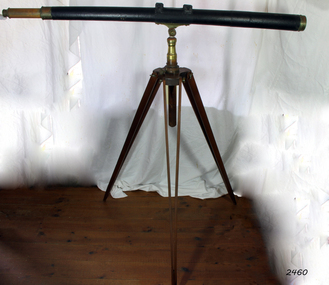
Instrument - Telescope, Mid-18th Century
... Mid-18th Century ...This Day or Night telescope, made by John Dollond, was designed for use in a range of lighting conditions, as its name suggests. Telescopes are optical instruments that make distant objects appear larger and closer, thereby extending the range of what the human eye can observe. The development of the telescope was gradual, shaped by a series of important advances in optical science. In 1608, the Dutch spectacle-maker Hans Lippershey discovered that when two lenses were held apart in a particular way, distant objects appeared closer. He applied for a patent for this invention, creating the first documented telescope. In 1668, Isaac Newton produced the first successful reflecting telescope, using a two-inch concave spherical mirror. This marked a major step forward, demonstrating that mirrors could overcome some of the limitations of lenses and greatly improve magnification. Further progress followed in the eighteenth century. In 1729, Chester Moor Hall developed the achromatic lens by combining two types of glass with different refractive properties. This reduced colour distortion and produced a sharper image, although some edge distortion remained. That same year, the Scottish instrument maker James Short developed parabolic and elliptical mirrors that were better suited to reflecting telescopes because they reduced optical distortion. Building on these advances, John Dollond improved the achromatic objective lens by placing a concave flint-glass lens between two convex crown-glass lenses, considerably enhancing image quality. Maker’s information. John Dollond (1707–1761), of London, was a maker of optical, scientific and astronomical instruments best known for developing the achromatic refracting telescope. He also introduced a practical heliometer, a telescope fitted with a divided lens that could be used to measure the Sun’s diameter and the angular distance between celestial bodies. The son of Huguenot refugees, Dollond first learned the family trade of silk weaving before turning his attention to optics and astronomy, in which he became highly skilled. In 1753, Dollond patented his improved lenses, the same year he had introduced the heliometer. In 1761, John Dollond was appointed as optician to George III and the Duke of York. He was also elected a Fellow of the Royal Society in May 1761, but died suddenly later that year in November. His share of the patent then passed to his eldest son, Peter. In later disputes between Peter Dollond and rival London opticians who challenged the patent, Peter consistently argued that, whatever earlier precedents may have existed, his father had independently developed a practical method for producing achromatic lenses through his command of Newtonian optics. By successfully defending the patent, the Dollond firm became one of the leading manufacturers of optical instruments. During the eighteenth and nineteenth centuries, the name ‘Dollond’ was at times used almost generically to mean ‘telescope,’ reflecting the firm’s reputation. Genuine Dollond telescopes were regarded as among the finest available. Peter Dollond (1731–1820) was the driving force behind the family business. He had founded a small optical business in 1750 on Vine Street, Halton Garden, with his father's guidance. The success of the business led to his father joining him in partnership in 1752. In 1959, J Dollond and Son opened a shop on The Strand, London. Dollonds appear to have produced both reflecting and refracting telescopes, and they possessed the technical skill to manufacture significant numbers of lenses largely free from chromatic aberration. In 1766, Peter went into partnership with his younger brother, John, and they traded under the name P and J Dollond. They supplied optical instruments for Captain Cook and George Hadley, an English lawyer and Meteorologist. In 1769, Captain Cook travelled with a Dollond telescope on the voyage to observe the Transit of Venus. Other notable customers included Thomas Jefferson and Admiral Lord Nelson. In 1781, Peter Dollond made bifocal spectacles. In 1804, young John Dollond passed away. The following year, Peter Dollond went into partnership with his nephew, George Huggins, and Huggins legally changed his surname to Dollond, and the firm remained P and J Dollond. In the early 20th century, the company sold film cameras. The firm remained in the hands of Dollond family members until 1927, when Dollond & Co. merged with James Aitchison & Co. to form Dollond & Aitchison, the well-known high street chain of opticians, which continued making and selling prescription spectacles. Now fully part of Boots Opticians, the company no longer manufactures instruments and operates exclusively as a retail business. The telescope in the collection is an excellent example of one of Dollond’s early library telescopes. Its association with one of eighteenth-century England’s leading innovators in optical development gives it considerable historical significance and makes it an important object within the collection. John Dollond’s experiments in optics advanced the understanding of the divergent properties of lenses and made a lasting contribution to the development of practical optical science. His work helped lay the foundation for major improvements in the design and performance of optical instruments. In his own time, Dollond was celebrated as the “Father of practical optics” and received widespread recognition for his achievements in the field. Dollond telescopes were associated with the renowned mariners, Captain James Cook and Admiral Lord Nelson Telescope: Dollond's Telescope, Day or Night model navigational instrument. Telescope is mounted on wooden tripod stand that has folding legs. Brass telescope with leather sheath over barrel, adjustable angle fitting with brass wing nuts that join the legs to the top frame, which is then joined to the telescope pole by an adjustable screw fitting. Manufactured by Dollond, London. Inscription reads "Dollond London, Day or Night" and "DOLLOND LONDON"flagstaff hill maritime museum and village, maritime museum, maritime village, great ocean road, warrnambool, optical instrument, achromatic telescope, heliometer, light refraction, instrument maker, lens, transit of venus, astronomical telescope, concave lens, scientific instrument, navigation, navigational instrument, astronomy, dollond, dollond london, john dollond, peter dollond, dollond telescope, day or night telescope, floor-standing telescope, library telescope, hans lippershey, isaac newton, chester moor hall, james short, captain cook, thomas jefferson, admiral lord nelson, dollond & co, aitchison & co, dollond & aitchison, boots opticians, george iii, duke of york, george huggins, george dollond, p and j dollond, j dollond and son, spectacles, cameras -
 Bright & District Historical Society operating the Bright Museum
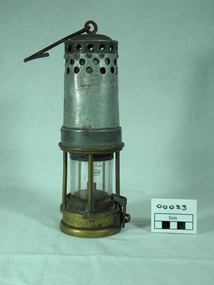
Lamp miner's safety, mid 18th-century
... mid 18th-century ...Safety lamp made for underground miners to replace naked flame lightingUsed in underground mining in Ovens or Buckland mining districtsmetal and glass oil powered lamp(partly obscured on glass) BRITISH MFP. ( on brass) 3BB BOSS ( on screw off base) 56 and 10mining, lamp, oil, safety, kerosene, underground -
 Australian Lace Guild - Victorian Branch
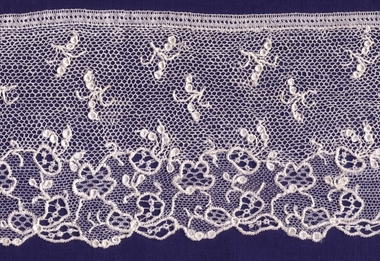
Textile - Alencon Lace, Mid 18th Century
... Mid 18th Century ...Fine lace used as a costume trimmingNeedle lace edging. Sample -
 Australian Lace Guild - Victorian Branch
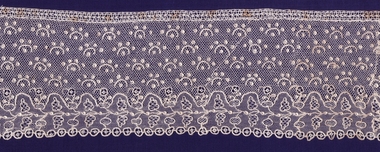
Textile - Alencon Lace, Mid 18th Century
... Mid 18th Century ...Fine lace used as a costume trimmingNeedle lace edging -
 Australian Lace Guild - Victorian Branch
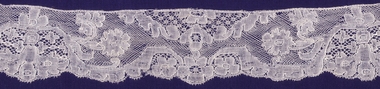
Textile - Mechlin lace, Mid 18th century
... Mid 18th century ...Fine old Mechlin lace used as a costume trimmingBobbin lace edging -
 Flagstaff Hill Maritime Museum and Village
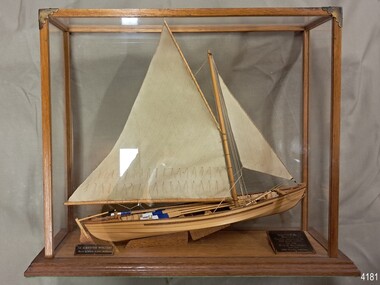
Craft - Ship Model, Whaleboat, Wally St John (ship model maker), New Bedford, 1988
... Coastal whaling in the area began in the 17th Century, and by the mid-18th century, it was performed on a large scale. ...Coastal whaling in the area began in the 17th Century, and by the mid-18th century, it was performed on a large scale. ...The whaleboat model was built for the 1988 Warrnambool Wunta Festival by Wally St John, of Melbourne. Its name comes from the port of New Bedford in Massachusetts, America. Coastal whaling in the area began in the 17th Century, and by the mid-18th century, it was performed on a large scale. The town is renowned for the author, Herman Melville, who sailed out on the whaler "Acushnet" in 1841. When he returned, he published his book about the great white whale "Moby Dick". The Wunta Festival began in 1985. In 1988, it was sponsored by the Warrnambool City Council and Mr. Alan Lane, a Warrnambool businessman who served on the Council for 18 years. The festival is held on the first weekend in February and involves the whole community. One of the activities is the Whaleboat Race. International whaleboat racing began in 1805 with a race between America and Britain. The City of Warrnambool Rowing Club started the whaleboat race in 1986 as part of the Wunta festival, and a Whaleboat Club was soon formed. The race is held on the Hopkins River. The ship model of the whaleboat, New Bedford, is significant because it represents vessels used in the early industry of whaling in southwest Victoria. It is also representative of the centuries-old craft of ship model making. It is important for its connection to the Wunta Festival, a Warrnambool community event. It is connected to Mr. Alan L Lane, whose estate generously funded the Alan Lane Foundation for the continuous support and funding of local community events and activities. Ship model of a whaleboat. The boat has two fabric sails, a tiller, and four wooden oars with blue and white sections painted on the blades. The model is mounted on a wooden stand inside a glass case with a wooden frame. Two gold embossed black plaques are on the base of the case, on the front. The plaques have decorative borders and inscriptions. The model of the New Bedford Whaleboat, built by Wally St John, Melbourne, was made for the 1988 WUNTA Festival in Warrnambool. Left plaque: "THE NEW BEDFORD WHALEBOAT / Built by Wally St John Melbourne" Right plaque: "]Logo of a Triangle with "WUNTA festival" "Proudly sponsored by Mr. ALAN LANE for the City of Warrnambool and 1988 Wunta Festival"flagstaff hill, flagstaff hill maritime museum and village, warrnambool, maritime museum, maritime village, great ocean road, shipwreck coast, whaleboat, ship model, vessel, 1988, wunta, wunta festival, wally st john, melbourne, new bedford, massachusetts, america, coastal whaling, herman melville, acushnet, alan lane, alan lane foundation, councillor, whaleboat race, warrnambool rowing club, hopkins river -
 Flagstaff Hill Maritime Museum and Village
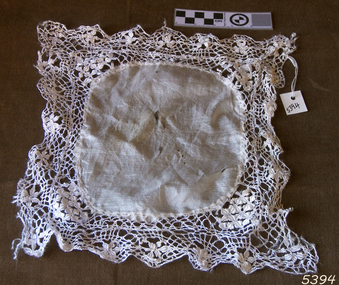
Accessory - Handkerchief
... Modern tatting is a craft that became popular in the 18th to mid-19th century. ...Modern tatting is a craft that became popular in the 18th to mid-19th century. This handcrafted handkerchief is an example of the tatting craft, used to make decorative edges on a wide variety of domestic manchester and clothing items. ...This ladies' dainty handkerchief has a handmade border of tatted craft work. Modern tatting is a craft that became popular in the 18th to mid-19th century. This handcrafted handkerchief is an example of the tatting craft, used to make decorative edges on a wide variety of domestic manchester and clothing items. It was common for household linen from the late 19th and early 20th century to be embellished with decorative trimsLadies' silk handkerchief with handmade tatted edges, square with rounded corners.flagstaff hill, warrnambool, shipwrecked-coast, flagstaff-hill, flagstaff-hill-maritime-museum, maritime-museum, shipwreck-coast, flagstaff-hill-maritime-village, handkerchief, tatting, silk handkerchief, clothing, handworked, craft, handcraft -
 Flagstaff Hill Maritime Museum and Village
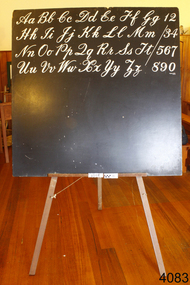
Functional object - Blackboard & Easel, Probably first half of 20th century
... The first classroom uses of large blackboards are difficult to date, but they were used for music education and composition in Europe as far back as the 16th century.The term "blackboard" is attested in English from the mid-18th century; the Oxford English Dictionary provides a citation from 1739, to write "with Chalk on a black-Board". ...The first classroom uses of large blackboards are difficult to date, but they were used for music education and composition in Europe as far back as the 16th century.The term "blackboard" is attested in English from the mid-18th century; the Oxford English Dictionary provides a citation from 1739, to write "with Chalk on a black-Board". ...The first classroom uses of large blackboards are difficult to date, but they were used for music education and composition in Europe as far back as the 16th century.The term "blackboard" is attested in English from the mid-18th century; the Oxford English Dictionary provides a citation from 1739, to write "with Chalk on a black-Board". The first attested use of chalk on blackboard in the United States dates to 1801, in a lecture course in mathematics given by George Baron. James Pillans has been credited with the invention of coloured chalk (1814); he had a recipe with ground chalk, dyes and porridge! The use of blackboards did change methods of education. Manufacturing of slate blackboards began by the 1840s. A green porcelain enamel surface was first used in 1930, and as this type of board became popular, the word "chalkboard" appeared. Various types of easel have been in use since ancient times, in particular for supporting paintings and other artwork. However, the schoolroom easel would have been introduced around the same time as when the blackboard started to be used in educational establishments. Wooden board painted black, resting on wooden easel with rope supporting the three easel legs.Noneflagstaff hill, warrnambool, shipwrecked-coast, flagstaff-hill, flagstaff-hill-maritime-museum, maritime-museum, shipwreck-coast, flagstaff-hill-maritime-village -
 Flagstaff Hill Maritime Museum and Village
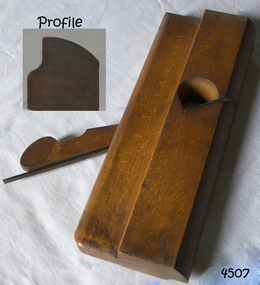
Tool - Wood Moulding Plane, Unknown
... The maker of this plane is unknown but probably made in London early to mid 18th century. There are many of his tools including decorative moulding planes of all sizes and designs for sale around the world with no makers marks however moulding planes from this era are well sought after by collectors of vintage tools....A significant tool from the early to mid 18th century that today is quite rare and sought after by collectors. ...A moulding plane is a specialised plane used for making the complex shapes found in wooden mouldings that are used to decorate furniture or other wooden object. Traditionally, moulding planes were blocks of wear resistant hardwood, often beech or maple, which were worked to the shape of the intended moulding. The blade, or iron was likewise formed to the intended moulding profile and secured in the body of the plane with a wooden wedge. A traditional cabinetmakers shop might have many, perhaps hundreds, of moulding planes for the full range of work to be performed. Large crown mouldings required planes of six or more inches in width, which demanded great strength to push and often had additional peg handles on the sides, allowing the craftsman's apprentice or other worker to pull the plane ahead of the master who guided it. The maker of this plane is unknown but probably made in London early to mid 18th century. There are many of his tools including decorative moulding planes of all sizes and designs for sale around the world with no makers marks however moulding planes from this era are well sought after by collectors of vintage tools.A vintage tool made by an unknown maker, this item was made commercially for firms and individuals that worked in wood and needed a tool that could produce a ornamental finish to timber. The tool was used before routers and spindle moulders came into use after World War ll, a time when to produce a decorative moulding for a piece of furniture, door trims etc or other items had to be accomplished using hand tools and in particular one of these types of planes. These profiled planes came in various shapes and sizes to achieve a decorative finish. A significant tool from the early to mid 18th century that today is quite rare and sought after by collectors. It gives us a snapshot of how furniture and other decorative finishes were created on timber by the use of hand tools. Tools that were themselves hand made shows the craftsmanship used during this time not only to make a tool such as the subject item but also the craftsmanship needed to produce a decorative finish that was needed to be made for any timber item.Wood Moulding Plane Rabbet typeMarked J Heath on end, (no makers mark)flagstaff hill, warrnambool, shipwrecked-coast, flagstaff-hill, flagstaff-hill-maritime-museum, maritime-museum, shipwreck-coast, flagstaff-hill-maritime-village, plane moulding, moulding plane, plane, j heath, ames -
 Flagstaff Hill Maritime Museum and Village
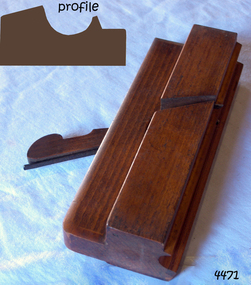
Tool - Wood Moulding Plane, 1844-1860
... All we known about John Ames is that he was a tool maker and retailer that operated a business in London early to mid 18th century. There are many of his tools including decorative moulding planes of all sizes and designs for sale around the world and that his tools in particular moulding planes are well sought after by collectors of vintage tools....A significant tool from the early to mid 18th century that today is quite rare and sought after by collectors. ...A moulding plane is a specialised plane used for making the complex shapes found in wooden mouldings that are used to decorate furniture or other wooden object. Traditionally, moulding planes were blocks of wear resistant hardwood, often beech or maple, which were worked to the shape of the intended moulding. The blade, or iron was likewise formed to the intended moulding profile and secured in the body of the plane with a wooden wedge. A traditional cabinetmakers shop might have many, perhaps hundreds, of moulding planes for the full range of work to be performed. Large crown mouldings required planes of six or more inches in width, which demanded great strength to push and often had additional peg handles on the sides, allowing the craftsman's apprentice or other worker to pull the plane ahead of the master who guided it. All we known about John Ames is that he was a tool maker and retailer that operated a business in London early to mid 18th century. There are many of his tools including decorative moulding planes of all sizes and designs for sale around the world and that his tools in particular moulding planes are well sought after by collectors of vintage tools.A vintage tool made by a known maker, this item was made commercially for firms and individuals that worked in wood and needed a tool that could produce a ornamental finish to timber. The tool was used before routers and spindle moulders came into use after World War ll, a time when to produce a decorative moulding for a piece of furniture, door trims etc or other items had to be accomplished using hand tools and in particular one of these types of planes. These profiled planes came in various shapes and sizes to achieve a decorative finish. A significant tool from the early to mid 18th century that today is quite rare and sought after by collectors. It gives us a snapshot of how furniture and other decorative finishes were created on timber by the use of hand tools. Tools that were themselves hand made shows the craftsmanship used during this time not only to make a tool such as the subject item but also the craftsmanship needed to produce a decorative finish that was needed to be made for any timber item.Complex Moulding Plane J Heath (owner) stamped. No 6 opposite endflagstaff hill, warrnambool, shipwrecked-coast, flagstaff-hill, flagstaff-hill-maritime-museum, maritime-museum, shipwreck-coast, flagstaff-hill-maritime-village, plane moulding, moulding plane, plane, j heath, ames -
 Flagstaff Hill Maritime Museum and Village
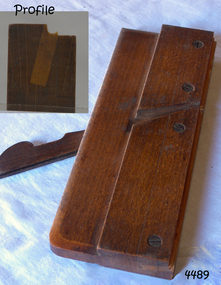
Tool - Wood Moulding Plane, 1844-1860
... All we known about John Ames is that he was a tool maker and retailer that operated a business in London early to mid 18th century. There are many of his tools including decorative moulding planes of all sizes and designs for sale around the world and that his tools in particular moulding planes are well sought after by collectors of vintage tools....A significant item from the mid to late 18th century that today is quite rare and sought after by collectors. ...A moulding plane is a specialised plane used for making the complex shapes found in wooden mouldings that are used to decorate furniture or other wooden object. Traditionally, moulding planes were blocks of wear resistant hardwood, often beech or maple, which were worked to the shape of the intended moulding. The blade, or iron was likewise formed to the intended moulding profile and secured in the body of the plane with a wooden wedge. A traditional cabinetmakers shop might have many, perhaps hundreds, of moulding planes for the full range of work to be performed. Large crown mouldings required planes of six or more inches in width, which demanded great strength to push and often had additional peg handles on the sides, allowing the craftsman's apprentice or other worker to pull the plane ahead of the master who guided it. All we known about John Ames is that he was a tool maker and retailer that operated a business in London early to mid 18th century. There are many of his tools including decorative moulding planes of all sizes and designs for sale around the world and that his tools in particular moulding planes are well sought after by collectors of vintage tools.A significant item from the mid to late 18th century that today is quite rare and sought after by collectors. It gives us a snapshot of how furniture was made predominately by hand and with tools that were themselves hand made shows the craftsmanship used to make such a unique item. It also gives an insight into how many manufacturing companies bid for the rights to use prison labour to make their products at this time in our history. Complex Moulding Plane J Ames maker, No 1 at opposite end Stamped J Heath (owner)flagstaff hill, warrnambool, shipwrecked-coast, flagstaff-hill, flagstaff-hill-maritime-museum, maritime-museum, shipwreck-coast, flagstaff-hill-maritime-village, plane moulding, moulding plane, plane, j heath, ames -
 Flagstaff Hill Maritime Museum and Village
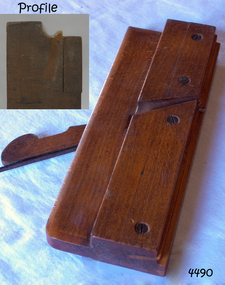
Tool - Wood Moulding Plane, 1844-1860
... All we known about John Ames is that he was a tool maker and retailer that operated a business in London early to mid 18th century. There are many of his tools including decorative moulding planes of all sizes and designs for sale around the world and that his tools in particular moulding planes are well sought after by collectors of vintage tools....A significant item from the mid to late 18th century that today is quite rare and sought after by collectors. ...A moulding plane is a specialised plane used for making the complex shapes found in wooden mouldings that are used to decorate furniture or other wooden object. Traditionally, moulding planes were blocks of wear resistant hardwood, often beech or maple, which were worked to the shape of the intended moulding. The blade, or iron was likewise formed to the intended moulding profile and secured in the body of the plane with a wooden wedge. A traditional cabinetmakers shop might have many, perhaps hundreds, of moulding planes for the full range of work to be performed. Large crown mouldings required planes of six or more inches in width, which demanded great strength to push and often had additional peg handles on the sides, allowing the craftsman's apprentice or other worker to pull the plane ahead of the master who guided it. All we known about John Ames is that he was a tool maker and retailer that operated a business in London early to mid 18th century. There are many of his tools including decorative moulding planes of all sizes and designs for sale around the world and that his tools in particular moulding planes are well sought after by collectors of vintage tools.A significant item from the mid to late 18th century that today is quite rare and sought after by collectors. It gives us a snapshot of how furniture was made predominately by hand and with tools that were themselves hand made shows the craftsmanship used to make such a unique item. It also gives an insight into how many manufacturing companies bid for the rights to use prison labour to make their products at this time in our history. Complex Moulding Plane Maker J Ames Stamped & No 6 & 5/16 opposite end, also J Heath (owner). flagstaff hill, warrnambool, shipwrecked-coast, flagstaff-hill, flagstaff-hill-maritime-museum, maritime-museum, shipwreck-coast, flagstaff-hill-maritime-village, plane moulding, moulding plane, plane, j heath, ames -
 Flagstaff Hill Maritime Museum and Village
Tool - Wood Moulding Plane, 1844-1860
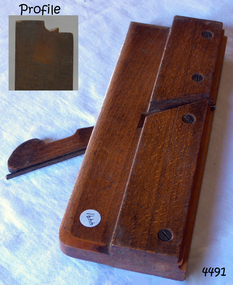
... All we known about John Ames is that he was a tool maker and retailer that operated a business in London early to mid 18th century. There are many of his tools including decorative moulding planes of all sizes and designs for sale around the world and that his tools in particular moulding planes are well sought after by collectors of vintage tools....A significant item from the mid to late 18th century that today is quite rare and sought after by collectors. ...A moulding plane is a specialised plane used for making the complex shapes found in wooden mouldings that are used to decorate furniture or other wooden object. Traditionally, moulding planes were blocks of wear resistant hardwood, often beech or maple, which were worked to the shape of the intended moulding. The blade, or iron was likewise formed to the intended moulding profile and secured in the body of the plane with a wooden wedge. A traditional cabinetmakers shop might have many, perhaps hundreds, of moulding planes for the full range of work to be performed. Large crown mouldings required planes of six or more inches in width, which demanded great strength to push and often had additional peg handles on the sides, allowing the craftsman's apprentice or other worker to pull the plane ahead of the master who guided it. All we known about John Ames is that he was a tool maker and retailer that operated a business in London early to mid 18th century. There are many of his tools including decorative moulding planes of all sizes and designs for sale around the world and that his tools in particular moulding planes are well sought after by collectors of vintage tools.A significant item from the mid to late 18th century that today is quite rare and sought after by collectors. It gives us a snapshot of how furniture was made predominately by hand and with tools that were themselves hand made shows the craftsmanship used to make such a unique item. It also gives an insight into how many manufacturing companies bid for the rights to use prison labour to make their products at this time in our history. Complex Moulding Plane with four screws on one sideMaker J Ames No 2 opposite end J Heath (owner) flagstaff hill, warrnambool, shipwrecked-coast, flagstaff-hill, flagstaff-hill-maritime-museum, maritime-museum, shipwreck-coast, flagstaff-hill-maritime-village, plane moulding, moulding plane, plane, j heath, ames -
 Flagstaff Hill Maritime Museum and Village
Tool - Wood Moulding Plane, 1830-1860
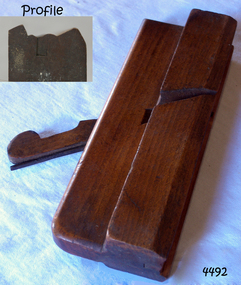
... All we known about R Knight is that he was a tool maker and retailer that operated a business in England early to mid 18th century. There are many of his tools including decorative moulding planes of all sizes and designs for sale around the world and that his tools in particular moulding planes are well sought after by collectors of vintage tools....A significant tool from the early to mid 18th century that today is quite rare and sought after by collectors. ...A moulding plane is a specialised plane used for making the complex shapes found in wooden mouldings that are used to decorate furniture or other wooden object. Traditionally, moulding planes were blocks of wear resistant hardwood, often beech or maple, which were worked to the shape of the intended moulding. The blade, or iron was likewise formed to the intended moulding profile and secured in the body of the plane with a wooden wedge. A traditional cabinetmakers shop might have many, perhaps hundreds, of moulding planes for the full range of work to be performed. Large crown mouldings required planes of six or more inches in width, which demanded great strength to push and often had additional peg handles on the sides, allowing the craftsman's apprentice or other worker to pull the plane ahead of the master who guided it. All we known about R Knight is that he was a tool maker and retailer that operated a business in England early to mid 18th century. There are many of his tools including decorative moulding planes of all sizes and designs for sale around the world and that his tools in particular moulding planes are well sought after by collectors of vintage tools.A vintage tool made by a known maker, this item was made commercially for firms and individuals that worked in wood and needed a tool that could produce a ornamental finish to timber. The tool was used before routers and spindle moulders came into use after World War ll, a time when to produce a decorative moulding for a piece of furniture, door trims etc or other items had to be accomplished using hand tools and in particular one of these types of planes. These profiled planes came in various shapes and sizes to achieve a decorative finish. A significant tool from the early to mid 18th century that today is quite rare and sought after by collectors. It gives us a snapshot of how furniture and other decorative finishes were created on timber by the use of hand tools. Tools that were themselves hand made shows the craftsmanship used during this time not only to make a tool such as the subject item but also the craftsmanship needed to produce a decorative finish that was needed to be made for any timber item.Complex Moulding Plane Maker R Knight, Stamped T Whlele (owner) & No 5 opposite endflagstaff hill, warrnambool, shipwrecked-coast, flagstaff-hill, flagstaff-hill-maritime-museum, maritime-museum, shipwreck-coast, flagstaff-hill-maritime-village, plane moulding, moulding plane, plane, j heath, ames -
 Flagstaff Hill Maritime Museum and Village
Tool - Wood Moulding Plane, 1844-1860
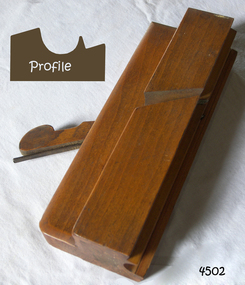
... All we known about John Ames is that he was a tool maker and retailer that operated a business in London early to mid 18th century. There are many of his tools including decorative moulding planes of all sizes and designs for sale around the world and that his tools in particular moulding planes are well sought after by collectors of vintage tools....A significant tool from the early to mid 18th century that today is quite rare and sought after by collectors. ...A moulding plane is a specialised plane used for making the complex shapes found in wooden mouldings that are used to decorate furniture or other wooden object. Traditionally, moulding planes were blocks of wear resistant hardwood, often beech or maple, which were worked to the shape of the intended moulding. The blade, or iron was likewise formed to the intended moulding profile and secured in the body of the plane with a wooden wedge. A traditional cabinetmakers shop might have many, perhaps hundreds, of moulding planes for the full range of work to be performed. Large crown mouldings required planes of six or more inches in width, which demanded great strength to push and often had additional peg handles on the sides, allowing the craftsman's apprentice or other worker to pull the plane ahead of the master who guided it. All we known about John Ames is that he was a tool maker and retailer that operated a business in London early to mid 18th century. There are many of his tools including decorative moulding planes of all sizes and designs for sale around the world and that his tools in particular moulding planes are well sought after by collectors of vintage tools.A vintage tool made by a known maker, this item was made commercially for firms and individuals that worked in wood and needed a tool that could produce a ornamental finish to timber. The tool was used before routers and spindle moulders came into use after World War ll, a time when to produce a decorative moulding for a piece of furniture, door trims etc or other items had to be accomplished using hand tools and in particular one of these types of planes. These profiled planes came in various shapes and sizes to achieve a decorative finish. A significant tool from the early to mid 18th century that today is quite rare and sought after by collectors. It gives us a snapshot of how furniture and other decorative finishes were created on timber by the use of hand tools. Tools that were themselves hand made shows the craftsmanship used during this time not only to make a tool such as the subject item but also the craftsmanship needed to produce a decorative finish that was needed to be made for any timber item. Moulding opposite end has 4 screws on bottomJ Ames maker, Stamped J Heath (owner) & No 7 flagstaff hill, warrnambool, shipwrecked-coast, flagstaff-hill, flagstaff-hill-maritime-museum, maritime-museum, shipwreck-coast, flagstaff-hill-maritime-village, plane moulding, moulding plane, plane, j heath, ames -
 Flagstaff Hill Maritime Museum and Village
Tool - Wood Moulding Plane, 1844-1860
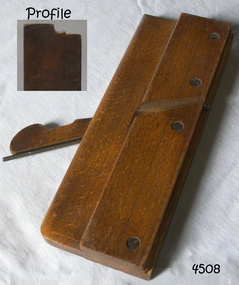
... All we known about John Ames is that he was a tool maker and retailer that operated a business in London early to mid 18th century. There are many of his tools including decorative moulding planes of all sizes and designs for sale around the world and that his tools in particular moulding planes are well sought after by collectors of vintage tools....A significant tool from the early to mid 18th century that today is quite rare and sought after by collectors. ...A moulding plane is a specialised plane used for making the complex shapes found in wooden mouldings that are used to decorate furniture or other wooden object. Traditionally, moulding planes were blocks of wear resistant hardwood, often beech or maple, which were worked to the shape of the intended moulding. The blade, or iron was likewise formed to the intended moulding profile and secured in the body of the plane with a wooden wedge. A traditional cabinetmakers shop might have many, perhaps hundreds, of moulding planes for the full range of work to be performed. Large crown mouldings required planes of six or more inches in width, which demanded great strength to push and often had additional peg handles on the sides, allowing the craftsman's apprentice or other worker to pull the plane ahead of the master who guided it. All we known about John Ames is that he was a tool maker and retailer that operated a business in London early to mid 18th century. There are many of his tools including decorative moulding planes of all sizes and designs for sale around the world and that his tools in particular moulding planes are well sought after by collectors of vintage tools.A vintage tool made by a known maker, this item was made commercially for firms and individuals that worked in wood and needed a tool that could produce a ornamental finish to timber. The tool was used before routers and spindle moulders came into use after World War ll, a time when to produce a decorative moulding for a piece of furniture, door trims etc or other items had to be accomplished using hand tools and in particular one of these types of planes. These profiled planes came in various shapes and sizes to achieve a decorative finish. A significant tool from the early to mid 18th century that today is quite rare and sought after by collectors. It gives us a snapshot of how furniture and other decorative finishes were created on timber by the use of hand tools. Tools that were themselves hand made shows the craftsmanship used during this time not only to make a tool such as the subject item but also the craftsmanship needed to produce a decorative finish that was needed to be made for any timber item.Moulding Plane one side has 4 screws heads visibleAmes J Heath (maker) stamped at end & 3/16 flagstaff hill, warrnambool, shipwrecked-coast, flagstaff-hill, flagstaff-hill-maritime-museum, maritime-museum, shipwreck-coast, flagstaff-hill-maritime-village, plane moulding, moulding plane, plane, j heath, ames -
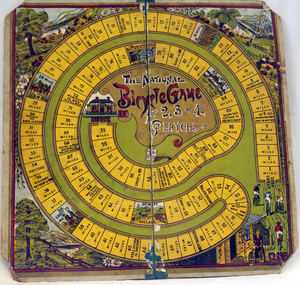 Orbost & District Historical Society
board game, 1930-1950
... The earliest board games date from the mid-18th century and were printed on copper or steel plates and coloured by hand. ...The earliest board games date from the mid-18th century and were printed on copper or steel plates and coloured by hand. ...The National Bicycle Game is an Australian-made and designed board game for 2, 3 or 4 players made by The National Game Company of Ballarat and Melbourne between 1930 and 1950. The earliest board games date from the mid-18th century and were printed on copper or steel plates and coloured by hand. By 1839 lithography was first used, making it possible for publishers to produce larger quantities of all types of toys. By the 1890s the games were mounted on to a folded board. Popular subjects were of an historical or geographical nature, as well as transport including motoring, aviation and railways and various sports. The board game 'A Motor Ride' ,made by The National Game Company, was possibly the first large-scale manufacturer of locally-designed board games in Australia. The firm was established in Ballarat, Victoria, at the beginning of the twentieth century by W. Owen. Other board games made by National include the 'Victory-United Nations" game, 'Fairyland', 'Yacht Race', 'Golf Game', 'Bicycle Game', Steeple Chase', 'Our Great Game' about football, 'Courtship and Marriage', 'Around the Commonwealth by Aeroplane', and 'Dugouts and Trenches' as well as the more traditional games such as Ludo, Snakes and Ladders, and Noughts and Crosses. This game board has been well-used. The game is significant because it uses scenarios familiar to Australian children in the first half of the twentieth century. This game board reflects the experience of being a child in the twentieth century. Toys were how children were socialised and taught. Most toys mimic the adult world, and looking at them can tell us something about how the world has changed. A folding game board for The national Bicycle Game for 2,3 or 4 players. It has a yellow spiral track on which the player progresses at the throw of the die, starting at the clubhouse until reaching home. In the background are pictures of rural scenes.board-games recreation cycling national-game-company -
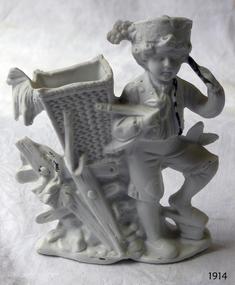 Flagstaff Hill Maritime Museum and Village
Decorative object - Ornament, ca. 19th century
... Figurine ornaments were popular for table decorations between the mid-18th to early 19th centuries. This ornament was made in Germany, and German manufacturers began to use bisque material to make realistic faces for dolls in the 1850s....Figurine ornaments were popular for table decorations between the mid-18th to early 19th centuries. This ornament was made in Germany, and German manufacturers began to use bisque material to make realistic faces for dolls in the 1850s. ...This fine white unglazed porcelain figurine is one of six donated together. The bisque material was easy to carve and allowed fine detail. Figurine ornaments were popular for table decorations between the mid-18th to early 19th centuries. This ornament was made in Germany, and German manufacturers began to use bisque material to make realistic faces for dolls in the 1850s.The set of six bisque figurines is representative of popular table decorations during the 19th and early 20th centuries.Fine unglazed white porcelain ornament, carved to represent a boy holding a basket on his back. One of a pair, the other being a girl holding a basket on her back. The hollow basket is a vase. It was made in Germany. No 0847. Marked "0847" "GERMANY GASP"flagstaff hill, flagstaff hill maritime museum and village, warrnambool, maritime museum, maritime village, great ocean road, shipwreck coast, bisque, china ornament, white china ornament, german, porcelain, unglazed porcelain, 19th century, 18th century, european ornament, pottery, unglazed pottery, domestic ornament, decoration, table decoration, germany, boy with basket, vase -
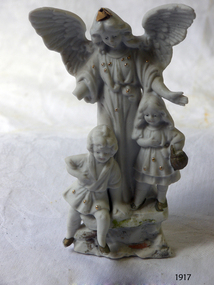 Flagstaff Hill Maritime Museum and Village
Decorative object - Ornament, ca. 19th century
... Figurine ornaments were popular for table decorations between the mid-18th to early 19th centuries. This ornament was likely made in Germany, and German manufacturers began to use bisque material to make realistic faces for dolls in the 1850s....Figurine ornaments were popular for table decorations between the mid-18th to early 19th centuries. This ornament was likely made in Germany, and German manufacturers began to use bisque material to make realistic faces for dolls in the 1850s. ...This fine white unglazed porcelain figurine is one of six donated together. The bisque material was easy to carve and allowed fine detail. Figurine ornaments were popular for table decorations between the mid-18th to early 19th centuries. This ornament was likely made in Germany, and German manufacturers began to use bisque material to make realistic faces for dolls in the 1850s.The set of six bisque figurines is representative of popular table decorations during the 19th and early 20th centuries.Figurine; unglazed white porcelain ornament, hollow inside. It is carved to represent an angel with two children, a boy and a girl. The surface is decorated with tiny gold balls and the angel wears a gold tiara. There are remnants of gold, orange, green and brown paint. No 1914. "1914"flagstaff hill, flagstaff hill maritime museum and village, warrnambool, maritime museum, maritime village, great ocean road, shipwreck coast, bisque, china ornament, white china ornament, german, porcelain, unglazed porcelain, 19th century, 18th century, european ornament, pottery, unglazed pottery, domestic ornament, decoration, table decoration, figurine, angel figurine, germany, angel with children -
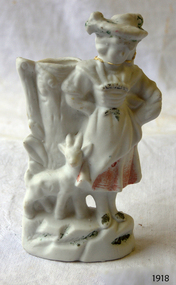 Flagstaff Hill Maritime Museum and Village
Decorative object - Ornament, ca. 19th century
... Figurine ornaments were popular for table decorations between the mid-18th to early 19th centuries. This ornament was likely made in Germany, and German manufacturers began to use bisque material to make realistic faces for dolls in the 1850s....Figurine ornaments were popular for table decorations between the mid-18th to early 19th centuries. This ornament was likely made in Germany, and German manufacturers began to use bisque material to make realistic faces for dolls in the 1850s. ...This fine white unglazed porcelain figurine is one of six donated together. The bisque material was easy to carve and allowed fine detail. Figurine ornaments were popular for table decorations between the mid-18th to early 19th centuries. This ornament was likely made in Germany, and German manufacturers began to use bisque material to make realistic faces for dolls in the 1850s.The set of six bisque figurines is representative of popular table decorations during the 19th and early 20th centuries.Fine unglazed white porcelain ornament, hollow inside. It is carved to represent a peasant girl and goat with a vase shaped like a tree stump in the background. The ornament has remnants of gold, red, brown and green paint. There is an inscription on the base."3943:warrnambool, shipwrecked-coast, flagstaff-hill-maritime-museum, maritime-museum, shipwreck-coast, ornament, flagstaff hill, flagstaff hill maritime museum and village, maritime museum, maritime village, great ocean road, shipwreck coast, bisque, china ornament, white china ornament, german, germany, porcelain, unglazed porcelain, 19th century, 18th century, european ornament, pottery, unglazed pottery, domestic ornament, decoration, table decoration, girl and goat, vase -
 Flagstaff Hill Maritime Museum and Village
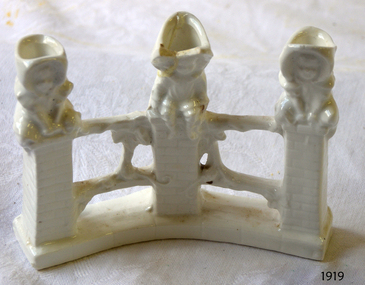
Decorative object - Ornament, ca. 19th century
... Figurine ornaments were popular for table decorations between the mid-18th to early 19th centuries. This ornament was likely made in Germany, and German manufacturers began to use bisque material to make realistic faces for dolls in the 1850s....Figurine ornaments were popular for table decorations between the mid-18th to early 19th centuries. This ornament was likely made in Germany, and German manufacturers began to use bisque material to make realistic faces for dolls in the 1850s. ...This fine white glazed porcelain figurine is one of six donated together. The bisque material was easy to carve and allowed fine detail. Figurine ornaments were popular for table decorations between the mid-18th to early 19th centuries. This ornament was likely made in Germany, and German manufacturers began to use bisque material to make realistic faces for dolls in the 1850s.The set of six bisque figurines is representative of popular table decorations during the 19th and early 20th centuries.Fine glazed white porcelain ornament, carved to represent three children sitting on three brick fence pillars. There are gold highlights on the surface. The hats on the children are vases. An inscription is on the base of the centre pillar."6946"flagstaff hill, flagstaff hill maritime museum and village, warrnambool, maritime museum, maritime village, great ocean road, shipwreck coast, bisque, china ornament, white china ornament, german, germany, porcelain, unglazed porcelain, 19th century, 18th century, european ornament, pottery, unglazed pottery, domestic ornament, decoration, table decoration, children on a fence, vase, candle holder -
 Flagstaff Hill Maritime Museum and Village
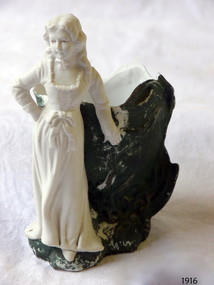
Decorative object - Ornament, 19th century
... Figurine ornaments were popular for table decorations between the mid-18th to early 19th centuries. This ornament was most likely made in Germany, and German manufacturers began to use bisque material to make realistic faces for dolls in the 1850s....Figurine ornaments were popular for table decorations between the mid-18th to early 19th centuries. This ornament was most likely made in Germany, and German manufacturers began to use bisque material to make realistic faces for dolls in the 1850s. ...This fine white unglazed porcelain figurine is one of six donated together. The bisque material was easy to carve and allowed fine detail. Figurine ornaments were popular for table decorations between the mid-18th to early 19th centuries. This ornament was most likely made in Germany, and German manufacturers began to use bisque material to make realistic faces for dolls in the 1850s.The set of six bisque figurines is representative of popular table decorations during the 19th and early 20th centuries.Ornament, fine unglazed white porcelain, carved to represent a woman standing in front of a green vase. flagstaff hill, flagstaff hill maritime museum and village, warrnambool, maritime museum, maritime village, great ocean road, shipwreck coast, bisque, china ornament, white china ornament, german, porcelain, unglazed porcelain, 19th century, 18th century, european ornament, pottery, unglazed pottery, domestic ornament, decoration, table decoration, vase, woman with vase, germany
