
Showing 122 items matching " mine safety"
-
 Bendigo Historical Society Inc.
Document - MINE SAFETY CAGES & FEDDER DUSTER
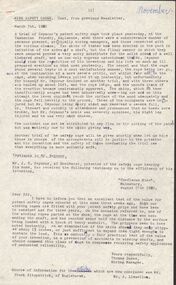
... MINE SAFETY CAGES & FEDDER DUSTER......Mine Safety Cages & Fedder Duster...Three pages of extracts titled Mine Safety Cages, Old Bendigonians, memories of 'Fedder Duster', a Chinese Market Gardener; and a book review. ...DOCUMENT Names of bendigo pioneers Mine Safety Cages & Fedder Duster Tasmanian Foundry Mr J H Seymour Dr Stewart Conflecua Mine Malmsbury Thomas Dunne Mr Frank Fitzpatrick Mr A Llewellun Old Bendigonians Mr John Robshaw Mr Hugh McDevitt Alexander Bayne Mr F Sciallero Camp Reserve Art Gallery Hon. ...Three pages of extracts titled Mine Safety Cages, Old Bendigonians, memories of 'Fedder Duster', a Chinese Market Gardener; and a book review. The Safety Cage was an invention to stop the cage falling down the shaft if the rope gave way. Fedder Duster was a Chinese Market Gardener who was forced off his garden lease. His name was Ah Louey. The Book Review was 'Land, Labour and Gold' or Two Years in Victoria, with visits to Sydney and Van Diemen’s Land, by William Howitt.document, names of bendigo pioneers, mine safety cages & fedder duster, tasmanian foundry, mr j h seymour, dr stewart, conflecua mine malmsbury, thomas dunne, mr frank fitzpatrick, mr a llewellun, old bendigonians, mr john robshaw, mr hugh mcdevitt, alexander bayne, mr f sciallero, camp reserve, art gallery, hon. w i winter-irvine, george avery fletcher, great central goldfield, dear old bendigo 1892, fedder duster, mrs chancellor, ah louey, market gardener, mr curnow, technical school art class, bendigo benevolent home, joch, land labour and gold 1855, two years in victoria with visits to sydney and van diemen's land, william howitt, lowden publishing co, government camp, stars & stripes of america, odd fellows, freemasons, miss f kingerlee -
 Bendigo Historical Society Inc.
Photograph - Napoleon Gold Mine Safety Cage, 1935
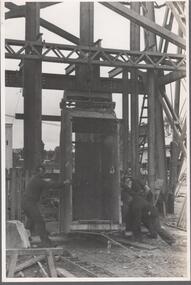
... Napoleon Gold Mine Safety Cage...Mine...Safety Cage...Photograph Napoleon Gold Mine Safety Cage ...Significant to mining history of Bendigo.Black and white photograph: Mine cage being maneuvered into position within headframe and over shaft by three workmen. Rope attached to bottom front of cage to assist in steadying the cage.Written in pencil on back of photograph : ''... (illegible) cage in Napoleon main shaft 31/8/35'.napoleon gold mine, safety cage -
 Federation University Historical Collection
Unknown - Object, Allan Mine Cage Safety Brake, c1873, c1873
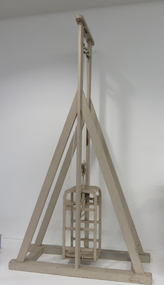
... Allan Mine Cage Safety Brake, c1873...safety cage...mine...In the 1870s in Victoria, deaths and injuries from falling cages in vertical shafts of gold mines were a major problem. The inventor of this safety cage was Robert Allan, a machinery maker of Creswick Rd, Ballarat. ...Model of a mine safety cafe. A grey painted wooden frame with metal model of cage and safety brake system. ...Ballarat School of Mines is the oldest Technical School in Australia and is a predecessor of Federation University. The model is significant to Ballarat's mining history. safety cage mine cage safety brake robert allan model safety cage model machine maker millwright mining gold mining tools equipment Victorian Board of Inquiry Model of a mine safety cafe. ...A mining safety cage was used in a mine lift. It was fitted with mechanisms to prevent the cage from dropping if the lifting rope broke. In the 1870s in Victoria, deaths and injuries from falling cages in vertical shafts of gold mines were a major problem. The inventor of this safety cage was Robert Allan, a machinery maker of Creswick Rd, Ballarat. He said his cage featured a ‘dissolving’ fulcrum. Others called it an eccentric (off centre) system. Note the pair of clutch levers designed to grab the side guides if tension ceases in the suspending rope from the poppet head pulley. Also, the hinged ‘lids’; designed to protect miners trapped in a braked cage from falling rope, and to enable rescue of the miners. This model was presented to The Ballarat School of Mines Council in November 1876. This model was shown at the Smeaton Show in November 1874, Ballarat School of Mines Museum from 1876, and examined by the 1879 Victorian Board of Inquiry (Pg 15 of FedUni Catalogue 3437) From the Argus of 13 November 1874: At Smeaton Show, Robert Allan of Ballarat won 1st prize for a Model of a Mining Cage, a Butter working machine, a Cheese press and a Curd Mill. By 1878 an Allan Safety-Cage was in operation in the Number 6 shaft of the Band and Albion Consols mine in Ballarat. This cage was judged the best inspected by the Victorian Board of Inquiry by 1879, p. 39.Mining was a big industry in Ballarat in the late 1800s and a lot of deaths were recorded because of mining accidents, the development of the mining safety cage brake limited the deaths and injuries from falling cages in vertical shafts. The model also has links to the Ballarat School of Mines, being presented to the council in 1876. Ballarat School of Mines is the oldest Technical School in Australia and is a predecessor of Federation University. The model is significant to Ballarat's mining history.Model of a mine safety cafe. A grey painted wooden frame with metal model of cage and safety brake system. When tension ceases in rope a pair of crutch levers grab strongly onto the wooden guide strips which run down the sides of a vertical shaft. This safety cage was discussed in "Safety Mining Cages. Report of the Board of Enquiry on Safety Cages 1878-9; together with proceedings of the Board and Appendices".safety cage, mine cage safety brake, robert allan, model, safety cage model, machine maker, millwright, mining, gold mining, tools, equipment, victorian board of inquiry -
 Moorabbin Air Museum
Equipment (item) - RAF Oxygen Mask Type P With Oxygen Tube
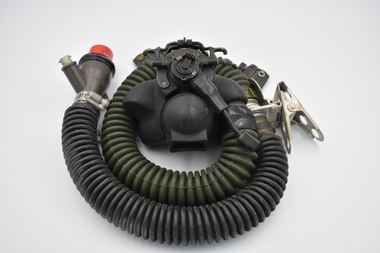
... Manufactured by Mine Safety Appliances, Glascow Scotland DRG No. ...Manufactured by Mine Safety Appliances, Glascow Scotland DRG No. ...Manufactured by Mine Safety Appliances, Glascow Scotland DRG No. OP5480 6D/2298 Serial No.45060 -
 Bendigo Historical Society Inc.
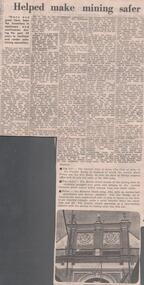
Newspaper - LYDIA CHANCELLOR COLLECTION: THE BENDIGO FUSE FACTORY HELPED MAKE MINING SAFER
... ... mine safety...MINING Equipment fuses Lydia Chancellor Collection collection Bendigo mine mining mine safety mining fuses Mr. Charles Perry Perry's Fuse Factory Amy Huxtable W. ...A Bendigo Advertiser newspaper article titled 'The Bendigo Fuse Factory by Amy Huxtable.' In 1860 Mr. Charles Perry set up as Proprietor of stamper grating works and was later joined by his nephew Mr. W. Hunter. During this time Mr. Perry worked on a model machine for constructing safer fuses. In 1876 Mr. Charles Perry built a fuse factory in Wattle Street. He refined his machines making them larger and very suitable for building safer fuses. In 1888 the English firm of fuse manufacturers Bickford, Smith & Co., purchased the factory and the secret of the manufacture. In 1912 the Wattle Street building was purchased by Tony Patterson and Huon Matear and was known as the Economic Manufacturing Co. (Bendigo White Works) making underwear. This was followed by Crestknit Industries which ceased operation in 1977. Photos in this article are of Perry's Fuse Factory. 05/02/1977.mining, equipment, fuses, lydia chancellor collection, collection, bendigo, mine, mining, mine safety, mining fuses, mr. charles perry, perry's fuse factory, amy huxtable, w. c. vahland, crestknit industries, manufacturing, perry safety fuse, male, industries -
 Bendigo Historical Society Inc.
Book - ANNUAL REPORT OF THE SECRETARY FOR MINES AND WATER SUPPLY, c1897
... mining machinery mine safety mining statistics bendigo mines...VICTORIA victorian mining report mining machinery mine safety mining statistics bendigo mines Annual Report Of The Secretary For Mines And Water Supply, Victoria 1896. ...Annual Report Of The Secretary For Mines And Water Supply, Victoria 1896. Publisher: Government Printer, Melbourne. 71 pages. Maps & drawings. Inscriptions: Little 180, see page 59 (cover), A Richardson, 29 Harrison St, Bendigo (1st page).victoria, victorian mining report, mining machinery mine safety mining statistics bendigo mines -
 Bendigo Historical Society Inc.
Book - ANNUAL REPORT OF THE SECRETARY FOR MINES AND WATER SUPPLY, c1896
... mining machinery mine safety mining statistics...VICTORIA victorian mining report mining machinery mine safety mining statistics Annual Report For The Secretary For Mines And Water Supply, Victoria 1895. ...Annual Report For The Secretary For Mines And Water Supply, Victoria 1895. Publisher: Government Printer, Melbourne. 86 pages. Plans & drawings.victoria, victorian mining report, mining machinery mine safety mining statistics -
 Bendigo Historical Society Inc.
Book - ANNUAL REPORT OF THE SECRETARY FOR MINES AND WATER SUPPLY, c1886
... ... mine safety...VICTORIA mines and water supply mining machinery mine safety mining statistics regulation inspection 1885 Annual Report Of The Secretary For Mines And Water Supply, Victoria. ...Annual Report Of The Secretary For Mines And Water Supply, Victoria. Publisher: Government Printer, Melbourne. 122 pages. Plans & drawings.victoria, mines and water supply, mining machinery, mine safety, mining statistics, regulation inspection 1885 -
 Federation University Historical Collection
Booklet, The Science and Art of Mining: Handbook for Mining Students and Colliery Managers
... Fifty page book with the following sections: * Geology * Surveying * Lighting of Mines (safety lamp, Dr Clowes' gas detecting lamp, Mueseler and Marsact Safety Lamp * Coal Miners Regulation Act...coal mining colliery mining safety lamp Fifty page book with the following sections: * Geology * Surveying * Lighting of Mines (safety lamp, Dr Clowes' gas detecting lamp, Mueseler and Marsact Safety Lamp * Coal Miners Regulation Act The Science and Art of Mining: Handbook for Mining Students and Colliery Managers Booklet ...Fifty page book with the following sections: * Geology * Surveying * Lighting of Mines (safety lamp, Dr Clowes' gas detecting lamp, Mueseler and Marsact Safety Lamp * Coal Miners Regulation Actcoal mining, colliery, mining, safety lamp -
 Bendigo Historical Society Inc.
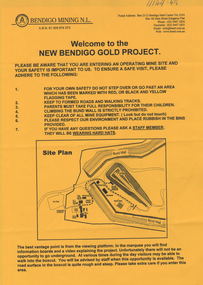
Document - Kangaroo Flat Gold Mine Collection: New Bendigo Gold Project, Department of Conservation and Environment, April 1991
... ...mine site...safety...Bendigo mining gold Open day information day mine site safety boxcut bund wall One yellow page information sheet, issued by Bendigo Mining N.L. ...One yellow page information sheet, issued by Bendigo Mining N.L. On top of sheet: welcome to the New Bendigo Gold Project. . A site plan and safety warnings are provided on the sheet. bendigo mining n.l., bendigo, mining, gold, open day, information day, mine site, safety, boxcut, bund wall -
 Federation University Historical Collection
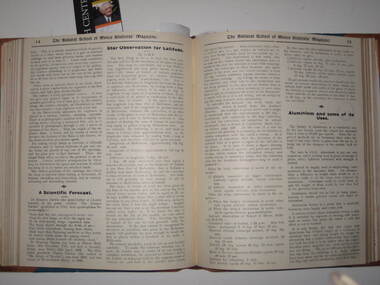
Book, Bound copies of the Ballarat School of Mines Students' Magazine, 1910-1912, 1910-1912
... mine salting...radium...safety...ballarat school of mines alumni hydro-electric scheme tasmania ballarat mount lyell wayne krause krause ferdinand krause pyke's creek reservoir pyke's creek reservoir excursion excursions pananma coal pig iron mount morgan mount morgan old boys mine salting radium safety cages rifle shooting oliver jager oliver jaeger o.e. jaeger a. galloway henry sutton a.d. gilchrist william baragwanath virgil tucker b .whitington lim khoon fah herbert hawkesworth surveying tuneneling america clays floatation process frequency changer grampians mt buffalo mt feathertop port pirrie repatriation scotsburn scotsburn excursion Kalgoorlie school of mines Former Ballarat School of Mines Students in Kalgoorlie Kalgoorlie Ore Treatment Bound copies of the Ballarat School of Mines Students' Magazine from 1910-1912 1911 - Hydro-electric Scheme for Tasmania - Wayne Krause 1912 - Mt Lyell Disaster Bound copies of the Ballarat School of Mines Students' Magazine, 1910-1912 Book ...Bound copies of the Ballarat School of Mines Students' Magazine from 1910-1912 1911 - Hydro-electric Scheme for Tasmania - Wayne Krause 1912 - Mt Lyell Disasterballarat school of mines, alumni, hydro-electric scheme, tasmania, ballarat, mount lyell, wayne krause, krause, ferdinand krause, pyke's creek reservoir, pyke's creek reservoir excursion, excursions, pananma coal, pig iron, mount morgan, mount morgan old boys, mine salting, radium, safety cages, rifle shooting, oliver jager, oliver jaeger, o.e. jaeger, a. galloway, henry sutton, a.d. gilchrist, william baragwanath, virgil tucker, b .whitington, lim khoon fah, herbert hawkesworth, surveying, tuneneling, america, clays, floatation process, frequency changer, grampians, mt buffalo, mt feathertop, port pirrie, repatriation, scotsburn, scotsburn excursion, kalgoorlie school of mines, former ballarat school of mines students in kalgoorlie, kalgoorlie ore treatment -
 Bendigo Historical Society Inc.
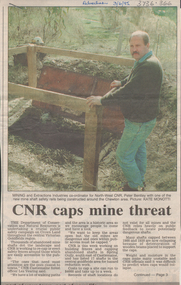
Newspaper - Kangaroo Flat Gold Mine Collection: abandoned mine shafts
... Colour photo shows Peter Bentley, standing alongside mine safety rails on a mine shaft in the Chewton area....Colour photo shows Peter Bentley, standing alongside mine safety rails on a mine shaft in the Chewton area. ...Bendigo Advertiser article, 3rd June,1995, titled 'CNR caps mine threat'. The Department of Natural Resources is 'undertaking a crucial public safety campaign on Crown Land' ...throughout the central goldfields. Shafts capped ' between 1900 and 1920 are now collapsing because of deterioration of wooden beams placed to support the caps'. Colour photo shows Peter Bentley, standing alongside mine safety rails on a mine shaft in the Chewton area.gold mining, bendigo, tourism, peter bentley, chewton, mine shaft, risk management -
 Emerald Museum & Nobelius Heritage Park
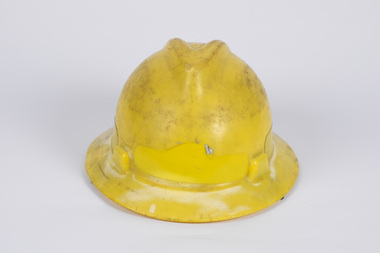
Headwear - Fire Fighters Helmet, MSA, c.1970s
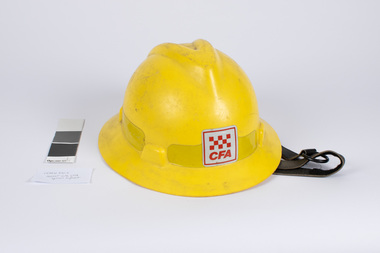
... MSA began as a mine safety company but since expanded into more general worker protection and safety products. ...MSA began as a mine safety company but since expanded into more general worker protection and safety products. ...During the 1960s in Australia, helmets evolved from metal construction to that of polymer and other plastics. This helmet was donated by the Emerald Fire Brigade which was established on 14 March 1941 as the Emerald Bush Brigade. Originally its equipment was stored at Madigan's butcher's shop near the corner of Monbulk Road. The Brigade's first fire station was built around 1945. In 1966, this station was recorded as containing the fire truck and a Land rover pumper, three radio sets, 40 knapsacks, six lengths of hose, helmets, rake hoes and other hand tools. In 2010, the Brigade moved into a new purpose-built building in Monbulk Road. The manufacturer of this helmet, MSA, was founded in 1914 in the USA. MSA began as a mine safety company but since expanded into more general worker protection and safety products. This helmet is an historical artifact worn by members of a crucial volunteer fire fighting service operating in the Emerald district since 1941.Yellow, lightweight, hard plastic or polymer helmet with black leather detachable chin strap with Velcro fastening. inside the helmet is an adjustable head harnessInside helmet on a partly torn label: 'MSA / VGARD / Type 2 ...? / STANDARDS AUSTRALIA' Inside the brim black pen writing EMERALD SPARE 5 EMERALD at one end engraved: 'MSA'' and at the other end: '1801-1881 On the outside of the helmet there is a yellow reflector on each side and at the front and the back there is evidence of labels that have been removed.helmets, fire fighting, msa, emerald fire brigade, cfa -
 Emerald Museum & Nobelius Heritage Park
Headwear - Fire Fighters Helmet, MSA, c.1970s
... The manufacturer of this helmet, MSA, was founded in 1914 in the USA. It began as a mine safety company but since expanded into more general worker protection and safety products. ...The manufacturer of this helmet, MSA, was founded in 1914 in the USA. It began as a mine safety company but since expanded into more general worker protection and safety products. ...Helmets protect firefighters from heat, falling objects and cinders. During the 1960s in Australia, helmets evolved from metal construction to that of polymer and other plastics. The manufacturer of this helmet, MSA, was founded in 1914 in the USA. It began as a mine safety company but since expanded into more general worker protection and safety products. The Emerald Fire Brigade was established on 14 March 1941 as the Emerald Bush Brigade. Originally its equipment was stored at Madigan's butcher's shop near the corner of Monbulk Road. The Brigade's first fire station was built around 1945. In 1966, this station was recorded as containing the fire truck and a Land rover pumper, three radio sets, 40 knapsacks, six lengths of hose, helmets, rake hoes and other hand tools. In 2010, the Brigade moved into a new purpose-built building in Monbulk Road.This helmet is an historical artifact worn by members of a crucial volunteer fire fighting service operating in the Emerald district since 1941.Yellow, lightweight, hard plastic or polymer helmet with black leather detachable chin strap with velcro fastening.Inside helmet on a partly torn label: 'MSA / VGARD / Type 2 ...? / STANDARDS AUSTRALIA' Inside the brim at one end engraved: 'MSA'' and at the other end: '1801-1881 / LN70' On front of helmet a label with logo and red lettering: 'CFA' helmets, fire fighting, msa, emerald fire brigade, cfa -
 Bendigo Historical Society Inc.
Document - Allan Llewellyn Collection: Safety Cages, 1876
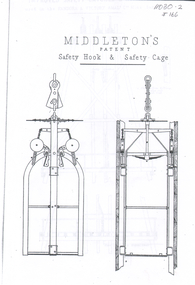
... Two page document (unknown source) with letter from William Grainger, Inspector of Mines, Sandhurst, 22nd March, 1879, detailing a report on the efficacy of the mine safety cages tested. Cages tested: No. 1 Allan's; No. 2 Seymour's; No. 3 Nance's; No. 4 Williams'; No. 5 Pryor's; No. 6 Hassan's; No. 7 Jackson's; No. 8 Carolin's. ...Two page document (unknown source) with letter from William Grainger, Inspector of Mines, Sandhurst, 22nd March, 1879, detailing a report on the efficacy of the mine safety cages tested. Cages tested: No. 1 Allan's; No. 2 Seymour's; No. 3 Nance's; No. 4 Williams'; No. 5 Pryor's; No. 6 Hassan's; No. 7 Jackson's; No. 8 Carolin's. ...Allan Llewellyn was a well known Eaglehawk identity. See Victorian Collections, Bendigo Historical Society, Allan Llewellyn Collection Cat. No.8389. Five page photocopied document. Three pages of plans for safety equipment in mines: Middleton's Patent Safety Hook & Safety Cage, two black line drawings of safety cage; Improved Safety Catches & Signal used in the Pandora & Victory Amalgamated Company Mine Sandhurst, two black line drawings showing cage and alarm bell line to Engine House; Hooper's Signalling Apparatus used in the Great Northern mine, Eaglehawk, black line drawing of apparatus with eleven point reference to parts. Two page document (unknown source) with letter from William Grainger, Inspector of Mines, Sandhurst, 22nd March, 1879, detailing a report on the efficacy of the mine safety cages tested. Cages tested: No. 1 Allan's; No. 2 Seymour's; No. 3 Nance's; No. 4 Williams'; No. 5 Pryor's; No. 6 Hassan's; No. 7 Jackson's; No. 8 Carolin's. One page summary, by Thomas Couchman, Esq., Chief Inspector of Mines, on 'the subject of providing increased safety appliances for mining' which has been the focus of 'eminent engineers in Great Britain, Europe and America.'safety cages, seymour's patent safety cage, j.h. seymour, bendigo, mining, allan llewellyn, , middleton's safety hook and safety cage, pandora and victory amalgamated co., sandhurst, mining equipment, hooper's signalling apparatus -
 Bendigo Historical Society Inc.
Book - MINE'S ACT, 1954
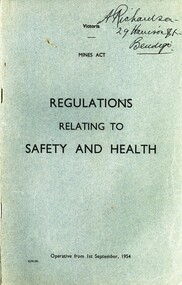
... Victoria Mine's Act.Regulations relating to Safety and Health. Operative from 1st September, 1954. ...VICTORIA History regulations to safety and health Victoria Mine's Act.Regulations relating to Safety and Health. ...Victoria Mine's Act.Regulations relating to Safety and Health. Operative from 1st September, 1954. Inscribed on the front cover : A. Richardson 29 Harrison street, Bendigovictoria, history, regulations to safety and health -
 Federation University Historical Collection
Photograph - Photograph (Black & White), Victa Studios, Presentation to Professor Alfred Mica Smith of the Ballarat School of Mines at Craig's Royal Hotel, c1924, c1924
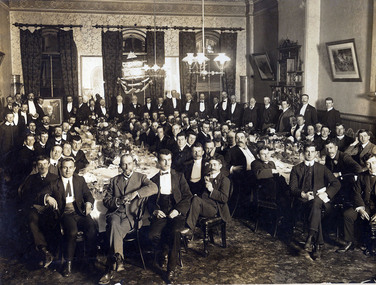
... of mines and became an authority on mine safety and ventilation. He was on the Mines Ventilation Board. ... of mines and became an authority on mine safety and ventilation. He was on the Mines Ventilation Board. ...This photo is thought to have been taken at the time of Alfred Mica Smith's retirement from the Ballarat School of Mines. It is most probably also the unveiling of the Max Meldrum portrait of Smith. Alfred Mica Smith retired from the Ballarat School of Mines in 1922 after an association of 41 years and aged 78 years. At the August meeting of the Ballarat School of Mines Council in 1881 it was resolved that 'Alfred Mica Smith Esq., B.Sc., be appointed Professor in Chemistry and Metallurgy and be Superintendent of the Laboratories, for the period of twelve months at a stipend of five hundred pounds per annum, and to commence duty as soon as possible'. (signed: James Oddie, Vice-President) Smith played a major role in the years of 1887-1893 when SMB was affiliated with Melbourne University. In 1912 he became Professor of Metallurgy and received an annual salary of 250 pounds. Alfred Mica Smith presented many scholarly papers, gave evidence at government enquiries into the safety of mines and became an authority on mine safety and ventilation. He was on the Mines Ventilation Board. Professor Smith was the public analyst for the City of Ballarat and Town of Ballarat East, as well as to a number of other boroughs and shires. He was also Chief juror to the Adelaide International Exhibition, chemical section. He provided information to the Royal Commission on gold mining (1889, 1891), and was President to the chemistry section of Australian Association for the Advancement of Science, Associate of American and Australasian Institute of Mining Engineering, Member of the Science Faculty Melbourne University, and Hon. Life Member of the Miner Managers' Association of Australia. He also was involved in many educational and community affairs such as President of the SMB Students' Association, President of the Ballarat Science Society, first President of the Ballarat Camera Club, Vice President of the Field Naturalists' Club, and he presented Ballaarat Fine Art Gallery with his collection of paintings and porcelain ware. His legacies include the mutual regard between him and his students, the many tributes by former students, the Mica Smith scholarship (established in 1923) and now known as the Corbould-Mica Smith Travelling Scholarship, his portrait in oils by noted artist Max Meldrum, and the marble bust of Smith sculptured by Paul Montford. Money for a scholarship in sanitary science at the University of Manchester in the name of his uncle R. A. Smith was left being set up in 1928. Smith died of cancer on 14 May 1926 and his remains, cremated at Springvale, were interred in the Ballaarat New Cemetery. See http://guerin.ballarat.edu.au/curator/honour-roll/honourroll_Smith,%20Alfred%20Mica.shtml Black and white mounted photograph showing a number of men sitting around two dining tables at Craig's Royal Hotel in Ballarat. Professor Alfred Mica Smith of the Ballarat School of Mines is standing 15 from the left, and is the subject of the painting on an easel to the left. The painting was presented to the Ballarat Fine Art GalleryLower right of mount 'Victa Studios Ballarat' Verso (typed and glued on): Presentation to professor Mica Smith, Craig's Hotelballarat school of mines, craig's hotel, craig's royal hotel, alfred mica smith, art gallery of ballarat, ballarat fine art gallery, portrait, frederick martell, daniel walker -
 Bendigo Historical Society Inc.
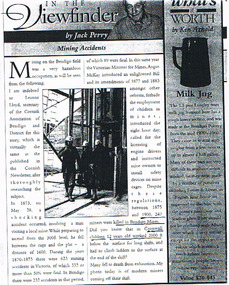
Document - LONG GULLY HISTORY GROUP COLLECTION; MINING ACCIDENTS
... Victorian Minister for Mines Angus McKay introduced a Bill, which forbade the employment of children in the mines, introduced the eight hour day, called for the licensing of engine drivers and instructed mine owners to install safety devices on mine cages. There is a photo of miners coming off their shift. ...Victorian Minister for Mines Angus McKay introduced a Bill, which forbade the employment of children in the mines, introduced the eight hour day, called for the licensing of engine drivers and instructed mine owners to install safety devices on mine cages. There is a photo of miners coming off their shift. ...BHS CollectionPhotocopy of a newspaper article titled In the Viewfinder by Jack Perry titled Mining Accidents. Article mentions the number of men killed in the mines in Bendigo. Victorian Minister for Mines Angus McKay introduced a Bill, which forbade the employment of children in the mines, introduced the eight hour day, called for the licensing of engine drivers and instructed mine owners to install safety devices on mine cages. There is a photo of miners coming off their shift. There are two other articles on the page - a piece about a 'Bendigo Pottery' Milk Jug by Ken Arnold.bendigo, history, long gully history group, the long gully history group - mining accidents, jack perry, ken arnold, leighton rawlings, leanne lloyd, cornish association of bendigo, cornish newsletter, angus mckay -
 Flagstaff Hill Maritime Museum and Village
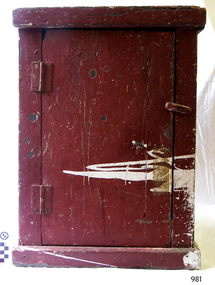
Furniture - Cupboard, Possibly 1920, when the City of Rayville was built
... mine in the Bass Strait, six miles south of Cape Otway at 7:45 pm on 8th November 1940. The explosion was heard on shore at Apollo Bay; the force of it tore out the foremast and the ship sank within 25 minutes. There was a crew of 38 and all but one survived. A rescue crew of fishermen from Apollo Bay left shore in the dark and picked up the survivors from the dangerous sea taking them back to safety...mine in the Bass Strait, six miles south of Cape Otway at 7:45 pm on 8th November 1940. The explosion was heard on shore at Apollo Bay; the force of it tore out the foremast and the ship sank within 25 minutes. There was a crew of 38 and all but one survived. A rescue crew of fishermen from Apollo Bay left shore in the dark and picked up the survivors from the dangerous sea taking them back to safety ...The biscuit locker came from the vessel the "City of Rayville", an American motor-driven freighter constructed in 1920. The ship was the second victim within 24 hours of an extensive minefield laid by German raiders in October 1940, during World War Two and the first American ship to be sunk in world war II. She was under the command of Captain Cronin and bound from Adelaide via Melbourne to New York, carrying a cargo of 1500 tons of lead from Port Pirie along with a cargo of wool and copper from Adelaide, when she struck a mine in the Bass Strait, six miles south of Cape Otway at 7:45 pm on 8th November 1940. The explosion was heard on shore at Apollo Bay; the force of it tore out the foremast and the ship sank within 25 minutes. There was a crew of 38 and all but one survived. A rescue crew of fishermen from Apollo Bay left shore in the dark and picked up the survivors from the dangerous sea taking them back to safety. The US Secretary of State Cordell Hull at the time wrote individual letters of thanks to all the rescuers involved. The biscuit locker is of historical and marine archaeological significance because of its association with the wreck of the City of Rayville. The vessel is listed on the Victorian Heritage Register No VHR S126. Additional significance is that the ship was the first American vessel sunk in the second world war and is still socially significant to the descendants of the City of Rayville crew and the Apollo bay fishermen who took part in the rescue.The external surfaces of the cupboard and the inside of the door are painted brown. The interior is painted blue the door has 2 metal hinges attached on the outside, each with 6 single-slotted screws and a wooden rotating door latch attached to the side of the door. There is a round eyelet on the door near the latch, the cupboard sides are each made from wood joined vertically and sit within a slightly wider, flat base and top. The frame of the cupboard is split with the paint on the outside of the cupboard scratched and chipped revealing a darker paint underneath. There is also a rough slash of white paint from the side of the cupboard going to about the Centre of the door. “PI/298” is hand written in black pen, paint or ink on the inside panel of the door in neat letters. "MS CITY OF RAYVILLE" stamped on back of cupboard in black paintcity of rayville, cupboard, locker, biscuit locker, 1940, world war ii, wwii, cape otway, german mines, american ship, flagstaff hill, warrnambool, flagstaff-hill, flagstaff-hill-maritime-museum, maritime-museum, shipwreck-coast, flagstaff-hill-maritime-village, rayvill -
 Flagstaff Hill Maritime Museum and Village
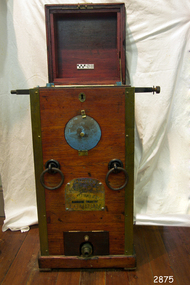
Machine - Diving Compressor, Siebe Gorman & Co. Ltd, 1880-1890
... The company gained a worldwide reputation for the manufacture of diving apparatus, decompression and observation chambers, and safety breathing apparatus of all types for use on the land, in the air and under the sea (including mine rescue, tunnelling, aircraft, diving, submarine escape and in other hazardous environments). ...The company gained a worldwide reputation for the manufacture of diving apparatus, decompression and observation chambers, and safety breathing apparatus of all types for use on the land, in the air and under the sea (including mine rescue, tunnelling, aircraft, diving, submarine escape and in other hazardous environments). ...This compressor was part of the E.G. Ward Collection. It is connected to the diving suit and boots, also in our collection. Siebe Gorman & Company Ltd was a British company that developed diving equipment and breathing equipment and worked on commercial diving and marine salvage projects. The company advertised itself as 'Submarine Engineers'. It was founded by Augustus Siebe, a German-born British engineer chiefly known for his contributions to diving equipment. Siebe Gorman traded as an engineering firm for over 180 years, from 1819 to 1999. The early success of the business was due to its founder, the Prussian immigrant Christian 'Augustus' Siebe (1788-1872). For business reasons, he applied for and was granted British citizenship in 1856. He was a gifted engineer who was able to translate theoretical problems into practical, working products. During the industrial Victorian period, the business traded as 'A. Siebe's at 145 High Street, Holborn, London, but in 1828, new premises were acquired at 5 Denmark Street, Soho. The family firm produced a wide range of manufactured goods, including paper-making machinery, measuring machinery, water-pumps, refrigeration equipment and diving apparatus. Augustus Siebe specialised in submarine engineering early on, and the company gained a reputation for the manufacture of safe, reliable diving apparatus. Augustus Siebe is best remembered for the development and manufacture of the ‘closed’ Diving Dress based on the ideas of Charles and John Deane, George Edwards and Charles Pasley. Apart from some small modifications to valves and diver communications, the basic 12 bolt ‘closed’ diving dress remained relatively unchanged after the 1870s. Later company successes were also based on innovation, with new products that could be successfully developed and manufactured to high standards. This was largely attributed to the inventive nature, foresight, engineering and entrepreneurial skills of Robert Henry Davis (1870-1965). In 1882, RH Davis joined the company of 'Siebe & Gorman' as a young 11-year-old office boy, and he was to remain with the company until he died in 1965. Augustus Siebe retired in 1869 and handed over the company to a new partnership of Henry H. Siebe (1830-1885) and William A. O'Gorman (1834-1904). The new firm traded as 'Siebe & Gorman' (1870-1879) from premises in and around Mason Street, Westminster Bridge Road, Lambeth, London. The two partners soon recognised the potential of R.H. Davis, and in 1894, aged 24, he became General Manager of Siebe & Gorman. Davis increasingly ran the company until the surviving partner (W.A. Gorman) died in 1904. The firm was disposed of to the Vickers (armaments) family, and a new company, Siebe Gorman & Co. Ltd. (1905-1998) was formed. Under the chairmanship of Albert Vickers, R.H. Davis was kept on as Managing Director, and the company forged ahead. However, after WW1, the Great Depression caused manufacturing output and share prices to slump. In 1924, Robert Davis made a deal with the Vickers Board and acquired control of the company through majority shares. Under his leadership, the Siebe Gorman Company flourished, and in time, four of his sons also joined the firm. The company gained a worldwide reputation for the manufacture of diving apparatus, decompression and observation chambers, and safety breathing apparatus of all types for use on the land, in the air and under the sea (including mine rescue, tunnelling, aircraft, diving, submarine escape and in other hazardous environments). Close research and development links with the MOD (especially the Admiralty), also provided a lucrative outlet for the company's products. In 1932, Robert Davis was knighted by King George V, principally for his invention of the ‘Davis Submerged Escape Apparatus’ (D.S.E.A.). Siebe Gorman essentially remained a family firm from the beginning (under A Siebe) until it became a public company for the first time in 1952. However, following WW2, British manufacturing stagnated through stifled investment and post-war austerity, and there was little innovation. Siebe Gorman's fortunes began to decline as an ageing Sir Robert Davis failed to invest or change the company's business and management practices. In 1959, Siebe Gorman was acquired by the “Fairy Group” and the ailing Sir Robert was made Life President. Consequently, nothing changed, and the slow decline continued until Sir Robert's death in March 1965. Around 1960, Siebe Gorman acquired the diving apparatus manufacturer C E Heinke, and for a brief period, it manufactured some diving equipment under the combined name of Siebe Heinke. Around 1964, Mr E. 'Barry' Stephens was appointed as the new Managing Director to modernise Siebe Gorman. Changes were made, including a move to a new factory in Wales in 1975. The new company concentrated on firefighting breathing apparatus and escape equipment, and the move coincided with the loss of many of the older, traditional craft skills. Between 1985 and 1998, Siebe expanded through acquisitions, and several other companies were acquired. The Siebe Gorman (diving apparatus) company has therefore traded as A. Siebe (1819-1870); Siebe & Gorman (1870-1879); Siebe Gorman & Co (1880-1904); Siebe Gorman & Co. Ltd (1905-1998).The diving compressor, along with associated equipment in the Flagstaff Hill collection, represents a highly significant snapshot of marine history. These items are particularly important in understanding the evolution of diving equipment, with a special focus on their use in salvage operations before and throughout the Second World War. Manufactured by a company renowned for its inventions, development, and innovation in marine engineering, the equipment demonstrates the progression of technology in deep-sea diving. Early helmets and related items produced by this company remain highly sought after by collectors worldwide, highlighting their historical and technological value. The presence of these items within the Flagstaff Hill Maritime Museum allows for a unique insight into the working conditions and methods employed by divers. It also illustrates the considerable dangers they faced while performing such essential and hazardous work, underscoring the critical role played by these professionals in maritime history.A single cylinder divers' pump by Siebe Gorman & Co Ltd, London, eccentric hand cranked in brass, brass-mounted mahogany case with instructions to the underside of the lid, brass-covered pressure gauge and air outlet, brass maker's plaque to the front, water inlet and outlet to the rear, green-painted lifting rings. Machinery has some blue-painted areas on the metal. This compressor is part of the E.G. Ward Collection.Plate on the back 'WATER SUPPLY" "WATER OVERFLOW" "WATER DRAIN-IN" Pressure gauge dial "BOURDON'S PRESSURE GAUGE" STEBE GORMAN & CO. LONDON", "LBS PRESSURE" "FEET OF SALT WATER" Plate on the front " PATENT, Siebe Gorman & Co Ltd Submarine Engineers" below emblem (Lion, Crown, Horse)flagstaff hill, warrnambool, flagstaff-hill, maritime-museum, diving compressor, london, siebe gorman & co ltd, marine technology, life saving, deep sea diving, maritime museum, maritime village, manine history, maritime history, marine engineers, marine diving, deep-sea diving, e g ward, vintage diving compressor, e. g. ward, e.g. ward, edward ward, ted ward -
 Flagstaff Hill Maritime Museum and Village
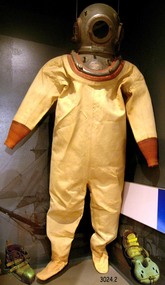
Functional object - Diving Suit, boots and weight, Early-to-mid 20th century
... The company gained a worldwide reputation for the manufacture of diving apparatus, decompression and observation chambers, and safety breathing apparatus of all types for use on the land, in the air and under the sea (including mine rescue, tunnelling, aircraft, diving, submarine escape and in other hazardous environments). ...The company gained a worldwide reputation for the manufacture of diving apparatus, decompression and observation chambers, and safety breathing apparatus of all types for use on the land, in the air and under the sea (including mine rescue, tunnelling, aircraft, diving, submarine escape and in other hazardous environments). ...This diving suit with helmet, boots and weight is part of the E. G.Ward collection, along with the diving compressor and a photograph of a diver in this equipment. Siebe Gorman & Company Ltd was a British company that developed diving equipment and breathing equipment and worked on commercial diving and marine salvage projects. The company advertised itself as 'Submarine Engineers'. It was founded by Augustus Siebe, a German-born British engineer chiefly known for his contributions to diving equipment. Siebe Gorman traded as an engineering firm for over 180 years from 1819 to 1999. The early success of the business was due to its founder, the Prussian immigrant Christian 'Augustus' Siebe (1788-1872). For business reasons, he applied for and was granted British citizenship in 1856. He was a gifted engineer who was able to translate theoretical problems into practical, working products. During the industrial Victorian period, the business traded as 'A. Siebe' at 145 High Street Holborn London, but in 1828 new premises were acquired at 5 Denmark Street, Soho. The family firm produced a wide range of manufactured goods including paper-making machinery, measuring machinery, water pumps, refrigeration equipment and diving apparatus. Augustus Siebe specialised in submarine engineering early on and the company gained a reputation for the manufacture of safe, reliable diving apparatus. Augustus Siebe is best remembered for the development and manufacture of the ‘closed’ Diving Dress based on the ideas of Charles and John Deane, George Edwards and Charles Pasley. Apart from some small modifications to valves and diver communications, the basic 12-bolt ‘closed’ diving dress remained relatively unchanged after the 1870s. Later company successes were also based on innovation, with new products that could be successfully developed and manufactured to high standards. This was largely attributed to the inventive nature, foresight, engineering and entrepreneurial skills of Robert Henry Davis (1870-1965). In 1882, RH Davis joined the company of 'Siebe & Gorman' as a young 11-year-old office boy and he was to remain with the company until he died in 1965. Augustus Siebe retired in 1869 and handed over the company to a new partnership of Henry H. Siebe (1830-1885) and William A. O'Gorman (1834-1904). The new firm traded as 'Siebe & Gorman' (1870-1879) from premises in and around Mason Street, Westminster Bridge Road, Lambeth, London. The two partners soon recognised the potential of R.H. Davis and in 1894, aged 24, he became General Manager of Siebe & Gorman. Davis increasingly ran the company until the surviving partner (W.A. Gorman) died in 1904. The firm was disposed of to the Vickers (armaments) family and a new company 'Siebe Gorman & Co. Ltd.' (1905-1998) was formed. Under the chairmanship of Albert Vickers, R.H. Davis was kept on as Managing Director, and the company forged ahead. However, after WW1, the Great Depression caused manufacturing output and share prices to slump. In 1924 Robert Davis made a deal with the Vickers Board and acquired control of the company through majority shares. Under his leadership, the Siebe Gorman Company flourished and within time, four of his sons also joined the firm. The company gained a worldwide reputation for the manufacture of diving apparatus, decompression and observation chambers, and safety breathing apparatus of all types for use on the land, in the air and under the sea (including mine rescue, tunnelling, aircraft, diving, submarine escape and in other hazardous environments). Close research and development links with the MOD (especially the Admiralty), also provided a lucrative outlet for the company products. In 1932, Robert Davis was knighted by King George V, principally for his invention of the ‘Davis Submerged Escape Apparatus’ (D.S.E.A.). Siebe Gorman essentially remained a family firm from the beginning (under A.Siebe) until it became a public company for the first time in 1952. However, following WW2, British manufacturing stagnated through stifled investment and post-war austerity, and there was little innovation. Siebe Gorman fortunes began to decline as an ageing Sir Robert Davis failed to invest, or change the company business and management practices. In 1959, Siebe Gorman was acquired by the “Fairy Group” and the ailing Sir Robert was made Life President. Consequently, nothing changed and the slow decline continued until Sir Robert's death in March 1965. Around 1960, Siebe Gorman acquired the diving apparatus manufacturer C E Heinke, and for a brief period, it manufactured some diving equipment under the combined name of Siebe Heinke. Around 1964, Mr E. 'Barry' Stephens was appointed as the new Managing Director to modernise Siebe Gorman. Changes were made, including a move to a new factory in Wales in 1975. The new company concentrated on fire-fighting breathing apparatus and escape equipment, and the move coincided with the loss of many of the older, traditional craft skills. Between 1985 and 1998, Siebe expanded through acquisitions, and several other companies were acquired. The Siebe Gorman (diving apparatus) company has therefore traded as A. Siebe (1819-1870); Siebe & Gorman (1870-1879); Siebe Gorman & Co (1880-1904); Siebe Gorman & Co. Ltd (1905-1998).The diving suit, helmet, boots, and weights, along with associated equipment in the Flagstaff Hill collection, represent a highly significant snapshot of marine history. These items are particularly important in understanding the evolution of diving equipment, with a special focus on their use in salvage operations before and throughout the Second World War. Manufactured by a company renowned for its inventions, development, and innovation in marine engineering, the equipment demonstrates the progression of technology in deep-sea diving. Early helmets and related items produced by this company remain highly sought after by collectors worldwide, highlighting their historical and technological value. The presence of these items within the Flagstaff Hill Maritime Museum allows for a unique insight into the working conditions and methods employed by divers. It also illustrates the considerable dangers they faced while performing such essential and hazardous work, underscoring the critical role played by these professionals in maritime history.Diving suit including helmet, boots and a weight. Diving suit is made of canvas with knitted cuffs. The helmet is metal. The boots have a thick sole and thick leather upper that is held on with leather straps and buckles. The toe of the boot is heavy metal. The weight is worn next to the trunk of the diver and it has an inscription to mark the front. It is worn with straps and buckles holding it in place. Royal Navy Admiralty Pattern 6 bolt No 3 light Siebe Gorman light diving helmet circa 1960, used by the Royal Navy before and after World War 2. This equipment is part of the E. G. Ward Collection."Siebe Gorman & Co Ltd Marine Engineers London. Patent" with "E G Ward" on front and back plate. On weight "FRONT"flagstaff hill, warrnambool, diving suit, siebe gorman and co ltd., siebe gorman and co ltd marine engineers london, marine engineers, diving helmet, diving boots, diving weight, marine diving, maritimemuseum, maritime village, maritime history, marine technology, life saving, deep sea diving, maritime museum, siebe gorman and co ltd., siebe gorman and co ltd, london, deep-sea diving, e. g. ward, e g ward, e.g. ward, edward ward, ted ward -
 Federation University Historical Collection
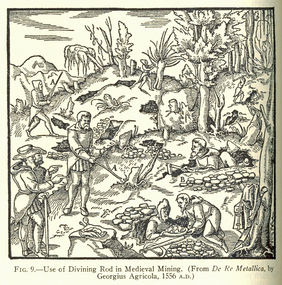
Book, The Economics of Mining (Non-Ferrous Metals), 1938, 1938
... Contents include mine valuation (sampling, ore deposits, ore reserves, financial provisions, sale of mineral product, metal prices, reports) and Mining Organization (Co-operative effort, Mining Companies, Promoting Mining Enterprises, fluctuations of share prices, valuation of mining shares, fakes and fallacies, the mining Engineer and the law) and Mine Management (Organization of staff, mine manager, efficiency, industrial relations, training and discipline, safety). ...Contents include mine valuation (sampling, ore deposits, ore reserves, financial provisions, sale of mineral product, metal prices, reports) and Mining Organization (Co-operative effort, Mining Companies, Promoting Mining Enterprises, fluctuations of share prices, valuation of mining shares, fakes and fallacies, the mining Engineer and the law) and Mine Management (Organization of staff, mine manager, efficiency, industrial relations, training and discipline, safety). ...The book was used by Charles Bacon who studied at the University of Nevada in the late 1930s/early 1940s. Bacon worked at Bunker Hill Mines and Kellogg Idaho, before arriving in Australian in 1951. He worked for CN Myers, a company involved with paper converting. CN Myers was a family business (on Charles Bacon's maternal line). The Mackay School of Mines, Nevada was established in 1908. At the time of writing this mook T.J. Hoover was Professor of Mining and Metallurgy and Dean of the School of Engineering at Stanford University. Theodore Jesse Hoover, brother of the 31st President of the United States, was born in West Branch, Iowa, on January 28, 1871. He attended Stanford and received the Bachelor of Arts degree in Geology and Mining in 1901. Following graduation his professional career started with the position of assayer for the Keystone Consolidated Mining Company. After one year, he became assistant manager for the Standard Consolidated Mine, and a year later he was promoted to manager of the operation. In 1907 Hoover went to London as general manager of Minerals Separation, Ltd. This company was developing the froth flotation process for recovering minerals from ores. Hoover took an active part in the development of the flotation concentration process and authored one of the first books on the concentration of ores by flotation. After four years with Minerals Separation, Ltd., Hoover entered private practice as a consulting mining and metallurgical engineer with offices in London and in San Francisco. He was very successful and held positions of consulting engineer, managing director, director, and president of many mining companies in America, Europe, Asia, Africa, and Australia. He returned to Stanford in 1919 as Professor of Mining and Metallurgy and Executive Head of the Department of Mining and Metallurgy. His experience and ability in organization made him a natural leader. He was influential in the formation of the School of Engineering at Stanford. The School was formed in 1925 and he was made dean, a position he held until his retirement in 1936. As dean of engineering, he promoted a broad fundamental training program for undergraduate engineering students. Under his guidance, emphasis was placed upon graduate work and he was responsible for developing strong graduate engineering curricula at Stanford. While dean he continued teaching and his course, "The Economics of Mining," developed into a book which was published in 1933. He became interested in the functions of engineers and, with Professor Fish, wrote a book entitled "The Engineering Profession" which was published in 1940 and revised in 1950. In addition to his academic activities he was generous in his hospitality. Faculty and students alike enjoyed the annual field day and barbecue at his Rancho del Oso, near Santa Cruz. He was widely read and had a lively interest in all the things he encountered. He speculated on the antiquity of man and man's early production processes. To verify an idea regarding flint tools, he studied their shapes and became proficient in making arrow heads. He was also interested in wild life, and was one of the founding members of the Cooper Ornithological Society. (http://engineering.stanford.edu/about/bio-hoover) Blue hard covered book of 547 pages including an index. Contents include mine valuation (sampling, ore deposits, ore reserves, financial provisions, sale of mineral product, metal prices, reports) and Mining Organization (Co-operative effort, Mining Companies, Promoting Mining Enterprises, fluctuations of share prices, valuation of mining shares, fakes and fallacies, the mining Engineer and the law) and Mine Management (Organization of staff, mine manager, efficiency, industrial relations, training and discipline, safety). Inside front cover 'Charles Bacon Mackay School of Mines"charles bacon, mining engineering, metallurgy, university of nevada, mackay school of mines, stanford, bacon, mining, economics, divining, theodore hoover -
 Federation University Historical Collection
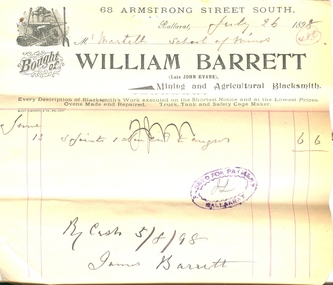
Document - Invoice, James Barnett, William Barrett Mining and Agricultural Blacksmith Invoice, 26/7/1898 (exact)
... james ballarat school of mines barrett william barrett blacksmith armstrong st ballarat frederick martell ovens safety cage mining blacksmith agricultural blacksmith Stamped 'Passed for Payment Ballarat' Printed invoice with business address and image of a forge on the top. ...Printed invoice with business address and image of a forge on the top. The invoice was made at to Fred Martell of the Ballarat School of Mines, and was signed by James BarrettStamped 'Passed for Payment Ballarat'james, ballarat school of mines, barrett, william barrett, blacksmith, armstrong st ballarat, frederick martell, ovens, safety cage, mining blacksmith, agricultural blacksmith -
 Federation University Historical Collection
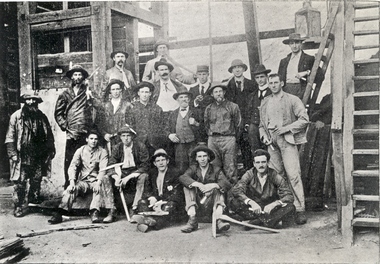
Photograph (black & white), Ballarat School of Mines Students visit the New Normanby Mine, 1899, 1899
... safety cage...john rowe...new normanby gold mine...(http://guerin.ballarat.edu.au/curator/honour-roll/honourroll_Rowe,John.shtml) candle ballarat school of mines safety cage john rowe new normanby gold mine mining alumni pick Nineteen men, some Ballarat School of Mines students, pose outside Ballarat's New Normanby Mine. ...In 1875 John Rowe enrolled at the Ballarat School of Mines (SMB) where he studied Metallurgy and Assaying. In 1880 the Britannia Mine closed and John Rowe moved to Launceston working as Manager of the Royal Tasman Gold Mining Company. He returned to Ballarat two years later to manage the Long Gully United Gold Mining Company. In 1885 John Rowe sought work in New Caledonia followed by South Africa. While in South Africa he received an offer from SMB to lecture in Practical Mining, an instructional innovation which involved weekly visits to some of the principle mines in the district. John Rowe took up this position in 1994, but it appears to have been a short lived innovation ending in 1996, possibly due to John Rowe's failing health. (http://guerin.ballarat.edu.au/curator/honour-roll/honourroll_Rowe,John.shtml)Nineteen men, some Ballarat School of Mines students, pose outside Ballarat's New Normanby Mine. Some hold picks and candles. The man in the centre wearing a waistcoat is John Rowe, experienced miner and lecturer in Practical Mining at the Ballarat School of Mines. The June 1899 Ballarat School of Mines Magazine records: "The mining class visited the Britannia Gold Mine, and were kindly shown over the surface and underground workings by Mr. Harvey."candle, ballarat school of mines, safety cage, john rowe, new normanby gold mine, mining alumni, pick -
 Federation University Historical Collection
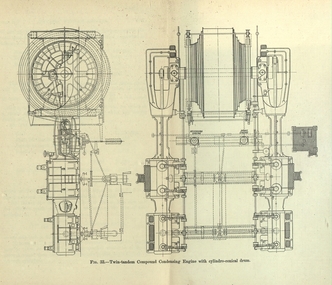
Book, Winding Engines and Winding Appliances, 1912, 1912
... George McCulloch was an inspector of machinery for the Western Australia Department of Mines. mining winding engines steam engines safety devices winding ropes cages safety cages Brown hard covered book of 452 pages including illustrations and index. ...George McCulloch was an inspector of machinery for the Western Australia Department of Mines. Brown hard covered book of 452 pages including illustrations and index. Contents include Design; Tail ropes; Winding from Great Depths; Colliery Winding; Electric Winding; Steam engine details, Drims; brakes; Clutches; Safety Devices; Winding ropes; Cages; Skips; Cage Safety Gear, Safety Cages; Cage Guides; Head gearsmining, winding, engines, steam engines, safety devices, winding ropes, cages, safety cages -
 Federation University Historical Collection
Mining Lamp, E. Thomas and Williams Ltd, Welsh Mining Lamp
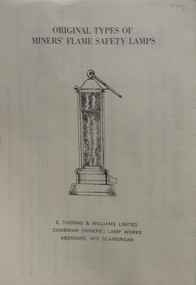
... safety. (http://www.welshminerslamps.com/info_lamp_personaluse.shtml, accessed 06/05/2015) E. Thomas & Williams, Ltd. mining lamps have been in continuous production since 1860. Cambrian Lamps are approved for use in coal mines...safety. (http://www.welshminerslamps.com/info_lamp_personaluse.shtml, accessed 06/05/2015) E. Thomas & Williams, Ltd. mining lamps have been in continuous production since 1860. Cambrian Lamps are approved for use in coal mines ...This lamp is typical of lamps used in Welsh Coal Mines. It was purchased from the supplier around mid 1995. The Welsh Miners’ Lamps were ingeniously designed over 180 years ago to alert coal miners to danger. It ensures the burning of a protected flame in the presence of explosive gas, by regulating the necessary supply of atmospheric air, and by allowing the products of combustion to pass through without igniting the gaseous atmosphere. If the atmosphere is so heavily charged that noxious gas enters the lamp, its presence will be indicated by a change in the length and color of the flame, and (unless there are exceptional circumstances), the miner has sufficient warning to secure his safety. (http://www.welshminerslamps.com/info_lamp_personaluse.shtml, accessed 06/05/2015) E. Thomas & Williams, Ltd. mining lamps have been in continuous production since 1860. Cambrian Lamps are approved for use in coal mines where methan gas and oxygem deficinecy are hazards.Solid Brass traditional miners Flame Safety Lamp with Copper Chimney. The base of this lamp is tooled from solid brass because brass does not spark when it hits rock and is therefore the safest metal to use underground. The lamp burns lamp oil (kerosene). R. Thomas and Williams Ltd Makers Aberdare Wales Cambrian No 152897mining lamp, miner's lamp, thomas and williams, wales, welsh, welsh miners lamp, mining, cambrian lampworks, miners flame safety lamps -
Federation University Historical Collection
Tool - Object, J.K. Dey & Sons, Mining Safety Lamp, c1967
... The Mining Safety Lamp is used in flammable atmospheres, and consists of a wick lamp with a mesh screen enclosing the flame. It was created for use in coal mines, to reduce the danger of explosions due to the presence of methane and other flammable gases, called firedamp or minedamp. ...The Mining Safety Lamp is used in flammable atmospheres, and consists of a wick lamp with a mesh screen enclosing the flame. It was created for use in coal mines, to reduce the danger of explosions due to the presence of methane and other flammable gases, called firedamp or minedamp. ...The Mining Safety Lamp is used in flammable atmospheres, and consists of a wick lamp with a mesh screen enclosing the flame. It was created for use in coal mines, to reduce the danger of explosions due to the presence of methane and other flammable gases, called firedamp or minedamp. J. K. DEY & SONS was established in 1947 and manufactures Safety Lamps, Torches and Carbide Lamps. In 1967 the Mining Authority of India issued approval of the Velox GL5 Flame Safety Lamp ( Kerosene burning ) self-extinguishing type. At that time J.K. Dey captured the whole mining market of safety lamps in India. (http://www.jkdey.com/history.html, accessed 06/05/2015)Metal mining safety lamp with copper bas and hanging hook. The Dey Velox GL5 Gas Testing Flame Safety Lamp boasts sharp detection of methane gas; detection of the shortage of oxygen; detection of the presence of Carbon-dioxide, is magnetically unlocked; ncludes a top feed device for testing Methane Gas close to the roof; contains an auto extinguisher. J.K. Dey & Sons Calcutta Velox Velox Gmining lamp, safety lamp, miners lamp, calcutta, india, mining -
 Federation University Historical Collection
Book - Ledger, Ballarat School of Mines Donation Book, 1878 - 1895, 1878-1895
... Mines include:
34. M. Hamburger, Ballarat - bunsen burner
41. W.H. Shaw, Phoenix Foundry - 81 nos of 'Engineer'
89. Juvenile Industrial Exhibition Association Committee per Joseph Flude - dies used for striking medals awarded to successful exhibits.
165. Ferdinand Von Mueller
172 Ferdinand Von Mueller o hortus siccus 6
197. James Stoddart
203. Edward Gazzard, North Creswick - Model of safety...The Museum was emptied in the 1960s with items being distrubuted to the Ballarat Historical Society, returned to original lenders (ie Pern Collection), of disposed of. ballarat school of mines doantions museum ballarat school of mines museum safety cage botanical garden materia medica garden library bella guerin james oddie phoenix foundry w.h. shaw john lynch henry sutton aboriginal stone axe tomahawk geological specimens moonta fedinand krause oddie collection of minerals thomas bath spears Solomon Islands King Billy bows and arrows ancient coins birds eggs snakes Donations to the Ballarat School of Mines include:
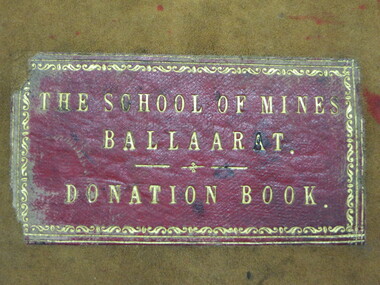
34. ...The Donation Book relates to the Ballarat School of Mines Museum which opened in 1872. Very few of these items are still held by Federation University. The Museum was emptied in the 1960s with items being distrubuted to the Ballarat Historical Society, returned to original lenders (ie Pern Collection), of disposed of. Donations to the Ballarat School of Mines include: 34. M. Hamburger, Ballarat - bunsen burner 41. W.H. Shaw, Phoenix Foundry - 81 nos of 'Engineer' 89. Juvenile Industrial Exhibition Association Committee per Joseph Flude - dies used for striking medals awarded to successful exhibits. 165. Ferdinand Von Mueller 172 Ferdinand Von Mueller o hortus siccus 6 197. James Stoddart 203. Edward Gazzard, North Creswick - Model of safety Cage invented and made by donor 218. E. Morey 222. Alfred Lestor 228. J.J. Sleep, Ballarat, patent Lever escarpment Clock (displayed in laboratories) 237. Bernard Smith (Warden) per favor of James M. Bickett - Bust of Mr John Lynch, Smythesdale. (Note: This item is not in the present Federation University Historical Collection) 241. James Oddie, J.P., Ballarat, Copy of 'the Chemist and Druggist' 267. John Lynch Junior, Smythesdale - Cast of "Golden Age" nugget, found at Browns by Co-operative party, 12 men. Weight 75 oz, 12 dwts, 12 grs.(Note: This item is not in the present Federation University Historical Collection) 270. Isaac Davis, Main Road, Ballarat 294. W. H. Shaw, Ballarat - 94 nos of 'The Engineer' 295. Rivett Henry Bland, Clunes - Specimen of water pipe from the Port Phillip Company's mine encrusted with carbonites of lime and magnesium (Note: This item is not in the present Federation University Historical Collection) 299. D.J. Williams, Queenscliff - 1 case shells from Fiji 305. C. Retallack, Ballarat 314. William Henry Shaw, Ballarat - glass case 323. W. Longley, Ballarat - Botanical Specimen (Note: This item is not in the present Federation University Historical Collection) 327. W. H. Angove, Perth 337. J. Cosmo Newbery, B Sc, Melbourne 343. James Hector, M.D., New Zealand 353. R.S. Mitchell, Ballarat - 8 specimens live plants (medicinal) (for the Ballarat School of Mines Garden) 355. W. Magee, Ballarat - Sugar cane plants and seeds (for the Ballarat School of Mines Garden) 363. James Hector, Wellington, new Zealand 371. William Wesley, 28 Essex St, Strand, London - Scientific book circular 380. Jacob Upfold (deceased) per favor of the trustees - bequest of steam engine indicator and belongings (boothe and case) 381. Joseph Mitchell, 22 Macarthur Street, Ballarat - sod of turf cut from Warboy's High Few, County Huntingdon, England, 1872. 394. W.H. Barnard 401. James Orr 418. F. Ratte, Sydney 440. Alfred Mica Smith, Sandhurst (Bendigo), Inaugural Address, delivered to the Bendigo School of Mines Science Society, June 20. 1881 by P.H. Macgillivray, MA, MRCS, FLS, President. (Note: This item is not in the present Federation University Historical Collection) (Note: This item is not in the present Federation University Historical Collection) 446. C. C. Shoppee, Ballarat 462. Dr Bunce, Ballarat 468. James Black, Mining Manager "Kerrit Bureet' 479. J.S. North, Mining Manager No. 2 Queen Co, Black Hill Ballarat. 505. Smith Tibbitts - A block of ancient leaves from the Nigtingbool Estate near Haddon on the Ballarat district from shaft 80 feet deep. (Note: This item is not in the present Federation University Historical Collection) 512. F.W. Niven, Ballarat - "A Handy Book to Tasmania" 522. James Hector, Wellington, New Zealand 549. C.E. Grainger, Manager Ballarat Woollen Mills - samples of dyed and raw wools 600. (4 July 1882) Henry Sutton, Ballarat - 13th annual report of the Aeronautical Society of Great Britain; 2 papers from the Proceedings of the Royal Society, nos 217 and 218- 1882, "One a new electrical storage battery by Henry Sutton, Ballarat, Victoria. 608. H. Glenny J.P., Ballarat - Specimen of Asbestos from Tasmania 610. M.H. Edelmann, Munich, Germany 674. W.H. Shaw, Phoenix Foundry - Steel boring 95 feet long taken from bed-plate of locomotive engine. 675 - H.R. Hancock J.P. pre favour Mr James Pryor, Moonta Mines 676. Baron Ferdinand Von Mueller KCMG, etc, Melbourne 678. E.F.A. Gaunt, Royal Navy, H.M.S. Nelson, per favour Lyde Gaunt - Specimen of manganese ore from the mines - Russell - New Zealand 728. Dr Pinnock, Ballarat 760. Simon Morrison, Ballarat 784. James Shugg, Hamilton - 1 case fossils from Muddy Creek, near Hamilton. (Note: This item is not in the present Federation University Historical Collection) 786. W. Bolam (inspector of Schools), Melbourne - 2 spears and 1 fishing prong Fijian 806. James Oddie, Ballarat 708. Henry G. Hanks, San Francisco 786. W. Bolam (Inspector of Government Schools Melbourne) - 2 spears and one fishing prong Fijian 824. Henrique Gorceixm Onro Preto, Brazil 840. W. Laplau, Ballarat - Gas furnace with a large assortment of fittings, also large gas holder and oil-heating apparatus 854. Robert Borch, Main Road, Ballarat - Improved safety chain (Note: This item is not in the present Federation University Historical Collection) 928. James Oddie 944. James P. Munroe, Registrar, Massachusetts 952. L.E. Cutter per favour of Mr F.J. Martell - Unexploded bomb shell from the Eureka Stockade 957. H. Glenny, Hobart 962. George Hart, Ballarat - eagle 976. Henry Sutton, Ballarat - 1 volume "Plattner on the Blowpipe" 978. J.W. Flatow, 45 Madeline Street, Carlton, Melbourne 984. Charles C Shoppee Ballarat - Copies of ancient coins 989-95 - Specimens from Moonta, South Australia 985. W.H. Wooster BOlwarra - books microscope related 1179. James Oddie - Live hedgehog 1181 C. Crisp, Bacchus Marsh, Portugal Copper Coin, 1785 1248 James Oddie, Solomon Islands - Bow and arrows & Spears 1285. C. Colyer, Smythesdale 1327. John L. McKenna, Smeaton - Fragment of Stone Axe. 1395. Mrs O. Skoglund, Nerrina 1428. Daniel Brophy, Ballarat - Collection of mineral specimen form Silverton (Collected by Mrs James Murray) 1442. Henry Sutton, Ballarat - Specimens of fossil fruits collected at Haddon by Charles Brown. 1444. Mining Department - Underground Mine Workings from Band of Hope and others. 1517. W.H. Wooster, Ballarat 1592. Bishop of Ballarat - Stone Axe and other native items 1669. H. McHaffier, Napoleons - 1 Spanish silver coin 1681. James Oddie, Dunedin 1688. W. Burbridge, Ballarat - Native Tomahawk from Metung 1708. A. Doepel, Ballarat 1712. Marty Guerin, Ballarat 1735. Bella Guerin. M.A., Ballarat - Copy Wide Awake Vol 1 No 7 May 28th 1887 and The Bulletin, March 19th 1887. 1747. Bella Geurin M.A., Ballarat - Copy Wide Awake Vol 1 No 8 June 4 1887 1751. Bella Geurin M.A., Ballarat - Copy Wide Awake Vol 1 No 9 June 11th 1887 1842. Linnean Society, London England - Charter, By Laws, Proceedings, Transactions, Journals 1853. W.J. Corbould, Silverton, NSW - chloride of silver from Pinnacles, Broken Hill, Silverton 1888. W. J. Corbould, Sample of metallic silver from Silverton, NSW 1928. E. Morey, Ballarat - Steam Engine 1937. Henry Sutton A.S.I.E., Ballarat - Plate Electric Machine, chimes and Sportman (number crossed out) 1951. Henry Sutton A.S.I.E., Ballarat - Plate Electric Machine, chimes and Sportman 1981. Harrie Wood (per W.H.B.[Barnard?), Ballarat 1996. W.H. Shaw, Phoenix Foundry - Papers "The Vict Engineer July 1887, May June July August 1888 and others 2014. Harrie Wood, Sydney - Report Department of Mines, 18872027. W.J. Bechervaise - Copy of Book by Baldwin Spencer 2034. A.G. Randall - Native Hatchet 2045. W.H. Corbould, Silverton, Collection of silver ores 2051. Fowler, Tarnagulla - Native Tomahawk 2123-2131. James Oddie, London 2163. Roff. F. Taplier, Sturt Street - Native Tomahawk 2178. Syd. Johnson, Meredith - Native Tomahawk, Greenstone 2184. Mr Tupp for Hall - Native Spear and Club 2292. Emmanuel Steinfeld, Melbourne 2313. A. Atwood, Rowlands Factory, Dana Street 2361. Dr Pinnock, Ballarat - Collection of Living Sponges 2363. P. Curnow, Ballarat - Piece of wood with stone naturally embedded 2364. R. Dowling, Waubra 2875. Mrs C, Flude, Ballarat - Collection of (5) mineral specimens 3460. Joseph Weir, Ballarat - Sample of rolled Annibar 3466. J. Hart, Ballarat - Native Shield - supposed to have been made by King Billy 4784. Mr. O. Woolnaugh, Pleasant Street - Four Native Tomahawks 6469. L. Balhausen, Ballarat 3472. John English, Smeaton - three samples of auriferous wash dirt 3607. Columbia College, New York - Handbook of Information of the Columbia College in the Ciry of New York 1892-3. 3672. L.A. Samuels, Bendigo 3724. P. Paperhagen 3736. The Late Rivett Henry Bland per John Noble Wilson - Collection of mineral specimens and fossils 3752. G.A. Denny, South Africa 3755. J. Carroll, Ballarat - Specimen of Native bread found in Ballarat East. 4765. J. Donnelly, Springs, Bungaree I. Fowler, Coolgardie, Specimen of Gold Bearing Quartz ballarat school of mines, doantions, museum, ballarat school of mines museum, safety cage, botanical garden, materia medica garden, library, bella guerin, james oddie, phoenix foundry, w.h. shaw, john lynch, henry sutton, aboriginal, stone axe, tomahawk, geological specimens, moonta, fedinand krause, oddie collection of minerals, thomas bath, spears, solomon islands, king billy, bows and arrows, ancient coins, birds eggs, snakes -
 Flagstaff Hill Maritime Museum and Village
Equipment - Diving compressor and helmet, 1944
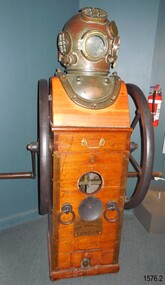
... The company gained a worldwide reputation for the manufacture of diving apparatus, decompression and observation chambers, and safety breathing apparatus of all types for use on the land, in the air, and under the sea (including mine rescue, tunneling, aircraft, diving, submarine escape and in other hazardous environments). ...The company gained a worldwide reputation for the manufacture of diving apparatus, decompression and observation chambers, and safety breathing apparatus of all types for use on the land, in the air, and under the sea (including mine rescue, tunneling, aircraft, diving, submarine escape and in other hazardous environments). ...Siebe Gorman & Company Ltd was a British company that developed diving equipment and breathing equipment and worked on commercial diving and marine salvage projects. The company advertised itself as 'Submarine Engineers'. It was founded by Augustus Siebe, a German-born British engineer chiefly known for his contributions to diving equipment. Siebe Gorman traded as an engineering firm for over 180 years from 1819 to 1999. The early success of the business was due to its founder, the Prussian immigrant Christian 'Augustus' Siebe (1788-1872). For business reasons, he applied for and was granted British citizenship in 1856. He was a gifted engineer who was able to translate theoretical problems into practical, working products. During the industrial Victorian period, the business traded as 'A. Siebe' at 145 High Street Holborn London, but in 1828 new premises were acquired at 5 Denmark Street, Soho. The family firm produced a wide range of manufactured goods including paper-making machinery, measuring machinery, water pumps, refrigeration equipment, and diving apparatus. Augustus Siebe specialised in submarine engineering early on and the company gained a reputation for the manufacture of safe, reliable diving apparatus. Augustus Siebe is best remembered for the development and manufacture of the ‘closed’ Diving Dress based on the ideas of Charles and John Deane, George Edwards, and Charles Pasley. Apart from some small modifications to valves and diver communications, the basic 12 bolt ‘closed’ diving dress remained relatively unchanged after the 1870s. Later company successes were also based on innovation, with new products that could be successfully developed and manufactured to high standards. This was largely attributed to the inventive nature, foresight, engineering, and entrepreneurial skills of Robert Henry Davis (1870-1965). In 1882, RH Davis joined the company of 'Siebe & Gorman' as a young 11-year-old office boy and he was to remain with the company until he died in 1965. Augustus Siebe retired in 1869 and handed over the company to a new partnership of Henry H. Siebe (1830-1885) and William A. O'Gorman (1834-1904). The new firm traded as 'Siebe & Gorman' (1870-1879) from premises in and around Mason Street, Westminster Bridge Road, Lambeth, London. The two partners soon recognised the potential of R.H. Davis and in 1894, aged 24, he became General Manager of Siebe & Gorman. Davis increasingly ran the company until the surviving partner (W.A. Gorman) died in 1904. The firm was disposed of to the Vickers (armaments) family and a new company 'Siebe Gorman & Co. Ltd.' (1905-1998) was formed. Under the chairmanship of Albert Vickers, R.H. Davis was kept on as Managing Director, and the company forged ahead. However, after WW1, the Great Depression caused manufacturing output and share prices to slump. In 1924 Robert Davis made a deal with the Vickers Board and acquired control of the company through majority shares. Under his leadership, the Siebe Gorman Company flourished and within time, four of his sons also joined the firm. The company gained a worldwide reputation for the manufacture of diving apparatus, decompression and observation chambers, and safety breathing apparatus of all types for use on the land, in the air, and under the sea (including mine rescue, tunneling, aircraft, diving, submarine escape and in other hazardous environments). Close research and development links with the MOD (especially the Admiralty), also provided a lucrative outlet for the company products. In 1932, Robert Davis was knighted by King George V, principally for his invention of the ‘Davis Submerged Escape Apparatus’ (D.S.E.A.). Siebe Gorman essentially remained a family firm from the beginning (under A.Siebe) until it became a public company for the first time in 1952. However, following WW2, British manufacturing stagnated through stifled investment and post-war austerity, and there was little innovation. Siebe Gorman's fortunes began to decline as an aging Sir Robert Davis failed to invest, or change the company's business and management practices. In 1959, Siebe Gorman was acquired by the “Fairy Group” and the ailing Sir Robert was made Life President. Consequently, nothing changed and the slow decline continued until Sir Robert's death in March 1965. Around 1960, Siebe Gorman acquired the diving apparatus manufacturer C E Heinke, and for a brief period, it manufactured some diving equipment under the combined name of Siebe Heinke. Around 1964, Mr E. 'Barry' Stephens was appointed as the new Managing Director to modernise Siebe Gorman. Changes were made, including a move to a new factory in Wales in 1975. The new company concentrated on fire-fighting breathing apparatus and escape equipment, and the move coincided with the loss of many of the older, traditional craft skills. Between 1985 and 1998, Siebe expanded through acquisitions, and several other companies were acquired. The Siebe Gorman (diving apparatus) company has therefore traded as A. Siebe (1819-1870); Siebe & Gorman (1870-1879); Siebe Gorman & Co (1880-1904); Siebe Gorman & Co. Ltd (1905-1998). (For information regards the diving helmet & Frank King see Notes Section at the end of this document)The items are very significant as a snapshot into marine history and the development of diving equipment generally especially that used for salvage operations before and during WW2. The company that made the equipment was a leading inventor,developer and innovator of marine equipment with its early helmets and other items eagerly sought after today for collections around the world. The items in the Flagstaff Hill collection give us an insight as to how divers operated and the dangers they faced doing a very necessary and dangerous job. Frank Kings' diving helmet and compressor (communication pipe stored separately). Compressor is hand cranked. US Navy diving helmet, Mark V. Two maker's plates attached. Made in 1944.On rear "WATER SUPPLY" On front 'PATENT" " Logo: Images (Lion, Crown, Horse, Shield within an oval) "SIEBE, GORMAN & Co. Ltd. SUBMARINE ENGINEERS, LONDON.flagstaff hill, warrnambool, maritime museum, great ocean road, us navy diving helmet, commonwealth government salvage, diving helmet, marine salvage, frank king, diver, siebe. gorman & co ltd, submarine equipment, diving equipment, communication under water, hand cranked, diving compressor -
 Federation University Historical Collection
Photograph - Colour, Phil Bryce, Removal of a fibre-glass chimney extension from a chimney from the former Ballarat Brewery, 2015, 13/11/2015
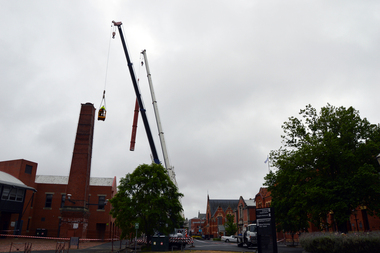
... The structure was removed for safety reasons and to preserve the integrity of the historic brick chimney which supported it. chimney fibreglass former ballarat brewery former carlton and united breweries ballarat school of mines brewery complex Coloured digital photographs associated with the removal of a fibreglass extension to a chimney which was part of the Former Ballarat Brewery/Carlton and United Breweries complex. ...The chimney extension on what was the former Carlton and United Breweries boiler house at Ballarat installed in 1972 and it is constructed of a special formulation of fibreglass reinforced plastics designed to operate at elevated temperature (ie boiler flue gas). It is thought to be one of 26 or 28 fibreglass boiler chimneys designed and installed in Victoria in the 1970s, and is thought to be one of the last to be removed. In its day the fibreglass chimney extension was at the cutting edge of fibreglass technology and is therefore well worth retaining. Removal of the chimney extension to the brick chimney outside the brewery building was deemed necessary to prolong the life of the chimney, and also because the fibreglass extension had reached end of life and posing a possible threat. According an Engineering assessment, fibreglass structures have a life expectancy of between 20 years (when fatigue loaded) and up to 100 years (static loaded). We don’t know when it was added to the chimney but believe it was most likely in the early 1970s. Given that it is subject to wind load and often observed to be moving in the wind it is likely that it will be at the end of its life. The chimney will be made good and we have the necessary planning approvals in place to undertake the works. The chimney extension was removed on 13 November 2015 in accordance with a planning permit obtained by the University. The extension is believed to have been added in the 1970s and was predominantly made from fibre glass. The structure was removed for safety reasons and to preserve the integrity of the historic brick chimney which supported it. Coloured digital photographs associated with the removal of a fibreglass extension to a chimney which was part of the Former Ballarat Brewery/Carlton and United Breweries complex. Images also include the last day the chimney was in situ.chimney, fibreglass, former ballarat brewery, former carlton and united breweries, ballarat school of mines, brewery complex
