
Showing 30 items matching " ministry of health"
-
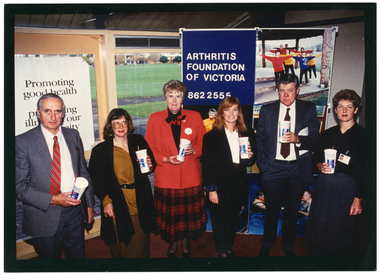 Musculoskeletal Health Australia (now held by the Glen Eira Historical Society)
Photograph - Group photo, Circa 1990-1991
... ... ministry of health...Appearing from left to right are: Dr Leslie Koadlow (Rheumatologist and AFV President), Rhonda Galbally (Chief Executive of VicHealth); Jan Ryan (Ministry of Health representative); Carmel Travers (Sandhurst Farms), Professor Ken Muirden (Rheumatologist), and Jenny Davidson (AFV's Education and Services Manager)....Appearing from left to right are: Dr Leslie Koadlow (Rheumatologist and AFV President), Rhonda Galbally (Chief Executive of VicHealth); Jan Ryan (Ministry of Health representative); Carmel Travers (Sandhurst Farms), Professor Ken Muirden (Rheumatologist), and Jenny Davidson (AFV's Education and Services Manager). arthritis foundation of victoria afv osteoporosis prevention and self management course dr leslie koadlow rheumatologist president rhonda galbally chief executive vichealth; jan ryan ministry of health representative carmel travers sandhurst farms professor ken muirden jenny davidson education and services manager physi-cal calcium bone health C1990 C1991 COL photo of a small group of people standing in a semi-circle in front of a large window and a freestanding vertical display board. ...Representatives from the Arthritis Foundation of Victoria (AFV), event partners and sponsors pose for a photo at the Osteoporosis Prevention and Self Management Course media launch, circa 1990-1991. This is a similar photo to Collection Item 642, which is a black and white print. Appearing from left to right are: Dr Leslie Koadlow (Rheumatologist and AFV President), Rhonda Galbally (Chief Executive of VicHealth); Jan Ryan (Ministry of Health representative); Carmel Travers (Sandhurst Farms), Professor Ken Muirden (Rheumatologist), and Jenny Davidson (AFV's Education and Services Manager).COL photo of a small group of people standing in a semi-circle in front of a large window and a freestanding vertical display board. They are each holding a disposable PhysiCal branded milk-shake cup with a straw. There is a large poster on one of the windows, which contains the text (partially obscured), "Promoting good health and preventing illness in our community". On one panel of the display board, there is the text, "Arthritis Foundation of Victoria 862 2555", and some large posters of people doing various types of exercises, including water exercise. Through the window, there is a view of a grassy sports oval, with a row of houses and some trees in the distance.arthritis foundation of victoria, afv, osteoporosis prevention and self management course, dr leslie koadlow, rheumatologist, president, rhonda galbally, chief executive, vichealth; jan ryan, ministry of health, representative, carmel travers, sandhurst farms, professor ken muirden, jenny davidson, education and services manager, physi-cal, calcium, bone health, c1990, c1991 -
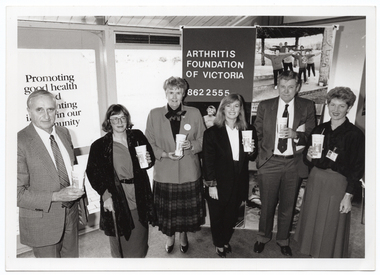 Musculoskeletal Health Australia (now held by the Glen Eira Historical Society)
Photograph - Group photo, Circa 1990-1991
... ... ministry of health...This photo appears on page 6 of the 1991 Annual Report with the caption: "Enjoying high calcium refreshments at the Osteoporosis Prevention and Self Management Course media launch are Foundation President, Dr Leslie Koadlow; Rhonda Galbally, Chief Executive of VicHealth; Jan Ryan, Ministry of Health representative; Carmel Travers for Sandhurst Farms; Professor Ken Muirden; and Jenny Davidson, Foundation Education and Services Manager."...This photo appears on page 6 of the 1991 Annual Report with the caption: "Enjoying high calcium refreshments at the Osteoporosis Prevention and Self Management Course media launch are Foundation President, Dr Leslie Koadlow; Rhonda Galbally, Chief Executive of VicHealth; Jan Ryan, Ministry of Health representative; Carmel Travers for Sandhurst Farms; Professor Ken Muirden; and Jenny Davidson, Foundation Education and Services Manager." arthritis foundation of victoria afv osteoporosis prevention and self management course dr leslie koadlow rheumatologist president rhonda galbally chief executive vichealth; jan ryan ministry of health representative carmel travers sandhurst farms professor ken muirden jenny davidson education and services manager physi-cal calcium bone health annual report C1990 C1991 B&W photo of a small group of people standing in a semi-circle in front of a large window and a freestanding vertical display board. ...Representatives from the Arthritis Foundation of Victoria (AFV), event partners and sponsors pose for a photo at the Osteoporosis Prevention and Self Management Course media launch, circa 1990-1991. This photo appears on page 6 of the 1991 Annual Report with the caption: "Enjoying high calcium refreshments at the Osteoporosis Prevention and Self Management Course media launch are Foundation President, Dr Leslie Koadlow; Rhonda Galbally, Chief Executive of VicHealth; Jan Ryan, Ministry of Health representative; Carmel Travers for Sandhurst Farms; Professor Ken Muirden; and Jenny Davidson, Foundation Education and Services Manager."B&W photo of a small group of people standing in a semi-circle in front of a large window and a freestanding vertical display board. They are each holding a disposable PhysiCal branded milk-shake cup with a straw. There is a large poster on one of the windows, which contains the text (partially obscured), "Promoting good health and preventing illness in our community". On one panel of the display board, there is the text, "Arthritis Foundation of Victoria 862 2555", and some large posters of people doing various types of exercises, including water exercise.arthritis foundation of victoria, afv, osteoporosis prevention and self management course, dr leslie koadlow, rheumatologist, president, rhonda galbally, chief executive, vichealth; jan ryan, ministry of health, representative, carmel travers, sandhurst farms, professor ken muirden, jenny davidson, education and services manager, physi-cal, calcium, bone health, annual report, c1990, c1991 -
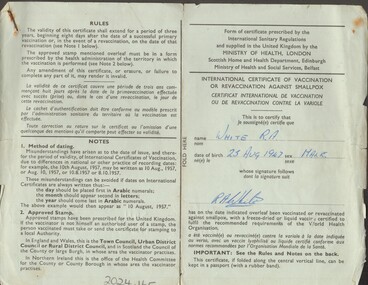 National Vietnam Veterans Museum (NVVM)
Certificate - Vaccination Certificates
... Issued by Ministry of Health - London International Certificate of Vaccination against Smallpox - R.A.White 25/8/1947 International Certificate of Vaccination against Yellow Fever - R.A.White 25/8/1947 International Certificate of Vaccination against Cholera - R.A.White 25/8/1947...Standard item as issued to Australian servicemen prior to travelling to Vietnam Vaccination Certificate Cholera Yellow Fever Smallpox R.A.White white Issued by Ministry of Health - London International Certificate of Vaccination against Smallpox - R.A.White 25/8/1947 International Certificate of Vaccination against Yellow Fever - R.A.White 25/8/1947 International Certificate of Vaccination against Cholera - R.A.White 25/8/1947 3 Vaccination Certificates Green - International Certificate of Vaccination against Smallpox - R.A.White 25/8/1947 Yellow - International Certificate of Vaccination against Yellow Fever - R.A.White 25/8/1947 Yellow - International Certificate of Vaccination against Cholera - R.A.White 25/8/1947 Certificate Vaccination Certificates ...Standard item as issued to Australian servicemen prior to travelling to Vietnam3 Vaccination Certificates Green - International Certificate of Vaccination against Smallpox - R.A.White 25/8/1947 Yellow - International Certificate of Vaccination against Yellow Fever - R.A.White 25/8/1947 Yellow - International Certificate of Vaccination against Cholera - R.A.White 25/8/1947Issued by Ministry of Health - London International Certificate of Vaccination against Smallpox - R.A.White 25/8/1947 International Certificate of Vaccination against Yellow Fever - R.A.White 25/8/1947 International Certificate of Vaccination against Cholera - R.A.White 25/8/1947vaccination certificate, cholera, yellow fever, smallpox, r.a.white, white -
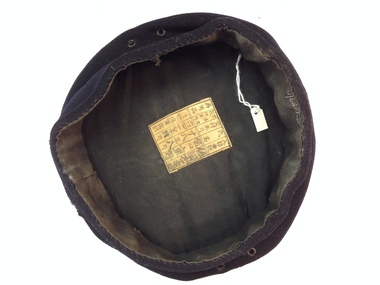 Geelong Naval and Maritime Museum
Hat, Imperial Japanese Navy, 1943
... The Japanese Ministry of Health, Labour and Welfare provided some information about Shigeyoshi Higuchi. ...The Japanese Ministry of Health, Labour and Welfare provided some information about Shigeyoshi Higuchi. ...The hat was picked up at sea by a German Sailor serving on the blockade runner RAMSES. It was giver to RAN sailor A. Tarr when HMAS Adelaide rescued survivors after the sinking of the RAMSES. The Japanese Ministry of Health, Labour and Welfare provided some information about Shigeyoshi Higuchi. He was a sailor but did not serve on a ship. After WWII, he returned safely home to his family.This hat is significant as a tangible connection to wartime service by Japanese sailor Shigeyoshi Higuchi.A dark blue circular velvet hat lined with black cotton on the inside with four studs. A square label with printed and hand written Japanese characters is attached to the underside of the hat.Part of the label has been translated from Japanese into English. It indicates the owner of the hat was Shigeyoshi Higuchi, who was based in Nagasaki Sasebo. His military number was (some kanji) and 1274. The hat was made in April 1943.japanese imperial navy, ramses, hmas adelaide, shigeyoshi higuchi, nagasaki sasebo -
 Broadmeadows Historical Society & Museum
Photograph, Mural, c 1987
... The project received funding from several sources, including the Ministry of Arts, the Community Arts Board, the Ministry of Housing, and Broadmeadows Health Services. This mural stands as a testament to the collaborative efforts of the community and various organisations in fostering a supportive and vibrant neighbourhood. ...The project received funding from several sources, including the Ministry of Arts, the Community Arts Board, the Ministry of Housing, and Broadmeadows Health Services. This mural stands as a testament to the collaborative efforts of the community and various organisations in fostering a supportive and vibrant neighbourhood. ...The photograph was published in the Broadmeadows Observer as part of an article highlighting community support initiatives. It features a mural located in the Banksia Gardens estate, which was painted by local residents. The project received funding from several sources, including the Ministry of Arts, the Community Arts Board, the Ministry of Housing, and Broadmeadows Health Services. This mural stands as a testament to the collaborative efforts of the community and various organisations in fostering a supportive and vibrant neighbourhood. The mural featured in the photograph, published in the Broadmeadows Observer, held significant cultural and community value. Located in the Banksia Gardens estate, this artwork was created by local residents and symbolised the collective spirit and creativity of the community. The project was made possible through the generous support of the Ministry of Arts, the Community Arts Board, the Ministry of Housing, and Broadmeadows Health Services. This mural not only enhanced the aesthetic appeal of the area but also served as a lasting testament to the power of community collaboration and the positive impact of public art initiatives.Black and white photograph on glossy photographic paper.Reduce/to/66%/P6.3/OBS/28-10-87banksia gardens estate, broadmeadows, broadmeadows observer, 1987 -
 Federation University Historical Collection
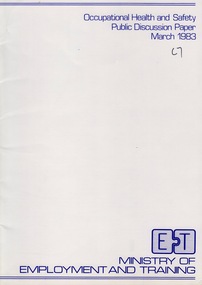
Document - Document - Course Outline, VIOSH: Ministry of Employment and Training; Occupational Health and Safety Public Discussion Paper, March 1983
... VIOSH: Ministry of Employment and Training; Occupational Health and Safety Public Discussion Paper, March 1983...health...ministry of employment and training...health and safety in Victoria. The Government intends involving workers and employers directly in developing new standards and practices. Submissions to be forwarded to the Ministry...Ministry on cover. Signature of Jim Simmonds, Minister; Mark Hennessy, Lincoln Institute of Health Sciences; Tom Norwood, Ballarat College of Advanced Education. ...Mark Hennessy comments that "a united approach might ensure rational decisions by government, beneficial to our mutually complimentary courses." . viosh victorian institute of occupational safety and health ministry of employment and training public discussion paper tom norwood mark hennessy jim simmonds workers employers ballarat college of advanced education lincoln institute of health sciences deakin university Emblem of Ministry on cover. ...Victorian Institute of Occupational Safety and Health (VIOSH) Australia is the Asia-Pacific centre for teaching and research in occupational health and safety (OHS) and is known as one of Australia's leaders on the field. VIOSH has a global reputation for its innovative approach within the field of OHS management. VIOSH had its first intake of students in 1979. At that time the Institution was known as the Ballarat College of Advanced Education. In 1990 it became known as Ballarat University College, then in 1994 as University of Ballarat. It was 2014 that it became Federation University. VIOSH Australia students are safety managers, senior advisors and experienced OHS professionals. They come from all over Australia and industry. Students are taught active research and enquiry; rather than textbook learning and a one-size fits all approach. VIOSH accepts people into the Graduate Diploma of Occupational Hazard Management who have no undergraduate degree - on the basis of extensive work experience and knowledge. The booklet sets out in detail the proposals for the implementation of Government policy on occupational health and safety. The objective is to improve standards of health and safety in Victoria. The Government intends involving workers and employers directly in developing new standards and practices. Submissions to be forwarded to the Ministry of Employment and Training by 20 May 1983. Responses from Tom Norwood of Ballarat College of Advanced Education and Mark Hennessy from Lincoln Institute of Health Sciences indicate what is already being done in courses available at Ballarat, Lincoln and Deakin. Mark Hennessy comments that "a united approach might ensure rational decisions by government, beneficial to our mutually complimentary courses." . Booklet - outlining proposals. Nine A4 pages - typedEmblem of Ministry on cover. Signature of Jim Simmonds, Minister; Mark Hennessy, Lincoln Institute of Health Sciences; Tom Norwood, Ballarat College of Advanced Education. Letterhead Ballarat BCAE and Lincoln Instituteviosh, victorian institute of occupational safety and health, ministry of employment and training, public discussion paper, tom norwood, mark hennessy, jim simmonds, workers, employers, ballarat college of advanced education, lincoln institute of health sciences, deakin university -
Federation University Historical Collection
Book - Book - Scrapbook, Ballarat College of Advanced Education: Scrapbook of newspaper cutting, Book 16; August 1985 to February 1986
... health...hospitality for tourists...high praise from professor...geoff bonney wins art prize...mural salutes agriculture...julie billsonwins national prize...new theatre company...bcae ahead in phys ed...meron mcdonald wins landragin award in graphic design...fitness testing scheme...piloted in ballarat...lloyd crump ceramics...nicole mayne honor...$1.2m expansion...department of nursing...department of human and social sciences...year of surging progress...dr ken hawkins...iain reid pints as he pilots...ministry...The cuttings cover the period from 24 August 1985 to 12 February 1986. . employment advertisements application for enrolment outline of courses ballarat college of advanced education bcae vicki nash winter exhibition 72 units for students 'merge but keep it loca' apprentice clowns apartheid may change soon dr john viljoen david addenbrooke dean faculty of arts bcae opens its doors top national art award julie billson alisin mauger senator don chip tax plan fairer base nursing head takes bcae post shirley ogden new and different photovoltaic panel david jirik social atlas of region launched doug wright exhibition student union debate deakin to reopen engineering standards and resources put to the test seminar on occupational health hospitality for tourists high praise from professor geoff bonney wins art prize mural salutes agriculture julie billsonwins national prize new theatre company bcae ahead in phys ed meron mcdonald wins landragin award in graphic design fitness testing scheme piloted in ballarat lloyd crump ceramics nicole mayne honor $1.2m expansion department of nursing department of human and social sciences year of surging progress dr ken hawkins iain reid pints as he pilots ministry causes resentment bcae cries 'unfair' librarian carolyn bray student housing Book with beige cover, front. ...Newspaper cuttings relating to Ballarat College of Advanced Education. These are from various newspapers and include The Age, Ballarat Courier, The Australian, The Herald. The cuttings cover the period from 24 August 1985 to 12 February 1986. . Book with beige cover, front. Spiral bound.employment advertisements, application for enrolment, outline of courses, ballarat college of advanced education, bcae, vicki nash, winter exhibition, 72 units for students, 'merge but keep it loca', apprentice clowns, apartheid may change soon, dr john viljoen, david addenbrooke, dean faculty of arts, bcae opens its doors, top national art award, julie billson, alisin mauger, senator don chip, tax plan fairer, base nursing head takes bcae post, shirley ogden, new and different, photovoltaic panel, david jirik, social atlas of region launched, doug wright exhibition, student union debate, deakin to reopen engineering, standards and resources put to the test, seminar on occupational health, hospitality for tourists, high praise from professor, geoff bonney wins art prize, mural salutes agriculture, julie billsonwins national prize, new theatre company, bcae ahead in phys ed, meron mcdonald wins landragin award in graphic design, fitness testing scheme, piloted in ballarat, lloyd crump ceramics, nicole mayne honor, $1.2m expansion, department of nursing, department of human and social sciences, year of surging progress, dr ken hawkins, iain reid pints as he pilots, ministry causes resentment, bcae cries 'unfair', librarian carolyn bray, student housing -
Federation University Historical Collection
Book - Book - Scrapbook, Ballarat School of MInes: Scrapbook of Newspaper Cuttings, Book 24, April 1985 to October 1985
... ministry of employment and training...forgotten hero is resurrected...baldwin spencer...barry hill...blackburn report on post-compulsory schooling...schools - what changes are needed...gifts for ballarat gardens...michael taffe presenting rose to smb...heritage roses in australia...courier 10/9/85...meri gracin smbfood services department...chokkie vegetable...learning the skills of hospitality...courier gardening seminar at smb...kevin heinze...smb redevelopment on target...eating their way to health...The papers concerned are The Courier, Ballarat, The Australian, The Age over the period of 8 April 1985 to 10 October 1985. teaching positions advertised pre-employment courses courses available industrial electrical engineers society trevor henderson wins award geoffrey blainey launches history of the school of mines wendouree tech high wins football six-day tree seminar at old ballarat east gardens ian duggan wins welding award smb facing big changes challenges writing workshops give pleasure ania walwicz - writer artist smb's famous head - r w richards antarctic hero dies - 92 jim bell head of engineering lee wallis head of plumbing and sheet metal ballarat council to replace statue of malcolm fraser staff farewelled captain moonlight slept here carpentary at smb will be moved dick richard's obituary hairdressing seminar flagstaff college of tafe smb kim odgers first woman - certificate of technology in surveying apprentices compete in work skill finals peter brown - carpentry ricky hains - engineering drawing craig haintz - fitting and turning lynn wheeler - hairdressing brendan mceldrew - fitter daryl edwards - electrical wiring phillip smith - construction steelworker dr murray gillan former smb student now dean - faculty of engineering - swinburne institute of technology tom walsh top farm apprentice for 1984 andrew gibbs top sheetmetal apprentice ballarat unique educational centre steven smith top motor mechanic for 1984 ricky hains selected fo skill olympics in japan lynne wheeler wins silver medal in hairdressing lynne kirkpatrick - most outstanding apprentice of 1985 lynne kirkpatrick - certificate of woolclassing david brown motor mechanic apprentice vacc award smb level one apprentice central highlands/wimmera regional tafe awards lynne kirkpatrick wool classer leigh gillbert building trade darrenhumphris automotive trades ian duggan metal trades peter flett electrical trades e j tippett resigns from smb council courses for young job-seekers $7 million project takes shape ballarat municipal observatory being restored breaking down more barriers disabled employment support smb grant for job training in modern office skills ricky hains receives smb's centenary medallion when centres for disabled will be redundant nursing aide girls' award jenny westin bronwyn fleming sharon rook leanne adams tracey foley tammy lench maxine cloks ministry for arts visit lydiard street closed between grant and dana streets dangers that lurk at work ministry of employment and training forgotten hero is resurrected baldwin spencer barry hill blackburn report on post-compulsory schooling schools - what changes are needed gifts for ballarat gardens michael taffe presenting rose to smb heritage roses in australia courier 10/9/85 meri gracin smbfood services department chokkie vegetable learning the skills of hospitality courier gardening seminar at smb kevin heinze smb redevelopment on target eating their way to health trevor mckenzie helen schaper steven marsden farmer lynne kirkpatrick outstanding silvana faulkner equal opportunities officer women try non-traditional jobs Book with beige cover, front, spiral bound. ...Collection of newspaper articles related to Ballarat School Of Mines.They cover activities and advertisements for staff. The papers concerned are The Courier, Ballarat, The Australian, The Age over the period of 8 April 1985 to 10 October 1985.Book with beige cover, front, spiral bound. teaching positions advertised, pre-employment courses, courses available, industrial electrical engineers society, trevor henderson wins award, geoffrey blainey launches history of the school of mines, wendouree tech high wins football, six-day tree seminar at old ballarat east gardens, ian duggan wins welding award, smb facing big changes, challenges, writing workshops give pleasure, ania walwicz - writer artist, smb's famous head - r w richards, antarctic hero dies - 92, jim bell head of engineering, lee wallis head of plumbing and sheet metal, ballarat council to replace statue of malcolm fraser, staff farewelled, captain moonlight slept here, carpentary at smb will be moved, dick richard's obituary, hairdressing seminar, flagstaff college of tafe, smb, kim odgers first woman - certificate of technology in surveying, apprentices compete in work skill finals, peter brown - carpentry, ricky hains - engineering drawing, craig haintz - fitting and turning, lynn wheeler - hairdressing, brendan mceldrew - fitter, daryl edwards - electrical wiring, phillip smith - construction steelworker, dr murray gillan, former smb student now dean - faculty of engineering - swinburne institute of technology, tom walsh top farm apprentice for 1984, andrew gibbs top sheetmetal apprentice, ballarat unique educational centre, steven smith top motor mechanic for 1984, ricky hains selected fo skill olympics in japan, lynne wheeler wins silver medal in hairdressing, lynne kirkpatrick - most outstanding apprentice of 1985, lynne kirkpatrick - certificate of woolclassing, david brown motor mechanic apprentice, vacc award smb level one apprentice, central highlands/wimmera regional tafe awards, lynne kirkpatrick, wool classer, leigh gillbert building trade, darrenhumphris automotive trades, ian duggan metal trades, peter flett electrical trades, e j tippett resigns from smb council, courses for young job-seekers, $7 million project takes shape, ballarat municipal observatory being restored, breaking down more barriers, disabled employment support, smb grant for job training in modern office skills, ricky hains receives smb's centenary medallion, when centres for disabled will be redundant, nursing aide girls' award, jenny westin, bronwyn fleming, sharon rook, leanne adams, tracey foley, tammy lench, maxine cloks, ministry for arts visit, lydiard street closed between grant and dana streets, dangers that lurk at work, ministry of employment and training, forgotten hero is resurrected, baldwin spencer, barry hill, blackburn report on post-compulsory schooling, schools - what changes are needed, gifts for ballarat gardens, michael taffe presenting rose to smb, heritage roses in australia, courier 10/9/85, meri gracin smbfood services department, chokkie vegetable, learning the skills of hospitality, courier gardening seminar at smb, kevin heinze, smb redevelopment on target, eating their way to health, trevor mckenzie, helen schaper, steven marsden, farmer lynne kirkpatrick outstanding, silvana faulkner equal opportunities officer, women try non-traditional jobs -
 Federation University Historical Collection
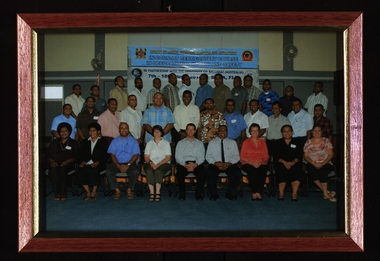
Photograph - Photograph - Colour, VIOSH - Certificate in Occupational and Safety Fiji, c2010, c2010
... health...fiji ministry of labour, industrial relations and employment...VIOSH accepts people into the Graduate Diploma of Occupational Hazard Management who have no undergraduate degree – on the basis of extensive work experience and knowledge. viosh viosh australia victorian institute of occupational safety and health fiji ministry of labour, industrial relations and employment university of ballarat steve cowley ocupational health and safety Brown timber framed photograph of VIOSH students in Fiji. ...Victorian Institute of Occupational Safety and Health (VIOSH) Australia is the Asia-Pacific centre for teaching and research in occupational health and safety (OHS) and is known as one of Australia's leaders in the field. VIOSH has a global reputation for its innovative approach within the field of OHS management. Federation University VIOSH Australia students are safety managers, senior advisors and experienced OHS professionals. They come from all over Australia and industry. Students are taught active research and enquiry; rather than textbook learning and a one-size fits all approach. VIOSH accepts people into the Graduate Diploma of Occupational Hazard Management who have no undergraduate degree – on the basis of extensive work experience and knowledge.Brown timber framed photograph of VIOSH students in Fiji. The banner behind the students includes the University of Ballarat with logo and Fiji Ministry of Labour, Industrial Relations and Employment. viosh, viosh australia, victorian institute of occupational safety and health, fiji ministry of labour, industrial relations and employment, university of ballarat, steve cowley, ocupational health and safety -
 Flagstaff Hill Maritime Museum and Village
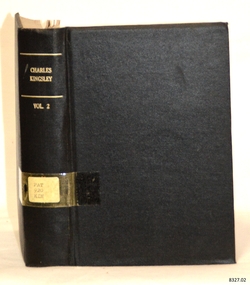
Book - Letters/Journals, Charles Kingsley, Charles Kingsley: His Letters and Memories of His Life Vol 2, 1879
... health reform initiatives. Essentially, Volume 1 gives you the making of the man, while Volume 2 gives you the peak of his power, his most famous public clashes, and his eventual death. The publisher Charles Kegan Paul (1828–1902) was an author, intellectual and former Anglican clergyman. Having grown disillusioned with the Church of England, he left the ministry...health reform initiatives. Essentially, Volume 1 gives you the making of the man, while Volume 2 gives you the peak of his power, his most famous public clashes, and his eventual death. The publisher Charles Kegan Paul (1828–1902) was an author, intellectual and former Anglican clergyman. Having grown disillusioned with the Church of England, he left the ministry ...While Volume 1 introduces Charles Kingsley’s early development and his explosive rise as a radical social reformer, Volume 2 pivots to his mature years as an established public figure. It focuses on his high-profile intellectual battles and his global travels. The transition from Volume 1 to Volume 2 charts a shift from a young, controversial outsider to a celebrated, busy member of the Victorian elite. Volume 1 covers his early life from 1819 to 1856, while Volume 2 spans the years between 1857 and 1875. It documents his mature family life, his appointment as Royal Chaplain to Queen Victoria, his tenure as a professor of Modern History at Cambridge, and his time as Canon of Westminster. It was during these later years that his children's classic, The Water-Babies (1863), and his late historical fiction were published.Charles Kingsley: His Letters and Memories of His Life Vol 2 Author: Charles Kingsley Edited by his wife ( Frances "Fanny" Grenfell) Publisher: C Kegan Paul & Co Date: 1879 Further Information: Sixth Abridged Editionnon-fictionWhile Volume 1 introduces Charles Kingsley’s early development and his explosive rise as a radical social reformer, Volume 2 pivots to his mature years as an established public figure. It focuses on his high-profile intellectual battles and his global travels. The transition from Volume 1 to Volume 2 charts a shift from a young, controversial outsider to a celebrated, busy member of the Victorian elite. Volume 1 covers his early life from 1819 to 1856, while Volume 2 spans the years between 1857 and 1875. It documents his mature family life, his appointment as Royal Chaplain to Queen Victoria, his tenure as a professor of Modern History at Cambridge, and his time as Canon of Westminster. It was during these later years that his children's classic, The Water-Babies (1863), and his late historical fiction were published.flagstaff hill, warrnambool, shipwrecked coast, flagstaff hill maritime museum, maritime museum, shipwreck coast, flagstaff hill maritime village, great ocean road, book, pattison collection, warrnambool library, warrnambool mechanics’ institute, ralph eric pattison, corangamite regional library service, warrnambool city librarian, mechanics’ institute library, victorian library board, warrnambool books and records, warrnambool children’s library, charles kingsley: his letters and memories of his life vol 1, frances "fanny" grenfell, mrs kingsley -
 Flagstaff Hill Maritime Museum and Village
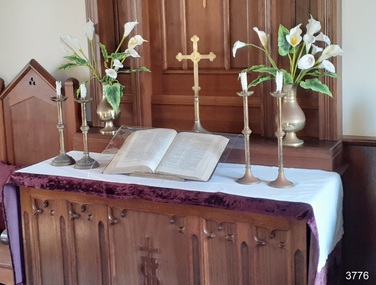
Textile - Altar Cloth
... John Ashley, who, 20 years earlier, had pioneered a ministry to seafarers in the Bristol Channel in Great Britain. When Ashley retired because of ill health, others determined that the work should continue, and they founded the Missions to Seamen. ...John Ashley, who, 20 years earlier, had pioneered a ministry to seafarers in the Bristol Channel in Great Britain. When Ashley retired because of ill health, others determined that the work should continue, and they founded the Missions to Seamen. ...This altar cloth represents ecclesiastical linen used in the early to mid-20th century. It is used on the altar in the Chapel of St Nicholas Seamen's Church at Flagstaff Hill Maritime Museum and Village. The Missions to Seamen organisation The Missions to Seamen is an Anglican (Church of England) charity that has been serving the world's seafarers since 1856. It was inspired by the work of Rev. John Ashley, who, 20 years earlier, had pioneered a ministry to seafarers in the Bristol Channel in Great Britain. When Ashley retired because of ill health, others determined that the work should continue, and they founded the Missions to Seamen. It adopted as its symbol a Flying Angel, inspired by a verse from Revelation 14 in the Bible. Today, there are over 200 ports worldwide where the Missions to Seamen has centres and chaplains. A Missions to Seamen’s Club offers a warm welcome to sailors of all colours, creeds and races. A sailor can watch television, have a drink and a chat, change money or buy goods from the club shop or worship in the Chapel. In Victoria, the Missions to Seamen still has clubs in Melbourne, Portland and Geelong. The altar cloth represents ecclesiastical linen used in the early to mid-20th century, when the original St Nicholas Seamen's Church was opened in Williamstown, Victoria. Altar cloth: simple white linen cloth, long rectangle shape with wide hems.flagstaff hill, warrnambool, shipwrecked coast, flagstaff hill maritime museum, maritime museum, shipwreck coast, flagstaff hill maritime village, great ocean road, religion, religious service, st nicholas seamen’s church flagstaff hill, altar cloth, church linen, ecclesiastical linen -
 Mission to Seafarers Victoria
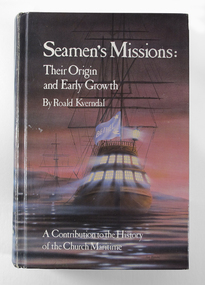
Book, Roald Kverndal, Seamen's Missions: Their origin and Early Growth. A contribution to the History of the Church Maritime, 1986
... The Melbourne Mission is mentioned on page 380. merchant seamen missions and charities royal navy chaplains missions-to-seamen mission to seafarers Roald Kverndal bethel welfare shangaing crimping health This book will long stand as the foundational study of church missions and ministry to men and women of the sea. ...This book will long stand as the foundational study of church missions and ministry to men and women of the sea. International in scope, it covers in detail the efforts, particularly during the past two centuries, to serve the spiritual and moral needs of seafarers. The author, himself a former seafarer and seafarers' chaplain, spent more than fifteen years of painstaking research to compile this fascinating and authoritative book.Hardback cover book with white Title (see above) and author text, KVERNDAL, Roald, on pink grey cover. pp 903, ills. Cover image depicts a masted galleon ship at anchor with interior lights at dusk or dawn flying from the stern of the ship is the blue BETHEL flag featuring a star and dove of peace in top and lwr corners respectively. xxviii, 903 p. : ill. ; 24 cmnon-fictionThis book will long stand as the foundational study of church missions and ministry to men and women of the sea. International in scope, it covers in detail the efforts, particularly during the past two centuries, to serve the spiritual and moral needs of seafarers. The author, himself a former seafarer and seafarers' chaplain, spent more than fifteen years of painstaking research to compile this fascinating and authoritative book.merchant seamen, missions and charities, royal navy chaplains, missions-to-seamen, mission to seafarers, roald kverndal, bethel, welfare, shangaing, crimping, health -
 National Vietnam Veterans Museum (NVVM)
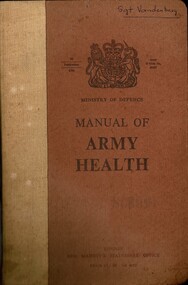
Booklet, British Army, Ministry of Defece Manual of Army Health
... Ministry of Defece Manual of Army Health...Health Sgt Vandenberg A brown coloured cove with black writing. The British Insignai is in the middle of the cover. At the top right hand corner is the name o Sgt. Wandenberg written in black ink. The booklet is bound with a light brown tape. Ministry ...A brown coloured cove with black writing. The British Insignai is in the middle of the cover. At the top right hand corner is the name o Sgt. Wandenberg written in black ink. The booklet is bound with a light brown tape.british armed forces - service manuals, medical, army health, sgt vandenberg -
 Uniting Church Archives - Synod of Victoria
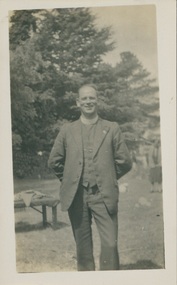
Photograph, Rev. Ron Albiston, Undated c.1940s
... His ministry was exercised in Northcote/Clifton Hill (1942–45), Yarrawonga and associated district (1945–50), Ballarat Dawson Street and "Zion" Sebastopol (1950–68), and Rockdale Congregational, Sydney, later Uniting (1968–83). Due to ill health...His ministry was exercised in Northcote/Clifton Hill (1942–45), Yarrawonga and associated district (1945–50), Ballarat Dawson Street and "Zion" Sebastopol (1950–68), and Rockdale Congregational, Sydney, later Uniting (1968–83). Due to ill health ...The Rev. Ronald W Albiston 28/9/1919–16/08/2006 was educated at Melbourne Boys' High School, the Victorian Congregational College and the University of Melbourne. From a young age he held positions within the local church, was secretary of the East Kew Congregational Church at the age of 16, as well as superintendent of the Sunday School from the age of 15. Ron was supported during his life and ministry by his wife of 63 years, Dorothy. He was ordained at Northcote Congregational Church on 21 December 1942. His ministry was exercised in Northcote/Clifton Hill (1942–45), Yarrawonga and associated district (1945–50), Ballarat Dawson Street and "Zion" Sebastopol (1950–68), and Rockdale Congregational, Sydney, later Uniting (1968–83). Due to ill health, Ron retired on the 30th of April 1983. He was President of the Australian Council of Churches from 1971 to 1973, President of the Congregational Union of NSW from 1973 to 1975. As a member of the Joint Planning Committee he was involved in the development of the Uniting Church and inaugural Chairperson. Following union, he was a member and later Chairman of the Board of Social Responsibility. He was instrumental in founding the Mayflower Village for the Aged, the Rockdale Community Aid Service, and helped form the St George Community Conference.The Rev. Ronald W Albiston 28/9/1919–16/08/2006 was educated at Melbourne Boys' High School, the Victorian Congregational College and the University of Melbourne. From a young age he held positions within the local church, was secretary of the East Kew Congregational Church at the age of 16, as well as superintendent of the Sunday School from the age of 15. Ron was supported during his life and ministry by his wife of 63 years, Dorothy. He was ordained at Northcote Congregational Church on 21 December 1942. His ministry was exercised in Northcote/Clifton Hill (1942–45), Yarrawonga and associated district (1945–50), Ballarat Dawson Street and "Zion" Sebastopol (1950–68), and Rockdale Congregational, Sydney, later Uniting (1968–83). Due to ill health, Ron retired on the 30th of April 1983. He was President of the Australian Council of Churches from 1971 to 1973, President of the Congregational Union of NSW from 1973 to 1975. As a member of the Joint Planning Committee he was involved in the development of the Uniting Church and inaugural Chairperson. Following union, he was a member and later Chairman of the Board of Social Responsibility. He was instrumental in founding the Mayflower Village for the Aged, the Rockdale Community Aid Service, and helped form the St George Community Conference.The Rev. Ronald W Albiston 28/9/1919–16/08/2006 was educated at Melbourne Boys' High School, the Victorian Congregational College and the University of Melbourne. From a young age he held positions within the local church, was secretary of the East Kew Congregational Church at the age of 16, as well as superintendent of the Sunday School from the age of 15. Ron was supported during his life and ministry by his wife of 63 years, Dorothy. He was ordained at Northcote Congregational Church on 21 December 1942. His ministry was exercised in Northcote/Clifton Hill (1942–45), Yarrawonga and associated district (1945–50), Ballarat Dawson Street and "Zion" Sebastopol (1950–68), and Rockdale Congregational, Sydney, later Uniting (1968–83). Due to ill health, Ron retired on the 30th of April 1983. He was President of the Australian Council of Churches from 1971 to 1973, President of the Congregational Union of NSW from 1973 to 1975. As a member of the Joint Planning Committee he was involved in the development of the Uniting Church and inaugural Chairperson. Following union, he was a member and later Chairman of the Board of Social Responsibility. He was instrumental in founding the Mayflower Village for the Aged, the Rockdale Community Aid Service, and helped form the St George Community Conference.Informal B & W photo of the Rev. Ron Albiston. Albiston is standing, hands clasped behind back, smiling into the camera. He's dressed in a suit with clerical collar and waistcoat. The photo has been taken outdoors, possibly at a picnic."Rev. Ron Albiston"albiston, ron, congregational minister -
 Uniting Church Archives - Synod of Victoria
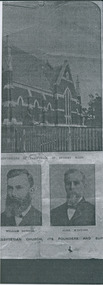
Photograph, Parkville Presbyterian Church, Undated
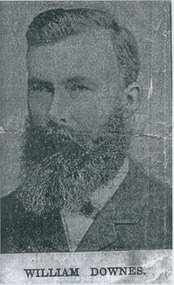
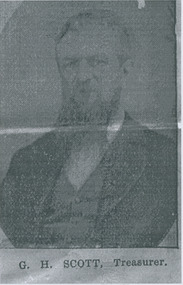
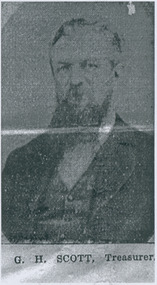
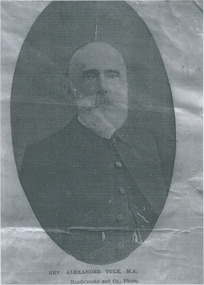
... health, and that his illness had gradually become more serious, but few among the intimate friends of the family thought the end was so near. Although Mr. Yule suffered much physical weakness, his mental faculties were unimpaired, and he was able to carry on his ministerial work almost to the last. He even conducted the services at the College Church, Parkville, on Sunday, March 31. Testimony is borne that his ministry...health, and that his illness had gradually become more serious, but few among the intimate friends of the family thought the end was so near. Although Mr. Yule suffered much physical weakness, his mental faculties were unimpaired, and he was able to carry on his ministerial work almost to the last. He even conducted the services at the College Church, Parkville, on Sunday, March 31. Testimony is borne that his ministry ...The College Church congregation initially worshipped in Ormond College in 1891. In 1895 they purchased the site of the present building. A committee set out certain specifications (including the crown tower), and a competition for the best design was won by architect RA Lawson. The building, constructed by Lang Brothers of Parkville at a cost of 2,170 pounds, was opened in 1898. College Church remained the only parish church in Parkville until 1934. The outstanding element is the crown tower, a choice of the first minister, the Reverend Alexander Yule. It is a copy, albeit on a reduced scale, of King's College Chapel, Aberdeen University, of which Reverend Yule was a former student. This crown tower is the only example in Victoria and is possibly unique in Australia. The church is constructed of red brick and Oamaru sandstone with a steeply pitched slate roof and parapeted gables. Windows are in the Gothic pointed arch style. The interior of the Church has a fine timber ceiling with arch braces. There are a number of quality stained glass windows, the two largest being dedicated to Mungo Scott and his wife, Scott having been a benefactor of the Church. The late nineteenth century pipe organ was built by George Fincham and Son (Richmond), with Professor Franklin Peterson as consultant, and was completed in November 1903. In the 1940s College Church was internally re-ordered and this work was designed by prominent church architect, Louis Williams. The church became part of the Uniting Church in Australia in 1977, and ownership subsequently passed to Mar Thoma Syrian Church in 2008. From The Argus, Friday 19 April 1907: Rev. Alexander Yule washeld in highest esteem in his ministerialbrethren and a large circle of friends was abundanrly evident by the expressions ofsorrowful regret at his death and of sympathy with his widow and her three sonsby those who attended the funeral servicesyesterday morning. To most of those present the announcement of Mr. Yule's death, made in "The Argus" on Wednesday, came as a painful surprise. It was known that at the time of his ministerial jubilee last January he shown symptoms of failing health, and that his illness had gradually become more serious, but few among the intimate friends of the family thought the end was so near. Although Mr. Yule suffered much physical weakness, his mental faculties were unimpaired, and he was able to carry on his ministerial work almost to the last. He even conducted the services at the College Church, Parkville, on Sunday, March 31. Testimony is borne that his ministry was appreciated most highly by the important congregations, both in Scotland and Victoria, under his charge; that in the church courts he was a safe and wise counsellor; and that he did excellent service on various committees, and as the convenor of the Theological-hall committee, on which he was appointed by the General Assembly. The esteem in which he was regarded by the Presbyterian Church as a whole was expressed in his election in 1891 to the Moderator's chair of the Victorian Church, and to that of the Federal Assembly in 1901. The funeral service was held at College Church, the scene of Mr. Yule's ministry since 1891. The building was filled to overflowing by a congregation that included most of the members of the metropolitan presbyteries, representatives from several of the provincial presbyterues, the students of the Theological-hall, members of the Parkville congregation, and the children of Miss Sutherland's Home. The pulpit and furniture were draped in black, and the plain oak coffin rested on the communion-table. The simple yet impressive service usual with the Presbyterian Church was conducted by Professor Rentoul, president of the Theological-hall Senatus, who was assisted by Professor Skene, Rev. W. Fraser (moderator of the Melbourne North Presbytery), Rev. D. S. McEacharn, and the Rev. John Thomson, a life-long friend of the departed minister. The Dead March in "Saul" was played on the organ as the coffin was borne to the hearse. The procession along Parkville-crescent to the cemetery gates was a notable one, and in the following order:—Theological-hall students; the hearse; the chief mourners—Dr. Yule, Rev. A. Yule, Mr. James Yule, and Mr. Groom, M.H.R., a relative of the family; the Theological-hall professors and committee; members of the presbyteries; and other friends, making a large and repre-sentative gathering. At the grave Professor Rentoul, Rev. Dr. Meiklejohn, Rev. D. Ross, and the Rev. Dr. Marshall officiated. The pall-bearers were Revs. D. S. McEachran, J. Thomson, A. McDonald, R. J. Smith,Mr. P. McLennan and Mr. L. E. Groom, M.H.R. The funeral arrangement were in the hands of Mr. Josiah Holdsworth.Portion of photocopy of the church and two of the portraits.college church, presbyterian church, yule, rev. alexander -
 Uniting Church Archives - Synod of Victoria
Photograph, Parkville Presbyterian Church, Undated
... health, and that his illness had gradually become more serious, but few among the intimate friends of the family thought the end was so near. Although Mr. Yule suffered much physical weakness, his mental faculties were unimpaired, and he was able to carry on his ministerial work almost to the last. He even conducted the services at the College Church, Parkville, on Sunday, March 31. Testimony is borne that his ministry...health, and that his illness had gradually become more serious, but few among the intimate friends of the family thought the end was so near. Although Mr. Yule suffered much physical weakness, his mental faculties were unimpaired, and he was able to carry on his ministerial work almost to the last. He even conducted the services at the College Church, Parkville, on Sunday, March 31. Testimony is borne that his ministry ...The College Church congregation initially worshipped in Ormond College in 1891. In 1895 they purchased the site of the present building. A committee set out certain specifications (including the crown tower), and a competition for the best design was won by architect RA Lawson. The building, constructed by Lang Brothers of Parkville at a cost of 2,170 pounds, was opened in 1898. College Church remained the only parish church in Parkville until 1934. The outstanding element is the crown tower, a choice of the first minister, the Reverend Alexander Yule. It is a copy, albeit on a reduced scale, of King's College Chapel, Aberdeen University, of which Reverend Yule was a former student. This crown tower is the only example in Victoria and is possibly unique in Australia. The church is constructed of red brick and Oamaru sandstone with a steeply pitched slate roof and parapeted gables. Windows are in the Gothic pointed arch style. The interior of the Church has a fine timber ceiling with arch braces. There are a number of quality stained glass windows, the two largest being dedicated to Mungo Scott and his wife, Scott having been a benefactor of the Church. The late nineteenth century pipe organ was built by George Fincham and Son (Richmond), with Professor Franklin Peterson as consultant, and was completed in November 1903. In the 1940s College Church was internally re-ordered and this work was designed by prominent church architect, Louis Williams. The church became part of the Uniting Church in Australia in 1977, and ownership subsequently passed to Mar Thoma Syrian Church in 2008. From The Argus, Friday 19 April 1907: Rev. Alexander Yule washeld in highest esteem in his ministerialbrethren and a large circle of friends was abundanrly evident by the expressions ofsorrowful regret at his death and of sympathy with his widow and her three sonsby those who attended the funeral servicesyesterday morning. To most of those present the announcement of Mr. Yule's death, made in "The Argus" on Wednesday, came as a painful surprise. It was known that at the time of his ministerial jubilee last January he shown symptoms of failing health, and that his illness had gradually become more serious, but few among the intimate friends of the family thought the end was so near. Although Mr. Yule suffered much physical weakness, his mental faculties were unimpaired, and he was able to carry on his ministerial work almost to the last. He even conducted the services at the College Church, Parkville, on Sunday, March 31. Testimony is borne that his ministry was appreciated most highly by the important congregations, both in Scotland and Victoria, under his charge; that in the church courts he was a safe and wise counsellor; and that he did excellent service on various committees, and as the convenor of the Theological-hall committee, on which he was appointed by the General Assembly. The esteem in which he was regarded by the Presbyterian Church as a whole was expressed in his election in 1891 to the Moderator's chair of the Victorian Church, and to that of the Federal Assembly in 1901. The funeral service was held at College Church, the scene of Mr. Yule's ministry since 1891. The building was filled to overflowing by a congregation that included most of the members of the metropolitan presbyteries, representatives from several of the provincial presbyterues, the students of the Theological-hall, members of the Parkville congregation, and the children of Miss Sutherland's Home. The pulpit and furniture were draped in black, and the plain oak coffin rested on the communion-table. The simple yet impressive service usual with the Presbyterian Church was conducted by Professor Rentoul, president of the Theological-hall Senatus, who was assisted by Professor Skene, Rev. W. Fraser (moderator of the Melbourne North Presbytery), Rev. D. S. McEacharn, and the Rev. John Thomson, a life-long friend of the departed minister. The Dead March in "Saul" was played on the organ as the coffin was borne to the hearse. The procession along Parkville-crescent to the cemetery gates was a notable one, and in the following order:—Theological-hall students; the hearse; the chief mourners—Dr. Yule, Rev. A. Yule, Mr. James Yule, and Mr. Groom, M.H.R., a relative of the family; the Theological-hall professors and committee; members of the presbyteries; and other friends, making a large and repre-sentative gathering. At the grave Professor Rentoul, Rev. Dr. Meiklejohn, Rev. D. Ross, and the Rev. Dr. Marshall officiated. The pall-bearers were Revs. D. S. McEachran, J. Thomson, A. McDonald, R. J. Smith,Mr. P. McLennan and Mr. L. E. Groom, M.H.R. The funeral arrangement were in the hands of Mr. Josiah Holdsworth.William Downes - one of the founders.college church, presbyterian church, yule, rev. alexander -
 Uniting Church Archives - Synod of Victoria
Photograph, Parkville Presbyterian Church, Undated
... health, and that his illness had gradually become more serious, but few among the intimate friends of the family thought the end was so near. Although Mr. Yule suffered much physical weakness, his mental faculties were unimpaired, and he was able to carry on his ministerial work almost to the last. He even conducted the services at the College Church, Parkville, on Sunday, March 31. Testimony is borne that his ministry...health, and that his illness had gradually become more serious, but few among the intimate friends of the family thought the end was so near. Although Mr. Yule suffered much physical weakness, his mental faculties were unimpaired, and he was able to carry on his ministerial work almost to the last. He even conducted the services at the College Church, Parkville, on Sunday, March 31. Testimony is borne that his ministry ...The College Church congregation initially worshipped in Ormond College in 1891. In 1895 they purchased the site of the present building. A committee set out certain specifications (including the crown tower), and a competition for the best design was won by architect RA Lawson. The building, constructed by Lang Brothers of Parkville at a cost of 2,170 pounds, was opened in 1898. College Church remained the only parish church in Parkville until 1934. The outstanding element is the crown tower, a choice of the first minister, the Reverend Alexander Yule. It is a copy, albeit on a reduced scale, of King's College Chapel, Aberdeen University, of which Reverend Yule was a former student. This crown tower is the only example in Victoria and is possibly unique in Australia. The church is constructed of red brick and Oamaru sandstone with a steeply pitched slate roof and parapeted gables. Windows are in the Gothic pointed arch style. The interior of the Church has a fine timber ceiling with arch braces. There are a number of quality stained glass windows, the two largest being dedicated to Mungo Scott and his wife, Scott having been a benefactor of the Church. The late nineteenth century pipe organ was built by George Fincham and Son (Richmond), with Professor Franklin Peterson as consultant, and was completed in November 1903. In the 1940s College Church was internally re-ordered and this work was designed by prominent church architect, Louis Williams. The church became part of the Uniting Church in Australia in 1977, and ownership subsequently passed to Mar Thoma Syrian Church in 2008. From The Argus, Friday 19 April 1907: Rev. Alexander Yule washeld in highest esteem in his ministerialbrethren and a large circle of friends was abundanrly evident by the expressions ofsorrowful regret at his death and of sympathy with his widow and her three sonsby those who attended the funeral servicesyesterday morning. To most of those present the announcement of Mr. Yule's death, made in "The Argus" on Wednesday, came as a painful surprise. It was known that at the time of his ministerial jubilee last January he shown symptoms of failing health, and that his illness had gradually become more serious, but few among the intimate friends of the family thought the end was so near. Although Mr. Yule suffered much physical weakness, his mental faculties were unimpaired, and he was able to carry on his ministerial work almost to the last. He even conducted the services at the College Church, Parkville, on Sunday, March 31. Testimony is borne that his ministry was appreciated most highly by the important congregations, both in Scotland and Victoria, under his charge; that in the church courts he was a safe and wise counsellor; and that he did excellent service on various committees, and as the convenor of the Theological-hall committee, on which he was appointed by the General Assembly. The esteem in which he was regarded by the Presbyterian Church as a whole was expressed in his election in 1891 to the Moderator's chair of the Victorian Church, and to that of the Federal Assembly in 1901. The funeral service was held at College Church, the scene of Mr. Yule's ministry since 1891. The building was filled to overflowing by a congregation that included most of the members of the metropolitan presbyteries, representatives from several of the provincial presbyterues, the students of the Theological-hall, members of the Parkville congregation, and the children of Miss Sutherland's Home. The pulpit and furniture were draped in black, and the plain oak coffin rested on the communion-table. The simple yet impressive service usual with the Presbyterian Church was conducted by Professor Rentoul, president of the Theological-hall Senatus, who was assisted by Professor Skene, Rev. W. Fraser (moderator of the Melbourne North Presbytery), Rev. D. S. McEacharn, and the Rev. John Thomson, a life-long friend of the departed minister. The Dead March in "Saul" was played on the organ as the coffin was borne to the hearse. The procession along Parkville-crescent to the cemetery gates was a notable one, and in the following order:—Theological-hall students; the hearse; the chief mourners—Dr. Yule, Rev. A. Yule, Mr. James Yule, and Mr. Groom, M.H.R., a relative of the family; the Theological-hall professors and committee; members of the presbyteries; and other friends, making a large and repre-sentative gathering. At the grave Professor Rentoul, Rev. Dr. Meiklejohn, Rev. D. Ross, and the Rev. Dr. Marshall officiated. The pall-bearers were Revs. D. S. McEachran, J. Thomson, A. McDonald, R. J. Smith,Mr. P. McLennan and Mr. L. E. Groom, M.H.R. The funeral arrangement were in the hands of Mr. Josiah Holdsworth.G. H. Scott - Treasurer.college church, presbyterian church, yule, rev. alexander -
 Uniting Church Archives - Synod of Victoria
Photograph, Parkville Presbyterian Church, Undated
... health, and that his illness had gradually become more serious, but few among the intimate friends of the family thought the end was so near. Although Mr. Yule suffered much physical weakness, his mental faculties were unimpaired, and he was able to carry on his ministerial work almost to the last. He even conducted the services at the College Church, Parkville, on Sunday, March 31. Testimony is borne that his ministry...health, and that his illness had gradually become more serious, but few among the intimate friends of the family thought the end was so near. Although Mr. Yule suffered much physical weakness, his mental faculties were unimpaired, and he was able to carry on his ministerial work almost to the last. He even conducted the services at the College Church, Parkville, on Sunday, March 31. Testimony is borne that his ministry ...The College Church congregation initially worshipped in Ormond College in 1891. In 1895 they purchased the site of the present building. A committee set out certain specifications (including the crown tower), and a competition for the best design was won by architect RA Lawson. The building, constructed by Lang Brothers of Parkville at a cost of 2,170 pounds, was opened in 1898. College Church remained the only parish church in Parkville until 1934. The outstanding element is the crown tower, a choice of the first minister, the Reverend Alexander Yule. It is a copy, albeit on a reduced scale, of King's College Chapel, Aberdeen University, of which Reverend Yule was a former student. This crown tower is the only example in Victoria and is possibly unique in Australia. The church is constructed of red brick and Oamaru sandstone with a steeply pitched slate roof and parapeted gables. Windows are in the Gothic pointed arch style. The interior of the Church has a fine timber ceiling with arch braces. There are a number of quality stained glass windows, the two largest being dedicated to Mungo Scott and his wife, Scott having been a benefactor of the Church. The late nineteenth century pipe organ was built by George Fincham and Son (Richmond), with Professor Franklin Peterson as consultant, and was completed in November 1903. In the 1940s College Church was internally re-ordered and this work was designed by prominent church architect, Louis Williams. The church became part of the Uniting Church in Australia in 1977, and ownership subsequently passed to Mar Thoma Syrian Church in 2008. From The Argus, Friday 19 April 1907: Rev. Alexander Yule washeld in highest esteem in his ministerialbrethren and a large circle of friends was abundanrly evident by the expressions ofsorrowful regret at his death and of sympathy with his widow and her three sonsby those who attended the funeral servicesyesterday morning. To most of those present the announcement of Mr. Yule's death, made in "The Argus" on Wednesday, came as a painful surprise. It was known that at the time of his ministerial jubilee last January he shown symptoms of failing health, and that his illness had gradually become more serious, but few among the intimate friends of the family thought the end was so near. Although Mr. Yule suffered much physical weakness, his mental faculties were unimpaired, and he was able to carry on his ministerial work almost to the last. He even conducted the services at the College Church, Parkville, on Sunday, March 31. Testimony is borne that his ministry was appreciated most highly by the important congregations, both in Scotland and Victoria, under his charge; that in the church courts he was a safe and wise counsellor; and that he did excellent service on various committees, and as the convenor of the Theological-hall committee, on which he was appointed by the General Assembly. The esteem in which he was regarded by the Presbyterian Church as a whole was expressed in his election in 1891 to the Moderator's chair of the Victorian Church, and to that of the Federal Assembly in 1901. The funeral service was held at College Church, the scene of Mr. Yule's ministry since 1891. The building was filled to overflowing by a congregation that included most of the members of the metropolitan presbyteries, representatives from several of the provincial presbyterues, the students of the Theological-hall, members of the Parkville congregation, and the children of Miss Sutherland's Home. The pulpit and furniture were draped in black, and the plain oak coffin rested on the communion-table. The simple yet impressive service usual with the Presbyterian Church was conducted by Professor Rentoul, president of the Theological-hall Senatus, who was assisted by Professor Skene, Rev. W. Fraser (moderator of the Melbourne North Presbytery), Rev. D. S. McEacharn, and the Rev. John Thomson, a life-long friend of the departed minister. The Dead March in "Saul" was played on the organ as the coffin was borne to the hearse. The procession along Parkville-crescent to the cemetery gates was a notable one, and in the following order:—Theological-hall students; the hearse; the chief mourners—Dr. Yule, Rev. A. Yule, Mr. James Yule, and Mr. Groom, M.H.R., a relative of the family; the Theological-hall professors and committee; members of the presbyteries; and other friends, making a large and repre-sentative gathering. At the grave Professor Rentoul, Rev. Dr. Meiklejohn, Rev. D. Ross, and the Rev. Dr. Marshall officiated. The pall-bearers were Revs. D. S. McEachran, J. Thomson, A. McDonald, R. J. Smith,Mr. P. McLennan and Mr. L. E. Groom, M.H.R. The funeral arrangement were in the hands of Mr. Josiah Holdsworth.G. H. Scott - Treasurer.college church, presbyterian church, yule, rev. alexander -
 Uniting Church Archives - Synod of Victoria
Photograph, Parkville Presbyterian Church, Undated
... health, and that his illness had gradually become more serious, but few among the intimate friends of the family thought the end was so near. Although Mr. Yule suffered much physical weakness, his mental faculties were unimpaired, and he was able to carry on his ministerial work almost to the last. He even conducted the services at the College Church, Parkville, on Sunday, March 31. Testimony is borne that his ministry...health, and that his illness had gradually become more serious, but few among the intimate friends of the family thought the end was so near. Although Mr. Yule suffered much physical weakness, his mental faculties were unimpaired, and he was able to carry on his ministerial work almost to the last. He even conducted the services at the College Church, Parkville, on Sunday, March 31. Testimony is borne that his ministry ...The College Church congregation initially worshipped in Ormond College in 1891. In 1895 they purchased the site of the present building. A committee set out certain specifications (including the crown tower), and a competition for the best design was won by architect RA Lawson. The building, constructed by Lang Brothers of Parkville at a cost of 2,170 pounds, was opened in 1898. College Church remained the only parish church in Parkville until 1934. The outstanding element is the crown tower, a choice of the first minister, the Reverend Alexander Yule. It is a copy, albeit on a reduced scale, of King's College Chapel, Aberdeen University, of which Reverend Yule was a former student. This crown tower is the only example in Victoria and is possibly unique in Australia. The church is constructed of red brick and Oamaru sandstone with a steeply pitched slate roof and parapeted gables. Windows are in the Gothic pointed arch style. The interior of the Church has a fine timber ceiling with arch braces. There are a number of quality stained glass windows, the two largest being dedicated to Mungo Scott and his wife, Scott having been a benefactor of the Church. The late nineteenth century pipe organ was built by George Fincham and Son (Richmond), with Professor Franklin Peterson as consultant, and was completed in November 1903. In the 1940s College Church was internally re-ordered and this work was designed by prominent church architect, Louis Williams. The church became part of the Uniting Church in Australia in 1977, and ownership subsequently passed to Mar Thoma Syrian Church in 2008. From The Argus, Friday 19 April 1907: Rev. Alexander Yule washeld in highest esteem in his ministerialbrethren and a large circle of friends was abundanrly evident by the expressions ofsorrowful regret at his death and of sympathy with his widow and her three sonsby those who attended the funeral servicesyesterday morning. To most of those present the announcement of Mr. Yule's death, made in "The Argus" on Wednesday, came as a painful surprise. It was known that at the time of his ministerial jubilee last January he shown symptoms of failing health, and that his illness had gradually become more serious, but few among the intimate friends of the family thought the end was so near. Although Mr. Yule suffered much physical weakness, his mental faculties were unimpaired, and he was able to carry on his ministerial work almost to the last. He even conducted the services at the College Church, Parkville, on Sunday, March 31. Testimony is borne that his ministry was appreciated most highly by the important congregations, both in Scotland and Victoria, under his charge; that in the church courts he was a safe and wise counsellor; and that he did excellent service on various committees, and as the convenor of the Theological-hall committee, on which he was appointed by the General Assembly. The esteem in which he was regarded by the Presbyterian Church as a whole was expressed in his election in 1891 to the Moderator's chair of the Victorian Church, and to that of the Federal Assembly in 1901. The funeral service was held at College Church, the scene of Mr. Yule's ministry since 1891. The building was filled to overflowing by a congregation that included most of the members of the metropolitan presbyteries, representatives from several of the provincial presbyterues, the students of the Theological-hall, members of the Parkville congregation, and the children of Miss Sutherland's Home. The pulpit and furniture were draped in black, and the plain oak coffin rested on the communion-table. The simple yet impressive service usual with the Presbyterian Church was conducted by Professor Rentoul, president of the Theological-hall Senatus, who was assisted by Professor Skene, Rev. W. Fraser (moderator of the Melbourne North Presbytery), Rev. D. S. McEacharn, and the Rev. John Thomson, a life-long friend of the departed minister. The Dead March in "Saul" was played on the organ as the coffin was borne to the hearse. The procession along Parkville-crescent to the cemetery gates was a notable one, and in the following order:—Theological-hall students; the hearse; the chief mourners—Dr. Yule, Rev. A. Yule, Mr. James Yule, and Mr. Groom, M.H.R., a relative of the family; the Theological-hall professors and committee; members of the presbyteries; and other friends, making a large and repre-sentative gathering. At the grave Professor Rentoul, Rev. Dr. Meiklejohn, Rev. D. Ross, and the Rev. Dr. Marshall officiated. The pall-bearers were Revs. D. S. McEachran, J. Thomson, A. McDonald, R. J. Smith,Mr. P. McLennan and Mr. L. E. Groom, M.H.R. The funeral arrangement were in the hands of Mr. Josiah Holdsworth.Rev. Alexander Yule M.A.Born 1830 - 1907.college church, presbyterian church, yule, rev. alexander -
 Uniting Church Archives - Synod of Victoria
BW photo, Undated
... Ministry was opened with three staff members, seventeen students, and the goodwill of the whole American Episcopal Church to win. During the next two years, the school took shape and was firmly established. Bp Stanway left an indelible stamp on every aspect of its life and work, its spiritual tone and ideals, its financial and administrative principles. He had inspired widespread support among evangelical episcopalians and had imparted a strong sense of divine guidance and purpose. The council would gladly have extended his term in office beyond three years, but at 75 years of age he knew that his health...Ministry was opened with three staff members, seventeen students, and the goodwill of the whole American Episcopal Church to win. During the next two years, the school took shape and was firmly established. Bp Stanway left an indelible stamp on every aspect of its life and work, its spiritual tone and ideals, its financial and administrative principles. He had inspired widespread support among evangelical episcopalians and had imparted a strong sense of divine guidance and purpose. The council would gladly have extended his term in office beyond three years, but at 75 years of age he knew that his health ...STANWAY, ALFRED (b. 9 Sept 1908; d. Melbourne, Vic, 27 June 1989). Anglican bishop, missionary. Stanway grew up in the Wimmera district of western Victoria, and left school when 14 years old. He found work in Melbourne, trained as an accountant, and at the age of 20, held a responsible position with a publishing company. This background, allied with an uncommon flair for figures and finance, was to stand him in good stead throughout his life. But he had little knowledge and no experience of the grace of God until 29 July 1928. At the Evening Service in the parish church of Fairfield on 29 July, he heard the Rev C H Nash (q.v.) preach a sermon which led to his conversion. Within two years he made up his mind to become a missionary and began night studies in order to matriculate. He entered Ridley College in March 1932 to prepare for ordination undertaking week-end duties as a catechist at Deer Park and St Albans. He joined the CMS League of Youth, became chairman, and gathered a fine band of young people many of whom were to become missionaries. He was closely involved with the Belgrave Heights Convention (then at Upwey) and established a League of Youth camp on the site. All his energies were thrown into the task of building up its members in personal holiness and vigorous evangelism. Stanway was ordained in St Paul's Cathedral, Melbourne on St Thomas Day 1934 and was placed in charge of the Old Mission Church of St James and St John, Melbourne. The duties were light enough to allow him to enrol in the Melbourne Teachers College and to complete the Diploma in Teaching. On 26 January 1937, he sailed for Africa to become a missionary in the Anglican Diocese of Mombasa, which at that time embraced the whole of Kenya. He was sent to the hot coastal town of Kaloleni as principal of a Secondary Boys School. Before he left Melbourne, he had become engaged to Marjory Harrison: she followed him to Africa and their marriage took place in Mombasa Cathedral in June 1939. He remained at Kaloleni until 1944 when he was transferred to the inland station of Maseno where all his gifts were to be deployed as rural dean of Nyanza. His oversight of some 500 village churches as well as a widespread primary school system was so efficient that in 1948 he was appointed archdeacon of Kenya with his home and office in Nairobi. As secretary of the African Church Council and of the African Education Board, he was responsible for all African work in the diocese. His contacts with government ministers and public servants were of first class significance at the time when the cry of Uhuru and the demand for independence was travelling throughout the colonial world. On 2 Feb 1951, Alfred Stanway was consecrated in Westminster Abbey as the third Anglican Bp of Central Tanganyika. This Diocese was the special sphere of the CMS Australia, and he already knew most of the missionary personnel. He brought with him the understanding and experience of one who had fully shared the lot and problems of a district missionary, but he came to the diocese at a time when it had yet to recover from its losses in personnel and finance as a result of the war. His immediate task was to provide the impetus of fresh leadership and a long-term overall policy. His aim from-the outset was to build up a strong autonomous church with its own indigenous pastorate. With the whole-hearted confidence of the home base, he was able to enlist the service of new missionaries. He saw a great increase in the number of African clergy and he encouraged village evangelists to open new fields of work. Simple structures were built as new churches at the rate of two a week, week in and week out, year by year. He worked hard to meet the need for Christian literature, bookshops, adult literacy and theological training. He opened Bible schools for village evangelists and sent suitable clergy overseas for further studies. He encouraged initiative in others, helped them to find and use their talents, and gave them his unstinted confidence and support. Fresh finance was required for new ventures. This led him to travel widely in Germany and America, where he raised large funds for these projects. Mackay House was built in Dodoma as the central administrative base for the diocese, hospitals such as those at Mvumi and Hombolo were modernised or established, schools were built and upgraded. In keeping with his vision for ultimate leadership by African personnel, he consecrated Yohana Omari in 1955 as his assistant, he was the first national to become a bp in East Africa. Bp Stanway then set on foot the long and complicated process for the division of his sprawling diocese. In 1963, the diocese of Victoria Nyanza came into being; in 1965, that of Morogoro; in 1966, that of Western Tanganyika. Yet in 1971, his own diocese of Central Tanganyika, though greatly reduced in size, had more churches and more clergy than in its undivided state in 195 l. Stanway then played a leading part in the formation of the Province of Tanzania in 1970, with an African abp as metropolitan. A year later, after 35 years in East Africa and 20 years as bishop of Central Tanganyika, he resigned. His leadership and achievements throughout those years had placed him in the front rank as a great missionary statesman. Stanway had returned to Melbourne at the time when his resignation took effect in August 1971. His early love for Ridley College reasserted itself and he went into residence as deputy principal under the Rev Dr Leon Morris. He was put in charge of chapel worship and the pastoral oversight of the students. All his gifts and experience were called into play as he sought to guide and encourage those who were on the threshold of their ministry. The whole bent of his heart was to foster the spiritual life and missionary calling of those whose hearts the Lord had touched. It was during those years that his life-long zeal for the spread of the gospel through Christian literature had its ultimate flowering. It had begun in his Nairobi days with a small church bookstall, this had developed into a major book-shop in the heart of the city. Then in Dodoma he had established the Central Tanganyika Press in order to promote the publication and distribution of Christian literature at all levels. He had marked out Kevin Engel, trained him, and launched him on the international scene. Hence it was natural that in Melbourne he and Kevin Engel should found the Australian Christian Literature Society. But his time at Ridley College was not to last. Unknown to him, the Rev J R W Stott had put his name forward as that of a person who could head a new school of theology in the United States to provide a sound training for evangelical ordinands. Such a task would have been formidable enough for a younger man who had grown up in America. How could an Australian who had spent half his life in Africa hope to succeed in a venture of that kind in America? How could one who had been a missionary, not a theologian, found a new school to train men for ordination? Nevertheless he rose to the challenge. In Sept 1975, he and Mrs Stanway left Melbourne for Sewickly, an outer suburb of Pittsburg, with the promise of three years' service. He had to start from scratch. He found a house to live in, but there was no land for the school, no funds in hand, no staff yet appointed, no students, and no buildings. His drive, his infections enthusiasm, and his flair for practical enterprise carried the day. One by one, obstacles were overcome and support grew in volume and strength. Twelve months after his arrival, in Sept 1976, the Trinity Episcopal School for Ministry was opened with three staff members, seventeen students, and the goodwill of the whole American Episcopal Church to win. During the next two years, the school took shape and was firmly established. Bp Stanway left an indelible stamp on every aspect of its life and work, its spiritual tone and ideals, its financial and administrative principles. He had inspired widespread support among evangelical episcopalians and had imparted a strong sense of divine guidance and purpose. The council would gladly have extended his term in office beyond three years, but at 75 years of age he knew that his health had begun to fail. When he finally relinquished his office in Nov 1978, he could look back on those three years as the crown of his ministry. It is not too much to say that his name was even more highly honoured and revered in the Trinity School of Ministry than in his own dearly loved Africa. His return to Melbourne led to quiet retirement at Mount Waverley where he settled down to a long battle with the ever worsening effects of Parkinson's Disease. The slow loss of physical capacity and the ultimate failure in powers of speech were a great trial, but he never complained. His faith was summed up in his brief reply when he was asked why he had not prayed for healing: 'What God allows, I accept'. That acceptance was without reserve; his testimony was never brighter. His mental powers were undiminished and his spiritual concerns were as wide as ever. He kept in touch with CMS, he went to church, he met with missionaries, he led Bible studies in his home as long as he was able. Africa was always in his heart, news from Sewickly always gave him great pleasure. He had left a mark for God on three great continents and his death left sad but thankful hearts in them all. It was the close of a life in which he had felt that he could never do enough for God who had done so much for him. One of Bp Stanway's sayings was 'when the Holy Spirit takes hold of you, anything can happen'. So it was in his case. He was very human, with his full share of human foibles and frailties. He had a great zest for life and an endless fund of stories drawn from his own experience. He was himself the subject of many stories, some true, others legendary. His vibrant personality always seemed to fill the house where he was, his presence could not be overlooked. His own home was one in which Mrs Stanway had a paramount influence. She was a trained teacher, a skilled artist, a born hostess and a first-class linguist. They had no children of their own, but were devoted Godparents and always deeply interested in the children of missionaries. Home life allowed him to relax in a serene and contented atmosphere and to exercise his gifts for friendship and hospitality. He was always on the watch for souls, a person-to-person evangelist par excellence. He was a man of faith and prayer who dared to believe in the God of the impossible. His love for Africa, his total dedication as a missionary; his gifts as a soulwinner; his genius for finance; his shrewd practical initiatives, and his statesmanlike vision were outstanding characteristics. But great or small, all his gifts were laid out in the service of the gospel, and that service marked him out as one of the most remarkable Australian missionaries of his generation. M L Loane, Men to Remember (Sydney, 1987) Rev. Alfred Stanway is standing with open book in hand, dressed in clerical garb.Bishop Alfred Stanwaybishop alfred stanway -
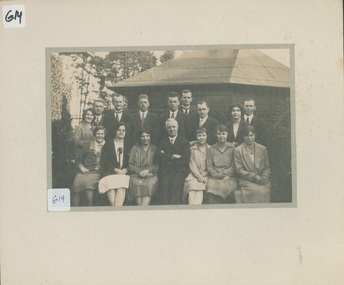 Uniting Church Archives - Synod of Victoria
photograph, c.1928
... ministry and was appointed to his first parish at Zeehan, Tasmania in 1927. He was called to serve with the Methodist Overseas Mission in New Britain and New Ireland in 1929. He married Dorothy Clarke just before he left. After four years in PNG he returned through ill-health...ministry and was appointed to his first parish at Zeehan, Tasmania in 1927. He was called to serve with the Methodist Overseas Mission in New Britain and New Ireland in 1929. He married Dorothy Clarke just before he left. After four years in PNG he returned through ill-health ...Alec Pederick was born in 1902 and left school at 15 to work on his parents' farm at Wyuna, Kyabrum,Victoria. After receiving a sense of call he trained for the Methodist ministry and was appointed to his first parish at Zeehan, Tasmania in 1927. He was called to serve with the Methodist Overseas Mission in New Britain and New Ireland in 1929. He married Dorothy Clarke just before he left. After four years in PNG he returned through ill-health to Victoria. He was appointed to the Beaufort Circuit in 1933 and then in 1936 to the Methodist Home Missions Department. He was called up as an Army chaplain in 1942 and sent on active service in Papua New Guinea. He was discharged in 1944 and returned to the Home Missions Department. He was appointed acting General Superintendent in 1944 and then General Superintendent in 1946, a position he held until 1962. He also served as Director of the Federal Methodist Inland Mission for a time. He died in 1972.B & W photograph of 16 men and women sitting and standing outdoors. Alec W. Pederick stands 3rd from the left in the back row. The group are probably students and staff of the George Brown Missionary College in Sydney. Photograph is mounted on grey card.alec pederick, methodist, minister, george brown college, zeehan, rabaul, dorothy clarke, methodist overseas mission, papua new guinea, army chaplain,, home missions, methodist inland mission -
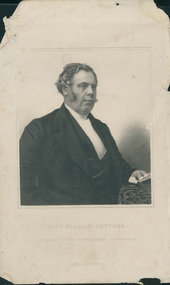 Uniting Church Archives - Synod of Victoria
Printed etching, Undated c.1858
... ministry in 1833 and sent as a missionary to Van Dieman's Land. Worked with convicts at Port Arthur, then served at Hobart, Ross and Launceston. In 1850 he was appointed to Melbourne. His health...ministry in 1833 and sent as a missionary to Van Dieman's Land. Worked with convicts at Port Arthur, then served at Hobart, Ross and Launceston. In 1850 he was appointed to Melbourne. His health ...Rev William Butters (1810 - 1887). Born Hibbaldstone, Lincolnshire on 24 January 1810. Entered the Wesleyan ministry in 1833 and sent as a missionary to Van Dieman's Land. Worked with convicts at Port Arthur, then served at Hobart, Ross and Launceston. In 1850 he was appointed to Melbourne. His health failed during the unprecedented difficulties initiated by the discovery of gold in 1851. Appointed to Adelaide 1855 - 1862. returned to Victoria in 1862, but his health broke down completely and he returned to England in 1863 and became a supernumerary. A founder of the Wesleyan Mission Carlton. President of the Australasian Conference in 1858. William Butters lived for 24 years in the London (Brixton) circuit before dying suddenly on 10 October 1887.B & W waist length printed etching of Rev. William Butters"Revd William Butters President of the Australasian Conference"william butters, wesleyan, methodist, minister, chaplain, port arthur, van dieman's land, wesleyan mission carlton, president of conference -
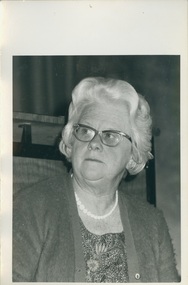 Uniting Church Archives - Synod of Victoria
Photograph, Undated
... ministry was Ormond and Carnegie South. In 1975 she moved to Rosanna, then Strathmore in 1981. Given permission to retire in August 1985 due to ill health. ...ministry was Ormond and Carnegie South. In 1975 she moved to Rosanna, then Strathmore in 1981. Given permission to retire in August 1985 due to ill health. ...B 1920 Trained as a Deaconess and then took up a position with the Methodist Department of Christian Education where she worked for 15 years. Then joined the Joint Board of Christian Education staff in 1961 and worked there until 1970. Miss Reid was one of the earliest women to become ordained when it was allowed. Ordained in 1971 her first ministry was Ormond and Carnegie South. In 1975 she moved to Rosanna, then Strathmore in 1981. Given permission to retire in August 1985 due to ill health. She died 29 July 1985 B & W gloss head and shoulders photograph of Rev. Christina Jessie Reid.rev. christina jessie reid; deaconess; methodist department of christian education; joint board of christian education; ormond; carnegie south; rosanna; strathmore -
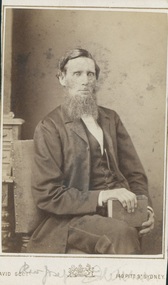 Uniting Church Archives - Synod of Victoria
Photograph, Undated c.1880s
... He was accepted for the Wesleyan ministry in 1845 and after training at Richmond College, Surrey, he married Kate Green in December 1848. He was sent to Auckland, New Zealand, where he became the founding principal of Wesley College. In 1856 poor health...He was accepted for the Wesleyan ministry in 1845 and after training at Richmond College, Surrey, he married Kate Green in December 1848. He was sent to Auckland, New Zealand, where he became the founding principal of Wesley College. In 1856 poor health ...Born 1823 West Indies, commenced ministry 1847, died 1890 in Rookwood, NSW. Joseph Horner Fletcher (1823-1890), Wesleyan minister, was born at St Vincent, Windward Islands, the eldest son of Rev. Joseph Fletcher, Wesleyan missionary, and his wife Mary, née Horner. In 1830-37 he attended a Methodist school in Kingswood, England, and then his uncle's school in Bath. He entered business but in July 1842 became a local preacher. He was accepted for the Wesleyan ministry in 1845 and after training at Richmond College, Surrey, he married Kate Green in December 1848. He was sent to Auckland, New Zealand, where he became the founding principal of Wesley College. In 1856 poor health obliged him to take up circuit work in Auckland and New Plymouth, where he witnessed the Maori war. He moved to Queensland and in 1861-64 was on circuit in Brisbane. In 1863 he became the first chairman of the Queensland Wesleyan District. In 1865 Fletcher was serving at Ipswich when invited to succeed Rev. John Manton as president of Newington College, Sydney. He acknowledged that the main business of the school was secular education in a Christian atmosphere and believed that education could help to overcome sectarianism. He invited distinguished academics to examine Newington students and strongly supported (Sir) Henry Parkes's education policies. He opposed the formation of a Methodist university college until a strong secondary school was established. He believed that boys should be taught to appreciate orderly conduct rather than to fear punishment and that corporal punishment was degrading and to be used only in extreme circumstances. Under Fletcher Newington developed a high moral tone and a tradition of order and respect. After he retired in 1887 the old boys gave him an address of appreciation and a portrait in oils to be hung in the hall. In addition to his normal duties from 1883 he had taught resident theological students. From 1887 he was an effective and progressive full-time theological tutor. As a preacher Fletcher had exceptional power: he expressed his thoughts in a fresh way with sparkling illustrations and characteristic humour. He combined humility with great spiritual power, prophetic vision and administrative ability. He encouraged the development of institutional church work which grew into the Central Methodist Mission in Sydney. Fletcher was elected as the first president of the New South Wales and Queensland Wesleyan Methodist Conference in 1874 and again in 1884, when he was also president of the General Conference of the Australasian Wesleyan Methodist Church. As conference editor in 1868, 1871 and 1873, Fletcher contributed more than fifty articles, numerous essays and reviews of books to the Weekly Advocate. He read widely, deeply and with discrimination. Never robust in health, he suffered months of illness before he died aged 66 at Stanmore, Sydney, on 30 June 1890. He was survived by three sons and two daughters, and buried in the Wesleyan section of Rookwood cemetery. In 1892 his eldest son, Joseph, edited a memorial edition of his Sermons, Addresses & Essays. Information from Australian Dictionary of Biography, Vol. 4, 1972. Sepia toned carte de visite. Seated studio portrait of the Rev. Joseph Fletcher.Rev Joseph Fletcherrev. joseph fletcher, joseph horner, wesleyan minister, newington college sydney, new zealand, queensland, president general conference, wesleyan methodist church, central methodist mission -
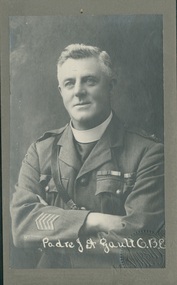 Uniting Church Archives - Synod of Victoria
Photograph, Undated c.1915 - 1918
... He retired from the ministry three years ago, and had suffered Ill-health from that time. ...He retired from the ministry three years ago, and had suffered Ill-health from that time. ...Born 26 June 1865 at Manchester, England Husband of Mrs. Edith Ann Maria GAULT Of 'The Inglenook', Sea Parade, Cheltenham, Vic. Aged 50 years Enlisted 01 July 1915 for Continuous Service Embarked 16 July 1915 per 'HMAT Demosthenes' from Melbourne, Vic Pay rate of 19s 0d after embarkation Embarked 29 March 1916 per 'RMS Orontes' from Melbourne, Vic. Served in Egypt and on the Western Front Returned to Australia 01 November 1919 Awarded OBE Death of Rev. J. A. Gault The Rev. J. A. Gault, a Methodist minister, who was widely known to Australian soldiers as Padre Gault, died yesterday after a long illness. One of the best-loved padres in the AIF, Mr. Gault served for four years with the Australians, at first in Egypt and later in France and England. After the war, he continued to show great interest in returned soldiers and work in training camps. When he retired in February, 1934, Mr. Gault had been in the ministry for 40 years. Bom at Manchester. England on June 10, 1865 he came to Australia when aged three years in the sailing-ship Antiope. He was educated at Gold street State school and later at Wesley College. After his appointment as a minister, he served the church in many circuits in Tasmania and Victoria. Before the war he was superintendent of the Methodist Mission at Collingwood,and after his return from overseas he occupied important positions, including those of superintendent minister in the Brunswick, Port Melbourne, and Yarra street, Geelong, circuits. His last charge was at Camberwell. After ill-health caused him to retire, he lived at Mentone. He has left a widow, a son, and two daughters. Dr. Edward Gault. of Collins street, is a brother, and there are two sisters in New Zealand. The funeral will leave Mr. Gault's home In Sea parade, Mentone, tomorrow, at 2p.m., for the Methodist Church, Mentone. It will then proceed to the Springvale Crematorium. W. D. Rose and Son. Cheltenham, are making the arrangemnts. R.S.L. Tribute "Returned soldiers will learn of the death of Padre Gault with deep regret," said the president of the Returned Soldiers' League (Mr. G. W. Holland) lastnight. "He was revered by the AIF. for his unfailing sympathy, understanding, and comradeship." - from the Melbourne Argus 02 Feb 1938 "REV. J. A. GAULT. BELOVED A.I.F."PADRE." Death After A Long Illness. After a long Illness, the death occurred at his home at Mentone yesterday afternoon, of Rev. James Archibald ("Padre") Gault, one of the best known and beloved Methodist chaplains to the A.I.F. at Galllpoli and in France. Sorrow at the "padre's" demise, at the age of 72 years, will be shared not only by the thousands to whom he rendered, both spiritual and temporal comfort during the war, but, also by a host of friends won during a long and. fruitful, ministry at many centres in the State, and as chaplain at military camps after the war. He retired from the ministry three years ago, and had suffered Ill-health from that time. Deceased entered the Methodist ministry in 1894, and was ordained four years later. After a successful year as conference evangelist. he was stationed at Mansfield, then at Richmond. Following a ministry at Richmond he was transferred to Tasmania, where for twelve years he exercised his ministry at Mt Lyell Launceston, Penguin and Hobart. Returning to Victoria, Mr. Gault was stationed at St. Kilda, and when the war broke out he was associated with the Colllngwood Mission. He left on active service as a chaplain with the first troops, and was ' present ' throughout the Galllpoli campaign. Later he was with the forces In France, and remained on active service until the last of the troops were demobilised to 1920. He was affectionately known as "padre"after the war to the thousands of soldiers who had learned to regard him as guide, philosopher and friend In the trenches. He was noted always for the good cheer he invariably brought to the troops, and his famous "stunts" among the men were subsequently recorded by him in his publication, "The Stunt Book." For services rendered he was made a member of the Order of the British Empire. On his return to Australia In 1920 he was stationed at Brunswick for three years, and then followed ministries at Port Melbourne, Spring-road, Malvern and finally at Camberwell. A deeply spiritual man, he brought a rare devotion to his ministry, and was beloved by his congregations and ministerial brethren alike. He shunned the limelight, and was one of the most retiring men in conference affairs. The deceased is survived by a widow, two daughters and, one, son. Dr. Edward L. Gaul is a brother." - from the Melbourne Age 02 Feb 1938 B & W waist length studio portrait of the Rev. James Archibald Gault dressed in uniform as Chaplain to the A.I.F. Mounted on grey card.Padre J.A. Gault OBE -
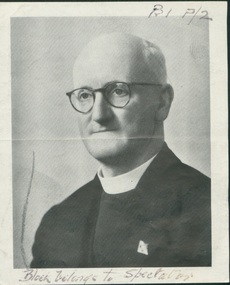 Uniting Church Archives - Synod of Victoria
Photograph, 1955 - 1962
... ministry and was appointed to his first parish at Zeehan, Tasmania in 1927. He was called to serve with the Methodist Overseas Mission in New Britain and New Ireland in 1929. He married Dorothy Clarke just before he left. After four years in PNG he returned through ill-health...ministry and was appointed to his first parish at Zeehan, Tasmania in 1927. He was called to serve with the Methodist Overseas Mission in New Britain and New Ireland in 1929. He married Dorothy Clarke just before he left. After four years in PNG he returned through ill-health ...Alec Pederick was born in 1902 and left school at 15 to work on his parents' farm at Wyuna, Kyabrum,Victoria. After receiving a sense of call he trained for the Methodist ministry and was appointed to his first parish at Zeehan, Tasmania in 1927. He was called to serve with the Methodist Overseas Mission in New Britain and New Ireland in 1929. He married Dorothy Clarke just before he left. After four years in PNG he returned through ill-health to Victoria. He was appointed to the Beaufort Circuit in 1933 and then in 1936 to the Methodist Home Missions Department. He was called up as an Army chaplain in 1942 and sent on active service in Papua New Guinea. He was discharged in 1944 and returned to the Home Missions Department. He was appointed acting General Superintendent in 1944 and then General Superintendent in 1946, a position he held until 1962. He also served as Director of the Federal Methodist Inland Mission for a time. He died in 1972.Set of 8 photos (F68-3 has two additional copies) of Rev. Alec W. Pederick L. Th. All six photographs were taken at approximately the same age - late middle age - while still General Superintendent of the Victorian Home Missions department. Mostly bald, bespectacled man wearing glasses and clerical collar and stock and dark suit. All B&W. F68-1 is a cutting from The Spectator. F68-2 shows Pederick looking directly at the camera, unsmiling. F68-3 shows Pederick smiling looking to the right of the camera. F68-4 and F68-5 were taken as he was seated holding a large, open folder of papers, looking at the folder in -4 and to the right of the camera in -5. F 68-6 shows Pederick standing outside in a garden or "the bush" dressed in clerical garb with an overcoat. He is holding what looks like a camera and he is looking away from the camera.All the photos except F68-6 have an identification by name (Rev. A. W. Pederick" and all bar F68-6 have also identified him as General Superintendent and F68-3-5 identify him as General Superintendent Methodist Home Missions. F68-3 has "President of Conference 1955" typed on the back in red ink.pederick, a. w., zeehan, methodist overseas mission, methodist inland mission, beaufort, army chaplain, new britain, new ireland -
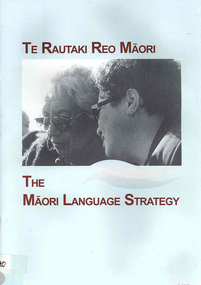 Victorian Aboriginal Corporation for Languages
Book, Ministry of Maori Development, Te rautaki reo Ma?ori =? The Ma?ori language strategy, 2003
... Maori government policy language retention Includes: A Vision for the Future of the Maori Language, Introduction, The History of Maori Language, The Current health of the Maori Languag and Goals for Strengthen Language Use. etc. Te rautaki reo Ma?ori =? The Ma?ori language strategy Book Ministry of Maori Development ...Includes: A Vision for the Future of the Maori Language, Introduction, The History of Maori Language, The Current health of the Maori Languag and Goals for Strengthen Language Use. etc.maori, government policy, language retention -
 Sunshine and District Historical Society Incorporated
Archive - Gwen Goedecke Collection - Western Region Commission
... sub committees in separate folders|Executive Committee|Advisory Committee|Environment Committee|Social Development Commission|Parks and Gardens Committee|Trainee and Apprenticeship Committee Engineering Committee|Health Commission|Regional Planners Group|Western Region Right to Work Committee|Arts Committee |publications: The Privatisation Papers - John Ernst (VU) 1994|Key Health Issues in Melbourne's West - Victorian Health Department (1987)|Western Region Social Profile - Western Region Consultative Commission/Westurb and Footscray Institute of Technology (1998)|West Link #4&8 - Western Region Consultative Committee (1976)|Industry and Industrial Relations in the Western Suburbs, Needs and Policies (Seminar in Sunshine 1976)|Metropolian Arterial Road Access Study (2 publications) - Ministry of Transport Priorities and Planning (1984)|Western Region Directory of Welfare Personnel (1979 & 1982) - Western Region Commission|We neeed great publict transport (no tollway tunnel and freeway) -office of Colleen Hartland MLC (2008)|Planning a better place to live -The Western Suburbs Facts Booklet (Western Region Commission ?) ...Part of the Gwenyth "Gwen" Goedecke Collection Western Region Commission sub committees in separate folders|Executive Committee|Advisory Committee|Environment Committee|Social Development Commission|Parks and Gardens Committee|Trainee and Apprenticeship Committee Engineering Committee|Health Commission|Regional Planners Group|Western Region Right to Work Committee|Arts Committee |publications: The Privatisation Papers - John Ernst (VU) 1994|Key Health Issues in Melbourne's West - Victorian Health Department (1987)|Western Region Social Profile - Western Region Consultative Commission/Westurb and Footscray Institute of Technology (1998)|West Link #4&8 - Western Region Consultative Committee (1976)|Industry and Industrial Relations in the Western Suburbs, Needs and Policies (Seminar in Sunshine 1976)|Metropolian Arterial Road Access Study (2 publications) - Ministry of Transport Priorities and Planning (1984)|Western Region Directory of Welfare Personnel (1979 & 1982) - Western Region Commission|We neeed great publict transport (no tollway tunnel and freeway) -office of Colleen Hartland MLC (2008)|Planning a better place to live -The Western Suburbs Facts Booklet (Western Region Commission ?) ...Part of the Gwenyth "Gwen" Goedecke Collectionsub committees in separate folders|Executive Committee|Advisory Committee|Environment Committee|Social Development Commission|Parks and Gardens Committee|Trainee and Apprenticeship Committee Engineering Committee|Health Commission|Regional Planners Group|Western Region Right to Work Committee|Arts Committee |publications: The Privatisation Papers - John Ernst (VU) 1994|Key Health Issues in Melbourne's West - Victorian Health Department (1987)|Western Region Social Profile - Western Region Consultative Commission/Westurb and Footscray Institute of Technology (1998)|West Link #4&8 - Western Region Consultative Committee (1976)|Industry and Industrial Relations in the Western Suburbs, Needs and Policies (Seminar in Sunshine 1976)|Metropolian Arterial Road Access Study (2 publications) - Ministry of Transport Priorities and Planning (1984)|Western Region Directory of Welfare Personnel (1979 & 1982) - Western Region Commission|We neeed great publict transport (no tollway tunnel and freeway) -office of Colleen Hartland MLC (2008)|Planning a better place to live -The Western Suburbs Facts Booklet (Western Region Commission ?) (1982)|Submissions to the Western Metro Region Health Planning Process #4 (1987) - West Metro Region Health Department|Comparitive Local Statistics - MMBW (1981)|Melbourne's West - The Way Ahead - Western Region Commission (1988)|A Social Profile of the Western Region of Melbourne - Western Region Consultative Commission (1979)|The Western Region - Action for the Eighties - Joh Cain MP Premier for Victoria / Beanland Lecture Footscray Institute of Technology (1983)|Hospitals and Health Services Planning Committee submission to the National Hospital and Health Services Interim Commission - Western Region Commission (1973)|Monitoring Melbourne's West - Western Region Commission 1986/1987|Extractive Industries in the Western Region - Draft by Western Region Commission (70's)|Melbourne Western Region discussion report - Department of Urban and Regional Development (1974)|Western Suburbs Transport Study - Wilbur Smith & Associates (1975)|Regionalisation of Refuse Disposal, a report to Western Region Steering Committee - Extractive Industries and Waste Disposal in the Western Region (1976)|Western Region Community Directory compiled by Footscray Institute of Technology (1989)|submission to the Hospitals and Charities Commission re Community and Counselling Centre in the Western Region by the Western Region Working Group of Alcohol and Drug Dependance (1976)|Report of the Western Region Recreation Study Draft (1976) for the Western Region Consultative Commission by John Paterson Urban Systems P/Lwestern region commission -
 City of Melbourne Libraries
Photograph, Bull, Hugh Jones, 1897-1993, Seventh Day Adventists Camp at Hampton: W.J. Westerman, G.G. Stewart & C.H. Watson
... Sanitarium Health and Wellbeing Company is exempt from paying company income tax on their profits due to their ownership by a religious organisation. Although not a compulsory rule for salvation, Adventists are encouraged to pay a tithe of 10% of their income to the church to support the ministry in God’s work. ...Sanitarium Health and Wellbeing Company is exempt from paying company income tax on their profits due to their ownership by a religious organisation. Although not a compulsory rule for salvation, Adventists are encouraged to pay a tithe of 10% of their income to the church to support the ministry in God’s work. ...Photographer notations on slide: Seventh Day Adventists Camp at Hampton W.J. Westerman, G.G. Stewart & C.H. Watson Published: 28 December 1933 Published title: SEVENTH DAY ADVENTISTS. Published caption: “I. — The Annual Camp of the Seventh Day Adventists in Highett-road, Hampton, comprising more than 250 tents and accommodating over a thousand persons. II. —W. J. Westerman (vice-president of Australasian) and Pastor G. G. Stewart (president of Victoria), conversing with Pastor C. H. Watson (world president of the Seventh Day Adventists).- III.— Evangelist E. R. Gane and family.” SEVENTH DAY ADVENTISTS. (1933, December 28). The Age (Melbourne, Vic. : 1854 - 1954), p. 9. Retrieved August 1, 2025, from http://nla.gov.au/nla.news-article203356427 Research by project volunteer, Fiona Collyer: In December 1933, the annual Seventh Day Adventists Conference of Victoria was held, with over a 1000 participants camping for ten days at Highett Road Hampton. Pastor Charles H. Watson, world president of the Seventh Day Adventists, Walter J. Westerman, vice-president of Australasian and Pastor George G. Stewart, president of Victoria attended. Interestingly, The Age newspaper modified the original photo in their publication, placing the three men close to each other. Description: Three middle aged men dressed in suits converse in front of tents. In December 1933, delegates from all over Victoria and beyond travelled to Melbourne for the annual Seventh Day Adventists Conference of Victoria, held over ten days on a vacant allotment at Highett Road Hampton. A canvas town of 250 tents for over 1000 campers was created along with large marquees for lectures, devotional services and kitchens. Many daily visitors also attended the lectures and services. The principal speaker was Victorian born world president of the Seventh Day Adventists, Pastor Charles H. Watson (1877-1962), who travelled from Washington DC for the event. The Highett Street campers attended a busy schedule of bible readings, devotional services and health lectures during the ten days of the camp. Lecture subjects included- “Among the Head Hunters of the Solomon Islands”, “ Looking Through the Prophetic Telescope into 1934”, “Soul Surgery”, “Viewing the Celestial Land Through the Prophetic Telescope”and “The Four Horsemen of the Apocalypse”. The Seventh Day Adventist religion was established in the USA in 1863. One of its co-founders was American Ellen G. White whose writings are regarded as divinely inspired and are still adhered to today. Ellen preached on the “Eight Laws of Health”- Nutrition, exercise, water, sunshine, temperance, air, rest and trust in God. Adventists regard their bodies as holy temples and avoid food deemed by the Bible as unclean. They eat a mainly plant based diet with no caffeinated beverages and abstain from alcohol and tobacco. They believe in the observance of Saturday, the seventh day of the week in the Christian (Gregorian) and Hebrew calendars as the sabbath and the literal and imminent second coming of Jesus Christ. New converts are baptised by immersion in water. The Adventists opened the Warburton Sanitarium in 1910 as a health retreat, integrating their holistic health philosophy of physical, mental and spiritual well being. It was a resort in the hills “among picturesque mountain scenery…surrounded by tall forests and deep fern gullies…” where highly strung Melburians could alleviate their digestive maladies, stress and jaded nerves as “…worn down nervous systems mend quickly in this peaceful environment…invigorating air and an abundance of home-grown fruit, vegetables, fresh eggs, milk, and cream help to build healthy bodies”. The resort also offered hydrotherapy, massage and electrical treatments. An advertisement in The Argus- 1 December 1947 assured readers- “EVERYTHING SUNNY AGAIN." “That's how you'll feel when you say farewell to Warburton Sanitarium and Hospital after spending a holiday here. Victoria's Hydro is famous far and wide for wonders worked with sufferers from nervous and digestive disorders. Wholesome food, perfectly cooked; splendid air, regulated exercise, sweet natural sleep; these quickly correct faulty digestion, restore vitality, bring back that sunny optimism natural to healthy people. Massage and curative baths under medical supervision…” Later, after further building work, it became the Warburton Hospital with medical, casualty and obstetrics wards as well as offering strategies to stop smoking, lose weight and for stress management. The hospital ceased operation in 2001. Ellen G. White wrote “God sent me to Australia” and in 1891, accompanied by her son William C. White she arrived in Australia to start a Bible school, spread her health philosophy and for missionary work. At first health food products were imported from America, but it soon became apparent that due to the expense and the food becoming stale over the long journey, that local manufacturing was necessary. In 1898 William secured the services of American Adventist baker Edward C. Halsey, who had worked at Dr Kellogg’s Battle Creek (“Cereal City”), Sanitarium, Michigan, USA. They rented the St George’s bakery in Northcote, Melbourne, producing the first ready to eat breakfast cereal Granola, Caramel Cereal, and peanut butter. The fledgling company relocated to larger premises in Cooranbong, NSW soon after. The Sanitarium Health Food Company opened a factory in Warburton in 1925, manufacturing Granose Biscuits, Cerix Puffed Wheat, San-Bran, Bixies malted wheat flakes, Betta peanut butter, Marmite, “Kwic-Bru - A delicious health “coffee” made from choicest cereals and free from drugs that affect the heart and nerves” In 1928, Sanitarium bought out Grain Products Limited who were manufacturing a sweet cereal biscuit called Weet-Bix which soon became Australia’s favourite breakfast cereal. The Warburton factory closed in 1997, with manufacturing shifting interstate. Sanitarium breakfast cereal boxes offered free collectable cards inside and children could buy albums from grocers for sixpence and mount the cards. Subjects of the albums included- “Aboriginal Tribes, Legends, Customs”, “Australia- Yesterday and Today”, “Marvels of the Great Barrier Reef”, “Advance Australia- a Pageant of the Years”. In 1902 the Adventist’s opened the “Pure Food Vegetarian Cafe” in Sydney (In 1907 the name was changed to “Sanitarium Health Food Cafe”), Eating vegetarian food was definitely a curiosity. “Cristina” reviewed the cafe for The Australasian-27 October 1906. Topics For The Block. “Feeling somewhat like a criminal, and hoping to escape detection, I stealthily made my way into a vegetarian restaurant the other day... If my friends happened to catch me walking in there, I should henceforth be considered a crank, a faddist, and little short of a lunatic! Whom did I find within, seated with the air of habitués at the small tables, but heaps of my friends. They had all this while been pursuing their vegetarian way, layin' low and sayin' nuffin'. Flesh-eaters, now that the Sydney summer has set in apparently in good earnest, are beginning to wonder if the vegetarians are not wiser in their day and generation. Roast beef, hot cornea beef, ragouts, and meat curries, the very thought of them makes one feel hot. Frosted lemon pudding, stewed fruits, wheatmeal rolls, and tomatoes sound nice when you look at their names on the vegetarian menu. Such weird messes are served, square, unintelligible blocks of some brown substance, a few bites of which form a full and satisfying meal. Cold nut foods, granose, nuttose, and jam protose, bromose, with jelly and various "ose" sandwiches, impossible for the unbeliever to diagnose, are put before you. You drink malted nut broth, you eat gluten sticks, stewed beans, lentil patties, with vegetable sauce, any or all of which are distinctly nourishing and filling at the price. A mock (decidedly mock) veal cutlet or a red lentil roast is sufficient lunch, it appears, for anyone. Thus, "you obtain the best working results from your machinery with the least possible expenditure..." In December 1906 the Adventists branched out to Melbourne, opening the Sanitarium Health Food Cafe at 289 Collins Street next to the Royal Bank building. (corner Collins and Elizabeth Streets, demolished in 1939). Their motto was “Quality and Purity”. “Cynthia” of The Leader “Social Circle” column reviewed the cafe in 9 March 1907- “Hundreds of people have a feeling of positive affection for a diet that will be satisfying, appetising and nourishing, without having meat for its backbone. It will come as news that we have in Melbourne a cafe where you can really enjoy yourself without eating anything in the way of meat. Cream, custard, cheese and the like are not cold shouldered out of the menu, and the housewife in search of new dishes will find here ever so much in the way of suggestions. Nuts figure conspicuously in the menu, and lentil and walnut cutlets may be instanced among the delicacies. Beans are cooked in quite alluring fashion, while creamed parsnips are excellent. For sandwiches you could hardly desire anything more appetising than granosi biscuits, and nut cheese. The combination is suggestive of school lunches, and nut meat might well be employed as a variant. A visit to the cafe itself — it is next the Royal Bank in Collins-street — will surprise anyone used to the average vegetarian restaurant. Every thing is fresh, fragrant, and thoroughly modern… It is run, in connection with that curious people the Seventh Day Adventists.” However, “Adele” writing for the Evelyn Observer and Bourke East Record -13 December 1907 had a different experience- CITY RESTAURANTS. “There is no glamour from the outside. We enter the dining room at six and secure a seat at a small table, for this night we are going to dine on vegetables. Some people pride themselves on being vegetarians, and devote a great deal of their spare cash and energy to disseminating vegetarian principles. I shall not in a hurry forget the dinner we tried to get through at this vegetarian restaurant. There was put before us plate after plate of vegetables not soaked, but sodden with water, not an atom of flavouring or dressing; no attempt was made to give the slightest piquancy to potato, cabbage, turnip or carrot. I beg pardon, I am unjust, there were two caterpillars in the cabbage. It is astonishing how persistently ordinary cooks spoil vegetables in the process of cooking and how little they understand the value of vegetables on a menu.” From the extensive menu of 1924, you could order cream of green pea soup, followed by nut meat with Yorkshire pudding, egg timbales, stewed brown lentils, savoury rissoles with piquant sauce. Among the dessert offerings were creamed sago, steamed figs and walnut drops. Washed down with fermented wine and to finish, “Frucerea”, a coffee substitute essence made from fruit and cereal. A four course meal of soup, entree, vegetables and sweets cost 1/6 in 1924. Proving that plant-based food was not just a novelty, 67,000 meals were served at the cafe in 1918, rising to 73,000 in 1921. Later the Sanitarium Cafe moved to 293 Little Collins Street, (opposite Royal Arcade) sharing the building with The Lilliput Golf Course, a miniature golf course of 18 holes. The course was a replica of the fashionable Lido Course in France and was open daily from 10am to midnight with a green fee of one shilling. It featured goldfish, waterfalls and dance music. Lilliput boasted that they were “Melbourne’s coolest indoor course” Miniature golf (mini, minnie, midget, miget, Tom Thumb, Wee golf, putt-putt, pigmy, peewee, crazy golf, obstacle golf) swept the globe in the 1930s, starting in the USA, then Europe. The courses provided affordable recreation during uncertainty at the start of the Great Depression. The craze arrived in Sydney September 1930 with the first mini golf course opening in the basement of the State Theatre. It featured a replica Sydney Harbour Bridge and attracted over 1000 players a day at one shilling per game. The miniature golf bug hit Melbourne hard in 1930-31 with nearly 200 courses springing up in the CBD and suburbs within a few months. The first miniature golf course to open in Melbourne was on 4 October 1930 in the basement of recently built art deco style Wentworth House at 203 Collins Street, designed by architect Cedric Heise Ballantyne, (also designed Regent Theatre, Plaza Ballroom, Athenaeum Club, National Theatre, St Kilda, built in 1930, demolished in 1974 for the City Square) It was managed by J. C. Williamson who advertised for a “Girl Spruiker” who “Must be Young, Attractive Personality, and Able to Talk to the Public” to work at the course. The Age 26 September 1930 reported - “The Wentworth House management have spared no expense in preparing the links. Water hazards, sand bunkers, running streams, ancestral castles, moats and a cunning drawbridge have each been devised to test the skill of players, while the walls and ceiling have been "atmospherically" treated to convey an exterior effect”. Even Melbourne City Council jumped on the bandwagon, leasing the lower hall of Melbourne Town Hall to colourful car dealer and racehorse owner Mr A. G. Barlow for £43 per week for the “Kit Kat Tiny Golf Course”, opening on 11 December 1930. (Turf identity, Mr Alexander George Barlow, (1880-1937) who raced under the nom de course “A. G. Vauxhall”, owned filly Frances Tressady, who in 1923 won the Victoria Derby and Oaks Stakes double and came fifth in the Melbourne Cup. The “Frances Tressady Stakes” is held each March at Flemington Racecourse in honour of the horse, the last filly to win the Derby. Barlow was the proprietor of Barlow Brothers Pty Ltd car dealership at 442 Elizabeth Street, Melbourne. He played 14 games for Carlton Football Club (VFL) on the half-forward line from 1901-1903). Patrons could vie for The Herald Miniature Golf Championship Cup, a gold cup worth £7/7, in an eight week long competition. Sports newspaper The Sporting Globe also offered a Cup and prize money. Many courses offered prizes of theatre tickets, cash and cigarettes. Myer’s department store, hoping to cash in on the fad, advertised in Melbourne’s newspapers that their Sports Department could design and equip complete miniature golf courses using “Fairway” imitation turf at 4/6 a yard. Newspaper cartoonists loved to lampoon the fad. Both Percy Leason, cartoonist for society magazine Table Talk and Syd Miller of Smith’s Weekly depicted “real” golfers causing havoc on a mini golf course, showing that being a “real” golf player was no advantage to playing miniature golf. But bust often follows boom. With such rapid market saturation, expensive novel hazards, waning interest, long opening hours, often to midnight, and price cutting of game fees from one shilling to sixpence and then to threepence amongst some courses, the bubble was bound to burst. The Sporting Globe columnist J.M.Dillon on 20 May 1931 lamented- £100,000 LOST Failure of ‘Minnie’ Golf. “Miniature golf might have provided fun and jokes for thousands of people in Australia, but there were many for whom it panned out a tragedy. It is likely that the dead losses of those who attempted to make money out of the game in Australia were in the vicinity of £100,000. …For a while there was hardly a spare block of land, or a possible “site” in the shape of a hall, or a showroom, in Sydney and Melbourne, that some one was not after to set upon it a “minnie links.” Big amusement firms and private individuals anxious to make money began to run courses. Practically every individual who touched the game had his finger’s financially burnt. …From the approximately £60,000 invested in Melbourne alone, there must have been £25,000 lost. …There are now dozens of courses going to ruin, and many more that the owners would be happy to give away if the takers would remove from them obligations of leases, &c…” The lease on the “Kit Kat Tiny Golf Club” at the Melbourne Town Hall expired on 30 April 1931, with Mr Barlow losing £798 on the venture. The hazards and fittings, which cost £400 and included a large replica of the Town Hall, now worthless. Due to declining patronage, the Little Collins Street cafe closed in 1938, although the adjacent shop continued to sell Sanitarium products. In New Zealand, the first Sanitarium factory opened in Christchurch in 1900, with the company later opening factories in Palmerston North and Auckland. The Adventists opened vegetarian cafes, firstly at 37 Taranaki Street Wellington in 1906, followed by cafes in Auckland, Christchurch and Dunedin. Weet-Bix is also New Zealand’s favourite cereal- there the jingle is “Kiwi kids are Weet-Bix kids.” In 1955, the Australian Women’s Weekly ran an illustrated, full colour advertisement featuring New Zealand born Edmund Hillary (later Sir) 1919-2008, who, along with Sherpa Tenzing Norgay, was the first climber to reach the summit of Mount Everest on 29 March 1953. The Australian Women’s Weekly, 30 March, 1955- “WEET-BIX carried by Hillary on Himalayan adventure! c/- N.Z. Alpine Club Inc., Dunedin, New Zealand. The Manager, Sanitarium Health Food Company, Christchurch, N.Z. Dear Sir. …Weet-Bix was chosen at my special request as I had always felt that some easily prepared form of breakfast was essential to the primitive conditions of high camps. Weet-Bix fulfilled its task very well indeed. We usually had them with hot milk (powdered) and sugar, and even when we were unable to eat anything else, we usually managed to have a little Weet-Bix . . . I regard them as a great success and expect they will be more widely used in the Himalayas in future. Yours faithfully, (Signed) E.P. Hillary. Sanitarium Marmite - motto- “Too much spoils the flavour”- is as beloved with Kiwis as Vegemite is with Australians. In 1966, a fire gutted the Christchurch Marmite factory causing a nation wide shortage. Once the factory was rebuilt, Sanitarium relaunched the yeasty extract in reusable glass tumblers with printed designs such as yachts, New Zealand birds and vintage cars. These popular collectibles can still be found in the kitchen cupboards of many New Zealand baches (holiday homes). After the devastating 2011 earthquake in Christchurch damaged the Marmite factory causing shortages and panic buying, a “Marmageddon” was declared with jars of the “black gold” advertised online for up to NZ$800. Consumers were advised to spread their Marmite sparingly until production resumed. (The Christchurch plant reportedly produces around 640,000kg of Marmite per year). Sanitarium Health and Wellbeing Company is exempt from paying company income tax on their profits due to their ownership by a religious organisation. Although not a compulsory rule for salvation, Adventists are encouraged to pay a tithe of 10% of their income to the church to support the ministry in God’s work. Nowadays, there are over 25 million members of the Seventh Day Adventists Church in 200 countries. ITEMS OF INTEREST (1933, December 22). The Argus (Melbourne, Vic. : 1848 - 1957), p. 8. Retrieved July 21, 2025, from http://nla.gov.au/nla.news-article11723188 SEVENTH DAY ADVENTISTS. (1933, December 28). The Age (Melbourne, Vic. : 1854 - 1954), p. 9. Retrieved July 1, 2025, from http://nla.gov.au/nla.news-article203356427 EVANGELISTS' CAMP (1933, December 20). The Herald (Melbourne, Vic. : 1861 - 1954), p. 30. Retrieved July 1, 2025, from http://nla.gov.au/nla.news-article243213209 Master Butchers Have A Time Pilots FOR School Air Race Charity Golf At Riversdale (1931, May 1). The Sun News-Pictorial (Melbourne, Vic. : 1922 - 1954; 1956), p. 14-15. Retrieved September 4, 2025, from http://nla.gov.au/nla.news-article276159136 2000 ADVENTISTS UNDER CANVAS (1933, December 27). The Herald (Melbourne, Vic. : 1861 - 1954), p. 17. Retrieved July 1, 2025, from http://nla.gov.au/nla.news-article243223698 TOPICS FOR THE BLOCK. (1906, October 27). The Australasian (Melbourne, Vic. : 1864 - 1946), p. 45. Retrieved August 30, 2025, from http://nla.gov.au/nla.news-article139178204 https://en.wikipedia.org/wiki/Seventh-day_Adventist_Church https://www.sanitarium.com/au/about/sanitarium-story/profits-for- ENTERTAINMENT AT MENZIES'. (1906, December 6). Punch (Melbourne, Vic. : 1900 - 1918; 1925), p. 26. Retrieved August 3, 2025, from http://nla.gov.au/nla.news-article175380296 https://encyclopedia.adventist.org/article?id=9HN0&highlight=Conference SOCIAL CIRCLE (1907, March 9). Leader (Melbourne, Vic. : 1862 - 1918, 1935), p. 41. Retrieved August 3, 2025, from http://nla.gov.au/nla.news-article196649677 CITY RESTAURANTS. (1907, December 13). Evelyn Observer and Bourke East Record (Vic. : 1902 - 1917), p. 1 (MORNING.). Retrieved August 3, 2025, from http://nla.gov.au/nla.news-article61133109 Advertising (1924, May 6). The Sun News-Pictorial (Melbourne, Vic. : 1922 - 1954; 1956), p. 9. Retrieved August 3, 2025, from http://nla.gov.au/nla.news-article274271406 1930, December 5). The Herald (Melbourne, Vic. : 1861 - 1954), p. 14. Retrieved August 5, 2025, from http://nla.gov.au/nla.news-page26374135 Thousands Are Still Playing Miniature Golf (1931, January 2). The Herald (Melbourne, Vic. : 1861 - 1954), p. 11. Retrieved August 8, 2025, from http://nla.gov.au/nla.news-article242880087 MINIATURE GOLF. (1930, October 16). The Argus (Melbourne, Vic. : 1848 - 1957), p. 10. Retrieved August 8, 2025, from http://nla.gov.au/nla.news-article4209280 THE REAL GOLFER WHO FORGOT HIMSELF ON THE MINIATURE GOLF COURSE (1930, November 13). Table Talk (Melbourne, Vic. : 1885 - 1939), p. 13. Retrieved August 8, 2025, from http://nla.gov.au/nla.news-article146706596 Advertising (1930, December 5). The Herald (Melbourne, Vic. : 1861 - 1954), p. 14. Retrieved August 8, 2025, from http://nla.gov.au/nla.news-article242761991 Advertising (1931, January 9). The Herald (Melbourne, Vic. : 1861 - 1954), p. 12. Retrieved August 8, 2025, from http://nla.gov.au/nla.news-article242887972 1955, March 30). The Australian Women's Weekly (1933 - 1982), p. 38. Retrieved August 9, 2025, from http://nla.gov.au/nla.news-page4812489 £100,000 LOST (1931, May 20). Sporting Globe (Melbourne, Vic. : 1922 - 1954), p. 1 (Edition1). Retrieved August 14, 2025, from http://nla.gov.au/nla.news-article183023946 1930, December 5). The Herald (Melbourne, Vic. : 1861 - 1954), p. 14. Retrieved August 15, 2025, from http://nla.gov.au/nla.news-page26374135 Advertising (1931, January 23). The Herald (Melbourne, Vic. : 1861 - 1954), p. 14. Retrieved August 15, 2025, from http://nla.gov.au/nla.news-article242887795 MINIATURE GOLF. (1931, February 5). The Dandenong Journal (Vic. : 1927 - 1954), p. 6. Retrieved August 16, 2025, from http://nla.gov.au/nla.news-article201082526 Still Time To Enter Midge (1931, January 16). The Herald (Melbourne, Vic. : 1861 - 1954), p. 12. Retrieved August 16, 2025, from http://nla.gov.au/nla.news-article242888830 WIT OF THE WEEK (1930, October 23). Table Talk (Melbourne, Vic. : 1885 - 1939), p. 23. Retrieved August 29, 2025, from http://nla.gov.au/nla.news-article146455050 Advertising (1930, October 2). Table Talk (Melbourne, Vic. : 1885 - 1939), p. 16. Retrieved August 18, 2025, from http://nla.gov.au/nla.news-article146454620 MIDGET GOLF LINKS. (1930, September 26). The Age (Melbourne, Vic. : 1854 - 1954), p. 6. Retrieved August 18, 2025, from http://nla.gov.au/nla.news-article202235074 https://www.smh.com.au/national/fairfax-archive-mini-golf-20131125-2y608.html TURF NOTES (1923, November 6). The Ballarat Star (Vic. : 1865 - 1924), p. 6. Retrieved September 3, 2025, from http://nla.gov.au/nla.news-article213855201 Advertising (1930, October 4). The Herald (Melbourne, Vic. : 1861 - 1954), p. 10. Retrieved October 14, 2025, from http://nla.gov.au/nla.news-article242937272 LAUGHTER AND TEARS. (1930, November 15). Smith's Weekly (Sydney, NSW : 1919 - 1950), p. 21. Retrieved September 9, 2025, from http://nla.gov.au/nla.news-article234426874 Advertising (1947, December 1). The Argus (Melbourne, Vic. : 1848 - 1957), p. 5. Retrieved September 15, 2025, from http://nla.gov.au/nla.news-article22523355Photographer notations on slide: "Seventh Day Adventists Camp at Hampton W.J. Westerman, G.G. Stewart & C.H. Watson".religion, health food, mini golf, 1930-1939, tents, churches, camps -
 City of Melbourne Libraries
Photograph, Bull, Hugh Jones, 1897-1993, Seventh Day Adventists Camp at Hampton: E. Gane + family
... Sanitarium Health and Wellbeing Company is exempt from paying company income tax on their profits due to their ownership by a religious organisation. Although not a compulsory rule for salvation, Adventists are encouraged to pay a tithe of 10% of their income to the church to support the ministry in God’s work. ...Sanitarium Health and Wellbeing Company is exempt from paying company income tax on their profits due to their ownership by a religious organisation. Although not a compulsory rule for salvation, Adventists are encouraged to pay a tithe of 10% of their income to the church to support the ministry in God’s work. ...Photographer notations on slide: Seventh Day Adventists Camp. E Gane + family Published: 28 December 1933 Published title: SEVENTH DAY ADVENTISTS. Published caption: “I. — The Annual Camp of the Seventh Day Adventists in Highett-road, Hampton, comprising more than 250 tents and accommodating over a thousand persons. II. —W. J. Westerman (vice-president of Australasian) and Pastor G. G. Stewart (president of Victoria), conversing with Pastor C. H. Watson (world president of the Seventh Day Adventists).- III.— Evangelist E. R. Gane and family.” SEVENTH DAY ADVENTISTS. (1933, December 28). The Age (Melbourne, Vic. : 1854 - 1954), p. 9. Retrieved August 1, 2025, from http://nla.gov.au/nla.news-article203356427 Research by project volunteer, Fiona Collyer: In December 1933, evangelist Mr E.R. Gane and his family gather outside their tent during the ten day Seventh Day Adventist Conference held in Highett Road, Hampton. Description: A woman, man and four small children sit and stand in front of a tent. One child plays with a toy train. In December 1933, delegates from all over Victoria and beyond travelled to Melbourne for the annual Seventh Day Adventists Conference of Victoria, held over ten days on a vacant allotment at Highett Road Hampton. A canvas town of 250 tents for over 1000 campers was created along with large marquees for lectures, devotional services and kitchens. Many daily visitors also attended the lectures and services. The principal speaker was Victorian born world president of the Seventh Day Adventists, Pastor Charles H. Watson (1877-1962), who travelled from Washington DC for the event. The Highett Street campers attended a busy schedule of bible readings, devotional services and health lectures during the ten days of the camp. Lecture subjects included- “Among the Head Hunters of the Solomon Islands”, “ Looking Through the Prophetic Telescope into 1934”, “Soul Surgery”, “Viewing the Celestial Land Through the Prophetic Telescope”and “The Four Horsemen of the Apocalypse”. The Seventh Day Adventist religion was established in the USA in 1863. One of its co-founders was American Ellen G. White whose writings are regarded as divinely inspired and are still adhered to today. Ellen preached on the “Eight Laws of Health”- Nutrition, exercise, water, sunshine, temperance, air, rest and trust in God. Adventists regard their bodies as holy temples and avoid food deemed by the Bible as unclean. They eat a mainly plant based diet with no caffeinated beverages and abstain from alcohol and tobacco. They believe in the observance of Saturday, the seventh day of the week in the Christian (Gregorian) and Hebrew calendars as the sabbath and the literal and imminent second coming of Jesus Christ. New converts are baptised by immersion in water. The Adventists opened the Warburton Sanitarium in 1910 as a health retreat, integrating their holistic health philosophy of physical, mental and spiritual well being. It was a resort in the hills “among picturesque mountain scenery…surrounded by tall forests and deep fern gullies…” where highly strung Melburians could alleviate their digestive maladies, stress and jaded nerves as “…worn down nervous systems mend quickly in this peaceful environment…invigorating air and an abundance of home-grown fruit, vegetables, fresh eggs, milk, and cream help to build healthy bodies”. The resort also offered hydrotherapy, massage and electrical treatments. An advertisement in The Argus- 1 December 1947 assured readers- “EVERYTHING SUNNY AGAIN." “That's how you'll feel when you say farewell to Warburton Sanitarium and Hospital after spending a holiday here. Victoria's Hydro is famous far and wide for wonders worked with sufferers from nervous and digestive disorders. Wholesome food, perfectly cooked; splendid air, regulated exercise, sweet natural sleep; these quickly correct faulty digestion, restore vitality, bring back that sunny optimism natural to healthy people. Massage and curative baths under medical supervision…” Later, after further building work, it became the Warburton Hospital with medical, casualty and obstetrics wards as well as offering strategies to stop smoking, lose weight and for stress management. The hospital ceased operation in 2001. Ellen G. White wrote “God sent me to Australia” and in 1891, accompanied by her son William C. White she arrived in Australia to start a Bible school, spread her health philosophy and for missionary work. At first health food products were imported from America, but it soon became apparent that due to the expense and the food becoming stale over the long journey, that local manufacturing was necessary. In 1898 William secured the services of American Adventist baker Edward C. Halsey, who had worked at Dr Kellogg’s Battle Creek (“Cereal City”), Sanitarium, Michigan, USA. They rented the St George’s bakery in Northcote, Melbourne, producing the first ready to eat breakfast cereal Granola, Caramel Cereal, and peanut butter. The fledgling company relocated to larger premises in Cooranbong, NSW soon after. The Sanitarium Health Food Company opened a factory in Warburton in 1925, manufacturing Granose Biscuits, Cerix Puffed Wheat, San-Bran, Bixies malted wheat flakes, Betta peanut butter, Marmite, “Kwic-Bru - A delicious health “coffee” made from choicest cereals and free from drugs that affect the heart and nerves” In 1928, Sanitarium bought out Grain Products Limited who were manufacturing a sweet cereal biscuit called Weet-Bix which soon became Australia’s favourite breakfast cereal. The Warburton factory closed in 1997, with manufacturing shifting interstate. Sanitarium breakfast cereal boxes offered free collectable cards inside and children could buy albums from grocers for sixpence and mount the cards. Subjects of the albums included- “Aboriginal Tribes, Legends, Customs”, “Australia- Yesterday and Today”, “Marvels of the Great Barrier Reef”, “Advance Australia- a Pageant of the Years”. In 1902 the Adventist’s opened the “Pure Food Vegetarian Cafe” in Sydney (In 1907 the name was changed to “Sanitarium Health Food Cafe”), Eating vegetarian food was definitely a curiosity. “Cristina” reviewed the cafe for The Australasian-27 October 1906. Topics For The Block. “Feeling somewhat like a criminal, and hoping to escape detection, I stealthily made my way into a vegetarian restaurant the other day... If my friends happened to catch me walking in there, I should henceforth be considered a crank, a faddist, and little short of a lunatic! Whom did I find within, seated with the air of habitués at the small tables, but heaps of my friends. They had all this while been pursuing their vegetarian way, layin' low and sayin' nuffin'. Flesh-eaters, now that the Sydney summer has set in apparently in good earnest, are beginning to wonder if the vegetarians are not wiser in their day and generation. Roast beef, hot cornea beef, ragouts, and meat curries, the very thought of them makes one feel hot. Frosted lemon pudding, stewed fruits, wheatmeal rolls, and tomatoes sound nice when you look at their names on the vegetarian menu. Such weird messes are served, square, unintelligible blocks of some brown substance, a few bites of which form a full and satisfying meal. Cold nut foods, granose, nuttose, and jam protose, bromose, with jelly and various "ose" sandwiches, impossible for the unbeliever to diagnose, are put before you. You drink malted nut broth, you eat gluten sticks, stewed beans, lentil patties, with vegetable sauce, any or all of which are distinctly nourishing and filling at the price. A mock (decidedly mock) veal cutlet or a red lentil roast is sufficient lunch, it appears, for anyone. Thus, "you obtain the best working results from your machinery with the least possible expenditure..." In December 1906 the Adventists branched out to Melbourne, opening the Sanitarium Health Food Cafe at 289 Collins Street next to the Royal Bank building. (corner Collins and Elizabeth Streets, demolished in 1939). Their motto was “Quality and Purity”. “Cynthia” of The Leader “Social Circle” column reviewed the cafe in 9 March 1907- “Hundreds of people have a feeling of positive affection for a diet that will be satisfying, appetising and nourishing, without having meat for its backbone. It will come as news that we have in Melbourne a cafe where you can really enjoy yourself without eating anything in the way of meat. Cream, custard, cheese and the like are not cold shouldered out of the menu, and the housewife in search of new dishes will find here ever so much in the way of suggestions. Nuts figure conspicuously in the menu, and lentil and walnut cutlets may be instanced among the delicacies. Beans are cooked in quite alluring fashion, while creamed parsnips are excellent. For sandwiches you could hardly desire anything more appetising than granosi biscuits, and nut cheese. The combination is suggestive of school lunches, and nut meat might well be employed as a variant. A visit to the cafe itself — it is next the Royal Bank in Collins-street — will surprise anyone used to the average vegetarian restaurant. Every thing is fresh, fragrant, and thoroughly modern… It is run, in connection with that curious people the Seventh Day Adventists.” However, “Adele” writing for the Evelyn Observer and Bourke East Record -13 December 1907 had a different experience- CITY RESTAURANTS. “There is no glamour from the outside. We enter the dining room at six and secure a seat at a small table, for this night we are going to dine on vegetables. Some people pride themselves on being vegetarians, and devote a great deal of their spare cash and energy to disseminating vegetarian principles. I shall not in a hurry forget the dinner we tried to get through at this vegetarian restaurant. There was put before us plate after plate of vegetables not soaked, but sodden with water, not an atom of flavouring or dressing; no attempt was made to give the slightest piquancy to potato, cabbage, turnip or carrot. I beg pardon, I am unjust, there were two caterpillars in the cabbage. It is astonishing how persistently ordinary cooks spoil vegetables in the process of cooking and how little they understand the value of vegetables on a menu.” From the extensive menu of 1924, you could order cream of green pea soup, followed by nut meat with Yorkshire pudding, egg timbales, stewed brown lentils, savoury rissoles with piquant sauce. Among the dessert offerings were creamed sago, steamed figs and walnut drops. Washed down with fermented wine and to finish, “Frucerea”, a coffee substitute essence made from fruit and cereal. A four course meal of soup, entree, vegetables and sweets cost 1/6 in 1924. Proving that plant-based food was not just a novelty, 67,000 meals were served at the cafe in 1918, rising to 73,000 in 1921. Later the Sanitarium Cafe moved to 293 Little Collins Street, (opposite Royal Arcade) sharing the building with The Lilliput Golf Course, a miniature golf course of 18 holes. The course was a replica of the fashionable Lido Course in France and was open daily from 10am to midnight with a green fee of one shilling. It featured goldfish, waterfalls and dance music. Lilliput boasted that they were “Melbourne’s coolest indoor course” Miniature golf (mini, minnie, midget, miget, Tom Thumb, Wee golf, putt-putt, pigmy, peewee, crazy golf, obstacle golf) swept the globe in the 1930s, starting in the USA, then Europe. The courses provided affordable recreation during uncertainty at the start of the Great Depression. The craze arrived in Sydney September 1930 with the first mini golf course opening in the basement of the State Theatre. It featured a replica Sydney Harbour Bridge and attracted over 1000 players a day at one shilling per game. The miniature golf bug hit Melbourne hard in 1930-31 with nearly 200 courses springing up in the CBD and suburbs within a few months. The first miniature golf course to open in Melbourne was on 4 October 1930 in the basement of recently built art deco style Wentworth House at 203 Collins Street, designed by architect Cedric Heise Ballantyne, (also designed Regent Theatre, Plaza Ballroom, Athenaeum Club, National Theatre, St Kilda, built in 1930, demolished in 1974 for the City Square) It was managed by J. C. Williamson who advertised for a “Girl Spruiker” who “Must be Young, Attractive Personality, and Able to Talk to the Public” to work at the course. The Age 26 September 1930 reported - “The Wentworth House management have spared no expense in preparing the links. Water hazards, sand bunkers, running streams, ancestral castles, moats and a cunning drawbridge have each been devised to test the skill of players, while the walls and ceiling have been "atmospherically" treated to convey an exterior effect”. Even Melbourne City Council jumped on the bandwagon, leasing the lower hall of Melbourne Town Hall to colourful car dealer and racehorse owner Mr A. G. Barlow for £43 per week for the “Kit Kat Tiny Golf Course”, opening on 11 December 1930. (Turf identity, Mr Alexander George Barlow, (1880-1937) who raced under the nom de course “A. G. Vauxhall”, owned filly Frances Tressady, who in 1923 won the Victoria Derby and Oaks Stakes double and came fifth in the Melbourne Cup. The “Frances Tressady Stakes” is held each March at Flemington Racecourse in honour of the horse, the last filly to win the Derby. Barlow was the proprietor of Barlow Brothers Pty Ltd car dealership at 442 Elizabeth Street, Melbourne. He played 14 games for Carlton Football Club (VFL) on the half-forward line from 1901-1903). Patrons could vie for The Herald Miniature Golf Championship Cup, a gold cup worth £7/7, in an eight week long competition. Sports newspaper The Sporting Globe also offered a Cup and prize money. Many courses offered prizes of theatre tickets, cash and cigarettes. Myer’s department store, hoping to cash in on the fad, advertised in Melbourne’s newspapers that their Sports Department could design and equip complete miniature golf courses using “Fairway” imitation turf at 4/6 a yard. Newspaper cartoonists loved to lampoon the fad. Both Percy Leason, cartoonist for society magazine Table Talk and Syd Miller of Smith’s Weekly depicted “real” golfers causing havoc on a mini golf course, showing that being a “real” golf player was no advantage to playing miniature golf. But bust often follows boom. With such rapid market saturation, expensive novel hazards, waning interest, long opening hours, often to midnight, and price cutting of game fees from one shilling to sixpence and then to threepence amongst some courses, the bubble was bound to burst. The Sporting Globe columnist J.M.Dillon on 20 May 1931 lamented- £100,000 LOST Failure of ‘Minnie’ Golf. “Miniature golf might have provided fun and jokes for thousands of people in Australia, but there were many for whom it panned out a tragedy. It is likely that the dead losses of those who attempted to make money out of the game in Australia were in the vicinity of £100,000. …For a while there was hardly a spare block of land, or a possible “site” in the shape of a hall, or a showroom, in Sydney and Melbourne, that some one was not after to set upon it a “minnie links.” Big amusement firms and private individuals anxious to make money began to run courses. Practically every individual who touched the game had his finger’s financially burnt. …From the approximately £60,000 invested in Melbourne alone, there must have been £25,000 lost. …There are now dozens of courses going to ruin, and many more that the owners would be happy to give away if the takers would remove from them obligations of leases, &c…” The lease on the “Kit Kat Tiny Golf Club” at the Melbourne Town Hall expired on 30 April 1931, with Mr Barlow losing £798 on the venture. The hazards and fittings, which cost £400 and included a large replica of the Town Hall, now worthless. Due to declining patronage, the Little Collins Street cafe closed in 1938, although the adjacent shop continued to sell Sanitarium products. In New Zealand, the first Sanitarium factory opened in Christchurch in 1900, with the company later opening factories in Palmerston North and Auckland. The Adventists opened vegetarian cafes, firstly at 37 Taranaki Street Wellington in 1906, followed by cafes in Auckland, Christchurch and Dunedin. Weet-Bix is also New Zealand’s favourite cereal- there the jingle is “Kiwi kids are Weet-Bix kids.” In 1955, the Australian Women’s Weekly ran an illustrated, full colour advertisement featuring New Zealand born Edmund Hillary (later Sir) 1919-2008, who, along with Sherpa Tenzing Norgay, was the first climber to reach the summit of Mount Everest on 29 March 1953. The Australian Women’s Weekly, 30 March, 1955- “WEET-BIX carried by Hillary on Himalayan adventure! c/- N.Z. Alpine Club Inc., Dunedin, New Zealand. The Manager, Sanitarium Health Food Company, Christchurch, N.Z. Dear Sir. …Weet-Bix was chosen at my special request as I had always felt that some easily prepared form of breakfast was essential to the primitive conditions of high camps. Weet-Bix fulfilled its task very well indeed. We usually had them with hot milk (powdered) and sugar, and even when we were unable to eat anything else, we usually managed to have a little Weet-Bix . . . I regard them as a great success and expect they will be more widely used in the Himalayas in future. Yours faithfully, (Signed) E.P. Hillary. Sanitarium Marmite - motto- “Too much spoils the flavour”- is as beloved with Kiwis as Vegemite is with Australians. In 1966, a fire gutted the Christchurch Marmite factory causing a nation wide shortage. Once the factory was rebuilt, Sanitarium relaunched the yeasty extract in reusable glass tumblers with printed designs such as yachts, New Zealand birds and vintage cars. These popular collectibles can still be found in the kitchen cupboards of many New Zealand baches (holiday homes). After the devastating 2011 earthquake in Christchurch damaged the Marmite factory causing shortages and panic buying, a “Marmageddon” was declared with jars of the “black gold” advertised online for up to NZ$800. Consumers were advised to spread their Marmite sparingly until production resumed. (The Christchurch plant reportedly produces around 640,000kg of Marmite per year). Sanitarium Health and Wellbeing Company is exempt from paying company income tax on their profits due to their ownership by a religious organisation. Although not a compulsory rule for salvation, Adventists are encouraged to pay a tithe of 10% of their income to the church to support the ministry in God’s work. Nowadays, there are over 25 million members of the Seventh Day Adventists Church in 200 countries. ITEMS OF INTEREST (1933, December 22). The Argus (Melbourne, Vic. : 1848 - 1957), p. 8. Retrieved July 21, 2025, from http://nla.gov.au/nla.news-article11723188 SEVENTH DAY ADVENTISTS. (1933, December 28). The Age (Melbourne, Vic. : 1854 - 1954), p. 9. Retrieved July 1, 2025, from http://nla.gov.au/nla.news-article203356427 EVANGELISTS' CAMP (1933, December 20). The Herald (Melbourne, Vic. : 1861 - 1954), p. 30. Retrieved July 1, 2025, from http://nla.gov.au/nla.news-article243213209 Master Butchers Have A Time Pilots FOR School Air Race Charity Golf At Riversdale (1931, May 1). The Sun News-Pictorial (Melbourne, Vic. : 1922 - 1954; 1956), p. 14-15. Retrieved September 4, 2025, from http://nla.gov.au/nla.news-article276159136 2000 ADVENTISTS UNDER CANVAS (1933, December 27). The Herald (Melbourne, Vic. : 1861 - 1954), p. 17. Retrieved July 1, 2025, from http://nla.gov.au/nla.news-article243223698 TOPICS FOR THE BLOCK. (1906, October 27). The Australasian (Melbourne, Vic. : 1864 - 1946), p. 45. Retrieved August 30, 2025, from http://nla.gov.au/nla.news-article139178204 https://en.wikipedia.org/wiki/Seventh-day_Adventist_Church https://www.sanitarium.com/au/about/sanitarium-story/profits-for- ENTERTAINMENT AT MENZIES'. (1906, December 6). Punch (Melbourne, Vic. : 1900 - 1918; 1925), p. 26. Retrieved August 3, 2025, from http://nla.gov.au/nla.news-article175380296 https://encyclopedia.adventist.org/article?id=9HN0&highlight=Conference SOCIAL CIRCLE (1907, March 9). Leader (Melbourne, Vic. : 1862 - 1918, 1935), p. 41. Retrieved August 3, 2025, from http://nla.gov.au/nla.news-article196649677 CITY RESTAURANTS. (1907, December 13). Evelyn Observer and Bourke East Record (Vic. : 1902 - 1917), p. 1 (MORNING.). Retrieved August 3, 2025, from http://nla.gov.au/nla.news-article61133109 Advertising (1924, May 6). The Sun News-Pictorial (Melbourne, Vic. : 1922 - 1954; 1956), p. 9. Retrieved August 3, 2025, from http://nla.gov.au/nla.news-article274271406 1930, December 5). The Herald (Melbourne, Vic. : 1861 - 1954), p. 14. Retrieved August 5, 2025, from http://nla.gov.au/nla.news-page26374135 Thousands Are Still Playing Miniature Golf (1931, January 2). The Herald (Melbourne, Vic. : 1861 - 1954), p. 11. Retrieved August 8, 2025, from http://nla.gov.au/nla.news-article242880087 MINIATURE GOLF. (1930, October 16). The Argus (Melbourne, Vic. : 1848 - 1957), p. 10. Retrieved August 8, 2025, from http://nla.gov.au/nla.news-article4209280 THE REAL GOLFER WHO FORGOT HIMSELF ON THE MINIATURE GOLF COURSE (1930, November 13). Table Talk (Melbourne, Vic. : 1885 - 1939), p. 13. Retrieved August 8, 2025, from http://nla.gov.au/nla.news-article146706596 Advertising (1930, December 5). The Herald (Melbourne, Vic. : 1861 - 1954), p. 14. Retrieved August 8, 2025, from http://nla.gov.au/nla.news-article242761991 Advertising (1931, January 9). The Herald (Melbourne, Vic. : 1861 - 1954), p. 12. Retrieved August 8, 2025, from http://nla.gov.au/nla.news-article242887972 1955, March 30). The Australian Women's Weekly (1933 - 1982), p. 38. Retrieved August 9, 2025, from http://nla.gov.au/nla.news-page4812489 £100,000 LOST (1931, May 20). Sporting Globe (Melbourne, Vic. : 1922 - 1954), p. 1 (Edition1). Retrieved August 14, 2025, from http://nla.gov.au/nla.news-article183023946 1930, December 5). The Herald (Melbourne, Vic. : 1861 - 1954), p. 14. Retrieved August 15, 2025, from http://nla.gov.au/nla.news-page26374135 Advertising (1931, January 23). The Herald (Melbourne, Vic. : 1861 - 1954), p. 14. Retrieved August 15, 2025, from http://nla.gov.au/nla.news-article242887795 MINIATURE GOLF. (1931, February 5). The Dandenong Journal (Vic. : 1927 - 1954), p. 6. Retrieved August 16, 2025, from http://nla.gov.au/nla.news-article201082526 Still Time To Enter Midge (1931, January 16). The Herald (Melbourne, Vic. : 1861 - 1954), p. 12. Retrieved August 16, 2025, from http://nla.gov.au/nla.news-article242888830 WIT OF THE WEEK (1930, October 23). Table Talk (Melbourne, Vic. : 1885 - 1939), p. 23. Retrieved August 29, 2025, from http://nla.gov.au/nla.news-article146455050 Advertising (1930, October 2). Table Talk (Melbourne, Vic. : 1885 - 1939), p. 16. Retrieved August 18, 2025, from http://nla.gov.au/nla.news-article146454620 MIDGET GOLF LINKS. (1930, September 26). The Age (Melbourne, Vic. : 1854 - 1954), p. 6. Retrieved August 18, 2025, from http://nla.gov.au/nla.news-article202235074 https://www.smh.com.au/national/fairfax-archive-mini-golf-20131125-2y608.html TURF NOTES (1923, November 6). The Ballarat Star (Vic. : 1865 - 1924), p. 6. Retrieved September 3, 2025, from http://nla.gov.au/nla.news-article213855201 Advertising (1930, October 4). The Herald (Melbourne, Vic. : 1861 - 1954), p. 10. Retrieved October 14, 2025, from http://nla.gov.au/nla.news-article242937272 LAUGHTER AND TEARS. (1930, November 15). Smith's Weekly (Sydney, NSW : 1919 - 1950), p. 21. Retrieved September 9, 2025, from http://nla.gov.au/nla.news-article234426874 Advertising (1947, December 1). The Argus (Melbourne, Vic. : 1848 - 1957), p. 5. Retrieved September 15, 2025, from http://nla.gov.au/nla.news-article22523355Photographer notations on slide: "Seventh Day Adventists Camp. E Gane + family".religion, health food, mini golf, 1930-1939, tents, churches, camps
