
Showing 12 items matching " mr ankle"
-
 Bendigo Historical Society Inc.
Document - GOLD RUSHES AROUND BENDIGO
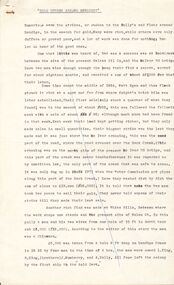
... ... Mr Ankle...John O'C Hattam Eaglehawk Police Station Mr W Perry Log Lock-ups John Fry Charles Fry Bendigo Advertiser 30/3/1949 Alex H Stone Bendigo Advertiser 20/41949 Milburn's Coffee Palace Shell Service Station Bridge Street Methodist Church Mr Don Hargreaves Bendigo Historical Society Newsletter Mr Buzza Mr Ankle Mr Foote Mr Scales Mr Bull Mr Mutton Mr Body Mr Satori Mr Tankard Mr Punch Mr Snowball Mr Sweet Mr Goody Mr Pallett Mr Frame Mr Henry Jones Bendigo Advertiser Centenary of Bendigo Supplement 1951 Sir John Quick A W Llewelyn Australian Natives Association Friendly Society Virginia Battery Commonwealth Parliament Federation League Mr Alfred Deakin Mr D'Esterre Taylor Mr Peacock Mr Barret Mr George Reid Corowa Conference 1893 Poet Gay Bendigo Cemetery Centenary History ANA 1871-1971 John E Menadue Typed and hand written notes on 'Gold Rushes around Bendigo', Eaglehawk Police Station, Bells In and Around Bendigo, Bendigo Historical Society Newsletter, Mr Henry Jones - Gold Buyer, and Sir John Quick. ...Typed and hand written notes on 'Gold Rushes around Bendigo', Eaglehawk Police Station, Bells In and Around Bendigo, Bendigo Historical Society Newsletter, Mr Henry Jones - Gold Buyer, and Sir John Quick. Gold Rushes Around Bendigo tells of some gold finds around Bendigo. Eaglehawk Police Station tells of the Building of the Log Lockups at Eaglehawk and White Hills and where the idea came from. Also the cost of building and source of logs. Bells In and Around Bendigo tell of a tram employee ringing a bell and shouting to all that the tram terminus at the Railway Station was discontinued. When this was sufficiently known the bell went to the Bridge Street Methodist Church. The BHS Newsletter mentions business men's names and connection with their trade. Mr Henry jones - Gold Buyer mentions where his office was and that you could buy gold and money could be exchanged as well. Sir John Quick page tells of the early life of Sir John Quick and his self-education, of the A. N. A. opening in Victoria.document, names of bendigo pioneers, bendigo goldfields, gold rushes around bendigo, caltex oil co, matt egan, thos fleck, knight's brick kiln, water commission, work shops, l king, r king, j mumberry, a kelly, 'auld dart', robert fallon, mrs jane stinton, joch, vol 1 gold nuggets literary society files (manuscript written 1852-1882.), john o'c hattam, eaglehawk police station, mr w perry, log lock-ups, john fry, charles fry, bendigo advertiser 30/3/1949, alex h stone, bendigo advertiser 20/41949, milburn's coffee palace, shell service station, bridge street methodist church, mr don hargreaves, bendigo historical society newsletter, mr buzza, mr ankle, mr foote, mr scales, mr bull, mr mutton, mr body, mr satori, mr tankard, mr punch, mr snowball, mr sweet, mr goody, mr pallett, mr frame, mr henry jones, bendigo advertiser centenary of bendigo supplement 1951, sir john quick, a w llewelyn, australian natives association, friendly society, virginia battery, commonwealth parliament, federation league, mr alfred deakin, mr d'esterre taylor, mr peacock, mr barret, mr george reid, corowa conference 1893, poet gay, bendigo cemetery, centenary history ana 1871-1971, john e menadue -
 The Beechworth Burke Museum
Postcard, c. Early 1900s
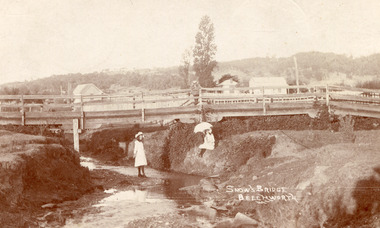
... ankle length styles which were acceptable for adult women. We can also see an example of early bridge construction and engineering, notably made from timber rather than from stone or steel, noted in the postcard as Snow's Bridge. Bridge Beechworth Snow's Bridge Children Childhood Postcard Obverse: Snow's Bridge/Beechworth Reverse: Dear Julie/ I received your pretty PB/ We haven't gone away yet. Mr ...Taken in the early 1900s, the postcard depicts two girls dressed in old style, white knee length dress which was common for this period for young women. This compared to the ankle length styles which were acceptable for adult women. We can also see an example of early bridge construction and engineering, notably made from timber rather than from stone or steel, noted in the postcard as Snow's Bridge. Sepia rectangular postcard printed on card Obverse: Snow's Bridge/Beechworth Reverse: Dear Julie/ I received your pretty PB/ We haven't gone away yet. Mr Stokes/ asked me were you going to be/ married. He wished you luck/ (I wonder/ if he meant it.) We sent the Magpie to Annie to-day. I haven't got any/ word about going to a [unknown]/ yet. We had a great Friendly Societies/ day yesterday but it rained a bit/ Sally is going to get a [illegible] silk/ dress. When are you to be married?/ Mr Pounceby is back at Allen's shop./ [unknown]. We are going to Belle's for a [unknown] if we can. With Love from Lilly. bridge, beechworth, snow's bridge, children, childhood, postcard -
 Bendigo Military Museum
Footwear - FLYING BOOTS, RAAF
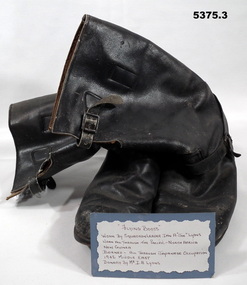
... Mr I. A. Lyons' .1) and .2) Pair of black leather calf length RAAF flying boots with leather sole and rubber heel. each boot is lined with soft brown leather with remnants of sheep wool attached to the right boot (.1). A buckle and strap at the ankle ...Part of the Flight Lieutenant Ian A. 'Joe' Lyons MBE Collection. See catalogue No 5374P for his service record..1) and .2) Pair of black leather calf length RAAF flying boots with leather sole and rubber heel. each boot is lined with soft brown leather with remnants of sheep wool attached to the right boot (.1). A buckle and strap at the ankle and calf height secure each boot when wearing. .3) Handwritten card with details of the boots' provenance..3) Handwritten in black ink: ' FLYING BOOTS. Worn by Squadron Leader Ian A. 'Joe' Lyons. Worn all through the Pacific - North Africa - New Guinea - Borneo - All through Japanese Occupation, 1942 Middle East. Donated by Mr I. A. Lyons'uniform, footwear, flying boots, flight lieutenant ian a. lyons -
 Bendigo Military Museum
Mixed media - REMEMBRANCE NOTICES 38th BN, Post 12.8.1918
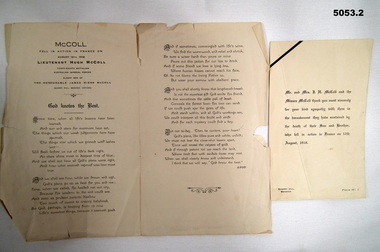
... Ankle, rejoin unit 28.4.1918, KIA 12.8.1918. Remembrance 38th Bn C Coy .1) Folding paper, nothing on the outside, inside two pages relating to the death of Hugh McColl 38th BN, page 1 has details re Hugh McColl and family followed by a five verse poem. .2) Folding paper nothing on inside, front has a black stripe across top RH corner, enscription re Mr & Mrs McColl and daughter thanking those for their sympathy on the loss of their sone Hugh. ...Hugh McColl. Hugh had pre war service in the local Bendigo 67th BN and reached the rank of 2nd Lieutenant. Enlisted 1.3.1916 in A Coy 38th BN then transfer to C Coy on 1.5.1916, embark for England 20.6.1916, promoted to Lieutenant 19.8.1916, hospital sick 21.11.1916 (unclear), embark for France 21.5.1917, WIA 12.10.1917 Bomb Concussion, rejoin unit 22.11.1917, hospital 14.3.1918 Defective Vision, rejoin unit 16.3.1918, hospital 7.4.1918 Sprained Ankle, rejoin unit 28.4.1918, KIA 12.8.1918..1) Folding paper, nothing on the outside, inside two pages relating to the death of Hugh McColl 38th BN, page 1 has details re Hugh McColl and family followed by a five verse poem. .2) Folding paper nothing on inside, front has a black stripe across top RH corner, enscription re Mr & Mrs McColl and daughter thanking those for their sympathy on the loss of their sone Hugh.remembrance, 38th bn, c coy -
 Bendigo Military Museum
Photograph - PHOTOGRAPH & POSTCARDS, 2) 17/02/1916
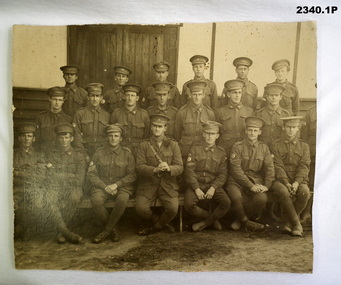
... Mr & Mrs DILLON from Pte. J. BURKE No. 3477 21st Batt. A.I.F", dated 17/02/1916. .3)-.10) These are "Daily mail official war pictures". Series 18. Albert Boldiston No 747 enlisted in the AIF in reinforcements 7 Anzac Cyclist Batt on 2.11.1916 age 24 years. Embarked for England 16.12.1916, transfer to 8th Batt 7.3.1917, embark for France 14.6.1917, transfer to 37th Batt 29.6.1917, hospital accidental injury (sprained ankle...Mr & Mrs DILLON from Pte. J. BURKE No. 3477 21st Batt. A.I.F", dated 17/02/1916. .3)-.10) These are "Daily mail official war pictures". Series 18. Albert Boldiston No 747 enlisted in the AIF in reinforcements 7 Anzac Cyclist Batt on 2.11.1916 age 24 years. Embarked for England 16.12.1916, transfer to 8th Batt 7.3.1917, embark for France 14.6.1917, transfer to 37th Batt 29.6.1917, hospital accidental injury (sprained ankle ....1) Albert BOLDISTON, No. 747 enlisted 02/11/1916 ANZAC cyclist Batt. then 37th Bn. Discharged 29/01/1919. .2) Letter is to "Mr & Mrs DILLON from Pte. J. BURKE No. 3477 21st Batt. A.I.F", dated 17/02/1916. .3)-.10) These are "Daily mail official war pictures". Series 18. Albert Boldiston No 747 enlisted in the AIF in reinforcements 7 Anzac Cyclist Batt on 2.11.1916 age 24 years. Embarked for England 16.12.1916, transfer to 8th Batt 7.3.1917, embark for France 14.6.1917, transfer to 37th Batt 29.6.1917, hospital accidental injury (sprained ankle) 5.7.1917, rejoin unit 10.9.1917, hospital 18.11.1917 with Trench Feet, rejoin unit 13.6.1918, WIA 10.8.1918 GSW left wrist (through the joint) return to Australia 20.10.1918, discharged from the AIF 29.1.1919. Joseph Martin Burke No 3477 enlisted in the AIF in 8th reinforcements 21st Batt on 16.7.1915 age 21 years 4 months. Embark for Egypt 29.12.1915, transfer to 60th Batt 26.2.1916, then 57th 21.3.1916, then 13th FAB (Artillery) 27.3.1916, embark for France 16.6.1916, transfer to 25th FAB 9.7.1916 then 13th FAB 24.1.1917, hospital England while on leave 29.10.1918 with Influenza, return to Australia 21.12.1918 re the Influenza for discharge, discharged from the AIF 21.3.1919..1) Photo, B&W on cardboard, group of soldiers (20) seated outside building. Albert BOLDISTON is on 2nd left front row. .2) Postcard photo, B&W, soldier in peak cap standing. Letter on rear in ink from J.M. BURKE. .3) Postcard photo, B&W featuring "King George" in a gun pit. .4) Postcard photo, B&W featuring "Australian heavy gun at work". .5) Postcard photo, B&W featuring "Australians loading a trench mortar". .6) Postcard photo, B&W showing a camouflaged troopship. .7) Postcard photo, B&W, soldier keeping a lookout in trench. .8) Postcard photo, B&W showing "An observation balloon". .9) Postcard photo, B&W showing wounded waiting for the field ambulance. .10) Postcard photo, B&W showing "Australian gunners at work". .11) Card, yellow with black print both sides relating to a 37th Batt. 1st & 2nd A.I.F reunion "Whippbang 1950"..5) "Troopship in port".photography-photographs, military history - army -
 Bendigo Historical Society Inc.
Document - MENU - RETIREMENT DINNER FOR H TREGANOWAN, 17/12/1918
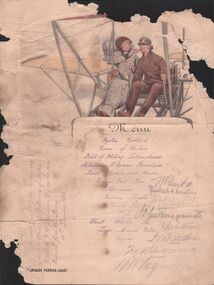
... Mr. H. Treganowan Esq. on his retirement from the Board. 17th December, 1918. At the top of the menu is a drawing of open cabin part of an airplane with a lady and a gentleman in it. He is wearing a brown suit and shoes with a grey cap and holding the controls of the aircraft. The lady is wearing an ankle...Mr. H. Treganowan Esq. on his retirement from the Board. 17th December, 1918. At the top of the menu is a drawing of open cabin part of an airplane with a lady and a gentleman in it. He is wearing a brown suit and shoes with a grey cap and holding the controls of the aircraft. The lady is wearing an ankle ...Dinner tendered by the Members and Executive Officers of the Board of Public Health to Mr. H. Treganowan Esq. on his retirement from the Board. 17th December, 1918. At the top of the menu is a drawing of open cabin part of an airplane with a lady and a gentleman in it. He is wearing a brown suit and shoes with a grey cap and holding the controls of the aircraft. The lady is wearing an ankle length grey & white check suit with black collar and cuffs and a brown hat. She is holding a bottle in one hand and is holding a glass up to the man and giving him a drink from it. The menu is under this drawing. There are some autographs beside the menu. Some of the readable names are E Robertson and Treganowan.event, social, retirement, menu, retirement dinner for h treganowan, board of public health, e robertson -
 Southern Sherbrooke Historical Society Inc.
Photograph, Alice and Tom Breen's wedding
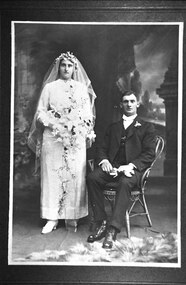
... ankle-length dress with high neck and full-length sleeves. She has a knee-length veil with a floral headpiece and is holding a large bouquet. Her hoes have a small curved heel. Mr...ankle-length dress with high neck and full-length sleeves. She has a knee-length veil with a floral headpiece and is holding a large bouquet. Her hoes have a small curved heel. Mr ...Black and White formal wedding portrait. Mrs Alice Breen stands on the left wearing an ankle-length dress with high neck and full-length sleeves. She has a knee-length veil with a floral headpiece and is holding a large bouquet. Her hoes have a small curved heel. Mr Tom Breen is seated on a wicker chair. He is wearing a dark 3-piece suit, a shirt with a high collar, study lace-up shoes and he holds a pair of white gloves. They are in a photographer's study. Both look solemnly at the camera. -
 Surrey Hills Historical Society Collection
Photograph, Richard and Annie Bate at 'Camelford', 7 Norris Street, Surrey Hills, c1914/1915
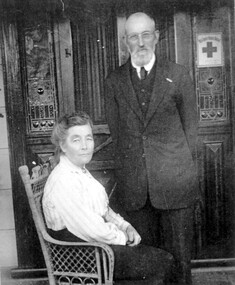
... Mr Richard bate Mrs Annie bate norris street house names camelford avondale union road box hill shire hall builders Ms Julie ellis davies family annie matilda bate richard alfred bate frederic george bate burwood cemetery jack bate A black and white photocopy of a photograph of a man dressed in a suit, standing beside a lady, seated, wearing a long sleeved, light coloured blouse and a long ankle length skirt. ...Photo was taken in front of the front door of 'Camelford', 7 Norris Street. The presence of the red cross suggests that it was taken during the First World War. Two of the couples' surviving sons served in the war - Frederic George Bate (SERN 1945); Richard Alfred Bate (SERN 695); the third was rejected because he had lost a finger in an accident. Richard Bate came to Australia in 1868 from Cornwall - the house was named after the town there. He was a cabinetmaker and settled in Angaston, SA for a year before coming to Melbourne where he worked as a builder. He built ‘Avondale’, 176 Union Road (dem.) circa 1883 as a display home for the Davies family, subdividers of the first land auction in Surrey Hills. He built many houses including his retirement home at 7 Norris Street (demolished after 2000). In the 1880s Richard also built the Shire Hall in Station Street Box Hill, replaced in 1934 by the Box Hill Town Hall. Two of his sons were also carpenters. Richard died in 1937 aged 93 and his wife Annie Matilda died in 1935 aged 83; both are buried in Burwood Cemetery. House was rented out until probate was settled. Occupied in 2000 by Julie Ellis. REF: Letter to Julie Ellis from Jack Bate of Mildura, grandson of Richard and Annie Bate, dated 29/2/2000.A black and white photocopy of a photograph of a man dressed in a suit, standing beside a lady, seated, wearing a long sleeved, light coloured blouse and a long ankle length skirt. They are in front of a front door with lead light windows.mr richard bate, mrs annie bate, norris street, house names, camelford, avondale, union road, box hill shire hall, builders, ms julie ellis, davies family, annie matilda bate, richard alfred bate, frederic george bate, burwood cemetery, jack bate -
 Surrey Hills Historical Society Collection
Photograph, Surrey Hills Bowling Club opening in 1912, 1912
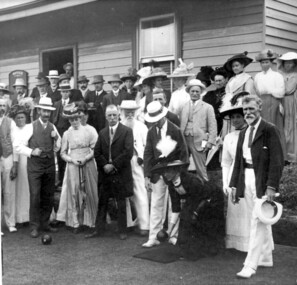
... Some information from Mrs Merle Phillips (deceased) a member when the club closed. mont albert road wilson street surrey hills montrose street surrey hills bowling club 1912 clothing and dress mr james albon mr john kendrick blogg "SHBC 1912" A black and white photograph of a group of men and women dressed in their finery. The ladies and men are wearing hats and most men in 3 piece suits. One lady is in position to roll a bowl. The women's dresses are all ankle ...James Albon, far right, built a bowling green at his home on the corner of Mont Albert Road and Wilson Street (later occupied by the convent). This green was so popular with his friends that he organised the formation of a bowling club at the corner of Montrose and Wilson Streets. Mr John Kendrick Blogg, wearing the white hat, is standing in the doorway. Earliest club records date from 1916. This was the original club-house; it was rebuilt in 1922/23 using interlocking blocks as recommended by Walter Burley-Griffin. This was quite an innovative design at the time. In turn cream brick buildings replaced this building in the 1950s. The Surrey Hills Bowls Club disbanded in 1995. Our original is framed copy donated by the Surrey Hills Bowls Club (with a spare copy and negative). Someone from the club has the original. Thre is also a frames portrait of James Albon the 1st president in the collection. (NB/ Duplicate = 1813; No.1943 is from the Bowling Club). Some information from Mrs Merle Phillips (deceased) a member when the club closed.A black and white photograph of a group of men and women dressed in their finery. The ladies and men are wearing hats and most men in 3 piece suits. One lady is in position to roll a bowl. The women's dresses are all ankle length."SHBC 1912"mont albert road, wilson street, surrey hills, montrose street, surrey hills bowling club, 1912, clothing and dress, mr james albon, mr john kendrick blogg -
 Linton and District Historical Society Inc
Photograph, Richards and Co, Ballarat, Mr and Mrs Harry O'Beirne, wedding photo 1919
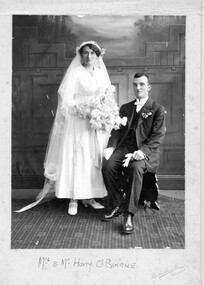
... Mr and Mrs Harry O'Beirne". Sepia photograph of man wearing suit with buttonhole, seated with hands on knees, at left of young woman in ankle length bridal outfit and long veil, white shoes holding large bouquet of flowers. ...Henry (Harry) O'Beirne married Julia Ann Porter on 28th May 1919 at St Mary's Church, Smythesdale.Sepia photograph of man wearing suit with buttonhole, seated with hands on knees, at left of young woman in ankle length bridal outfit and long veil, white shoes holding large bouquet of flowers."Mr and Mrs Harry O'Beirne".henry (harry) o'beirne, julia porter, weddings -
 Bacchus Marsh & District Historical Society
Photograph, Peter Murray Bootmaker, Bacchus Marsh, 1883
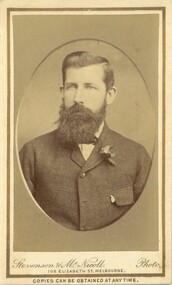
... Mr. Murray was active in the local community, and was a Councillor on his death. He was also the local Electoral Registrar. His death may have been hastened as a result of a serious accident in 1893 when he fell heavily and broke his right leg above the ankle, which necessitated the removal of a protruding portion of bone. ...Mr. Murray was active in the local community, and was a Councillor on his death. He was also the local Electoral Registrar. His death may have been hastened as a result of a serious accident in 1893 when he fell heavily and broke his right leg above the ankle, which necessitated the removal of a protruding portion of bone. ...This portrait was taken during the visit of Stevenson & McNicoll to Bacchus Marsh September-November 1883. It is probable that they used the silver albumen process. The subject of the portrait is Peter Murray, bootmaker, who set up his business in Bacchus Marsh at 181 Main Street in 1872. In 1889 he added an extension to his dwelling. In later years, Mrs Murray advertised Board and Lodging at "Murri House", in premises adjoining the shop and dwelling. Mr. Murray was active in the local community, and was a Councillor on his death. He was also the local Electoral Registrar. His death may have been hastened as a result of a serious accident in 1893 when he fell heavily and broke his right leg above the ankle, which necessitated the removal of a protruding portion of bone. He was taken by train to the Melbourne Hospital, accompanied by Dr Vance and a number of his neighbours. He made a recovery and in 1904 hosted a meeting of the local Quoit Club. On 14th June 1908 Peter Murray died at his home in Main Street Bacchus Marsh. He had been suffering from Brights disease for about 6 months. He was aged 65 at the time of his death. His first wife had predeceased him. His second wife, Margaret survived him. Later in 1908, Mr. W. Bullock advertised that he had taken over the business of the late Mr. P. Murray.The Melbourne photographers Stevenson & McNicoll visited the Bacchus Marsh district in 1883. They took photographs of many local families and individuals in front of their houses or businesses. More than 50 of these images were preserved by the Hawkins family of Bacchus Marsh and passed to a granddaughter of that family Mrs Beryl Jeremeas who donated those images to the Bacchus Marsh and District Historical Society in 1973. Stevenson & McNicoll are known to have taken numerous studio portrait photographs of Bacchus Marsh people. This was probably the larger part of their work. However very few of these images have been acquired by local historical societies. This image of Peter Murray is the only known example of one of the 1883 studio portraits of Bacchus Marsh residents produced by Stevenson & McNicoll. It is therefore particularly significant as a rare example of their portrait photography in the Bacchus Marsh area and beyond.A sepia coloured photograph on cardboard. Carte de Visite size. Portrait in an oval frame of a young man with full beard and moustache. He is wearing a suit coat with breast pocket and a buttonhole arrangement on the lapel. On the front: Stevenson and McNicoll. Photo. 108 Elizabeth St, Melbourne. Copies can be obtained at any time. On the Back: Logo of the rising sun with the words LIGHT & TRUTH on a banner. Copies of this portrait can be had at any time by sending the Name and Post Office Money Order or Stamps for the amount of order to Stevenson & McNicoll Late Benson & Stevenson, Photographers. 108 Elizabeth Street, Melbourne. By Hand in black Texta: PETER MURRAY BOOTMAKER. 1883 In ink (faded) : Pete Murray In biro: Courtesy C. McFarlane bootmakers, stevenson and mcnicoll 1883 photographs of bacchus marsh and district, stevenson and mcnicoll photographers, dr vance, murri house, early surgery, peter murray bootmaker bacchus marsh 1843-1908 -
 City of Melbourne Libraries
Photograph, Bull, Hugh Jones, 1897-1993, Tennis player, Dorothy Round, Albert Grounds, Melbourne
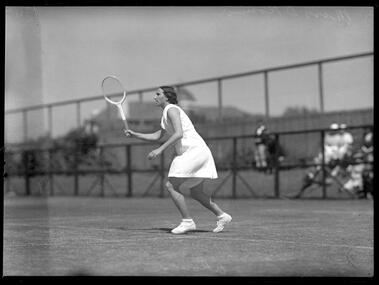
... British player Henry “Bunny” Austin was the first top male player to wear shorts at Centre Court Wimbledon in 1933, and his sister Joan Lycett nee Austin became the first female player to play without stockings on Centre Court, appearing with bare legs and ankle socks in 1931. In 1933 Mr Harley Malcolm, Secretary of the Lawn Tennis Association Australia (LTAA) and referee of big tournaments , said “the rules say regulation costume must be worn – I consider shorts are not regulation costume and would stop both men and women, particularly women, wearing them. ...British player Henry “Bunny” Austin was the first top male player to wear shorts at Centre Court Wimbledon in 1933, and his sister Joan Lycett nee Austin became the first female player to play without stockings on Centre Court, appearing with bare legs and ankle socks in 1931. In 1933 Mr Harley Malcolm, Secretary of the Lawn Tennis Association Australia (LTAA) and referee of big tournaments , said “the rules say regulation costume must be worn – I consider shorts are not regulation costume and would stop both men and women, particularly women, wearing them. ...Dorothy Round in shorts English-born Dorothy Round (1909-1982) plays tennis at Albert Park Cricket Ground, wearing her signature white sleeveless dress with divided skirt, pleated to form loose shorts. Dorothy won Wimbledon in 1934 and 1937, and the Australian Open in 1935. In the early 1930s, many women players in Europe and USA swapped stockings and long skirts for bare legs, short skirts and shorts. In October 1933, Mr Harley Malcolm, Secretary of Lawn Tennis Association Australia (LTAA) declared, “I consider shorts not regulation costume and would stop both men and women, particularly women, wearing them. I think women’s desire to strut themselves in such a costume is unreasonable.” However by November, the Victorian Lawn Tennis Association (VLTA) officially allowed shorts at Kooyong for both sexes. At the July 1934 Wimbledon Women’s Final, played in front of the King and Queen, Dorothy wore a sleeveless dress with the skirt divided. Her American competitor, Helen Jacobs, wore white tailored shorts with a black stripe on either side, described as “mannish, though businesslike”. In October, Australian tennis player Mrs Nell Hopman warned, “When Miss Dorothy Round arrives in a few weeks’ time, the LTAA will have to reconsider its decision about women playing in dresses, as she is sure to bring a trunkful of shorts. Miss Round has a “shorts only” rule which I fancy she will stick to here. She is the most stylish player I saw abroad.” The papers also reported that “Mrs Hopman saw no “he girls” among tennis players in Europe. Even the almost universal rule for shorts did not make them look masculine.” Dorothy said, “I wear shorts because they do not get in the way as a frock does. Mine are made in one piece and this avoids any tightness around the waist.” Featured in "Newsworthy: Melbourne in photographs 1933-1936" exhibition at East Melbourne Library, October to December 2023. Exhibition caption by project volunteer, Fiona Collyer. Photographer notations on slide: "Mrs D Round; D Round B6" Description: Dorothy Round plays tennis at Albert Grounds, Albert Park, Melbourne. She is wearing her signature white sleeveless dress with divided skirt, pleated to form loose shorts. Research by project volunteer, Fiona Collyer: Dorothy Round (1909-1982) was an English tennis champion from Dudley, Worcestershire. She won the Wimbledon Women’s Singles in 1934 and 1937. In 1935 she won the Australian Championships Women’s Singles in Melbourne. Dorothy won the Mixed Doubles at Wimbledon in 1934, 1935 and 1936. Dorothy was a staunch Methodist and taught Sunday School at Dudley Wesleyan Methodist Church throughout her career. She did not drink, smoke, dance or play tennis on Sundays and declined to compete in the 1933 French Open as tennis officials refused to comply to her scheduling preferences of No Sundays. During the Wightman Cup in New York when play was rained out on the Saturday, Dorothy refused to return on the Sunday. Officials reluctantly agreed to reschedule the clash for Monday, where she put in a sub par performance, prompting the New York Times to quip “Miss Round doesn’t play on Sundays, and doesn’t play particularly well on Mondays!”. In the early 1930s many women tennis players in Europe and USA abandoned their stockings and long skirts for bare legs, short skirts and shorts and some men swapped their long flannel trousers for shorts. British player Henry “Bunny” Austin was the first top male player to wear shorts at Centre Court Wimbledon in 1933, and his sister Joan Lycett nee Austin became the first female player to play without stockings on Centre Court, appearing with bare legs and ankle socks in 1931. In 1933 Mr Harley Malcolm, Secretary of the Lawn Tennis Association Australia (LTAA) and referee of big tournaments , said “the rules say regulation costume must be worn – I consider shorts are not regulation costume and would stop both men and women, particularly women, wearing them. I think women’s desire to strut themselves in such a costume is unreasonable.” (Herald 5/10/1933) However, by November 1933 the Victorian Lawn Tennis Assn officially allowed shorts as regulation dress at Kooyong for both sexes. One speaker suggested that as the majority of women were knock-kneed, the privilege of wearing shorts would not be taken up extensively by them. He added that women were not intended by nature to wear such garments. Another member mentioned that men were rather handsome objects and “works of art” and would carry off the short pants vogue nicely. (Sun Sydney 15/11/33) At the 1934 Wimbledon Singles Finals, playing in front of King George V and Queen Mary, Dorothy wore her signature outfit of sleeveless white dress with the skirt divided and pleated to form loose shorts and American Helen Jacobs wore white tailored shorts with a black stripe on either side described as “mannish, though business like.” In the lead up to Dorothy’s arrival in Australia to compete in the Australian Championship of 1935, there was much speculation written in the press about Dorothy’s preference for wearing shorts. Tennis player Mrs Nell Hopman warned “When Miss Dorothy Round arrives in a few weeks’ time, the Australian Lawn Tennis Association will have to reconsider its decision about women playing in dresses, as she is sure to bring a trunkful of shorts.” “Miss Round has a “shorts only” rule which I fancy she will stick to here. She is the most stylish player abroad.” Mrs Hopman saw no “he girls” among the tennis players in Europe. Even the almost universal rule for shorts did not make them look masculine. Mrs Hopman brought back a couple of pleated pairs that tennis player and designer Mrs Fearnley-Whittingstall (nee Eileen Bennett) made popular and worn by most English players. “They are really quite radical for they look no more startling than a short, pleated skirt” she said. (Newcastle Sun 1/10/1934) Writing for the Sydney Morning Herald 6/12/34, Dorothy said ”I have heard that a photograph of a player wearing shorts was sent to the Queen for her approval and I understand that she said in reply “that they were very attractive”. The Queen is a frequent and interested visitor to Wimbledon so this story is most credible and possibly explains the lack of official opposition to shorts this year.” “I wear shorts because they do not get in the way as a frock does. You have probably noticed that mine are made in one piece and this avoids any tightness around the waist. I don’t know whether shorts have come to stay. They do not suit everybody and the majority of the men don’t like the women in them and this may help condemn the fashion. I really think the men dislike them because too many people who shorts obviously do not suit rushed to be in the fashion and the result was devastating. For my part, I hope that this comfortable fashion endures.” Dorothy’s doubles partner, English tennis champion Fred Perry, did not approve of shorts for men and was particularly perturbed at the idea of women wearing them. Fred always wore long, white flannel trousers and white collared polo shirt on the tennis court. In July 1935 Dorothy took up a post as a dress designer and sportswear design advisor at British outfitters Jaeger. She published two books – “Modern Lawn Tennis” in 1935 and ”Tennis for Girls” in 1938 – described as cheerful and sensible guides. In 1937, Dorothy married Dr Douglas Leigh Little at Dudley Wesleyan Methodist Church. Her wedding dress was designed by renowned fashion designer Teddy Tinling who specialised in designing tennis dresses. (Tinling designed the dress worn by Billie Jean King for the famous “Battle of the Sexes” tennis match against Bobby Riggs in 1973.) News reel co. Gaumont British News filmed the wedding, showing 10,000 people, mostly women, surging towards the couple, describing it as a riot, and quipping that Dorothy’s forehand was useful when cutting the wedding cake. The city of Dudley gifted the couple an antique walnut bedroom suite chosen by them. Dorothy and Douglas had a son, Ian, and a daughter, Patricia. She gave up competitive tennis to coach and write newspaper articles. In later life she took up golf. Dorothy died of cancer in 1982 aged 73. She was inducted into the International Tennis Hall of Fame 1986. In 2004 a bronze bust of Dorothy was installed at Wimbledon, and in 2013 a life size bronze statue was erected at Priory Park, Dudley. References: MRS. HOPMAN RETURNS (1934, October 1). The Newcastle Sun (NSW : 1918 - 1954), p. 9. Retrieved September 20, 2023, from http://nla.gov.au/nla.news-article166292409 FIGURED IT OUT (1933, November 15). The Sun (Sydney, NSW : 1910 - 1954), p. 13 (FINAL EXTRA). Retrieved September 20, 2023, from http://nla.gov.au/nla.news-article230199908 FASHIONS OF THE TENNIS COURTS. (1934, December 6). The Sydney Morning Herald (NSW : 1842 - 1954), p. 7 (Women's Supplement). Retrieved September 20, 2023, from http://nla.gov.au/nla.news-article28021332 Leading Tennis Referee Condemns Wearing of Shorts (1933, October 5). The Herald (Melbourne, Vic. : 1861 - 1954), p. 11. Retrieved September 20, 2023, from http://nla.gov.au/nla.news-article243193607 DOROTHY ROUND Chooses Going-Away TROUSSEAU (1937, September 4). The Australian Women's Weekly (1933 - 1982), p. 39. Retrieved September 20, 2023, from http://nla.gov.au/nla.news-article51588090 Ban On Shorts For Tennis Girls? (1934, April 15). The Sun (Sydney, NSW : 1910 - 1954), p. 3. Retrieved February 5, 2024, from http://nla.gov.au/nla.news-article230535547 Dorothy Round Little - one of Britain's greatest champions, 13 September 2009, Tennis Forum, https://www.tennisforum.com/threads/dorothy-round-little-one-of-britains-greatest-champions.409612/Photographer notations on slide: "Mrs D Round; D Round B6".tennis, clothing and dress, 1930-1939
