
Showing 34 items matching " mr j best"
-
 Bendigo Historical Society Inc.
Document - ANCIENT ORDER OF FORESTERS NO. 3770 COLLECTION: JOHN G. EDWARDS
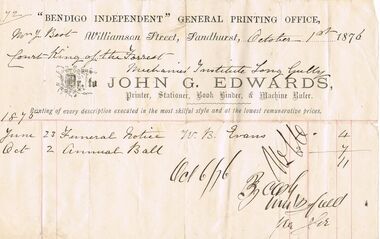
... ... Mr J Best...Edwards Bendigo Independent General Printing Office Mr J Best Court King of the Forest Mechanics' Institute zjohn G Edwards W B Evans Account from John G. ...Account from John G. Edwards, Printer. 'Bendigo Independent' General Printing Office, dated October 1st 1876 for Funeral Notice June 23 1875 for W. B. Evans 4/- and Oct 2 1875 Annual Ball 7/-. Marked paid Oct 6/76.societies, aof, correspondence, ancient order of foresters no. 3770 collection - john g. edwards, bendigo independent general printing office, mr j best, court king of the forest, mechanics' institute, zjohn g edwards, w b evans -
 Ringwood and District Historical Society
Certificate, Oliver, Thomas, Ringwood & District Horticultural Society Show First Prize Certificate - 1899, March, 1899
... First Prize Mr J. Hewish Best 6 swede turnips" +Additional Keywords: Oliver, Thomas, Lilydale / Hewish, J / Hall, C.D. ...First Prize Mr J. Hewish Best 6 swede turnips" +Additional Keywords: Oliver, Thomas, Lilydale / Hewish, J / Hall, C.D. ...1 of 5 certificates belonging to J. HewishWhite cardboard certificate with gold printing from "Ringwood & District Horticultural Society. Third Show held on Tuesday March 14, 1899. First Prize Mr J. Hewish Best 6 swede turnips" +Additional Keywords: Oliver, Thomas, Lilydale / Hewish, J / Hall, C.D. (Pres) / Williams, George A. (Sec)as above -
Ringwood and District Historical Society
Certificate, Hodges, E F G "Reporter" Offices, Ringwood & District Horticultural Society Show First Prize Certificate - 1901, March 12 1901
... First Prize Mr J. Hewish. Best 3 heads of cabbage. Class B, Section 10. ...First Prize Mr J. Hewish. Best 3 heads of cabbage. Class B, Section 10. ...As in Brief Description. 1 of 5 certificates belonging to J. Hewish.Pink coloured cardboard certificate with gold lettering: Ringwood & District Horticultural Society, Fifth Show held on Tuesday March 12, 1901. First Prize Mr J. Hewish. Best 3 heads of cabbage. Class B, Section 10. +Additional Keywords: Hewish, J / Thatcher, H (Pres) / McComas, A.E. (Sec) / Hodges, E.F.G. "Reporter" Offices, Box Hill.as above -
 Flagstaff Hill Maritime Museum and Village
Letter
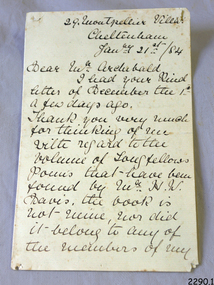
... best known shipwrecks in Victoria’s history. Flagstaff Hill Warrnambool Shipwrecked coast Flagstaff Hill Maritime Museum Maritime Museum Shipwreck coast Flagstaff Hill Maritime Village Great Ocean Road Loch Line LOCH ARD Captain Gibbs Eva Carmichael Tom Pearce Glenample Station Mutton Bird Island LOCH ARD Gorge loch ard survivor’s letter eva carmichael longfellow’s poems warrnambool mechanics institute museum joseph archibald henry davis The copies include the reproduction of a typed index card which accompanies the original letter. The card states: “Photographic copy of the letter written by Eva Carmichael to Mr J ...This original letter was handwritten and dated 21 January 1884. The author is Eveline V. Carmichael, of 29 Montpellier Villa, Cheltenham. Eva Carmichael was the only woman survivor of the iron clipper LOCH ARD, which was wrecked on 1 June 1878, at the subsequently named Loch Ard Gorge near Port Campbell. The letter was written to Mr J Archibald, first curator of the Warrnambool Mechanics Institute Museum, and was in response to a letter he wrote to Miss Carmichael on 1 December 1883. A complete transcript of Eva’s letter is attached as a Hard Copy Supplementary File. The letter first addressed the subject of her reply. She writes, “Thank you very much for thinking of me with regard to the volume of Longfellows Poems that have been found by Mr HW Davis [at Loch Ard Gorge], the book is not mine, nor did it belong to any members of my family. We had a ‘Longfellows’, but our book had a green cover.” The rescued book is on display at Flagstaff Hill (541) and has a blue cover. Another interesting aspect to her letter is its reference to the only other survivor from the LOCH ARD. As a postscript she writes, “You will be glad to hear that Tom Pearce is now on board the HMS Solvent. I heard from him last month he wrote from the West-Indies and seemed well and in good spirits. I have not seen him since we parted in Melbourne. I believe he is to be married next year, or perhaps this, but I do not know the young lady.” Tom Pearce was the young, male, able seaman who had risked his life to save her. In the months after the shipwreck, an excited public press speculated of a romantic connection between the two survivors, but this was clearly not the case. HISTORY OF THE LOCH ARD The LOCH ARD belonged to the famous Loch Line which sailed many ships from England to Australia. Built in Glasgow by Barclay, Curdle and Co. in 1873, the LOCH ARD was a three-masted square rigged iron sailing ship. The ship measured 262ft 7" (79.87m) in length, 38ft (11.58m) in width, 23ft (7m) in depth and had a gross tonnage of 1693 tons. The LOCH ARD's main mast measured a massive 150ft (45.7m) in height. LOCH ARD made three trips to Australia and one trip to Calcutta before its final voyage. LOCH ARD left England on March 2, 1878, under the command of Captain Gibbs, a newly married, 29 year old. She was bound for Melbourne with a crew of 37, plus 17 passengers and a load of cargo. The general cargo reflected the affluence of Melbourne at the time. On board were straw hats, umbrella, perfumes, clay pipes, pianos, clocks, confectionary, linen and candles, as well as a heavier load of railway irons, cement, lead and copper. There were items included that intended for display in the Melbourne International Exhibition in 1880. The voyage to Port Phillip was long but uneventful. At 3am on June 1, 1878, Captain Gibbs was expecting to see land and the passengers were becoming excited as they prepared to view their new homeland in the early morning. But LOCH ARD was running into a fog which greatly reduced visibility. Captain Gibbs was becoming anxious as there was no sign of land or the Cape Otway lighthouse. At 4am the fog lifted. A man aloft announced that he could see breakers. The sheer cliffs of Victoria's west coast came into view, and Captain Gibbs realised that the ship was much closer to them than expected. He ordered as much sail to be set as time would permit and then attempted to steer the vessel out to sea. On coming head on into the wind, the ship lost momentum, the sails fell limp and LOCH ARD's bow swung back. Gibbs then ordered the anchors to be released in an attempt to hold its position. The anchors sank some 50 fathoms - but did not hold. By this time LOCH ARD was among the breakers and the tall cliffs of Mutton Bird Island rose behind the ship. Just half a mile from the coast, the ship's bow was suddenly pulled around by the anchor. The captain tried to tack out to sea, but the ship struck a reef at the base of Mutton Bird Island, near Port Campbell. Waves broke over the ship and the top deck was loosened from the hull. The masts and rigging came crashing down knocking passengers and crew overboard. When a lifeboat was finally launched, it crashed into the side of LOCH ARD and capsized. Tom Pearce, who had launched the boat, managed to cling to its overturned hull and shelter beneath it. He drifted out to sea and then on the flood tide came into what is now known as LOCH ARD Gorge. He swam to shore, bruised and dazed, and found a cave in which to shelter. Some of the crew stayed below deck to shelter from the falling rigging but drowned when the ship slipped off the reef into deeper water. Eva Carmichael had raced onto deck to find out what was happening only to be confronted by towering cliffs looming above the stricken ship. In all the chaos, Captain Gibbs grabbed Eva and said, "If you are saved Eva, let my dear wife know that I died like a sailor". That was the last Eva Carmichael saw of the captain. She was swept off the ship by a huge wave. Eva saw Tom Pearce on a small rocky beach and yelled to attract his attention. He dived in and swam to the exhausted woman and dragged her to shore. He took her to the cave and broke open case of brandy which had washed up on the beach. He opened a bottle to revive the unconscious woman. A few hours later Tom scaled a cliff in search of help. He followed hoof prints and came by chance upon two men from nearby Glenample Station three and a half miles away. In a state of exhaustion, he told the men of the tragedy. Tom returned to the gorge while the two men rode back to the station to get help. By the time they reached LOCH ARD Gorge, it was cold and dark. The two shipwreck survivors were taken to Glenample Station to recover. Eva stayed at the station for six weeks before returning to Ireland, this time by steamship. In Melbourne, Tom Pearce received a hero's welcome. He was presented with the first gold medal of the Royal Humane Society of Victoria and a £1000 cheque from the Victorian Government. Concerts were performed to honour the young man's bravery and to raise money for those who lost family in the LOCH ARD disaster. Of the 54 crew members and passengers on board, only two survived: the apprentice, Tom Pearce and the young woman passenger, Eva Carmichael, who lost all of her family in the tragedy. Ten days after the LOCH ARD tragedy, salvage rights to the wreck were sold at auction for £2,120. Cargo valued at £3,000 was salvaged and placed on the beach, but most washed back into the sea when another storm developed. The wreck of LOCH ARD still lies at the base of Mutton Bird Island. Much of the cargo has now been salvaged and some was washed up into what is now known as LOCH ARD Gorge. Cargo and artefacts have also been illegally salvaged over many years before protective legislation was introduced. One of the most unlikely pieces of cargo to have survived the shipwreck was a Minton porcelain peacock - one of only nine in the world. The peacock was destined for the Melbourne International Exhibition in 1880. It had been well packed, which gave it adequate protection during the violent storm. Today, the Minton peacock can be seen at the Flagstaff Hill Maritime Museum in Warrnambool. From Australia's most dramatic shipwreck it has now become Australia's most valuable shipwreck artefact and is one of very few 'objects' on the Victorian State Heritage Register. The LOCH ARD shipwreck is of State significance – Victorian Heritage Number S417 Flagstaff Hill’s collection of artefacts from LOCH ARD is significant for being one of the largest collections of artefacts from this shipwreck in Victoria. It is significant for its association with the shipwreck, which is on the Victorian Heritage Register (VHR S417). The collection is significant because of the relationship between the objects, as together they have a high potential to interpret the story of the LOCH ARD. The LOCH ARD collection is archaeologically significant as the remains of a large international passenger and cargo ship. The LOCH ARD collection is historically significant for representing aspects of Victoria’s shipping history and its potential to interpret sub-theme 1.5 of Victoria’s Framework of Historical Themes (living with natural processes). The collection is also historically significant for its association with the LOCH ARD, which was one of the worst and best known shipwrecks in Victoria’s history. A photocopy of a letter, handwritten in ink on both sides of 4 small sheets of thick, light blue paper. The letter is in neat cursive script. The writing originally covered 7 sides of the note paper and has been reproduced as 7 separate pages. It is dated 21 January 1884, five and a half years after the LOCH ARD shipwreck. The letter is from Eva Carmichael, one of only 2 survivors from that disaster, and is addressed to J. Archibald, first curator of the Warrnambool Mechanics Institute Museum. The copies include the reproduction of a typed index card which accompanies the original letter. The card states: “Photographic copy of the letter written by Eva Carmichael to Mr J Archibald, first Curator of the Warrnambool Museum. The original letter is kept with other documents, but the writing being on both sides of the note-paper it was not possible to read in its entireity when on display”.flagstaff hill, warrnambool, shipwrecked coast, flagstaff hill maritime museum, maritime museum, shipwreck coast, flagstaff hill maritime village, great ocean road, loch line, loch ard, captain gibbs, eva carmichael, tom pearce, glenample station, mutton bird island, loch ard gorge, loch ard, survivor’s letter, eva carmichael, longfellow’s poems, warrnambool mechanics institute museum, joseph archibald, henry davis -
 Ringwood and District Historical Society
Book - Bibles, Collection of 6 Bibles - Maggs Family Collection, Ringwood, Victoria - 1908-1934
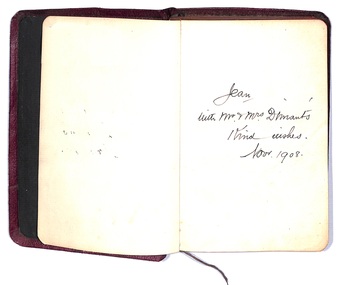
... Mr. and Mrs. Dimants good wishes Nov 1908. 26272-2 To my Dear Sister Evelyn Victoria Maggs with fond love and best wishes for her 13th. birthday from her loving sister Jane E. Maggs. Proverbs 3.6. 26272-3 To my beloved brother David J...Mr. and Mrs. Dimants good wishes Nov 1908. 26272-2 To my Dear Sister Evelyn Victoria Maggs with fond love and best wishes for her 13th. birthday from her loving sister Jane E. Maggs. Proverbs 3.6. 26272-3 To my beloved brother David J ...Bibles given as gifts to siblings or prizes from Sunday SchoolBibles belonging to various members of the Maggs Family. 1 . Jean 1908. 2 Evelyn victoria Maggs 1910. 3 David Maggs 21st. birthday. 4 Eva Maggs 1911. 5 Eva Maggs 1914. 6 Chrissie Maggs 1934. 26272-1 Jean with Mr. and Mrs. Dimants good wishes Nov 1908. 26272-2 To my Dear Sister Evelyn Victoria Maggs with fond love and best wishes for her 13th. birthday from her loving sister Jane E. Maggs. Proverbs 3.6. 26272-3 To my beloved brother David J Maggs as a gift of sincere love for his 21st. Birthday of the 31st. January 1908 from his affectionate sister Jean E. Maggs &. Proverbs 3.6 26272-4 Eva Maggs 2nd class Special Prize May 1911 26272-5 Eva Maggs Presented by her S.S. Super H. L Smythe 25-12-14 also to my dear Alison from Mother Armistice Day 11-11 30 26272-6 Presented to Chrissie Maggs from Mother 24-5-34 -
 Orbost & District Historical Society
cotton reels, first half 20th century
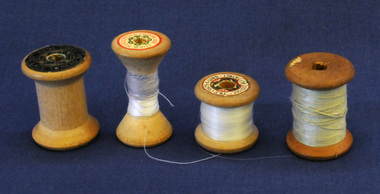
... Best Linen lace thread Barbours No 50 200 yards Wm Barbour & Sons Ltd Lisburn Ireland" 2495.2 is a wooden reel with thick linen thread. On one end " H11 underlined" 2495.3 is a narrow wooden reel with white thread and grey wound over it. It has paper labels at both ends. " J. & P. Coats 500 yards No 50 457 metres - Chain Brand Mercerised Cotton MR...Best Linen lace thread Barbours No 50 200 yards Wm Barbour & Sons Ltd Lisburn Ireland" 2495.2 is a wooden reel with thick linen thread. On one end " H11 underlined" 2495.3 is a narrow wooden reel with white thread and grey wound over it. It has paper labels at both ends. " J. & P. Coats 500 yards No 50 457 metres - Chain Brand Mercerised Cotton MR ...These cotton reels were owned and used by Helena Warren of Newmerella. Helena Francis Warren (nee McKeown) was married to William John Warren and lived in Newmerella. She was a fine amateur photographer who supplied the photos for the Back-To-Orbost celebration book in 1937 and also designed the Back-To-Orbost badge. She was known for her soft toy making. (by Ivy Rodwell in from Personalities and Stories of the Early Orbost District by Mary Gilbert).Helena Warren was a popular Orbost identity who was well known as an accomplished photographer and needleworker,Four wooden cotton reels. 2495.1 is an empty reel with paper labels at both ends. " Best Linen lace thread Barbours No 50 200 yards Wm Barbour & Sons Ltd Lisburn Ireland" 2495.2 is a wooden reel with thick linen thread. On one end " H11 underlined" 2495.3 is a narrow wooden reel with white thread and grey wound over it. It has paper labels at both ends. " J. & P. Coats 500 yards No 50 457 metres - Chain Brand Mercerised Cotton MR WHITE" 2495.4 is a wooden reel with synthetic thread - one paper label. "J. & P. Coats 6 Cord 200 yards 40 183 metres"needlework cotton-reels warren-helena -
 Mission to Seafarers Victoria
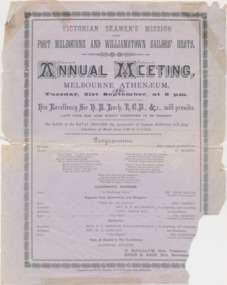
Flyer, Annual Meeting, 1886
... Stawell — and the result jof several years' experience fully justifies the statement that these institutions have supplied a felt want — the attendance of visitors reaching now about 30,000 per annum ; whilst so economically are they managed, that the annual cost to the public is less than L150 The thanks of the committee are specially due to those ladies and gentlemen who so kindly made a special and successful effort to supply both of the Bests with new piano fortes, to the great enjoyment of ' Jack ashore.' The instrument which was pre sented to the Port Melbourne institution by Mr. J...Stawell — and the result jof several years' experience fully justifies the statement that these institutions have supplied a felt want — the attendance of visitors reaching now about 30,000 per annum ; whilst so economically are they managed, that the annual cost to the public is less than L150 The thanks of the committee are specially due to those ladies and gentlemen who so kindly made a special and successful effort to supply both of the Bests with new piano fortes, to the great enjoyment of ' Jack ashore.' The instrument which was pre sented to the Port Melbourne institution by Mr. J ...The Annual Meeting presenting the Annual Report was held on the 21st of September 1886 at the Melbourne Athenaeum. In the Standard (Port Melbourne, Vic. : 1884 - 1914), Saturday 25 September 1886, page 2 VICTORIAN SEAMEN'S MISSION. This institution held its annual meeting in the Melbourne Athenæum on Tuesday evening under the most favourable auspices. The hall was filled in every part, a very large pro portion of the audience being seamen. The half hour previous to the com mencement of the meeting was very pleasantly occupied bv listening to the capital playing of the band of the Naval Brigade, and precisely at eight o'clock the musicians heralded the entrance of the vice-regal party by playing ' The National Anthem.' Sir Henry and Lady Loch were received by the Mayor of Melbourne (Mr. Stewart), the Hon. F. T. Derham, Captain Pasco, Mr. H. R. Reid (hon. secretary), and Lieutenant - Colonel Templeton, and His Excellency imme diately took the chair. The venerable ex-chaplain, the Rev. Kerr Johnson, was present, but as he did not feel equal to taking part in the proceedings, the Rev. E. T. Miles opened the meeting with prayer. Nothing could have been more cal culated to give a distinctive character to the meeting than the singing of the Sailors' Hymn by the 300 odd seamen present. The rugged yet tuneful voices of the men blending with those of the ladies present, who heartily joined in, gave a most spirit-stirring effect to the beautiful words of the refrain : — Rocks and streams I'll fear no more, When on that eternal shore; Drop the anchor ! furl the sail ! I am safe within the vail. Next followed His Excellency's address as chairman. The Governor threw himself heartily into the pro ceedings, and his remarks, expressive of the utmost sympathy with the sea men of the empire, were applauded to the echo. In fact from the start all the speakers struck the right key-note. The institution was not held up as a charity on which Jack was more or less dependent. According to the gentlemen who one and all welcomed him as a friend, and a right useful friend too, the thing was all the other way. To the sailor it was, they de clared, that they owed all that the colony possessed, and more — the great ness and prosperity of the Empire, He was the sort of man who never turned his back on a fellow creature, or refused to give a hand to a comrade in distress. Therefore it was deter mined that Jack should not come to these shores and think there were none to care for the comfort of his body or the welfare of his soul, and with the object of greeting the sailor on his arrival, of grasping his hand as a friend, beguiling his hours on shore, and saving him from the scores of dangers and temptations which beset a sea-faring man's stay in port, the institution had in '57 been started. Its claims on the Victorian public, not as a charity, but as a means of show ing some recognition of the services of the brave men who man our mercan tile marine, were ably put before the meeting. The Rev. G. D. Buchanan de clared that if the Melbourne merchants contributed to the mission a tithe of the amount they spent in insurance, they would find their goods better looked after by the seamen than by the insurance companies. Captain McCallum, the treasurer, read the following report of the com mittees of the Port Melbourne and Williamstown Rests : — In no part of the Queen's dominions have there been more changes during the last thirty years than in the colony bearing her gracious name ; and it is therefore all the more pleasant to report that the Victorian Mission to seamen, which started so long ago as 1857, still pursues an active career of usefulness, holding out a helping hand to mariners of all nations, without distinction of colour, race or creed. Eight years ago, some of the supporters of the Mission, feeling the want of a Temperance Club, where the crews of the various ships might recreate themselves and enjoy the three ' C's' — Coffee — Comfort — Company, appealed to the public for assistance, resulting in sufficient funds being obtained to justify the establishment of Sailors' Rests at Sandridge and Williamstown. Both these institutions were opened by a distinguished gentleman who has always taken a practical interest in sea men, and who, but for illness, would have been present at this meeting — Sir W. F. Stawell — and the result jof several years' experience fully justifies the statement that these institutions have supplied a felt want — the attendance of visitors reaching now about 30,000 per annum ; whilst so economically are they managed, that the annual cost to the public is less than L150 The thanks of the committee are specially due to those ladies and gentlemen who so kindly made a special and successful effort to supply both of the Bests with new piano fortes, to the great enjoyment of ' Jack ashore.' The instrument which was pre sented to the Port Melbourne institution by Mr. J. M. Bruce, on behalf of the sub scribers, the funds having been collected by his daughter yet in her teens, being espec ially one of great value. Concerts free to all seamen, given by amateur singers, are held weekly on both sides of the bay, and are largely attended and much appreciated. The building at Port Melbourne, which, being of wood, is merely of a temporary character, is free from debt ; but there is a mortgage of L500 on the Williamstown institution, which cripples its usefulness. The committee have regretfully to report that during the year under review they have lost, through the weakness of increas ing years, tbe loving services of the Rev. Kerr Johnston, their venerable friend and chaplain, whose life is, indeed, the history of the Mission, for he has been connected with it from the commencement of the work. Mr. Johnston has proved himself a true disciple of his Divine Master, and the com mittee trust that in the evening of his days he may enjoy that peace and rest which he lias so well earned. The com mittee presented Mr. Johnston, on retiring, with an honorarium of L100. Mr. E. James has been appointed iu Mr. JohuBton'u room, and the committee believe that their choice lias been a fortunate one. The Mission aud Sailors' Bests have been kept afloat by the unwearied and self -deny-ing exertions of the Ladies1 Committee, who have personally collected nearly the whole of the income ; but it may fairly be asked whether, in this great seaport, where last year there entered in at Her Majesty's Customs 1711 ships, manned by 61,256 men, the mercantile community of Melbourne should net take a more active interest in the welfare of the thousands of brave men who, for a few weeks, temporary sojourners on our shores, away from friends and relatives, have a special claim on our sympathy and help. We are of the old land, ' that gem sunk in the silver sea and we can re-echo Mr. Gladstone's recent words to the crew of the yacht Sunbeam, ' The calling which you follow is a noble one, and is calculated to bring forth the highest qualities of our common nature ; ana if it is possible for any occupation to make a man, in the highest and wideBt sense of the word, it is ' the occupation to which your lives are given. How closely it is connected with the the prosperity and fame of tbi» great nation ; how closely, indeed, it is connected with advancement of civilisation, and tiie general welfare of the world, it needs no words of mine to tell yon, for in your work and life you know it well, and feel it truly.' Look ing at what we Victorians owe to the British sailor, the committee earnestly trust that, with the blessings of the Almighty God, increased success will attend the work of the Mission and Rests. Mr. James read the chaplain's re port: — Since my appointment as chaplain to tbe Seamens' Mission, I have met with greater success than I anticipated. I have visited all the ships that have come into port, also many of the vessels on the Yarra, and am pleased with the civil and courteous manner in which I have been received by captains, officers and men, and in most cases my invitations to them to attend our meetings have been most heartily responded to. . The attendance at the services in the Bethel has much improved — on some occasions scarcely sitting room is to be found. The services have proved a great blessing to many Christian seamen ; whilst several who have come into port caring for nothing of a religious nature, have left praying. God fearing men, with the request that those left behind would remember them in their supplications, that they should be kept through all the trials and temptations to which seamen are exposed. The weekly Tuesday evening concerts got up bj the ladies of the committee and others, have proved a great benefit to the Mission, and a source of great enjoyment to the seamen in port. The programmes are excellent; and are spoken of by the sailors as the best they have heard in any port. The Sailors* Rest is provided with a library, the daily papers, and illustrated literature, with games of chess, draughts, dominoes, quoits, and other amusements, which are much taken advantage of during the evenings. Seamen ' are alio provided with writing materials, free, bo that everyone may have any opportunity of writing to their friends; for many an anxious parent is counting the days and hoping for .the time to come when they shall get a line from their sons in the far distant land, and many a son is reminded of his obligation by the opportunity thus afforded. I am much pleased at this time to acknowledge the kindness of the committee, and the great help I have received from them, also from Mr. Douglas, the manager of the Best. I do not think I could have been blest with a better co-worker. I have no hesitation in recommending the seamen to go to the Best, and telling them that they will receive a most hearty welcome, to which they can all testify ; my thanks are due to the voluntary workers, who have given every assistance ft their power, especially to Miss Lloyd, who is an invaluable help, attending in all weathers, and playing the organ at every service. The Sunday School is progressing, and we aie now about to make another addition to the library, of good readable books. The work at Williamstown is also pro gressing well, the Wednesday night concerts being well attended, and the singing and reciting supplied by local talent really good; the sailors contributing largely to the programmes. Captain McCallum is the backbone of the work at Williamstown, well supported by many warm friends of the sailors. The services held every Sunday night are productive of mnch good. The work here, too, is very encouraging, having much improved of late. I am thank ful to God that He has so blessed the efforts of His people, and hope they may be long spared to carry on the work. The Rev. G. D. Buchanan in an eloquent speech proposed the first re solution : — ' That the Reports now read be adopted, and that the following ladies and gentlemen be the Committee for the ensuing year : — SEAMEN'S MISSION. Ladies Committee. — Mesdames Templeton, Campbell, Chamberlin, Elworthy, Lormer, Gourlay, Gowan, B. Johnston, Webb, Young, Plummer, Misses Elwortny, Webb, Gowan, and M. Hastie. Gentlemen's Committee. — Captains Pasco, R. N., Adams, McCallum, J.P., Dalgarno, Garside, Messrs. Courtis, A. J. Smith, Macpherson, H. R. Reid, J.P., Henry Berry, J.P., Revs. Kerr Johnston, and A. R. Edgar.' Captain Pasco seconded, and in formed the audience that Baron Von Mueller had written regretting his inability to attend, but had sent a substantial cheque. (Applause.) A collection was then taken up and liberally responded to, the band mean-time playing airs suitable to the occa sion, such as ' The Death of Nelson' and ' Rocked in the Cradle of the Deep.' The hon. F. T. Derham next pro posed the second resolution : — ' That the success which has attended the working of the Port Melbourne Sailors' Rest justifies this meeting in taking imme diate steps to raise the funds necessary to erect a Seamen's Institute worthy of the in creasing trade and commerce of Victoria.' This was seconded by the Rev. A. R. Edgar, and both were carried by ac clamation. The Mayor of Melbourne moved a vote of thanks to His Excellency, and Sir Henry in the course of his reply said his sympathies were not only with sailors because he had been much brought into contact with them, but because he had been a sailor himself and had had the honour and privilege of serving in Her Majesty's navy. At this the men sprang to their feet and gave three deafening cheers for the Governor and another for Lady Loch, who bowed her acknowledgment and appeared very pleased at the hearty reception accorded to her. During the evening Mrs. Pearce, and Messrs. Walsh, Woods, and Robinson, members of the Liedertafel, contributed songs. The lady, who has sung at the Tuesday evening concerts, sang ' When the Tide comes in' so charmingly that an encore, although against the rule of the evening, was insisted upon, which was responded to by a beautiful rendering of the old ballad ' Robin Adair,' Altogether the meeting was a com plete success, and will doubtless afford the committee fresh encouragement in their well-directed efforts. Printed programme for the 1886 annual meeting taking place in the Melbourne AthenaeumWritten in black ink at the back by WHC Darvall: annual meeting, melbourne athenaeum, 1886, baron ferdinand von mueller, sailors' rest, hugh ronald reid, captain fullarton, captain mccallum, henry loch, captain pasco, reverend kerr johnston -
 Eltham District Historical Society Inc
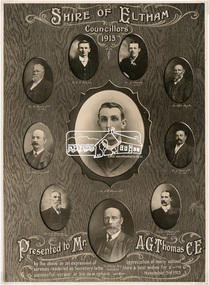
Negative - Photograph, Councillors of the Shire of Eltham in 1913. Presented to Mr A. G. Thomas C.E., Shire Secretary (centre), 1913
... Mr A.G. Thomas C.E. whose photo is prominant on the panel "by the above as an expression of appreciation of many services rendered as Secretary to the Shire and best wishes for a successful career in his new sphere, November 3rd 1913.". Photographs include: Cr. W. Morris J.P. Ex Pres., Cr P.J. Downer, Cr J...Mr A.G. Thomas C.E. whose photo is prominant on the panel "by the above as an expression of appreciation of many services rendered as Secretary to the Shire and best wishes for a successful career in his new sphere, November 3rd 1913.". Photographs include: Cr. W. Morris J.P. Ex Pres., Cr P.J. Downer, Cr J ...Sepia photograph of a portrait panel of ten councillors of the Shire of Eltham, 1913 Woodgrained Portrait panel with photos of ten Shire of Eltham Councillors 1913 presented to Mr A.G. Thomas C.E. whose photo is prominant on the panel "by the above as an expression of appreciation of many services rendered as Secretary to the Shire and best wishes for a successful career in his new sphere, November 3rd 1913.". Photographs include: Cr. W. Morris J.P. Ex Pres., Cr P.J. Downer, Cr J. Smedley, Ex-Pres., Crs R. D. Taylor, Cr. W. G. Gray J.P.. Cr. J. Fitch, J.P. Ex. Pres., Hon. E. H. Cameron, M.L.A. J.P. Ex Pres., Cr. C. H. Bath, J.P. Ex Pres and Cr. J. Darley Mealy J.P. President.This photo forms part of a collection of photographs gathered by the Shire of Eltham for their centenary project book, "Pioneers and Painters: 100 years of the Shire of Eltham" by Alan Marshall (1971). The collection of over 500 images is held in partnership between Eltham District Historical Society and Yarra Plenty Regional Library (Eltham Library) and is now formally known as 'The Shire of Eltham Pioneers Photograph Collection.' It is significant in being the first community sourced collection representing the places and people of the Shire's first one hundred years.Digital image 120 format B&W negative Printsepp, shire of eltham pioneers photograph collection, councilors, shire of eltham, a.g thomas, councillors, downer, e.h. cameron, eltham shire council, ewan hugh cameron, g.h smith, greg taylor, j smedley, w morris, w.d taylor, w.g gray -
 Bendigo Historical Society Inc.
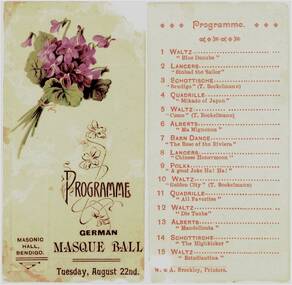
Programme - Programme for German Masque Ball, 1905
... Mr. J. D. Khaland, while it would be difficult to find a better M.C. than Mr. J. Armstrong. The dancing was witnessed by a large number of the public, who were accommodated on a temporary gallery at one end of the hall. A small charge was made for their admission, which helped to swell thelibrary funds. An excellent supper, served in Mr. W. C. Dick's best...Mr. J. D. Khaland, while it would be difficult to find a better M.C. than Mr. J. Armstrong. The dancing was witnessed by a large number of the public, who were accommodated on a temporary gallery at one end of the hall. A small charge was made for their admission, which helped to swell thelibrary funds. An excellent supper, served in Mr. W. C. Dick's best ...Two cardboard parts to a printed programme. On one is a posy of violets and the printing: "Programme German Masque Ball, Tuesday 22nd. The second lists 15 dances. Printed by A. Brookley, Printers. Also are the following two articles from Trove: From the Bendigo Advertiser and the Bendigo Independant, Wed 23 Aug 1905: GERMAN MASQUE BALL. The pleasant plan of fancy masque ball, which for nearly 20 years now has been an annual fixture at this season, is always looked forward to with delight. It is got up by the Bendigo Deutcher Verein, in aid of their free library. The function took place last night in the Masonic Hall and was most enjoyable, and all who took part in it were delighted. The hall was tastefully decorated with flags, flowers and ferns. Bockelmann's Band occupied the stage and discoured sweet music. Many of the items on a long programme were of Mr. Bockelmann's own composition, notably the schottische "Bendigo," the waltz 'Como, 'and the waltz "Golden City." By 9 o'clock there were about 80 couples on the floor. Amongst the merry troupe of dancers were youths and maidens in all sorts and descriptions of gay costumes, including flower girls, Japanese lady, German peasant, lily of the valley, Mercia, Geisha girl, French Vivandiere, red dominos, black dominos, "The Last Rose of Summer," rose, sailor girls, gondolier, Pierot, Charles II., Tipperary boy. Toreador, Romeo, Prince Le Var, huntsman, Indian prince, fireman, barristers. jockeys, cricketers, etc. Many of the Iadies were in evening dress, but wore the masque. The arrangements were admirably carried out by the secretarv. Mr. J. D. Khaland, while it would be difficult to find a better M.C. than Mr. J. Armstrong. The dancing was witnessed by a large number of the public, who were accommodated on a temporary gallery at one end of the hall. A small charge was made for their admission, which helped to swell thelibrary funds. An excellent supper, served in Mr. W. C. Dick's best style, was much enjoyed. Dancing was kept up till about three o'clock, everybody pronouncing the gathering a highly enjoyable one. bendigo history, sandhurst, lutheran german church, penny school -
 Victorian Interpretive Projects Inc.
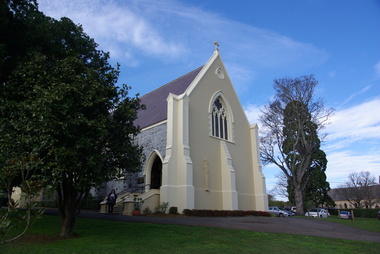
Photograph - colour, Clare Gervasoni, St Peter's Catholic Church, Daylesford, 2015, 14/06/2015
... best and most substantial manner. The building has been erected under the superintendence of the architect Mr. John Townsend Brophy, a member of the congregation, and who has discharged his duty with great ability and care. The hour of half-past eleven has scarcely passed when from the sacristy entered His Lordship the Right Rev. Dr. Gould, Bishop of Melbourne, preceded by the Very Rev. Dean Hayes (Sandhurst), the Rev. P. J...best and most substantial manner. The building has been erected under the superintendence of the architect Mr. John Townsend Brophy, a member of the congregation, and who has discharged his duty with great ability and care. The hour of half-past eleven has scarcely passed when from the sacristy entered His Lordship the Right Rev. Dr. Gould, Bishop of Melbourne, preceded by the Very Rev. Dean Hayes (Sandhurst), the Rev. P. J ..."The fine structure of St. Peter's, with its prettily-decorated interior, which holds crowded congregations at Holy Mass on Sundays, is alone an eloquent testimony of the piety and devotion which permeates the whole parish. Attached to the church is a circulating library, and Catholic papers and other literature are distributed at the church door. Branches of the H.A.C.B. Society and Catholic Federation are doing much good work. (Melbourne Advocate, 17 January 1914) "OPENING AND CONSECRATION OF THE NEW CATHOLIC CHURCH OF ST. PETER’S, DAYLESFORD Cross on St. Peter'sNotwithstanding the inclemency of the weather, the opening of the new Catholic Church of St. Peter’s, yesterday (Sunday), attracted a crowded congregation. Although the rain, which has poured almost incessantly for some days past, had left our roads and streets in the condition for which Daylesford is celebrated in winter weather, and although he storm and rain seemed to increase as the hour announced for the ceremonies approached, the church was filled by a large congregation, comprising all sects and denominations of Christians in and around the district. The beautiful edifice, erected mainly through the zeal, liberality and energy of the respected pastor, presented a most imposing appearance, and reflects infinite credit upon the Rev. Mr. Slattery, and the flock committed to his charge. The church was commenced in November 1863 and has been in the hands of the workmen up to the present time, work being uninterruptedly carried on. On commencing the foundations, it was necessary to excavate until solid clay was reached, which in consequence of the deep rich chocolate soil on the site of the building, had to be carried down to an average depth of 6 feet 6 inches. The foundations were laid with massive stones in courses of 12-inch, and four feet thick, reducing to 3 feet below the floor line. The style of the building is decorated Gothic, and consists of a nave, 80 feet by 30 feet in the clear, and a chancel 18 feet high; from floor line to apex of roof, 47 feet, which is elegantly constructed, consisting of six spans or frames with puncheons resting on carved corbels, low down between the windows. The north side consists of a handsome entrance, near the north-west angle, approached by nine steps of cut stone, and four bays of windows on nave, and a small door on side of chancel, intended as an entry from the sacristy. The south side presents a very handsome view to Victoria street, a beautiful porch entrance giving access to the building on the south-east end of nave; and on the south-west angle a handsome octagonal spire, terminating in an iron cross, with gilt floriations; the height of top of cross, from floor line, is 88 feet. A stone stairs gives access to the organ gallery and the belfry. The whole of the windows are of a handsome geometrical design, and carved in stone, with mullions and tracery, and glazed with amber-tinted glass, the chancel window being 15 feet high, and 8 feet wide. The chancel arch is unusually large, 27 feet St. Peter's interiorhigh and 18 feet wide, and handsomely moulded, and presents a fine appearance from the body of the church. The roof is stained a rich oak, with heavy cornice, and all the walls are smoothly plastered, and colored peach color, giving the amber-tinted glass a beautiful soft cathedral appearance to the interior. The altar is of a very chaste design, the panels being moulded with Gothic heads, and finished in white and gold; the altar rail was not completed, but is intended to be of polished cedar, with carved pillars. The interior fittings will be proceeded with immediately, and to complete the design, an organ gallery, with sittings for about 100 persons besides the choir, will be constructed on the west end. It is intended also to place pillar gaslights on each side of the main entrance, for lighting during vespers in winter. The style of architecture has been strictly carried out, and in the best and most substantial manner. The building has been erected under the superintendence of the architect Mr. John Townsend Brophy, a member of the congregation, and who has discharged his duty with great ability and care. The hour of half-past eleven has scarcely passed when from the sacristy entered His Lordship the Right Rev. Dr. Gould, Bishop of Melbourne, preceded by the Very Rev. Dean Hayes (Sandhurst), the Rev. P. J. Slattery, and a number of boys dressed in white surplices. The Right Reverend Prelate proceeded to the foot of the altar, the Very Rev. the Dean on his right, and the Rev. P. J. Slattery on the left. The prayers usual upon the occasion were read by the Bishop. A procession was then formed, and went around the church in the following order. Several youths bearing wax candles first, next the Very Rev. the Dean, then the Bishop and his train bearers, and following were the Rev. Mr. Slattery and acolytes. Having returned to the altar in the same order, the Deacon (Dean Hayes) and Sub-Deacon (Rev. P. J. Slattery) proceeded to robe his Lordship, who had taken his seat at the epistle side of the altar, for the solemn High Mass, at appropriate times wearing his mitre and bearing his crozier. The mass, which was chanted by the Bishop with touching simplicity and earnestness, was then commenced. The choir, under the direction of Mr. Meunsch, organist, was full and most effective. Mrs. Testar, of Melbourne, having generously offered her valuable services, took the leading soprano solos, and it is scarcely necessary to add, rendered them with exquisite taste and feeling – her beautiful voice being heard with great effect throughout the entire building. The choir consisted of the following ladies and gentlemen who volunteered to aid in the ceremonies upon this most interesting occasion. Ladies: Mrs. Tresar, soprano; Mrs. J.J. McCormick, alto; Miss Julia Conry, soprano; Mrs. Vincent, soprano; Mrs. Aitken, soprano. Gentlemen: H. Guthiel, tenor; Master John Murphy, tenor; James Knox, bass; J. M. Murphy, bass; Mr. Staunton, baritone; Mr. Sourby, alto; Mr. Short, bass. The chant, “Let us adore,” during the procession, was given by Mrs. Vincent with considerable power. The selection of the “Imperial Mass” (Haydn’s No. 3) was felicitous, and the highly artistic and finished manner in which the different parts were sustained, demonstrated that great and persevering care must have been bestowed on the preparation for “the opening day.” The “Kyrie” was given with the full strength and power of the choir. The swelling of the voices in complete harmony, and the pealing of the organ in the midst of incense and prayer, produced a most marked effect upon the congregation. In the “Gloria,” the solos of Mrs. Testar were really beautiful and Mrs. McCormick rendered the alto solos with considerable merit. Mr. Knox sang the part commencing with the words “Qui tolles” with much taste and power. The “Credo” than which we believe there is not a more magnificent piece of sacred music extant, was most successful in its rendering, nor do we ever remember to have heard anything more touching than the manner in which the line “Vetam Venturi in Seculi,” was given by Mrs. Testar. The offertory hymn “Come unto Me all ye that labor,” was given by Mrs. Testar with the most thrilling effect. The “Sanctus” having been sung, in which Mr. Sourby ably rendered an alto solo, the “Agnus Dei” was commenced with a solo by Mrs. McCormick and was given with great taste and feeling, Mrs. Testar, at the conclusion of the “Agnus,” taking up the soprano part. Mass being concluded, the Very Reverend Dean Hayes ascended the altar and proceeded to preach the opening sermon, taking as his text Second Paralipomenon [Chronicles II], 7th chapter and 16th verse – “For I have chosen and have sanctified this place that My hand may be there for ever, and My eyes and My heart may remain there perpetually.” St Peter's manseAt the close of the sermon a collection was made by the very reverend preacher, assisted by John Egan, Esq., Corinella, on behalf of the church, and about fifty pounds were contributed. When it is remembered that 500 tickets had been issues at 10s each, and the inclemency of the weather taken into consideration, the collection may be regarded as a large one. Benediction was sung by the Rev. P. J. Slattery, assisted by Dean Hayes, the choir singing the “O! Salutaris Hostia” and “Laudate.” Handel’s Hallelujah Chorus was sung at the termination of the ceremonies. The vestments issued at Benediction, as well as at the Mass, were of the most gorgeous and beautiful character. When the Benediction was over, the Rev. P. J. Slattery, standing at the front of the altar said– “I wish to say one or two words before the congregation leave. I feel most deeply indebted to all of you who have attended here today for the honor and glory of God, not withstanding the difficulties you had to encounter from this most inclement season. I am truly delighted at such a manifestation of feeling, and will not easily forget it.” The rev. gentleman having disrobed, thanked the members of the choir for their kindness in assisting at the ceremonies, and more especially Mrs. Testar, who had braved all the storm and rain to be present at, and give the advantage of her great musical abilities on, the “opening day.” (Daylesford Mercury, 15 May 1865.)A number of photographs of St Peter's Catholic Church, Daylesford, taken at the 150th anniversary celebration. st peter's catholic church daylesford, decoration, altar decoration, anniversary, daylesford, religion, painting, interior, slattery, gough, d'alton, mcmahon -
 Bendigo Historical Society Inc.
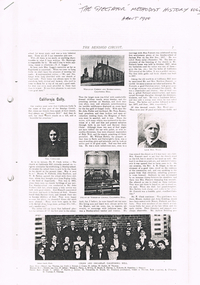
Document - LONG GULLY HISTORY GROUP COLLECTION: THE BENDIGO CIRCUIT
... Written at the top of the page is 'The Spectator' Methodist History Vol. 11, about 1900.Photos for California Gully include: Mrs Christian, Wesleyan Church and Sunday-school California Hill, Pulpit of Wesleyan Church California Hill, Lat Mrs Wood, Choir and Organist California Hill, Sunday School Teachers and Officers California Hill, Senior Sunday School California Hill, Trustees California Hill, Mrs M Fawcett, Executive Christian Endeavour California Gully, Some of the Best Workers, Long Gully Wesleyan Church, Sunday School teachers and Officers Long Gully, Executive and Officers Christian Endeavour Long Gully, Mr W Gard, Mr P H Ebbott, Choir and Organist Long Gully, Sir John Quick Kt LL D, MP, Late Mr M Fawcett, Trustees and Church Officers Long Gully, Mr J F Stephenson,...Written at the top of the page is 'The Spectator' Methodist History Vol. 11, about 1900.Photos for California Gully include: Mrs Christian, Wesleyan Church and Sunday-school California Hill, Pulpit of Wesleyan Church California Hill, Lat Mrs Wood, Choir and Organist California Hill, Sunday School Teachers and Officers California Hill, Senior Sunday School California Hill, Trustees California Hill, Mrs M Fawcett, Executive Christian Endeavour California Gully, Some of the Best Workers, Long Gully Wesleyan Church, Sunday School teachers and Officers Long Gully, Executive and Officers Christian Endeavour Long Gully, Mr W Gard, Mr P H Ebbott, Choir and Organist Long Gully, Sir John Quick Kt LL D, MP, Late Mr M Fawcett, Trustees and Church Officers Long Gully, Mr J F Stephenson, Document LONG GULLY HISTORY GROUP COLLECTION: THE BENDIGO CIRCUIT ...BHS CollectionPages 7 to 15 of the Bendigo Circuit which includes some history of California Gully and Long Gully. Written at the top of the page is 'The Spectator' Methodist History Vol. 11, about 1900.Photos for California Gully include: Mrs Christian, Wesleyan Church and Sunday-school California Hill, Pulpit of Wesleyan Church California Hill, Lat Mrs Wood, Choir and Organist California Hill, Sunday School Teachers and Officers California Hill, Senior Sunday School California Hill, Trustees California Hill, Mrs M Fawcett, Executive Christian Endeavour California Gully, Some of the Best Workers, Long Gully Wesleyan Church, Sunday School teachers and Officers Long Gully, Executive and Officers Christian Endeavour Long Gully, Mr W Gard, Mr P H Ebbott, Choir and Organist Long Gully, Sir John Quick Kt LL D, MP, Late Mr M Fawcett, Trustees and Church Officers Long Gully, Mr J F Stephenson,bendigo, history, long gully history group, the long gully history group - the bendigo circuit, the spectator methodist history vol 11, mrs christian, mr f clark, d padwick, john dawborn, w b batkin, john falder, wesleyan church, thos benson, william batkin, miss fawcett, mr and mrs matthew fawcett, mrs wood, rev a r edgar, miss batkin, andrew dowding, john dowding, jas thomas, jas snell, j brewer, j green, w jeffrey, w batkin, m thomas, jas cox, h jeffrey, l perry, a mccoy, e moyle, k harvey, l roberts, h hambley, j matcott, i jeffrey, f martin, j stirton, m trewartha, n moyle, mr penaluna, a thomas, rule, a chirgwin, m thomas, f thomas, mrs shum, mrs wood, joseph williams, e mattcott, w mattcock, r martin, mrs g owen, ellis, crossman, r williams, inch, w kidd, mattcott, hicks, miller, gilbert, roberts, thomas, arthur, green, r williams, m thomas, j h miller, r crossman, g owen, miss rule, dermer smith, j roberts, j perry, mr w c kidd, a roberts, mr w c kidd, g williams, j thomas, mr w jeffrey, miss chirgwin, mr w stephens, mr m williams, miss dennis, miss batkin, mr j johns, mr r williams, mr richard williams, mr clark, m thomas, m fawcett, w batkin, t t roper, rev joseph dare, rev john mewton, j h miller, r c crossman, w owen, m thomas, robert martin, john chirgwin, mrs martin, mr bickford, mr powell, mr tregear, mr scholes, john thompson, robert crossman, daniel reeves, j miller, mrs richard williams, tobias stephens, joseph williams, rev herbert williams, james williams, mrs m thomas, john thomas, rev thomas james, mrs m fawcett, jacob perry, rev charles tregear, j hopkins, walter jeffrey, w j stephens, w jones, miss b youlder, miss h hambly, miss alice perry, miss melita williams, miss annie chirgwin, miss e batkin, miss b arthur, miss e dennis, jacob perry, arthur lelean, joseph roberts, george willen, michael thomas, robert thomas, rev joseph dare, mrs matcott, mrs geo roberts, mrs joseph roberts, mrs a crosswell, mrs j m inch, mrs w c kidd, mrs r thomas, mrs a ellis, mrs g owen, mrs r williams, mrs j h miller, edward jeffrey, michael thomas, the argus, the age, judge higinbotham, mr clucas, mrs christian, queen victoria, mr and mrs michael thomas, richard williams, mrs thomas, william goyne, rev george daniel, dermer smith, j wearne, c thomas, j langdon, h thomas, e payne, jennings, j penberthy, martin, goldsworthy, white, jennings, campbell, pascoe, langdon, miss gard, mrs thomas, miss l berryman, miss e malcolm, mr peters, miss mason, miss l williams, miss a warren, miss s knuckey miss m bolitho, miss c allen, miss m jennings, miss s thomas, mrs may, miss j jenkins, miss a pickles, miss e woolcock, miss m knuckey, miss a hampton, miss f thomas, miss a thomas -
 Bendigo Historical Society Inc.
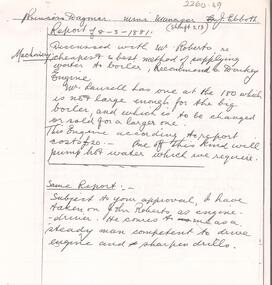
Document - ALBERT RICHARDSON COLLECTION: PRINCESS DAGMAR MINE, GARDEN GULLY LINE
... J. Ebboth. 'Discussed with Mr. Roberts re cheapest and best method of supplying water to boiler, recommend a donkey engine. ...J. Ebboth. 'Discussed with Mr. Roberts re cheapest and best method of supplying water to boiler, recommend a donkey engine. ...4 page handwritten document, (copy) detailing some of the Mine Manager's reports for Princess Dagmar mine 1881 - 1914. Example: Report of 8.3.1881, shaft 213, Mine Manager J. Ebboth. 'Discussed with Mr. Roberts re cheapest and best method of supplying water to boiler, recommend a donkey engine. Mr. Lansell has one at the 180 which is not large enough for the big boiler and which is to be changed or sold for a larger one. This engine according to report costs 20 pounds. One of this kind will pump hot water which we require. Subject to your approval I have taken on John Roberts as engine driver. He comes to me as a steady man competent to drive engine and sharpen drills.'bendigo, mining, princess dagmar, albert richardson -
 Bendigo Historical Society Inc.
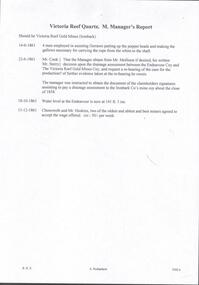
Document - VICTORIA QUARTZ - NOTES ON THE VICTORIA QUARTZ MINE
... DOCUMENT Gold victoria quartz Victoria Quartz Notes on the Victoria Quartz Mine Goldmines Hotel Mr William Rae Lansell's 180 Mr E J Dunn Geological Branch of the Mines Department New Chum Railway Mine New Chum Drainage Association Mines Dept Special Edition Australian Mining Standard 1/6/1899 Mines Dept Booklet 'Bendigo Goldfield' 1936 Mines Dept Annual and Quarterly Reports Annals of Bendigo A Richardson Three typed and one handwritten copies of notes on the Victoria Quartz Mine. Notes include Size of Lease, Depth of Shaft, Locality, P;lant, Early History, Leading & Prominent, Best ...Three typed and one handwritten copies of notes on the Victoria Quartz Mine. Notes include Size of Lease, Depth of Shaft, Locality, P;lant, Early History, Leading & Prominent, Best Gold and Gold Yield.document, gold, victoria quartz, victoria quartz, notes on the victoria quartz mine, goldmines hotel, mr william rae, lansell's 180, mr e j dunn, geological branch of the mines department, new chum railway mine, new chum drainage association, mines dept special edition australian mining standard 1/6/1899, mines dept booklet 'bendigo goldfield' 1936, mines dept annual and quarterly reports, annals of bendigo, a richardson -
 Bendigo Historical Society Inc.
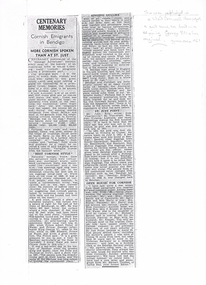
Newspaper - LONG GULLY HISTORY GROUP COLLECTION: CENTENARY MEMORIES - CORNISH EMIGRANTS IN BENDIGO
... BENDIGO History long gully history group The Long Gully History Group - Centenary Memories - Cornsih Emigrants in Bendigo Bendigo Advertiser Mrs Kennedy Duke of Edinburgh 1867 Prince Albert Victor of Wales Prince George (later King George V) Edward Prince of Wales The Duke and Duchess of York French's Corner Long Gully Old Cornwall Society Mr John Ellis Bendigo Hospital Mr Harry Perak Malaya Mr and Mrs Charles Harry Mrs Boyns Hon Mrs J Keppel Lord St Levan Mr Keppel Victorian Railways Bendigo Railway Station Mr Herbert Thomas Copy of a newspaper article titled Centenary Memories, Cornish Emigrants in Bendigo, More Cornish spoken than at St. Just. Written on the side is - This was published in a West Cornwell Newspaper & sent back to Aust in a clipping George Ellis has original. Approx circa 1951. Items mentioned are: More Cornish spoken than at St Just, Best ...Copy of a newspaper article titled Centenary Memories, Cornish Emigrants in Bendigo, More Cornish spoken than at St. Just. Written on the side is - This was published in a West Cornwell Newspaper & sent back to Aust in a clipping George Ellis has original. Approx circa 1951. Items mentioned are: More Cornish spoken than at St Just, Best Cornsih Style, Singing Gullies particularly where Cornishmen and Welshmen were as they were fond of singing, Royal visits, St Just point and Open House for Cornish.bendigo, history, long gully history group, the long gully history group - centenary memories - cornsih emigrants in bendigo, bendigo advertiser, mrs kennedy, duke of edinburgh 1867, prince albert victor of wales, prince george (later king george v), edward prince of wales, the duke and duchess of york, french's corner long gully, old cornwall society, mr john ellis, bendigo hospital, mr harry perak malaya, mr and mrs charles harry, mrs boyns, hon mrs j keppel, lord st levan, mr keppel, victorian railways, bendigo railway station, mr herbert thomas -
 Bendigo Historical Society Inc.
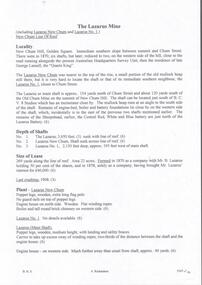
Document - LAZARUS MINE - NOTES ON THE LAZARUS MINE
... Mr Barnet Lazarus White Lead Mines Department Special Edition 'Australian Mining Standard' 1/6/1899 Mines Department Booklet 'Bendigo Goldfield' 1936 Mines Dept. Annual and Quarterly Reports Annals of Bendigo Mining Sections 1868 - 1910 A Richardson The Bendigo Goldfield Registry J N Macartney 1/3/1871. Five pages of handwritten notes with typed copies of same, on the Lazarus Mine including Lazarus New Chum and Lazarus No 1. Notes include locality, depth of shafts, size of lease and plant. Includes the history, prominence, best ...Five pages of handwritten notes with typed copies of same, on the Lazarus Mine including Lazarus New Chum and Lazarus No 1. Notes include locality, depth of shafts, size of lease and plant. Includes the history, prominence, best gold, Total Gold Yield and Dividends. Albert Richardson Collectionmining, parish map, lazarus mine, lazarus mine, lazarus new chum, lazarus no 1, george lansell, b. c. v. 8 studios, sheepshead, central red white & blue, mr b lazarus, mr george gibbs, black lead, lansell's fortuna, mr ballerstedt, mr barnet lazarus, white lead, mines department special edition 'australian mining standard' 1/6/1899, mines department booklet 'bendigo goldfield' 1936, mines dept. annual and quarterly reports, annals of bendigo mining sections 1868 - 1910, a richardson, the bendigo goldfield registry j n macartney 1/3/1871. -
 Bendigo Historical Society Inc.
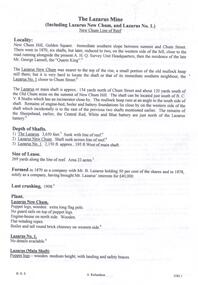
Document - THE LAZARUS MINE - NOTES ON THE THE LAZARUS MINE
... DOCUMENT Gold the lazarus mine The Lazarus Mine Notes on the The Lazarus Mine Lazarus New Chum Lazarus No 1 Australian Headquarters Survey Unit George Lansell New Chum Hill B C V 8 Studios Sheepshead Central Red White & Blue Mr Lazarus Lansell's 222 Old Chum Mine Lazarus Company Mr George Gibbs Lansell's Fortuna Ballerstedt Mr Barnet Lazarus The Black Lead The White Lead Mount Alvernia Hospital Mines Dept Special Edition 'Australian Mining Standard' 1/6/1899 Mines Dept Booklet 'Bendigo Goldfield' 1936 Mines Dept Annual and Quarterly Reports Annals of Bendigo Mining Sections 1868 - 1910 A Richardson the Bendigo Goldfield Registry J N Macartney 1/3/1871 One siix page handwritten and three typed copies of notes on the The Lazarus Mine including the Lazarus New Chum and the Lazarus No 1 on the New Chum Line of Reef. Notes include locality, depth of shafts, size of lease, plant, early history, the Lazarus Company, Prominence, Best ...One siix page handwritten and three typed copies of notes on the The Lazarus Mine including the Lazarus New Chum and the Lazarus No 1 on the New Chum Line of Reef. Notes include locality, depth of shafts, size of lease, plant, early history, the Lazarus Company, Prominence, Best Gold and Total Gold Yields. Notes prepared by Albert Richardson.document, gold, the lazarus mine, the lazarus mine, notes on the the lazarus mine, lazarus new chum, lazarus no 1, australian headquarters survey unit, george lansell, new chum hill, b c v 8 studios, sheepshead, central red white & blue, mr lazarus, lansell's 222, old chum mine, lazarus company, mr george gibbs, lansell's fortuna, ballerstedt, mr barnet lazarus, the black lead, the white lead, mount alvernia hospital, mines dept special edition 'australian mining standard' 1/6/1899, mines dept booklet 'bendigo goldfield' 1936, mines dept annual and quarterly reports, annals of bendigo mining sections 1868 - 1910, a richardson, the bendigo goldfield registry j n macartney 1/3/1871 -
 Bendigo Historical Society Inc.
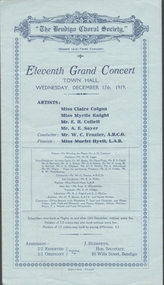
Document - TOWN HALL, THE BENDIGO CHORAL SOCIETY
... Mr. R J Duguid & G L McCoy. Auditors-Mr. H T Bayton, A.A.I.S. * Harold Walker. Committee-Office Bearers: Mesdames T Scott, & Chisholm, & Misses Colgan, Gall, Field & Wheaton, & Messrs. Sleeman, Jeffrey, McClure, Brown, F J Walter & Frank Wittscheibe. Subscribers may book at Flights on and After 12th December, without extra fee. Holders of 2/2 tickets may also book by paying difference, 1/1. Admission- 2/2/ Reserved, 1/1/ Ordinary, including tax. J Hudspeth, Hon. Secretary, 85 Wills Street, Bendigo. Programme. 'Comfort Ye' 'Every Valley' 'And the Glory', Hungarian Danse' No.3, 'Softly Sighs', 'Fire, Fire my Heart', 'Spring', 'Best...Mr. R J Duguid & G L McCoy. Auditors-Mr. H T Bayton, A.A.I.S. * Harold Walker. Committee-Office Bearers: Mesdames T Scott, & Chisholm, & Misses Colgan, Gall, Field & Wheaton, & Messrs. Sleeman, Jeffrey, McClure, Brown, F J Walter & Frank Wittscheibe. Subscribers may book at Flights on and After 12th December, without extra fee. Holders of 2/2 tickets may also book by paying difference, 1/1. Admission- 2/2/ Reserved, 1/1/ Ordinary, including tax. J Hudspeth, Hon. Secretary, 85 Wills Street, Bendigo. Programme. 'Comfort Ye' 'Every Valley' 'And the Glory', Hungarian Danse' No.3, 'Softly Sighs', 'Fire, Fire my Heart', 'Spring', 'Best ...Town Hall, The Bendigo Choral Society. (Season 1919-Third Concert) Eleventh Grand Concert, Town Hall. Wednesday, December 17th, 1919. Artists: Miss Claire Colgan, Miss Myrtle Knight, Mr. E H Collett, Mr. A E Sayer. Conductor: Mr. W C Frazier, A.R.C.O. Pianiste: Miss Muriel Hyett, L.A.B. Patron-His Worship the Mayor (Cr. J H Curnow). President-Mr. H M Leggo. Vice-Presidents-Sir John Quick, Cr. C W Beebe, Mr. Oscar Flight, Mr. E S Cahill, Mr. D Berrriman, Mr A L Bolton, Mr. G E Bolton, Dr W G Long, DR O Penfold, Mr. J G Oliphant, Mr. Alf E Wallis, Mr. A Whitehead, Mr. W Watts. From the performing Members-Mr. E H Collett, Mr. A W McGibboney. Conductor-Mr. W C Frazier, A.R.C.O. Sub-Conductor- Mr. E A Miller, Pianist-Miss Muriel Hyett, L.A.B. Ass. Sec.-Mr. Fred A Wittscheibi. Treasurer-Mr. D H Holden. Librarians-Mr. R J Duguid & G L McCoy. Auditors-Mr. H T Bayton, A.A.I.S. * Harold Walker. Committee-Office Bearers: Mesdames T Scott, & Chisholm, & Misses Colgan, Gall, Field & Wheaton, & Messrs. Sleeman, Jeffrey, McClure, Brown, F J Walter & Frank Wittscheibe. Subscribers may book at Flights on and After 12th December, without extra fee. Holders of 2/2 tickets may also book by paying difference, 1/1. Admission- 2/2/ Reserved, 1/1/ Ordinary, including tax. J Hudspeth, Hon. Secretary, 85 Wills Street, Bendigo. Programme. 'Comfort Ye' 'Every Valley' 'And the Glory', Hungarian Danse' No.3, 'Softly Sighs', 'Fire, Fire my Heart', 'Spring', 'Best Pair of Sirens', ' Legende', 'Eleanore', 'Dream Wind', 'Ave Maria', 'Fantasie Pastorale', 'O Great is the Depth'. 'Dream Wind' Words by William Sharp. 'Fire, Fire My Heart' Words by Morley. 'Blest Sirens' ''Voice'' and ''Verse'' Words by Milton. The Bendigo Choral Society. Exists for the worthy production of the choral works of the great composers. Under the leadership of Mr. Frazier, it can fairly claim to have accomplished this, at least in some degree, during the past year. Works have been. . . . . . Note - The rehearsals will be resumed 2nd week in February 1920. Annual Meeting 3rd week. A and b are same, a is in excellent condition, b has some slight discoloration on the back. Both have been folded in half and in half againBolton Bros, Printersprogram, theatre, the bendigo choral society -
 Otway Districts Historical Society
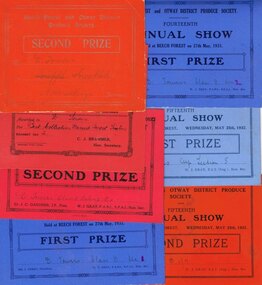
Prize, Beech Forest and Otway District Produce Society, Prizes, 1922-1932, See individual prizes
... Best Collection Dressed Forest Timbers, exhibit no. 2, C.J. Brammer, Hon. Secretary. (c) Twelfth Annual Show, Second Prize, D. Towers, Class B Section 2 Ex 1, Cr. J.C. Gardner JP, Pres., W.J. Gray FABI SFAI, Hon. Sec. (d) Fourteenth Annual Show, 27 May 1931, First Prize, D. Towers, Class B Sec 1, Mr J...Best Collection Dressed Forest Timbers, exhibit no. 2, C.J. Brammer, Hon. Secretary. (c) Twelfth Annual Show, Second Prize, D. Towers, Class B Section 2 Ex 1, Cr. J.C. Gardner JP, Pres., W.J. Gray FABI SFAI, Hon. Sec. (d) Fourteenth Annual Show, 27 May 1931, First Prize, D. Towers, Class B Sec 1, Mr J ...Beech Forest and Otway District Produce Society: (a) Second Prize, D. Towers, for Snowflake, A.W. MacKenzie, Secretary. (b) Seventh Annual Show, 1923, Second Prize, D. Towers, for Best Collection Dressed Forest Timbers, exhibit no. 2, C.J. Brammer, Hon. Secretary. (c) Twelfth Annual Show, Second Prize, D. Towers, Class B Section 2 Ex 1, Cr. J.C. Gardner JP, Pres., W.J. Gray FABI SFAI, Hon. Sec. (d) Fourteenth Annual Show, 27 May 1931, First Prize, D. Towers, Class B Sec 1, Mr J. Perry, President, W.J. Gray FABI SFAI, Hon. Sec. (e) Fourteenth Annual Show, 27 May 1931, First Prize, D. Towers, Class B Sec 2, Mr J. Perry, President, W.J. Gray FABI SFAI, Hon. Sec. (f) Fifteenth Annual Show, 25 May 1932, First Prize, D. Towers, Cup Section 5, J.A. Perry, Pres., W.J. Gray, FCI (Eng.), Hon. Sec. (g) Fifteenth Annual Show, 25 May 1932, Second Prize, D. Towers, B 1/7, J.A. Perry, Pres., W.J. Gray FCI (Eng.), Hon. Sec.beech forest; otway; produce; prize; -
Glen Eira Historical Society
Book - Ormond Amateur Football Club
... Best and fairest winners, life members. 2/A responsible drinking poster distributed in 2013. Ormond Amateur Football Club Burdekin E. Donaldson E. Foulsham C. Kingston J. Rowe G. Scott D. Sheehan J. Bray J. Dart S. Godfredson R. Hassed M. Johnston M. Yewdall M. Dalton Fine Paper Sponsors Berby Graham Typographical Services PIL Ashley Ray Ashley Dean PIC The Campaign Palace Peterson Janis Hall Tony Rankine Chris Harris Geoff Moran G. F. Lacey Scott Victorian Amateur Football Association Districtclub Smith L. E. President Organizations Sporting Clubs Emblems Sports Uniforms Johnson Alex Ormond Park Smith Mr ...This file contains 2 items: 1/An 83 page book titled ‘The First Fifty Years. Ormond Amateur Football Club.’ The book details why it was written and by whom. It then goes on to describe the playing years from 1931-1981, missing the 6 years from 1940-1946 during WWII. Includes 11 photographs, Presidents’ history, captains and Premiership coaches, Best and fairest winners, life members. 2/A responsible drinking poster distributed in 2013.ormond amateur football club, burdekin e., donaldson e., foulsham c., kingston j., rowe g., scott d., sheehan j., bray j., dart s., godfredson r., hassed m., johnston m., yewdall m., dalton fine paper, sponsors, berby graham, typographical services pil, ashley ray, ashley dean pic, the campaign palace, peterson janis, hall tony, rankine chris, harris geoff, moran g. f., lacey scott, victorian amateur football association, districtclub, smith l. e., president, organizations, sporting clubs, emblems, sports, uniforms, johnson alex, ormond park, smith mr., stevens mr., gunn e. e., elliston mr., hogan mr., coffey mr., skates mr., gymnasiums, jasper road, junior club, smith east suburban football league, ormond junior football club, kingston jack, australian rules football, football clubs, sports officials, clubs and associations -
 Warrnambool and District Historical Society Inc.
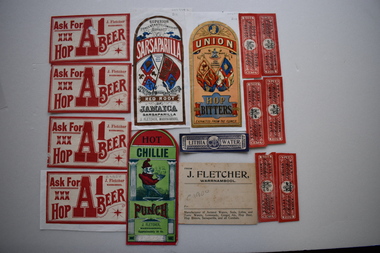
17 labels, J Fletcher, Early 20th century
... Mr. Fletcher was connected from its commencement, and whom he succeeded in 1885. His business continued until 1930. The Warrnambool and District Historical Society has a collection of bottles used by John Fletcher to contain his products. These labels are significant as John Fletcher was a most successful manufacturer of cordials and aerated waters in Warrnambool in the late 1800s and early 1900s john fletcher warnambool cordials .1 FROM J. FLETCHER, WARRNAMBOOL Manufacturer of Aerated Waters, Soda, Lithia and Tonic Waters, Lemonade, Ginger Ale, Hop beer, Hop Bitters, Sarsaparilla and all Cordials .2 SUPERIOR CONCENTATED COMPOUND EXTRACT OF SARSAPARILLA PREPARED FROM THE BEST ...In 1888 it was reported in "Victoria and its Metropolis" that John Fletcher carried on the business of a manufacturer of aerated waters, cordials, hop bitters, etc. in Warrnambool, and traded throughout the Western District. The establishment was started by a Mr. J. Davis with whom Mr. Fletcher was connected from its commencement, and whom he succeeded in 1885. His business continued until 1930. The Warrnambool and District Historical Society has a collection of bottles used by John Fletcher to contain his products. These labels are significant as John Fletcher was a most successful manufacturer of cordials and aerated waters in Warrnambool in the late 1800s and early 1900s .1 Buff coloured rectangular card label with black text. 2 Rectangular label with curved top adhered to a piece of white paper. It is coloured red, blue black and gold and features two standards and text. .3 Rectangular label with curved top adhered to the reverse of .2. It is coloured red and green and features a sketch of Punch carrying a bowl of a steaming substance and text .4 Rectangular label with curved top adhered to a piece of white paper. It is coloured red, apricot, dark and light blue, gold and black. It features the linked initials JF, two standards a trade mark and text .5 Rectangular label with curved top adhered to the reverse of .4 It is coloured red, blue, green, black and gold. It features two standards and text. .6 Identical to .3 but not adhered to paper .7,.8, .9 .10 White rectangular labels with red text. .9 has a damaged corner. .10 is adhered to a piece of white paper. .11,.12,.13,.14,.15..16 Red rectangular labels with black text and a coat of arms. .13 is adhered to a piece of pink card, .17 Blue rectangular label with text and a coat of arms .1 FROM J. FLETCHER, WARRNAMBOOL Manufacturer of Aerated Waters, Soda, Lithia and Tonic Waters, Lemonade, Ginger Ale, Hop beer, Hop Bitters, Sarsaparilla and all Cordials .2 SUPERIOR CONCENTATED COMPOUND EXTRACT OF SARSAPARILLA PREPARED FROM THE BEST RED ROOT OF JAMAICA SARSAPARILLA J. FLETCHER,WARRNAMBOOL .3 HOT CHILLIE PUNCH J. FLETCHER WARRNAMBOOL Approximately 26 Oz. .4 UNION TRADE MARK JOHN FLETCHER WARRNAMBOOL HOP BITTERS EXTRACTED FROM THE FLOWER .5 J FLETCHER WARRNAMBOOL SUPERIOR GREEN COLOURED WITH BURNT SUGAR GINGER CORDIAL .6 Identical to .3 .7,.8,.9,.10 ASK FOR XXX HOP A1 BEER J FLETCHER WARRNAMBOOL .11,.12,.13.14,.15.16 SODA WATER J Fletcher .17 LITHIA WATER J FLETCHER WARRNAMBOOL john fletcher, warnambool, cordials -
 Ballarat and District Irish Association
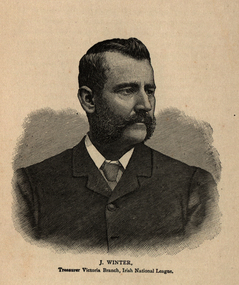
Image, Joseph Winter, c1864
... J. H. O'Connell, Victoria : — " The Irish National League, 45 O'Connell-street Upper, Dublin, 12th October, 1886. '"Rev. Dear Sir, — I beg to acknowledge with best thanks receipt of your letter of 24th August, with draft for £1000 towards the Irish Parliamentary Fund from the Executive Committee of the Irish Parliamentary Fund of Melbourne.— Yours faithfully, "Joseph G. Biggar. "Rev. J. H. O'Connell, St. George's Presbytery, Carlton, Melbourne." (Sydney Freeman's Journey, 4 December 1886) MR...J. H. O'Connell, Victoria : — " The Irish National League, 45 O'Connell-street Upper, Dublin, 12th October, 1886. '"Rev. Dear Sir, — I beg to acknowledge with best thanks receipt of your letter of 24th August, with draft for £1000 towards the Irish Parliamentary Fund from the Executive Committee of the Irish Parliamentary Fund of Melbourne.— Yours faithfully, "Joseph G. Biggar. "Rev. J. H. O'Connell, St. George's Presbytery, Carlton, Melbourne." (Sydney Freeman's Journey, 4 December 1886) MR ...Winter was Treasurer of the Irish National League. "AUSTRALIAN AID TO IRELAND. - GRATEFUL ACKNOWLEDGMENTS. The following letters have been received:— "The Irish National League, "43 O'Connell-street Upper, "Dublin, 14th Oct., 1886. "My Dear Mr. 'Winter, — I beg to acknowledge receipt of your favour of the 16th August, enclosing; draft for £250 from the Irish National League of Australasia towards the Irish Parliamentary Fund. The treasurers of the fund, to whom I have handed the draft, are transmitting by this mail a formal receipt for the amount of your generous contribution. ' I am very happy to learn from reports which have appeared in our newspapers here within the past few days that the vacancy in Melbourne has been accepted by our worthy, able, and patriotic prelate, the Most. Rev. Dr. Carr, Bishop of Galway. While the Catholic people of the diocese of Melbourne will find in Dr. Carr an able, zealous, and dignified prelate; of whom they will haye every rea son to be proud, the Irish Catholics of the diocese will, in an especial sense, find in him one who knows the wants of their country, who is deeply in sympathy with .the just feelings and aspirations of her people, and who is second to none in his desire to see his native land happy and prosperous I thought our friends in the Federal Council of the League would be anxious to know what man ner of man the new prelate is, and, therefore, writing to you so soon after his appointment I think it my duty to say so much. "Assuring our friends of our warm gratitude for the generous assistance they are continually giving us in the struggle in which we are en gaged — I remain, my dear Mr. Winter, yours sincerely, T. Harrington. "Joseph Winter, Esq., Advocate office, Melbourne," ''The Irish National League, 43 O'Connell-street Upper, " Dublin; 12th October, 1886. 'My Dear Sir, — I beg to acknowledge with thanks receipt of your letter of 16th August, with 'draft for' £250 from the Federal Council of the Irish National League of Australasia to the Parli mentary Fund. Joseph G. Biggar. ' 'J. Winter, Esq.' ' ; IRISH PARLIAMENTARY ELECTION FUND. The following acknowledgment has been received by the Rev. J. H. O'Connell, Victoria : — " The Irish National League, 45 O'Connell-street Upper, Dublin, 12th October, 1886. '"Rev. Dear Sir, — I beg to acknowledge with best thanks receipt of your letter of 24th August, with draft for £1000 towards the Irish Parliamentary Fund from the Executive Committee of the Irish Parliamentary Fund of Melbourne.— Yours faithfully, "Joseph G. Biggar. "Rev. J. H. O'Connell, St. George's Presbytery, Carlton, Melbourne." (Sydney Freeman's Journey, 4 December 1886) MR JOSEPH WINTER AND THE IRISH NATIONAL LEAGUE - Mr Joseph Winter, of Melbourne, has received a courteous letter from Mr. Harrington, M.P., enclosing the following official document : — ' On the motion of the Right Hon. the Lord Mayor, T. Sexton, M.P., seconded by Dr. B. J. Kenny, M.P., the following resolution was unani mously adopted by the Organizing Committee of the Irish National League :— 'That we have heard with regret of the proposed retirement from the treasurership of the Irish National League of Australia of Mr. Joseph Winter, manager of the Melbourne Advocate, and we seize this opportunity of placing on record our appreciation of tbe signal services which he has rendered to the Irish people by his unselfish and devoted advocacy of their cause, especially during the past eight years, during which time the sum of £27,487 has reached the home move ment through his hands. We desire to assure Mr. Winter that his services will not be forgotten by his countrymen in Ireland, and we venture to express the hope that the Irishmen of Australasia may still be permitted to command them.'(Sydney Freeman's Journal, 6 April 1889) Image of a moustached man known as Joseph Winter.ballarat irish, winter, bishop carr, carr, joseph winter, irish national league -
 Uniting Church Archives - Synod of Victoria
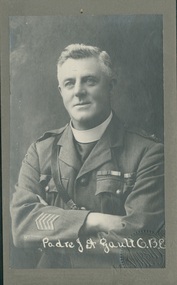
Photograph, Undated c.1915 - 1918
... J. A. Gault, a Methodist minister, who was widely known to Australian soldiers as Padre Gault, died yesterday after a long illness. One of the best-loved padres in the AIF, Mr...J. A. Gault, a Methodist minister, who was widely known to Australian soldiers as Padre Gault, died yesterday after a long illness. One of the best-loved padres in the AIF, Mr ...Born 26 June 1865 at Manchester, England Husband of Mrs. Edith Ann Maria GAULT Of 'The Inglenook', Sea Parade, Cheltenham, Vic. Aged 50 years Enlisted 01 July 1915 for Continuous Service Embarked 16 July 1915 per 'HMAT Demosthenes' from Melbourne, Vic Pay rate of 19s 0d after embarkation Embarked 29 March 1916 per 'RMS Orontes' from Melbourne, Vic. Served in Egypt and on the Western Front Returned to Australia 01 November 1919 Awarded OBE Death of Rev. J. A. Gault The Rev. J. A. Gault, a Methodist minister, who was widely known to Australian soldiers as Padre Gault, died yesterday after a long illness. One of the best-loved padres in the AIF, Mr. Gault served for four years with the Australians, at first in Egypt and later in France and England. After the war, he continued to show great interest in returned soldiers and work in training camps. When he retired in February, 1934, Mr. Gault had been in the ministry for 40 years. Bom at Manchester. England on June 10, 1865 he came to Australia when aged three years in the sailing-ship Antiope. He was educated at Gold street State school and later at Wesley College. After his appointment as a minister, he served the church in many circuits in Tasmania and Victoria. Before the war he was superintendent of the Methodist Mission at Collingwood,and after his return from overseas he occupied important positions, including those of superintendent minister in the Brunswick, Port Melbourne, and Yarra street, Geelong, circuits. His last charge was at Camberwell. After ill-health caused him to retire, he lived at Mentone. He has left a widow, a son, and two daughters. Dr. Edward Gault. of Collins street, is a brother, and there are two sisters in New Zealand. The funeral will leave Mr. Gault's home In Sea parade, Mentone, tomorrow, at 2p.m., for the Methodist Church, Mentone. It will then proceed to the Springvale Crematorium. W. D. Rose and Son. Cheltenham, are making the arrangemnts. R.S.L. Tribute "Returned soldiers will learn of the death of Padre Gault with deep regret," said the president of the Returned Soldiers' League (Mr. G. W. Holland) lastnight. "He was revered by the AIF. for his unfailing sympathy, understanding, and comradeship." - from the Melbourne Argus 02 Feb 1938 "REV. J. A. GAULT. BELOVED A.I.F."PADRE." Death After A Long Illness. After a long Illness, the death occurred at his home at Mentone yesterday afternoon, of Rev. James Archibald ("Padre") Gault, one of the best known and beloved Methodist chaplains to the A.I.F. at Galllpoli and in France. Sorrow at the "padre's" demise, at the age of 72 years, will be shared not only by the thousands to whom he rendered, both spiritual and temporal comfort during the war, but, also by a host of friends won during a long and. fruitful, ministry at many centres in the State, and as chaplain at military camps after the war. He retired from the ministry three years ago, and had suffered Ill-health from that time. Deceased entered the Methodist ministry in 1894, and was ordained four years later. After a successful year as conference evangelist. he was stationed at Mansfield, then at Richmond. Following a ministry at Richmond he was transferred to Tasmania, where for twelve years he exercised his ministry at Mt Lyell Launceston, Penguin and Hobart. Returning to Victoria, Mr. Gault was stationed at St. Kilda, and when the war broke out he was associated with the Colllngwood Mission. He left on active service as a chaplain with the first troops, and was ' present ' throughout the Galllpoli campaign. Later he was with the forces In France, and remained on active service until the last of the troops were demobilised to 1920. He was affectionately known as "padre"after the war to the thousands of soldiers who had learned to regard him as guide, philosopher and friend In the trenches. He was noted always for the good cheer he invariably brought to the troops, and his famous "stunts" among the men were subsequently recorded by him in his publication, "The Stunt Book." For services rendered he was made a member of the Order of the British Empire. On his return to Australia In 1920 he was stationed at Brunswick for three years, and then followed ministries at Port Melbourne, Spring-road, Malvern and finally at Camberwell. A deeply spiritual man, he brought a rare devotion to his ministry, and was beloved by his congregations and ministerial brethren alike. He shunned the limelight, and was one of the most retiring men in conference affairs. The deceased is survived by a widow, two daughters and, one, son. Dr. Edward L. Gaul is a brother." - from the Melbourne Age 02 Feb 1938 B & W waist length studio portrait of the Rev. James Archibald Gault dressed in uniform as Chaplain to the A.I.F. Mounted on grey card.Padre J.A. Gault OBE -
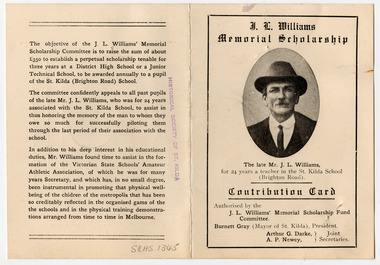 St Kilda Historical Society
Administrative record - Contribution Card, J. L. Williams Memorial Scholarship, c1927
... J. L. Williams Medal, first issued in 1931 by the Australian State/Secondary Schools' National Football Council (now awarded by School Sport Australia), in recognition of his efforts to establish what is now known as the School Sport Australia Championship. The award is given to the best and fairest footballer in the Championship. J. L. Williams Jack Williams St Kilda schools Stamped card no. 49 Cream coloured card printed in black on both sides and folded, with a photo of late Mr ...Card to record contributions to the J. L. Williams Memorial Scholarship fund. The fund was established in the memory of Jack Williams, who was a teacher at the St Kilda School on Brighton Road for 24 years. Contributions were sought towards raising about 350 pounds to establish a perpetual scholarship awarded annually to a pupil of the school. Jack Williams is also remembered through the J. L. Williams Medal, first issued in 1931 by the Australian State/Secondary Schools' National Football Council (now awarded by School Sport Australia), in recognition of his efforts to establish what is now known as the School Sport Australia Championship. The award is given to the best and fairest footballer in the Championship.Cream coloured card printed in black on both sides and folded, with a photo of late Mr J. L. Williams on the front page.Stamped card no. 49j. l. williams, jack williams, st kilda schools -
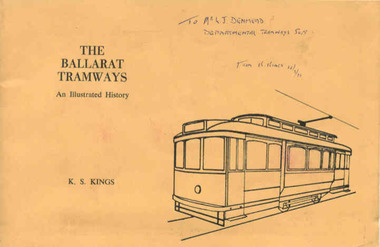 Ballarat Tramway Museum
Book, Keith Kings, "The Ballarat Tramways", Sep. 1971
... Mr. L. J. Denmead, Departmental Tramways Supt. from K. Kings 12/9/1971" handwritten on front cover in blue ink and on title page (page 1) in red ink "Mr. L. J. Denmead / Dear Les, / Best...Mr. L. J. Denmead, Departmental Tramways Supt. from K. Kings 12/9/1971" handwritten on front cover in blue ink and on title page (page 1) in red ink "Mr. L. J. Denmead / Dear Les, / Best ...Yields information about the history of the Ballarat Tramways from horse to the closure of the electric trams in 1971. Gives a good understanding of the development and operation of the tramways. Has a strong association with the author.Book, 64 pages, gloss art paper, in black ink with a light brown card cover in green ink, centre stapled, titled "The Ballarat Tramways" Details history of Ballarat tramways, its tramcars and the involvement of the various operators. Has maps and photographs. Written by Keith Kings and published by the Victorian Division of the Australian Railway Historical Society at the time of the closure of the Ballarat system. Inside front cover is a typed sheet of amendments for the book - typed on Charles Martin Watermarked paper. Has details of the various organisations that published the book on the rear cover. 114.2 - as for 114.1 - but with many hand written notes etc. 114.3 - as for 114.1 - but with "City of Ballarat" stamped on front cover. 114.4 - as for 114.1 - but with "To Mr. L. J. Denmead, Departmental Tramways Supt. from K. Kings 12/9/1971" handwritten on front cover. For entire book see pdf images i1 to i3.114.2 - notes on pages 7, 10, 17, 18, 21, 22, 23, 25, 26, 29, 36, 49 and 63 - has in blue or black ink, many notes, corrections and additions. 114.3 - "City of Ballaarat" stamped in red on top right hand corner. 114.4 - "To Mr. L. J. Denmead, Departmental Tramways Supt. from K. Kings 12/9/1971" handwritten on front cover in blue ink and on title page (page 1) in red ink "Mr. L. J. Denmead / Dear Les, / Best Wishes for the future! / Bob Prentice" and on same page, in blue stamp "L.J. Denmead".trams, tramways, ballarat tramways, history, tramcars of ballarat -
 Sunshine and District Historical Society Incorporated
Book - Jim Davis, John Masefield, 1947
... best thought. Front Cover - Jim Davis Longmans First Page - Handwritten From Mr. j. ...A book of a series of books that will lead to wider horizons by awakening a love of good books, and by providing a key to the tresures of the world's best thought.Green hard covered book with black text on front cover.non-fictionA book of a series of books that will lead to wider horizons by awakening a love of good books, and by providing a key to the tresures of the world's best thought.sunshine technical school, derby road, sunshine, john willaton -
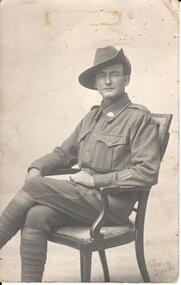 Hume City Civic Collection
Photograph, c 1916
... J. Smith Handwritten on front: ............................? Handwritten on back: TO MR AND MRS HEDE WITH BEST WISHES / FROM J SMITH...c1918 Private Light Horse, Wounded twice in action world war 1 postcards smith j. hede - (mr) - (mrs) soldiers uniforms clothing and dress armed forces george evans collection Typewritten on front: J. Smith Handwritten on front: ............................? Handwritten on back: TO MR AND MRS HEDE WITH BEST ...c1918 Private Light Horse, Wounded twice in actionA sepia postcard sized portrait of soldier J. Smith seated on a chair.Typewritten on front: J. Smith Handwritten on front: ............................? Handwritten on back: TO MR AND MRS HEDE WITH BEST WISHES / FROM J SMITHworld war 1, postcards, smith, j., hede, - (mr), - (mrs), soldiers, uniforms, clothing and dress, armed forces, george evans collection -
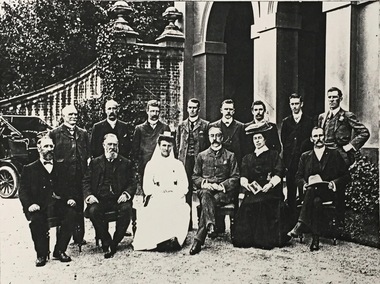 Kew Historical Society Inc
Photograph, Staff, Kew Mental Institute, 1907, 1907
... J McKie (Pharmacist), 4th from left Mr H. Oxlade (Accountant), 8th from left Mr T. Walsh. Front Row: Left Mr. Morrison, 2nd from left Mr Vallance, 4th from left Dr. Hollow. Inscription on reverse: "Mr McKie With Best...J McKie (Pharmacist), 4th from left Mr H. Oxlade (Accountant), 8th from left Mr T. Walsh. Front Row: Left Mr. Morrison, 2nd from left Mr Vallance, 4th from left Dr. Hollow. Inscription on reverse: "Mr McKie With Best ...Group photograph of staff of the Kew Mental Institute (Kew Asylum) including Dr Joseph Hollow.The following individuals in the photograph are identified on the reverse: Back Row 2nd from left J McKie (Pharmacist), 4th from left Mr H. Oxlade (Accountant), 8th from left Mr T. Walsh. Front Row: Left Mr. Morrison, 2nd from left Mr Vallance, 4th from left Dr. Hollow. Inscription on reverse: "Mr McKie With Best wishes (illegible), Kew H.I. {Kew Hospital for the Insane], April 1907". [NOTE: A descendant of Mr H Oxlade has suggested that he is the man 5th from left in the back row]kew lunatic asylum, kew mental institute, dr joseph hollow -
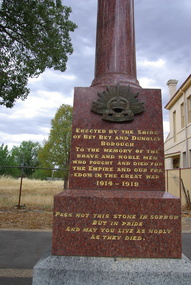 Ballarat Heritage Services
Photograph - War Memorial, Lisa Gervasoni, Dunolly War Memorial, 2025, 1921
... I gave all the Dunolly boys your best wishes and they all wish to be remembered to you— also the same remembrance from Dave Millar, who used to play football for Dunolly from Moliagul. He is in our battalion, having come over with reinforcements. I see him every day and he wished to be remembered to you. A brother of Mr A. J...I gave all the Dunolly boys your best wishes and they all wish to be remembered to you— also the same remembrance from Dave Millar, who used to play football for Dunolly from Moliagul. He is in our battalion, having come over with reinforcements. I see him every day and he wished to be remembered to you. A brother of Mr A. J ...The Dunolly World War One Memorial Pillar, located in front of the Town Hall on Broadway Street, and was unveiled on November 18th 1921. The pillar is topped by an urn and rests on a square concrete plinth, which lists the names ninety-four locals who died serving during the First World War. On Friday afternoon the Premier, accompanied by Messrs. Pennington and Groves, M's.L.A., visited Dunolly, and unveiled a soldiers' memorial — a polished granite column on a square base, erected by the residents at a cost of £300. It bears the names of 94 district soldiers who were killed in action. The Premier, who is a native of Dunolly, referred to his early associations with the town and district. Speaking of the valiant service rendered by the Australian soldiers in the great war, he paid a tribute to those who enlisted from the country districts. He was not one of those who would withhold national memorials to the fallen because provision had not been made for all who had returned. It was right and proper to have these memorials as silent reminders of the great sacrifice made by the many as a lasting tribute to their memory. Messrs. Groves and Pennington and local clergymen also spoke. The school children sang O God, Our Help in Ages Past, and a bugler sounded the Last Post after the unveiling. The shire president entertained the visitors and committee at dinner. The Age (Melbourne), 19 November 1921. Colour photograph of the Dunolly War Memorial. Front Inscription "Erected by the Shire of Bet Bet and Dunolly Borough To the memory of the brave and noble men who fought and died for the Empire and our freedom in the Great War 1914 - 1918. Pass not this stone in sorrow but in pride, and may you live as nobly as they died." "Private L. Polinelli has written several letters to his mother at Dunolly, dated from from Tel el Kebir from January 13th till the 22nd. He had written every day or two, and this example, is a very fine one. He explains why there was an interval some weeks during which he sent no letters. This was just before the evacuation of Gallipoli, and no-one was permitted to send letters at such a critical time, as there were fears that carefully arranged plans might leak out in some way. Gallipoli had been evacuated on the 19th December, which happened to be Private Polinelli's 24th birthday, and he has cause, he says, to remember that birthday particularly, when this important movement, in which he participated, was so success-fully carried out. He was in the best of health. They had been on Lemnos Island for two weeks after leaving Galilipoli, and while there they got billeted and numerous gifts from Australia, which gave great delight. He (Private Polinelli) had got a big mail - 35 letters and a number of parcels. Both Norman Watson and himself were feeling well, although they had a pretty rough time at the front, but they were feeling better every day. Further letters speak of the arrival in Egypt and the Australian being encamped at Tel el Kebir, 40 miles from Cairo. He states that W. Lyndon had returned from England and was with them. He (W. Lyndon) looks splendid and had had a splendid time in England and Scotland. He saw Jack Lewis in England, and thinks he was to return to Australia. Reference is made to the Rev. Father Goidanich who was with their brigade, and who had been wounded at the front, but was all right again. Father Goidanich is well-known in this district. The letters were written in good spirits and many references were made to friends in Dunolly and district. A friend in Dunolly has received a letter from Private L. Polinelli, which is dated February 3rd, and written 'from the Arabian Desert.' This covers a vast extent of country, so that there is no use in speculating as to the locality, and portions of the letter which possibly would have given some indication have bean 'censored.' Private Polinelli wrote that Norman Watson and Himself were in the best of health and have stook the life well. They are right out of civilisation at time of writing. He referred to their Dtsojourns at Lemoos Island, where Christmas was spent, and where the billies and puddings assisted much in their enjoyment. But they were glad to leave Lemnos Island. After being in camp at Tel el E-bir for two weeks they were sent to where they were at the time of writing, all being in good xxxx and the open country suiting them well. He speaks with admiration of the desert work done by the camels so very largely used. The censoring was very strict so that he could not give much news. After alluding to the return to splendid health of W. Lyndon from England, he says he saw a lot of others from round Dunolly on returning to Egypt, including Tom Fishlock, R. Johnson, and J. Taylor, and some others from Betley, and all looked well. He had also seen Erie Williamson a few times, and he looked splendid. He concludes with remembrances to friends, and from himself and Norman Watson to the Loyal Prince Alfred Lodge." (Dunolly and Betbetshire Express and County of Gladstone Advertiser, Tue 14 Mar 1916) "SOLDIER'S LETTERS PRIVATE L. POLINELLI A friend in Dunolly has received another interesting letter from Private L Polinelli, son of Mrs J Davis, South Dunolly. It is from "Somewhere in France," and is dated July 23rd. He remarks with regret that a good deal of the soldiers' mail from Australia went down in the Arabia, and then goes on to say:- "Norman is back here with us again now and looking well. He had a splendid time over in England after he was able to get out of bed. It was two years on the 18th of this month (January) since Norman and I enlisted, and we celebrated the occasion by having a bit of an evening out. I am very pleased that he is back; we spend most of our time together. We are at present out of the line having a spell in a village, so we are not having a bad time just now but we will soon be going into the trenches again. I met Wally Bell a few days ago; they were going into the line to relieve our brigade. We did not have time to have a long talk. He looks rather thin, but he was always that way. He is feeling well, and wishes to be remembered to his friends in Dunolly. I also met C. Game the same day; he looked well but, as he was also going into the line, we could not have much of a talk J. Hughes and C. Atherton are also over here now; I often see them. W. Lyndon and T. Miles are well ; I was speaking to them yesterday. We are having very bad weather over here now ; it is either raining or snowing every day. The snow was about a fool deep a few days ago. When the rain comes after it, it makes things muddy, The mud is very bad over here; it takes us all our time to struggle through it in places. We will all be very glad when the winter is over. I was over in England on furlough last month, and had a splendid time. The people over there do all they can to give us a good time. I had several invitations to visit different people, and those that we did visit gave us a splendid time. At the place where I was staying they always had a guide waiting of a morning to show us any place of interest that we wanted to see. There was also always a supply of free tickets to the different theatres if we wanted them ; so you see that they go to some expense to give ns a good time. When they know yon are from France you are sure of a hearty welcome. was up in Scotland, and spent five days in Edinburgh. It is a very pretty place, especially when it is seen from Edinburgh Castle, which is on a high bill overlooking the place. We veil through the Castle; also Holyrood Palace. There are a lot of interesting things to be seen in the two places connected with the history of Scotland. It was snowing very heavily while v« were in Scotland, and we bad some fine snowballing with the Scotch people. I greatly enjoyed the trip to Scotland. It would take a very long time to see all round London. I saw a lot of the old historical places there, which were very interesting. The fogs are very bad in London. I had an experience of a London fog one day; it was the heaviest they experienced for a number of years. We could only see a few yards ahead of us. Nearly everyone carried torches; it looked very funny. . . . There are nearly always as many women drinking in the bars as men; it struck me as being very strange, a bit different to what we are used to in Australia, a trip through some parts of London is a real eye-opener to us. It is interesting to watch the traffic in some of the business parts of London it moves along in one big mass. It is a wonder that a lot more accidents do not happen. I saw Australia House, where the High Commissioner has his office, in the Strand. It is not yet finished. It looks a very fine place, and when completed will be 'some' place. Both Norman and I are well, and send remembrances to friends." (Since this letter was written we have had the sad news of the death from wounds of Privates Atherton and Hughes, and that Sergeant Miles and Corporal Norman Watson have been wounded.) (Dunolly and Betbetshire Express and County of Gladstone Advertiser , Friday 13 April 1917, page 2) "Private L Polinelli, from some of whose previous letters we have published interesting extracts, has written to a friend in Dunolly, the letter being from France, and dated April 28th. Private Polinelli says among other things, "I am pleased to say that, Norman (Watson), Les (Anderson) and myself are in the best of health. We now have been in France some time. It is a terrible place for rain ; It has been raining all the time we have been here. It has also been very cold, snowing at times, but it is starting to "fine up" now, and the last few days have been splendid. I hope it keeps like that for a while, as it makes things very miserable in the trenches when it is so wet. We get a few days spell out of the trenches every now and again; so things are not as bad here as they were at Gallipoli. It is not so lively here so far as it was over there either. I am sorry to say that Jack Sanderson, who had been Will Lyndon's mate since they joined the forces, got killed during a bombardment last night. He was terribly knocked about with a shell. I saw W. Lyndon to-day and he was telling me all about it. He seemed terribly cut up over it, and so am I, as I was with Jack a lot over at Gallipoli after Will got sent away sick. He was always bright and cheerful, always had a smile up whenever I met him. I feel very sad about it. We will do all we can to make the Germans pay for it. You will most likely know him, as be used to live in Dunolly before going to Bendigo. Will Lyndon had a narrow escape also, as he was not very far from where the shell burst. He escaped with a bit of a shock, otherwise he is in the best of health. We have a good time among the French people when we are out of the trenches. They do all they can to make us feel at home. I am getting quite expert at speaking French. They smile at us a treat trying to speak French, but we generally make ourselves understood and have a good time among them. It is very rarely we see a young Frenchman, they being all away fighting. The women do all the work on the farms themselves, and deserve every credit for it. . . . I was sorry to hear about the death of Nurse M'Mahon; she was a grand old nurse. I heard that her daughter Nelly was nurse in a hospital on Lemnos Island, and when we were there I went to two of the hospitals to try to see her, but she did not happen to be at either, and I had no time to visit any of the others, so I did not see her. I was also sorry to hear about Mrs Rokahr, as she has left so many little ones behind. (Reference is made to other happenings in Dunolly.) So far I am pleased to say Norman and I have had the luck not to have had a day's illness; I think we are very fortunate, as such a lot get sent to the hospital ill. We are also lucky to have escaped the bullets and shells so far. I hope that luck sticks to us. I am sorry that, owing to the censorship, I cannot give you any interesting news of our trip over to France and the places we have seen. I will have to keep that till I get back to Dunolly again. . . . I have just heard that the battalion that Teddy Game is in has arrived, so I am going to look him up first chance I get." (The letter concludes with remembrances to members of the Lodge and other friends.) (Dunolly and Betbetshire Express and County of Gladstone Advertiser, Tuesday 13 June 1916, page 3) "PRIVATE L POLINELLI Another very interesting letter has been received by a friend in Dunolly from Private L. Polinelli, from France dated May 4th, 1916- Private Polinelli says-" I was glad that you got the letter I wrote from the Arabian Desert. The Censor must have crossed a good deal of it out. They seem to cross out a lot more than is really necessary. We left out there all of a sudden, and in a very short while found ourselves over here. It does not take them very long to make a move. I was saying in the last letter that I was going to try and find " Teddy " Game. I met him a few days ago and had a good yarn with him; he looks real well. I also met S. Prew, and "Ted" Smyth and his son Ernie. They all looked splendid, and are in the same battalion. "Ted" Smyth sticks to it well, and looks better than he ever looked. They will be under fire for the first time in a few days. S. Prew was hit in the landing at Gallipoli, but be is quite well now. W. Smythe, who is in our brigade is well ; I see him very often. " Les " Peart is not with us now; he has joined a Pioneer battalion, and I have not seen him since he joined it. I gave all the Dunolly boys your best wishes and they all wish to be remembered to you— also the same remembrance from Dave Millar, who used to play football for Dunolly from Moliagul. He is in our battalion, having come over with reinforcements. I see him every day and he wished to be remembered to you. A brother of Mr A. J. Williamson, manager of the Bank of Victoria, Dunolly, is also in this battalion. He is a great friend of mine ; we often have a talk about Dunolly. He was not well a little while ago, having to go into a hospital, but is all right again and is back with me. Eric Williamson, son of Mr A. J. Williamson is over here ; Norman (Watson) saw him a few days ago and said he looked well. Norman has been a corporal for some time. I was also offered stripes lately, but preferred to remain a private. There is a lot of worry and running about when you are an N.C.O., so I think I will remain as I am. ... So football is about done this season. I don't think they should cut it right out. I suppose some of them have to stay at home, so they ought to have some amusement. I would very much like to have a game, but I think I would just about forget how to play now. It is very amusing for us to read some of the soldiers letters in the Australian papers. . . l told you in the last letter about xxx young "Jack "Sanderson ; I was terribly sorry about him." Private Polinelli mentions in a letter to his sister in Dunolly that he happened to be beach at Gallipoli where the late Lord Kitchener was xxxxx addressed the' soldiers and' xxxxxx to them the message from the King. Private Polinelli states that he was very proud to have been one of those addressed by the great man. He and Norman Watson have never been a day out of the lines since arriving first in Egypt. It is intended to grant special leave to all those who have been kept so close to their posts xxx three months, and they are looking forward to this relaxation with keen anticipation, hoping to visit England and Scotland. (Dunolly and Betbetshire Express and County of Gladstone Advertiser, Tue 27 Jun 1916) "SOLDIER'S LETTERS. CORPORAL L. POLINELLI. Two letters have been received by Mrs J. Davis, South Dunolly, from her son, Corporal L. Polinelli, both written subsequent to the time when he was wounded, as reported when word was received at the time. Corporal Polinelli writes from No. 12 General Hospital, Rouen, France, and his first letter is dated 7th May. He stated that he was in hospital, he having been wounded in the arm and shoulder on 3rd May. He continued— " It is not a bad wound, and will not take long to heal up, as it is a clean wound. I was very lucky to get out of the fight alive, as I was buried by a shell explosion about an hour before I was wounded. It was very rough, and the noise of all the shells was terrible. Four men were killed by the same shell that wounded me, so I was fortunate. I am feeling a bit " shook up," and my head is aching from the concussion of the shells, but after a few days' spell in bed here I will be feeling just the thing again. So you need not worry about me ; a week or two will see me quite right again. We are having very nice warm weather just now-pleasant change after all the bad weather we have had." The second letter is dated May 12, Corporal Polinelli saying— "I am getting along splendidly ; the wound is healing up fast, so it will not be very long before I am quite right. The doc-tor, the other day said it would be better not to take the piece of shell out of my shoulder yet, and that it would not interfere with me in any way ; so perhaps l will always carry it about with me. He feared lest taking it out at that time would interfere with an artery. Rouen, where the hospital is, is a very pretty city. They give us leave to visit all the places when we are well enough. It is a nice spell here, away from the firing line. We have nothing to trouble us at all, so I will soon be just the thing again. When I got buried by a shell it shook me up a good deal. I felt it far more than the wound I got after; but it has not done me any harm, as I feel hardly any effects now. My good luck sticks to me in getting out of it so lightly. I hope you are not worrying at all about me, as I am all right. We are having beautiful weather over here— sunny days just like the Australian spring. . . . The sisters in the hospital are very nice, and treat us well. They have a lot of work to do, as a good few men have been wounded lately. I would have liked to have been sent over to England, but they are not sending many over there now. They treat as many as they can in France on account of attacks on hospital ships. I would have been able to have a good time with Norman (Watson) had l got over. He was just about all right when I heard from him last." Corporal Polinelli sends kind remembrances to friends." (Dunolly and Betbetshire Express and County of Gladstone Advertiser, Friday 6 July 1917, page 2) "SOLDIERS' LETTERS. CORPORAL L. POLINELLI. The following letter, dated from London on December 27; has been received by a friend in Dunolly from Corporal L. Polinelli (son of Mrs J. Davis, South Donolly), who, at the time of writing, after long and hard service at the front, was on furlough in England. After an introduction he says:— I am having a very good time. I went over to Ireland for five days, spending the most of the time in Dublin. I like the place very much. War appearances are not so conspicuous in Ireland as in England. The hotels are open all day, and a good meal can be obtained anywhere, which is more than can be got in England. The war seems to be making things very bad in England. It is very hard to get a good meal in London ; everything is so restricted. The only way to get a good meal is to go into two places. The people have to line up outside the shops for hours to get sugar, tea, and butter, and then they sometimes fail to get any. So many of our boats getting sunk is the cause of it. If things continue to go on in this way I am afraid that there is a very hard time in store for the people in England. Several people that I have spoken to say that they are just beginning to feel the pinch now. I was in London while an air raid was on a few days ago; it caused a lot of excitement among the people. Ten were killed and 70 wounded in the raid. I was about half a mile from where the bombs fell, so I was pretty right. I thought I had left the war behind in France, but it seems to be on over here at times also. I spent Christmas day with a family at Grantham, a town between London and Newcastle; they were very nice people. I had a very enjoyable time with them. I went to a dance in the evening and enjoyed it very much. It was a bit strange for a start, as it is the first dance I have been to since Norman and I had the send off at Dunolly in January, 1915. They do the dances a bit different over here to what they are done in Australia, and that made it worse still. I went through Guinness's Brewery while I was in Dublin. It is a wonderful place, and covers 55 acres of ground. I got a great surprise when I was starting on my leave in France. We were taken to the station we had to start from in a motor lorry, and who should the driver of the lorry be but Syd. Richards (son of Mr W. Richards, South Dunolly), who used to work at the Post Office in Dunolly. I rode on the front with him, so we had a good yarn. I did not know that be had joined, so was surprised to see him. He has grown a lot since I saw him last, and is looking well. Norman and Bill Lyndon were both well when I left France. We had been having a good spell near Messines, in Flanders, but they will be in the trenches by now. We have been round about Ypres for this last four months, and had some pretty rough times there. dunolly, dunolly war memorial, l. polinelli, bet bet, world war one, world war two, j. deledio, b. battilana, c. fitzgerald, f.s. kendall, j.h. hogan, p. zampatti, louisa davis, louisa gervasoni, bill lyndon, norman lyndon, sydney lindsay -
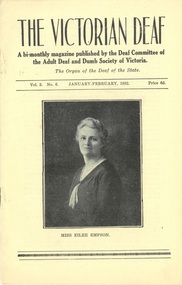 Expression Australia
Newsletter, The Victorian Deaf - January-February 1932
... james martin, hannah martin, h. sumner martin, elsie martin, elsie white, eileen empson, deaf hockey club, deaf ramblers club, e. r. peacock, n. armstrong, l.a. cleveland, f. w. spry, m. j. heath, e. h. peacock, mr porter, kodak, stan neilson, beechworth house queenscliff, d. hood, o. quinton, w. bladier, f. e. frewin, stella garry, colin johns, mrs j. m. johnston, r. dow, mrs gus damman, w. wood, w. limbrick, h. puddy, w. kent, j. elwin, herb wilson, e. roxburgh, a. taylor, mrs nicholson, jessie best, j. hunt, willie o'brien, j. retallick, cjarlie buck, e. cohen, e. sohwellj. e. kenworthy, jack mclaurin, alice smith,mrs j. e. muir, emily rose, f. j. rose, mrs james pierce, ernest j. d. abraham, t flukes...A bi-monthly magazine published by the Deaf Committee of the Adult Deaf and Dumb Society of Victoria The Victorian Deaf Newsletter is significant publication as an historical record giving and insight into the people, activities and events of the Deaf Community in Victoria. james martin, hannah martin, h. sumner martin, elsie martin, elsie white, eileen empson, deaf hockey club, deaf ramblers club, e. r. peacock, n. armstrong, l.a. cleveland, f. w. spry, m. j. heath, e. h. peacock, mr porter, kodak, stan neilson, beechworth house queenscliff, d. hood, o. quinton, w. bladier, f. e. frewin, stella garry, colin johns, mrs j. m. johnston, r. dow, mrs gus damman, w. wood, w. limbrick, h. puddy, w. kent, j. elwin, herb wilson, e. roxburgh, a. taylor, mrs nicholson, jessie best, j. hunt, willie o'brien, j. retallick, cjarlie buck, e. cohen, e. sohwellj. e. kenworthy, jack mclaurin, alice smith,mrs j. e. muir, emily rose, f. j. rose, mrs james pierce, ernest j. d. abraham, t flukes Vol. 2 No. 6, January-February 1932; Size 21.5cmHx14cmW The Victorian Deaf - January-February 1932 Newsletter ...A bi-monthly magazine published by the Deaf Committee of the Adult Deaf and Dumb Society of VictoriaThe Victorian Deaf Newsletter is significant publication as an historical record giving and insight into the people, activities and events of the Deaf Community in Victoria.Vol. 2 No. 6, January-February 1932; Size 21.5cmHx14cmWjames martin, hannah martin, h. sumner martin, elsie martin, elsie white, eileen empson, deaf hockey club, deaf ramblers club, e. r. peacock, n. armstrong, l.a. cleveland, f. w. spry, m. j. heath, e. h. peacock, mr porter, kodak, stan neilson, beechworth house queenscliff, d. hood, o. quinton, w. bladier, f. e. frewin, stella garry, colin johns, mrs j. m. johnston, r. dow, mrs gus damman, w. wood, w. limbrick, h. puddy, w. kent, j. elwin, herb wilson, e. roxburgh, a. taylor, mrs nicholson, jessie best, j. hunt, willie o'brien, j. retallick, cjarlie buck, e. cohen, e. sohwellj. e. kenworthy, jack mclaurin, alice smith,mrs j. e. muir, emily rose, f. j. rose, mrs james pierce, ernest j. d. abraham, t flukes -
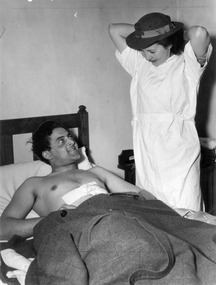 Royal District Nursing Service (now known as Bolton Clarke)
Photograph - Photograph, black and white:, 1952
... best quality care. The Sisters liaised with the patient’s Doctors and hospitals to provide information on the progress of patient’s wounds and to receive any change of wound care from the Doctors. When RDNS introduced Wound Care Specialists they carried out assessments and provided advice and support to the District Sisters working in the field. mdns melbourne district nursing society (1885-1957) nurses mdns uniforms rdns royal district nursing service rdns wound care mr george spartel sister j. faust On the left of the black and white photograph is Mr. ...The photograph is taken in Mr. Spartel's home in St. Kilda. The MDNS uniform worn under her white gown was a dark grey cotton frock with a belt. The grey stiffened and brimmed felt hat had a light grey hatband with a red Maltese cross attached in the centre. Sister J. Faust is about to redress a wound on Mr. Spartel's abdomen. The photograph is a record of wound care being given by MDNS trained nurses in a patients home during the 1950s. This photograph appeared along with an article in The Sun newspaper Oct 17 1952.The Trained nurses (Nurses) of the Melbourne District Nursing Society (MDNS), from its inception in 1885, provided wound care to their patients, who ranged in age from the very young to the elderly. As research developed better products and dressing materials, the methods and medication applied to wounds changed. MDNS received Royal patronage in 1966 and as Royal District Nursing Service (RDNS), the Education department developed programs, such as the Wound Specialist program, and the Leg Ulcer Management Program, to provide their Trained nurses (Sisters) with methods of best quality care. The Sisters liaised with the patient’s Doctors and hospitals to provide information on the progress of patient’s wounds and to receive any change of wound care from the Doctors. When RDNS introduced Wound Care Specialists they carried out assessments and provided advice and support to the District Sisters working in the field. On the left of the black and white photograph is Mr. George Spartel, who has dark short curly hair and is lying on his bed. His shoulders and head are resting on the white pillow with his head against the wooden slatted backrest of his bed. His torso is bare and part of a white wound dressing can be seen on his upper abdominal area. A dark grey covering is over the lower portion of his body. He is smiling and looking up at Sister J. Faust from Melbourne District Nursing Society (MDNS) who is standing to the right of his bed.Sister Faust, who has dark curled hair, has her arms raised behind her neck as she reaches the ties on the white gown she is wearing over her uniform. She is wearing her grey brimmed uniform hat. Behind her is a wooden table, with a dark coloured radio on its right, and a jug with a doily over it, on the right.mdns, melbourne district nursing society (1885-1957), nurses, mdns uniforms, rdns, royal district nursing service, rdns wound care, mr george spartel, sister j. faust
