
Showing 33 items matching " needle weaving"
-
 Bendigo Historical Society Inc.
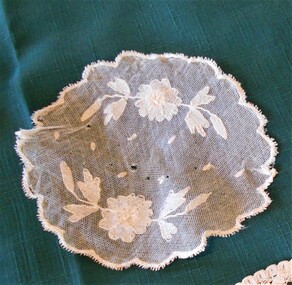
Textile - MAGGIE BARBER COLLECTION: VERY FINE NET NEEDLE WEAVING EMBROIDERED DOYLEY, Early 1900's
... MAGGIE BARBER COLLECTION: VERY FINE NET NEEDLE WEAVING EMBROIDERED DOYLEY......needle weaving embroidered doyley...The floral ''needle weaving'' embroidery comprises two petalled flowers, with raised bulliow stitch embroidered centres. ...Textile MAGGIE BARBER COLLECTION: VERY FINE NET NEEDLE WEAVING EMBROIDERED DOYLEY ...Textiles. Oval in shape, with a scalloped edge trimmed with a fine picot edged braid. The floral ''needle weaving'' embroidery comprises two petalled flowers, with raised bulliow stitch embroidered centres. Leaves and buds on either side of the flowers are also fine examples of needle weaving. Eight tiny buds complete the centrepiece.textiles, domestic, needle weaving embroidered doyley -
 Embroiderers Guild, Victoria
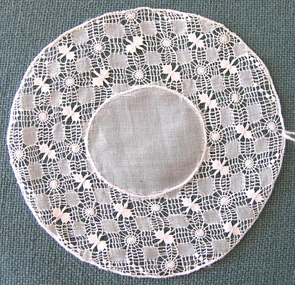
Textile - Drawn Thread with Needle Weaving Mat, 1940-60
... Drawn Thread with Needle Weaving Mat...... Needle weaving...Small round mat, very fine cotton, with a plain centre ane 4 cms border of drawn thread and needle weaving....Textile Drawn Thread with Needle Weaving Mat ...Small round mat, very fine cotton, with a plain centre ane 4 cms border of drawn thread and needle weaving.embroidery, mats, drawn thread, needle weaving, reunion islands, 1940-60 -
 Embroiderers Guild, Victoria
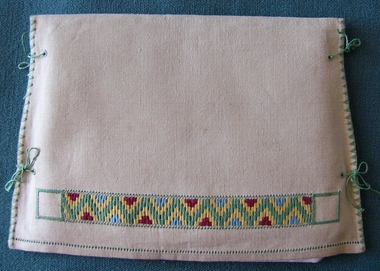
Textile - Tea Cosy Cover with Needle Weaving, Doris Adams, 1980
... Tea Cosy Cover with Needle Weaving...... Needle-weaving...Cream linen with a simple band of coloured needle-weaving. Constructed for easy cleaning with decorative buttonhole edging and tied with a cord. ...Mrs Doris Adams designed and worked this tea cosy Embroidery Needle-weaving Tea cosies Australia 1960-80 Cream linen with a simple band of coloured needle-weaving. ...Mrs Doris Adams designed and worked this tea cosyCream linen with a simple band of coloured needle-weaving. Constructed for easy cleaning with decorative buttonhole edging and tied with a cord. White pad inside.embroidery, needle-weaving, tea cosies, australia, 1960-80 -
 Embroiderers Guild, Victoria
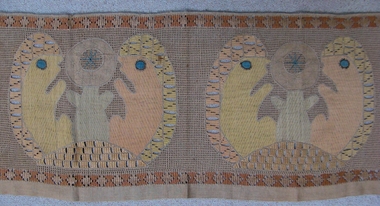
Textile - Russian Drawn Ground and Needle Weaving Panel, Early 19th century
... Russian Drawn Ground and Needle Weaving Panel..."The panel of needle weaving was taken from a remaining strip of a full length brown linen curtain. ...The back ground is Russian drawn ground and design is in needle weaving and surface stitchery....The back ground is Russian drawn ground and design is in needle weaving and surface stitchery. Textile Russian Drawn Ground and Needle Weaving Panel ..."The panel of needle weaving was taken from a remaining strip of a full length brown linen curtain. This was brought to Australia in the early years of the 20 th century but was possibly done much earlier. It is known to be of Russian workmanship and with a base of Russian drawn ground, round which was embroidered a primitive design showing several patterns of needle weaving in the detail. The central motif of two small animals, possibly bears, on either side of a mythical figure shows three designs of continuous border above and below the motifs is needle woven in a brighter coloured design. The donor was a member of the Guild who spent a considerable time in Great Britain, Western Europe and the Orient, including Russia, learning embroidery techniques at various schools of embroidery and bringing samples of local work back to Australia". Geraldine Amies (see Media) This was used as inspiration for the "Inspired by the Past" Exhibition by Lorna Law.Part of a larger piece in a coarse natural linen design appears to be of mythological significance - showing some animals (bears?). The back ground is Russian drawn ground and design is in needle weaving and surface stitchery.embroidery, cloths, early 19th century, russia, darning, surface stitchery, needleweaving pattern -
 Embroiderers Guild, Victoria
Textile - Drawn Thread with Needle Weaving Mat, Miss Collins
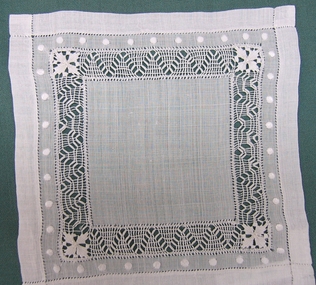
... Drawn Thread with Needle Weaving Mat...Square mat with l5 mms band of drawn thread work in a zig-zag design, and needle weaving square in each corner. There is an outer border of satin stitch dots and a hemstitched edge. ...Textile Drawn Thread with Needle Weaving Mat Miss Collins ...Made by donor's Aunts, the Misses Collins of "Fairfield" Compton, near Mount Gambier. Mary-Ann Collins born 1870 and died 1945Square mat with l5 mms band of drawn thread work in a zig-zag design, and needle weaving square in each corner. There is an outer border of satin stitch dots and a hemstitched edge. All white.embroidery, mats, drawn thread, australia -
 Embroiderers Guild, Victoria
Textile - Pink Linen Drawn Thread Embroidered Table Runner, 1940-60
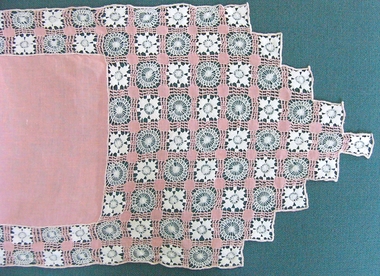
... ... Needle weaving...Pink linen with drawn thread embroidery in white. Needle weaving inserts....Needle weaving inserts. Textile Pink Linen Drawn Thread Embroidered Table Runner ...Pink linen with drawn thread embroidery in white. Needle weaving inserts.embroidery, drawn thread, needle weaving, 1940-60, reunion islands -
 Embroiderers Guild, Victoria
Textile - Natural Linen with White Embroidery Mat, prior to 1982
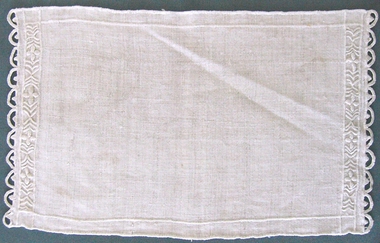
... ... Needle weaving...Coarse handwoven natural linen with 5 cm bands of off white embroidery in satin stitch, detached buttonhole stitch and needle weaving....Embroidery Surface stitchery Needle weaving Mats Italy Coarse handwoven natural linen with 5 cm bands of off white embroidery in satin stitch, detached buttonhole stitch and needle weaving. ...Coarse handwoven natural linen with 5 cm bands of off white embroidery in satin stitch, detached buttonhole stitch and needle weaving.embroidery, surface stitchery, needle weaving, mats, italy -
 Embroiderers Guild, Victoria
Textile - Reunion Island Drawn Thread Mat, 1940-60
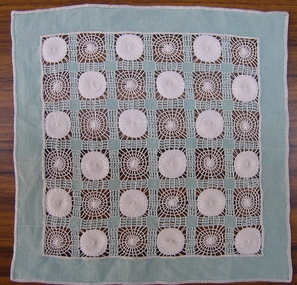
... ... Needle weaving...Square green linen mat with an all over drawn thread pattern in white incorporating needle weaving from Reunion Island (near Madagascar)...Embroidery Mats 1940-60 Reunion Island Drawn thread Needle weaving Square green linen mat with an all over drawn thread pattern in white incorporating needle weaving from Reunion Island (near Madagascar) Textile Reunion Island Drawn Thread Mat ...Square green linen mat with an all over drawn thread pattern in white incorporating needle weaving from Reunion Island (near Madagascar)embroidery, mats, 1940-60, reunion island, drawn thread, needle weaving -
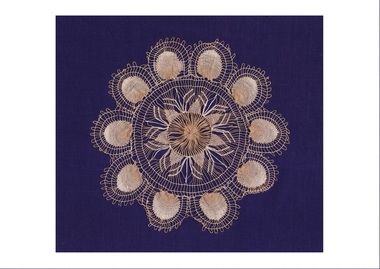 Australian Lace Guild - Victorian Branch
Textile - Nanduti lace
... Needle weaving lace round mat...Use: Domestic Needle weaving lace round mat Textile Nanduti lace ...Use: DomesticNeedle weaving lace round mat -
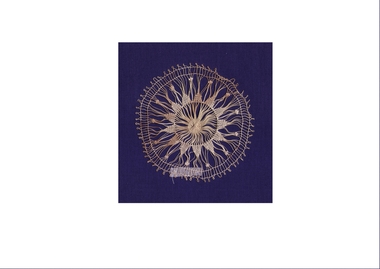 Australian Lace Guild - Victorian Branch
Textile - Nanduti lace
... Needle weaving lace round mat...Use: Domestic Needle weaving lace round mat Textile Nanduti lace ...Use: DomesticNeedle weaving lace round mat -
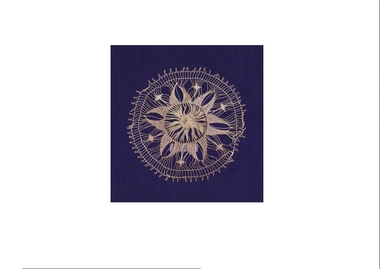 Australian Lace Guild - Victorian Branch
Textile - Nanduti lace
... Needle weaving lace round mat...Use: Domestic Needle weaving lace round mat Textile Nanduti lace ...Use: Domestic Needle weaving lace round mat -
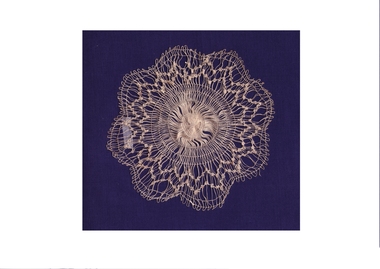 Australian Lace Guild - Victorian Branch
Textile - Nanduti lace
... Needle weaving lace round mat...Use: Domestic Needle weaving lace round mat Textile Nanduti lace ...Use: Domestic Needle weaving lace round mat -
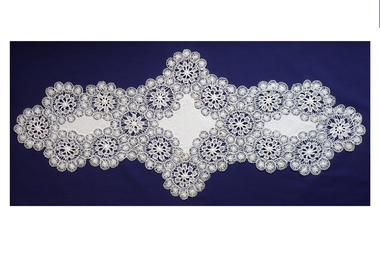 Australian Lace Guild - Victorian Branch
Textile - Nanduti lace
... Needle weaving lace table runner...Use: Domestic Needle weaving lace table runner Textile Nanduti lace ...Use: DomesticNeedle weaving lace table runner -
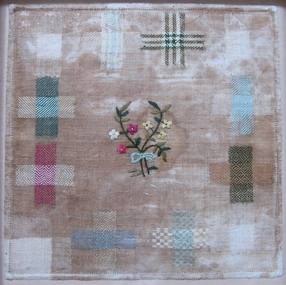 Embroiderers Guild, Victoria
Textile - Darning Sampler, 18th early 19th century
... Examples of pattern darning and needle weaving. Small floral motif with bow in the centre....Embroidery Darning Sampler Early 19th century England Examples of pattern darning and needle weaving. Small floral motif with bow in the centre. ...Examples of pattern darning and needle weaving. Small floral motif with bow in the centre.embroidery, darning, sampler, early 19th century, england -
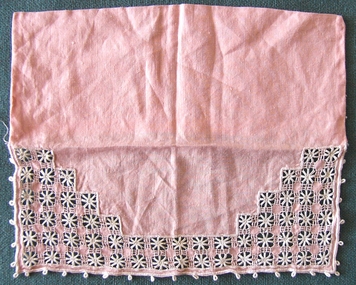 Embroiderers Guild, Victoria
Textile - Reunion Island Drawn Thread Linen Sachet, 1940-60
... ... Needle weaving...Embroidery Drawn thread 1940-60 Needle weaving Reunion Island Pink linen sachets with cream drawn thread embroidery and a looped buttonholed edge. ...Pink linen sachets with cream drawn thread embroidery and a looped buttonholed edge.embroidery, drawn thread, 1940-60, needle weaving, reunion island -
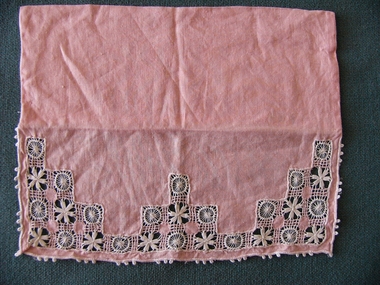 Embroiderers Guild, Victoria
Textile - Reunion Island Drawn Thread Linen Sachet, 1940-60
... ... Needle weaving...Embroidery Drawn thread 1940-60 Needle weaving Reunion Island Pink linen sachets with cream drawn thread embroidery and a looped buttonholed edge. ...Pink linen sachets with cream drawn thread embroidery and a looped buttonholed edge.embroidery, drawn thread, 1940-60, needle weaving, reunion island -
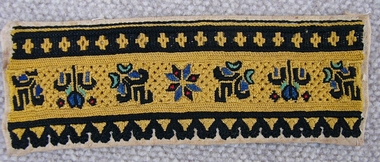 Embroiderers Guild, Victoria
Textile - Eastern European Embroidered Cuff
... ... Needle weaving...Georgina Sweet, who was the first woman veterinarian in Victoria and who travelled extensively in Middle Europe in the Early 20th century. Embroidery Needle weaving Surface Embroidery Czechoslovakia Hungary Garment Probably a cuff band. ...From the collection of the late Dr. Georgina Sweet, who was the first woman veterinarian in Victoria and who travelled extensively in Middle Europe in the Early 20th century.Probably a cuff band. Silk embroidery thread in black and gold with touches of blue, red and turquoise. Needlewoven one edge in black and gold. Centre start, flower and other motif in stitched ground, other edge black and gold triangle patterns. Worked on a natural linen or cotton fabricembroidery, needle weaving, surface embroidery, czechoslovakia, hungary, garment -
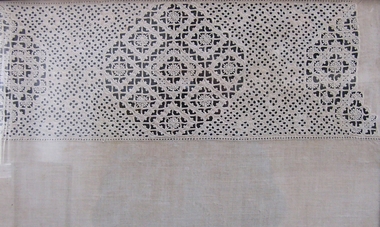 Embroiderers Guild, Victoria
Textile - Early Whitework Embroidered Panel, 18th Century?
... Eyelets, drawn thread and needle weaving with picots. The design is reminiscent of Hardanger and could possibly be an early form....Eyelets, drawn thread and needle weaving with picots. The design is reminiscent of Hardanger and could possibly be an early form. ...Fine natural linen with an intricate design worked in natural thread. Eyelets, drawn thread and needle weaving with picots. The design is reminiscent of Hardanger and could possibly be an early form.embroidery, hardanger, panels, sweden, 18th century -
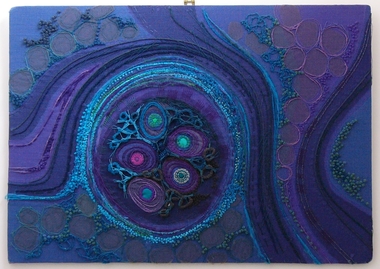 Embroiderers Guild, Victoria
Textile - Bird's Nest Panel, Jan Beaney, Mid 20th century
... A collage in complex design of net in layers and surface stitchery with some needle-weaving. Shades of blue, green, purple and pink wools and silk are used....A collage in complex design of net in layers and surface stitchery with some needle-weaving. Shades of blue, green, purple and pink wools and silk are used. ...By courtesy of Lady Hamilton-Fairley to the Victoria Guild from Embroiderers in the U.K.Designed and embroidered by Jan Beaney. A collage in complex design of net in layers and surface stitchery with some needle-weaving. Shades of blue, green, purple and pink wools and silk are used.embroidery, 1940-60, england, creative, panels, jan beaney -
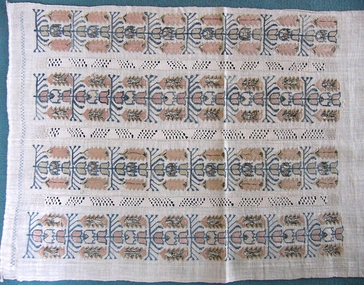 Embroiderers Guild, Victoria
Textile - Turkish Towel Fragment, Late 19th century
... Heavily embroidered with alternate bands of needle weaving and floral sprays of tent and cross stitch in pink and blue silks, along with metal threads...Heavily embroidered with alternate bands of needle weaving and floral sprays of tent and cross stitch in pink and blue silks, along with metal threads Textile Turkish Towel Fragment ...Natural coloured cotton fabric hand woven. Heavily embroidered with alternate bands of needle weaving and floral sprays of tent and cross stitch in pink and blue silks, along with metal threadsembroidery, towels, late 19th century, turkey, counted thread -
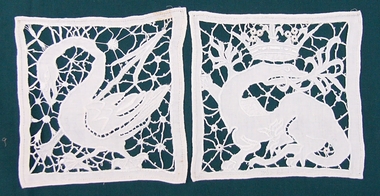 Embroiderers Guild, Victoria
Textile - The Arms of Francis I of France and his wife La Reine Claude (Swan and Arrow) 1494-1547, Late 19th century
... Picots and spider webs, some needle weaving....Picots and spider webs, some needle weaving. Textile The Arms of Francis I of France and his wife La Reine Claude (Swan and Arrow) 1494-1547 ...Heraldry in white richelieu work. The Arms of Francis I of France and his wife La Reine Claude (Swan and Arrow) 1494-1547 Stitches used are buttonhole, satin stitch, seeding, four sided. Picots and spider webs, some needle weaving.embroidery, heraldry, late 19th century, france, cutwork -
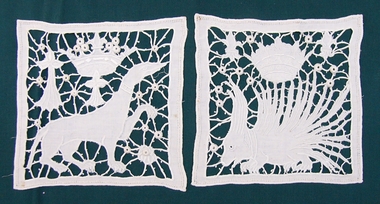 Embroiderers Guild, Victoria
Textile - The Arms of Louis XII King of France and his wife Anne of Brittany 1462-1575, 1476-1514, Late 19th century
... Picots and spider webs, some needle weaving....Picots and spider webs, some needle weaving. Textile The Arms of Louis XII King of France and his wife Anne of Brittany 1462-1575, 1476-1514. ...Heraldry in white richelieu work. The Arms of Louis XII King of France and his wife Anne of Brittany 1462-1575, 1476-1514. Stitches used are buttonhole, satin stitch, seeding, four sided. Picots and spider webs, some needle weaving.Border panel 1. - Franco1~7embroidery, heraldry, late 19th century, france, cutwork -
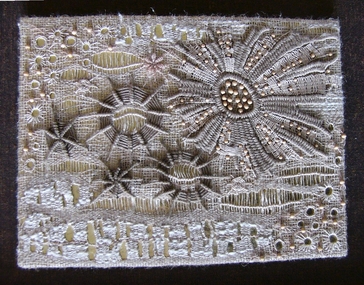 Embroiderers Guild, Victoria
Textile - Creative Embroidery Panel, Mrs Merle Whittle, 1972
... The flower heads have needle weaving and surface stitches in cream, beige and light brown, including small wooden beads, used in interesting ways....The flower heads have needle weaving and surface stitches in cream, beige and light brown, including small wooden beads, used in interesting ways. ...Designed and worked by Mrs Merle Whittle. Purchased from the 1972 George's Exhibition.Deep wood frame and brown slub silk mount, with a raised panel of a very loosely woven cream and white fabric over a gold mount. The flower heads have needle weaving and surface stitches in cream, beige and light brown, including small wooden beads, used in interesting ways.embroidery, panel, 1960-80, australia, creative embroidery -
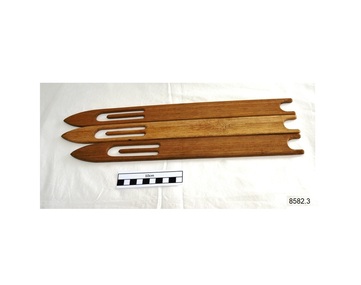 Flagstaff Hill Maritime Museum and Village
Tool - Netting Shuttle, Early-to-mid 20th century
... Shuttles, or net needles, are used in the netting process, along with twine or cord, and a sharp knife or scissors. The twine is wound onto the shuttle and dispensed as the shuttle knots and weaves the cord to make the net. ...Angus weaving netting shuttle net craft net needles safety nets safety equipment Shuttles, set of three; wooden slats, one end pointed, the other a concave shape. ...Maritime trades included making and mending nets. Netcraft skills have been taught and applied for centuries and are ongoing. Shuttles, or net needles, are used in the netting process, along with twine or cord, and a sharp knife or scissors. The twine is wound onto the shuttle and dispensed as the shuttle knots and weaves the cord to make the net. These shuttles are lightweight, compact and portable too. Nets were used on sailing ships for the crew's safety, often saving the sailor's lives in stormy seas Examples are the ship mast nets or shrouds that are wide at the base on the deck and taper to a point at the top of the mast, and railing nets that encircle the rails around the deck and prevent people and objects from rolling or falling into the sea. The shuttles were donated to Flagstaff Hill Maritime Village by the family of Doctor William Roy Angus, Surgeon and Oculist. It is part of the “W.R. Angus Collection” that includes historical medical equipment, surgical instruments and material belonging to Dr Edward Ryan and Dr Thomas Francis Ryan, (both of Nhill, Victoria) and Dr Angus’ own belongings. The Collection’s history spans the medical practices of the two Doctors Ryan, from 1885-1926 plus that of Dr Angus, until 1969. Nets were an essential part of the life-saving safety equipment on sailing vessels. The set of netting shuttles is an example of net-making tools used in the 18th to 20th centuries and continues into modern times to create and repair safety equipment. The shuttles are part of the W.R. Angus Collection, which is significant for still being located at the site it is connected with, Doctor Angus being the last Port Medical Officer in Warrnambool. Shuttles, set of three; wooden slats, one end pointed, the other a concave shape. The centre is cut-out, leaving a straight tab in the centre lengthwise. The set is part of the W.R. Angus Collection. warrnambool, shipwreck coast, flagstaff hill, flagstaff hill maritime museum, flagstaff hill maritime village, net making, net mending, net shuttle, net making tool, maritime trade, darning, shuttle, tool, 20th century, w.r. angus, weaving, netting shuttle, net craft, net needles, safety nets, safety equipment -
 Flagstaff Hill Maritime Museum and Village
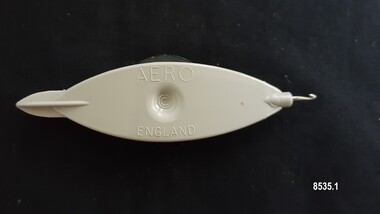
Domestic object - Tatting Shuttle, Aero Needles Group Ltd, Mid to late 20th century
... Shuttles hold a larger amount of thread (as compared with needles) which means fewer ends to weave in. Fishermen in the past are thought to have used large shuttles to weave cord into certain knots whilst making their fishing nets. ...Shuttles hold a larger amount of thread (as compared with needles) which means fewer ends to weave in. Fishermen in the past are thought to have used large shuttles to weave cord into certain knots whilst making their fishing nets. ...Tatting is a form of knotted lace making using thread and a small shuttle. Twisted threads are tied around or through small, pointed shuttles that can be made of bone, mother of pearl, tortoise shell, steel or plastic. This produces a stable, strong lace using simple knots of two half hitches to make rings and chains embellished with picots.The origins of tatting are not clear but early versions of decorative knotting were used by the Egyptians on their ceremonial dress. Tatting also has elements of fishermen's net making techniques and the decorative knotting that was practiced by aristocratic women from the 15th century.Tatting, as we know it today, emerged in the first half of the 19th century. The new availability of mercerised thread from 1835 encouraged a burgeoning of lace crafts of all sorts. It was known in Italy as "occhi" and in France as "la frivolite". Tatting looks fragile but is both strong and durable. An article in a column named "Wives and Daughters" published in the Star newspaper in May 1910 describes the durability of tatting lace - "there is edging and insertion still in existence that have outworn two sets of pillow slips." In the 19th century and well into the 20th century, tatting was used like crochet and knitted lace for decorative edgings, collars, doylies, tray cloths etc. At first, different tatting patterns were passed along by word of mouth from person to person, however in time, patterns regularly appeared in newspapers and magazines well into the 1950's. A shuttle is a small tool that looks like a small boat "sailing" in and out of the thread. Tatting is called "schiffchenarbeit" in German, which means "the work of a little boat". There are two popular types of shuttles. The first has closed ends and a removable bobbin where the thread is wound around - often made from metal or plastic (as is item 8535.1). The second type has a post in the center where the thread is wound (e.g. item 8535.2). The ends of this bobbin are open but snug. Because it is constructed in two pieces, it can be made from materials like bone, ivory or mother of pearl. Shuttles hold a larger amount of thread (as compared with needles) which means fewer ends to weave in. Fishermen in the past are thought to have used large shuttles to weave cord into certain knots whilst making their fishing nets. Their methods were copied by weavers, who innovated by using threads and smaller shuttles to make lace. One type of tatting shuttle produced by "Aero" from the 1930's to the late 1960's was an anodized grey coated aluminium shuttle with a sharp pick at one end. In the 1970's it was superseded by the grey plastic "Aero" which has a removeable bobbin which you can put on the end of the shuttle to make thread winding easier and an embedded crochet hook for joining picots. The "Aero" company developed in Redditch, England - a town renowned as a centre for manufacturing needles. Firms run by Henry Milward and Abel Morrall were based in Redditch and by the 18th century Redditch was manufacturing one million sewing needles per year. Abel Morrall Ltd launched the "Aero" brand in 1936 and greatly expanded the firm's product line to include tatting shuttles and knitting needles. The classic plastic "Aero" tatting shuttle was manufactured in England from the early 1970's until the 1990's. These items are significant as examples of easily accessible handiwork tools that enabled women in the 1930s -1960s to be able to decorate and personalize their household linen and clothing.Shuttle no. 8535.1 is a beige, boat shaped plastic shuttle with enclosed ends, small round central indentations on both sides and an enclosed black removeable bobbin. The shuttle has a grooved point at one end to hold a bobbin and a small metal crochet hook at the other end. Shuttle no. 8535.2 is a beige, boat shaped metal shuttle with pointed ends that are open but snug, small round central indentations and two smaller circular markings (on both sides) and two internal posts with cream thread wound around.Shuttle no. 8535.1 - "AERO" / "ENGLAND" Shuttle no. 8535.2 - "AERO' / "ENGLAND" "39c" (written in ball point pen)flagstaff hill maritime museum and village, flagstaff hill, warrnambool, shipwreck coast, great ocean road, tatting shuttle, aero company, handwork, handwork tool, craft, handcraft, needlework, tatting -
 Flagstaff Hill Maritime Museum and Village
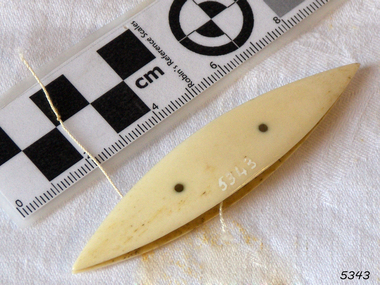
Tatting Shuttle
... Shuttles hold a larger amount of thread (as compared with needles) which means fewer ends to weave in. Fishermen in the past are thought to have used large shuttles to weave cord into certain knots whilst making their fishing nets. ...Shuttles hold a larger amount of thread (as compared with needles) which means fewer ends to weave in. Fishermen in the past are thought to have used large shuttles to weave cord into certain knots whilst making their fishing nets. ...Tatting is a form of knotted lace making using thread and a small shuttle. Twisted threads are tied around or through small, pointed shuttles that can be made of bone, mother of pearl, tortoise shell, steel or plastic. This produces a stable, strong lace using simple knots of two half hitches to make rings and chains embellished with picots. The origins of tatting are not clear but early versions of decorative knotting were used by the Egyptians on their ceremonial dress. Tatting also has elements of fishermen's net making techniques and the decorative knotting that was practiced by aristocratic women from the 15th century. Tatting, as we know it today, emerged in the first half of the 19th century. The new availability of mercerised thread from 1835 encouraged a burgeoning of lace crafts of all sorts. It was known in Italy as "occhi" and in France as "la frivolite". Tatting looks fragile but is both strong and durable. An article in a column named "Wives and Daughters" published in the Star newspaper in May 1910 describes the durability of tatting lace - "there is edging and insertion still in existence that have outworn two sets of pillow slips." In the 19th century and well into the 20th century, tatting was used like crochet and knitted lace for decorative edgings, collars, doylies, tray cloths etc. At first, different tatting patterns were passed along by word of mouth from person to person, however in time, patterns regularly appeared in newspapers and magazines well into the 1950's. A shuttle is a small tool that looks like a small boat "sailing" in and out of the thread. Tatting is called "schiffchenarbeit" in German, which means "the work of a little boat". There are two popular types of shuttles. The first has closed ends and a removable bobbin where the thread is wound around - often made from metal or plastic. The second type has a post in the center where the thread is wound. The ends of this bobbin are open but snug. Because it is constructed in two pieces, it can be made from materials like bone, ivory or mother of pearl. Shuttles hold a larger amount of thread (as compared with needles) which means fewer ends to weave in. Fishermen in the past are thought to have used large shuttles to weave cord into certain knots whilst making their fishing nets. Their methods were copied by weavers, who innovated by using threads and smaller shuttles to make lace.Tatting Shuttle, Ivoryflagstaff hill, warrnambool, shipwrecked-coast, flagstaff-hill, flagstaff-hill-maritime-museum, maritime-museum, shipwreck-coast, flagstaff-hill-maritime-village, tatting shuttle, handcraft, needlework -
 Flagstaff Hill Maritime Museum and Village
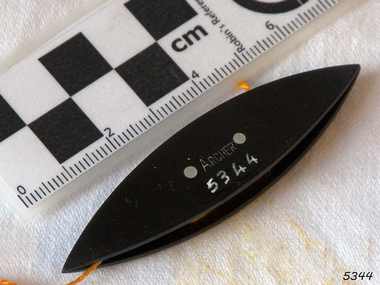
Tatting Shuttle
... Shuttles hold a larger amount of thread (as compared with needles) which means fewer ends to weave in. Fishermen in the past are thought to have used large shuttles to weave cord into certain knots whilst making their fishing nets. ...Shuttles hold a larger amount of thread (as compared with needles) which means fewer ends to weave in. Fishermen in the past are thought to have used large shuttles to weave cord into certain knots whilst making their fishing nets. ...Tatting is a form of knotted lace making using thread and a small shuttle. Twisted threads are tied around or through small, pointed shuttles that can be made of bone, mother of pearl, tortoise shell, steel or plastic. This produces a stable, strong lace using simple knots of two half hitches to make rings and chains embellished with picots. The origins of tatting are not clear but early versions of decorative knotting were used by the Egyptians on their ceremonial dress. Tatting also has elements of fishermen's net making techniques and the decorative knotting that was practiced by aristocratic women from the 15th century. Tatting, as we know it today, emerged in the first half of the 19th century. The new availability of mercerised thread from 1835 encouraged a burgeoning of lace crafts of all sorts. It was known in Italy as "occhi" and in France as "la frivolite". Tatting looks fragile but is both strong and durable. An article in a column named "Wives and Daughters" published in the Star newspaper in May 1910 describes the durability of tatting lace - "there is edging and insertion still in existence that have outworn two sets of pillow slips." In the 19th century and well into the 20th century, tatting was used like crochet and knitted lace for decorative edgings, collars, doylies, tray cloths etc. At first, different tatting patterns were passed along by word of mouth from person to person, however in time, patterns regularly appeared in newspapers and magazines well into the 1950's. A shuttle is a small tool that looks like a small boat "sailing" in and out of the thread. Tatting is called "schiffchenarbeit" in German, which means "the work of a little boat". There are two popular types of shuttles. The first has closed ends and a removable bobbin where the thread is wound around - often made from metal or plastic. The second type has a post in the center where the thread is wound. The ends of this bobbin are open but snug. Because it is constructed in two pieces, it can be made from materials like bone, ivory or mother of pearl. Shuttles hold a larger amount of thread (as compared with needles) which means fewer ends to weave in. Fishermen in the past are thought to have used large shuttles to weave cord into certain knots whilst making their fishing nets. Their methods were copied by weavers, who innovated by using threads and smaller shuttles to make lace.Tatting Shuttle, Black plastic, "ARCHER" inscribed. "ARCHER" inscribed.flagstaff hill, warrnambool, shipwrecked-coast, flagstaff-hill, flagstaff-hill-maritime-museum, maritime-museum, shipwreck-coast, flagstaff-hill-maritime-village, tatting shuttle, handcraft, needlework -
 Flagstaff Hill Maritime Museum and Village
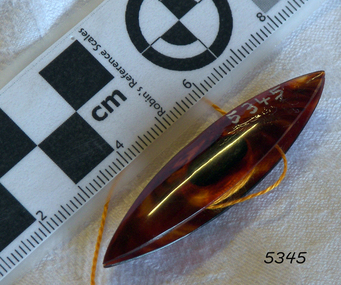
Tatting Shuttle
... Shuttles hold a larger amount of thread (as compared with needles) which means fewer ends to weave in. Fishermen in the past are thought to have used large shuttles to weave cord into certain knots whilst making their fishing nets. ...Shuttles hold a larger amount of thread (as compared with needles) which means fewer ends to weave in. Fishermen in the past are thought to have used large shuttles to weave cord into certain knots whilst making their fishing nets. ...Tatting is a form of knotted lace making using thread and a small shuttle. Twisted threads are tied around or through small, pointed shuttles that can be made of bone, mother of pearl, tortoise shell, steel or plastic. This produces a stable, strong lace using simple knots of two half hitches to make rings and chains embellished with picots. The origins of tatting are not clear but early versions of decorative knotting were used by the Egyptians on their ceremonial dress. Tatting also has elements of fishermen's net making techniques and the decorative knotting that was practiced by aristocratic women from the 15th century. Tatting, as we know it today, emerged in the first half of the 19th century. The new availability of mercerised thread from 1835 encouraged a burgeoning of lace crafts of all sorts. It was known in Italy as "occhi" and in France as "la frivolite". Tatting looks fragile but is both strong and durable. An article in a column named "Wives and Daughters" published in the Star newspaper in May 1910 describes the durability of tatting lace - "there is edging and insertion still in existence that have outworn two sets of pillow slips." In the 19th century and well into the 20th century, tatting was used like crochet and knitted lace for decorative edgings, collars, doylies, tray cloths etc. At first, different tatting patterns were passed along by word of mouth from person to person, however in time, patterns regularly appeared in newspapers and magazines well into the 1950's. A shuttle is a small tool that looks like a small boat "sailing" in and out of the thread. Tatting is called "schiffchenarbeit" in German, which means "the work of a little boat". There are two popular types of shuttles. The first has closed ends and a removable bobbin where the thread is wound around - often made from metal or plastic. The second type has a post in the center where the thread is wound. The ends of this bobbin are open but snug. Because it is constructed in two pieces, it can be made from materials like bone, ivory or mother of pearl. Shuttles hold a larger amount of thread (as compared with needles) which means fewer ends to weave in. Fishermen in the past are thought to have used large shuttles to weave cord into certain knots whilst making their fishing nets. Their methods were copied by weavers, who innovated by using threads and smaller shuttles to make lace.Tatting Shuttle, tortoise-shellflagstaff hill, warrnambool, shipwrecked-coast, flagstaff-hill, flagstaff-hill-maritime-museum, maritime-museum, shipwreck-coast, flagstaff-hill-maritime-village, tatting shuttle, handcraft, needlework -
 Flagstaff Hill Maritime Museum and Village
Tatting Shuttle
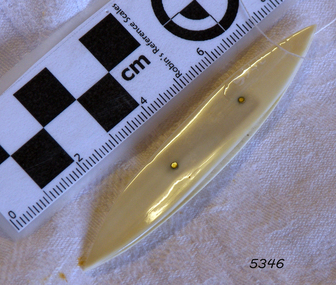
... Shuttles hold a larger amount of thread (as compared with needles) which means fewer ends to weave in. Fishermen in the past are thought to have used large shuttles to weave cord into certain knots whilst making their fishing nets. ...Shuttles hold a larger amount of thread (as compared with needles) which means fewer ends to weave in. Fishermen in the past are thought to have used large shuttles to weave cord into certain knots whilst making their fishing nets. ...Tatting is a form of knotted lace making using thread and a small shuttle. Twisted threads are tied around or through small, pointed shuttles that can be made of bone, mother of pearl, tortoise shell, steel or plastic. This produces a stable, strong lace using simple knots of two half hitches to make rings and chains embellished with picots. The origins of tatting are not clear but early versions of decorative knotting were used by the Egyptians on their ceremonial dress. Tatting also has elements of fishermen's net making techniques and the decorative knotting that was practiced by aristocratic women from the 15th century. Tatting, as we know it today, emerged in the first half of the 19th century. The new availability of mercerised thread from 1835 encouraged a burgeoning of lace crafts of all sorts. It was known in Italy as "occhi" and in France as "la frivolite". Tatting looks fragile but is both strong and durable. An article in a column named "Wives and Daughters" published in the Star newspaper in May 1910 describes the durability of tatting lace - "there is edging and insertion still in existence that have outworn two sets of pillow slips." In the 19th century and well into the 20th century, tatting was used like crochet and knitted lace for decorative edgings, collars, doylies, tray cloths etc. At first, different tatting patterns were passed along by word of mouth from person to person, however in time, patterns regularly appeared in newspapers and magazines well into the 1950's. A shuttle is a small tool that looks like a small boat "sailing" in and out of the thread. Tatting is called "schiffchenarbeit" in German, which means "the work of a little boat". There are two popular types of shuttles. The first has closed ends and a removable bobbin where the thread is wound around - often made from metal or plastic. The second type has a post in the center where the thread is wound. The ends of this bobbin are open but snug. Because it is constructed in two pieces, it can be made from materials like bone, ivory or mother of pearl. Shuttles hold a larger amount of thread (as compared with needles) which means fewer ends to weave in. Fishermen in the past are thought to have used large shuttles to weave cord into certain knots whilst making their fishing nets. Their methods were copied by weavers, who innovated by using threads and smaller shuttles to make lace.Tatting Shuttle, ivory, flagstaff hill, warrnambool, shipwrecked-coast, flagstaff-hill, flagstaff-hill-maritime-museum, maritime-museum, shipwreck-coast, flagstaff-hill-maritime-village, tatting shuttle, handcraft, needlework -
 Flagstaff Hill Maritime Museum and Village
Tatting Shuttle
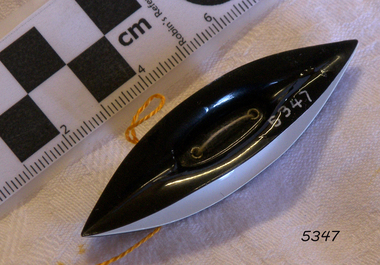
... Shuttles hold a larger amount of thread (as compared with needles) which means fewer ends to weave in. Fishermen in the past are thought to have used large shuttles to weave cord into certain knots whilst making their fishing nets. ...Shuttles hold a larger amount of thread (as compared with needles) which means fewer ends to weave in. Fishermen in the past are thought to have used large shuttles to weave cord into certain knots whilst making their fishing nets. ...Tatting is a form of knotted lace making using thread and a small shuttle. Twisted threads are tied around or through small, pointed shuttles that can be made of bone, mother of pearl, tortoise shell, steel or plastic. This produces a stable, strong lace using simple knots of two half hitches to make rings and chains embellished with picots. The origins of tatting are not clear but early versions of decorative knotting were used by the Egyptians on their ceremonial dress. Tatting also has elements of fishermen's net making techniques and the decorative knotting that was practiced by aristocratic women from the 15th century. Tatting, as we know it today, emerged in the first half of the 19th century. The new availability of mercerised thread from 1835 encouraged a burgeoning of lace crafts of all sorts. It was known in Italy as "occhi" and in France as "la frivolite". Tatting looks fragile but is both strong and durable. An article in a column named "Wives and Daughters" published in the Star newspaper in May 1910 describes the durability of tatting lace - "there is edging and insertion still in existence that have outworn two sets of pillow slips." In the 19th century and well into the 20th century, tatting was used like crochet and knitted lace for decorative edgings, collars, doylies, tray cloths etc. At first, different tatting patterns were passed along by word of mouth from person to person, however in time, patterns regularly appeared in newspapers and magazines well into the 1950's. A shuttle is a small tool that looks like a small boat "sailing" in and out of the thread. Tatting is called "schiffchenarbeit" in German, which means "the work of a little boat". There are two popular types of shuttles. The first has closed ends and a removable bobbin where the thread is wound around - often made from metal or plastic. The second type has a post in the center where the thread is wound. The ends of this bobbin are open but snug. Because it is constructed in two pieces, it can be made from materials like bone, ivory or mother of pearl. Shuttles hold a larger amount of thread (as compared with needles) which means fewer ends to weave in. Fishermen in the past are thought to have used large shuttles to weave cord into certain knots whilst making their fishing nets. Their methods were copied by weavers, who innovated by using threads and smaller shuttles to make lace.Tatting Shuttle, black plastic flagstaff hill, warrnambool, shipwrecked-coast, flagstaff-hill, flagstaff-hill-maritime-museum, maritime-museum, shipwreck-coast, flagstaff-hill-maritime-village, tatting shuttle, handcraft, needlework
