
Showing 66 items matching " perforated paper"
-
 Embroiderers Guild, Victoria
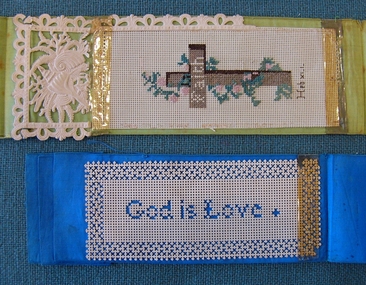
Textile - Bristol Board Embroidered Christian Bookmarks, Mid 19th century
... ... Perforated paper...Embroidery Bookmarks Ecclesiastical Late 19th century England Canvas work Perforated paper Embroidery on perforated cardboard or bristol board (1.) ...Embroidery on perforated cardboard or bristol board (1.) Religious text partly worked, mounted on a blue silk ribbon for protection "God is Love" (2.) Partly worked cross on a decorative card mounted on a green silk ribbon for protection 'Faith" Heb 1.1.embroidery, bookmarks, ecclesiastical, late 19th century, england, canvas work, perforated paper -
 Embroiderers Guild, Victoria
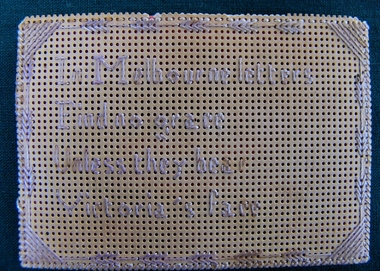
Tool - Stamp Holder, c. 1900
... Perforated paper with silk embroidery sewing together with decorative stitching. ...19th century Embroidery Small Articles Counted thread Australia Side 1, In Melbourne letters Side 2, To guard her head from Find no grace Dust and damps Unless they bear This case provides for Victoria's face Postage stamps Perforated paper with silk embroidery sewing together with decorative stitching. ...Perforated paper with silk embroidery sewing together with decorative stitching. Side 1, In Melbourne letters Side 2, To guard her head from Find no grace Dust and damps Unless they bear This case provides for Victoria's face Postage stamps19th century, embroidery, small articles, counted thread, australia -
 Great Stupa of Universal Compassion
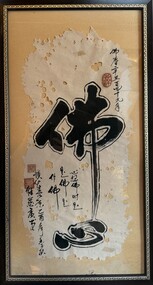
Artwork, other (item) - Framed picture with calligraphy and red stamps, Ho Chi Min City, Vietnam, April 2009
... A framed piece featuring calligraphy artwork on perforated paper, adorned with intricate calligraphy and accented by vibrant red stamps....This framed artwork, featuring traditional calligraphy and symbolic red stamps on perforated paper, was presented to Ian Green by Thich Giac Thien in Ho Chi Minh City, Vietnam. ...The Jade Buddha for Universal Peace, the largest Buddha carved from gemstone-quality jade in the world, is the centerpiece of the Great Stupa of Universal Compassion in Bendigo, Australia. Standing 2.5 meters tall and weighing 4 tonnes, this priceless Buddhist statue toured over 120 cities across 20 countries from 2009 to 2018, inspiring peace in families, schools, and communities worldwide. After attracting an estimated 12 million visitors, it returned to the Great Stupa in May 2018, where it continues to be a potent symbol of peace.This framed artwork, featuring traditional calligraphy and symbolic red stamps on perforated paper, was presented to Ian Green by Thich Giac Thien in Ho Chi Minh City, Vietnam. Centered around the character for 'Buddha,' it reflects the spiritual reverence, artistic heritage, and goodwill that marked the early stages of the Jade Buddha’s global journey.Calligraphy symbol meaning Buddhajade buddha, memorabilia, great stupa archive -
 Mont De Lancey
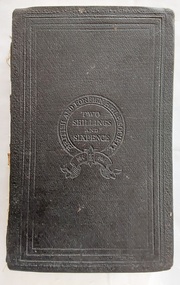
Book, Oxford University Press, The Holy Bible containing the Old and New Testaments, 1772
... Included are two ribbon bookmarks, one yellow with 'Think of Me. 1870.' embroidered on perforated paper in blue cross stitch. The other blue one has 'Love' embroidered on perforated paper in coloured thread. ...Included are two ribbon bookmarks, one yellow with 'Think of Me. 1870.' embroidered on perforated paper in blue cross stitch. The other blue one has 'Love' embroidered on perforated paper in coloured thread. ...The Holy Bible containing the Old and New testaments: translated out of the original tongues and with the former translations diligently compared and revised, By His Majesty's Special Command. Appointed to be read in churches.A badly damaged thick black hardcover Holy Bible with an embossed insignia on the front cover as well as lined patterns on the front and back covers. The front has stamped inside a circular insignia the words, 'British and Foreign Bible Society, Two Shillings and Sixpence' embossed in the middle. The end paper at the front has come away from the spine, there are marks and foxing inside. The text is clear. There is no spine and many pages are loose. Throughout the bible are several added pieces of handwritten notes on paper, small leaflets a newspaper article about the death of King George VI. There is no pagination. Included are two ribbon bookmarks, one yellow with 'Think of Me. 1870.' embroidered on perforated paper in blue cross stitch. The other blue one has 'Love' embroidered on perforated paper in coloured thread. A third green ribbon bookmark has 'Who ever absent dear' embroidered in brown thread on perforated paper. non-fictionThe Holy Bible containing the Old and New testaments: translated out of the original tongues and with the former translations diligently compared and revised, By His Majesty's Special Command. Appointed to be read in churches. holy bible, religion, christianity, gibson collection -
 Embroiderers Guild, Victoria
Accessory - 'Buda' Castlemaine Wedding Favour, late 19th C
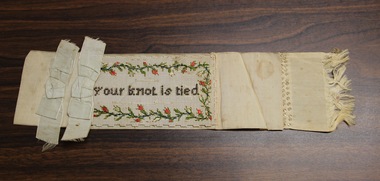
... The centre is perforated paper bordered with silk buds (pink) and green leaves, and gun metal beads "Your knot is tied"....The centre is perforated paper bordered with silk buds (pink) and green leaves, and gun metal beads "Your knot is tied". ...Found amongst old Levy family (Family who lived at Buda, Castlemaine) papers and photographs.Cream silk ribbon (wide). One end is fringed and beaded, the other end has 2 flat silk ribbon bows. The centre is perforated paper bordered with silk buds (pink) and green leaves, and gun metal beads "Your knot is tied"." Your knot is tied"embroidery, favour, silk, paperbeads, fringe, bows -
 St Kilda Historical Society
Ephemera - Stamps, Don't Forget St Kilda Beach Carnival Sat. Feb. 27 to Sat. Mar. 6, 1926
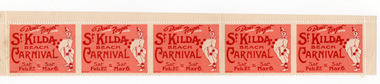
... Series of five identical stamps, printed in red and pink on a sheet of perforated white paper, discoloured with age, and backed with gum. ...St Kilda carnivals St Kilda Beach WWI fund-raising Series of five identical stamps, printed in red and pink on a sheet of perforated white paper, discoloured with age, and backed with gum. ...The stamps advertise a 5-day festival in 1926 to raise funds for the Bush Fire Relief Fund, Soldiers' Memorial Hall, St Vincent's Hospital and the Catani Memorial (St Kilda cenotaph).Series of five identical stamps, printed in red and pink on a sheet of perforated white paper, discoloured with age, and backed with gum. st kilda carnivals, st kilda beach, wwi fund-raising -
 Clunes Museum
Document - INVITATION AND PROGRAMME, BACK TO CLUNES 1925
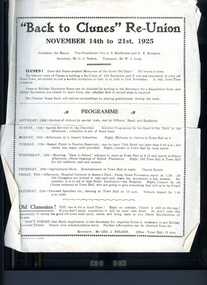
... .1 INVITATION, BLUE PAPER, PERFORATED 2/3 WAY DOWN FOR REPLY FOR REUNION NOV 14-21 1925 .2 PROGRAMME CREAM PAPER DETAILS OF ACTIVITIES...REUNION 1925 CLUNES PROGRAMME REUNION 1925 CLUNES INVITATION 'BACK TO CLUNES' REUNION NOV 14 TO 21 1925 .1 INVITATION, BLUE PAPER, PERFORATED 2/3 WAY DOWN FOR REPLY FOR REUNION NOV 14-21 1925 .2 PROGRAMME CREAM PAPER DETAILS OF ACTIVITIES BACK TO CLUNES 1925 Document INVITATION AND PROGRAMME ....1 INVITATION, BLUE PAPER, PERFORATED 2/3 WAY DOWN FOR REPLY FOR REUNION NOV 14-21 1925 .2 PROGRAMME CREAM PAPER DETAILS OF ACTIVITIES'BACK TO CLUNES' REUNION NOV 14 TO 21 1925reunion 1925 clunes programme, reunion 1925 clunes invitation -
 Bendigo Historical Society Inc.
Financial record - INVOICE COLLECTION: The Australian Mutual Provident Society
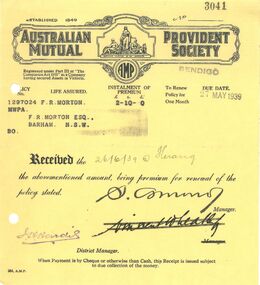
... 10934.35a: No. 3041 A small, square sheet of yellow paper with two clean punch holes on the left side and a perforated edge. The paper is thin, but sturdy. ...Attached to 10934.35h 10934.35j: No. 876 A small, square sheet of yellow paper with two clean punch holes on the left side and a perforated edge. The paper is thin, but sturdy. ...https://www.amp.com.au/about-amp/what-we-do "From its humble beginnings in 1849 by offering life insurance as the Australian Mutual Provident Society, AMP has evolved over the past 175 years to be a publicly listed company with over 1.3 million customers and AU$133 billion in assets under management (as at FY23). Proudly celebrating 175 years of business in 2024, AMP now helps millions of people in Australia and New Zealand invest, build wealth and retire with confidence." Milestones 1849 – The Australian Mutual Provident Society (AMP) opens for business 1860 – Benjamin Short joins AMP as its first agent 1869 – The National Mutual Life Association of Australasia opens for business 1899 – James Tuscon Thompson joins National Mutual as its first agent 1962 – The iconic AMP building in Sydney's Circular Quay is opened by Prime Minister Robert Menzies 1995 – National Mutual demutualises and lists on the Australian Stock Exchange 1998 – AMP demutualises and lists on the Australian Stock Exchange. AMP Bank opens for business 2000 – AMP plays a major part in the first Olympics of the new century, supporting the Sydney 2000 Olympic Games, the Paralympic Games and the Olympic Torch Relay 2009 – AMP and China Life Group form strategic partnership 2011 – AMP and AXA Asia Pacific (formerly National Mutual) merge. AMP and Mitsubishi UFJ Trust and Banking form strategic partnership 2017 – AMP Capital takes a minority stake in US based real estate investment manager PCCP 2020 – Completed sale of AMP Life insurance business to Resolution Life 2022 – Announced sale of global asset management business, AMP Capital, to focus on AMP’s core businesses in banking and wealth management. 2024 – AMP celebrates 175 years of helping people create their tomorrow10934.35a: No. 3041 A small, square sheet of yellow paper with two clean punch holes on the left side and a perforated edge. The paper is thin, but sturdy. Printed in black ink is the business name and details: Australian Mutual Provident Society established 1849. Policy No. 1297024 The receipt is printed in black ink. Payment due 27 May 1939. Receipt indicates payment received 26 June 1939. Payment listed in British Pounds, totaling 2 pounds 10 shillings. 10934.35b: No. 3861 A small, square sheet of yellow paper with two clean punch holes on the left side and a perforated edge. The paper is thin, but sturdy. Printed in black ink is the business name and details: Australian Mutual Provident Society established 1849. Policy No. 1311528 The receipt is printed in black ink. Payment due 18 Jun 1939. Receipt indicates payment received 26 June 1939. Payment listed in British Pounds, totaling 2 pounds 10 shillings. 10934.35c: No. 1671 A small, square sheet of yellow paper with two clean punch holes on the left side and a perforated edge. The paper is thin, but sturdy. Printed in black ink is the business name and details: Australian Mutual Provident Society established 1849. Policy No. 1311528 The receipt is printed in black ink. Payment due 18 Mar 1939. Receipt indicates payment received 25 March 1939. Payment listed in British Pounds, totaling 2 pounds 10 shillings. 10934.35d: No. 903 A small, square sheet of yellow paper with two clean punch holes on the left side and a perforated edge. The paper is thin, but sturdy. Printed in black ink is the business name and details: Australian Mutual Provident Society established 1849. Policy No. 1297024 The receipt is printed in black ink. Payment due 27 Feb 1939. Receipt indicates payment received 25 March 1939. Payment listed in British Pounds, totaling 2 pounds 10 shillings. 10934.35e: No. 8557 A small, square sheet of yellow paper with two clean punch holes on the left side and a perforated edge. The paper is thin, but sturdy. Printed in black ink is the business name and details: Australian Mutual Provident Society established 1849. Policy No. 1297024 The receipt is printed in black ink. Payment due 27 Dec 1938. Receipt indicates payment received 25 Jan 1939. Payment listed in British Pounds, totaling 2 pounds 10 shillings. 10934.35f: No. 338 A small, square sheet of yellow paper with two clean punch holes on the left side and a perforated edge. The paper is thin, but sturdy. Printed in black ink is the business name and details: Australian Mutual Provident Society established 1849. Policy No. 1311528 The receipt is printed in black ink. Payment due 18 Jan 1939. Receipt indicates payment received 25 Jan 1939. Payment listed in British Pounds, totaling 2 pounds 10 shillings. 10934.35g: No. 365 A small, square sheet of yellow paper with two clean punch holes on the left side and a perforated edge. The paper is thin, but sturdy. Printed in black ink is the business name and details: Australian Mutual Provident Society established 1849. Policy No. 1297024 The receipt is printed in black ink. Payment due 27 Jun 1939. Receipt indicates payment received 25 Feb 1939. Payment listed in British Pounds, totaling 2 pounds 10 shillings. receipt attached to 10934.35j 10934.35h: No. 2321 A small, square sheet of yellow paper with two clean punch holes on the left side and a perforated edge. The paper is thin, but sturdy. Printed in black ink is the business name and details: Australian Mutual Provident Society established 1849. Policy No. 1311528 The receipt is printed in black ink. Payment due 18 April 1939. Receipt indicates payment received 27 April 1939. Payment listed in British Pounds, totaling 2 pounds 10 shillings. receipt is attached to 10934.35i 10934.35i: No. 1697 A small, square sheet of yellow paper with two clean punch holes on the left side and a perforated edge. The paper is thin, but sturdy. Printed in black ink is the business name and details: Australian Mutual Provident Society established 1849. Policy No. 1297024 The receipt is printed in black ink. Payment due 27 Mar 1939. Receipt indicates payment received 27 April 1939. Payment listed in British Pounds, totaling 2 pounds 10 shillings. Attached to 10934.35h 10934.35j: No. 876 A small, square sheet of yellow paper with two clean punch holes on the left side and a perforated edge. The paper is thin, but sturdy. Printed in black ink is the business name and details: Australian Mutual Provident Society established 1849. Policy No. 1311528 The receipt is printed in black ink. Payment due 18 Feb 1939. Receipt indicates payment received 25 Feb 1939. Payment listed in British Pounds, totaling 2 pounds 10 shillings. Attached 10934.35gac morton, amp, australian mutual provident society, insurance -
 Melbourne Tram Museum
Document - Personal Papers, Jack McLean, Keith Kings, "Tramway / Railway level crossings", 1954
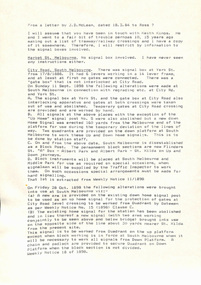
... Consist of .1 - letter to Ross dated 19/3/1984, carbon copy from Jack McLean, printed on computer paper perforated computer paper torn into strips - has hand written notes. ...Consist of .1 - letter to Ross dated 19/3/1984, carbon copy from Jack McLean, printed on computer paper perforated computer paper torn into strips - has hand written notes. ...Set pf personal papers concerning tramway / railway level crossings in Melbourne. Consist of .1 - letter to Ross dated 19/3/1984, carbon copy from Jack McLean, printed on computer paper perforated computer paper torn into strips - has hand written notes. Three separate sheets. Covers Market St Melbourne (Queensbridge) South Melbourne (City Road) St George Road - North Fitzroy Queens Parade Clifton Hill Epsom Road Showgrounds Glenferrie Road Hawthorn Glenferrie Road Malvern Burke Road Camberwell, Glenferrie Rd Kooyong, Burke Road Gardiner Glenhuntly Road Glenhuntly Glenhuntly Road Elsternwick, Whitehorse Road (Deepdene), Riversdale Road, Riversdale Lygon St North Carlton Nicholson St Footscray Nicholson St North Fitzroy, .2 - six pages - retype of above document on A4 computer printing paper - covers the same material. .3 - Hand drawing of the Melbourne rail system with crossing dates including bridges noted on it for cable and electric tramways. Has initials KK 12/54 in bottom right hand corner. drawn on lined double width foolscap paper.trams, tramways, level crossings, railway squares, tramway square, cable trams -
 Bendigo Historical Society Inc.
Financial record - INVOICE COLLECTION: J. H. Curnow & Son
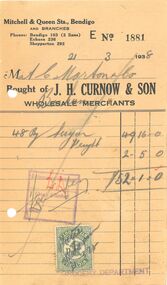
... 10934.33a: A small, aged sheet of yellow paper with two clean punch holes on the left side and a perforated edge. The paper is thin, but sturdy. ...AC Morton JH Curnow & Son 10934.33a: A small, aged sheet of yellow paper with two clean punch holes on the left side and a perforated edge. The paper is thin, but sturdy. ...See below for an article by Jim Evans of the Bendigo Historical Society: From the Bendigo Miner Number 9 - 1 March 2007 Cock-eyed Curnow - James Henry Curnow Cornishman and famous Bendigonian By Jim Evans Five-time Mayor of Bendigo, James Henry Curnow of Eumana , was for fifty years associated with almost every progressive movement in the life of the city. He was born in Ludgvan, Cornwall, in 1861, the son of Sampson Curnow, tin-miner and later mine-manager. His parents brought him to Bendigo when he was two years old and settled at Long Gully. He was educated at the state school and St Andrew s College. In 1883, he married Jane Corbel in the Congregational Church. Curnow joined the Post-Master-General s Department in 1881. Taking leave in 1887, he acted as secretary of the Australian Natives Association (ANA) exhibition at Geelong. He became a clerk with Connelly and Tatchell's, Bendigo solicitors, leaving in 1894 to establish an accountancy and real estate business. Considered shrewd and hard-working, Curnow prospered; he later added an auctioneering section and formed the company J.H. Curnow & Son (now Curnow & Dyett). The ANA provided the grounding for Curnow s public life. He joined the Sandhurst branch in 1881 and was secretary in 1883-1891. He helped form new branches in northern Victoria. With (Sir) John Quick, he set up the first Federation League in the colony in 1893. Curnow was secretary of the League in that year and again in 1898-99. He was elected to the Bendigo City Council in 1901 and, apart from 1906-09 remained a very energetic councillor. He was Mayor in 1902-03, 1903-04, 1912-13, 1919-20 and 1927-28. It was during his second term as Mayor in 1904, that he had William Beebe design a home - Eumana in Flora Hill. (Local historian Betty Jackman informs me that Curnow s house at 75 Wills Street where he lived before moving to Flora Hill, was also called Eumana ). He took a leading role in the installation of sewerage and was later Chairman of the city s Sewerage authority when that body was being subjected to a great deal of criticism. He was an executive member of The Municipal Association of Victoria and president in 1919. Curnow was very interested in politics, but his four attempts to enter parliament failed. He was Justice of the Peace for the states of New South Wales and Victoria, deputy coroner for the city of Bendigo, a guardian of minors and registrar of marriages. Curnow was managing director of the Bendigo Pottery, director of the Bendigo Gas Co. and the Bendigo and Eaglehawk Star Building Society and chairman of directors of the Bendigo Boot and Shoe factory. He was a life member of both the Bendigo Base Hospital and the Benevolent Asylum (Anne Caudle Centre). Curnow s family affairs were marred by tragedy. His father was killed in a mining accident in 1881; his first wife and three of their five children died in the measles epidemic of 1893. His second wife Mary Jordan died in 1909 after spilling carbolic acid on her hip, leaving three young children. He married Amy McLean in 1911and they had one daughter. When the Prince Edward visited Bendigo in 1920, Curnow made a speech, telling his audience: I will now merely ask you to drink his health as the Prince of Wales and also as the Duke of Cornwall. In this district there are a tremendous number of Cornishmen and I need not tell His Royal Highness that it was the Cousin Jacks who made Bendigo, who found the gold and developed the mines. They have added more to the riches of the Commonwealth than any other class of people. When he visits the mines today, he will find that ninety per cent of the miners are Cornishmen and descendants of Cornishmen. His remarks were greeted by loud applause. J.H. Curnow was known locally as Cock-eyed because of an eye defect. He died on Anzac Day 1932 at his then home, The Knoll in Wattle Street. He was 71. He was cremated at the new Fawkner Cemetery and his ashes were buried in the Bendigo Cemetery. His grave is close to that of another famous Cornishman and Bendigonian, Sir John Quick, who died in the same year. The Curnow memorial drinking fountain in Rosalind Park was unveiled in 1938 by Mayor Taylor. The distinguished Bendigo born sculptress Ola Cohn designed the memorial and made the bust and other plaques of terracotta. The plaques were damaged in the 1950s and a restoration program was undertaken, with bronze plaques replacing the original terracotta ones.10934.33a: A small, aged sheet of yellow paper with two clean punch holes on the left side and a perforated edge. The paper is thin, but sturdy. Printed in black ink is the business name and details: Bought of J.H. Curnow & Son Wholesale Merchants. The address: Mitchell & Queen Sts. Bendigo and branches. Phones: Bendigo 103. The receipt is handwritten in grey lead pencil. Dated 21 March 1938. Below the header is neat, ruled lines for listing items with prices listed in British Pounds, totaling 52 pounds 1 shillings. Receipt number 1881. There is also a Victorian 3 pence stamp duty stamp printed in green ink. 10934.33b: A small, aged sheet of yellow paper with two clean punch holes on the left side and a perforated edge. The paper is thin, but sturdy. Printed in black ink is the business name and details: Bought of J.H. Curnow & Son Wholesale Merchants. The address: Mitchell & Queen Sts. Bendigo and branches. Phones: Bendigo 103. The receipt is handwritten in grey lead pencil. Dated 25 May 1938. Below the header is neat, ruled lines for listing items. Receipt number 14291. The Receipt is crossed out in blye pencil. The top left corner is folded and slightly torn. 10934.33c: A small, aged sheet of yellow paper with two clean punch holes on the left side and a perforated edge. The paper is thin, but sturdy. Printed in black ink is the business name and details: Bought of J.H. Curnow & Son Wholesale Merchants. The address: Mitchell & Queen Sts. Bendigo and branches. Phones: Bendigo 103. The receipt is handwritten in grey lead pencil. Dated 27 June 1938. Below the header is neat, ruled lines for listing items with prices listed in British Pounds, totaling 2 pounds. Receipt number 1466. The receipt is crossed out in blue pencil and indicates and credit. 10934.33d: A small, aged sheet of yellow paper with two clean punch holes on the left side and a perforated edge. The paper is thin, but sturdy. Printed in black ink is the business name and details: Bought of J.H. Curnow & Son Wholesale Merchants. The address: Mitchell & Queen Sts. Bendigo and branches. Phones: Bendigo 103. The receipt is handwritten in grey lead pencil. Dated 7 March 1938. Below the header is neat, ruled lines for listing items with prices listed in British Pounds, totaling 34 pounds 14 shillings. Receipt number 1627. There is also a Victorian 3 pence stamp duty stamp printed in green ink.ac morton, jh curnow & son -
 Ballarat Tramway Museum
Document - Letter/s, Lardner family, Apr. 2000
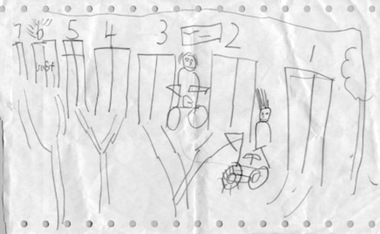
... A complimentary letter from a child of the Lardner Family that arrived at the depot (placed under the door) on 12 April 2000, with drawings and a note on computer printer paper with perforated holes on the sides. 1429.1 - Drawing of the depot building with tracks outside, with No. 6 road highlighted and with a note "best". ...A complimentary letter from a child of the Lardner Family that arrived at the depot (placed under the door) on 12 April 2000, with drawings and a note on computer printer paper with perforated holes on the sides. 1429.1 - Drawing of the depot building with tracks outside, with No. 6 road highlighted and with a note "best". ...A complimentary letter from a child of the Lardner Family that arrived at the depot (placed under the door) on 12 April 2000, with drawings and a note on computer printer paper with perforated holes on the sides. 1429.1 - Drawing of the depot building with tracks outside, with No. 6 road highlighted and with a note "best". Two people with bikes in from of the shed, shows sign and a tree. 1429.2 - two sheets of same computer paper, addressed "Dear the Tramline People" on one side, a sketch of tram 13, and two written notes, from the "Lardner family"BTM letter Date stamp and item no. - arrived at the depot 12 Apr 2000 and given the item No. "9136" in black ink.trams, tramways, children, btm, complimentary, drawings -
 Ballarat Tramway Museum
Certificate, City of Ballaarat, "Public Inoculation Depot / Pneumonic Influenza", 1919
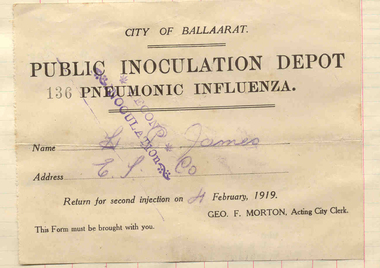
... Printed form on paper with perforated left hand edge, to record the H.P. ...Printed form on paper with perforated left hand edge, to record the H.P. ...Certificate contained within Reg. Item 2526, page 8 titled "Public Inoculation Depot / Pneumonic Influenza". Printed form on paper with perforated left hand edge, to record the H.P. James of ESCo had received the two injections for the Spanish Influenza outbreak of 1919. Formed signed by Geo. F. Morton as Acting Town Clerk. Has been stamped that the second injection had been received. The required date for the 2nd injection was 4/2/1919. H.P. James refers to the outbreak in the item on the retirement of Bob Haines (Reg. Item 2529), and notes he was the "Dispenser-Inspector" of two quinine powders to each man and that they had to wear gauze masks. S Note Item Not formally Numbered. A photocopy of the manuscript is held with the work sheet.Has stamped number '136' on form.tramways, trams, esco, tram crews, personnel, influenza -
 Bendigo Historical Society Inc.
Financial record - INVOICE COLLECTION: The Cohn Bros
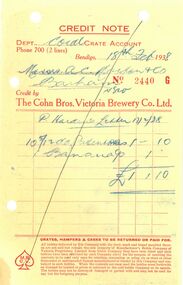
... The receipt has a long black line, diagonally crossing the page. 10934.34b: A long, aged sheet of yellow paper with two clean punch holes on the left side and a perforated edge. The paper is thin, but sturdy. ...The receipt has a long black line, diagonally crossing the page. 10934.34b: A long, aged sheet of yellow paper with two clean punch holes on the left side and a perforated edge. The paper is thin, but sturdy. ..." The former Cohn Brothers brewery was established in 1858. Today, only remnants of the once substantial complex survive, including the ice works building (1880s), built for the storage of lager beer on site, and the adjacent fermentation vats building. The ice works and fermentation buildings constitute the public interface with the site, as viewed from Water Street. The site also includes other process and ancillary buildings and a building which appears likely to have been for office/administration use. There is also a substantial retaining concrete wall which provides a reference to the site boundary... The former Cohn Brothers ice works and brewery, a long-standing and once extensive industrial site, is of local historical significance. Established in the 1850s, the site was contemporary with establishment and rapid expansion of Bendigo during the alluvial gold rushes. The Cohn Bros.' brewery was one of the largest and longest-running in the city, outlasting many of the small breweries which had been established during the 1850s. It operated continuously as a brewery and aerated drinks manufactory from 1858 to 1984. The Cohn Bros installed extensive refrigeration and ice-making facilities in the 1880s, to facilitate the production and storage of lager beer. The equipment was acquired from J H Schwalbe and Son of Chemnitz, Germany. The brewery is noted as the first in Australia to produce lager beer. The ice works building, at the north-west corner of the site addressing Water Street, is a remnant of the significant investment in ice making and refrigeration equipment in the 1880s." Victorian Heritage Database Report Report generated 22/07/25 Former Cohn Brothers Ice Works and Brewery10934.34a: No. 2440 A small sheet of yellow paper with two clean punch holes on the left side and two along the top edge. The paper is thin, but sturdy. Printed in red ink is the business name and details: Credit Note: Credit by the Cohn Bros. Victoria Brewery Co. Ltd. The receipt is handwritten in blue ink. Dated 18 Feb 1938. Below the header is neat, ruled lines for listing items with prices listed in British Pounds, totaling 1 pounds 1 shillings and 10 pence. The receipt has a long black line, diagonally crossing the page. 10934.34b: A long, aged sheet of yellow paper with two clean punch holes on the left side and a perforated edge. The paper is thin, but sturdy. Printed in black ink is the business name and details: Cart Note: Cordial Branch, Phones: Bendigo 700 and Swan Hill 196 Receipt No. 5126 Bendigo, Bought of the Cohn Bros. Victoria Brewery Co. Ltd. The receipt is handwritten in blue pencil. Dated 5 Jan 1948. Below the header is neat, ruled lines for listing items. The Receipt is crossed out in black pencil. The bottom edge of the page is creased from being folded. The receipt has a large black cross indicating payment. Below the header is neat, ruled lines for listing items with prices listed in British Pounds, totaling 1 pounds 5 shillings and 3 pence. 10934.34c: A long, aged sheet of yellow paper with two clean punch holes on the left side and a perforated edge. The paper is thin, but sturdy. Printed in black ink is the business name and details: Cart Note: Cordial Branch, Phones: Bendigo 700 and Swan Hill 196 Receipt No. 5155 Bendigo, Bought of the Cohn Bros. Victoria Brewery Co. Ltd. The items are pre-printed on the receipt. The remainder of the receipt is handwritten in blue pencil. Dated 22 Jan 1948. Below the header is neat, ruled lines for listing items. The bottom edge of the page is creased from being folded. The receipt has a large black cross indicating payment. Below the header is neat, ruled lines for listing items with prices listed in British Pounds, totaling 50 pounds 14 shillings and 6 pence. 10934.34d: A long, aged sheet of yellow paper with two clean punch holes on the left side and a perforated edge. One of the holes has torn to the left edge. The paper is thin, but sturdy. Printed in black ink is the business name and details: Cart Note: Cordial Branch, Phones: Bendigo 700 and Swan Hill 196 Receipt No. 3116 Bendigo, Bought of the Cohn Bros. Victoria Brewery Co. Ltd. The receipt is handwritten in blue pencil. Dated 16 Nov 1945. Below the header is neat, ruled lines for listing items. The Receipt is crossed out in Green pencil. The bottom edge of the page is creased from being folded. Below the header is neat, ruled lines for listing items with prices listed in British Pounds, totaling 17 pounds 15 shillings and 1 pence. 10934.34e: A long, aged sheet of yellow paper with two clean punch holes on the left side and a perforated edge. The paper is thin, but sturdy. Printed in black ink is the business name and details: Cart Note: Cordial Branch, Phones: Bendigo 700 and Swan Hill 196 Receipt No. 3373 Bendigo, Bought of the Cohn Bros. Victoria Brewery Co. Ltd. The receipt is handwritten in blue pencil. Dated 18 Jan 1946. Below the header is neat, ruled lines for listing items. The Receipt is crossed out in Green and black pencil. The bottom edge of the page is creased from being folded. Below the header is neat, ruled lines for listing items with prices listed in British Pounds, totaling 20 pounds 14 shillings and 9 pence. 10934.34f: A long, aged sheet of yellow paper with two clean punch holes on the left side and a perforated edge. The paper is thin, but sturdy. Printed in black ink is the business name and details: Cart Note: Cordial Branch, Phones: Bendigo 700 and Swan Hill 196 Receipt No. 5126 Bendigo, Bought of the Cohn Bros. Victoria Brewery Co. Ltd. The receipt is handwritten in blue pencil. Dated 9 Jan 1946. Below the header is neat, ruled lines for listing items. The Receipt is crossed out in Green and black pencil. The bottom edge of the page is creased from being folded. Below the header is neat, ruled lines for listing items with prices listed in British Pounds, totaling 14 pounds and 4 pence.ac morton, cohn bros -
 Flagstaff Hill Maritime Museum and Village
Currency - Bank cheque, Sands & McDougall Limited, 03-12-1885
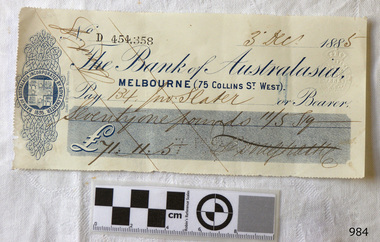
... The rectangular paper has three sides that have been perforated. It is printed in blue with bank's Insignia of a heraldic shield of sheep hung by their waists and ships in full sail. ...The rectangular paper has three sides that have been perforated. It is printed in blue with bank's Insignia of a heraldic shield of sheep hung by their waists and ships in full sail. ...This bank cheque originated from the Bank of Australasia, Melbourne branch. It was issued on 3rd December 1885 to a person surnamed Slater for £71.11.5 (seventy-one pounds, eleven shillings and five pence). The parallel lines are called Cheque Crossed and mean that only Slater and no one else could receive the payment and that it would have been paid into Slater's bank account, not exchanged for cash. The embossed dots signify that the cheque amount was also paid to be the bearer of the cheque. Slater would have visited the bank to deposit the money into his or her own account. The cheque was printed by Sands & McDougall, a long-standing Melbourne printing and stationery company. It was then Stamped at the bank with its own unique number before it was issued to the customer. From its previously perforated edges, it is presumed that the cheque was part of a page of cheques, likely to be contained within a book of similar cheques ready for use. The Bank of Australia was incorporated by Royal Charter of England in March 1834. It had its Australian beginnings on 14th December 1835, opening in Sydney. The Acting Superintendent of the bank at that time was David Charters McArthur. He was Superintendent from 1867-to 1876. The Melbourne branch opened on 28th August 1838 in a two-roomed brick cottage on the north side of Little Collins Street, where two huge mastiff dogs were used at night to guard the bank. The government also provided an armed military sentinel. Due to the bank's rapid growth, a new building for the Melbourne branch was opened in 1840 at 75 Collins Street West. By 1879 the bank had been upgraded to a magnificent two-storey building on the corners of Collins and Queens Streets, with the entry on Collins Street. In 1951 the Bank of Australasia amalgamated with the Union Bank to form the Australia and New Zealand Bank, now known as the ANZ. Then in 1970, the ANZ merged with both the ES&A and the London Bank of Australia to form the ANZ Banking Group Limited. The ANZ Banking Group Ltd kindly donated a variety of historic items from the Bank of Australasia. BANK of AUSTRALASIA, WARRNAMBOOL – In 1854 Warrnambool had two banks, the Union Bank and the Bank of Australasia. Later, completely different bank businesses opened; in 1867 the National Bank of Australasia, then in 1875 the Colonial Bank of Australasia. The original Warrnambool branch of the Bank of Australasia was established in July 1854, and operated from a leased cottage on Merri Street, close to Liebig Street. The bank next bought a stone building previously erected by drapers Cramond & Dickson on the corner of Timor and Gibson Streets. Samuel Hannaford was a teller and then Manager at the Warrnambool branch from 1855 to 1856 and the Warrnambool Council chose that bank for its dealings during 1856-57. In 1859 Roberts & Co. was awarded the contract to build the new Bank of Australasia branch for the sum of £3,000. The land was on a sand hill on the northeast corner of Timor and Kepler Streets and had been bought in 1855 from investor James Cust. The new building opened on May 21, 1860. The bank continued to operate there until 1951 when it merged with the Union Bank to form the ANZ Bank, which continued operating from its Liebig Street building. Warrnambool City Council purchased the former Bank of Australasia building in 1971 and renovated it, then on 3rd December 1973 it was officially opened as the Art Gallery by Cr. Harold Stephenson and Gallery Director John Welsh. The Gallery transferred to the purpose-built building in Liebig Street in 1986 and the old bank building is now the Gallery club. Staff at the Bank of Australasia in Warrnambool included the following men but others were also involved: Samuel Hannaford, Teller then Manager from 1855-1856; W H Palmer, Manager from January 1857 until November 1869 when the Teller Basil Spence was promoted to Manager; H B Chomley, Manager from April 1873 and still there in 1886; A Butt, Manager in 1895-1904; J R McCleary Accountant and Acting Manager for 12 months, until 1900; A Kirk, Manager 1904; J Moore, staff until his transfer to Bendigo in December 1908; J S Bath was Manager until 1915; C C Cox, Manager until April 1923; Richard C Stanley, Manager 1923 to April 1928. The bank cheque has significance through its association with the Bank of Australasia. The early Australian bank was established in 1834 by Royal Charter and opened in Sydney, Australia, in Sydney in 1835. The bank had many Australian offices in November 1877, particularly on the east and south coasts. Victoria had 45 percent of all Offices. The bank cheque is significant as an early example of financial management of money and money exchange or transfer.Bank cheque of the Bank of Australasia, Melbourne branch. The rectangular paper has three sides that have been perforated. It is printed in blue with bank's Insignia of a heraldic shield of sheep hung by their waists and ships in full sail. Embossed Stamp Duty mark. Embossed dots. Handwritten black ink details Dated 3rd Dec 1885. Printed in Melbourne by Sands & McDougall. Diagonal parallel lines are across the cheque. Printed: "Bank of Australasia, MELBOURNE (75 COLLINS ST. WEST)." "454,358" "Sands & McDougall, Melbourne" Embossed stamp: Symbol of Crown above double oval lines " - STAMP DUTY" "ONE PENNY" Embossed dots forming test "7 PAID T2" Handwritten: "3rd Dec. [188] 5" "134 - Slater" "Seventy one pounds 11/S 5p" "£71.11.5" Signature: (undecipherable) flagstaff hill, warrnambool, shipwrecked-coast, flagstaff-hill, flagstaff-hill-maritime-museum, maritime-museum, shipwreck-coast, flagstaff-hill-maritime-village, bank cheque, shipwrecked coast, flagstaff hill maritime museum, maritime museum, shipwreck coast, flagstaff hill maritime village, great ocean road, bank of australasia, boa, union bank, australia & new zealand bank, anz bank, bank note, melbourne, slater, sands & mcdougall, chrssed cheque, embossed dots, paid cheque, banknote -
 Federation University Historical Collection
Accessory - Bookmark, Adam And Charles Black, The English Lakes and Religious Bookmark, 1949
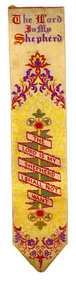
... For this, the picture was plotted on squared paper, in the fashion of a cross-stitch embroidery design, and a large card then perforated to represent each colour appearing in every "line" of the picture. ...For this, the picture was plotted on squared paper, in the fashion of a cross-stitch embroidery design, and a large card then perforated to represent each colour appearing in every "line" of the picture. ...This bookmark was found in a book called 'The English Lakes' owned by Elizabeth Chatham-Holmes. The bookmark is a Stevenograph. In 1854 Thomas Stevens began with weaving plain and fancy ribbons, but was soon experimenting with a development of jacquard weaving to produce pictures. For this, the picture was plotted on squared paper, in the fashion of a cross-stitch embroidery design, and a large card then perforated to represent each colour appearing in every "line" of the picture. The cards, arranged in an endless chain and attached to the loom, controlled the manipulation of the warp threads. Each time the shuttle crossed the loom a different card came into use, changing the arrangement of the warp threads and, consequently, the pattern woven..When the industry collapsed in 1860, Stevens determined to make use of his experiments by producing pictures in such variety as to appeal to all tastes. The earliest productions seem to have been bookmarkers... The pictures included portraits of celebrities and local scenes, scriptural texts, hymns and psalms, and verses from the poets. Stevens also introduced to the Admiralty a hat ribbon with the name of the ship woven in gold wire. This he patented; it was adopted and for many years the firm was the sole supplier to the Admiralty Contracts Department. https://stevengraphs.com/thomstevandh.html Also found in the book was a small card with dried flowers glued with the words 'Flowers from the Holy Land' and a WW2 photograph of the bust of a man in uniform with a cap..1) Red hard covered book called 'The English Lakes' by W.T. Palmer. .2) Woven silk bookmark with white (now cream) and yellow background and red, purple, green and yellow detail and the start of Psalm 23 woven into the bookmark. Possibly made in the late nineteenth century. .3) Small card with dried flowers glued with the words Flowers from the Holy Land .4) WW2 photograph of the bust of a man in uniform with a cap. .1) Inside front cover "E.S. Holmes Ascot" .2) Woven into the bookmark - The Lord is my Shepard I shall not want, & T. Stevens, Coventry .3) Printed on the front - Flowers from the Holy Land, Placed on the Holy Sepulchreholmes, ec holmes, ascot, religious, religion, bookmark, english lakes, w.t. palmer, chatham-holmes collection, flowers from the the holy land, stevengraph -
 Flagstaff Hill Maritime Museum and Village
Container - Round Metal Shaker
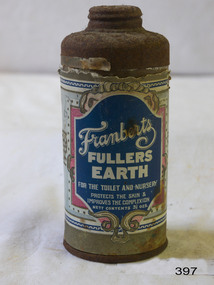
... Container of cylindrical sheet metal with perforated lid, used by Duerdin and Sainsbury Ltd, Sellers of Franbert's Fuller's Earth. Colour printed paper deteriorating. ...Container of cylindrical sheet metal with perforated lid, used by Duerdin and Sainsbury Ltd, Sellers of Franbert's Fuller's Earth. Colour printed paper deteriorating. ...The history of metal packaging began in Bohemia in the 1200s. Metal has been produced for a very long time. But the first metal used for packaging was tin. In particular, it was the process of tin plating that was invented in Bohemia. Before this no other metal was economically able to be used for packaging. Later, in 1667 Andrew Yarranton, and English engineer, and Ambrose Crowley brought the method to England. Here it was improved by ironmasters including Philip Foley. Then by 1697, John Hanbury had a rolling mill at Pontypool in South Wales. The method they developed involved rolling iron plates using cylinders. This process enabled more uniform blank plates to be produced than was possible by just hammering the tin. https://www.shilohplastics.com.au/history-of-metal-packaging/ Fuller's Earth is any clay material that has the capability to bleach or dissolve oil or other liquids without the use of harsh chemical treatment. Modern uses of Fuller's Earth include as absorbents for oil, grease, and animal waste (cat litter) and as a carrier for pesticides and fertilisers. Minor uses include filtering, clarifying, and decolorising; active and inactive ingredient in beauty products; and as a filler in paint, plaster, adhesives, and pharmaceuticals. Fulling is an important step in the production of woollen garments, and can be traced back to ancient times. Cuneiform texts from Mesopotamia mention a raw material, which was delivered to fullers for the finishing of cloth. https://en.wikipedia.org/wiki/Fuller%27s_earth The use of tin to protect and store items, revolutionised the world. Fuller's Earth is a widely used product.Container of cylindrical sheet metal with perforated lid, used by Duerdin and Sainsbury Ltd, Sellers of Franbert's Fuller's Earth. Colour printed paper deteriorating. ‘Nett Contents 3½ oz.’ Ingredients still inside.Tin very rusty.'Franbert's Fuller's Earth. For the Toilet and Nursery. Protects the skin & Improves the Complexion. Nett Contents 3½ oz.'flagstaff hill, warrnambool, shipwrecked-coast, flagstaff-hill, flagstaff-hill-maritime-museum, maritime-museum, shipwreck-coast, flagstaff-hill-maritime-village, tin, tin plating, containers -
 Shepparton RSL Sub Branch
Gas Mask Filter, c. 1910s
... perforated edges presumably for grip and a cast inscription on top. Lid twists to remove and gives view of interior filter of wire mesh and other material. This section in turn screws onto mask. Base of filter has mesh layers of varying sizes and appears to have once had a paper...perforated edges presumably for grip and a cast inscription on top. Lid twists to remove and gives view of interior filter of wire mesh and other material. This section in turn screws onto mask. Base of filter has mesh layers of varying sizes and appears to have once had a paper ...This filter is part of a complete set of a German gas mask dating to the First World War. This may have been a spare filter which was attached to a mask.Metal cylindrical filter with removable screw on lid. Lid has perforated edges presumably for grip and a cast inscription on top. Lid twists to remove and gives view of interior filter of wire mesh and other material. This section in turn screws onto mask. Base of filter has mesh layers of varying sizes and appears to have once had a paper cover which may have been torn off upon first use; small pieces of paper still attached.Engraving on lid reads "GJB".german, germany, world war i, world war 1, first world war, the great war, chemical warfare, gas mask, gas warfare, mustard gas -
Glenelg Shire Council Cultural Collection
Programme - Entry Form and Programme - Hamilton District Rifle Club, Apr-26
... Pinkish-brown paper, black print, printed one side only. Perforated entry form bottom of programme....Pinkish-brown paper, black print, printed one side only. Perforated entry form bottom of programme. ...Entry form and programme for the Hamilton District Rifle Clubs' Union No. 10 annual prize meeting, held at Hamilton, Easter Mon. and Tues. April 5 and 6, 1926. Pinkish-brown paper, black print, printed one side only. Perforated entry form bottom of programme. -
 Orbost & District Historical Society
invoice forms, Snowy River Mail as "Mail" Print, 19th century
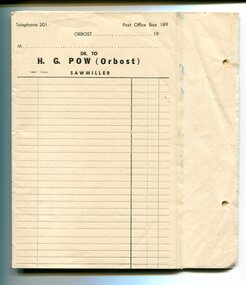
... paper with black print and lines. On the right hand side are two small holes for filing. The page is perforated with carbon underneath to provide two copies - one for filing and one for the customer. ...paper with black print and lines. On the right hand side are two small holes for filing. The page is perforated with carbon underneath to provide two copies - one for filing and one for the customer. ...These invoice forms were to be used by Hector G. Pow's Sawmiller Company in Newmerella ( Henty's & Pow). Pow's had a mill at Cabbage Tree as well. The mill is currently owned by Mectec.Orbost has historically been based on the timber industry, but that industry has declined considerably over the last 20 years. The number of locals involved in the timber industry has declined and many of the mills have closed. This item reflects a time when that industry was a significant contributor to the economy of the district.Unused invoice forms for H.G.Pow Orbost Sawmillers. They are white paper with black print and lines. On the right hand side are two small holes for filing. The page is perforated with carbon underneath to provide two copies - one for filing and one for the customer. At the top of each page is "Telephone 201 Post Office 189 Orbost" and a line for the date. Below this is a line for the customer's name and "Dr to H.G. Pow (Orbost) Sawmiller". There are columns for item descriptions and costs.h.g.pow sawmills timber-orbost -
 Flagstaff Hill Maritime Museum and Village
Document - Ticket, voyage, P & O Branch Service, P & O, Australia via The Cape Service, Bef.3rd June 1929
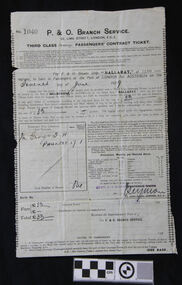
... paper page. The documents have been completed by hand, and the pages have creases as though they have been folded. Details include the date of sailing, amount paid, and the signature of the P & O Branch Service’s representative. The contract ticket lists weekly provisions for the voyage, a disclaimer of the shipping company, a list of dangerous goods not to be carried on board, and fines. The page has straight edges, top and bottom, and perforated...paper page. The documents have been completed by hand, and the pages have creases as though they have been folded. Details include the date of sailing, amount paid, and the signature of the P & O Branch Service’s representative. The contract ticket lists weekly provisions for the voyage, a disclaimer of the shipping company, a list of dangerous goods not to be carried on board, and fines. The page has straight edges, top and bottom, and perforated ...The bearer of this ticket was George Thomas Henry Phillpot, who was only 17 years old when he sailed on the S.S. Ballarat (II), built in 1921. (The first S.S. Ballarat was built in 1911 and sunk after being hit by a torpedo in 1917 while serving during WWI). George relates his trip from England to Australia, summarised as follows: He caught a bus from Bolton to Manchester, in the north west U.K., then the train from Manchester to London and the boat train to Tilbury Docks (near Gravesend). On the morning of June 7th 1929, the ship S.S. Ballarat sailed down the Thames estuary and into the English Channel. The next port of call was Southampton, UK, to take on board some technical equipment. The S.S. Ballarat then sailed through the Bay of Biscay. Instead of taking the customary route around the Cape of Good Hope, this trip, on her maiden voyage, was through the Suez Canal. She sailed through the Straits of Gibraltar, into the Mediterranean Sea and on to Malta, where George and others paid a local boat owner to take them ashore for a short time. They then sailed to Port Said, stopping to load cargo, then at night through the Suez Canal. They woke up early the next morning to watch the locals working on the banks of the canal. The excessive heat on board the ship caused much illness. As they travelled through the Red Sea, the heat and the smell of oil also caused sickness. On they went through the Arabian Sea to Colombo, the capital of Sri Lanka (which at that time was called Ceylon). A Navigation Slip, donated together with this ticket, shows the coordinates for a location 16 miles from Colombo. They again went ashore for a meal at four-pence a head and a bottle of lemonade for a penny. George and another passenger walked to the slums area and were shocked at the state of it compared to Britain’s slums. They then sailed via the Indian Ocean to Fremantle, stopping again for goods to be unloaded. While ashore, they played a game of soccer against the ship’s crew. Then on to Port Adelaide via the Great Australian Bight. Here they shopped for suitable clothing under the advice of some Australian passengers. They then arrived at Port of Melbourne on July 20th 1929, and two days later (on George’s mother’s birthday). George left for Warrnambool. He received his Citizenship Award in 1971. He conducted an electrical retail business in Liebig Street for many years. His son William became principal of the accounting business Sinclair and Wilson, on the retirement of Bill Sinclair, and was actively involved in support of many community organisations. His daughter-in-law, Glenys Phillpot, is actively involved in the Warrnambool community and local government. George was one of 3 orphans on the S.S. Ballarat. (The daughter and son-in-law of one of the other orphans also live in Warrnambool.) Herbert B.G. Larkin, whose rubber-stamped name appears on the ticket, later migrated to Australia and passed away in NSW in 1944. Of Historical Significance, this ticket is for the ship’s maiden voyage via the Suez Canal route (previously the ship travelled via the Cape of Good Hope). It is also the only existing ticket for the "S.S. Ballarat"(3rd) in our collection. Socially, it shows the fare, luggage restrictions, conditions and weekly provisions for a third-class passenger’s voyage from London to Melbourne, which has research potential. This ticket is also of significance to the Local Community, giving the background of the ancestor of a local family. It was also of Personal Significance to the bearer as he kept and preserved it in his possession for at least 46 years before donating it to our museum, together with a Navigation Slip, a map and a summary of his journey to Australia.Third Class steerage Passenger’s Contract Ticket, accompanied by the Navigation Slip, for passage on board the P & O line’s steamer, S.S. Ballarat, to Australia via the Cape Service, from Port of London to Port of Melbourne. The ticket contract is printed on both sides of a thin paper page. The documents have been completed by hand, and the pages have creases as though they have been folded. Details include the date of sailing, amount paid, and the signature of the P & O Branch Service’s representative. The contract ticket lists weekly provisions for the voyage, a disclaimer of the shipping company, a list of dangerous goods not to be carried on board, and fines. The page has straight edges, top and bottom, and perforated edges on the sides; some perforation holes are complete. A small fleur de lies is printed along the inside of each perforation, forming a decorative left and right border. Stamps and inscriptions are on the contract ticket and navigation slip, which also has a black and white photo of a steam ship.The ticket has been stamped in black, No. ‘1040’. Handwritten details are in black pen and ink. Date of departure: ‘Seventh June [192]9’ for the cost of,’33’ [poind], and the sum of ‘33’ pounds is acknowledged as received. ‘Mr George T.H. PHILLPOT’, the age is written as ‘17’, equal to the status of ‘1’ adult, the total number of persons is ‘One’. The fare is handwritten in pen £’33’ and the total £’33’. It has a purple stamp ‘HERBT. B G LARKIN’ and a crossed out stamp ‘FREDERICK WHITE, A handwritten signature ‘_Seymore’. Under the signature, the date is stamped ‘3 JUNE 1929’.warrnambool, shipwrecked coast, flagstaff hill, flagstaff hill maritime museum, maritime museum, shipwreck coast, flagstaff hill maritime village, s.s.ballarat, phillpot, 7 june 1929, george phillpot, george t.h. phillpot, third class passenger, steerage passenger, herbert b g larkin, ticket, voyage, p & o, australia via the cape, cape of good hope, suez canal, passengers’ contract ticket, navigation slip, s.s. ballarat, steamship, 1929, 3-6-1929, 7-6-1929, third-class, steerage, port of london, port of melboune, 33 pounds, george thomas henry phillpot, herbt. b g larkin, _seymore, bolton, manchester, english channel, southampton, bay of biscay, straits of gibraltar, maritia, port said, arabian sea, colombo, sri lanka, ceylon, indian ocean, fremantle, port adelaide, citizenship, 1971, herbert b.g. larkin, s.s. ballarat ii, -
 Bendigo Military Museum
Postcard - SOUVENIR BOOKLET, CAIRO, c.WW1
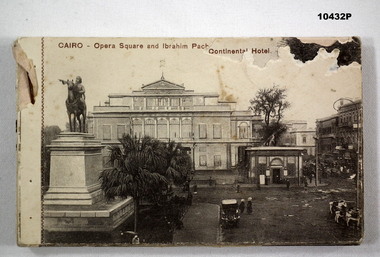
... LH side of each postcard is perforated to facilitate removal for postage. Postcards are separated by a sheet of tissue paper....LH side of each postcard is perforated to facilitate removal for postage. Postcards are separated by a sheet of tissue paper. ...Postcards collected by W.J.L. Bennetts during WW1. Part of the Bennetts collection. See Cat No. 9886P for details of service for "William John Leslie Bennetts".Booklet of 19 black and white photographic postcards featuring views of Cairo and surrounds. Each postcard is labelled with an explanation of the detail in the scene. Postcards are secured with a metal staple. LH side of each postcard is perforated to facilitate removal for postage. Postcards are separated by a sheet of tissue paper.william john leslie bennetts, alva bennetts, cairo, postcards, ww1 -
 Warrnambool and District Historical Society Inc.
Financial record - Patriotic Fund Stamps (2), c. 1918
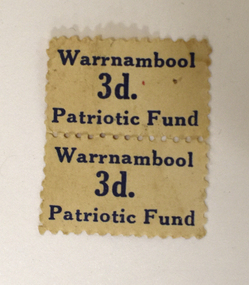
... These are two rectangular-shaped pieces of paper, part of a pad of stamps joined together by perforated lines for easy detachment. ...These are two rectangular-shaped pieces of paper, part of a pad of stamps joined together by perforated lines for easy detachment. ...These stamps have been printed and sold to gain funds for the Warrnambool Patriotic Fund. This fund was first set up in 1914 by the Mayor of Warrnambool, Cr A. Fritz Landmann, to provide funds for the welfare of servicemen and women during World War One so these stamps may date from that time (with the cost of threepence suggesting this time). However the Warrnambool Patriotic Fund also existed in World War Two and the Warrnambool R.S.L. today has a Patriotic Fund to assist ex-servicemen and their dependants and other charitable causes.These stamps are of minor interest as a memento of local fund raising in war time.These are two rectangular-shaped pieces of paper, part of a pad of stamps joined together by perforated lines for easy detachment. These two stamps have perforations on the sides and in the middle. The middle perforation is partly separated. The stamps contain blue printed material.Warrnambool Patriotic Fund 3d.world war one, warrnambool r.s.l. -
 Kiewa Valley Historical Society
Papers - History of the Barber Family and Gundowring, Barber Family History
... White roll of computer paper - old style with 'tear off' strip of holes along each side enabling easy tearing.Typed continually including over the join (also perforated) of the 10 pages. ...Written in aqua pen - 'Barbour (sic) Family / History White roll of computer paper - old style with 'tear off' strip of holes along each side enabling easy tearing.Typed continually including over the join (also perforated) of the 10 pages. ...The Barber family arrived in Australia in 1803. Charles Henry Barber took up Gundowing in 1838. The history includes the Barber family homestead. John McDonald, Schools, St Andrew's Church, Richard Goldsworthy 1843, John and George Larkin, Geering,;David, Joseph and Arthur Ford , Richard Barton, Thomas Carrol, Mrs E. Bell, John Arundel, Tobacco, History of Gundowring and its familiesWhite roll of computer paper - old style with 'tear off' strip of holes along each side enabling easy tearing.Typed continually including over the join (also perforated) of the 10 pages. Includes many headings re Families living in the area. Perforations on sides torn off to enable easy storing.On the back of the Title written in blue pen - 'Historical Society of Kiewa Valley / A History of the /Kiewa Valley.' Written in aqua pen - 'Barbour (sic) Family / Historyfamilies in gundowring, families in the kiewa valley, barber family, john mcdonald, richard goldsworthy, john and george larkin, geering, ford brothers, richard barton, thomas carrol, mrs e. bell, john arundel, tobacco -
 Bendigo Military Museum
Administrative record - APPLICATION FORM, WAR GRAVES, Post WW1
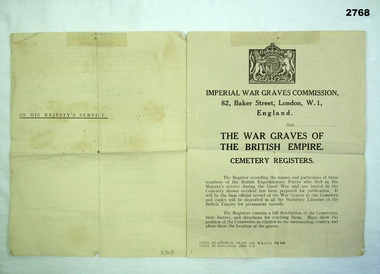
... Foolscap size paper form folded in half, additional notes added to printed form with typed & glued labels. Register for cemetery completed in block typewriting service personnel completed with notice from a newspaper fold line perforated....Foolscap size paper form folded in half, additional notes added to printed form with typed & glued labels. Register for cemetery completed in block typewriting service personnel completed with notice from a newspaper fold line perforated. ...From newspaper notice: "ROGAN, Pte Linten Cyprus, 6947A. 22nd Bn. Australian Inf. Killed in action 11th June, 1918 Age 20. Son of Michael John and Elizabeth Ann Rogan, of Casey St, Maryborough, Victoria, Australia" III. C.2. 253Application form for the Imperial War Graves Commission for The War Graves of the British Empire Cemetery Registers. Foolscap size paper form folded in half, additional notes added to printed form with typed & glued labels. Register for cemetery completed in block typewriting service personnel completed with notice from a newspaper fold line perforated."Register for: MERICOURT L'ABBE GROUP MERICOURT L'ABBE COMMUNAL CEMETERY EXTENSION FRANCE 207-211" Service personnel - see Historydocuments - forms, military history, passchendaele barracks trust -
 Bendigo Historical Society Inc.
Financial record - INVOICE COLLECTION: Bendigo Preserving Co
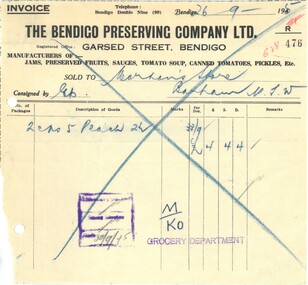
... Paper is thin, slightly see-through lower portion of page is creased and folded, seemingly from a book or larger page as indicated by the perforated edges. 10934.24c Messrs. ...Paper is thin, slightly see-through lower portion of page is creased and folded, seemingly from a book or larger page as indicated by the perforated edges. 10934.24c Messrs. ...The Bendigo Preserving Company Ltd. Garsed Street, Bendigo Manufacturers of jams, preserved fruits, sauces, tomato soup, canned tomatoes, pickles etc. 10934.24a The Bendigo Preserving Company Ltd. invoice to Morton's Store 26 Sep 1945 Grocery department Paper is thin, slightly see-through lower left corner is torn, seemingly from a book or larger page as indicated by the perforated edges. 10934.24b Messr. AC Morton Co. Barham 31 March 1939 In Account with the Bendigo Preserving Company Ltd. Fruit Statement purchase of tomatoes "Please let us know any amount you are out of pocket with on the first conveyance + we will adjust same." Paper is thin, slightly see-through lower portion of page is creased and folded, seemingly from a book or larger page as indicated by the perforated edges. 10934.24c Messrs. A. C. Morton & Co., Barham. 21 April 1939 Credit by Bendigo Preserving Co. Ltd. No. 690 Duplicate invoice only Paper is thicker. 10934.24d Invoice from Bendigo Preserving Company Ltd. to AC Morton. 23 October 1942 Paper is thin, slightly see-through torn, seemingly from a book or larger page as indicated by the perforated edges. 10934.24e Invoice to Morton's stores 18 Jun 1948 Paper is thin, slightly see-through torn, seemingly from a book or larger page as indicated by the perforated edges. rip in the top edge of the page. paid july. The following papers are pinned together. 10934.24f Credit settlements 1 May 1939 10934.24g Statement 29 April 1939 10934.24h Payment receipt 11 April 1939 10934.24i & 10934.24j payment receipts 12 April 1939 no new inscriptions or markings.the bendigo preserving company, marton's store bendigo -
 Bendigo Historical Society Inc.
Financial record - INVOICE COLLECTION: Various Businesses
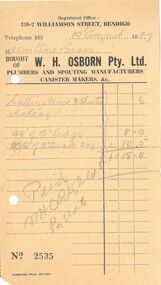
... 10934.38a: no. 2535 A small rectangular piece of paper with the header and body printed in black ink. The page has two punched holes in the left side, along a perforated edge. the header reads: Bought of W. ...AC Morton Northern Terrazzo Co Payne and Whitington WH Osborn Mayfair Distribuors 10934.38a: no. 2535 A small rectangular piece of paper with the header and body printed in black ink. The page has two punched holes in the left side, along a perforated edge. the header reads: Bought of W. ...10934.38a: no. 2535 A small rectangular piece of paper with the header and body printed in black ink. The page has two punched holes in the left side, along a perforated edge. the header reads: Bought of W. H. Osborn Pty. Ltd. Plumbers and spouting manufacturers, canister makers, &c. 130-2 Williamson Street, Bendigo. telephone 162 typed in black ink, the receipt is dated 19 August 1949. price of items is pounds, reading 1 pound, 18 shillings and 11 pence. 10934.38b: no. 4042 A cut rectangular piece of paper with the header and body printed in blue ink. The page has 2 punched holes in the left-hand side. the header reads: Bought of Mayfair Distributors Pty. Ltd. Incorporated in New South Wales. Distributors of Mayfair brand products. Telegraphic Address: Maypack, Bendigo Telephone: Bendigo 406 P.O. Box 90 typed in black ink, the receipt is dated 12 August 1947. price of items is pounds, reading 1 pound, 19 shillings and 1 pence. 10934.38c: no. 468 A small, square piece of paper printed with the header and body printed in black ink. The page has to punched holes in the left side, along a perforated edge. the header reads: Northern Terrazzo Co. G. Miles, Prop. Lyttleton Terrace, Bendigo Memorial Work A speciality - washtroughs, sinks, baths etc. Phone 319 Handwritten in grey lead pencil, the receipt is dated 12 April 1939. price of items is listed in pound reading 1 pound, 1 shilling. 10934.38d: no. 2155 A small, rectangle piece of paper printed with the header and body printed in black ink. The page has two punched holes in the left side, along a perforated edge. the header reads: Payne & Whitington Joinery Works McKenzie Street, Alexandra, Vic. Phone: 13 Handwritten in blue pen, the receipt is dated 2 April 1951. price of items is listed in pound reading 236 pound, 8 shilling and 7 pence.ac morton, northern terrazzo co, payne and whitington, wh osborn, mayfair distribuors -
 Bendigo Historical Society Inc.
Financial record - INVOICE COLLECTION: Various Businesses 2
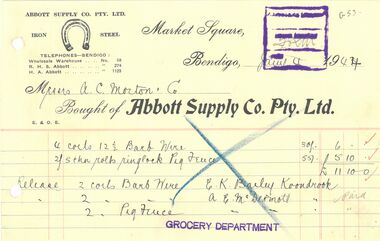
... Invoice lists prices in pounds, reading 11 pound, 10 shillings. the invoice is paid and has been crossed out in blue pencil. 10934.39b: Thin rectangular pink paper with the invoice's header printed in black ink. The invoice has 3 holes punched in the left side, along a perforated edge. ...Invoice lists prices in pounds, reading 11 pound, 10 shillings. the invoice is paid and has been crossed out in blue pencil. 10934.39b: Thin rectangular pink paper with the invoice's header printed in black ink. The invoice has 3 holes punched in the left side, along a perforated edge. ...10934.39a: Thin rectangular white paper with the invoice's header printed in black ink and list section in red. The invoice has 2 holes punched in the left side. Header reads: Bought of Abbott Supply Co. Pty. Ltd. Market Square, Bendigo, Invoice dated 4 Jan 1944. Invoice lists prices in pounds, reading 11 pound, 10 shillings. the invoice is paid and has been crossed out in blue pencil. 10934.39b: Thin rectangular pink paper with the invoice's header printed in black ink. The invoice has 3 holes punched in the left side, along a perforated edge. Header reads: Bendigo Timber Co. Timber Yards, Hardware Stores and Sawmills Mollison & Williamson Streets, Bendigo Phones: 218 and 2538 Dated: 27 May 1953 10934.39c: Thin rectangular white paper with the invoice's header printed in black ink. the invoice has 2 holes punched in the left side. Header reads: The Bendigo Advertiser The leading provincial daily in Australia Office: 29 Pall Mall Telephones 1, 61 and 2121 Dated: 31 Dec 1949 the invoice has a small slip attached to its front indicating payment was made 13 May 1950. 10934.39d: Thin rectangular paper with the invoice's header printed in black ink. The invoice has 2 holes punched in the left side. Header reads: W. Cowling Grain, Hay & Machinery merchants poultry and stock foods supplies. Market square, Bendigo. Invoice dated 5 March 1948. Invoice lists prices in pounds, reading 5 pound, 2 pence. the invoice is paid and has been crossed out in black pencil. 10934.39e: Thin rectangular white paper with the invoice's header printed in black ink and list section in red. The invoice has two holes punched in the left side. the page has been torn around the holes. Header reads: Bought of Abbott Supply Co. Pty. Ltd. Market Square, Bendigo, Invoice dated 19 September 1944. Invoice lists prices in pounds, reading 2 pound, 16 shillings. the invoice is paid and has been crossed out in blue pencil.ac morton, abbott supply co, bendigo timber co, 'the bendigo advertiser, w cowling -
 Bendigo Historical Society Inc.
Administrative record - Photographer's Receipt Book, 1912
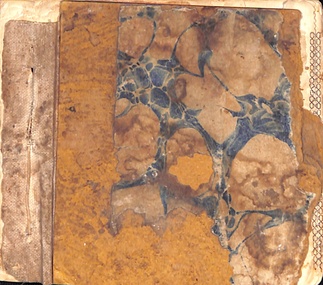
... paper. Binding on the spine is missing. Book originally had attached duplicate customer copies which have been removed along perforated lines. ...paper. Binding on the spine is missing. Book originally had attached duplicate customer copies which have been removed along perforated lines. ...Small bound receipt book used by an unknown photographer in Chancery Lane. Dated February - May 1912. "Bendigo" printed at the top of each page. Includes spaces to record the date, name and address of purchaser, items prcchased and amont paid. Items purchased include photographs, postcards and artist supplies. Cardboard cover is covered with a blue marrbled patter paper. Binding on the spine is missing. Book originally had attached duplicate customer copies which have been removed along perforated lines. The RHS of both covers have been torn off,receipt book, photographer -
 Bendigo Historical Society Inc.
Document - CAMBRIDGE PRESS COLLECTION: DOCKETS - CITY OF BENDIGO WEIGHBRIDGE
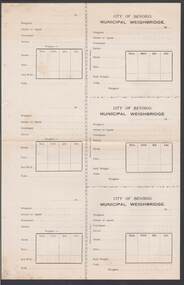
... Printed in black on cream paper. Date line ends 19- -. Dockets are perforated with an unperforated strip down the left side which stays in the book. ...Printed in black on cream paper. Date line ends 19- -. Dockets are perforated with an unperforated strip down the left side which stays in the book. ...Sheet of three City of Bendigo Municipal Weighbridge dockets. Printed in black on cream paper. Date line ends 19- -. Dockets are perforated with an unperforated strip down the left side which stays in the book. Each docket has printed on it: City of Bendigo Municipal Weighbridge, date space, Weighed, Owner or Agent, Purchaser, Driver Gross, Tare, Net Weight, Tolls, Weigher and has a table with Tons, Cwts, Qrs and Lbs. The copies that stay in the book don't have City of Bendigo Municipal Weighbridge printed on them.business, printers, cambridge press, cambridge press collection, city of bendigo municipal weighbridge -
 Bendigo Historical Society Inc.
Ephemera - MISS G ALICE JONES COLLECTION: FUEL RATION TICKETS 1 GALLON
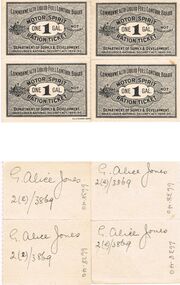
... Fuel Ration Tickets 1 Gallon: rectangle in shape with perforated edges. Printed in black ink the background is a wall paper of small oval shapes with "Motor Spirit Ration". ...McCracken Australia Fuel Ration Tickets 1 Gallon: rectangle in shape with perforated edges. Printed in black ink the background is a wall paper of small oval shapes with "Motor Spirit Ration". ...Petrol rationing was gazetted in May 1941. Australia's lack of fuel storage options and the diversion of tankers bringing fuel here forced the government to begin rationing. Initially it was proposed that consumption should be reduced by 50% but this was modified to 1/3 reduction. People had to apply for a petrol licence and this was then used to obtain ration coupons. Initially coupons were issued on a 6 monthly basis but this was reduced to 2 monthly and allowed people roughly 2000 gallons per year. Coupons allowed for 1, 2, 5, 10, 44 and 100 gallon amounts depending on need. eg. private, commercial, farm use. Rationing was strictly enforced until 1942 but remained in effect until 1950.Fuel Ration Tickets 1 Gallon: rectangle in shape with perforated edges. Printed in black ink the background is a wall paper of small oval shapes with "Motor Spirit Ration". Over printed is "Commonwealth Liquid Fuel Control Board, in the middle is the commonwealth emblem and Motor Spirit, one 1 Gal, not transferable Ration Ticket". Department of supply & Development issued under National Security Act 1939-40. On the back of each is printed in black ink and hand written is "G. Alice Jones 2(e)/3869".W.C.G. McCracken Australiapetrol rationing, war world ii
