
Showing 32 items matching " pine cones"
-
 Friends of Ballarat Botanical Gardens History Group
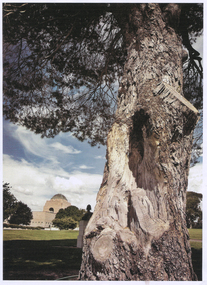
Work on paper - On the Trail of the Lone Pine, Pine Cones from the Gallipoli Battlefield, April - June 2011
... Pine Cones from the Gallipoli Battlefield...There is a column about these trees down the left-hand side of the page. Pine Cones from the Gallipoli Battlefield Work on paper On the Trail of the Lone Pine ...Sergeant Keith McDowell gave a cone he collected from Gallipoli to his aunt to try and grow. One seed was planted in the Warrnambool Botanic Gardens and another at the Shrine of Remembrance in Melbourne. These pine trees have symbolic importance as a representation of Australian soldiers' "tenacity and fortitude". They are an important link to the remembrance of those men and women from Ballarat who saw action in World War 1.3 pages (pp.44-46). p.44 in black print on white paper, a photograph of the planting of one of the pines in 1934 at the Australian War Memorial, Canberra. p.45 is a coloured picture of the pine in Canberra. p46 has a history of the seeds brought from Gallipoli by Smith and Mcdowell on the right-hand side of the page and a photograph of the Pines being labelled. There is a column about these trees down the left-hand side of the page.None john garner, doctor, john garner collection, ballarat botanical gardens, friends of the ballarat botanical gardens, the lone pine, gallipoli, anzacs, sergeant keith mcdowell, lance corporal benjamin smith, aleppo pine, turkish pine, pinus halepensis, pinus brutia, gardens, ballarat -
 Sunshine and District Historical Society Incorporated
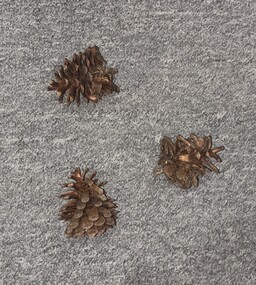
Plant specimen - Commonwealth Remont Department Pinecones
... ... Pine Cones...A large row of pine trees fronted Raleigh Road where some Explosive Factory houses once stood Remount Department Pine Cones Collection of three pinecones Plant specimen Commonwealth Remont Department Pinecones ...These pinecones were picked up from the ground along Raleigh Road North Side between Rosamond Road and Randall Street. A large row of pine trees fronted Raleigh Road where some Explosive Factory houses once stoodCollection of three pineconesremount department, pine cones -
 Melbourne Legacy
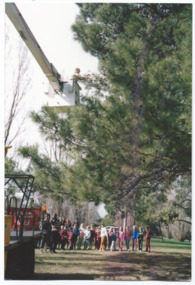
Photograph - Photo, Legacy Lone Pines, 1989
... Photos of President Chas Wilks collecting pine cones from the Lone Pine descendant at the Shrine of Remembrance, the 24th Battalion tree. ...Colour photo x 4 of President Chas Wilks in a crane collecting pine cones at the Shrine and children collecting the cones....Photos of President Chas Wilks collecting pine cones from the Lone Pine descendant at the Shrine of Remembrance, the 24th Battalion tree. ...Photos of President Chas Wilks collecting pine cones from the Lone Pine descendant at the Shrine of Remembrance, the 24th Battalion tree. The cones dropped to the ground and school children are seen collecting them. Legacy has run a programme since the 1970s of propagating saplings taken from seeds of pine descended from a pine tree from Gallipoli and giving them to various clubs, schools and town councils. The photo appeared in the President's Highlights report in 1989. The caption says '1,000 seedlings from the historic Lone Pine tree near the Shrine of Remembrance will be propagated on behalf of Melbourne Legacy by the Department of Conservation Forests and Lands. Melbourne President Legatee Chas Wilks, along with the Minister for CFL, Ms Kay Setches and pupils from South Yarra Primary School helped to collect the seeds. The trees, once grown will be distributed to schools by Melbourne Legacy. Also see item at 01334 in 1993 when President Woodward was giving out saplings, it was three years later was when the saplings grown from these seeds were distributed. Legacy is helping to keep the memory of the Gallipoli "Lone Pine" alive - its spirit living on today. Presentations are made to schools, ex-service organisations and interested bodies by Legacy Clubs in the hope that they will be cherished as a symbol of nationhood and of its just pride, devotion, courage, selflessness and sense of service to others.A record of the way Legacy was propagating Lone Pine saplings for schools and organisations. The Lone Pine programme show the type of work done by Legatees to keep the memory of Gallipoli and fallen comrades alive.Colour photo x 4 of President Chas Wilks in a crane collecting pine cones at the Shrine and children collecting the cones.Handwritten '10' in a circle in blue pen.tree planting, lone pine -
 Whitehorse Historical Society Inc.
Card - Prayer card
... Deckle edge cream card with blue pine cone decoration....McNamara family collection Prayer McNamara Religion Cares and prayers Deckle edge cream card with blue pine cone decoration. Card Prayer card ...McNamara family collectionDeckle edge cream card with blue pine cone decoration.Cares and prayersprayer, mcnamara, religion -
 Nillumbik Shire Council
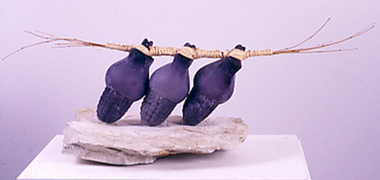
Sculpture: Joseph Scott COWCHER, Passionately Packaged, 1987
... Three purple glass objects in the form of pine cones, held together by raffia, resting on a large slab of white stone. ...N/A Three purple glass objects in the form of pine cones, held together by raffia, resting on a large slab of white stone. ...This artwork was a finalist in the 1987 Shire of Eltham Art Awards. The materials Cowcher has chosen constitute different transformations of earth - stone, sand (fired into glass), bamboo and dried grass. The work is a sign of the artist's passion in working with these materials and 'packaging' them into an aesthetic composition that connect and dance with one another.Three purple glass objects in the form of pine cones, held together by raffia, resting on a large slab of white stone. N/A -
 Warrnambool and District Historical Society Inc.
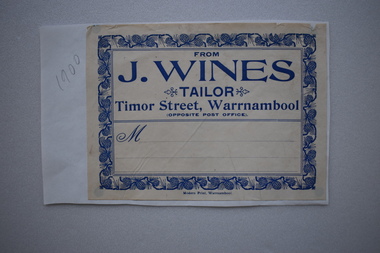
Label, J.Wines Tailor
... Buff coloured rectangular paper label with blue text and decorative border of pine cones and leaves attached to a white piece of paper....This label is of some significance as it is our only memento of this early 20th century tailoring business in Warrnambool . j. wines tailor FROM J.WINES .TAILOR Timor Street, Warrnambool OPPOSITE POST OFFICE M Modern Print, Warrnambool Buff coloured rectangular paper label with blue text and decorative border of pine cones and leaves attached to a white piece of paper. ...We have only one reference to J. Wines as operating a tailoring business in Timor Street opposite the old Post Office in 1909 but the label dates from about 1900.This label is of some significance as it is our only memento of this early 20th century tailoring business in Warrnambool .Buff coloured rectangular paper label with blue text and decorative border of pine cones and leaves attached to a white piece of paper.FROM J.WINES .TAILOR Timor Street, Warrnambool OPPOSITE POST OFFICE M Modern Print, Warrnamboolj. wines, tailor -
 Tatura Irrigation & Wartime Camps Museum
Decorations - Christmas, 1940's
... Pine cone shaped Christmas decorations. Card/paper like material covered with a paint like finish that "Sparkles". ...Used by internees at Camp 3 christmas decorations bissinger g wied k and n camp 3 tatura ww2 ornaments paper handcrafts decorations Pine cone shaped Christmas decorations. Card/paper like material covered with a paint like finish that "Sparkles". ...Used by internees at Camp 3Pine cone shaped Christmas decorations. Card/paper like material covered with a paint like finish that "Sparkles". Thread for hanging decoration.christmas decorations, bissinger g, wied k and n, camp 3, tatura, ww2, ornaments, paper, handcrafts, decorations -
 Embroiderers Guild, Victoria
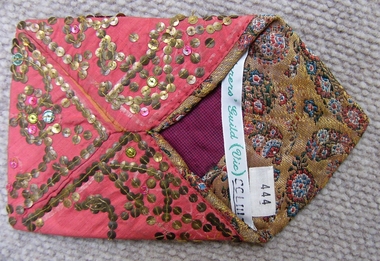
Accessory - Kohl Bag, 1960-80
... Lined in red cotton and a woven pine cone motif fabric, gold background....Lined in red cotton and a woven pine cone motif fabric, gold background. Accessory Kohl Bag ...used by Iranian women to hold makeup such as Kohl sticksDeep pink embroidered in gold with coloured sequins. Bag is a folded square. Lined in red cotton and a woven pine cone motif fabric, gold background.embroidery, beading, bags, 1960-80, middle east -
 Embroiderers Guild, Victoria
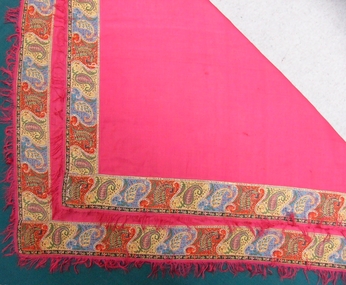
Accessory - Shawl, c. 1819-1830
... Plain turkey red fabric with paisley border and pine cone floral style in red, blue, green and yellow. ...Weaving Scotland 1920-40 Shawls Plain turkey red fabric with paisley border and pine cone floral style in red, blue, green and yellow. ...Plain turkey red fabric with paisley border and pine cone floral style in red, blue, green and yellow. Paisley border has been let in, and fringe attached to it.weaving, scotland, 1920-40, shawls -
 Bendigo Military Museum
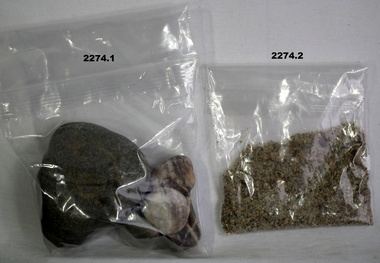
Souvenir - SOUVENIRS, ANZAC COVE, Post 1990
... .1) Four rocks of various size from the beach on Anzac Cove .2) Sand from the beach at Anzac Cove .3) Cone from an aleppo pine grown on Gallipoli .4) Small round pine cone from Gallipoli...ANZAC pines minerals souvenirs .1) Four rocks of various size from the beach on Anzac Cove .2) Sand from the beach at Anzac Cove .3) Cone from an aleppo pine grown on Gallipoli .4) Small round pine cone from Gallipoli Souvenir SOUVENIRS, ANZAC COVE ....1) Four rocks of various size from the beach on Anzac Cove .2) Sand from the beach at Anzac Cove .3) Cone from an aleppo pine grown on Gallipoli .4) Small round pine cone from Gallipolianzac, pines, minerals, souvenirs -
Tatura Irrigation & Wartime Camps Museum
Decorative object - Christmas Tree, 1942/43
... Hand cut and painted angels and dwarfs, painted walnuts, stars (gold and silver), other ornaments - tiny pine cones, cotton wool, candle holders...Hand cut and painted angels and dwarfs, painted walnuts, stars (gold and silver), other ornaments - tiny pine cones, cotton wool, candle holders Christmas Tree Decorative object Christmas Tree ...Made by German POW's Camp 13 and sent by Army Guards to Internment Camp 3 as a gift to German Beilharz family. Used until family released in 1946. Later, Meta Beilharz had it with her in the Tabulam and Templer Home for the Aged In Bayswater Vic.Christmas tree made of wooden upright and stand, wire branches covered in silver tinsel. Hand cut and painted angels and dwarfs, painted walnuts, stars (gold and silver), other ornaments - tiny pine cones, cotton wool, candle holderstatura, christmas tree, camp 3, beilharz family, pow, camp 13 -
 Melbourne Legacy
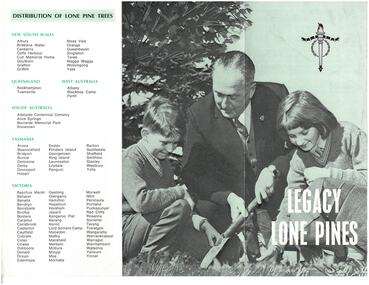
Pamphlet, Legacy Lone Pines, 1971
... In approx 1971 Legacy distributed pine trees grown from seeds of a pine cone from Gallipoli, this brochure lists the towns that received the seedlings. ...In approx 1971 Legacy distributed pine trees grown from seeds of a pine cone from Gallipoli, this brochure lists the towns that received the seedlings. ...In approx 1971 Legacy distributed pine trees grown from seeds of a pine cone from Gallipoli, this brochure lists the towns that received the seedlings. It includes "The Story of the ANZACS" and "The Legacy Lone Pine Project". A record of a type of work done by Legatees to keep the memory of Gallipoli and fallen comrades alive.Single page printed brochure folded in three.legacy promotion, lone pine -
 Embroiderers Guild, Victoria
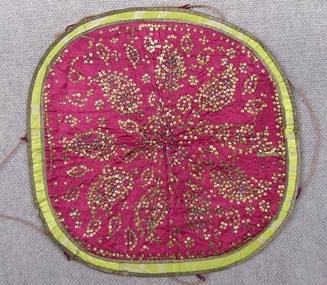
Accessory - Iranian Bag - Sugar Container
... Cherry silk embroidered in gold and coloured sequins in the classic pine cone motif. Chartreuse border edged on both sides with gold braid. ...Embroidery Beading 1960-80 Middle East Cherry silk embroidered in gold and coloured sequins in the classic pine cone motif. Chartreuse border edged on both sides with gold braid. ...Said to be a requirement of the nomadic Persian family groups. Sugar made in thick blocks and rasped down when required, it was hung in these bags to keep it away from insects and animals. Part of the Iranian collection selected by Lady Amies when on a trip in 1976.Cherry silk embroidered in gold and coloured sequins in the classic pine cone motif. Chartreuse border edged on both sides with gold braid. Cord and tassels threaded through rod loops for hanging. Red cotton lining. Small sample of Coats Filosheen mending cottonembroidery, beading, 1960-80, middle east -
 Kew Historical Society Inc
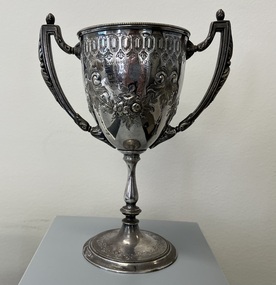
Award - Kew High School trophy, 1880
... Silver plated trophy in the form of a cup on a pedestal with two arms, each surmounted with pine cones. The trophy has a range of design features including convex and concave decorated surfaces created by repoussé (i.e.hammering). ...Vance Inscribed: "Kew High School / Old Boys Cup / Presented by / Mrs John Bon / Won by / N Vance 1880" Silver plated trophy in the form of a cup on a pedestal with two arms, each surmounted with pine cones. The trophy has a range of design features including convex and concave decorated surfaces created by repoussé (i.e.hammering). ...F.G.Barnard, writing in 1910, recorded that Ernest Ingle opened a boys' school in a private house in Cotham Road, Kew, in 1872. The school was later moved to larger premises in Charles Street, where suitable school rooms were added. Ingle's career was cut short by a fatal attack of typhoid fever in 1875. The school then passed into the hands of Mr. J. Henning Thompson. Under Thompson's management the school speedily became a strong rival to the neighbouring Hawthorn Grammar School. Barnard also lists in his Jubilee History of Kew, that Dr N.C. Vance [winner of the trophy for the 440 yards running event] was a notable alumnus of Kew High School. It is assumed that N.C. Vance was the son of Rev G.O. Vance who was appointed vicar of Holy Trinity Church, Kew, in 1870. This is a tangible memento of the first Kew High School, awarded to a pupil eight years after the school's establishment. The trophy is historically interesting as it was presented to N.C. Vance by Ann Bon, a notable Kew resident and a supporter of Indigenous People in Victoria, particularly William Barak and his family.Silver plated trophy in the form of a cup on a pedestal with two arms, each surmounted with pine cones. The trophy has a range of design features including convex and concave decorated surfaces created by repoussé (i.e.hammering). Specific decorative aspects include scrolling at the top of the cup and floral sprays at front and the rear of the trophy. There is a single inscription identifying the school, the event, the winner and the identity of the person presenting the trophy. The metal used in the cup section of the trophy is heavier and thicker than that used in the rest of the trophy.There are no compositional or maker marks on the trophy.Inscribed: "Kew High School / Old Boys Cup / Presented by / Mrs John Bon / Won by / N Vance 1880"dr n vance, kew high school -- kew (vic.), private schools -- kew (vic.), sports trophies -- kew (vic.), n.c. vance -
 Linton and District Historical Society Inc
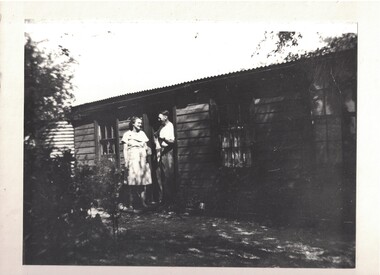
Photograph, Joe Reidy and Stella Pearse, undated
... The small foot bridge had decorative pine cones along it. Lovely garden etc. Joe was also Captain of the fire brigade for a long time." ...The small foot bridge had decorative pine cones along it. Lovely garden etc. Joe was also Captain of the fire brigade for a long time." ...The house is identified in the early LDHS index to photographs as being "Joe and Stella Reidy's home on Geelong Road" (Geelong Road now called Linton-Naringhil Road). Joe Reidy and Stella Pearse married in 1938. Information provided in 2025: "Joe and Stella out the back of their house. It has a flat roof on the back verandah and a normal peaked roof on the house. The house is on Naringhil Rd opposite side of road to Linton Park and back towards Linton. It used to have a foot bridge over the small creek, but now it has a pipe and driveway. At the back of the house is an old dairy where Joe would milk the cows morning and night after working the day for the Shire. The small foot bridge had decorative pine cones along it. Lovely garden etc. Joe was also Captain of the fire brigade for a long time." Enlarged black and white copy of original photograph, which has been mounted on white card. The photograph shows a young woman and young man standing outside a timber cottage. On card attached to bottom of photograph: "Joe Reidy and Stella Pearse (Mick Chung was born in this house.)"joe reidy, stella reidy nee pearse -
 Mortlake and District Historical Society
Lone Pine
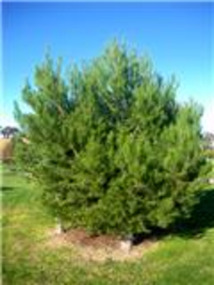
... However, two soldiers first brought home pine cones direct from that fateful battlefield. . ...However, two soldiers first brought home pine cones direct from that fateful battlefield. . ...This pine tree (Allepo Pine, Pinus halepensis) a native of the Gallipoli Peninisula (Gelibolu, Turkey), was grown from a cutting obtained from the War Memorial Canberra and planted in the Mortlake Botanic Gardens in 2002. It replaces the original which grew outside the Mortlake RSL Hall which blew down in a storm c.2000. That tree (Allepo brutius)came from 'the original on Gallipoli' and was planted to commemorate 'fallen comrades' in 'the Jubilee year 1965.' However, two soldiers first brought home pine cones direct from that fateful battlefield. . One was Sgt. Keith McDowell of the 24th Btn. His aunt, Mrs. Emma Gray of Grassmere (Vic.) planted the seeds c. 1928 and four seedlings resulted. One was planted in Wattle Park, Melbourne, one at the Shrine of Remembrance, one at the Soldier's Memorial Hall at The Sisters (c.15 km. south of Mortlake) and one at the Warrnambool Botanic Gardens. The First World War (or 'Great War') and in particular the battle for the Gallipoli Peninsula is of immense national significance. Lone Pine or Plateau 400 was the scene of a major offensive on August 6th 1915. All the trees on the ridge at this point were cut down but one, which was dominated by the 'Lone Pine'. In three days of fighting more than 2,000 Australians lost their lives and seven Victoria Crosses were won. Two Australian soldiers souvenired pine cones - one was brought back to Victoria (see above). Many young men from Mortlake and district volunteered to fight in the Great War and the presence of this tree in our Gardens reminds us all of the local as well as the national sacrifice.l pine tree Small plaque on railing western side. gallipoli, lone pine first world war great war mcdowell, keith -
 The Beechworth Burke Museum
Photograph - Lantern Slide, c1900
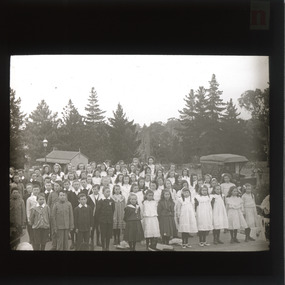
... These are the Loblolly Pine, Italian Cypress, Shore Pine, and the Big Cone Pine. These trees hold significance as they date back to 1875 and show rare and localised examples of these types of species which are not seen in many other places in Victoria. ...These are the Loblolly Pine, Italian Cypress, Shore Pine, and the Big Cone Pine. These trees hold significance as they date back to 1875 and show rare and localised examples of these types of species which are not seen in many other places in Victoria. ...This glass slide depicts a group of school children standing in Queen Victoria Park (previously Beechworth Botanic Gardens), circa 1900. Queen Victoria Park was first secured in 1858 by the Beechworth Council with the assistance of the Central Board of Health (CBH). The CBH was a firm believer in the socially beneficial effects of parks and other recreation areas which is why they aided the council in securing the parkland. the council held a local competition for the design of the park and decided on a plan called "Better late than never" by Hungarian nobleman, J.A. Rochlitz. The first non-native trees were planted in 1861 and have since been heritage listed on the National Trust's register of significant trees. There are nine trees located in Queen Victoria Park that are currently on the National Trust's register. These are the Loblolly Pine, Italian Cypress, Shore Pine, and the Big Cone Pine. These trees hold significance as they date back to 1875 and show rare and localised examples of these types of species which are not seen in many other places in Victoria. The trees in the background of the glass slide depict a species of the pine tree and may be some of the trees still standing in Queen Victoria Park today.This glass slide captures social and historical significance as it not only captures a moment in time of these school children, but it also shows environmental significance for the heritage trees depicted in the background.burke museum, beechworth, lantern slide, slide, glass slide, plate, burke museum collection, photograph, monochrome, queen victoria park, indigo shire, school, j.a. rochlitz, beechworth council -
 Melbourne Legacy
Document, Gallipoli's 'Lone Pine' Lives On
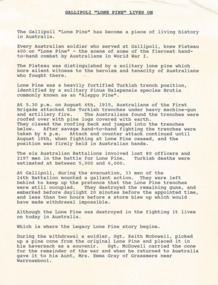
... Keith McDowell, picked up a pine cone from the original Lone Pine and placed it in his haversack as a souvenir. ...Keith McDowell, picked up a pine cone from the original Lone Pine and placed it in his haversack as a souvenir. ...A detailed account of the story of Lone Pine in Gallipoli and how seedlings were grown from a pine cone brought back by Sgt. Keith McDowell. The author and date of this account is not known but was post 1989. The text says: " Gallipoli Lone Pine Lives On The Gallipoli Lone Pine has become a piece of living history in Australia. Every Australian solider who served at Gallipoli, knew Plateau 400 or ‘Lone Pine’ – the scene of some of the fiercest hand-to-hand combat by Australian in World War 1. The Plateau was distinguished by a solitary lone pine which bore silent witness to the heroism and tenacity of Australians who fought there. Lone Pine was a heavily fortified Turkish trench position, identified by a solitary Pinus Halepensis species commonly known as an ‘Aleppo Pine’. (** NB this has since been corrected and the species is not an 'Aleppo pine' but Pinus Brutia, commonly called Turkish pine) At 5.30 pm on August 6th, 1915, Australians of the First Brigade attacked the Turkish trenches under heavy machine-gun and artillery fire. The Australians found the trenches were roofed over with pine logs covered with earth. They clawed the roofing back and jumped into the trenches below. After savage hand-to-hand fighting the trenches were taken by 6 pm. Attack and counter attack continued until August 10, when fighting at Lone Pine ceased, and the position as firmly held in Australian hands. The six Australian Battalions involved lost 80 officers and 2197 men in the battle for Lone Pine. Turkish deaths were estimated at between 5,000 and 6,000. At Gallipoli during the evacuation, 33 men of the 24th Battalion mounted a gallant action. They were left behind to keep up the pretence that the Lone Pine trenches were still occupied. They destroyed the remaining guns, and embarked before daylight 20 minutes before the appointed time, and less than two hours before a storm blew up which would have made withdrawal impossible. Although the Lone Pine was destroyed in the fighting it lives on today in Australia. Which is where the Legacy Lone Pine story begins. During the withdrawal a soldier, Sgt. Keith McDowell, picked up a pine cone from the original Lone Pine and placed it in his haversack as a souvenir. Sgt. McDowell carried the cone for the remainder of the war and when he returned to Australia gave it to his Aunt, Mrs Emma Gray of Grassmere near Warrnambool. “Here Aunty, you’ve got a green thumb, see if you can grow something out of this”, the late Mrs Gray’s son, Alexander, recalled. But it wasn’t until some 12 years later that Mrs Gray planted the few seeds from the cone, five of which sprouted and grew into little trees. One of the pines eventually died but the remaining four survived. In May, 1933, one was planted in Wattle Park on the occasion of the Trooping of the Colour by the 24th Battalion. On the 11th June 1933, the second tree was planted with full military honours by S G Savige of the 24th Battalion, at the Shrine of Remembrance in Melbourne, where it now shades the well-loved statue of Simpson and his donkey. The late Lieutenant-General Sir Stanley Savige KBE, CB, DSO, MC, ED, was the founder of Melbourne Legacy. Formed in 1923, the Melbourne Legacy Club was the first such Club to be established. On the 18 June 1933 the third tree was planted at the Sisters, near Terang, just north east of Warrnambool. This is the area Mrs Gray’s family lived and the home of several Gallipoli veterans. The fourth tree was planted in the Warrnambool Gardens on 23 January 1934. In 1964 Legatee Tom Griffiths, then President of Warrnambool Legacy, put forward the idea that more seedlings should be raised in the Jubilee Year of Gallipoli from the established trees with the object of planting memorial trees throughout Australia in memory of those who fell in action at Lone Pine in 1915. The project was outlined in a paper presented to the Perth Conference in 1965 and was strongly supported. Two batches of cones were sent to Melbourne, one from the tree at ‘The Sisters’ and another from the tree at the Warrnambool Gardens, and the full cooperation of the (then) Forests Commission of Victoria, was guaranteed by the Chief Commissioner, Mr Benallack. Unfortunately, these cones had been gathered too late as the seeds had already been cast, and the few seeds that survived failed to germinate. However, Melbourne Legacy then undertook the propagation and distribution of seedlings. With the assistance of the Shrine of Remembrance Trustees, permission was granted by the Melbourne City Parks and gardens Curator to harvest a limited number of cones from the 24th Battalion tree at the Shrine and these were gathered by the Forest Commission and after the necessary preparatory treatment were planted in the Commission’s nursery at Macedon. Approximately 150 seedlings were raised from these cones by Dr Grose, Director and Silviculture. Melbourne Legacy’s Commemoration Committee was responsible for the collection, propagation, presentation and dedication of Lone Pines from the 24th Battalion tree at the Shrine of Remembrance. One the 14 September 1989 further cones were collected with the hope to raise 1000 trees from the seeds. This could not have been done without the invaluable assistance of the Department of Natural Resources and Dr Peter May at the Victorian College of Agriculture and Horticulture in Richmond, Victoria. Thus, Legacy is helping to keep the memory of the Gallipoli ‘Lone Pine’ alive – its spirit living on today. Presentations are made to schools, ex-service organisations and interested bodies by Legacy Clubs in the hope that they will be cherished as a symbol of Australian nationhood and of its just pride, devotion, courage, selflessness and sense of service to others. "The Legacy Lone Pine program helped promote the Anzac story throughout Australia.White A4 paper with black type x 3 pages recounting the story of Legacy's propagation of Lone Pine seedlings. lone pine, gallipoli -
 Ballarat Heritage Services
Photograph - Digital photographs, L.J. Gervasoni, Snow at the Wombat Hill Botanic Gardens, Daylesford, c2012-2016
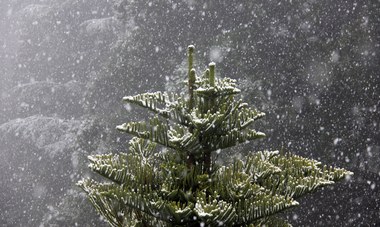
... Significant trees include Pinus ponderosa (Western Yellow Pine), Pinus coulteri (Big Cone Pine), twoAbies nordmanniana (Caucasian Fir), Abies pinsapo, (Spanish Fir) and a Cedrus atlantica f. glauca(Blue Atlas Cedar), Pinus wallichiana (Bhutan Pine), Pinus pinaster (Maritime Pine), Sequoiadendron giganteum (Giant Redwood), (Monkey Puzzle) and Aesculus hippocastanum (Horse Chestnut), many the largest or finest examples in Victoria. ...Significant trees include Pinus ponderosa (Western Yellow Pine), Pinus coulteri (Big Cone Pine), twoAbies nordmanniana (Caucasian Fir), Abies pinsapo, (Spanish Fir) and a Cedrus atlantica f. glauca(Blue Atlas Cedar), Pinus wallichiana (Bhutan Pine), Pinus pinaster (Maritime Pine), Sequoiadendron giganteum (Giant Redwood), (Monkey Puzzle) and Aesculus hippocastanum (Horse Chestnut), many the largest or finest examples in Victoria. ...The Daylesford Botanic Gardens are of historic, scientific (botanic), and aesthetic significance to the State of Victoria. The Daylesford Botanic Gardens are historically significant as a fine example of a regional botanic garden demonstrating the typical characteristics of a carriage drive, informal park layout, decorative structures and works such as the memorial tower, conservatory, rotunda, cascade and fernery, which contrasts with the open lawns planted with specimen trees, areas of intensive horticultural interest and close proximity to a township developed during the mid to late nineteenth century. The Daylesford Botanic Gardens are historically significant for the design input by noted landscape designer William Sangster, and for the survival of his 1884 plan, which is a rare example of a plan from this prolific garden designer. The Daylesford Botanic Gardens are of scientific (botanic) significance for the extensive conifer collection and cool climate plants. The Gardens contain an outstanding collection of conifers and other mature trees, many of which were donated by renowned botanist Ferdinand von Mueller. Significant trees include Pinus ponderosa (Western Yellow Pine), Pinus coulteri (Big Cone Pine), twoAbies nordmanniana (Caucasian Fir), Abies pinsapo, (Spanish Fir) and a Cedrus atlantica f. glauca(Blue Atlas Cedar), Pinus wallichiana (Bhutan Pine), Pinus pinaster (Maritime Pine), Sequoiadendron giganteum (Giant Redwood), (Monkey Puzzle) and Aesculus hippocastanum (Horse Chestnut), many the largest or finest examples in Victoria. Other outstanding trees include a Tilia cordata (Small-leaved European Linden), a row of Cupressus lusitanica (Mexican cypress), a Quercus robur (English Oak) planted in 1863, avenues of Dutch Elms and a rare Quercus leucotrichophora (Himalayan Oak). The Daylesford Botanic Gardens are of aesthetic significance as a rare example of a botanic garden spectacularly sited on an extinct volcanic cone which allows a panoramic view, aided by the 1938 Pioneers’ Memorial Tower, as well as vistas within and out of the gardens and from the township to the gardens. As the most prominent local landmark, the Garden’s vertical dominance in the landscape provides a dark contrast to the elms avenues, oaks and other deciduous species. (Heritage Victoria Register, )Digital imagesdaylesford, snow, weather, climate, winter, daylesford botanic gardens, botanic gardens, wombat hill, wombat hill botanic gardens, pinetum, trees, reservoir -
 Ballarat Heritage Services
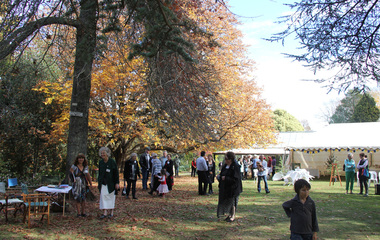
Photograph - Digital photographs, L.J. Gervasoni, Wombat Hill Botanic Gardens 150 anniversary event Daylesford community event, 2013
... Significant trees include Pinus ponderosa (Western Yellow Pine), Pinus coulteri (Big Cone Pine), twoAbies nordmanniana (Caucasian Fir), Abies pinsapo, (Spanish Fir) and a Cedrus atlantica f. glauca(Blue Atlas Cedar), Pinus wallichiana (Bhutan Pine), Pinus pinaster (Maritime Pine), Sequoiadendron giganteum (Giant Redwood), (Monkey Puzzle) and Aesculus hippocastanum (Horse Chestnut), many the largest or finest examples in Victoria. ...Significant trees include Pinus ponderosa (Western Yellow Pine), Pinus coulteri (Big Cone Pine), twoAbies nordmanniana (Caucasian Fir), Abies pinsapo, (Spanish Fir) and a Cedrus atlantica f. glauca(Blue Atlas Cedar), Pinus wallichiana (Bhutan Pine), Pinus pinaster (Maritime Pine), Sequoiadendron giganteum (Giant Redwood), (Monkey Puzzle) and Aesculus hippocastanum (Horse Chestnut), many the largest or finest examples in Victoria. ...The Daylesford Botanic Gardens are of historic, scientific (botanic), and aesthetic significance to the State of Victoria. The Daylesford Botanic Gardens are historically significant as a fine example of a regional botanic garden demonstrating the typical characteristics of a carriage drive, informal park layout, decorative structures and works such as the memorial tower, conservatory, rotunda, cascade and fernery, which contrasts with the open lawns planted with specimen trees, areas of intensive horticultural interest and close proximity to a township developed during the mid to late nineteenth century. The Daylesford Botanic Gardens are historically significant for the design input by noted landscape designer William Sangster, and for the survival of his 1884 plan, which is a rare example of a plan from this prolific garden designer. The Daylesford Botanic Gardens are of scientific (botanic) significance for the extensive conifer collection and cool climate plants. The Gardens contain an outstanding collection of conifers and other mature trees, many of which were donated by renowned botanist Ferdinand von Mueller. Significant trees include Pinus ponderosa (Western Yellow Pine), Pinus coulteri (Big Cone Pine), twoAbies nordmanniana (Caucasian Fir), Abies pinsapo, (Spanish Fir) and a Cedrus atlantica f. glauca(Blue Atlas Cedar), Pinus wallichiana (Bhutan Pine), Pinus pinaster (Maritime Pine), Sequoiadendron giganteum (Giant Redwood), (Monkey Puzzle) and Aesculus hippocastanum (Horse Chestnut), many the largest or finest examples in Victoria. Other outstanding trees include a Tilia cordata (Small-leaved European Linden), a row of Cupressus lusitanica (Mexican cypress), a Quercus robur (English Oak) planted in 1863, avenues of Dutch Elms and a rare Quercus leucotrichophora (Himalayan Oak). The Daylesford Botanic Gardens are of aesthetic significance as a rare example of a botanic garden spectacularly sited on an extinct volcanic cone which allows a panoramic view, aided by the 1938 Pioneers’ Memorial Tower, as well as vistas within and out of the gardens and from the township to the gardens. As the most prominent local landmark, the Garden’s vertical dominance in the landscape provides a dark contrast to the elms avenues, oaks and other deciduous species. (Heritage Victoria Register, )Digital imagesvictoria, 150, anniversary, botanic, gardens, wombat hill, botanic gardens, heritage, celebration, garden party, daylesford, people, crowd, community, john hawker, john madigan, stilt, trees, owls, wombat hill botanic gardens -
 Ballarat Heritage Services
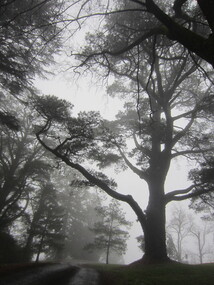
Photograph - Digital photographs, L.J. Gervasoni, Wombat Hill in the Fog, c2015
... Significant trees include Pinus ponderosa (Western Yellow Pine), Pinus coulteri (Big Cone Pine), twoAbies nordmanniana (Caucasian Fir), Abies pinsapo, (Spanish Fir) and a Cedrus atlantica f. glauca(Blue Atlas Cedar), Pinus wallichiana (Bhutan Pine), Pinus pinaster (Maritime Pine), Sequoiadendron giganteum (Giant Redwood), (Monkey Puzzle) and Aesculus hippocastanum (Horse Chestnut), many the largest or finest examples in Victoria. ...Significant trees include Pinus ponderosa (Western Yellow Pine), Pinus coulteri (Big Cone Pine), twoAbies nordmanniana (Caucasian Fir), Abies pinsapo, (Spanish Fir) and a Cedrus atlantica f. glauca(Blue Atlas Cedar), Pinus wallichiana (Bhutan Pine), Pinus pinaster (Maritime Pine), Sequoiadendron giganteum (Giant Redwood), (Monkey Puzzle) and Aesculus hippocastanum (Horse Chestnut), many the largest or finest examples in Victoria. ...The Daylesford Botanic Gardens are of historic, scientific (botanic), and aesthetic significance to the State of Victoria. The Daylesford Botanic Gardens are historically significant as a fine example of a regional botanic garden demonstrating the typical characteristics of a carriage drive, informal park layout, decorative structures and works such as the memorial tower, conservatory, rotunda, cascade and fernery, which contrasts with the open lawns planted with specimen trees, areas of intensive horticultural interest and close proximity to a township developed during the mid to late nineteenth century. The Daylesford Botanic Gardens are historically significant for the design input by noted landscape designer William Sangster, and for the survival of his 1884 plan, which is a rare example of a plan from this prolific garden designer. The Daylesford Botanic Gardens are of scientific (botanic) significance for the extensive conifer collection and cool climate plants. The Gardens contain an outstanding collection of conifers and other mature trees, many of which were donated by renowned botanist Ferdinand von Mueller. Significant trees include Pinus ponderosa (Western Yellow Pine), Pinus coulteri (Big Cone Pine), twoAbies nordmanniana (Caucasian Fir), Abies pinsapo, (Spanish Fir) and a Cedrus atlantica f. glauca(Blue Atlas Cedar), Pinus wallichiana (Bhutan Pine), Pinus pinaster (Maritime Pine), Sequoiadendron giganteum (Giant Redwood), (Monkey Puzzle) and Aesculus hippocastanum (Horse Chestnut), many the largest or finest examples in Victoria. Other outstanding trees include a Tilia cordata (Small-leaved European Linden), a row of Cupressus lusitanica (Mexican cypress), a Quercus robur (English Oak) planted in 1863, avenues of Dutch Elms and a rare Quercus leucotrichophora (Himalayan Oak). The Daylesford Botanic Gardens are of aesthetic significance as a rare example of a botanic garden spectacularly sited on an extinct volcanic cone which allows a panoramic view, aided by the 1938 Pioneers’ Memorial Tower, as well as vistas within and out of the gardens and from the township to the gardens. As the most prominent local landmark, the Garden’s vertical dominance in the landscape provides a dark contrast to the elms avenues, oaks and other deciduous species. (Heritage Victoria Register, )Black and white photograph of a treed landscape covered with fog. The trees are in the Daylesford Botanical Gardens on Wombat Hill.wombat hill botanic gardens, wombat hill, daylesford, daylesford botanic gardens, fog, weather, arboretum -
 Ballarat Heritage Services
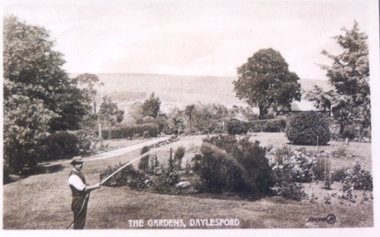
Photograph - Postcard, Wombat Hill Gardens, Daylesford
... Significant trees include Pinus ponderosa (Western Yellow Pine), Pinus coulteri (Big Cone Pine), twoAbies nordmanniana (Caucasian Fir), Abies pinsapo, (Spanish Fir) and a Cedrus atlantica f. glauca(Blue Atlas Cedar), Pinus wallichiana (Bhutan Pine), Pinus pinaster (Maritime Pine), Sequoiadendron giganteum (Giant Redwood), (Monkey Puzzle) and Aesculus hippocastanum (Horse Chestnut), many the largest or finest examples in Victoria. ...Significant trees include Pinus ponderosa (Western Yellow Pine), Pinus coulteri (Big Cone Pine), twoAbies nordmanniana (Caucasian Fir), Abies pinsapo, (Spanish Fir) and a Cedrus atlantica f. glauca(Blue Atlas Cedar), Pinus wallichiana (Bhutan Pine), Pinus pinaster (Maritime Pine), Sequoiadendron giganteum (Giant Redwood), (Monkey Puzzle) and Aesculus hippocastanum (Horse Chestnut), many the largest or finest examples in Victoria. ...The Daylesford Botanic Gardens are of historic, scientific (botanic), and aesthetic significance to the State of Victoria. The Daylesford Botanic Gardens are historically significant as a fine example of a regional botanic garden demonstrating the typical characteristics of a carriage drive, informal park layout, decorative structures and works such as the memorial tower, conservatory, rotunda, cascade and fernery, which contrasts with the open lawns planted with specimen trees, areas of intensive horticultural interest and close proximity to a township developed during the mid to late nineteenth century. The Daylesford Botanic Gardens are historically significant for the design input by noted landscape designer William Sangster, and for the survival of his 1884 plan, which is a rare example of a plan from this prolific garden designer. The Daylesford Botanic Gardens are of scientific (botanic) significance for the extensive conifer collection and cool climate plants. The Gardens contain an outstanding collection of conifers and other mature trees, many of which were donated by renowned botanist Ferdinand von Mueller. Significant trees include Pinus ponderosa (Western Yellow Pine), Pinus coulteri (Big Cone Pine), twoAbies nordmanniana (Caucasian Fir), Abies pinsapo, (Spanish Fir) and a Cedrus atlantica f. glauca(Blue Atlas Cedar), Pinus wallichiana (Bhutan Pine), Pinus pinaster (Maritime Pine), Sequoiadendron giganteum (Giant Redwood), (Monkey Puzzle) and Aesculus hippocastanum (Horse Chestnut), many the largest or finest examples in Victoria. Other outstanding trees include a Tilia cordata (Small-leaved European Linden), a row of Cupressus lusitanica (Mexican cypress), a Quercus robur (English Oak) planted in 1863, avenues of Dutch Elms and a rare Quercus leucotrichophora (Himalayan Oak). The Daylesford Botanic Gardens are of aesthetic significance as a rare example of a botanic garden spectacularly sited on an extinct volcanic cone which allows a panoramic view, aided by the 1938 Pioneers’ Memorial Tower, as well as vistas within and out of the gardens and from the township to the gardens. As the most prominent local landmark, the Garden’s vertical dominance in the landscape provides a dark contrast to the elms avenues, oaks and other deciduous species. (Heritage Victoria Register, )Black and white postcard of Wombat Hill Botanical Gardens, Daylesford.wombat hill botanical gardens, daylesford, gardener, wombat hill botanic gardens -
 Ballarat Heritage Services
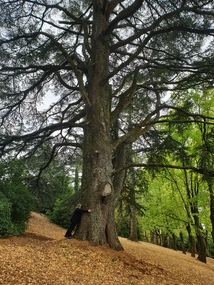
Photograph - Photograph - Colour, Clare Gervasoni, Wombat Botanic Gardens, Daylesford, 2019, 23/04/2019
... Significant trees include Pinus ponderosa (Western Yellow Pine), Pinus coulteri (Big Cone Pine), twoAbies nordmanniana (Caucasian Fir), Abies pinsapo, (Spanish Fir) and a Cedrus atlantica f. glauca(Blue Atlas Cedar), Pinus wallichiana (Bhutan Pine), Pinus pinaster (Maritime Pine), Sequoiadendron giganteum (Giant Redwood), (Monkey Puzzle) and Aesculus hippocastanum (Horse Chestnut), many the largest or finest examples in Victoria. ...Significant trees include Pinus ponderosa (Western Yellow Pine), Pinus coulteri (Big Cone Pine), twoAbies nordmanniana (Caucasian Fir), Abies pinsapo, (Spanish Fir) and a Cedrus atlantica f. glauca(Blue Atlas Cedar), Pinus wallichiana (Bhutan Pine), Pinus pinaster (Maritime Pine), Sequoiadendron giganteum (Giant Redwood), (Monkey Puzzle) and Aesculus hippocastanum (Horse Chestnut), many the largest or finest examples in Victoria. ...The Daylesford Botanic Gardens are of historic, scientific (botanic), and aesthetic significance to the State of Victoria. The Daylesford Botanic Gardens are historically significant as a fine example of a regional botanic garden demonstrating the typical characteristics of a carriage drive, informal park layout, decorative structures and works such as the memorial tower, conservatory, rotunda, cascade and fernery, which contrasts with the open lawns planted with specimen trees, areas of intensive horticultural interest and close proximity to a township developed during the mid to late nineteenth century. The Daylesford Botanic Gardens are historically significant for the design input by noted landscape designer William Sangster, and for the survival of his 1884 plan, which is a rare example of a plan from this prolific garden designer. The Daylesford Botanic Gardens are of scientific (botanic) significance for the extensive conifer collection and cool climate plants. The Gardens contain an outstanding collection of conifers and other mature trees, many of which were donated by renowned botanist Ferdinand von Mueller. Significant trees include Pinus ponderosa (Western Yellow Pine), Pinus coulteri (Big Cone Pine), twoAbies nordmanniana (Caucasian Fir), Abies pinsapo, (Spanish Fir) and a Cedrus atlantica f. glauca(Blue Atlas Cedar), Pinus wallichiana (Bhutan Pine), Pinus pinaster (Maritime Pine), Sequoiadendron giganteum (Giant Redwood), (Monkey Puzzle) and Aesculus hippocastanum (Horse Chestnut), many the largest or finest examples in Victoria. Other outstanding trees include a Tilia cordata (Small-leaved European Linden), a row of Cupressus lusitanica (Mexican cypress), a Quercus robur (English Oak) planted in 1863, avenues of Dutch Elms and a rare Quercus leucotrichophora (Himalayan Oak). The Daylesford Botanic Gardens are of aesthetic significance as a rare example of a botanic garden spectacularly sited on an extinct volcanic cone which allows a panoramic view, aided by the 1938 Pioneers’ Memorial Tower, as well as vistas within and out of the gardens and from the township to the gardens. As the most prominent local landmark, the Garden’s vertical dominance in the landscape provides a dark contrast to the elms avenues, oaks and other deciduous species. (Heritage Victoria Register, 2025)A large tree in the Wombat Gardens. wombat botanical gardens, daylesford botanical gardens, daylesford, trees, lisa gervasoni, wombat botanic gardens -
 Ballarat Heritage Services
Photograph - Photograph - Colour, Clare Gervasoni, Wombat Botanic Gardens, Daylesford, 2019, 23/04/2019
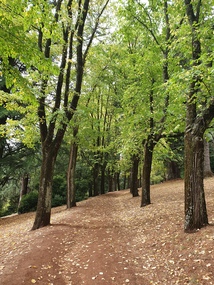
... Significant trees include Pinus ponderosa (Western Yellow Pine), Pinus coulteri (Big Cone Pine), twoAbies nordmanniana (Caucasian Fir), Abies pinsapo, (Spanish Fir) and a Cedrus atlantica f. glauca(Blue Atlas Cedar), Pinus wallichiana (Bhutan Pine), Pinus pinaster (Maritime Pine), Sequoiadendron giganteum (Giant Redwood), (Monkey Puzzle) and Aesculus hippocastanum (Horse Chestnut), many the largest or finest examples in Victoria. ...Significant trees include Pinus ponderosa (Western Yellow Pine), Pinus coulteri (Big Cone Pine), twoAbies nordmanniana (Caucasian Fir), Abies pinsapo, (Spanish Fir) and a Cedrus atlantica f. glauca(Blue Atlas Cedar), Pinus wallichiana (Bhutan Pine), Pinus pinaster (Maritime Pine), Sequoiadendron giganteum (Giant Redwood), (Monkey Puzzle) and Aesculus hippocastanum (Horse Chestnut), many the largest or finest examples in Victoria. ...The Daylesford Botanic Gardens are of historic, scientific (botanic), and aesthetic significance to the State of Victoria. The Daylesford Botanic Gardens are historically significant as a fine example of a regional botanic garden demonstrating the typical characteristics of a carriage drive, informal park layout, decorative structures and works such as the memorial tower, conservatory, rotunda, cascade and fernery, which contrasts with the open lawns planted with specimen trees, areas of intensive horticultural interest and close proximity to a township developed during the mid to late nineteenth century. The Daylesford Botanic Gardens are historically significant for the design input by noted landscape designer William Sangster, and for the survival of his 1884 plan, which is a rare example of a plan from this prolific garden designer. The Daylesford Botanic Gardens are of scientific (botanic) significance for the extensive conifer collection and cool climate plants. The Gardens contain an outstanding collection of conifers and other mature trees, many of which were donated by renowned botanist Ferdinand von Mueller. Significant trees include Pinus ponderosa (Western Yellow Pine), Pinus coulteri (Big Cone Pine), twoAbies nordmanniana (Caucasian Fir), Abies pinsapo, (Spanish Fir) and a Cedrus atlantica f. glauca(Blue Atlas Cedar), Pinus wallichiana (Bhutan Pine), Pinus pinaster (Maritime Pine), Sequoiadendron giganteum (Giant Redwood), (Monkey Puzzle) and Aesculus hippocastanum (Horse Chestnut), many the largest or finest examples in Victoria. Other outstanding trees include a Tilia cordata (Small-leaved European Linden), a row of Cupressus lusitanica (Mexican cypress), a Quercus robur (English Oak) planted in 1863, avenues of Dutch Elms and a rare Quercus leucotrichophora (Himalayan Oak). The Daylesford Botanic Gardens are of aesthetic significance as a rare example of a botanic garden spectacularly sited on an extinct volcanic cone which allows a panoramic view, aided by the 1938 Pioneers’ Memorial Tower, as well as vistas within and out of the gardens and from the township to the gardens. As the most prominent local landmark, the Garden’s vertical dominance in the landscape provides a dark contrast to the elms avenues, oaks and other deciduous species. (Heritage Victoria Register, 2025)An avenue of trees in the Wombat Hill Gardens. wombat botanical gardens, daylesford botanical gardens, daylesford, trees -
 Ballarat Heritage Services
Photograph - Photograph - Colour, Clare Gervasoni, Wombat Botanic Gardens, Daylesford, 2019, 23/04/2019
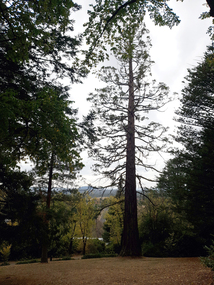
... Significant trees include Pinus ponderosa (Western Yellow Pine), Pinus coulteri (Big Cone Pine), twoAbies nordmanniana (Caucasian Fir), Abies pinsapo, (Spanish Fir) and a Cedrus atlantica f. glauca(Blue Atlas Cedar), Pinus wallichiana (Bhutan Pine), Pinus pinaster (Maritime Pine), Sequoiadendron giganteum (Giant Redwood), (Monkey Puzzle) and Aesculus hippocastanum (Horse Chestnut), many the largest or finest examples in Victoria. ...Significant trees include Pinus ponderosa (Western Yellow Pine), Pinus coulteri (Big Cone Pine), twoAbies nordmanniana (Caucasian Fir), Abies pinsapo, (Spanish Fir) and a Cedrus atlantica f. glauca(Blue Atlas Cedar), Pinus wallichiana (Bhutan Pine), Pinus pinaster (Maritime Pine), Sequoiadendron giganteum (Giant Redwood), (Monkey Puzzle) and Aesculus hippocastanum (Horse Chestnut), many the largest or finest examples in Victoria. ...The Daylesford Botanic Gardens are of historic, scientific (botanic), and aesthetic significance to the State of Victoria. The Daylesford Botanic Gardens are historically significant as a fine example of a regional botanic garden demonstrating the typical characteristics of a carriage drive, informal park layout, decorative structures and works such as the memorial tower, conservatory, rotunda, cascade and fernery, which contrasts with the open lawns planted with specimen trees, areas of intensive horticultural interest and close proximity to a township developed during the mid to late nineteenth century. The Daylesford Botanic Gardens are historically significant for the design input by noted landscape designer William Sangster, and for the survival of his 1884 plan, which is a rare example of a plan from this prolific garden designer. The Daylesford Botanic Gardens are of scientific (botanic) significance for the extensive conifer collection and cool climate plants. The Gardens contain an outstanding collection of conifers and other mature trees, many of which were donated by renowned botanist Ferdinand von Mueller. Significant trees include Pinus ponderosa (Western Yellow Pine), Pinus coulteri (Big Cone Pine), twoAbies nordmanniana (Caucasian Fir), Abies pinsapo, (Spanish Fir) and a Cedrus atlantica f. glauca(Blue Atlas Cedar), Pinus wallichiana (Bhutan Pine), Pinus pinaster (Maritime Pine), Sequoiadendron giganteum (Giant Redwood), (Monkey Puzzle) and Aesculus hippocastanum (Horse Chestnut), many the largest or finest examples in Victoria. Other outstanding trees include a Tilia cordata (Small-leaved European Linden), a row of Cupressus lusitanica (Mexican cypress), a Quercus robur (English Oak) planted in 1863, avenues of Dutch Elms and a rare Quercus leucotrichophora (Himalayan Oak). The Daylesford Botanic Gardens are of aesthetic significance as a rare example of a botanic garden spectacularly sited on an extinct volcanic cone which allows a panoramic view, aided by the 1938 Pioneers’ Memorial Tower, as well as vistas within and out of the gardens and from the township to the gardens. As the most prominent local landmark, the Garden’s vertical dominance in the landscape provides a dark contrast to the elms avenues, oaks and other deciduous species. (Heritage Victoria Register, )A tree in the Wombat Hill Gardens.wombat botanical gardens, daylesford botanical gardens, daylesford, trees, wombat hill botanic gardens -
 Ballarat Heritage Services
Photograph - digital photographs, Lisa Gervasoni, Wombat Hill, Daylesford, c2006-2016
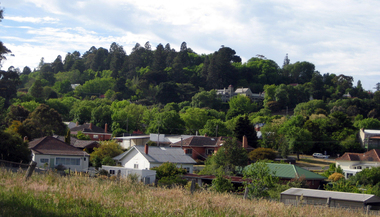
... Significant trees include Pinus ponderosa (Western Yellow Pine), Pinus coulteri (Big Cone Pine), twoAbies nordmanniana (Caucasian Fir), Abies pinsapo, (Spanish Fir) and a Cedrus atlantica f. glauca(Blue Atlas Cedar), Pinus wallichiana (Bhutan Pine), Pinus pinaster (Maritime Pine), Sequoiadendron giganteum (Giant Redwood), (Monkey Puzzle) and Aesculus hippocastanum (Horse Chestnut), many the largest or finest examples in Victoria. ...Significant trees include Pinus ponderosa (Western Yellow Pine), Pinus coulteri (Big Cone Pine), twoAbies nordmanniana (Caucasian Fir), Abies pinsapo, (Spanish Fir) and a Cedrus atlantica f. glauca(Blue Atlas Cedar), Pinus wallichiana (Bhutan Pine), Pinus pinaster (Maritime Pine), Sequoiadendron giganteum (Giant Redwood), (Monkey Puzzle) and Aesculus hippocastanum (Horse Chestnut), many the largest or finest examples in Victoria. ...The Daylesford Botanic Gardens are of historic, scientific (botanic), and aesthetic significance to the State of Victoria. The Daylesford Botanic Gardens are historically significant as a fine example of a regional botanic garden demonstrating the typical characteristics of a carriage drive, informal park layout, decorative structures and works such as the memorial tower, conservatory, rotunda, cascade and fernery, which contrasts with the open lawns planted with specimen trees, areas of intensive horticultural interest and close proximity to a township developed during the mid to late nineteenth century. The Daylesford Botanic Gardens are historically significant for the design input by noted landscape designer William Sangster, and for the survival of his 1884 plan, which is a rare example of a plan from this prolific garden designer. The Daylesford Botanic Gardens are of scientific (botanic) significance for the extensive conifer collection and cool climate plants. The Gardens contain an outstanding collection of conifers and other mature trees, many of which were donated by renowned botanist Ferdinand von Mueller. Significant trees include Pinus ponderosa (Western Yellow Pine), Pinus coulteri (Big Cone Pine), twoAbies nordmanniana (Caucasian Fir), Abies pinsapo, (Spanish Fir) and a Cedrus atlantica f. glauca(Blue Atlas Cedar), Pinus wallichiana (Bhutan Pine), Pinus pinaster (Maritime Pine), Sequoiadendron giganteum (Giant Redwood), (Monkey Puzzle) and Aesculus hippocastanum (Horse Chestnut), many the largest or finest examples in Victoria. Other outstanding trees include a Tilia cordata (Small-leaved European Linden), a row of Cupressus lusitanica (Mexican cypress), a Quercus robur (English Oak) planted in 1863, avenues of Dutch Elms and a rare Quercus leucotrichophora (Himalayan Oak). The Daylesford Botanic Gardens are of aesthetic significance as a rare example of a botanic garden spectacularly sited on an extinct volcanic cone which allows a panoramic view, aided by the 1938 Pioneers’ Memorial Tower, as well as vistas within and out of the gardens and from the township to the gardens. As the most prominent local landmark, the Garden’s vertical dominance in the landscape provides a dark contrast to the elms avenues, oaks and other deciduous species. (Heritage Victoria Register, )Colour photograph of Wombat Hill Botanical Gardens, Daylesford.heritage, daylesford, townscape, wombat hill, wombat hill botanical gardens, wombat hill botanic gardens -
 Ballarat Heritage Services
Photograph - Digital photographs, L.J. Gervasoni, Wombat Hill Botanic Gardens 150 anniversary event Daylesford organiser Gael Shannon, 2013
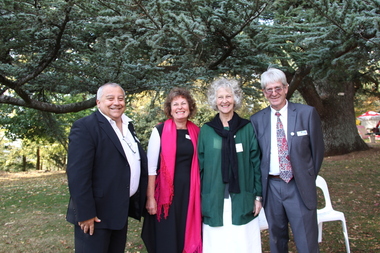
... Significant trees include Pinus ponderosa (Western Yellow Pine), Pinus coulteri (Big Cone Pine), twoAbies nordmanniana (Caucasian Fir), Abies pinsapo, (Spanish Fir) and a Cedrus atlantica f. glauca(Blue Atlas Cedar), Pinus wallichiana (Bhutan Pine), Pinus pinaster (Maritime Pine), Sequoiadendron giganteum (Giant Redwood), (Monkey Puzzle) and Aesculus hippocastanum (Horse Chestnut), many the largest or finest examples in Victoria. ...Significant trees include Pinus ponderosa (Western Yellow Pine), Pinus coulteri (Big Cone Pine), twoAbies nordmanniana (Caucasian Fir), Abies pinsapo, (Spanish Fir) and a Cedrus atlantica f. glauca(Blue Atlas Cedar), Pinus wallichiana (Bhutan Pine), Pinus pinaster (Maritime Pine), Sequoiadendron giganteum (Giant Redwood), (Monkey Puzzle) and Aesculus hippocastanum (Horse Chestnut), many the largest or finest examples in Victoria. ...The Wombat Hill Botanic Gardens 150 anniversary event organiser was Gael Shannon. The Daylesford Botanic Gardens are of historic, scientific (botanic), and aesthetic significance to the State of Victoria. The Daylesford Botanic Gardens are historically significant as a fine example of a regional botanic garden demonstrating the typical characteristics of a carriage drive, informal park layout, decorative structures and works such as the memorial tower, conservatory, rotunda, cascade and fernery, which contrasts with the open lawns planted with specimen trees, areas of intensive horticultural interest and close proximity to a township developed during the mid to late nineteenth century. The Daylesford Botanic Gardens are historically significant for the design input by noted landscape designer William Sangster, and for the survival of his 1884 plan, which is a rare example of a plan from this prolific garden designer. The Daylesford Botanic Gardens are of scientific (botanic) significance for the extensive conifer collection and cool climate plants. The Gardens contain an outstanding collection of conifers and other mature trees, many of which were donated by renowned botanist Ferdinand von Mueller. Significant trees include Pinus ponderosa (Western Yellow Pine), Pinus coulteri (Big Cone Pine), twoAbies nordmanniana (Caucasian Fir), Abies pinsapo, (Spanish Fir) and a Cedrus atlantica f. glauca(Blue Atlas Cedar), Pinus wallichiana (Bhutan Pine), Pinus pinaster (Maritime Pine), Sequoiadendron giganteum (Giant Redwood), (Monkey Puzzle) and Aesculus hippocastanum (Horse Chestnut), many the largest or finest examples in Victoria. Other outstanding trees include a Tilia cordata (Small-leaved European Linden), a row of Cupressus lusitanica (Mexican cypress), a Quercus robur (English Oak) planted in 1863, avenues of Dutch Elms and a rare Quercus leucotrichophora (Himalayan Oak). The Daylesford Botanic Gardens are of aesthetic significance as a rare example of a botanic garden spectacularly sited on an extinct volcanic cone which allows a panoramic view, aided by the 1938 Pioneers’ Memorial Tower, as well as vistas within and out of the gardens and from the township to the gardens. As the most prominent local landmark, the Garden’s vertical dominance in the landscape provides a dark contrast to the elms avenues, oaks and other deciduous species. (Heritage Victoria Register, )Four people photographed at the 150th anniversary event at the Wombat Botanic Gardens.victoria, 150, anniversary, botanic, gardens, wombat hill, botanic gardens, heritage, celebration, garden party, daylesford, people, crowd, community, organiser, tour, gael shannon, don henderson, wombat hill botanic gardens -
 Bendigo Military Museum
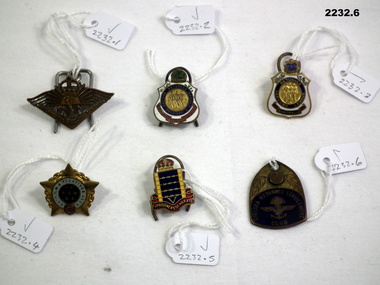
Badge - ACTIVE SERVICE, MEMBERSHIP BADGES, All post 1945
... pine date 1994 membership. Front of badge "Returned Services League Australia". Numbered stamped badge on rear with 2 lugs and pin. .4) Membership badge, metal, 5 star shape with wreath around. Centre in light blue circle "Ex POW R.A". Small pin at bottom in red with "50" denoting membership 1950. rear has 2 lugs and is stamped with number. .5) Membership badge, metal, crown at top, centre has depiction of barbwire through blue background. At bottom is a "v" then scroll with "Ex Prisoner of War Assn" in red. rear lhas 2 lugs and pin. .6) Membership badge, metal cone...pine date 1994 membership. Front of badge "Returned Services League Australia". Numbered stamped badge on rear with 2 lugs and pin. .4) Membership badge, metal, 5 star shape with wreath around. Centre in light blue circle "Ex POW R.A". Small pin at bottom in red with "50" denoting membership 1950. rear has 2 lugs and is stamped with number. .5) Membership badge, metal, crown at top, centre has depiction of barbwire through blue background. At bottom is a "v" then scroll with "Ex Prisoner of War Assn" in red. rear lhas 2 lugs and pin. .6) Membership badge, metal cone ....1) badge, brass, "Returned From Active Service". Crown at top over wings. Rising Sun and Anchor. Boomerang at base with "Returned From Active Service, rear has 2 lugs and pin. Rear is stamped with a number. .2) Membership badge, metal, centre has 3 figures, crown at top with pin date 1954 membership. Front of badge "Returned Sailors, Soldiers and Airmans Imperial league of Australia. Numbered stamped badge on rear with 2 lugs and pin. .3) Membership badge, metal centre has 3 figures crown at top with pine date 1994 membership. Front of badge "Returned Services League Australia". Numbered stamped badge on rear with 2 lugs and pin. .4) Membership badge, metal, 5 star shape with wreath around. Centre in light blue circle "Ex POW R.A". Small pin at bottom in red with "50" denoting membership 1950. rear has 2 lugs and is stamped with number. .5) Membership badge, metal, crown at top, centre has depiction of barbwire through blue background. At bottom is a "v" then scroll with "Ex Prisoner of War Assn" in red. rear lhas 2 lugs and pin. .6) Membership badge, metal cone shape with small hole at top. Pin with "73" under denoting membership 1970. At bottom in blue "Rising Sun, Wings and Anchor surrounded by "Chelsea Returned Servicemens Club". Rear is numbered stamp..1) Issued by Commonwealth Government of Australia” .2) “Property of League V41531” .3) “Property of League V80354” .4) "593" .6) "470"”numismatics - medals /military, membership -
 Melbourne Legacy
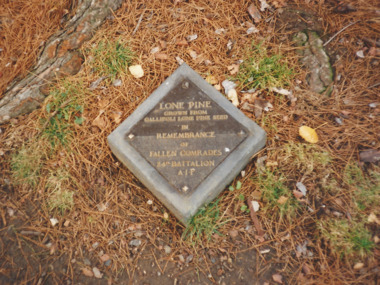
Photograph, Tree Plaques, 1988
... One is of the Lone Pine planted from by Legacy from the seeds of a cone from Gallipoli and planted by Legatee Stan Savige in 1933 in remembrance of fallen comrades of the 24th Battalion. ...One is of the Lone Pine planted from by Legacy from the seeds of a cone from Gallipoli and planted by Legatee Stan Savige in 1933 in remembrance of fallen comrades of the 24th Battalion. ...Photos of plaques at the base of trees at the Shrine of Remembrance. One is of the Lone Pine planted from by Legacy from the seeds of a cone from Gallipoli and planted by Legatee Stan Savige in 1933 in remembrance of fallen comrades of the 24th Battalion. The plaque is in the form of the red and white diamond badge of the 24th Battalion. This tree had to be removed in 2012 due to its age had led to safety concerns. Also a plaque from the Olive tree of peace planted by Legatee Frank Doolan in 1973 which was the 50th anniversary of Legacy. Other trees were for Netherlands' Service Personnel, and the 18th squadron NEI-RAAF Forces Association, and the fallen comrades of the RAAF Beaufort squadrons. There is also a tree for the 'Carry On' Club of Victoria. These photos were taken at the same time as views of the Legacy Garden and photos of the man and donkey statue at the Shrine of Remembrance. Believed to be late 1980s when the garden was renamed for Legacy, and before 1998 when the statue of the Widow and Children was installed. Photos were in a scrapbook of photos spanning 1983 to 1991.A record of trees at the Shrine.Colour photo x 5 of plaques at the base of trees planted at the Shrine of Remembrance.Printed on reverse 'shrine of remembrance, memorial -
 Mentone Grammar School
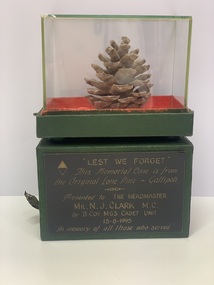
Archive, Memorial Cone from the original Lone Pine, Gallipoli, 1916
... Memorial Cone from the original Lone Pine, Gallipoli, 1916...Memorial cone from the original 'Lone Pine' at Gallipoli, presented to Headmaster Neville Clarke by B Company, Mentone Grammar Cadet Unit, 15th August 1995 in memory of those who served. ...Memorial cone from the original 'Lone Pine' at Gallipoli, presented to Headmaster Neville Clarke by B Company, Mentone Grammar Cadet Unit, 15th August 1995 in memory of those who served. ...Memorial cone from the original 'Lone Pine' at Gallipoli, presented to Headmaster Neville Clarke by B Company, Mentone Grammar Cadet Unit, 15th August 1995 in memory of those who served. The Battle of Lone Pine was fought between Australian and New Zealand Army Corps (ANZAC) and Ottoman Empire forces during the Gallipoli Campaign of the First World War, between 6 and 10 August 1915. The battle was part of a diversionary attack to draw Ottoman attention away from the main assaults being conducted by British, Indian and New Zealand troops around Sari Bair, Chunuk Bair and Hill 971, which became known as the August Offensive.
