
Showing 72 items matching " port howard"
-
 Glen Eira Historical Society
Document - REGENT STREET, 54, ELSTERNWICK
... ... Port Howard...Regent Street Elsternwick Cottages Victorian style Biggin Scott Real estate agents Johnson William Port Howard Edwards Minnie Walker F J Gill K J Document REGENT STREET, 54, ELSTERNWICK ...Two items about this property: 1/Advertisement in the Bayside Weekly, 27/10/2010, for the forthcoming auction of 54 Regent Street, Elsternwick. Gives brief details of the house interior and exterior. 2/Research note dated 06/06/2012 by Claire Barton, referencing Sands and McDougall editions 1911, 1913, 1923, 1948, 1960 and 1970 giving names of previous tenants at 54 Regent Street.regent street, elsternwick, cottages, victorian style, biggin scott, real estate agents, johnson william, port howard, edwards minnie, walker f j, gill k j -
 Mission to Seafarers Victoria
Letter - Correspondence, Letter to Lillie from Howard, 29 August 1925
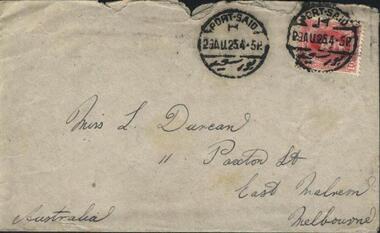
... ...howard...port...Lillie Duncan was a member of the Harbour Lights Guild and this letter forms part of a collection of letters sent to her by different seafarers. lillie duncan howard port said lhlg ss city of norwich The envelope is torn across the top for access to its contents. ...The "letters to Lillie" show the international nature of the Mission to Seafarers. They are an important display of the handwriting style of the time, revealing courting attempts and give us an insight into life in 1925. Page 1 S/S City of Norwich Port Said My Dear Old Lillie, Well, I never got so much of a shock in my life, when your postcard turned up 2 days before my birthday, wishing me many happy returns, for which I thank you sincerely, and am sorry to say I had forgotten yours, or being very quiet about your various qualities, you would not tell me. Well to get on with the news, the next day I had a telegram to report at the Line head office, on the 15th Aug. early, imagine how I swore, as a little do was to [be] held at night, they immediately shored me on this ship S/S City of Norwich to go to Port Said, then join the City of Corinth bound for Boston & New-York so I may come out to “little Aussie” again from there with a little luck, any way we ought to be in New-York about the 19th Sept to stay a month, I will write you more in detail from there, if you feel inclined and have forgiven me for being so long about answering your last letter, could you write to S/S City of Corinth, C/o Norton Lilly & Co, New-York. U.S.A. I would jump like L”l Page 2 how is the cow milking going on, but still that joke is as unfair as the small joke about my age now, both afflictions being cured by now I hope. Well really I am no letter writer and can find very little to interest you on paper Lillie, and my photo, I hate being taken as much as you, but will do my best, if you can wait a little please, hoping you are getting one that awfully exciting week with the mission as you call it. You must be A.1 actresses to amuse such a motley crew. Hoping you are all well at home, give Mr & Mrs Duncan my kind regards, sending my best love to you dear. Hoping you will recognize me if I can come along. with tons of love, Howard. P.S. I hope to be a little more sophisticated when I come next time [-] you may be able to tell me. Lillie Duncan was a member of the Harbour Lights Guild and this letter forms part of a collection of letters sent to her by different seafarers.Letter addressed to Miss L Duncan, 11 Paxton St, East Malvern, Melbourne, Australia from Howard in three parts: Part 1.1 (0007.1) Envelope Part 1.2 (0007.2) First page of letter Part 1.3 (0007.3) Second page of letter The pages, as is the envelope, are a creamy yellow colour with black cursive writing on one side of the page. Page 1 of the letter begins with the salutation "My Dear Old Lillie...". Page 2 of the letter concludes with "...you may be able to tell me".The envelope is torn across the top for access to its contents. It has two stamps on the top right hand corner both with the text "Port Said 23AU25.4.5P".lillie duncan, howard, port said, lhlg, ss city of norwich -
 Flagstaff Hill Maritime Museum and Village
Domestic object - Card Holder, c. 1854 - 1957
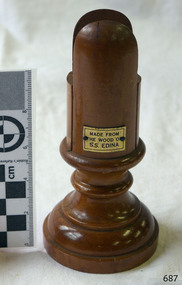
... Howard Smith Ltd., to a Williamstown shipbreaker, Mr George Burton. The Melbourne Harbour Trust permitted Burton to strip the hull and sell all parts at auction. The fittings were sold by auctioneers J.W. Styles & Son, c. 1938, on site at the Port...Howard Smith Ltd., to a Williamstown shipbreaker, Mr George Burton. The Melbourne Harbour Trust permitted Burton to strip the hull and sell all parts at auction. The fittings were sold by auctioneers J.W. Styles & Son, c. 1938, on site at the Port ...This wooden cardholder was made from the wood of the screw steamer S.S. Edina, most probably after she was broken up in 1957, but could have been made after one of several renovations during her lifetime. The slotted design of the cardholder allows a card to stand vertically, and the base is made wider to stabilise the holder. It could be used for holding items such as place cards, menus, and table numbers. ABOUT THE SS EDINA: - The three-masted, iron-hulled screw steamer SS Edina was built in Glasgow, Scotland, in 1854 by Barclay and Curle and launched on the Clyde on May 4th, 1854. The 322-ton, three-masted ship was 171 feet long, 23 feet 6 inches broad, and 12 feet 7 inches deep (52.12 L x 7.16 B x 3.84 D metres). The traditional figurehead of Edina, the ‘fair maid of Judea’, adorned its bow. The Edina later became famous worldwide for being the longest-serving screw steamer. (The term screw steamer comes from being driven by a single propeller, sometimes called a screw, driven by a steam engine.) During its long working life, SS Edina had its accommodation enlarged for war service, was completely overhauled and serviced several times; boilers were replaced, masts were reduced to one, and later added then reduced, a Poop Deck, Forecastle and additional accommodation were added, the hull was gutted completely, new decks and bulwarks, saloon was redecorated and upgraded, and several changes of commander. The busy vessel also survived several mishaps at sea. SS Edina’s interesting history includes English Channel runs, carrying stores and horses to the Black Sea in the Crimean War as HMS Edina 1864-55. The vessel then sailed to Europe and the UK before being sold and used for further service in 1861 as a blockade runner in the American Civil War. The vessel later served as a coastal trader in the western district of Victoria and Queensland, then carried gold, currency, and gold prospectors from Australia to New Zealand. SS Edina was an escort vessel to H.R.H. the Duke of Edinburgh during his visit to Australia in 1867. SOME EVENTS in the life of SS EDINA: - The SS Edina had voyaged to Australia under sail. Owners Leith, Hull & Hamburg Steam Packet Co. sold the SS Edina in March 1863 at Port Phillip Bay, Melbourne, to Stephen Henty of Portland, Victoria; Edina was perfect for working the West Coast cargo and passenger run between Melbourne and Portland, via the Port of Warrnambool, and Port Fairy. It first visited Warrnambool on April 4, 1863. SS Edina briefly worked the run from Australia to New Zealand, then returned to the West Coast run; the cargo included bales of wool produced in the western district of Victoria. In 1867-68, Stephen Henty sold SS Edina to the Warrnambool Steam Packet Company to continue trading along the coast of western Victoria. Captain John Thompson was the commander, and John Davies was the Chief Engineer. In 1870, SS Edina was in Lady Bay, Warrnambool, when a gale sprang up and caused a collision with the iron screw steamer SS Dandenong. SS Edina’s figurehead was broken into pieces and was never replaced. The Edina was refitted that year for use as a coastal trader in Queensland for a period, named R.M.S. Edina. It then went to Melbourne and carried cargo and passengers between there and Geelong from 1880 to 1938, with modifications in 1917; the ship was extensively overhauled, radically changing its appearance. It returned to having two masts, and the funnel, bridge, engines, and promenade deck were upgraded, and the saloon reupholstered. By 1924, Edina had made over 12,000 journeys, carrying over one million travellers between Melbourne and Geelong. In 1937, Australian Steamships Pty Ltd advertised in The Argus its Bay Excursions on the SS Edina from Portarlington and Geelong; it promoted, “Splendid Beaches, Excellent Bathing Facilities, and Light Refreshments available on board”. After several collisions, the SS Edina was taken out of service in 1938 and sold by its owner, Howard Smith Ltd., to a Williamstown shipbreaker, Mr George Burton. The Melbourne Harbour Trust permitted Burton to strip the hull and sell all parts at auction. The fittings were sold by auctioneers J.W. Styles & Son, c. 1938, on site at the Port of Melbourne and became widely dispersed. Victorian Lighterage Pty Ltd. purchased the hull, removed the engine and superstructure, and repurposed it as a ‘lighter’ named Dinah. It was loaded with wool and general cargo, then towed behind small tugs around the bay between Melbourne and Geelong. In 1957, after 104 years of activity, the SS Edina was broken up on the banks of the Maribyrnong River, Footscray, Melbourne, and used as landfill. A piece of the hull with Victorian Heritage significance is buried in the river. This card holder is made from wood from the SS Edina and is significant for its association with that vessel. The SS Edina is heritage listed on the Victorian Heritage Database VHR S199. She had endeared herself to the people of Port Phillip Bay as a passenger ferry, part of their history and culture. She played a significant role in the Crimean War, the American Civil War and the gold rush in New Zealand. She also served Western Victoria for many years in her cargo and passenger runs. The SS Edina is famous for being the longest-serving screw steamer in the world. After spending her first nine years overseas, she arrived in Melbourne, and her work included running the essential service of transporting cargo and passengers between Melbourne and the western Victoria ports of Warrnambool, Port Fairy and Portland. The SS Edina was purchased in the late 1860s by local Warrnambool business, the Warrnambool Steam Packet Co. and continued trading from there as part of the local business community. The SS Edina’s original ‘fair maid of Judea’ figurehead was broken to pieces in a collision with another vessel (the SS Dandenong) in a gale off Warrnambool, Victoria, in 1870. Card holder, made from the wood from the SS Edina (screw steamer ship). Holder is cylindrical shape, wider turned wood base. Top is divided with a space in the centre tor inserting a card. Rectangular metal plaque, gold-coloured, has a printed inscription within black border. Made c. 1854 - 1957.Printed on plaque "MADE FROM / THE WOOD OF / S.S. EDINA"warrnambool, shipwrecked coast, flagstaff hill, flagstaff hill maritime museum, maritime museum, shipwreck coast, flagstaff hill maritime village, shipwrecked artefact, barclay & curle, figurehead 'fair maid of judea', centenary maritime exhibition 1934, a brief review of steam navigation in victoria, pleasure steamer edina, trade and travel late 19th and early 20th century, trade melbourne to geelong, screw steamer edina, coastal trader edina, lighter dinah, cargo carrying for cremean war, cargo carrying for american civil war, passenger and trade in western district of victoria, export gold and currency and gold diggers to new zealand, export vessel to h r h the duke of edinburgh, melbourne - warrnambool - port fairy - portland cargo run, warrnambool steam packet company, stephen henty, captain john thompson, chief engineer john davies, lady bay warrnambool, lighter edina, shipping victoria, port phillip bay steamers, steamship great britain, edina, vhr s199 victorian heritage database, card holder, menu holder, table number holder, souvenir of the ss edina -
 Flagstaff Hill Maritime Museum and Village
Photograph - Captain F Chapman SS Dawn
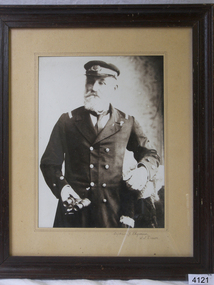
... The Dawn steamship was a 522-ton coastal trader built in 1876 and it’s original captain Jones operated the vessel around the Victorian west coast from 1877 until 1898 for the Portland & Belfast Steam Navigation Co, the vessel was then owned in October 1885 by the renamed company, Belfast & Koroit Steam Navigation Co., until March 1896 when it’s ownership moved to W Howard Smith & Sons Ltd., This Melbourne company used the ship to service most ports around Australia. ...The Dawn steamship was a 522-ton coastal trader built in 1876 and it’s original captain Jones operated the vessel around the Victorian west coast from 1877 until 1898 for the Portland & Belfast Steam Navigation Co, the vessel was then owned in October 1885 by the renamed company, Belfast & Koroit Steam Navigation Co., until March 1896 when it’s ownership moved to W Howard Smith & Sons Ltd., This Melbourne company used the ship to service most ports around Australia. ...The Dawn steamship was a 522-ton coastal trader built in 1876 and it’s original captain Jones operated the vessel around the Victorian west coast from 1877 until 1898 for the Portland & Belfast Steam Navigation Co, the vessel was then owned in October 1885 by the renamed company, Belfast & Koroit Steam Navigation Co., until March 1896 when it’s ownership moved to W Howard Smith & Sons Ltd., This Melbourne company used the ship to service most ports around Australia. Captain F Chapman took over from captain Jones and served on the SS Dawn from 1898 until 1900 when he took command of the SS Casino operated by the Belfast & Koroit Shipping Company at Port Fairy and became the captain from 1900 until 1922 when he retired after twenty-two years becoming the ships longest-serving captain. Captain Roberts took over command until 1924 followed by captain Middleton until 1932 when the Casino was sunk off Apollo Bay and captain Middleton collapsed and died in the surf. Picture of a long serving sea captain connected with a significant ship that was involved in a significant historical incident prior to his taking command of the vessel also his long time association with Port Fairy's Belfast Steam Navigation Company until 1922.Photograph of Captain Chapman framedCaptain F Chapman SS Dawnflagstaff hill, warrnambool, shipwrecked-coast, flagstaff-hill, flagstaff-hill-maritime-museum, maritime-museum, shipwreck-coast, flagstaff-hill-maritime-village, photograph, captain chapman, ss dawn -
 Flagstaff Hill Maritime Museum and Village
Instrument - Barometer, 1952
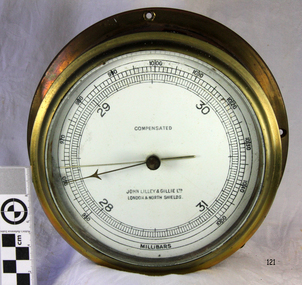
... Tug Melbourne: The barometer was salvaged from a 496-ton tug that had been built in 1952 and had sunk in Port Philip Bay on the 9th of August 1972 after a collision with the SS Nieuw Holland, in 1973 it had been raised and scraped at this time the barometer was salvaged. The tug had been renamed from the Howard... Smith to the “Melbourne” after the Adelaide Steamship Co was taken over by Howard Smith& Co, who were heavily involved in towage, salvage and the stevedoring industries in 1961. The significance is that the item was on a vessel that was evolved in a serious collision in Port Philip Bay in 1972. ...Mr John Wilson Gillie was born on the 31st of March 1864. On the 31st of July 1880 he was apprenticed for four years to J.J. Wilson and Sons, Nautical Instrument Makers of Sunderland. Following the apprenticeship he spent six months to a year as an ‘improver’ in Glasgow, and then started a new company ‘Wilson and Gillie’ in North Shields. At this time sail had just given way to steam and wooden ships to steel, and the railways were competing with colliers for the carrying of coal from the North East of England to London and the South. In 1858 only seven out of 44 shipyards on the Tyne were using iron, but by 1862 there were ten, employing around 4,000 men. These changes had a significant effect on nautical instrument manufacturers, as the magnetic compass for a wooden sailing vessel was very simple and required little in the way of compensation. For steel vessels much more was required and this was a period of great development, both in the compass bowl and the binnacle in which it was housed. In 1870 Sir William Thomson (later Lord Kelvin) designed his dry card standard compass, which completely replaced all previous designs. Wilson and Gillie started as agents for the Thomson compass, but later J.W. Gillie, using similar principles, redesigned the compass suspension and patented the ‘UNIT’ standard compass. It became popular with local shipowners and shipbuilders. In 1910 the firm of John Lilley and Son (which had been established in London in 1812), found themselves in financial difficulties and were saved with the help of John Wilson Gillie, who established, on the 8th of August 1911, a new firm of John Lilley and Son Limited. John Lilley and Son had been the sole London agents for Sir William Thomson, a very enviable position during this period, when the Thomson compass led the field. Unfortunately, Mr. Lilley had quarreled with the Glasgow company, who withdrew the agency and established their own branch in London (later to become Kelvin White and Hutton). On November 7th 1913, the firm of John Lilley and Son Limited of London amalgamated with Wilson and Gillie of North Shields, and after this date instruments manufactured by the two companies bore the name John Lilley and Son Limited of London and North Shields. During the 1930s many of the London nautical instrument makers were in difficulties, including John Lilley and Son Limited and Reynolds and Son, Dobbie and Clyde Limited, and Mr. J.W. Gillie arranged an amalgamation between these two companies. The new firm became Lilley and Reynolds Limited. In 1943, with estate duties in mind, the North Shields company was reconstituted and took the name of John Lilley and Gillie Limited, although the shareholders, directors and personnel remained unchanged In the early 1970s Lilley and Gillie developed close links with Observator in Rotterdam, who manufactured one of the first fully reliable transmitting magnetic compass systems. The Observator shareholders, Holland America Line, bought the share capital of John Lilley and Gillie Limited., but retained all the personnel and the directors. Tug Melbourne: The barometer was salvaged from a 496-ton tug that had been built in 1952 and had sunk in Port Philip Bay on the 9th of August 1972 after a collision with the SS Nieuw Holland, in 1973 it had been raised and scraped at this time the barometer was salvaged. The tug had been renamed from the Howard Smith to the “Melbourne” after the Adelaide Steamship Co was taken over by Howard Smith& Co, who were heavily involved in towage, salvage and the stevedoring industries in 1961.The significance is that the item was on a vessel that was evolved in a serious collision in Port Philip Bay in 1972. It is linked with the activities of the Port at that time and helps to form a picture of what the maritime industries that operated from Port Melbourne were like and the activities that stevedore and towage companies underwent.Ship Barometer, in brass caseInscribed "Compensated" , "John Lilley & Gillie Ltd London & North Shields." and "Millibars".flagstaff hill, warrnambool, shipwrecked coast, flagstaff hill maritime museum, maritime museum, shipwreck coast, flagstaff hill maritime village, great ocean road, barometer, ship's barometer, weather instrument, john lilley & gillie ltd, shipwreck artefact, the tigboat melbourne, north shields, howard smith, the melbourne, salvage -
 Flagstaff Hill Maritime Museum and Village
Photograph
... Port Adelaide, with the lettering H.M.C. No. 3 Pt ADEL (standing for His/Her Majesty’s Customs). There is a black and white photo of her at a wharf and another showing a person on board. - a lifebuoy, with Pt Adelaide on it. - a bullet found in pieces of timber when Reginald M was restored in 1979 (References: Flagstaff Hill Fact Sheet “Reginald M”, the book “The Reg Webb Story” compiled by the Warooka & District Museum. Reg Webb’s daughter Lily Ramsay (nee Webb) and her husband Howard...Port Adelaide, with the lettering H.M.C. No. 3 Pt ADEL (standing for His/Her Majesty’s Customs). There is a black and white photo of her at a wharf and another showing a person on board. - a lifebuoy, with Pt Adelaide on it. - a bullet found in pieces of timber when Reginald M was restored in 1979 (References: Flagstaff Hill Fact Sheet “Reginald M”, the book “The Reg Webb Story” compiled by the Warooka & District Museum. Reg Webb’s daughter Lily Ramsay (nee Webb) and her husband Howard ...This coloured photograph of the ketch Reginald M was taken when she was docked at Port Adelaide. The side of the vessel shows the letters "REGINALD M / H.M.C. No. 2 Pt ADEL" - (abbreviation H.M.C. meaning His/Her Majesty's Customs. HISTORY The Reginald M, a two-masted coastal ketch, was owned and built by Mr. Jack (John) Murch of Birkenhead, Port of Adelaide, South Australia to serve the coastal ports of South Australia. Its construction took approximately 6 months and it was launched at Largs Bay in 1922. Its purpose was to carry cargo cheaply and efficiently, and tradition has it that the keel was in fact hewn from two telegraph poles! Its builder frequented all the salvage yards for materials and fittings. The Reginald M had a very shallow draft and a flat bottom that enabled it to sit high and dry at low tide. The flat bottom was also to make the ship able to skim over reefs. Wagons were able to load and unload direct from her side. Her cargo included Guano, Barley, Wool, Horses, Cattle, Timber, Explosives, Potatoes, Shell Grit and Gypsum. In 1931 she weathered a large storm in St Vincents Gulf, SA. Her crew at the time were Owner Mr John H Murch, Wells St, Largs Bay, Skipper, John’s brother Mr R Murch, Murray, son of Mr R Murch and Seaman John Smith Reg Webb purchased Carribie Station, at Marion in the Warooka District, south of Adelaide, in 1921. He cleared the land and farmed sheep and grain. In 1923 he shipped his own wool and grain from Marion Bay, having first carted 300 bags of the barley grain, 12 bags at a time, along the unmade track to the jetty. A photograph dating about 1929 -1942 shows 2 men on the Reginald M, having just landed their fishing catch of a hammer shark. The photograph is stamped “GRENFELL STUDIO PORT LINCLON PRINT” and titled “hammer shark caught on Reginall Emm”. Reg Webb knew the Murch Brothers from Port Adelaide. The brothers had been using their ketch REGINALD M to ship Guano from the Islands, led by Captain Richard Murch. Reg approached them in 1934 about shipping grain from Marion Bay. The brothers visited the bay and thought it was an ideal place. They showed Reg where to stack his grain and they measured up the cliffs. When Reg was ready, they brought down and installed a ninety foot wooden chute. The bags of grain were then individually sent down the chute, landing in a waiting small boat then rowed to REGINALD M, 14 bags at a time. After 10 hours REGINALD M would be fully loaded with 1300 bags of grain and shipped to waiting ports. At one time a wild storm destroyed the chute but it was rebuilt and strengthened. REGINALD M was involved in shipping the grain from there until 1938. In 1940 Able Seaman Allan H Lucas served on Reginald M between September and December, being engaged and discharged from Port of Adelaide. His Certificate of Discharge was signed by ship’s Master W S Murch. It seems that at some stage Reginald M was used as a Customs vessel because a photograph in Flagstaff Hill’s collection shows the text “H.M.C. No. 3, Pt Adelaide” on the bow, the abbreviations standing for “His/Her Majesty’s Customs”. In 1969 the last freight left Marion Bay on the ketch REGINALD M carrying grain, wool and explosives. In late 1970 she was sold to the Mt. Lyell Copper Company, based in Queenstown, Tasmania, to carry explosives. In 1972 the Navy League of Strahan, Tasmania, purchased her for use by the Strahan Sea Cadet Unit and renamed her T.S. Macquarie. In 1974 Mr. Andrew Rennie, of East Brighton, Melbourne, bought her, paying $5,000 and donating a ‘Cadet of the Year” trophy to the Sea Cadets. He sailed her from Strahan to Melbourne, planning to use her for pleasure sailing. In 1975 Reginald M was sold to Melbourne Ferry Company at auction. In 1975 the Reginald M was bought by Flagstaff Maritime Museum for $20,000. She has been restored and is now one of the exhibits, tied up at the dock. Flagstaff Hill Maritime Village’s Collection holds several other artefacts associated with Reginald M. They include - Photographs of the Reginald M, including one photograph of her in Outer Harbour, S.A. dated 1947, with Skipper- R.F. Dale and Owner- John Murch. Another shows her docked at Port Adelaide, with the lettering H.M.C. No. 3 Pt ADEL (standing for His/Her Majesty’s Customs). There is a black and white photo of her at a wharf and another showing a person on board. - a lifebuoy, with Pt Adelaide on it. - a bullet found in pieces of timber when Reginald M was restored in 1979 (References: Flagstaff Hill Fact Sheet “Reginald M”, the book “The Reg Webb Story” compiled by the Warooka & District Museum. Reg Webb’s daughter Lily Ramsay (nee Webb) and her husband Howard, Lizzie Rennie (daughter of owner Andrew Rennie), brochure “Discover the Yorke Peninsula South Australia”, Ketch in Peril; Adelaide Chronicle 9 April 1931, K Gordon & Mary Filmer of Warooka; South Australian Maritime Museum) Thiis photograph is significant because of its connection to the history of the vessel REGINALD M is a coastal trading ketch from South Australia built in 1922. It is one of very few sailing coastal trading vessels still extant, and its flat bottom, single chine shape illustrates a very simple but robust method of construction, compared to other round bilged examples of trading vessels. She is now listed on the Australian Register of Historic Vessels (ARHV Number: HV000562.)Photograph of Reginald M at Port Adelaide. The side of the vessel shows the letters "REGINALD M / H.M.C. No. 2 Pt ADEL" - (abbreviation H.M.C. meaning His/Her Majesty's Customs. Painted on the side of the vessel "REGINALD M / H.M.C. No. 2 Pt ADEL" - flagstaff hill, warrnambool, shipwrecked-coast, flagstaff-hill, flagstaff-hill-maritime-museum, maritime-museum, shipwreck-coast, flagstaff-hill-maritime-village, reginald m, coastal trading ketch, trading vessel, john murch ship builder, port adelaide vessel reginald m, andrew rennie, macquarie training vessel, mt lyell copper company, queenstown navy league, ch murch, reg webb, carribie station, melbourne ferry company, grenfell studio port lincoln, vessel reginald m -
Federation University Historical Collection
Letter, Inwards Correspondence to the Ballarat School of Mines, 1898, 1898
... William Howard Smith and Sons...Port...Banfield Letterhead* William Howard Smith and Sons Port Pirrie blakeville royal mint assay A number of handwritten letters bound together with a brass split pin on the top right corner ...A number of handwritten letters bound together with a brass split pin on the top right corner. * Letter from Thomas Harwood from Port Darwin concerning bags of auriferous sand for treatment. * Letterhead from Ivor Davies, Cambrian Battery, Mosquito Flat * Request for results and certificates from D.W. Kennedy * J.H. Salter requesting a Ballarat School of Mines prospectus * Ballarat School of Mines Indentures student Thonmas Andrews * Letter introducing prospective student Walter Pomeroy * Ballarat School of Mines visit to New Normanby Mine * Letter from Sara McLean of Daylesfors asking about Botany, Geology and Drawing classes and railway forms. thomas harwood, darwin, mining, letterhead, ivor davis, frogmore sorell tasmania, d.w. kennedy, james horsfall, walter andrews, thomas p. lewis, j.h. salter, lettercard, queenstown tasmania, arch douglas, thomas andrews, gundagai, joseph bryant, c.m. bryant, percy glenton, clunes, land surveying, chalk and cahir, steam gauge testing, brisbane newspaper company, h. herman, t. price, geelong college letterhead, walter pomeroy, industrial schools act, n.r salmon, james and mccrindle, homes mccrindle, broken hill, j.e. blake, norval, john pearce, new nprmanby mine, maryborough school of mines, duncan mcdougall, old scotch collegians club, w.a. gosman, broken hill pty co. ltd, w. robertson, howard smith and sons, sara mclean, daylesford, william h. nicholas, surprise gold mining company, a. vaudeau, j.w. banfield, letterhead*, william howard smith and sons, port pirrie, blakeville, royal mint, assay -
 Federation University Historical Collection
Book - Ledger, Ballarat School of Mines Assay Reports, 1873-1887, 1873-1887
... howard...dr holthouse...a.e. hawson...thomas james...e. jordon...j.h. jago...james johns...john kelsall...charles klug...c. eagle...d.e. kingr.h. cock...lal lal iron co....john letcher...rev. j. love...c.w. langtree...william moss...j. mcgrath...p. marquand...south clunes mine...david merton...fred masters...e. morey...william mercer...b. mason, freemantle...spring leads co, smeaton...diamond drill co, ballarat east...star of the east...h.g. neill...william nicholls...new kohrinor co...charles ogilvy...james oddie...james orr...james ord, stawell...frank parrington...port...Copies of assays undertaken are compiled together in this book. ballarat school of mines assaying mining phoenix foundry a.e. anderson john andrew, greendale john anderson black horse quartz mining company rivett henry bland band and albion consols john barbour broadbent brothers dalton blakely union bank w.j. butcher john m. bickett j.p. brophy j. barnett j.j. blundell george bailey w.r. bechervaise bateman and co. captain baker j. chew g.j. carroll r. coad c. collyer w. corbould david david cameron c. crisp, bacchus marsh c. clark james cotter h. cherry john ditchburn james donaldson george davey c.e. dudley geirge davidson a. doepel john holmes w. hayden g. hatfield s. horsley j. howard dr holthouse a.e. hawson thomas james e. jordon j.h. jago james johns john kelsall charles klug c. eagle d.e. kingr.h. cock lal lal iron co. john letcher rev. j. love c.w. langtree william moss j. mcgrath p. marquand south clunes mine david merton fred masters e. morey william mercer b. mason, freemantle spring leads co, smeaton diamond drill co, ballarat east star of the east h.g. neill william nicholls new kohrinor co charles ogilvy james oddie james orr james ord, stawell frank parrington port phillip gold mining company, clunes w. patrick phoneix foundry john quayle e. rowlands rowlands and lewis charles reeves stanley copper mines charles sargeant sergeant's freehold scotchman's united company, stawell i. sharpe james selby william spargo w.h. shaw try again comany r. timms d.c. urquhart w.p. white white horse range e. wissel w.c. wilson george wyatt mining laboratory Large green hard covered ledger with brown leather binding. ...The Ballarat School of Mines had a 'Model Mine' that was used to teach students. Practical work was undertaken for a fee, supervised by laboratory superintendents. Copies of assays undertaken are compiled together in this book. Large green hard covered ledger with brown leather binding. An alphabetical listing of names of those who requested assays from the Ballarat School of Mines is found in the front. 713 of the 994 pages are used. The pages are transfer copies of original correspondence prepared by the Ballarat School of Mines.ballarat school of mines, assaying, mining, phoenix foundry, a.e. anderson, john andrew, greendale, john anderson, black horse quartz mining company, rivett henry bland, band and albion consols, john barbour, broadbent brothers, dalton blakely, union bank, w.j. butcher, john m. bickett, j.p. brophy, j. barnett, j.j. blundell, george bailey, w.r. bechervaise, bateman and co., captain baker, j. chew, g.j. carroll, r. coad, c. collyer, w. corbould, david, david cameron, c. crisp, bacchus marsh, c. clark, james cotter, h. cherry, john ditchburn, james donaldson, george davey, c.e. dudley, geirge davidson, a. doepel, john holmes, w. hayden, g. hatfield, s. horsley, j. howard, dr holthouse, a.e. hawson, thomas james, e. jordon, j.h. jago, james johns, john kelsall, charles klug, c. eagle, d.e. kingr.h. cock, lal lal iron co., john letcher, rev. j. love, c.w. langtree, william moss, j. mcgrath, p. marquand, south clunes mine, david merton, fred masters, e. morey, william mercer, b. mason, freemantle, spring leads co, smeaton, diamond drill co, ballarat east, star of the east, h.g. neill, william nicholls, new kohrinor co, charles ogilvy, james oddie, james orr, james ord, stawell, frank parrington, port phillip gold mining company, clunes, w. patrick, phoneix foundry, john quayle, e. rowlands, rowlands and lewis, charles reeves, stanley copper mines, charles sargeant, sergeant's freehold, scotchman's united company, stawell, i. sharpe, james selby, william spargo, w.h. shaw, try again comany, r. timms, d.c. urquhart, w.p. white, white horse range, e. wissel, w.c. wilson, george wyatt, mining laboratory -
Federation University Historical Collection
Booklet, Ballarat School of MInes Certificate Book, 1911-1912, 1911-1912
... port pirrir...n. buley...electricity and magnetism...l.s. anderson...aubret simmons...william f. williamson...robert n. allan...jack blackie...nelson h. ferguson...ronald Ferguson...w. McKenzie...david W. Bonar...harry J. Myles...Charters Towers...howard...McGregor f.g. middleton Dora Furness v. matthews george farmer d. owen ethel m. woolcock r.j. walker port pirrir n. buley electricity and magnetism l.s. anderson aubret simmons william f. williamson robert n. allan jack blackie nelson h. ferguson ronald Ferguson w. McKenzie david W. Bonar harry J. Myles Charters Towers howard ...A Certificate stubb book, the stub recording when a Ballarat School of MInes certificate was collected, and the right hand section signed by the person who picked it up. g.o. ramsay, assaying, mining engineering, reginald a. roberts, virgil tucker, thomas sim, fitter and machinist, john worthington, ernest h. fraser, metallurgy, george w. cornell, thomas r. williams, mt morgan, jubilee hill, e. morshead, engineering drawing, norman buley, p.e. marmion, loyal h. finch, engineering draughtsman, elsie lewis, dressmaking, dresscutting, harold h. bieske, chemistry, mineralogy, leslie james middleton, f.v. retallack, a.g. campbell, mining engineering, leslie j. coulter, w. baragwanth, geology, w. moon, w.j. sayer, john f. foster, j.h. thomas, algebra, geometry, electrical technology, francis c. hall, chemistry, dynamics and heat, applied mechanics, vincent m. booth, turning and fitting, fitting and turning, steam and gas engines, h.i.w. dixon, colin c. corrie, f.v. retallack, r.a.j. roberts, v.e. mellington, j. sides, trigonometry, h.j. whittingham, w.h hull, milton williamson, a.c. stanger-leathes, w.j. mckenzie, e.s. anderson, richard g. walker, h.g. cornell, r.h. achison, s.h. mayo, allan o'meara, r.m. serjeant (jnr), j.h. thomas, l.h. finch, leslie j. middleton, virgil tucker, h.e. hawkesworth, r. ingram moore, reginald e. callister, rudolph bieske, j.f. roy, william geldard, w. richardson, l. trahar, albert j, robin, tongala, mine surveying, land surveying, john l. sampson, edgar c. hurdsfield, george e. stephenson, sherbourne hal. sheppard, oliver w. williams, e. mowbray boyer, first aid to the injured, lilliam nankervis, alan j. perry, albert e. coates, r. hamlyn, r. ironbridge, s.e. ellsworth, j.m. matthews, ross ironbridge, sarag e. ellsworth, frncis r. mcgregor, f.g. middleton, dora furness, v. matthews, george farmer, d. owen, ethel m. woolcock, r.j. walker, port pirrir, n. buley, electricity and magnetism, l.s. anderson, aubret simmons, william f. williamson, robert n. allan, jack blackie, nelson h. ferguson, ronald ferguson, w. mckenzie, david w. bonar, harry j. myles, charters towers, howard hall, r.a. roberts, william baragwanath, guy o. ramsay, harold bieske, leslie coulter, john foster, francis hall, vincent booth, colin corrie, milton wiliamson, albert coates, francis r. mcgregor, ethel woolcock, aubrey simmons, ronald j. ferguson -
 Flagstaff Hill Maritime Museum and Village
Photograph - Steamers - Julia Percy, Dawn and Coorong, Chuck Photo Ballarat, Circa 1885
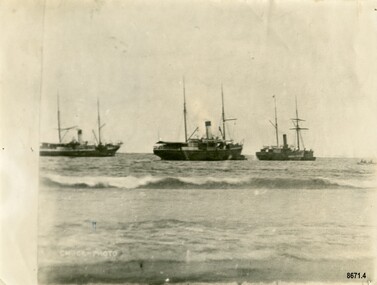
... Howard Smith and Sons (1901) for use in Queensland coastal trades and then it was bought by George Turnbull in 1903 and used for local mail contract in Western Australia. The Julia Percy was sold to the Melbourne Steamship Company Ltd. (1906) and re-named the “Leeuwin” but continued in her Western Australian coastal run. It was converted into a coal hulk in Melbourne in 1910 as a result of damaged caused when it was driven against the jetty at Dongara during a gale. The ship was eventually dismantled and scuttled off Port...Howard Smith and Sons (1901) for use in Queensland coastal trades and then it was bought by George Turnbull in 1903 and used for local mail contract in Western Australia. The Julia Percy was sold to the Melbourne Steamship Company Ltd. (1906) and re-named the “Leeuwin” but continued in her Western Australian coastal run. It was converted into a coal hulk in Melbourne in 1910 as a result of damaged caused when it was driven against the jetty at Dongara during a gale. The ship was eventually dismantled and scuttled off Port ...This photograph was one of ten photographs donated to Flagstaff Hill Maritime Museum and Village by Fred Trewartha. Frederick John Fox Trewartha (Fred) was a well-known Warrnambool businessman. He was born in Beeac near Geelong in 1920 and came to Warrnambool with his family as a very young child. He was apprenticed to his father John, as a saddler and later opened his own shop on Raglan Parade. He then moved into working with tarpaulins and canvases for the trucking industry. Fred was keenly interested in photography (and was a member of the Warrnambool Cine Club), yachting and boat building. He kept his yacht moored at Port Fairy for many years and participated in sailing events locally and interstate. He also built boats with his sons. He had the opportunity to meet many older sailors and it's thought this photo (and others in the set) may have been given to him by one of these men. Fred Trewartha died in 2016 in Warrnambool. Shipping was the cheapest and most practical means of carrying produce and goods during the period 1840-1890. Regular domestic steamer services commenced in the Warrnambool district in the late 1850’s and by 1870 the passenger trade was booming. Four coastal traders made regular stops at Warrnambool in the 1880's - S. S. Julia Percy, S. S. Dawn, S. S. Nelson and S. S. Casino. The S.S. Julia Percy (later named Leeuwin) was an iron passenger-cargo steam ship built in 1876. At one point in time the Julia Percy would sail from Warrnambool to Melbourne every Friday and return from Melbourne to Warrnambool every Tuesday. The cost of a return ticket for a Saloon Fare was £1.0.0. The Julia Percy was built in Glasgow by Thomas Wingate & Company, Whiteinch, in 1876 for the Warrnambool Steam Packet Company, which commissioned it for trade in Victoria’s western district. It was first registered in Warrnambool, Victoria in 1876. Two steamships, the Julia Percy and the Nelson, collided on 25th December 1881. The Julia Percy was at that time owned by its first owners, the Warrnambool Steam Packet Company, and she sailed under the command of Captain Chapman. It had left Melbourne the evening of 24th December, with about 150 passengers, sailing in fine weather through Port Phillip Heads around 9pm. It was headed for Warrnambool, Belfast (now named Port Fairy) and Portland. The Julia Percy was off Apollo Bay when Captain Chapman was woken by the ship’s whistle after midnight, the steamer Nelson being on a collision course with the Julia Percy. The Nelson struck Julia Percy midship. Boats were lowered from the ship (apart from a damaged lifeboat) and about 30-40 of the passengers boarded the Nelson. The engine room and the forehold were checked and found clear of water. The company manager, Mr. Evans, had been on the Nelson, so he boarded and inspected the Julia Percy and the decision was made to continue on to Warrnambool with the passengers as there appeared to be no immediate danger. However, Captain Thomas Smith said the Nelson was taking on water, so Julia Percy followed it for about an hour towards Melbourne on standby in case of need. Then Julia Percy turned around towards Warrnambool again. Shortly afterwards the Nelson turned to follow her, the ships stopped and passengers were returned to Julia Percy, and three from Julia Percy boarded the Nelson. Both ships proceeded on their way. Julia Percy passed Cape Otway light afterwards, signaling that there had been a collision. It was discovered later that one of the passengers was missing, then thought to have boarded the Nelson but later thought to have fallen into the sea and drowned while trying to jump from Julia Percy to Nelson. There had been 3 tickets purchased under the same name of that passenger “Cutler”; a father, son and friend named Wordsworth, which had caused quite some confusion. No further mishap occurred to either ship and both the Julia Percy and the Nelson reached their destinations safely. An enquiry was instigated by the Victoria Steam Navigation Board regarding the cause of the accident between the two steamships, in connection with the death of Cutler who was supposed to have lost his life by the collision. The enquiry resulted in Captain Thomas Smith having his master's certificate suspended for six months. The Julia Percy changed hands several times. Its next owner was the Western Steam Navigation Co (1887), managed by Mr. T.H. Osborne (the company’s office was on the corner of Timor and Liebig Streets - its north-western wall is now part of the current Warrnambool Regional Art Gallery.) The Melbourne Steamship Co became the next owners (1890), followed by William Howard Smith and Sons (1901) for use in Queensland coastal trades and then it was bought by George Turnbull in 1903 and used for local mail contract in Western Australia. The Julia Percy was sold to the Melbourne Steamship Company Ltd. (1906) and re-named the “Leeuwin” but continued in her Western Australian coastal run. It was converted into a coal hulk in Melbourne in 1910 as a result of damaged caused when it was driven against the jetty at Dongara during a gale. The ship was eventually dismantled and scuttled off Port Phillip Heads on 28 December 1934. The steamship "Dawn" was a 522-ton coastal trader built in 1876 and the vessel operated around the Victorian west coast from 1877 until 1898 for the Portland & Belfast Steam Navigation Co. sailing between Melbourne and Portland, via Warrnambool. The vessel was then owned in October 1885 by the renamed company, Belfast & Koroit Steam Navigation Co., until March 1896 when its ownership moved to W Howard Smith & Sons Ltd. This Melbourne company used the ship to service most ports around Australia. Captain F. Chapman took over from Captain Jones and served on the SS Dawn from 1898 until 1900 when he took command of the SS Casino. On September 4th 1880, the three masted clipper ship, "Eric the Red" struck Otway Reef, near Cape Otway. The S. S. Dawn, under the command of Captain Jones, was returning to Warrnambool from Melbourne, its sailing time different to its usual schedule. The provedore of the Dawn, Benjamin Lear, heard cries of distress coming through the portholes of the saloon. He gave the alarm and the engines were stopped. Cries could be heard clearly, coming from the land. Captain Jones sent out crew in two boats, and fired off rockets and blue lights to illuminate the area. They picked up the three survivors who were in the long boat from "Eric the Red". Two men were picked up out of the water, one being the owner’s son who was clinging to floating kerosene boxes. At daylight the Dawn then rescued the 18 men from the floating portion of the deckhouse, which had drifted about 4 miles from where they’d struck the reef. Shortly after the rescue the deckhouse drifted onto breakers and was thrown onto rocks at Point Franklin, about 2 miles east of Cape Otway. Captain Jones had signalled to Cape Otway lighthouse the number of the Eric the Red and later signalled that there was a wreck at Otway Reef but there was no response from the lighthouse. The captain and crew of the Dawn spent several more hours searching unsuccessfully for more survivors, even going back as far as Apollo Bay. On board the Dawn the exhausted men received care and attention to their needs and wants, including much needed clothing. Four men (three crew and one passenger) died. A week after the shipwreck, the Australian Government had also conveyed its thanks to the Captain and crew of the S.S. Dawn - “Captain Griffith Jones, S.S. Dawn, The Hon. Mr Clark desires that the thanks of the Government should be conveyed to you for the prompt, persevering and seamanlike qualities displayed by you, your officers and crew in saving the number of lives you did on the occasion referred to. The Hon. The Commissioner has also been pleased to award you a souvenir in commemoration of the occasion, and a sum of 65 pounds to be awarded to your officers and crew according to annexed scale. I am, &c, W Collins Rees, for and in the absence of the Chief Harbour Master.” The Awards are as follows: - Crew of DAWN'S lifeboat-Chief Officer, Mr G. Peat, 15 pounds; boat's crew-G. Sterge, A.B., 5 pounds; T. Hammond, A.B., 5 pounds; J. Black, A.B., 5 pounds; H. Edwards, A.B., 5 pounds. Dinghy's Crew-Second Officer, Mr Christie, 10 pounds; boat's crew -F. Lafer, A.B., 5 pounds; W. Johnstone, A.B., 5 pounds; Mr Lear, provedore, 5 pounds; Mr Dove, purser, 5 pounds. Captain Jones receives a piece of plate. (from “Wreck of the ship Eric the Red” by Jack Loney). Medals of Bravery were awarded to the Captain and crew of the S.S. Dawn by the President of the United States, through the Consul-general (Mr Oliver M. Spencer), in July 1881 “ … in recognition of their humane efforts in rescuing the 23 survivors of the American built wooden sailing ship, the Eric the Red, on 4th September 1880.” The men were also presented with substantial monetary rewards and gifts. The city of Warrnambool’s care of the survivors was also mentioned by the President at the presentation, saying that “the city hosted and supported the crew ‘most graciously’. The Medal of Bravery awarded to Nelson Johnson is in the collection at Flagstaff Hill Maritime Museum and Village in Warrnambool. Prior to 1882, and the arrival of the S. S. Casino, the "Dawn" was the only steamer to be able to navigate up the Moyne River at Port Fairy and unload at the wharf. The other regular steamers had to anchor in the bay instead. In February 1891 (as reported in The Age newspaper) the "Dawn" became the first vessel to berth alongside the newly completed Warrnambool Breakwater. The occasion was celebrated with a number of prominent townspeople assembling on board to "participate of a glass of wine". In 1895 the owners of the S.S. Dawn, the Portland and Belfast Steam Navigation Co., wound up and sold out to the Belfast Company who took over the Dawn for one year before selling it to Howard Smith. It took over the Melbourne to Warrnambool run in 1906 when the S. S. Flinders was sold. The S. S. Dawn was condemned and sunk in Suva in 1928. The State Library of Victoria has a lithograph in its collection depicting the steamer Dawn and the shipwrecked men, titled. "Wreck of the ship Eric the Red, Cape Otway: rescue of the crew by the Dawn". The third ship depicted in the photograph was thought to be the S. S. Coorong but there was a question mark next to its name. The photograph was thought to have been taken in 1885 and it's possible the S.S. Coorong was working in Clarence River, N. S. W. by this time. The steamer "Coorong" was built in 1862 by J. G. Lawrie of Glasgow. It was an "iron screw" steamer of 304 tons. It had many owners including Joseph Darwent of Adelaide (1863 - 1871), McMeckan Blackwood and Company, Melbourne (1871 - 1877), Mount Gambier Steamship Company Ltd. (1877 - 1881). William Whineham, Port Adelaide (1882), John See and Company, Sydney (1884 - 1892) and the North Coast Steam Navigation Company Ltd, Sydney (1892 - 1910). In 1911 it was hulked in Sydney Harbour and in 1921 it was being used as a coal hulk at Sydney. It had been originally imported into South Australia for the Port Augusta trade (primarily transporting goods needed by the early settlers) however the owners recognized that it had too much space for that purpose, so it was moved to work on the Adelaide to Melbourne line. Its passenger accommodation was enlarged and it enjoyed a "first class reputation" and by 1874 had made 313 voyages between Melbourne and Adelaide. Its captains included Captain McLean, Captain Ashton and Captain Dowell. In 1867, when 25 miles west of Cape Otway, while travelling from Adelaide to Melbourne, it came across the crew of the schooner "Black Watch" who had abandoned ship after it began quickly taking on water. The crew (six men) were able to get away in a small boat with a compass, chart and few candles. They were "excessively cold from exposure to the weather" when the S. S. Coorong picked them up. In 1877 the Coorong ran aground when entering the Outer Harbour at Adelaide (but was not damaged) and in 1882 it was stranded (for a short time) near Curdies Inlet (Victoria) with some slight damage to its bottom plates. Note - A ship with the same name "Coorong" (a coal carrying barque) was often on the Newcastle / Wollongong to Adelaide route also stopped several times in Warrnambool in the mid 1880's. The photograph has the label "Chuck Photos" printed on the front. Thomas Foster Chuck (born 1826 in London) was a photographer and entrepreneur who arrived in Victoria in 1861. The following year he produced and toured a "Grand Moving Diarama" of dramatic painted scenes from the Burke and Wills expedition. By 1866 he had established a photography studio in Daylesford and later he returned to Melbourne where he opened a studio in the Royal Arcade. In 1874 a collection of Chuck's photographs won a gold medal at the Annual International Exhibition in London. Throughout the 1870's he took over 700 individual photographs of prominent citizens for his historical photographic montage titled "Historical Pictures of the Explorers and Early Colonists of Victoria" which is now in the collection of the National Library of Australia. By 1888 he had sold his Melbourne studio and had established a studio in Ballarat (with his son Thomas Henry Chuck). In 1886 they produced an album titled "Warrnambool and District 1886, Western Hotel - J. Fox proprietor" containing over sixty large photographs of local coastal scenes and seascapes, for the use of patrons of the Western Hotel. This photo (of the three steamers in Lady Bay) was taken at this time and is in the album. Thomas Chuck died on December 7th, 1898, in Albert Park, Melbourne and his son Thomas Henry continued to operate the photography studio in Ballarat into the 1920's.This photograph is a significant record of several of the well-known coastal traders (S. S. Julia Percy, S. S. Dawn and possibly S. S. Coorong) that sailed along the southwest coast of Victoria for many years - transporting goods and passengers between Melbourne and Warrnambool in the 1880's. They are also significant in the role they played in the history of Warrnambool and the other coastal ports they visited as well as being examples of the dangers and hazards associated with navigating the waters along the southern coast of Australia. It is also a good example of a photograph taken by a well-known and significant photographer of that era.Black and white photograph of three steam ships anchored in Lady Bay, Warrnambool. They each have a funnel and two masts and are side on to the beach. A small rowboat with a crew can be seen on the far right. The words "CHUCK-PHOTO" are on the bottom left of the photograph. On the back of the photograph is the name and telephone number of the donor (handwritten in black ball point pen) and the names of the three steamships and date written in uppercase letters in dark blue ink. There is a four-figure number stamped in the centre of the back.Front - "CHUCK-PHOTO" Back - Name of donor and telephone number "6944" "JULIA PERCY, DAWN & KOORONG(?) IN LADY BAY 1885"flagstaff hill maritime museum and village, warrnambool, great ocean road, fred trewartha, s. s. julia percy, s. s. dawn, s. s. nelson, s. s. casino, leeuwin, steamer, steamship, coastal trader, warrnambool steam packet company, captain chapman, victorian steam navigation board, western steam navigation company, melbourne steamship company, william howard smith and sons, portland and belfast steam navigation company, w howard smith and sons ltd, eric the red, captain jones, medal of bravery, rescue, moyne river, warrnambool breakwater, lady bay, s. s. coorong, mount gambier steamship company, black watch, thomas foster chuck, chuck photos, chuck photography -
 Flagstaff Hill Maritime Museum and Village
Photograph - Photograph of S. S. Eumeralla launch, 1908
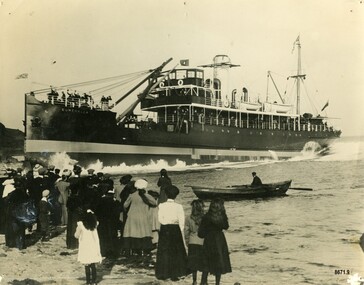
... Port Fairy...Eumeralla...S. S. Eumeralla...Eumerella...Steamer Eumeralla...John McIlwraith and Company...Belfast and Koroit Steam Navigation Company...Howard...Port Fairy Eumeralla S. S. Eumeralla Eumerella Steamer Eumeralla John McIlwraith and Company Belfast and Koroit Steam Navigation Company Howard Smith Ltd Portarlington Geelong Melbourne Mel Lee No. 2 Mow Lee No. 2 Tanghai steamship steamer Fred Trewartha Frederick John Fox Trewartha Name of donor, address and telephone number "S. ...This photograph was one of ten photographs donated to Flagstaff Hill Maritime Museum and Village by Fred Trewartha. Frederick John Fox Trewartha (Fred) was a well-known Warrnambool businessman. He was born in Beeac near Geelong in 1920 and came to Warrnambool with his family as a very young child. He was apprenticed to his father John, as a saddler and later opened his own shop on Raglan Parade. He then moved into working with tarpaulins and canvases for the trucking industry. Fred was keenly interested in photography (and was a member of the Warrnambool Cine Club), yachting and boat building. He kept his yacht moored at Port Fairy for many years and participated in sailing events locally and interstate. He also built boats with his sons. He had the opportunity to meet many older sailors and it's thought this photo (and others in the set) may have been given to him by one of these men. Fred Trewartha died in 2016 in Warrnambool. The Eumeralla (sometimes spelt Eumerella) was built in 1908 in Scotland by Messrs. Scott of Kinghorn on the Firth of Forth. It was a steel screw steamer and had been designed to meet the growing demand for a thoroughly up to date passenger and cargo steamer for the Melbourne to Portland service for John McIlwraith and Company in partnership with the Belfast, Koroit Steam Navigation Company and Howard Smith Company Ltd. This photograph appeared in the Leader (Melbourne) on Saturday 28th November 1908 with the headline "Launching the Eumeralla" and shows the ship being launched on October 10th, 1908, in Scotland. It was described as "Length, 190 feet; breadth, 30 feet; depth 15 feet". It went on to say it had a speed guaranteed at 11 knots and was expected in Melbourne by the following January. It could accommodate sixty saloon passengers and thirty in steerage and had electric light fitted throughout. While on the Melbourne to Portland service the Eumeralla had several mishaps. In 1909 it crashed into the breakwater at Portarlington, splintering the woodwork and leaving a gap of about 12 feet. On Saturday 9th August 1913, as it was leaving Warrnambool, it encountered heavy seas and a passenger (Frederick Mahoney) sustained fatal injuries after hitting his head on the bulwark - and the second mate was found dead after the water poured off the deck. Several other passengers were also injured. Between 1912 and 1913 it was used to carry passengers between Brisbane, Maryborough and Rockhampton before being sent back to Melbourne for an overhaul. In 1915 it was selected for the Winter service to run daily trips between Melbourne and Geelong. In 1925 it nearly sank in the Yarra (at Queens Wharf) when it developed a list and water entered the engine room. Firemen from the Eastern Hill Station, crew and wharf workers were able to stop it from sinking. Between 1928 and 1935 the Eumeralla was laid up in Hobson's Bay before being sold to a Chinese firm to be used on the short coastal run between Shanghai and Wen Chow. It was renamed "Mel Lee (Mow Lee) Number 2". It arrived on July 12th, 1935, at Tanghai (a small Chinese port to the south of Shanghai) with 400 local passengers. The population of the town turned out to welcome the new ship with a fireworks display which caused the passengers to rush across to the side of the ship nearest the scene. The steamer immediately listed to one side and sank.This photograph is significant because of its association with the coastal trader S.S. Eumeralla and its important contribution to trade along Victoria's West Coast in the early 20th century.Black and white photograph showing a crowd of people standing on a shore watching a steamer (the Eumeralla) being launched. The crew of the steamer are standing in the bow, waving at the crowd. A single oarsman is in a small rowboat nearby. On the back of the photograph, the name, address and telephone number of the donor is written in black, ballpoint pen. More writing, in cursive script (in blue ink) gives a brief description of the ship and the events depicted in the photograph.Name of donor, address and telephone number "S. S. Eumeralla / Built in Scotland / being launched/ in Scotland/ 1904"warrnambool, flagstaff hill maritime museum and village, great ocean road, portland, port fairy, eumeralla, s. s. eumeralla, eumerella, steamer eumeralla, john mcilwraith and company, belfast and koroit steam navigation company, howard smith ltd, portarlington, geelong, melbourne, mel lee no. 2, mow lee no. 2, tanghai, steamship, steamer, fred trewartha, frederick john fox trewartha -
 Flagstaff Hill Maritime Museum and Village
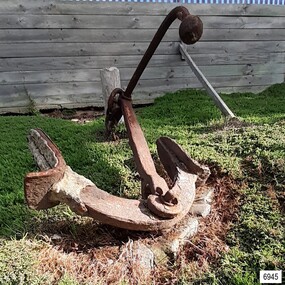
Equipment - Anchor, John Trotman, 1852 to early 1900s
... port, including the various plans for the construction of the Breakwater. Flagstaff Hill Warrnambool Maritime Village Maritime Museum Shipwreck coast Great Ocean Road anchor mooring Trotman Lady Bay Breakwater Admiralty ship equipment stock anchor John Trotman 1852 patent 2001 Birdon Dredging Steve Walker Howard Nichol Peter Ronald British Admiralty Lieutenant Stanley Committee of 1852 on Anchors Anchor: an iron Trotman’s pattern style with a rectangular-section shank that is wider in the middle and has a base that extends on two opposite sides in a ‘fork prong’ manner. ...This Trotman’s pattern stock anchor is the southernmost anchor displayed in Flagstaff Hill’s Anchor Graveyard. Patented by John Trotman in 1852, this robust design was used on merchant ships and became known for its practical efficiency. Around midday on 15 April 2001, in Lady Bay, Warrnambool, Birdon Dredging crews raised this anchor from the seabed. Company spokesperson Steve Walker explained that the team was hired to dredge the harbour and discovered the anchor, still attached to its long chain, when the chain became tangled in the cutter blade of their dredging equipment. Once the anchor had been lifted onto the Breakwater, a front-end loader moved it onto a truck for delivery to Flagstaff Hill Maritime Museum and Village. Howard Nichol, the Museum Manager at the time, estimated that the anchor could be up to 130 years old. Former Museum Manager and diver Peter Ronald later identified it as a Trotman’s type, like those used on several major wrecks in the region. According to Nichol, museum staff believed this anchor may have been one of a pair used to secure a mooring designed to catch drifting vessels and prevent ships from washing onto the sandbar or drifting out to sea in rough weather. This mooring line appears as a dotted line on a 1890 chart of Lady Bay approved by Lieutenant Stanley of the British Admiralty. The anchor’s location matches a point marked on that chart, and the length of its chain supports the theory. Nichol noted that the chart is a detailed survey of the bay, showing two anchors with buoys at either end, with about one hundred yards of chain stretched between them. Before the building of the Breakwater, the bay was especially treacherous, so ships would anchor there and use the chain as a safeguard. About Trotman’s Anchors In the mid-19th century, the Admiralty sought an anchor design with greater holding power. To assess the strengths of the leading designs, it appointed the Committee of 1852 on Anchors. Among the anchors reviewed, the Trotman’s pattern anchor received the highest rating. The Trotman’s anchor resembles the Admiralty pattern but includes pivoting arms that move as the anchor settles. As it takes hold, the upper fluke folds back against the shank, allowing the anchor to sit lower and reducing the risk of the chain, cable, or rope becoming tangled. A fitting at the top of the shank also allows the chain to be quickly released if necessary. This Trotman’s anchor is significant as a part of the maritime history of the Port of Warrnambool regardless of whether it belonged to one of the 29 ships that were stranded or wrecked in Lady Bay. The anchor is connected to the many attempts to maintain Warrnambool as a safe and manageable port, including the various plans for the construction of the Breakwater.Anchor: an iron Trotman’s pattern style with a rectangular-section shank that is wider in the middle and has a base that extends on two opposite sides in a ‘fork prong’ manner. A crescent-shaped, double-ended arm is fitted into the base of the shank with a bolt, enabling it to pivot. Each arm has a fluke in the shape of an upward palm with an attached metal plate that forms a horn at the back of the palm. A long, round-section pipe is fitted to the top of the shank at 90 degrees to the arms; one side has an elbow bend parallel to the arms, and both ends have an attached metal sphere. The pivoting ring at the top of the shank can be lifted for a quick release of the chain.flagstaff hill, warrnambool, maritime village, maritime museum, shipwreck coast, great ocean road, anchor, mooring, trotman, lady bay, breakwater, admiralty, ship equipment, stock anchor, john trotman, 1852 patent, 2001, birdon dredging, steve walker, howard nichol, peter ronald, british admiralty, lieutenant stanley, committee of 1852 on anchors -
 Flagstaff Hill Maritime Museum and Village
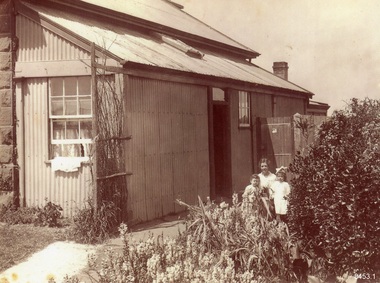
Photograph - Historical, building, Lighthouse Keeper's Quarters Warrnambool, Ca. 1917
... Port of Warrnambool...Planning Board...1917...Howard...Howard Nicholl, the Director of Flagstaff Hill at that time. The following information was gleaned from the contents of the letter and the labels attached to the photograph:- The photograph of the Cottage was taken in about 1917. The woman is Gertrude Shade, married to James Shade, who was the Warrnambool Town Council's Officer responsible for keeping records of Shipping activity entering and leaving the busy Port of Warrnambool. ...Flagstaff Hill Warrnambool Maritime Museum Shipwreck coast Great Ocean Road Lighthouse Keeper's quarters Lighthouse Keeper's Cottage Gertrude Shade James Shade Janet Shade John Stewart Lindsay Stewart Lindsay Nestle Warrnambool exports Port of Warrnambool Planning Board 1917 Howard Nicholl William Shade export to Indonesia Janet Lindsay light keeper Typed label "Gertrude Shade with William and Janet. ...This photograph of the Warrnambool Lighthouse Keeper's Quarters was donated together with an accompanying letter written by John Lindsay on October 21st, 1997. The letter was addressed to Howard Nicholl, the Director of Flagstaff Hill at that time. The following information was gleaned from the contents of the letter and the labels attached to the photograph:- The photograph of the Cottage was taken in about 1917. The woman is Gertrude Shade, married to James Shade, who was the Warrnambool Town Council's Officer responsible for keeping records of Shipping activity entering and leaving the busy Port of Warrnambool. The couple and their children, Janet and William, were residents of the Assistant Lighthouse Keeper's Quarters at that time. The family is pictured in the garden on the west side of the building. A washhouse, these days referred to as a laundry, is behind the building and had already been removed when the Flagstaff Hill Planning Board had access to the site in 1972. The corrugated iron veranda was replaced in the 1980s with a smaller covered entry. Janet Shade married the man who lived across the road, Stewart Lindsay, in 1935. Stewart was employed by Nestle at the age of sixteen, working in the export department. He was acting Manager when the Manager became ill, supervising the loading of dairy products and biscuits into the holds of the waiting ships, where they were then exported to Indonesia. Many of the ships were registered in Liberia and the seamen were called 'lascar seamen, or Indian Sailors. Janet and Stewart had a son, John Stewart Lindsay, who was a Pharmacist, a member of the Warrnambool City Council, the Mayor of the City of Warrnambool, a former Director of Flagstaff Hill, and Chairman of the Flagstaff Hill Advisory Committee.This photograph has significance as a historical record of the Warrnambool Lighthouse Kerr'er's Quarters in 1917. The photograph connects the cottage to local families, to local industry, to the Port of Warrnambool, and to overseas exports from Warrnambool. Photograph from c. 1917 depicts the western side of the Warrnambool's Lighthouse keeper's Quarters constructed in bluestone, which was where the Assistant Lighthouse Keeper resided. The image shows the corrugated iron lean-to, and other rooms that were added to the original building after 1872, which were removed in the 1970s due to their poor condition. The members of the family pictured were residents at the time; Gertrude Shade (Mrs James Shade), her daughter Janet and her son William. Inscriptions are on the reverse and the accompanying envelope. Typed label "Gertrude Shade with William and Janet. Lighthouse Keeper's Cottage, Flagstaff Hill, Merri St Warrnambool" Stamp "John Stewart Lindsay, Pharmacist, --0 Thompson Street Warrnambool 3280" "HOWARD NICHOLL / FLAGSTAFF HILL / MERRI STREET" " KEEP OUT OF REACH OF CHILDREN / Lindsay's Pharmacy / 119 Liebig Street, Warrnambool / Tel. 5561 4310" [round symbol of mortar and pestle] Typed letter (from John Lindsay to Howard Nicholl, October 21 1997)flagstaff hill, warrnambool, maritime museum, shipwreck coast, great ocean road, lighthouse keeper's quarters, lighthouse keeper's cottage, gertrude shade, james shade, janet shade, john stewart lindsay, stewart lindsay, nestle, warrnambool exports, port of warrnambool, planning board, 1917, howard nicholl, william shade, export to indonesia, janet lindsay, light keeper -
Glenelg Shire Council Cultural Collection
Souvenir - Souvenir Wooden Bowl, c. 1958
... Edina arrived in Melbourne under sail in March 1863 and was purchased by Stephen Henty for use from ports in western Victoria and later carried gold prospectors across the Tasman to New Zealand. After a refit in 1870 she was used in the coastal trade along the Queensland coast for Howard Smith until returning to Victoria and the Melbourne-Geelong trade as a cargo-passenger vessel. ...Edina arrived in Melbourne under sail in March 1863 and was purchased by Stephen Henty for use from ports in western Victoria and later carried gold prospectors across the Tasman to New Zealand. After a refit in 1870 she was used in the coastal trade along the Queensland coast for Howard Smith until returning to Victoria and the Melbourne-Geelong trade as a cargo-passenger vessel. ...The Edina was one of the longest serving steam vessels anywhere in the world. Built on the Clyde by Barclay, Curle & Co. she was an iron hull single screw steamer of 322 tons with three masts. In 1855 Edina was requisitioned by the Admiralty from her owners the Leith, Hull & Hamburg Steam Packet Co. to carry stores and horses to the Black Sea during the Crimean War. After return to her owners Edina traded around the UK and Mediterranean before being purchased and used as a blockade runner during the American Civil War carrying cotton from the Confederate states in 1861. Edina arrived in Melbourne under sail in March 1863 and was purchased by Stephen Henty for use from ports in western Victoria and later carried gold prospectors across the Tasman to New Zealand. After a refit in 1870 she was used in the coastal trade along the Queensland coast for Howard Smith until returning to Victoria and the Melbourne-Geelong trade as a cargo-passenger vessel. She was taken out of service in 1938 but was later renamed Dinah and used as a lighter until 1958 when she was broken up and her remains used as land-fill.Small round shallow wooden bowl, 9 cm diameter with small brass plate attached wit two small brass tacks to the inner rim. Inscription 'MADE FROM THE WOOD OF S.S. EDINA''MADE FROM THE WOOD OF S.S. EDINA'souvenir, ss edina, shipwreck -
Glenelg Shire Council Cultural Collection
Photograph - Photograph - tug, Portland, n.d
... Port of Portland Authority Archives Port of Portland Archives tug tug crew marine maritime harbour Back: Howard Simmonds, Ken Johnston - blue biro - Black stamp (Feb '82 ' 62 (? ...Port of Portland Authority ArchivesBack: Howard Simmonds, Ken Johnston - blue biro - Black stamp (Feb '82 ' 62 (?92)port of portland archives, tug, tug crew, marine, maritime, harbour -
 Mission to Seafarers Victoria
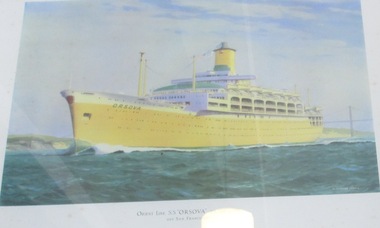
Print - Print, framed, William Howard Jarvis (1903-1964), Orient Line S.S. Orsova off San Francisco, 1954-1966
... port phillip bay...artwork-paintings...w. howard...Crew of the Orsova are recorded as regularly visiting the Mission to Seamen. s.s. orsova passengers ships steamship emigration greece italy australia passenger liner melbourne port phillip bay artwork-paintings w. howard jarvis orient line p and o peninsular and oriental steam navigation company ocean liner passengers liners passenger ships Printed inscription on border of print at lower centre edge: "Orient Line S.S. ...British painter Howard Jarvis was best known for his maritime landscape paintings. An early member of the Society of Marine Artists (UK), formed in 1939, he went to sea on merchant ships and served in the Royal Navy during World War II. His works were influenced by marine artist Kenneth Shoesmith. Jarvis was commissioned by the Cunard-White Star Cruises to create a stone litho poster, which was quite well known, giving passengers a birds-eye view of a cruise ship.SS Orsova, built in 1954, was a British ocean liner for the Orient Steam Navigation Company until 1960, then P&O Orient Lines between 1960-1966, although the Orient ships retained their corn-coloured hulls and sailed under their own house flag. The colour of the hull on the print indicates it was made between 1954 and 1966. On 24 May 1956, Orsova ran aground off Port Phillip Bay, Melbourne, for twelve hours. In 1966 P&O acquired the balance of the Orient Line shares and all their ships were painted white. In the 1960s, Orsova carried many thousands of emigrants from Greece and Italy to Australia. It was staffed by approximately 600 crew and carried over a 1000 passengers. Maritime Art, Marine artColour printed reproduction of a painting or lithograph print featuring 20th C passenger liner, hull and superstructure primarily painted pale yellow, under steam at sea. Print is mounted glazed with thin gilded and moulded frame.Printed inscription on border of print at lower centre edge: "Orient Line S.S. Orsova / Off San Francisco"s.s. orsova, passengers ships, steamship, emigration, greece, italy, australia, passenger liner, melbourne, port phillip bay, artwork-paintings, w. howard jarvis, orient line, p and o, peninsular and oriental steam navigation company, ocean liner, passengers liners, passenger ships -
 Mission to Seafarers Victoria
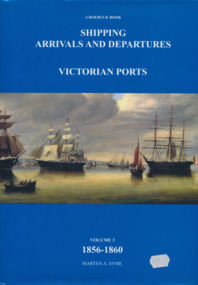
Book, Marten Syme, Shipping Arrivals and Departures, Victorian Ports Volume 3 1856-1860, 1984
... Howard Timbury and also signature from H. Timbury Golden sticker from J. Donne & Son Shipping Arrivals and Departures, Victorian Ports Volume 3 1856-1860 Book Marten Syme Roebuck Book ..."This book is dedicated to the seamen who supplied the physical link for trade and immigration in the development of the Colony".non-fiction"This book is dedicated to the seamen who supplied the physical link for trade and immigration in the development of the Colony".howard timbury, interest group, navigation, genealogy, family history, ship registers -
 Mission to Seafarers Victoria
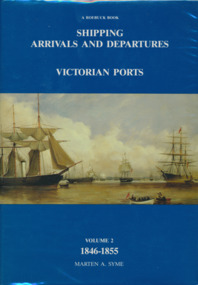
Book, Marten Syme, Shipping Arrivals and Departures, Victorian Ports Volume 2 1846-1855, 1984
... Howard Timbury and also signature from H. Timbury Golden sticker from J. Donne & Son Shipping Arrivals and Departures, Victorian Ports Volume 2 1846-1855 Book Marten Syme Roebuck Book ..."This book is dedicated to the seamen who supplied the physical link for trade and immigration in the development of the Colony".non-fiction"This book is dedicated to the seamen who supplied the physical link for trade and immigration in the development of the Colony". howard timbury, first fleet fellowship victoria, interest group, ship registers, genealogy, family history -
 Seaworks Maritime Museum
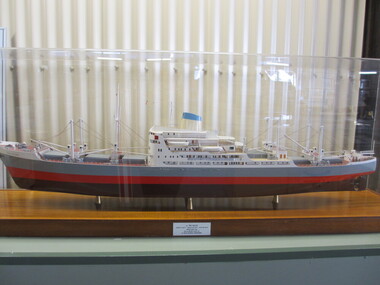
Shipbuilders model, Tri Ellis
... Port of Aden (Yemen) and Freemantle. The first load of phosphate was unloaded at Corio Bay (geelong) Formerly part of the collection of Melbourne shipping company, Howard Smith Ltd. plaque at foot of model "MV TRI ELLIS/ LENGTH B.P. 486'-3"- BREADTH MLD 68'0" - DEPTH MLD 40'6"/ TONNAGE GROSS 11,760/ Built by HARLAND & WOLFF LTD/ For BRITISH PHOSPHATE COMMISSIONERS" On model "TRI-ELLIS" painted black Ship builder's model of the cargo ship Tri-Ellis IMO 5368196 - Body of moulded polyurethane painted in red, black and grey, the deck painted in red, with detailed fittings, machinery, rigging and superstructure, raised on a wooden base. ...Model ship was presented to the Melbourne Maritime Museum by the British Phosphate Commissioners. Built as Tri-Ellis (1958-74), Tryphena (1974-78), Man Tat (1978-80), 1980 broken up. DWT 13,756 SPEED 14 KNOTS.AT 112RPM. BOILERS LARKSON TRIMBLETUBE. FUEL CONSUMPTION 7 TPD. GENERATORS W.H.ALLEN - 4CYL.2SA290/470. 480B.H.P.320L.W.-220V 333RPM DAILY CONS - 1.5 TONS. EMERGENCY GEN R & H. 40 K.N. -220V. REFRIGERATING MACH: J & G HALL LTD. SUPERSTRUCTURE: FORECASTLE 62'..2 DECKS RIVETED AND WELDED. CARGO BATTONS NOT FITTED. 9 BULKHEADS. RISE OF FLOOR 6".WATER BALLAST 3,296 TONS INCLUDING TUNNEL TANKS 1,341 TONS. 'TWEEN- DECKS FORWARD 274 TONS. REFRIGERATED CARGO INSTALLATION - 6 HOLDS - 55.2',52',54',59.5',43' ,53'. GRAIN CAPACITY :621,640 CU. FT. BALE CAPACITY : 573,810 CU. FT. INSULATED CAPACITY : 5,050 CU.FT. 6 STEEL HATCHWAYS (27',30',30'* 30') (30'* 27.75') (27', 24' * 28' ). 12 WINCHES...DERRICKS 1 (25), 2 (10), 10 (5). MACHINERY: OIL 2SA 7CY.C20 * 1400MM EXHAUST 470MM. 6500 BHP. FUEL BUNKERS: 2135 TONS HIGH VISCOCITY FUEL. The main engine was an opposed piston type Harland & Wolff 6-620/ 1870 6 for the number of cylinders.. 620 for the cylinder bore and 1870 for the combined strokes of the main exhaust pistons in each cylinder. This engine was based no a Burmeister and Wain design but H & W gave these engines their own type designation. Sailed on board its maiden voyage to Australia via Casablanca Morocco where she collected her first load of phosphate. We sailed to Geelong via the Suez canal and the Port of Aden (Yemen) and Freemantle. The first load of phosphate was unloaded at Corio Bay (geelong) Formerly part of the collection of Melbourne shipping company, Howard Smith Ltd. Ship builder's model of the cargo ship Tri-Ellis IMO 5368196 - Body of moulded polyurethane painted in red, black and grey, the deck painted in red, with detailed fittings, machinery, rigging and superstructure, raised on a wooden base. Original ship built Clyde 1958, 11,761 gross tonnes, 531.5' x 68' x 31' (162.0 x 20.73 x 9.45m)plaque at foot of model "MV TRI ELLIS/ LENGTH B.P. 486'-3"- BREADTH MLD 68'0" - DEPTH MLD 40'6"/ TONNAGE GROSS 11,760/ Built by HARLAND & WOLFF LTD/ For BRITISH PHOSPHATE COMMISSIONERS" On model "TRI-ELLIS" painted black -
 Queenscliffe Maritime Museum
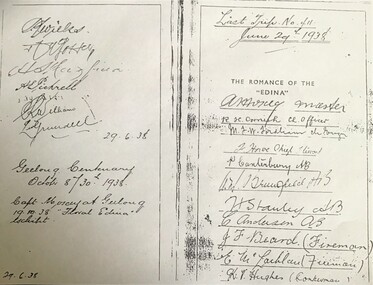
Document - copy of extract
... Edina arrived in Melbourne under sail in March 1863 and was purchased by Stephen Henty for use from ports in western Victoria and later carried gold prospectors across the Tasman to New Zealand. After a refit in 1870 she was used in the coastal trade along the Queensland coast for Howard Smith until returning to Victoria and the Melbourne-Geelong trade as a cargo-passenger vessel. ...Title: The romance of the "Edina" : the world's oldest screw-steamship : with chapters on the auxiliary steamship :Great Britain", and the Port Phillip Bay steamers past and present / by C. Dickson Gregory Author: Gregory, C. Dickson (Charles Dickson) Publication Information: Melbourne : Robertson & Mullens, 1935 Physical Description: xii, 84 p., [24] p. of plates : ill. ; 23 cm Series Link: Queenscliffe Maritime Museum General Note: Item no. Corporate Subject: Edina (Ship) Great Britain (Ship) Subject Term: Shipping -- Victoria Geographic Term: Port Phillip Bay Region (Vic.) -- History Format: Books Holds: 0 Copies: 2This iron hull single screw steamer had a long and distinguished carrier operating between 1853 and 1938. She served in the Crimean war carrying stores and horses to the Black Sea and later trading in the Mediterranean, and carrying cotton for the Confederate States in the American Civil War. Edina arrived in Melbourne under sail in March 1863 and was purchased by Stephen Henty for use from ports in western Victoria and later carried gold prospectors across the Tasman to New Zealand. After a refit in 1870 she was used in the coastal trade along the Queensland coast for Howard Smith until returning to Victoria and the Melbourne-Geelong trade as a cargo-passenger vessel. The Edina had two narrow escapes from destruction in 1898 and 1899 when she collided with other steamers, both being sunk. A further refit in 1917 altered her appearance with a new mast, funnel, bridge and promenade deck. By 1924 Edina had made over 12,000 Melbourne-Geelong passages and carried over one million people on the service. A further collision in July 1931 which sank the tug Hovell forced Edina onto a mudbank on Port Phillip Bay. She was taken out of service in 1938 but was later renamed Dinah and used as a lighter until 1958 when she was broken up and her remains used as land-fill.Extract from the book 'The Romance of the Edina' showing signatures of her last voyage crew in 1938.'The Romance of the Edina'ss edina, port phillip, steam ships -
 Queenscliffe Maritime Museum
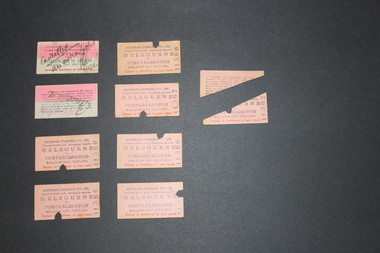
Document - Ticket, Steamship
... The site is archaeologically significant as the only remnant of the hull of the vessel and as part of the Maribyrnong riverine landscape situated amongst the remnants of shipbuilding slipways, Footscray wharves, S781 Unidentified ticket steam screw vessels ss edina port phillip bay steamers Australian Steamships Pty Ltd, Howard Smith Ltd, managing agents Clipped and used steamship tickets [the children's tickets are an adult ticket cut in half diagonally] - Melbourne to Portarlington Document Ticket, Steamship ...Ticket was used in 1931 and kept in storage by a member of the Edina's crew. The SS Edina was the most famous steamer in Australia and underwent a number of changes and refits during its lifetime. It had an unchallenged record of strandings and collisions with other vessels and of escaping serious damage itself. The vessels City of Melbourne, Courier, Manawatu, Excelsior (twice), Hovell, Batman, all suffered. When Edina was retired in 1938 it was the world's oldest working steamer and had travelled more than 1 million km. She was finally broken up by George Seelf on the banks of the Maribyrnong in 1957.The SS Edina was an iconic and affectionately regarded part of Port Phillips maritime history and culture. It is historically significant for being internationally famous as the worlds oldest working screw steamship between 1912 and 1938. Its career was varied and interesting and it is considered significant for its involvement in the Crimean War, US Civil War, NZ gold rushes, and locally for its career as a western district steamship and Bay steamer. The site is archaeologically significant as the only remnant of the hull of the vessel and as part of the Maribyrnong riverine landscape situated amongst the remnants of shipbuilding slipways, Footscray wharves, S781 UnidentifiedClipped and used steamship tickets [the children's tickets are an adult ticket cut in half diagonally] - Melbourne to PortarlingtonAustralian Steamships Pty Ltd, Howard Smith Ltd, managing agentsticket, steam screw vessels, ss edina, port phillip, bay steamers -
Port Melbourne Historical & Preservation Society
Document - Newsletter, Burra News, Port Melbourne Sub-Branch RSL, Royal Tour, Burra News, 1963
... Societies Clubs Unions and other Organisations Royal Visits and Occasions A J DAWSEY F PALMER G LEWIS E GILL H BARWISE R V ALEXANDER W BARFOOT W CUNNINGHAM E McLEISH F WALDRON S HOWARD W BRASHNER W PEARSON Graham E WALSH 'Burra News' of the Port Melbourne Sub-Branch RSL,Royal Tour Edition 1963 Burra News Document Newsletter, Burra News, Port Melbourne Sub-Branch RSL, Royal Tour Greenan Publications ...'Burra News' of the Port Melbourne Sub-Branch RSL,Royal Tour Edition 1963societies clubs unions and other organisations, royal visits and occasions, a j dawsey, f palmer, g lewis, e gill, h barwise, r v alexander, w barfoot, w cunningham, e mcleish, f waldron, s howard, w brashner, w pearson, graham e walsh -
Port Melbourne Historical & Preservation Society
Document - Newsletter, Burra News, Port Melbourne Sub-Branch RSL, Burra News, 1966
... Official organ of the Port Melbourne Sub-Branch RSL, Christmas edition 1966. Lewis, G (President, RSL 1966):Palmer, F. (vice president RSL 1966):Howard, S. ...returned services league rsl societies clubs unions and other organisations g lewis f palmer s howard w pearson h barwise albert stuckbery h eason g larkin e wood w barfoot t franklin g young w kidd g frost p deaker r kent f tucker Official organ of the Port Melbourne Sub-Branch RSL, Christmas edition 1966. ...Official organ of the Port Melbourne Sub-Branch RSL, Christmas edition 1966. Lewis, G (President, RSL 1966):Palmer, F. (vice president RSL 1966):Howard, S. (vice president RSL 1966):Pearson, W. (secretary RSL 1966):Barwise, H (treasurer RSL 1966):Stuckbery, Albert:Eason, H:Larkin, G:Wood, E.:Barfoot, W.:Franklin, T.:Young, G.:Kidd, W.:Frost, G.:Deaker, P.:Kent, R.:Tucker, F.returned services league, rsl, societies clubs unions and other organisations, g lewis, f palmer, s howard, w pearson, h barwise, albert stuckbery, h eason, g larkin, e wood, w barfoot, t franklin, g young, w kidd, g frost, p deaker, r kent, f tucker -
Glen Eira Historical Society
Article - St. Clement’s Church of England, Elsternwick
... Clement’s Church Hall. 2/An article from the Port Phillip Leader, dated 03/04/2012, about the increased attendances of churches, mentioning Rev. Rowan Fairbairn of St. Clement’s Anglican Church. Southern Cross Leigh Howard ...This file contains two items: 1/An article from Southern Cross, dated 15/12/1993, detailing proposed eviction of ‘Little Kids Occasional Care Centre’ if Brighton Hyundai go through with plans to enlarge their parking storage area in the current Miller Street, St. Clement’s Church Hall. 2/An article from the Port Phillip Leader, dated 03/04/2012, about the increased attendances of churches, mentioning Rev. Rowan Fairbairn of St. Clement’s Anglican Church.southern cross, leigh howard, elsternwick, kindergartens, st. clement’s church of england, st. clement’s anglican church, halls, miller st., brighton rd., glenhuntly rd., hotham st., hislop john rev., richtman shana, north caulfield, pearce sue, stephens katie, grossbard alain cr., little kids contact and occasional care centre, brighton hyundai, caulfield council, thurston richard, fairbairn rowan rev., st. clement’s anglican church, nepean highway -
Port Melbourne Historical & Preservation Society
Document - Calendar 2021, Pat Grainger and PMHPS members, Historic Port Melbourne - Women of Port, September 2020
... Researched, written and designed by Pat GRAINGER and PMHPS members Ladies Harbour Lights Guild Religion - Anglican (Holy Trinity) Norah HOWARD nee MALLET Janne RAY Caroline LIARDET Sarah Stella EDWARDS Sarah WHITEMAN Eli (Dick) EDWARDS Women's Welcoming Committee George SAMSON Albert 'Joe' BUDD Mary Elizabeth FREAME Mary Ada A'BECKETT Lady FOSTER Ethel GODFREY Alice TRACEY Stan HOWARD Joan ROUND Jean SCHINCK Jenny TSERKEZIDIS Joyce DERMOTT Diane PERAZZO Heather WALE Mother Anthony Lilian 'Lil' GOSS nee JOHNSON Peggy HOWARD nee ANTONIO George BAINES Mary McLEAVY Lyn McLEAVY Jan SOLDATOS nee HARRIS Anna ROBIESON Liana THOMPSON Destiny DEACON Jude MUNRO Wendy MORRIS Janet BOLITHO Lyn ALLISON Bernadene VOSS Moira FINDLAY Fiona McCONNELL Beris CAMPBELL Rosie BRAY Pat GRAINGER Janet Phillicia BATTY Margaret ADDICOAT Thomas EDWARDS Norm GOSS Snr Mary Anthony BYRNE Sarah Jane 'Jennie' BAINES nee HUNT Annie SAMSON nee ANDERSON Sister Norma Jean BARNETT Jane RENDALL nee HARRISON "Historic Port Melbourne - Women of Port 2021" Produced by PMHPS. ...Researched, written and designed by Pat GRAINGER and PMHPS members"Historic Port Melbourne - Women of Port 2021" Produced by PMHPS. Black and white cover with portrait of Caroline LIARDET and dog. PMHPS logo at top right.ladies harbour lights guild, religion - anglican (holy trinity), norah howard nee mallet, janne ray, caroline liardet, sarah stella edwards, sarah whiteman, eli (dick) edwards, women's welcoming committee, george samson, albert 'joe' budd, mary elizabeth freame, mary ada a'beckett, lady foster, ethel godfrey, alice tracey, stan howard, joan round, jean schinck, jenny tserkezidis, joyce dermott, diane perazzo, heather wale, mother anthony, lilian 'lil' goss nee johnson, peggy howard nee antonio, george baines, mary mcleavy, lyn mcleavy, jan soldatos nee harris, anna robieson, liana thompson, destiny deacon, jude munro, wendy morris, janet bolitho, lyn allison, bernadene voss, moira findlay, fiona mcconnell, beris campbell, rosie bray, pat grainger, janet phillicia batty, margaret addicoat, thomas edwards, norm goss snr, mary anthony byrne, sarah jane 'jennie' baines nee hunt, annie samson nee anderson, sister norma jean barnett, jane rendall nee harrison -
Port Melbourne Historical & Preservation Society
Programme - Remembrance Day, City of Port Phillip, 2019
... war - world war i celebrations fetes and exhibitions memorials tom connors lionel boxer dick gross zeta hamilton-durkin john coulson kay rowan graham lockwood howard cornish City of Port Phillip Remembrance Day event. 10 November 2014 at 5 pm. ...Program with red poppy on white background. Made for remembrance day 11 November 2019. Inside cover is copy in red of poster to welcome home St Kilda enlistees. Program on facing page with photo of Tom Connors and daughterCity of Port Phillip Remembrance Day event. 10 November 2014 at 5 pm. Remembrance Garden, Station St at Raglan St Port Melbournewar - world war i, celebrations fetes and exhibitions, memorials, tom connors, lionel boxer, dick gross, zeta hamilton-durkin, john coulson, kay rowan, graham lockwood, howard cornish -
Port Melbourne Historical & Preservation Society
Audio - Oral History, Norah HOWARD, June Kirby, 24 Apr 1988
... Norah HOWARD discussing her memories of the 1937 opening of the Mission to Seamen's building, Harbour Lights Guild ativities, changes in Port Melbourne, Poolman St and more...Interview used in contribution to the book "They can Carry me Out" (Interview originally took place as part of a Heritage Week event at the Mission) Missions to Seamen Norah HOWARD nee MALLET Ladies Harbour Lights Guild Duration side 0:24:21 Norah HOWARD discussing her memories of the 1937 opening of the Mission to Seamen's building, Harbour Lights Guild ativities, changes in Port Melbourne, Poolman St and more Audio Oral History, Norah HOWARD June Kirby ...Interview used in contribution to the book "They can Carry me Out" (Interview originally took place as part of a Heritage Week event at the Mission)Norah HOWARD discussing her memories of the 1937 opening of the Mission to Seamen's building, Harbour Lights Guild ativities, changes in Port Melbourne, Poolman St and moreDuration side 0:24:21missions to seamen, norah howard nee mallet, ladies harbour lights guild -
Port Melbourne Historical & Preservation Society
Photograph - PMHPS Back to Port 1940s/50s exhibition, Masonic Hall, Liardet Street, Port Melbourne, Ann Smallpage, 25 Mar 2001
... ...Norah HOWARD nee MALLET...Port...Celebrations Fetes and Exhibitions Costume Norah HOWARD nee MALLET Port Melbourne Historical & Preservation Society PMHPS Twelve colour photographs taken by Ann Smallpage at the Port Melbourne Historical and Preservation Society's Back to Port 1940s/50s exhibition 25.03.2001 in the Masonic Hall in Liardet Street, for the Port Melbourne Community Festival Photograph PMHPS Back to Port 1940s/50s exhibition, Masonic Hall, Liardet Street, Port Melbourne Ann Smallpage ...Twelve colour photographs taken by Ann Smallpage at the Port Melbourne Historical and Preservation Society's Back to Port 1940s/50s exhibition 25.03.2001 in the Masonic Hall in Liardet Street, for the Port Melbourne Community Festivalcelebrations fetes and exhibitions, costume, norah howard nee mallet, port melbourne historical & preservation society, pmhps -
Port Melbourne Historical & Preservation Society
Photograph - PMHPS Back to Port 1940s/50s exhibition, Masonic Hall, Liardet Street, Port Melbourne, Ann Smallpage, 25 Mar 2001
... ...Norah HOWARD nee MALLET...Port...Celebrations Fetes and Exhibitions Costume Norah HOWARD nee MALLET Port Melbourne Historical & Preservation Society PMHPS Eleven colour photographs taken by Ted Kobelt at the Port Melbourne Historical and Preservation Society's Back to Port 1940s/50s exhibition 25.03.2001 at the Masonic Hall in Liardet Street, for the Port Melbourne Community Festival Photograph PMHPS Back to Port 1940s/50s exhibition, Masonic Hall, Liardet Street, Port Melbourne Ann Smallpage ...Eleven colour photographs taken by Ted Kobelt at the Port Melbourne Historical and Preservation Society's Back to Port 1940s/50s exhibition 25.03.2001 at the Masonic Hall in Liardet Street, for the Port Melbourne Community Festivalcelebrations fetes and exhibitions, costume, norah howard nee mallet, port melbourne historical & preservation society, pmhps -
 Port Melbourne Historical & Preservation Society
Photograph - Launch of History of a Street Precinct, 25 Sep
... Port Melbourne street precinct from the 1880s to 1960. The area is bounded by Evans Street, the E side of Bridge Street, S side of Williamstown Road, Farrell Street both the E & W sides plus the section of Ross Street between Farrell and Bridge and the part of Derham Street between Farrell and Bridge. The resulting map and an interactive CD won the Best Community Research, Registers & Records project at the 2007 Victorian Community History Awards. The project was launched on the railway reserve near the corner of Evans & Farrell streets. L - R - Unknown, Norah HOWARD...Port Melbourne street precinct from the 1880s to 1960. The area is bounded by Evans Street, the E side of Bridge Street, S side of Williamstown Road, Farrell Street both the E & W sides plus the section of Ross Street between Farrell and Bridge and the part of Derham Street between Farrell and Bridge. The resulting map and an interactive CD won the Best Community Research, Registers & Records project at the 2007 Victorian Community History Awards. The project was launched on the railway reserve near the corner of Evans & Farrell streets. L - R - Unknown, Norah HOWARD ...In 2005, members of the PMH&PS undertook a study of the residents of the houses in a Port Melbourne street precinct from the 1880s to 1960. The area is bounded by Evans Street, the E side of Bridge Street, S side of Williamstown Road, Farrell Street both the E & W sides plus the section of Ross Street between Farrell and Bridge and the part of Derham Street between Farrell and Bridge. The resulting map and an interactive CD won the Best Community Research, Registers & Records project at the 2007 Victorian Community History Awards. The project was launched on the railway reserve near the corner of Evans & Farrell streets. L - R - Unknown, Norah HOWARD, Mayor Darren RAY.CoPP mayor and PMHPS members at the launch of the History of a Street Precinct25/9/05 Not known, Norah Howard, Darren Ray, Mayorhistory of a street precinct, darren ray, norma howard
