
Showing 23 items matching " racial discrimination"
-
 Victorian Aboriginal Corporation for Languages
Book with CD, Human Rights and Equal Opportunity Commission, Voices of Australia : 30 years of the Racial Discrimination Act : 1975-2005 : a collection of real-life stories about Australians living together, 2005
... Voices of Australia : 30 years of the Racial Discrimination Act : 1975-2005 : a collection of real-life stories about Australians living together...colour illustrations, colour photographs, CD Voices of Australia : 30 years of the Racial Discrimination Act : 1975-2005 : a collection of real-life stories about Australians living together Book with CD Human Rights and Equal Opportunity Commission ...colour illustrations, colour photographs, CD -
Koorie Heritage Trust
Book, Butt, Peter et al, Mabo : what the High Court said, 1993
... . | Australia. Racial Discrimination Act 1975 | Native title - Cases - Mabo | Law - Relation to Anglo Australian law | Law - Jurisprudence | Native title - Extinguishment | Race relations - Racial discrimination - Anti discrimination - Legislation. | Mabo.... | Australia. Racial Discrimination Act 1975 | Native title - Cases - Mabo | Law - Relation to Anglo Australian law | Law - Jurisprudence | Native title - Extinguishment | Race relations - Racial discrimination - Anti discrimination - Legislation. | Mabo Edward 1936-1992. ...This book sets out the High Court Mabo decision in plain English, giving everyone the chance to read the case for themselves. It reduces the judgements to less than a third of their original length. It avoids repetition, translates legalese into English and gathers the judgement into chapters and themes. It looks at the specific issues raised by the High Court judges including terra nullius, Crown sovereignty, land ownership, naive title and protecting native title under the Racial Dicrimination Act.93 p. : ill., 1 port. ; 20 cm.This book sets out the High Court Mabo decision in plain English, giving everyone the chance to read the case for themselves. It reduces the judgements to less than a third of their original length. It avoids repetition, translates legalese into English and gathers the judgement into chapters and themes. It looks at the specific issues raised by the High Court judges including terra nullius, Crown sovereignty, land ownership, naive title and protecting native title under the Racial Dicrimination Act.australia. high court. mabo and others v. state of queensland. | australia. racial discrimination act 1975 | native title - cases - mabo | law - relation to anglo australian law | law - jurisprudence | native title - extinguishment | race relations - racial discrimination - anti discrimination - legislation. | mabo, edward, 1936-1992. mabo and others v. state of queensland. | mabo, edward, 1936-1992 -- trials, litigation, etc. | australia. high court. mabo and others v. state of queensland. | native title (australia) | torres strait islanders -- land tenure. | torres strait islanders -- legal status, laws, etc. | aboriginal australians -- land tenure. | aboriginal australians -- legal status, laws, etc. | land tenure -- law and legislation -- australia. | queensland -- trials, litigation, etc. -
Koorie Heritage Trust
Journal - Serials, Department of Pacific and Southeast Asian History, Australian National University, Aboriginal History - Volume 06. 1-2 1982, 1982
... gathering and fishing | Social organisation - Avoidance rules - Avoidance relationships | Socioeconomic conditions - Living conditions | Law enforcement - Police conduct and attitudes | Race relations - Racial discrimination - Courts | Race relations - Racial discrimination - Legislative | Transport - Air - Aircraft | Settlement and contacts - 20th Century | Stories and motifs - Eagles / hawks / crows | Settlement and contacts - Explorers | Costume and clothing - Necklaces.... | Hunting gathering and fishing | Social organisation - Avoidance rules - Avoidance relationships | Socioeconomic conditions - Living conditions | Law enforcement - Police conduct and attitudes | Race relations - Racial discrimination - Courts | Race relations - Racial discrimination - Legislative | Transport - Air - Aircraft | Settlement and contacts - 20th Century | Stories and motifs - Eagles / hawks / crows | Settlement and contacts - Explorers | Costume and clothing - Necklaces pendants etc. | Colonisation | Government policy - Initial period and protectionism | Race relations - Racism - Stereotyping | Sites - Dreaming tracks | Technology - Stone - Knapped | Literature and stories - Authors | Literature and stories - Fiction | Literature and stories - Plays | Literature and stories - Poetry | A series of articles by leading writers on Aboriginal History. 178 P.; tables; figs.; ports.; footnotes; bibs.; 24 cm. ...A series of articles by leading writers on Aboriginal History.178 P.; tables; figs.; ports.; footnotes; bibs.; 24 cm.A series of articles by leading writers on Aboriginal History.aboriginal australians -- periodicals. | ethnology -- australia -- periodicals. | hunting, gathering and fishing | social organisation - avoidance rules - avoidance relationships | socioeconomic conditions - living conditions | law enforcement - police conduct and attitudes | race relations - racial discrimination - courts | race relations - racial discrimination - legislative | transport - air - aircraft | settlement and contacts - 20th century | stories and motifs - eagles / hawks / crows | settlement and contacts - explorers | costume and clothing - necklaces, pendants etc. | colonisation | government policy - initial period and protectionism | race relations - racism - stereotyping | sites - dreaming tracks | technology - stone - knapped | literature and stories - authors | literature and stories - fiction | literature and stories - plays | literature and stories - poetry | -
Unions Ballarat
My life with Martin Luther King Jr, King, Coretta Scott, 1969
... ...racial discrimination...Relevant to social history - USA. btlc ballarat trades hall ballarat trades and labour council biography king, martin luther king, coretta scott civil rights social customs politics baptists racial discrimination racial equality assassinations history Front cover: title and author's name. ...A personal memoir from the widow of Martin Luther King Jr who was a prominent campaigner for civil rights in the USA. He was assassinated in 1968. Covers the history of the civil rights movement in the USA.Biographical relevance - Martin Luther King Jr. Relevant to social history - USA.Paper; book. Front cover: black and white photo of the author and Martin Luther King; black background; white and pink lettering. Front cover: title and author's name.btlc, ballarat trades hall, ballarat trades and labour council, biography, king, martin luther, king, coretta scott, civil rights, social customs, politics, baptists, racial discrimination, racial equality, assassinations, history -
 Robin Boyd Foundation
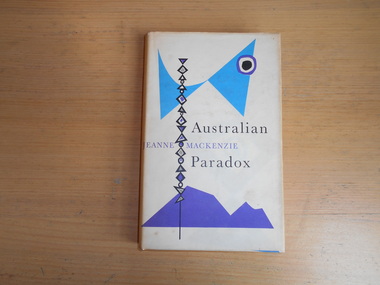
Book, Jeanne Mackenzie, Australian Paradox, 1961
... ... Racial discrimination...Law Legislation Racial discrimination Cabbage Tree Island QLD Walsh St library Hardcover w/ Dust Jacket Australian Paradox Book Jeanne Mackenzie F.W. ...Hardcover w/ Dust Jacketlaw, legislation, racial discrimination, cabbage tree island qld, walsh st library -
Koorie Heritage Trust
Book, Roberts, Janine, From Massacres to mining. The colonization of Aboriginal Australia, 1978
... . - To 1900 | Race relations - Racial discrimination - Legislative.... - To 1900 | Race relations - Racial discrimination - Legislative White colonisation of Australia; violent conflict; establishment of reserves; current situation legal oppression in Queensland; racism and discrimination; poverty, malnutrition and disease; government policy; land rights; mining on Aboriginal land; Aboriginal struggle for rights. 212 P.; appendices; maps; plates; ill.; footnotes; bib.; refs.; figs.; 21 cm. ...White colonisation of Australia; violent conflict; establishment of reserves; current situation legal oppression in Queensland; racism and discrimination; poverty, malnutrition and disease; government policy; land rights; mining on Aboriginal land; Aboriginal struggle for rights.212 P.; appendices; maps; plates; ill.; footnotes; bib.; refs.; figs.; 21 cm.White colonisation of Australia; violent conflict; establishment of reserves; current situation legal oppression in Queensland; racism and discrimination; poverty, malnutrition and disease; government policy; land rights; mining on Aboriginal land; Aboriginal struggle for rights.aboriginal australians -- social conditions. | aboriginal australians -- government relations. | aboriginal australians -- land tenure. | colonisation | economics - income - poverty and low income | government policy | health - nutrition disorders | land rights - mining industry | land rights - excisions and leases - mining leases | race relations - violent - massacres, murders, poisonings etc. - to 1900 | race relations - racial discrimination - legislative -
Koorie Heritage Trust
Book, Broome, Richard, Aboriginal Australians : a history since 1788, 2010
... . | Colonisation. | Racial discrimination. | Social conditions. | History. | Aboriginal Australians - Social conditions. | Race discrimination - Australia. | Australia - Race relations. | Australia - Colonization - History..... | Colonisation. | Racial discrimination. | Social conditions. | History. | Aboriginal Australians - Social conditions. | Race discrimination - Australia. | Australia - Race relations. | Australia - Colonization - History. ...Richard Broome tells the history of Australia from the standpoint of the original Australians: those who lost most in the ealy colonial struggle for power. 'In this book Richard Broome has managed an enviable achievement. The vast sweeping story of Aboriginal Australia from 1788 is told in his typical lucid and imaginative style.v-vi; 400 P. facs. photographs; notes; maps; bib. indexRichard Broome tells the history of Australia from the standpoint of the original Australians: those who lost most in the ealy colonial struggle for power. 'In this book Richard Broome has managed an enviable achievement. The vast sweeping story of Aboriginal Australia from 1788 is told in his typical lucid and imaginative style.aboriginal australians -- social conditions. | race discrimination -- australia. | australia -- race relations. | australia -- colonization -- history. | stolen generations (australia). | aboriginal australians -- removal -- government policy. | aboriginal australians -- history. | colonization. | race discrimination. | race relations. | australia -- colonization. | australia. | aborigines. | colonisation. | racial discrimination. | social conditions. | history. | aboriginal australians - social conditions. | race discrimination - australia. | australia - race relations. | australia - colonization - history. -
Koorie Heritage Trust
Document - Printed Sheets, Canberra : A. J. Law, Commonwealth Government Printer, Mabo : The High Court Decision on Native Title : Discussion Paper June 1993, 1993
... Native title - Cases - High Court | Law - Land - Commonwealth | Environment - Land management | Law - Constitutional law | Native title - Compensation | Native title - Cases - Mabo | Race relations - Racism - Stereotyping | Race relations - Racial discrimination - Anti discrimination - Legislation....Native title - Cases - High Court | Law - Land - Commonwealth | Environment - Land management | Law - Constitutional law | Native title - Compensation | Native title - Cases - Mabo | Race relations - Racism - Stereotyping | Race relations - Racial discrimination - Anti discrimination - Legislation. ...Federal government's discussion paper which outlines background to High Court's decision on native title, consultation process, unresolved key issues; includes legal framework in relation to High Court's decision, Racial Discrimination Act, valid future grants, constitutional powers relevant to possible Commonwealth legislation, identification of native title, possible tribunal system, land management issues, economic development and national compensation fund, relationship between High Court's decision and reconciliation; Appendix lists framework of principles for consultation.[29] leaves ; 30 cm.Federal government's discussion paper which outlines background to High Court's decision on native title, consultation process, unresolved key issues; includes legal framework in relation to High Court's decision, Racial Discrimination Act, valid future grants, constitutional powers relevant to possible Commonwealth legislation, identification of native title, possible tribunal system, land management issues, economic development and national compensation fund, relationship between High Court's decision and reconciliation; Appendix lists framework of principles for consultation.native title - cases - high court | law - land - commonwealth | environment - land management | law - constitutional law | native title - compensation | native title - cases - mabo | race relations - racism - stereotyping | race relations - racial discrimination - anti discrimination - legislation. -
Koorie Heritage Trust
Journal - Serials, Aboriginal History Inc, Aboriginal History - Volume 23. 1999, 1999
... Isabel (Sally) - Anthropologist | Demography - Population mobility | Settlement and contacts - Resettlement and removals | Defence - Missile and weapons testing - Nuclear weapons | Language - Linguistics - Language elicitation | Language - Vocabulary - Word lists | Language - Linguistics - Phonology and phonetics | History - Biographies - Indigenous | Colonisation | Race relations - Racial discrimination - Women | Music - Vocal - Group - Children | Music - Education | Music - Analysis - Vocal...White Isabel (Sally) - Anthropologist | Demography - Population mobility | Settlement and contacts - Resettlement and removals | Defence - Missile and weapons testing - Nuclear weapons | Language - Linguistics - Language elicitation | Language - Vocabulary - Word lists | Language - Linguistics - Phonology and phonetics | History - Biographies - Indigenous | Colonisation | Race relations - Racial discrimination - Women | Music - Vocal - Group - Children | Music - Education | Music - Analysis - Vocal A series of articles by leading writers on Aboriginal History. iiv-xii; 151 P.; refs.; footnotes; plates; 25 cm. ...A series of articles by leading writers on Aboriginal History.iiv-xii; 151 P.; refs.; footnotes; plates; 25 cm.A series of articles by leading writers on Aboriginal History.aboriginal australians -- periodicals. | ethnology -- australia -- periodicals | language, aboriginal-upper murray vic. - pallangamiddang., unaipon, david-interview., white, isabel (sally) - anthropologist | demography - population mobility | settlement and contacts - resettlement and removals | defence - missile and weapons testing - nuclear weapons | language - linguistics - language elicitation | language - vocabulary - word lists | language - linguistics - phonology and phonetics | history - biographies - indigenous | colonisation | race relations - racial discrimination - women | music - vocal - group - children | music - education | music - analysis - vocal -
Koorie Heritage Trust
Journal - Serials, Aboriginal Law Research Unit in association with the Legal Service Bulletin Co-operative Ltd., 1981-1997, Aboriginal Law Bulletin, 1981
... . -- Periodicals | Race discrimination -- Law and legislation -- Australia | Discrimination in law enforcement -- Australia -- Periodicals | Government policy | Law - Indigenous | Law - International law - Human rights | Law - Legal system | Law - Legal aid services | Race relations - Racial discrimination - Legislative | Politics and Government - Social justice.... -- Periodicals | Race discrimination -- Law and legislation -- Australia | Discrimination in law enforcement -- Australia -- Periodicals | Government policy | Law - Indigenous | Law - International law - Human rights | Law - Legal system | Law - Legal aid services | Race relations - Racial discrimination - Legislative | Politics and Government - Social justice Aboriginal Law Bulletin began in 1981 as one of the first projects of the Aboriginal Law Research Centre at the University of NSW. ...Aboriginal Law Bulletin began in 1981 as one of the first projects of the Aboriginal Law Research Centre at the University of NSW. The Centre became the Aboriginal Law Centre in 1986 and the Indigenous Law Centre in 1997; journal title changed to Indigenous law bulletin from Vol. 4 no. 1 (Apr. 1997)v. ; 29cm.Aboriginal Law Bulletin began in 1981 as one of the first projects of the Aboriginal Law Research Centre at the University of NSW. The Centre became the Aboriginal Law Centre in 1986 and the Indigenous Law Centre in 1997; journal title changed to Indigenous law bulletin from Vol. 4 no. 1 (Apr. 1997)law -- australia -- periodicals | aboriginal australians -- legal status, laws, etc. -- periodicals | torres strait islanders -- legal status, laws, etc. -- periodicals | race discrimination -- law and legislation -- australia | discrimination in law enforcement -- australia -- periodicals | government policy | law - indigenous | law - international law - human rights | law - legal system | law - legal aid services | race relations - racial discrimination - legislative | politics and government - social justice -
 Port Fairy Historical Society Museum and Archives
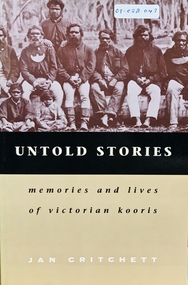
Book, Melbourne University Press, Untold stories : memories and lives of Victorian Kooris, 1998
... race relations - racial discrimination.....) -- colonization. aboriginal australians -- victoria -- western district -- history. aboriginal australians -- victoria -- western district -- interviews race relations - racial discrimination. child welfare - child / parent separation - stolen generations. history - biographies - indigenous. ...'I'm your half-brother and I'm here to stay. This is my home.' With these words Wilmot Abraham sought refuge with his white relations. 'Did you ever read your history?': Mrs. Mary Clarke remembers p. 1 'An old hand': Jim Cain p. 12 'I'm your half-brother, and I'm here to stay': Wilmot Abraham p. 36 The Three Pompeys The Written Record p. 48 Banjo Clarke's Stories p. 62 'Why did they take them away?': Lizzie and Henry McCrae p. 74 In Defence of Framlingham: Collin Hood p. 79 Double Dispossession: King David p. 107 James Dawson's Informants p. 137 'Why are we kept prisoners here?': Ernest and Maggie Mobourne p. 148 'The old ones, they wouldn't tell us nothing': Mrs. Connie Hart's memories p. 181 'Breaking the cycle is the hard thing to do': Geoff Rose, a stolen child p. 200 Epilogue: James Dawson, Camperdown George and the Obelisk p. 220 The Hood Family p. 238 The Mobourne Letters p. 241 Abbreviations p. 252 Notes p. 252 Bibliography p. 264 Index p. 274xxi, 283 p. : ill., facsims., map, ports. ; 23 cm. Includes index and bibliographical references: p. 264-273.non-fiction'I'm your half-brother and I'm here to stay. This is my home.' With these words Wilmot Abraham sought refuge with his white relations. 'Did you ever read your history?': Mrs. Mary Clarke remembers p. 1 'An old hand': Jim Cain p. 12 'I'm your half-brother, and I'm here to stay': Wilmot Abraham p. 36 The Three Pompeys The Written Record p. 48 Banjo Clarke's Stories p. 62 'Why did they take them away?': Lizzie and Henry McCrae p. 74 In Defence of Framlingham: Collin Hood p. 79 Double Dispossession: King David p. 107 James Dawson's Informants p. 137 'Why are we kept prisoners here?': Ernest and Maggie Mobourne p. 148 'The old ones, they wouldn't tell us nothing': Mrs. Connie Hart's memories p. 181 'Breaking the cycle is the hard thing to do': Geoff Rose, a stolen child p. 200 Epilogue: James Dawson, Camperdown George and the Obelisk p. 220 The Hood Family p. 238 The Mobourne Letters p. 241 Abbreviations p. 252 Notes p. 252 Bibliography p. 264 Index p. 274 western district (vic.) -- colonization., aboriginal australians -- victoria -- western district -- history., aboriginal australians -- victoria -- western district -- interviews, race relations - racial discrimination., child welfare - child / parent separation - stolen generations., history - biographies - indigenous., book -
Victorian Aboriginal Corporation for Languages
Book, Pat Dodson et al, Recognising Aboriginal and Torres Strait Islander Peoples in the Constitution : report of the expert panel, 2012
... The 'race' provisions 6. Racial non-discrimination 7. Governance and political participation 8. ...The 'race' provisions 6. Racial non-discrimination 7. Governance and political participation 8. ...Current multiparty support has created a historic opportunity to recognise Aboriginal and Torres Strait Islander peoples as the first peoples of Australia, to affirm their full and equal citizenship, and to remove the last vestiges of racial discrimination from the Constitution. The Expert Panel was tasked to report to the Government on possible options for constitutional change to give effect to Indigenous constitutional recognition, including advice as to the level of support from Indigenous people and the broader community for these options. This executive summary sets out the Panel's conclusions and recommendations" [taken from executive summary]. Report contains draft Bill for an Act to alter the Constitution to recognise Aboriginal and Torres Strait Islander peoples and their cultures, languages and heritage, to replace racially discriminatory provisions and to include a prohibition of racial discrimination. Letter to the Prime Minister Foreword from the co-chairs Executive summary Introduction: Expert panel and its methodology 1. Historical background 2. Comparative and international recognition 3. The national conversation: themes from the consultation program 4. Forms of recognition 5. The 'race' provisions 6. Racial non-discrimination 7. Governance and political participation 8. Agreement-making 9. The question of sovereignty 10. Approaches to the referendum 11. Draft bill Appendixes Bibliography.maps, tables, colour photographs, chartsconstitutional history, legislation, australian constitution, constitutional law, closing the gap, 1967 referendum, white australia policy, sovereignty -
 Victorian Aboriginal Corporation for Languages
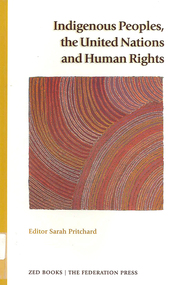
Book, Sarah Pritchard, Indigenous Peoples, the United Nations and human rights, 1998
... Elizabeth Evatt .-- The Committee on the Elimination of Racial Discrimination: non-governmental input and the early warning and urgent procedure /? ...Elizabeth Evatt .-- The Committee on the Elimination of Racial Discrimination: non-governmental input and the early warning and urgent procedure /? ...Introduction: The significance of international law /? Sarah Pritchard.-- Linking international standards with contemporary concerns of Aboriginal and Torres Strait Islander peoples /? Mick Dodson.-- The UN Charter-based human rights system: The UN Charter-based human rights system: an overview /? Garth Nettheim.-- Working Group on Indigenous Populations: mandate, standard-setting activities and future perspectives /? Sarah Pritchard.-- The UN treaty-based human rights system and individual complaints: The UN treaty-based human rights system: an overview /? Hilary Charlesworth.-- Individual complaints: an overview and admissibility requirements /? Hilary Charlesworth.-- Individual complaints: historical perspectives and the International Covenant on Economic, Social and Cultural Rights /? Philip Alston.-- Individual communications under the Optional Protocol to the International Covenant on Civil and Political Rights Elizabeth Evatt.-- Individual communications: the Convention against Torture and the Convention on the Elimination of All Forms of Racial Discrimination /? Michael O'Flaherty.-- The UN treaty-based human rights system and periodic reporting: Periodic reporting: the International Covenant on Economic, Social and Cultural Rights and the Convention on the Rights of the Child /? Philip Alston.-- Periodic reporting: the International Covenant on Civil and Political Rights and the Convention on the Elimination of All Forms of Discrimination against Women /? Elizabeth Evatt .-- The Committee on the Elimination of Racial Discrimination: non-governmental input and the early warning and urgent procedure /? Michael O'Flaherty.-- Indigenous peoples and some relevant human rights standards: Substantive provisions of the International Convention on the Elimination of All Forms of Racial Discrimination /? Michael O'Flaherty.-- The International Covenant on Civil and Political Rights and Indigenous peoples /? Sarah Pritchard.united nations -- history. indigenous peoples -- legal status, laws, etc. aboriginal australians -- civil rights. aboriginal australians -- legal status, laws, etc. human rights. -
Victorian Aboriginal Corporation for Languages
Video, Richard Frankland, From Sand to Celluloid, 1996
... Touches on topics which include Black Deaths In Custody, family life, social interaction and social disadvantage, traditions and racial discrimination. No way to forget /? writer, director, Richard Frankland (11 min.) ...Touches on topics which include Black Deaths In Custody, family life, social interaction and social disadvantage, traditions and racial discrimination. No way to forget /? writer, director, Richard Frankland (11 min.) ...A compilation of 6 short films by Aboriginal filmakers dramatising various aspects of Aboriginal life in white Australia. Touches on topics which include Black Deaths In Custody, family life, social interaction and social disadvantage, traditions and racial discrimination. No way to forget /? writer, director, Richard Frankland (11 min.) Fly Peewee fly /? writer, director, Sally Riley (10 min.) Round up /? writer, director, Rima Tamou (16 min.) Two bob mermaid /? writer, director, Darlene Johnson (15 min.) Payback /? writer, director, Warwick Thornton (10 min.) Black man down /? writer, co-producer, Sam Watson ; director, Bill McCrow (11 min.) No way to forget /? writer, director, Richard Frankland (11 min.).videocassetteindigenous filmmakers, richard frankland, darlene johnson, sally riley, rima tamou, warwick thornton, australian film institute, afi -
 Ballarat Heritage Services
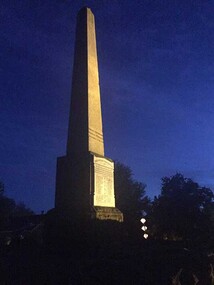
Photograph - Photograph - Colour, Burning of an Effigy of Pauline Hanson, 03 December 2016, 03/12/2016
... “While Immigration Minister Peter Dutton (burned in effigy at last year’s Eureka Dawn), has become the face of refugee detention cruelty, Pauline Hanson has become the face and voice of popular advocacy for racial discrimination. “We want the burning of Pauline in effigy to be seen as a repudiation of racism and attempts to associate the Eureka flag with racial discrimination and anti refugee and migrant policies. ...“While Immigration Minister Peter Dutton (burned in effigy at last year’s Eureka Dawn), has become the face of refugee detention cruelty, Pauline Hanson has become the face and voice of popular advocacy for racial discrimination. “We want the burning of Pauline in effigy to be seen as a repudiation of racism and attempts to associate the Eureka flag with racial discrimination and anti refugee and migrant policies. ...Media Release 29 January 2016 Advocate of Racism to burn at Eureka Dawn A cardboard effigy of Senator Pauline Hanson, will burn at the Ballarat Eureka Stockade Memorial next Eureka Dawn 3 December. For eight years now effigy burning has become an integral and flamboyant part of the annual 3 December Eureka remembrance, part of the Reclaim the Radical Spirit of the Eureka Rebellion program organised by Dr Joe Toscano, medical practitioner, broadcaster on Melbourne community radio 3CR and Australia's best known anarchist. Colour photographs of the burning of a cardboard effigy of Pauline Hanson at dawn on Eureka Day, 03 December 2016. Pauline Hanson was chosen as the effigy to be burnt by the Anarchist Media Alliance at Eureka Dawn because she was an advocate of racism. eureka stockade, anniversary, joe toscano, reclaim the radical spirit of the eureka rebellion, graeme dunstam, pauline hanson, effigy burning, pauline hanson effigy -
 Melbourne Tram Museum
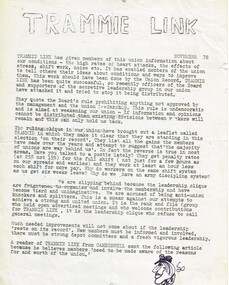
Newsletter, Tramways rank and file group, "Trammie Link", 1978 - 1982 and 1991 and 1992
... Amalgamation was a major push of the Hawke - Keating Government. .14 - March 1992 - supportive of Jim Harper, dismissive of Lou DiGregorio, Union executive, union amalgamation, cross linking of tram routes, racial discrimination within the PTC, Kew Depot, ACTU. ...Amalgamation was a major push of the Hawke - Keating Government. .14 - March 1992 - supportive of Jim Harper, dismissive of Lou DiGregorio, Union executive, union amalgamation, cross linking of tram routes, racial discrimination within the PTC, Kew Depot, ACTU. ...Set of 14 duplicated newsletters printed on coloured quarto or foolscap duplicated paper, "Trammie Link" .1 - November 1978 - 1 quarto sheet - complaining about the lack of union leadership - published by a "tramways rank and file group" .2 - March 1979 - 4 sheets - training, shift work, Burke Road tram, route 72 tram, Gardiner, lifeguards, uniforms. .3 - April 1979 - 4 sheets - disciplinary panel, rosters, Camberwell depot, route 72, buses, North Fitzroy, Doncaster, Clifton Hill, Z class cars. .4 - May 1979 - 4 sheets - discipline, lifeguards, bus safety, union issues. .5 - June 1979 - 3 sheets - politics and unions, Preston depot, Camberwell depot, wage indexation, union matters, finance for public transport, Tramway Record. .6 - August 1979 - 10 pages- Preston Depot, item written by Jim Harper, public transport and government, hook turns, union meetings, women, ACTU, wages, shift work, rosters, depots, wage indexation, shift lengths. .7 - June 1980? - two pages - undated - Service cuts at North Fitzroy, depot committees, news from depots, and note re a meeting on Monday 7 July. .8 - July 1979? - 4 pages - strikes, union campaigns, depot management, industrial issues, discipline, depot facilities. .9 - Sep. 1980 - 3 pages - Lonie report, buses, closure, public transport, union, 35 hour week, unions. .10 - Oct. 1980 - 4 pages - union elections, industrial campaigns, 35 hour week, Lonie repot, public transport. .11 - Oct. 1982 - 3 pages - Preston workshops and new trams, new trams, W class trams, accidents. .12 - Undated - 2 pages about Paul Krutulis - a scab or an Agent Provocateur - see https://www.anu.edu.au/polsci/marx/interventions/years/11revival.htm - accessed 30-8-2016. - Extracted are the 4th and 5th paragraph below which give a bit of a background. .13 - July 1991 - 4 pages - open letter to Jim Harper re union Amalgamation, rank file view, what it would mean to workers - a negative view. Amalgamation was a major push of the Hawke - Keating Government. .14 - March 1992 - supportive of Jim Harper, dismissive of Lou DiGregorio, Union executive, union amalgamation, cross linking of tram routes, racial discrimination within the PTC, Kew Depot, ACTU. Lists the rank and file committee - see key associations. Latham’s frustrations were shared by several would-be heroes in Victoria. In 1977 Paul Krutulis gained an exemption from union membership from the Arbitration Commission as a conscientious objector, only to find that tramway workers at Kew planned to stop work as soon as he appeared. Commissioner Cohen then recommended his dismissal, saying she “had to deal with the reality of the situation.” Krutulis later became president of a group called People Against Communism, before being murdered in September. Thus Krutulis departed the scene to be followed in early 1978 by motor mechanic Jack Kane, who had crossed a picket line at a Melbourne City Council depot. The AMWU forced the Council to sack him before it would end the strike. In September of the same year, Barbara Biggs succeeded in provoking a confrontation in the tramways where Krutulis had failed, by refusing to join the union and prompting 100 unionists at Brunswick depot to go on strike. The union executive had arranged token action confined to this depot, but the members wanted more. The strike spread to Preston, then 2,000 trammies at a mass meeting voted for an indefinite strike amidst “rowdy outbursts”. When Biggs complained at being excluded from the meeting a conductress told her, “We should have let you in, love. You would have been torn to pieces.” Paul was murdered by his brother George in Sydney - see the Age 29/11/1977, but there seems to be some conspiracy theories abounding as well.Handwritten note / letter from Chris Jacobson.trams, tramways, unions, training, shifts, uniforms, route 75, gardiner, light rail, camberwell, z class, buses, discipline, tramway record, preston, north fitzroy, services, strike, depots, discipline, lonie report, public transport, preston workshops, rtbu, actu, ptc -
 Sunshine and District Historical Society Incorporated
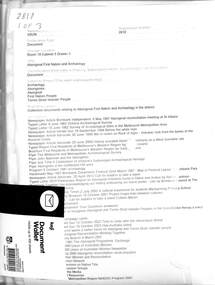
Archive - Aboriginal First Nation and Archaelogy
... Newspaper Article Brimbank Independent 6 May 1997 Aboriginal reconciliation meeting at St Albans|Typed Letter 8 June 1982 Victoria Archaelogical Survey|Typed Letter 10 June 1982 Survey of Archaelogical Sites in the Melbourne Metropolitan Area|Newspaper Article Herald Sun 18 September 1994 Before the white man|Newspaper Article Advocate 30 June 1999 We re rockin on Rock of Ages - Volcanic rock from the banks of the Kororoit Creek|Newspaper Article Advocate 20 June 2000 History revealed Aboriginal artefacts on a West Sunshine site|Typed Report First Residents of Melbourne's Western Region by Gary Presland|Brochure First Residents of Melbourne's Western Region by Gary Presland|Flyer The Melbourne and Metropolitan Archaeological Survey|Flyer John Bateman and the Aborigines|Flyer and Time A Celebration of Victoria's Submerged Archaelogical Heritage|Flyer Aborigines in the Gellibrand Hill area|Program 9 Octoberr 1981 Archaelogy|Handmade Map 1997 Brimbank Dreamtime Festival 22nd March 1997 - Map of Festival Layout at Brimbank Park|Newspaper Article Advocate 20 April 2013 Call for leaders to take a stand|Typed Letter 2010 Preliminary Report on Aboriginal Artefacts found in Albion and Ardeer by Robert Jackson|Brimbank Together Yes Acknowledging our history embracing our future poster - Use by Brimbank Council at The Hunt Club Community Centre|Newspaper Article Weekly Times 2 July 2002 A cultural experience for students Maribyrnong Primary School|Newspaper Article Living Museum 10 October 2001 Project forges links between cultures|The Advocate 20th April - Call for leaders to take a stand Colleen Marion|Booklet The Voice to Parliament|Booklet The Voice to Parliament Your Questions answered|Brochure Yes23 It's time to recognise Aboriginal and Torres Strait Islander Peoples in the Consititution throug a voice information sheets|Your official referendum booklet|Flyer How to vote yes campaign cards|Newspaper Article Herald Sun 15 October 2023 Time to Unite after the referendum defeat|Newspaper Article Herald Sun 16 October 2023 How Australia Voted|Brochure Brimbank council wants a better future for Aboriginal and Torres Strait Islander people|Brochure council for Aboriginal Reconciliation Working Together|Email La Trobe University Branch 4 March 2001|Typed Letter 13 March 1991 The Aboriginal Programme Exchange|Typed Letter 20 April 2000 Union of Australian Women|Typed Letter August 2000 Union of Australian Women Newsletter|Magazine Dissent Spring 2000 Aborigines reconciliation racial prejudice|Brochure Talking Together Women and Reconciliation|Brochure A National Action Network|Brochure High Court Decision on Native Title|Brochure Running Discussion Groups|Brochure Dealing with the Media|Brochure Contacts and Resources|Program The Western Metropolitan Region NAIDOC Program 2007|Newspaper Article The Age 25 May 1991 The Jawoyns troubled dreaming|Newsletter AEQUA Equal Employment Opportunity Newsletter 12 August 1981 Aboriginal employment in the APS on the up|Photocopy of Photograph Off Opie Road near Brachnell Place|Brochure Brimbank News Issue 10 2023 Be Bold Festival 7 October 2023|Typed Notes Uluru Statement from the Heart|Newspaper Article The Age 18 January 2001 William Barak|Newspaper Article The Star 17th October 2006 Special day for youth Karen Jackson|Newspaper Article Lalor Star March 1980 Aboriginal Treaty|Typed Letter Womens International Leagure for Peace and Freedom November 1979|Newspaper Article The Age 17 April 1997 Rednecks using Wik debate to grab new rights|Flyer Support Workers Claims for Stolen Wages and Return the Stolen wages for Workers and their families and Support Wage Justice Return the Stolen Wages|Handwritten Letter from Leo Prestia 27 January|List of Aboriginal Organisatons February 2004|Newspaper Article A Saturday Reflection|Postcard Pitchi Richi Sanctuary Alice Springs|Postcard Pitchi Richi Sanctuary Alice Spring|Invitation The Mayor and Councillors of Moreland City Council Connections Land and people|Notes Address Selina Aborignes|Booklet Recognition The Way forward An Issues paper from the Ausralian Catholic Social Justice Council|Newspaper Article The Age 21 January 1980 Signs of ancient man found in threatened valley|Form Australians for Native title reconciliation|Booklet Vic Uni News June 1997 Jindi woraback joining together|Newspaper Article The Age 17 April 1997 Black network hears Wik plan|Booklet Australian Institute for a Just Sustainable Peaceful Future Native Title Implications for Land management April 1997 Discussion Paper Number 11|Typed Notes Parliament of Australia Department of the Parliamentary Library current Information Digest Education and Welfare 14 January 1973 Aborigines Government Policy|Koori music and the Multicultural choir 13 July|Typed Notes 4 February 2004|Flyer State of Shock A new film by David Bradbury|Newspaper Article 21 October 1997 The Age Metro Arts and Life Heritage voting for a Trust you can trust6|Typed Letter from Parliament of Australia The Senate Hon Margaret Reynolds 15 September 1997 Native title Amendment bill 1997|Typed notes What are the International implications of Australias proposed legislative response to the Wik decision 16 May 1997|Newspaper Article The Age 11 October 1980 CRA and the Aborigines|Newspaper Article The Age 27 October 1980 Lost languages of the Aborigine|Program Western Metropolitan Region NAIDOC Committee 6 October 2004|Typed Notes How the English Language is used to put Aborigines down Deny us rights or Is Employed as a Political Tool Against Us|Flyer Australias for Reconciliation Study Circle The Footscray Community Arts Centre|Newspaper Article Weekly Times 4 December 2001 Smoking marks opening|Flyer Save The Racial Discrimination Act The Law for All of Us|Flyer Freedom fund for 1988 Dont Celebrate 1988 White Australia Has a Black History|Typed Notes 4 May 1997 Area Meeting on Aboriginal Reconciliation 20 May 1997 Why Reconciliation|Newspaper Article Sunday Press 17 July 1988 Hes black hes white and hes Browned off|Handwritten list Morning Tea with Yolande Klempprier 5 December 1979|Typed Notes Interim Consultative Committee Western Region Community Legal Centre|Brochure Aboriginal Myths and Legends from the Goldfields to the South West of Western Australia|Brochure Messagestick Conserve or Destroy May 1980 Voume 5 No 1|Brochure Aboringinal Women's Task Force "We need to know what you think"|Newspaper Article The Age 27th February 1980 Aboriginal skeleton found by workmen Barries Rd Melton|Newspaper Article 18th September 1985 Only maternal instricts have saved Aboriginal race from destruction says Hollows|Newspaper Article Star Weekly 26th March 2024 New Indigenous name for Sydenham Park "Yaluk barring Park"|Newspaper Article Star Weekly 30th July 2024 - New name for park|Newspaper Artilce 9th January 2024 Abandoning January 26 - Brimbank Council will no longer hold citizenship cermonies on January 26...Aborigine Aboriginal First Nation Newspaper Article Brimbank Independent 6 May 1997 Aboriginal reconciliation meeting at St Albans|Typed Letter 8 June 1982 Victoria Archaelogical Survey|Typed Letter 10 June 1982 Survey of Archaelogical Sites in the Melbourne Metropolitan Area|Newspaper Article Herald Sun 18 September 1994 Before the white man|Newspaper Article Advocate 30 June 1999 We re rockin on Rock of Ages - Volcanic rock from the banks of the Kororoit Creek|Newspaper Article Advocate 20 June 2000 History revealed Aboriginal artefacts on a West Sunshine site|Typed Report First Residents of Melbourne's Western Region by Gary Presland|Brochure First Residents of Melbourne's Western Region by Gary Presland|Flyer The Melbourne and Metropolitan Archaeological Survey|Flyer John Bateman and the Aborigines|Flyer and Time A Celebration of Victoria's Submerged Archaelogical Heritage|Flyer Aborigines in the Gellibrand Hill area|Program 9 Octoberr 1981 Archaelogy|Handmade Map 1997 Brimbank Dreamtime Festival 22nd March 1997 - Map of Festival Layout at Brimbank Park|Newspaper Article Advocate 20 April 2013 Call for leaders to take a stand|Typed Letter 2010 Preliminary Report on Aboriginal Artefacts found in Albion and Ardeer by Robert Jackson|Brimbank Together Yes Acknowledging our history embracing our future poster - Use by Brimbank Council at The Hunt Club Community Centre|Newspaper Article Weekly Times 2 July 2002 A cultural experience for students Maribyrnong Primary School|Newspaper Article Living Museum 10 October 2001 Project forges links between cultures|The Advocate 20th April - Call for leaders to take a stand Colleen Marion|Booklet The Voice to Parliament|Booklet The Voice to Parliament Your Questions answered|Brochure Yes23 It's time to recognise Aboriginal and Torres Strait Islander Peoples in the Consititution throug a voice information sheets|Your official referendum booklet|Flyer How to vote yes campaign cards|Newspaper Article Herald Sun 15 October 2023 Time to Unite after the referendum defeat|Newspaper Article Herald Sun 16 October 2023 How Australia Voted|Brochure Brimbank council wants a better future for Aboriginal and Torres Strait Islander people|Brochure council for Aboriginal Reconciliation Working Together|Email La Trobe University Branch 4 March 2001|Typed Letter 13 March 1991 The Aboriginal Programme Exchange|Typed Letter 20 April 2000 Union of Australian Women|Typed Letter August 2000 Union of Australian Women Newsletter|Magazine Dissent Spring 2000 Aborigines reconciliation racial prejudice|Brochure Talking Together Women and Reconciliation|Brochure A National Action Network|Brochure High Court Decision on Native Title|Brochure Running Discussion Groups|Brochure Dealing with the Media|Brochure Contacts and Resources|Program The Western Metropolitan Region NAIDOC Program 2007|Newspaper Article The Age 25 May 1991 The Jawoyns troubled dreaming|Newsletter AEQUA Equal Employment Opportunity Newsletter 12 August 1981 Aboriginal employment in the APS on the up|Photocopy of Photograph Off Opie Road near Brachnell Place|Brochure Brimbank News Issue 10 2023 Be Bold Festival 7 October 2023|Typed Notes Uluru Statement from the Heart|Newspaper Article The Age 18 January 2001 William Barak|Newspaper Article The Star 17th October 2006 Special day for youth Karen Jackson|Newspaper Article Lalor Star March 1980 Aboriginal Treaty|Typed Letter Womens International Leagure for Peace and Freedom November 1979|Newspaper Article The Age 17 April 1997 Rednecks using Wik debate to grab new rights|Flyer Support Workers Claims for Stolen Wages and Return the Stolen wages for Workers and their families and Support Wage Justice Return the Stolen Wages|Handwritten Letter from Leo Prestia 27 January|List of Aboriginal Organisatons February 2004|Newspaper Article A Saturday Reflection|Postcard Pitchi Richi Sanctuary Alice Springs|Postcard Pitchi Richi Sanctuary Alice Spring|Invitation The Mayor and Councillors of Moreland City Council Connections Land and people|Notes Address Selina Aborignes|Booklet Recognition The Way forward An Issues paper from the Ausralian Catholic Social Justice Council|Newspaper Article The Age 21 January 1980 Signs of ancient man found in threatened valley|Form Australians for Native title reconciliation|Booklet Vic Uni News June 1997 Jindi woraback joining together|Newspaper Article The Age 17 April 1997 Black network hears Wik plan|Booklet Australian Institute for a Just Sustainable Peaceful Future Native Title Implications for Land management April 1997 Discussion Paper Number 11|Typed Notes Parliament of Australia Department of the Parliamentary Library current Information Digest Education and Welfare 14 January 1973 Aborigines Government Policy|Koori music and the Multicultural choir 13 July|Typed Notes 4 February 2004|Flyer State of Shock A new film by David Bradbury|Newspaper Article 21 October 1997 The Age Metro Arts and Life Heritage voting for a Trust you can trust6|Typed Letter from Parliament of Australia The Senate Hon Margaret Reynolds 15 September 1997 Native title Amendment bill 1997|Typed notes What are the International implications of Australias proposed legislative response to the Wik decision 16 May 1997|Newspaper Article The Age 11 October 1980 CRA and the Aborigines|Newspaper Article The Age 27 October 1980 Lost languages of the Aborigine|Program Western Metropolitan Region NAIDOC Committee 6 October 2004|Typed Notes How the English Language is used to put Aborigines down Deny us rights or Is Employed as a Political Tool Against Us|Flyer Australias for Reconciliation Study Circle The Footscray Community Arts Centre|Newspaper Article Weekly Times 4 December 2001 Smoking marks opening|Flyer Save The Racial Discrimination Act The Law for All of Us|Flyer Freedom fund for 1988 Dont Celebrate 1988 White Australia Has a Black History|Typed Notes 4 May 1997 Area Meeting on Aboriginal Reconciliation 20 May 1997 Why Reconciliation|Newspaper Article Sunday Press 17 July 1988 Hes black hes white and hes Browned off|Handwritten list Morning Tea with Yolande Klempprier 5 December 1979|Typed Notes Interim Consultative Committee Western Region Community Legal Centre|Brochure Aboriginal Myths and Legends from the Goldfields to the South West of Western Australia|Brochure Messagestick Conserve or Destroy May 1980 Voume 5 No 1|Brochure Aboringinal Women's Task Force "We need to know what you think"|Newspaper Article The Age 27th February 1980 Aboriginal skeleton found by workmen Barries Rd Melton|Newspaper Article 18th September 1985 Only maternal instricts have saved Aboriginal race from destruction says Hollows|Newspaper Article Star Weekly 26th March 2024 New Indigenous name for Sydenham Park "Yaluk barring Park"|Newspaper Article Star Weekly 30th July 2024 - New name for park|Newspaper Artilce 9th January 2024 Abandoning January 26 - Brimbank Council will no longer hold citizenship cermonies on January 26 Collection documents relating to Aboriginal First Nation and Archaelogy in the district Archive Aboriginal First Nation and Archaelogy ...Newspaper Article Brimbank Independent 6 May 1997 Aboriginal reconciliation meeting at St Albans|Typed Letter 8 June 1982 Victoria Archaelogical Survey|Typed Letter 10 June 1982 Survey of Archaelogical Sites in the Melbourne Metropolitan Area|Newspaper Article Herald Sun 18 September 1994 Before the white man|Newspaper Article Advocate 30 June 1999 We re rockin on Rock of Ages - Volcanic rock from the banks of the Kororoit Creek|Newspaper Article Advocate 20 June 2000 History revealed Aboriginal artefacts on a West Sunshine site|Typed Report First Residents of Melbourne's Western Region by Gary Presland|Brochure First Residents of Melbourne's Western Region by Gary Presland|Flyer The Melbourne and Metropolitan Archaeological Survey|Flyer John Bateman and the Aborigines|Flyer and Time A Celebration of Victoria's Submerged Archaelogical Heritage|Flyer Aborigines in the Gellibrand Hill area|Program 9 Octoberr 1981 Archaelogy|Handmade Map 1997 Brimbank Dreamtime Festival 22nd March 1997 - Map of Festival Layout at Brimbank Park|Newspaper Article Advocate 20 April 2013 Call for leaders to take a stand|Typed Letter 2010 Preliminary Report on Aboriginal Artefacts found in Albion and Ardeer by Robert Jackson|Brimbank Together Yes Acknowledging our history embracing our future poster - Use by Brimbank Council at The Hunt Club Community Centre|Newspaper Article Weekly Times 2 July 2002 A cultural experience for students Maribyrnong Primary School|Newspaper Article Living Museum 10 October 2001 Project forges links between cultures|The Advocate 20th April - Call for leaders to take a stand Colleen Marion|Booklet The Voice to Parliament|Booklet The Voice to Parliament Your Questions answered|Brochure Yes23 It's time to recognise Aboriginal and Torres Strait Islander Peoples in the Consititution throug a voice information sheets|Your official referendum booklet|Flyer How to vote yes campaign cards|Newspaper Article Herald Sun 15 October 2023 Time to Unite after the referendum defeat|Newspaper Article Herald Sun 16 October 2023 How Australia Voted|Brochure Brimbank council wants a better future for Aboriginal and Torres Strait Islander people|Brochure council for Aboriginal Reconciliation Working Together|Email La Trobe University Branch 4 March 2001|Typed Letter 13 March 1991 The Aboriginal Programme Exchange|Typed Letter 20 April 2000 Union of Australian Women|Typed Letter August 2000 Union of Australian Women Newsletter|Magazine Dissent Spring 2000 Aborigines reconciliation racial prejudice|Brochure Talking Together Women and Reconciliation|Brochure A National Action Network|Brochure High Court Decision on Native Title|Brochure Running Discussion Groups|Brochure Dealing with the Media|Brochure Contacts and Resources|Program The Western Metropolitan Region NAIDOC Program 2007|Newspaper Article The Age 25 May 1991 The Jawoyns troubled dreaming|Newsletter AEQUA Equal Employment Opportunity Newsletter 12 August 1981 Aboriginal employment in the APS on the up|Photocopy of Photograph Off Opie Road near Brachnell Place|Brochure Brimbank News Issue 10 2023 Be Bold Festival 7 October 2023|Typed Notes Uluru Statement from the Heart|Newspaper Article The Age 18 January 2001 William Barak|Newspaper Article The Star 17th October 2006 Special day for youth Karen Jackson|Newspaper Article Lalor Star March 1980 Aboriginal Treaty|Typed Letter Womens International Leagure for Peace and Freedom November 1979|Newspaper Article The Age 17 April 1997 Rednecks using Wik debate to grab new rights|Flyer Support Workers Claims for Stolen Wages and Return the Stolen wages for Workers and their families and Support Wage Justice Return the Stolen Wages|Handwritten Letter from Leo Prestia 27 January|List of Aboriginal Organisatons February 2004|Newspaper Article A Saturday Reflection|Postcard Pitchi Richi Sanctuary Alice Springs|Postcard Pitchi Richi Sanctuary Alice Spring|Invitation The Mayor and Councillors of Moreland City Council Connections Land and people|Notes Address Selina Aborignes|Booklet Recognition The Way forward An Issues paper from the Ausralian Catholic Social Justice Council|Newspaper Article The Age 21 January 1980 Signs of ancient man found in threatened valley|Form Australians for Native title reconciliation|Booklet Vic Uni News June 1997 Jindi woraback joining together|Newspaper Article The Age 17 April 1997 Black network hears Wik plan|Booklet Australian Institute for a Just Sustainable Peaceful Future Native Title Implications for Land management April 1997 Discussion Paper Number 11|Typed Notes Parliament of Australia Department of the Parliamentary Library current Information Digest Education and Welfare 14 January 1973 Aborigines Government Policy|Koori music and the Multicultural choir 13 July|Typed Notes 4 February 2004|Flyer State of Shock A new film by David Bradbury|Newspaper Article 21 October 1997 The Age Metro Arts and Life Heritage voting for a Trust you can trust6|Typed Letter from Parliament of Australia The Senate Hon Margaret Reynolds 15 September 1997 Native title Amendment bill 1997|Typed notes What are the International implications of Australias proposed legislative response to the Wik decision 16 May 1997|Newspaper Article The Age 11 October 1980 CRA and the Aborigines|Newspaper Article The Age 27 October 1980 Lost languages of the Aborigine|Program Western Metropolitan Region NAIDOC Committee 6 October 2004|Typed Notes How the English Language is used to put Aborigines down Deny us rights or Is Employed as a Political Tool Against Us|Flyer Australias for Reconciliation Study Circle The Footscray Community Arts Centre|Newspaper Article Weekly Times 4 December 2001 Smoking marks opening|Flyer Save The Racial Discrimination Act The Law for All of Us|Flyer Freedom fund for 1988 Dont Celebrate 1988 White Australia Has a Black History|Typed Notes 4 May 1997 Area Meeting on Aboriginal Reconciliation 20 May 1997 Why Reconciliation|Newspaper Article Sunday Press 17 July 1988 Hes black hes white and hes Browned off|Handwritten list Morning Tea with Yolande Klempprier 5 December 1979|Typed Notes Interim Consultative Committee Western Region Community Legal Centre|Brochure Aboriginal Myths and Legends from the Goldfields to the South West of Western Australia|Brochure Messagestick Conserve or Destroy May 1980 Voume 5 No 1|Brochure Aboringinal Women's Task Force "We need to know what you think"|Newspaper Article The Age 27th February 1980 Aboriginal skeleton found by workmen Barries Rd Melton|Newspaper Article 18th September 1985 Only maternal instricts have saved Aboriginal race from destruction says Hollows|Newspaper Article Star Weekly 26th March 2024 New Indigenous name for Sydenham Park "Yaluk barring Park"|Newspaper Article Star Weekly 30th July 2024 - New name for park|Newspaper Artilce 9th January 2024 Abandoning January 26 - Brimbank Council will no longer hold citizenship cermonies on January 26aborigine, aboriginal, first nation -
 Yarra City Council
Painting - Public Art, Rule 30
... racial vilification code in Australian sport. It prohibited conduct between players, clubs and other AFL officials, which threatened, disparaged, vilified or insulted another person on the basis of that person’s race, religion, colour, descent or ethnic origin. In 2013, ‘Rule 30’ was amended to ‘Rule 35’ to combat other forms of discrimination...racial vilification code in Australian sport. It prohibited conduct between players, clubs and other AFL officials, which threatened, disparaged, vilified or insulted another person on the basis of that person’s race, religion, colour, descent or ethnic origin. In 2013, ‘Rule 30’ was amended to ‘Rule 35’ to combat other forms of discrimination ...Clinton Naina’s earliest memory is attending Collingwood football matches at Victoria Park with his father and uncles. His dad was an avid Collingwood supporter and Naina proudly wore his football colours. Lining up to enter the grounds at the big old black-and-white painted wooden doors gave Naina the feeling of entering into another world. 'Rule 30' is a comment on race relations in sport. The artwork is made from the original doors located at the front entrance of the Collingwood Football Club’s grounds at Victoria Park. When the club was refurbished the door was gifted to Naina by a friend—an ex-Collingwood football player—for use in his art practice. The work depicts a big red target painted on the existing Black and white stripes—Collingwood colours—of the door. Naina placed a fabric number ‘30’ on top of the target—created from material used for numbers on the back of players’ football vests. This represents the individuals who have been racially vilified while playing football over many years. The red represents the colour of human blood, while the Blak and white Collingwood colours already painted on the wood are a very fitting comment on race relations. The door itself becomes a potent metaphor for “overcoming barriers, making change, breaking down doors and moving forth into a new era of respect for people”. Rule 30 in the AFL was the first racial vilification code in Australian sport. It prohibited conduct between players, clubs and other AFL officials, which threatened, disparaged, vilified or insulted another person on the basis of that person’s race, religion, colour, descent or ethnic origin. In 2013, ‘Rule 30’ was amended to ‘Rule 35’ to combat other forms of discrimination including disability, appearance and sexuality.The number '30' cut out of fabric placed on top of a painted red target at the centre of an existing black and white wooden door.Accompanying labelracism, sport, football, afl -
 Sunshine and District Historical Society Incorporated
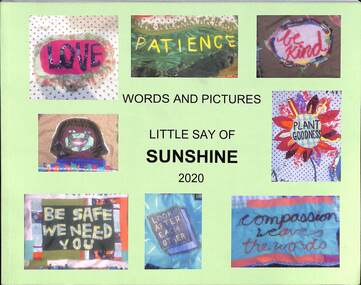
Book - Words and Pictures Little Say of Sunshine 2020, Gallery Sunshine Everywhere et al, 2020
... The pandemic raised issues of racial and geographic discrimination, health equity, and the balance between public health imperatives and individual rights. ...A photographic history of the 'Kindness Banner' project implemented during the COVID pandemic in 2020. The photos include Sunshine locals with their fence banners as well as 'Kindness' banners world wide. The global COVID-19 pandemic (also known as the coronavirus pandemic), caused by severe acute respiratory syndrome coronavirus 2 (SARS-CoV-2), began with an outbreak in Wuhan, China, in December 2019. It spread to other parts of Asia and then worldwide in early 2020. The World Health Organization (WHO) declared the outbreak a public health emergency of international concern (PHEIC) on 30 January 2020 and assessed it as having become a pandemic on 11 March. The WHO declared that the public health emergency caused by COVID-19 had ended in May 2023, while noting that COVID-19 continued to be a global health threat. The pandemic caused severe social and economic disruption around the world, including the largest global recession since the Great Depression.[12] Widespread supply shortages, including food shortages, were caused by supply chain disruptions and panic buying. Reduced human activity led to an unprecedented temporary decrease in pollution. Educational institutions and public areas were partially or fully closed in many jurisdictions, and many events were cancelled or postponed during 2020 and 2021. Telework became much more common for white-collar workers as the pandemic evolved. Misinformation circulated through social media and occasionally through mass media, and political tensions intensified. The pandemic raised issues of racial and geographic discrimination, health equity, and the balance between public health imperatives and individual rights.Soft covered bookA photographic history of the 'Kindness Banner' project implemented during the COVID pandemic in 2020. The photos include Sunshine locals with their fence banners as well as 'Kindness' banners world wide. The global COVID-19 pandemic (also known as the coronavirus pandemic), caused by severe acute respiratory syndrome coronavirus 2 (SARS-CoV-2), began with an outbreak in Wuhan, China, in December 2019. It spread to other parts of Asia and then worldwide in early 2020. The World Health Organization (WHO) declared the outbreak a public health emergency of international concern (PHEIC) on 30 January 2020 and assessed it as having become a pandemic on 11 March. The WHO declared that the public health emergency caused by COVID-19 had ended in May 2023, while noting that COVID-19 continued to be a global health threat. The pandemic caused severe social and economic disruption around the world, including the largest global recession since the Great Depression.[12] Widespread supply shortages, including food shortages, were caused by supply chain disruptions and panic buying. Reduced human activity led to an unprecedented temporary decrease in pollution. Educational institutions and public areas were partially or fully closed in many jurisdictions, and many events were cancelled or postponed during 2020 and 2021. Telework became much more common for white-collar workers as the pandemic evolved. Misinformation circulated through social media and occasionally through mass media, and political tensions intensified. The pandemic raised issues of racial and geographic discrimination, health equity, and the balance between public health imperatives and individual rights.sunshine, history -
 Victorian Aboriginal Corporation for Languages
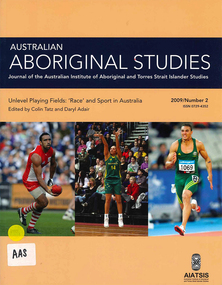
Periodical, Australian Institute of Aboriginal and Torres Strait Islander Studies, Australian Aboriginal studies : journal of the Australian Institute of Aboriginal and Torres Strait Islander Studies, 2009
... discrimination in the 1868 Aboriginal cricket tour of England David Sampson As a consequence of John Mulvaney?s important historical research, the Aboriginal cricket and performance tour of Britain in 1868 has in recent decades become established as perhaps the most famous of all public events in contact history involving Aborigines, white settlers and the British metropolis. Although recognition of its importance is welcome and significant, public commemorations of the tour have enveloped the tour in mythologies of cricket and nation. Such mythologies have obscured fundamental aspects of the tour that were inescapable racial...discrimination in the 1868 Aboriginal cricket tour of England David Sampson As a consequence of John Mulvaney?s important historical research, the Aboriginal cricket and performance tour of Britain in 1868 has in recent decades become established as perhaps the most famous of all public events in contact history involving Aborigines, white settlers and the British metropolis. Although recognition of its importance is welcome and significant, public commemorations of the tour have enveloped the tour in mythologies of cricket and nation. Such mythologies have obscured fundamental aspects of the tour that were inescapable racial ...Darkness and a little light: ?Race? and sport in Australia Colin Tatz (AIATSIS & Australian National University) and Daryl Adair (University of Technology Sydney) Despite ?the wonderful and chaotic universe of clashing colors, temperaments and emotions, of brave deeds against odds seemingly insuperable?, sport is mixed with ?mean and shameful acts of pure skullduggery?, villainy, cowardice, depravity, rapaciousness and malice. Thus wrote celebrated American novelist Paul Gallico on the eve of the Second World War (Gallico 1938 [1988]:9-10). An acute enough observation about society in general, his farewell to sports writing also captures the ?clashing colors? in Australian sport. In this ?land of the fair go?, we look at the malice of racism in the arenas where, as custom might have it, one would least want or expect to find it. The history of the connection between sport, race and society - the long past, the recent past and the social present - is commonly dark and ugly but some light and decency are just becoming visible. Coming to terms: ?Race?, ethnicity, identity and Aboriginality in sport Colin Tatz (AIATSIS & Australian National University) Notions of genetic superiority have led to some of the world?s greatest human calamities. Just as social scientists thought that racial anthropology and biology had ended with the cataclysm of the Second World War, so some influential researchers and sports commentators have rekindled the pre-war debate about the muscular merits of ?races? in a new discipline that Nyborg (1994) calls the ?science of physicology?. The more recent realm of racial ?athletic genes?, especially within socially constructed black athletic communities, may intend no malice but this search for the keys to their success may well revive the old, discredited discourses. This critical commentary shows what can happen when some population geneticists and sports writers ignore history and when medical, biological and sporting doctrines deriving from ?race? are dislocated from any historical, geographic, cultural and social contexts. Understanding discourses about race, racism, ethnicity, otherness, identity and Aboriginality are essential if sense, or nonsense, is to be made of genetic/racial ?explanations? of sporting excellence. Between the two major wars boxing was, disproportionately, a Jewish sport; Kenyans and Ethiopians now ?own? middle- and long-distance running and Jamaicans the shorter events; South Koreans dominate women?s professional golf. This essay explores the various explanations put forward for such ?statistical domination?: genes, biochemistry, biomechanics, history, culture, social dynamics, the search for identity, alienation, need, chance, circumstances, and personal bent or aptitude. Traditional games of a timeless land: Play cultures in Aboriginal and Torres Strait Islander communities Ken Edwards (University of Southern Queensland) Sports history in Australia has focused almost entirely on modern, Eurocentric sports and has therefore largely ignored the multitude of unique pre- European games that are, or once were, played. The area of traditional games, especially those of Aboriginal and Torres Strait Islander peoples, is an important aspect of the cultural, social and historical experiences of Indigenous communities. These activities include customs of play that are normally not associated with European notions of competitive sport. Overall, this paper surveys research undertaken into traditional games among Indigenous Australians, as well as proposals for much needed further study in this area. Culture, ?race? and discrimination in the 1868 Aboriginal cricket tour of England David Sampson As a consequence of John Mulvaney?s important historical research, the Aboriginal cricket and performance tour of Britain in 1868 has in recent decades become established as perhaps the most famous of all public events in contact history involving Aborigines, white settlers and the British metropolis. Although recognition of its importance is welcome and significant, public commemorations of the tour have enveloped the tour in mythologies of cricket and nation. Such mythologies have obscured fundamental aspects of the tour that were inescapable racial and colonial realities of the Victorian era. This reappraisal of the tour explores the centrality of racial ideology, racial science and racial power imbalances that enabled, created and shaped the tour. By exploring beyond cricketing mythology, it restores the central importance of the spectacular performances of Aboriginal skills without which the tour would have been impossible. Such a reappraisal seeks to fully recognise the often trivialised non-cricketing expertise of all of the Aboriginal performers in 1868 for their achievement of pioneering their unique culture, skills and technologies to a mass international audience. Football, ?race? and resistance: The Darwin Football League, 1926?29 Matthew Stephen (Northern Territory Archive Service) Darwin was a diverse but deeply divided society in the early twentieth century. The Commonwealth Government introduced the Aboriginals Ordinance 1911 in the Northern Territory, instituting state surveillance, control and a racially segregated hierarchy of whites foremost, then Asians, ?Coloureds? (Aborigines and others of mixed descent) and, lastly, the so-called ?full-blood? Aborigines. Sport was important in scaffolding this stratification. Whites believed that sport was their private domain and strictly controlled non-white participation. Australian Rules football, established in Darwin from 1916, was the first sport in which ?Coloured? sportsmen challenged this domination. Football became a battleground for recognition, rights and identity for all groups. The ?Coloured? community embraced its team, Vesteys, which dominated the Northern Territory Football League (NTFL) in the 1920s. In 1926, amidst growing racial tension, the white-administered NTFL changed its constitution to exclude non-white players. In reaction, ?Coloured? and Chinese footballers formed their own competition - the Darwin Football League (DFL). The saga of that colour bar is an important chapter in Australia?s football history, yet it has faded from Darwin?s social memory and is almost unknown among historians. That picture - Nicky Winmar and the history of an image Matthew Klugman (Victoria University) and Gary Osmond (The University of Queensland) In April 1993 Australian Rules footballer Nicky Winmar responded to on-field racist abuse by lifting his jersey and pointing to his chest. The photographic image of that event is now famous as a response to racial abuse and has come to be seen as starting a movement against racism in football. The racial connotations in the image might seem a foregone conclusion: the power, appeal and dominant meaning of the photograph might appear to be self-evident. But neither the fame of the image nor its racial connotation was automatic. Through interviews with the photographers and analysis of the use of the image in the media, we explore how that picture came to be of such symbolic importance, and how it has remained something to be re-shown and emulated. Rather than analyse the image as a photograph or work of art, we uncover some of its early history and explore the debates that continue to swirl around its purpose and meaning. We also draw attention to the way the careful study of photographs might enhance the study of sport, race and racism. ?She?s not one of us?: Cathy Freeman and the place of Aboriginal people in Australian national culture Toni Bruce (University of Waikato) and Emma Wensing (Independent scholar) The Sydney 2000 Olympic Games generated a national media celebration of Aboriginal 400 metre runner Cathy Freeman. The construction of Freeman as the symbol of national reconciliation was evident in print and on television, the Internet and radio. In contrast to this celebration of Freeman, the letters to the editor sections of 11 major newspapers became sites for competing claims over what constitutes Australian identity and the place of Aboriginal people in national culture. We analyse this under-explored medium of opinion and discuss how the deep feelings evident in these letters, and the often vitriolic responses to them, illustrate some of the enduring racial tensions in Australian society. Sport, physical activity and urban Indigenous young people Alison Nelson (The University of Queensland) This paper challenges some of the commonly held assumptions and ?knowledges? about Indigenous young people and their engagement in physical activity. These include their ?natural? ability, and the use of sport as a panacea for health, education and behavioural issues. Data is presented from qualitative research undertaken with a group of 14 urban Indigenous young people with a view to ?speaking back? to these commentaries. This research draws on Critical Race Theory in order to make visible the taken-for-granted assumptions about Indigenous Australians made by the dominant white, Western culture. Multiple, shifting and complex identities were expressed in the young people?s articulation of the place and meaning of sport and physical activity in their lives. They both engaged in, and resisted, dominant Western discourses regarding representations of Indigenous people in sport. The paper gives voice to these young people in an attempt to disrupt and subvert hegemonic discourses. An unwanted corroboree: The politics of the New South Wales Aboriginal Rugby League Knockout Heidi Norman (University of Technology Sydney) The annual New South Wales Aboriginal Rugby League Knockout is so much more than a sporting event. Involving a high level of organisation, it is both a social and cultural coming together of diverse communities for a social and cultural experience considered ?bigger than Christmas?. As if the planning and logistics were not difficult enough, the rotating-venue Knockout has been beset, especially since the late 1980s and 1990s, by layers of opposition and open hostility based on ?race?: from country town newspapers, local town and shire councils, local business houses and, inevitably, the local police. A few towns have welcomed the event, seeing economic advantage and community good will for all. Commonly, the Aboriginal ?influx? of visitors and players - people perceived as ?strangers?, ?outsiders?, ?non-taxpayers? - provoked public fear about crime waves, violence and physical safety, requiring heavy policing. Without exception, these racist expectations were shown to be totally unfounded. Research report: Recent advances in digital audio recorder technology provide considerable advantages in terms of cost and portability for language workers.b&w photographs, colour photographs, tablessport and race, racism, cathy freeman, nicky winmar, rugby league, afl, athletics, cricket, digital audio recorders -
Koorie Heritage Trust
Book, Broome, Richard, Aboriginal Australians. Black Responses to white Dominance 1788-1994. (Second Edition), 1994
... . - To 1900 | Race relations - Racism - Stereotyping | Surveys traditional life and values, confrontations with the British; violent conflicts with settlers, native police throughout the country; attacks on Aboriginal initiative at Coranderrk, Cumeroogunja and other settlements; racial legislation, missionary attitudes; cattle industry, mining; discrimination; growth of Aboriginal rights movement, Aboriginal organizations, land rights. 4-275 P.; plates; ill,; appendices; notes; bib.; index; 22 cm. ...Surveys traditional life and values, confrontations with the British; violent conflicts with settlers, native police throughout the country; attacks on Aboriginal initiative at Coranderrk, Cumeroogunja and other settlements; racial legislation, missionary attitudes; cattle industry, mining; discrimination; growth of Aboriginal rights movement, Aboriginal organizations, land rights.4-275 P.; plates; ill,; appendices; notes; bib.; index; 22 cm.Surveys traditional life and values, confrontations with the British; violent conflicts with settlers, native police throughout the country; attacks on Aboriginal initiative at Coranderrk, Cumeroogunja and other settlements; racial legislation, missionary attitudes; cattle industry, mining; discrimination; growth of Aboriginal rights movement, Aboriginal organizations, land rights.aboriginal australians -- social conditions. | race discrimination -- australia. | australia -- race relations. | economic sectors - agriculture and horticulture - pastoral industry - beef cattle | religions - christianity - missions | settlement and contacts - 20th century | enterprises - pastoral industry | government policy - assimilation | government policy - initial period and protectionism | government policy - integration | government policy - state and territory - new south wales | government policy - state and territory - victoria | law - land | land rights - mining industry | land rights - pastoral industry | socioeconomic conditions - living conditions | occupations - pastoral industry workers | law enforcement - police - native police | law enforcement - police conduct and attitudes | politics and government - political action - land rights | race relations - violent - massacres, murders, poisonings etc. - to 1900 | race relations - racism - stereotyping | -
Koorie Heritage Trust
Book, Olbrei, Erik, Black Australians : the prospects for change, 1982
... Garth Nettheim: The possibilities for Commonwealth action in Queensland. THE RACIAL DISCRIMINATION ACT. Al Grassby: Combatting racism in Australia. ...Contents: THE LEGACY OF THE PAST. Henry Reynolds: European justification for taking the land; Noel Loos & Jane Thomson: Black resistance past & present: An overview. FEDERAL POLICIES IN THE SEVENTIES. Lyndall Ryan: Federal policies on land rights: an overview of the seventies; Commentary: H.C. Coombs. LAND RIGHTS IN THE NORTHERN TERRITORY. Bob Collins: The march backwards; Proposed liquor laws & a draft criminal code for the Northern Territory. A TREATY & THE NAC. H.C. Coombs: The case for a treaty; Les Malezer: NAC proposals for a Makarrata; Marcia Langton: The international lobby and Makarrata; Judith Wright: In defence of a treaty. QUEENSLAND GOVERNMENT POLICIES. Garth Nettheim: The Queensland Acts & human rights; Jim Keeffe: DAIA: The role of the protector - then & now. QUEENSLAND RESERVES AND COMMUNITIES. Kenny Jacobs, Roberta Felton & Darwin Mudunathi: Mornington Island perspectives; Delphine Geia: Life on Palm Island; Eric Kyle: Changes on Palm Island; Shorty O'Neill : The effects of Queensland policies on grass roots Aborigines; Granny Dolly speaks; Les Collins: The significance of the Aboriginal flag. TORRES STRAIT ISLANDER PERSPECTIVES. Eddie Koiki Mabo: Land rights in the Torres Strait; Nonie Sharp: The seafaring peoples of the Cape York region: Themes in a quest for homelands; Ben Mills: Islanders' response to proposed repeal of the Torres Strait Islanders Act. POSSIBILITIES FOR COMMONWEALTH ACTION. Garth Nettheim: The possibilities for Commonwealth action in Queensland. THE RACIAL DISCRIMINATION ACT. Al Grassby: Combatting racism in Australia. A HIGH COURT CHALLENGE? Barbara Hocking: Is might right? An argument for the recognition of traditional Aboriginal title to land in the Australian courts; Greg McIntyre: Aboriginal land rights - a definition at common law.xvii, 255 p. ; maps; 21 cm.Contents: THE LEGACY OF THE PAST. Henry Reynolds: European justification for taking the land; Noel Loos & Jane Thomson: Black resistance past & present: An overview. FEDERAL POLICIES IN THE SEVENTIES. Lyndall Ryan: Federal policies on land rights: an overview of the seventies; Commentary: H.C. Coombs. LAND RIGHTS IN THE NORTHERN TERRITORY. Bob Collins: The march backwards; Proposed liquor laws & a draft criminal code for the Northern Territory. A TREATY & THE NAC. H.C. Coombs: The case for a treaty; Les Malezer: NAC proposals for a Makarrata; Marcia Langton: The international lobby and Makarrata; Judith Wright: In defence of a treaty. QUEENSLAND GOVERNMENT POLICIES. Garth Nettheim: The Queensland Acts & human rights; Jim Keeffe: DAIA: The role of the protector - then & now. QUEENSLAND RESERVES AND COMMUNITIES. Kenny Jacobs, Roberta Felton & Darwin Mudunathi: Mornington Island perspectives; Delphine Geia: Life on Palm Island; Eric Kyle: Changes on Palm Island; Shorty O'Neill : The effects of Queensland policies on grass roots Aborigines; Granny Dolly speaks; Les Collins: The significance of the Aboriginal flag. TORRES STRAIT ISLANDER PERSPECTIVES. Eddie Koiki Mabo: Land rights in the Torres Strait; Nonie Sharp: The seafaring peoples of the Cape York region: Themes in a quest for homelands; Ben Mills: Islanders' response to proposed repeal of the Torres Strait Islanders Act. POSSIBILITIES FOR COMMONWEALTH ACTION. Garth Nettheim: The possibilities for Commonwealth action in Queensland. THE RACIAL DISCRIMINATION ACT. Al Grassby: Combatting racism in Australia. A HIGH COURT CHALLENGE? Barbara Hocking: Is might right? An argument for the recognition of traditional Aboriginal title to land in the Australian courts; Greg McIntyre: Aboriginal land rights - a definition at common law.aboriginal australians. land rights. conference proceedings | aboriginal australians. race relations. conference proceedings | aboriginal australians -- land tenure -- congresses. | aboriginal australians, treatment of -- congresses. | australia -- race relations -- congresses. -
Koorie Heritage Trust
Book, Bandler, Faith, Turning the tide : a personal history of the Federal Council for the Advancement of Aborigines and Torres Strait Islanders, 1989
... Faith Bandler's background has given her the right to speak out loudly and clearly against racial discrimination. In 1956 she co-founded the Aboriginal - Australian Fellowship and later became a key figure in the founding of the Federal Council for the Advancement of Aborigines and Torres Strait Islanders xvii, 173 p. : ill., ports. ; 20 cm. ...Turning the Tide is about political struggle in the past three decades of Aboriginal affairs in Australia. Faith Bandler's background has given her the right to speak out loudly and clearly against racial discrimination. In 1956 she co-founded the Aboriginal - Australian Fellowship and later became a key figure in the founding of the Federal Council for the Advancement of Aborigines and Torres Strait Islandersxvii, 173 p. : ill., ports. ; 20 cm.Turning the Tide is about political struggle in the past three decades of Aboriginal affairs in Australia. Faith Bandler's background has given her the right to speak out loudly and clearly against racial discrimination. In 1956 she co-founded the Aboriginal - Australian Fellowship and later became a key figure in the founding of the Federal Council for the Advancement of Aborigines and Torres Strait Islandersbandler, faith. | federal council for the advancement of aborigines and torres strait islanders -- history. | federal council for the advancement of aborigines and torres strait islanders -- history. | aboriginal australians -- social conditions. | race discrimination -- australia. | australia -- history -- 20th century. | australia -- race relations.
