
Showing 51 items matching " rubbings"
-
 Federation University Historical Collection
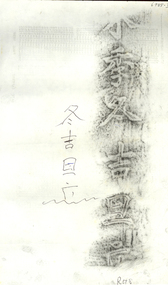
Work on paper - Artwork - Frotage, Keith E. Rash, Chinese Rubbings relating to Ballarat, c1950s-60s
... Chinese Rubbings relating to Ballarat......rubbings...Chinese rubbings, possibly from the Ballarat Cemetery. ...chinese chinese calligraphy cemetery headstone keith rash frotage rubbings Ballarat Chinese rubbings, possibly from the Ballarat Cemetery. ...Chinese rubbings, possibly from the Ballarat Cemetery. They are thought to have been made by Keith Rash.chinese, chinese calligraphy, cemetery, headstone, keith rash, frotage, rubbings, ballarat -
 Federation University Historical Collection
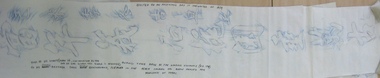
Work on paper - Artwork, Ballarat East Main Road Joss House Rubbings
... Ballarat East Main Road Joss House Rubbings...Erected in winter of 1859. .9) Crayon rubbing .10) Outline of calligraphy on copy paper .11) Rubbings of calligraphy on copy paper. ...Erected in winter of 1859. .9) Crayon rubbing .10) Outline of calligraphy on copy paper .11) Rubbings of calligraphy on copy paper. ...A number of rubbings of calligraphic carvings thought to be from the Ballarat East Joss House in Main Road. .1) Blue and brown crayon. Translation: Erected on an auspicious day in winter 1859. Think of his loyalty (Quan Yu, now can canonised as the god of war to whom this temple is dedicated) (AD1084) to his sworn lover their sworn botherhood pledged in the peach garden as has been praised for thousands of years. .2) Rubbing in blue crayon of Chinese calligraphy from pole on right hand side of Joss House Door. (Larger) his great graciousness spreads to other (us here in foreign lands) kingdoms, and his virtue guards our gold miners everywhere. (Smaller) Dedicated to his disciples the Chu Pei-Huo family .3) Rubbing on litho paper. translation - One who knows the nature of things (in the world) will thus understand human nature. .4) Rubbing on litho paper. Translation of middle calligraphy - We all behold the wisdom of the gods in the heavens, earth and man. .5) Rubbing on litho paper - translation - The grace of god flows to all corners of the earth. .6) Charcoal rubbing - translation - Temple of the god of war. .7) Crayon rubbing of calligraphy on litho paper. Translation - Dedicated by the Ma Chu-Feng family. Emperor's virtue spreads far and wide. Grace in Abundance. Erected in winter, 1859. .8) Crayon rubbing of calligraphy on litho paper. Translation: Respectfully dedicated by the Ts'Ai Chi-Yang family. Grace in abundance. Erected in winter of 1859. .9) Crayon rubbing .10) Outline of calligraphy on copy paper .11) Rubbings of calligraphy on copy paper. Translation: The Holy God of War. Exhibited in 1862. Your respectful disciples. .12) List of 11 disciples chinese, joss house, keith rash, chu pei-huo, quan yu, ma chu-feng, ts'ai chi-yang, lee chua-yeh, hwong tien-jyue, wa perg-nan, liu chin-chuson, an lee factory, lice hsue-chiere, lee mei-tzy, lee pas-chi, lui lih-nie, wir hon-fu, li hsi-yang -
 Federation University Historical Collection
Work on paper - Artwork, Keith Rash, Ballarat Chinese Joss House Rubbing, c1960s
... Ballarat Chinese Joss House Rubbing...These rubbings were probably made before the Ballarat Joss House was demolished in the 1960s. ...Rubbings made from signs at the Ballarat Joss House....verso "This rubbing from K. Rash, Ballarat for Chinese section for translation please. ...Thanks Keith." Rubbings made from signs at the Ballarat Joss House. ...These rubbings were probably made before the Ballarat Joss House was demolished in the 1960s. Translation Large characters: For the benefit of all Right hand side; Established during the Winter Festival 1919. Left hand side: Donated by Chou Ai Lien (two characters not clear)Rubbings made from signs at the Ballarat Joss House.verso "This rubbing from K. Rash, Ballarat for Chinese section for translation please. Thanks Keith."chinese, chinese joss house, chou ai lien -
 Canterbury History Group
Document - Brass rubbing of a plaque, Jan Pigot, May 1994
... Brass rubbing of the plaque in the footpath outside 78 Maling Road noting the opening of the row of new shops 60-78 Maling Road and a time capsule with material collected from every business in Maling Road in May 1994....Brass rubbing in brown wax of a plaque...Maling Road Time Capsules Brass rubbing in brown wax of a plaque Document Brass rubbing of a plaque Jan Pigot ...Brass rubbing of the plaque in the footpath outside 78 Maling Road noting the opening of the row of new shops 60-78 Maling Road and a time capsule with material collected from every business in Maling Road in May 1994.Brass rubbing in brown wax of a plaquemaling road, time capsules -
 Vision Australia
Photograph - Image, Pampering session at RBS
... A group of ladies sit around a table, rubbing make up products into their face. One lady, in the foreground, is receiving a facial massage....1 B/W photograph of woman sitting and rubbing lotion on their faces...A group of ladies sit around a table, rubbing make up products into their face. One lady, in the foreground, is receiving a facial massage. ...A group of ladies sit around a table, rubbing make up products into their face. One lady, in the foreground, is receiving a facial massage.1 B/W photograph of woman sitting and rubbing lotion on their faces12 A recreation - William Streetroyal blind society of new south wales, recreation -
Whitehorse Historical Society Inc.
Document, Plaque, 4/05/1972 12:00:00 AM
... (a) a sketch of the plaque and base. (b) a rubbing of the plaque....(a) a sketch of the plaque and base. (b) a rubbing of the plaque....(a) a sketch of the plaque and base. (b) a rubbing of the plaque. Plaque Yarran Dheran Reserve Trees Shire of Nunawading Sketch and Rubbing of a plaque Sketch and Rubbing of a plaque on brownish coloured paper to mark the Centenary of the Shire of Nunawading situated at Yarran Dheran. 4 May 1872 - 4 May 1972 . ...Sketch and Rubbing of a plaqueSketch and Rubbing of a plaque on brownish coloured paper to mark the Centenary of the Shire of Nunawading situated at Yarran Dheran. 4 May 1872 - 4 May 1972 . The original plaque is lost.100 trees were planted by 100 children in commemoration. (a) a sketch of the plaque and base. (b) a rubbing of the plaque.Sketch and Rubbing of a plaqueplaque, yarran dheran reserve, trees, shire of nunawading -
Hand Tool Preservation Association of Australia Inc
Rubbing block
... rubbing block...This item is part of the Thomas Caine Tool Collection, owned by The National Trust of Australia (Victoria) and curated by the Hand Tools Preservation Association of Australia. rubbing block Rubbing block ...This item is part of the Thomas Caine Tool Collection, owned by The National Trust of Australia (Victoria) and curated by the Hand Tools Preservation Association of Australia.rubbing block -
 Bright & District Historical Society operating the Bright Museum
Turkey Stone, 1800s
... All sides show evidence of rubbing....All sides show evidence of rubbing. Turkey Stone ...Oblong stone. All sides show evidence of rubbing.turkey stone, chinese, goldfields, harrietville -
 Bendigo Historical Society Inc.
Tool - Wiltshire rasp file combination
... a course file or similar metal tool for scraping, filing or rubbing down wood, metal or other materials. ...Tools rasp file Wiltshire V V Australia a course file or similar metal tool for scraping, filing or rubbing down wood, metal or other materials. ...a course file or similar metal tool for scraping, filing or rubbing down wood, metal or other materials. It has two rasp and two file grades.Wiltshire V V Australia tools, rasp, file -
 School of Health and Biomedical Sciences, RMIT University
Work on paper - Rubbing, for a favour tantamount to giving somebody a new lease of life
... Framed rubbing on paper with brown wood frame. Brown wax seal at rear bottom right corner. ...Chinese medicine patients RMIT Chinese Medicine Collection Framed rubbing on paper with brown wood frame. Brown wax seal at rear bottom right corner. ...Framed rubbing on paper with brown wood frame. Brown wax seal at rear bottom right corner. A plaque made by a patient who appreciated the doctor. chinese medicine, patients, rmit chinese medicine collection -
Women's Art Register
Archive (Series) - Fitzgerald, Mirabel. Artist File 1
... ... Rubbings...Drawing Rubbings Architecture Foolscap white archival 4 flap folder or document wallet Archive Fitzgerald, Mirabel. ...drawing, rubbings, architecturedrawing, rubbings, architecture -
Women's Art Register
Archive (Collection) - Mirabel Fitzgerald Artist Archive
... ... Rubbings...Drawing Rubbings Architecture Archive Mirabel Fitzgerald Artist Archive ...drawing, rubbings, architecturedrawing, rubbings, architecture -
Women's Art Register
Archive (Series) - Mirabel Fitzgerald. Duplicate File 1
... ... Rubbings...Drawing Rubbings Architecture Foolscap manilla file Archive Mirabel Fitzgerald. ...drawing, rubbings, architecturedrawing, rubbings, architecture -
 Greensborough Historical Society
Domestic object - Washboard, 1900 c
... The corrugated section used to remove ingrained dirt by rubbing...The corrugated section used to remove ingrained dirt by rubbing washboards laundry laundry equipment Wooden washboard, corrugated both sides, painted green Domestic object Washboard ...Used in laundering clothing etc. The corrugated section used to remove ingrained dirt by rubbingWooden washboard, corrugated both sides, painted greenwashboards, laundry, laundry equipment -
Federation University Historical Collection
Drawing - Rubbing, Rubbing on a plaque relating to the Sky High Restaurant
... Rubbing...Rubbing on a plaque relating to the Sky High Restaurant......rubbing...A number of rubbings from plaques on buildings. .1) Sky High Restaurant .2) Pioneers Tablet (Probably relating to the Pioneers Plot at the Ballaarat Old Cemetery. .3) and .4) Plaque relating to the Pioneers tablet...The only remaining members of the Original Pioneers Memorial Committee. A number of rubbings from plaques on buildings. .1) Sky High Restaurant .2) Pioneers Tablet (Probably relating to the Pioneers Plot at the Ballaarat Old Cemetery. .3) and .4) Plaque relating to the Pioneers tablet Rubbing on a plaque relating to the Sky High Restaurant Drawing Rubbing ...This is thought to be the work of Keith Rash of Ballarat.A number of rubbings from plaques on buildings. .1) Sky High Restaurant .2) Pioneers Tablet (Probably relating to the Pioneers Plot at the Ballaarat Old Cemetery. .3) and .4) Plaque relating to the Pioneers tablet.1) This Skyhigh restaurant was officially opened by The Hon. Vance Dickie M.L.C. Minister for Tourism on the 25th March 1971 This building was planned and constructed for The Ministry of Tourism J. Dale Fisher F.R.A.I.A. Architect W.J. Cody & Quinn Pty Ltd Builders .2) (logo) This tablet was erected by the citizens of Ballarat in honour of the pioneers of this city and district. .3) This MEMORIAL TABLET was unveiled on the 3rd May 1961 by F.W. WRAY, Esq in the company of S.C. HENDERSON, Esq. The only remaining members of the Original Pioneers Memorial Committee.architecture, j. dale, w, j, cody & quinn, skyhigh restaurant, frottage, rubbing, ballarat pioneers, keith rash -
Lakes Entrance Historical Society
Photograph - Aboriginal men making fire, Mission Station Lakes Tyers Victoria, Bulmer
... Black and white photograph of two Aboriginal men making fire by rubbing two sticks, man on right holding a bundle of grass on fire. ...Enlarged from Bulmer postcard Arts aboriginal culture Fire makers Boomerang vendors Lake Tyers Black and white photograph of two Aboriginal men making fire by rubbing two sticks, man on right holding a bundle of grass on fire. ...Enlarged from Bulmer postcardBlack and white photograph of two Aboriginal men making fire by rubbing two sticks, man on right holding a bundle of grass on fire. Baskets and boomerangs in foreground Mission Station Lakes Tyers VictoriaFire makers Boomerang vendors Lake Tyersarts, aboriginal culture -
 National Wool Museum
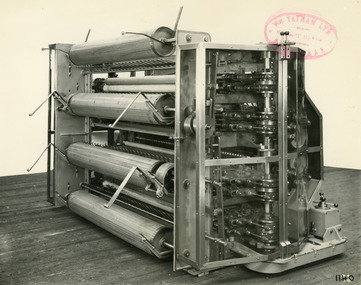
Photograph - Product Photograph, Tape Condenser
... Machine Maker Front bottom right corner - 1140 Rear - New Model Four-teir Tape Condenser showing rubbing motion side Note greatly improved guarding completely enclosing rubbing motion and gearing, also Variable Speed Drive to Rubbing Motiom via heavy ‘V’ Belt. ...Machine Maker Front bottom right corner - 1140 Rear - New Model Four-teir Tape Condenser showing rubbing motion side Note greatly improved guarding completely enclosing rubbing motion and gearing, also Variable Speed Drive to Rubbing Motiom via heavy ‘V’ Belt. ...These are sales photographs for William Tatham Ltd. of Rochdale. These photographs are taken in the fitting shop at William Tatham Ltd. where final assembly would have taken place. A Tape Condenser is a device that receives the wide fibre web from a woollen card, divides it, and rubs each section into a sliver. The photographed machine was made by William Tatham Ltd, a textile engineering company based in Rochdale, UK. Established in 1866 Tatham developed innovative textile machinery and send their products to Australia and other countries around the world.Two black and white photos of a Tape Condenser in a landscape format. The first photo is of the front of the machine, the second is of the rear.8038.1 - Front - top margin: For description see over. Front mid right edge - Wm. TATHAM Ltd. ROCHDALE. Machine Maker Front bottom right corner - 1138 Rear - Showing new model Tape Condenser with all-Perspex Guards, new gear box type of main drive to Condenser. New mounting of all Tape Rollers, cross shaft drive to Variable Speed Gear Box for drive to rubber shaft and many other improved features. 8038.2 - Front mid right edge - Wm. TATHAM Ltd. ROCHDALE. Machine Maker Front bottom right corner - 1140 Rear - New Model Four-teir Tape Condenser showing rubbing motion side Note greatly improved guarding completely enclosing rubbing motion and gearing, also Variable Speed Drive to Rubbing Motiom via heavy ‘V’ Belt. The drive is taken by cross-shaft from the main gearing of the Condenser. Rubbing Motion has all roller bearing eccentrics throughout.textile machinery, tatham, wool manufacture, tape condenser -
 Alfred Hospital Nurses League - Nursing History Collection
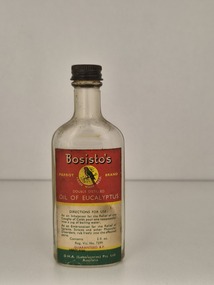
Container - Glass bottle, Bosito's oil of eucalyptus bottle
... Eucalyptus oil as 'an inhalation for the relief of coughs and colds( when diluted with boiling water) and as an "emrocation for the relief of sprains , strains and other muscular disorders, by rubbing freely into the affected parts...Eucalyptus oil as 'an inhalation for the relief of coughs and colds( when diluted with boiling water) and as an "emrocation for the relief of sprains , strains and other muscular disorders, by rubbing freely into the affected parts First aid practices in the mid 1900's Oil of eucalyptus first aid On back of bottle there is a small rectangular white sticker on which the previous catalogue number has been handwritten [black ink] Clear glass bottle with metal cap There is a rectangular red, white and green label with and green print detailing contents, uses and manufactures details including logo [parrot] Bosito's oil of eucalyptus bottle Container Glass bottle ...Eucalyptus oil as 'an inhalation for the relief of coughs and colds( when diluted with boiling water) and as an "emrocation for the relief of sprains , strains and other muscular disorders, by rubbing freely into the affected partsFirst aid practices in the mid 1900'sClear glass bottle with metal cap There is a rectangular red, white and green label with and green print detailing contents, uses and manufactures details including logo [parrot]On back of bottle there is a small rectangular white sticker on which the previous catalogue number has been handwritten [black ink]oil of eucalyptus, first aid -
 Melbourne Tram Museum
Ephemera - MBCTT 2d ticket, The Melbourne, Brunswick and Coburg Tramways Trust (MBCTT), late 1910s
... On the rear has an advert for Witch soap - no rubbing, only boil....On the rear has an advert for Witch soap - no rubbing, only boil. Demonstrates a MBCTT ticket that has been used. tramways tickets MBCTT ticket printed on light green paper with black printing. ...Ticket issued by the MBCTT, value 2d, printed with the conditions of travel. Has 8 sections on either side, has been punched for section 3, Up or inbound to the city trip. On the rear has an advert for Witch soap - no rubbing, only boil.Demonstrates a MBCTT ticket that has been used.ticket printed on light green paper with black printing.tramways, tickets, mbctt -
 Warrnambool and District Historical Society Inc.
Book, Saturday Mornings, 1931
... The spine lettering is faded and the cover has some slight rubbing. It is bound with glue and reinforced inside the cover with tape. ...The spine lettering is faded and the cover has some slight rubbing. It is bound with glue and reinforced inside the cover with tape. ...This book contains a collection of essays written by Walter Murdoch. Most of them were originally published in the Melbourne Argus newspaper. Walter Logie Forbes Murdoch (1874-1970) had a distinguished academic and literary career. In addition he was a household name to two generations of Australians through his radio broadcasts and syndicated columns in several Australian newspapers. In 1901 Murdoch came to Warrnambool as the proprietor of a private school. In 1904 he became a lecturer in English at Melbourne University and later the foundation Professor of English at the University of Western Australia. He was later its Chancellor. Murdoch University in Western Australia is named after him and he was knighted in 1964. He published over 40 books. This book is of interest as it was written by Walter Murdoch who was not only an important figure in Australia literature but also he played a part in Warrnambool’s history. He came to Warrnambool in 1901, going into partnership with James Scott, the proprietor of Warrnambool College. They bought out Stanley’s Warrnambool Grammar School and when Scott retired Murdoch became the sole proprietor and Headmaster of Warrnambool College. Whilst in Warrnambool Murdoch wrote the school history text book, ‘The Struggle for Freedom’. He left Warrnambool in 1904. The original owner of the book, Mary Minkwitz, may have had some connection with Warrnambool as a member of the Minkwitz family who lived in Warrnambool in the 1950s. This is a hard cover book of 240 pages. It has a dark green cover with the name of the book and the author printed in gold lettering on the spine. It has a Preface, 35 short essays by Walter Murdoch and an Index. The spine lettering is faded and the cover has some slight rubbing. It is bound with glue and reinforced inside the cover with tape. ‘This book belongs to Mary D. Minkwitz’.walter murdoch, australian literature, history of warrnambool, warrnambool college (early 20th century) -
 Kilmore Historical Society
Illustrated Scripture History, Illustrated Scripture History for the Improvement of Youth, Vol. 2, 1851
... Green marbelled board cover with black leather spine & corners. Surface rubbing of board and leather, leather spine cracked at coners. ...Green marbelled board cover with black leather spine & corners. Surface rubbing of board and leather, leather spine cracked at coners. ...Green marbelled board cover with black leather spine & corners. Surface rubbing of board and leather, leather spine cracked at coners. Binding intact but spine detached at front cover. Six decorative gilt bands on spine. Title in gilt on spine. P. 177 torn, loose. P. 175 loose. 304 pp. Fair condition.Label inside front cover 'from Chapman Family'. Pressed pansies between pp. 99-100.scriptures, children, kilmore mechanics institute library. -
Federation University Historical Collection
Equipment - Ethnograpgic Material, Axe blanks
... Axe blanks are pieces of stone that Aboriginal people chipped into a basic shape at stone quarries and sharpened by rubbing the edges over sandstone. Axe blanks were made by striking larke flakes of stone from rocky outcrops, then roughly sharpening them. ...Axe blanks are pieces of stone that Aboriginal people chipped into a basic shape at stone quarries and sharpened by rubbing the edges over sandstone. Axe blanks were made by striking larke flakes of stone from rocky outcrops, then roughly sharpening them. ...Axe blanks are pieces of stone that Aboriginal people chipped into a basic shape at stone quarries and sharpened by rubbing the edges over sandstone. Axe blanks were made by striking larke flakes of stone from rocky outcrops, then roughly sharpening them. The axes were often finished away fro the quarry.Three stone axe blanksaxe, tool, aboriginal -
 Federation University Art Collection
Painting - Artwork, 'Ovens River' by Veronica Drum, 2019
... Artists' Statement: Through the fusion of colours, textures, mark-making and a 'rubbing back' process, my intuitive rendering of the chosen media creates layers in my artwork that reflect and build upon cherished childhood memories. ...Artists' Statement: Through the fusion of colours, textures, mark-making and a 'rubbing back' process, my intuitive rendering of the chosen media creates layers in my artwork that reflect and build upon cherished childhood memories. ...I conceive my work as unfinished fragments of memory and childhood rituals, and through the art making process, I build and then peel back the layers of these memories and early influences, to reveal my personal dreamscape. Through the fusion of colour, texture, mark making and rubbing back, my intuitive rendering of the media creates layers that like memories, can be stacked up, hidden, peeled away, rubbed out, etched back in, and the process of layering and building up of a tactile textured surface, reflects memory itself; with its elusiveness and hard to grasp impressions that are more like ingrained watermarks. As I work, layering the surface then taking it back; rebuilding, adding marks and burnishing back, I feel into the textures, and through this tactile rendering I often discover something unintended and the end result is not quite how I perceived it in the planning. Perhaps something of a happy accident, which again reflects the arbitrariness of memory. I see my artworks less as paintings, but assemblages, with the layering technique creating a sculptural effect that reflects my great interest in the landscape and its beautiful and varied colours, shapes and textures. Part of my process is to take long drives into the country where I grew up, photographing along the way, to create a visual documentary that then informs my practice. The wide paddocks of the Victorian wheatbelt, beneath the endless blue of the horizon evokes very early memories so that a singular Bullock, a fencepost, a hay roll or corrugated iron wall, is so uniquely resonant to me, I am compelled to create this in my work. My connection to the land, to farming practices; the poplars, oaks and elm trees of my childhood holidays, is a mindscape that I return to again and again as I try to recreate that early sense of wonder, love and familiarity, grief and joy, that forms my unique vision. Veronica DRUM (1967 - ) Born Donald, Victoria A student at Federation University Arts Academy from 2015 until 2019, Veronica Drum is committed to establishing regular studio practice. Veronica Drum made this work in the final studio semester of the Bachelor of Visual Arts at the Federation University Arts .Academy.Framed Mixed media artwork depicting the Ovens Rivers, Victoria. Artists' Statement: Through the fusion of colours, textures, mark-making and a 'rubbing back' process, my intuitive rendering of the chosen media creates layers in my artwork that reflect and build upon cherished childhood memories. This work won the 2019 Federation University DVC 2D Art Acquisition Award.veronica drum, mixed media, alumni, oven river, dvc art acquisition award, trees, landscape, treescape -
 Warrnambool and District Historical Society Inc.
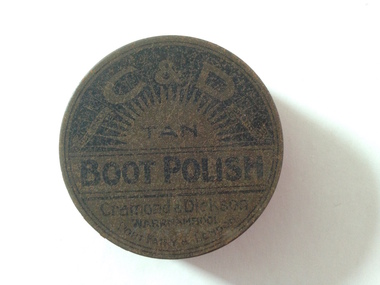
Tin, Boot polish Cramond & Dickson, Early 20th century
... Port Fairy and London’ Bottom: ‘For best results remove all dust, apply a little C & D dressing, brush briskly. Rubbing finally with a soft cloth produces a brilliant surface. ...Port Fairy and London’ Bottom: ‘For best results remove all dust, apply a little C & D dressing, brush briskly. Rubbing finally with a soft cloth produces a brilliant surface. ...This tin of boot polish was a common household item in the 20th century (and is still used to a lesser extent today). This tan boot polish was sold under the brand name of ‘C & D’ at the general store of Cramond and Dickson in Liebig Street, Warrnambool. John Glass Cramond and James Dickson established their business in Warrnambool in 1855 and this general store operated (firstly in Timor Street and later in Liebig Street) until 1973, making it one of the longest-running and one of the most important businesses in Warrnambool’s history. By 1868 a London agency had been established and direct imports from England began on a large scale. Many of the articles they sold, including the boot polish, were made expressly for the Cramond and Dickson store. This tin of boot polish is of great interest as an example of the goods sold by Cramond and Dickson that were made expressly for the Warrnambool store. Cramond and Dickson were one of the most important stores ever to operate in Warrnambool.This is a round metal tin originally gold-coloured and with a red tape binding to prevent its opening. The front of the tin has printing and the image of a stylized rising sun and the bottom has more printing. The bottom of the tin is indented to allow the tin to rest on the rim only. The printing is legible but much faded. The tin contains the original polish. Top: ‘Use only C & D brand of Tan Boot Polish, Cramond & Dickson, Warrnambool. Port Fairy and London’ Bottom: ‘For best results remove all dust, apply a little C & D dressing, brush briskly. Rubbing finally with a soft cloth produces a brilliant surface. Weight when packed 1½ ozs. net’ cramond and dickson store -
Glen Eira Historical Society
Drawing - Caulfield Educational Institute
... Sims of Caulfield Historical Society which accompanied the rubbing and photocopy of Prof. Charles Damm’s inscription in the book he presented on December 17, 1859. ...Sims of Caulfield Historical Society which accompanied the rubbing and photocopy of Prof. Charles Damm’s inscription in the book he presented on December 17, 1859. ...A photocopy of an advertisement in The Argus, January 6, 1858 for the opening of Baden Villa, Mr. and Mrs. Damm’s Boarding School for young ladies at Glenhuntly Road, Caulfield on January 19, 1858. A photocopy of the page with Prof. Charles Damm’s handwritten inscription in the book presented to George Dickson, Student at Baden Villa Educational Institute on December 17, 1859. A one page rubbing of the embossing on the cover of the book presented to George Dickson on December 17, 1859. The embossing reads Harry’s Book of Poetry. One page handwritten letter dated July 11, 1978 from Dorothy Champion to Mr. Sims of Caulfield Historical Society which accompanied the rubbing and photocopy of Prof. Charles Damm’s inscription in the book he presented on December 17, 1859. One page of handwritten notes by Peta Darke dated February 1, 2011 concerning Miss Cathcart and Mr. David Birrell’s Schools’ locations.baden villa, clonmore, glenhuntly road, caulfield educational institute, caulfield north, kooyong road, parkside street, shoobra road, downshire road, caulfield, damm charles, damm mrs., dickson george, cathcart lilian, birrell david w., snowball miss, champion dorothy, sims mr., education, schools, independent schools, principals, teachers, schoolhouses, caulfield historical society -
 Warrnambool and District Historical Society Inc.
Board, Wash board child, Early 20th century
... This child’s wash board, a play item, is possibly home-made. Wash boards for rubbing and washing clothes were common household clothes- washing items in Australia until the mid 20th century, along with wood coppers, washing troughs, copper sticks and simple wringers. ...This child’s wash board, a play item, is possibly home-made. Wash boards for rubbing and washing clothes were common household clothes- washing items in Australia until the mid 20th century, along with wood coppers, washing troughs, copper sticks and simple wringers. ...This child’s wash board, a play item, is possibly home-made. Wash boards for rubbing and washing clothes were common household clothes- washing items in Australia until the mid 20th century, along with wood coppers, washing troughs, copper sticks and simple wringers. By the 1950s and 60s washing machines were becoming more prevalent and the wash board was no longer a common item in households. This item is retained as an interesting example of a twentieth Century child's toy.This is a rectangular-shaped unpainted wooden wash board with clear rippled glass inserted in the centre and held in by four metal screws. The top of the board has a piece of the wood missing. household items, children’s toys -
 Warrnambool and District Historical Society Inc.
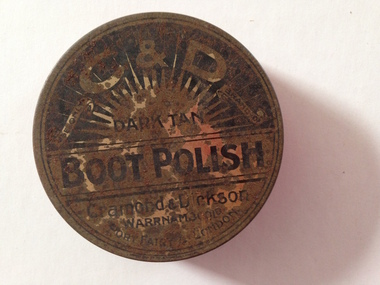
Tin, Boot polish Cramond & Dickson
... Top: ‘Use only C & D brand of Dark Tan Boot Polish, Cramond & Dickson, Warrnambool, Port Fairy and London’ Bottom: ‘For best results remove all dust, apply a little C & D dressing, brush briskly. Rubbing finally with a soft cloth produces a brilliant surface. ...Cramond and Dickson store Warrnambool Top: ‘Use only C & D brand of Dark Tan Boot Polish, Cramond & Dickson, Warrnambool, Port Fairy and London’ Bottom: ‘For best results remove all dust, apply a little C & D dressing, brush briskly. Rubbing finally with a soft cloth produces a brilliant surface. ...A tin of boot polish was a common household item in the 20th century (and is still in use to a lesser extent today). This dark tan boot polish was sold under the brand name of ‘C & D’ at the general store of Cramond and Dickson in Liebig Street, Warrnambool. John Glass Cramond and James Dickson established their business in Warrnambool in 1855 and this general store operated (firstly in Timor Street and later in Liebig Street) until 1973, making it one of the longest-running and one of the most important businesses in Warrnambool’s history. By 1868 a London agency had been established and direct imports from England began on a large scale. Many of the articles they sold, including the boot polish, were made expressly for the Cramond and Dickson store.This tin of boot polish is of great interest as an example of the goods sold by Cramond and Dickson that were made expressly for the Warrnambool store. Cramond and Dickson were one of the most important stores ever to operate in Warrnambool. This is a round metal tin, originally gold-coloured and with a red tape binding to prevent its opening. The front of the tin has printing and the image of a stylized rising sun and the bottom has more printing. The bottom of the tin is indented to allow the tin to rest on the rim only. The printing is legible but much faded. The tin contains the original polish. Top: ‘Use only C & D brand of Dark Tan Boot Polish, Cramond & Dickson, Warrnambool, Port Fairy and London’ Bottom: ‘For best results remove all dust, apply a little C & D dressing, brush briskly. Rubbing finally with a soft cloth produces a brilliant surface. Weight when packed 1½ ozs. net’ cramond and dickson store, warrnambool -
 Mont De Lancey
Clothing - Silk Scarf, Unknown
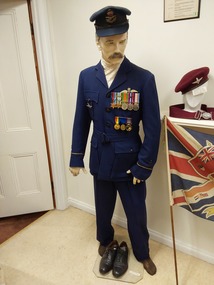
... Tightly woven silk was smooth, lightweight, and durable, preventing heavy leather flight jacket collars from rubbing and chafing the pilot's skin during constant 360-degree head-turning and scanning....Tightly woven silk was smooth, lightweight, and durable, preventing heavy leather flight jacket collars from rubbing and chafing the pilot's skin during constant 360-degree head-turning and scanning. ...During World War II, silk scarves were widely used by Royal Australian Air Force (RAAF) aircrew primarily for practical and personal purchase reasons rather than as standard issue dress uniform items. Tightly woven silk was smooth, lightweight, and durable, preventing heavy leather flight jacket collars from rubbing and chafing the pilot's skin during constant 360-degree head-turning and scanning.A long narrow cream silk scarf self patterned with small squares. It has long knotted fringing at each end. It was worn by Ralph Proctor under his Officers' WW2 Dress Uniform.Noneww2 raaf clothing, scarves, clothing, clothing accessories -
 Department of Energy, Environment and Climate Action
"Pig"
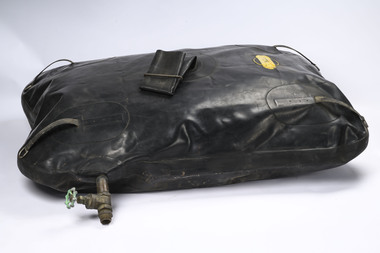
... The frayed anchor ropes, under strain due to constant rubbing on the high side wall of the vehicle, would snap, and the whole assembly of tank, pump and hose would break away from the vehicle and bounce down through the bush...The frayed anchor ropes, under strain due to constant rubbing on the high side wall of the vehicle, would snap, and the whole assembly of tank, pump and hose would break away from the vehicle and bounce down through the bush Forests Commission Victoria (FCV) Bushfire Fire Pump Dunlop Large rubber bag which held 80 gallons of water. ...Early water carrying bladder A number of accidents with these rubber tanks occurred on the fireline, particularly on tracks with steep side grades. The movement of the water sloshing and accumulating on the lower tank wall created an imbalance in the vehicle. The frayed anchor ropes, under strain due to constant rubbing on the high side wall of the vehicle, would snap, and the whole assembly of tank, pump and hose would break away from the vehicle and bounce down through the bushLarge rubber bag which held 80 gallons of water. Developed in the 1960s. It was strapped down in the back tray of Utes and attached to a small fire pump with a control valve. It was filled by a top tube that was clamped closed. It wallowed badly when the vehicle was moving, hence the common name of "Pig". When the bag was full it made driving dangerousDunlopforests commission victoria (fcv), bushfire, fire pump -
 Flagstaff Hill Maritime Museum and Village
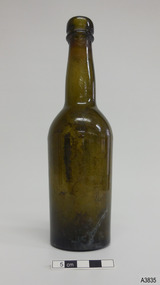
Container - Bottle, 1840s to 1870s
... Sediment on inside surfaces. White rubbing line and scratches on outside. ...Sediment on inside surfaces. White rubbing line and scratches on outside. Container Bottle John Chance ...This small green bottle has been handmade by a glassblower and is the typical shape of a carbonated soda or mineral water bottle. It was made from 1840s-1870s. The bottle was found in the coastal waters of Victoria about 100 years from when it was made. It is part of the John Chance Collection. Glassblowers made bottles like this one by blowing air through a long pipe and into molten glass at the end of it. The shape of the glass would be blown out to fit into the shape of the cylindrical dip mould. Once it set, the glass was removed from the mould and the glassblower would continue using the pipe to create the neck and another ponty tool to push up and form the base. The bottle would be cracked off the end of the glassblower’s pipe and a blob of molten glass would be wrapped around the top of the neck and shaped to finish the lip of the bottle. The seal was usually a cork, held in place with a ball-wire fitting attached between the upper and lower parts of the neck finish. This style of handmade bottles usually had thick glass so that it could be heat-sterilised, then re-filled. The bottles would often have horizontal bubbles in the applied finish, caused by twisting the glass, and vertical bubbles and diagonal lines in the body from it being blown, and a pontil mark in the base where the ponty tool had been attached. Although the bottle is not linked to a particular shipwreck, it is recognised as being historically significant as an example of bottles imported for use in Colonial Victoria in the mid-to-late 1800s. The bottle is also significant as it was recovered by John Chance, a diver in Victoria’s coastal waters in the late 1960s to early 1970s. Items that come from several wrecks have since been donated to the Flagstaff Hill Maritime Village’s museum collection by his family, illustrating this item’s level of historical value. Bottle; green glass, soda or mineral water style, handmade. Applied finish, blob double ring collar; upper is wide and rounded, lower is a narrow ring. Diagonal lines in glass on neck and shoulder. Low shoulder mould seam. Body is matt and tapers inward towards base. Shoulder and neck are shiny. Push-up base with pontil mark. Uneven base. Bubble on top of lip. Sediment on inside surfaces. White rubbing line and scratches on outside. flagstaff hill, warrnambool, flagstaff hill maritime museum, maritime museum, shipwreck coast, flagstaff hill maritime village, great ocean road, shipwreck artefact, john chance, glass bottle, antique bottle, handmade, dip mould, mouth blown, pontil mark, 19th century bottle, collectable, soda bottle, mineral water bottle, green glass, blob finish, push-up base
