
Showing 10 items matching " sherlock holmes"
-
 Bendigo Historical Society Inc.
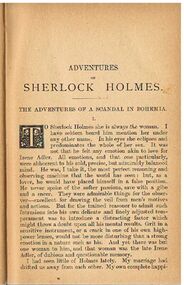
Book - ALEC H CHISHOLM COLLECTION: BOOK ''THE ADVENTURES OF SHERLOCK HOLMES'' BY A.CONAN DOYLE
... ALEC H CHISHOLM COLLECTION: BOOK ''THE ADVENTURES OF SHERLOCK HOLMES'' BY A.CONAN DOYLE...... SHERLOCK HOLMES...ALEC H CHISHOLM COLLECTION. 293 page hardcover book of 12 stories of Sherlock Holmes by Arthur Conan Doyle. Published in 1920 by John Murray, London and printed by Wyman & Sons Ltd, London and Reading. ...BOOKS Collections short stories ALEC H CHISHOLM COLLECTION ARTHUR CONAN DOYLE SHERLOCK HOLMES Arthur Conan Doyle Book. ALEC H CHISHOLM COLLECTION. 293 page hardcover book of 12 stories of Sherlock Holmes by Arthur Conan Doyle. ...Book. ALEC H CHISHOLM COLLECTION. 293 page hardcover book of 12 stories of Sherlock Holmes by Arthur Conan Doyle. Published in 1920 by John Murray, London and printed by Wyman & Sons Ltd, London and Reading. Catalogue sticker ''2147 DOY'' on spine. Handwritten in ink on the title page ''With all pleasant remembrances of Brisbane - in spite of the mosquitos (one or two of which were human) A. Conan Doyle'' Also handwritten in ink inside front cover ''This book (now rebound) was given to me by its author - Sir A.Conan Doyle - in Brisbane in Jan.1921. The reference to human 'mosquitos' on the title page is prompted by the fact that some of the interjectors or questioners at Doyle's spiritualistic lectures were inclined to be scurrilous. A.H.Chisholm''Arthur Conan Doylebooks, collections, short stories, alec h chisholm collection, arthur conan doyle, sherlock holmes -
 Yarrawonga and Mulwala Pioneer Museum
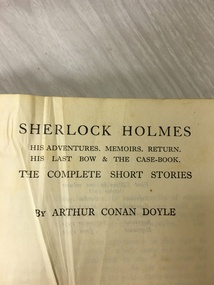
Short story Book, Sherlock Holmes Short Stories, Reprint 1934
... Sherlock Holmes Short Stories...Sherlock Holmes - his adventures, memoirs. Return, His last bow and the case-book. ...Conan Doyle Preface written 1928, 1336 pages \ Sherlock Holmes Short Stories Short story Book ...Famous detective stories. Sold by Angus and Robertson, 89 Castlereagh St, SydneyFawn hardcover book containing short stories written by A. Conan Doyle Preface written 1928, 1336 pages \Sherlock Holmes - his adventures, memoirs. Return, His last bow and the case-book. The complete short stories -
 Bendigo Historical Society Inc.
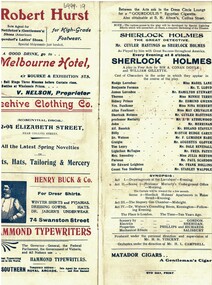
Document - HAMILTON COLLECTION: THEATRE PROGRAM, Early 1900s
... Eight page theatre program booklet advertising ''Sherlock Holmes'', Her Majesty's Theatre, Melbourne....Eight page theatre program booklet advertising ''Sherlock Holmes'', Her Majesty's Theatre, Melbourne. ...Document. Eight page theatre program booklet advertising ''Sherlock Holmes'', Her Majesty's Theatre, Melbourne.performing arts, elocution, concert -
 Mission to Seafarers Victoria
Film - VHS, Flying Angels, 1995
... Intro: Yarra River Images of the Sherlock Holmes Hotel. Archbishop Rodney Oliver, son of Reverend Padre Oliver, and Chairman of the State Council talks about the history of the Mission. ...Intro: Yarra River Images of the Sherlock Holmes Hotel. Archbishop Rodney Oliver, son of Reverend Padre Oliver, and Chairman of the State Council talks about the history of the Mission. ...In the Annual Report 1995: " During the year, a group of young people sponsored by the L.E.A.P. organisations, spent some weeks at the 717 Flinders Street, designing and making a video about the work and life of the Mission." The documentary filmed in VHS, mixes interviews, images from the MTSV collection and shooting of the port, the mission under renovation. Intro: Yarra River Images of the Sherlock Holmes Hotel. Archbishop Rodney Oliver, son of Reverend Padre Oliver, and Chairman of the State Council talks about the history of the Mission. John Phillips, caretaker Joan Leslie, volunteer The film has been transferred onto DVD, USB key and saved on digital form.john rodney oliver, dora simpson nee walker, john phillips, caretaker, joan leslie -
 Flagstaff Hill Maritime Museum and Village
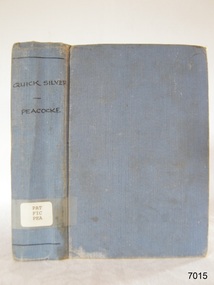
Book - Fictional Story, Isabel Maude Peacocke et al, Quicksilver, 1922-1925
... Beeton's Book of Household Management (1861), Arthur Conan Doyle's first Sherlock Holmes story (A Study in Scarlet, 1887), and an extensive list of popular fiction, children's annuals, and travel guides known as 'Red Guides' throughout the British Empire. ...Beeton's Book of Household Management (1861), Arthur Conan Doyle's first Sherlock Holmes story (A Study in Scarlet, 1887), and an extensive list of popular fiction, children's annuals, and travel guides known as 'Red Guides' throughout the British Empire. ...Quicksilver (1922) is a children's novel written by New Zealand author Isabel Maude Peacocke and illustrated by the noted English artist Harold Copping. The story revolves around a young boy named Ronnie, who is being pampered and coddled by the women in his family. His uncle, Uncle Jimmy, decides that Ronnie needs to be toughened up and arranges for him to have a companion, a spirited, lively young girl nicknamed 'Quicksilver' (or Quixy). Typical of Peacocke's post-World War I writing, the novel blends juvenile adventure with subtle social commentary on class differences, gender expectations, and child rearing in the early 20th century.Hard cover book. Quicksilver Author: Isabel Maude Peacocke Illustrator. Harold Copping Publisher: Ward, Lock & Co Date: 1922-1925 Further Information: Light blue Cloth hardcover with lettering and patterning to spine in black. The spine has a Library label with an inscription.fictionQuicksilver (1922) is a children's novel written by New Zealand author Isabel Maude Peacocke and illustrated by the noted English artist Harold Copping. The story revolves around a young boy named Ronnie, who is being pampered and coddled by the women in his family. His uncle, Uncle Jimmy, decides that Ronnie needs to be toughened up and arranges for him to have a companion, a spirited, lively young girl nicknamed 'Quicksilver' (or Quixy). Typical of Peacocke's post-World War I writing, the novel blends juvenile adventure with subtle social commentary on class differences, gender expectations, and child rearing in the early 20th century.warrnambool, shipwrecked-coast, flagstaff-hill, flagstaff-hill-maritime-museum, maritime-museum, shipwreck-coast, flagstaff-hill-maritime-village, shipwrecked-artefact, book, quicksilver, isabel maude peacocke, warrnambool mechanics’ institute, pattison collection, warrnambool library, ralph eric pattison, corangamite regional library service, warrnambool city librarian, mechanics’ institute library, victorian library board, warrnambool books and records, warrnambool children’s library -
 Flagstaff Hill Maritime Museum and Village
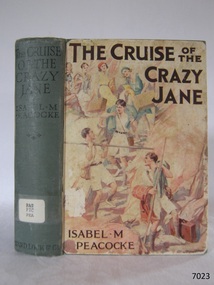
Book - Fictional Story, Isabel Maude Peacocke et al, The Cruise of The Crazy Jane, 1932
... Beeton's Book of Household Management (1861), Arthur Conan Doyle's first Sherlock Holmes story (A Study in Scarlet, 1887), and an extensive list of popular fiction, children's annuals, and travel guides known as 'Red Guides' throughout the British Empire. ...Beeton's Book of Household Management (1861), Arthur Conan Doyle's first Sherlock Holmes story (A Study in Scarlet, 1887), and an extensive list of popular fiction, children's annuals, and travel guides known as 'Red Guides' throughout the British Empire. ...The Cruise of The Crazy Jane (published in 1932 by Ward, Lock & Co.) follows young protagonist Vicky and a group of Auckland children on a summer boating and camping holiday aboard a vessel named the Crazy Jane. Set against the local geography of New Zealand including Auckland Harbour and nearby coastal areas the story follows their outdoor excursions, cliff-climbing adventures (such as descending "Jacob's ladder," as depicted in the frontispiece), and holiday mishaps. Unlike many of Isabel Maude Peacocke's other works, which feature adult third-person perspectives, The Cruise of The Crazy Jane is notable for using a child’s direct narrative voice to frame the story.Hard cover book. The Cruise of The Crazy Jane Author: Isabel Maude Peacocke Illustrator. Alan Gilderdale Publisher: Ward, Lock & Co Date: 1932 Further Information: Green Cloth hardcover boards with lettering and patterning to spine in black. Front cover has illustration. The spine has a Library label with an inscription.fictionThe Cruise of The Crazy Jane (published in 1932 by Ward, Lock & Co.) follows young protagonist Vicky and a group of Auckland children on a summer boating and camping holiday aboard a vessel named the Crazy Jane. Set against the local geography of New Zealand including Auckland Harbour and nearby coastal areas the story follows their outdoor excursions, cliff-climbing adventures (such as descending "Jacob's ladder," as depicted in the frontispiece), and holiday mishaps. Unlike many of Isabel Maude Peacocke's other works, which feature adult third-person perspectives, The Cruise of The Crazy Jane is notable for using a child’s direct narrative voice to frame the story.warrnambool, shipwrecked-coast, flagstaff-hill, flagstaff-hill-maritime-museum, maritime-museum, shipwreck-coast, flagstaff-hill-maritime-village, shipwrecked-artefact, book, the cruise of the crazy jane, isabel maude peacocke, warrnambool mechanics’ institute, pattison collection, warrnambool library, ralph eric pattison, corangamite regional library service, warrnambool city librarian, mechanics’ institute library, victorian library board, warrnambool books and records, warrnambool children’s library, i. m. cluett. -
 Flagstaff Hill Maritime Museum and Village
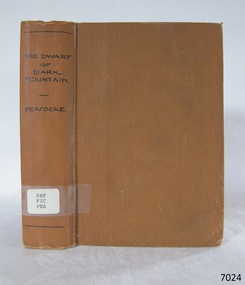
Book - Fictional Story, Isabel Maude Peacocke et al, The Dwarf Of Dark Mountain, 1932-1939
... Beeton's Book of Household Management (1861), Arthur Conan Doyle's first Sherlock Holmes story (A Study in Scarlet, 1887), and an extensive list of popular fiction, children's annuals, and travel guides known as 'Red Guides' throughout the British Empire. ...Beeton's Book of Household Management (1861), Arthur Conan Doyle's first Sherlock Holmes story (A Study in Scarlet, 1887), and an extensive list of popular fiction, children's annuals, and travel guides known as 'Red Guides' throughout the British Empire. ...The Dwarf of Dark Mountain is a children's adventure novel illustrated by Norman Sutcliffe. Set against the backdrop of the New Zealand bush and rural landscapes, the story follows a group of young protagonists on a mystery-filled adventure centred around a local geological landmark known as "Dark Mountain". Typical of Isabel Maud Peacocke's popular juvenile fiction of the 1930s (such as The Cruise of the Crazy Jane and Cathleen with a C), the book weaves together themes of bush navigation and exploration. The children venture through dense ti-tree scrub and native fern gullies, with the narrative centring around the titular "dwarf" of the mountain blending rural Australian and New Zealand family life with wholesome mystery, moral growth, and outdoor adventure.The Dwarf Of Dark Mountain Author: Isabel Maude Peacocke Illustrator: Norman Sutcliffe Publisher: Ward Lock & Co Date: Further Information: Plain brown/tan cloth binding with the title and author hand-lettered directly onto the spine with no decorative illustration, gilt stamping, or pictorial design. The spine has a Library label with an inscription.fictionThe Dwarf of Dark Mountain is a children's adventure novel illustrated by Norman Sutcliffe. Set against the backdrop of the New Zealand bush and rural landscapes, the story follows a group of young protagonists on a mystery-filled adventure centred around a local geological landmark known as "Dark Mountain". Typical of Isabel Maud Peacocke's popular juvenile fiction of the 1930s (such as The Cruise of the Crazy Jane and Cathleen with a C), the book weaves together themes of bush navigation and exploration. The children venture through dense ti-tree scrub and native fern gullies, with the narrative centring around the titular "dwarf" of the mountain blending rural Australian and New Zealand family life with wholesome mystery, moral growth, and outdoor adventure.warrnambool, shipwrecked-coast, flagstaff-hill, flagstaff-hill-maritime-museum, maritime-museum, shipwreck-coast, flagstaff-hill-maritime-village, shipwrecked-artefact, book, the dwarf of dark mountain, isabel maude peacocke, warrnambool mechanics’ institute, pattison collection, warrnambool library, ralph eric pattison, corangamite regional library service, warrnambool city librarian, mechanics’ institute library, victorian library board, warrnambool books and records, warrnambool children’s library, i. m. cluett., illustrator norman sutcliffe -
 City of Melbourne Libraries
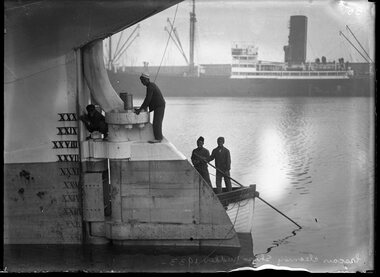
Photograph, Bull, Hugh Jones, 1897-1993, Lascars cleaning ship's rudder
... The term lascar has been widely used to engender an element of exoticism in literature eg “Sir Arthur Conan Doyle created a Lascar foil to Sherlock Holmes in "The Man with the Twisted Lip" in 1891. ...The term lascar has been widely used to engender an element of exoticism in literature eg “Sir Arthur Conan Doyle created a Lascar foil to Sherlock Holmes in "The Man with the Twisted Lip" in 1891. ...Published: unknown, however, on 26 June 1935 a similar, but not the exact photo in the McKenzie Collection, was published in The Age: Published title: Shipping Victorian Flour to the East Published Caption: Flour and wheat figure prominently in all cargoes carried by ships trading to Chinese, Japanese and Eastern ports. Victorian millers are eager to extend lids outlet for their produce, and every opportunity is grasped. The pictures show Australian labourers unloading from railway trucks some of the 2300 tons of flour which will go into the hold of the Burns, Philp motor ship Neptuna for shipment to Hong Kong, while Chinese seamen are busy cleaning and painting the rudder post of the ship. Hard by the Neptuna, other ships are taking on flour for the East. Research by Project Volunteer, Louise McKenzie: The image was described by Hugh Bull on the rear of the glass plate as – “Lascars cleaning ships rudder 1933”. Basically, a “lascar” is a seaman. Image No. 032 in the McKenzie Collection shows two lascars perched on the rudder of a ship, with two others standing in a rowboat along side. They are dressed in baggy trousers and jackets and wearing caps. Across a very calm dock area is a single funnel ship with on-deck derricks. The rudder of the ship being cleaned is white, with large black roman numbering denoting the depth at which the ship is sitting, depending on whether it is loaded or empty. Whilst the exact photo in the McKenzie Collection has yet to be located in The Age in 1933, the date when it was taken, there is a photo published in The Age on 25 June 1935 which appears to be one of a series of photos taken on the same day, featuring lascars cleaning a ship’s rudder. It bears a striking resemblance to MCK 032, but it is taken from a slightly different angle. The 1935 published photo is a close up of a ship’s rudder being cleaned, with same style of roman numerals in black on the white of the rudder. One lascar is standing on the rudder, one is standing in a small clinker style rowboat, with its characteristic wooden overlapping hull planks, holding a broom; two more lascars are sitting in the bow and stern of the rowboat. The ship being cleaned is in a dock, as a wharf and warehouses can be seen in the background, the water is very calm, and there are two other ships moored nearby – one across the other side of the dock with a black and white hull and derricks on its deck, and one adjacent, with its mooring lines clearly visible. The lascars are wearing caps, baggy trousers and jackets. Compelling similarities therefore exist between the two images. Whilst it is difficult to positively identify the cultural background of these particular lascars in either photo, the newspaper article dated June 1935 advises they are “Chinese”. This is possibly because the ship they are associated with, the Neptuna, is reported to have sailed from Melbourne on this date, bound for Hong Kong. However, the men are probably from South East Asia. Wikipedia describes the term “Southeast Asia” as covering ” … the people of Southeast Asia from prehistory to the present in two distinct sub-regions: Mainland Southeast Asia (or Indochina) and Maritime Southeast Asia (or Insular Southeast Asia). Mainland Southeast Asia comprises Cambodia, Laos, Myanmar (or Burma), Peninsular Malaysia, Thailand and Vietnam whereas Maritime Southeast Asia comprises Brunei, Cocos (Keeling) Islands, Christmas Island, East Malaysia, East Timor, Indonesia, Philippines and Singapore. Additionally, Wikipedia “Lascars” states that “Lascars were sailors from the Indian subcontinent, South East Asia, the Arab world, British Somaliland and lands east of the Cape of Good Hope, who were employed to work on colonial merchant ships. The practice ran from the 16th century to the mid 20th century”. Indian seamen were used as early as the 16th century by Portuguese explorer Vasgo da Gama in his successful voyage to India, and subsequently by Portuguese ships in the 16th and 17th centuries. “Through the Portuguese and Spanish maritime world empires, some Indian lascars found their way onto English merchant ships, and were among the sailors on the first English East India Company (EIC) ships to sail to India.” In the 17th Century “When the English adopted the term "lascar", they initially used it for all Asian sailors on English-flagged ships, but after 1661 and the Portuguese ceded Bombay to England, the term was used mainly to describe Indian sailors specifically. The term "topaze" was used to describe Indo-Portuguese personnel, especially those from Bombay, Thana, Diu, Dammam and Cochin. The term "sepoy" was used to describe Indian soldiers in European service. The number of lascars employed on EIC East Indiamen was so great that the Parliament of England restricted their employment via the Navigation Acts (in force from 1660 onwards) which required that 75% of the crew onboard English-flagged ships importing goods from Asia be English subjects. The restriction arose due to the high rates of illnesses and death among European sailors on East Indiamen, and their frequent desertions in Asia, which left such ships short of crew for the return voyage. Another reason was the frequent impressment of European sailors from EIC East Indiamen by the Royal Navy in times of war“. The term “impressment” colloquially refers to “the “press gang” …”a type of conscription of people into a military force, especially a naval force, via intimidation and physical coercion, conducted by an organized group (hence “gang”). .. The large size of the British Royal Navy in the Age of Sail meant impressment was most commonly associated with Great Britain.”. (Wikipedia – Impressment). By the 20th century these sailors served on British ships under "lascar agreements", which allowed shipowners more control than was the case in ordinary articles of agreement. The sailors could be transferred from one ship to another and retained in service for up to three years at one time. “Lascars served all over the world in the period leading up to the First World War. Lascars were barred from landing at some ports, such as in British Columbia. At the beginning of World War I, there were 51,616 lascars working on British merchant ships in and around the British Empire. In World War II thousands of lascars served in the war and died on vessels throughout the world, especially those of the British India Steam Navigation Company, P&O and other British shipping companies. The lack of Canadian naval manpower led to the employment of a total of 121 Catholic Goans and 530 Muslim British Indians on the Empress vessels of the Canadian Pacific Railway, such as the Empress of Asia and Empress of Japan. These ships served in the Indian Ocean both as ANZAC convoy ships and in actions at Aden. The ships were placed under the British Admiralty as part of Canada's contribution to the war effort and all of the Indian men were awarded medals by the Admiralty, though none of them were delivered. In the 1950s the use of the term "lascar" declined with the ending of the British Empire. The Indian “Lascar Act” of 1832 was finally repealed in 1963. However, "traditional" Indian deck and Pakistani engine crews continued to be used in Australia until 1986 when the last crew was discharged from the P&O and replaced by a general-purpose crew of Pakistanis. The term lascar has been widely used to engender an element of exoticism in literature eg “Sir Arthur Conan Doyle created a Lascar foil to Sherlock Holmes in "The Man with the Twisted Lip" in 1891. Lascars aboard the ship Patna figure prominently in the early chapters of Joseph Conrad's novel Lord Jim. Frances Hodgson Burnett's novel A Little Princess features a lascar named Ram Dass. Also, Caleb Carr portrays two lascars as bodyguards for a Spanish diplomat near the end of The Angel of Darkness. In Wuthering Heights, it is speculated that Heathcliff, the main character, may be of lascar origin." (Wikipedia – Lascar) And what has become of these “forgotten heroes of the World Wars”? The South Asian Heritage Trust, which seeks to commemorate, mark and celebrate South Asian cultures, stories, and communities, published an article in July 2025 entitled – The Lascars: Seafaring Roots of Modern Britain. It particularly honours the role of the 80,000 lascars who served Britain in WWI, and the over 100,000 who served in the British Merchant Navy in WWII, and concludes: “The hardships faced by Lascars were profound. They were often assigned the most dangerous tasks, lived in substandard conditions aboard ships and, even after their immense contributions to the war efforts, many veterans found it difficult to secure the recognition, pensions and rights afforded to other veterans. Many were employed under ‘Asiatic Articles’, which offered less protection and lower pay than their European counterparts. Yet, their legacy endures. The multicultural fabric of areas like East London owes much to these early seafarers and settlers. The East London Mosque, established in 1910, became an important spiritual and community hub. Today, efforts to bring their stories out of the shadows are growing. The Museum of London Docklands features exhibits on their history. Memorials, such as the P&O headstone in Dover for the 22 Lascar crew members of the SS Maloja sunk in 1916 and the careful restoration of the Lascar War Memorial in Kolkata, serve as important reminders of the sacrifices. The journey of the Lascars – from their homelands, along dangerous wartime shipping routes, to the docklands of Britain – is a story of personal courage and of a rich contribution to Britain’s history and identity.” The ship MV Neptuna, mentioned in the 1935 article, had that year been purchased from a German company by Australian-owned Burns Philp, with Australian Government assistance, and it was instrumental in ensuring the shipment of rice from Vietnam to Papua New Guinea. Rice is still a household staple in PNG. Despite it being introduced into PNG more than 100 years ago, the crop has not been sufficiently integrated into the country’s traditional agricultural production system, and today PNG imports still account for nearly 98% of rice. (Spotlight Magazine Sept. 2016) The 1935 newspaper article states that the Neptuna is involved in moving flour for the East. Australian wheat exports began in 1845, but were not regular until the 1870s. New land clearing methods in Australia allowed large tracts of land to be cleared more efficiently – this included the invention of the iconic ‘stump jump’ plough. With the success of the wheat harvests, flour mills began to spring up around the country. By the 1870s, many large country towns had their own mills, with around 500 mills producing flour across the country. Flour exports were an important part of the wheat industry until around the 1930s. After the Second World War, many of Australia’s export partners (which were mainly in the developing nations of Asia) began setting up their own flour industries and the Australian product was no longer in demand. In 1942 MV Neptuna was being utilised for the war effort, and carrying depth charges and other armaments for Australia, when on 19 February it was sunk in a bombing raid on Darwin, and where part of her hull still lies. References: SHIPPING VICTORIAN FLOUR TO THE EAST. (1935, June 25). The Age (Melbourne, Vic. : 1854 - 1954), p. 11. Retrieved July 23, 2025, from http://nla.gov.au/nla.news-article204357218 Age (Melbourne, Vic. : 1854 - 1954), Tuesday 25 June 1935, page 11 Wikipedia, Clinker (boat building), https://en.wikipedia.org/wiki/Clinker_(boat_building) Wikipedia, Lascar, https://en.wikipedia.org/wiki/Lascar Wikipedia, History of Southeast Asia, https://en.wikipedia.org/wiki/History_of_Southeast_Asia Wikipedia, Impressment, https://en.wikipedia.org/wiki/Impressment NEPTUNA LEAVES FOR CHINA WITH TOURISTS (1935, June 25). The Herald (Melbourne, Vic. : 1861 - 1954), p. 5. Retrieved July 23, 2025, from http://nla.gov.au/nla.news-article244841163 National Research Institute SPOTLIGHT paper Vol 9, Issue 7, https://pngnri.org/images/Publications/Spotlight_No_9_Vol_7_-_201609_-_Sofe__Odhuno_-_Rice_Import_Quota1.pdf South Asian Heritage Trust, The Lascars: Seafaring Roots of Modern Britain, July 11,2025 : Royal British Legion. https://southasianheritage.org.uk/royal-british-legion/the-lascars-seafaring-roots-of-modern-britain/ Photographer notations on slide: "Lascars cleaning ships rudder 1933".lascars, ships, 1930-1939, employment, ethnic communities -
Box Hill Historical Society
Book, Lahey, John, Damn you John Christie
... The public life of Australia's Sherlock Holmes, reproduced from Christie's writing. ...Biography. The public life of Australia's Sherlock Holmes, reproduced from Christie's writing. John Christie, a Scotsman, came to Australia in 1860s and joined the Police Force as a detective in 1867 and appointed Revenue Detective 1888. He died 1927 and is buried in Box Hill Cemetery.Biography. The public life of Australia's Sherlock Holmes, reproduced from Christie's writing. John Christie, a Scotsman, came to Australia in 1860s and joined the Police Force as a detective in 1867 and appointed Revenue Detective 1888. He died 1927 and is buried in Box Hill Cemetery.victorian police force, victorian customs department, cemeteries, box hill, christie> john -
 Mrs Aeneas Gunn Memorial Library
Book, Arthur Conan Doyle, The great Boer war, 1902
... Boer war 1899-1902 Arthur Conan Doyle While most people remember Sir Arthur Conan Doyle for his 'Sherlock Holmes' stories, he actually wanted more to be a journalistic and historical writer. ...While most people remember Sir Arthur Conan Doyle for his 'Sherlock Holmes' stories, he actually wanted more to be a journalistic and historical writer. This is one of his works in that vein, documenting the events of the Boer War, which had yet to end at the time of writing.Index, maps, p.743.non-fictionWhile most people remember Sir Arthur Conan Doyle for his 'Sherlock Holmes' stories, he actually wanted more to be a journalistic and historical writer. This is one of his works in that vein, documenting the events of the Boer War, which had yet to end at the time of writing.boer war 1899-1902, arthur conan doyle
