
Showing 39 items matching " silk embroidery - oriental"
-
 Embroiderers Guild, Victoria
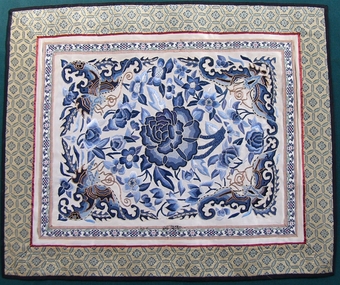
Textile - Mat, 1980
... ... Silk Embroidery... Oriental...Bought by donor in Hong Kong in 1983 Embroidery Silk Embroidery Oriental Mats 1960-80 China Cream silk mat with blue silk embroidery in a traditional Chinese design with peonies, bats and plum blossoms. ...Bought by donor in Hong Kong in 1983Cream silk mat with blue silk embroidery in a traditional Chinese design with peonies, bats and plum blossoms. The border is made of two rows of woven braid.embroidery, silk embroidery, oriental, mats, 1960-80, china -
 Embroiderers Guild, Victoria
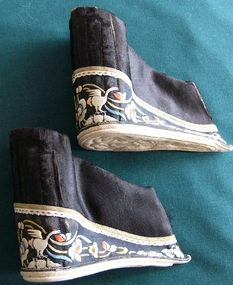
Footwear - Shoes, Early 20th century (?)
... ... Silk Embroidery... Oriental...Purchased at a flea market in New York, September 2004 Shoes Silk Embroidery Oriental China Embroidery Black silk uppers, lined in blue cotton, and stiffened with a small amount of quilting. ...Purchased at a flea market in New York, September 2004Black silk uppers, lined in blue cotton, and stiffened with a small amount of quilting. Lower edge embroidered in silk with multicoloured flowers, leaves, 2 birds and ribbons. Shoes show some wear. Maybe they were for a child, or an adult with bound feet.shoes, silk embroidery, oriental, china, embroidery -
 Embroiderers Guild, Victoria
Accessory - Bag
... ... Silk Embroidery... Oriental...Embroidery Bags Silk Embroidery Oriental China Late 19th century Pocket - made to suspend from belt. ...Pocket - made to suspend from belt. Floral design worked in twisted silk and couched gold thread in satin and pekin knot stitch. Large tassel of antique gold thread over wooden foundation.embroidery, bags, silk embroidery, oriental, china, late 19th century -
 Embroiderers Guild, Victoria
Textile - Stole
... ... Silk Embroidery... Oriental...Embroidery Silk Embroidery Oriental Garments Piece of Chinese embroidery, Length of cream silk with panel of cream silk embroidery depicting butterflies. ...Piece of Chinese embroidery, Length of cream silk with panel of cream silk embroidery depicting butterflies. embroidery, silk embroidery, oriental, garments -
 Embroiderers Guild, Victoria
Clothing - Shawl, Early to mid 19th century
... ... Silk Embroidery... Oriental...Embroidery Surface stitchery 19th century China Silk Embroidery Oriental Shawl Ivory Canton crepe with a deep fringe. ...This type of shawl said to have been made by Chinese for the European market. Provenance : Colombo? India? China?Ivory Canton crepe with a deep fringe. Cream coloured embroidery over a large area. Satin stitch floral design. Knotted fringe.embroidery, surface stitchery, 19th century, china, silk embroidery, oriental, shawl -
 Embroiderers Guild, Victoria
Textile - Mat
... ... Silk Embroidery... Oriental...Bought for the Guild by Lady Amies on a trip to South East Asia in June 1972 Embroidery Mat China-Taiwan Silk Embroidery Oriental Background beige silk. A domestic scene depicting houses, bridge, trees and plants. ...Bought for the Guild by Lady Amies on a trip to South East Asia in June 1972Background beige silk. A domestic scene depicting houses, bridge, trees and plants. Around the circular edge are flowers alternating with a geometrical design, gold thread couched down. Lining - green rayon fabric. Of the late Manchu period. A birthday gift panel.embroidery, mat, china-taiwan, silk embroidery, oriental -
 Embroiderers Guild, Victoria
Textile - Mat
... ... Silk Embroidery... Oriental...Textiles Mats Silk Embroidery Oriental China Pink silk damask centre embroidered with flowers, birds and animals. ...Pink silk damask centre embroidered with flowers, birds and animals. Cream silk border edged in gold metal thread. Backed with blue cotton.textiles, mats, silk embroidery, oriental, china -
 Embroiderers Guild, Victoria
Textile - Jacket Pieces
... ... Silk Embroidery... Oriental...Embroidery China Silk Embroidery Oriental Garments Three pieces of an embroidered Chinese jacket. ...Three pieces of an embroidered Chinese jacket. Black silk fabric very thickly covered with rows of couched threads, both gold and silk. Design contains traditional Chinese symbols - wave, swastika etc. Lined with blue silk. embroidery, china, silk embroidery, oriental, garments -
 Embroiderers Guild, Victoria
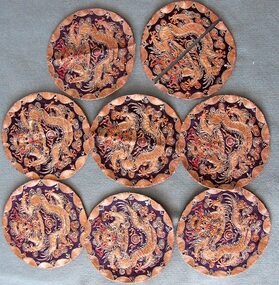
Textile - Medallion
... ... Silk Embroidery... Oriental...Embroidery China Silk Embroidery Oriental Garments 7 circular pieces and 2 half circles. ...7 circular pieces and 2 half circles. Black silk fabric with couched embroidery in gold and coloured threads. Each motif has a dragon in the centre. Lined with blue silk.embroidery, china, silk embroidery, oriental, garments -
 Embroiderers Guild, Victoria
Textile - Panel (Framed), Chinese Coastal Scene
... ... Silk Embroidery... Oriental...Embroidery Panel China-Taiwan Silk Embroidery Oriental Chinese symbols. A coastal scene worked in coloured silk on a satin background. ...Bought for the Guild by Lady Amies on a trip to South East Asia.A coastal scene worked in coloured silk on a satin background. Willow trees, 2 boats, bridge, people and mountains. This is a modern version of the old Chinese style. Narrow green with gold frame.Chinese symbols.embroidery, panel, china-taiwan, silk embroidery, oriental -
 Embroiderers Guild, Victoria
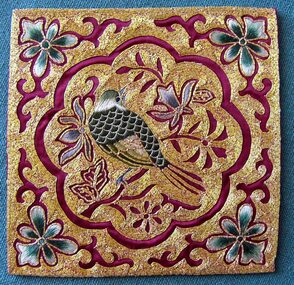
Textile - Rank Badge (replica)
... ... Silk Embroidery... Oriental...Embroidery China Silk Embroidery Oriental badge Rank badge depicting birds and flowers. ...Purchased in Macau for the Guild by Lady Amies on a trip to South East Asia in June 1972. From the Peoples' Republic of China.Rank badge depicting birds and flowers. The central bird motif is embroidered in silk thread. Remainder of design is worked in gold thread couched with red silk thread. embroidery, china, silk embroidery, oriental, badge -
 Embroiderers Guild, Victoria
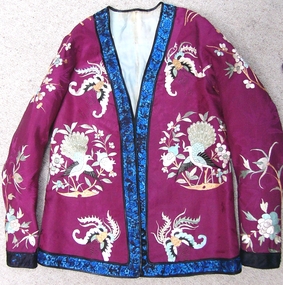
Clothing - Ladies jacket, Early 20th century
... ... Silk Embroidery... Oriental...Embroidery Silk Embroidery Oriental Garments 1900-20 China Magenta brocade with embroidered motifs of bats, peacocks and peony roses in coloured silks using satin stitch. ...In Chinese embroidery, the combination of bats, peacocks, and peony roses creates a rich tapestry of highly auspicious symbols, primarily associated with wishes for happiness, wealth, beauty, and high rank. When these motifs appear together, as they often do in intricate antique textiles or Mandarin squares, they collectively represent a desire for a life filled with wealth, prestige, and abundant happiness. Magenta brocade with embroidered motifs of bats, peacocks and peony roses in coloured silks using satin stitch. Jacket is edged with a band of black silk embroidered with blue peony roses.embroidery, silk embroidery, oriental, garments, 1900-20, china -
 Embroiderers Guild, Victoria
Textile - Panel, Two Deers Panel, Late 19th century
... ... Silk Embroidery - Oriental...Embroidery Panel Late 19th century Japan Silk Embroidery - Oriental Silk background with a peach brocade edging natural colours of silk embroidery in long and short stitch for the design of two deers with fir tree branch. ...Bought for the Guild, found in an antique shop by Mrs Beryl Warne (member) March 1974.Silk background with a peach brocade edging natural colours of silk embroidery in long and short stitch for the design of two deers with fir tree branch.embroidery, panel, late 19th century, japan, silk embroidery - oriental -
 Embroiderers Guild, Victoria
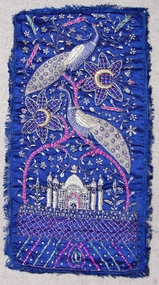
Textile - Wall panel
... ... Silk Embroidery... Oriental...Information in 1980 - Possibly Indian village work Embroidery Panels India Metal thread Silk Embroidery Oriental Deep blue satin with fringed edge. ...Information in 1980 - Possibly Indian village workDeep blue satin with fringed edge. The design is of an Indian temple and large birds embroidered in gold and silver threads with some brightly coloured floss silks. It is edged with matching blue fringe.embroidery, panels, india, metal thread, silk embroidery, oriental -
 Embroiderers Guild, Victoria
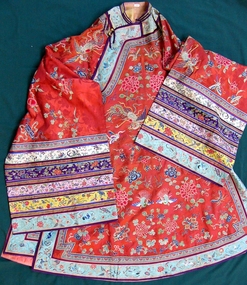
Clothing - Chinese Mandarin Robe, Circa 17th century
... ... Silk Embroidery... Oriental...Embroidery Garments China Silk Embroidery Oriental 17th century Classical style of garment, very long-sleeved in red silk with coloured embroidery. ...Purchased by the donor from a Chinese family on a rubber estate in Malacca for 3 pound in 1922. The country was suffering a deep depression owing to a slump in rubber and many wealthy Chinese were in serious financial difficulties and were realising on anything they could. When the coat was on show at an exhibition the donor was told by someone who had lived in China for many years that it was a very fine example and was possibly 200-300 years old (identified by the cut and fastening of the front panel). The golden pheasants embroidered on the back indicated it came from a Southern state and from a family of high degree. Some years later it was dated as 17th century. Classical style of garment, very long-sleeved in red silk with coloured embroidery. The symbols belong to a high ranking official, symbols of two white doves embroidered on the back, and also the long sleeves with their decorative embroidered bands of turquoise, blue, pink and yellow. The front of the garment overlaps the right side with five small decorative buttons fastened with loops. The buttons were gold and because of their value they were replaced with identical brass buttons. Motifs include phoenix, butterflies, birds, pomegranate, flowers and auspicious symbols. Predominate stitch used is Pekinese Knot Stitch with couched gold outlines of the motifs. The birds and butterflies are worked in satin and long and short stitch. embroidery, garments, china, silk embroidery, oriental, 17th century -
 Embroiderers Guild, Victoria
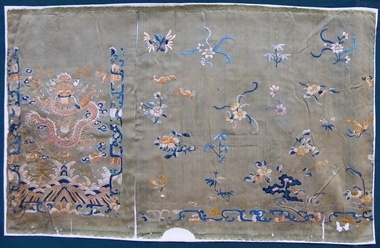
Textile - Strip of Chinese Embroidered Silk
... ... Silk Embroidery... Oriental...Embroidery Surface stitchery China Silk Embroidery Oriental Fragment Green silk, embroidered silks in blues and golds. ...From the collection of the late Dr. Georgina Sweet, who was the first woman veterinarian in Victoria and who travelled extensively in Middle Europe in the Early 20th century.Green silk, embroidered silks in blues and golds. Dragon with some metal threads. Fragile.embroidery, surface stitchery, china, silk embroidery, oriental, fragment -
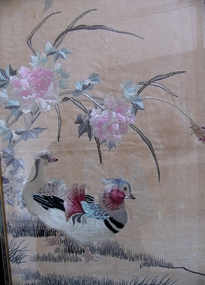 Embroiderers Guild, Victoria
Textile - Chinese Embroidered Panel with Ducks
... ... Silk Embroidery... Oriental...Embroidery Panel Japan Silk Embroidery Oriental Cream silk background with two Mandarin ducks by water along with sprays of peonies and grasses. ...Cream silk background with two Mandarin ducks by water along with sprays of peonies and grasses. All worked in fine floss silk with delicate colours of white, pink, grey and green.embroidery, panel, japan, silk embroidery, oriental -
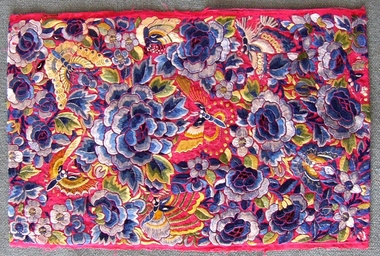 Embroiderers Guild, Victoria
Textile - Silk Embroidered Peonies and Butterflies
... ... Silk Embroidery... Oriental...According to the donor this is Indian work on Madras silk. Embroidery Garments Silk Embroidery Oriental India Red silk background embroidered in an all over design of peonies and butterflies in shades of blues, greens and yellows. ...According to the donor this is Indian work on Madras silk.Red silk background embroidered in an all over design of peonies and butterflies in shades of blues, greens and yellows.embroidery, garments, silk embroidery, oriental, india -
 Embroiderers Guild, Victoria
Clothing - Chinese Silk Floral Embroidery Length
... ... Silk Embroidery... Oriental...Embroidery Garments Silk Embroidery Oriental China Cream silk embroidered length with sprays of flowers in satin stitch in cream silk - in style of Cantonese embroidery. ...Cream silk embroidered length with sprays of flowers in satin stitch in cream silk - in style of Cantonese embroidery.embroidery, garments, silk embroidery, oriental, china -
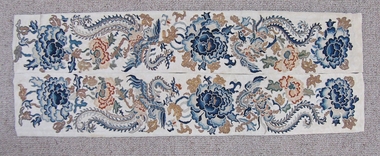 Embroiderers Guild, Victoria
Accessory - Pair of Chinese Embroidered Sleeve Bands
... ... Silk Embroidery... Oriental...Embroidery Garments Silk Embroidery Oriental China Pale green brocade with Pekin knot stitch in blue, green, cream and brown. ...Chinese sleeve embroidery bands, or wanxiu became popular in the late 19th century during the Qing Dynasty, evolving from the traditional Han cuff embroidery and Manchu styles. These detachable, decorated bands were added to women's informal jackets and robes, often featuring symbolic motifs like landscapes, flowers, and auspicious symbols. They served both a decorative function, displaying artistic skill and personal wishes, and a practical one by covering the sleeves when hands were folded at the waist. History and evolution: Origins: The practice of embroidering cuffs on robes existed during the previous Ming Dynasty for Han women, and this was adopted by the Manchu rulers who founded the Qing Dynasty. Qing Dynasty (1644-1911): The practice was popularized and elaborated upon during this era, with detachable bands becoming a fashionable element for informal wear. Symbolism: The embroidery included a complex visual vocabulary of wishes for a long life, many offspring, and a happy marriage, derived from nature, mythology, and classical literature. Functionality: Women would fold their arms, often with their hands inside the sleeves, so the embroidered bands, which were sewn to hang down the back of the jacket, would be displayed prominently down the front. 19th century peak: The late 19th century was the peak of their popularity, with intricate designs becoming fashionable and even influenced by court tastes, such as those favoured by the Empress Dowager Cixi. Later developments: The late 19th century saw the introduction of chemical 'aniline' dyes from Europe, leading to brighter, bolder colours in embroidery. Motifs and their Meanings: Auspicious symbols: Designs often included symbols for good fortune, wealth, and longevity. Natural imagery: Birds, flowers, and landscapes were common motifs that could represent natural beauty or convey specific symbolic meanings. Figurative scenes: Bands could also feature narrative scenes from classical stories or legends. The choice of motifs allowed women to express personal desires, cultural values, and aesthetic preferences, reflecting a more personal and informal style than official court attire.Pale green brocade with Pekin knot stitch in blue, green, cream and brown. Large heads and the phoenix used in the design. Gold thread couched with cream thread.embroidery, garments, silk embroidery, oriental, china -
 Embroiderers Guild, Victoria
Textile - Chinese Embroidered Panels
... ... Silk Embroidery... Oriental...Embroidery China Metal thread Silk Embroidery Oriental Panels phoenix crysanthemum Two blue silk panels with mirror image designs of phoenix and chrysanthemums. ...Two blue silk panels with mirror image designs of phoenix and chrysanthemums. Metal thread, gold couched in orange, red, cream and turquoise silk. Selvedge and hemmed edges.embroidery, china, metal thread, silk embroidery, oriental, panels, phoenix, crysanthemum -
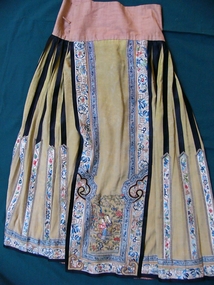 Embroiderers Guild, Victoria
Clothing - Chinese Embroidered Skirt, 19th century
... ... Silk Embroidery... Oriental...Embroidery Garment Silk Embroidery Oriental 19th century China Lemon silk skirt lined with coral coloured silk. ...Symbolism: Woman with a fan (shan) - a symbol of longevity and a pun for goodness. Gourds: fertility and good fortune. Peony: wealth and honour (fugui). Blossoms: bring forth fruit and therefore bring forth prosperity. Meander pattern: represents longevity.Lemon silk skirt lined with coral coloured silk. There is a broad cotton waist band with loops at each end, through which a tie would have been used to fasten the skirt. The reason for the cotton at the top was so that it didn't slip, as silk would have done. There is a central front panel bordered in black satin. within this is an embroidered floral and 'meander' or Greek key pattern. The 'meander' pattern is done in couched goldwork. Within this is another border of embroidered, machine made braid. The central motif of two women in a garden setting is embroidered on silk mesh and appliqued onto the background fabric. One of the women holds a fan, the other has her arms raised up and she bends slightly forward. Behind the woman with the fan there a is a little fence/bridge. To the left of the other woman is what appears to be a vase with a flower, next to what may be a gourd shaped vase. Worked in Pekin knot stitch and couched gold.embroidery, garment, silk embroidery, oriental, 19th century, china -
 Embroiderers Guild, Victoria
Textile - Panel, 20th century
... Silk Embroidery... China... Oriental...Embroidery Panel Silk Embroidery China Oriental Red satin, embroidered with shades of blue silks. ...Red satin, embroidered with shades of blue silks. Border of braid and black satin.embroidery, panel, silk embroidery, china, oriental -
 Embroiderers Guild, Victoria
Accessory - Sleeve Bands, Pre 1985
... Silk Embroidery... Japan... Oriental...Embroidery Silk Embroidery Japan Oriental Sleeve Bands Garments Two sleeve bands. ...Chinese sleeve embroidery bands, or wanxiu became popular in the late 19th century during the Qing Dynasty, evolving from the traditional Han cuff embroidery and Manchu styles. These detachable, decorated bands were added to women's informal jackets and robes, often featuring symbolic motifs like landscapes, flowers, and auspicious symbols. They served both a decorative function, displaying artistic skill and personal wishes, and a practical one by covering the sleeves when hands were folded at the waist. History and evolution: Origins: The practice of embroidering cuffs on robes existed during the previous Ming Dynasty for Han women, and this was adopted by the Manchu rulers who founded the Qing Dynasty. Qing Dynasty (1644-1911): The practice was popularized and elaborated upon during this era, with detachable bands becoming a fashionable element for informal wear. Symbolism: The embroidery included a complex visual vocabulary of wishes for a long life, many offspring, and a happy marriage, derived from nature, mythology, and classical literature. Functionality: Women would fold their arms, often with their hands inside the sleeves, so the embroidered bands, which were sewn to hang down the back of the jacket, would be displayed prominently down the front. 19th century peak: The late 19th century was the peak of their popularity, with intricate designs becoming fashionable and even influenced by court tastes, such as those favoured by the Empress Dowager Cixi. Later developments: The late 19th century saw the introduction of chemical 'aniline' dyes from Europe, leading to brighter, bolder colours in embroidery. Motifs and their Meanings: Auspicious symbols: Designs often included symbols for good fortune, wealth, and longevity. Natural imagery: Birds, flowers, and landscapes were common motifs that could represent natural beauty or convey specific symbolic meanings. Figurative scenes: Bands could also feature narrative scenes from classical stories or legends. The choice of motifs allowed women to express personal desires, cultural values, and aesthetic preferences, reflecting a more personal and informal style than official court attire.Two sleeve bands. Embroidered in coloured silk and gold metal thread. Motifs of lotus flowers, birds, swastikas and other flowers. Mostly satin stitch.embroidery, silk embroidery, japan, oriental, sleeve bands, garments -
 Embroiderers Guild, Victoria
Accessory - Chinese Silk Embroidered Medallions for Garment
... Silk Embroidery... Garments... Oriental...Possibly for decorating an Oriental garment, one medallion is halved for a front opening. Fine white canvas covered in silk embroidery. ...Embroidery Silk Embroidery Garments Oriental China Possibly for decorating an Oriental garment, one medallion is halved for a front opening. ...Found in an Opportunity Shop.Possibly for decorating an Oriental garment, one medallion is halved for a front opening. Fine white canvas covered in silk embroidery. Black background and large pink, blue and gold flowers outlined with fine white cord.embroidery, silk embroidery, garments, oriental, china -
 Embroiderers Guild, Victoria
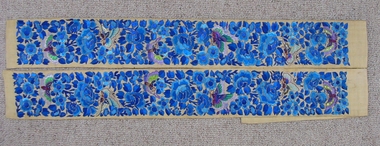
Accessory - Pair of Chinese Sleeve Bands
... Silk Embroidery... China... Oriental...Embroidery Garments Silk Embroidery China Oriental butterflies flowers Old gold satin embroidered with blue flowers and leaves in silks. ...Butterfly is a symbol of happiness and conjugal bliss. Peonies - flowers of happiness. Chinese sleeve embroidery bands, or wanxiu became popular in the late 19th century during the Qing Dynasty, evolving from the traditional Han cuff embroidery and Manchu styles. These detachable, decorated bands were added to women's informal jackets and robes, often featuring symbolic motifs like landscapes, flowers, and auspicious symbols. They served both a decorative function, displaying artistic skill and personal wishes, and a practical one by covering the sleeves when hands were folded at the waist. History and evolution: Origins: The practice of embroidering cuffs on robes existed during the previous Ming Dynasty for Han women, and this was adopted by the Manchu rulers who founded the Qing Dynasty. Qing Dynasty (1644-1911): The practice was popularized and elaborated upon during this era, with detachable bands becoming a fashionable element for informal wear. Symbolism: The embroidery included a complex visual vocabulary of wishes for a long life, many offspring, and a happy marriage, derived from nature, mythology, and classical literature. Functionality: Women would fold their arms, often with their hands inside the sleeves, so the embroidered bands, which were sewn to hang down the back of the jacket, would be displayed prominently down the front. 19th century peak: The late 19th century was the peak of their popularity, with intricate designs becoming fashionable and even influenced by court tastes, such as those favoured by the Empress Dowager Cixi. Later developments: The late 19th century saw the introduction of chemical 'aniline' dyes from Europe, leading to brighter, bolder colours in embroidery. Motifs and their Meanings: Auspicious symbols: Designs often included symbols for good fortune, wealth, and longevity. Natural imagery: Birds, flowers, and landscapes were common motifs that could represent natural beauty or convey specific symbolic meanings. Figurative scenes: Bands could also feature narrative scenes from classical stories or legends. The choice of motifs allowed women to express personal desires, cultural values, and aesthetic preferences, reflecting a more personal and informal style than official court attire.Old gold satin embroidered with blue flowers and leaves in silks. Butterflies worked in mauve, green, blue, cream, burgundy and aquamarine.embroidery, garments, silk embroidery, china, oriental, butterflies, flowers -
 Embroiderers Guild, Victoria
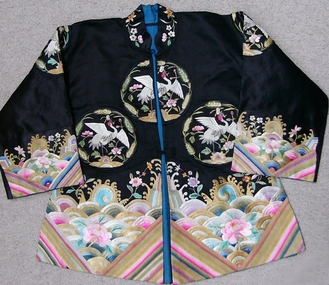
Clothing - Jacket, Ladies
... Silk Embroidery... Garments... China... Oriental...Embroidery Silk Embroidery Garments China Oriental Black satin with rich silk embroidery around the hem, which means it may have been made for a lady of high rank. ...In Chinese embroidery, the crane (He, 鹤) is a powerful symbol of longevity, wisdom, immortality, and good fortune, often depicted with other auspicious motifs like peaches, pine, or bamboo to enhance these meanings, and historically used on civil officials' rank badges (buzi) to denote high rank and virtue, reflecting aspirations for a long, prosperous, and wise life, linked to Daoist immortals and heavenly ascent. Black satin with rich silk embroidery around the hem, which means it may have been made for a lady of high rank. Circular motifs of cranes and storks. Probably made for a pregnancy. Bright blue lining.embroidery, silk embroidery, garments, china, oriental -
 Orbost & District Historical Society
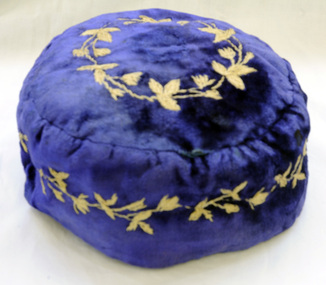
smoking cap, late 19th century
... The design, with its elaborate embroidery shows an aspect of Victorian material culture and reflects the nineteenth-century love of 'Oriental' style. . head-coverings Stirling-James smoking-cap A domed shaped smoking cap of blue velvet .It is lined with silk. ...Smoking Caps are caps worn by men while smoking to stop the hair from smelling of smoke. They also kept the head warm. They were popular in the period 1840-1880, usually worn by gentlemen in the privacy of their home. This beautiful velvet smoking cap was worn by James Stirling who was the first settler to occupy land in the Marlo township. James stirling arrived in Victoria from Scotland in 1842.He took over Corringle Station (Ewing's Marsh). His son James stirling later established theMarlo Hotel. (Read more in Mary Gilbert’s book)Smoking accessories like this cap were popular through the mid-to-late nineteenth century to prevent the smoker's hair from absorbing the smell of tobacco smoke and were often worn with smoking jackets. The design, with its elaborate embroidery shows an aspect of Victorian material culture and reflects the nineteenth-century love of 'Oriental' style. . A domed shaped smoking cap of blue velvet .It is lined with silk. The tops and sides are embroidered with tan coloured leaves. head-coverings stirling-james smoking-cap -
 Embroiderers Guild, Victoria
Artwork, other - "Theatre Mask" Edna Wark Metal Thread Embroidery, Edna Wark, "Theatre Mask", 1985
... Embroidery Metal thread Oriental Goldwork Picture "Thread Mask" EW 1985 Oriental head embroidered in genuine Jap gold thread with hair of black felt, and beard of couched threads (plastic?) Background is brown silk ...Oriental head embroidered in genuine Jap gold thread with hair of black felt, and beard of couched threads (plastic?) Background is brown silk or synthetic, mounted on a lighter brown padded board."Thread Mask" EW 1985embroidery, metal thread, oriental, goldwork, picture -
 Embroiderers Guild, Victoria
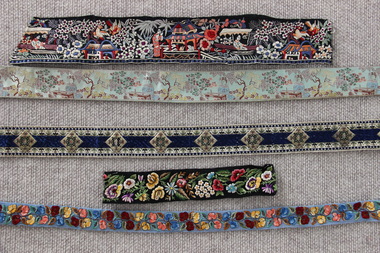
Textile - Braids, 20th C
... Embroidery Weaving 5 braid pieces A. machine made, woven on cream background, dark blue centre with gold work, diamonds at regular intervals B. Green woven oriental lady in garden. C. Black silk ...5 braid pieces A. machine made, woven on cream background, dark blue centre with gold work, diamonds at regular intervals B. Green woven oriental lady in garden. C. Black silk ribbon, hand embroidered with Chinese figures, trees, flowers, pagodas etc. D. Blue crepe, machine embroidered flowers in a repeating pattern E. Black crepe, machine embroidered flowers, pansies, roses etc.embroidery, weaving
