
Showing 50 items matching " sir thomas bent"
-
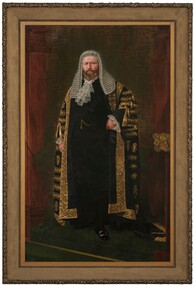 Bayside Gallery - Bayside City Council Art & Heritage Collection
Painting - oil on canvas, Charles E. Gordon Frazer, Sir Thomas Bent, 1892
... Sir Thomas Bent...sir thomas bent...Thomas Bent is depicted as standing in his Speaker's robe on the dais beneath the canopy in the Legislative Assembly Chamber in the act of addressing the House. He wears the traditional Speaker’s dress of a black silk and gold laced robe over a three-piece black suit, lace jabot and cuffs, buckled shoes and a ceremonial long wig. The top of the gold parliamentary mace sits on the right of the work near the frame's edge. sir ...When Thomas Bent, politician and land speculator, was appointed Speaker of the Victorian Legislative Assembly in 1892, a number of local Brighton constituents and supporters raised money to present him with an oil portrait. Bent had been a member for Brighton for 21 years, and the painting was seen as a way of showing their appreciation of his services to the Brighton constituency, as well as congratulating him to his new position as Speaker. In June 1892, British/Australian landscape and portrait artist Charles E. Gordon-Frazer was given the commission to paint the portrait. Thomas Bent is depicted as standing in his Speaker's robe on the dais beneath the canopy in the Legislative Assembly Chamber in the act of addressing the House. He wears the traditional Speaker’s dress of a black silk and gold laced robe over a three-piece black suit, lace jabot and cuffs, buckled shoes and a ceremonial long wig. The top of the gold parliamentary mace sits on the right of the work near the frame's edge.sir thomas bent, thomas bent, speaker, mayor, premier, brighton, moorabbin, land speculator, local government, councillor, official, member of lower house, portrait, parliament, ceremonial robes, legislative assembly, jabot, wig, mace -
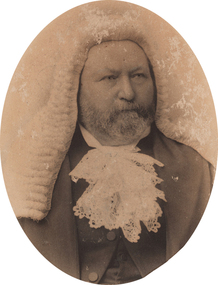 Bayside Gallery - Bayside City Council Art & Heritage Collection
Photograph - sepia photograph, Sir Thomas Bent and two unidentified men, c.1892-94
... Sir Thomas Bent and two unidentified men...sir thomas bent...sir thomas bent mayor politician brighton speaker premier land speculator local government councillor member of lower house portrait wig jabot government photograph Sir Thomas Bent and two unidentified men Photograph sepia photograph ...sir thomas bent, mayor, politician, brighton, speaker, premier, land speculator, local government, councillor, member of lower house, portrait, wig, jabot, government, photograph -
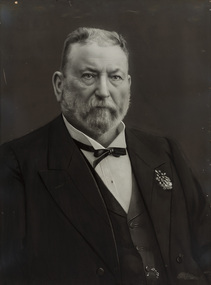 Bayside Gallery - Bayside City Council Art & Heritage Collection
Photograph - gelatin silver photograph, Talma & Co, Sir Thomas Bent, c. 1907
... Sir Thomas Bent...sir thomas bent...sir thomas bent thomas bent speaker mayor premier brighton moorabbin land speculator local government councillor official member of lower house portrait parliament Gelatin silver photograph with some areas hand coloured Sir Thomas Bent Photograph gelatin silver photograph Talma & Co. ...sir thomas bent, thomas bent, speaker, mayor, premier, brighton, moorabbin, land speculator, local government, councillor, official, member of lower house, portrait, parliament -
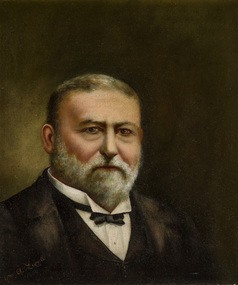 Bayside Gallery - Bayside City Council Art & Heritage Collection
Painting - oil on canvas, Sir Thomas Bent, 1909
... Sir Thomas Bent...sir thomas bent...sir thomas bent mayor policitian portrait brighton speaker premier councillor land speculator local government member of lower house Mayor of Brighton Premier of Victoria Sir Thomas Bent Painting oil on canvas ...Artist unknown, Sir Thomas Bent 1909, oil on canvas, 29.5 x 24.5 cm. Bayside City Council Art and Heritage Collection.sir thomas bent, mayor, policitian, portrait, brighton, speaker, premier, councillor, land speculator, local government, member of lower house, mayor of brighton, premier of victoria -
 Bayside Gallery - Bayside City Council Art & Heritage Collection
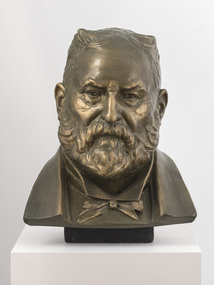
Sculpture, Margaret Baskerville, Sir Thomas Bent, c. 1911
... Sir Thomas Bent...This work is a plaster maquette of a large bronze statue of politician and land speculator Sir Thomas Bent by Margaret Baskerville that is located on the corner of Bay Street and Nepean Highway, Brighton....This work is a plaster maquette of a large bronze statue of politician and land speculator Sir Thomas Bent by Margaret Baskerville that is located on the corner of Bay Street and Nepean Highway, Brighton. thomas bent politician mayor premier bust sculpture margaret baskerville land speculator speaker local government councillor member of lower house portrait patinated plaster Sir Thomas Bent Sculpture sculpture Margaret Baskerville ...This work is a plaster maquette of a large bronze statue of politician and land speculator Sir Thomas Bent by Margaret Baskerville that is located on the corner of Bay Street and Nepean Highway, Brighton.Margaret Baskerville, Sir Thomas Bent c.1911, patinated plaster, 55 x 49 x 49 cm. Bayside City Council Art and Heritage Collection. Donated by Charles Douglas Richardson, 1931.patinated plaster thomas bent, politician, mayor, premier, bust, sculpture, margaret baskerville, land speculator, speaker, local government, councillor, member of lower house, portrait -
 Bayside Gallery - Bayside City Council Art & Heritage Collection
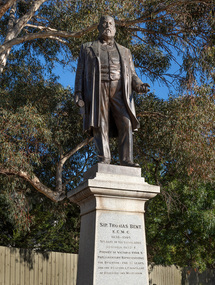
Sculpture, Margaret Baskerville, Sir Thomas Bent, 1913
... Sir Thomas Bent...Arguably Margaret Baskerville’s most famous work, the bronze statue of politician and land speculator Sir Thomas Bent was Baskerville’s first public commission and a significant turning point in her career. ...The statue of Sir Thomas Bent is of historic and social significance to the State of Victoria. ...Arguably Margaret Baskerville’s most famous work, the bronze statue of politician and land speculator Sir Thomas Bent was Baskerville’s first public commission and a significant turning point in her career. Originally located in the centre of the Nepean Highway, in Brighton, it became somewhat of signpost for many Melbournians until it was relocated to the corner of Bay Street in 1980.The statue of Sir Thomas Bent is of historic and social significance to the State of Victoria. The statue is historically significant for commemorating Bent's long, active and infamous political career in Victoria. He was responsible for many important speculative ventures both within his electorate and in the wider context of Victoria. Although not without thought for personal gain, Bent was a committed advocate of public utilities, railways, roads, tramways and gasworks. The statue is historically significant as the first large public commission given to a woman sculptor in Victoria. This work helped the sculptor, Margaret Baskerville, preserve her name as Victoria's first professional woman sculptor. The statue is socially significant as testimony to the late nineteenth century land boom and the financial and political corruption and scandals that accompanied it. https://vhd.heritagecouncil.vic.gov.au/places/12614bronze and granite thomas bent, politician, mayor, premier, bust, sculpture, margaret baskerville, speaker, member of parliament, member of lower house, local government, councillor, brighton, public art, bayside -
 Bayside Gallery - Bayside City Council Art & Heritage Collection
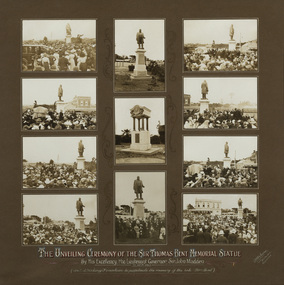
Photograph - gelatin silver photograph, R. McGeehan, Unveiling Ceremony of the Sir Thomas Bent Memorial Statue, 1913
... Unveiling Ceremony of the Sir Thomas Bent Memorial Statue...Compilation of eleven gelatin silver photographs recording the unveiling ceremony for statue of Sir Thomas Bent and the drinking fountain in memory of the Late Mrs Bent, by His Excellency, the Lieutenant Governor, Sir John Madden, 27 October 1913. ...politician mayor premier bust sculpture margaret baskerville speaker member of parliament member of lower house local government councillor brighton public art bayside thomas bent unveiling ceremony mayoress sculptor councillor wilson crowd 1913 nepean highway mrs bent elizabeth bleazby fountain memorial John Madden Lieutenant Governor Compilation of eleven gelatin silver photographs recording the unveiling ceremony for statue of Sir Thomas Bent and the drinking fountain in memory of the Late Mrs Bent, by His Excellency, the Lieutenant Governor, Sir John Madden, 27 October 1913. ...politician, mayor, premier, bust, sculpture, margaret baskerville, speaker, member of parliament, member of lower house, local government, councillor, brighton, public art, bayside, thomas bent, unveiling, ceremony, mayoress, sculptor, councillor wilson, crowd, 1913, nepean highway, mrs bent, elizabeth bleazby, fountain, memorial, john madden, lieutenant governor -
 Bayside Gallery - Bayside City Council Art & Heritage Collection
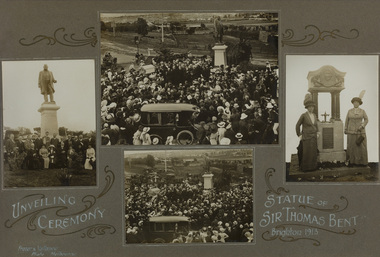
Photograph - gelatin silver photograph, Frazer & Vallance, Unveiling Ceremony, Statue of Sir Thomas Bent, Brighton, 1913
... Unveiling Ceremony, Statue of Sir Thomas Bent, Brighton...Compilation of four gelatin silver photographs recording the unveiling ceremony for statue of Sir Thomas Bent, Brighton, 1913. The photograph on the left (0000-640.1) features the committee group by the statue, seated— Hon. ...Unveiling Ceremony, Statue of Sir Thomas Bent, Brighton Photograph gelatin silver photograph Frazer & Vallance ...politician, mayor, premier, bust, sculpture, margaret baskerville, speaker, member of parliament, member of lower house, local government, councillor, brighton, public art, bayside, thomas bent, unveiling, ceremony, mayoress, sculptor, councillor wilson, crowd, 1913, nepean highway, mrs bent, elizabeth bleazby, fountain, memorial -
 Glen Eira Historical Society
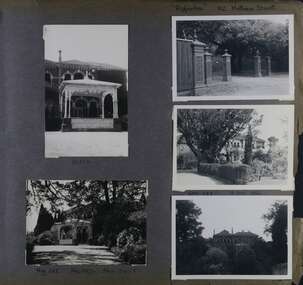
Album - Album page, Ripponlea, 192 Hotham Street, Circa 1972
... ...thomas bent...sir...Many alterations have changed the interior and exterior during the ownerships of Benjamin Nathan and later his daughter Mrs Louisa Jones in the 1930s and are in their own right of significance. Sir Thomas Bent owned the property from 1903 until 1911 but never lived there. ...This photograph is part of the Caulfield Historical Album 1972. This album was created in approximately 1972 as part of a project by the Caulfield Historical Society to assist in identifying buildings worthy of preservation. The album is related to a Survey the Caulfield Historical Society developed in collaboration with the National Trust of Australia (Victoria) and Caulfield City Council to identify historic buildings within the City of Caulfield that warranted the protection of a National Trust Classification. Principal photographer thought to be Trevor Hart, member of Caulfield Historical Society. Most photographs were taken between 1966-1972 with a small number of photographs being older and from unknown sources. All photographs are black and white except where stated, with 386 photographs over 198 pages.From Victorian Heritage Database citation for Rippon Lea H0614 https://vhd.heritagecouncil.vic.gov.au/places/427(as at 23/10/2020) Rippon Lea was commenced in 1868 by Frederick Sargood, a most successful politician and merchant. He was born in England in 1834 and arrived in Melbourne in 1850. He soon joined his father's wholesale soft goods firm, spending some time as its manager on the goldfields. Sargood entered the Legislative Council in 1874. He was Victoria's first Minister for Defence in 1883. Sir Frederick Sargood was created CMG. In 1885 and KCMG in 1890 as a reward for his contribution to public life. He died suddenly in 1903. Rippon Lea was designed by the leading firm of architects, Reed and Barnes. Joseph Reed had travelled in Europe in 1863, including northern Italy. When he returned he introduced the use of polychromy. While not the first examples, Rippon Lea and the Independent Church in Collins Street were the best and set a fashion which became a distinctly Melbourne style, particularly used for houses and churches. Its popularity was possible because of the new availability of different coloured bricks. Reed's fine Lombardic Romanesque details soon became debased by others. As Sargood's family grew and his fortunes prospered, Rippon Lea was extended to include 33 rooms - a complete mansion. The cast iron porte cochere and the northern conservatory were added in 1897. The architects were Taylor and Fitts. The ballroom was added in 1882 and remodelled in 1889. Many alterations have changed the interior and exterior during the ownerships of Benjamin Nathan and later his daughter Mrs Louisa Jones in the 1930s and are in their own right of significance. Sir Thomas Bent owned the property from 1903 until 1911 but never lived there. He subdivided much of the land. The original garden dates from about 1868, and it seems that William Guilfoyle of the Botanic Gardens was involved. It was redesigned in a more natural style in the 1880s by Sargood and his head gardener, Adam Anderson. The lake, waterfalls, fernery, hill and grotto are balanced by mighty deciduous trees and conifers. These are interspersed with, but never dominated by Australian species such as eucalyptus and other exotics. The sinuous drive with its carefully prepared approach to the house is notable. The original vegetable gardens, orchard and outer paddocks no longer survive. The shade house is important as the largest known in Australia and possibly the world. Its curved plan and form of construction are particularly notable. It was built about 1884.Page 90 of Photograph Album with five photographs (one landscape and 4 portrait) of Ripponlea - two different views of the front entrance to the mansion, one of the front gates and two different views of the main residence.Handwritten: "Ripponlea" 192 Hotham Street [top right] / North [under top left photo] / Neg 255 Dec 1972 MAIN DRIVE [under bottom left photo] / Neg 238 8 OCT 1966 [under middle right photo] / 88 [bottom right]trevor hart, elsternwick, mansion, hotham street, frederick sargood, reed and barnes, cast iron porte cochere, conservatory, 1860's, 1890's, ballroom, 1880's, benjamin nathan, louisa jones, thomas bent, sir thomas bent, william guilfoyle, adam anderson, lake, grotto, shade house, portico, ripponlea, victorian, sir frederick sargood, architects, polychrome bricks, lombardic romanesque architectural style, rippon lea, taylor and fitts, land subdivisions, gardens, drives, vegetable gardens, orchards -
 Glen Eira Historical Society
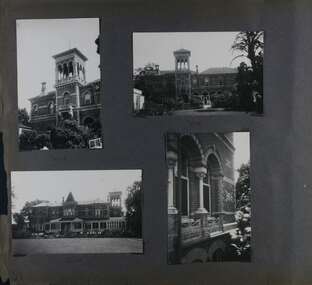
Album - Album page, Ripponlea, 192 Hotham Street, Circa 1972
... ...thomas bent...sir...Many alterations have changed the interior and exterior during the ownerships of Benjamin Nathan and later his daughter Mrs Louisa Jones in the 1930s and are in their own right of significance. Sir Thomas Bent owned the property from 1903 until 1911 but never lived there. ...This photograph is part of the Caulfield Historical Album 1972. This album was created in approximately 1972 as part of a project by the Caulfield Historical Society to assist in identifying buildings worthy of preservation. The album is related to a Survey the Caulfield Historical Society developed in collaboration with the National Trust of Australia (Victoria) and Caulfield City Council to identify historic buildings within the City of Caulfield that warranted the protection of a National Trust Classification. Principal photographer thought to be Trevor Hart, member of Caulfield Historical Society. Most photographs were taken between 1966-1972 with a small number of photographs being older and from unknown sources. All photographs are black and white except where stated, with 386 photographs over 198 pages.From Victorian Heritage Database citation for Rippon Lea H0614 https://vhd.heritagecouncil.vic.gov.au/places/427(as at 23/10/2020) Rippon Lea was commenced in 1868 by Frederick Sargood, a most successful politician and merchant. He was born in England in 1834 and arrived in Melbourne in 1850. He soon joined his father's wholesale soft goods firm, spending some time as its manager on the goldfields. Sargood entered the Legislative Council in 1874. He was Victoria?s first Minister for Defence in 1883. Sir Frederick Sargood was created CMG. In 1885 and KCMG in 1890 as a reward for his contribution to public life. He died suddenly in 1903. Rippon Lea was designed by the leading firm of architects, Reed and Barnes. Joseph Reed had travelled in Europe in 1863, including northern Italy. When he returned he introduced the use of polychromy. While not the first examples, Rippon Lea and the Independent Church in Collins Street were the best and set a fashion which became a distinctly Melbourne style, particularly used for houses and churches. Its popularity was possible because of the new availability of different coloured bricks. Reed's fine Lombardic Romanesque details soon became debased by others. As Sargood's family grew and his fortunes prospered, Rippon Lea was extended to include 33 rooms - a complete mansion. The cast iron porte cochere and the northern conservatory were added in 1897. The architects were Taylor and Fitts. The ballroom was added in 1882 and remodelled in 1889. Many alterations have changed the interior and exterior during the ownerships of Benjamin Nathan and later his daughter Mrs Louisa Jones in the 1930s and are in their own right of significance. Sir Thomas Bent owned the property from 1903 until 1911 but never lived there. He subdivided much of the land. The original garden dates from about 1868, and it seems that William Guilfoyle of the Botanic Gardens was involved. It was redesigned in a more natural style in the 1880s by Sargood and his head gardener, Adam Anderson. The lake, waterfalls, fernery, hill and grotto are balanced by mighty deciduous trees and conifers. These are interspersed with, but never dominated by Australian species such as eucalyptus and other exotics. The sinuous drive with its carefully prepared approach to the house is notable. The original vegetable gardens, orchard and outer paddocks no longer survive. The shade house is important as the largest known in Australia and possibly the world. Its curved plan and form of construction are particularly notable. It was built about 1884.Page 91 of Photograph Album with four photographs (two portrait and two landscape) of various external views of Ripponlea.Handwritten: SOUTH [under top left photo] / SOUTH [under top right photo] / WEST [under bottom left photo] / 91 [bottom left]trevor hart, elsternwick, mansion, hotham street, frederick sargood, reed and barnes, cast iron porte cochere, conservatory, 1860's, 1890's, ballroom, 1880's, benjamin nathan, louisa jones, thomas bent, sir thomas bent, william guilfoyle, adam anderson, lake, grotto, shade house, portico, ripponlea, victorian, sir frederick sargood, architects, taylor and fitts, rippon lea, polychrome bricks, lombardic romanesque style -
 Glen Eira Historical Society
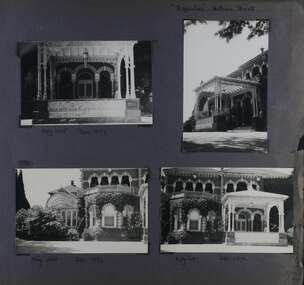
Album - Album page, Ripponlea, Hotham Street, Circa 1972
... ...thomas bent...sir...Many alterations have changed the interior and exterior during the ownerships of Benjamin Nathan and later his daughter Mrs Louisa Jones in the 1930s and are in their own right of significance. Sir Thomas Bent owned the property from 1903 until 1911 but never lived there. ...This photograph is part of the Caulfield Historical Album 1972. This album was created in approximately 1972 as part of a project by the Caulfield Historical Society to assist in identifying buildings worthy of preservation. The album is related to a Survey the Caulfield Historical Society developed in collaboration with the National Trust of Australia (Victoria) and Caulfield City Council to identify historic buildings within the City of Caulfield that warranted the protection of a National Trust Classification. Principal photographer thought to be Trevor Hart, member of Caulfield Historical Society. Most photographs were taken between 1966-1972 with a small number of photographs being older and from unknown sources. All photographs are black and white except where stated, with 386 photographs over 198 pages.From Victorian Heritage Database citation for Rippon Lea H0614 https://vhd.heritagecouncil.vic.gov.au/places/427(as at 23/10/2020) Rippon Lea was commenced in 1868 by Frederick Sargood, a most successful politician and merchant. He was born in England in 1834 and arrived in Melbourne in 1850. He soon joined his father's wholesale soft goods firm, spending some time as its manager on the goldfields. Sargood entered the Legislative Council in 1874. He was Victoria?s first Minister for Defence in 1883. Sir Frederick Sargood was created CMG. In 1885 and KCMG in 1890 as a reward for his contribution to public life. He died suddenly in 1903. Rippon Lea was designed by the leading firm of architects, Reed and Barnes. Joseph Reed had travelled in Europe in 1863, including northern Italy. When he returned he introduced the use of polychromy. While not the first examples, Rippon Lea and the Independent Church in Collins Street were the best and set a fashion which became a distinctly Melbourne style, particularly used for houses and churches. Its popularity was possible because of the new availability of different coloured bricks. Reed's fine Lombardic Romanesque details soon became debased by others. As Sargood's family grew and his fortunes prospered, Rippon Lea was extended to include 33 rooms - a complete mansion. The cast iron porte cochere and the northern conservatory were added in 1897. The architects were Taylor and Fitts. The ballroom was added in 1882 and remodelled in 1889. Many alterations have changed the interior and exterior during the ownerships of Benjamin Nathan and later his daughter Mrs Louisa Jones in the 1930s and are in their own right of significance. Sir Thomas Bent owned the property from 1903 until 1911 but never lived there. He subdivided much of the land. The original garden dates from about 1868, and it seems that William Guilfoyle of the Botanic Gardens was involved. It was redesigned in a more natural style in the 1880s by Sargood and his head gardener, Adam Anderson. The lake, waterfalls, fernery, hill and grotto are balanced by mighty deciduous trees and conifers. These are interspersed with, but never dominated by Australian species such as eucalyptus and other exotics. The sinuous drive with its carefully prepared approach to the house is notable. The original vegetable gardens, orchard and outer paddocks no longer survive. The shade house is important as the largest known in Australia and possibly the world. Its curved plan and form of construction are particularly notable. It was built about 1884.Page 92 of Photograph Album with four photographs (three landscape and one portrait) of Ripponlea - views of entrance and left front of mansion.Handwritten: "Ripponlea" Hotham Street [top right] / Neg 245 Dec 1972 [under top left photo] / Neg 246 Dec 1972 [under bottom left photo] / Neg 247 Dec 1972 [under bottom right photo] / 92 [bottom right]trevor hart, elsternwick, mansion, hotham street, frederick sargood, reed and barnes, lombardic, romanesque, cast iron porte cochere, conservatory, 1860's, 1890's, ballroom, 1880's, benjamin nathan, louisa jones, thomas bent, sir thomas bent, william guilfoyle, adam anderson, lake, grotto, shade house, portico, ripponlea, victorian, sir frederick sargood, architects, polychrome bricks, lombardic romanesque style, rippon lea, entrances -
 Glen Eira Historical Society
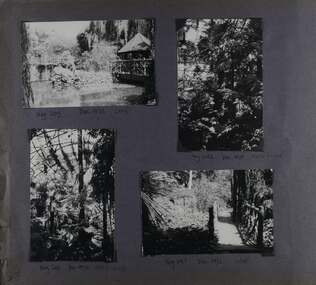
Album - Album page, Ripponlea, Hotham Street, Circa 1972
... ...thomas bent...sir...Many alterations have changed the interior and exterior during the ownerships of Benjamin Nathan and later his daughter Mrs Louisa Jones in the 1930s and are in their own right of significance. Sir Thomas Bent owned the property from 1903 until 1911 but never lived there. ...This photograph is part of the Caulfield Historical Album 1972. This album was created in approximately 1972 as part of a project by the Caulfield Historical Society to assist in identifying buildings worthy of preservation. The album is related to a Survey the Caulfield Historical Society developed in collaboration with the National Trust of Australia (Victoria) and Caulfield City Council to identify historic buildings within the City of Caulfield that warranted the protection of a National Trust Classification. Principal photographer thought to be Trevor Hart, member of Caulfield Historical Society. Most photographs were taken between 1966-1972 with a small number of photographs being older and from unknown sources. All photographs are black and white except where stated, with 386 photographs over 198 pages.From Victorian Heritage Database citation for Rippon Lea H0614 https://vhd.heritagecouncil.vic.gov.au/places/427(as at 23/10/2020) Rippon Lea was commenced in 1868 by Frederick Sargood, a most successful politician and merchant. He was born in England in 1834 and arrived in Melbourne in 1850. He soon joined his father's wholesale soft goods firm, spending some time as its manager on the goldfields. Sargood entered the Legislative Council in 1874. He was Victoria?s first Minister for Defence in 1883. Sir Frederick Sargood was created CMG. In 1885 and KCMG in 1890 as a reward for his contribution to public life. He died suddenly in 1903. Rippon Lea was designed by the leading firm of architects, Reed and Barnes. Joseph Reed had travelled in Europe in 1863, including northern Italy. When he returned he introduced the use of polychromy. While not the first examples, Rippon Lea and the Independent Church in Collins Street were the best and set a fashion which became a distinctly Melbourne style, particularly used for houses and churches. Its popularity was possible because of the new availability of different coloured bricks. Reed's fine Lombardic Romanesque details soon became debased by others. As Sargood's family grew and his fortunes prospered, Rippon Lea was extended to include 33 rooms - a complete mansion. The cast iron porte cochere and the northern conservatory were added in 1897. The architects were Taylor and Fitts. The ballroom was added in 1882 and remodelled in 1889. Many alterations have changed the interior and exterior during the ownerships of Benjamin Nathan and later his daughter Mrs Louisa Jones in the 1930s and are in their own right of significance. Sir Thomas Bent owned the property from 1903 until 1911 but never lived there. He subdivided much of the land. The original garden dates from about 1868, and it seems that William Guilfoyle of the Botanic Gardens was involved. It was redesigned in a more natural style in the 1880s by Sargood and his head gardener, Adam Anderson. The lake, waterfalls, fernery, hill and grotto are balanced by mighty deciduous trees and conifers. These are interspersed with, but never dominated by Australian species such as eucalyptus and other exotics. The sinuous drive with its carefully prepared approach to the house is notable. The original vegetable gardens, orchard and outer paddocks no longer survive. The shade house is important as the largest known in Australia and possibly the world. Its curved plan and form of construction are particularly notable. It was built about 1884.Page 93 of Photograph Album with four photographs (two landscape and two portrait) of Ripponlea - lake and gardens.Handwritten: Neg 239 Dec 1973 LAKE [under top left photo] / Neg 242 Dec 1973 FERN HOUSE [under top right photo] / Neg 243 Dec 1972 FERN HOUSE [under bottom left photo] / Neg 241 Dec 1972 LAKE [under bottom right photo] / 93 [bottom left]trevor hart, elsternwick, mansion, hotham street, frederick sargood, sargood, reed and barnes, 1860's, 1890's, 1880's, benjamin nathan, nathan, louisa jones, thomas bent, sir thomas bent, william guilfoyle, adam anderson, lake, grotto, shade house, portico, ripponlea, victorian, sir frederick sargood, architects, taylor and fitts, rippon lea, gardens, ferns, bridges, walking trails -
 Glen Eira Historical Society
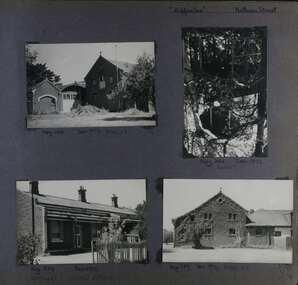
Album - Album page, "Ripponlea", Hotham Street, Circa 1972
... ...thomas bent...sir...Many alterations have changed the interior and exterior during the ownerships of Benjamin Nathan and later his daughter Mrs Louisa Jones in the 1930s and are in their own right of significance. Sir Thomas Bent owned the property from 1903 until 1911 but never lived there. ...This photograph is part of the Caulfield Historical Album 1972. This album was created in approximately 1972 as part of a project by the Caulfield Historical Society to assist in identifying buildings worthy of preservation. The album is related to a Survey the Caulfield Historical Society developed in collaboration with the National Trust of Australia (Victoria) and Caulfield City Council to identify historic buildings within the City of Caulfield that warranted the protection of a National Trust Classification. Principal photographer thought to be Trevor Hart, member of Caulfield Historical Society. Most photographs were taken between 1966-1972 with a small number of photographs being older and from unknown sources. All photographs are black and white except where stated, with 386 photographs over 198 pages.From Victorian Heritage Database citation for Rippon Lea H0614 https://vhd.heritagecouncil.vic.gov.au/places/427(as at 23/10/2020) Rippon Lea was commenced in 1868 by Frederick Sargood, a most successful politician and merchant. He was born in England in 1834 and arrived in Melbourne in 1850. He soon joined his father's wholesale soft goods firm, spending some time as its manager on the goldfields. Sargood entered the Legislative Council in 1874. He was Victoria?s first Minister for Defence in 1883. Sir Frederick Sargood was created CMG. In 1885 and KCMG in 1890 as a reward for his contribution to public life. He died suddenly in 1903. Rippon Lea was designed by the leading firm of architects, Reed and Barnes. Joseph Reed had travelled in Europe in 1863, including northern Italy. When he returned he introduced the use of polychromy. While not the first examples, Rippon Lea and the Independent Church in Collins Street were the best and set a fashion which became a distinctly Melbourne style, particularly used for houses and churches. Its popularity was possible because of the new availability of different coloured bricks. Reed's fine Lombardic Romanesque details soon became debased by others. As Sargood's family grew and his fortunes prospered, Rippon Lea was extended to include 33 rooms - a complete mansion. The cast iron porte cochere and the northern conservatory were added in 1897. The architects were Taylor and Fitts. The ballroom was added in 1882 and remodelled in 1889. Many alterations have changed the interior and exterior during the ownerships of Benjamin Nathan and later his daughter Mrs Louisa Jones in the 1930s and are in their own right of significance. Sir Thomas Bent owned the property from 1903 until 1911 but never lived there. He subdivided much of the land. The original garden dates from about 1868, and it seems that William Guilfoyle of the Botanic Gardens was involved. It was redesigned in a more natural style in the 1880s by Sargood and his head gardener, Adam Anderson. The lake, waterfalls, fernery, hill and grotto are balanced by mighty deciduous trees and conifers. These are interspersed with, but never dominated by Australian species such as eucalyptus and other exotics. The sinuous drive with its carefully prepared approach to the house is notable. The original vegetable gardens, orchard and outer paddocks no longer survive. The shade house is important as the largest known in Australia and possibly the world. Its curved plan and form of construction are particularly notable. It was built about 1884.Page 94 of Photograph Album with four photographs (three landscape and one portrait) of Ripponlea - stables, lookout and neighbouring cottages.Handwritten: "Ripponlea" Hotham Street [top right] / Neg 256 Dec 1972 STABLES [under top left photo] / Neg 248 Dec 1972 LOOKOUT [under top right photo] / Neg 254 Dec 1972 / COTTAGES WILLOW STREET [under bottom left photo] / Neg 259 Dec 1972 STABLES [under bottom right photo] / 94 [bottom right]trevor hart, elsternwick, mansion, hotham street, frederick sargood, reed and barnes, 1860's, 1890's, 1880's, benjamin nathan, nathan, louisa jones, thomas bent, sir thomas bent, william guilfoyle, guilfoyle, adam anderson, ripponlea, victorian, sir frederick sargood, architects, bricks, polychrome bricks, taylor and fitts, stables, lookouts, cottages, outbuildings, rippon lea -
 Bendigo Historical Society Inc.
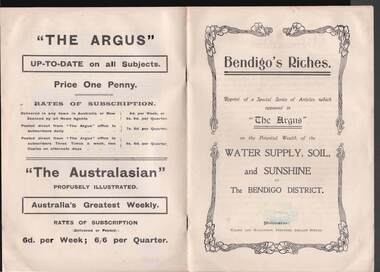
Book - BOOK: BENDIGO'S RICHES
... ... Sir Thomas Bent...PLACE Land agricultural Book - Bendigo's Riches The Argus Wilson and Mackinnon Councillor Carolin James Cumming Dairying Mr Elwood Mead Tomato Growing Mr B Puig y Ventura Mr Elliot Borley Fruitgrowers Bendigo Fruitgrowers' Co-operative Society Mr W A Hamilton ex-MLA Upper Coliban Coliban system Antiquated Mining Regulations Lands Department Chaffey Bros Mr G H Crawford Mine-owners' Association Councillor Andrew Mr Baillieu Miners' Association Agricultural Society Sir Thomas Bent Strathfieldsaye Shire Mr R B Brennan Mr T L Sweeny Jun Bendigo Sewerage Farm Councillor Osborne Councillor Lowndes Councillor T R Long Bendigo Chamber of Commerce Bendigo City Council Councillor Andrew Councillor H A Ross Councillor Wilkie H M Leggo and Co Small booklet titled 'Bendigo's Riches'. ...Small booklet titled 'Bendigo's Riches'. Reprint of a Special Series of Articles which appeared in 'The Argus' on the Potential Wealth of the Water Supply, Soil, and Sunshine of The Bendigo District. Printed by Wilson and Mackinnon, Printers, Collins Street. Booklet mentions the potential wealth of Bendigo's Water, Soil and Sunshine; Orchards, Dairying, Tomato Growing, Fruit growing, Land, and Water Supply. Also discussed are Antiquated Mining Regulations, City Trust suggested, and its Advantages, Opportunities, 'The Argus' suggestions endorsed, Mine-owner's Opinion, The Mayor of Bendigo's Opinion, Statement by Strathfieldsaye Shire Secretary, Locked-up Area Useless for Timber, Shire Appeals for Unlocking the Land, 'The Argus' Thanked, Bendigo Chamber of Commerce, Bendigo City Council and Preserving Factory at Bendigo. Photos include Irrigated pastures, ryegrass and clovers on Mr. James Cumming's Farm; Irrigating Tomatoes on Mr. Elliot Borley's Farm, White Hills; Junction of Huntly and White Hills Irrigation Channels; Packing Tomatoes at Mr. B. Puig Y. Ventura's Garden, White Hills; and Tomato Patch on the Holding of Mr. T. L. Sweeny, Jun. Back of the booklet has subscription rates and price of The Argus. place, land, agricultural, book - bendigo's riches, the argus, wilson and mackinnon, councillor carolin, james cumming, dairying, mr elwood mead, tomato growing, mr b puig y ventura, mr elliot borley, fruitgrowers, bendigo fruitgrowers' co-operative society, mr w a hamilton ex-mla, upper coliban, coliban system, antiquated mining regulations, lands department, chaffey bros, mr g h crawford, mine-owners' association, councillor andrew, mr baillieu, miners' association, agricultural society, sir thomas bent, strathfieldsaye shire, mr r b brennan, mr t l sweeny jun, bendigo sewerage farm, councillor osborne, councillor lowndes, councillor t r long, bendigo chamber of commerce, bendigo city council, councillor andrew, councillor h a ross, councillor wilkie, h m leggo and co -
 Bendigo Historical Society Inc.
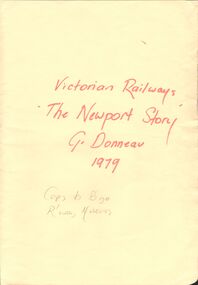
Document - VICTORIAN RAILWAYS - THE NEWPORT STORY
... Sir james Allport... Midland Railway... Mr Allison Dalrymple... Phoenix Foundry... North Melbourne Loco Depot... Beyer Peacock & CO... Mr A E Smith... Roger Barnes... Thomas Tait... BHP... F J Shea... Commonwealth Ordnance Department... James Rooks... London Times... Mr Merz... Mr McLellan... Bendigo North Railway Workshops... Ballarat Shops... James Taylor... Donald McGregor... Julius Aurelian Sylvester Barber... Victor Lethlean... Melbourne Institute of Technology... Prince of Wales... Queen Victoria... W M Shannon... Sir Thomas Bent...DOCUMENT Victorian Railways The Newport Story G Donneau Melbourne and Geelong Railway Co Melbourne & Hobson's Bay United Railway Co Mr William Meikle Solomon Mirls Richard Speight Sir james Allport Midland Railway Mr Allison Dalrymple Phoenix Foundry North Melbourne Loco Depot Beyer Peacock & CO Mr A E Smith Roger Barnes Thomas Tait BHP F J Shea Commonwealth Ordnance Department James Rooks London Times Mr Merz Mr McLellan Bendigo North Railway Workshops Ballarat Shops James Taylor Donald McGregor Julius Aurelian Sylvester Barber Victor Lethlean Melbourne Institute of Technology Prince of Wales Queen Victoria W M Shannon Sir Thomas Bent Puffing Billy Harold Winthrop Clapp Francis Boardman Clapp Melbourne Tramway & Omnibus Co Austral Otis Engineering Co Melbourne University Franklin Supply Co E H Brownbill Heavy Harry Locomotive Mausoleum North Melbourne North British Locomotive Co Walter Stinton Thomas Smith Peter Alexander Peter Alexander Robert Ferguson King George V English Railway Gazette Harry Nunn May Merz & MacLellan Arthur Lowe R H Roach W H Chapman L C Rolls G A Swift John McRae Caledonian Society Thistle Club Bristol Hotel James Taylor George Allibon Walter Grimshaw Robert Maybin Roy Hodge Walter Biddle John Ramsbottom Robert Hewitt James Green Thomas Waldhuter Giles Dobney Mr Richardson Mr Arthur Sydney Express The Age Mr Speight David Syme Father Gapon Typed history of the Newport Railway Workshops. ...Typed history of the Newport Railway Workshops. Mentions the men who worked at the workshop, the locomotives that were built there, the different classes of locomotives, the equipment they used, and some of the work they did. Written by G. Donneau (who worked there) and dated 19-3-79.document, victorian railways, the newport story, g donneau, melbourne and geelong railway co, melbourne & hobson's bay united railway co, mr william meikle, solomon mirls, richard speight, sir james allport, midland railway, mr allison dalrymple, phoenix foundry, north melbourne loco depot, beyer peacock & co, mr a e smith, roger barnes, thomas tait, bhp, f j shea, commonwealth ordnance department, james rooks, london times, mr merz, mr mclellan, bendigo north railway workshops, ballarat shops, james taylor, donald mcgregor, julius aurelian sylvester barber, victor lethlean, melbourne institute of technology, prince of wales, queen victoria, w m shannon, sir thomas bent, puffing billy, harold winthrop clapp, francis boardman clapp, melbourne tramway & omnibus co, austral otis engineering co, melbourne university, franklin supply co, e h brownbill, heavy harry, locomotive mausoleum north melbourne, north british locomotive co, walter stinton, thomas smith, peter alexander, peter alexander, robert ferguson, king george v, english railway gazette, harry nunn may, merz & maclellan, arthur lowe, r h roach, w h chapman, l c rolls, g a swift, john mcrae, caledonian society, thistle club, bristol hotel, james taylor, george allibon, walter grimshaw, robert maybin, roy hodge, walter biddle, john ramsbottom, robert hewitt, james green, thomas waldhuter, giles dobney, mr richardson, mr arthur, sydney express, the age, mr speight, david syme, father gapon -
 Glen Eira Historical Society
Document - Elizabeth Street, 30, Elsternwick, formerly Trengrove
... Sir... Bent Thomas...Elsternwick Elizabeth Street Historical buildings Davis Peter Caulfield Davis Street Sinclair Street Sargood Frederick Sir Bent Thomas Bent Street Rippon Lea Ripponlea Word War 1914-1918 Depression 1890s Depression 1929-1939 Hannan Stanley Rippon Bent Elizabeth Brighton Historical Society Bullock Hilary Sargood Frederick James Sargood Frederick Thomas Document Elizabeth Street, 30, Elsternwick, formerly Trengrove ...A two page typed research report dated 23/11/1988 by the Brighton Historical Society regarding the history of the large land area acquired by Peter Davis "in Melbourne's very early days" including the block later used for the house building in 1938 at 30 Elizabeth Street, Elsternwick. The report includes a brief history of the suburb of Ripponlea and the occupancy of 30 Elizabeth Street from 1938 to 1974 by Stanley Hannan. The file also includes one page of handwritten working notes for the typed report.elsternwick, elizabeth street, historical buildings, davis peter, caulfield, davis street, sinclair street, sargood frederick sir, bent thomas, bent street, rippon lea, ripponlea, word war 1914-1918, depression 1890s, depression 1929-1939, hannan stanley, rippon, bent elizabeth, brighton historical society, bullock hilary, sargood frederick james, sargood frederick thomas -
Glen Eira Historical Society
Document - Elizabeth Street, 22, Elsternwick
... Sir... Bent Thomas...Elizabeth Street Elsternwick Historical buildings Victorian style Edwardian style Rippon Lea Sargood Frederick Sir Bent Thomas Elsternwick Urban Conservation Area Stephens Nettie Dickson William Architectural features Ward Andrew Document Elizabeth Street, 22, Elsternwick ...A two page black and white copy of a Caulfield Conservation Study by Andrew Ward, dated 09/1994, on the house at 22 Elizabeth Street. The study includes an architectural description of the building, a brief history of ownership, a statement of significance and a black and white photograph (101mm x 154mm) of the exterior of the house.elizabeth street, elsternwick, historical buildings, victorian style, edwardian style, rippon lea, sargood frederick sir, bent thomas, elsternwick urban conservation area, stephens nettie, dickson william, architectural features, ward andrew -
Glen Eira Historical Society
Article - Elizabeth Street, 30, Elsternwick, formerly Trengrove
... Sir... Bent Thomas...Rippon Lea estate Elizabeth Street Elsternwick Sargood Fredericl Sir Bent Thomas Hannon S J Mrs Georgian revival style Gardens Architectural features Walling Edna Flats House names Talbot Birner Morley Trengrove Architectural styles Grant-Drew Maurice Article Elizabeth Street, 30, Elsternwick, formerly Trengrove ...A one page article from the Southern Cross newspaper, dated 09/12/1998, on page 12, for the auction of the mansion at 30 Elizabeth Street. The article includes a brief history of the existence of a 1908 property called "Trengrove", occupancy of the current house built for Mrs SJ Hannon after the demolition of "Trengrove" in 1937, mention of the Edna Walling-designed garden, a description of the property and the interior plan and three colour photographs (168mm x 121mm; 59mm x 78mm; 58mm x 73mm) taken by Maurice Grant-Drew.rippon lea estate, elizabeth street, elsternwick, sargood fredericl sir, bent thomas, hannon s j mrs, georgian revival style, gardens, architectural features, walling edna, flats, house names, talbot birner morley, trengrove, architectural styles, grant-drew maurice -
Glen Eira Historical Society
Document - Elizabeth Street, 56, Elsternwick
... ... Bent Thomas Sir...Elizabeth Street Elsternwick Davis Peter Davis Street Sargood Mr Ripponlea Bent Thomas Sir Bent Street Gordon Street Barlow George F S Brown George H C Collis-Brown George Collis-Brown Mr Weickhardt E C Collis-Brown L G Collis-Brown Laurie Burke V J Bullock Hilary Landells Rosalind Brighton Historical Society Document Elizabeth Street, 56, Elsternwick ...A one page typed research report on 56 Elizabeth Street, Elsternwick, dated 01/01/1989 and produced by the Brighton Historical Society. The report includes a brief history of the owners and occupancy of the house and of the area. The file also includes one page of undated, unattributed, handwritten working notes.elizabeth street, elsternwick, davis peter, davis street, sargood mr, ripponlea, bent thomas sir, bent street, gordon street, barlow george f s, brown george h c, collis-brown george, collis-brown mr, weickhardt e c, collis-brown l g, collis-brown laurie, burke v j, bullock hilary, landells rosalind, brighton historical society -
Glen Eira Historical Society
Article - Hawthorn Road, 449, Caulfield South
... ... Bent Sir Thomas...The projects are all on Hawthorn Road or Maple Street- Maple on the Park - a mixed use of developments Elle-luxury apartments Central Shule Chabad – new synagogue and community centre Hawthorn Road Caulfield South Land Subdivision Shops Flats Caulfield Primary School Towers Japanese School of Melbourne Sporting Clubs McCubbin Frederick Armadale Bowls Club Brighton Cemetery Boyd Arthur Merricks Artists Bent Sir Thomas Premiers Bentleigh Bent Street Jewish Community Maple on the Park CBG Architects Maple Apartments Schacter Max Property Developers Century 21 Wilson Pride Real Estate Agents Elle Besser David Rosenwald Yoel Amira Gaby Harper Terry Central Shule Chabad Synagogues Community Centres Halls Beter-Zionist Youth Movement Residential Development Commercial Development Eckstein Joey Fein Peter Liebowitz Lionel Besser Dion Butt Rochelle Article Hawthorn Road, 449, Caulfield South ...One item on this address. An article and ads in PRW of 29/07/2011 about three new developments in Caulfield South. Included is a short history and description of the suburb. The projects are all on Hawthorn Road or Maple Street- Maple on the Park - a mixed use of developments Elle-luxury apartments Central Shule Chabad – new synagogue and community centrehawthorn road, caulfield south, land subdivision, shops, flats, caulfield primary school, towers, japanese school of melbourne, sporting clubs, mccubbin frederick, armadale bowls club, brighton cemetery, boyd arthur merricks, artists, bent sir thomas, premiers, bentleigh, bent street, jewish community, maple on the park, cbg architects, maple apartments, schacter max, property developers, century 21 wilson pride, real estate agents, elle, besser david, rosenwald yoel, amira gaby, harper terry, central shule chabad, synagogues, community centres, halls, beter-zionist youth movement, residential development, commercial development, eckstein joey, fein peter, liebowitz lionel, besser dion, butt rochelle -
 Whitehorse Historical Society Inc.
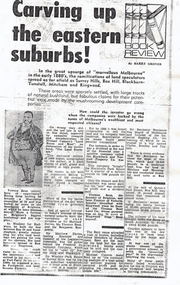
Print - Article, Carving up the Eastern Suburbs, 8/11/1972 12:00:00 AM
... sir...bent...thomas...davies matthew henry sir bent thomas benjamin freehold investment and banking company of australia ltd. blackburn and tunstall property co. queens park estate box hill residential development Photocopy of book review of Michael Cannon's 'Land Boom and Bust' describing the work of land speculators in the 1880's. ...Photocopy of book review of Michael Cannon's 'Land Boom and Bust' describing the work of land speculators in the 1880's.Photocopy of book review of Michael Cannon's 'Land Boom and Bust' describing the work of land speculators in the 1880's. The involvement of senior politicians is discussed. Sir Matthew Davies and the Freehold Investment Company in Blackburn and the sale of the Blackburn Park Estate is mentioned. A copy of a Queen's Park, Box Hill 10 pound deposit receipt is illustrated.Photocopy of book review of Michael Cannon's 'Land Boom and Bust' describing the work of land speculators in the 1880's. davies, matthew henry, sir, bent, thomas, benjamin, freehold investment and banking company of australia ltd., blackburn and tunstall property co., queens park estate, box hill, residential development -
 Melbourne Tram Museum
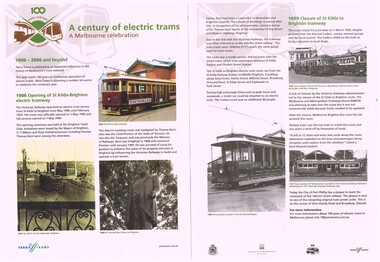
Pamphlet, Yarra Trams, "A Century of electric trams - A Melbourne celebration", 2006
... Double sided A4 sheet, on plain paper, printed in colour, titled "A Century of electric trams - A Melbourne celebration" looking at the celebration by Yarra Trams of the century of electric trams in Melbourne - particularly the St Kilda Brighton VR line, Sir Thomas Bent, and its closure in 1959. Seven copies held. ...Trams tramways VR St Kilda Brighton Opening Tramcars Centenary 100 years of electric trams Double sided A4 sheet, on plain paper, printed in colour, titled "A Century of electric trams - A Melbourne celebration" looking at the celebration by Yarra Trams of the century of electric trams in Melbourne - particularly the St Kilda Brighton VR line, Sir Thomas Bent, and its closure in 1959. Seven copies held. ...Double sided A4 sheet, on plain paper, printed in colour, titled "A Century of electric trams - A Melbourne celebration" looking at the celebration by Yarra Trams of the century of electric trams in Melbourne - particularly the St Kilda Brighton VR line, Sir Thomas Bent, and its closure in 1959. Seven copies held. Has the RSL, Shine of Remembrance, 100 years of trams and Yarra Trams logos.trams, tramways, vr, st kilda brighton, opening, tramcars, centenary, 100 years of electric trams -
 Bendigo Historical Society Inc.
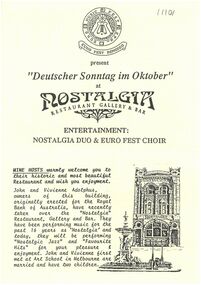
Document - Euro Fest menu and leaflet from 'Nostalgia Restaurant', Bendigo
... Deague & Son, and the foundation stone was laid by the then Premier of Victoria, Sir Thomas Bent. The building was purchased by John and Viviene Adolphus in 1991. ...Deague & Son, and the foundation stone was laid by the then Premier of Victoria, Sir Thomas Bent. The building was purchased by John and Viviene Adolphus in 1991. ...The building which housed the 'Nostalgia Restaurant, Gallery and Bar' at 17 View Point Street, Bendigo was designed by William Beene and George Garvin and opened in 1908 as a branch of the Royal Bank of Australia. Erected on the site of the old Oriental Hotel, the area was once known as the 'View Point Rocks'. The contractors were W. H. Deague & Son, and the foundation stone was laid by the then Premier of Victoria, Sir Thomas Bent. The building was purchased by John and Viviene Adolphus in 1991. Menu and brochure leaflet from 'Nostalgia' restaurant gallery and bar, 17 View Point Street, Bendigo. A4 piece of paper, folded in half, and tan in color. Menu is from 'Deutscher Sonntag im Oktober'. Menu included Entree, Main Course, and Dessert. Leaflet gives description of chef and manager of the venue. nostalgia restaurant, dining, euro fest, garvin, beebe -
 Bayside Gallery - Bayside City Council Art & Heritage Collection
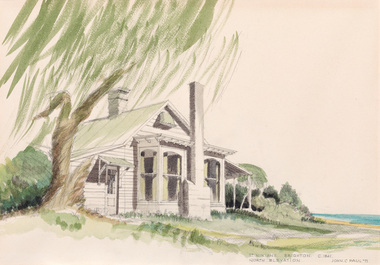
Work on paper - watercolour, John C. Paul, St. Ninian's north elevation c.1841, 1971
... Following the death of George Ward Cole in 1879 and his wife in 1898, their only surviving child, Margaret, sold the property to Sir Thomas Bent, who subdivided the land in the early 1900s. ...Following the death of George Ward Cole in 1879 and his wife in 1898, their only surviving child, Margaret, sold the property to Sir Thomas Bent, who subdivided the land in the early 1900s. ...Built around 1841, St Ninian’s, located at 10 Miller Street, was one of Brighton’s earliest buildings. It is best known as being the home of merchant shipping agent, politician and former British naval officer, George Ward Cole between the 1840s and 1902. Following the death of George Ward Cole in 1879 and his wife in 1898, their only surviving child, Margaret, sold the property to Sir Thomas Bent, who subdivided the land in the early 1900s. The property was demolished in 1974. John C. Paul, St. Ninian's north elevation c.1841 1971, watercolour, 29.5 x 42.3 cm. Bayside City Council Art and Heritage Collection. Purchased 1974.st ninian's, brighton, historic house, george ward cole, thomas bent -
 Bayside Gallery - Bayside City Council Art & Heritage Collection
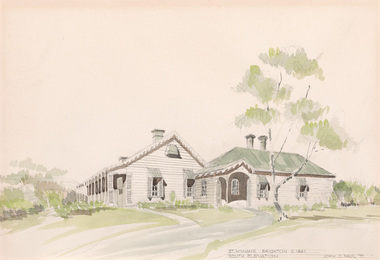
Work on paper - watercolour, John C. Paul, St. Ninian's south elevation c.1841, 1971
... Following the death of George Ward Cole in 1879 and his wife in 1898, their only surviving child, Margaret, sold the property to Sir Thomas Bent, who subdivided the land in the early 1900s. ...Following the death of George Ward Cole in 1879 and his wife in 1898, their only surviving child, Margaret, sold the property to Sir Thomas Bent, who subdivided the land in the early 1900s. ...Built around 1841, St Ninian’s, located at 10 Miller Street, was one of Brighton’s earliest buildings. It is best known as being the home of merchant shipping agent, politician and former British naval officer, George Ward Cole between the 1840s and 1902. Following the death of George Ward Cole in 1879 and his wife in 1898, their only surviving child, Margaret, sold the property to Sir Thomas Bent, who subdivided the land in the early 1900s. The property was demolished in 1974. John C. Paul, St. Ninian's south elevation c.1841 1971, watercolour, 29.5 x 43 cm. Bayside City Council Art and Heritage Collection. Purchased 1974.st ninian's, brighton, historic house, george ward cole, thomas bent -
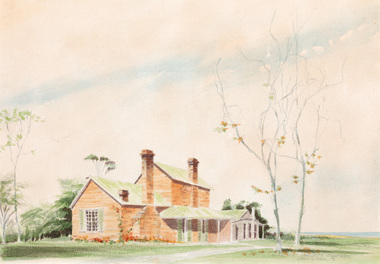 Bayside Gallery - Bayside City Council Art & Heritage Collection
Work on paper - watercolour, John C. Paul, St. Ninian's servants' quarters, 1975
... Following the death of George Ward Cole in 1879 and his wife in 1898, their only surviving child, Margaret, sold the property to Sir Thomas Bent, who subdivided the land in the early 1900s. ...Following the death of George Ward Cole in 1879 and his wife in 1898, their only surviving child, Margaret, sold the property to Sir Thomas Bent, who subdivided the land in the early 1900s. ...Built around 1841, St Ninian’s, located at 10 Miller Street, was one of Brighton’s earliest buildings. It is best known as being the home of merchant shipping agent, politician and former British naval officer, George Ward Cole between the 1840s and 1902. Following the death of George Ward Cole in 1879 and his wife in 1898, their only surviving child, Margaret, sold the property to Sir Thomas Bent, who subdivided the land in the early 1900s. The property was demolished in 1974. John C. Paul, St. Ninian's servants' quarters 1975, watercolour, 27.5 x 39.6 cm. Bayside City Council Art and Heritage Collectionst ninian's, brighton, historic house, george ward cole, thomas bent, servants' quarters -
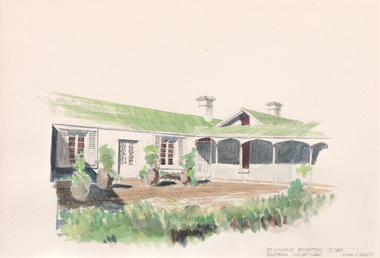 Bayside Gallery - Bayside City Council Art & Heritage Collection
Work on paper - watercolour, John C. Paul, St. Ninian's eastern courtyard c.1841, 1971
... Following the death of George Ward Cole in 1879 and his wife in 1898, their only surviving child, Margaret, sold the property to Sir Thomas Bent, who subdivided the land in the early 1900s. ...Following the death of George Ward Cole in 1879 and his wife in 1898, their only surviving child, Margaret, sold the property to Sir Thomas Bent, who subdivided the land in the early 1900s. ...Built around 1841, St Ninian’s, located at 10 Miller Street, was one of Brighton’s earliest buildings. It is best known as being the home of merchant shipping agent, politician and former British naval officer, George Ward Cole between the 1840s and 1902. Following the death of George Ward Cole in 1879 and his wife in 1898, their only surviving child, Margaret, sold the property to Sir Thomas Bent, who subdivided the land in the early 1900s. The property was demolished in 1974. John C. Paul, St. Ninian's eastern courtyard c.1841 1971, watercolour, 28.5 x 40.8 cm. Bayside City Council Art and Heritage Collection. Purchased 1974.st ninian's, brighton, historic house, george ward cole, thomas bent, courtyard -
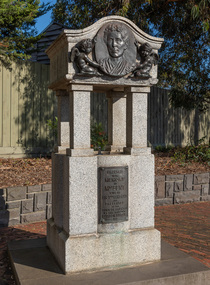 Bayside Gallery - Bayside City Council Art & Heritage Collection
Sculpture - fountain, Margaret Baskerville, Mrs Bent Drinking Fountain, 1913
... The fountain was commissioned by Elizabeth Bleazby, daughter of Sir Thomas and Mrs Bent, and unveiled 27 October 1913 by Mrs Wilson, Mayoress of Brighton....The fountain was commissioned by Elizabeth Bleazby, daughter of Sir Thomas and Mrs Bent, and unveiled 27 October 1913 by Mrs Wilson, Mayoress of Brighton. ...The fountain was commissioned by Elizabeth Bleazby, daughter of Sir Thomas and Mrs Bent, and unveiled 27 October 1913 by Mrs Wilson, Mayoress of Brighton.The fountain is of historical interest and aesthetic significance. The memorial is a good example of the smaller commemorative work of sculptor Margaret Baskerville. The memorial commemorates the wife of notable local resident, Sir Thomas Bent, who was a long-standing parliamentary representative, Mayor of Brighton and Premier of Victoria from 1904-1909.bronze and granite thomas bent, politician, mayor, premier, bust, sculpture, margaret baskerville, speaker, member of parliament, member of lower house, local government, councillor, brighton, public art, bayside, mrs bent, memorial, fountain, drinking fountain, cherubs, elizabeth bleazby -
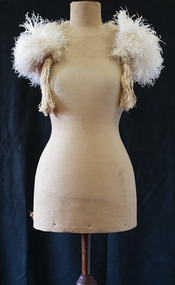 Brighton Historical Society
Cape, Capelet, circa 1920
... In 1909 he succeeded Sir Thomas Bent as Brighton's representative in the Victorian Legislative Assembly, a seat he held for close to twenty years until his death in 1928. ...In 1909 he succeeded Sir Thomas Bent as Brighton's representative in the Victorian Legislative Assembly, a seat he held for close to twenty years until his death in 1928. ...This capelet belonged to Ellen Grace Snowball, nee Anketell, (1866-1945), who lived with husband Oswald Robinson Snowball (1859-1928) at 'Wolsingham', 11 Boxshall Street, Brighton. Oswald Snowball was a solicitor and politician who was active in the Freemasons and the Orange Order. Active in Protestant moral crusades during the 1990s, he was a vocal opponent of liquor and gambling and advocated Bible reading in public schools. In 1909 he succeeded Sir Thomas Bent as Brighton's representative in the Victorian Legislative Assembly, a seat he held for close to twenty years until his death in 1928. During his last year of life, despite serious illness, he served as Speaker of the Legislative Assembly under the Hogan government.White ostrich feather capelet. Feathers sewn onto crescent-shaped cream cotton fabric, with an elaborate silk tassel at either end.ellen grace snowball, ellen grace anketell, oswald snowball, capelet, ostrich feather, 1920s -
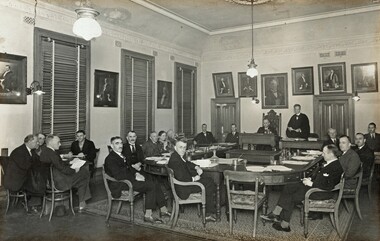 Bayside Gallery - Bayside City Council Art & Heritage Collection
Photograph - gelatin silver photograph, Council meeting, Brighton Town Hall, 1 March 1933, 1933
... On the wall surrounding the meeting are portraits of former mayors including a large photograph of Sir Thomas Bent which is placed behind the Mayor's chair....On the wall surrounding the meeting are portraits of former mayors including a large photograph of Sir Thomas Bent which is placed behind the Mayor's chair. ...council, meeting, brighton, town clerk, councillor, reporters, press table, elizabeth bleazby, city engineer, g. woodward, hallkeeper, c.e. tuxen, j.h. taylor, mayor, portrait, thomas bent, local government, brighton town hall, cr. j.a. grant, cr. f.e. rogers, cr. a.r. horton, cr. a. giles, cr. e. bleazby, cr. j.v. satchwell, cr. j.a. kennedy, cr. h.e. hall, cr. e.m. young, cr. r. eustace tracey, cr. j. redapple
