
Showing 5 items matching " suburban lifestyle"
-
 Glen Eira Historical Society
Document - Capek, Irene Mrs
... ... Suburban Lifestyle...Capek Irene Orrong Road Dandenong Road Caulfield Caulfield North Norwood Road Suburban Lifestyle Rose Document Capek, Irene Mrs. ...Typed notes by Irene Capek dated February 2001 describing her neighbor Rose, a long time resident of Norwood Road, and changes to the housing in Norwood Road, Caulfield North.capek irene, orrong road, dandenong road, caulfield, caulfield north, norwood road, suburban lifestyle, rose -
 Greensborough Historical Society
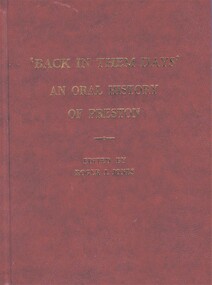
Book, Roger J. Jones, 'Back in them days': an oral history of Preston, 1994
... Collection of experiences and impressions of Preston residents 1920-1960, focusing on working lives, suburban development and lifestyles. Preston City Library Oral History Project....Collection of experiences and impressions of Preston residents 1920-1960, focusing on working lives, suburban development and lifestyles. Preston City Library Oral History Project. preston victoria city of preston preston city library oral history social conditions working conditions An oral history project in the Melbourne suburb of Preston Signed by the Editor 119 p. , black and white illustrations; with colour photograph of book launch, compliments slip and article on Junction Hotel Preston pasted in 'Back in them days': an oral history of Preston Book Book Roger J. ...An oral history project in the Melbourne suburb of Preston119 p. , black and white illustrations; with colour photograph of book launch, compliments slip and article on Junction Hotel Preston pasted inAn oral history project in the Melbourne suburb of Prestonpreston victoria, city of preston, preston city library, oral history, social conditions, working conditions -
 Friends of Westgarthtown
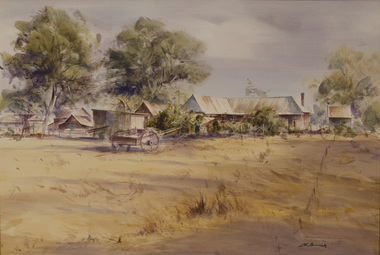
Painting, John Borrack, Last Days Ziebells "The Pines" Thomastown, c. 1970s
... suburban encroachment. They function as accurate visual records of the farm’s earlier setting and the self-sufficient lifestyle. ...Painted from the home (or front) paddock which ran south to the creek. The paddock was used for the cultivation of lucerne and maize crops in the lower regions while closer to the house where Ainwick Crescent is now situated, it was a burgeoning market garden for the cultivation of all varieties of vegetables. The large pines beyond, sheltered the farmyard on the west of Gardenia Road. That complex can be partly glimpsed on the left of the painting. This is a directly painted watercolour relying on the use of white paper and transparencies to impart a feeling of morning light. The figure is the artist's mother for whom the picture was painted. Provenance: Augusta Borrack (nee Ziebell) Collection, John Borrack CollectionThese two paintings by acclaimed Victorian artist John Borrack, a direct descendant of the Ziebell family through his mother Augusta, hold substantial artistic, historical, and familial significance for Ziebell’s Farmhouse Museum and the broader Westgarthtown narrative. Borrack, recognised as one of Australia’s leading landscape painters, is known for his sensitive, precise and atmospheric depictions of place. His professional standing and artistic skill considerably elevate the cultural value of these works. The paintings depict Ziebell’s Farmhouse and the associated outbuildings on the opposite side of Gardenia Road, capturing the rural character of the property prior to subdivision and suburban encroachment. They function as accurate visual records of the farm’s earlier setting and the self-sufficient lifestyle. Their documentary value is amplified by Borrack’s own reflections: he explained that he made the original sketches in the 1950s and later, in the 1970s, “decided to make a positive record of what the farm looked like”, developing these paintings from those earlier drawings. One work shows the farmhouse and milking shed as seen from the cemetery: the other captures the view from the front garden toward the former vegetable garden. Their provenance deepens their significance. As works created by a Ziebell descendant who consciously sought to record his family heritage, the paintings embody intergenerational memory, personal connection, and the enduring legacy of the Ziebell family within Victoria’s cultural landscape. They enrich the museum’s interpretive capacity, offering rare artistic insight into the historic farmstead and contributing meaningfully to the preservation and understanding of Westgarthtown’s heritage. Watercolour painting, depicting Ziebell's Farmhouse from the south (Thomastown and Mernda). Painting is mounted in a gold frame with cream board.Artist signature: John Borrack; Last Days at Ziebells "The Pines" Thomastown, 'Pro mea matre hanc picturan feci (In Memoria)'illustrations, watercolours, john borrack, ziebell, watercolour, painting -
 Friends of Westgarthtown
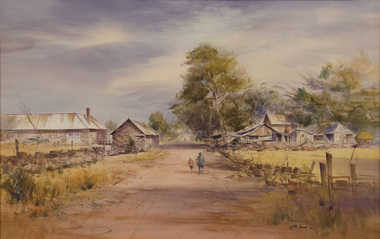
Painting, John Borrack, Ziebells, German Lane, South View, c. 1970s
... suburban encroachment. They function as accurate visual records of the farm’s earlier setting and the self-sufficient lifestyle. ...Painted from Gardenia Road. The extensive farm complex on the right. (Western side of Gardenia Road). was demolished in 1972 for housing development. Buildings shown are cowshed, hay barn, engine shed and stables. Painted in the late afternoon, the lengthening shadows and lowering sky, could presage the ominous fate awaiting the farm with development. The Ziebell Farm was known as “The Pines†and sadly none of the many that proliferated there remain. Today they would be equivalent to those at the cemetery, having been planted at the same time. Provenance: John Borrack CollectionThese two paintings by acclaimed Victorian artist John Borrack, a direct descendant of the Ziebell family through his mother Augusta, hold substantial artistic, historical, and familial significance for Ziebell’s Farmhouse Museum and the broader Westgarthtown narrative. Borrack, recognised as one of Australia’s leading landscape painters, is known for his sensitive, precise and atmospheric depictions of place. His professional standing and artistic skill considerably elevate the cultural value of these works. The paintings depict Ziebell’s Farmhouse and the associated outbuildings on the opposite side of Gardenia Road, capturing the rural character of the property prior to subdivision and suburban encroachment. They function as accurate visual records of the farm’s earlier setting and the self-sufficient lifestyle. Their documentary value is amplified by Borrack’s own reflections: he explained that he made the original sketches in the 1950s and later, in the 1970s, “decided to make a positive record of what the farm looked like”, developing these paintings from those earlier drawings. One work shows the farmhouse and milking shed as seen from the cemetery: the other captures the view from the front garden toward the former vegetable garden. Their provenance deepens their significance. As works created by a Ziebell descendant who consciously sought to record his family heritage, the paintings embody intergenerational memory, personal connection, and the enduring legacy of the Ziebell family within Victoria’s cultural landscape. They enrich the museum’s interpretive capacity, offering rare artistic insight into the historic farmstead and contributing meaningfully to the preservation and understanding of Westgarthtown’s heritage. Watercolour depicting Ziebell Farmhouse from the north, Thomastown and Mernda. In gold frame with cream border.Artist signature: John Borrack; 70's Ziebells German Lane South Viewillustrations, watercolours, john borrack, ziebell, watercolour, painting -
 Bendigo Historical Society Inc.
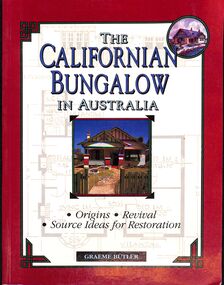
Book - "The Californian Bungalow in Australia", 2001
... suburban landscapes in Melbourne, Sydney, and beyond between World War I and World War II. California Bungalows follow a simpler floor plan than earlier architectural styles, centred around an entrance hallway and leaning towards open-plan living. These family homes were designed to suit the climate and relaxed lifestyle...suburban landscapes in Melbourne, Sydney, and beyond between World War I and World War II. California Bungalows follow a simpler floor plan than earlier architectural styles, centred around an entrance hallway and leaning towards open-plan living. These family homes were designed to suit the climate and relaxed lifestyle ...The California Bungalow remains one of the most recognizable architectural styles in Australia. Its elegant design, focus on natural materials, and connection to the outdoors have made it a staple in suburban streetscapes for over a century. Originally inspired by American architecture, this style has been embraced and adapted to suit Australian conditions, reflecting a shift towards a more relaxed and practical style of residential architecture. Today, these homes are valued not only for their charm but also for their potential to be thoughtfully renovated and extended to meet contemporary needs. Parts of Australia, particularly the east coast and some southern regions, share a similar climate to Southern California. These environmental similarities, combined with the promotion of American culture, shifted Australia’s architectural gaze from Britain to the United States in the early 1900s. This shift saw the rise of the California Bungalow in Australia, becoming a staple of suburban landscapes in Melbourne, Sydney, and beyond between World War I and World War II. California Bungalows follow a simpler floor plan than earlier architectural styles, centred around an entrance hallway and leaning towards open-plan living. These family homes were designed to suit the climate and relaxed lifestyle that many Australians sought during the 1920s and beyond. "The Californian Bungalow in Australia" written by Graeme Butler. Contents include: Introduction, Origins, Bungalow Suburbs, External Finishes & Fittings, Interiors, and Bungalow Gardens. Published in Australia by Lothian Books in 2001. Soft cover. Cover has several colors - Colored photo of Californian Bungalow house; surrounded by cream background; cream area then bordered by burgundy/brown border. Titles in different shades of blue. First published in 1992, then 1995, 1997, and 2001. Book includes both color and black and white images. 154 pp. ISBN 0850913551. Contains index. californian bungalow, housing, styles of housing
