
Showing 32 items matching " synthetic textiles"
-
 Women's Art Register
Archive (Collection) - Caroline Phillips Artist Archive
... ... Synthetic textiles...1966- Recycled Abstraction Minimalism Colour Feminism Curatorial Soft Soft sculpture Synthetic textiles Participatory Art Relational Craft Mixed Media Metal Macrame Contemporary Luce Irigaray Sexual Difference Interval Gender Philosophy Wikimedia Australia Art+Feminism George Paton Gallery Victorian College of the Arts Melbourne Social Equity Institute Artlink Care Research Project Doing Feminism Margaret Lawrence Gallery Australian Tapestry Workshop UMSU Art Collection Sculpture Photography Textiles Installation Archive Caroline Phillips Artist Archive ...recycled, abstraction, minimalism, colour, feminism, curatorial, soft soft sculpture, synthetic textiles, participatory art, relational, craft, mixed media, metal, macrame, contemporary, luce irigaray, sexual difference, interval, gender, philosophy, wikimedia australia, art+feminism, george paton gallery, victorian college of the arts, melbourne social equity institute, artlink, care research project, doing feminism, margaret lawrence gallery, australian tapestry workshop, umsu art collection, sculpture, photography, textiles, installationrecycled, abstraction, minimalism, colour, feminism, curatorial, soft soft sculpture, synthetic textiles, participatory art, relational, craft, mixed media, metal, macrame, contemporary, luce irigaray, sexual difference, interval, gender, philosophy, wikimedia australia, art+feminism, george paton gallery, victorian college of the arts, melbourne social equity institute, artlink, care research project, doing feminism, margaret lawrence gallery, australian tapestry workshop, umsu art collection, sculpture, photography, textiles, installation -
Women's Art Register
Archive (Series) - Phillips, Caroline. Artist File 1
... ... Synthetic textiles...Recycled Abstraction Minimalism Colour Feminism Curatorial Soft Soft sculpture Synthetic textiles Participatory Art Relational Craft Mixed Media Metal Macrame Contemporary Luce Irigaray Sexual Difference Interval Gender Philosophy Wikimedia Australia Art+Feminism George Paton Gallery Victorian College of the Arts Melbourne Social Equity Institute Artlink Care Research Project Doing Feminism Margaret Lawrence Gallery Australian Tapestry Workshop UMSU Art Collection Sculpture Photography Textiles Installation Foolscap white archival 4 flap folder or document wallet Archive Phillips, Caroline. ...CV, Biography, Invitations, Artwork Images, Catalogues, Newspaper Clippings, Promotional Material, Artist's Statementrecycled, abstraction, minimalism, colour, feminism, curatorial, soft soft sculpture, synthetic textiles, participatory art, relational, craft, mixed media, metal, macrame, contemporary, luce irigaray, sexual difference, interval, gender, philosophy, wikimedia australia, art+feminism, george paton gallery, victorian college of the arts, melbourne social equity institute, artlink, care research project, doing feminism, margaret lawrence gallery, australian tapestry workshop, umsu art collection, sculpture, photography, textiles, installationrecycled, abstraction, minimalism, colour, feminism, curatorial, soft soft sculpture, synthetic textiles, participatory art, relational, craft, mixed media, metal, macrame, contemporary, luce irigaray, sexual difference, interval, gender, philosophy, wikimedia australia, art+feminism, george paton gallery, victorian college of the arts, melbourne social equity institute, artlink, care research project, doing feminism, margaret lawrence gallery, australian tapestry workshop, umsu art collection, sculpture, photography, textiles, installation -
Women's Art Register
Archive (Series) - Phillips, Caroline. Artist File 2
... ... Synthetic textiles...Recycled Abstraction Minimalism Colour Feminism Curatorial Soft Soft sculpture Synthetic textiles Participatory Art Relational Craft Mixed Media Metal Macrame Contemporary Luce Irigaray Sexual Difference Interval Gender Philosophy Wikimedia Australia Art+Feminism George Paton Gallery Victorian College of the Arts Melbourne Social Equity Institute Artlink Care Research Project Doing Feminism Margaret Lawrence Gallery Australian Tapestry Workshop UMSU Art Collection Sculpture Photography Textiles Installation Foolscap white archival 4 flap folder or document wallet Archive Phillips, Caroline. ...Curatorial, CV, Biography, Invitations, Artwork Images, Catalogues, Newspaper Clippings, Promotional Material, Artist's Statementrecycled, abstraction, minimalism, colour, feminism, curatorial, soft soft sculpture, synthetic textiles, participatory art, relational, craft, mixed media, metal, macrame, contemporary, luce irigaray, sexual difference, interval, gender, philosophy, wikimedia australia, art+feminism, george paton gallery, victorian college of the arts, melbourne social equity institute, artlink, care research project, doing feminism, margaret lawrence gallery, australian tapestry workshop, umsu art collection, sculpture, photography, textiles, installationrecycled, abstraction, minimalism, colour, feminism, curatorial, soft soft sculpture, synthetic textiles, participatory art, relational, craft, mixed media, metal, macrame, contemporary, luce irigaray, sexual difference, interval, gender, philosophy, wikimedia australia, art+feminism, george paton gallery, victorian college of the arts, melbourne social equity institute, artlink, care research project, doing feminism, margaret lawrence gallery, australian tapestry workshop, umsu art collection, sculpture, photography, textiles, installation -
Women's Art Register
Archive (Series) - Caroline Phillips. Duplicate File 1
... ... Synthetic textiles...Sculpture Photography Textiles Installation Recycled Abstraction Minimalism Colour Feminism Curatorial PSoft Soft sculpture Synthetic textiles Participatory Art Relational Craft Mixed Media Metal Macrame Contemporary Luce Irigaray Sexual Difference Interval Gender Philosophy Wikimedia Australia Art+Feminism George Paton Gallery Victorian College of the Arts Melbourne Social Equity Institute Artlink Care Research Project Doing Feminism Margaret Lawrence Gallery Australian Tapestry Workshop UMSU Art Collection Foolscap manilla file Archive Caroline Phillips. ...CV, Biography, Invitations, Artwork Images, Catalogues, Newspaper Clippings, Promotional Material, Artist's Statementsculpture, photography, textiles, installation, recycled, abstraction, minimalism, colour, feminism, curatorial, psoft soft sculpture, synthetic textiles, participatory art, relational, craft, mixed media, metal, macrame, contemporary, luce irigaray, sexual difference, interval, gender, philosophy, wikimedia australia, art+feminism, george paton gallery, victorian college of the arts, melbourne social equity institute, artlink, care research project, doing feminism, margaret lawrence gallery, australian tapestry workshop, umsu art collectionsculpture, photography, textiles, installation, recycled, abstraction, minimalism, colour, feminism, curatorial, psoft soft sculpture, synthetic textiles, participatory art, relational, craft, mixed media, metal, macrame, contemporary, luce irigaray, sexual difference, interval, gender, philosophy, wikimedia australia, art+feminism, george paton gallery, victorian college of the arts, melbourne social equity institute, artlink, care research project, doing feminism, margaret lawrence gallery, australian tapestry workshop, umsu art collection -
Women's Art Register
Archive (Series) - Caroline Phillips. Digital Images
... ... Synthetic textiles...Sculpture Photography Textiles Installation Recycled Abstraction Minimalism Colour Feminism Curatorial PSoft Soft sculpture Synthetic textiles Participatory Art Relational Craft Mixed Media Metal Macrame Contemporary Luce Irigaray Sexual Difference Interval Gender Philosophy Wikimedia Australia Art+Feminism George Paton Gallery Victorian College of the Arts Melbourne Social Equity Institute Artlink Care Research Project Doing Feminism Margaret Lawrence Gallery Australian Tapestry Workshop UMSU Art Collection Archive Caroline Phillips. ...sculpture, photography, textiles, installation, recycled, abstraction, minimalism, colour, feminism, curatorial, psoft soft sculpture, synthetic textiles, participatory art, relational, craft, mixed media, metal, macrame, contemporary, luce irigaray, sexual difference, interval, gender, philosophy, wikimedia australia, art+feminism, george paton gallery, victorian college of the arts, melbourne social equity institute, artlink, care research project, doing feminism, margaret lawrence gallery, australian tapestry workshop, umsu art collectionsculpture, photography, textiles, installation, recycled, abstraction, minimalism, colour, feminism, curatorial, psoft soft sculpture, synthetic textiles, participatory art, relational, craft, mixed media, metal, macrame, contemporary, luce irigaray, sexual difference, interval, gender, philosophy, wikimedia australia, art+feminism, george paton gallery, victorian college of the arts, melbourne social equity institute, artlink, care research project, doing feminism, margaret lawrence gallery, australian tapestry workshop, umsu art collection -
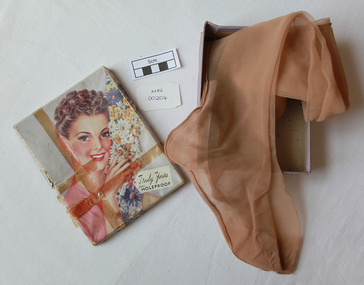 City of Moorabbin Historical Society (Operating the Box Cottage Museum)
Clothing - Clothing, lady's stockings "Holeproof', mid 20thC
... textile firm that was founded in 1901.With extensive advertising the brand name became recognized worldwide. The business produced men's and women's hosiery, underwear, lingerie, and men's pyjamas. Holeproof Hosiery began making nylon hosiery in January 1940, starting production on 8 of its 230 machines. The hose were made of a synthetic...textile firm that was founded in 1901.With extensive advertising the brand name became recognized worldwide. The business produced men's and women's hosiery, underwear, lingerie, and men's pyjamas. Holeproof Hosiery began making nylon hosiery in January 1940, starting production on 8 of its 230 machines. The hose were made of a synthetic ...Holeproof Hosiery was a Milwaukee, Wisconsin textile firm that was founded in 1901.With extensive advertising the brand name became recognized worldwide. The business produced men's and women's hosiery, underwear, lingerie, and men's pyjamas. Holeproof Hosiery began making nylon hosiery in January 1940, starting production on 8 of its 230 machines. The hose were made of a synthetic yarn composed of derivatives of coal and iron manufactured by Du Pont. In the late 1920s, a successful hosiery manufacturer, Staley & Staley Ltd, started making ladies hosiery under licence from the Holeproof Hosiery Company in Milwaukee, USA. The company went public in 1929 and opened the first Holeproof mill at Brunswick, Victoria in 1930, becoming the first manufacturer to produce and market Australian-made self-supporting socks. During the 1930s, Holeproof revolutionised the Australian market by promoting their products as a sought-after fashion accessory. The Australian company is still in business today, owned by Pacific Brands. A unused pair of lady's silk stockings in original box. 'Holeproof' 'Truly Yours' Candlelight, size 10Box Cover: Truly Yours / by / Holeproof Side Holeproof 'Candlelight' Size 10clothing, stockings, nylons, holeproof hosiery pty ltd, lingerie, melbourne, bentleigh, cheltenham moorabbin, brunswick milwaukee usa, wisconsin -
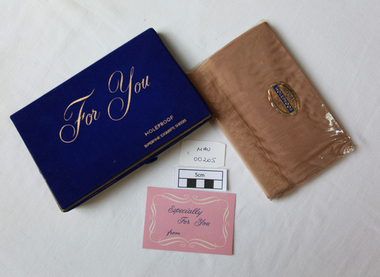 City of Moorabbin Historical Society (Operating the Box Cottage Museum)
Clothing - Clothing, lady's stockings 'Holeproof', c1950
... textile firm that was founded in 1901.With extensive advertising the brand name became recognized worldwide. The business produced men's and women's hosiery, underwear, lingerie, and men's pyjamas. Holeproof Hosiery began making nylon hosiery in January 1940, starting production on 8 of its 230 machines. The hose were made of a synthetic...textile firm that was founded in 1901.With extensive advertising the brand name became recognized worldwide. The business produced men's and women's hosiery, underwear, lingerie, and men's pyjamas. Holeproof Hosiery began making nylon hosiery in January 1940, starting production on 8 of its 230 machines. The hose were made of a synthetic ...Holeproof Hosiery was a Milwaukee, Wisconsin textile firm that was founded in 1901.With extensive advertising the brand name became recognized worldwide. The business produced men's and women's hosiery, underwear, lingerie, and men's pyjamas. Holeproof Hosiery began making nylon hosiery in January 1940, starting production on 8 of its 230 machines. The hose were made of a synthetic yarn composed of derivatives of coal and iron manufactured by Du Pont. In the late 1920s, a successful hosiery manufacturer, Staley & Staley Ltd, started making ladies hosiery under licence from the Holeproof Hosiery Company in Milwaukee, USA. The company went public in 1929 and opened the first Holeproof mill at Brunswick, Victoria in 1930, becoming the first manufacturer to produce and market Australian-made self-supporting socks. During the 1930s, Holeproof revolutionised the Australian market by promoting their products as a sought-after fashion accessory. The Australian company is still in business today, owned by Pacific Brands. An unused pair of lady's nylon stockings in original box. 'Holeproof' 'For you', 'Precious' size 91/2Box Cover : For You / HOLEPROOF/ SUPERFINE EXQUISITE SHEERS Side : Precious 9 1/2 Package : 60 GUAGE / SHEER NYLON / BY / HOLEPROOF / 9 1/2 Card : Especially / For You / fromclothing, stockings, nylons, holeproof pty ltd, milwaukee usa, hosiery, fashion, melbourne, bentleigh, cheltenham moorabbin, brunswick, lingerie -
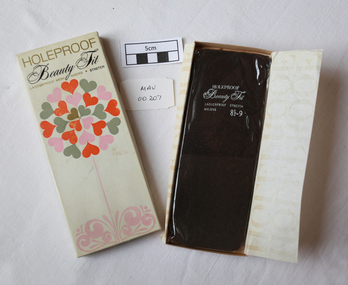 City of Moorabbin Historical Society (Operating the Box Cottage Museum)
Clothing - Clothing, lady's stockings 'Holeproof', c1950
... textile firm that was founded in 1901.With extensive advertising the brand name became recognized worldwide. The business produced men's and women's hosiery, underwear, lingerie, and men's pyjamas. Holeproof Hosiery began making nylon hosiery in January 1940, starting production on 8 of its 230 machines. The hose were made of a synthetic...textile firm that was founded in 1901.With extensive advertising the brand name became recognized worldwide. The business produced men's and women's hosiery, underwear, lingerie, and men's pyjamas. Holeproof Hosiery began making nylon hosiery in January 1940, starting production on 8 of its 230 machines. The hose were made of a synthetic ...Holeproof Hosiery was a Milwaukee, Wisconsin textile firm that was founded in 1901.With extensive advertising the brand name became recognized worldwide. The business produced men's and women's hosiery, underwear, lingerie, and men's pyjamas. Holeproof Hosiery began making nylon hosiery in January 1940, starting production on 8 of its 230 machines. The hose were made of a synthetic yarn composed of derivatives of coal and iron manufactured by Du Pont. In the late 1920s, a successful hosiery manufacturer, Staley & Staley Ltd, started making ladies hosiery under licence from the Holeproof Hosiery Company in Milwaukee, USA. The company went public in 1929 and opened the first Holeproof mill at Brunswick, Victoria in 1930, becoming the first manufacturer to produce and market Australian-made self-supporting socks. During the 1930s, Holeproof revolutionised the Australian market by promoting their products as a sought-after fashion accessory. The Australian company is still in business today, owned by Pacific BrandsAn unused pair of lady's stockings, in original box, 'Holeproof', 'Beauty Fit', ' Nocturn' Size 81/2 - 9 Box Cover : HOLEPROOF / Beauty Fit / LADDERPROOF MESH SHEERS STRETCH Inside Wrapper ; HOLEPROOF / Beauty Fit / LADDERPROOF STRETCH NYLONS 8 1/2 - 9clothing, stockings, nylons, hosiery, melbourne, bentleigh, cheltenham moorabbin, brunswick, holeproof pty ltd, lingerie, fashion -
 Bendigo Historical Society Inc.
Textile - 1956 Olympics Ladies' scarf
... synthetic fabric scarf. Flags from competing nations are arranged in two circles. In the top LH corner and lower Rh corner are are symbols of the Olympic torch and rings, with lettering "XVIth Olympiad Melbourne 1956". The five Olympic rings are placed in the lower LH corner and the top RH corner. Textile ...The 1956 Summer Olympics, officially known as the Games of the XVI Olympiad, were an international multi-sport event held in Melbourne, Victoria, Australia, from 22 November to 8 December 1956, with the exception of the equestrian events, which were held in Stockholm, Sweden, in June 1956. These Games were the first to be staged in the Southern Hemisphere and Oceania, as well as the first to be held outside Europe and North America. Scarf produced as a souvenir for the 1956 Melbourne Olympics. Ivory coloured synthetic fabric scarf. Flags from competing nations are arranged in two circles. In the top LH corner and lower Rh corner are are symbols of the Olympic torch and rings, with lettering "XVIth Olympiad Melbourne 1956". The five Olympic rings are placed in the lower LH corner and the top RH corner.1956 olympics, scarf -
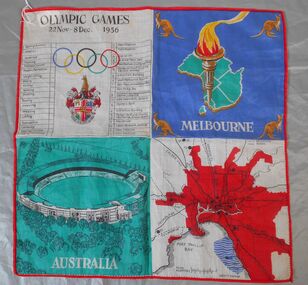 Bendigo Historical Society Inc.
Textile - 1956 Olympics Ladies' handkerchief
... Synthetic fabric. The handkerchief s bordered in red thread and divided into four squares of contrasting colours. 1. A table of main events and ceremonies, Olympic rings and symbol. 2. Map of Australia (green) with an Olympic torch and kangaroos in each corner. 3 An image of the main stadium. caption "AUSTRALIA" in white on a green background. 4. Map of Melbourne in red with connecting road and rail links to other parts of Victoria. Textile ...The 1956 Summer Olympics, officially known as the Games of the XVI Olympiad, were an international multi-sport event held in Melbourne, Victoria, Australia, from 22 November to 8 December 1956, with the exception of the equestrian events, which were held in Stockholm, Sweden, in June 1956. These Games were the first to be staged in the Southern Hemisphere and Oceania, as well as the first to be held outside Europe and North America. Handkerchief produced as a souvenir for the 1956 Melbourne Olympics. Synthetic fabric. The handkerchief s bordered in red thread and divided into four squares of contrasting colours. 1. A table of main events and ceremonies, Olympic rings and symbol. 2. Map of Australia (green) with an Olympic torch and kangaroos in each corner. 3 An image of the main stadium. caption "AUSTRALIA" in white on a green background. 4. Map of Melbourne in red with connecting road and rail links to other parts of Victoria. 1956 olympics, handkerchief -
 Bendigo Historical Society Inc.
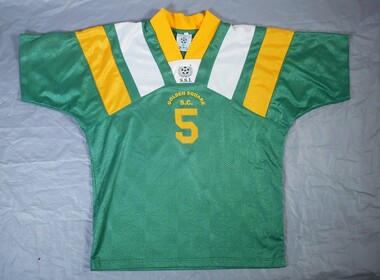
Textile - GSSC Sports top
... synthetic sports top with gold coloured V shaped collar. There are gold and white diagonal stripes on the collar. Symbol on the front of a soccer ball and decorative wreath with letters "SSI" and "Golden Square S C" The number % is in large print on the front and back. Made in Thailand. Textile ...Golden Square High School in the city of Bendigo, was established in temporary accommodation at Camp Hill Primary School in central Bendigo in 1960. With the completion of the new school's buildings, it moved to Golden Square in 1962, providing for Forms 1 to 6, now known as years 7 to 12. In 1978 it became a 7–10 school and was one of the original feeder schools to Bendigo Senior High School. In 1986, a Hearing Impaired Unit was established and in 1990 it underwent a name change to become Golden Square Secondary College. The Golden Square Secondary College campus closed on 28 November 2008. It merged with Kangaroo Flat and Flora Hill secondary colleges as part of the implementation of the Bendigo Education Plan. Its buildings were demolished. (Wikipedia https://en.wikipedia.org/wiki/Golden_Square_Secondary_College)Dark green short sleeved synthetic sports top with gold coloured V shaped collar. There are gold and white diagonal stripes on the collar. Symbol on the front of a soccer ball and decorative wreath with letters "SSI" and "Golden Square S C" The number % is in large print on the front and back. Made in Thailand.gssc, sports top -
 National Wool Museum
Letter
... ...Textile Fibres - synthetic...Roy Textile Mills - staff Woollen mills Textile Fibres - synthetic Letter ...Letter from the Warrnambool Woollen Mill Company Limited, Victoria, 1956 to Gordon Institute of Technology, (W.R. Lang) re: Garnetted Nylon Waste samplestextile mills - staff woollen mills textile fibres - synthetic, warrnambool woollen mill, lang, dr w. roy, textile mills - staff, woollen mills, textile fibres - synthetic -
National Wool Museum
Report, Australian Wool Corporation survey for market potential of wool minority blends
... ...Textile Fibres - synthetic...Textile Industry Fashion Textile Fibres Textile Fibres - synthetic Cloth - woollen Cloth - worsted Textile Industry Fashion Textile Fibres Textile Fibres - synthetic Australian Wool Corporation survey for market potential of wool minority blends Report ..."Australian Wool Corporation survey for market potential of wool minority blends " - WD Scott & Co Pty Ltd : a survey of Australian garment manufacturers and retailers.textile industry fashion textile fibres textile fibres - synthetic, cloth - woollen, cloth - worsted, textile industry, fashion, textile fibres, textile fibres - synthetic -
 National Wool Museum
Book, The Du Ponts of Delaware
... Textile Fibres Textile Fibres - synthetic...Textile Fibres Textile Fibres - synthetic Nylon Textile Fibres Textile Fibres - synthetic The Du Ponts of Delaware Book ..."The Du Ponts of Delaware" -W E Carr ,1965. The Du Pont company originally developed nylon.textile fibres textile fibres - synthetic, nylon, textile fibres, textile fibres - synthetic -
National Wool Museum
Book, The wool year book 1962
... "Textile Mercury Limited: the wool year book (incorporating the Rayon and Synthetic Fibres Annual) 1962"..."Textile Mercury Limited: the wool year book (incorporating the Rayon and Synthetic Fibres Annual) 1962" Textile Industry - history Textile Machinery Textile Mercury Ltd Textile Industry - history Textile Machinery The wool year book 1962 Book ..."Textile Mercury Limited: the wool year book (incorporating the Rayon and Synthetic Fibres Annual) 1962"textile industry - history textile machinery, textile mercury ltd, textile industry - history, textile machinery -
 Embroiderers Guild, Victoria
Textile - Bolivian Embroidered Cushion Cover, 1974
... Embroidery Bolivia Wool Synthetic Cream hand spun and woven wool ground embroidered with 6 figures (3 male, 3 female) in national costume, using knitting weight wool and some synthetics, in bright multi-coloured threads. Includes cords, pompoms and fringing as part of costumes. Textile ...Cream hand spun and woven wool ground embroidered with 6 figures (3 male, 3 female) in national costume, using knitting weight wool and some synthetics, in bright multi-coloured threads. Includes cords, pompoms and fringing as part of costumes.embroidery, bolivia, wool, synthetic -
 Embroiderers Guild, Victoria
Textile - Indian Embroidered Panel, Mrs Sofia Natemitha Mutna, Late 20thC/early 21st
... synthetic ground. Stitches are chain, running stitch, feather stitch and shisha work. Feather stitch is in a variegated thread. Textile ...Contemporary Ahir style embroidery purchased by the donor from the embroiderer, Mrs Sofia Natemitha Mutna of Dhordo Village near Bhuj in Gujarat, India in January 2012.Contemporary Ahir style embroidery. A circular design in silk thread in red, blue, green, orange, yellow, pink and white on a black synthetic ground. Stitches are chain, running stitch, feather stitch and shisha work. Feather stitch is in a variegated thread.india, embroidery, india, shisha -
 RMIT Design Archives
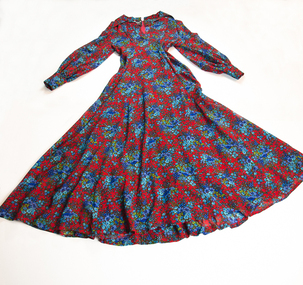
Textile - Woman's dress, Norma Tullo, Garment Designer, Shirley Lyle, Textile Designer, Woman's Dress
... synthetic fibres such as rayon. The garment is historically significant for the use of a merino wool showcasing its versatility for dress fabrics. wool rmit design archives rmit university woman's dress textile design australian fashion Inscribed, black label on back neck left of zip, 'TULLO/IN/PEPPINELLA/AUSTRALIA MERINO WOOL'; Inscribed, white satin label on back neck right of zip, 'DRY CLEAN ONLY'; Inscribed, white satin label underneath above label, 'SIZE 12/To Fit Bust 34"/To Fit Waist Full length woman's dress with full skirt and long sleeves, collared with open neck and pleat work on bodice. ...This light woollen evening dress is made from Peppinella, a new fabric Norma Tullo introduced into her range in 1973. The fabric was used exclusively by Tullo, and came from the wool of Peppin Merino (first introduced into Australia in 1858 by the Peppin brothers). According to the papers of the day Tullo’s 1973 winter collection featured ‘St. Trinian’s styles to garments dripping lace, in bold plain colours to floral prints.” Shirley Lyle designed the floral fabric. Norma Tullo (1935-2019) was one of the leading fashion designers of her time, establishing her label in 1956. After establishing a business the Old Metropole Arcade in Melbourne in 1956, with three sewing machines, Tullo's ready to wear fashions for young women became sought after, and her business flourished. In 1966 the Japanese department store chain Isetan Co Ltd began to mass-produce her garments for their stores across Japan. Tullo closed her label in 1977, and later worked for Fletcher Jones. Ann Carew, 2020The dress is historically significant as a dress designed by Norma Tullo, a leading fashion designer of the 1960s and 1970s. During this period the Australian Wool Industry strove to promote wool, and to develop light woollen fabrics to compete with new synthetic fibres such as rayon. The garment is historically significant for the use of a merino wool showcasing its versatility for dress fabrics. Full length woman's dress with full skirt and long sleeves, collared with open neck and pleat work on bodice. Material is predominately red with a repeated pattern featuring posie of blue and mauve flowers.Inscribed, black label on back neck left of zip, 'TULLO/IN/PEPPINELLA/AUSTRALIA MERINO WOOL'; Inscribed, white satin label on back neck right of zip, 'DRY CLEAN ONLY'; Inscribed, white satin label underneath above label, 'SIZE 12/To Fit Bust 34"/To Fit Waistwool, rmit design archives, rmit university, woman's dress, textile design, australian fashion -
 National Wool Museum
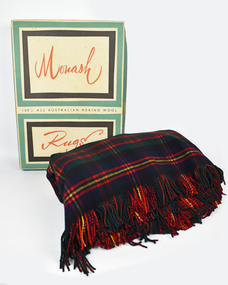
Textile - Rug, Returned Soldiers and Sailors Mill, 1963
... Compared to modern textile production which can spin a fine yarn out of synthetic fibre or imported cotton easily, spinning fine yarn from medium quality wool at a textile factory was cumbersome and no longer financially viable to suit new consumer demands. ...Compared to modern textile production which can spin a fine yarn out of synthetic fibre or imported cotton easily, spinning fine yarn from medium quality wool at a textile factory was cumbersome and no longer financially viable to suit new consumer demands. ...The Returned Soldiers and Sailors Mills was located near the Barwon river on Pakington Street, Geelong, where its building still stands. The mill was established in October 1922 with capital acquired from War Gratuity Bonds. The mill produced fine grade woollen products with its speciality being ‘Retsol’ travelling rugs. The mill first began to run into financial troubles with the ‘Credit Squeeze’ or the ‘Holt Jolt’ of the early 1960s. This saw import restrictions lifted which triggered the start of a minor recession and a rise in unemployment. Included in these troubles was the RS&S Mill which saw the number of employees gradually decrease and business declining with cheaper imports beginning to grab an expanding part of the market share. The mill was eventually purchased by Godfrey Hirst in 1973 who tried to continue operations without success and in June 1975 textile production at the site ceased. Outside of financial considerations contributing to the closure of Woollen Mills in this period was the declining need for heavier fabrics as in-home heating and insulation improved. This need had been replaced for a demand for ever softer, finer and lighter worsted fabrics for more casual clothing. Modern day textile production requires fewer steps in the processing of materials for this use. This meant large factory complexes such as early woollen mills like the RS&S mills were no longer required. Compared to modern textile production which can spin a fine yarn out of synthetic fibre or imported cotton easily, spinning fine yarn from medium quality wool at a textile factory was cumbersome and no longer financially viable to suit new consumer demands. This rug provides context to this statement. It was gifted to Shirley and Gordon Green as a wedding present in November 1963 by one of Gordon's colleagues in the wool industry. Living in areas such as Neutral Bay, the Hornsby area and later in life retiring to the Central Coast, the blanket was too heavy for use in these weather conditions and hence it stayed in its original box for nearly 60 years. Top and bottom of rug has frilled edges. Pattern is titled the 'Clan Cameron' and is repeated in a 7x7 grid. Front of rug has a red background with 4 vertical and horizontal lines. All is surrounded by a yellow boarder. Label is stitched into the bottom right corner. Reverse of rug also has a repeating 7x7 grid. Blue background with thick green horizontal stripe. Yellow and red boarder to the grid with 4 red vertical and horizontal lines making up the interior. Rug measure 1550 x 2040mm, approximately the same size as a queen size mattress.Wording, Bottom right corner. THE GEELONG R.S&S. WOOLEN MILLS/ PURE/ WOOL/ AUSTRALIA/ The John Monash Rug (cursive)/ The Clan Cameron (cursive)rs&s mills, textile manufacture, rug, clan cameron, sydney greasy wool exchange -
 National Wool Museum
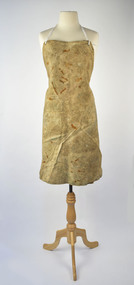
Textile - Dyers Apron
... synthetic dyed clothing. This dyer’s apron would have protected the wearer from the chemicals of the dyer’s trade. There are several ways that fabrics would have been dyed including direct application, exhaust methods, continuous methods and waterless dyeing methods. Dying Wool Apron Wool dying As seen folded in archive box. Textile ...Over time, apron design and function diversified, and many trades and professions developed their own versions. Aprons were practical for protecting the wearer’s clothing as well as signifying their trade or craft. Wool dyeing was an industrialised profession to aid in the mass production of synthetic dyed clothing. This dyer’s apron would have protected the wearer from the chemicals of the dyer’s trade. There are several ways that fabrics would have been dyed including direct application, exhaust methods, continuous methods and waterless dyeing methods. As seen folded in archive box.dying, wool, apron, wool dying -
 Embroiderers Guild, Victoria
Textile - Patchwork Quilt, Crazy Patchwork Quilt, Begin 1892
... Red cord edging and cream synthetic knit lining. Crazy Patchwork Quilt Textile Patchwork Quilt ...Donors note: Commenced by Donor's mother 1892 and worked over some years. Marriage, business and World War I saw it laid aside. She died aged 88. In 1980 a friend procured old material and threads and completed the quilt.Crazy patchwork using a wide variety of materials and colours. Centre panel is deep red velvet with some surface stitches. Red cord edging and cream synthetic knit lining.patchwork, quilts, late 19th century, australia, crazy patchwork -
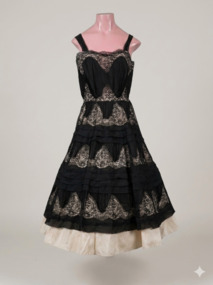 Kew Historical Society Inc
Clothing - Cocktail Dress, House of Lucas, 1950s
... The gown showcases the firm’s pioneering expertise in fine, permanent textile pleating, applied here to luxury pure silk rather than everyday synthetics. ...Founded in Ballarat, Victoria in 1888 by Eleanor Lucas, by the mid-20th century, the Lucas Clothing Factory employed hundreds of local workers (popularly known as the "Lucas Girls"). The company was a pioneer in Australian textiles, producing the country's very first knitted nylon tricot and manufacturing luxury Vanity Fair lingerie under license for the domestic market. As Lucas shifted from utility wear and intimate apparel into upscale daytime and evening wear during the 1940s and 1950s, they launched specialised fashion lines. The Jill Heriote line was created as their signature high-end ready-to-wear and cocktail range. The line became widely celebrated for its elite tailoring, structure, and use of both premium local and imported fabrics Designers working under this line, such as Eve Ogilvie, translated sophisticated European aesthetic trends directly to the Australian market.This garment represents a pinnacle of mid-century regional Australian fashion manufacturing. Operating from Ballarat, Victoria, E. Lucas & Co. utilised elite local designers to compete directly with imported European couture houses. The gown showcases the firm’s pioneering expertise in fine, permanent textile pleating, applied here to luxury pure silk rather than everyday synthetics.This bias-cut silk and lace cocktail dress sold under the label 'Jill Heriote' for the House of Lucas, Ballarat, features a narrow waist and a dramatically flared skirt. The overdress is constructed from intricate, black imitation Valenciennes machine-made lace. It layers over a cream silk taffeta underdress that shows through the openwork and extends structurally past the hemline. The bodice is designed with shoulder straps leading into a sweetheart neckline. Its form-fitting structure showcases panels of finely pleated black silk, creating texture across the bust. Below, the full skirt alternates between sheer black lace segments and contrasting horizontal bands of smooth black silk.Label" 'LUCAS / Jill Heriote / in pure silk fabric'jill heriote, house of lucas -- ballarat (vic.), fashion -- 1950s, cocktail dresses, manufacturing -- ballarat -
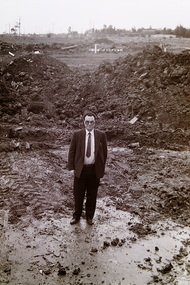 Sunshine and District Historical Society Incorporated
Photograph - Flickers Fabric Dye Works 295 – 317 St. Albans Road 1990 Photographs, Sharon Cavanagh, 3rd September 1990
... The business now known as Flicker’s Australia Pty Ltd began in the 1940s – 1950s as Worsted Finishers Australia Pty Ltd, a textile finishing and dyeing works specialising in wool and later synthetic fabrics. ...The business now known as Flicker’s Australia Pty Ltd began in the 1940s – 1950s as Worsted Finishers Australia Pty Ltd, a textile finishing and dyeing works specialising in wool and later synthetic fabrics. ...These photographs were taken by The Advocate in 1990. These photographs feature Flickers Fabric Dye Works located at 295 – 317 St. Albans Road during one of their expansion projects. The business now known as Flicker’s Australia Pty Ltd began in the 1940s – 1950s as Worsted Finishers Australia Pty Ltd, a textile finishing and dyeing works specialising in wool and later synthetic fabrics. In 1975, the business was purchased by Mr Harry Flicker, after which it was renamed it to Flicker’s Australia.By the 1980s–1990s, Flickers Fabric Dye Works had become one of the largest dye houses in Victoria, supplying knitted cotton, polyester, nylon, viscose and blended fabrics to garment manufacturers.7431.01 - Flickers Fabric Dye Works 295–317 St. Albans Road 1990 Photographs (Advocate 382.1).JPG 7431.02 - Flickers Fabric Dye Works 295–317 St. Albans Road 1990 Photographs (Advocate 382.1).JPG 7431.03 - Flickers Fabric Dye Works 295–317 St. Albans Road 1990 Photographs (Advocate 382.1).JPGflickers, st. albans road, sunshine north -
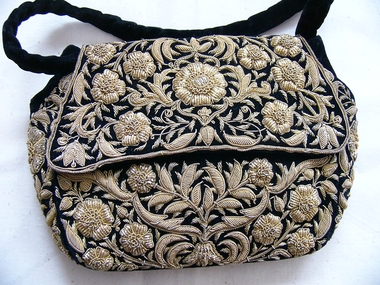 Embroiderers Guild, Victoria
Accessory - Indian Goldwork Handbag, Early 20th century
... Materials: Originally done with pure gold or silver threads, modern Kamdani often uses synthetic metallic threads or beads for affordability. Application: It is commonly featured on luxurious textiles, including georgette, chiffon, and cotton, frequently worn as formal wedding wear (sarees, dupattas, and kurtas). ...Materials: Originally done with pure gold or silver threads, modern Kamdani often uses synthetic metallic threads or beads for affordability. Application: It is commonly featured on luxurious textiles, including georgette, chiffon, and cotton, frequently worn as formal wedding wear (sarees, dupattas, and kurtas). ...Known as Karchob it is divided into 2 types of gold embroidery: 1. Key Aspects of Zardozi Embroidery: Origin and Meaning: The term "Zardozi" comes from the Persian words "zar" (gold) and "dozi" (embroidery), literally meaning "sewing with gold". Materials Used: Traditionally, threads were made of pure gold or silver, but modern zardozi typically uses copper wires with a gold or silver polish, often blended with silk threads, sequins, and crystals. The Process: Adda: The fabric is stretched tightly over a wooden frame, known as an adda, to facilitate precise, delicate work. Aari Needle: Artisans often use a hook-ended needle, similar to a crochet needle, called an aari, to make intricate stitches. Techniques: Specialized techniques include Dabka (coiled wire) and Kasab (twisted wire) to create raised, three-dimensional motifs. Common Motifs: Designs often feature intricate floral patterns, leaves, paisley, and geometric shapes inspired by nature and architecture. 2. Key details about Kamdani embroidery: Technique: It is often called a "lighter version" of Zardozi. It involves using a needle to insert flat metallic wires (badla) through the fabric, making tiny stitches that sparkle, often creating dots, paisleys, or floral patterns. Origin: The craft originated in the Indian subcontinent, specifically developing in Lucknow, India. Materials: Originally done with pure gold or silver threads, modern Kamdani often uses synthetic metallic threads or beads for affordability. Application: It is commonly featured on luxurious textiles, including georgette, chiffon, and cotton, frequently worn as formal wedding wear (sarees, dupattas, and kurtas). Types of Work: It is often referred to by related terms such as Mukaish, Badla, or Fardi work.Gold embroidery all over bag except under flap. Intricate design on flowers in very typical of the variety of metal threads. Velvet handles with black silk lining with press-studs in both corners of the flap. Decorative beaded tassel at base. Intricate design of flowers in typical design known as Karchob.embroidery, bags, 1900-20, india, goldwork -
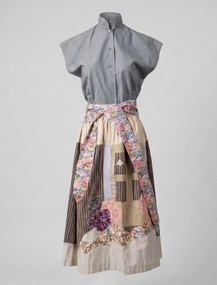 Kew Historical Society Inc
Clothing - Blouse and Scenic Patchwork Skirt Ensemble, Prue Acton, 1971–1975
... This ensemble is a highly representative example of the pioneering textile artistry of Prue Acton, an iconic figure in Australian fashion history often celebrated for injecting the energy of the 1960s and '70s "Youthquake" movement into the domestic market. The piece belongs to Acton’s critically acclaimed 1970s "Patch" era. During this period, Acton moved away from the slick synthetics ...This ensemble is a highly representative example of the pioneering textile artistry of Prue Acton, an iconic figure in Australian fashion history often celebrated for injecting the energy of the 1960s and '70s "Youthquake" movement into the domestic market. The piece belongs to Acton’s critically acclaimed 1970s "Patch" era. During this period, Acton moved away from the slick synthetics of the Mod era toward natural fibers and whimsical, story-driven collections inspired by the global folk revival and bohemian styles. According to historical archival provenance from similar surviving museum garments, these conversational, pictorial patchwork designs were often ingeniously engineered utilizing high-quality end-of-roll textile remnants. This specific garment beautifully encapsulates the early 1970s pastoral "cottagecore" fantasy, exhibiting how Acton blended commercial garment production with playful, illustrative textile collage.A two-piece daywear ensemble comprising a structured blouse and an elaborate, narrative-driven midi skirt with a coordinating waist sash. Comprised of a semi-fitted blouse of medium-weight slate gray plain-weave fabric. It features brief, extended cap sleeves, a high mandarin-style band collar, and a center-front button closure secured by five self-colored small round buttons. The high-waisted skirt is a full A-line midi-length skirt featuring an intricate, illustrative folk-art narrative applique landscape. The pieced design represents a stylized house or cottage set within a garden. Fabric sections are arranged into vertical stripe configurations mimicking window panes, alongside curved, layered patch elements in multi-colored floral calicos that form bushes and ground structures. The lower tier terminates in a broad, contrasting cream-colored patterned base hem panel. A wide, detachable self-tie waist sash executed in a dense, small-scale floral calico print is intended to be cinched around the high-fitted waistband to form a statement bow at the front.Label: "Prue Acton"prue acton, fashion -- melbourne -- 1970s -
 Embroiderers Guild, Victoria
Textile - South American Reverse Appliqué, 1970's
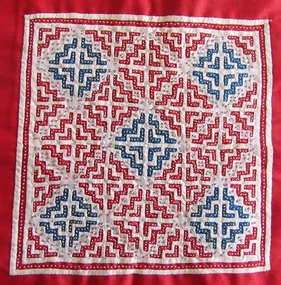
... The fabric includes some synthetic, and is embroidered in yellow, pink and green rayon threads, and a silver thread. Textile ...White and blue reverse applique on red ground in geometric design. The fabric includes some synthetic, and is embroidered in yellow, pink and green rayon threads, and a silver thread.embroidery, quilting, reverse applique, applique, south america, 1970's -
 Embroiderers Guild, Victoria
Textile - "Frog Sampler No. 2" Annemieke Mein, Annemieke Mein OAM, "Frog Sampler No. 2", 1994
... synthetic Lurex fibres under the frog's jaw, right arm and leg. b) cotton canvas backing behind painted silk organza. Quilting and padding with dacron filler behind the throat and body of the frog. Shades of blue and green. Blue grey wooden frame and mount. "Frog Sampler No. 2" Textile ...This piece is a sampler for a major work "Frog in a whirlpool". Annemieke Mein OAM - designer/maker. Completed June 1994.Small framed panel, depicting a frog in a whirlpool. Hand painted silk organza - 'Dual Everfast Fabric Paint' diluted to watercolour consistency with reducer and water. Machine embroidery including free sewing. Underlying fabric a) fluoro organza and synthetic Lurex fibres under the frog's jaw, right arm and leg. b) cotton canvas backing behind painted silk organza. Quilting and padding with dacron filler behind the throat and body of the frog. Shades of blue and green. Blue grey wooden frame and mount.AM (bottom right - design maker's signature)machine embroidery, creative embroidery, panel, 1980-2000, australia -
 Embroiderers Guild, Victoria
Textile - Bedouin Embroidered Garment Fragments
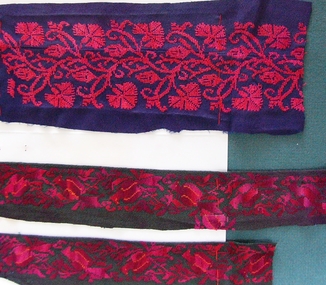
... synthetic grey fabric with cross stitch embroidery of birds in shades of pink and red. B. One piece dark blue fabric with red cross stitch flowers C. Two multiple tassels mainly red cord with white and blue beads Textile Bedouin Embroidered Garment Fragments ..."Pieces of embroidery from Bedouins which they sell in the market at Beersheba".A. Two strips of synthetic grey fabric with cross stitch embroidery of birds in shades of pink and red. B. One piece dark blue fabric with red cross stitch flowers C. Two multiple tassels mainly red cord with white and blue beads embroidery, counted thread, cross stitch, fragments, jordan, middle east -
 Kew Historical Society Inc
Coat dress, Kenneth Pirrie, 1967-8
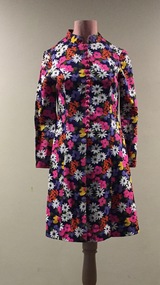
... By 1967, Pirrie was heavily commissioning his own exclusive textile prints—capitalizing on newly popularized, easy-to-launder synthetic crepes, crimplenes, and lightweight blends that mirrored the fast-paced, modern lifestyles of younger working women. ...By 1967, Pirrie was heavily commissioning his own exclusive textile prints—capitalizing on newly popularized, easy-to-launder synthetic crepes, crimplenes, and lightweight blends that mirrored the fast-paced, modern lifestyles of younger working women. ...This garment reflects the apex of the Australian "Youthquake" movement between 1967 and 1968. During this tight window, international mod influences from London's Carnaby Street fused heavily with local Australian manufacturing. Melbourne emerged as the absolute epicenter of the nation's revolutionary ready-to-wear "rag trade," led by visionary young designers who rebelled against traditional haute couture. Kenneth Pirrie, starting his label in 1959, became a crucial vanguard of this shift. By 1967, Pirrie was heavily commissioning his own exclusive textile prints—capitalizing on newly popularized, easy-to-launder synthetic crepes, crimplenes, and lightweight blends that mirrored the fast-paced, modern lifestyles of younger working women. The high collar and structured button-front design seen here explicitly capture the brief design transition where military tailoring elements met bright, counter-culture psychedelia.This coat dress stands as a stellar, physically intact index of mid-century Australian fashion innovation. It documents a pivotal socio-cultural era when locally manufactured ready-to-wear labels successfully captured and redirected global youth subcultures specifically for the domestic market. The piece demonstrates the high-caliber printmaking and structured garment construction that earned Kenneth Pirrie national acclaim. It provides an excellent material baseline of the late-1960s shift away from structural, monochromatic mod toward organic, vivid flower-power palettes. The dress, owned by Melbourne architect, Dione McIntyre, possesses exceptional local provenance. It highlights the local domestic and commercial history of Kew and greater Melbourne, recording what the fashion-conscious public actually bought, wore, and preserved during a period of massive industry transformationAn A-line, knee-length woman’s garment designed to function as a standalone dress or light structured coat. The piece is constructed from a dark base fabric featuring a densely populated, screen-printed psychedelic floral motif. The pattern exhibits stylized white, pink, magenta, and purple blossoms with golden-yellow centers, typifying the iconic "flower power" aesthetic of the late sixties. The garment features a structured, high Nehru collar closing directly down a central front-button placket. It has tailored, long inset sleeves terminating in clean cuffs, a fitted torso that gently flares outward from the hips into a minimalist A-line skirt, and an overall sharp, geometric silhouette.Label: Kenneth Pirriekenneth pirrie, women's clothing, australian fashion - 1970s, mcintyre collection, day wear, coat dresses -
 Embroiderers Guild, Victoria
Textile - Embroidered Thai Mat, Prior to 1979
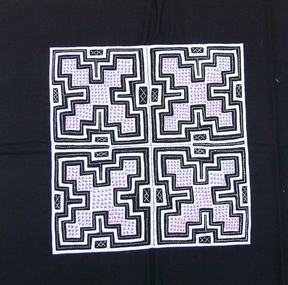
... synthetic embroidery thread. Geometric design based on squares. Backed with natural cotton. Textile ...Made in refugee camps in norther Thailand. Traditional design.Black and white cotton fabric, the white applied to the black. White and black running stitches. Pink and green small triangles embroidered on silk or synthetic embroidery thread. Geometric design based on squares. Backed with natural cotton.embroidery, applique, surface stitchery, mats, 1960-80, thailand, laos, reverse applique
