
Showing 13 items matching " tambourine"
-
 Stawell Historical Society Inc
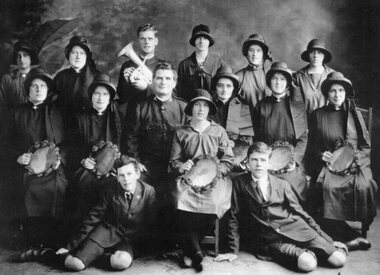
Photograph, Salvation Army Stawell Cadet Brigade 1927
... Females in the group are wearing hats and those seated are holding tambourines. Stawell Corps Cadet Brigade Back Row, Mavis Vince, May Clark, Charlie Carter, Ruth Parry, Joyce Reeve, Kath Reeve. ...All females have hats on and those seated are holding tambourines. ...All females have hats on and those seated are holding tambourines. Salvation Army Stawell Cadet Brigade 1927 Photograph ...Salvation Army Corps Cadet Brigade Group 1927. Females in the group are wearing hats and those seated are holding tambourines. Stawell Corps Cadet Brigade Back Row, Mavis Vince, May Clark, Charlie Carter, Ruth Parry, Joyce Reeve, Kath Reeve. Centre Row, Margaret Frazer, Amy Clark, Adj. & Mrs. Barnes, Eunice Perry, (Mrs. Colonel Wright), Mabel Mackay. Front Row, Don. Reeve, Pearl Reeve, Robert Clark. Photograph of a group of Salvation Army band people with musical instruments. All females have hats on and those seated are holding tambourines. stawell religion -
 Stawell Historical Society Inc
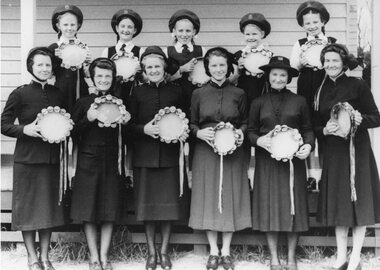
Photograph, Stawell Salvation ArmyTimbrel Brigade. Opening of quarters 4 Wimera Street 1952/1953
... Two rows of eleven Girls & Women holding Tambourines in front of weatherboard House wall....Religion Timbrel Bigade Opening of Wimmera Street Quarters Two rows of eleven Girls & Women holding Tambourines in front of weatherboard House wall. ...Back Row: Janet Tyler, Joan White, Paula White or Patty Barnett, Lois Denholm, Mary Wilson. Front Row: Jessie Clark, Mrs Agnes Wilson, Mrs CCaptain Denholm, Elieen Esky, Thelma White, Mrs Gwen Reeve.Two rows of eleven Girls & Women holding Tambourines in front of weatherboard House wall.Timbrel Bigade Opening of Wimmera Street Quartersreligion -
 Bendigo Historical Society Inc.
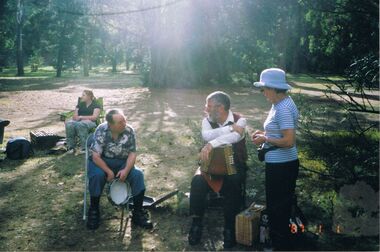
Photograph - PETER ELLIS COLLECTION: GROUP OF PEOPLE, 1st January, 1987
... Woman sitting in camp chair. Man with tambourine. Peter Ellis with accordian, woman standing. ...Woman sitting in camp chair. Man with tambourine. Peter Ellis with accordian, woman standing. ...Colour photograph. Woman sitting in camp chair. Man with tambourine. Peter Ellis with accordian, woman standing. Bush setting. Date stamped '87 1 1 bottom right corner on front of photograph.photo, group, mixed group -
 Bendigo Historical Society Inc.
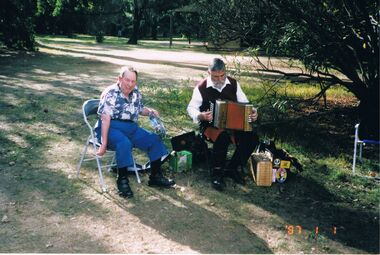
Photograph - PETER ELLIS COLLECTION: BUSH SETTING, 1st January, 1997
... Man on left with tambourine. Peter Ellis playing accordion. Date stamped '97 1 1 back of photo reads: John McQueen (Harry's son) and Peter Ellis....Man on left with tambourine. Peter Ellis playing accordion. Date stamped '97 1 1 back of photo reads: John McQueen (Harry's son) and Peter Ellis. ...Colour photograph. Two men in camp chairs. Bush setting. Man on left with tambourine. Peter Ellis playing accordion. Date stamped '97 1 1 back of photo reads: John McQueen (Harry's son) and Peter Ellis.entertainment, music, musicians -
 Bendigo Historical Society Inc.
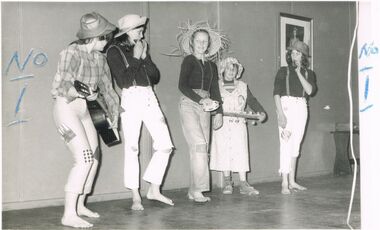
Photograph - BERT GRAHAM COLLECTION: CONCERT, 25/8/1973
... Black & white Photograph, Bert Graham Collection, The East Bendigo Swimming Club concert 25 August 1973, featuring 5 young people dressed as Hillbillies with instrumments like Guitar, mouthorgan, tambourine, topstick, flute. No 1 in blue biro written on front....BENDIGO Clubs bendigo east swimming club Black & white Photograph, Bert Graham Collection, The East Bendigo Swimming Club concert 25 August 1973, featuring 5 young people dressed as Hillbillies with instrumments like Guitar, mouthorgan, tambourine, topstick, flute. No 1 in blue biro written on front. ...Black & white Photograph, Bert Graham Collection, The East Bendigo Swimming Club concert 25 August 1973, featuring 5 young people dressed as Hillbillies with instrumments like Guitar, mouthorgan, tambourine, topstick, flute. No 1 in blue biro written on front.bendigo, clubs, bendigo east swimming club -
 City of Ballarat
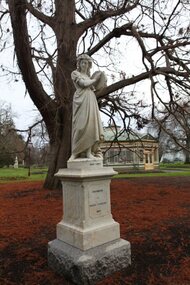
Artwork, other - Public Artwork, Giovanni Udny, Bacchante by John Udny, circa 1880
... Bacchante, Priestess to Bacchus the God of wine and good times, is depicted here wearing jewellery and playing a tambourine. ...Bacchante, Priestess to Bacchus the God of wine and good times, is depicted here wearing jewellery and playing a tambourine. The artwork is of aesthetic and historic significance to the people of Ballarat bacchante botanic gardens stoddard Ballarat Bacchante White marble figure of a woman playing a tamborine Bacchante by John Udny Artwork, other Public Artwork Giovanni Udny ...Thomas Stoddart (1828 - 1905) bought 12 white marble statues during a visit to Italy. Stoddart arranged for them to be shipped to Victoria and placed on pedestals of Sicilian marble and on bases of Victorian granite. These statues were unveiled in the gardens on Queen Victoria's birthday, 24th May, 1884. His intention was for the statues to adorn and add interest to the gardens. Bacchante, Priestess to Bacchus the God of wine and good times, is depicted here wearing jewellery and playing a tambourine. The artwork is of aesthetic and historic significance to the people of BallaratWhite marble figure of a woman playing a tamborineBacchantebacchante, botanic gardens, stoddard, ballarat -
 Bayside Gallery - Bayside City Council Art & Heritage Collection
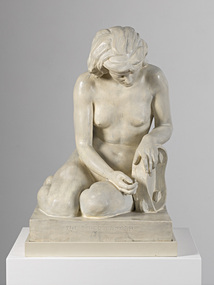
Sculpture, Charles Douglas Richardson, The tired dancer, 1909
... ...tambourine...sculpture human figure dancer tambourine charles douglas richardson cd richardson c douglas richardson plaster patinated plaster The tired dancer Sculpture sculpture Charles Douglas Richardson ...Charles Douglas Richardson, The tired dancer 1909, patinated plaster, 59 x 42 x 45 cm. Bayside City Council Art and Heritage Collection. Donated by the artist 1931.patinated plastersculpture, human figure, dancer, tambourine, charles douglas richardson, cd richardson, c douglas richardson, plaster -
 Benalla Art Gallery
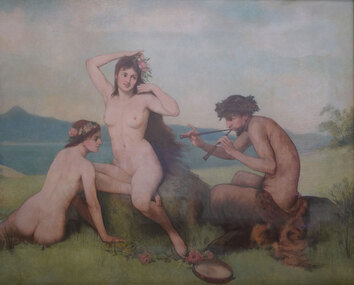
Painting, Julian ASHTON, Bacchantes, 1892
... ... Tambourine...Neoclassicism Painting Figures Faun Allegorical Flute Tambourine Flowers Nude Mountains Sky Mythical Two naked women listening to a Faun play twin pipes. ...Born: Addlestone, Surrey, England 1851; Arrived: Melbourne, Victoria, Australia 1878; Died: Bondi, New South Wales, Australia 1942NeoclassicismGift of Mr Philip Bacon, 2002Two naked women listening to a Faun play twin pipes.painting, figures, faun, allegorical, flute, tambourine, flowers, nude, mountains, sky, mythical -
 Benalla Art Gallery
Painting, Julian ASHTON, Neo-classical allegory, c. 1890
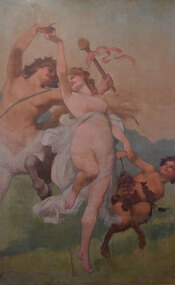
... ... Tambourine...Neoclassicism Painting Mythical Figures Centraur Child Faun Tambourine Grapes Trees Sky Nude Dancing Neo-classical allegory Painting Julian ASHTON ...Born: Addlestone, Surrey, England 1851; Arrived: Melbourne, Victoria, Australia 1878; Died: Bondi, New South Wales, Australia 1942NeoclassicismGift of Mr Wayne N. Kratzmann, 2005painting, mythical, figures, centraur, child, faun, tambourine, grapes, trees, sky, nude, dancing -
 Royal Australian Air Force Band
March Card, Jesse Greer (Composer) et al, Cheer Up (Good Times Are Coming), Composed: 1930
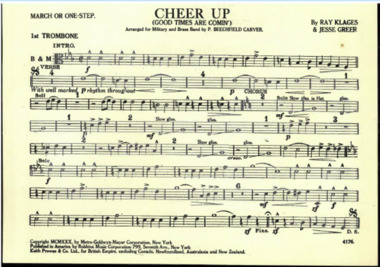
... Beechfield Carver Instrumentation: Eb Flute & Piccolo Oboes Eb Clarinets 1st Clarinets Bb 2nd & 3rd Clarinets Bb Bassoons Eb Alto Saxophone 1st Baritone Bb (or Tenor Saxophone) Repiano Cornet Bb Solo Cornet Bb (Conductor) 2nd Cornet Bb 1st Horn Eb (or Solo Tenor) 2nd Horn Eb (or 1st Tenor) 3rd & 4th Horns Eb (or 2nd Tenor) 1st Trombone (Alto Clef) 2nd Trombone (Tenor Clef) Bass Trombone Euphonium (Bass Clef) Bb Bass (Treble Clef) Basses (Bass Clef) Drums & Effects (Tubular Bells in Eb, Sleigh Bells, Tambourine etc.)...Beechfield Carver Instrumentation: Eb Flute & Piccolo Oboes Eb Clarinets 1st Clarinets Bb 2nd & 3rd Clarinets Bb Bassoons Eb Alto Saxophone 1st Baritone Bb (or Tenor Saxophone) Repiano Cornet Bb Solo Cornet Bb (Conductor) 2nd Cornet Bb 1st Horn Eb (or Solo Tenor) 2nd Horn Eb (or 1st Tenor) 3rd & 4th Horns Eb (or 2nd Tenor) 1st Trombone (Alto Clef) 2nd Trombone (Tenor Clef) Bass Trombone Euphonium (Bass Clef) Bb Bass (Treble Clef) Basses (Bass Clef) Drums & Effects (Tubular Bells in Eb, Sleigh Bells, Tambourine etc.) Cheer Up (Good Times Are Coming) March Card Jesse Greer (Composer) Ray Klages (Lyricist) Metro Goldwyn-Mayer Co. ...In 1932 the call was put out to the ABC to start a military band. The band’s task was to record music to play on air four times a week, and to perform live concerts for the public. By November 1933 a band was put together with 40 musicians from around Australia. The band was initially conducted by Captain H. E. Adkins, Director of the Royal Military School of Music, Kneller Hall, London. After the tour, Adkins returned to his position at Kneller Hall, and Stephen Yorke, a retired bandmaster of the Gloucestershire Regiment, was brought out to Australia to become the permanent director and conductor of the band, which he did until the band closed in 1951. During the band’s 17 year history they presented a sizable program of music. Their final concert received a standing ovation from its audience of 1500, with a teary-eyed Yorke. 23 Parts Concert Band Instrumentation Quick March (March or One-Step) Key Signature: Eb Major Arranged for Military and Brass Band by P. Beechfield Carver Instrumentation: Eb Flute & Piccolo Oboes Eb Clarinets 1st Clarinets Bb 2nd & 3rd Clarinets Bb Bassoons Eb Alto Saxophone 1st Baritone Bb (or Tenor Saxophone) Repiano Cornet Bb Solo Cornet Bb (Conductor) 2nd Cornet Bb 1st Horn Eb (or Solo Tenor) 2nd Horn Eb (or 1st Tenor) 3rd & 4th Horns Eb (or 2nd Tenor) 1st Trombone (Alto Clef) 2nd Trombone (Tenor Clef) Bass Trombone Euphonium (Bass Clef) Bb Bass (Treble Clef) Basses (Bass Clef) Drums & Effects (Tubular Bells in Eb, Sleigh Bells, Tambourine etc.)On envelope: QM33. March or One Step, Cheer up Good Times are Coming, Greer. Q33, 402 (crossed out). Stamped on the reverse of each card: Australian Broadcasting Commission, Sydneybrass band, australian broadcasting commission, marching band, concert band -
 Flagstaff Hill Maritime Museum and Village
Functional object - Crochet Hook, Mid 19th Century
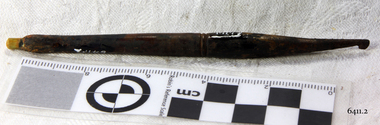
... Crochet evolved in the early 1700s when stitching material on a tambourine reached Europe after going through India, Persia, North America, Turkey, North Africa and other places around the world. ...Crochet evolved in the early 1700s when stitching material on a tambourine reached Europe after going through India, Persia, North America, Turkey, North Africa and other places around the world. ...Crochet came from the Old French word crochet, meaning ‘small hook.’ This word comes from Croche. Croche comes from the Germanic word croc. Both mean hook and crochetage, which means a single stitch used to join separate pieces of lace together. People used this term in making French lace in the 1600s and the word crochet describes the hook and the craft. Evidence shows the starting point was the mid-1800s but as early as the late 16th and early 17th century, crocheted braiding was used in clothing and other products. Like on a man’s cape at the Victoria and Albert Museum. Crochet evolved in the early 1700s when stitching material on a tambourine reached Europe after going through India, Persia, North America, Turkey, North Africa and other places around the world. People removed the background fabric used for tambouring. The French named the new technique “crochet in the air.” In the early 1800s, shepherd’s knitting came about, along with the shepherd’s hook. It’s thicker than a modern crochet hook but still with a hooked end. By the mid-1800s, it became known as crochet or slip stitch crochet. In the 60s, the granny square and crocheted home ware appeared and became more popular.A significant domestic item used in crochet or craft work and recovered from the wreck of the Schomberg in the 1970s. For more information regard the wrecking of the Schomberg see note sect this document. The Schomberg has historical significance as one of the first luxurious ships built to bring emigrants to Australia. The collection of recovered artefacts from the Schomberg wreck and held at Flagstaff Hill Museum are significant because of their potential to interpret the story of the Schomberg and its passengers.Crochet hook made from Bovine Bone. It has two sections that screw apart. Recovered from the wreck of the Schomberg. Nonewarrnambool, shipwrecked-coast, flagstaff-hill, flagstaff-hill-maritime-museum, maritime-museum, shipwreck-coast, flagstaff-hill-maritime-village, schomberg, shipwrecked-artefact, clipper ship, black ball line, 1855 shipwreck, aberdeen clipper ship, captain forbes, peterborough shipwreck, ss queen, crochet hook, crocheterage, craft -
 Embroiderers Guild, Victoria
Textile - Coggeshall Lace Flounce, Early 1800
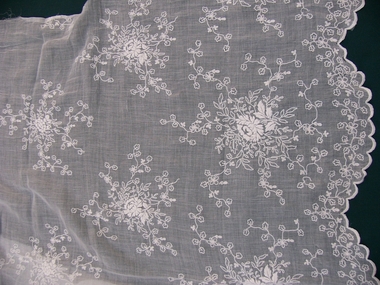
... Tambouring produces a line of chain stitches and originated in the Far East, where the workers used a round frame resembling a tambourine or drum. This they could grip between the knees, thereby releasing both hands for tambouring. ...Tambouring produces a line of chain stitches and originated in the Far East, where the workers used a round frame resembling a tambourine or drum. This they could grip between the knees, thereby releasing both hands for tambouring. ...Miss Bostock, Foundation member of the EGV, travelled to England and met with The Hon. Rachel Kay-Shuttleworth of Gawthorpe Hall. Rachel "cut" off many pieces from her extensive lace collection which were gifted to the EGV. A Brief History (Information from the work of the late Jean Dudding) About 1812 a French émigré, M. Drago and his two daughters settled in Coggeshall, Essex. Here they hired a room and began to teach the women and small children a method of decorating this net by using a tambour hook. Thus began the making of Coggeshall Lace (sometimes called tambour lace). Tambouring produces a line of chain stitches and originated in the Far East, where the workers used a round frame resembling a tambourine or drum. This they could grip between the knees, thereby releasing both hands for tambouring. Coggeshall workers used a rectangular frame and this type is still used today. Throughout the 19th century this tamboured net lace was made in the tambour rooms and cottages of Coggeshall, and also in the homes of surrounding villages. Lace manufacturers and lace dealers co-ordinated these workers by obtaining orders from London and elsewhere. Sometimes more sophisticated designs were introduced and these would be tamboured by the more proficient workers. Besides the designs, all the necessary net and threads would also be distributed to the lace workers. Liberty & Co., amongst others, were supplied with Coggeshall Lace. The fluctuations in prosperity of the tambour lacemakers were governed by many factors. Fashion requiring flounces and frills gave great encouragement but the invention of chain stitch sewing machines and of machine made laces imitating the hand made article, together with a deterioration in the quality of design meant hard times for the laceworkers. Just after 1900 there was a great improvement in the quality of Coggeshall Lace. This was due largely to the activities of two ladies, the Misses Spurge, who were the chief employers in the district. Their brother William was an art teacher who improved the general standard of design and also introduced some old Italian designs. The First World War resulted in a decline in the making of Coggeshall Lace. The workers found it more profitable to do tambour beading. In the 1930's a determined effort was made to revive the making of Coggeshall Lace, and three handkerchiefs were given to Princess Marina on her marriage (See below). Coggeshall Lace was made into dresses for the Queen, Princess Margaret and Princess Alexandra. This work was undertaken by three very proficient workers in Great Tey. Queen Mary also chose two lace dresses and a teacloth in Coggeshall Lace. It was hoped that this Royal Patronage would encourage a revival of the craft. However the financial return was too meagre and after the Second World War both net and threads disappeared. Today Coggeshall lace is made by some members of the Lacemakers Guild and is taught as part of the City and Guilds course. https://coggeshallmuseum.org.uk/lace1.htm White muslin, with sprays of roses in white satin stitch, surrounded by delicate tambour embroidery known as Coggeshall embroidery. Coggeshall being a town in Essex.embroidery, garments, whitework, england, tambour work, early 18th century -
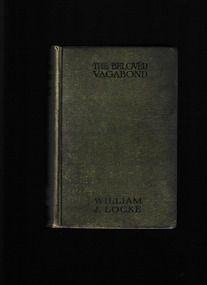 Mrs Aeneas Gunn Memorial Library
Book, William John Locke, The belovéd vagabond, 1906
... A young urchin from the London slums is adopted by the hero and given an adventurous education traveling through Europe, tambourine player in a group of ragamuffin musicians... p.303. ...To Paragot I owe everything. He is at once my benefactor, my venerated master, my beloved friend, my creator." Thus begins the story of one of the greatest characters of English Literature - Paragot the lovable Bohemian and celebrated Bon Vivant. A young urchin from the London slums is adopted by the hero and given an adventurous education traveling through Europe, tambourine player in a group of ragamuffin musicians...p.303.fictionTo Paragot I owe everything. He is at once my benefactor, my venerated master, my beloved friend, my creator." Thus begins the story of one of the greatest characters of English Literature - Paragot the lovable Bohemian and celebrated Bon Vivant. A young urchin from the London slums is adopted by the hero and given an adventurous education traveling through Europe, tambourine player in a group of ragamuffin musicians... england - fiction, homeless persons
