
Showing 52 items matching " the cornish association"
-
 Bendigo Historical Society Inc.
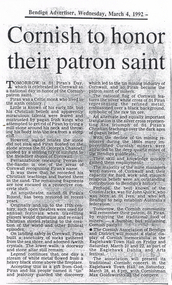
Document - LONG GULLY HISTORY GROUP COLLECTION: THE AUSTRALIAN HIGH COMMISSIONER'S VISIT TO CORNWALL
... ... The Cornish Association...Mentioned is the visit by the Australian High Commissioner Mr Michael L'Estrange to Trevessa Farm, Cornwall, the birthplace of Sir John Quick. The Cornish Association placed a plaque on Trevessa Farm in 2002. ...Mentioned is the visit by the Australian High Commissioner Mr Michael L'Estrange to Trevessa Farm, Cornwall, the birthplace of Sir John Quick. The Cornish Association placed a plaque on Trevessa Farm in 2002. ...BHS CollectionThe Australian High Commissioner's Visit to Cornwall. Information supplied by Tom and Libby Luke. Mentioned is the visit by the Australian High Commissioner Mr Michael L'Estrange to Trevessa Farm, Cornwall, the birthplace of Sir John Quick. The Cornish Association placed a plaque on Trevessa Farm in 2002. Margaret Bigg, one of the owners of Trevessa Farm can claim to have relatives of the Ellis Family here in Bendigo. On the back is a copy of a Bendigo Advertiser article titled Cornish to honour their patron saint. It was dated March 4, 1992. Article contains some information on St Piran, the patron saint of miners. Also mentioned is the birthplace of Sir John Quick.bendigo, history, long gully history group, the long gully history group - the australian high commissioner's visit to cornwall, tom and libby luke, michael l'estrange, trevessa farm, sir john quick, camborne pool redruth urban regeneration company, dr tim williams, cr graeme hicks, cornwall county council, adrian and margaret bigg, the cornish association, john bolitho, ellis family, bendigo advertiser 4 mar 1992, st piran's day, tin mining, the cornish association of bendigo and district, eaglehawk town hall, eaglehawk dahlia and arts festival, max goldsworthy -
 Bendigo Historical Society Inc.
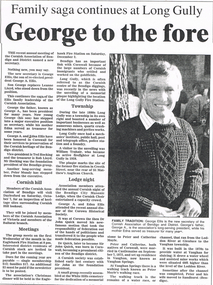
Newspaper - LONG GULLY HISTORY GROUP COLLECTION: GEORGE TO THE FORE
... ... The Cornish Association of Bendigo and District...A photo of George is included and printed under it it mentions that George Ellis is the new secretary of the Cornish Association of Bendigo and District. George's father, George A., is the associations long-serving president, while his mother Edna served as treasurer for many years. ...BHS Collection BENDIGO History long gully history group The Long Gully History Group - George to the fore The Cornish Association of Bendigo and District George Ellis George A Ellis Leanne Lloyd Edna Ellis Ted Hocking Rob Lloyd Peter Mundy Cornish Association of Victoria Eaglehawk Fire Station William Trahair St Matthew's Anglican Church Bendigo City Masonic Lodge Cornish Choir Corowa Historical Society Dr John Quick Sir John Quick White Hill Cemetry Peter and Catherine Moyle Copy of a newspaper article titled Family saga continues at Long Gully George to the fore. ...BHS CollectionCopy of a newspaper article titled Family saga continues at Long Gully George to the fore. A photo of George is included and printed under it it mentions that George Ellis is the new secretary of the Cornish Association of Bendigo and District. George's father, George A., is the associations long-serving president, while his mother Edna served as treasurer for many years. Sir John Quick is also mentioned. He was born in Cornwall.bendigo, history, long gully history group, the long gully history group - george to the fore, the cornish association of bendigo and district, george ellis, george a ellis, leanne lloyd, edna ellis, ted hocking, rob lloyd, peter mundy, cornish association of victoria, eaglehawk fire station, william trahair, st matthew's anglican church, bendigo city masonic lodge, cornish choir, corowa historical society, dr john quick, sir john quick, white hill cemetry, peter and catherine moyle -
 Bendigo Historical Society Inc.
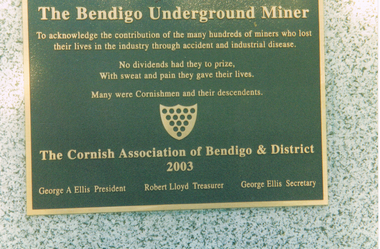
Photograph - LONG GULLY HISTORY GROUP COLLECTION: THE BENDIGO UNDERGROUND MINER MONUMENT
... ... The Cornish Association of Bendigo & District...There is a shield her with fifteen holes in the shape of a triangle. The Cornish Association of Bendigo & District 2003 George A Ellis President. ...There is a shield her with fifteen holes in the shape of a triangle. The Cornish Association of Bendigo & District 2003 George A Ellis President. ...BHS CollectionColour photo of the upper plaque on the Bendigo Underground Miner Monument. The plaque is dark grey with gold edge and printing. It is mounted on a marble base. The plaque reads: The Bendigo Underground Miner To acknowledge the contribution of the many hundreds of miners who lost their lives in the industry through accident and industrial disease. No dividends had they to prize, With sweat and pain they gave their lives. Many were Cornish men and their descendent. There is a shield her with fifteen holes in the shape of a triangle. The Cornish Association of Bendigo & District 2003 George A Ellis President. Robert Lloyd Treasurer. George Ellis Secretary.bendigo, history, long gully history group, the long gully history group - the bendigo underground miner monument, the cornish association of bendigo & district, george a ellis, robert lloyd -
 Bendigo Historical Society Inc.
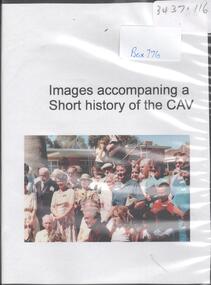
Archive - SHORT HISTORY OF CAV
... Cornish Association of Victoria...Images accompaning a short history of the CAV, Cornish Association of Victoria....Cornish Association of Victoria History DVD. Images accompaning a short history of the CAV, Cornish Association of Victoria. ...DVD. Images accompaning a short history of the CAV, Cornish Association of Victoria.cornish association of victoria, history -
 Bendigo Historical Society Inc.
Document - LONG GULLY HISTORY GROUP COLLECTION: PRESS RELEASE
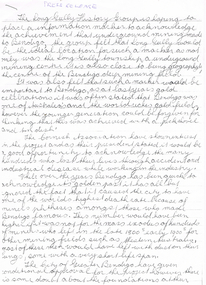
... ... The Cornish Association...BHS Collection BENDIGO History long gully history group The Long Gully History Group - Press Release The Long Gully History Group The Cornish Association The City of Greater Bendigo Long Gully Community House Copy of a two page press release mentioning the placement of an information marker to acknowledge the achievement that underground mining made to Bendigo. ...BHS CollectionCopy of a two page press release mentioning the placement of an information marker to acknowledge the achievement that underground mining made to Bendigo. It was felt that Long Gully was the ideal location for a marker as not only was the Long Gully township an underground mining centre it is also close to being geographically the centre of the Bendigo deep mining field.bendigo, history, long gully history group, the long gully history group - press release, the long gully history group, the cornish association, the city of greater bendigo, long gully community house -
 Bendigo Historical Society Inc.
Document - LONG GULLY HISTORY GROUP COLLECTION: MARKING OUR MINING HISTORY
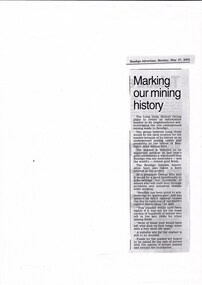
... ... The Bendigo Cornish Association...BENDIGO History long gully history group The Long Gully History Group - Marking our mining history Long Gully History Group The Bendigo Cornish Association George Ellis Bendigo Advertiser Copy of a newspaper article titled Marking our mining history printed in the Bendigo Adveretiser 27/5/2002. the Long Gully History Group plans to create an information marker in its neighbourhood acknowledging the role underground mining made to Bendigo. ...Copy of a newspaper article titled Marking our mining history printed in the Bendigo Adveretiser 27/5/2002. the Long Gully History Group plans to create an information marker in its neighbourhood acknowledging the role underground mining made to Bendigo.bendigo, history, long gully history group, the long gully history group - marking our mining history, long gully history group, the bendigo cornish association, george ellis, bendigo advertiser -
 Brunswick Community History Group
Photograph - Keith Stodden, Not known
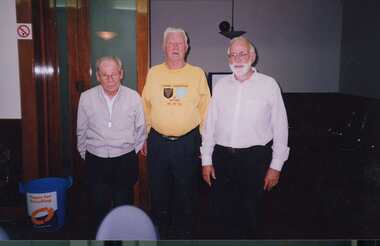
... Keith was Treasurer of BCHG and was a member of the Cornish Association of Victoria....Keith was Treasurer of BCHG and was a member of the Cornish Association of Victoria. Photograph Keith Stodden ...Colour photograph of three men at a BCHG meeting in the Mayor's Room at Brunswick Town Hall. Keith Stodden (1931-2023) is standing in the middle. Keith was Treasurer of BCHG and was a member of the Cornish Association of Victoria. -
 Bendigo Historical Society Inc.
Mixed media - HOSKING AND HUNKIN COLLECTION: CD/DVD, 2011
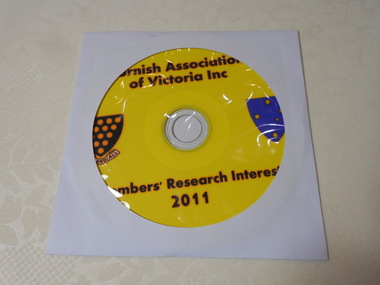
... Yellow label "Cornish Association of Victoria Inc. Members' Research Interests 2011". ...Yellow label "Cornish Association of Victoria Inc. Members' Research Interests 2011". ...Object. CD in white paper sleeve. Yellow label "Cornish Association of Victoria Inc. Members' Research Interests 2011". Two shield emblems, one brown and orange with "One and All" below one blue with Southern Cross.history, australian, cornish -
 Bendigo Historical Society Inc.
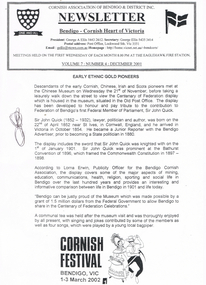
Document - LONG GULLY HISTORY GROUP COLLECTION: CORNISH ASSOCIATION NEWSLETTER DECEMBER 2001
... LONG GULLY HISTORY GROUP COLLECTION: CORNISH ASSOCIATION NEWSLETTER DECEMBER 2001...... Cornish Association of Bendigo & District Inc...Cornish Association of Bendigo & District Inc. Newsletter Volume 7: Number 4: December 2001. ...BENDIGO History long gully history group The Long Gully History Group - Cornish Association Newsletter December 2001 Cornish Association of Bendigo & District Inc George A Ellis Eaglehawk Fire Statin Chinese Museum Centenary of Federation Old Post Office Sir John Quick Bendigo Advertiser Bathurst Convention of 1896 Commonwealth Constitution 1897 - 1898 Lorna Erwin Cornish Association of Bendigo & District Inc. ...Cornish Association of Bendigo & District Inc. Newsletter Volume 7: Number 4: December 2001. Titled Early Ethnic Gold Pioneers. Members met at the Chinese Museum before taking a walk down the street to view the Centenary of Federation display which is housed in the Museum, situated in the Old Post Office. Sir John Quick is also mentioned. According to Lorna Erwin, Publicity Officer for the Bendigo Cornish Association, the display covers some of the major aspects of mining, education, communications, health, religion, sporting and social life in Bendigo over the last 100 years and provides an interesting and informative comparison between life in Bendigo in 1901 and life today. Also mentioned is Bendigo can be proud of the Museum which was made possible by a grant from the Federal Government to allow Bendigo to share in the Centenary of Federation Celebrations.bendigo, history, long gully history group, the long gully history group - cornish association newsletter december 2001, cornish association of bendigo & district inc, george a ellis, eaglehawk fire statin, chinese museum, centenary of federation, old post office, sir john quick, bendigo advertiser, bathurst convention of 1896, commonwealth constitution 1897 - 1898, lorna erwin -
 Bendigo Historical Society Inc.
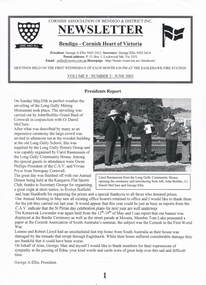
Document - LONG GULLY HISTORY GROUP COLLECTION: CORNISH ASSOCIATION NEWSLETTER JUNE 2003 - PRESIDENTS REPORT
... LONG GULLY HISTORY GROUP COLLECTION: CORNISH ASSOCIATION NEWSLETTER JUNE 2003 - PRESIDENTS REPORT...... Cornish Association of Bendigo & District Inc...Cornish Association Newsletter Volume 9, Number 2, June 2003 mentions the unveiling of the Long Gully Mining Monument on May 25th. ...BENDIGO History long gully history group The Long Gully History Group - Cornish Association Newsletter June 2003 - Presidents Report Cornish Association of Bendigo & District Inc George A Ellis Eaglehawk Fire Station Long Gully Mining Monument John Bolitho Cr Darrel McClure Long Gully History Group Carol Rasmussen Long Gully Community fHouse Gwen Phillips Vivian Pryor Kaangaroo Sports Club Evelyn Butfield Jean Shadforth Tom Luke Cornish Association of South Australia Leanne and Robert Lloyd Cornish Association Newsletter Volume 9, Number 2, June 2003 mentions the unveiling of the Long Gully Mining Monument on May 25th. ...Cornish Association Newsletter Volume 9, Number 2, June 2003 mentions the unveiling of the Long Gully Mining Monument on May 25th. The unveiling was carried out by John Bolitho Grand Bard of Cornwall in conjunction with Cr Darrel McClure. The ceremony was followed by afternoon tea supplied by the Long Gully History Group and organised by Carol Rasmussen of the Long Gully Community House. Some special guests were Gwen Phillips president of the C.A.V. and Vivian Pryor from Newquay Cornwall. The day was finished by Annual Dinner held at the Kangaroo Sports Club. Plans for other celebrations were underway. A paper, the Cornish in the First World War, was presented by Tom Luke at the Cornish association of South Australia's seminar. Leanne and Robert Lloyd had to come home as their house was considerably damaged by a tornado that swept through Eaglehawkbendigo, history, long gully history group, the long gully history group - cornish association newsletter june 2003 - presidents report, cornish association of bendigo & district inc, george a ellis, eaglehawk fire station, long gully mining monument, john bolitho, cr darrel mcclure, long gully history group, carol rasmussen, long gully community fhouse, gwen phillips, vivian pryor, kaangaroo sports club, evelyn butfield, jean shadforth, tom luke, cornish association of south australia, leanne and robert lloyd -
 Bendigo Historical Society Inc.
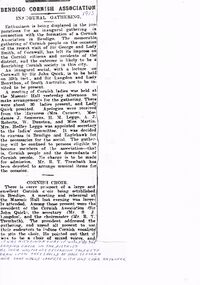
Document - CORNISH COLLECTION: ARTICLES RELATING TO THE CORNISH CHOIR
... ...Bendigo Cornish Association. Choir....Mention of conductor - Mr R T Trembath.; c. copy from newspaper headed in handwriting ''Bendigo Cornish Association 1913'' - report on the inaugural social, the letter from Sir George Smith, the lecture by Sir John Quick (details of the content of his lecture on Cornwall), and performance of the Cornish male choir (with details of songs and performers)....BENDIGO History cornish Bendigo Cornish Association. Choir. Document. Various articles relating to the Cornish Choir: a. copy of 1913 (according to handwritten addition of date) newspaper article re the formation of a Cornish Association in Bendigo with inaugural social with a lecture by Sir John Quick planned plus details of formation of a Cornish choir (meeting and rehearsal) with hopes expressed for the future of the choir (print article completed with handwritten attachment); b. ...Document. Various articles relating to the Cornish Choir: a. copy of 1913 (according to handwritten addition of date) newspaper article re the formation of a Cornish Association in Bendigo with inaugural social with a lecture by Sir John Quick planned plus details of formation of a Cornish choir (meeting and rehearsal) with hopes expressed for the future of the choir (print article completed with handwritten attachment); b. Article reproduced from paper (no date) re ''Cornish Choir's Entertainment'' - Christmas carols and biograph in Upper Reserve. Mention of conductor - Mr R T Trembath.; c. copy from newspaper headed in handwriting ''Bendigo Cornish Association 1913'' - report on the inaugural social, the letter from Sir George Smith, the lecture by Sir John Quick (details of the content of his lecture on Cornwall), and performance of the Cornish male choir (with details of songs and performers).bendigo, history, cornish, bendigo cornish association. choir. -
 Bendigo Historical Society Inc.
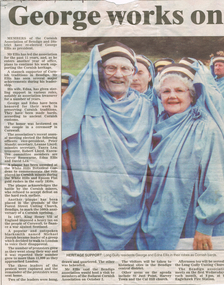
Newspaper - LONG GULLY HISTORY GROUP COLLECTION: GEORGE AND EDNA ELLIS
... ... Ballarat Cornish Association...Mentioned in the article is George's work with the Cornish Association and his re-election as president. ...Mentioned in the article is George's work with the Cornish Association and his re-election as president. ...Newspaper cutting titled George works on, printed in the Bendigo Advertiser Sep 16, '99. Mentioned in the article is George's work with the Cornish Association and his re-election as president. An honour was bestowed on George and his wife, Edna at a ceremony in Cornwall. A photograph shows George and his Wife, Edna wearing a light bluerobe and a horizontal banded hat with two dark blue? bands with a yellow band in the centre.bendigo, history, long gully history group, the long gully history group - george and edna ellis, bendigo advertiser 16 /9/99, cornish association of bendigo and district, peter mundy, leanne lloyd, tanya lea, robert lloyd, trevor rosewarne, david lea, white hilll botanical gardens, forest street uniting church, michael joseph, ballarat cornish association, long gully uniting church, eaglehawk fire station -
 Bendigo Historical Society Inc.
Document - LONG GULLY HISTORY GROUP COLLECTION: NEIGHBOURHOOD WATCH
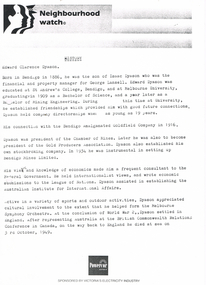
... ... Cornish Association...The third, dated 30/5/97, also mentions Eaglehawk Heritage Society, Cornish Miners, Cornish Association, Long Gully School, Department of Main Roads, St laurence Court, Charles Fay, La Trobe History Department. ...The third, dated 30/5/97, also mentions Eaglehawk Heritage Society, Cornish Miners, Cornish Association, Long Gully School, Department of Main Roads, St laurence Court, Charles Fay, La Trobe History Department. ...BHS CollectionThree pages, the first titled Neighbourhood Watch. The second, dated 2/6/97, mentions a phone call to the City of Greater Bendigo about speaking to Marco in the Planning Department. The third, dated 30/5/97, also mentions Eaglehawk Heritage Society, Cornish Miners, Cornish Association, Long Gully School, Department of Main Roads, St laurence Court, Charles Fay, La Trobe History Department. It has Cheryl Wallis signature at the bottom of page.bendigo, history, long gully history group, the long gully history group - neighbourhood watch, edward clarence dyason, isaac dyason, george lansell, st andrew's college, melbourne university, bendigo amalgamated goldfield company, chamber of mines, gold producers association, bendigo mines limited, league of nations, australian institute for international affairs, melbourne syphony orchestra, world war ii, british commonwealth relations conference, powercor australia, city of greater bendigo, eaglehawk heritage society, cornish association, long gully school, department of main roads, st laurence court, charles fay, la trobe history department, cheryl wallis -
 Bendigo Historical Society Inc.
Document - LONG GULLY HISTORY GROUP COLLECTION: PLAN FOR PLAQUE
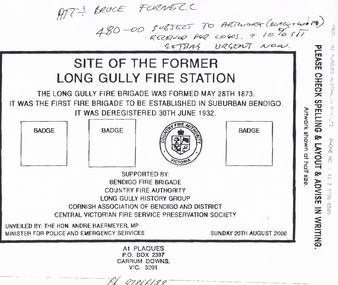
... ... Cornish Association of Bendigo and District...Also mentioned is the supporters: Bendigo Fire Brigade, Country Fire Authority, Long Gully History Group, Cornish Association of Bendigo and District and the Central Victorian Fire Service Presentation Society. ...Also mentioned is the supporters: Bendigo Fire Brigade, Country Fire Authority, Long Gully History Group, Cornish Association of Bendigo and District and the Central Victorian Fire Service Presentation Society. ...Copy of a plan for the plaque for the Site of the Former Long Gully Fire Station. Plan has the Country Fire Authority Victoria Logo and three spaces for badges. It also has when the Long Gully Fire brigade was formed and when it was deregistered. Also mentioned is the supporters: Bendigo Fire Brigade, Country Fire Authority, Long Gully History Group, Cornish Association of Bendigo and District and the Central Victorian Fire Service Presentation Society. Unveiled by The Hon Andre Haermeyer MP and Minister for Police and Emergency Services on Sunday 20th August 2000. Plaque to be made by A1 Plaques.bendigo, history, long gully history group, the long gully history group - plan for plaque, bruce furnell, long gully fire station, long gully fire brigade, country fire authority, bendigo fire brigade, long gully history group, cornish association of bendigo and district, central victorian fire service presentation society, the hon andre haermeyer mp, a1 plaques -
 Bendigo Historical Society Inc.
Document - LONG GULLY HISTORY GROUP COLLECTION: UNVEILING OF MINING MONUMENT AT LONG GULLY
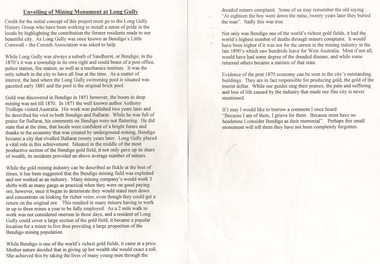
... ... Cornish Association...Long Gully was once known as Bendigo's Little Cornwall - the Cornish Association was asked to help. Also mentioned Long Gully in the 1870's, Gold discovery, Anthony Trollop's visit to Bendigo and his praise for Ballarat and his comments on Bendigo which were not flattering. ...Long Gully was once known as Bendigo's Little Cornwall - the Cornish Association was asked to help. Also mentioned Long Gully in the 1870's, Gold discovery, Anthony Trollop's visit to Bendigo and his praise for Ballarat and his comments on Bendigo which were not flattering. ...Paper mentions that credit for the project must go to the Long Gully History Group who have been working to install a sense of pride in the locals by highlighting the contribution the former residents made to the city. Long Gully was once known as Bendigo's Little Cornwall - the Cornish Association was asked to help. Also mentioned Long Gully in the 1870's, Gold discovery, Anthony Trollop's visit to Bendigo and his praise for Ballarat and his comments on Bendigo which were not flattering. Also mentioned was the men and their work, the miners complaint, the unrest in the mining industry and a lot of the miners leaving for West Australia.bendigo, history, long gully history group, the long gully history group - unveiling of mining monument at long gully, long gully history group, bendigo's little cornwall, cornish association, anthony trollop -
 Bendigo Historical Society Inc.
Document - LONG GULLY HISTORY GROUP COLLECTION: LONG GULLY COMMUNITY HOUSE
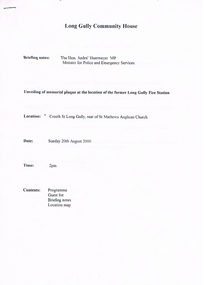
... Bendigo and District Cornish Association...Special Guests included Representatives of the Bendigo Fire Brigade, Long Gully Community House, Bendigo and District Cornish Association, Central Victorian Fire Preservation Society and St Mathews Church. ...Special Guests included Representatives of the Bendigo Fire Brigade, Long Gully Community House, Bendigo and District Cornish Association, Central Victorian Fire Preservation Society and St Mathews Church. ...Program for the unveiling of memorial plaque at the location of the former Long Gully Fire Station on the 20th August 2000 at Creeth St Long Gully, rear of St Mathews Anglical Church. List of Dignitaries include Parliamentarians: Hon Andre' Haermeyer MP, Hon Bob Cameron MP and Ron Best MLC. Other Dignitaries: Cr Laurie Whelan, Cr Willi Carney and CFA Bill Davies and Bruce Furnell. Special Guests included Representatives of the Bendigo Fire Brigade, Long Gully Community House, Bendigo and District Cornish Association, Central Victorian Fire Preservation Society and St Mathews Church. Briefing notes include the Plaque, Long Gully and a brief history of the Long Gully Fire Brigade. Also included is a location map of the Long Gully Area.bendigo, history, long gully history group, the long gully history group - long gully community house, the hon andre' haermeyer mp, long gully fire station, st mathews anglical church, george a ellis, long gully history group, bruce furnell, cr laurie whelan, greater city of bendigo, hon bob cameron mp, hon ron best mlc, cr willi carney, bill davies, country fire authority, bendigo and district cornish association, central victorian fire preservation society, mechanics institute, post and telegraph office, cfbb chief officer hennah -
 Bendigo Historical Society Inc.
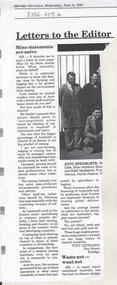
Newspaper - Kangaroo Flat Gold Mine Collection: letters to Bendigo Advertiser Editor
... ...Cornish Association...The statue of the Cornish miner came about as a project of the Bendigo Cornish Association. ...The statue of the Cornish miner came about as a project of the Bendigo Cornish Association. Newspaper Kangaroo Flat Gold Mine Collection: letters to Bendigo Advertiser Editor ...Three photocopies and one original 'Bendigo Advertiser' articles, 'Letters to the Editor': 1. 'Mine statements are naive', June 6, 2001, from Tony Lethlean, Don Street, Bendigo. Letter discusses the damage done to the environment by farming and logging compared to mining. 2. "Mining letter is misleading' 4th July, 2001, from Geoff Turner, AIG Victorian Branch, Strathfieldsaye. Letter discusses 'misleading information circulating in the wider Strathfieldsaye area' regarding the mining operations proposed by Perseverance Exploration Pty. Ltd. 3. 'A Balance to Open Cut Mining', 16th July 2001, by '. Letter refers to Geoff Turner's letter and writes to bring 'balance to this subject' 4. Bendigo Advertiser original copy of article: 'Cornish statue feature pleasing' 22nd January, 2001, by Ruth Hopkins, Peel Street, Bendigo. Ruth's letter discusses the history of the Cornish miner in Bendigo; the largest ethnic group on the field. The statue of the Cornish miner came about as a project of the Bendigo Cornish Association. gold mining, bendigo, perserverance exploration pty ltd., open cut mining, bendigo advertiser, tony lethlean, geoff turner, ruth hopkins, cornish association, fosterville gold mine, luch and graeme reed, objectors, cornish statue -
 Bendigo Historical Society Inc.
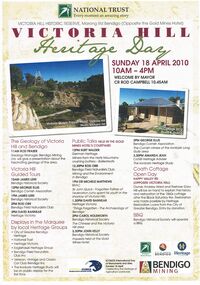
Document - VICTORIA HILL MARONG RD BENDIGO HERITAGE DAY BROCHURE 2010, 2010
... Victoria Hill Guided Tours James Lerk (Bendigo Historical Society) George Ellis (Bendigo Cornish Association) Rod Orr (Bendigo Field Naturalists Club) David Bannear (Heritage Victoria) Presentations: Rod Fraser The Geology of Victoria Hill and Bendigo, Kurt Walder German Heritage Ballerstedts-miners from the Hartz Mountains crushing battery, Rod Orr Mining and the Environment in Bendigo, Michele Matthews (BRAC) Sir John Quick the Forgotten Father of Federation spent his youth in the shadow of Victoria Hill, David Bannear ''Things Forgotten'' - the Archaelogy of Bendigo, Carol Holsworth the Chinese and Victoria Hill area, John Kelly Inquests held at the Gold Mines Hotel, George Ellis The Cornish miners of the Ironbark and Long Gully area, Amanda Jean The Ironbark Heritage Study. ...Victoria Hill Guided Tours James Lerk (Bendigo Historical Society) George Ellis (Bendigo Cornish Association) Rod Orr (Bendigo Field Naturalists Club) David Bannear (Heritage Victoria) Presentations: Rod Fraser The Geology of Victoria Hill and Bendigo, Kurt Walder German Heritage Ballerstedts-miners from the Hartz Mountains crushing battery, Rod Orr Mining and the Environment in Bendigo, Michele Matthews (BRAC) Sir John Quick the Forgotten Father of Federation spent his youth in the shadow of Victoria Hill, David Bannear ''Things Forgotten'' - the Archaelogy of Bendigo, Carol Holsworth the Chinese and Victoria Hill area, John Kelly Inquests held at the Gold Mines Hotel, George Ellis The Cornish miners of the Ironbark and Long Gully area, Amanda Jean The Ironbark Heritage Study. ...Victoria Hill Marong Rd Bendigo (Opposite the Gold Mines Hotel) Heritage Day Brochure 2010. Victoria Hill Guided Tours James Lerk (Bendigo Historical Society) George Ellis (Bendigo Cornish Association) Rod Orr (Bendigo Field Naturalists Club) David Bannear (Heritage Victoria) Presentations: Rod Fraser The Geology of Victoria Hill and Bendigo, Kurt Walder German Heritage Ballerstedts-miners from the Hartz Mountains crushing battery, Rod Orr Mining and the Environment in Bendigo, Michele Matthews (BRAC) Sir John Quick the Forgotten Father of Federation spent his youth in the shadow of Victoria Hill, David Bannear ''Things Forgotten'' - the Archaelogy of Bendigo, Carol Holsworth the Chinese and Victoria Hill area, John Kelly Inquests held at the Gold Mines Hotel, George Ellis The Cornish miners of the Ironbark and Long Gully area, Amanda Jean The Ironbark Heritage Study. Coath Cottage Open Day owner Andrew Ward and Restorer Gary Hill explain the history and restoration of the 1860s miners cottage after Black Saturday fire. Restoration Loans from the City of Greater Bendigo.bendigo, gold mining, heritage day 2010 -
 Bendigo Historical Society Inc.
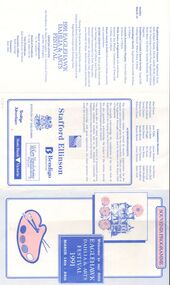
Document - EAGLEHAWK DAHLIA & ARTS FESTIVAL 1991, SOUVENIR PROGRAMME, 14 March 1991
... ... Cornish Association Display...Display of Memorabilia, Cornish Association. Children's multi-Dimensional Art Exhibition. ...Memorabilia Cornish Association. Children's multi-Dimensional Art Exhibition. ...Eaglehawk Dahlia & Arts Festival 1991, Souvenir Programme, March 14th - 24th. Programme. Debutante Ball x2 Debs presented to Mayor of Eaglehawk Cr. W Carney. Music 'Gaytones'. Gala Fair, Canterbury Park. Organised by Y's Men and Menettes of Eaglehawk. Porcelain Art and Craft Show, Art Show, Stafford Ellison & McKern Awards. Display of Memorabilia, Cornish Association. Children's multi-Dimensional Art Exhibition. Flower Show, sponsored by North West Country Credit. Children's Photographic Display. Photographic Print Competition. Historic California Hill Church, open. Victorian Police Display Unit caravan open to public. Official Opening His Excellency, Dr. Davis McCaughey. A.C. Governor of Victoria. Dahlia and Arts Street Procession. Presentation of Art, Craft Photographic and Literary Awards. 9th Annual Dahlia and Arts Half-Marathon, conducted by Eaglehawk Athletic Club. Ecumenical Church Service, Combined Clergy. Speaker: Rev. Lindsay Faulkner, Eaglehawk Citizens Brass Band. Their Excellencies, the Governor of Victoria, Dr. McGaughey and Mrs McGaughey. Picnic Lunch. Free Concert. Cycling Criterium, Featuring the Tony McCaig Memorial Wheelrace. Barry Kenny Country Roundup. Family Mini Fair. Borough Bingo. Indoor Garden Party. Celebrity Concert. Rotary Club Dinner. Children's Fancy Dress Parade, sponsored by Bendigo Advertiser. Gala Charity Old Time Ball, 'Premiers Orchestra'. Traditional Cornish Concert, Eaglehawk Citizens Brass Band, Val Broad, Annette Beckwith, Steven Higgs. Traditional Cornish Service. Genealogy Society, Cornish Association Display, Walk Tours of Eaglehawk, Ray Wallace. Picnic in the Park followed by family reunions and entertainment. Aussie Clean-up Day. Croquet and Bowls Tournaments. Official Guests: His Excellency, Dr. Davis McCaughey A.C. Governor of Victoria, and Mrs McCaughey. Mayor of Eaglehawk: Cr. W Carney J.P. Festival President: Cr Lola Miller B.E.M. Vice Presidents: Alan Bull & Kevin Herdman. Executive Officer: Ruth Claridge. Treasurer: Mary Mills. Committee Members: Alan Pearce, Harold Trahair, Wendy Holland, Trevie Dineen, Wayne Evans, Rebecca Evans, Jean Tebb, Lois Locket, Pam Wright Ron Dineen, Sandie Morris, Wayne Morris, Joyce Shelton, Dot White, Ric Norris, Ron Watts, Noel Thomas, Lorna Thomas, Ted Brown, Heather Bull, Dennis Cock, Edith Mudford, Ron Mudford, Anne Scott. Acknowledgements: Councillors, Officers and Staff of the Eaglehawk Borough Council, and by members of the Rotary Club of Eaglehawk. Lions Club of Eaglehawk. Judges of various awards. Sponsors, donors of procession prizes, voluntary workers, dedicated community of Eaglehawk. Sponsors: Stafford Ellison, Borough of Eaglehawk, Bendigo Bank, KcKern Manufacturing Pty Ltd, Bendigo Advertiser, State Bank of Victoria.event, entertainment, eaglehawk dalia and arts festival, eaglehawk dahlia & arts festival 1991, programme, march 14th - 24th. programme. debutante ball x2 debs. music 'gaytones'. gala fair, canterbury park. organised by y's men and menettes of eaglehawk. porcelain art and craft show, art show, stafford ellison & mckern awards. memorabilia, cornish association. children's multi-dimensional art exhibition. flower show, sponsored by north west country credit. children's photographic display. photographic print competition. historic california hill church, . victorian police display unit caravan open to public. street procession. presentation of art, craft photographic literary awards. 9th annual dahlia and arts half-marathon, conducted by eaglehawk athletic club. ecumenical church service, combined clergy. rev. lindsay faulkner, eaglehawk excellencies, the governor of victoria, dr. mcgaughey and mrs mcgaughey. picnic lunch. free concert. cycling criterium, featuring the tony mccaig memorial wheelrace. barry kenny country roundup. family mini fair. borough bingo. indoor garden party. celebrity concert. rotary club dinner. children's fancy dress parade, sponsored by bendigo advertiser. gala charity old time ball, 'premiers orchestra'. traditional cornish concert, eaglehawk citizens brass band, val broad, annette beckwith, steven higgs. traditional cornish service. genealogy society, cornish association display, walk tours of eaglehawk, ray wallace. picnic in the park family reunions and entertainment. aussie clean-up day. croquet bowls tournaments. official guests: his excellency, dr. davis mccaughey a.c. governor of victoria, and mrs mccaughey. mayor of eaglehawk: cr. w carney j.p. festival president: cr lola miller b.e.m. vice presidents: alan bull & kevin herdman. executive officer: ruth claridge. treasurer: mary mills. committee members: alan pearce, harold trahair, wendy holland, trevie dineen, wayne evans, rebecca evans, jean tebb, lois locket, pam wright ron dineen, sandie morris, wayne morris, joyce shelton, dot white, ric norris, ron watts, noel thomas, lorna thomas, ted brown, heather bull, dennis cock, edith mudford, ron mudford, anne scott. acknowledgements: councillors, officers and staff of the eaglehawk borough council, and by members of the rotary club of eaglehawk. lions club of eaglehawk. judges of various awards. sponsors, donors of procession prizes, voluntary workers, dedicated community of eaglehawk. sponsors: stafford ellison, borough of eaglehawk, bendigo bank, kckern manufacturing pty ltd, bendigo advertiser, state bank of victoria. -
 Uniting Church Archives - Synod of Victoria
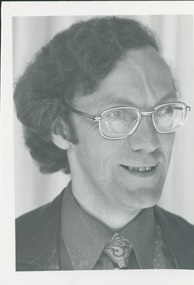
BW photo, Undated, but post-1977
... He has been involved with, lectured in, studied at, worked for, chaired committees or directed at one or more times — La Trobe University, Christian Television Association, Australian Consultation on Liturgy, UCA Assembly committees, Lincoln College, England, Brugge Catholic Faculty, Oxford Institute for Methodist Theological Studies, Graduate School in Ecumenism at Bosse, the English Language Liturgical Consultation, World Methodist Council, World Council of Churches, Christian Unity Working Group, the Victorian Casino and Gambling Authority, Centre for Ecumenical Studies, Cambridge Society of Australia, Fellow of the School of Historical Studies Melbourne University, Queen’s College Council, Fellow of Queen’s College, Editor of the Australian Journal of Liturgy, Professorial Fellow of Charles Sturt University, President of the Cornish Association of Victoria, and member of the Council of the Genealogical Society of Victoria. ...He has been involved with, lectured in, studied at, worked for, chaired committees or directed at one or more times — La Trobe University, Christian Television Association, Australian Consultation on Liturgy, UCA Assembly committees, Lincoln College, England, Brugge Catholic Faculty, Oxford Institute for Methodist Theological Studies, Graduate School in Ecumenism at Bosse, the English Language Liturgical Consultation, World Methodist Council, World Council of Churches, Christian Unity Working Group, the Victorian Casino and Gambling Authority, Centre for Ecumenical Studies, Cambridge Society of Australia, Fellow of the School of Historical Studies Melbourne University, Queen’s College Council, Fellow of Queen’s College, Editor of the Australian Journal of Liturgy, Professorial Fellow of Charles Sturt University, President of the Cornish Association of Victoria, and member of the Council of the Genealogical Society of Victoria. ...The Rev. Dr Robert Gribben was born in 1943 in country Victoria where he was educated through primary and secondary state schools. He entered Queen’s College in 1961 in order to study degrees in law and arts, but after two years discontinued his legal studies and completed his Bachelor of Arts whilst beginning his candidature for the Methodist ministry. In 1965 he and his wife Susan became engaged, but before he could begin his theological studies he was offered the opportunity to undertake his theological studies in Cambridge University in Wesley House. After Susan completed her law degree with honours at Melbourne University, she followed Robert to England in June 1967, and they were married in June 1968 as Robert was completing his Cambridge B.A. He’d received notice that his first Methodist ministry appointment was to be in “Portland No. 2”, but as they had six months before he was to take that up, they moved to India where Robert worked for the Student Christian Movement and Susan for the Church of South India sorting out their legal records. Robert’s placements that followed in the Methodist Church were Portland and Heywood and Highbury Grove Kew, and in the Uniting Church as chaplain of Ormond College, Trinity Church North Balwyn, General Secretary of the Victorian Council of Churches, Wesley Church Melbourne, and Professor of Worship and Mission at the UCA Theological Hall and UFT. He formally retired in 2008. He has been involved with, lectured in, studied at, worked for, chaired committees or directed at one or more times — La Trobe University, Christian Television Association, Australian Consultation on Liturgy, UCA Assembly committees, Lincoln College, England, Brugge Catholic Faculty, Oxford Institute for Methodist Theological Studies, Graduate School in Ecumenism at Bosse, the English Language Liturgical Consultation, World Methodist Council, World Council of Churches, Christian Unity Working Group, the Victorian Casino and Gambling Authority, Centre for Ecumenical Studies, Cambridge Society of Australia, Fellow of the School of Historical Studies Melbourne University, Queen’s College Council, Fellow of Queen’s College, Editor of the Australian Journal of Liturgy, Professorial Fellow of Charles Sturt University, President of the Cornish Association of Victoria, and member of the Council of the Genealogical Society of Victoria. He has written some seven books and edited both editions of Uniting in Worship. On top of all that he has visited, worked in, or represented one body or another in — Colombo, Cairo, Rome, Geneva, Parish, the UK, Bangalore, Mysore, Madras, Kottoyam, Agra, Jaipur, Sri Lanka, Malaysia, Philippines, Japan, Hong Kong, the USA, Canada, Vienna, Israel, Netherlands, Poland, Bangkok, Singapore, Romania, Bucharest, Bulgaria, Greece, Syria, Lebanon, Cyprus, Turkey, Zimbabwe, Ethiopia, Jordan, Italy, Tonga, Finland, Germany, Norway, Denmark, Samoa, South Africa, Spain, Sicily, Chile, Indonesia, New Zealand, Ghana, Nigeria, Russia, Antigua and Jamaica. And on top of all that, he’s had two audiences with the Pope! Susan and Robert have two children and three grandchildren. Head and shoulders portrait of Rev. Dr Robert Gribben."Rev. Dr Robert Gribben", "Church & Nation"rev. dr robert gribben; liturgy; theological hall melbourne -
 Flagstaff Hill Maritime Museum and Village
Equipment - Pattern, Briggs Brass Foundry, Early 20th century
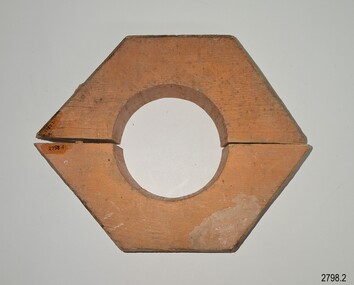
... Cornish chimney, constructed as a working model to illustrate the process of smelting metal in furnaces and pouring it into sand moulds. The chimney, crafted from specially curved bricks, currently stands at approximately two-thirds of its original height, having previously been located at the Grassmere Cheese factory. The craft of sand-casting, which utilises intricately carved wooden patterns to create metal objects, stands as a testament to the enduring value of traditional skills. This age-old technique remains relevant today, linking past craftsmanship to ongoing industrial practices. The foundry pattern set holds particular significance due to its strong associations ...The wooden pattern forms part of a larger collection, securely stored within a durable wooden crate. This pattern was an essential tool at Briggs’ Brass Foundry, specifically designed for creating sand casts. Sand casting is a time-honoured technique, with a history exceeding 2,000 years. The handcrafted nature of this process results in the production of brass and copper alloy items, which are particularly suitable for maritime applications. Typical products include bells, boat hooks, cowls, propellers, handles, lids, rowlocks, hooks, letters, bolts, rail holders, brackets, deck plates, flanges, rudder guides, portholes and covers. The distinctive bronze mixture used at Briggs’ Foundry is copper-based, composed of local ingots of copper, tin, zinc and lead, blended in precisely measured quantities. The resulting alloy is non-ferrous, known for its exceptional durability and longevity. In the early years of Flagstaff Hill, the Briggs family generously donated the crate of patterns along with other related items such as brassware, tools and machinery. These items were prominently displayed in a simulated Brass Foundry within the Village, alongside other working crafts, trades and services typical of a maritime town. From the completion of the building in 1986 until its repurposing in 1994, visitors could view these items and gain insight into the foundering and metalwork trades that supported maritime industries, including shipwrights and boatbuilders. The castings produced at the foundry were also vital for farmers, manufacturers and other local industries. The Brass Foundry display featured a historic Cornish chimney, constructed as a working model to illustrate the process of smelting metal in furnaces and pouring it into sand moulds. The chimney, crafted from specially curved bricks, currently stands at approximately two-thirds of its original height, having previously been located at the Grassmere Cheese factory. The craft of sand-casting, which utilises intricately carved wooden patterns to create metal objects, stands as a testament to the enduring value of traditional skills. This age-old technique remains relevant today, linking past craftsmanship to ongoing industrial practices. The foundry pattern set holds particular significance due to its strong associations with brass foundries, both locally and in coastal regions across Victoria. In these areas, marine industries such as ship and boat building have long depended on high-quality metal castings for the machinery, equipment, and fittings essential to their operations. The alloys formulated by Briggs Brass Foundry, crafted from non-ferrous metals, were specifically designed to provide superior longevity and durability in maritime environments. These patterns are closely tied to the history of the Briggs Brass Foundry, a respected and long-running company that specialised in producing cast goods for the marine sector. The foundry was equipped to supply both unique, one-off items and mass-produced components, ensuring that its products found their way onto a variety of sail and steam vessels along the Victorian coast, including in Warrnambool. In addition to its broader marine applications, Briggs Brass Foundry established itself as a bell-founder specialist. The company’s expertise is notably linked to the historic Schomberg Bell at Flagstaff Hill, which they restored to its original splendour as a fine example of a bell from a luxury migrant ship of the mid-19th century. The significance of the pattern set is further heightened by its association with Briggs Brass Founders, a firm established in the early 20th century and widely recognised for its proficiency in producing, repairing, and restoring ship bells and other marine equipment. Renowned for their non-ferrous metal casting, Briggs Brass Founders consistently supplied high-quality fittings and equipment vital to maritime pursuits. Moreover, the company expanded its influence by opening a branch in Warrnambool. Through this local presence, Briggs Brass Founders supported the regional marine industry and forged strong connections with fishermen and businesses. This not only reinforced their reputation as skilled manufacturers but also highlighted their commitment to community engagement and support. Pattern; hexagonal wooden shape painted orange. The thick carved wooden shape is in halves forming a hole when locked together with the dowel pegs and opposing drilled holes. The pattern is part of a set of foundry patterns from Briggs Brass Foundry.flagstaff hill, flagstaff hill maritime museum and village, warrnambool, maritime museum, maritime village, great ocean road, shipwreck coast, briggs' bronze, trade, sand cast, cast, brass alloy, copper alloy, pattern, mould, foundry, brass foundry, metal foundry, casting, sand mould, sand casting, marine equipment, marine tools, marine fittings, copper tin zinc lead, non-ferrous, non-corrosive, brassware, metalware, foundering, metalwork, maritime, bell founders, ship chandlers, marine products, briggs family, herbert harrison briggs, h h briggs, george edward briggs, cyril falkiner mckinnon briggs, cyril briggs, briggs & son brass foundry, h h briggs & sons foundry, briggs marine, alliance casting & engineering solutions, grassmere cheese factory, cornish chimney, curved bricks, collingwood, moorabbin, collingwood foundry, moorabbin foundry, 1912, briggs, briggs brass foundry, briggs marine foundry, briggs marine products, frank lee, les lee, eva lee, briggs marine warrnambool, non-ferrous founders, bell specialists, ship bell specialists, founders, traditional send casting -
 Flagstaff Hill Maritime Museum and Village
Furniture - Cupboard, 1912-1972
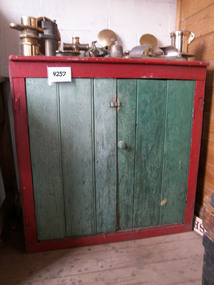
... Cornish chimney, presented as a working model. This chimney visually demonstrated the process of smelting metal in furnaces and pouring it into sand moulds. Constructed from specially curved bricks, the chimney now stands at about two-thirds of its original height, having been relocated from the Grassmere Cheese factory. The small cupboard holds particular significance due to its association ...At Briggs’ Brass Foundry, traditional sand-casting techniques have been practised for generations. Sand casting, a craft that spans over two thousand years, involves creating intricate moulds into which molten metal is poured. This handcrafted process produces durable brass and copper alloy goods, which are particularly suited to marine environments. Items such as bells, boat hooks, cowls, propellers, handles, lids, rowlocks, hooks, letters, bolts, rail holders, brackets, deck plates, flanges, rudder guides, portholes and covers have all been made using this technique. The bronze mixture used by Briggs is a copper-based alloy, carefully formulated from locally sourced ingots of copper, tin, zinc and lead in precise quantities. This results in a non-ferrous finished product, renowned for its longevity and resilience, often lasting indefinitely even in harsh conditions. Donation to Flagstaff Hill: In Flagstaff Hill's formative years, 1972-1975, the Briggs family generously donated a range of related items, including casting patterns, brassware, tools, machinery and a cupboard. These patterns illustrate the historic trades of foundering and metalwork, both of which have been essential in supporting marine industries such as shipwrights and boatbuilders. Furthermore, local industries like farming and manufacturing have relied on foundries for the casting of essential equipment. It is believed that Briggs Marine’s family members gave personal assistance in setting up the displays in the original village shops, particularly the ‘Brass Foundry’ building. Exhibition and Legacy: The donated items were displayed in a simulated Brass Foundry within the Village. This exhibit was part of a broader showcase of working crafts, trades and services typical of a Maritime town. The display was available to the public from the completion of the building in 1986 until 1994, when the space was repurposed. A notable feature of the Village Brass Foundry was the historic Cornish chimney, presented as a working model. This chimney visually demonstrated the process of smelting metal in furnaces and pouring it into sand moulds. Constructed from specially curved bricks, the chimney now stands at about two-thirds of its original height, having been relocated from the Grassmere Cheese factory.The small cupboard holds particular significance due to its association with brass foundries operating across Victoria. Marine industries, including ship and boat building, depend heavily on high-quality castings for their machinery, equipment and fittings. Briggs Brass Foundry developed a specialised brass alloy using non-ferrous metals, ensuring the durability and longevity of its products in demanding marine environments. The cupboard is linked to Briggs Maine, a longstanding business dedicated to producing cast goods tailored for the marine sector. The foundry was equipped to meet requirements for both custom and mass-produced items. Briggs Foundry’s products were commonly installed on sailing and steam vessels operating along Victoria’s coastline, including in Warrnambool. In addition to general marine fittings, Briggs Marine was recognised for its expertise in bell-founding. The foundry is notably associated with the Schomberg Bell at Flagstaff Hill, having restored this small, historic bell to its original condition. The Schomberg Bell is a fine example from a luxury migrant vessel dating back to the mid-19th century, reflecting the craftsmanship and heritage preserved by Briggs Brass Foundry.Cupboard; wooden, painted red with two green doors, round wood door knobs a wood catch. Doors are made from tongue-and-groove wood. Inside are two shelves. Stored on the shelves are an assortment of brass hinges, pipes, handles, ventilators, collars, and so on from the Briggs Foundry, Melbourne.flagstaff hill, flagstaff hill maritime museum and village, warrnambool, maritime museum, maritime village, great ocean road, shipwreck coast, briggs, briggs marine, briggs foundry, cupboard, storage, brass objects, briggs family, marine products, village display, briggs brass foundry, briggs marine foundry, briggs marine products, herbert harrison briggs, george edward briggs, cyril falkiner mckinnon briggs, collingwood, moorabbin, frank lee, les lee, eva lee, briggs marine warrnambool, non-ferrous founders, bell specialists, ship bell specialists, sand cast, marine equipment, marine fittings, foundry, brass foundry, founders -
 Federation University Historical Collection
Book, Ballarat School of Mines Students' Magazine, 1902-1906, 1902-1906
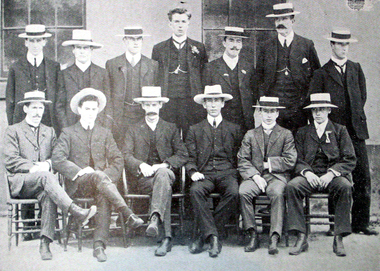
... Association Committee and Officers, 1905 Standing left to right: W. Pearce, T. Williams, S. Hepburn, Seward, W. Figgis, J.R. Reid, P. Elliott Sitting left to right: P.A. Pratt, N. Buley, John Sutherland, H.R Murphy, J. Inglis, R. Nevett 1906 Excursion to Broken Hill, The Artistic Printing Process, Hints on Portraiture, Arizona, Cornish...Association Committee and Officers, 1905 Standing left to right: W. Pearce, T. Williams, S. Hepburn, Seward, W. Figgis, J.R. Reid, P. Elliott Sitting left to right: P.A. Pratt, N. Buley, John Sutherland, H.R Murphy, J. Inglis, R. Nevett 1906 Excursion to Broken Hill, The Artistic Printing Process, Hints on Portraiture, Arizona, Cornish ...The Ballarat School of Mines is a predecessor institution of Federation University Ausgtralia.Five copies of the Ballarat School of Mines Students' Magazine bound in a blue hard cover and quart bound in calf. 1902 - Retirement of Herbert L. Krause 1905 - Mt Lyall Ore Deposits Images: Ballarat School of Mines Sports Association Committee and Officers, 1905 Standing left to right: W. Pearce, T. Williams, S. Hepburn, Seward, W. Figgis, J.R. Reid, P. Elliott Sitting left to right: P.A. Pratt, N. Buley, John Sutherland, H.R Murphy, J. Inglis, R. Nevett 1906 Excursion to Broken Hill, The Artistic Printing Process, Hints on Portraiture, Arizona, Cornish Mining Images Ballarat School of Mines and AusImm at the Central Mine, Broken Hill; At Iron Knob, Brown Boveri Turbo Generator at Block 10, Junction Mine plant or Potter Process, Broken Hill Propriety Mill, Carlyon's Hotel, Sam Jamieson, Electrical Labortory, Ballarat School of Mines Rowing Eight, Sports Committee,ballarat school of mines, magazines, sports committee, thomas williams, mount lyell, w. pearce, t. williams, s. hepburn, seward, w. figgis, j.r. reid, p. elliott, p.a. pratt, n. buley, john sutherland, h.r murphy, j. inglis, r. nevett, herbert l. krause, broken hill, artistic printing process, hints on portraiture, arizona, cornish mining, ausimm at the central mine, broken hill, iron knob, brown boveri turbo generator at block 10, junction mine plant or potter process, broken hill propriety mill, carlyon's hotel, sam jamieson, electrical labortory, ballarat school of mines rowing eight, sports committee,, rowing on lake wendouree, boat shed, h. valentine, l. seward, c. macgennis, d. don, m. gaunt, h. owne, l. nott, s. leathes, j.a. reid, h.r. murphy, alfred mica smith, r. hosking, zeehan, moonta, wallaroo, smelting silver, south africa, south australia excursion, sunnyside woollen mills, tasmanian excursion, swedish iron, mt jukes excurson, western australian gold ore, wynne-grant furnace, bhp sintering slimes, leggo furnace, mine ventilation, mount morgan mine, mount pani ltd, new zealand coal, adelaide school of mines, students' association, at iron knob, ausimm, excursions, visits, south australian excursion -
 The Beechworth Burke Museum
Audio - Oral History, Jennifer Williams, Dr Roy Phillips, 8th October 2000 (exact date unclear)
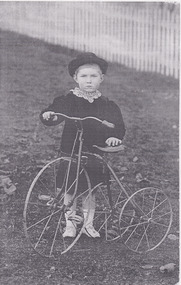
... Association...Hotels...Twentieth Century...Coronation of King George IV...Echo Point...The Echo...Tippany Cat...Marbles...Children's games...Cornish...Beechworth Yackandandah Wangaratta mining dredging 1910s 1920s 1930s Chinese community Typhoid Lake Kerferd Reminiscences Memories Childhood Lake Sambell Alcoholism New Year Celebrations Transport Horses Foresters Lodge Oddfellows Lodge Funeral Practices Child-rearing practices Star Hotel The Rock Racism Chinese Dragon Benevolent Society Star Lane Coach Building Factory Outdoor concerts Gold Jimmy Ingram Kelly Gang Kelly Family Churches Catholic Methodist Protestant Anglican Confuscionist Buddhism Women's Christian Temperance Association Hotels Twentieth Century Coronation of King George IV Echo Point The Echo Tippany Cat Marbles Children's games Cornish Cornwall Listen to what they say oral history Dr Roy Phillips / This is a digital copy of a recording that was originally captured on a cassette tape. ...Roy Phillips was born in 1907 in Yackandandah and moved with his family to Beechworth when he was five years old. His father was involved in dredging operations at Lake Sambell but his parents also had other family living in Beechworth, with whom they lived. Dr Phillips tells vivid stories about life in Beechworth in the first half of the Twentieth Century, from the daily lives of young children of the time to the town's relationship to the local Chinese community. He discusses features of the landscape such as 'The Rock' at which community concerts were held and 'The Echo' (an echo-sounding point over a nearby gully) which he states are no longer used in the same way. He also discusses changing community attitudes to various issues, for example, 'not being coddled' as a child but living in a town with very strict rules about people of different religions mingling. This oral history recording was part of a project conducted by Jennifer Williams in the year 2000 to capture the everyday life and struggles in Beechworth during the twentieth century. This project involved recording seventy oral histories on cassette tapes of local Beechworth residents which were then published in a book titled: Listen to what they say: voices of twentieth century Beechworth. These cassette tapes were digitised in July 2021 with funds made available by the Friends of the Burke.Dr Roy Phillips' account of his life in Beechworth in the early part of the 20th Century is historically and socially significant to the cultural heritage of the region. He describes town life from a child's point of view during a time of transition to life after the Gold Rush era, including social tensions existing between cultural groups such as the Chinese community and European-heritage townspeople and between people of different religious groups in Beechworth. This oral history account is socially and historically significant as it is a part of a broader collection of interviews conducted by Jennifer Williams which were published in the book 'Listen to what they say: voices of twentieth-century Beechworth.' While the township of Beechworth is known for its history as a gold rush town, these accounts provide a unique insight into the day-to-day life of the town's residents during the 20th century, many of which will have now been lost if they had not been preserved.This is a digital copy of a recording that was originally captured on a cassette tape. The cassette tape is black with a horizontal white strip and is currently stored in a clear flat plastic rectangular container. It holds up 40 minutes of recordings on each side.Dr Roy Phillips /beechworth, yackandandah, wangaratta, mining, dredging, 1910s, 1920s, 1930s, chinese community, typhoid, lake kerferd, reminiscences, memories, childhood, lake sambell, alcoholism, new year celebrations, transport, horses, foresters lodge, oddfellows lodge, funeral practices, child-rearing practices, star hotel, the rock, racism, chinese dragon, benevolent society, star lane coach building factory, outdoor concerts, gold, jimmy ingram, kelly gang, kelly family, churches, catholic, methodist, protestant, anglican, confuscionist, buddhism, women's christian temperance association, hotels, twentieth century, coronation of king george iv, echo point, the echo, tippany cat, marbles, children's games, cornish, cornwall, listen to what they say, oral history -
 Federation University Historical Collection
Book, Ballarat School of Mines Principal's Reports,1923-1934, 1923-1934
... cornish...w.h. steane...l. hillman...l. vernon...kalgoorlie excursion...james peart...e.a. brophy...n.g. king...r. young...j.m. sutherland...woolclassing...yallourn...v. dorron...ballarat school of mines literary society...w. hollway...s. palmer...albert street...j.r. elsworth...ballarat school of mines caretaker...e. watson...j.r. pounds...m.s. kewkins...battery...m.g. rumpff...j. eldridge...eureka progress association...ballarat school of mines a. f. heseltine dick richards r.w. richards j.p. chard j. tung g.l. nicholls arc lamp telephone mechnics class l.a. archibald visits associated smelters iron knob arbor day w.h. finlayson ethel campbell repatriation xray x-ray plumbing alfred bayley w. knight mica smith scholarship w.h. findlayson herald shield j.d. o'laughlin e. schache brown and sharp micrometer h.r murphy a. cornish w.h. steane l. hillman l. vernon kalgoorlie excursion james peart e.a. brophy n.g. king r. young j.m. sutherland woolclassing yallourn v. dorron ballarat school of mines literary society w. hollway s. palmer albert street j.r. elsworth ballarat school of mines caretaker e. watson j.r. pounds m.s. kewkins battery m.g. rumpff j. eldridge eureka progress association cyanide plant dismantle materia medica t. henderson w.s. rackham m. dean new guinea goldfields gala day Red hard covered book with hand written reports by A.F. ...Red hard covered book with hand written reports by A.F. Heseltine. 23 February 1922 - Sickness of Dick Richards 18 August 1926 - Mrs Weston, sister of Alfred Mica Smith, donates photos of the professor.ballarat school of mines, a. f. heseltine, dick richards, r.w. richards, j.p. chard, j. tung, g.l. nicholls, arc lamp, telephone mechnics class, l.a. archibald, visits, associated smelters, iron knob, arbor day, w.h. finlayson, ethel campbell, repatriation, xray, x-ray, plumbing, alfred bayley, w. knight, mica smith scholarship, w.h. findlayson, herald shield, j.d. o'laughlin, e. schache, brown and sharp micrometer, h.r murphy, a. cornish, w.h. steane, l. hillman, l. vernon, kalgoorlie excursion, james peart, e.a. brophy, n.g. king, r. young, j.m. sutherland, woolclassing, yallourn, v. dorron, ballarat school of mines literary society, w. hollway, s. palmer, albert street, j.r. elsworth, ballarat school of mines caretaker, e. watson, j.r. pounds, m.s. kewkins, battery, m.g. rumpff, j. eldridge, eureka progress association, cyanide plant dismantle, materia medica, t. henderson, w.s. rackham, m. dean, new guinea goldfields, gala day -
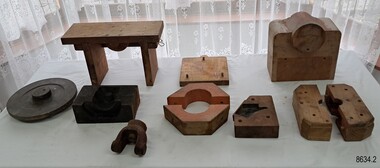 Flagstaff Hill Maritime Museum and Village
Equipment - Foundry Patterns set, Briggs Brass Foundry, 1912-1972
... Cornish chimney, presented as a working model. This chimney visually demonstrated the process of smelting metal in furnaces and pouring it into sand moulds. Constructed from specially curved bricks, the chimney now stands at about two-thirds of its original height, having been relocated from the Grassmere Cheese factory. The hand-cast sand patterns hold considerable significance due to their association ...The wooden pattern forms part of a larger collection; some of them were secured within a durable wooden crate. The cast pattern was an essential tool at Briggs Brass Foundry, specifically designed for creating sand casts. Sand casting is a time-honoured technique, with a history exceeding 2,000 years. The handcrafted nature of this process produces brass and copper alloy items particularly suitable for maritime applications. Typical products include bells, boat hooks, cowls, propellers, handles, lids, rowlocks, hooks, letters, bolts, rail holders, brackets, deck plates, flanges, rudder guides, portholes and covers. The distinctive bronze mixture used at Briggs’ Foundry is copper based. It is composed of local ingots of copper, tin, zinc and lead, blended in precisely measured quantities. The resulting alloy is non-ferrous, known for its exceptional durability and longevity. HISTORY OF BRIGGS MARINE: The Briggs Brass Foundry, trading as Briggs & Son Foundry, was established in 1912 by Herbert Harrison Briggs (1863-1931) with his son George Edward Briggs. In 1922, the youngest son, Cyril Falkiner McKinnon Briggs, joined the foundry. After Herbert died in 1931, his sons George and Cyril ran the foundry. The business became known as Briggs Marine Foundry, the “non-ferrous founders” and “bell specialists”. The foundry products were made using the traditional sand-casting method, which is now over two thousand years old and is becoming a dying art. The foundry operated at 70 Wellington St, Collingwood, and specialised in casting ship bells and other marine equipment and fittings. It also made decorative items such as miniature ship propellers. The great-granddaughter of Herbert Briggs inherited a Briggs brass bell, similar to one at Flagstaff Hill Maritime Village. In 1965, Cyril was the only remaining family member involved in Briggs Marine Products. The firm relocated to Chesterville Rd, Moorabbin and Cyril went into partnership with Frank Lee. In the same year, the firm exhibited its products at the 1965 Boat Show. When Cyril passed away in 1967, Frank took over the business with two new partners. After Frank Lee died in 1971, the foundry was run by his son and daughter-in-law, Les and Eva Lee. Briggs Marine still exists today, but the Briggs family is no longer involved. Briggs Foundry had a community-minded retail branch in Warrnambool, selling cast boat fittings and equipment to fishermen and others in the regional marine industry. The branch closed in 1972. In Flagstaff Hill’s formative years, 1972-1975, many Briggs Marine brassware products were generously donated from its Melbourne foundry, along with casting patterns, tools, machinery and a cupboard. EXHIBITION and LEGACY: The donated items were displayed in a simulated Brass Foundry within the Village, where visitors could view them and gain insight into the foundering and metalwork trades that supported maritime industries, including shipwrights and boatbuilders. The castings produced at the foundry were also vital for farmers, manufacturers and other local industries. This exhibit was part of a broader showcase of working crafts, trades and services typical of a Maritime town. The display was available to the public from the completion of the building in 1986 until 1994, when the space was repurposed. It is believed that Briggs Marine’s family members gave personal assistance in setting up the displays in the original village shops, particularly the ‘Brass Foundry’ building. A notable feature of the Village Brass Foundry was the historic Cornish chimney, presented as a working model. This chimney visually demonstrated the process of smelting metal in furnaces and pouring it into sand moulds. Constructed from specially curved bricks, the chimney now stands at about two-thirds of its original height, having been relocated from the Grassmere Cheese factory. The hand-cast sand patterns hold considerable significance due to their association with Briggs Brass Founders, a firm established in the early 20th century and widely recognised for its expertise in producing, repairing, and restoring ship bells and marine equipment. Known for their specialisation in non-ferrous metal casting, Briggs Brass Founders supplied high-quality fittings and equipment for maritime use. The company extended its operations by opening a branch in Warrnambool, where it actively supported the local community. The foundry’s ability to cast essential products was important to local and regional industries, like fishing, farming, manufacturing and commercial businesses. Through its presence, its reputation was reinforced as both a skilled manufacturer and a community-minded enterprise. The foundry is notably associated with the Schomberg Bell at Flagstaff Hill, having restored this small, historic bell to its original condition. The Schomberg Bell is a fine example from a luxury migrant vessel dating back to the mid-19th century, reflecting the craftsmanship and heritage preserved by Briggs Brass Foundry. Wooden rectangular crate with removable wooden lid. Inside is a set of wooden patterns of various shapes and sizes for making sand moulds in a metal foundry. The crate is made from thick wooden planks nailed together. The extended wooden struts on the long sides form a frame to hold the wooden lid. A pair of metal handles is at each short end of the crate, fixed with strong metal bolts. Between each pair of handles is an inscription stamped into the wood. The underside of the crate has red paint splashes. There are insect holes in the wood, but no active infestation. The patterns were made and used at Briggs Brass Foundry in Melbourne.Stamped: "H.33 / II" (H may be N or a square B)flagstaff hill maritime museum and village, great ocean road, shipwreck coast, pattern, mould, foundry, brass foundry, metal foundry, crate, box, wooden container, briggs, traditional method, trade, sand cast, cast, brass alloy, copper alloy, marine equipment, marine tools, marine fittings, briggs' bronze, copper tin zinc lead, non-corrosive, briggs family, brassware, metalware, foundering, metalwork, maritime, casting, cornish chimney, curved bricks, grassmere cheese factory, 1912, herbert harrison briggs, h h briggs, george edward briggs, briggs & son foundry, collingwood, cyril falkiner mckinnon briggs, cyril briggs, h h briggs & sons foundry, bell founders, schomberg bell, alliance casting & engineering solutions, collingwood foundry, ship chandlers, marine products, flagstaff hill, warrnambool, maritime museum, maritime village, briggs & son brass foundry, briggs marine, moorabbin, briggs brass foundry, briggs marine foundry, briggs marine products, frank lee, les lee, eva lee, briggs marine warrnambool, non-ferrous founders, bell specialists, ship bell specialists, founders, metalworking, traditional sand casting, casting pattern, foundry pattern -
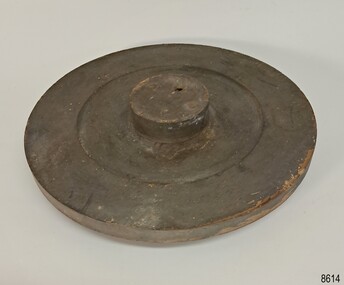 Flagstaff Hill Maritime Museum and Village
Equipment - Pattern, Briggs Brass Foundry, 1912-1972
... Cornish chimney, presented as a working model. This chimney visually demonstrated the process of smelting metal in furnaces and pouring it into sand moulds. Constructed from specially curved bricks, the chimney now stands at about two-thirds of its original height, having been relocated from the Grassmere Cheese factory. The hand-cast sand patterns hold considerable significance due to their association ...The wooden pattern forms part of a larger collection; some of them were secured within a durable wooden crate. The cast pattern was an essential tool at Briggs Brass Foundry, specifically designed for creating sand casts. Sand casting is a time-honoured technique, with a history exceeding 2,000 years. The handcrafted nature of this process produces brass and copper alloy items particularly suitable for maritime applications. Typical products include bells, boat hooks, cowls, propellers, handles, lids, rowlocks, hooks, letters, bolts, rail holders, brackets, deck plates, flanges, rudder guides, portholes and covers. The distinctive bronze mixture used at Briggs’ Foundry is copper based. It is composed of local ingots of copper, tin, zinc and lead, blended in precisely measured quantities. The resulting alloy is non-ferrous, known for its exceptional durability and longevity. HISTORY OF BRIGGS MARINE: The Briggs Brass Foundry, trading as Briggs & Son Foundry, was established in 1912 by Herbert Harrison Briggs (1863-1931) with his son George Edward Briggs. In 1922, the youngest son, Cyril Falkiner McKinnon Briggs, joined the foundry. After Herbert died in 1931, his sons George and Cyril ran the foundry. The business became known as Briggs Marine Foundry, the “non-ferrous founders” and “bell specialists”. The foundry products were made using the traditional sand-casting method, which is now over two thousand years old and is becoming a dying art. The foundry operated at 70 Wellington St, Collingwood, and specialised in casting ship bells and other marine equipment and fittings. It also made decorative items such as miniature ship propellers. The great-granddaughter of Herbert Briggs inherited a Briggs brass bell, similar to one at Flagstaff Hill Maritime Village. In 1965, Cyril was the only remaining family member involved in Briggs Marine Products. The firm relocated to Chesterville Rd, Moorabbin and Cyril went into partnership with Frank Lee. In the same year, the firm exhibited its products at the 1965 Boat Show. When Cyril passed away in 1967, Frank took over the business with two new partners. After Frank Lee died in 1971, the foundry was run by his son and daughter-in-law, Les and Eva Lee. Briggs Marine still exists today, but the Briggs family is no longer involved. Briggs Foundry had a community-minded retail branch in Warrnambool, selling cast boat fittings and equipment to fishermen and others in the regional marine industry. The branch closed in 1972. In Flagstaff Hill’s formative years, 1972-1975, many Briggs Marine brassware products were generously donated from its Melbourne foundry, along with casting patterns, tools, machinery and a cupboard. EXHIBITION and LEGACY: The donated items were displayed in a simulated Brass Foundry within the Village, where visitors could view them and gain insight into the foundering and metalwork trades that supported maritime industries, including shipwrights and boatbuilders. The castings produced at the foundry were also vital for farmers, manufacturers and other local industries. This exhibit was part of a broader showcase of working crafts, trades and services typical of a Maritime town. The display was available to the public from the completion of the building in 1986 until 1994, when the space was repurposed. It is believed that Briggs Marine’s family members gave personal assistance in setting up the displays in the original village shops, particularly the ‘Brass Foundry’ building. A notable feature of the Village Brass Foundry was the historic Cornish chimney, presented as a working model. This chimney visually demonstrated the process of smelting metal in furnaces and pouring it into sand moulds. Constructed from specially curved bricks, the chimney now stands at about two-thirds of its original height, having been relocated from the Grassmere Cheese factory. The hand-cast sand patterns hold considerable significance due to their association with Briggs Brass Founders, a firm established in the early 20th century and widely recognised for its expertise in producing, repairing, and restoring ship bells and marine equipment. Known for their specialisation in non-ferrous metal casting, Briggs Brass Founders supplied high-quality fittings and equipment for maritime use. The company extended its operations by opening a branch in Warrnambool, where it actively supported the local community. The foundry’s ability to cast essential products was important to local and regional industries, like fishing, farming, manufacturing and commercial businesses. Through its presence, its reputation was reinforced as both a skilled manufacturer and a community-minded enterprise. The foundry is notably associated with the Schomberg Bell at Flagstaff Hill, having restored this small, historic bell to its original condition. The Schomberg Bell is a fine example from a luxury migrant vessel dating back to the mid-19th century, reflecting the craftsmanship and heritage preserved by Briggs Brass Foundry. Pattern; round wooden shape with a wide concave centre and a round flat handle in the middle, painted dark brown. The underside has a large wooden disc added to the centre. The pattern is part of a set of foundry patterns from Briggs Brass Foundry.flagstaff hill, flagstaff hill maritime museum and village, warrnambool, maritime museum, maritime village, great ocean road, shipwreck coast, briggs' bronze, traditional method, trade, sand cast, cast, brass alloy, copper alloy, pattern, mould, foundry, brass foundry, metal foundry, casting, sand mould, sand casting, marine equipment, marine tools, marine fittings, copper tin zinc lead, non-ferrous, non-corrosive, brassware, metalware, foundering, metalwork, maritime, bell founders, ship chandlers, marine products, biggs, briggs family, herbert harrison briggs, h h briggs, george edward briggs, cyril falkiner mckinnon briggs, cyril briggs, briggs & son brass foundry, h h briggs & sons foundry, briggs marine, alliance casting & engineering solutions, grassmere cheese factory, cornish chimney, curved bricks, collingwood, moorabbin, collingwood foundry, moorabbin foundry, 1912, briggs, briggs brass foundry, briggs marine foundry, briggs marine products, frank lee, les lee, eva lee, briggs marine warrnambool, non-ferrous founders, bell specialists, ship bell specialists, founders, metalworking, traditional sand casting, casting pattern, foundry pattern -
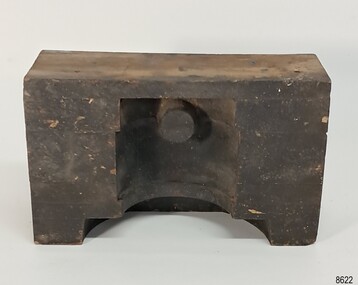 Flagstaff Hill Maritime Museum and Village
Equipment - Pattern, Briggs Brass Foundry, 1912-1972
... Cornish chimney, presented as a working model. This chimney visually demonstrated the process of smelting metal in furnaces and pouring it into sand moulds. Constructed from specially curved bricks, the chimney now stands at about two-thirds of its original height, having been relocated from the Grassmere Cheese factory. The hand-cast sand patterns hold considerable significance due to their association ...The wooden pattern forms part of a larger collection; some of them were secured within a durable wooden crate. The cast pattern was an essential tool at Briggs Brass Foundry, specifically designed for creating sand casts. Sand casting is a time-honoured technique, with a history exceeding 2,000 years. The handcrafted nature of this process produces brass and copper alloy items particularly suitable for maritime applications. Typical products include bells, boat hooks, cowls, propellers, handles, lids, rowlocks, hooks, letters, bolts, rail holders, brackets, deck plates, flanges, rudder guides, portholes and covers. The distinctive bronze mixture used at Briggs’ Foundry is copper based. It is composed of local ingots of copper, tin, zinc and lead, blended in precisely measured quantities. The resulting alloy is non-ferrous, known for its exceptional durability and longevity. HISTORY OF BRIGGS MARINE: The Briggs Brass Foundry, trading as Briggs & Son Foundry, was established in 1912 by Herbert Harrison Briggs (1863-1931) with his son George Edward Briggs. In 1922, the youngest son, Cyril Falkiner McKinnon Briggs, joined the foundry. After Herbert died in 1931, his sons George and Cyril ran the foundry. The business became known as Briggs Marine Foundry, the “non-ferrous founders” and “bell specialists”. The foundry products were made using the traditional sand-casting method, which is now over two thousand years old and is becoming a dying art. The foundry operated at 70 Wellington St, Collingwood, and specialised in casting ship bells and other marine equipment and fittings. It also made decorative items such as miniature ship propellers. The great-granddaughter of Herbert Briggs inherited a Briggs brass bell, similar to one at Flagstaff Hill Maritime Village. In 1965, Cyril was the only remaining family member involved in Briggs Marine Products. The firm relocated to Chesterville Rd, Moorabbin and Cyril went into partnership with Frank Lee. In the same year, the firm exhibited its products at the 1965 Boat Show. When Cyril passed away in 1967, Frank took over the business with two new partners. After Frank Lee died in 1971, the foundry was run by his son and daughter-in-law, Les and Eva Lee. Briggs Marine still exists today, but the Briggs family is no longer involved. Briggs Foundry had a community-minded retail branch in Warrnambool, selling cast boat fittings and equipment to fishermen and others in the regional marine industry. The branch closed in 1972. In Flagstaff Hill’s formative years, 1972-1975, many Briggs Marine brassware products were generously donated from its Melbourne foundry, along with casting patterns, tools, machinery and a cupboard. EXHIBITION and LEGACY: The donated items were displayed in a simulated Brass Foundry within the Village, where visitors could view them and gain insight into the foundering and metalwork trades that supported maritime industries, including shipwrights and boatbuilders. The castings produced at the foundry were also vital for farmers, manufacturers and other local industries. This exhibit was part of a broader showcase of working crafts, trades and services typical of a Maritime town. The display was available to the public from the completion of the building in 1986 until 1994, when the space was repurposed. It is believed that Briggs Marine’s family members gave personal assistance in setting up the displays in the original village shops, particularly the ‘Brass Foundry’ building. A notable feature of the Village Brass Foundry was the historic Cornish chimney, presented as a working model. This chimney visually demonstrated the process of smelting metal in furnaces and pouring it into sand moulds. Constructed from specially curved bricks, the chimney now stands at about two-thirds of its original height, having been relocated from the Grassmere Cheese factory. The hand-cast sand patterns hold considerable significance due to their association with Briggs Brass Founders, a firm established in the early 20th century and widely recognised for its expertise in producing, repairing, and restoring ship bells and marine equipment. Known for their specialisation in non-ferrous metal casting, Briggs Brass Founders supplied high-quality fittings and equipment for maritime use. The company extended its operations by opening a branch in Warrnambool, where it actively supported the local community. The foundry’s ability to cast essential products was important to local and regional industries, like fishing, farming, manufacturing and commercial businesses. Through its presence, its reputation was reinforced as both a skilled manufacturer and a community-minded enterprise. The foundry is notably associated with the Schomberg Bell at Flagstaff Hill, having restored this small, historic bell to its original condition. The Schomberg Bell is a fine example from a luxury migrant vessel dating back to the mid-19th century, reflecting the craftsmanship and heritage preserved by Briggs Brass Foundry. Pattern; rectangular wooden block made from laminated sections of wood painted black. A half-cylinder shape was carved into the long side, and a dowel shape was placed at the lower side. The pattern is part of a set of foundry patterns from Briggs Brass Foundry.flagstaff hill, flagstaff hill maritime museum and village, warrnambool, maritime museum, maritime village, great ocean road, shipwreck coast, briggs' bronze, traditional method, trade, sand cast, cast, brass alloy, copper alloy, pattern, mould, foundry, brass foundry, metal foundry, casting, sand mould, sand casting, marine equipment, marine tools, marine fittings, copper tin zinc lead, non-ferrous, non-corrosive, brassware, metalware, foundering, metalwork, maritime, bell founders, ship chandlers, marine products, biggs, briggs family, herbert harrison briggs, h h briggs, george edward briggs, cyril falkiner mckinnon briggs, cyril briggs, briggs & son brass foundry, h h briggs & sons foundry, briggs marine, alliance casting & engineering solutions, grassmere cheese factory, cornish chimney, curved bricks, collingwood, moorabbin, collingwood foundry, moorabbin foundry, 1912, briggs, briggs brass foundry, briggs marine foundry, briggs marine products, frank lee, les lee, eva lee, briggs marine warrnambool, non-ferrous founders, bell specialists, ship bell specialists, founders, metalworking, traditional sand casting, casting pattern, foundry pattern -
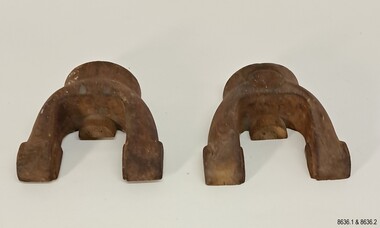 Flagstaff Hill Maritime Museum and Village
Equipment - Pattern, Briggs Brass Foundry, 1912-1972
... Cornish chimney, presented as a working model. This chimney visually demonstrated the process of smelting metal in furnaces and pouring it into sand moulds. Constructed from specially curved bricks, the chimney now stands at about two-thirds of its original height, having been relocated from the Grassmere Cheese factory. The hand-cast sand patterns hold considerable significance due to their association ...The wooden pattern forms part of a larger collection; some of them were secured within a durable wooden crate. The cast pattern was an essential tool at Briggs Brass Foundry, specifically designed for creating sand casts. Sand casting is a time-honoured technique, with a history exceeding 2,000 years. The handcrafted nature of this process produces brass and copper alloy items particularly suitable for maritime applications. Typical products include bells, boat hooks, cowls, propellers, handles, lids, rowlocks, hooks, letters, bolts, rail holders, brackets, deck plates, flanges, rudder guides, portholes and covers. The distinctive bronze mixture used at Briggs’ Foundry is copper based. It is composed of local ingots of copper, tin, zinc and lead, blended in precisely measured quantities. The resulting alloy is non-ferrous, known for its exceptional durability and longevity. HISTORY OF BRIGGS MARINE: The Briggs Brass Foundry, trading as Briggs & Son Foundry, was established in 1912 by Herbert Harrison Briggs (1863-1931) with his son George Edward Briggs. In 1922, the youngest son, Cyril Falkiner McKinnon Briggs, joined the foundry. After Herbert died in 1931, his sons George and Cyril ran the foundry. The business became known as Briggs Marine Foundry, the “non-ferrous founders” and “bell specialists”. The foundry products were made using the traditional sand-casting method, which is now over two thousand years old and is becoming a dying art. The foundry operated at 70 Wellington St, Collingwood, and specialised in casting ship bells and other marine equipment and fittings. It also made decorative items such as miniature ship propellers. The great-granddaughter of Herbert Briggs inherited a Briggs brass bell, similar to one at Flagstaff Hill Maritime Village. In 1965, Cyril was the only remaining family member involved in Briggs Marine Products. The firm relocated to Chesterville Rd, Moorabbin and Cyril went into partnership with Frank Lee. In the same year, the firm exhibited its products at the 1965 Boat Show. When Cyril passed away in 1967, Frank took over the business with two new partners. After Frank Lee died in 1971, the foundry was run by his son and daughter-in-law, Les and Eva Lee. Briggs Marine still exists today, but the Briggs family is no longer involved. Briggs Foundry had a community-minded retail branch in Warrnambool, selling cast boat fittings and equipment to fishermen and others in the regional marine industry. The branch closed in 1972. In Flagstaff Hill’s formative years, 1972-1975, many Briggs Marine brassware products were generously donated from its Melbourne foundry, along with casting patterns, tools, machinery and a cupboard. EXHIBITION and LEGACY: The donated items were displayed in a simulated Brass Foundry within the Village, where visitors could view them and gain insight into the foundering and metalwork trades that supported maritime industries, including shipwrights and boatbuilders. The castings produced at the foundry were also vital for farmers, manufacturers and other local industries. This exhibit was part of a broader showcase of working crafts, trades and services typical of a Maritime town. The display was available to the public from the completion of the building in 1986 until 1994, when the space was repurposed. It is believed that Briggs Marine’s family members gave personal assistance in setting up the displays in the original village shops, particularly the ‘Brass Foundry’ building. A notable feature of the Village Brass Foundry was the historic Cornish chimney, presented as a working model. This chimney visually demonstrated the process of smelting metal in furnaces and pouring it into sand moulds. Constructed from specially curved bricks, the chimney now stands at about two-thirds of its original height, having been relocated from the Grassmere Cheese factory. The hand-cast sand patterns hold considerable significance due to their association with Briggs Brass Founders, a firm established in the early 20th century and widely recognised for its expertise in producing, repairing, and restoring ship bells and marine equipment. Known for their specialisation in non-ferrous metal casting, Briggs Brass Founders supplied high-quality fittings and equipment for maritime use. The company extended its operations by opening a branch in Warrnambool, where it actively supported the local community. The foundry’s ability to cast essential products was important to local and regional industries, like fishing, farming, manufacturing and commercial businesses. Through its presence, its reputation was reinforced as both a skilled manufacturer and a community-minded enterprise. The foundry is notably associated with the Schomberg Bell at Flagstaff Hill, having restored this small, historic bell to its original condition. The Schomberg Bell is a fine example from a luxury migrant vessel dating back to the mid-19th century, reflecting the craftsmanship and heritage preserved by Briggs Brass Foundry Pattern: pair of U-shaped carved blocks, unpainted. The blocks have opposing metal pins and holes to hold them together. One block has a disc shape carved into the base. The pattern is part of a set of foundry patterns from Briggs Brass Foundry.flagstaff hill, flagstaff hill maritime museum and village, warrnambool, maritime museum, maritime village, great ocean road, shipwreck coast, briggs' bronze, traditional method, trade, sand cast, cast, brass alloy, copper alloy, pattern, mould, foundry, brass foundry, metal foundry, casting, sand mould, sand casting, marine equipment, marine tools, marine fittings, copper tin zinc lead, non-ferrous, non-corrosive, brassware, metalware, foundering, metalwork, maritime, bell founders, ship chandlers, marine products, biggs, briggs family, herbert harrison briggs, h h briggs, george edward briggs, cyril falkiner mckinnon briggs, cyril briggs, briggs & son brass foundry, h h briggs & sons foundry, briggs marine, alliance casting & engineering solutions, grassmere cheese factory, cornish chimney, curved bricks, collingwood, moorabbin, collingwood foundry, moorabbin foundry, 1912, briggs, briggs brass foundry, briggs marine foundry, briggs marine products, frank lee, les lee, eva lee, briggs marine warrnambool, non-ferrous founders, bell specialists, ship bell specialists, founders, metalworking, traditional sand casting, casting pattern, foundry pattern -
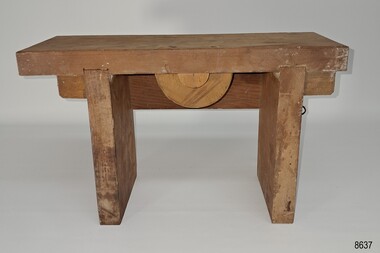 Flagstaff Hill Maritime Museum and Village
Equipment - Pattern, Briggs Brass Foundry, 1912-1972
... Cornish chimney, presented as a working model. This chimney visually demonstrated the process of smelting metal in furnaces and pouring it into sand moulds. Constructed from specially curved bricks, the chimney now stands at about two-thirds of its original height, having been relocated from the Grassmere Cheese factory. The hand-cast sand patterns hold considerable significance due to their association ...The wooden pattern forms part of a larger collection; some of them were secured within a durable wooden crate. The cast pattern was an essential tool at Briggs Brass Foundry, specifically designed for creating sand casts. Sand casting is a time-honoured technique, with a history exceeding 2,000 years. The handcrafted nature of this process produces brass and copper alloy items particularly suitable for maritime applications. Typical products include bells, boat hooks, cowls, propellers, handles, lids, rowlocks, hooks, letters, bolts, rail holders, brackets, deck plates, flanges, rudder guides, portholes and covers. The distinctive bronze mixture used at Briggs’ Foundry is copper based. It is composed of local ingots of copper, tin, zinc and lead, blended in precisely measured quantities. The resulting alloy is non-ferrous, known for its exceptional durability and longevity. HISTORY OF BRIGGS MARINE: The Briggs Brass Foundry, trading as Briggs & Son Foundry, was established in 1912 by Herbert Harrison Briggs (1863-1931) with his son George Edward Briggs. In 1922, the youngest son, Cyril Falkiner McKinnon Briggs, joined the foundry. After Herbert died in 1931, his sons George and Cyril ran the foundry. The business became known as Briggs Marine Foundry, the “non-ferrous founders” and “bell specialists”. The foundry products were made using the traditional sand-casting method, which is now over two thousand years old and is becoming a dying art. The foundry operated at 70 Wellington St, Collingwood, and specialised in casting ship bells and other marine equipment and fittings. It also made decorative items such as miniature ship propellers. The great-granddaughter of Herbert Briggs inherited a Briggs brass bell, similar to one at Flagstaff Hill Maritime Village. In 1965, Cyril was the only remaining family member involved in Briggs Marine Products. The firm relocated to Chesterville Rd, Moorabbin and Cyril went into partnership with Frank Lee. In the same year, the firm exhibited its products at the 1965 Boat Show. When Cyril passed away in 1967, Frank took over the business with two new partners. After Frank Lee died in 1971, the foundry was run by his son and daughter-in-law, Les and Eva Lee. Briggs Marine still exists today, but the Briggs family is no longer involved. Briggs Foundry had a community-minded retail branch in Warrnambool, selling cast boat fittings and equipment to fishermen and others in the regional marine industry. The branch closed in 1972. In Flagstaff Hill’s formative years, 1972-1975, many Briggs Marine brassware products were generously donated from its Melbourne foundry, along with casting patterns, tools, machinery and a cupboard. EXHIBITION and LEGACY: The donated items were displayed in a simulated Brass Foundry within the Village, where visitors could view them and gain insight into the foundering and metalwork trades that supported maritime industries, including shipwrights and boatbuilders. The castings produced at the foundry were also vital for farmers, manufacturers and other local industries. This exhibit was part of a broader showcase of working crafts, trades and services typical of a Maritime town. The display was available to the public from the completion of the building in 1986 until 1994, when the space was repurposed. It is believed that Briggs Marine’s family members gave personal assistance in setting up the displays in the original village shops, particularly the ‘Brass Foundry’ building. A notable feature of the Village Brass Foundry was the historic Cornish chimney, presented as a working model. This chimney visually demonstrated the process of smelting metal in furnaces and pouring it into sand moulds. Constructed from specially curved bricks, the chimney now stands at about two-thirds of its original height, having been relocated from the Grassmere Cheese factory. The hand-cast sand patterns hold considerable significance due to their association with Briggs Brass Founders, a firm established in the early 20th century and widely recognised for its expertise in producing, repairing, and restoring ship bells and marine equipment. Known for their specialisation in non-ferrous metal casting, Briggs Brass Founders supplied high-quality fittings and equipment for maritime use. The company extended its operations by opening a branch in Warrnambool, where it actively supported the local community. The foundry’s ability to cast essential products was important to local and regional industries, like fishing, farming, manufacturing and commercial businesses. Through its presence, its reputation was reinforced as both a skilled manufacturer and a community-minded enterprise. The foundry is notably associated with the Schomberg Bell at Flagstaff Hill, having restored this small, historic bell to its original condition. The Schomberg Bell is a fine example from a luxury migrant vessel dating back to the mid-19th century, reflecting the craftsmanship and heritage preserved by Briggs Brass Foundry. Pattern; an unpainted, rectangular wooden frame with a top and sides, similar to a small rectangular stool. A solid half-cylinder shape was added under the horizontal 'seat' with another smaller half-cylinder attached to it, end-to-end. A string is tied between two metal loops attached to the back. There are two X marks stamped into the back. The pattern is part of a set of foundry patterns from Briggs Brass Foundry.Stamped: "X" "X"flagstaff hill, flagstaff hill maritime museum and village, warrnambool, maritime museum, maritime village, great ocean road, shipwreck coast, briggs' bronze, traditional method, trade, sand cast, cast, brass alloy, copper alloy, pattern, mould, foundry, brass foundry, metal foundry, casting, sand mould, sand casting, marine equipment, marine tools, marine fittings, copper tin zinc lead, non-ferrous, non-corrosive, brassware, metalware, foundering, metalwork, maritime, bell founders, ship chandlers, marine products, biggs, briggs family, herbert harrison briggs, h h briggs, george edward briggs, cyril falkiner mckinnon briggs, cyril briggs, briggs & son brass foundry, h h briggs & sons foundry, briggs marine, alliance casting & engineering solutions, grassmere cheese factory, cornish chimney, curved bricks, collingwood, moorabbin, collingwood foundry, moorabbin foundry, 1912, briggs, briggs brass foundry, briggs marine foundry, briggs marine products, frank lee, les lee, eva lee, briggs marine warrnambool, non-ferrous founders, bell specialists, ship bell specialists, founders, metalworking, traditional sand casting, casting pattern, foundry pattern
