
Showing 256 items matching " theatre design"
-
 Alfred Hospital Nurses League - Nursing History Collection
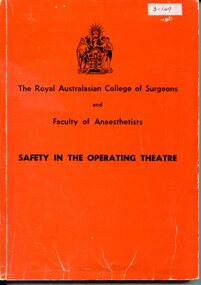
Book - Seminar book, The Royal Australasian College of Surgeons, Safety in the operating theatre - Submissions from woking parties for discussion at seminar, 1971
... ...Operating theatre design...The book contains submissions from working parties for discussion at the Royal Australasian College of Surgeons anf Faculty Of Anaesthetists second seminar on 'Safety in the operating theatre, held on September 30-October 1, 1971 Alfred hospital staff were members of the working parties, and attended the seminar Theatre staffing and resposibilities Patient handlling Operating theatre design anaesthetic equipment apsesis in the operating theatre Previous catalogue number handwrritten [black ink] on small rectangular white sticker at top right of front cover. ...The book contains submissions from working parties for discussion at the Royal Australasian College of Surgeons anf Faculty Of Anaesthetists second seminar on 'Safety in the operating theatre, held on September 30-October 1, 1971Alfred hospital staff were members of the working parties, and attended the seminarIllustrated paperback book, red cover with black print detailing producer and abreviated title under the coat of arms of the Royal Australian College of Surgeons. Also includes a 6 page typed document - final draft of resolutions for session 9.Previous catalogue number handwrritten [black ink] on small rectangular white sticker at top right of front cover. At base of right cover is a rectangular white sticker is a handwritten note [blue ink] detailing the fact that Patti Weeks and Audrey Morwick hd atteneded the seminar and also contributed to the publication, particulary Chapter 5, he theatr sisters section,Nummerous annotations throughouttheatre staffing and resposibilities, patient handlling, operating theatre design, anaesthetic equipment, apsesis in the operating theatre -
 Alfred Hospital Nurses League - Nursing History Collection
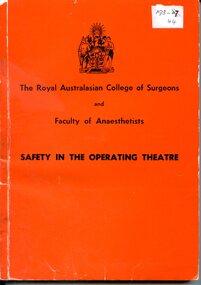
Book - Seminar book, The Royal Australasian College of Surgeons, Safety in the operating theatre - Submissions from woking parties for discussion at seminar, 1971
... ...Operating theatre design...The book contains submissions from working parties for discussion at the Royal Australasian College of Surgeons anf Faculty Of Anaesthetists second seminar on 'Safety in the operating theatre, held on September 30-October 1, 1971 Alfred hospital staff were members of the working parties, and attended the seminar Theatre staffing and resposibilities Patient handlling Operating theatre design anaesthetic equipment apsesis in the operating theatre Previous catalogue number handwrritten [black ink] on small rectangular white sticker at top right of front cover. ...The book contains submissions from working parties for discussion at the Royal Australasian College of Surgeons anf Faculty Of Anaesthetists second seminar on 'Safety in the operating theatre, held on September 30-October 1, 1971Alfred hospital staff were members of the working parties, and attended the seminarIllustrated paperback book, red cover with black print detailing producer and abreviated title under the coat of arms of the Royal Australian College of Surgeons. Also includes a 6 page typed document - final draft of resolutions for session 9.Previous catalogue number handwrritten [black ink] on small rectangular white sticker at top right of front cover. theatre staffing and resposibilities, patient handlling, operating theatre design, anaesthetic equipment, apsesis in the operating theatre -
 Women's Art Register
Archive (Collection) - Philippa O'Brien Artist Archive
... ... Theatre Design...1941- Painting Drawing Theatre Design Archive Philippa O'Brien Artist Archive ...painting, drawing, theatre designpainting, drawing, theatre design -
Women's Art Register
Archive (Collection) - Janet Dawson Artist Archive
... ... Theatre Design...1935- Abstraction Figurative Mixed Media Drawing Theatre Design Archive Janet Dawson Artist Archive ...abstraction, figurative, mixed media, drawing, theatre designabstraction, figurative, mixed media, drawing, theatre design -
Women's Art Register
Archive (Series) - Dawson, Janet. Artist File 1
... ... Theatre Design...Abstraction Figurative Mixed Media Drawing Theatre Design Foolscap white archival 4 flap folder or document wallet Archive Dawson, Janet. ...List of Images, CV, Biography, Newspaper Clippings, Catalogue, Promotional Material, Artwork Imagesabstraction, figurative, mixed media, drawing, theatre designabstraction, figurative, mixed media, drawing, theatre design -
Women's Art Register
Archive (Series) - O'Brien, Philippa. Artist File 1
... ... Theatre Design...Painting Drawing Theatre Design Foolscap white archival 4 flap folder or document wallet Archive O'Brien, Philippa. ...painting, drawing, theatre designpainting, drawing, theatre design -
Women's Art Register
Archive (Series) - Philippa O'Brien. Duplicate File 1
... ... Theatre Design...Painting Drawing Theatre Design Foolscap manilla file Archive Philippa O'Brien. ...painting, drawing, theatre designpainting, drawing, theatre design -
Women's Art Register
Archive (Series) - Janet Dawson. Duplicate File 1
... ... Theatre Design...Mixed Media Drawing Theatre Design Abstraction Figurative Foolscap manilla file Archive Janet Dawson. ...List of Images, CV, Biography, Newspaper Clippings, Catalogue, Promotional Material, Artwork Imagesmixed media, drawing, theatre design, abstraction, figurativemixed media, drawing, theatre design, abstraction, figurative -
Women's Art Register
Archive (Collection) - Frances Burke Artist Archive
... Design... Theatre...1904 -1994 Interior Design Theatre Colour Nature Flora & Fauna George Bell School Selwyn Chambers Burway Prints Morris Holloway Textiles Printmaking Linocut Silkscreen Home Furnishings Archive Frances Burke Artist Archive ...interior design, theatre, colour, nature, flora & fauna, george bell school, selwyn chambers, burway prints, morris holloway, textiles, printmaking, linocut, silkscreen, home furnishingsinterior design, theatre, colour, nature, flora & fauna, george bell school, selwyn chambers, burway prints, morris holloway, textiles, printmaking, linocut, silkscreen, home furnishings -
Women's Art Register
Archive (Series) - Burke, Frances. Artist File 1
... Design... Theatre...Interior Design Theatre Colour Nature Flora & Fauna George Bell School Selwyn Chambers Burway Prints Morris Holloway Textiles Printmaking Linocut Silkscreen Home Furnishings Foolscap white archival 4 flap folder or document wallet Archive Burke, Frances. ...Biography, Newspaper Clippings, Artwork Images, Articlesinterior design, theatre, colour, nature, flora & fauna, george bell school, selwyn chambers, burway prints, morris holloway, textiles, printmaking, linocut, silkscreen, home furnishingsinterior design, theatre, colour, nature, flora & fauna, george bell school, selwyn chambers, burway prints, morris holloway, textiles, printmaking, linocut, silkscreen, home furnishings -
Women's Art Register
Archive (Series) - Frances Burke. Duplicate File 1
... Design... Theatre...Textiles Printmaking Linocut Silkscreen Home Furnishings Interior Design Theatre Colour Nature Flora & Fauna George Bell School Selwyn Chambers Burway Prints Morris Holloway Foolscap manilla file Archive Frances Burke. ...Biography, Newspaper Clippings, Artwork Images, Articlestextiles, printmaking, linocut, silkscreen, home furnishings, interior design, theatre, colour, nature, flora & fauna, george bell school, selwyn chambers, burway prints, morris hollowaytextiles, printmaking, linocut, silkscreen, home furnishings, interior design, theatre, colour, nature, flora & fauna, george bell school, selwyn chambers, burway prints, morris holloway -
 Bendigo Historical Society Inc.
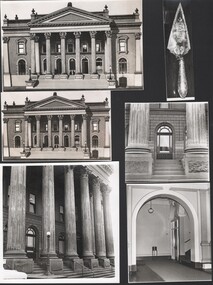
Photograph - National Trust Collection: Masonic Hall, View Street (now Capital Theatre)
... National Trust Collection: Masonic Hall (now Capital Theatre) designed by Vahland Six B&W photographs, includes two sketches of View Street facade Three negatives of select photos 3084.97a large sketch of View Street facade of Masonic Hall 3084.97b small sketch of View Street facade of Masonic Hall 3084.97c B&W photo of six columns at entry to the Hall 3084.97d B&W photo of facade column and steps 3084.97e B&W photo of internal lobby 3084.97f B&W photo of masonic silver trowel Three negatives (3084.97 a & b, c and f) ...historic building Bendigo Masonic Hall (Capital Theatre) National Trust Collection: Masonic Hall (now Capital Theatre) designed by Vahland Six B&W photographs, includes two sketches of View Street facade Three negatives of select photos 3084.97a large sketch of View Street facade of Masonic Hall 3084.97b small sketch of View Street facade of Masonic Hall 3084.97c B&W photo of six columns at entry to the Hall 3084.97d B&W photo of facade column and steps 3084.97e B&W photo of internal lobby 3084.97f B&W photo of masonic silver trowel Three negatives (3084.97 a & b, c and f) Photograph National Trust Collection: Masonic Hall, View Street (now Capital Theatre) ...historic buildingNational Trust Collection: Masonic Hall (now Capital Theatre) designed by Vahland Six B&W photographs, includes two sketches of View Street facade Three negatives of select photos 3084.97a large sketch of View Street facade of Masonic Hall 3084.97b small sketch of View Street facade of Masonic Hall 3084.97c B&W photo of six columns at entry to the Hall 3084.97d B&W photo of facade column and steps 3084.97e B&W photo of internal lobby 3084.97f B&W photo of masonic silver trowel Three negatives (3084.97 a & b, c and f) bendigo masonic hall (capital theatre) -
 Ballarat Heritage Services
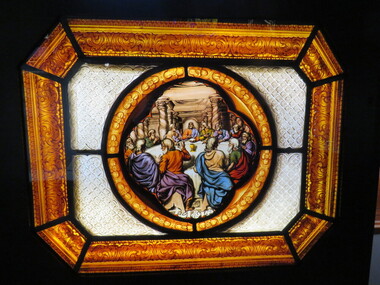
Photograph - Digital photograph, Victoria and Albert Museum, London, 2016, 09/2016
... The Museum holds many of the UK's national collections and houses some of the greatest resources for the study of architecture, furniture, fashion, textiles, photography, sculpture, painting, jewellery, glass, ceramics, book arts, Asian art and design, theatre and performance. https://www.vam.ac.uk/info/about-us...The Museum holds many of the UK's national collections and houses some of the greatest resources for the study of architecture, furniture, fashion, textiles, photography, sculpture, painting, jewellery, glass, ceramics, book arts, Asian art and design, theatre and performance. https://www.vam.ac.uk/info/about-us Victoria and Albert Museum window interior Stained Glass window Digital photographs of a stained glass window at the Victoria And Albert Museum, London Victoria and Albert Museum, London, 2016 Photograph Digital photograph ...The V&A is the world’s leading museum of art and design, housing a permanent collection of over 2.3 million objects that span over 5,000 years of human creativity. The Museum holds many of the UK's national collections and houses some of the greatest resources for the study of architecture, furniture, fashion, textiles, photography, sculpture, painting, jewellery, glass, ceramics, book arts, Asian art and design, theatre and performance. https://www.vam.ac.uk/info/about-usDigital photographs of a stained glass window at the Victoria And Albert Museum, Londonvictoria and albert museum, window, interior, stained glass window -
 Bendigo Historical Society Inc.
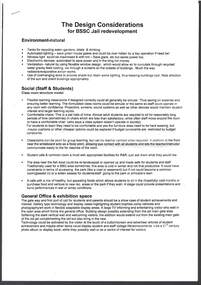
Document - Digital, BENDIGO JAIL DEVELOPMENT
... Design Considerations for BSSC Jail redevelopment'. Outlines environment, class room structure models, general office & exhibition space, lecture theatre, overall buildings, design consistency, and learning area requirements....Design Considerations for BSSC Jail redevelopment'. Outlines environment, class room structure models, general office & exhibition space, lecture theatre, overall buildings, design consistency, and learning area requirements. ...Photocopy undated article from Australian Conservation Foundation re Bendigo Jail, together with undated Design Considerations for development of BSSC jail redevelopment. 1. Article by Brian Morley outlines history of the jail, Ronald Ryan's execution in 1967, and petitions against capital punishment. 2. Three page stapled A4 sheets, undated unknown authority document titled 'The Design Considerations for BSSC Jail redevelopment'. Outlines environment, class room structure models, general office & exhibition space, lecture theatre, overall buildings, design consistency, and learning area requirements.bendigo, institutions, bendigo jail -
 Eltham District Historical Society Inc
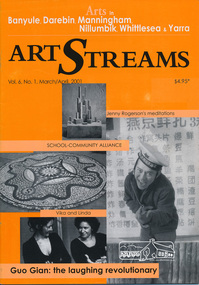
Journal, Peter Doughtery, ArtStreams: Arts in Banyule, Darebin, Manningham, Nillumbik, Whittlesea & Yarra; Vol. 6, No. 1, Mar-Apr 2001, 2001
... Vol. 6, No. 1, Mar-Apr 2001 CONTENTS Vika & Linda Between Family and Fame 3 Eltham History in Ceramics A school Community cooperation 6 Exposing the beauty of clay International Pottery Market in Warrandyte 8 Were Street Hill Climb Banyule's Boutique Festival 11 Between Swirl and Solid Jenny Rodgerson's Meditations on lndeterminacy 12 Guo Gian and Anthony Pryor at HeideMOMA A laughing pointer and a craftsman sculptor 14 Dandenong Ranges Folk Festival The Hills Were Alive 16 Book Review Penelope Hobhouse's Flower & Garden Design 18 Theatre Review Kathy Oliver visits La Mama 19 Australian Classical Music Elizabeth Scarlett 20 New faces The Arts Administration Shuffle 22 Bolin Bolin Billabong Cultural Precinct and Walking Trail 24 CD Reviews 26 Artin About 28 Wining & Dining 30 Art Services and Teaching 32 ...Vol. 6, No. 1, Mar-Apr 2001 CONTENTS Vika & Linda Between Family and Fame 3 Eltham History in Ceramics A school Community cooperation 6 Exposing the beauty of clay International Pottery Market in Warrandyte 8 Were Street Hill Climb Banyule's Boutique Festival 11 Between Swirl and Solid Jenny Rodgerson's Meditations on lndeterminacy 12 Guo Gian and Anthony Pryor at HeideMOMA A laughing pointer and a craftsman sculptor 14 Dandenong Ranges Folk Festival The Hills Were Alive 16 Book Review Penelope Hobhouse's Flower & Garden Design 18 Theatre Review Kathy Oliver visits La Mama 19 Australian Classical Music Elizabeth Scarlett 20 New faces The Arts Administration Shuffle 22 Bolin Bolin Billabong Cultural Precinct and Walking Trail 24 CD Reviews 26 Artin About 28 Wining & Dining 30 Art Services and Teaching 32 "Peter Dougherty has been involved in the local art scene for many years. ...Vol. 6, No. 1, Mar-Apr 2001 CONTENTS Vika & Linda Between Family and Fame 3 Eltham History in Ceramics A school Community cooperation 6 Exposing the beauty of clay International Pottery Market in Warrandyte 8 Were Street Hill Climb Banyule's Boutique Festival 11 Between Swirl and Solid Jenny Rodgerson's Meditations on lndeterminacy 12 Guo Gian and Anthony Pryor at HeideMOMA A laughing pointer and a craftsman sculptor 14 Dandenong Ranges Folk Festival The Hills Were Alive 16 Book Review Penelope Hobhouse's Flower & Garden Design 18 Theatre Review Kathy Oliver visits La Mama 19 Australian Classical Music Elizabeth Scarlett 20 New faces The Arts Administration Shuffle 22 Bolin Bolin Billabong Cultural Precinct and Walking Trail 24 CD Reviews 26 Artin About 28 Wining & Dining 30 Art Services and Teaching 32 "Peter Dougherty has been involved in the local art scene for many years. As publisher and editor of the arts magazine Artstreams, his comments on the various branches of the arts are widely respected. His "The Arts" column in the Diamond Valley Leader presents a brief summary for a much wider cross section of the local community. Peter also operates his own gallery and the Artstreams Cafe at the St Andrews market. Peter has a wealth of knowledge about present day and historical aspects of local art and artists." - Eltham District Historical Society Newsletter No. 161, March 2005Colour front and back cover with feature articles and literary pieces with photographs and advertisements printed in black and white. 36 pages, 30 cm. Vol. 1, no. 1 (Nov. 1996) - Vol. 10, no. 5 (summer ed. 2005/06) art streams, banyule festival, vika and linda, willy wonka's ice cream gourmet food, eltham high school, arts science courtyard project, plenty views golf park, jane annois, nillumbik festival of the arts, bahnhof cafe, dynamic vegies, were st food store, were street hill climb, walkers wheels, jenny rodgerson, claire renkin, heide museum of modern art, guo jian, anthony pryor, dandenong ranges folk festival, kinglake galley, bulleen art & garden, montsalvat, rachel hanrahan, fran silvester, helen baker, katrina phillips-rank, old bakery cottage, bolin bolin billabong, eltham wiregrass gallery, thompsons pharmacy, st andrews market, heide museum of modern art -
 Flagstaff Hill Maritime Museum and Village
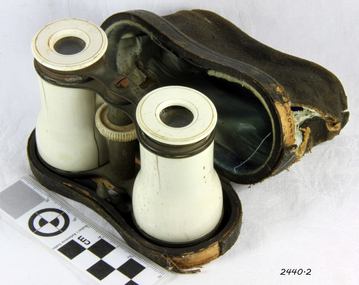
Opera Glasses & case, Early 20th Century
... After this development, opera glasses and theatre binoculars grew in popularity because of the superior view they facilitated in opera and theatre houses. The beautiful design of the glasses themselves also added appeal to the opera-going crowd. ...After this development, opera glasses and theatre binoculars grew in popularity because of the superior view they facilitated in opera and theatre houses. The beautiful design of the glasses themselves also added appeal to the opera-going crowd. ...Opera Glasses came into existence as a result of a long line of inventions, and further improvements upon those inventions. The process started in the year 1608 when a Dutch optician by the name of Hans Lipperhey developed the first pair of binoculars with a magnification capability of X3. Less than a year later, a well-known inventor and philosopher by the name of Galileo developed what became known as the Galilean telescope. Advertisements were first found for opera glasses and theatre binoculars in London as early as 1730 in the form of a long collapsible telescope. The "Opera Glass" as it was referred to; was often covered in enamel, gems, ivory, or other art and paintings. For almost 100 years opera glasses existed merely as telescopes. In Vienna, in 1823 the first binocular opera glasses and theatre binoculars began to appear. They were two simple Galilean telescopes with a bridge in the centre, each telescope focused independently from the other by extending or shortening the telescope until the desired focus was achieved, which was useful, yet very cumbersome. Two years later in Paris, Pierre Lemiere improved on this design and created a centre focus wheel. This allowed the focusing of both telescopes together. After this development, opera glasses and theatre binoculars grew in popularity because of the superior view they facilitated in opera and theatre houses. The beautiful design of the glasses themselves also added appeal to the opera-going crowd. By the 1850's opera glasses and theatre, glasses had become a must-have fashion accessory for all opera and theatergoers.Not very significant as not associated with a historic event or person and made during the first half of the 20th Century and many are still available and easily sourced.Vintage Pair of Opera Glasses, with cow bone barrels and eyepieces, both barrel pieces have split in them, both metal end barrels each have a minor dent, optics are pretty clear no mould although have very minor dust spots inside, they look like they were gilded at some point but most of this has rubbed off glasses have a black leather case with blue lining. No markings whatsoever anywhereflagstaff hill, warrnambool, shipwrecked coast, flagstaff hill maritime museum, maritime museum, shipwreck coast, flagstaff hill maritime village, great ocean road, binoculars, opera glasses, theatre glasses, optical instrument, cow bone -
 Flagstaff Hill Maritime Museum and Village
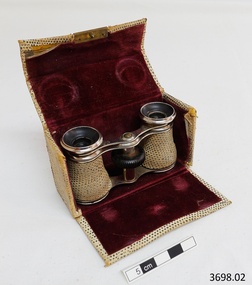
Functional object - Opera Glasses, 1920s
... After this development, opera glasses and theatre binoculars grew in popularity because of the superior view they facilitated in opera and theatre houses. The beautiful design of the glasses themselves also added appeal to the opera-going crowd. ...After this development, opera glasses and theatre binoculars grew in popularity because of the superior view they facilitated in opera and theatre houses. The beautiful design of the glasses themselves also added appeal to the opera-going crowd. ...Opera Glasses came into existence as a result of a long line of inventions, and further improvements upon those inventions. The process started in the year 1608 when a Dutch optician by the name of Hans Lipperhey developed the first pair of binoculars with a magnification capability of X3. Less than a year later, a well-known inventor and philosopher by the name of Galileo developed what became known as the Galilean telescope. Advertisements were first found for opera glasses and theatre binoculars in London as early as 1730 in the form of a long collapsible telescope. The "Opera Glass" as it was referred to; was often covered in enamel, gems, ivory, or other art and paintings. For almost 100 years opera glasses existed merely as telescopes. In Vienna, in 1823 the first binocular opera glasses and theatre binoculars began to appear. They were two simple Galilean telescopes with a bridge in the centre, each telescope focused independently from the other by extending or shortening the telescope until the desired focus was achieved, which was useful, yet very cumbersome. Two years later in Paris, Pierre Lemiere improved on this design and created a centre focus wheel. This allowed the focusing of both telescopes together. After this development, opera glasses and theatre binoculars grew in popularity because of the superior view they facilitated in opera and theatre houses. The beautiful design of the glasses themselves also added appeal to the opera-going crowd. By the 1850's opera glasses and theatre, glasses had become a must-have fashion accessory for all opera and theatregoers. A vintage pair of 1920s opera glasses probably made in France by an unknown maker the item is significant due to it's provenance that can be traced and it's completeness as a useful social item and fashion accessory used by theatergoers from the mid 19th century and well into the 20th century. Some people still use modern variants of theater glasses today to improve their enjoyment of the theater.Both glasses and case are covered with black and white snake skin. Case lined with purple velvet, and has brass closure clip.Noneflagstaff hill, warrnambool, shipwrecked coast, flagstaff hill maritime museum, maritime museum, flagstaff hill maritime village, great ocean road, opera glasses, serpentine opera glasses, binoculars, accessories, optical instrument, scientific instrument, theater glasses, french opera glasses, hans lipperhey -
 Federation University Historical Collection
Book - Copies of newspaper articles, Ballarat Academy of Performing Arts Press Releases 1997, 1997
... Ballarat Academy of Performing Arts - New lecturers 1997: Lecturer in Design and theatre crafts - Damian Muller; lecturer in production and stage management - Leonard Bauska; and lecturer in theatre technology - Matthew Heenan. ...Ballarat Academy of Performing Arts - New lecturers 1997: Lecturer in Design and theatre crafts - Damian Muller; lecturer in production and stage management - Leonard Bauska; and lecturer in theatre technology - Matthew Heenan. ...Reports published in The Courier newspaper of performances by Ballarat Academy of Performing Arts, including items naming students past and present of the University of Ballarat during 1997 plus articles of people and events connected to the Arts Academy. Also contains information about Ballarat University courses for performing arts. Articles are mostly from the Ballarat Courier newspaper in chronology year (1997) order with no page numbers. Two items are from December 1996 and three articles in October 2001. PRODUCTIONS : *' Pericles' performed by Ballarat's Ozact Theatre Company at Port Fairy's Battery Point. *'Maelstrom' written by Chris Dickens and directed by Peter Tulloch performed by BAPA third year students.(Oct. 28th - Nov 1st) Some cast members were: James McLaverty, Melissa Casey, Linda Judd, Angela Coad, Sarah Griffin, Kathy Lucas, Melissa Casey, Laura Hill, Grant Hickey, Jamie Robertson, Jon Catanzariti, Steve Kerr, Jeff Parker Natalie Zappulla. Performed at Ballarat University Studio Theatre (Nov 4th -8th) and also at Melbourne's CUB Malthouse (Nov. 25th-29th) *"7 Deadly" directed by Chris Dickens and performed in The Chapel at the Academy's Victoria Street campus by 1st year Ballarat University students. Some cast members were: Ash Abdou, Niniane Le Page, Alex Meerbach, Adam Davies and Elicia Bolger. *"Sounds of Broadway and Off' (Oct 9th - 11th) directed and choreographed by Judith Roberts and performed at the Studio Theatre , University of Ballarat, by 1st year students of Musical Theatre at BAPA. Some cast members were Paul Thomas, Shannon Palmer, Aakash Andrews, Justine Schnellbeck, Erica Chestnut,, Rebecca McGuinness, Matthew Heyward, Kellie Rode. Tickets cost $5.00 *'Bewitched" "a parody of the original television series" directed and produced by Ballarat performing arts graduates Adam Turnbull and Claire O'Sullivan. Most of the cast and crew were graduates from the University of Ballarat. Some cast members were: Katherine Evans as Samantha and Martin Cole as Darren. Simon Buckle was responsible for his original music, songs and special effects. *Concert: Featuring pianist Slavomir Zumis and cellist Robert Ekselman (Oct. 3rd) *"Charley's Aunt" by Brandon Thomas, performed by 2nd year Ballarat Academy of the Arts 2nd Year Company at The Venue Studio Theatre, University of Ballarat (Sept. 23rd-27th). Cast members: Derren Jackson, Ross Larkin, Kevin Dee, Adelle Gregory, Colette Bruggeman, Luke Doxey, Gavin Fenech, Dennis Marinovic, Nadia Andary, Narelle Werner. Cost: Adults $10, Concession $7.50, Bookings at Majestix. *'The Importance of Being Ernest' (by Oscar Wilde), performed by second year theatre company of the University of Ballarat, directed by Maureen Edwards, designed by Andrew Arney. Cast members included Narrell Werner as Gwendolen, Tim Haymes as Jack, Mark Gambino as Algermon, Adelle Gregory as Cecily and Heather Kent as Lady Bracknell. The production was at the Studio Theatre, University of Ballarat, September 16th-20th , 8pm. Ticket costs: $10 Adult, $7.50 Pensioners/students. Double bill tickets for The Importance of Being Ernest and Charley's Aunt (Sept.23-27) costs: $15 Adults,$10 Concession. *"The Man From Muckinupin' (by Dorothy Hewett), directed by Chris Dickens and performed by University of Ballarat 3rd Year Performing Arts at Studio Theatre, University of Ballarat from Aug 26th - Aug 30th 1997. Cast members: Lisa Judd as Polly, James McLaverty as Jack, Jamie Robertson, Natalia Rose, Steven Kerr, Jon Catanzariti, Melissa Casey, Grant Hickey, Sarah Griffin, Laura Hill, Kathy Lucas, Angela Coad, and Jeff Parker. Ticket costs: $10 Adults, $7.50 Concession from MajesTix *'The Inspector' (by John Cousins) director Bruce Widdop, performed by the Third Year Graduating Company, University of Ballarat, Ballarat Academy of Performing Arts; at Studio Theatre, University of Ballarat, Aug 19th-23rd, 1997. Cast: Jamie Robertson as the mayor, Jeff Parker as the supposed government inspector, Grant Hickey as Sidney, Melissa Carey as Rose, and Sarah Griffin as Rose's daughter, Laura Hill as the postmaster and Linda Judd as the headmistress. Some 1st year students had cameo roles - Adam Parsons and Adam Davies. *'Cosi' directed by Andrew Seeary and performed by Theatre Movement at the Grainery Lane Theatre, Doveton Street, Balarat. The story has a young, nervous director Lewis, played by Brett Edginton, arrive in a mental home to produce a play with the inmates. Other cast members are Karl Hatton (Roy), Miranda Crellin (Cherry), Rob MacLeod (Henry), Ray Craven (Zac), Narrell Werner (Julie), Nadia Andary (Ruth), Mark Gambino (Doug), Elizabet Stewart and Michael Cooper (Lewis' unsympathetic friends) and Bob House (the Social Worker). Nadia, Mark and Narelle are Ballarat University performing arts students. Season: July 24th,25th 26th and 31st and August 1st and 2nd, 1997. Tickets at the door or through Majestix. Cost: Adults $16; Concession $11. Reviewer: Barry Breen, a Ballarat author, poet and performance artist. *'New Works' involves two plays - 'The Inside Out', director Melissa Casey and 'Secrets'. director Jeff Parker, presented by Ballarat Academy of Performing Arts Third Year Company, both written and directed by third year students. All production areas handled by students of BAPA. Cast members: 'The Inside Out' - Jamie Robertson, Laura Hill. 'Secrets' - Sarah Griffin, Linda Jude, Steven Kerr, Angela Coad, Natalie Zappulla. Staged at University of Ballarat's Studio Theatre. Bookings MajesTix - $10 or $7.5 *Euripide's, 'The Bacchae', a tale of revenge, directed by Bruce Widdop and performed by 2nd year students from the University of Ballarat Performing Arts Department and the BAPA. Assistant directors' Tim Haymes and Derren Jackson. Cast members: Richard DiGregorio (Dionysus), Chris Stipic (Cadmus), Colette Brugman (Agaue), Denis Marinovic (Pentheus), Mark Gambino (Teiresias) and Ross Larkin as the messenger. Other supporting performers are Luke Doxey, Brendan Mayne, Heather Kent, Kevin Dee, Gavin Fenech, Nadia Andary, Karissa Clarke, Adelle Gregory and Narrell Werner. The play was performed at the Studio Theatre, Ballarat University, June 3rd-6th, 1997.Tickets MajesTix or at the door - $10 Adult, $7.50 Concession. *'Back to the Tivoli' School of Performing Arts - June 10th -14th. Venue: Academy of Performing Arts, Victoria Street, 8pm *Aristophane's 'Lysistrata', an anti-war comedy. Performed by first year drama students from the University of Ballarat and BAPA at the Studio Theatre, University of Ballarat, Mount Helen, on May 27th-30th, 1997. Cast members: Niniane Le Page (Lysistrata), Fiona Russell (Calonice), Anne Winter (Myhrrine), Dominic Phelan (Cinesias), Alex Meerbach (Stratyllis), Michael Rafferty (Leader), Melissa Lowndes (Lampito), Renee Francis (Ismenia), Kathryn Martin (Corinthian), Geoffrey Spink (doorman), Adam Parsons (magistrate), Adrian Dart (policeman), David Kambouris (policeman two), Max Grarock (negotiator), Phol Crompton (ambassador) and Ross Farrell (herald). Male chorus members: Paul Thomas, Adam Davies, Ashraf Abdou, Karan Khanna. Female chorus members: Lauren Oliver, Suzie, Lewis and Lindy Kerr. Tickets MajesTix - $10 Adults, $7.50 Concession; or $12 special double bill price including The Bacchae. *Roger Woodward Recital - a piano recital by the internationally acclaimed Australian pianist to launch the Ballarat Academy of the Arts asset drive. He performed on the University's historic Erard Grand Concert piano on stage in Founders Hall, describing it as "absolutely amazing.' The instrument was 93 years old and hadn't been played for more than eighty years. An audience of 500 were entertained with pieces by Schubert and Bach for the first half of the program and Waltzes, Mazurkas, and Polonaises by Chopin after the interval. Fittingly an encore of the Minuet in G by Paderewski was played on the very piano the composer had brought from England for his Australian tour in 1906. *'The Merry Wives of Windsor' by William Shakespeare; directed by Beth Child; designer Damian Muller; Production by Third Year Graduating Company, University of Ballarat Performing Arts Department. This play is a comedy not performed very frequently. Cast members: Angela Coad (Mistress Page), Laura Hil (Mistress Quickly), Gavin Fenech (Falstaff), Kathy Lucus (Justice Shallow), Melissa Casey (Mistress Ford), Jeff Parker (Mr Ford), Jamie Robertson ( Mr Page) and Karrissa Clarke (Simple). Staged at the Studio Theatre, University of Ballarat, May 6th-10th 1997 at 8pm. Tickets $10. Concession $7.50. *"Ship of Fools" SMB Performing Arts. Grainery Lane Theatre, 9th-10th May 1997 Cast members: Chris Lytas (Mac & Convinso), Kate Edwards (Mayor & Rachel), Ruth Sheridan (numerous characters) *'Lola Montez - The Musical' author Alan Burke; director Peter Tulloch; choreographer Fred Fargher; designer Damian Muller, musical director Graeme Vendy. Performed by twenty-eight second year Performing Arts students with Nadia Andary in the lead role of Lola,, Grant Hickey as Henry Seekamp the Ballarat Times editor who receives a whipping from Lola for his criticism of her. Tim Haymes is the character Smith, Karissa Clarke plays nurse Jane Oliver and Ross Larkin plays soldier Daniel Brady. Other cast members were Luke Doxey, Richard Di Gregorio, Chris Stipic and Brendan Mayne. A feature of the show is Lola's celebrated Spider Dance which was acknowledged many years ago by the crowd throwing gold nuggets onto the stage. Presented by the Hugh Williamson Foundation in association with the Begonia Festival organizers the performance was at Her Majesty's Theatre, Ballarat nightly from 12th-15th March at 8pm with a matinee at 2pm on the 15th. Tickets at Majestic: Adult $18.50, Concession $13.50, Group Adult $15.50, Group Concession $10.50, Culture Vulture $12.00 Family $46 Season 97. *' 2001- 'On The Town' a musical comedy performed by graduating Ballarat Academy of Performing Arts and directed by course coordinator Kim Durban from the Victorian Theatre Company; and BAPA assistant production manager Jo Pearson. It features a cast of 30 and music from a 15 piece band. Photo depicts three cast members: Keith Miles, Adam Lubicz and Glenn Quinn. It was performed in America in 1944 and tells the story of three sailors who arrive in New York on 24-hour shore leave. It was performed at Founder's Hall, University of Ballarat, Mount Helen campus. Tickets $15 adults, $10 concession and $7 for children and students. Family tickets were available. Bookings MajesTix. *'Play With Your Food' a new theatre restaurant show performed by SMB Performing Arts students at Craig's Cellar, Lydiard Street, Ballarat. It was an original show devised and written by Second Year SMB Performing Arts students. following their sold-out touring show 'unplugged' and Book Week play 'SapceDust'. There are also articles about people involved with the University of Ballarat Performing Arts course and the courses in the Arts. Lady Lush's world of unusual characters presented jokes, songs, music whisked together into a bizarre story for audiences to enjoy and even be tie up. Cast members: Melissa Porritt, Loenne Whitecross, Jess Matthews, Kristie Glab and Julia McNamee. It was performed over five nights, 7th-8th-9th-15th and 16th November, 2001. Cost $20. NEWSPAPER ARTICLES: Directors for University of Ballarat 2nd Year Performing Arts Maureen Edwards (photo) An advertisement for BA Visual Arts - Studio Studies available for Ceramics / Drawing / Graphic Design / Print Making /Painting / Multi-Discipline - Undergraduate and Post Graduate Studies. Also for BA Performing Arts - Major Studies available: Performance Acting, Theatre Production, Performance Music Theatre. Ballarat Academy of Performing Arts - New lecturers 1997: Lecturer in Design and theatre crafts - Damian Muller; lecturer in production and stage management - Leonard Bauska; and lecturer in theatre technology - Matthew Heenan. Ballarat Academy of Performing Arts - 1 st article in 'The Flag' Alumni Newsletter, University of Ballarat, Issue June, 1997 re 1st intake of students in February, 1997. 2nd article 'Where Are They Now' - Amanda Sandwith. Event - 'Lydiard Street Alive' : firebreathing act 'David and Goliath' performed by David Patullo. Article with information (includes advertisment for course) about the 3 year performing arts degree at Ballarat consisting of performance acting, theatre production and performance music theatre which are part of Ballarat Academy of Performi8ng Arts which resources from three institutions - University of Ballarat, Australian Catholic University and the School of Mines. BAPA launch: Photos of some attendees - June 3rd 1997 Ballarat Courier. Performers featured Erica Chestnut and Sue-Ann Thomas. Amy Young - Up Close and Personal article - Ballarat Courier - Saturday June 14 1997. Amy Young was the director and conductress of Ballarat 'Y" Choir for 45 years. In 1996 she donated her husband's (Dr Keith Young) Steinway grand piano and musical collection to BAPA. This article is about her life. Events calendar for the Month of May, 1997. Peter Tulloch ( University of Ballarat Performing Arts Co-ordinator 1997) Newspaper article - interview by Elise Sullivan that appeared in The Ballarat Courier Saturday May 3rd 1997 Weekend Edition . Many articles on Roger Woodward and a $3 million asset drive for the Ballarat Academy of Performing Arts. Advertisement for 3 Arts positions at the University of Ballarat - Lecturers in Theatre for Movement/Dance; Design, Theory and Craft; and Theatre Technology Article: 'Who's Who at the Academy' - A list of First Year, Second Year, Third Year, Performing Arts Staff (University of Ballarat and Australian Catholic University). Article about the Erard Concert Grande piano and its acquisition by the University of Ballarat. There are several articles linked to the production of "Lola Montez the Musical' including: *Lola Montez's life in a timeline -1818 to 1861 compiled by Peter Freund, Her Majesty's Theatre historian on behalf of Ballarat Begonia Festival. * A radio show in 1952 performed by Ballarat's "Y" Drama Group featuring 16 year old Joy Brehaut as Lola Montez and directed by 3BA's Ted Furling *Ballarat's Most Famous Scandal Advertising Poster for Lola Montez *Lola Whips In * Lola to Tread the Boards Again * Lola to Return to Ballarat - The "Minister for Purity, The Reverend John Potter" - (actor Jamie Robertson) * Veteran Takes His First Look at Lola * First Stage Lola meets the New Lola - Nadia Andary meets 1967 Lola, Nancy Brauer. * Lola Returns Home An article listing the 12th Annual Encore Awards held at Ballarat Village on Wednesday 5th March 1997. * Advertisement for major studies available in 1998 -Theatre Performance; Music Theatre Performance and Theatre Production plus upcoming productions - Aug - The Inspector and The Man From Muckinup; Sept - The Importance of Being Ernest and Charley's Aunt; Oct- The London Blitz Show and They Shot Horses Don't They? Nov - Graduate Exhibition * Article 3/12/1996: Amy Young donates her husband Dr. W. H. Keith Young's Steinway grand piano and studio stacked with historic documents to the jointly run Performing Arts Academy following his death. The book consists of A4 paper sheets, heat bound with blue card front and back cover with a plastic overlay. The pages contain photocopied articles printed in the Ballarat Courier during 1997. Two articles are from December 1996.bapa, pericles, ozact theatre company, ozact, maelstrom, chris dickens, joan petering, peter tulloch, 7 deadly, ballarat academy of performing arts, bpca, ballarat college of performing arts, sounds of broadway and off, judith roberts, graeme vendy, bewitched, adam turnbull, claire o'sullivan, katherine evans, martin cole, simon buckle, charley's aunt, brandon thomas, derren jackson, ross larkin, kevin dee, adelle gregory, colette bruggeman, luke doxey, gavin fenech, dennis marinovic, nadia andary, narelle werner, the importance of being ernest, maureen edwards, andrew arney, tim haymes, mark gambino, heather kent, performing arts courses 1997, the man from muckinupin, dorothy hewett, chris dickins, linda judd, james mclaverty, jamie robertson, natalia rose, steven kerr, jon catanzariti, grant hickory, sarah griffin, laura hill, kathy lucas, angela coad, jeff parker, john cousins, bruce widdop, melissa carey, adam parsons, adam davies, damian muller, leonard bauska, matthew heenan, cosi, grainery lane theatre, andrew seeary, brett edginton, karl hatton, miranda crellin, rob macleod, ray craven, elizabeth stewart, michael cooper, bob house, barry breen, the flag, performing arts academy - ballarat, bert labont'e, lydiard stree alive, david and goliath, david patullo, amanda sandwith, bapa launch, erica chestnut, sue-ann thomas, amy young, dr keith young, ballarat "y" choir, the bacchae, richard digregorio, chris stipic, colette brugman, denis marinovic, brendan mayne, karissa clarke, narrell werner, niniane le page, fiona russell, anne winters, melissa lownds, renee francis, kathryn martin, michael rafferty, dominic phelan, geoffrey spink, paul thomas, ashraf abdou, karan khanna, alex meerbach, lauren oliver, suzie lewis, lindy kerr, adrian dart, david kambouris, max grarock, phil crompton, ross farrell, roger woodward, erard grand concert piano, karrissa clarke, beth child, chris lytas, kate edwards, ruth sheridan, ballarat academy of performing arts asset drive, positions - school of arts, erard concert grande piano, ignace paderewski, professor david james, david james, robert allen, bapa opening, gabrielle mcmullen, dr ron wild, graham clarke, michael faulkner, sacred heart convent of mercy ballarat, lola montez the musical, spider dance, lola montez, grant hickey, fred fargher, peter freund, ballarat begonia festival, nancy brauer, james robertson, jo pearson, on the town, keith miles, adam lubicz, glenn quinn, play with your food, melissa porritt, loenne whitecross, jess matthews, kristie glab, julia mcnamee, smb performing arts students, the london blitz show, they shoot horses don't they?, graduate exhibition -
 City of Melbourne Libraries
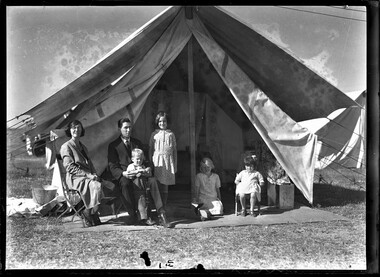
Photograph, Bull, Hugh Jones, 1897-1993, Seventh Day Adventists Camp at Hampton: E. Gane + family
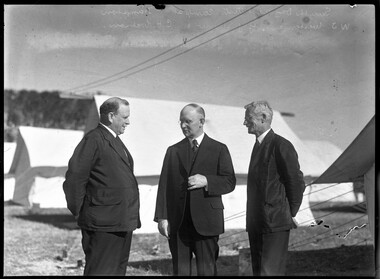
... by architect Cedric Heise Ballantyne, (also designed Regent Theatre, Plaza Ballroom, Athenaeum Club, National Theatre, St Kilda, built in 1930, demolished in 1974 for the City Square) It was managed by J. ... by architect Cedric Heise Ballantyne, (also designed Regent Theatre, Plaza Ballroom, Athenaeum Club, National Theatre, St Kilda, built in 1930, demolished in 1974 for the City Square) It was managed by J. ...Photographer notations on slide: Seventh Day Adventists Camp. E Gane + family Published: 28 December 1933 Published title: SEVENTH DAY ADVENTISTS. Published caption: “I. — The Annual Camp of the Seventh Day Adventists in Highett-road, Hampton, comprising more than 250 tents and accommodating over a thousand persons. II. —W. J. Westerman (vice-president of Australasian) and Pastor G. G. Stewart (president of Victoria), conversing with Pastor C. H. Watson (world president of the Seventh Day Adventists).- III.— Evangelist E. R. Gane and family.” SEVENTH DAY ADVENTISTS. (1933, December 28). The Age (Melbourne, Vic. : 1854 - 1954), p. 9. Retrieved August 1, 2025, from http://nla.gov.au/nla.news-article203356427 Research by project volunteer, Fiona Collyer: In December 1933, evangelist Mr E.R. Gane and his family gather outside their tent during the ten day Seventh Day Adventist Conference held in Highett Road, Hampton. Description: A woman, man and four small children sit and stand in front of a tent. One child plays with a toy train. In December 1933, delegates from all over Victoria and beyond travelled to Melbourne for the annual Seventh Day Adventists Conference of Victoria, held over ten days on a vacant allotment at Highett Road Hampton. A canvas town of 250 tents for over 1000 campers was created along with large marquees for lectures, devotional services and kitchens. Many daily visitors also attended the lectures and services. The principal speaker was Victorian born world president of the Seventh Day Adventists, Pastor Charles H. Watson (1877-1962), who travelled from Washington DC for the event. The Highett Street campers attended a busy schedule of bible readings, devotional services and health lectures during the ten days of the camp. Lecture subjects included- “Among the Head Hunters of the Solomon Islands”, “ Looking Through the Prophetic Telescope into 1934”, “Soul Surgery”, “Viewing the Celestial Land Through the Prophetic Telescope”and “The Four Horsemen of the Apocalypse”. The Seventh Day Adventist religion was established in the USA in 1863. One of its co-founders was American Ellen G. White whose writings are regarded as divinely inspired and are still adhered to today. Ellen preached on the “Eight Laws of Health”- Nutrition, exercise, water, sunshine, temperance, air, rest and trust in God. Adventists regard their bodies as holy temples and avoid food deemed by the Bible as unclean. They eat a mainly plant based diet with no caffeinated beverages and abstain from alcohol and tobacco. They believe in the observance of Saturday, the seventh day of the week in the Christian (Gregorian) and Hebrew calendars as the sabbath and the literal and imminent second coming of Jesus Christ. New converts are baptised by immersion in water. The Adventists opened the Warburton Sanitarium in 1910 as a health retreat, integrating their holistic health philosophy of physical, mental and spiritual well being. It was a resort in the hills “among picturesque mountain scenery…surrounded by tall forests and deep fern gullies…” where highly strung Melburians could alleviate their digestive maladies, stress and jaded nerves as “…worn down nervous systems mend quickly in this peaceful environment…invigorating air and an abundance of home-grown fruit, vegetables, fresh eggs, milk, and cream help to build healthy bodies”. The resort also offered hydrotherapy, massage and electrical treatments. An advertisement in The Argus- 1 December 1947 assured readers- “EVERYTHING SUNNY AGAIN." “That's how you'll feel when you say farewell to Warburton Sanitarium and Hospital after spending a holiday here. Victoria's Hydro is famous far and wide for wonders worked with sufferers from nervous and digestive disorders. Wholesome food, perfectly cooked; splendid air, regulated exercise, sweet natural sleep; these quickly correct faulty digestion, restore vitality, bring back that sunny optimism natural to healthy people. Massage and curative baths under medical supervision…” Later, after further building work, it became the Warburton Hospital with medical, casualty and obstetrics wards as well as offering strategies to stop smoking, lose weight and for stress management. The hospital ceased operation in 2001. Ellen G. White wrote “God sent me to Australia” and in 1891, accompanied by her son William C. White she arrived in Australia to start a Bible school, spread her health philosophy and for missionary work. At first health food products were imported from America, but it soon became apparent that due to the expense and the food becoming stale over the long journey, that local manufacturing was necessary. In 1898 William secured the services of American Adventist baker Edward C. Halsey, who had worked at Dr Kellogg’s Battle Creek (“Cereal City”), Sanitarium, Michigan, USA. They rented the St George’s bakery in Northcote, Melbourne, producing the first ready to eat breakfast cereal Granola, Caramel Cereal, and peanut butter. The fledgling company relocated to larger premises in Cooranbong, NSW soon after. The Sanitarium Health Food Company opened a factory in Warburton in 1925, manufacturing Granose Biscuits, Cerix Puffed Wheat, San-Bran, Bixies malted wheat flakes, Betta peanut butter, Marmite, “Kwic-Bru - A delicious health “coffee” made from choicest cereals and free from drugs that affect the heart and nerves” In 1928, Sanitarium bought out Grain Products Limited who were manufacturing a sweet cereal biscuit called Weet-Bix which soon became Australia’s favourite breakfast cereal. The Warburton factory closed in 1997, with manufacturing shifting interstate. Sanitarium breakfast cereal boxes offered free collectable cards inside and children could buy albums from grocers for sixpence and mount the cards. Subjects of the albums included- “Aboriginal Tribes, Legends, Customs”, “Australia- Yesterday and Today”, “Marvels of the Great Barrier Reef”, “Advance Australia- a Pageant of the Years”. In 1902 the Adventist’s opened the “Pure Food Vegetarian Cafe” in Sydney (In 1907 the name was changed to “Sanitarium Health Food Cafe”), Eating vegetarian food was definitely a curiosity. “Cristina” reviewed the cafe for The Australasian-27 October 1906. Topics For The Block. “Feeling somewhat like a criminal, and hoping to escape detection, I stealthily made my way into a vegetarian restaurant the other day... If my friends happened to catch me walking in there, I should henceforth be considered a crank, a faddist, and little short of a lunatic! Whom did I find within, seated with the air of habitués at the small tables, but heaps of my friends. They had all this while been pursuing their vegetarian way, layin' low and sayin' nuffin'. Flesh-eaters, now that the Sydney summer has set in apparently in good earnest, are beginning to wonder if the vegetarians are not wiser in their day and generation. Roast beef, hot cornea beef, ragouts, and meat curries, the very thought of them makes one feel hot. Frosted lemon pudding, stewed fruits, wheatmeal rolls, and tomatoes sound nice when you look at their names on the vegetarian menu. Such weird messes are served, square, unintelligible blocks of some brown substance, a few bites of which form a full and satisfying meal. Cold nut foods, granose, nuttose, and jam protose, bromose, with jelly and various "ose" sandwiches, impossible for the unbeliever to diagnose, are put before you. You drink malted nut broth, you eat gluten sticks, stewed beans, lentil patties, with vegetable sauce, any or all of which are distinctly nourishing and filling at the price. A mock (decidedly mock) veal cutlet or a red lentil roast is sufficient lunch, it appears, for anyone. Thus, "you obtain the best working results from your machinery with the least possible expenditure..." In December 1906 the Adventists branched out to Melbourne, opening the Sanitarium Health Food Cafe at 289 Collins Street next to the Royal Bank building. (corner Collins and Elizabeth Streets, demolished in 1939). Their motto was “Quality and Purity”. “Cynthia” of The Leader “Social Circle” column reviewed the cafe in 9 March 1907- “Hundreds of people have a feeling of positive affection for a diet that will be satisfying, appetising and nourishing, without having meat for its backbone. It will come as news that we have in Melbourne a cafe where you can really enjoy yourself without eating anything in the way of meat. Cream, custard, cheese and the like are not cold shouldered out of the menu, and the housewife in search of new dishes will find here ever so much in the way of suggestions. Nuts figure conspicuously in the menu, and lentil and walnut cutlets may be instanced among the delicacies. Beans are cooked in quite alluring fashion, while creamed parsnips are excellent. For sandwiches you could hardly desire anything more appetising than granosi biscuits, and nut cheese. The combination is suggestive of school lunches, and nut meat might well be employed as a variant. A visit to the cafe itself — it is next the Royal Bank in Collins-street — will surprise anyone used to the average vegetarian restaurant. Every thing is fresh, fragrant, and thoroughly modern… It is run, in connection with that curious people the Seventh Day Adventists.” However, “Adele” writing for the Evelyn Observer and Bourke East Record -13 December 1907 had a different experience- CITY RESTAURANTS. “There is no glamour from the outside. We enter the dining room at six and secure a seat at a small table, for this night we are going to dine on vegetables. Some people pride themselves on being vegetarians, and devote a great deal of their spare cash and energy to disseminating vegetarian principles. I shall not in a hurry forget the dinner we tried to get through at this vegetarian restaurant. There was put before us plate after plate of vegetables not soaked, but sodden with water, not an atom of flavouring or dressing; no attempt was made to give the slightest piquancy to potato, cabbage, turnip or carrot. I beg pardon, I am unjust, there were two caterpillars in the cabbage. It is astonishing how persistently ordinary cooks spoil vegetables in the process of cooking and how little they understand the value of vegetables on a menu.” From the extensive menu of 1924, you could order cream of green pea soup, followed by nut meat with Yorkshire pudding, egg timbales, stewed brown lentils, savoury rissoles with piquant sauce. Among the dessert offerings were creamed sago, steamed figs and walnut drops. Washed down with fermented wine and to finish, “Frucerea”, a coffee substitute essence made from fruit and cereal. A four course meal of soup, entree, vegetables and sweets cost 1/6 in 1924. Proving that plant-based food was not just a novelty, 67,000 meals were served at the cafe in 1918, rising to 73,000 in 1921. Later the Sanitarium Cafe moved to 293 Little Collins Street, (opposite Royal Arcade) sharing the building with The Lilliput Golf Course, a miniature golf course of 18 holes. The course was a replica of the fashionable Lido Course in France and was open daily from 10am to midnight with a green fee of one shilling. It featured goldfish, waterfalls and dance music. Lilliput boasted that they were “Melbourne’s coolest indoor course” Miniature golf (mini, minnie, midget, miget, Tom Thumb, Wee golf, putt-putt, pigmy, peewee, crazy golf, obstacle golf) swept the globe in the 1930s, starting in the USA, then Europe. The courses provided affordable recreation during uncertainty at the start of the Great Depression. The craze arrived in Sydney September 1930 with the first mini golf course opening in the basement of the State Theatre. It featured a replica Sydney Harbour Bridge and attracted over 1000 players a day at one shilling per game. The miniature golf bug hit Melbourne hard in 1930-31 with nearly 200 courses springing up in the CBD and suburbs within a few months. The first miniature golf course to open in Melbourne was on 4 October 1930 in the basement of recently built art deco style Wentworth House at 203 Collins Street, designed by architect Cedric Heise Ballantyne, (also designed Regent Theatre, Plaza Ballroom, Athenaeum Club, National Theatre, St Kilda, built in 1930, demolished in 1974 for the City Square) It was managed by J. C. Williamson who advertised for a “Girl Spruiker” who “Must be Young, Attractive Personality, and Able to Talk to the Public” to work at the course. The Age 26 September 1930 reported - “The Wentworth House management have spared no expense in preparing the links. Water hazards, sand bunkers, running streams, ancestral castles, moats and a cunning drawbridge have each been devised to test the skill of players, while the walls and ceiling have been "atmospherically" treated to convey an exterior effect”. Even Melbourne City Council jumped on the bandwagon, leasing the lower hall of Melbourne Town Hall to colourful car dealer and racehorse owner Mr A. G. Barlow for £43 per week for the “Kit Kat Tiny Golf Course”, opening on 11 December 1930. (Turf identity, Mr Alexander George Barlow, (1880-1937) who raced under the nom de course “A. G. Vauxhall”, owned filly Frances Tressady, who in 1923 won the Victoria Derby and Oaks Stakes double and came fifth in the Melbourne Cup. The “Frances Tressady Stakes” is held each March at Flemington Racecourse in honour of the horse, the last filly to win the Derby. Barlow was the proprietor of Barlow Brothers Pty Ltd car dealership at 442 Elizabeth Street, Melbourne. He played 14 games for Carlton Football Club (VFL) on the half-forward line from 1901-1903). Patrons could vie for The Herald Miniature Golf Championship Cup, a gold cup worth £7/7, in an eight week long competition. Sports newspaper The Sporting Globe also offered a Cup and prize money. Many courses offered prizes of theatre tickets, cash and cigarettes. Myer’s department store, hoping to cash in on the fad, advertised in Melbourne’s newspapers that their Sports Department could design and equip complete miniature golf courses using “Fairway” imitation turf at 4/6 a yard. Newspaper cartoonists loved to lampoon the fad. Both Percy Leason, cartoonist for society magazine Table Talk and Syd Miller of Smith’s Weekly depicted “real” golfers causing havoc on a mini golf course, showing that being a “real” golf player was no advantage to playing miniature golf. But bust often follows boom. With such rapid market saturation, expensive novel hazards, waning interest, long opening hours, often to midnight, and price cutting of game fees from one shilling to sixpence and then to threepence amongst some courses, the bubble was bound to burst. The Sporting Globe columnist J.M.Dillon on 20 May 1931 lamented- £100,000 LOST Failure of ‘Minnie’ Golf. “Miniature golf might have provided fun and jokes for thousands of people in Australia, but there were many for whom it panned out a tragedy. It is likely that the dead losses of those who attempted to make money out of the game in Australia were in the vicinity of £100,000. …For a while there was hardly a spare block of land, or a possible “site” in the shape of a hall, or a showroom, in Sydney and Melbourne, that some one was not after to set upon it a “minnie links.” Big amusement firms and private individuals anxious to make money began to run courses. Practically every individual who touched the game had his finger’s financially burnt. …From the approximately £60,000 invested in Melbourne alone, there must have been £25,000 lost. …There are now dozens of courses going to ruin, and many more that the owners would be happy to give away if the takers would remove from them obligations of leases, &c…” The lease on the “Kit Kat Tiny Golf Club” at the Melbourne Town Hall expired on 30 April 1931, with Mr Barlow losing £798 on the venture. The hazards and fittings, which cost £400 and included a large replica of the Town Hall, now worthless. Due to declining patronage, the Little Collins Street cafe closed in 1938, although the adjacent shop continued to sell Sanitarium products. In New Zealand, the first Sanitarium factory opened in Christchurch in 1900, with the company later opening factories in Palmerston North and Auckland. The Adventists opened vegetarian cafes, firstly at 37 Taranaki Street Wellington in 1906, followed by cafes in Auckland, Christchurch and Dunedin. Weet-Bix is also New Zealand’s favourite cereal- there the jingle is “Kiwi kids are Weet-Bix kids.” In 1955, the Australian Women’s Weekly ran an illustrated, full colour advertisement featuring New Zealand born Edmund Hillary (later Sir) 1919-2008, who, along with Sherpa Tenzing Norgay, was the first climber to reach the summit of Mount Everest on 29 March 1953. The Australian Women’s Weekly, 30 March, 1955- “WEET-BIX carried by Hillary on Himalayan adventure! c/- N.Z. Alpine Club Inc., Dunedin, New Zealand. The Manager, Sanitarium Health Food Company, Christchurch, N.Z. Dear Sir. …Weet-Bix was chosen at my special request as I had always felt that some easily prepared form of breakfast was essential to the primitive conditions of high camps. Weet-Bix fulfilled its task very well indeed. We usually had them with hot milk (powdered) and sugar, and even when we were unable to eat anything else, we usually managed to have a little Weet-Bix . . . I regard them as a great success and expect they will be more widely used in the Himalayas in future. Yours faithfully, (Signed) E.P. Hillary. Sanitarium Marmite - motto- “Too much spoils the flavour”- is as beloved with Kiwis as Vegemite is with Australians. In 1966, a fire gutted the Christchurch Marmite factory causing a nation wide shortage. Once the factory was rebuilt, Sanitarium relaunched the yeasty extract in reusable glass tumblers with printed designs such as yachts, New Zealand birds and vintage cars. These popular collectibles can still be found in the kitchen cupboards of many New Zealand baches (holiday homes). After the devastating 2011 earthquake in Christchurch damaged the Marmite factory causing shortages and panic buying, a “Marmageddon” was declared with jars of the “black gold” advertised online for up to NZ$800. Consumers were advised to spread their Marmite sparingly until production resumed. (The Christchurch plant reportedly produces around 640,000kg of Marmite per year). Sanitarium Health and Wellbeing Company is exempt from paying company income tax on their profits due to their ownership by a religious organisation. Although not a compulsory rule for salvation, Adventists are encouraged to pay a tithe of 10% of their income to the church to support the ministry in God’s work. Nowadays, there are over 25 million members of the Seventh Day Adventists Church in 200 countries. ITEMS OF INTEREST (1933, December 22). The Argus (Melbourne, Vic. : 1848 - 1957), p. 8. Retrieved July 21, 2025, from http://nla.gov.au/nla.news-article11723188 SEVENTH DAY ADVENTISTS. (1933, December 28). The Age (Melbourne, Vic. : 1854 - 1954), p. 9. Retrieved July 1, 2025, from http://nla.gov.au/nla.news-article203356427 EVANGELISTS' CAMP (1933, December 20). The Herald (Melbourne, Vic. : 1861 - 1954), p. 30. Retrieved July 1, 2025, from http://nla.gov.au/nla.news-article243213209 Master Butchers Have A Time Pilots FOR School Air Race Charity Golf At Riversdale (1931, May 1). The Sun News-Pictorial (Melbourne, Vic. : 1922 - 1954; 1956), p. 14-15. Retrieved September 4, 2025, from http://nla.gov.au/nla.news-article276159136 2000 ADVENTISTS UNDER CANVAS (1933, December 27). The Herald (Melbourne, Vic. : 1861 - 1954), p. 17. Retrieved July 1, 2025, from http://nla.gov.au/nla.news-article243223698 TOPICS FOR THE BLOCK. (1906, October 27). The Australasian (Melbourne, Vic. : 1864 - 1946), p. 45. Retrieved August 30, 2025, from http://nla.gov.au/nla.news-article139178204 https://en.wikipedia.org/wiki/Seventh-day_Adventist_Church https://www.sanitarium.com/au/about/sanitarium-story/profits-for- ENTERTAINMENT AT MENZIES'. (1906, December 6). Punch (Melbourne, Vic. : 1900 - 1918; 1925), p. 26. Retrieved August 3, 2025, from http://nla.gov.au/nla.news-article175380296 https://encyclopedia.adventist.org/article?id=9HN0&highlight=Conference SOCIAL CIRCLE (1907, March 9). Leader (Melbourne, Vic. : 1862 - 1918, 1935), p. 41. Retrieved August 3, 2025, from http://nla.gov.au/nla.news-article196649677 CITY RESTAURANTS. (1907, December 13). Evelyn Observer and Bourke East Record (Vic. : 1902 - 1917), p. 1 (MORNING.). Retrieved August 3, 2025, from http://nla.gov.au/nla.news-article61133109 Advertising (1924, May 6). The Sun News-Pictorial (Melbourne, Vic. : 1922 - 1954; 1956), p. 9. Retrieved August 3, 2025, from http://nla.gov.au/nla.news-article274271406 1930, December 5). The Herald (Melbourne, Vic. : 1861 - 1954), p. 14. Retrieved August 5, 2025, from http://nla.gov.au/nla.news-page26374135 Thousands Are Still Playing Miniature Golf (1931, January 2). The Herald (Melbourne, Vic. : 1861 - 1954), p. 11. Retrieved August 8, 2025, from http://nla.gov.au/nla.news-article242880087 MINIATURE GOLF. (1930, October 16). The Argus (Melbourne, Vic. : 1848 - 1957), p. 10. Retrieved August 8, 2025, from http://nla.gov.au/nla.news-article4209280 THE REAL GOLFER WHO FORGOT HIMSELF ON THE MINIATURE GOLF COURSE (1930, November 13). Table Talk (Melbourne, Vic. : 1885 - 1939), p. 13. Retrieved August 8, 2025, from http://nla.gov.au/nla.news-article146706596 Advertising (1930, December 5). The Herald (Melbourne, Vic. : 1861 - 1954), p. 14. Retrieved August 8, 2025, from http://nla.gov.au/nla.news-article242761991 Advertising (1931, January 9). The Herald (Melbourne, Vic. : 1861 - 1954), p. 12. Retrieved August 8, 2025, from http://nla.gov.au/nla.news-article242887972 1955, March 30). The Australian Women's Weekly (1933 - 1982), p. 38. Retrieved August 9, 2025, from http://nla.gov.au/nla.news-page4812489 £100,000 LOST (1931, May 20). Sporting Globe (Melbourne, Vic. : 1922 - 1954), p. 1 (Edition1). Retrieved August 14, 2025, from http://nla.gov.au/nla.news-article183023946 1930, December 5). The Herald (Melbourne, Vic. : 1861 - 1954), p. 14. Retrieved August 15, 2025, from http://nla.gov.au/nla.news-page26374135 Advertising (1931, January 23). The Herald (Melbourne, Vic. : 1861 - 1954), p. 14. Retrieved August 15, 2025, from http://nla.gov.au/nla.news-article242887795 MINIATURE GOLF. (1931, February 5). The Dandenong Journal (Vic. : 1927 - 1954), p. 6. Retrieved August 16, 2025, from http://nla.gov.au/nla.news-article201082526 Still Time To Enter Midge (1931, January 16). The Herald (Melbourne, Vic. : 1861 - 1954), p. 12. Retrieved August 16, 2025, from http://nla.gov.au/nla.news-article242888830 WIT OF THE WEEK (1930, October 23). Table Talk (Melbourne, Vic. : 1885 - 1939), p. 23. Retrieved August 29, 2025, from http://nla.gov.au/nla.news-article146455050 Advertising (1930, October 2). Table Talk (Melbourne, Vic. : 1885 - 1939), p. 16. Retrieved August 18, 2025, from http://nla.gov.au/nla.news-article146454620 MIDGET GOLF LINKS. (1930, September 26). The Age (Melbourne, Vic. : 1854 - 1954), p. 6. Retrieved August 18, 2025, from http://nla.gov.au/nla.news-article202235074 https://www.smh.com.au/national/fairfax-archive-mini-golf-20131125-2y608.html TURF NOTES (1923, November 6). The Ballarat Star (Vic. : 1865 - 1924), p. 6. Retrieved September 3, 2025, from http://nla.gov.au/nla.news-article213855201 Advertising (1930, October 4). The Herald (Melbourne, Vic. : 1861 - 1954), p. 10. Retrieved October 14, 2025, from http://nla.gov.au/nla.news-article242937272 LAUGHTER AND TEARS. (1930, November 15). Smith's Weekly (Sydney, NSW : 1919 - 1950), p. 21. Retrieved September 9, 2025, from http://nla.gov.au/nla.news-article234426874 Advertising (1947, December 1). The Argus (Melbourne, Vic. : 1848 - 1957), p. 5. Retrieved September 15, 2025, from http://nla.gov.au/nla.news-article22523355Photographer notations on slide: "Seventh Day Adventists Camp. E Gane + family".religion, health food, mini golf, 1930-1939, tents, churches, camps -
 City of Melbourne Libraries
Photograph, Bull, Hugh Jones, 1897-1993, Seventh Day Adventists Camp at Hampton: W.J. Westerman, G.G. Stewart & C.H. Watson
... by architect Cedric Heise Ballantyne, (also designed Regent Theatre, Plaza Ballroom, Athenaeum Club, National Theatre, St Kilda, built in 1930, demolished in 1974 for the City Square) It was managed by J. ... by architect Cedric Heise Ballantyne, (also designed Regent Theatre, Plaza Ballroom, Athenaeum Club, National Theatre, St Kilda, built in 1930, demolished in 1974 for the City Square) It was managed by J. ...Photographer notations on slide: Seventh Day Adventists Camp at Hampton W.J. Westerman, G.G. Stewart & C.H. Watson Published: 28 December 1933 Published title: SEVENTH DAY ADVENTISTS. Published caption: “I. — The Annual Camp of the Seventh Day Adventists in Highett-road, Hampton, comprising more than 250 tents and accommodating over a thousand persons. II. —W. J. Westerman (vice-president of Australasian) and Pastor G. G. Stewart (president of Victoria), conversing with Pastor C. H. Watson (world president of the Seventh Day Adventists).- III.— Evangelist E. R. Gane and family.” SEVENTH DAY ADVENTISTS. (1933, December 28). The Age (Melbourne, Vic. : 1854 - 1954), p. 9. Retrieved August 1, 2025, from http://nla.gov.au/nla.news-article203356427 Research by project volunteer, Fiona Collyer: In December 1933, the annual Seventh Day Adventists Conference of Victoria was held, with over a 1000 participants camping for ten days at Highett Road Hampton. Pastor Charles H. Watson, world president of the Seventh Day Adventists, Walter J. Westerman, vice-president of Australasian and Pastor George G. Stewart, president of Victoria attended. Interestingly, The Age newspaper modified the original photo in their publication, placing the three men close to each other. Description: Three middle aged men dressed in suits converse in front of tents. In December 1933, delegates from all over Victoria and beyond travelled to Melbourne for the annual Seventh Day Adventists Conference of Victoria, held over ten days on a vacant allotment at Highett Road Hampton. A canvas town of 250 tents for over 1000 campers was created along with large marquees for lectures, devotional services and kitchens. Many daily visitors also attended the lectures and services. The principal speaker was Victorian born world president of the Seventh Day Adventists, Pastor Charles H. Watson (1877-1962), who travelled from Washington DC for the event. The Highett Street campers attended a busy schedule of bible readings, devotional services and health lectures during the ten days of the camp. Lecture subjects included- “Among the Head Hunters of the Solomon Islands”, “ Looking Through the Prophetic Telescope into 1934”, “Soul Surgery”, “Viewing the Celestial Land Through the Prophetic Telescope”and “The Four Horsemen of the Apocalypse”. The Seventh Day Adventist religion was established in the USA in 1863. One of its co-founders was American Ellen G. White whose writings are regarded as divinely inspired and are still adhered to today. Ellen preached on the “Eight Laws of Health”- Nutrition, exercise, water, sunshine, temperance, air, rest and trust in God. Adventists regard their bodies as holy temples and avoid food deemed by the Bible as unclean. They eat a mainly plant based diet with no caffeinated beverages and abstain from alcohol and tobacco. They believe in the observance of Saturday, the seventh day of the week in the Christian (Gregorian) and Hebrew calendars as the sabbath and the literal and imminent second coming of Jesus Christ. New converts are baptised by immersion in water. The Adventists opened the Warburton Sanitarium in 1910 as a health retreat, integrating their holistic health philosophy of physical, mental and spiritual well being. It was a resort in the hills “among picturesque mountain scenery…surrounded by tall forests and deep fern gullies…” where highly strung Melburians could alleviate their digestive maladies, stress and jaded nerves as “…worn down nervous systems mend quickly in this peaceful environment…invigorating air and an abundance of home-grown fruit, vegetables, fresh eggs, milk, and cream help to build healthy bodies”. The resort also offered hydrotherapy, massage and electrical treatments. An advertisement in The Argus- 1 December 1947 assured readers- “EVERYTHING SUNNY AGAIN." “That's how you'll feel when you say farewell to Warburton Sanitarium and Hospital after spending a holiday here. Victoria's Hydro is famous far and wide for wonders worked with sufferers from nervous and digestive disorders. Wholesome food, perfectly cooked; splendid air, regulated exercise, sweet natural sleep; these quickly correct faulty digestion, restore vitality, bring back that sunny optimism natural to healthy people. Massage and curative baths under medical supervision…” Later, after further building work, it became the Warburton Hospital with medical, casualty and obstetrics wards as well as offering strategies to stop smoking, lose weight and for stress management. The hospital ceased operation in 2001. Ellen G. White wrote “God sent me to Australia” and in 1891, accompanied by her son William C. White she arrived in Australia to start a Bible school, spread her health philosophy and for missionary work. At first health food products were imported from America, but it soon became apparent that due to the expense and the food becoming stale over the long journey, that local manufacturing was necessary. In 1898 William secured the services of American Adventist baker Edward C. Halsey, who had worked at Dr Kellogg’s Battle Creek (“Cereal City”), Sanitarium, Michigan, USA. They rented the St George’s bakery in Northcote, Melbourne, producing the first ready to eat breakfast cereal Granola, Caramel Cereal, and peanut butter. The fledgling company relocated to larger premises in Cooranbong, NSW soon after. The Sanitarium Health Food Company opened a factory in Warburton in 1925, manufacturing Granose Biscuits, Cerix Puffed Wheat, San-Bran, Bixies malted wheat flakes, Betta peanut butter, Marmite, “Kwic-Bru - A delicious health “coffee” made from choicest cereals and free from drugs that affect the heart and nerves” In 1928, Sanitarium bought out Grain Products Limited who were manufacturing a sweet cereal biscuit called Weet-Bix which soon became Australia’s favourite breakfast cereal. The Warburton factory closed in 1997, with manufacturing shifting interstate. Sanitarium breakfast cereal boxes offered free collectable cards inside and children could buy albums from grocers for sixpence and mount the cards. Subjects of the albums included- “Aboriginal Tribes, Legends, Customs”, “Australia- Yesterday and Today”, “Marvels of the Great Barrier Reef”, “Advance Australia- a Pageant of the Years”. In 1902 the Adventist’s opened the “Pure Food Vegetarian Cafe” in Sydney (In 1907 the name was changed to “Sanitarium Health Food Cafe”), Eating vegetarian food was definitely a curiosity. “Cristina” reviewed the cafe for The Australasian-27 October 1906. Topics For The Block. “Feeling somewhat like a criminal, and hoping to escape detection, I stealthily made my way into a vegetarian restaurant the other day... If my friends happened to catch me walking in there, I should henceforth be considered a crank, a faddist, and little short of a lunatic! Whom did I find within, seated with the air of habitués at the small tables, but heaps of my friends. They had all this while been pursuing their vegetarian way, layin' low and sayin' nuffin'. Flesh-eaters, now that the Sydney summer has set in apparently in good earnest, are beginning to wonder if the vegetarians are not wiser in their day and generation. Roast beef, hot cornea beef, ragouts, and meat curries, the very thought of them makes one feel hot. Frosted lemon pudding, stewed fruits, wheatmeal rolls, and tomatoes sound nice when you look at their names on the vegetarian menu. Such weird messes are served, square, unintelligible blocks of some brown substance, a few bites of which form a full and satisfying meal. Cold nut foods, granose, nuttose, and jam protose, bromose, with jelly and various "ose" sandwiches, impossible for the unbeliever to diagnose, are put before you. You drink malted nut broth, you eat gluten sticks, stewed beans, lentil patties, with vegetable sauce, any or all of which are distinctly nourishing and filling at the price. A mock (decidedly mock) veal cutlet or a red lentil roast is sufficient lunch, it appears, for anyone. Thus, "you obtain the best working results from your machinery with the least possible expenditure..." In December 1906 the Adventists branched out to Melbourne, opening the Sanitarium Health Food Cafe at 289 Collins Street next to the Royal Bank building. (corner Collins and Elizabeth Streets, demolished in 1939). Their motto was “Quality and Purity”. “Cynthia” of The Leader “Social Circle” column reviewed the cafe in 9 March 1907- “Hundreds of people have a feeling of positive affection for a diet that will be satisfying, appetising and nourishing, without having meat for its backbone. It will come as news that we have in Melbourne a cafe where you can really enjoy yourself without eating anything in the way of meat. Cream, custard, cheese and the like are not cold shouldered out of the menu, and the housewife in search of new dishes will find here ever so much in the way of suggestions. Nuts figure conspicuously in the menu, and lentil and walnut cutlets may be instanced among the delicacies. Beans are cooked in quite alluring fashion, while creamed parsnips are excellent. For sandwiches you could hardly desire anything more appetising than granosi biscuits, and nut cheese. The combination is suggestive of school lunches, and nut meat might well be employed as a variant. A visit to the cafe itself — it is next the Royal Bank in Collins-street — will surprise anyone used to the average vegetarian restaurant. Every thing is fresh, fragrant, and thoroughly modern… It is run, in connection with that curious people the Seventh Day Adventists.” However, “Adele” writing for the Evelyn Observer and Bourke East Record -13 December 1907 had a different experience- CITY RESTAURANTS. “There is no glamour from the outside. We enter the dining room at six and secure a seat at a small table, for this night we are going to dine on vegetables. Some people pride themselves on being vegetarians, and devote a great deal of their spare cash and energy to disseminating vegetarian principles. I shall not in a hurry forget the dinner we tried to get through at this vegetarian restaurant. There was put before us plate after plate of vegetables not soaked, but sodden with water, not an atom of flavouring or dressing; no attempt was made to give the slightest piquancy to potato, cabbage, turnip or carrot. I beg pardon, I am unjust, there were two caterpillars in the cabbage. It is astonishing how persistently ordinary cooks spoil vegetables in the process of cooking and how little they understand the value of vegetables on a menu.” From the extensive menu of 1924, you could order cream of green pea soup, followed by nut meat with Yorkshire pudding, egg timbales, stewed brown lentils, savoury rissoles with piquant sauce. Among the dessert offerings were creamed sago, steamed figs and walnut drops. Washed down with fermented wine and to finish, “Frucerea”, a coffee substitute essence made from fruit and cereal. A four course meal of soup, entree, vegetables and sweets cost 1/6 in 1924. Proving that plant-based food was not just a novelty, 67,000 meals were served at the cafe in 1918, rising to 73,000 in 1921. Later the Sanitarium Cafe moved to 293 Little Collins Street, (opposite Royal Arcade) sharing the building with The Lilliput Golf Course, a miniature golf course of 18 holes. The course was a replica of the fashionable Lido Course in France and was open daily from 10am to midnight with a green fee of one shilling. It featured goldfish, waterfalls and dance music. Lilliput boasted that they were “Melbourne’s coolest indoor course” Miniature golf (mini, minnie, midget, miget, Tom Thumb, Wee golf, putt-putt, pigmy, peewee, crazy golf, obstacle golf) swept the globe in the 1930s, starting in the USA, then Europe. The courses provided affordable recreation during uncertainty at the start of the Great Depression. The craze arrived in Sydney September 1930 with the first mini golf course opening in the basement of the State Theatre. It featured a replica Sydney Harbour Bridge and attracted over 1000 players a day at one shilling per game. The miniature golf bug hit Melbourne hard in 1930-31 with nearly 200 courses springing up in the CBD and suburbs within a few months. The first miniature golf course to open in Melbourne was on 4 October 1930 in the basement of recently built art deco style Wentworth House at 203 Collins Street, designed by architect Cedric Heise Ballantyne, (also designed Regent Theatre, Plaza Ballroom, Athenaeum Club, National Theatre, St Kilda, built in 1930, demolished in 1974 for the City Square) It was managed by J. C. Williamson who advertised for a “Girl Spruiker” who “Must be Young, Attractive Personality, and Able to Talk to the Public” to work at the course. The Age 26 September 1930 reported - “The Wentworth House management have spared no expense in preparing the links. Water hazards, sand bunkers, running streams, ancestral castles, moats and a cunning drawbridge have each been devised to test the skill of players, while the walls and ceiling have been "atmospherically" treated to convey an exterior effect”. Even Melbourne City Council jumped on the bandwagon, leasing the lower hall of Melbourne Town Hall to colourful car dealer and racehorse owner Mr A. G. Barlow for £43 per week for the “Kit Kat Tiny Golf Course”, opening on 11 December 1930. (Turf identity, Mr Alexander George Barlow, (1880-1937) who raced under the nom de course “A. G. Vauxhall”, owned filly Frances Tressady, who in 1923 won the Victoria Derby and Oaks Stakes double and came fifth in the Melbourne Cup. The “Frances Tressady Stakes” is held each March at Flemington Racecourse in honour of the horse, the last filly to win the Derby. Barlow was the proprietor of Barlow Brothers Pty Ltd car dealership at 442 Elizabeth Street, Melbourne. He played 14 games for Carlton Football Club (VFL) on the half-forward line from 1901-1903). Patrons could vie for The Herald Miniature Golf Championship Cup, a gold cup worth £7/7, in an eight week long competition. Sports newspaper The Sporting Globe also offered a Cup and prize money. Many courses offered prizes of theatre tickets, cash and cigarettes. Myer’s department store, hoping to cash in on the fad, advertised in Melbourne’s newspapers that their Sports Department could design and equip complete miniature golf courses using “Fairway” imitation turf at 4/6 a yard. Newspaper cartoonists loved to lampoon the fad. Both Percy Leason, cartoonist for society magazine Table Talk and Syd Miller of Smith’s Weekly depicted “real” golfers causing havoc on a mini golf course, showing that being a “real” golf player was no advantage to playing miniature golf. But bust often follows boom. With such rapid market saturation, expensive novel hazards, waning interest, long opening hours, often to midnight, and price cutting of game fees from one shilling to sixpence and then to threepence amongst some courses, the bubble was bound to burst. The Sporting Globe columnist J.M.Dillon on 20 May 1931 lamented- £100,000 LOST Failure of ‘Minnie’ Golf. “Miniature golf might have provided fun and jokes for thousands of people in Australia, but there were many for whom it panned out a tragedy. It is likely that the dead losses of those who attempted to make money out of the game in Australia were in the vicinity of £100,000. …For a while there was hardly a spare block of land, or a possible “site” in the shape of a hall, or a showroom, in Sydney and Melbourne, that some one was not after to set upon it a “minnie links.” Big amusement firms and private individuals anxious to make money began to run courses. Practically every individual who touched the game had his finger’s financially burnt. …From the approximately £60,000 invested in Melbourne alone, there must have been £25,000 lost. …There are now dozens of courses going to ruin, and many more that the owners would be happy to give away if the takers would remove from them obligations of leases, &c…” The lease on the “Kit Kat Tiny Golf Club” at the Melbourne Town Hall expired on 30 April 1931, with Mr Barlow losing £798 on the venture. The hazards and fittings, which cost £400 and included a large replica of the Town Hall, now worthless. Due to declining patronage, the Little Collins Street cafe closed in 1938, although the adjacent shop continued to sell Sanitarium products. In New Zealand, the first Sanitarium factory opened in Christchurch in 1900, with the company later opening factories in Palmerston North and Auckland. The Adventists opened vegetarian cafes, firstly at 37 Taranaki Street Wellington in 1906, followed by cafes in Auckland, Christchurch and Dunedin. Weet-Bix is also New Zealand’s favourite cereal- there the jingle is “Kiwi kids are Weet-Bix kids.” In 1955, the Australian Women’s Weekly ran an illustrated, full colour advertisement featuring New Zealand born Edmund Hillary (later Sir) 1919-2008, who, along with Sherpa Tenzing Norgay, was the first climber to reach the summit of Mount Everest on 29 March 1953. The Australian Women’s Weekly, 30 March, 1955- “WEET-BIX carried by Hillary on Himalayan adventure! c/- N.Z. Alpine Club Inc., Dunedin, New Zealand. The Manager, Sanitarium Health Food Company, Christchurch, N.Z. Dear Sir. …Weet-Bix was chosen at my special request as I had always felt that some easily prepared form of breakfast was essential to the primitive conditions of high camps. Weet-Bix fulfilled its task very well indeed. We usually had them with hot milk (powdered) and sugar, and even when we were unable to eat anything else, we usually managed to have a little Weet-Bix . . . I regard them as a great success and expect they will be more widely used in the Himalayas in future. Yours faithfully, (Signed) E.P. Hillary. Sanitarium Marmite - motto- “Too much spoils the flavour”- is as beloved with Kiwis as Vegemite is with Australians. In 1966, a fire gutted the Christchurch Marmite factory causing a nation wide shortage. Once the factory was rebuilt, Sanitarium relaunched the yeasty extract in reusable glass tumblers with printed designs such as yachts, New Zealand birds and vintage cars. These popular collectibles can still be found in the kitchen cupboards of many New Zealand baches (holiday homes). After the devastating 2011 earthquake in Christchurch damaged the Marmite factory causing shortages and panic buying, a “Marmageddon” was declared with jars of the “black gold” advertised online for up to NZ$800. Consumers were advised to spread their Marmite sparingly until production resumed. (The Christchurch plant reportedly produces around 640,000kg of Marmite per year). Sanitarium Health and Wellbeing Company is exempt from paying company income tax on their profits due to their ownership by a religious organisation. Although not a compulsory rule for salvation, Adventists are encouraged to pay a tithe of 10% of their income to the church to support the ministry in God’s work. Nowadays, there are over 25 million members of the Seventh Day Adventists Church in 200 countries. ITEMS OF INTEREST (1933, December 22). The Argus (Melbourne, Vic. : 1848 - 1957), p. 8. Retrieved July 21, 2025, from http://nla.gov.au/nla.news-article11723188 SEVENTH DAY ADVENTISTS. (1933, December 28). The Age (Melbourne, Vic. : 1854 - 1954), p. 9. Retrieved July 1, 2025, from http://nla.gov.au/nla.news-article203356427 EVANGELISTS' CAMP (1933, December 20). The Herald (Melbourne, Vic. : 1861 - 1954), p. 30. Retrieved July 1, 2025, from http://nla.gov.au/nla.news-article243213209 Master Butchers Have A Time Pilots FOR School Air Race Charity Golf At Riversdale (1931, May 1). The Sun News-Pictorial (Melbourne, Vic. : 1922 - 1954; 1956), p. 14-15. Retrieved September 4, 2025, from http://nla.gov.au/nla.news-article276159136 2000 ADVENTISTS UNDER CANVAS (1933, December 27). The Herald (Melbourne, Vic. : 1861 - 1954), p. 17. Retrieved July 1, 2025, from http://nla.gov.au/nla.news-article243223698 TOPICS FOR THE BLOCK. (1906, October 27). The Australasian (Melbourne, Vic. : 1864 - 1946), p. 45. Retrieved August 30, 2025, from http://nla.gov.au/nla.news-article139178204 https://en.wikipedia.org/wiki/Seventh-day_Adventist_Church https://www.sanitarium.com/au/about/sanitarium-story/profits-for- ENTERTAINMENT AT MENZIES'. (1906, December 6). Punch (Melbourne, Vic. : 1900 - 1918; 1925), p. 26. Retrieved August 3, 2025, from http://nla.gov.au/nla.news-article175380296 https://encyclopedia.adventist.org/article?id=9HN0&highlight=Conference SOCIAL CIRCLE (1907, March 9). Leader (Melbourne, Vic. : 1862 - 1918, 1935), p. 41. Retrieved August 3, 2025, from http://nla.gov.au/nla.news-article196649677 CITY RESTAURANTS. (1907, December 13). Evelyn Observer and Bourke East Record (Vic. : 1902 - 1917), p. 1 (MORNING.). Retrieved August 3, 2025, from http://nla.gov.au/nla.news-article61133109 Advertising (1924, May 6). The Sun News-Pictorial (Melbourne, Vic. : 1922 - 1954; 1956), p. 9. Retrieved August 3, 2025, from http://nla.gov.au/nla.news-article274271406 1930, December 5). The Herald (Melbourne, Vic. : 1861 - 1954), p. 14. Retrieved August 5, 2025, from http://nla.gov.au/nla.news-page26374135 Thousands Are Still Playing Miniature Golf (1931, January 2). The Herald (Melbourne, Vic. : 1861 - 1954), p. 11. Retrieved August 8, 2025, from http://nla.gov.au/nla.news-article242880087 MINIATURE GOLF. (1930, October 16). The Argus (Melbourne, Vic. : 1848 - 1957), p. 10. Retrieved August 8, 2025, from http://nla.gov.au/nla.news-article4209280 THE REAL GOLFER WHO FORGOT HIMSELF ON THE MINIATURE GOLF COURSE (1930, November 13). Table Talk (Melbourne, Vic. : 1885 - 1939), p. 13. Retrieved August 8, 2025, from http://nla.gov.au/nla.news-article146706596 Advertising (1930, December 5). The Herald (Melbourne, Vic. : 1861 - 1954), p. 14. Retrieved August 8, 2025, from http://nla.gov.au/nla.news-article242761991 Advertising (1931, January 9). The Herald (Melbourne, Vic. : 1861 - 1954), p. 12. Retrieved August 8, 2025, from http://nla.gov.au/nla.news-article242887972 1955, March 30). The Australian Women's Weekly (1933 - 1982), p. 38. Retrieved August 9, 2025, from http://nla.gov.au/nla.news-page4812489 £100,000 LOST (1931, May 20). Sporting Globe (Melbourne, Vic. : 1922 - 1954), p. 1 (Edition1). Retrieved August 14, 2025, from http://nla.gov.au/nla.news-article183023946 1930, December 5). The Herald (Melbourne, Vic. : 1861 - 1954), p. 14. Retrieved August 15, 2025, from http://nla.gov.au/nla.news-page26374135 Advertising (1931, January 23). The Herald (Melbourne, Vic. : 1861 - 1954), p. 14. Retrieved August 15, 2025, from http://nla.gov.au/nla.news-article242887795 MINIATURE GOLF. (1931, February 5). The Dandenong Journal (Vic. : 1927 - 1954), p. 6. Retrieved August 16, 2025, from http://nla.gov.au/nla.news-article201082526 Still Time To Enter Midge (1931, January 16). The Herald (Melbourne, Vic. : 1861 - 1954), p. 12. Retrieved August 16, 2025, from http://nla.gov.au/nla.news-article242888830 WIT OF THE WEEK (1930, October 23). Table Talk (Melbourne, Vic. : 1885 - 1939), p. 23. Retrieved August 29, 2025, from http://nla.gov.au/nla.news-article146455050 Advertising (1930, October 2). Table Talk (Melbourne, Vic. : 1885 - 1939), p. 16. Retrieved August 18, 2025, from http://nla.gov.au/nla.news-article146454620 MIDGET GOLF LINKS. (1930, September 26). The Age (Melbourne, Vic. : 1854 - 1954), p. 6. Retrieved August 18, 2025, from http://nla.gov.au/nla.news-article202235074 https://www.smh.com.au/national/fairfax-archive-mini-golf-20131125-2y608.html TURF NOTES (1923, November 6). The Ballarat Star (Vic. : 1865 - 1924), p. 6. Retrieved September 3, 2025, from http://nla.gov.au/nla.news-article213855201 Advertising (1930, October 4). The Herald (Melbourne, Vic. : 1861 - 1954), p. 10. Retrieved October 14, 2025, from http://nla.gov.au/nla.news-article242937272 LAUGHTER AND TEARS. (1930, November 15). Smith's Weekly (Sydney, NSW : 1919 - 1950), p. 21. Retrieved September 9, 2025, from http://nla.gov.au/nla.news-article234426874 Advertising (1947, December 1). The Argus (Melbourne, Vic. : 1848 - 1957), p. 5. Retrieved September 15, 2025, from http://nla.gov.au/nla.news-article22523355Photographer notations on slide: "Seventh Day Adventists Camp at Hampton W.J. Westerman, G.G. Stewart & C.H. Watson".religion, health food, mini golf, 1930-1939, tents, churches, camps -
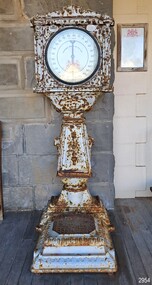 Flagstaff Hill Maritime Museum and Village
Instrument - Scale, Weighing Machine, G. Salter & Co, 1884-1909
... George Salter & Co., West Bromwich, England, produced automatic weighing scale machines from Everitt’s patented design, and advertised them as suitable for hotels, pleasure gardens, theatres, exhibition halls, clubs, baths and places of public resort. ...George Salter & Co., West Bromwich, England, produced automatic weighing scale machines from Everitt’s patented design, and advertised them as suitable for hotels, pleasure gardens, theatres, exhibition halls, clubs, baths and places of public resort. ...This ornate, Victorian-era automatic weighing machine was made in England around 1884-1909, by George Salter and Co. of West Bromwich, UK, makers of scales since 1760. It is protected by Queen Victoria’s Royal Letters Patent, signed in 1900. The scale stood outside the Warrnambool Post Office in Timor Street from around 1909 to 1966, as shown on postcards and photographs held at the State Library of Victoria. The scale is identified by the Serial Number '665', and was installed by the distributors, the Australasian Automatic Weighing Machine Co. Ltd.. The scale’s weight measurements were in Imperial stones and pounds up to 20 stone (127 kg). The scale’s face included charts of average weights, for men, women, boys and girls, by various heights, in feet and inches. The coin slot and its face were converted to metric measurements by the Eastern Scale Company Pty. Ltd; that firm was registered on October 2, 1974. The Australasian Automatic Weighing Machine Co. Ltd was a large supplier of weighing scales in Australia and held the Royal Letters patent for their machines, distributing them in prominent locations. In 1902, the firm was listed under the Import Entries Passed at His Majesty’s Customs, importing into Sydney, NSW, eight cases of scales. In 1911, the company asked permission from the Port Pirie Corporation to install a machine in Alexander Street. In 1913, the company applied to the City of Sydney to install machines around the city, including at the tram depot. One application mentions “… three machines in three places for three pounds per year”. In 1923, the firm tendered for the right to place Automatic Weighing Machines on railway and tram premises throughout New South Wales, subsequently for five-year terms, in return for a fixed payment per machine and a portion of the revenue to the NSW Government. In 1928, the Sydney Harbour Trust gave the firm the right to place the weighing machines on various ferry jetties. The firm was still operating in 1941, advertising for two boys aged 14-16 for the workshop and messages, at the Rialto building, 497 Collins St., Melbourne. On December 21, 1946, the Commonwealth government invited offers to tender for the right to place automatic weighing machines on postal premises throughout the six states; the successful company then made arrangements with the federal Postmaster General's Department to place machines outside post offices across the country. A few years later, on September 11, 1950, the firm's Adelaide branch ceased trading. From 11th July 1950, the Australian and Eastern Engineering Company Pty. Ltd took over at the same premises, at 179 Pirie Street, Adelaide. The Perth branch ceased business in WA on July 6th, 1950. Percival Everitt invented and patented the automatic, coin-operated personal scale design. Everitt was a Norfolk-born engineer and regarded as the father of the coin-operated industry. As a young man in 1877, he invented a hay and corn pitcher, a turnip thinner in 1878 and an Automatic Travelling Anchor in 1880. But his fame came in 1883 with the first postcard-vending machine, over a hundred of which he distributed around London. In 1884, he patented one of his many inventions, the coin-operated scales for use in public places; for many people, it was their first exposure to coin-operated machines. His success prompted the formation of the Weighing Machine Company in 1885. Further inventions followed: a blow tester in 1887, the machine for testing a person's grip in 1888, and in 1889, the dispensing machine for hiring out opera glasses, and a device for shutting down the coin entry slot if the machine was empty. In 1890, he invented a fortune-telling machine. Everitt sadly did not make his fortune; he died suddenly in February 1893, in his late forties, with £71 to his name. George Salter & Co., West Bromwich, England, produced automatic weighing scale machines from Everitt’s patented design, and advertised them as suitable for hotels, pleasure gardens, theatres, exhibition halls, clubs, baths and places of public resort. The company was established in 1760 by brothers Richard and William Salter, and manufactured springs and pocket steelyards (spring balances). After several generations, the company was taken over in 1855 by a nephew, George, and renamed George Salter & Co. In 1884, Salter registered the trademark of a Staffordshire knot pierced by an arrow. The company's expanded range of products included the first coin-operated public weighing machines in the 1880s and, in 1895, the first English-made typewriter. In 1915, Salter became a limited company, Geo. Salter & Co. Ltd. When the last George Salter died in 1917, the company passed into the hands of other relatives, but continued to grow before being bought out by Staveley Industries in 1973. Despite several subsequent mergers, the Salter name continues to be seen on household products such as digital scales. This patented, coin-operated weight machine is significant for its association with Percival Everitt, the inventor of the world’s first slot machine, with the renowned maker of scales, G. Salter & Co., which began operating in 1760, and also with the Australasian Automatic Weighing Scale Co., which imported and widely distributed the scales throughout Australia from the early-to-mid 20th century. It is a rare example of an early vending machine used in public places from the late 19th through to the mid-20th century. These machines were the early step in the evolution of coin-in-the-slot machines, which are still used today. The scales give a glimpse into our history; they became quickly popular with the public, which, until then, had little access to weight scales apart from those at medical services. They also provided inexpensive entertainment for families, especially while waiting for trains or visiting the post office. The machines were also attractive and lucrative to the distributors; once installed, they required very little maintenance, and their low cost to customers kept the money coming in. This automatic weighing machine is also significant for its decades of service to the local and regional community of Warrnambool, for personal and commercial purposes. A public coin-operated weighing scale, also called a penny scale. It is a large, silver-painted cast metal stand with a square top on a pedestal that flares outwards to join a rectangular platform base with posts on the side and corners that may have had fitted wheels. The round, white face on top has red and black measurements and inscriptions. A slim indicator with a point at one end and an arc at the other is attached to the face’s centre. The coin slot is above the face, on the left, and the scale’s identification number is engraved on an oval plate on the right. Moulded motifs decorate the pedestal’s front and are repeated on its sides; they depict a tall, narrow urn with a bowl on top and fancy scrolls on either side. There is a decorative panel across the front top of the stand. The top of the pedestal has a small keyhole. The size of the coin slot fitted a penny coin, and the weight measurements on the face were in Imperial stones and pounds. Quite some time after 1966, when Australia introduced new decimal weights, measurements and currency, the scale was updated; the coin slot size was changed, and a new face with metric measurements was installed. The scale now accepts a $1 coin (one dollar) and the scale measures weight in kilograms and grams, from 0 to 125 kg.. The rear of the scale has a small, rectangular metal plate with printed text. The scale was made by G Salter & Co. of West Bromwich, UK, distributed by the Australasian Automatic Weighing Platform Co., and updated to metric measurements by Eastern Scale Co. Pty Ltd. It was previously installed at the Warrnambool Post Office. Engraved on an oval plate on the right: "665" Top centre of the face, in red: "$1 coin" Top of face: "EASTERN SCALE CO. PTY LTD" Base of face, in red: "[Royal Coat of Arms of Britain]" with words, below in red: "BY ROYAL LETTERS PATENT" Around the face, in black: "[numbers 0 to 125, in increments 5, and makes between the numbers for each 500g]" "kg" Below the face, moulded letters within a shield: "AUSTRALASIAN AUTOMATIC WEIGHING MACHINES CO. LTD." At the back of the weighing platform: "G SALTER & CO. / WEST BROMWICH", remnants of logo “[Staffordshire knot pierced by an arrow]” Plate on rear: THIS SCALE REMAINS THE PROPERTY OF EASTERN SCALE CO. PTY. LTD., 8 GEORGE COURT, GREENSBOROUGH, VIC, 3088. PHONE (03 ) _ 34 _ _ 33” (434 9333 ?_flagstaff hill, warrnambool, maritime village, maritime museum, flagstaff hill maritime museum and village, shipwreck coast, great ocean road, scale, weighing scale, salter, australasian, 1 dollar, $1 coin, 1p, 1 penny coin, penny scale, coin in slot scale, eastern scale co. pty. ltd., british royal coat of arms, royal letters patent, letters patent, health, ending machine, coin-operated machine, percival everett, weighing machine co., george salter & co., g salter & co, west bromwich, vending machine, weights & balances, measurements, slot machine, coin operated machine, penny-in-the-slot, coin fed, coin op scale, weights & measures, australasian automatic weighing machine co. ltd., warrnambool post office, machine 665, no. 665, blalnce technology, scales and weights, weights and measures, penny weight scales, vintage, weighing machine, coin in the slot, coin operated, public scale, public weighing machine, penny-weighing machines, penny weighing machines, penny scales, coin operated weighing machine, scale weighing machine -
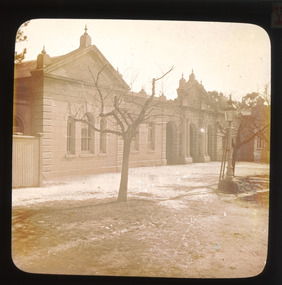 The Beechworth Burke Museum
Photograph - Lantern Slide, c1900
... designed by J.H. Dobbyn, cost £2347. The hospital had two wards, a dispensary, apartments for a resident surgeon and the matron, an operating theatre and a board room. ...designed by J.H. Dobbyn, cost £2347. The hospital had two wards, a dispensary, apartments for a resident surgeon and the matron, an operating theatre and a board room. ...This lantern slide shows the Ovens District Hospital (also called the Ovens Goldfields Hospital) in Beechworth in approximately 1900. The Hospital was built as part of a community push to develop the infrastructure needed for a permanent town in the 1850s. At the time there was no hospital located between Melbourne and the NSW town of Goulburn and it was recognised that the nature of mining and agricultural work predisposed people to serious injury. The community voted in 1853 to raise funds for a hospital and a voluntary committee elected from people who contributed £2 or more annually determined the organisation's management policies, which aimed to provide care for poor people at rates levied according to the person's means. Ongoing operations of the hospital were primarily supported by Government grants, however. The foundation stone was laid at a site in Church Street at a ceremony held 1st September 1856 which was attended by 2000 people using a locally crafted trowel with a tin ore handle and pure gold blade. The hospital, which was designed by J.H. Dobbyn, cost £2347. The hospital had two wards, a dispensary, apartments for a resident surgeon and the matron, an operating theatre and a board room. Further medical facilities including services to meet the cultural and health needs of the local Chinese community were later added, in addition to a Palladian-style cut-granite face built in 1862-63. It functioned as the region's primary hospital until surpassed by the Wangaratta Hospital in 1910. In the 1940s much of the building materials were salvaged and repurposed, with the exception of the facade which was restored in 1963 by the Beechworth Lions Club and still stands today. The facade featured on the covers of local history volume 'Beechworth: a Titan's Field' by Carole Woods and heritage-focused travel guide the 'Readers Digest Book of Historic Australian Towns'. Lantern slides, sometimes called 'magic lantern' slides, are glass plates on which an image has been secured for the purpose of projection. Glass slides were etched or hand-painted for this purpose from the Eighteenth Century but the process became more popular and accessible to the public with the development of photographic-emulsion slides used with a 'Magic Lantern' device in the mid-Nineteenth Century. Photographic lantern slides comprise a double-negative emulsion layer (forming a positive image) between thin glass plates that are bound together. A number of processes existed to form and bind the emulsion layer to the base plate, including the albumen, wet plate collodion, gelatine dry plate and woodburytype techniques. Lantern slides and magic lantern technologies are seen as foundational precursors to the development of modern photography and film-making techniques.This glass slide is significant because it provides insight into Beechworth's built environment and infrastructure in the early Twentieth Century, around the time of Australia's Federation. It is also an example of an early photographic and film-making technology in use in regional Victoria in the time period.Thin translucent sheet of glass with a round-edged square image printed on the front and framed in a black backing. It is held together by metal strips to secure the edges of the slide.Obverse: Y /burke museum, beechworth, lantern slide, slide, glass slide, plate, burke museum collection, photograph, monochrome, ovens district hospital, indigo shire, north-east victoria, hospital, palladian architecture, granite, community fundraising, community infrastructure, j.h. dobbyn, beechworth lions club, ovens goldfields hospital, chinese community -
Frankston RSL Sub Branch
Webbing, Belt, No maker discernible, Unknown
... design was confirmed on 8 June 1938 and wide-scale issue began in 1939. Towards the end of World War II, some 37 Webbing was produced in jungle green for troops fighting in the Pacific Theatre, although purpose-made 44 Pattern Webbing was then introduced for the humid jungle conditions, being lighter in weight, quicker drying, and rot-proofed.[ Although 44 Pattern continued in use with the British Army for jungle warfare in its various post-World War II colonial conflicts, it did not replace 37 Pattern in general service, which was in use up until the introduction of 58 Pattern. ...design was confirmed on 8 June 1938 and wide-scale issue began in 1939. Towards the end of World War II, some 37 Webbing was produced in jungle green for troops fighting in the Pacific Theatre, although purpose-made 44 Pattern Webbing was then introduced for the humid jungle conditions, being lighter in weight, quicker drying, and rot-proofed.[ Although 44 Pattern continued in use with the British Army for jungle warfare in its various post-World War II colonial conflicts, it did not replace 37 Pattern in general service, which was in use up until the introduction of 58 Pattern. ...Used with dress uniform for ceremonious purposes.An example of the standard issue webbing belt used by Australian service personnel. The name "Bretterecker" and the number 360053, (possibly a post World War 2 service number) is written in black ink on the inside surface of the belt. The belt has been "blackened" for ceremonial use and has brass fittings, the 2 angled buckles normally located on the rear of the belt have been removed. The 1937 pattern equipment (also known as '37 webbing') was an item of military load-carrying equipment. Pattern 37 replaced the 1908 Pattern and 1925 Pattern—on which it was based—and was standard issue for British and Commonwealth troops from its introduction in 1937, throughout World War II, and in the post-war period until it was superseded by 58 pattern webbing. The design was confirmed on 8 June 1938 and wide-scale issue began in 1939. Towards the end of World War II, some 37 Webbing was produced in jungle green for troops fighting in the Pacific Theatre, although purpose-made 44 Pattern Webbing was then introduced for the humid jungle conditions, being lighter in weight, quicker drying, and rot-proofed.[ Although 44 Pattern continued in use with the British Army for jungle warfare in its various post-World War II colonial conflicts, it did not replace 37 Pattern in general service, which was in use up until the introduction of 58 Pattern. However, 37 Pattern was used for ceremonial purposes and still issued to Cadets in the 1990s. 1937 Pattern Webbing was made from cotton webbing, which was waterproofed and dyed before being woven. The fittings were made of stamped brass and it was produced by various manufacturers.Written in black ink on the inside "Bretterecker" and the number 360053, possibly a post World War 2 service number.webbing belt, dress webbing -
 Federation University Historical Collection
Booklet - Promotional brochure and CD catalogue, Visual Arts at the Arts Academy, c2005
... Design) inc Diploma of Arts (Graphic Arts)...Advanced Diploma in Music...Diploma of Live Production...Theatre...Higher Education courses listed: Bachelor of Visual Arts (Fine Arts), Bachelor of Visual Arts (Graphic design/Multimedia), Bachelor of Arts Visual Arts (Honours), Bachelor of Arts (Music Theatre), Bachelor of Arts (Acting), Master of Arts (by Research), Doctor of Philosophy. ...Higher Education courses listed: Bachelor of Visual Arts (Fine Arts), Bachelor of Visual Arts (Graphic design/Multimedia), Bachelor of Arts Visual Arts (Honours), Bachelor of Arts (Music Theatre), Bachelor of Arts (Acting), Master of Arts (by Research), Doctor of Philosophy. ...Higher Education courses listed: Bachelor of Visual Arts (Fine Arts), Bachelor of Visual Arts (Graphic design/Multimedia), Bachelor of Arts Visual Arts (Honours), Bachelor of Arts (Music Theatre), Bachelor of Arts (Acting), Master of Arts (by Research), Doctor of Philosophy. TAFE courses listed: Diploma of Arts (Visual Arts), Diploma of Arts (Ceramics), Advanced Diploma of Arts (Graphic Design) inc Diploma of Arts (Graphic Arts), Advanced Diploma in Music, Diploma of Live Production, Theatre & Events (Technical Production) inc Certificate IV, Diploma of Theatre Arts inc Certificate IV in Theatre Arts, Certificate IV in Visual Arts and Contemporary Crafts – Koori Visual Arts. Includes testimonials from Sarah Schmidt, David Noonan, Felicity Morton.Promotional brochure aimed at prospective students for courses at the University of Ballarat, Arts Academy, Camp Street Campus. 6pp roll fold full colour.federation university, arts academy, diploma of arts (visual arts), diploma of arts (ceramics), advanced diploma of arts (graphic design) inc diploma of arts (graphic arts), advanced diploma in music, diploma of live production, theatre & events (technical production) inc certificate iv, diploma of theatre arts inc certificate iv in theatre arts, certificate iv in visual arts and contemporary crafts – koori visual arts -
Federation University Historical Collection
Article - Promotional CD catalogue, Visual Arts at the Arts Academy, c2005
... Design) inc Diploma of Arts (Graphic Arts)...Advanced Diploma in Music...Diploma of Live Production...Theatre...Higher Education courses listed: Bachelor of Visual Arts (Fine Arts), Bachelor of Visual Arts (Graphic design/Multimedia), Bachelor of Arts Visual Arts (Honours), Bachelor of Arts (Music Theatre), Bachelor of Arts (Acting), Master of Arts (by Research), Doctor of Philosophy. ...Higher Education courses listed: Bachelor of Visual Arts (Fine Arts), Bachelor of Visual Arts (Graphic design/Multimedia), Bachelor of Arts Visual Arts (Honours), Bachelor of Arts (Music Theatre), Bachelor of Arts (Acting), Master of Arts (by Research), Doctor of Philosophy. ...Courses listed on accompanying flyer. Higher Education courses listed: Bachelor of Visual Arts (Fine Arts), Bachelor of Visual Arts (Graphic design/Multimedia), Bachelor of Arts Visual Arts (Honours), Bachelor of Arts (Music Theatre), Bachelor of Arts (Acting), Master of Arts (by Research), Doctor of Philosophy. TAFE courses listed: Diploma of Arts (Visual Arts), Diploma of Arts (Ceramics), Advanced Diploma of Arts (Graphic Design) inc Diploma of Arts (Graphic Arts), Advanced Diploma in Music, Diploma of Live Production, Theatre & Events (Technical Production) inc Certificate IV, Diploma of Theatre Arts inc Certificate IV in Theatre Arts, Certificate IV in Visual Arts and Contemporary Crafts – Koori Visual Arts.Promotional compact disc aimed at prospective students for courses at the University of Ballarat, Arts Academy, Camp Street Campus. federation university, arts academy, diploma of arts (visual arts), diploma of arts (ceramics), advanced diploma of arts (graphic design) inc diploma of arts (graphic arts), advanced diploma in music, diploma of live production, theatre & events (technical production) inc certificate iv, diploma of theatre arts inc certificate iv in theatre arts, certificate iv in visual arts and contemporary crafts – koori visual arts -
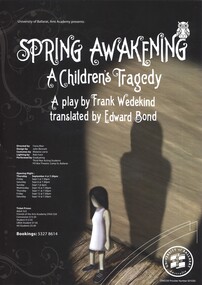 Federation University Historical Collection
Poster - Advertisment, Spring Awakening, 15375.1 - 2002; 15375.2 - 2014
... Director - Fiona Blair; Design - John Bennett; Costumes - Melanie Liertz; Lighting - Rob Irwin. It was performed at PO Box Theatre from Thursday September 4th - Saturday September 13th, all performances at 7.30pm except Sunday 7th at 6pm. ...Director - Fiona Blair; Design - John Bennett; Costumes - Melanie Liertz; Lighting - Rob Irwin. It was performed at PO Box Theatre from Thursday September 4th - Saturday September 13th, all performances at 7.30pm except Sunday 7th at 6pm. ...15375.1 The poster is an advertisement for the performance presented by University of Ballarat Arts Academy, Third Year Acting Students, 2002, for the play 'Spring Awakening A Children's Tragedy'. A play by Frank Wedekin translated by Edward Bond. Director - Fiona Blair; Design - John Bennett; Costumes - Melanie Liertz; Lighting - Rob Irwin. It was performed at PO Box Theatre from Thursday September 4th - Saturday September 13th, all performances at 7.30pm except Sunday 7th at 6pm. Ticket prices: Adult $22, Friends of the Arts Academy (FAA) $20, Concession $15.50, Student $12, UBSA Student $7.50, AA Students $5. 15375.2 A flyer advertising a performance by Faculty of Education and Arts, Arts Academy 2014 Graduating Music Theatre Company of 'Spring Awakening A New Musical'. Book and Lyrics by Steven Sater; Music by Duncan Sheik. Based on the Original Play by Frank Wedekind. Director - Tom Healey, Music Direction - David Piper. This production of Spring Awakening has been double cast: Austria Cast and Germany Cast. (See Media for names). The musical was performed at Helen MacPherson Theatre from Wednesday 9th April to Tuesday 15th April and with four Austria and Four Germany productions. There were two performances on Saturday 12th ( 2pm & 7.30 pm) and a 4pm performance on Sunday 13th. All other performances were at 7.30. Spring Awakening is a coming-of-age rock musical with music by Duncan Sheik and a book and lyrics by Steven Sater. It is based on the 1891 German play Spring Awakening by Frank Wedekind. Set in late 19th-century Germany, the musical tells the story of teenagers discovering the inner and outer tumult of adolescent sexuality. In the musical, alternative rock is employed as part of the folk-infused rock score.15375.1 Original Poster 15375.2 A paper flyerspring awakening, frank wedekind, edward bond, fiona blair, rob irwin, university of ballarat, the university of ballarat arts academy, po box theatre, steven sater, duncan sheik, tom haley, david piper, anna -francesca armenia, cody arthur, prudence bell, robbie bennett, jamie bray, shelley cocker, tamara cohen, ryan hawke, ben hodges, eden holmes, josh kerr, lauren marshal, shaly mccomas, grace sabbatucci, josh sanders, regan schmidt, christopher southall, sharon wills, kylie baker, robbie bennet, isabella bevan, chloe bruer-jones, darcy dann, louisa fitzhardinge, kirsty gayther, rebecca koroneos, stephanie long, vanessa menjivar, elizabeth sahlstrom -
Federation University Historical Collection
Photograph, Joseph At Her Majesty's Theatre Ballarat, c1990
... theatre ballarat...ballarat...rehearsals...costume design...39 Colour Photographs of a Student Production of Joseph At Her Majesty's Theatre Ballarat c. 1990s .1) Len Bauska (Technician) on a red ladder .2) Len Bauska .3) Unknown Student .4) Unknown Student .5) Older woman .6) Rehearsals in Progress .7) Students in Dressing Room .8) Two students .9) Student .10)Rehearsing in Orchestra Pit .11) Rehearsing In Orchestra Pit .12)Rehearsing in Orchestra Pit .13) Set Design .14)Student .15) Two Students .16) Green Room at Her Majesty's Theatre Ballarat .17)Directors and students .18)Len Bauska with Disco Balls .19)On set with ladder .20)Rehearsals .21) Making the Technicolour Dreamcoat .22)Making the Technicolour Dreamcoat .23) Student making costume .24)Students making costumes .25)Student .26)Students making costumes .27)Making costumes .28) Students making costumes .29) students making costumes .30) Younger members of the cast .31) Hair and Makeup .32)Preparing for a performance .33)Male cast members .34) Three cast members .35) Male cast members in dressing room .36) Student on phone .37)Student on phone .38) Courier poster announcing 6 more nights .39) Promotional banner for Joseph and the Amazing Technicolour Dreamcoat - Students in dressing room - Children on stairs -Male actor's headshot ...Possibly dating c. 1990 joseph joseph and his amazing technicolour dreamcoat performing arts alumni her majesty's theatre ballarat ballarat rehearsals costume design stage mirror ball orchestra pit band 1990 Balllarat University College BAPA Ballarat Academy of Performing arts 39 Colour Photographs of a Student Production of Joseph At Her Majesty's Theatre Ballarat c. 1990s .1) Len Bauska (Technician) on a red ladder .2) Len Bauska .3) Unknown Student .4) Unknown Student .5) Older woman .6) Rehearsals in Progress .7) Students in Dressing Room .8) Two students .9) Student .10)Rehearsing in Orchestra Pit .11) Rehearsing In Orchestra Pit .12)Rehearsing in Orchestra Pit .13) Set Design .14)Student .15) Two Students .16) Green Room at Her Majesty's Theatre Ballarat .17)Directors and students .18)Len Bauska with Disco Balls .19)On set with ladder .20)Rehearsals .21) Making the Technicolour Dreamcoat .22)Making the Technicolour Dreamcoat .23) Student making costume .24)Students making costumes .25)Student .26)Students making costumes .27)Making costumes .28) Students making costumes .29) students making costumes .30) Younger members of the cast .31) Hair and Makeup .32)Preparing for a performance .33)Male cast members .34) Three cast members .35) Male cast members in dressing room .36) Student on phone .37)Student on phone .38) Courier poster announcing 6 more nights .39) Promotional banner for Joseph and the Amazing Technicolour Dreamcoat - Students in dressing room - Children on stairs -Male actor's headshot Joseph At Her Majesty's Theatre Ballarat Photograph ...A student production of Joseph and His Amazing Technicolour Dreamcoat. Possibly dating c. 199039 Colour Photographs of a Student Production of Joseph At Her Majesty's Theatre Ballarat c. 1990s .1) Len Bauska (Technician) on a red ladder .2) Len Bauska .3) Unknown Student .4) Unknown Student .5) Older woman .6) Rehearsals in Progress .7) Students in Dressing Room .8) Two students .9) Student .10)Rehearsing in Orchestra Pit .11) Rehearsing In Orchestra Pit .12)Rehearsing in Orchestra Pit .13) Set Design .14)Student .15) Two Students .16) Green Room at Her Majesty's Theatre Ballarat .17)Directors and students .18)Len Bauska with Disco Balls .19)On set with ladder .20)Rehearsals .21) Making the Technicolour Dreamcoat .22)Making the Technicolour Dreamcoat .23) Student making costume .24)Students making costumes .25)Student .26)Students making costumes .27)Making costumes .28) Students making costumes .29) students making costumes .30) Younger members of the cast .31) Hair and Makeup .32)Preparing for a performance .33)Male cast members .34) Three cast members .35) Male cast members in dressing room .36) Student on phone .37)Student on phone .38) Courier poster announcing 6 more nights .39) Promotional banner for Joseph and the Amazing Technicolour Dreamcoat - Students in dressing room - Children on stairs -Male actor's headshot joseph, joseph and his amazing technicolour dreamcoat, performing arts, alumni, her majesty's theatre ballarat, ballarat, rehearsals, costume design, stage, mirror ball, orchestra pit, band, 1990, balllarat university college, bapa, ballarat academy of performing arts -
Federation University Historical Collection
Book - Book - Scrapbook, Ballarat College of Advanced Education: Scrapbook of newspaper cutting, Book 16; August 1985 to February 1986
... theatre company...bcae ahead in phys ed...meron mcdonald wins landragin award in graphic design...The cuttings cover the period from 24 August 1985 to 12 February 1986. . employment advertisements application for enrolment outline of courses ballarat college of advanced education bcae vicki nash winter exhibition 72 units for students 'merge but keep it loca' apprentice clowns apartheid may change soon dr john viljoen david addenbrooke dean faculty of arts bcae opens its doors top national art award julie billson alisin mauger senator don chip tax plan fairer base nursing head takes bcae post shirley ogden new and different photovoltaic panel david jirik social atlas of region launched doug wright exhibition student union debate deakin to reopen engineering standards and resources put to the test seminar on occupational health hospitality for tourists high praise from professor geoff bonney wins art prize mural salutes agriculture julie billsonwins national prize new theatre company bcae ahead in phys ed meron mcdonald wins landragin award in graphic design fitness testing scheme piloted in ballarat lloyd crump ceramics nicole mayne honor $1.2m expansion department of nursing department of human and social sciences year of surging progress dr ken hawkins iain reid pints as he pilots ministry causes resentment bcae cries 'unfair' librarian carolyn bray student housing Book with beige cover, front. ...Newspaper cuttings relating to Ballarat College of Advanced Education. These are from various newspapers and include The Age, Ballarat Courier, The Australian, The Herald. The cuttings cover the period from 24 August 1985 to 12 February 1986. . Book with beige cover, front. Spiral bound.employment advertisements, application for enrolment, outline of courses, ballarat college of advanced education, bcae, vicki nash, winter exhibition, 72 units for students, 'merge but keep it loca', apprentice clowns, apartheid may change soon, dr john viljoen, david addenbrooke, dean faculty of arts, bcae opens its doors, top national art award, julie billson, alisin mauger, senator don chip, tax plan fairer, base nursing head takes bcae post, shirley ogden, new and different, photovoltaic panel, david jirik, social atlas of region launched, doug wright exhibition, student union debate, deakin to reopen engineering, standards and resources put to the test, seminar on occupational health, hospitality for tourists, high praise from professor, geoff bonney wins art prize, mural salutes agriculture, julie billsonwins national prize, new theatre company, bcae ahead in phys ed, meron mcdonald wins landragin award in graphic design, fitness testing scheme, piloted in ballarat, lloyd crump ceramics, nicole mayne honor, $1.2m expansion, department of nursing, department of human and social sciences, year of surging progress, dr ken hawkins, iain reid pints as he pilots, ministry causes resentment, bcae cries 'unfair', librarian carolyn bray, student housing -
Federation University Historical Collection
Book - Book - Scrapbook, Ballarat School of MInes: Scrapbook of Newspaper Cuttings, Book 74, June 1996 to August 1996
... theatre...tenders exceed funding...ray borner to olympic games...shane everard inspiration to all...network caters for chefs...judith beaton and jennifer martin...business studies...master painters' association...innovative businesses...building course for women...deanne jakiel's win a boon for kooris...dr ron wild...bright future for smb...young workers test their skills...melissa cameron...michael ronaldson mhr...peter morey work skill...angela cox...geoffrey richards...a legacy of design...The papers concerned are The Courier, Ballarat, The Australian, The Age ad other region papers over the period of 1 June 1996 to 6 August 1996. teaching positions advertised pre-employment courses courses available enrolment for smb courses counselling course may be lost myma rance father son graduate phil allender steve allender building apprentices non payment proposed changes to industrialrelations laws brenda huggins winner of award education is lifelong quest smb graduation night her majesty's 121st food fit for a king tony leonard cuts fall on regional takes administration students placed in workforce art appreciation through theatre tenders exceed funding ray borner to olympic games shane everard inspiration to all network caters for chefs judith beaton and jennifer martin business studies master painters' association innovative businesses building course for women deanne jakiel's win a boon for kooris dr ron wild bright future for smb young workers test their skills melissa cameron michael ronaldson mhr peter morey work skill angela cox geoffrey richards a legacy of design jocelynne scutt - barrister paralympians at smb barry jones - alp tafe cuts hit farmers smb and red lion hotel - hospitality course Book with yellow cover, front, spiral bound. ...Collection of newspaper articles related to Ballarat School Of Mines.They cover activities and advertisements for staff. The papers concerned are The Courier, Ballarat, The Australian, The Age ad other region papers over the period of 1 June 1996 to 6 August 1996.Book with yellow cover, front, spiral bound. teaching positions advertised, pre-employment courses, courses available, enrolment for smb courses, counselling course may be lost, myma rance, father son graduate, phil allender, steve allender, building apprentices non payment, proposed changes to industrialrelations laws, brenda huggins winner of award, education is lifelong quest, smb graduation night, her majesty's 121st, food fit for a king, tony leonard, cuts fall on regional takes, administration students placed in workforce, art appreciation through theatre, tenders exceed funding, ray borner to olympic games, shane everard inspiration to all, network caters for chefs, judith beaton and jennifer martin, business studies, master painters' association, innovative businesses, building course for women, deanne jakiel's win a boon for kooris, dr ron wild, bright future for smb, young workers test their skills, melissa cameron, michael ronaldson mhr, peter morey work skill, angela cox, geoffrey richards, a legacy of design, jocelynne scutt - barrister, paralympians at smb, barry jones - alp, tafe cuts hit farmers, smb and red lion hotel - hospitality course -
 Lara RSL Sub Branch
Picture Print, Hurricane, Unknown
... designed and predominantly built by Hawker Aircraft Ltd. for service with the Royal Air Force (RAF). It was overshadowed in the public consciousness by the Supermarine Spitfire's role during Battle of Britain in 1940, but the Hurricane actually inflicted 60 percent of the losses sustained by the Luftwaffe in the engagement, and it went on to fight in all the major theatres of the Second World War. ...designed and predominantly built by Hawker Aircraft Ltd. for service with the Royal Air Force (RAF). It was overshadowed in the public consciousness by the Supermarine Spitfire's role during Battle of Britain in 1940, but the Hurricane actually inflicted 60 percent of the losses sustained by the Luftwaffe in the engagement, and it went on to fight in all the major theatres of the Second World War. ...The Hawker Hurricane is a British single-seat fighter aircraft of the 1930s–40s that was designed and predominantly built by Hawker Aircraft Ltd. for service with the Royal Air Force (RAF). It was overshadowed in the public consciousness by the Supermarine Spitfire's role during Battle of Britain in 1940, but the Hurricane actually inflicted 60 percent of the losses sustained by the Luftwaffe in the engagement, and it went on to fight in all the major theatres of the Second World War. Url Hurricane.html. The Hawker Hurricane Mk.IIc - LF363, first flew on the 1st January 1944 and is believed to be the last Hurricane to enter service in the RAF. It was in service with 63 squadron and 26 squadron. After hostilities, LF363 was spared the scrap yard and used on various station flights and also appeared in films 'Angels one five', 'Reach for the Sky' and 'The Battle of Britain'. Whilst flying to Jersey in September 1991, LF363 suffered engine problems and had to be diverted to RAF Wittering but on the final approach the aircraft suffered complete engine failure and had to make an emergency landing. The pilot was saved with relative minor injuries (a broken ankle and minor burns) but the aircraft suffered severe damage. Historic Flying Limited completely rebuilt LF363 and by 1998 it was flying again as part of the B.B.M.F. LF363 currently wears the colour scheme of a Mk.I Hurricane of 17 squadron, P3878 'YB-W' which was flown by Flying Office Harold Bird-Wilson at Debden and Tangmere. Harold 'Birdy' Bird-Wilson had previously been badly burned in a pre-war flying accident. Upon his recovery he joined 17 squadron and fought through the 'Battle of France' and the 'Battle of Britain' achieving 6 confirmed kills. On 24th September 1940, 'Birdy' was shot down by Adolf Galland, his 40th 'kill', and had to bale out. 'Birdy' survived the war and when he retired from the RAF he had reached the rank of Vice Marshall and had been awarded the CBE, DSO, DFC & Bar and the AFC & Bar. British single-seat fighter aircraft manufactured by Hawker Aircraft, Ltd., in the 1930s and ’40s. The Hurricane was numerically the most important British fighter during the critical early stages of World War II, sharing victory laurels with the Supermarine Spitfire in the Battle of Britain (1940–41) and the defense of Malta (1941–42). Hurricanes served in all theatres of war where British forces were engaged. https://www.britannica.com/technology/Hurricane-airplane Framed coloured picture print on plastic sheetOn the aircraft are the markings LF 363
