
Showing 112 items matching " w h wells"
-
 Bendigo Historical Society Inc.
Document - MAJOR MITCHELL AND MOUNT ALEXANDER
... ... W H Wells...DOCUMENT Major Mitchell and Mount Alexander Tommy-Came-Last The Major Mitchell Tourist Trail Major General John Byng Phillip of Macedonia Alexander the Great Henty s Surveyor Davidson Alexander Mollison George Augustus Robinson William Morton Mr Charles Hotson Ebden John Randell Public Library of Melbourne Les Blake Governor Burke Phillip Parker King Crown Solicitor Henry Field Gurner Arthur Phillip Hume Australia Felix Expedition L Blake Place Names of Victoria G Brenmer Booklet for Secondary Schools M Cannon Historical Records of Victoria Vol 1 J H L Cumpston Thomas Mitchell Surveyor General and Explorer H F Gurner Chronicle of Port Phillip T L Mitchell Three Expeditions into the Interior of Eastern Australia A F Mollison An Overlanding Diary W L Morton Adventures of a Pioneer M S 5188 Itinerary from the Journal of the Exploring Expedition returning from Portland Bay M S 5189 Mitchell's 1837 Map J O Randell Pastoral Settlement in Northern Victoria Vol 1 Pastoral Settlement in Northern Victoria Vol 2 Records of the Victorian Archaeological Survey Number 5 Journals of George Augustus Robinson T C Sargent Some Peninsular Names in Australia Felix W H Wells A Geographical Dictionary or Gazetteer of the Australian Colonies Typed notes mentioning the naming of Mount Alexander, Coliban, Campaspe and who named them. ...Typed notes mentioning the naming of Mount Alexander, Coliban, Campaspe and who named them. Also the origins of the names.document, major mitchell and mount alexander, tommy-came-last, the major mitchell tourist trail, major general john byng, phillip of macedonia, alexander the great, henty s, surveyor davidson, alexander mollison, george augustus robinson, william morton, mr charles hotson ebden, john randell, public library of melbourne, les blake, governor burke, phillip parker king, crown solicitor henry field gurner, arthur phillip, hume, australia felix expedition, l blake, place names of victoria, g brenmer, booklet for secondary schools, m cannon, historical records of victoria vol 1, j h l cumpston, thomas mitchell surveyor general and explorer, h f gurner, chronicle of port phillip, t l mitchell, three expeditions into the interior of eastern australia, a f mollison, an overlanding diary, w l morton, adventures of a pioneer, m s 5188, itinerary from the journal of the exploring expedition returning from portland bay, m s 5189, mitchell's 1837 map, j o randell, pastoral settlement in northern victoria vol 1, pastoral settlement in northern victoria vol 2, records of the victorian archaeological survey number 5, journals of george augustus robinson, t c sargent, some peninsular names in australia felix, w h wells, a geographical dictionary or gazetteer of the australian colonies -
 Glen Eira Historical Society
Drawing - Methodist Church, 23 - 25 Bundeera Road, Caulfield South
... ... Gvard W. H. Rev.... Wells...Shaw Mesolames Morris Miles Monday Bryant Woodford Paice Warren Evans Bert Shaw William Ronald Gvard W. H. Rev. Wells Charlotte Evans Elsie Narrawong Road. ...Phamphlet containing photocopied and dated newspaper articles about construction of church from various newspapers in 1926 and a brief outline of how and why church was begun and of its eventual demise, 1923 - 1985. Photocpied page of Recollections of Bundeera Road Church by Charlotte Harley (b. 1890), listing the members of December, 1985.methodist church, taylor mr., latham a. t., kindergartens, methodist uniting church, wesley johns rev., corben mrs, bundeera road, eddy r., organs, collier charitable fund, south caulfield, primary schools, kooyong road, methodist church, woodford, bambra estate, mcconchie rev. r. bruce, davenport mr., davies bill, davies mrs., philp rev., shaw mesolames, morris, miles, monday, bryant, woodford, paice, warren, evans bert, shaw william ronald, gvard w. h. rev., wells charlotte, evans elsie, narrawong road., bundeera road uniting church., mcraw dick, westaway frank, adamson dorothy, harley charlotte (nee wells), harley j, hunkin ena, hunkin edward rev., lydiard ruby, lydiard dick, sharples d, sharples j, spence margaret, spence bert, summers mary, summers ron, veitch alan, westaway m, arundell joyce, campbell heather, cock marian, heywood. a, putland roy, richards d, spence philip, taylor mrs., trewin norman, newton m., uniting church archives, kilgour alex, mann gwenda, gray daniel, gray gordon, heywood a, putland roy, richards d, featenby rev., brent p. e, woodford s. g., bent mr., st. kilda circuit, bundeera road ladies gvild, sunday school, choirs, windows -
 Mission to Seafarers Victoria
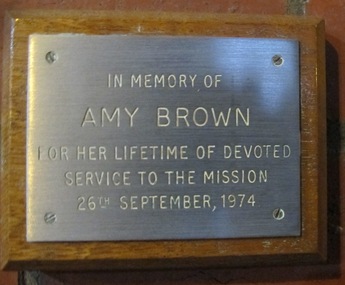
Plaque - Memorial Plaque, Amy Neville Brown (1882-1974), 1976
... The principal of this firm was W H Moule, well known judge and cricketer. His son, also W H Moule, was Honorary Secretary of MtSV Executive Committee for 20 years until his retirement in 1958. ...The principal of this firm was W H Moule, well known judge and cricketer. His son, also W H Moule, was Honorary Secretary of MtSV Executive Committee for 20 years until his retirement in 1958. ...Amy Neville Brown (1882-1974) was a longlife member of the Mission to Seafarers ladies' Committees: 1910 - Amy is first mentioned in our records as LHLG branch secretary for Elsternwick. (from diaries written by her and her sister Beatrice during 1909-1913 and held at the Glen Eira Historical Society, Amy tells she attends “kirk” with Miss Godfrey about once a month and each time they go to the “Institute” afterwards.) 1918 - 1922 sees Amy as “Schools secretary” LHLG. 1933 - Miss A N Brown becomes Honorary Secretary of the LHLG. 1946 – LHLG becomes “Harbour Lights Guild”. 1949 – Dora Simpson is president of HLG & Amy Brown is Honorary Secretary. 1957 – Amy retires as Honorary Secretary of the HLG. Other interests: 1933 - Amy founded the Victorian Aboriginal Group along with Valentine Alexa Leeper (1900-2001). She acted as Hon. Sec. to the VAG for 40 years until its winding up in 1971 8 boxes of papers related to their activities are held at the SLV under Amy’s name (with Val Leeper). 1950 - Amy was a member of the YWCA 1963 – she was president of the Agnes Benson Auxiliary of the YWCA. Amy’s parents were Andrew Howden Brown & Catherine Marianne (Kitty) Wight. She had 2 brothers: Charles John Brown, Edward Byam Brown & 3 sisters: Jean Constance Brown (1884-1973), Catherine Philpott Brown (1886-1980), Grace *Beatrice Brown (1889-1984) who was also a member of the Mission's ladies' committee. None of 4 sisters married, they lived all their lives in Elsternwick. Edward Byam Brown was an academic at Melbourne University rising to become Ass. Prof. of Electrical Engineering by the 1950s. He married Vera Scantlebury in 1926 – they had 2 children. Amy’s maternal grandparents were Edward Byam Wight and Catherine Philpott. Both arrived in Melbourne in the early 1840s. Edward Wight is included on Thomas Chuck’s collage of early Victorian pioneers. Anne Jackson has written a short biography of Catherine’s brother, William Philpott, which includes a paragraph on Edward Wight. Catherine’s youngest son, Neville Wight, became a solicitor living at Woodend. He married Grace Rutherford – Mrs Neville Wight was a member of our Executive Committee from 1929 to 1933. Neville Wight’s obituary states that “he served his articles with … the firm of Moule & Seddon”. The principal of this firm was W H Moule, well known judge and cricketer. His son, also W H Moule, was Honorary Secretary of MtSV Executive Committee for 20 years until his retirement in 1958. was a member of the Harbour Lights Guild ( Honorary General Secretary in the 30s) then the Flying Angel League. She passed away in September 1974. A protege and friend of the Godfreys and Ina Higgins she actively assisted in setting up school branches of LHLG and eventually became a leading member in the 1930s.The window made by Tony Hall along with this plaque were dedicated in 1976. Amy Neville Brown had a lifelong association with the Mission and other philanthropic and social causes. Small plaque mounted on wooded board.In memory of Amy Brown For her lifetime of devoted service to the Mission 26th September, 1974amy brown, plaque, memorial, flying angel club, lhlg, amy neville brown (1882-1974), victoria aboriginal group (1933-1971), vag, val leeper, valentina alexa leeper (1900-2001) -
 Flagstaff Hill Maritime Museum and Village
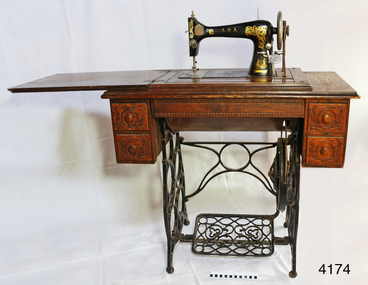
Domestic object - Sewing Machine, Early 20th century
... H. Keck MLC, W. Wallace, and W. Ewing) operated their business out of the former W. Webb & Co. building in Queen St. Bendigo. Around 1923-1924 they decided to switch from traction engines to manufacturing sewing machines. The actual date is not known but that year's financial report made note of both Cordings and Bendigo Sewing Machines Limited. The switch was made with the government of the day agreeing to a tariff of two pounds per head for every machine head made completely in Australia. The change from traction engines to sewing machines went well...H. Keck MLC, W. Wallace, and W. Ewing) operated their business out of the former W. Webb & Co. building in Queen St. Bendigo. Around 1923-1924 they decided to switch from traction engines to manufacturing sewing machines. The actual date is not known but that year's financial report made note of both Cordings and Bendigo Sewing Machines Limited. The switch was made with the government of the day agreeing to a tariff of two pounds per head for every machine head made completely in Australia. The change from traction engines to sewing machines went well ...Ward Brothers (George and Samuel) registered a company (Australian Sewing Machines Limited Pty Ltd) with the head office address in Errol St, North Melbourne, and Prahan. The earliest newspaper advertisement for this company was in 1897. Around this time the Ward Brothers first imported sewing machines from England and Wertheim placed their decal on them and mounted them in their own Australian made cabinets. David Ward later imported machines from Beisolt & Locke in Germany and registered name A.N.A. (All Native Australian), his shop was in Collingwood Melbourne. Some of these machines had Ward Brothers decals on them as well. The three brothers sold under the same name as Ward Brothers. The early Ward Brothers logo had a map of Australia with a picture of all three brothers on it. In 1911 all three of the Ward Brothers decided to share a stall in the yearly Melbourne exhibition. The A.N.A was the machine that got rave reviews. It was at this time that the Australian Sewing Machine Company Pty Ltd decided to add the A.N.A logo to their logo to cash in on the new found celebrity status that the A.N.A has gained. To cut a long story short. David Ward took his brothers to court to prevent this from happening. This was a long drawn out affair that took quite a few years. The settlement was decided out of court and nothing was disclosed of the deal that was made. David seemed to have left the scene, then the remaining Ward Brothers and A.N.A. combined and then became “Wardana”. There are many Ward Brothers sewing machines in displays, they originated from Japan, England, America, and Germany. It seems that where ever they got the best deal for sewing machines or parts is the direction they went. This is where the Bendigo sewing machine company came into the picture. All imported sewing machines into Australia drew a government tax. Bendigo Cording's Traction Company was given proposed two-pound tariff protection that gave the company a significant price advantage for its machines. As a result, the Ward Brothers purchased a huge number of Bendigo shares to get cheaper machines for their sewing machine cabinets. Ward Brothers then placed one of their company officials on the Board of “Bendigo Sewing Machines Limited” and the rest is history. Ward Brothers had shops Australian wide and in most of the major country towns. History for “Bendigo Sewing Machines Limited” Cordings Traction Company owners (H. Keck MLC, W. Wallace, and W. Ewing) operated their business out of the former W. Webb & Co. building in Queen St. Bendigo. Around 1923-1924 they decided to switch from traction engines to manufacturing sewing machines. The actual date is not known but that year's financial report made note of both Cordings and Bendigo Sewing Machines Limited. The switch was made with the government of the day agreeing to a tariff of two pounds per head for every machine head made completely in Australia. The change from traction engines to sewing machines went well. Government representatives visited the factory in Bendigo to inspect and ensure that the sewing machines were Australian made as a result they agreed on granting the two-pound tariff to the company. After the first 12 months, they built 30, the following 12 months the company had produced 1500 machines probably due to the involvement of the Ward brothers. However, the government proposed a new condition to the tariff agreement which was that the company must produce 20% of Australia's requirements for sewing machines. In 1924 after having had produced 1500 machines resulting in reaching their financial limit for tariff support. According to the government, the requirement was 15,000 machines for the next year had to be produced to qualify for the tariff. The company had already reached its production limit and unfortunately folded. There were several attempts to regain government assistance to save this new industry but it was to no avail. Even a promise to open another factory in Sydney was offered but unfortunately wasn't accepted. An item fabricated in Australia from a majority of imported parts from either Germany, America or England giving a snapshot into the early manufacturing industries that were operating at the time of Federation. Sewing machine, treadle, in timber cabinet. Branded Ward Bros, A.N.A., Australian Sewing Machine Coy. Decorative carved timber cabinet, hinged, fold-out laminated timber top and five drawers; two small on each side with handles and one long, shallow, between side drawers without handle. Thread is on bobbin in a rocket shuttle (both in good condition) plus spare empty shuttle (rusty). Brass ‘Half Yard’ ruler inlaid across front, measuring scale in inches and centimetres. Two metal shuttle cover plates (or throat plate / slide plate); front one is impressed with a gauge for needle and thread. Gold trim and decals on flatbed and machine front and back, serial number under shuttle cover, brand on decals and on round metal plate on back of machine. Front right of machine has a bobbin winder. Treadle belt shows signs of wear and laminate on timber machine cover is peeling slightly.Decal coat of arms on right front of machine: kangaroo on left, man with broad-brim hat, holding pick-axe on right, in centre, top “SEWING MACHINE / THE / A. N. A.” then below it, the rising sun, then below that is state of Victoria shield with the Southern Cross constellation. Wheat sheaves around edge on left and flowering plant on right. Gold ribbon banner at bottom with script “WARD BROS.“ Decal of map of Australia on flatbed of machine. States and capital cities are marked and named (no northern territory), portrait of two men. In centre of map are interwoven letters “A. N. A.” and written in script “WARD BROS.” Decal across front of machine body has large, decorated gold lettering “A. N. A.” Decal across the top of machine “THE AUSTRALIAN SEWING MACHINE COY. PTY. Ltd.” Steel shuttle cover at front has an impressed gage listing cotton and needle sizes and number of stitches. Brass disc on back of machine “A. N. A.” in centre. Brass ruler across front of machine has carved or pressed words in the timber. In centre “INCHES” above ruler and “CENTIMETRES” below ruler, and on right above ruler is “HALF YARD” Decal across back of machine’s body “A.N. A. / MADE IN U.S.A.” Stamped into metal under shuttle cover is “219415” (2 and 5 are partially there, first 1 could instead be a 7) flagstaff hill, warrnambool, shipwrecked coast, flagstaff hill maritime museum, maritime museum, shipwreck coast, flagstaff hill maritime village, great ocean road, ward bros., australian sewing machine co., a.n.a., treadle sewing machine, rocket shuttle sewing machine, home industry, clothing, wardana, australian sewing machine company, all native australian, dressmaking, clothing manufacturer -
 Federation University Historical Collection
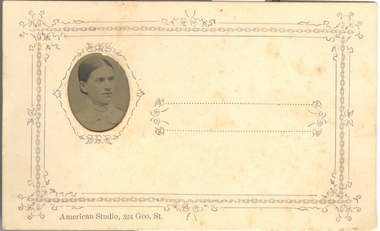
Photograph - Little Gem tintype, American Studio, Portrait of a Woman, (exact)
... well. Although Gove and Allen studios produced the majority of gem tintypes in Australia, other studios offered them including: - London, American & Sydney Photo Company, 328 George St, Sydney; - David Edelsten, 55 & 57 Bourke St, Melbourne; - Burman's Portrait Rooms, St. George's Hall, 209 Bourke St, Melbourne; - Bell's Gem Portrait Studio, 57 Bourke St East, Melbourne; - R. H. Kenny, Bridge St, Ballarat; - Marinus W...well. Although Gove and Allen studios produced the majority of gem tintypes in Australia, other studios offered them including: - London, American & Sydney Photo Company, 328 George St, Sydney; - David Edelsten, 55 & 57 Bourke St, Melbourne; - Burman's Portrait Rooms, St. George's Hall, 209 Bourke St, Melbourne; - Bell's Gem Portrait Studio, 57 Bourke St East, Melbourne; - R. H. Kenny, Bridge St, Ballarat; - Marinus W ...The tintype (or ferrotype or Melainotype) was produced on metallic sheet (not, actually, tin) instead of glass. The plate was coated with collodion and sensitized just before use. It was introduced by Adolphe Alexandre Martin in 1853. The most common size was about the same as the carte-de-visite, 5.5cm x 9.0cm, but both larger and smaller ferrotypes were made. The smallest were "Little Gem" tintypes, about the size of a postage-stamp, made simultaneously on a single plate in a camera with 12 or 16 lenses. They were often produced by travelling photographers, and were cheaper than Ambrotypes so made photography available to working classes, not just to the more well-to-do. The print would come out laterally reversed (as one sees oneself in a mirror). Being quite rugged, tintypes could be sent by post. Tintypes were eventually superseded by gelatin emulsion dry plates in the 1880s, though street photographers in various parts of the world continued with this process until the 1950s. (Above information abridged from http://www.rleggat.com/photohistory/history/tintype.htm) The firm of Gove and Allen opened in Sydney in 1880 and were responsible for the belated popularizing of the gem tintype in Australia. The firm traded as both The American Gem Studio and The American Studio. Others franchises were opened in Melbourne, Ballarat and Sandhurst (Bendigo). The Sandhurst branch closed in 1882 and Adelaide in 1884. All Gove and Allen studios had ceased trading by 1885. The studio addresses were: 23 King William St, Adelaide; 324 George St, Sydney; 95 Swanston St, Melbourne; Howard Place, Sandhurst; 7 Queen St, Brisbane; The card mounts used in Gove and Allen studios in Australia are identical to those used in America. They were initially made of plain white card with embossing around the oval image opening in the mount while some also had simple geometric and floral printed designs as well. Although Gove and Allen studios produced the majority of gem tintypes in Australia, other studios offered them including: - London, American & Sydney Photo Company, 328 George St, Sydney; - David Edelsten, 55 & 57 Bourke St, Melbourne; - Burman's Portrait Rooms, St. George's Hall, 209 Bourke St, Melbourne; - Bell's Gem Portrait Studio, 57 Bourke St East, Melbourne; - R. H. Kenny, Bridge St, Ballarat; - Marinus W. Bent, Sandhurst (Bendigo); - George Fisher, Victoria; - Anson Brothers, Hobart Town. (Abridged information from http://members.ozemail.com.au/~msafier/photos/tintypes.html) A tintype portrait of a woman's head, attached to a card.Printed lower left hand side of the card "American Studio, 324 Geo. St."tintype, american studio, woman, unidentified woman, women, photograph -
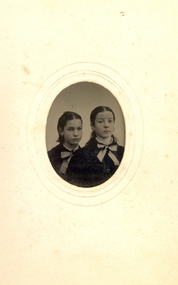 Federation University Historical Collection
Photograph - Tintype, Portrait of two young girls
... well. Although Gove and Allen studios produced the majority of gem tintypes in Australia, other studios offered them including: - London, American & Sydney Photo Company, 328 George St, Sydney; - David Edelsten, 55 & 57 Bourke St, Melbourne; - Burman's Portrait Rooms, St. George's Hall, 209 Bourke St, Melbourne; - Bell's Gem Portrait Studio, 57 Bourke St East, Melbourne; - R. H. Kenny, Bridge St, Ballarat; - Marinus W...well. Although Gove and Allen studios produced the majority of gem tintypes in Australia, other studios offered them including: - London, American & Sydney Photo Company, 328 George St, Sydney; - David Edelsten, 55 & 57 Bourke St, Melbourne; - Burman's Portrait Rooms, St. George's Hall, 209 Bourke St, Melbourne; - Bell's Gem Portrait Studio, 57 Bourke St East, Melbourne; - R. H. Kenny, Bridge St, Ballarat; - Marinus W ...The tintype (or ferrotype or Melainotype) was produced on metallic sheet (not, actually, tin) instead of glass. The plate was coated with collodion and sensitized just before use. It was introduced by Adolphe Alexandre Martin in 1853. The most common size was about the same as the carte-de-visite, 5.5cm x 9.0cm, but both larger and smaller ferrotypes were made. The smallest were "Little Gem" tintypes, about the size of a postage-stamp, made simultaneously on a single plate in a camera with 12 or 16 lenses. They were often produced by travelling photographers, and were cheaper than Ambrotypes so made photography available to working classes, not just to the more well-to-do. The print would come out laterally reversed (as one sees oneself in a mirror). Being quite rugged, tintypes could be sent by post. Tintypes were eventually superseded by gelatin emulsion dry plates in the 1880s, though street photographers in various parts of the world continued with this process until the 1950s. (Above information abridged from http://www.rleggat.com/photohistory/history/tintype.htm) The firm of Gove and Allen opened in Sydney in 1880 and were responsible for the belated popularizing of the gem tintype in Australia. The firm traded as both The American Gem Studio and The American Studio. Others franchises were opened in Melbourne, 6 Sturt St Ballarat and Sandhurst (Bendigo). The Sandhurst branch closed in 1882 and Adelaide in 1884. All Gove and Allen studios had ceased trading by 1885. The studio addresses were: 23 King William St, Adelaide; 324 George St, Sydney; 95 Swanston St, Melbourne; Howard Place, Sandhurst; 7 Queen St, Brisbane; The card mounts used in Gove and Allen studios in Australia are identical to those used in America. They were initially made of plain white card with embossing around the oval image opening in the mount while some also had simple geometric and floral printed designs as well. Although Gove and Allen studios produced the majority of gem tintypes in Australia, other studios offered them including: - London, American & Sydney Photo Company, 328 George St, Sydney; - David Edelsten, 55 & 57 Bourke St, Melbourne; - Burman's Portrait Rooms, St. George's Hall, 209 Bourke St, Melbourne; - Bell's Gem Portrait Studio, 57 Bourke St East, Melbourne; - R. H. Kenny, Bridge St, Ballarat; - Marinus W. Bent, Sandhurst (Bendigo); - George Fisher, Victoria; - Anson Brothers, Hobart Town. (Abridged information from http://members.ozemail.com.au/~msafier/photos/tintypes.html) .2) A tintype portrait of two girls heads, attached to a card. The girls are wearing a cloak with a large bow at the frontlittle gem, women, children, photography, tintype -
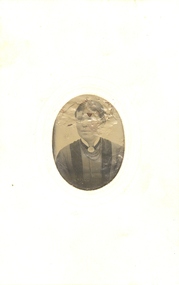 Federation University Historical Collection
Photograph - Little Gem tintype, Portrait of a Woman
... well. Although Gove and Allen studios produced the majority of gem tintypes in Australia, other studios offered them including: - London, American & Sydney Photo Company, 328 George St, Sydney; - David Edelsten, 55 & 57 Bourke St, Melbourne; - Burman's Portrait Rooms, St. George's Hall, 209 Bourke St, Melbourne; - Bell's Gem Portrait Studio, 57 Bourke St East, Melbourne; - R. H. Kenny, Bridge St, Ballarat; - Marinus W ...The tintype (or ferrotype or Melainotype) was produced on metallic sheet (not, actually, tin) instead of glass. The plate was coated with collodion and sensitized just before use. It was introduced by Adolphe Alexandre Martin in 1853. The most common size was about the same as the carte-de-visite, 5.5cm x 9.0cm, but both larger and smaller ferrotypes were made. The smallest were "Little Gem" tintypes, about the size of a postage-stamp, made simultaneously on a single plate in a camera with 12 or 16 lenses. They were often produced by travelling photographers, and were cheaper than Ambrotypes so made photography available to working classes, not just to the more well-to-do. The print would come out laterally reversed (as one sees oneself in a mirror). Being quite rugged, tintypes could be sent by post. Tintypes were eventually superseded by gelatin emulsion dry plates in the 1880s, though street photographers in various parts of the world continued with this process until the 1950s. (Above information abridged from http://www.rleggat.com/photohistory/history/tintype.htm) The firm of Gove and Allen opened in Sydney in 1880 and were responsible for the belated popularizing of the gem tintype in Australia. The firm traded as both The American Gem Studio and The American Studio. Others franchises were opened in Melbourne, Ballarat and Sandhurst (Bendigo). The Sandhurst branch closed in 1882 and Adelaide in 1884. All Gove and Allen studios had ceased trading by 1885. The studio addresses were: 23 King William St, Adelaide; 324 George St, Sydney; 95 Swanston St, Melbourne; Howard Place, Sandhurst; 7 Queen St, Brisbane; The card mounts used in Gove and Allen studios in Australia are identical to those used in America. They were initially made of plain white card with embossing around the oval image opening in the mount while some also had simple geometric and floral printed designs as well. Although Gove and Allen studios produced the majority of gem tintypes in Australia, other studios offered them including: - London, American & Sydney Photo Company, 328 George St, Sydney; - David Edelsten, 55 & 57 Bourke St, Melbourne; - Burman's Portrait Rooms, St. George's Hall, 209 Bourke St, Melbourne; - Bell's Gem Portrait Studio, 57 Bourke St East, Melbourne; - R. H. Kenny, Bridge St, Ballarat; - Marinus W. Bent, Sandhurst (Bendigo); - George Fisher, Victoria; - Anson Brothers, Hobart Town. (Abridged information from http://members.ozemail.com.au/~msafier/photos/tintypes.html) .3) A tintype portrait of a woman, attached to a card. little gem, tintype, woman, unidentified woman, women -
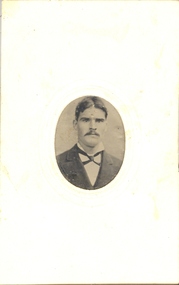 Federation University Historical Collection
Photograph - Little Gem tintype, Portrait of a Man
... well. Although Gove and Allen studios produced the majority of gem tintypes in Australia, other studios offered them including: - London, American & Sydney Photo Company, 328 George St, Sydney; - David Edelsten, 55 & 57 Bourke St, Melbourne; - Burman's Portrait Rooms, St. George's Hall, 209 Bourke St, Melbourne; - Bell's Gem Portrait Studio, 57 Bourke St East, Melbourne; - R. H. Kenny, Bridge St, Ballarat; - Marinus W...well. Although Gove and Allen studios produced the majority of gem tintypes in Australia, other studios offered them including: - London, American & Sydney Photo Company, 328 George St, Sydney; - David Edelsten, 55 & 57 Bourke St, Melbourne; - Burman's Portrait Rooms, St. George's Hall, 209 Bourke St, Melbourne; - Bell's Gem Portrait Studio, 57 Bourke St East, Melbourne; - R. H. Kenny, Bridge St, Ballarat; - Marinus W ...The tintype (or ferrotype or Melainotype) was produced on metallic sheet (not, actually, tin) instead of glass. The plate was coated with collodion and sensitized just before use. It was introduced by Adolphe Alexandre Martin in 1853. The most common size was about the same as the carte-de-visite, 5.5cm x 9.0cm, but both larger and smaller ferrotypes were made. The smallest were "Little Gem" tintypes, about the size of a postage-stamp, made simultaneously on a single plate in a camera with 12 or 16 lenses. They were often produced by travelling photographers, and were cheaper than Ambrotypes so made photography available to working classes, not just to the more well-to-do. The print would come out laterally reversed (as one sees oneself in a mirror). Being quite rugged, tintypes could be sent by post. Tintypes were eventually superseded by gelatin emulsion dry plates in the 1880s, though street photographers in various parts of the world continued with this process until the 1950s. (Above information abridged from http://www.rleggat.com/photohistory/history/tintype.htm) The firm of Gove and Allen opened in Sydney in 1880 and were responsible for the belated popularizing of the gem tintype in Australia. The firm traded as both The American Gem Studio and The American Studio. Others franchises were opened in Melbourne, Ballarat and Sandhurst (Bendigo). The Sandhurst branch closed in 1882 and Adelaide in 1884. All Gove and Allen studios had ceased trading by 1885. The studio addresses were: 23 King William St, Adelaide; 324 George St, Sydney; 95 Swanston St, Melbourne; Howard Place, Sandhurst; 7 Queen St, Brisbane; The card mounts used in Gove and Allen studios in Australia are identical to those used in America. They were initially made of plain white card with embossing around the oval image opening in the mount while some also had simple geometric and floral printed designs as well. Although Gove and Allen studios produced the majority of gem tintypes in Australia, other studios offered them including: - London, American & Sydney Photo Company, 328 George St, Sydney; - David Edelsten, 55 & 57 Bourke St, Melbourne; - Burman's Portrait Rooms, St. George's Hall, 209 Bourke St, Melbourne; - Bell's Gem Portrait Studio, 57 Bourke St East, Melbourne; - R. H. Kenny, Bridge St, Ballarat; - Marinus W. Bent, Sandhurst (Bendigo); - George Fisher, Victoria; - Anson Brothers, Hobart Town. (Abridged information from http://members.ozemail.com.au/~msafier/photos/tintypes.html) .4) A tintype portrait of a man, attached to a card. little gem, tintype, man, unidentified man -
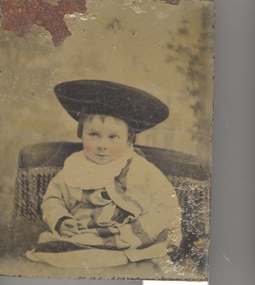 Federation University Historical Collection
Photograph - Photograph - Little Gem tintype, Possibly American Studio, Portrait of a child
... well. Although Gove and Allen studios produced the majority of gem tintypes in Australia, other studios offered them including: - London, American & Sydney Photo Company, 328 George St, Sydney; - David Edelsten, 55 & 57 Bourke St, Melbourne; - Burman's Portrait Rooms, St. George's Hall, 209 Bourke St, Melbourne; - Bell's Gem Portrait Studio, 57 Bourke St East, Melbourne; - R. H. Kenny, Bridge St, Ballarat; - Marinus W...well. Although Gove and Allen studios produced the majority of gem tintypes in Australia, other studios offered them including: - London, American & Sydney Photo Company, 328 George St, Sydney; - David Edelsten, 55 & 57 Bourke St, Melbourne; - Burman's Portrait Rooms, St. George's Hall, 209 Bourke St, Melbourne; - Bell's Gem Portrait Studio, 57 Bourke St East, Melbourne; - R. H. Kenny, Bridge St, Ballarat; - Marinus W ...The tintype (or ferrotype or Melainotype) was produced on metallic sheet (not, actually, tin) instead of glass. The plate was coated with collodion and sensitized just before use. It was introduced by Adolphe Alexandre Martin in 1853. The most common size was about the same as the carte-de-visite, 5.5cm x 9.0cm, but both larger and smaller ferrotypes were made. The smallest were "Little Gem" tintypes, about the size of a postage-stamp, made simultaneously on a single plate in a camera with 12 or 16 lenses. They were often produced by travelling photographers, and were cheaper than Ambrotypes so made photography available to working classes, not just to the more well-to-do. The print would come out laterally reversed (as one sees oneself in a mirror). Being quite rugged, tintypes could be sent by post. Tintypes were eventually superseded by gelatin emulsion dry plates in the 1880s, though street photographers in various parts of the world continued with this process until the 1950s. (Above information abridged from http://www.rleggat.com/photohistory/history/tintype.htm) The firm of Gove and Allen opened in Sydney in 1880 and were responsible for the belated popularizing of the gem tintype in Australia. The firm traded as both The American Gem Studio and The American Studio. Others franchises were opened in Melbourne, Ballarat and Sandhurst (Bendigo). The Sandhurst branch closed in 1882 and Adelaide in 1884. All Gove and Allen studios had ceased trading by 1885. The studio addresses were: 23 King William St, Adelaide; 324 George St, Sydney; 95 Swanston St, Melbourne; Howard Place, Sandhurst; 7 Queen St, Brisbane; The card mounts used in Gove and Allen studios in Australia are identical to those used in America. They were initially made of plain white card with embossing around the oval image opening in the mount while some also had simple geometric and floral printed designs as well. Although Gove and Allen studios produced the majority of gem tintypes in Australia, other studios offered them including: - London, American & Sydney Photo Company, 328 George St, Sydney; - David Edelsten, 55 & 57 Bourke St, Melbourne; - Burman's Portrait Rooms, St. George's Hall, 209 Bourke St, Melbourne; - Bell's Gem Portrait Studio, 57 Bourke St East, Melbourne; - R. H. Kenny, Bridge St, Ballarat; - Marinus W. Bent, Sandhurst (Bendigo); - George Fisher, Victoria; - Anson Brothers, Hobart Town. (Abridged information from http://members.ozemail.com.au/~msafier/photos/tintypes.html) A tintype portrait of a child, attached to a card. little gem, child, hat -
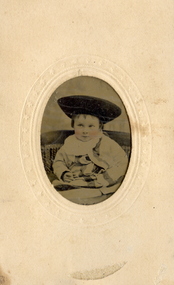 Federation University Historical Collection
Photograph - Photo - Little Gem tintype, Possibly American Studio, Portrait of a child
... well. Although Gove and Allen studios produced the majority of gem tintypes in Australia, other studios offered them including: - London, American & Sydney Photo Company, 328 George St, Sydney; - David Edelsten, 55 & 57 Bourke St, Melbourne; - Burman's Portrait Rooms, St. George's Hall, 209 Bourke St, Melbourne; - Bell's Gem Portrait Studio, 57 Bourke St East, Melbourne; - R. H. Kenny, Bridge St, Ballarat; - Marinus W...well. Although Gove and Allen studios produced the majority of gem tintypes in Australia, other studios offered them including: - London, American & Sydney Photo Company, 328 George St, Sydney; - David Edelsten, 55 & 57 Bourke St, Melbourne; - Burman's Portrait Rooms, St. George's Hall, 209 Bourke St, Melbourne; - Bell's Gem Portrait Studio, 57 Bourke St East, Melbourne; - R. H. Kenny, Bridge St, Ballarat; - Marinus W ...The tintype (or ferrotype or Melainotype) was produced on metallic sheet (not, actually, tin) instead of glass. The plate was coated with collodion and sensitized just before use. It was introduced by Adolphe Alexandre Martin in 1853. The most common size was about the same as the carte-de-visite, 5.5cm x 9.0cm, but both larger and smaller ferrotypes were made. The smallest were "Little Gem" tintypes, about the size of a postage-stamp, made simultaneously on a single plate in a camera with 12 or 16 lenses. They were often produced by travelling photographers, and were cheaper than Ambrotypes so made photography available to working classes, not just to the more well-to-do. The print would come out laterally reversed (as one sees oneself in a mirror). Being quite rugged, tintypes could be sent by post. Tintypes were eventually superseded by gelatin emulsion dry plates in the 1880s, though street photographers in various parts of the world continued with this process until the 1950s. (Above information abridged from http://www.rleggat.com/photohistory/history/tintype.htm) The firm of Gove and Allen opened in Sydney in 1880 and were responsible for the belated popularizing of the gem tintype in Australia. The firm traded as both The American Gem Studio and The American Studio. Others franchises were opened in Melbourne, Ballarat and Sandhurst (Bendigo). The Sandhurst branch closed in 1882 and Adelaide in 1884. All Gove and Allen studios had ceased trading by 1885. The studio addresses were: 23 King William St, Adelaide; 324 George St, Sydney; 95 Swanston St, Melbourne; Howard Place, Sandhurst; 7 Queen St, Brisbane; The card mounts used in Gove and Allen studios in Australia are identical to those used in America. They were initially made of plain white card with embossing around the oval image opening in the mount while some also had simple geometric and floral printed designs as well. Although Gove and Allen studios produced the majority of gem tintypes in Australia, other studios offered them including: - London, American & Sydney Photo Company, 328 George St, Sydney; - David Edelsten, 55 & 57 Bourke St, Melbourne; - Burman's Portrait Rooms, St. George's Hall, 209 Bourke St, Melbourne; - Bell's Gem Portrait Studio, 57 Bourke St East, Melbourne; - R. H. Kenny, Bridge St, Ballarat; - Marinus W. Bent, Sandhurst (Bendigo); - George Fisher, Victoria; - Anson Brothers, Hobart Town. (Abridged information from http://members.ozemail.com.au/~msafier/photos/tintypes.html) .5) A tintype portrait of a child, attached to a card. little gem, photography, child, portrait -
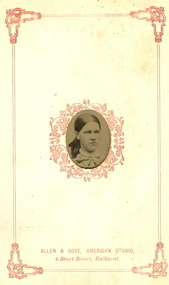 Federation University Historical Collection
Photograph - Photograph - Little Gem tintype, American Studio, Portrait of a Woman
... well. Although Gove and Allen studios produced the majority of gem tintypes in Australia, other studios offered them including: - London, American & Sydney Photo Company, 328 George St, Sydney; - David Edelsten, 55 & 57 Bourke St, Melbourne; - Burman's Portrait Rooms, St. George's Hall, 209 Bourke St, Melbourne; - Bell's Gem Portrait Studio, 57 Bourke St East, Melbourne; - R. H. Kenny, Bridge St, Ballarat; - Marinus W...well. Although Gove and Allen studios produced the majority of gem tintypes in Australia, other studios offered them including: - London, American & Sydney Photo Company, 328 George St, Sydney; - David Edelsten, 55 & 57 Bourke St, Melbourne; - Burman's Portrait Rooms, St. George's Hall, 209 Bourke St, Melbourne; - Bell's Gem Portrait Studio, 57 Bourke St East, Melbourne; - R. H. Kenny, Bridge St, Ballarat; - Marinus W ...The tintype (or ferrotype or Melainotype) was produced on metallic sheet (not, actually, tin) instead of glass. The plate was coated with collodion and sensitized just before use. It was introduced by Adolphe Alexandre Martin in 1853. The most common size was about the same as the carte-de-visite, 5.5cm x 9.0cm, but both larger and smaller ferrotypes were made. The smallest were "Little Gem" tintypes, about the size of a postage-stamp, made simultaneously on a single plate in a camera with 12 or 16 lenses. They were often produced by travelling photographers, and were cheaper than Ambrotypes so made photography available to working classes, not just to the more well-to-do. The print would come out laterally reversed (as one sees oneself in a mirror). Being quite rugged, tintypes could be sent by post. Tintypes were eventually superseded by gelatin emulsion dry plates in the 1880s, though street photographers in various parts of the world continued with this process until the 1950s. (Above information abridged from http://www.rleggat.com/photohistory/history/tintype.htm) The firm of Gove and Allen opened in Sydney in 1880 and were responsible for the belated popularizing of the gem tintype in Australia. The firm traded as both The American Gem Studio and The American Studio. Others franchises were opened in Melbourne, 6 Sturt St Ballarat and Sandhurst (Bendigo). The Sandhurst branch closed in 1882 and Adelaide in 1884. All Gove and Allen studios had ceased trading by 1885. The studio addresses were: 23 King William St, Adelaide; 324 George St, Sydney; 95 Swanston St, Melbourne; Howard Place, Sandhurst; 7 Queen St, Brisbane; The card mounts used in Gove and Allen studios in Australia are identical to those used in America. They were initially made of plain white card with embossing around the oval image opening in the mount while some also had simple geometric and floral printed designs as well. Although Gove and Allen studios produced the majority of gem tintypes in Australia, other studios offered them including: - London, American & Sydney Photo Company, 328 George St, Sydney; - David Edelsten, 55 & 57 Bourke St, Melbourne; - Burman's Portrait Rooms, St. George's Hall, 209 Bourke St, Melbourne; - Bell's Gem Portrait Studio, 57 Bourke St East, Melbourne; - R. H. Kenny, Bridge St, Ballarat; - Marinus W. Bent, Sandhurst (Bendigo); - George Fisher, Victoria; - Anson Brothers, Hobart Town. (Abridged information from http://members.ozemail.com.au/~msafier/photos/tintypes.html) A tintype portrait of a woman's head, attached to a card. Printed on the lower edge of the card "Allen & Gove, American Studion, 6 Sturt St, Ballarat"ballarat, american studio, little gem, allen gove, tintype, woman, unidentified woman, photography -
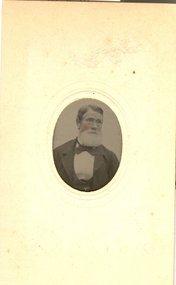 Federation University Historical Collection
Photograph - Little Gem tintype, Portrait of a Man
... well. Although Gove and Allen studios produced the majority of gem tintypes in Australia, other studios offered them including: - London, American & Sydney Photo Company, 328 George St, Sydney; - David Edelsten, 55 & 57 Bourke St, Melbourne; - Burman's Portrait Rooms, St. George's Hall, 209 Bourke St, Melbourne; - Bell's Gem Portrait Studio, 57 Bourke St East, Melbourne; - R. H. Kenny, Bridge St, 6 Sturt St Ballarat; - Marinus W ...The tintype (or ferrotype or Melainotype) was produced on metallic sheet (not, actually, tin) instead of glass. The plate was coated with collodion and sensitized just before use. It was introduced by Adolphe Alexandre Martin in 1853. The most common size was about the same as the carte-de-visite, 5.5cm x 9.0cm, but both larger and smaller ferrotypes were made. The smallest were "Little Gem" tintypes, about the size of a postage-stamp, made simultaneously on a single plate in a camera with 12 or 16 lenses. They were often produced by travelling photographers, and were cheaper than Ambrotypes so made photography available to working classes, not just to the more well-to-do. The print would come out laterally reversed (as one sees oneself in a mirror). Being quite rugged, tintypes could be sent by post. Tintypes were eventually superseded by gelatin emulsion dry plates in the 1880s, though street photographers in various parts of the world continued with this process until the 1950s. (Above information abridged from http://www.rleggat.com/photohistory/history/tintype.htm) The firm of Gove and Allen opened in Sydney in 1880 and were responsible for the belated popularizing of the gem tintype in Australia. The firm traded as both The American Gem Studio and The American Studio. Others franchises were opened in Melbourne, Ballarat and Sandhurst (Bendigo). The Sandhurst branch closed in 1882 and Adelaide in 1884. All Gove and Allen studios had ceased trading by 1885. The studio addresses were: 23 King William St, Adelaide; 324 George St, Sydney; 95 Swanston St, Melbourne; Howard Place, Sandhurst; 7 Queen St, Brisbane; The card mounts used in Gove and Allen studios in Australia are identical to those used in America. They were initially made of plain white card with embossing around the oval image opening in the mount while some also had simple geometric and floral printed designs as well. Although Gove and Allen studios produced the majority of gem tintypes in Australia, other studios offered them including: - London, American & Sydney Photo Company, 328 George St, Sydney; - David Edelsten, 55 & 57 Bourke St, Melbourne; - Burman's Portrait Rooms, St. George's Hall, 209 Bourke St, Melbourne; - Bell's Gem Portrait Studio, 57 Bourke St East, Melbourne; - R. H. Kenny, Bridge St, 6 Sturt St Ballarat; - Marinus W. Bent, Sandhurst (Bendigo); - George Fisher, Victoria; - Anson Brothers, Hobart Town. (Abridged information from http://members.ozemail.com.au/~msafier/photos/tintypes.html) .8)A tintype portrait of a man's head, attached to a card. The cheeks have been hand coloured.little gem -
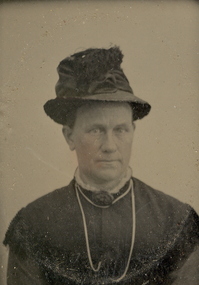 Federation University Historical Collection
Photograph - Little Gem tintype, Portrait of a Woman in a hat
... well. Although Gove and Allen studios produced the majority of gem tintypes in Australia, other studios offered them including: - London, American & Sydney Photo Company, 328 George St, Sydney; - David Edelsten, 55 & 57 Bourke St, Melbourne; - Burman's Portrait Rooms, St. George's Hall, 209 Bourke St, Melbourne; - Bell's Gem Portrait Studio, 57 Bourke St East, Melbourne; - R. H. Kenny, Bridge St, 6 Sturt St Ballarat; - Marinus W...well. Although Gove and Allen studios produced the majority of gem tintypes in Australia, other studios offered them including: - London, American & Sydney Photo Company, 328 George St, Sydney; - David Edelsten, 55 & 57 Bourke St, Melbourne; - Burman's Portrait Rooms, St. George's Hall, 209 Bourke St, Melbourne; - Bell's Gem Portrait Studio, 57 Bourke St East, Melbourne; - R. H. Kenny, Bridge St, 6 Sturt St Ballarat; - Marinus W ...The tintype (or ferrotype or Melainotype) was produced on metallic sheet (not, actually, tin) instead of glass. The plate was coated with collodion and sensitized just before use. It was introduced by Adolphe Alexandre Martin in 1853. The most common size was about the same as the carte-de-visite, 5.5cm x 9.0cm, but both larger and smaller ferrotypes were made. The smallest were "Little Gem" tintypes, about the size of a postage-stamp, made simultaneously on a single plate in a camera with 12 or 16 lenses. They were often produced by travelling photographers, and were cheaper than Ambrotypes so made photography available to working classes, not just to the more well-to-do. The print would come out laterally reversed (as one sees oneself in a mirror). Being quite rugged, tintypes could be sent by post. Tintypes were eventually superseded by gelatin emulsion dry plates in the 1880s, though street photographers in various parts of the world continued with this process until the 1950s. (Above information abridged from http://www.rleggat.com/photohistory/history/tintype.htm) The firm of Gove and Allen opened in Sydney in 1880 and were responsible for the belated popularizing of the gem tintype in Australia. The firm traded as both The American Gem Studio and The American Studio. Others franchises were opened in Melbourne, Ballarat and Sandhurst (Bendigo). The Sandhurst branch closed in 1882 and Adelaide in 1884. All Gove and Allen studios had ceased trading by 1885. The studio addresses were: 23 King William St, Adelaide; 324 George St, Sydney; 95 Swanston St, Melbourne; Howard Place, Sandhurst; 7 Queen St, Brisbane; The card mounts used in Gove and Allen studios in Australia are identical to those used in America. They were initially made of plain white card with embossing around the oval image opening in the mount while some also had simple geometric and floral printed designs as well. Although Gove and Allen studios produced the majority of gem tintypes in Australia, other studios offered them including: - London, American & Sydney Photo Company, 328 George St, Sydney; - David Edelsten, 55 & 57 Bourke St, Melbourne; - Burman's Portrait Rooms, St. George's Hall, 209 Bourke St, Melbourne; - Bell's Gem Portrait Studio, 57 Bourke St East, Melbourne; - R. H. Kenny, Bridge St, 6 Sturt St Ballarat; - Marinus W. Bent, Sandhurst (Bendigo); - George Fisher, Victoria; - Anson Brothers, Hobart Town. (Abridged information from http://members.ozemail.com.au/~msafier/photos/tintypes.html) .9) A tintype portrait of a woman's head, attached to a card. The cheeks have been hand coloured.little gem, woman, unidentified woman, women, photography -
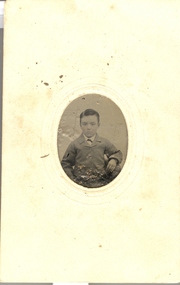 Federation University Historical Collection
Photograph - Little Gem tintype, Possibly American Studio, Portrait of a Boy
... well. Although Gove and Allen studios produced the majority of gem tintypes in Australia, other studios offered them including: - London, American & Sydney Photo Company, 328 George St, Sydney; - David Edelsten, 55 & 57 Bourke St, Melbourne; - Burman's Portrait Rooms, St. George's Hall, 209 Bourke St, Melbourne; - Bell's Gem Portrait Studio, 57 Bourke St East, Melbourne; - R. H. Kenny, Bridge St, 6 Sturt St Ballarat; - Marinus W...well. Although Gove and Allen studios produced the majority of gem tintypes in Australia, other studios offered them including: - London, American & Sydney Photo Company, 328 George St, Sydney; - David Edelsten, 55 & 57 Bourke St, Melbourne; - Burman's Portrait Rooms, St. George's Hall, 209 Bourke St, Melbourne; - Bell's Gem Portrait Studio, 57 Bourke St East, Melbourne; - R. H. Kenny, Bridge St, 6 Sturt St Ballarat; - Marinus W ...The tintype (or ferrotype or Melainotype) was produced on metallic sheet (not, actually, tin) instead of glass. The plate was coated with collodion and sensitized just before use. It was introduced by Adolphe Alexandre Martin in 1853. The most common size was about the same as the carte-de-visite, 5.5cm x 9.0cm, but both larger and smaller ferrotypes were made. The smallest were "Little Gem" tintypes, about the size of a postage-stamp, made simultaneously on a single plate in a camera with 12 or 16 lenses. They were often produced by travelling photographers, and were cheaper than Ambrotypes so made photography available to working classes, not just to the more well-to-do. The print would come out laterally reversed (as one sees oneself in a mirror). Being quite rugged, tintypes could be sent by post. Tintypes were eventually superseded by gelatin emulsion dry plates in the 1880s, though street photographers in various parts of the world continued with this process until the 1950s. (Above information abridged from http://www.rleggat.com/photohistory/history/tintype.htm) The firm of Gove and Allen opened in Sydney in 1880 and were responsible for the belated popularizing of the gem tintype in Australia. The firm traded as both The American Gem Studio and The American Studio. Others franchises were opened in Melbourne, Ballarat and Sandhurst (Bendigo). The Sandhurst branch closed in 1882 and Adelaide in 1884. All Gove and Allen studios had ceased trading by 1885. The studio addresses were: 23 King William St, Adelaide; 324 George St, Sydney; 95 Swanston St, Melbourne; Howard Place, Sandhurst; 7 Queen St, Brisbane; The card mounts used in Gove and Allen studios in Australia are identical to those used in America. They were initially made of plain white card with embossing around the oval image opening in the mount while some also had simple geometric and floral printed designs as well. Although Gove and Allen studios produced the majority of gem tintypes in Australia, other studios offered them including: - London, American & Sydney Photo Company, 328 George St, Sydney; - David Edelsten, 55 & 57 Bourke St, Melbourne; - Burman's Portrait Rooms, St. George's Hall, 209 Bourke St, Melbourne; - Bell's Gem Portrait Studio, 57 Bourke St East, Melbourne; - R. H. Kenny, Bridge St, 6 Sturt St Ballarat; - Marinus W. Bent, Sandhurst (Bendigo); - George Fisher, Victoria; - Anson Brothers, Hobart Town. (Abridged information from http://members.ozemail.com.au/~msafier/photos/tintypes.html) .9) A tintype portrait of a child's head and torso, attached to a card. The boy is wearing a suit and the cheeks have been hand coloured.little gem -
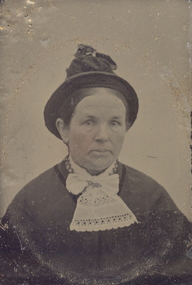 Federation University Historical Collection
Photograph - Little Gem tintype, Portrait of a Woman in a Hat
... well. Although Gove and Allen studios produced the majority of gem tintypes in Australia, other studios offered them including: - London, American & Sydney Photo Company, 328 George St, Sydney; - David Edelsten, 55 & 57 Bourke St, Melbourne; - Burman's Portrait Rooms, St. George's Hall, 209 Bourke St, Melbourne; - Bell's Gem Portrait Studio, 57 Bourke St East, Melbourne; - R. H. Kenny, Bridge St, 6 Sturt St Ballarat; - Marinus W...well. Although Gove and Allen studios produced the majority of gem tintypes in Australia, other studios offered them including: - London, American & Sydney Photo Company, 328 George St, Sydney; - David Edelsten, 55 & 57 Bourke St, Melbourne; - Burman's Portrait Rooms, St. George's Hall, 209 Bourke St, Melbourne; - Bell's Gem Portrait Studio, 57 Bourke St East, Melbourne; - R. H. Kenny, Bridge St, 6 Sturt St Ballarat; - Marinus W ...The tintype (or ferrotype or Melainotype) was produced on metallic sheet (not, actually, tin) instead of glass. The plate was coated with collodion and sensitized just before use. It was introduced by Adolphe Alexandre Martin in 1853. The most common size was about the same as the carte-de-visite, 5.5cm x 9.0cm, but both larger and smaller ferrotypes were made. The smallest were "Little Gem" tintypes, about the size of a postage-stamp, made simultaneously on a single plate in a camera with 12 or 16 lenses. They were often produced by travelling photographers, and were cheaper than Ambrotypes so made photography available to working classes, not just to the more well-to-do. The print would come out laterally reversed (as one sees oneself in a mirror). Being quite rugged, tintypes could be sent by post. Tintypes were eventually superseded by gelatin emulsion dry plates in the 1880s, though street photographers in various parts of the world continued with this process until the 1950s. (Above information abridged from http://www.rleggat.com/photohistory/history/tintype.htm) The firm of Gove and Allen opened in Sydney in 1880 and were responsible for the belated popularizing of the gem tintype in Australia. The firm traded as both The American Gem Studio and The American Studio. Others franchises were opened in Melbourne, Ballarat and Sandhurst (Bendigo). The Sandhurst branch closed in 1882 and Adelaide in 1884. All Gove and Allen studios had ceased trading by 1885. The studio addresses were: 23 King William St, Adelaide; 324 George St, Sydney; 95 Swanston St, Melbourne; Howard Place, Sandhurst; 7 Queen St, Brisbane; The card mounts used in Gove and Allen studios in Australia are identical to those used in America. They were initially made of plain white card with embossing around the oval image opening in the mount while some also had simple geometric and floral printed designs as well. Although Gove and Allen studios produced the majority of gem tintypes in Australia, other studios offered them including: - London, American & Sydney Photo Company, 328 George St, Sydney; - David Edelsten, 55 & 57 Bourke St, Melbourne; - Burman's Portrait Rooms, St. George's Hall, 209 Bourke St, Melbourne; - Bell's Gem Portrait Studio, 57 Bourke St East, Melbourne; - R. H. Kenny, Bridge St, 6 Sturt St Ballarat; - Marinus W. Bent, Sandhurst (Bendigo); - George Fisher, Victoria; - Anson Brothers, Hobart Town. (Abridged information from http://members.ozemail.com.au/~msafier/photos/tintypes.html) A tintype portrait of a woman's head and shoulders, attached to a card. The cheeks have been hand coloured.little gem, woman, unidentified woman, women, photography -
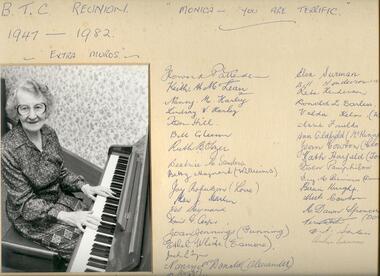 Federation University Historical Collection
Photograph, Monica Miller photograph, BTC Reunion 1947 - 1982
... Monica was a well-loved music teacher at the Ballarat Teachers' College. ballarat teachers' college monica miller Lynette Vickery (Lynch) Beth Stutterd (Leslie) Howard Pattender Keith H. M. Lean Nancy M. Harley Lindsay W ...Monica was a well-loved music teacher at the Ballarat Teachers' College.Black and white photograph in cream matte board. Monica Miller sits at the piano. Those who attended the BTC Reunion 1947 - 1982 signed the mountballarat teachers' college, monica miller, lynette vickery (lynch), beth stutterd (leslie), howard pattender, keith h. m. lean, nancy m. harley, lindsay w. harley, jon hill, bill gleeson, ruth b gozer, beatrice m. sanders, betty maynard (williams), joy anderson (love), stan j marlen, wal maynard, david g. cooper, joan jennings (gunning), etherl white (esmore), jack ..., nancy mcdonald (alexander), pat watts (knight), lorna davis (welsh), joyce fraser (mathison), hugh fraser, margaret alexander (palmer), maurene canter (merlin), elva surman, bill henderson, reta henderson, ronald l. earless, valda kelm (witney), marie faulds, ann oldfield (mckinnen), jean cowton (clode), kath harfield (tobin), groen pamphilon, inez m bemirs (domascheng), bernie kurght, mick cowton, m. dawn spencer (doney), vern white, n.t. sanders, arther ..., -
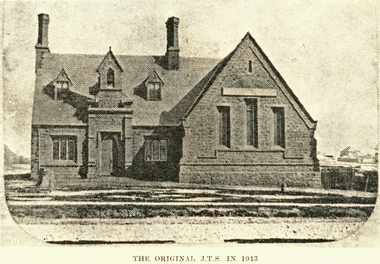 Federation University Historical Collection
Magazine - Booklet, F.W. Niven, Ballarat School of Mines Students' Magazine, 1957, 1957
... W. Eyers R. Ross G. Dreever R. Ross I. Beaumont R. Parker G. Waller J. Rash J. Sarah J. Walters P. Rowe L. Drummond R. Whitcher R. Ingle I. Pollock P. Bilney I. Collier L. Thomas G. Leslie P. Schoutens A. Morris G. Wells B. McGregor J. Bedggood K. Spencer J. Vincent J. Elliott J. Whitten G. Higgins G. Le Couteur H ...The Ballarat School of Mines produced an annual students' magazine from 1899 - 1966. Contents include, School Council, Members of Staff, 1st Corbould Scholarship, Australian Speech, Art Lending Library, Literary Society, football, Boys' Junior Technical School, Bullarto Camp Reunion, John Leckie, Stan Hillman, Girls' Junior Technical School, Parliament House, Ballarat North Junior Technical School Images include: Craig's Royal Hotel, Peter Robinson, John Thomas Huyton Clelland, John Wolfe, Bernie Gallagher, Nelson Hails, John Gowan, Beverley Selkirk, Pat Collier, Barry Singleton Mara Jekabsons, Bill Widdop, Neil Brogden, frank Pomeroy, Laurence Trevan, Neville Bunning, Jim McKay, Malcolm Hausler, Josephine Young, George Lewis, Alan Clarke, Norman Leckie, Andrew Atkins, Lorette Davey, Noel Flood, Denis Bryan, SMB Football Team, SMB Athletics Team, SMB Baseball Team, SMB Basketball Team, SMB Tennis Team, Athletic Champions, R. Ross, I. Beaumont, R. Parker, G. Waller, John Rash, J. Sarah, J. Walters, P. Rowe, L. Drummond, R. Whitcher, ATC Flight No 24, BJTS Football Team, BJTS Swimming Team, BJTS Tennis Team, BJTS Athletics Squad, BJTS Cricket Team, BJTS Softball team and coach, W. Sawall, L. McDonald, K. Penna, J. Clarke, K. Rogers, Mr Wilson, F. Holmes, graham Manning, Andrew Brumby, Kevin Rogers, Graham Walters, Yellow soft covered students' magazine of 92 pages. keith alexander, brian bellingham, neil brogden, bernie gallagher, john gowan, francis hunting, teng hor khoo, teng seong khoo, norman leckie, boon thiam lu, brian mclennan, peter russell, chookiate sirivingse, laurie trean, john wolfe, ballarat school of mines, peter robinson, john thomas huyton clelland, d. w. brown, n. bunning, jim mckay, barry singleton, malcolm hausler, josephine young, george lewis, alan clarke, andrew atkins, lorette davey, noel flood, denis bryans, john mckenzie, robert skewes, ian fraser, walter reimann, pat collier, ralph hepburn, peter m. robinson, a. bethune, j. lane, d. colbourn, w. etty, b. bellingham, n. hails, t. white, p. agrums, w. widdop, f. pomeroy, b. singleton, j. mckay, j. pollock, r. cutter, d. vendy, j. wolfe, p. collier, w. bowtell, r. hepburn, w. wynd, p. menz, b. dunstan, j. gowan, l. groat, g. westwood, j. erdmanis, a. rock, k. alexander, p. walker, w. reimann, n. delosa, b. mclennan, a. clarke, g. wilson, t. coad, j. caldwell, d. chung, r. champneys, j. mckenzie, b. paterson, j. cowan, somnam nandhabiwat, w. spencer, p. schoutens, d. treller, gayle peterson, denise lockett, carmel dobbyn, margaret ayars, raymond jenkin, l. nester, w. eyers, r. ross, g. dreever, r. ross, i. beaumont, r. parker, g. waller, j. rash, j. sarah, j. walters, p. rowe, l. drummond, r. whitcher, r. ingle, i. pollock, p. bilney, i. collier, l. thomas, g. leslie, p. schoutens, a. morris, g. wells, b. mcgregor, j. bedggood, k. spencer, j. vincent, j. elliott, j. whitten, g. higgins, g. le couteur, h. mcdougall, g. wise, m. allen, d. pattie, i. collinson, c. kearns, g. severino, g. smith, n. smith, f. tolliday, r. williams, d. coldicott, m. hewitt, g. higgins, c. ludbrook, j. simpson, glenys spielvogel, norma davies, dawn ridgeway, carmel dobbyn, beverley davis, j. crouch, kathleen harris, j. walters, jan hunter, j. carroll, c. jenkins, lesley cutts, h. vagg, irene horgan, graham manning, andrew brumby, kevin rogers, graham walters, k. howell, n. malthouse, l. deppler, g. manning, n. nugent, b. antonio, r. mccarthy, mr morrison, r. mckenzie, w. wakeling, j. clarke, l. mayne, n. bromley, a. brumby, a. abrams, k. penna, r. button, p. linane, f. holmes, n. yean, mr love, miss atkins, p. cochrane, i. quick, mr mitchell, b. flynn, r. brown, k. penna, j. mcmahon, g. turnbull, n. skewes, d. vowles, d. blake, mr nuttall, g. borchers, i. greenbank, d. evans, j. whelan, j. milne, w. sawall, d. ward, r. rundell, mr ellerton, m. foy, l. reed, c. tilgals, peter agrums -
 Mission to Seafarers Victoria
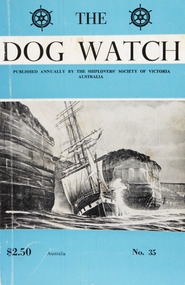
Journal (item) - Periodicals-Annual, Shiplovers' Society of Victoria, The Annual Dog Watch
... H. E. Turner R.N. (Ret) - 41 "Dennis" - Commander G. McKee R.D. R.N.R. - 44 The Hey-day of Passenger Services between the U.K. and Australia - N. E. Shannon - 46 The Drift of the Schooner "Tyulen" - Y. A. Shemanskij - 49 "Pamir" is well remembered - J. Hopton - 59 Plymouth's Heritage of Houses - E. Harper - 62 The Sinking of the "Ballarat" - A. F. Reid, O.B.E. - 64 The Boarding House - R. N. Thiele - 68 The "Aurora" - K. Broberg - 75 First Voyage - L. Adams - 82 The Salvage of the "Tango Maru" 1928 - Captain W...H. E. Turner R.N. (Ret) - 41 "Dennis" - Commander G. McKee R.D. R.N.R. - 44 The Hey-day of Passenger Services between the U.K. and Australia - N. E. Shannon - 46 The Drift of the Schooner "Tyulen" - Y. A. Shemanskij - 49 "Pamir" is well remembered - J. Hopton - 59 Plymouth's Heritage of Houses - E. Harper - 62 The Sinking of the "Ballarat" - A. F. Reid, O.B.E. - 64 The Boarding House - R. N. Thiele - 68 The "Aurora" - K. Broberg - 75 First Voyage - L. Adams - 82 The Salvage of the "Tango Maru" 1928 - Captain W ...This journal provides the reader with glimpses of the adventures and hardships of a seaman's life. Many of the stories are of sailing ships.Contributes to our knowledge of the importance of shipping and places on record those stories of the sea which would otherwise be lost.Contents Foreword - Sir John Holland - 5 Editorial - - 8 The "Lock Ard" J. M. MacKenzie - 13 "Moana" Interlude - Captain J. Gaby - 21 From Deckboy to Lord Chief Justice - R. Osmond - 32 Week-end at La Bera - I. L. Barton - 39 The Anchor on Mangalum Island - Commander H. E. Turner R.N. (Ret) - 41 "Dennis" - Commander G. McKee R.D. R.N.R. - 44 The Hey-day of Passenger Services between the U.K. and Australia - N. E. Shannon - 46 The Drift of the Schooner "Tyulen" - Y. A. Shemanskij - 49 "Pamir" is well remembered - J. Hopton - 59 Plymouth's Heritage of Houses - E. Harper - 62 The Sinking of the "Ballarat" - A. F. Reid, O.B.E. - 64 The Boarding House - R. N. Thiele - 68 The "Aurora" - K. Broberg - 75 First Voyage - L. Adams - 82 The Salvage of the "Tango Maru" 1928 - Captain W. J. Cowling - 92 Dismasted - Captain J. Aage. Wilson - 96 Pranks in the "Lauriston" - R. W. Rudd - 105 The Wreck of the "Hydrabad" Then and Now - D. McLennan - 107 Shipwrecks - C. E. Bonwick - 110 Oh, those English - Dr. Stanislaw Bernatt - 111 Diary of a Matelot, Part 3 - P. Watson - 112 Book Reviews - 121sailing ships, steamships, shipping, seafaring life, shiplovers' society of victoria, dog watch -
 Mission to Seafarers Victoria
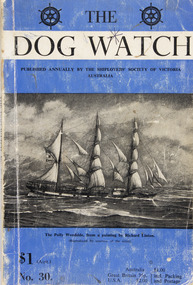
Journal (item) - Periodicals-Annual, Shiplovers' Society of Victoria, The Annual Dog Watch
... H. Scammell" - A. D. Long - 47 A Western Port Boatman - Arthur Woodley - 51 Apology To A Freighter - C. E. Bonwick - 52 When Ships Burned Coal -- The 'Black Gang' - E. Carpenter - 53 From The Galley -- Fried Chicken - R.G.E. - 57 Just a Bit Outside The Law - Captain C. Meyer - 59 More Of Pearling Off The ARU Islands - Capt. W. J. Cowling - 63 A Medal Well...H. Scammell" - A. D. Long - 47 A Western Port Boatman - Arthur Woodley - 51 Apology To A Freighter - C. E. Bonwick - 52 When Ships Burned Coal -- The 'Black Gang' - E. Carpenter - 53 From The Galley -- Fried Chicken - R.G.E. - 57 Just a Bit Outside The Law - Captain C. Meyer - 59 More Of Pearling Off The ARU Islands - Capt. W. J. Cowling - 63 A Medal Well ...This journal provides the reader with glimpses of the adventures and hardships of a seaman's life. Many of the stories are of sailing ships.Contributes to our knowledge of the importance of shipping and places on record those stories of the sea which would otherwise be lost.Contents Foreword - Commodore Dacre H. D. Smyth, R.A.N. - 7 Editorial - Pondering on Polly - 9 Progress Of The "Polly Woodside" - J. F. Yuncken - 13 Nearly Another "Birkenhead" - E. J. Batten - 21 Pawn Of The Storm - N. S. Smith - 27 The "Golden Plover" - I. L. Barton - 35 The "Brier Holme" - Ross Osmond - 43 The "Joseph H. Scammell" - A. D. Long - 47 A Western Port Boatman - Arthur Woodley - 51 Apology To A Freighter - C. E. Bonwick - 52 When Ships Burned Coal -- The 'Black Gang' - E. Carpenter - 53 From The Galley -- Fried Chicken - R.G.E. - 57 Just a Bit Outside The Law - Captain C. Meyer - 59 More Of Pearling Off The ARU Islands - Capt. W. J. Cowling - 63 A Medal Well Earned - L. A. Marchant - 70 The Tale Of The "Komet" - Harrow Morgan - 72 A Passage From England To Australia in the "Gauntlet" - Sven Tvermoes - 79 A Tug Of The Past - H. R. Watson - 94 Commodore Beal To The Rescue - Capt. F. K. Klebingat - 98 The Peacock From The Sea - J. M. MacKenzie - 106 The Man From Timbuctoo - L. de Neumann - 110 H.M.A.S. "Tingira" - D. C. Ricketts - 112 Inverneill At Iquiqui 1912 - Major M. H. O. Forbes - 116 The "Bear" - S. A. E. Strom - 121 Book Reviews - - 125 Glossary - - 128 More After Thoughts - W. F. Cook - 129sailing ships, steamships, shipping, seafaring life, shiplovers' society of victoria, dog watch, polly woodside -
 Mission to Seafarers Victoria
Photograph, 14 February 1928
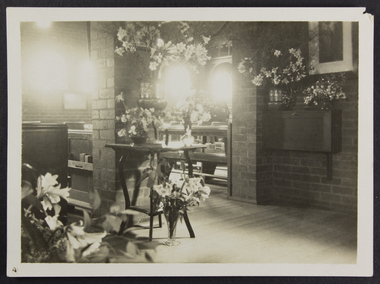
... H. Simpson, of Mornington. A group of her fellow workers decorated the chapel with lovely pink and white gladioli, carnations and roses. The ceremony was performed by the Rev. J. R. Weller, chaplain of the Mission, and the bride was given away by her father, Mr A. W...H. Simpson, of Mornington. A group of her fellow workers decorated the chapel with lovely pink and white gladioli, carnations and roses. The ceremony was performed by the Rev. J. R. Weller, chaplain of the Mission, and the bride was given away by her father, Mr A. W ...The article in the Herald of the day describes the event: "WEDDING AT SEAMEN'S CHAPEL Reception at Hotel Windsor The pretty little chapel at the Seamen's Institute was packed with interested friends this afternoon, when Miss Dora Walker, one of the Mission's most enthusiastic and efficient voluntary helpers, chose it as the setting for her marriage with Mr H. P. Simpson, son of Mr and Mrs J. H. Simpson, of Mornington. A group of her fellow workers decorated the chapel with lovely pink and white gladioli, carnations and roses. The ceremony was performed by the Rev. J. R. Weller, chaplain of the Mission, and the bride was given away by her father, Mr A. W. Walker, of Manning road, East Malvern. She wore a lovely ivory georgette frock, the finely tucked skirt being fashioned with a deep transparent hem of Chantilly lace. Over it fell a beautiful Honiton lace veil mounted on tulle and arranged to give the ef fect of a train. Fragrant white roses composed her bouquet. Two attendants followed her down the aisle — her sister, Miss Molly Walker, and Miss Ella Kendall — both wearing dainty shrimp pink georgette frocks and large crinoline straw hats in the same shade with a dainty edging of tulle. They carried bouquets of pink cactus dahlias nnd delphiniums. Mr Louis Buscombe was best man, and Mr George Thompson grooms man. After the ceremony Mr and Mrs Walker entertained about 50 guests at the Hotel Windsor."In 1928 there were not many stained glass windows in the chapel, giving that bright light inside.2 original prints and a reprinted versionwedding, dora walker, st peter chapel, flinders street, dora simpson, lhlg, amy dora walker, molly walker, elle kendall, reverend j.r. weller, harry simpson, missals, flowers, bookcase -
 Mission to Seafarers Victoria
Photograph, 14 February 1928
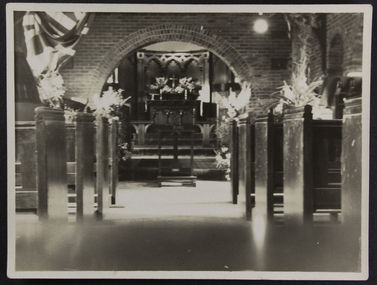
... H. Simpson, of Mornington. A group of her fellow workers decorated the chapel with lovely pink and white gladioli, carnations and roses. The ceremony was performed by the Rev. J. R. Weller, chaplain of the Mission, and the bride was given away by her father, Mr A. W...H. Simpson, of Mornington. A group of her fellow workers decorated the chapel with lovely pink and white gladioli, carnations and roses. The ceremony was performed by the Rev. J. R. Weller, chaplain of the Mission, and the bride was given away by her father, Mr A. W ...Dora Walker, a member of the Ladies Harbour Lights Guild married H.P. Simpson on 14 February 1928. The wedding was celebrated at the Mission's chapel at 2.45pm. The article in the Herald of the day describes the event: "WEDDING AT SEAMEN'S CHAPEL Reception at Hotel Windsor The pretty little chapel at the Sea men's Institute was packed with interested friends this afternoon, when Miss Dora Walker, one of the Mission's most enthusiastic and efficient voluntary helpers, chose it as the setting for her marriage with Mr H. P. Simpson, son of Mr and Mrs J. H. Simpson, of Mornington. A group of her fellow workers decorated the chapel with lovely pink and white gladioli, carnations and roses. The ceremony was performed by the Rev. J. R. Weller, chaplain of the Mission, and the bride was given away by her father, Mr A. W. Walker, of Manning road, East Malvern. She wore a lovely ivory georgette frock, the finely tucked skirt being fashioned with a deep transparent hem of Chantilly lace. Over it fell a beautiful Honiton lace veil mounted on tulle and arranged to give the ef fect of a train. Fragrant white roses composed her bouquet. Two attendants followed her down the aisle — her sister, Miss Molly Walker, and Miss Ella Kendall — both wearing dainty shrimp pink georgette frocks and large crinoline straw hats in the same shade with a dainty edging of tulle. They carried bouquets of pink cactus dahlias nnd delphiniums. Mr Louis Buscombe was best man, and Mr George Thompson grooms man. After the ceremony Mr and Mrs Walker entertained about 50 guests at the Hotel Windsor."2 original prints and a reprinted version depicting the St Peter chapel decorated with flowers for Dora Walker's wedding in 1928 wedding, dora walker, st peter chapel, mission to seamen, mission to seafarers, flinders st, lhlg, dora simpson, 1928, valentine's day, amy dora walker, ladies harbour lights guild, malvern, reverend j.r. weller, molly walker, ella kendall, flowers -
 The Beechworth Burke Museum
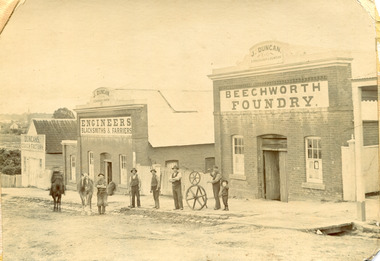
Photograph, c1900
... The foundry was reopened by W H Phillips in 1905 and taken over by H Delora in 1906 This image is significant as it shows some of the many buildings of the Beechworth Foundry, which was a fundamental business to the running of the town and surrounding district, and supplied many of the tools and machines required for the mining and agricultural industries, as well as other aspects of life between the 1850s and early 1900s Duncan John Duncan J Duncan M Straughair Straughair Foundry Beechworth Foundry industry factory Newtown New Ford Street Foundry A Roger Roger W H Phillips Phillips W Phillips H Delora Delora Metalwork Farming and agriculture Tools Mining workmen Reverse 97.2321 / BMM A03115 Sepia rectangular photograph printed on paper. ...The Beechworth Foundry was vital to the industry of the town and surrounding district in the early years of the town’s development. Originally opened as the New Ford Street Foundry by A. Roger in 1858, J Duncan and M Straughair amalgamated and established the Beechworth Foundry in 1867. The business was extensive and operated out of many buildings, each with their own specialisation. All of the buildings pictured in this image are part of the larger Beechworth Foundry. In the late 1860s it employed 16 men. The foundry was fundamental to the running of the town and surrounding district, as it manufactured all manner of items, including tools and machinery for the mining and agricultural industries. The foundry business collapsed in 1896 after the death of it’s founder, John Duncan, the same year (Straughair had died in 1882). The foundry was reopened by W H Phillips in 1905 and taken over by H Delora in 1906 This image is significant as it shows some of the many buildings of the Beechworth Foundry, which was a fundamental business to the running of the town and surrounding district, and supplied many of the tools and machines required for the mining and agricultural industries, as well as other aspects of life between the 1850s and early 1900sSepia rectangular photograph printed on paper. It has rough, torn-looking edgesReverse 97.2321 / BMM A03115duncan, john duncan, j duncan, m straughair, straughair, foundry, beechworth foundry, industry, factory, newtown, new ford street foundry, a roger, roger, w h phillips, phillips, w phillips, h delora, delora, metalwork, farming and agriculture, tools, mining, workmen -
Federation University Historical Collection
Booklet, The School of Mines and Industries Ballarat, Annual Report, 1912, 1912
... W. H. Middleton was Acting President of the Ballarat School of Mines. Part of the report includes are: 'The Trade Classes in Plumbing, Manual Training, Carpentry, Telegraphy, Blacksmithing and Fitting and Turning are all being carried out with success'. 'Classes in Agricultural Chemistry and Botany for teachers have been carried on during the year, and have been well...W. H. Middleton was Acting President of the Ballarat School of Mines. Part of the report includes are: 'The Trade Classes in Plumbing, Manual Training, Carpentry, Telegraphy, Blacksmithing and Fitting and Turning are all being carried out with success'. 'Classes in Agricultural Chemistry and Botany for teachers have been carried on during the year, and have been well ...In 1912 W. H. Middleton was Acting President of the Ballarat School of Mines. Part of the report includes are: 'The Trade Classes in Plumbing, Manual Training, Carpentry, Telegraphy, Blacksmithing and Fitting and Turning are all being carried out with success'. 'Classes in Agricultural Chemistry and Botany for teachers have been carried on during the year, and have been well attended by those for whom they were intended'. Photocopy - 4 page booklet relating to the Ballarat School of Mines in the year 1912. ballarat school of mines, w. h. middleton, gwenda mann, daniel walker, hon. w. a. watt, a. g. gilchrist, f. foster, h. hall, j. s. sutherland, professor t. s. hart, w. poole, e. j. mcconnon, h. thwaites, f. w. hawkins -
 Federation University Historical Collection
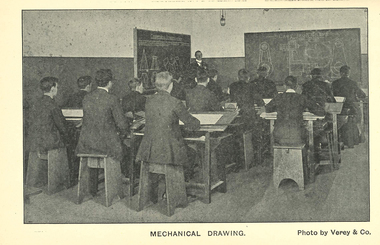
Booklet, Leader Printing Works, The Castlemaine Technical School and Trade Workshops Prospectus 1919, For Engineering, Trade and Art Students, 1919
... The objectives of the Castlemaine School and Trade Workshops is "to fully equip all Students in the full basic principles of Science, Engineering or Art: and from an establishment of such, to then specialise in the various branches of the same; hence it affords opportunity for investigation into Chemistry, Metallurgy, and the various avenues of Engineering Science and Art." castlemaine technical school castlemaine technical school prospectus trade workshops w.v. dam m.t. fogarty a.d. freeman w. corlett t.h. mccreery a. verey j. bennett a.c. elvish colonel j.w.b. field Reverend f.a. hagenauer j. lowry h.s.w. lawson j.w.c. short h.t. govett j. stell s.s. graves f.w. adams c.w. steiner geo chaster c.w. joy e.r. lewis s.j. ellis e. dann t.t. wells j. robertson v. henderson f.a. moran f. barry j. colbert h. payne schools of mines principal registrar science engineering art chemistry metallurgy Brown soft covered booklet with 36 pages and information on office bearers, teaching staff, objects of the school, information for parents, courses, subjects and fees. ...Used at Ballarat School of Mines and Industries Ballarat. The objectives of the Castlemaine School and Trade Workshops is "to fully equip all Students in the full basic principles of Science, Engineering or Art: and from an establishment of such, to then specialise in the various branches of the same; hence it affords opportunity for investigation into Chemistry, Metallurgy, and the various avenues of Engineering Science and Art."Brown soft covered booklet with 36 pages and information on office bearers, teaching staff, objects of the school, information for parents, courses, subjects and fees.castlemaine technical school, castlemaine, technical school, prospectus, trade workshops, w.v. dam, m.t. fogarty, a.d. freeman, w. corlett, t.h. mccreery, a. verey, j. bennett, a.c. elvish, colonel j.w.b. field, reverend f.a. hagenauer, j. lowry, h.s.w. lawson, j.w.c. short, h.t. govett, j. stell, s.s. graves, f.w. adams, c.w. steiner, geo chaster, c.w. joy, e.r. lewis, s.j. ellis, e. dann, t.t. wells, j. robertson, v. henderson, f.a. moran, f. barry, j. colbert, h. payne, schools of mines, principal, registrar, science, engineering, art, chemistry, metallurgy -
 Federation University Historical Collection
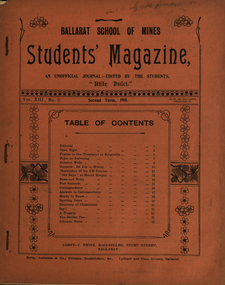
Booklet, Berry, Anderson and Co., Printers, Bookbinders, &c, Ballarat School of Mines, Student Magazine, Second Term, 1910, 1910
... wells, concrete: its use in mining, description of the i. r. process, "old boys" at mount morgan, news and notes, past students, correspondence, answers to correspondence, handy to know, sporting notes, discovery of chloroform, say!, a tragedy, the berdan pan, editorial notes, images. ballarat school of mines associates. alumni: fred j. martell, m. w. bernewitz, angus a. gibson, r. ingram moore, philpot f. brown, w. avery, e. preddergast, godfrey stephen hart, t. s. hart, l. westcott, a. r. booth, w. t. lakeland, lewis westcott, leo m. seward, w. e. eyres, virgil tucker, h. hawkesworth, h. j. saw, h. meadows, fred g. brinsden, c. stephenson, fred treloar, j. peart, e. m. weston, dick galloway, h. b. bennetts, g. r. curry, h. meadows, will watson, don cameron, eric bieske, cliff garrard, lindsay d. cameron, phil brown, w. p. avery, j. foster, j. bickett, f. h. inglis , g. davenport, l. c. courbould, t. lennon, h. wilkins, g. h. reid, c. hesselmann, e. fraser, reg callister, e. c. hursfield, w. baragwanath, c. c. corrie, r. i. moore, j. l. sampson, h. conran, w. geldard. ...Table of Contents: Editorial, Open night, Process in ore treatment at Kalgoolie, Notes on surveying, Artesian wells, Concrete: Its use in mining, Description of the I. R. process, "Old Boys" at Mount Morgan, News and notes, Past students, Correspondence, Answers to correspondence, Handy to know, Sporting notes, Discovery of Chloroform, Say!, A tragedy, The Berdan pan, Editorial notes. Ballarat School of Mines Associates. Images.Booklet of 28 pages.table of contents: editorial, open night, process in ore treatment at kalgoolie, notes on surveying, artesian wells, concrete: its use in mining, description of the i. r. process, "old boys" at mount morgan, news and notes, past students, correspondence, answers to correspondence, handy to know, sporting notes, discovery of chloroform, say!, a tragedy, the berdan pan, editorial notes, images. ballarat school of mines associates., alumni: fred j. martell, m. w. bernewitz, angus a. gibson, r. ingram moore, philpot f. brown, w. avery, e. preddergast, godfrey stephen hart, t. s. hart, l. westcott, a. r. booth, w. t. lakeland, lewis westcott, leo m. seward, w. e. eyres, virgil tucker, h. hawkesworth, h. j. saw, h. meadows, fred g. brinsden, c. stephenson, fred treloar, j. peart, e. m. weston, dick galloway, h. b. bennetts, g. r. curry, h. meadows, will watson, don cameron, eric bieske, cliff garrard, lindsay d. cameron, phil brown, w. p. avery, j. foster, j. bickett, f. h. inglis , g. davenport, l. c. courbould, t. lennon, h. wilkins, g. h. reid, c. hesselmann, e. fraser, reg callister, e. c. hursfield, w. baragwanath, c. c. corrie, r. i. moore, j. l. sampson, h. conran, w. geldard. -
 Federation University Historical Collection
Magazine, J.A. Hoskin & Son, Quadrangle: Magazine of the Ballarat Technical School, 1965, 1965
... Longman g.v. bergin r.g. dunlop s. barclay d.l. gresswell r.k. wells d.b. james a.c. leviston r.p. mcmahon j.c. ferguson j.r. benn john benn b. bogocevic r. skewes k.d. felstead b. morison H. Russell w ...Buff soft covered magazine of 27 pages. ballarat school of mines, ballarat junior technical school, ballarat technical school, r.r. watson, r.l. whitla, b. bogicevic, keith rash, c. dower, joyc elewis, a.e.stohr, m.b. john, grham beanland, e.j. barker, h.j. trudinger, e.a. bald, b.a. johnson, b.j. longman, g.v. bergin, r.g. dunlop, s. barclay, d.l. gresswell, r.k. wells, d.b. james, a.c. leviston, r.p. mcmahon, j.c. ferguson, j.r. benn, john benn, b. bogocevic, r. skewes, k.d. felstead, b. morison, h. russell, w. bampton, fr o'halloran -
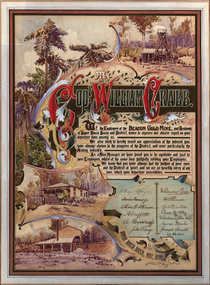 Federation University Historical Collection
Painting - Illumination, john Sands Limited, Illuminated Address Presented to William Crabb of the Beacon Gold Mine, 1899, 05/1899
... William Crabb was later a well respected manager of the Victoria United GMC, Ballarat after leaving the Bucca Bucca region in Queensland. illumination william crabb victoria united gold mine beacon gold mine upper bucca bucca william s. boyce james dennings thomas f. fraser a. griffith a. moncrieff john parry n. daery-porter h. skinner c. strather trever w. alley william peter james marles joseph smith We also wish to record our appreciation of the interest you have always shown in the progress of the District, and more particularly the Mining industry. ...William Crabb was later a well respected manager of the Victoria United GMC, Ballarat after leaving the Bucca Bucca region in Queensland.Digital copy of an illumination presented to William Crabb, mine manager at Beacon Gold Mine, Bucca Bucca. We also wish to record our appreciation of the interest you have always shown in the progress of the District, and more particularly the Mining industry. As a Mine Manager, we have found you to be equitable and just to your Employees, whilst at the same time faithfully serving our Employers. We know that you have always had the welfare of your men and the District at heart, and we are as heartily sorry at our loss, which your departure necessitates." (signed) William S Bryce James Demming Thos. G. Fraser, A. Griffith, A. Moncrieff, John Parry, N. Danvers Power, H Skinner, G. Strathen, Trevor W. Alley, William Peter J.P., James Marles, Joseph Smith and 45 others.illumination, william crabb, victoria united gold mine, beacon gold mine, upper bucca bucca, william s. boyce, james dennings, thomas f. fraser, a. griffith, a. moncrieff, john parry, n. daery-porter, h. skinner, c. strather, trever w. alley, william peter, james marles, joseph smith -
Federation University Historical Collection
Booklet, Ballarat School of Mines, Student Magazine, Second Term, 1910, 1910
... Wells, Concrete: Its use in mining, Description of the I. R. Process, "Old Boys" at Mt Morgan, News and Notes, Past Students, Correspondence, Answers to Correspondents, Handy to Know, Sporting Notes, Discovery of Chloroform, Say!, A Tragedy, The Berdan Pan, Editorial Notes. ballarat school of mines students' magazine king edward vii m. w. bernewitz angus a. gibson r. ingram-moore philpot f. brown w. avery e. prendergast godfrey stephen hart t. s. hart l. westcott a. r. booth w. t. lakeland lewis westcott leo m. seward reginald williamson stanley white clyde allan charles laird w. e. eyres virgil tucker h. hawkesworth h. j. saw h. meadows fred g. brinsden c. stephenson fred treloar j. peart e. m. weston dick galloway h. b. bennetts g. r. curry will watson don cameron eric bieske cliff garrard lindsay d. cameron phil brown w. p. avery j. foster j. bickett f. h. inglis g. davenport l. c. courbould t. lennon h. wilkins g. h. reid c. hesselmann e. fraser e. c. hurdsfield Orange coloured booklet of 28 pages. ...Table of Contents: Editorial, Open Night, Process in Ore Treatment at Kalgoorlie, Notes on Surveying, Artesian Wells, Concrete: Its use in mining, Description of the I. R. Process, "Old Boys" at Mt Morgan, News and Notes, Past Students, Correspondence, Answers to Correspondents, Handy to Know, Sporting Notes, Discovery of Chloroform, Say!, A Tragedy, The Berdan Pan, Editorial Notes. Orange coloured booklet of 28 pages.ballarat school of mines, students' magazine, king edward vii, m. w. bernewitz, angus a. gibson, r. ingram-moore, philpot f. brown, w. avery, e. prendergast, godfrey stephen hart, t. s. hart, l. westcott, a. r. booth, w. t. lakeland, lewis westcott, leo m. seward, reginald williamson, stanley white, clyde allan, charles laird, w. e. eyres, virgil tucker, h. hawkesworth, h. j. saw, h. meadows, fred g. brinsden, c. stephenson, fred treloar, j. peart, e. m. weston, dick galloway, h. b. bennetts, g. r. curry, will watson, don cameron, eric bieske, cliff garrard, lindsay d. cameron, phil brown, w. p. avery, j. foster, j. bickett, f. h. inglis, g. davenport, l. c. courbould, t. lennon, h. wilkins, g. h. reid, c. hesselmann, e. fraser, e. c. hurdsfield -
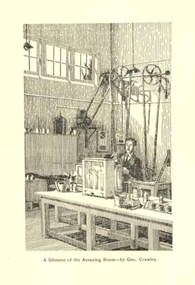 Federation University Historical Collection
Magazine - Booklet, Ballarat School of Mines Students' Magazine, 1941, 1941
... List of Full Course Students' 1941, Editorial, Honour Roll, The Literary Society, Fumes from the Lab, Arts & Crafts Gossip, Sport, Commercial Notes, The Junior Techs ballarat school of mines magazine r. spence i. grant isabel boustead kenneth palmer eric marshman a. stevens margaret dark john r. elliott joy martin gilbert t. myers marian peirce john p.l. gibbs winsome hender peggy wells geoffrey mounter p. martin john h. calaby dr pound mr mein lorraine siemering j. lockhead herb christensen max coward ernest gribble stan laurie jim martin jack nott bill walters adrian ward fred badenhope eddie gilpin john hassell frank jelbart bob monteith george lugg dick menhennett j. r. pound william r. burrow w. e. hender mavis heinz a. j. henderson eric goon donald eltringham k. richards leslie f. evans ian d. mclachlan philip c. kempe maxwell w. lawrence g. hale william rowe murray linklater alan s. fisher james w. mcclure norman m. murray william h. wray mackay gleeson john g. wilson edward t. mann keith s. waller kenneth g. gingell joan banes patricia goldsmith coralie clogan miss rollan mrs mcilvena elva davies maurice collins betty davison a. pilven j. hucker m. beaumont k. mclachlan r. harbour d. browning a. grieve a. white h. bantz j. waddington r. leigh b. holloway k. fletcher l. lehmann r. dunstone s. wallis e. n. thompson mr hosie loris hopwood dawn austin f.g. procter gladstone procter Signed on front cover by "H. ...List of Full Course Students' 1941, Editorial, Honour Roll, The Literary Society, Fumes from the Lab, Arts & Crafts Gossip, Sport, Commercial Notes, The Junior Techs Black, green and gold soft covered magazine of 56 pages including advertisements. Artwork Mr Allsop - By Margaret Taylor Mr Lambert - By Isabel Boustead Mr Mein - By Margaret Taylor Gaffer - By Margaret Taylor Bickarts Lino Cut Competition Section A - 1st place - By Winsome Hender Barney - By Margaret Taylor Tony - By Isabel Boustead Jack - By Margaret Taylor Lake Wendouree - By Mavis Heinz Issie - By Margaret Taylor Smoking Man - By Margaret Taylor Beryl - By Margaret Taylor Joyce - By Margaret Taylor Pat - By Isabel Boustead Bickarts Lino Cut Competition Section A - 2nd place - By John Henderson Albert - By Isabel Boustead Chick - By Isabel Boustead Leila - By Margaret Taylor Scottie - By Margaret Taylor Mary - By Margaret Taylor Margaret - By Isabel Boustead Bickarts Lino Cut Competition Section B - 1st place - By Maurice Collins Gladys - By Isabel Boustead Squizzy - By Margaret Taylor & Joyce Thompson Spence - By Margaret Taylor Pop-eye - By Margaret Taylor Haymes - By Margaret Taylor and Joyce Thompson Hucker - By Margaret Taylor Minnie - By Margaret Taylor & Joyce Thompson Ian - By Isabel Boustead Keep quiet or I'll slap you - By Isabel Boustead Joe-Joe - By Isabel Boustead Jean - By Isabel Boustead Elva - Isabel Boustead Bickarts Lino Cut Competition Section B - 2nd place - By John Henderson Blondie - By Maurice Collins Wilk - By Isabel Boustead Gladys - By Isabel Boustead Dawn - By Isabel Boustead Signed on front cover by "H. Darby" Has Receipt for Miss Darby for the amount of two shillings from activities and extraneous accounts , signed by W. Hinderballarat school of mines, magazine, r. spence, i. grant, isabel boustead, kenneth palmer, eric marshman, a. stevens, margaret dark, john r. elliott, joy martin, gilbert t. myers, marian peirce, john p.l. gibbs, winsome hender, peggy wells, geoffrey mounter, p. martin, john h. calaby, dr pound, mr mein, lorraine siemering, j. lockhead, herb christensen, max coward, ernest gribble, stan laurie, jim martin, jack nott, bill walters, adrian ward, fred badenhope, eddie gilpin, john hassell, frank jelbart, bob monteith, george lugg, dick menhennett, j. r. pound, william r. burrow, w. e. hender, mavis heinz, a. j. henderson, eric goon, donald eltringham, k. richards, leslie f. evans, ian d. mclachlan, philip c. kempe, maxwell w. lawrence, g. hale, william rowe, murray linklater, alan s. fisher, james w. mcclure, norman m. murray, william h. wray, mackay gleeson, john g. wilson, edward t. mann, keith s. waller, kenneth g. gingell, joan banes, patricia goldsmith, coralie clogan, miss rollan, mrs mcilvena, elva davies, maurice collins, betty davison, a. pilven, j. hucker, m. beaumont, k. mclachlan, r. harbour, d. browning, a. grieve, a. white, h. bantz, j. waddington, r. leigh, b. holloway, k. fletcher, l. lehmann, r. dunstone, s. wallis, e. n. thompson, mr hosie, loris hopwood, dawn austin, f.g. procter, gladstone procter -
Federation University Historical Collection
Booklet, Ballarat School of Mines Students' Magazine, 1942, 1942
... List of Full Course Students' 1942, Editorial, News, Obituary Ralph Taylor, Editor's Notes, Personal, The Literary Society, Fumes from the Lab, Arts & Crafts Gossip, Sport, Commercial Notes, The Junior Techs ballarat school of mines magazine n. wilcock patricia martin m.w. lawrence winsome hender eveleigh wells m. pescott j. w. mcclure marian peirce k. r. wylie francis duffy d.h. eltringham patricia allen john h. calaby margaret dark graham lawry joy martin kevin mclachlan p.c. kempe mr mein kenneth palmer fay renfrey dr pound ralph (bill) taylor f. barrow m. martin mr cornell a.g. hale i.d. mclachlan w. r. whiteside denise kidd patricia goldsmith t. evans enid chambers noreen webster joan banes miss king mrs ilvena patricia lane c. w. rowe joyce thompson m. linklater n. murray g. lehmann a.m. scott a. w. wilson e.j. poppins w.j. lawry p.d. fisher r. mckenzie m.a. richards j.r. elliott a. stanley white r.g. mccahon j. sandlant beryl grinter joan bryan p. lawry norma parkes m. plover k. b. stephens j. m. hucker p. george n. f. reeve c. f. moyihan p. b. humphrey e. h. adams b. j. linklater r. j. doull j. waddingham a. c. wilson d. d. jones f. w. wren e. j. skilbeck b. r. holloway w. g. young s. g. wallis g. bergin d. w. hart h. packham max coward william rowe ralph taylor obituary bill taylor f. barrow obituary honey ballarat school of mines combined sports association yarrowee creek gordon hale a.w. steane f.g. procter gladstone procter Black, green and gold soft covered magazine of 62 pages including advertisements. ...List of Full Course Students' 1942, Editorial, News, Obituary Ralph Taylor, Editor's Notes, Personal, The Literary Society, Fumes from the Lab, Arts & Crafts Gossip, Sport, Commercial Notes, The Junior Techs Black, green and gold soft covered magazine of 62 pages including advertisements. Artwork Mr J. - By Patricia Allen Mr Wilkinson - Possibly By - William Rowe Kirk - By Patricia Allen Cactus - By Patricia Allen Spud - By Joy Martin Gus - By Kenneth Palmer Wilson - By Kenneth Palmer Cut out that sill dive bombing biddy! - By William Rowe Ben - By Kenneth Palmer George - By Patricia Allen Jim - By Patricia Allen Jackie - By Patricia Allen The Yarrawee Creek Ballarat - By William Rowe Man - By Kenneth Palmer Marion - By Patricia Allen Ruth - By Patricia Allen Screecm - By Patricia Allen Jack - By Kenneth Palmer Lino Cut - By Joyce Thompson Alphonso - By Kenneth Palmer Ken - By Kenneth Palmer Slushpuhp - By Joy Martin Round and Round - By Kenneth Palmer and Graham Lawry John D. - By Patricia Allen Ruth - By Patricia Allen Marie - By Patricia Allen Joan - By Patricia Allen Curly - By Patricia Allen Girl - By Kenneth Palmer Fireworks - By Kenneth Palmer Geek - By Kenneth Palmer Marj - By Kenneth Palmer June - By Patricia Allen Joan - By Kenneth Palmer Betty - By Patricia Allen Lois - By Patricia Allen Val - By Margaret Dark Fatty - By Kenneth Palmer John - By Margaret Dark Harold - By Patricia Allen Dick & Tig - By Kenneth Palmer Evans - By Kenneth Palmer Max - By Patricia Allen & Marian Peirce Pro - By Kenneth Palmer ballarat school of mines, magazine, n. wilcock, patricia martin, m.w. lawrence, winsome hender, eveleigh wells, m. pescott, j. w. mcclure, marian peirce, k. r. wylie, francis duffy, d.h. eltringham, patricia allen, john h. calaby, margaret dark, graham lawry, joy martin, kevin mclachlan, p.c. kempe, mr mein, kenneth palmer, fay renfrey, dr pound, ralph (bill) taylor, f. barrow, m. martin, mr cornell, a.g. hale, i.d. mclachlan, w. r. whiteside, denise kidd, patricia goldsmith, t. evans, enid chambers, noreen webster, joan banes, miss king, mrs ilvena, patricia lane, c. w. rowe, joyce thompson, m. linklater, n. murray, g. lehmann, a.m. scott, a. w. wilson, e.j. poppins, w.j. lawry, p.d. fisher, r. mckenzie, m.a. richards, j.r. elliott, a. stanley white, r.g. mccahon, j. sandlant, beryl grinter, joan bryan, p. lawry, norma parkes, m. plover, k. b. stephens, j. m. hucker, p. george, n. f. reeve, c. f. moyihan, p. b. humphrey, e. h. adams, b. j. linklater, r. j. doull, j. waddingham, a. c. wilson, d. d. jones, f. w. wren, e. j. skilbeck, b. r. holloway, w. g. young, s. g. wallis, g. bergin, d. w. hart, h. packham, max coward, william rowe, ralph taylor obituary, bill taylor, f. barrow obituary, honey, ballarat school of mines combined sports association, yarrowee creek, gordon hale, a.w. steane, f.g. procter, gladstone procter
