
Showing 34 items matching ".303 lee enfield"
-
 Montmorency–Eltham RSL Sub Branch
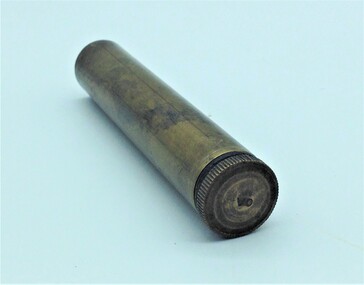
Container - Mk IV Oil Bottle for .303 Lee-Enfield Rifle, 1942-46
... Mk IV Oil Bottle for .303 Lee-Enfield Rifle...Mk IV Oil Bottle for .303 Lee-Enfield Rifle...Typical MkIII oil bottle for the .303 calibre Lee-Enfield rifle. This one was made at Orange in New South Wales sometime during WW2 (from 1942) because the main ordnance factory at Lithgow was unable to keep up with requirements. ... Lee-Enfield Rifle Container Mk IV Oil Bottle for .303 Lee-Enfield Rifle ...Typical MkIII oil bottle for the .303 calibre Lee-Enfield rifle. This one was made at Orange in New South Wales sometime during WW2 (from 1942) because the main ordnance factory at Lithgow was unable to keep up with requirements. Orange was a 'Feeder Factory' and was one of several operating in the area. Brass cylindrical receptacle. Brass stopper and spoon applicator with leather washer..OA (Orange, Australia)oil bottle, lee enfield -
 The 5th/6th Battalion Royal Victoria Regiment Historical Collection
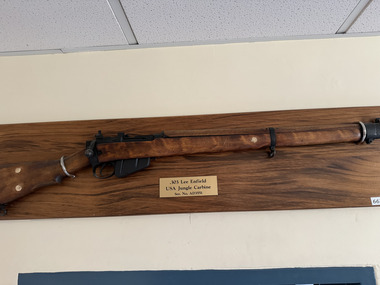
Weapon - INNOC: .303 Lee Enfield
... INNOC: .303 Lee Enfield....303 Lee Enfield USA Jungle Carbine fixed to the Wooden board and bolted onto the wall....303 Lee Enfield Ser No. AD3551...Rifle used by US forces during WWII Pacific .303 Lee Enfield Ser No. AD3551 .303 Lee Enfield USA Jungle Carbine fixed to the Wooden board and bolted onto the wall Weapon INNOC: .303 Lee Enfield ...Rifle used by US forces during WWII Pacific.303 Lee Enfield USA Jungle Carbine fixed to the Wooden board and bolted onto the wall.303 Lee Enfield Ser No. AD3551 -
 The 5th/6th Battalion Royal Victoria Regiment Historical Collection
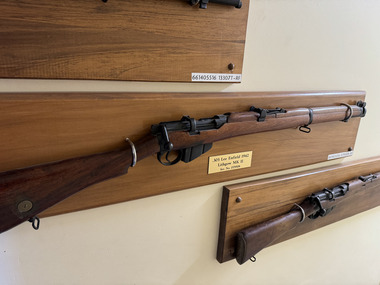
Weapon - INNOC: .303 Lee Enfield 1942
... INNOC: .303 Lee Enfield 1942....303 Lee Enfield 1942 Lithgow MK II fixed onto the Wooden board and bolted onto the wall....303 Lee Enfield 1942 Lithgow MK II Ser No. D79508...Weapon used by Allied forces during WWII .303 Lee Enfield 1942 Lithgow MK II Ser No. D79508 .303 Lee Enfield 1942 Lithgow MK II fixed onto the Wooden board and bolted onto the wall Weapon INNOC: .303 Lee Enfield 1942 ...Weapon used by Allied forces during WWII.303 Lee Enfield 1942 Lithgow MK II fixed onto the Wooden board and bolted onto the wall.303 Lee Enfield 1942 Lithgow MK II Ser No. D79508 -
 4th/19th Prince of Wales's Light Horse Regiment Unit History Room
Rifle, 303 Lee Enfield, 1903
... Rifle, 303 Lee Enfield......lee enfield...303...Rifle, 303, Lee Enfield This firearm has been rendered inoperative...Stock Code 66-140-6339 rifle lee enfield 303 Serial No 15220 Rifle, 303, Lee Enfield This firearm has been rendered inoperative Rifle, 303 Lee Enfield ...Stock Code 66-140-6339Rifle, 303, Lee Enfield This firearm has been rendered inoperativeSerial No 15220rifle, lee enfield, 303 -
4th/19th Prince of Wales's Light Horse Regiment Unit History Room
Rifle, 303 Lee Enfield, Small Arms Factory
... Rifle, 303 Lee Enfield......lee enfield...303...Rifle, 303, Lee Enfield, short magazine This firearm has been rendered inoperative...rifle lee enfield 303 Serial No 202346 Rifle, 303, Lee Enfield, short magazine This firearm has been rendered inoperative Rifle, 303 Lee Enfield Small Arms Factory ...Rifle, 303, Lee Enfield, short magazine This firearm has been rendered inoperativeSerial No 202346rifle, lee enfield, 303 -
 Ringwood RSL Sub-Branch
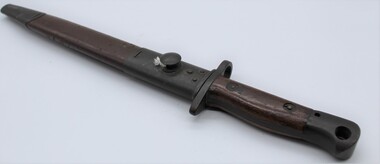
Edged weapon, 303 bayonet short magazine Lee Enfield rifle, C WW1
... 303 bayonet short magazine Lee Enfield rifle...303 Lee Enfield bayonet with scabbard and frog...Scabbard DD 3 Bayonet 03 20 and B9922 Frog Lyle Stephenson 303 Lee Enfield bayonet with scabbard and frog 303 bayonet short magazine Lee Enfield rifle Edged weapon ...303 Lee Enfield bayonet with scabbard and frogScabbard DD 3 Bayonet 03 20 and B9922 Frog Lyle Stephenson -
 The 5th/6th Battalion Royal Victoria Regiment Historical Collection
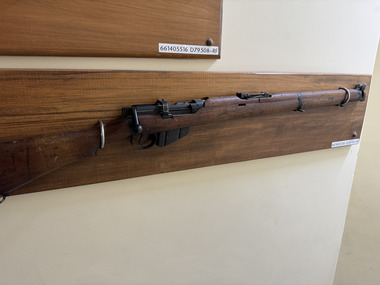
Weapon - INNOC: Lee Enfield .303
... INNOC: Lee Enfield .303....303 Lee Enfield fixed to the wooden board and bolted onto the wall...Weapon used by the Allied forces during both wars .303 Lee Enfield fixed to the wooden board and bolted onto the wall Weapon INNOC: Lee Enfield .303 ...Weapon used by the Allied forces during both wars.303 Lee Enfield fixed to the wooden board and bolted onto the wall -
4th/19th Prince of Wales's Light Horse Regiment Unit History Room
Rifle .303" Lee Enfield SMLE
... Rifle .303" Lee Enfield SMLE ...rifle 303 Serial No 62995 This firearm has been rendered inoperative Rifle .303" Lee Enfield SMLE ...This firearm has been rendered inoperativeSerial No 62995rifle, 303 -
 Warrnambool RSL Sub Branch
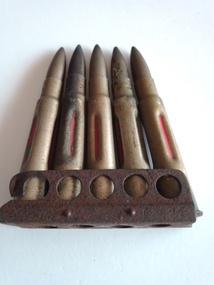
Weapon - Inert Training Rounds in Clip WW2, Lee Enfield 303 Training Rounds
... Lee Enfield 303 Training Rounds ...5 inert training rounds in original clip. Lee Enfield 303 WW2...WW2 4 rounds on Base- MF VI 26. 1 round- A ↑ I VI 24. very dificult to decipher. 5 inert training rounds in original clip. Lee Enfield 303 WW2 Lee Enfield 303 Training Rounds Weapon Inert Training Rounds in Clip WW2 ...WW25 inert training rounds in original clip. Lee Enfield 303 WW24 rounds on Base- MF VI 26. 1 round- A ↑ I VI 24. very dificult to decipher. -
 Bendigo Military Museum
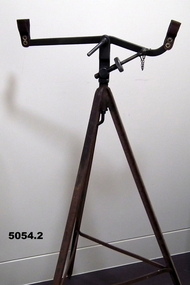
Equipment - TRAINING STAND FOR .303 IN LEE ENFIELD RIFLE, 21 Bn. AIF, c1915-1918
... TRAINING STAND FOR .303 IN LEE ENFIELD RIFLE....Equipment TRAINING STAND FOR .303 IN LEE ENFIELD RIFLE. 21 Bn. AIF ...This is a WW1 stand for mounting a .303 rifle, to train soldiers in shooting.This device consists of two parts; 1. Top part has an adjustable 'arm' . At the end of each arm is a leather covered 'U' section. Under the arm is a large threaded rod and knurled knob, this is to adjust elevation. At the center of the arm is a pivot that can lock into position. This top section is mounted on a tripod, it can be removed. 2. This is a steel tripod made out of 'T' section steel. There are fixed cross braces about 40 cm fom bottom. The top has a tube section within which the upper arm mounts.Marked on one leg is "XXI". Believed to be from 21st Bn. AIF. on the top of that leg is a very small arrow head.ww1, training, .303 rifles -
 Dandenong/Cranbourne RSL Sub Branch
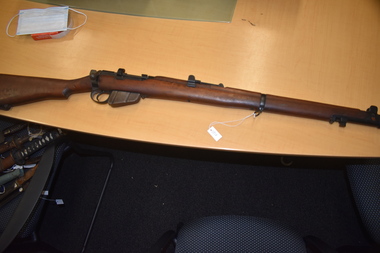
Weapon - S.M.L.E 303 Rifle. Short Magazine Lee Enfield .303
... S.M.L.E 303 Rifle. Short Magazine Lee Enfield .303...Short Magazine Lee Enfield Rifle. Weapon S.M.L.E 303 Rifle. Short Magazine Lee Enfield .303 ...Short Magazine Lee Enfield Rifle.MA Lithgow SMLE. Mk.3. HV.1943. -
 Waverley RSL Sub Branch
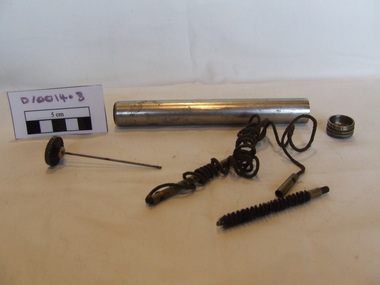
Canister cleaning kit for .303 Enfield
... ....303 lee enfield...The cleaning kit was issued with all lee enfield .303 rifles. They were kept in a chamber in the butt and covered by a hinged cover. ...The cleaning kit was issued with all lee enfield .303 rifles. They were kept in a chamber in the butt and covered by a hinged cover. ...The cleaning kit was issued with all lee enfield .303 rifles. They were kept in a chamber in the butt and covered by a hinged cover. Cleaning of rifles was imperative to allow the rifles to function consistently especially in field conditions.Nickel plated brass canister with two removable screw ends containing oil with applicator and brass weighted cord pullthrough with brush for cleaning and mainenance of .303 Enfield riflerifle, .303 lee enfield, pullthrough, cleaning kit -
 Running Rabbits Military Museum operated by the Upwey Belgrave RSL Sub Branch
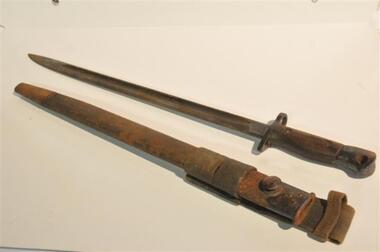
Bayonet & Scabbard
... .303 Lee Enfield sn59023...Weapon Army .303 Lee Enfield sn59023 Bayonet & Scabbard ....303 Lee Enfield sn59023weapon, army -
 Dandenong/Cranbourne RSL Sub Branch
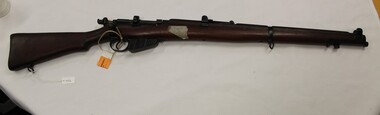
Weapon - 303 Short Magazine Lee Enfield rifle
... .303 Short Magazine Lee Enfield rifle...Weapon .303 Short Magazine Lee Enfield rifle ... -
 Ringwood RSL Sub-Branch
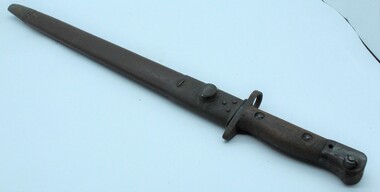
Edged weapon, Bayonet - Short Magazine Lee Enfield 303 Rifle, 1944
... Bayonet - Short Magazine Lee Enfield 303 Rifle...Bayonet - Short Magazine Lee Enfield 303 Rifle Edged weapon ...The standard British bayonet used from WW1 through to the Korean War. Pattern 1907 SMLE bayonet and scabbard.Bayonet - OA 1 o 44. Scabbard - Mangorvite 44 -
4th/19th Prince of Wales's Light Horse Regiment Unit History Room
Rifle .303
... Rifle, 303 Lee Enfield SMLE Mk1 No 4 This firearm has been rendered inoperative...Army Report No 1016658 Stock Code 66-1405-516 rifle 303 Serial No 3614 Rifle, 303 Lee Enfield SMLE Mk1 No 4 This firearm has been rendered inoperative Rifle .303 ...Army Report No 1016658 Stock Code 66-1405-516Rifle, 303 Lee Enfield SMLE Mk1 No 4 This firearm has been rendered inoperativeSerial No 3614rifle, 303 -
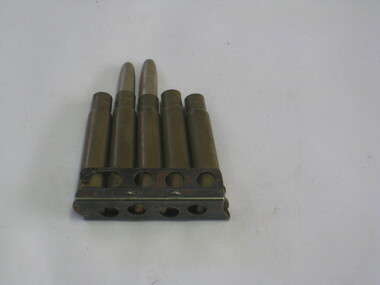 Lilydale RSL Sub Branch
Ammunition Clip
... .303 Lee Enfield Stripper Clip - 5 round ammunition clip with 5 bullet casings....303 Lee Enfield Stripper Clip - 5 round ammunition clip with 5 bullet casings Ammunition Clip ....303 Lee Enfield Stripper Clip - 5 round ammunition clip with 5 bullet casings -
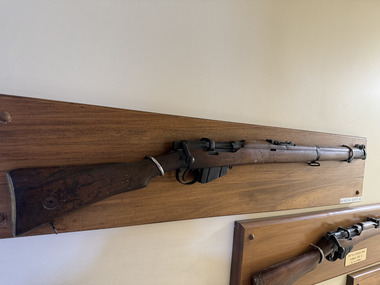 The 5th/6th Battalion Royal Victoria Regiment Historical Collection
Weapon - INNOC: Lee Enfield .303
... INNOC: Lee Enfield .303...The main rifle widely used by Allied Forces during the war .303 Enfield fixed onto the Wooden board and bolted onto the wall Weapon INNOC: Lee Enfield .303 ...The main rifle widely used by Allied Forces during the war.303 Enfield fixed onto the Wooden board and bolted onto the wall -
 8th/13th Victorian Mounted Rifles Regimental Collection
Weapon - Bayonet
... The 7.62mm self loading rifle (SLR) was introduced to the Australian Army in 1962 replacing the .303 Lee Enfield Magazine rifle. For Australia, the SLR was the main infantry weapon of the Vietnam War era (1962-1972)....The 7.62mm self loading rifle (SLR) was introduced to the Australian Army in 1962 replacing the .303 Lee Enfield Magazine rifle. For Australia, the SLR was the main infantry weapon of the Vietnam War era (1962-1972). bayonet weapon slr L1A2 bayonet for use with 7.62mm self-loading rifle (SLR), together with plastic scabbard. ...The 7.62mm self loading rifle (SLR) was introduced to the Australian Army in 1962 replacing the .303 Lee Enfield Magazine rifle. For Australia, the SLR was the main infantry weapon of the Vietnam War era (1962-1972).L1A2 bayonet for use with 7.62mm self-loading rifle (SLR), together with plastic scabbard.bayonet, weapon, slr -
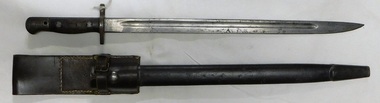 8th/13th Victorian Mounted Rifles Regimental Collection
Weapon - Bayonet 1907 pattern
... This pattern bayonet, which affixed to a .303 Lee Enfield rifle was standard issue to Australian forces in World War 1 ( 1914 - 1918 ), World War 2 ( 1939 - 1945 ) and the Korean War ( 1950 - 1953 )....This pattern bayonet, which affixed to a .303 Lee Enfield rifle was standard issue to Australian forces in World War 1 ( 1914 - 1918 ), World War 2 ( 1939 - 1945 ) and the Korean War ( 1950 - 1953 ). ...This pattern bayonet, which affixed to a .303 Lee Enfield rifle was standard issue to Australian forces in World War 1 ( 1914 - 1918 ), World War 2 ( 1939 - 1945 ) and the Korean War ( 1950 - 1953 ).Part of a collection of edged weapons relevant to Victorian Colonial and Australian Military forces.British pattern 1907 bayonet, with wood hand grips blade 430mm long, with leather scabbard with steel fittings and leather bayonet frog.ON handle " A- 93061 " On blade " 1 - 1922 Lithgow "wwi, wwii, korea, world war one, world war two, lee enfield -
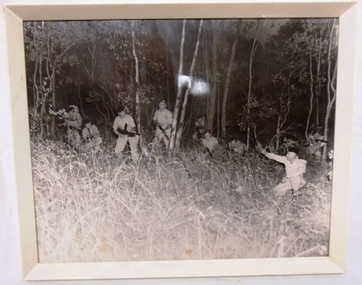 8th/13th Victorian Mounted Rifles Regimental Collection
Photograph, 1960 circa
... Ten troops in photograph armed with Bren light machine gun and .303 Lee Enfield rifles. Light wooden frame with glass panel....Ten troops in photograph armed with Bren light machine gun and .303 Lee Enfield rifles. Light wooden frame with glass panel. ...Training of this nature often carried out on Nail Tree Hill just west of Albury during a night parade. Soldier with Bren LMG Sergeant J Bauerle, Officer giving hand signal Lieutenant Allister Waite.Representative of night parade training carried out by CMF soldiers in early 1960s.Framed black & white photograph of soldiers from 8th/13th Victorian Mounted Rifles engaged in a training exercise at night in a bush area. Ten troops in photograph armed with Bren light machine gun and .303 Lee Enfield rifles. Light wooden frame with glass panel.8/13 vmr, training, bauerle j sergeant, waite a lieutenant -
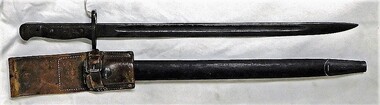 8th/13th Victorian Mounted Rifles Regimental Collection
Weapon - 1907 Bayonet & scabbard
... This pattern bayonet which affixed to a .303 Lee Enfield rifle was standard issue to Australian forces in World War 1 (1914-1918), World War 2 (1939-1945) and the Korean War (1950-1953). ...This pattern bayonet which affixed to a .303 Lee Enfield rifle was standard issue to Australian forces in World War 1 (1914-1918), World War 2 (1939-1945) and the Korean War (1950-1953). ...This pattern bayonet which affixed to a .303 Lee Enfield rifle was standard issue to Australian forces in World War 1 (1914-1918), World War 2 (1939-1945) and the Korean War (1950-1953). Leather bayonet frog might indicate WWI light horse issue.Part of a collection of edged weapons relevant to Victorian Colonial and Australian Military forces.British pattern 1907 bayonet, blade 430 mm long with wood hand grip and leather scabbard and leather frog.Blade " 7. 17 Wilkinson" Frog " Dexxil Don 1917"military, bayonet, world war one, world war two, korea, light horse -
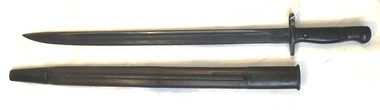 8th/13th Victorian Mounted Rifles Regimental Collection
Weapon - Bayonet
... British 1907 pattern bayonet and .303 Lee Enfield rifle was standard issue to the armies of many Commonwealth countries including Australia, in World War One (1914-1918), World War Two (1939-1945), and Korean War (1950-1953). ...British 1907 pattern bayonet and .303 Lee Enfield rifle was standard issue to the armies of many Commonwealth countries including Australia, in World War One (1914-1918), World War Two (1939-1945), and Korean War (1950-1953). ...British 1907 pattern bayonet and .303 Lee Enfield rifle was standard issue to the armies of many Commonwealth countries including Australia, in World War One (1914-1918), World War Two (1939-1945), and Korean War (1950-1953). In Australia it was replaced by the 7.62mm Self-loading rifle (SLR) in 1960.British 1907 pattern bayonet with leather scabbard with metal fittings. XOA and L 43 under 1907 with Slazenger on handleworld war one, weapon, bayonet, british, lee enfield -
Lilydale RSL Sub Branch
Magazine - Rifle
... Rifle, short magazine, Lee-Enfield 303...Rifle, short magazine, Lee-Enfield 303 Magazine - Rifle ...Rifle, short magazine, Lee-Enfield 303 -
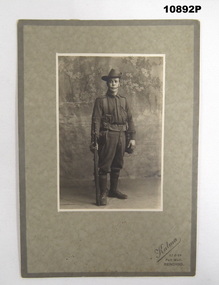 Bendigo Military Museum
Photograph - PORTRAIT, WW1 SOLDIER, Kalma Studios, 1914
... He is wearing a slouch hat and has WW1 style webbing, .303 Lee Enfield rifle. His boots are dull and he has no badges of rank and is not wearing the metal "Australia" shoulder badges. ...He is wearing a slouch hat and has WW1 style webbing, .303 Lee Enfield rifle. His boots are dull and he has no badges of rank and is not wearing the metal "Australia" shoulder badges. ...Black and white, full length image of a young Australian WW1 soldier. He is wearing a slouch hat and has WW1 style webbing, .303 Lee Enfield rifle. His boots are dull and he has no badges of rank and is not wearing the metal "Australia" shoulder badges. One ammo pouch is undone. This all suggests he was in basic training for the photo. The portrait was taken by"Kalma Studios, 57-59 Pall Mall, Bendigo". The photo is mounted on a cardboard backing sheet.Written on the back, in ink, is: "To Elsie, from Charlie Oct 15th 1914".ww1, photograph, australian soldier -
Running Rabbits Military Museum operated by the Upwey Belgrave RSL Sub Branch
Firearm
... Lee Enfield .303/.22 Rifle. Serial no.E14958 - mounted on board with bayonet....WW1&2 Lee Enfield .303/.22 Rifle. Serial no.E14958 - mounted on board with bayonet. ...Lee Enfield .303/.22 Rifle. Serial no.E14958 - mounted on board with bayonet.ww1&2 -
Running Rabbits Military Museum operated by the Upwey Belgrave RSL Sub Branch
Firearm
... Lee Enfield .303 Mark 1 No 2 British SN A23205 Bolt MURC1. ...Weapon Boer War Army Lee Enfield .303 Mark 1 No 2 British SN A23205 Bolt MURC1. ...Lee Enfield .303 Mark 1 No 2 British SN A23205 Bolt MURC1. Known as Long Tom.weapon, boer war, army -
Running Rabbits Military Museum operated by the Upwey Belgrave RSL Sub Branch
Firearm
... Lee Enfield .303 No 1 Mark 3 British Used in WW1 & 2. ...Weapon 1917 Army Lee Enfield .303 No 1 Mark 3 British Used in WW1 & 2. ...Lee Enfield .303 No 1 Mark 3 British Used in WW1 & 2. Sn G64707 Bolt A713oweapon, 1917, army -
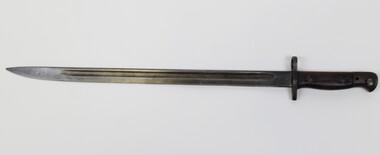 Beechworth RSL Sub-Branch
Bayonet, 1907
... Sword bayonet for use with the .303 caliber Short, Magazine, Lee-Enfield No. I Mk. III (SMLE) rifle....However, the leather rapidly deteriorated in the tropical climate, so the Siamese made a replacement steel scabbard body to which the original steel mounts were brazed. ww2 world war 2 bayonet A tiger head on the left side with some symbols Sword bayonet for use with the .303 caliber Short, Magazine, Lee-Enfield No. I Mk. III (SMLE) rifle. ...The Type 62 is a re-badged British Pattern 1907 bayonet. Siam purchased 10,000 SMLE rifles and Pattern 1907 bayonets from Britain in 1919 to equip the "Wild Tiger Corps," royal bodyguard of Vajiravudh, King Rama VI (reigned 1910–1925). The tiger figural on the ricasso is representative of the Wild Tiger Corps. Year 2462 on the Buddhist Calendar corresponds to 1919. SMLE rifles and Pattern 1907 bayonets were taken from British stocks, refurbished by Birmingham Small Arms (BSA), and remarked with Siamese markings. The bayonets were shipped with standard steel-mounted leather scabbards. However, the leather rapidly deteriorated in the tropical climate, so the Siamese made a replacement steel scabbard body to which the original steel mounts were brazed. Sword bayonet for use with the .303 caliber Short, Magazine, Lee-Enfield No. I Mk. III (SMLE) rifle.A tiger head on the left side with some symbolsww2, world war 2, bayonet -
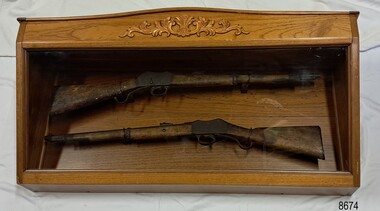 Flagstaff Hill Maritime Museum and Village
Weapon - Historic Rifles, Royal Small Arms Factory, 1877-1900
... 303 ammunition. Eventually, by 1900, the Martini-Henry Carbines were replaced by the Lee Enfield gun design. ...303 ammunition. Eventually, by 1900, the Martini-Henry Carbines were replaced by the Lee Enfield gun design. ...Martini-Henry Artillery Carbin rifles were made by the Royal Small Arms Factory at Enfield, Britain, from 1877 until 1900. Many were distributed to the British Colonies, including this pair, which was allocated to the Woodford Police, Victoria Police District of Warrnambool, Southwest Victoria. The Carbine model rifles were shorter than the standard rifles and more suited to mounted police and troopers. It is likely that in the early 20th century, Victoria Police replaced the two carbines with more modern firearms, and the outdated guns were stored in the stables. The rifles were left there and likely forgotten about due to changes in police staff. In 1915, police authorities announced that they would be replacing patrol horses with bicycles and would also close some smaller police stations. This affected Woodford Police Station, which closed in 1917. The forgotten firearms remained in the stables and were noticed by schoolboy Robert Jellie in 1940 and seen again in 1946. In 1995, the property was sold by the Education Department to a private owner. The Woodford Community donated the pair of Martini-Henry Carbines to the Victoria Police Museum in the late 1990s for mounting and display, which was funded by the Victoria Police Historical Society Inc. The decorative wood and glass display case and frame were designed to preserve the significant history of the guns. On November 1st 1999, the display was presented to Warrnambool Police and the local community due to the historical significance of the Woodford Police Station. In 2025, these items were formally deaccessioned by the Victoria Police Museum, and ownership was transferred to the Warrnambool Police Station. On March 10th, 2025, the display was transferred to Flagstaff Hill Maritime Museum and Village, where the historical story of the Martini-Henry Carbines could continue to be preserved and accessed by local families, the community, visitors to the area, and online visitors. WOODFORD POLICE: - The small settlement at Woodford was established in the 1840s around the Merri River where there was a ford across the water and a bridge from 1848 to 1851. The area was settled very early in Victoria’s history, and the river crossing provided travellers with access to the early route between Port Fairy (named Belfast at that time), Warrnambool and Melbourne. Occasionally, a Warrnambool police trooper would ride through Woodford and the district. In December 1854, Woodford Police barracks and stables were built on the hill by the Merri River on Bridge Road east, where Jubilee Park now stands. A local mounted trooper kept law and order in the area. In 1856, a lock-up was installed, and the first Woodford Police Station was in action in 1857. By 1871, the police station had been moved from the hill to land across the Merri River bridge, on the southern side of Bridge Road west, near Mill Street. In 1890, the police residence there was replaced by a stone Edwardian-style building with the stables and lock-up behind it and the old police station at the rear. The police continued to have a presence in Woodford until it was closed by the Police Commissioner in July 1917 for economic reasons. The residence was used for government housing until 1923, when it was taken over by the Education Department for the school teacher’s home. In 1995, it became privately owned. THE MARTINI-HENRY ARTILLERY CARBINE: - The Martini-Henry rifles were made in Britain from 1871 at the Royal Small Arms factory at Enfield and were stamped with the symbol of the Royal Cipher (Crown over VR) over ENFIELD to identify their origin. They were named after two of several people who helped design this method: Swiss Friederich von Martini and Scotsman Alexander Henry. The design was breech-loaded, and the inner barrel was rifled. A thumb rest was incorporated into the top right of the bullet receiver’s chamber. The small teardrop lever on the right side of the rifle showed whether the rifle was ready to be shot. In 1877, the shorter, lighter-weight Carbine version of the firearm was produced for mounted troops and artillery. Its official name was “Carbine, B.L., Rifled, Martini-Henry.” The bullets were slightly lighter in weight than those used for the longer rifle. The sight position was adjusted for the shorter gun, and wings were added to the sight on the tip, making it easier to slide the rifle back into a saddle bag. Some of the later Carbines also had leather sight covers screwed to the stock to prevent them from catching on the saddle bags. The Carbines had accessories available, such as barrel extensions with bayonets and swivels for adding slings. The Martini-Henry Carbine designs were later modified to fire the British .303 ammunition. Eventually, by 1900, the Martini-Henry Carbines were replaced by the Lee Enfield gun design. The pair of Martini-Henry Carbine firearms represents policing in the early pre-1900 days of colonial settlement; Woodford was one of the first townships settled in Victoria, and it had a police presence from 1854 until 1917. The rifles and display provide a historic connection between the location of Woodford and relatives and associates. The carbine rifles show a stage in the evolution of weapon design, adapted to suit mounted troops, and adding features to streamline use and storage. The ammunition was also improved during this progression. The carbines are important for their connection to policing law and order in a remote area. They are significant for their association with the township of Woodford, which was important to travel in the southwest Victoria district, providing access across a river for a road between Port Fairy and Melbourne, and later Warrnambool, and supplying food, goods and accommodation for the travellers. A pair of mounted rifles is mounted behind glass in a timer case, accompanied by a framed display of two photographs and an account of the rifles’ history. The case and display each have a horizontal board with a gently curved edge and carved decorations added. The identical firearms are British-made Martini Henry Carbine breach-loaded rifled guns, supplied by Britain to its Colonial troops from around 1877. The rifles are lever-action, single-shot .500 calibre weapons. They have a teardrop lever on their right side. They were used by Victoria Police mounted troops at the Woodford Police Station, Victoria. The black and white photographs were taken in 1946. The left photograph has a circled area; the right photograph is an enlarged view of the circled area, showing the Woodford Police Station in detail. The printed text is on textured paper with the Victoria Police watermark. It gives a summary of the rifle’s history. There is an inscription on the left photograph. Left photograph, handwritten in white pen: “WOODFORD” Document’s print: “During the late 1840s the small town of Woodford grew around the crossing of the Merri River on the Melbourne/Port Fairy Rad. Woodford was proclaimed a township in 1854 and a police quarters was established there in 1857. The police station remained until 1917 when it was closed and police service from then on was provided from Warrnambool. The building was then used as a school residence and is now privately owned. In !940 Robert JELLIE, then a schoolboy, observed two rifles mounted on the wall of the disused stable at the rear of the old police building. Following the devastating flood of 1946 (see photograph above) the rifles were again seen in the room next to the stable but were not seen again until the building was sold by the Education Department many years later. It was a recognition of the historical value of the rifles which led to their donation to the Warrnambool Police Complex. The rifles have been authenticated by the Victoria Police Armoury as being Victoria Police issue some time before 1900. The rifles are an identical pair of the famous British-made Martini Henry, a .500 inch calibre military weapon widely used by British Colonial troops. Victoria Police and the wider community of Warrnambool are indebted to the members of the Woodford community for their fine gesture in donating the rifles for mounting so that their historical importance can be preserved and they can be displayed for generations to come. This display was funded by the Victoria Police Historical Society Incorporated, and presented on the first day of November, 1999.”flagstaff hill maritime museum and village, great ocean road, shipwreck coast, martini henry, victoria police, woodford police station, rifle, carbine, display case, british, martini henry carbine, breech-loaded, rifled, colonial, single-shot, .500 calibre, weapon, gun, 1877, troops, mounted troops, merri river, victoria police woodford, victoria police warrnambool, victoria police melbourne, police quarters, robert jellie, school residence, stable, 1946 flood, victoria police armoury, identical pair, british colonial troops, victoria police historical society incorporated, woodford, bicycles, found by a schoolboy, edwardian-style building, victoria police museum, warrnambool police station
