
Showing 21 items matching "10th australian light horse"
-
 Box Hill Historical Society
Photograph - Armed Forces
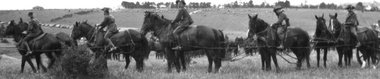
... ...10th Australian Light Horse...Light Horse Troop in training - possibly No 5 Squadron of the 10th Australian Light Horse holding its annual gymkana at Box Hill on 11 May (year unknown)....Light Horse Troop in training - possibly No 5 Squadron of the 10th Australian Light Horse holding its annual gymkana at Box Hill on 11 May (year unknown). ...Light Horse Troop in training - possibly No 5 Squadron of the 10th Australian Light Horse holding its annual gymkana at Box Hill on 11 May (year unknown). B & W photo armed forces, light horse, 10th australian light horse, gymkana -
 Box Hill Historical Society
Photograph - Australian Light Horse
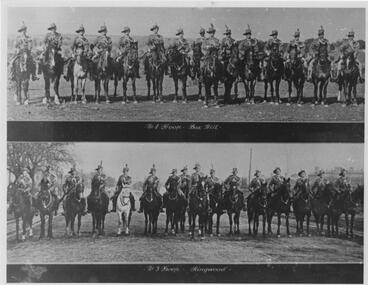
... ...10th Australian Light Horse...Australian Light Horse - No. 3 Troop, Ringwood and No. 4 Troop - Box Hill. See p. 37 "The Days Before Yesterday".Captioned 1907 Box Hill Troop No. 5 Squadron 10th Australian Light Horse....Australian Light Horse - No. 3 Troop, Ringwood and No. 4 Troop - Box Hill. See p. 37 "The Days Before Yesterday".Captioned 1907 Box Hill Troop No. 5 Squadron 10th Australian Light Horse. ...Australian Light Horse - No. 3 Troop, Ringwood and No. 4 Troop - Box Hill. See p. 37 "The Days Before Yesterday".Captioned 1907 Box Hill Troop No. 5 Squadron 10th Australian Light Horse. B & W photo divided into 2 armed forces, soldiers, australian light horse, "the days before yesterday", 10th australian light horse -
 Australian Army Museum of Western Australia
Diorama, 2015
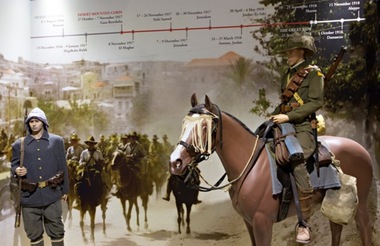
... 1:1 scale diorama showing mounted trooper of 10th Australian Light Horse Regiment in Palestine 1918 and dismounted Ottoman soldier...Australian Light Horse and Ottoman infantry. This diorama attempts to convey the conditions experienced and the country traversed during "The Great Ride" gaza, beersheba, light horse 1:1 scale diorama showing mounted trooper of 10th Australian Light Horse Regiment in Palestine 1918 and dismounted Ottoman soldier Diorama ...This diorama is the central feature in the World War 1 Gallery - Middle East Campaigns sequence and shows typical uniforms and accoutrements of the Australian Light Horse and Ottoman infantry. This diorama attempts to convey the conditions experienced and the country traversed during "The Great Ride" 1:1 scale diorama showing mounted trooper of 10th Australian Light Horse Regiment in Palestine 1918 and dismounted Ottoman soldier gaza, beersheba, light horse -
 Orbost & District Historical Society
certificate, November 1894
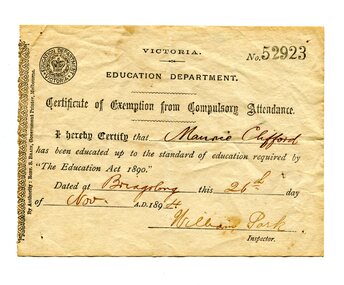
... Having served in the 10th Australian Light Horse, Citizen Military Forces, he enlisted on 22 February 1916 as a private in 37th Battalion D Company....Having served in the 10th Australian Light Horse, Citizen Military Forces, he enlisted on 22 February 1916 as a private in 37th Battalion D Company. ...This is Certificate No. 5293 and certifies that Maurice Clifford has been educated up to the standard of education required by "The Education Act 1890." It is dated at Briagolong on 26th November, 1894. Briagolong Primary School was established in 1875 when the town of Briagolong came into being. Maurice William Clifford was a farmer in Briagolong. He was killed in action at Ypres, Belgium on 4 October, 1917. Having served in the 10th Australian Light Horse, Citizen Military Forces, he enlisted on 22 February 1916 as a private in 37th Battalion D Company. The 1890 Act called for all children in Victoria between the ages of 6 and 13 to attend school forty days in each quarter of a year. Section 13 of the Act states that “Two hours before noon on any two days or two hours after noon on any two days” is deemed to be equal to one day's attendance. One of the reasons for exemption from compulsory attendance was if the child lived more than two miles from a school (or two and a half miles if aged 9 or over). If a student had reached a sufficient level of education an exemption could be granted. A white paper certificate with black print. It is issued by the Victorian Education Department for the exemption from compulsory attendance for Maurice Clifford. The certificate is printed with hand-written details. education clifford-maurice-william -
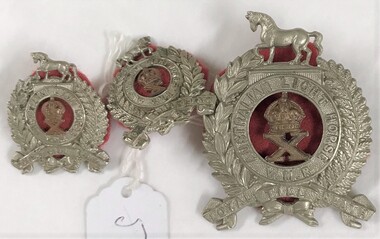 8th/13th Victorian Mounted Rifles Regimental Collection
Badge - 10th LH badge
... The 10th Australian Light Horse (VMR) was raised from companies of the pre-federation Victorian Mounted Rifles mainly in the Gippsland area of Victoria. ...The 10th Australian Light Horse (VMR) was raised from companies of the pre-federation Victorian Mounted Rifles mainly in the Gippsland area of Victoria. ...The 10th Australian Light Horse (VMR) was raised from companies of the pre-federation Victorian Mounted Rifles mainly in the Gippsland area of Victoria. In 1912 it was renumbered 13th Light Horse with the motto Loyal till Death and the territorial title Gippsland. Following World War One the regiment retained its number, title and motto. The regiment trained as a cavalry regiment till August 1940, when it converted from horse to mechanised initially as 13th Motor Regiment then 13th Armoured Regiment. It trained in Victoria and, as the Japanese threat to the mainland declined, was disbanded in October 1943 with men going to other units. Hat badge and two collar badges of the 10th Light Horse (VMR) Regiment. Badges have a red fabric backing. light horse, vmr, gippsland, 10th -
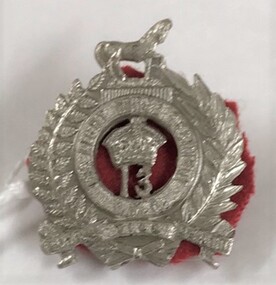 8th/13th Victorian Mounted Rifles Regimental Collection
Badge - 13th LH badge
... The 10th Australian Light Horse (VMR) was raised from companies of the pre-federation Victorian Mounted Rifles mainly in the Gippsland area of Victoria. ...The 10th Australian Light Horse (VMR) was raised from companies of the pre-federation Victorian Mounted Rifles mainly in the Gippsland area of Victoria. ...The 10th Australian Light Horse (VMR) was raised from companies of the pre-federation Victorian Mounted Rifles mainly in the Gippsland area of Victoria. In 1912 it was renumbered 13th Light Horse with the motto Loyal till Death and the territorial title Gippsland. Following World War One the regiment retained its number, title and motto. The regiment trained as a cavalry regiment till August 1940, when it converted from horse to mechanised initially as 13th Motor Regiment then 13th Armoured Regiment. It trained in Victoria and, as the Japanese threat to the mainland declined, was disbanded in October 1943 with men going to other units. Collar badge of the 13th Light Horse (Gippsland) Regiment. Badge has a red fabric backing. light horse, vmr, gippsland, 10th -
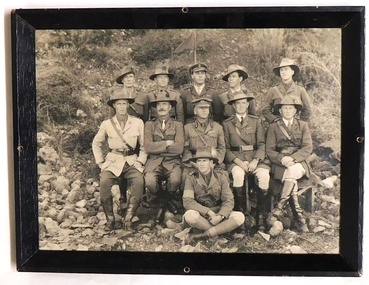 8th/13th Victorian Mounted Rifles Regimental Collection
Photograph - 3rd LH Bde 1918
... Following Gallipoli service, 3rd Light Horse Brigade comprising 8th (Victorian), 9th (South Australian/ Victorian) and 10th (West Australian) Light Horse Regiments formed part of the ANZAC Mounted Corps under command of Sir Harry Chauvel in the campaigns through Egypt, Palestine and Syria, 1916-1918. ...Following Gallipoli service, 3rd Light Horse Brigade comprising 8th (Victorian), 9th (South Australian/ Victorian) and 10th (West Australian) Light Horse Regiments formed part of the ANZAC Mounted Corps under command of Sir Harry Chauvel in the campaigns through Egypt, Palestine and Syria, 1916-1918. ...Following Gallipoli service, 3rd Light Horse Brigade comprising 8th (Victorian), 9th (South Australian/ Victorian) and 10th (West Australian) Light Horse Regiments formed part of the ANZAC Mounted Corps under command of Sir Harry Chauvel in the campaigns through Egypt, Palestine and Syria, 1916-1918. Fine study of senior officers of a Light Horse Brigade in the Middle East during World War 1 (1914-1918). Small Black and white photograph of Brigadier Wilson and Staff, 3rd Light Horse Brigade circa 1918. Back row L-R, Lieutenant Latham, Major Worthington, Captain Lyall, Captain Barker. Front row L-R. Lieutenant - Colonel Stewart ( Field Ambulance ), Lieutenant - Colonel Todd ( 10 Light Horse ), Brigadeer Wilson, ( Brig.( OMD ) , Lieutenant Colonel Wilson ( Brig. OND ), Lieutenant - Colonel Scott ( 9th Light Horse ), Lieutenant - Colonel Daly ( 8th Light Horse ) & seated in front Captain Hammond 3rd light horse brigade, wilson, wwi, world war one, middle east -
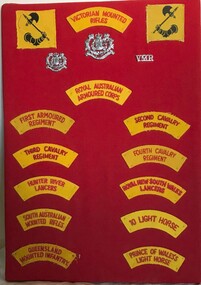 8th/13th Victorian Mounted Rifles Regimental Collection
Memorabilia - Shoulder titles
... CMF regiments used their territorial designation: Victorian, Queensland, New South Wales, Hunter River, South Australian, Prince of Wales's and 10th Light Horse. Australia’s defence plans and priorities changed after the Second World War. ...CMF regiments used their territorial designation: Victorian, Queensland, New South Wales, Hunter River, South Australian, Prince of Wales's and 10th Light Horse. Australia’s defence plans and priorities changed after the Second World War. ...Embroidered shoulder titles were worn on the upper sleeves of uniform prior to the introduction of colour patches c.1990. Regular regiments used the numerical designations First, Second, Third and Fourth. CMF regiments used their territorial designation: Victorian, Queensland, New South Wales, Hunter River, South Australian, Prince of Wales's and 10th Light Horse. Australia’s defence plans and priorities changed after the Second World War. Decolonisation coupled with competing ideologies created an unstable situation in the Asia-Pacific region. Australia recognised it needed both regular and citizen forces. Six Armoured Corps regiments were formed in 1948, all with territorial titles reflecting their Light Horse heritage. In Victoria they were 4th/19th Prince of Wales’s Light Horse and 8th/13th Victorian Mounted Rifles. The 1st Armoured Regiment, formed July 1949, was the first regular RAAC regiment, followed by 2nd, 3rd and 4th Cavalry Regiments decades later. Unique collection of regimental titles worthy of preservation and display. Display board containing the badge and shoulder title of 8/13 Victorian Mounted Rifles flanked by the formation signs of 2nd Armoured Brigade. These are followed by the shoulder titles of Royal Australian Armoured Corps and eight other RAAC regiments. military, titles, uniform, ara, cmf -
 4th/19th Prince of Wales's Light Horse Regiment Unit History Room
Colour Patch Display, Frontier Military History Services, Australian Light Horse Colour Patches of the 1st AIF 1915-1920 & AMF/CMF 1921-1940's, 24/07/2010
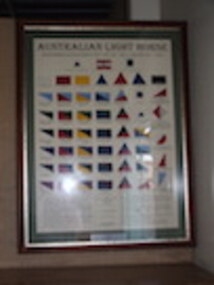
... Colour patches displayed are those of : 1st Cavalry Division HQ (CMF) Desert Mounted Corps HQ 2nd Cavalry Division HQ (CMF) HQ 1st Light Horse Brigade (AIF & CMF) HQ 2nd Light Horse Brigade (AIF & CMF) HQ 3rd Light Horse Brigade (AIF & CMF) HQ 4th Light Horse Brigade (AIF) HQ 5th Light Horse Brigade (AIF & CMF) HQ 4th Light Horse Brigade (CMF) HQ 6th Light Horse Brigade (CMF) 1st Light Horse Regiment / 1st Royal NSW Lancers 5th Light Horse Regiment / 5th Wide Bay & Burnett Light Horse 8th Light Horse Regiment / 8th Indi Light Horse Regiment 4th Light Horse Regiment / 4th Corangamite Light Horse Regiment 14th Light Horse Regiment / 14th West Moreton Light Horse Regiment 18th Adelaide Lancers 4th Light Horse Regiment / 1st Aust Div Mounted Regiment / 2nd ANZAC Mounted Regiment / 22nd Corps Mounted Regiment. 2nd Light Horse Regiment / 2nd Moreton Light Horse Regiment 6th Light Horse Regiment / 6th NSW Mounted Rifles 9th Light Horse Regiment / 9th Flinders Light Horse Regiment 11th Light Horse Regiment / 11th Darling Downs Light Horse Regiment 15th Light Horse Regiment / 15th Northern River Lancers 21st Riverina Light Horse 13th Light Horse Regiment / 2nd Aust Div Mounted Regiment / 1st ANZAC Mounted Regiment / Aust Corps Mounted Regiment / 13th Gippsland Light Horse Regiment 3rd Light Horse Regiment / 3rd South Australian Mounted Rifles 7th Light Horse Regiment / 7th Australian Horse 10th Light Horse Regiment / 10th Western Australian Mounted Infantry 12th Light Horse Regiment / 12th New England Light Horse Regiment 17th Prince of Wales Light Horse Regiment 22nd Tasmanian Mounted Infantry 11th Light Horse Regiment / 4th Aust Div Mounted Regiment / 24th Gwydir Light Horse Regiment 1st Machine Gun Squadron / 25th Light Horse (MG) 2nd Machine Gun Squadron / 16th Hunter River Lancers 3rd Machine Gun Squadron / 20th Victorian Mounted Rifles 4th Machine Gun Squadron / 26th Light Horse (MG) 5th Machine Gun Squadron / 19th Yarrowee Light Horse 23rd Barossa Light Horse Regiment 12th Light Horse Regiment / 5th Aust Div Mounted Regiment 1st Light Horse Field Ambulance 2nd Light Horse Field Ambulance 3rd Light Horse Field Ambulance 4th Light Horse Field Ambulance 5th Light Horse Field Ambulance 4th Signal Troop / 4th Light Horse brigade 6th Mobile Veterinary Section /1st Light Horse Brigade 7th Mobile Veterinary Section / 2nd Light Horse Brigade 8th Mobile Veterinary Section / 3rd Light Horse Brigade 9th Mobile Veterinary Section / 4th Light Horse brigade 10th Mobile Veterinary Section / 5th Light Horse Brigade 5th Signal Troop / 5th Light Horse Brigade 1st Signal Squadron / NZ & Aust Mounted Div Signal Squadron...Colour patches displayed are those of : 1st Cavalry Division HQ (CMF) Desert Mounted Corps HQ 2nd Cavalry Division HQ (CMF) HQ 1st Light Horse Brigade (AIF & CMF) HQ 2nd Light Horse Brigade (AIF & CMF) HQ 3rd Light Horse Brigade (AIF & CMF) HQ 4th Light Horse Brigade (AIF) HQ 5th Light Horse Brigade (AIF & CMF) HQ 4th Light Horse Brigade (CMF) HQ 6th Light Horse Brigade (CMF) 1st Light Horse Regiment / 1st Royal NSW Lancers 5th Light Horse Regiment / 5th Wide Bay & Burnett Light Horse 8th Light Horse Regiment / 8th Indi Light Horse Regiment 4th Light Horse Regiment / 4th Corangamite Light Horse Regiment 14th Light Horse Regiment / 14th West Moreton Light Horse Regiment 18th Adelaide Lancers 4th Light Horse Regiment / 1st Aust Div Mounted Regiment / 2nd ANZAC Mounted Regiment / 22nd Corps Mounted Regiment. 2nd Light Horse Regiment / 2nd Moreton Light Horse Regiment 6th Light Horse Regiment / 6th NSW Mounted Rifles 9th Light Horse Regiment / 9th Flinders Light Horse Regiment 11th Light Horse Regiment / 11th Darling Downs Light Horse Regiment 15th Light Horse Regiment / 15th Northern River Lancers 21st Riverina Light Horse 13th Light Horse Regiment / 2nd Aust Div Mounted Regiment / 1st ANZAC Mounted Regiment / Aust Corps Mounted Regiment / 13th Gippsland Light Horse Regiment 3rd Light Horse Regiment / 3rd South Australian Mounted Rifles 7th Light Horse Regiment / 7th Australian Horse 10th Light Horse Regiment / 10th Western Australian Mounted Infantry 12th Light Horse Regiment / 12th New England Light Horse Regiment 17th Prince of Wales Light Horse Regiment 22nd Tasmanian Mounted Infantry 11th Light Horse Regiment / 4th Aust Div Mounted Regiment / 24th Gwydir Light Horse Regiment 1st Machine Gun Squadron / 25th Light Horse (MG) 2nd Machine Gun Squadron / 16th Hunter River Lancers 3rd Machine Gun Squadron / 20th Victorian Mounted Rifles 4th Machine Gun Squadron / 26th Light Horse (MG) 5th Machine Gun Squadron / 19th Yarrowee Light Horse 23rd Barossa Light Horse Regiment 12th Light Horse Regiment / 5th Aust Div Mounted Regiment 1st Light Horse Field Ambulance 2nd Light Horse Field Ambulance 3rd Light Horse Field Ambulance 4th Light Horse Field Ambulance 5th Light Horse Field Ambulance 4th Signal Troop / 4th Light Horse brigade 6th Mobile Veterinary Section /1st Light Horse Brigade 7th Mobile Veterinary Section / 2nd Light Horse Brigade 8th Mobile Veterinary Section / 3rd Light Horse Brigade 9th Mobile Veterinary Section / 4th Light Horse brigade 10th Mobile Veterinary Section / 5th Light Horse Brigade 5th Signal Troop / 5th Light Horse Brigade 1st Signal Squadron / NZ & Aust Mounted Div Signal Squadron Australian Light Horse Colour Patches of the 1st AIF 1915-1920 & AMF/CMF 1921-1940's Colour Patch Display Frontier Military History Services Keith Dudley ...Display board of replica cloth colour patches, mounted in glass fronted wooden frame. Colour patches displayed are those of : 1st Cavalry Division HQ (CMF) Desert Mounted Corps HQ 2nd Cavalry Division HQ (CMF) HQ 1st Light Horse Brigade (AIF & CMF) HQ 2nd Light Horse Brigade (AIF & CMF) HQ 3rd Light Horse Brigade (AIF & CMF) HQ 4th Light Horse Brigade (AIF) HQ 5th Light Horse Brigade (AIF & CMF) HQ 4th Light Horse Brigade (CMF) HQ 6th Light Horse Brigade (CMF) 1st Light Horse Regiment / 1st Royal NSW Lancers 5th Light Horse Regiment / 5th Wide Bay & Burnett Light Horse 8th Light Horse Regiment / 8th Indi Light Horse Regiment 4th Light Horse Regiment / 4th Corangamite Light Horse Regiment 14th Light Horse Regiment / 14th West Moreton Light Horse Regiment 18th Adelaide Lancers 4th Light Horse Regiment / 1st Aust Div Mounted Regiment / 2nd ANZAC Mounted Regiment / 22nd Corps Mounted Regiment. 2nd Light Horse Regiment / 2nd Moreton Light Horse Regiment 6th Light Horse Regiment / 6th NSW Mounted Rifles 9th Light Horse Regiment / 9th Flinders Light Horse Regiment 11th Light Horse Regiment / 11th Darling Downs Light Horse Regiment 15th Light Horse Regiment / 15th Northern River Lancers 21st Riverina Light Horse 13th Light Horse Regiment / 2nd Aust Div Mounted Regiment / 1st ANZAC Mounted Regiment / Aust Corps Mounted Regiment / 13th Gippsland Light Horse Regiment 3rd Light Horse Regiment / 3rd South Australian Mounted Rifles 7th Light Horse Regiment / 7th Australian Horse 10th Light Horse Regiment / 10th Western Australian Mounted Infantry 12th Light Horse Regiment / 12th New England Light Horse Regiment 17th Prince of Wales Light Horse Regiment 22nd Tasmanian Mounted Infantry 11th Light Horse Regiment / 4th Aust Div Mounted Regiment / 24th Gwydir Light Horse Regiment 1st Machine Gun Squadron / 25th Light Horse (MG) 2nd Machine Gun Squadron / 16th Hunter River Lancers 3rd Machine Gun Squadron / 20th Victorian Mounted Rifles 4th Machine Gun Squadron / 26th Light Horse (MG) 5th Machine Gun Squadron / 19th Yarrowee Light Horse 23rd Barossa Light Horse Regiment 12th Light Horse Regiment / 5th Aust Div Mounted Regiment 1st Light Horse Field Ambulance 2nd Light Horse Field Ambulance 3rd Light Horse Field Ambulance 4th Light Horse Field Ambulance 5th Light Horse Field Ambulance 4th Signal Troop / 4th Light Horse brigade 6th Mobile Veterinary Section /1st Light Horse Brigade 7th Mobile Veterinary Section / 2nd Light Horse Brigade 8th Mobile Veterinary Section / 3rd Light Horse Brigade 9th Mobile Veterinary Section / 4th Light Horse brigade 10th Mobile Veterinary Section / 5th Light Horse Brigade 5th Signal Troop / 5th Light Horse Brigade 1st Signal Squadron / NZ & Aust Mounted Div Signal Squadron Colour Patch Display No 39. Includes detailed notes about history, usage and design of colour patches world war one, ww1, army, aif, insignia, heraldry, light horse, militia, badges, colour patches, cmf -
 Bendigo Military Museum
Photograph - PHOTOGRAPH WW1, C.1917 - 18
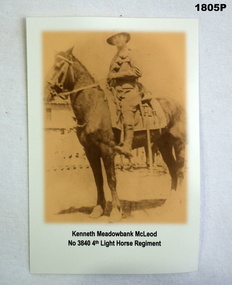
... 10th reinforcements 23rd Batt AIF on 5.8.1915. He was discharged on 10.8.1916 not due to misconduct medically unfit. He had refused to have a Varicose vein operation. He then re enlisted in the AIF No 3840 in 30th reinforcements 4th L.H.Regt on 28.5.1917 age 24 years 8 months. Embark for Egypt 2.11.1917, hospital 22.1.1918 (unclear), rejoin unit 7.3.1918, hospital 24.4.1918, with Tonsilitis, rejoin unit 19.5.1918, hospital 6.10.1918 with Pyrexia then later diagnosed Pluerisy and then Influenza, rejoin unit 4.3.1919, embark for Australia 15.6.1919, discharged from the AIF stating disability Malaria B.T. military history photographs- photography Light horse Sepia tone photo copy of original for display of Kenneth Meadowbank McLeod. ...Kenneth Meadowbank McLeod initially enlisted as No 4150 in 10th reinforcements 23rd Batt AIF on 5.8.1915. He was discharged on 10.8.1916 not due to misconduct medically unfit. He had refused to have a Varicose vein operation. He then re enlisted in the AIF No 3840 in 30th reinforcements 4th L.H.Regt on 28.5.1917 age 24 years 8 months. Embark for Egypt 2.11.1917, hospital 22.1.1918 (unclear), rejoin unit 7.3.1918, hospital 24.4.1918, with Tonsilitis, rejoin unit 19.5.1918, hospital 6.10.1918 with Pyrexia then later diagnosed Pluerisy and then Influenza, rejoin unit 4.3.1919, embark for Australia 15.6.1919, discharged from the AIF stating disability Malaria B.T. Sepia tone photo copy of original for display of Kenneth Meadowbank McLeod. Subject is in full kit on Horseback. Under photo is name, Regt No and unit. military history, photographs- photography, light horse -
 Victorian Interpretive Projects Inc.
Photograph - Digital, Troopship Wiltshire, 1918, c1918
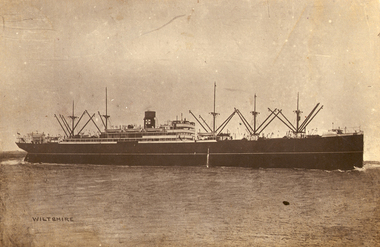
... Light Horse Regiment in Egypt on 10 December 1914. On 01 November 1914 The Wiltshire assembled with the first convoy at King George's Sound, Albany Western Australia in transporting the first detachment of the Australian and New Zealand Imperial Expeditionary Forces. It completed nine transport voyages from Australia commencing 18 October 1914 until final voyage from Sydney 9th November 1918. During that time The Wiltshire carried the 4th Field Artillery Brigade (Victoria) 2nd Division Artillery and their 1st Reinforcements, 1st Division Ammunition Column 1st Division Artillery 4th Reinforcements, thirty-four Infantry Battalion Reinforcements, the 10th...Light Horse Regiment in Egypt on 10 December 1914. On 01 November 1914 The Wiltshire assembled with the first convoy at King George's Sound, Albany Western Australia in transporting the first detachment of the Australian and New Zealand Imperial Expeditionary Forces. It completed nine transport voyages from Australia commencing 18 October 1914 until final voyage from Sydney 9th November 1918. During that time The Wiltshire carried the 4th Field Artillery Brigade (Victoria) 2nd Division Artillery and their 1st Reinforcements, 1st Division Ammunition Column 1st Division Artillery 4th Reinforcements, thirty-four Infantry Battalion Reinforcements, the 10th ...The HMAT A18 Wiltshire (1912-1922) weighed 10,390 tons with an average cruise speed of 13.5 knots or 25.00 kmph. Described as a refrigerated steamship it was b uilt 1912 by John Brown, Clydebank for the Federal S N Co Ltd, London and was propelled by a twin screw, quadruple expansion engine 2 x 4 cylinders each 6500 hp. Owned by the Commonwealth & Dominion Line Ltd, London, it was leased by the Commonwealth until 2 October 1917. It embarked from Egypt on 2 February 1918. On 18 October 1914 at Melbourne embarked the 4th Light Horse Regiment (Victoria) A, B & C squadron & their Machine Gun Section, the 2nd Field Ambulance (Victoria) First Division. The disembarked the 4th Light Horse Regiment in Egypt on 10 December 1914. On 01 November 1914 The Wiltshire assembled with the first convoy at King George's Sound, Albany Western Australia in transporting the first detachment of the Australian and New Zealand Imperial Expeditionary Forces. It completed nine transport voyages from Australia commencing 18 October 1914 until final voyage from Sydney 9th November 1918. During that time The Wiltshire carried the 4th Field Artillery Brigade (Victoria) 2nd Division Artillery and their 1st Reinforcements, 1st Division Ammunition Column 1st Division Artillery 4th Reinforcements, thirty-four Infantry Battalion Reinforcements, the 10th, 11th & 12th Field Artillery Battery (Victoria) 4th Field Artillery Brigades, the 4th Brigade Ammunition Column 4th Field Artillery Brigade, the 1st Siege Artillery Brigade 15th Reinforcements, the 4th Light Horse Regiment (Victoria) A, B & C squadron & their Machine Gun Section, six Light Horse Brigade Reinforcements, the 1st Veterinary Section (New South Wales) 11th Reinforcements, the 1st Mobile Veterinary Section (New South Wales) 1st Division 11th Reinforcements, the 2nd Mobile Veterinary Section (Victoria, New South Wales) 2nd Division 11th Reinforcements, the 1st Cyclist Battalion (New South Wales and Queensland) 3rd Reinforcements, the 2nd Field Ambulance (Victoria) First Division & Medical Officers. After the conclusion of World War One is was wrecked Rosalie Bay, Great Barrier Island New Zealand 31 May 1922 on passage London for Dunedin. Onboard was a crew of 103 plus 1 stowaway, and 10,000 ton of general cargo. No lives lost and is now a well frequented 'Dive' wrecksite. (http://www.flotilla-australia.com/hmat.htm#A18) Photographic postcard of the troopship Wiltshire out at sea. world war one, world war, wiltshire, troop ship, mmm -
 RSL Victoria - Anzac House Reference Library and Memorabilia Collection
Photograph Album
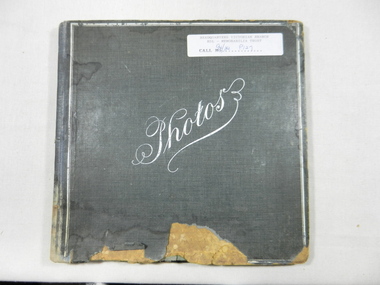
... 10th May 1915. Commanded the Australian units of the Imperial Camel Corps and later was CO of the 14th Light Horse. ...10th May 1915. Commanded the Australian units of the Imperial Camel Corps and later was CO of the 14th Light Horse. ...George Langley, a teacher from Port Melbourne, embarked from Melbourne onboard HMAT Ulysses on 10th May 1915. Commanded the Australian units of the Imperial Camel Corps and later was CO of the 14th Light Horse. Returned to Australia in July 1919. Albums (7), photographs, negatives and postcards of George Furner Langley (14 Australian Light Horse / Imperial Camel Corps). ww1, george furner langley, imperial camel corps, 14 light horse, photographs -
 Wangaratta RSL Sub Branch
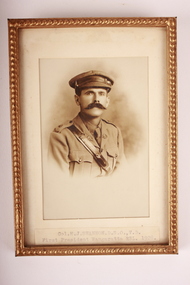
Photograph - Framed photograph, Colonel H J SHANNON
... Australian Light Horse and later as Colonel of the 3rd Cavalry Brigade During the second world war Colonel Shannon came out from retirement to organise the V.D.C in North East Victoria. Colonel SHANNON was awarded a DSO for distinguished service during active operations against the enemy in 1915. He became the President of Wangaratta RSL in 1928. hj shannon 8th light horse aif dso wangaratta Typed below image - "Col.H.J.SHANNON.D.S.O.;V.D." "FIRST PRSIDENT WANGARATTA PRSIDENT RSL. 1928." Handwritten on rear of postcard image inside frame as follows: - Salten(?) at Cairo 10th ...Image of Lt Colonel Herbert James SHANNON DSO,VD - Commanding Officer of the 8th Light Horse AIF. Colonel Shannon became the 1st President of the Wangaratta RSL when it was organised under Anzac House and the present constitution. He was born at Bowman's Forest in 1874 and died in Wangaratta in 1960. He served in the Victorian Mounted Rifles at the turn of the century, rose to the rank of Captain and commanded the Wangaratta Detachment and Company - this later became the 8th Light Horse Regiment. In 1915 he embarked as Major in the 8th Light Horse and served in Gallipoli, Sinai, Palestine and Syria when he commanded the 8th Squadron. Later he was promoted to Lieutenant Colonel and commanded the Regiment. During the Amman raids, he was awarded the D.S.O at El Salt. This award was presented to him by the Duke of Clarence. In post war period he commanded the 8th Australian Light Horse and later as Colonel of the 3rd Cavalry Brigade During the second world war Colonel Shannon came out from retirement to organise the V.D.C in North East Victoria. Colonel SHANNON was awarded a DSO for distinguished service during active operations against the enemy in 1915. He became the President of Wangaratta RSL in 1928. Gold coloured metal frame containing sepia photograph of Army Officer with moustache Typed below image - "Col.H.J.SHANNON.D.S.O.;V.D." "FIRST PRSIDENT WANGARATTA PRSIDENT RSL. 1928." Handwritten on rear of postcard image inside frame as follows: - Salten(?) at Cairo 10th November, 1916 "I hope you like this. I think it a very good photo. Wishing you a happy Xmas" Bert Rear of frame- "Col.H.J.SHANNON D.S.O.,; V.D. Photographed CAIRO 1916 hj shannon, 8th light horse aif, dso, wangaratta -
 Australian Army Museum of Western Australia
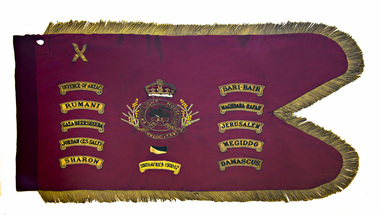
Guidon - 10th Light Horse Regiment
... Presented to 10th Light Horse Regiment (West Australian Mounted Infantry) by Lt-General Sir Harry Chauvel, GCMG, KCB on the Esplanade, Perth, 10 March 1928. ...Other related facts:- • The battle honour "South Africa 1900-02" was granted under MO 123/1908 to 18th Australian Light Horse Regiment which was the predecessor Militia Light Horse regiment existing at the time. • This battle honour appeared under 10th Light Horse Regiment in the Australian Army List from 1928 onwards. • Having the battle honour added at a later date would explain why this battle honour is positioned on the lower portion of the guidon in the centre. ...Presented to 10th Light Horse Regiment (West Australian Mounted Infantry) by Lt-General Sir Harry Chauvel, GCMG, KCB on the Esplanade, Perth, 10 March 1928. ...Presented to 10th Light Horse Regiment (West Australian Mounted Infantry) by Lt-General Sir Harry Chauvel, GCMG, KCB on the Esplanade, Perth, 10 March 1928. Consecrated by Senior Chaplain COL Riley, OBE, VD, DD. Later carried by the post-World War Two unit, 10th West Australian Mounted Infantry, raised as a CMF unit of the Royal Australian Armoured Corps in 1949 as a direct successor unit to the above light horse regiment. This unit was redesignated as 10th Light Horse in 1956. The Guidon was laid up at the State War Memorial, King's Park on 10 June 1967, following presentation of a new Guidon to 10th Light Horse in 1966. It was transferred to the Army Museum of WA in 1988 as part of the Bicentenary Colours Project. Crimson with gold fringes, swallow tailed end (traditional cavalry Guidon shape). In the centre a black swan within a circle inscribed "10th LIGHT HORSE (WAMI)", across the lower portion of the circle a scroll inscribed with the regimental motto "PERCUTE ET PERCUTE VELOCITER", the whole surrounded with a wreath of Australian wattle and surmounted by the Crown. In the upper canton the roman numeral "X" Below the whole centrepiece is the regimental colour patch in black over gold diagonals in a rectangle and below that is the battle honour SOUTH AFRICA 1900-02 . Emblazoned on either side of the centrepiece are ten selected battle honours from the Great War: DEFENCE OF ANZAC, SARI BAIR, RUMANI, MAGHDABA-RAFAH, GAZA-BEERSHEBA, JERUSALEM, JORDAN (ES SALT), MEGIDDO, SHARON, DAMASCUS. The battle honour for South Africa for unknown reasons was not included on the guidon when originally presented in 1928, and was not emblazoned on the Guidon until the early 1950's. Other related facts:- • The battle honour "South Africa 1900-02" was granted under MO 123/1908 to 18th Australian Light Horse Regiment which was the predecessor Militia Light Horse regiment existing at the time. • This battle honour appeared under 10th Light Horse Regiment in the Australian Army List from 1928 onwards. • Having the battle honour added at a later date would explain why this battle honour is positioned on the lower portion of the guidon in the centre. At the time of approving battle honours for the Great War, the authorised position for any pre-existing South Africa battle honour was in the top left corner of the Guidon or colour, followed by the battle honours of the Great War. (AAO 112/1927). -
 8th/13th Victorian Mounted Rifles Regimental Collection
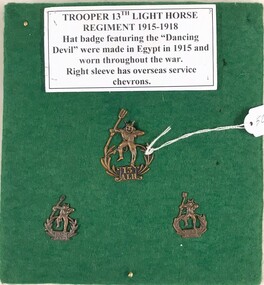
Badge - Dancing devils
... Australian Corps Mounted Troops. The regiment was raised as 13th Light Horse (Gippsland), a Citizen Forces unit. following WWI, and trained as a cavalry regiment till August 1940, when it converted from horse to mechanised initially as 13th Motor Regiment then 13th Armoured Regiment. It trained in Victoria and Queensland but as the Japanese threat to the mainland declined, it was disbanded in October 1943 with men going to other units. The 10th...Australian Corps Mounted Troops. The regiment was raised as 13th Light Horse (Gippsland), a Citizen Forces unit. following WWI, and trained as a cavalry regiment till August 1940, when it converted from horse to mechanised initially as 13th Motor Regiment then 13th Armoured Regiment. It trained in Victoria and Queensland but as the Japanese threat to the mainland declined, it was disbanded in October 1943 with men going to other units. The 10th ...The 13th Light Horse Regiment considered themselves to be the 'Devil's Own' owing to their number 13 designation, consequently when in Egypt in 1915 they commissioned local metal workers to produce unofficial hat and lapel badges. The 13th Light Horse Regiment (AIF) was raised at Broadmeadows Victoria in March 1915. Following service at Gallipoli the regiment was broken up with squadrons going to France as Divisional Cavalry Squadrons of 2nd, 4th and 5th Divisions. The regiment was reformed as firstly 1st Anzac Corps Mounted Troops and later Australian Corps Mounted Troops. The regiment was raised as 13th Light Horse (Gippsland), a Citizen Forces unit. following WWI, and trained as a cavalry regiment till August 1940, when it converted from horse to mechanised initially as 13th Motor Regiment then 13th Armoured Regiment. It trained in Victoria and Queensland but as the Japanese threat to the mainland declined, it was disbanded in October 1943 with men going to other units. The 10th Light Horse was raised in 1903 from Victorian Mounted Rifles companies in Gippsland. In 1912 the regiment was renumbered 13th Light Horse. In 1920 the regiment had the territorial title Gippsland Light Horse added. The regiment was raised as 13th Light Horse (Gippsland), a Citizen Forces unit. In 1940 the regiment converted from horse to mechanised, initially as 13th Motor Regiment then 13th Armoured Regiment. It trained in Victoria and Queensland but as the Japanese threat to the mainland declined, was disbanded in October 1943 with men going to other units. Fabric covered board with Dancing Devil hat badge and two lapel badges attached, also a paper label. The attached label relates to a previous display when the badges were displayed alongside a uniform. world war one, wwi, 13th, light horse, badge, devil -
 8th/13th Victorian Mounted Rifles Regimental Collection
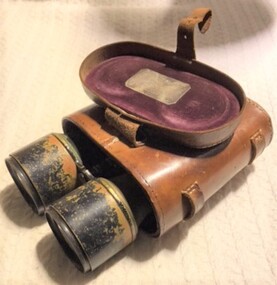
Equipment - Binoculars
... Australian Light Horse Regiment. Howard was killed in action in the charge at the Nek, Gallipoli peninsula, on 7 August 1915. Howard was a 25-year-old grain dealer from Melbourne when he enlisted in the AIF and was appointed a lieutenant in the 8th ALH on 24 October 1914. He had pre-World War One service with 10th...Australian Light Horse Regiment. Howard was killed in action in the charge at the Nek, Gallipoli peninsula, on 7 August 1915. Howard was a 25-year-old grain dealer from Melbourne when he enlisted in the AIF and was appointed a lieutenant in the 8th ALH on 24 October 1914. He had pre-World War One service with 10th ...These binoculars belonged to Lieutenant Thomas Spencer Howard, 8th Australian Light Horse Regiment. Howard was killed in action in the charge at the Nek, Gallipoli peninsula, on 7 August 1915. Howard was a 25-year-old grain dealer from Melbourne when he enlisted in the AIF and was appointed a lieutenant in the 8th ALH on 24 October 1914. He had pre-World War One service with 10th Light Horse (VMR), 11th & 29th Light Horse Regiments. Prior to sailing he was presented with these binoculars: “Lieut TS Howard 8th LH, 3rd Aust Imp Exped’y Force, From Chief and Staff of J.F.C. Jan 1915”. They were returned, together with his spurs, to his family following his death. Metal binoculars with leather case with metal presentation plaque on inside flap lid. Lieut TS Howard 8th LH, 3rd Aust Imp Exped’y Force, From Chief and Staff of J.F.C. Jan 1915 howard, light horse, 8th, gallipoli, binoculars, wwi, world war one, nek -
 8th/13th Victorian Mounted Rifles Regimental Collection
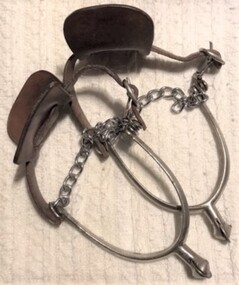
Equipment - Spurs
... Australian Light Horse Regiment. Howard was killed in action in the charge at the Nek, Gallipoli peninsula, on 7 August 1915. Howard was a 25-year-old grain dealer from Melbourne when he enlisted in the Australian Imperial Force and was appointed a lieutenant in the 8th Australian Light Horse on 24 October 1914. He had pre-World War One service with 10th...Australian Light Horse Regiment. Howard was killed in action in the charge at the Nek, Gallipoli peninsula, on 7 August 1915. Howard was a 25-year-old grain dealer from Melbourne when he enlisted in the Australian Imperial Force and was appointed a lieutenant in the 8th Australian Light Horse on 24 October 1914. He had pre-World War One service with 10th ...This set of spurs belonged to Lieutenant Thomas Spencer Howard 8th Australian Light Horse Regiment. Howard was killed in action in the charge at the Nek, Gallipoli peninsula, on 7 August 1915. Howard was a 25-year-old grain dealer from Melbourne when he enlisted in the Australian Imperial Force and was appointed a lieutenant in the 8th Australian Light Horse on 24 October 1914. He had pre-World War One service with 10th Light Horse (VMR), 11th & 29th Light Horse Regiments. They were returned, together with a pair of binoculars, to his family following his death. Spurs with leather straps and chains howard, gallipoli, nek, wwi, world war one, light horse, 8th -
 8th/13th Victorian Mounted Rifles Regimental Collection
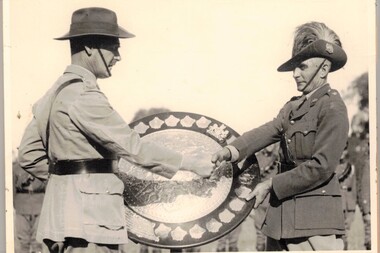
Photograph
... Light Horse Troop in Australia. The trophy is now held at the Armoured Centre Puckapunyal. Inter-regimental competition was strong in the years between WWI and WWII. Annually, the best troop in the regiments of the 3rd (Vic), 4th (SA), 5th (WA) and 6th (Tas) Military Districts competed for the Hutton Trophy and the Lord Forster Cup. The Tocumwal Troop 20th LH commanded by Sgt HG (Bob) Fyffe were the winners in 1937/38 and the Tallangatta Troop 8th LH led by Lt L Wildsmith, in 1938/39. Other competitors in 1938/39 were the York Troop, 10th...Light Horse Troop in Australia. The trophy is now held at the Armoured Centre Puckapunyal. Inter-regimental competition was strong in the years between WWI and WWII. Annually, the best troop in the regiments of the 3rd (Vic), 4th (SA), 5th (WA) and 6th (Tas) Military Districts competed for the Hutton Trophy and the Lord Forster Cup. The Tocumwal Troop 20th LH commanded by Sgt HG (Bob) Fyffe were the winners in 1937/38 and the Tallangatta Troop 8th LH led by Lt L Wildsmith, in 1938/39. Other competitors in 1938/39 were the York Troop, 10th ...The Hutton Trophy or Shield was awarded annually to the best Light Horse Troop in Australia. The trophy is now held at the Armoured Centre Puckapunyal. Inter-regimental competition was strong in the years between WWI and WWII. Annually, the best troop in the regiments of the 3rd (Vic), 4th (SA), 5th (WA) and 6th (Tas) Military Districts competed for the Hutton Trophy and the Lord Forster Cup. The Tocumwal Troop 20th LH commanded by Sgt HG (Bob) Fyffe were the winners in 1937/38 and the Tallangatta Troop 8th LH led by Lt L Wildsmith, in 1938/39. Other competitors in 1938/39 were the York Troop, 10th Light Horse (WA), Burnie Troop 22nd LH (Tas) and Orroroo Troop 9th/23rd LH (SA). Troops were marked on Personnel, Horses (type & turnout), Saddlery, Hotchkiss Gun (turnout), Horsemanship, Fire control, Shooting (rifle & H gun), Sword action and Time. VX 42774 Captain Robert (Bob) Fyffe, a grazier from Tocumwal, NSW, served with the Tocumwal troop of the 20th Light Horse prior to WWII (1939-46). He enlisted at the outbreak of war and served with the 9th Division Cavalry Regiment in North Africa. During the attack on Trig 22 on 17 July 1942 Captain Fyffe commanding a composite squadron manoeuvred his tanks to knock out machine guns and anti-tank guns enabling 2/32 Battalion to capture the objective. Captain Fyffe was awarded the Military Cross for his leadership and courage in the action. This was 9th Division Cavalry's first tank action of the war. Complement other images in collection Black and white photograph glued to corrugated plastic backing card showing two officers with large silver shield. Occasion is the presentation of the Hutton Trophy to the troop leader of the Tocumwal Troop 20th Light Horse Regiment, Lieutenant H G (Bob) Fyffe, 1938. hutton trophy, tocumwal, fyffe, light horse, competition, victoria -
 8th/13th Victorian Mounted Rifles Regimental Collection
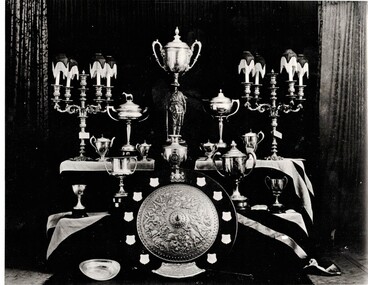
Photograph - Trophies 13LH
... 10th Light Horse Regiment. In 1912 the regiment was renumbered 13th Light Horse. The 13th Light Horse Regiment (AIF) was raised at Broadmeadows Victoria in March 1915. Following service at Gallipoli the regiment was broken up with squadrons going to France as Divisional Cavalry Squadrons of 2nd, 4th and 5th Divisions. The regiment was reformed as firstly 1st Anzac Corps Mounted Troops and later Australian...10th Light Horse Regiment. In 1912 the regiment was renumbered 13th Light Horse. The 13th Light Horse Regiment (AIF) was raised at Broadmeadows Victoria in March 1915. Following service at Gallipoli the regiment was broken up with squadrons going to France as Divisional Cavalry Squadrons of 2nd, 4th and 5th Divisions. The regiment was reformed as firstly 1st Anzac Corps Mounted Troops and later Australian ...At Federation, the Victorian Mounted Rifles companies in the Gippsland area of Victoria were reorganised into the 10th Light Horse Regiment. In 1912 the regiment was renumbered 13th Light Horse. The 13th Light Horse Regiment (AIF) was raised at Broadmeadows Victoria in March 1915. Following service at Gallipoli the regiment was broken up with squadrons going to France as Divisional Cavalry Squadrons of 2nd, 4th and 5th Divisions. The regiment was reformed as firstly 1st Anzac Corps Mounted Troops and later Australian Corps Mounted Troops. The regiment was re-raised as 13th Light Horse (Gippsland), a Citizen Forces unit. following WWI, and trained as a cavalry regiment till August 1940, when it converted from horse to mechanised, initially as 13th Motor Regiment then 13th Armoured Regiment. It trained in Victoria and, as the Japanese threat to the mainland declined, was disbanded in October 1943 with men going to other units. In 1948, the 13th Light Horse was linked with 8th and 20th Regiments to form the 8/13 Victorian Mounted Rifles in the Citizen Military Forces. Black and white photograph of 13th Light Horse Regiment trophies arranged around the Hutton Trophy shield. light horse, 13th, trophies, hutton, vmr -
 8th/13th Victorian Mounted Rifles Regimental Collection
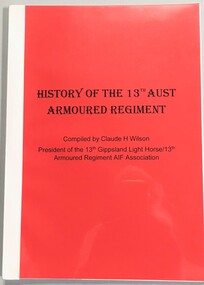
Document - 13th LH History
... Light Horse Regiment (AIF) was raised at Broadmeadows Victoria in March 1915. Following service at Gallipoli the regiment was broken up with squadrons going to France as Divisional Cavalry Squadrons of 2nd, 4th and 5th Divisions. The regiment was reformed as firstly 1st Anzac Corps Mounted Troops and later Australian Corps Mounted Troops. History light horse armour 13th Gippsland Wilson Walker History of 13th Armoured Regiment and its preceding regiments 10th ...The 10th Light Horse was raised in 1903 from Victorian Mounted Rifles companies in Gippsland. In 1912 the regiment was renumbered 13th Light Horse. In 1920 the regiment had the territorial title Gippsland Light Horse added. The regiment was raised as 13th Light Horse (Gippsland), a Citizen Forces unit. In 1940 the regiment converted from horse to mechanised, initially as 13th Motor Regiment then 13th Armoured Regiment. It trained in Victoria and Queensland but as the Japanese threat to the mainland declined, was disbanded in October 1943 with men going to other units. The 13th Light Horse Regiment (AIF) was raised at Broadmeadows Victoria in March 1915. Following service at Gallipoli the regiment was broken up with squadrons going to France as Divisional Cavalry Squadrons of 2nd, 4th and 5th Divisions. The regiment was reformed as firstly 1st Anzac Corps Mounted Troops and later Australian Corps Mounted Troops. History of 13th Armoured Regiment and its preceding regiments 10th Light Horse (VMR), 13th Light Horse (VMR), 13th Light Horse (AIF) and 13th Light Horse (Gippsland Light Horse) compiled by the President of the regimental association, Claude H Wilson c.1970. The text is handwritten and includes the World War diary of lieutenant Vernon C Walker, who was a member of the AIF regiment. A4 format, thermal bound 27 pages with 6 page addendum. history, light horse, armour, 13th, gippsland, wilson, walker -
 Dandenong/Cranbourne RSL Sub Branch
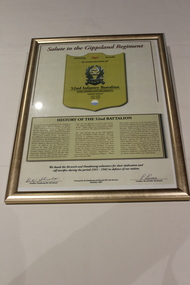
Certificate - Certificate -Salute to the Gippsland Regiment
... 10th Infantry Brigade, 3rd Militia (CMF) Division. With the reversion to voluntary citizen forces in1930,declining numbers forced an amalgamation with the 37th Bn to become 37th/52nd Bn. Then in mid 1936, an expansion and modernisation of the CMF, including the conversation of the Light Horse to motorised, allowed both battalions to separate and for the 52nd to expand into East Gippsland. In 1938, 52nd Bn was granted linkage with the "Queens Own Cameron Highlanders" and permission to use its Regimental March- "March of the Cameron Men'. When Japan entered the war in December 1941,the Australian...10th Infantry Brigade, 3rd Militia (CMF) Division. With the reversion to voluntary citizen forces in1930,declining numbers forced an amalgamation with the 37th Bn to become 37th/52nd Bn. Then in mid 1936, an expansion and modernisation of the CMF, including the conversation of the Light Horse to motorised, allowed both battalions to separate and for the 52nd to expand into East Gippsland. In 1938, 52nd Bn was granted linkage with the "Queens Own Cameron Highlanders" and permission to use its Regimental March- "March of the Cameron Men'. When Japan entered the war in December 1941,the Australian ...Refer also https://en.wikipedia.org/wiki/52nd_Battalion_(Australia) Rectangular framed Certificate. Salute to the Gippsland Regiment. ---------------------------------------------------------------------------------------------------------------------------------------- In Shield in top half of certificate-: Defending Australia with rising sun badge then In commemoration of: No 52 surrounded by wreath with inscription on bottom Always Ready Gippsland Regiment 52nd Infantry Battalion (The Gippsland Regiment) "Always Ready" 1921-1930 1936-1942 Circle with white top half and light blue bottom half. -------------------------------------------------------------------------------------------------------------------------------- Under the Shield-: History of the 52nd Battalion. Tracing the ancestry going back to the "Gippsland Battalion of the Victorian Rangers, the Militia (CMF) 52nd Battalion was raised from the 2nd Bn/5th Australian Infantry Regiment (HQ Dandenong) as part of an overhaul of Australia's defences in 1920-21 that saw the reintroduction of compulsory military service. To afford it a proud identity ,the new battalion was assigned the same number as the 52nd/1st AIF which had performed with distinction in France ( Somme, Pozieres, Bullicort, Messine and Ypes to name just some). In addition the new battalion also inherited the Kings and Regimental Colours which, as part of the 52nd Bn/1st AIF's lineage including battle honours earned by 2nd Bn, Tasmanian Infantry Regiment in the Boer War, 1899-1902, and the same circular colour patch, horizontally bisected with white over blue halves. Later the 52nd officially received its regional title, "The Gippsland Regiment" and its motto "Always Ready". Digger prevailing during WW2 it was nicknamed "The Gippsland Bushrangers". The 52nd formed part of the 10th Infantry Brigade, 3rd Militia (CMF) Division. With the reversion to voluntary citizen forces in1930,declining numbers forced an amalgamation with the 37th Bn to become 37th/52nd Bn. Then in mid 1936, an expansion and modernisation of the CMF, including the conversation of the Light Horse to motorised, allowed both battalions to separate and for the 52nd to expand into East Gippsland. In 1938, 52nd Bn was granted linkage with the "Queens Own Cameron Highlanders" and permission to use its Regimental March- "March of the Cameron Men'. When Japan entered the war in December 1941,the Australian Military Forces were fully mobilized, (part time to full time) for the defence of homeland Australia. While training at various locations in central Victoria, the militia became for many, a stepping stone into the AIF and other services, as well as a training unit for new conscripts. As part of our national defence preparations, in mid 1942 the 52 Bn relocated to Queensland as part of the 3rd Division, replacing the AIF 7th Div on the so called "Brisbane Line". However as the threat of invasion lifted, a restructure of army units saw the disbandment of the 10th Brigade and hence the 52nd in September 1942 and the revival of the 37th/52nd Battalion. The 52nds colours were returned to Melbourne, eventually being placed in the Shrine of Remembrance for safe keeping. ----------------------------------------------------------------------------------------------------------------------------------------------------------------------------------------------------------------------------------- At bottom of the certificate- We thank the Berwick and Dandenong volunteers for their dedication and self sacrifice during the period 1921- 1942 in defence of our nation. (Signed) D W Shields President Dandenong RSL Sub Branch L Lucas President Berwick RSL Sub Branch Presented by the Dandenong and Berwick RSL Sub Branches November 2009.
