
Showing 4 items matching "400 telephone"
-
 Bendigo Historical Society Inc.
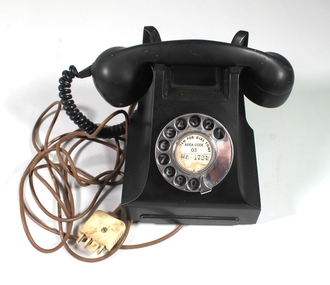
Functional object - Telephone 400 Series, Ericsson, 1957
... Telephone 400 Series...400 Telephone...The 400 series telephone was developed by the PMG in 1957 and introduced into service in 1958 to replace the 300 Series telephones. ...The 400 series telephone was developed by the PMG in 1957 and introduced into service in 1958 to replace the 300 Series telephones. ...The 400 series telephone was developed by the PMG in 1957 and introduced into service in 1958 to replace the 300 Series telephones. This telephone series was based on the Ericsson/GEC 1000 type and designed to work on longer and lighter gauge cables (1000 ohm lines). It was fitted with a new 5 winding Induction Coil (Coil, Induction No. 21A), had a more efficient anti-sidetone circuit, a sensitive rocking armature receiver and a new style handset with no spittoon. The 400 Series included automatic (401, 404, 405 and 411), central battery (402, 406 and 407) and local battery/magneto (403) versions and was made as both table and wall models. The 410 was used on Shared Service. Initially it was intended that the 400 Series would be available in a range of colours but due to fading issues only black and ivory were eventually available to subscribers. There were several variants of the 400 Series and they were manufactured by Ericsson and GEC in England and by AWA in Australia. The Ericsson/GEC version used an internal chassis like the Telephone 332 or 332AT but the AWA version had all the main components mounted on the base plate. The initial APO instruction issued in 1958 showed the rounded GEC/Ericsson 1000 shape case as the new 400 series but the production models had the older 300 type case. The ivory 400 series was only available as a table model and was made by Ericsson. The wall models were only made by AWA Reference https://www.britishtelephones.com/aus/400type.htp.A black telephone with a with a metal dial with numbers 1 to 0 in the finger holes in the dial. A handset with a mouthpiece on one end and an earpiece on the other end sits on the top of the telephone and is attached to the telephone with a plastic black spring winded cord. A plastic brown cord with a white plug connects the telephone to a socket 400 telephone, dial telephone -
 Department of Energy, Environment and Climate Action
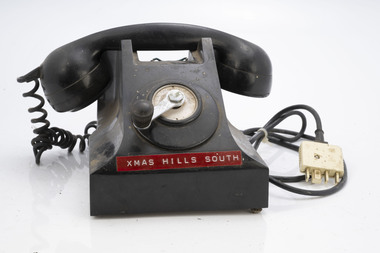
Instrument - Field telephone - Fire Tower, 400 series 'Bakelite' magneto table telephone
... 400 series 'Bakelite' magneto table telephone ...Manufactured in both UK and Australia, the 400 series telephone was developed for the PMG in 1957 based on the British, prototype, no.700, Bakelite phone. ...Manufactured in both UK and Australia, the 400 series telephone was developed for the PMG in 1957 based on the British, prototype, no.700, Bakelite phone. ...After the 1939 bushfires, the Forests Commission Victoria invested heavily in a radically new communications network. After suffering some inevitable delays due to the war, radio VL3AA switched into full operation in October 1945 proudly beaming out 200 watts across the State. But by today’s standards, the technology was primitive and the reception poor unless the user was on a high point somewhere. The radio signal was "line-of-sight" and bounced between fire towers and relay transmitters across the mountains back to the District offices. The advent of solid-state electronics in the 1960s replaced the more delicate valve sets which enabled greater use of vehicle mounted radios. The Commission continued to research, develop and build new radios at its many workshops around Victoria. The network was supported by a large team of skilled radio technicians. The more secure and versatile State Mobile Radio (SMR) digital trunk system came into operation in about 1995. Upgraded Tait Radios were purchased in 2014 after recommendations of the 2009 Bushfires Royal Commission. But it was the convergence of separate technologies such as 5G mobile phones, high-capacity and light-weight lithium batteries, Wi-Fi, the ever-expanding internet, cloud data storage, digital cameras, GPS, personal organisers and hundreds of supporting Apps into powerful smartphones and tablets which revolutionised bushfire communications from the mid-2000s. Manufactured in both UK and Australia, the 400 series telephone was developed for the PMG in 1957 based on the British, prototype, no.700, Bakelite phone. They became obsolescent by the early 1960s but because some magneto exchanges persisted in Australia for another quarter of a century and alternatives were not cost effective, PMG/Telecom regularly repaired or refurbished these obsolete phones until they were superseded by automatic exchanges. Used to communicate to remote fire towers Single wire (with earth return) often run through the bush from FCV district officesMagneto table telephone Christmas Hills South Instructions for use around winderbushfire, radios, forests commission victoria (fcv) -
 Department of Energy, Environment and Climate Action
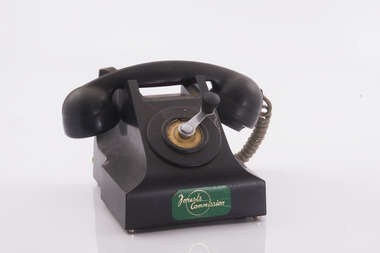
400 series 'Bakelite' magneto table telephone PMG
... 400 series 'Bakelite' magneto table telephone PMG ...Radios Forests Commission Victoria (FCV) Desk top telephone with handset and hand crank made from black Bakelite 400 series 'Bakelite' magneto table telephone PMG ...Dedicated phone lines were often connected between FCV District Offices and firetowers or local depots. These lines were activated by winding the metal handle to ring the bell at the other end of the line.Desk top telephone with handset and hand crank made from black Bakelite radios, forests commission victoria (fcv) -
 Bendigo Historical Society Inc.
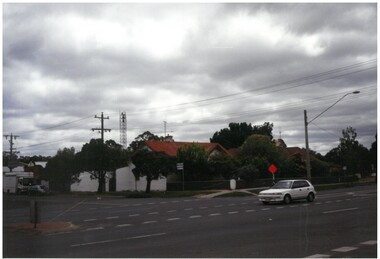
Photograph - Edith Perry Collection: Kangaroo Flat, 1966
... 400. Block sold to Mutual Homes about 1960 for 1000 pounds. Stevenson's owned it before Kentucky Fried Chicken purchased it and demolished it. c) Cnr High Street and Station Street Kangaroo Flat 1998. Dower home. d) From left - Kangaroo Flat buses. Block of shops built on block originally owned by PMG Telephone...400. Block sold to Mutual Homes about 1960 for 1000 pounds. Stevenson's owned it before Kentucky Fried Chicken purchased it and demolished it. c) Cnr High Street and Station Street Kangaroo Flat 1998. Dower home. d) From left - Kangaroo Flat buses. Block of shops built on block originally owned by PMG Telephone ...Edith Isabel Johanson was born in Kangaroo Flat in 1929. She lived there for most of her life until her death in 2019. Her parents Percy and Violet Johanson lived in Station Street and operated Kangaroo Flat Buslines. Edith had one brother - Warwick. Edith married Arthur Henry Perry in 1952. They had three children - Lynton, Malcolm and Leonie. Edith completed her initial teacher training at Melbourne Teachers' College and later studied part time to become a Teacher Librarian. She then worked at the Bendigo Teachers' College until her retirement. Edith was an active member of her Community. She was involved in building a new kindergarten and Infant Welfare Centre in the 1960s, and actively involved in the activities of the Shire of Marong. Edith was a member of the Committee that produced David Horsfall's "History of Kangaroo Flat" in 1993. Edith was a lifelong member of St. Mary's Anglican Church and the archive room is named in her honour.Four color photos of High Street Kangaroo Flat in 1997. a) Cnr High/Station St. K.Flat 1998 b) Cnr High/Station Street Kangaroo Flat 1998 - Marong Shire used the block as a pound. Block sold to P.G. Johanson about 1954 for 400. Block sold to Mutual Homes about 1960 for 1000 pounds. Stevenson's owned it before Kentucky Fried Chicken purchased it and demolished it. c) Cnr High Street and Station Street Kangaroo Flat 1998. Dower home. d) From left - Kangaroo Flat buses. Block of shops built on block originally owned by PMG Telephone workshop or exchange. Brick home - Tobin family lived there. Present owner Avis Silke, Douglas Family had owned it. Anderson Home/Dower home - Purchased by Murray family. Demolished by Kentucky Fried Chicken.houses, kangaroo flat
