

Historical information
The 400 series telephone was developed by the PMG in 1957 and introduced into service in 1958 to replace the 300 Series telephones. This telephone series was based on the Ericsson/GEC 1000 type and designed to work on longer and lighter gauge cables (1000 ohm lines). It was fitted with a new 5 winding Induction Coil (Coil, Induction No. 21A), had a more efficient anti-sidetone circuit, a sensitive rocking armature receiver and a new style handset with no spittoon. The 400 Series included automatic (401, 404, 405 and 411), central battery (402, 406 and 407) and local battery/magneto (403) versions and was made as both table and wall models. The 410 was used on Shared Service.
Initially it was intended that the 400 Series would be available in a range of colours but due to fading issues only black and ivory were eventually available to subscribers. There were several variants of the 400 Series and they were manufactured by Ericsson and GEC in England and by AWA in Australia. The Ericsson/GEC version used an internal chassis like the Telephone 332 or 332AT but the AWA version had all the main components mounted on the base plate. The initial APO instruction issued in 1958 showed the rounded GEC/Ericsson 1000 shape case as the new 400 series but the production models had the older 300 type case. The ivory 400 series was only available as a table model and was made by Ericsson. The wall models were only made by AWA
Reference https://www.britishtelephones.com/aus/400type.htp
Physical description
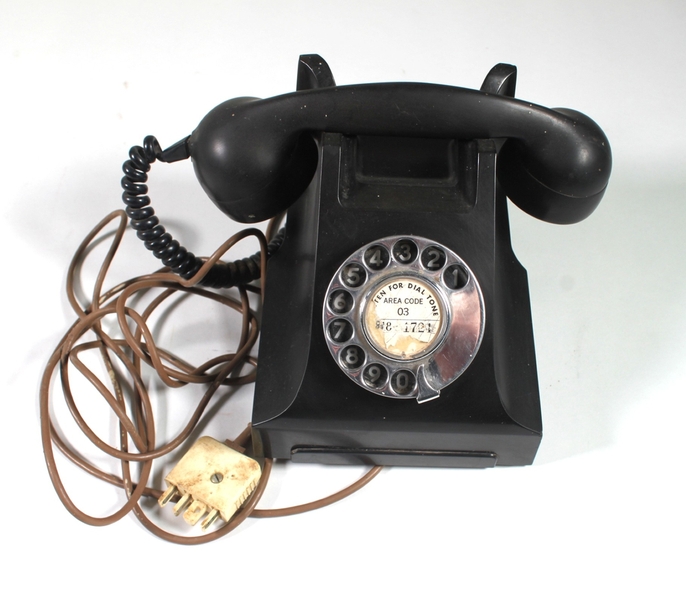
.A black telephone with a with a metal dial with numbers 1 to 0 in the finger holes in the dial. A handset with a mouthpiece on one end and an earpiece on the other end sits on the top of the telephone and is attached to the telephone with a plastic black spring winded cord. A plastic brown cord with a white plug connects the telephone to a socket
