
Showing 8 items matching "52nd australian battalion"
-
 The Beechworth Burke Museum
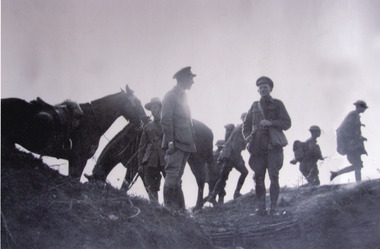
Photograph, 31/08/1918
... ...52nd australian battalion...Taken on the 31st of August ,1918, this photograph depicts Gunner Wilson, Lieutenant Driscoll, and Lieutenant Clark (facing camera) of the 12th Battery of Australian Field Artillery, choosing a site for new battery positions, as members of the 52nd Australian Battalion move past to a new sector north of the Somme, before Mont St Quentin....Taken on the 31st of August ,1918, this photograph depicts Gunner Wilson, Lieutenant Driscoll, and Lieutenant Clark (facing camera) of the 12th Battery of Australian Field Artillery, choosing a site for new battery positions, as members of the 52nd Australian Battalion move past to a new sector north of the Somme, before Mont St Quentin. ...Taken on the 31st of August ,1918, this photograph depicts Gunner Wilson, Lieutenant Driscoll, and Lieutenant Clark (facing camera) of the 12th Battery of Australian Field Artillery, choosing a site for new battery positions, as members of the 52nd Australian Battalion move past to a new sector north of the Somme, before Mont St Quentin.The Battle of Mont St Quentin commenced on the 31st of August 1918 and ended on the 3rd of September 1918. The battle saw Australian troops storm, seize and hold the key height of Mont St Quentin (overlooking Peronne), a pivotal German defensive position on the line of the Somme.Black and white rectangular reproduced photograph on matte photographic paperReverse: 5144/military album, beechworth, burke museum, ww2, world war two, france, somme, 12th battery of australian field artillery, 52nd australian battalion, military, mont st quentin -
 Bendigo Military Museum
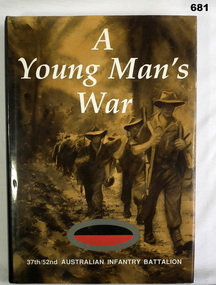
Book, Ronald Carl Blair, A Young Man's War / 37th/52nd Australian Infantry Battalion, 1992
... A Young Man's War / 37th/52nd Australian Infantry Battalion...A Young Man's War / 37th/52nd Australian Infantry Battalion Book BOOK Ronald Carl Blair 37/52 Australian Infantry Battalion Association ...Colour paper dust cover with picture of marching soldiers in shades of brown. 428 pages, illustrated with black and white photos and maps on inside covers. hard cover, buckram."Donated to Bendigo RSL Sub Branch Walter Witmarsh"books, military history -
 Monbulk RSL Sub Branch
Book, 37/52 Australian Infantry Battalion Association, A young man's war : a history of the 37th/52nd Australian Infantry Battalion in World War Two : Battle honours South West Pacific 1943-1945, liberation of Australian New Guinea, Gusika -Fortification Point, 1992
... A young man's war : a history of the 37th/52nd Australian Infantry Battalion in World War Two : Battle honours South West Pacific 1943-1945, liberation of Australian New Guinea, Gusika -Fortification Point...A young man's war : a history of the 37th/52nd Australian Infantry Battalion in World War Two : Battle honours South West Pacific 1943-1945, liberation of Australian New Guinea, Gusika -Fortification Point Book 37/52 Australian Infantry Battalion Association Ron Blair ...A history of the wartime experiences of the Australian Army 37th/52nd infantry battalionsIndex, ill, maps, p.428.non-fictionA history of the wartime experiences of the Australian Army 37th/52nd infantry battalionsworld war 1939-1945 - regimental histories - australia, world war 1939-1945 - campaigns - south west pacific -
 Wangaratta RSL Sub Branch
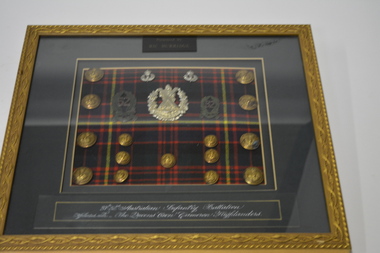
Memorabilia - Framed buttons and badges
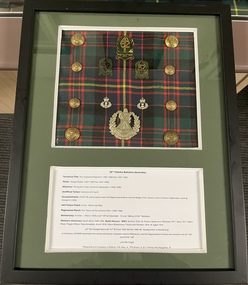
... 37th/52nd australian infantry battalion...52nd Infantry Battalion. In 1937 the battalion was separated but merged again in August 1942, after Japan's entry into the Second World War and the subsequent reorganisation of the Australian Army. ...52nd Infantry Battalion. In 1937 the battalion was separated but merged again in August 1942, after Japan's entry into the Second World War and the subsequent reorganisation of the Australian Army. 37th/52nd australian infantry battalion cameron highlanders 37th-52rd Australian Infantry Battalion Affilitated with The Queens "Own" Cameron Highlanders gold coloured metal frame with green mount containing 3 silver and 2 green badges 8 large and 7 small gold coloured buttons on tartan cloth background. ...After the First World War the defence of the Australian mainland lay with the part-time soldiers of the Citizens Military Force (CMF), also known as the Militia. The Militia was organized to maintain the structure of the First AIF and kept the same numerical designations. The Militia units were distributed in the same areas the original AIF units were raised. Consequently, Militia units were also known by the name of their shire. Thus, the Victorian 37th Infantry Battalion was the "Hunt Regiment", while the 52nd Infantry Battalion was the "Gippsland Regiment". Both were raised in 1921 and linked in 1930, forming the 37th/52nd Infantry Battalion. In 1937 the battalion was separated but merged again in August 1942, after Japan's entry into the Second World War and the subsequent reorganisation of the Australian Army. gold coloured metal frame with green mount containing 3 silver and 2 green badges 8 large and 7 small gold coloured buttons on tartan cloth background.37th-52rd Australian Infantry Battalion Affilitated with The Queens "Own" Cameron Highlanders 37th/52nd australian infantry battalion, cameron highlanders -
 The 5th/6th Battalion Royal Victoria Regiment Historical Collection
Artwork, other - 52nd Infantry Battalion (Australia) Link to A COY 5/6 RVR Framed Badges and Information
... 52nd Infantry Battalion (Australia) Link to A COY 5/6 RVR Framed Badges and Information...52nd Infantry Battalion (Australia) Link to A COY 5/6 RVR Framed Badges and Information...Badge board in black frame showing the badges of the 52nd Infantry Battalion (Australia), The Gippsland Regiment and the Cameron Highlanders on a Cameron of Erracht tartan backing. ...Information panel reads: 52nd Infantry Battalion (Australia) Territorial Title: The 'Gippsland Regiment' (1927-1930 then 1937-1942) Motto: 'Always Ready' (1927-1930 then 1937-1942) Alliances: The Queen's Own Cameron Highlanders' (1930-1946) Unofficial Tartan: Cameron of Erracht Accoutrements: 37/52nd Bn authorised to wear the Regimental Buttons and Hat Badge of the 'Queen's Own Cameron Highlanders' by King George VI (1932) Unit Colour Patch: Circle - White over Blue Regimental March: The 'March of the Cameron Men' (1930-1946) Anniversary: Formed - 1 March 1916 as 52nd AIF & Disbanded - 12 June 1946 as 37/52nd Battalion Honours: Distinction: South Africa 1899-1902. ...Badge board in black frame showing the badges of the 52nd Infantry Battalion (Australia), The Gippsland Regiment and the Cameron Highlanders on a Cameron of Erracht tartan backing. ...Badge board in black frame showing the badges of the 52nd Infantry Battalion (Australia), The Gippsland Regiment and the Cameron Highlanders on a Cameron of Erracht tartan backing. Below this is an information panel which includes a summary of important historical information about the 52nd Infantry Battalion, The Gippsland Regiment and its connection to A COY 5/6 RVR. Information panel reads: 52nd Infantry Battalion (Australia) Territorial Title: The 'Gippsland Regiment' (1927-1930 then 1937-1942) Motto: 'Always Ready' (1927-1930 then 1937-1942) Alliances: The Queen's Own Cameron Highlanders' (1930-1946) Unofficial Tartan: Cameron of Erracht Accoutrements: 37/52nd Bn authorised to wear the Regimental Buttons and Hat Badge of the 'Queen's Own Cameron Highlanders' by King George VI (1932) Unit Colour Patch: Circle - White over Blue Regimental March: The 'March of the Cameron Men' (1930-1946) Anniversary: Formed - 1 March 1916 as 52nd AIF & Disbanded - 12 June 1946 as 37/52nd Battalion Honours: Distinction: South Africa 1899-1902. Battle Honours - WW1: Somme 1916-18, Poziers, Bullecourt, Messines 1917, Ypres 1917, Menin Road, Polygon Wood, Passchendaele, Ancre 1918, Villers-Bretonneux, France and Flanders 1916-18, Egypt 1916. 52nd Bn amalgamated with 37th Bn from 1930-36 then 1942-46. Headquarters in Dandenong. A Company, 5/6 RVR remembers the service personnel of greater eastern Melbourne, and the Gippslanders of those who served in the 52nd AIF and 37/52nd AIF. Lest We Forget Presented to A Company in 2026 by: CPL Ross, A., PTE Brown, D. & LT (Porter) MacNaughton, M. -
 Australian Army Museum of Western Australia
Photograph
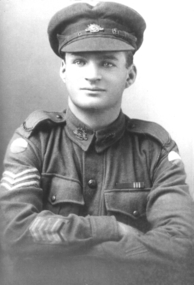
... This required him to be returned to Australia and the Naval doctors considered him unfit for further Naval service. When his hand healed Spence joined the AIF on the 2 August 1915 and was posted to the 52nd Battalion and embarked on the “Benalla” on the 1 November 1915. ...This required him to be returned to Australia and the Naval doctors considered him unfit for further Naval service. When his hand healed Spence joined the AIF on the 2 August 1915 and was posted to the 52nd Battalion and embarked on the “Benalla” on the 1 November 1915. ...John Alexander Spence was born in Fremantle 2nd July 1893. In 1912 he joined the Australian Navy as a Stoker and was posted to H.M.A.S. Australia. He was on this ship when it sailed at the head of the convoy into Sydney Harbour in 1913. At the outbreak of WW1, his ship was sent to German New Guinea where he saw conflict with the enemy and received a gunshot wound to his hand. This required him to be returned to Australia and the Naval doctors considered him unfit for further Naval service. When his hand healed Spence joined the AIF on the 2 August 1915 and was posted to the 52nd Battalion and embarked on the “Benalla” on the 1 November 1915. He was promoted to Lance Corporal on the 1 June 1916 on 9 September was promoted to Corporal and the next day to Sergeant. At Messines Ridge he was awarded the Distinguished Conduct Medal. At Dernancourt, a village near Villers he was awarded the Military Medal on 6 April 1918. Subsequently he was badly injured. He had captured four German soldiers and one Officer. While marching them back to the Allied lines the Officer grabbed one of the patrol member’s gun and fired three shots at Sergeant Spence which smashed his hip. Despite his injuries Spence managed to bring the Officer down with a revolver shot. On the 30th April he was repatriated to England and admitted to the Alexandria Hospital at Cosham. He did not return to the western front as his injuries were too severe. He returned to Australia on board the Somalia arriving home on the 21st December 1919. Before joining the forces he was a prominent amateur boxer, a pupil of the renowned heavyweight Bill Doherty. During WW1 he won the Army lightweight championship, competing against professionals as well as amateurs. He defended the title successfully for three successive years. On his discharge from the Army he fought under the name of Sonny Kidson. He also turned to coaching and had remarkable success having coached the Army and Navy boxing teams. John Spence died on the 20 November 1962 at Hollywood Repatriation Hospital aged 69. Post card sized photo of 3400 Sergeant John Alexander Spence DCM, MM, 52 Battalion AIF. Photo shows medal ribbons of Distinguished Conduct Medal (awarded June 1917) and Military Medal (awarded April 1918), 2 wound stripes, 5 service stripes, 52 Battalion AIF colour patch and soft style forage cap.spence, 52 battalion, aif, dcm, mm -
 Dandenong/Cranbourne RSL Sub Branch
Certificate - Certificate -Salute to the Gippsland Regiment
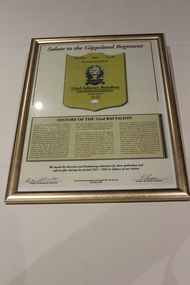
... Tracing the ancestry going back to the "Gippsland Battalion of the Victorian Rangers, the Militia (CMF) 52nd Battalion was raised from the 2nd Bn/5th Australian Infantry Regiment (HQ Dandenong) as part of an overhaul of Australia's defences in 1920-21 that saw the reintroduction of compulsory military service. ...Tracing the ancestry going back to the "Gippsland Battalion of the Victorian Rangers, the Militia (CMF) 52nd Battalion was raised from the 2nd Bn/5th Australian Infantry Regiment (HQ Dandenong) as part of an overhaul of Australia's defences in 1920-21 that saw the reintroduction of compulsory military service. ...Refer also https://en.wikipedia.org/wiki/52nd_Battalion_(Australia)Rectangular framed Certificate. Salute to the Gippsland Regiment. ---------------------------------------------------------------------------------------------------------------------------------------- In Shield in top half of certificate-: Defending Australia with rising sun badge then In commemoration of: No 52 surrounded by wreath with inscription on bottom Always Ready Gippsland Regiment 52nd Infantry Battalion (The Gippsland Regiment) "Always Ready" 1921-1930 1936-1942 Circle with white top half and light blue bottom half. -------------------------------------------------------------------------------------------------------------------------------- Under the Shield-: History of the 52nd Battalion. Tracing the ancestry going back to the "Gippsland Battalion of the Victorian Rangers, the Militia (CMF) 52nd Battalion was raised from the 2nd Bn/5th Australian Infantry Regiment (HQ Dandenong) as part of an overhaul of Australia's defences in 1920-21 that saw the reintroduction of compulsory military service. To afford it a proud identity ,the new battalion was assigned the same number as the 52nd/1st AIF which had performed with distinction in France ( Somme, Pozieres, Bullicort, Messine and Ypes to name just some). In addition the new battalion also inherited the Kings and Regimental Colours which, as part of the 52nd Bn/1st AIF's lineage including battle honours earned by 2nd Bn, Tasmanian Infantry Regiment in the Boer War, 1899-1902, and the same circular colour patch, horizontally bisected with white over blue halves. Later the 52nd officially received its regional title, "The Gippsland Regiment" and its motto "Always Ready". Digger prevailing during WW2 it was nicknamed "The Gippsland Bushrangers". The 52nd formed part of the 10th Infantry Brigade, 3rd Militia (CMF) Division. With the reversion to voluntary citizen forces in1930,declining numbers forced an amalgamation with the 37th Bn to become 37th/52nd Bn. Then in mid 1936, an expansion and modernisation of the CMF, including the conversation of the Light Horse to motorised, allowed both battalions to separate and for the 52nd to expand into East Gippsland. In 1938, 52nd Bn was granted linkage with the "Queens Own Cameron Highlanders" and permission to use its Regimental March- "March of the Cameron Men'. When Japan entered the war in December 1941,the Australian Military Forces were fully mobilized, (part time to full time) for the defence of homeland Australia. While training at various locations in central Victoria, the militia became for many, a stepping stone into the AIF and other services, as well as a training unit for new conscripts. As part of our national defence preparations, in mid 1942 the 52 Bn relocated to Queensland as part of the 3rd Division, replacing the AIF 7th Div on the so called "Brisbane Line". However as the threat of invasion lifted, a restructure of army units saw the disbandment of the 10th Brigade and hence the 52nd in September 1942 and the revival of the 37th/52nd Battalion. The 52nds colours were returned to Melbourne, eventually being placed in the Shrine of Remembrance for safe keeping. ----------------------------------------------------------------------------------------------------------------------------------------------------------------------------------------------------------------------------------- At bottom of the certificate- We thank the Berwick and Dandenong volunteers for their dedication and self sacrifice during the period 1921- 1942 in defence of our nation. (Signed) D W Shields President Dandenong RSL Sub Branch L Lucas President Berwick RSL Sub Branch Presented by the Dandenong and Berwick RSL Sub Branches November 2009. -
 The 5th/6th Battalion Royal Victoria Regiment Historical Collection
Artwork, other - 5th Infantry Battalion (Australia) Link to A COY 5/6 RVR Framed Badges and Information
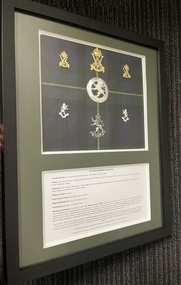
... 52nd Infantry Battalion (The Gippsland Regiment) who had its HQ located for many years in Dandenong near the current A COY 5/6 RVR depot. While B COY 5/6 RVR is the primary custodian of the VSR historical link, the message of this object is that A COY also has a connection which should be remembered. 5th Infantry Battalion (Australia) Link to A COY 5/6 RVR Framed Badges and Information Artwork, other 5th Infantry Battalion (Australia) Link to A COY 5/6 RVR Framed Badges and Information ...Badge board in black frame showing the badges of the Royal Victoria Regiment and the 5th Battalion, Victorian Scottish Regiment on a Gordon tartan backing. Below this is an information panel which includes a summary of important historical information about the 5th Infantry Battalion and its connection to A COY 5/6 RVR. Note: While this object notes the connection between A COY 5/6 RVR and 5th Bn VSR it should be remembered that the RVR is the custodian of the legacy of all Victorian Infantry units. This is therefore not the only historical link of A COY 5/6 RVR which also holds strong links to the 52nd Infantry Battalion (The Gippsland Regiment) who had its HQ located for many years in Dandenong near the current A COY 5/6 RVR depot. While B COY 5/6 RVR is the primary custodian of the VSR historical link, the message of this object is that A COY also has a connection which should be remembered. Information panel reads: 5th Infantry Battalion (Australia) Territorial Title: The 'Victorian Scottish Regiment' (1927-1944 then 1948-1960) Motto: "Mori Quam Fordari - Death before dishonour' (1927-1935), Now 'Nemo Me Impune Lacessit - No one shall provoke me without impunity' (1935-1944 then 1948-) Alliances: The 'Gordon Highlanders' (1930-1994), Then 'The Highlanders (Seaforth, Gordons, Camerons)' (1994-2006), Now '4" Battalion, The Royal Regiment of Scotland - 4 SCOTS' (2006-) Official Tartan: Gordon Unit Colour Patch: Rectangle - Black over Red Regimental March: Cock of the North (1953-) Anniversary: Formed - 29 August 1898 Honours: Distinction: South Africa 1899-1902. Battle Honours - WW1: Somme 1916-18, Poziers, Bullecourt, Ypres 1917, Menin Road, Polygon Wood, Broodseinde, Poelcappelle, Passchendaele, Lys, Hazebrouck, Amiens, Albert 1918, Hindenburg Line, Epehy, France and Flanders 1916-18, Helles, Krithia, Anzac, Landing at Anzac, Defence of Anzac, Suvla, Sari-Bair, Gallipoli 1915, Egypt 1915-16. Battle Honours - WW2: North Africa 1940-41, Bardia 1941, Capture of Tabruk, Syria 1941, Marjayun, Damour, Greece 1941, South West Pacific 1942-45, Wau, Bobdubi II, Mubo II, Mount Tambu, Komiatum, Liberation of Australian New Guinea, Perimbul, Balif, Yamil-Ulupu, Kaboibus-Kiarivu. The Scottish customs and traditions of the '5" Infantry Battalion, Victorian Scottish Regiment' have been upheld through '1 RVR', then '5 RVR', and now "5/6 RVR'. It is your duty to uphold the customs and traditions of those that have come before you and remember the ultimate sacrifice of those who served in the 5" AlF and 2/5" AIF. A Company, 5/6 RVR your lineage is: Support Company (Dandenong) 5" Bn, VSR (1948-1960) & A Coy 5 RVR. Wherever you may be garrisoned; display your identity proudly, now and into the future. Presented to A Company in 2026 by: CPL Ross, A., PTE Brown, D. & LT (Porter) MacNaughton, M.
