
Showing 7 items matching "9th australian divisional cavalry regiment"
-
 Bendigo Historical Society Inc.
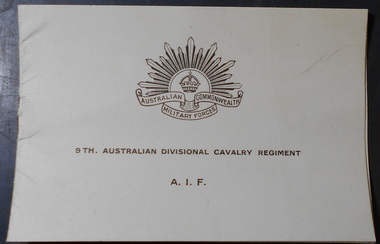
Document - ANA COLLECTION: CHRISTMAS CARD SENT DEC 1941 FROM 9TH AUSTRALIAN DIVISIONAL CAVALRY REGIMENT A.I.F
... ANA COLLECTION: CHRISTMAS CARD SENT DEC 1941 FROM 9TH AUSTRALIAN DIVISIONAL CAVALRY REGIMENT A.I.F....9th Australian Divisional Cavalry Regiment...Martindale, 9th Australian Divisional Cavalry Regiment A.I.F.; to "Fellow Members of the A.N.A. wishing you all A Merry Christmas and A Happy New Year" Two sheets of beige card a Christmas card front, with Australian Commonwealth Military Forces badge b central message, hand written from Trooper J.A. ...9th Australian Divisional Cavalry Regiment A.I.F....Australian Natives Association Christmas card 9th Australian Divisional Cavalry Regiment 9th Australian Divisional Cavalry Regiment A.I.F. ...Christmas card sent from the Middle East, Dec 1941 from Trooper J.A. Martindale, 9th Australian Divisional Cavalry Regiment A.I.F.; to "Fellow Members of the A.N.A. wishing you all A Merry Christmas and A Happy New Year" Two sheets of beige card a Christmas card front, with Australian Commonwealth Military Forces badge b central message, hand written from Trooper J.A. Martindale9th Australian Divisional Cavalry Regiment A.I.F.australian natives association, christmas card, 9th australian divisional cavalry regiment -
 Dandenong/Cranbourne RSL Sub Branch
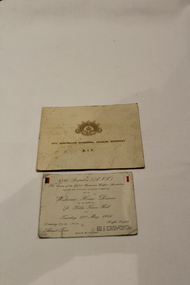
Card - Card and invitation, Unknown
... 9th Australian Division Cavalry Regiment Christmas Card from Middle East December 1942. 57/60 Battalion AIF Invitation to "Welcome Home Dance" St Kilda Town Hall. ...9th Australian Division Cavalry Regiment Christmas Card from Middle East December 1942. 57/60 Battalion AIF Invitation to "Welcome Home Dance" St Kilda Town Hall. ...9th Australian Division Cavalry Regiment Christmas Card from Middle East December 1942. 57/60 Battalion AIF Invitation to "Welcome Home Dance" St Kilda Town Hall. Tuesday 21st May 1946. -
 Frankston RSL Sub Branch
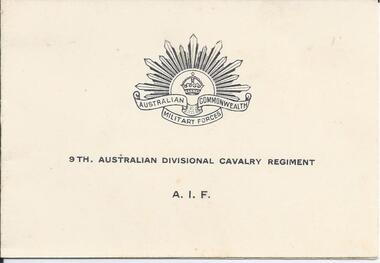
Card
... The card front cover has the Australian 'Rising Sun' badge and the words "9th Australian Divisional Cavalry Regiment" and "A. I. F.". The centre pages have an illustration of a village scene on the left page and the words "A Merry Christmas And A Happy New Year" printed on the right page. ...christmas middle east 2nd aif army aif ww2 world war 2 syria blundell noel blundell 9th australian division The card front cover has the Australian 'Rising Sun' badge and the words "9th Australian Divisional Cavalry Regiment" and "A. ...Christmas card sent to a family in Australia by Australian Army serviceman, Noel Blundell who served in Syria during World war 2. The card is in the form of a booklet consisting of the cover and one double page insert. The card front cover has the Australian 'Rising Sun' badge and the words "9th Australian Divisional Cavalry Regiment" and "A. I. F.". The centre pages have an illustration of a village scene on the left page and the words "A Merry Christmas And A Happy New Year" printed on the right page. The serviceman has written "To Alice From Noel" beneath the Christmas message. At the bottom of this page are the words "MIDDLE EAST" and "DECEMBER 1941". The rear cover page has an illustration of two camels, one leading the other.christmas, middle east, 2nd aif, army, aif, ww2, world war 2, syria, blundell, noel blundell, 9th australian division -
 Australian Commando Association - Victoria
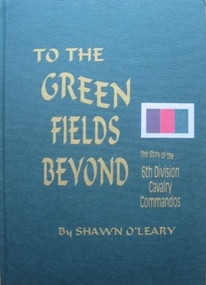
Book - 6th Div, Shawn OLeary, To The Green Fields Beyond:The story of the 6th Division Cavalry Commandos
... regiment remained in Syria as part of the occupation force and returned to Australia in March 1942. It was sent to the Adelaide River, in the Northern Territory, and then later to Murgon, in Queensland. In 1943 and 1944 divisional cavalry regiments were reorganised into cavalry (commando) regiments. In January 1944 the 6th Division Cavalry Regiment became the 2/6th Cavalry (Commando) Regiment. The regiment lost its vehicles and became the administrative headquarters for the 2/7th, 2/9th ...The comprehensive history of the 6th Australian Division Cavalry Commandos – a (now out of print) reprint of one of the rarer Armoured unit history books. This is the story of one of Australia’s most famous fighting regiments during World War II. As an armoured cavalry unit it fought the Italians and Germans in the sands of the African desert and the Vichy French in the mountains of Syria. Later as a dismounted commando unit it fought the Japanese in the terrifying jungles of New Guinea. The heroism of the men in its ranks and the actions in which they engaged are portrayed in a way which makes battle deeds leap realistically from the pages. “To The Green Fields Beyond” is a documented and detailed book which is of value to everyone who is interested in Australia’s story. Seldom before has such a contribution been made to record of our national history. The book has been approved and sponsored by the Australian War Memorial. The 6th Division Cavalry Regiment was formed in November 1939 and, just two months later, was sent overseas to the Middle East in January 1940. Arriving in Egypt, the regiment immediately went to Palestine, where it joined the rest of the 6th Division and trained using machine-gun carriers and, from October, six old Vickers light tanks. At the end of the year the regiment moved into the Western Desert, where it joined British forces ready for the major offensive to commence on 9 December. Two days later the regiment became the first unit of the 2nd Australian Imperial Force (AIF) to go into action when one of its squadron fought a sharp action against the Italians holding Garn el Grein and Fort Maddalina on 11 and 12 December. By 21 December British forces had captured Sidi Barrrani and the desert was now open for the 6th Division’s advance along the Libyan coast. On 3 January 1941 the division attacked and captured the Italian fort of Bardia. The regiment’s A Squadron, under the command of Major Denzil Macarthur-Onslow, who went on to command the 4th Armoured Brigade, supported the attack. Tobruk was the next Italian fort to be captured, with the regiment again in support and covering the 19th Brigade’s advance. The regiment, though, was under-equipped and without its full compliment of vehicles, using only machine gun carriers. To compensate for this, A Squadron was parity re-equipped with captured Italian light tanks, which had large kangaroos painted on the hulls and turrets to distinguish them from enemy vehicles. After Tobruk, the regiment was used as part of the advance guard in the capture of Derna and then Benghazi. In April the unit moved to Helwan, where it was equipped with Vickers light tanks and machine-gun carriers, and operated with British troops in capturing Sollum. Towards the end of May the regiment moved to Palestine, where it came under the command of the 7th Division for the imminent invasion of Syria. The regiment experienced its heaviest fighting during the Syrian campaign, which began on 7 June. A Squadron was attached to the 21st Brigade and advanced along the coast, where the rugged hills made it difficult to manoeuvre the tanks and carriers. The squadron was relieved by one of the 9th Division Cavalry Regiment’s squadrons on 13 and 14 June. C Squadron, meanwhile, was with the 25th Brigade, and advanced along the Rosh Pinna road, engaging strong enemy defences at Fort Khirbe. C Squadron was relieved by B Squadron, which was later attacked by Vichy French tanks that were supported by heavy artillery and machine-gun fire, which forced the Australians to withdrawal. Always willing or needing to improvise during the campaign, A and B Squadrons both operated three captured French R35 Renault light tanks, while C Squadron provided personnel for a horse troop, quickly nicknamed the “Kelly Gang”, to patrol the high, rugged hills near the Mardjayoun–Banis Road. The regiment remained in Syria as part of the occupation force and returned to Australia in March 1942. It was sent to the Adelaide River, in the Northern Territory, and then later to Murgon, in Queensland. In 1943 and 1944 divisional cavalry regiments were reorganised into cavalry (commando) regiments. In January 1944 the 6th Division Cavalry Regiment became the 2/6th Cavalry (Commando) Regiment. The regiment lost its vehicles and became the administrative headquarters for the 2/7th, 2/9th, and 2/10th Commando Squadrons. The regiment remained with the 6th Division and participated in the Aitpae–Wewak campaign, in New Guinea, during 1945. Includes Nominal Rollnon-fictionThe comprehensive history of the 6th Australian Division Cavalry Commandos – a (now out of print) reprint of one of the rarer Armoured unit history books. This is the story of one of Australia’s most famous fighting regiments during World War II. As an armoured cavalry unit it fought the Italians and Germans in the sands of the African desert and the Vichy French in the mountains of Syria. Later as a dismounted commando unit it fought the Japanese in the terrifying jungles of New Guinea. The heroism of the men in its ranks and the actions in which they engaged are portrayed in a way which makes battle deeds leap realistically from the pages. “To The Green Fields Beyond” is a documented and detailed book which is of value to everyone who is interested in Australia’s story. Seldom before has such a contribution been made to record of our national history. The book has been approved and sponsored by the Australian War Memorial. The 6th Division Cavalry Regiment was formed in November 1939 and, just two months later, was sent overseas to the Middle East in January 1940. Arriving in Egypt, the regiment immediately went to Palestine, where it joined the rest of the 6th Division and trained using machine-gun carriers and, from October, six old Vickers light tanks. At the end of the year the regiment moved into the Western Desert, where it joined British forces ready for the major offensive to commence on 9 December. Two days later the regiment became the first unit of the 2nd Australian Imperial Force (AIF) to go into action when one of its squadron fought a sharp action against the Italians holding Garn el Grein and Fort Maddalina on 11 and 12 December. By 21 December British forces had captured Sidi Barrrani and the desert was now open for the 6th Division’s advance along the Libyan coast. On 3 January 1941 the division attacked and captured the Italian fort of Bardia. The regiment’s A Squadron, under the command of Major Denzil Macarthur-Onslow, who went on to command the 4th Armoured Brigade, supported the attack. Tobruk was the next Italian fort to be captured, with the regiment again in support and covering the 19th Brigade’s advance. The regiment, though, was under-equipped and without its full compliment of vehicles, using only machine gun carriers. To compensate for this, A Squadron was parity re-equipped with captured Italian light tanks, which had large kangaroos painted on the hulls and turrets to distinguish them from enemy vehicles. After Tobruk, the regiment was used as part of the advance guard in the capture of Derna and then Benghazi. In April the unit moved to Helwan, where it was equipped with Vickers light tanks and machine-gun carriers, and operated with British troops in capturing Sollum. Towards the end of May the regiment moved to Palestine, where it came under the command of the 7th Division for the imminent invasion of Syria. The regiment experienced its heaviest fighting during the Syrian campaign, which began on 7 June. A Squadron was attached to the 21st Brigade and advanced along the coast, where the rugged hills made it difficult to manoeuvre the tanks and carriers. The squadron was relieved by one of the 9th Division Cavalry Regiment’s squadrons on 13 and 14 June. C Squadron, meanwhile, was with the 25th Brigade, and advanced along the Rosh Pinna road, engaging strong enemy defences at Fort Khirbe. C Squadron was relieved by B Squadron, which was later attacked by Vichy French tanks that were supported by heavy artillery and machine-gun fire, which forced the Australians to withdrawal. Always willing or needing to improvise during the campaign, A and B Squadrons both operated three captured French R35 Renault light tanks, while C Squadron provided personnel for a horse troop, quickly nicknamed the “Kelly Gang”, to patrol the high, rugged hills near the Mardjayoun–Banis Road. The regiment remained in Syria as part of the occupation force and returned to Australia in March 1942. It was sent to the Adelaide River, in the Northern Territory, and then later to Murgon, in Queensland. In 1943 and 1944 divisional cavalry regiments were reorganised into cavalry (commando) regiments. In January 1944 the 6th Division Cavalry Regiment became the 2/6th Cavalry (Commando) Regiment. The regiment lost its vehicles and became the administrative headquarters for the 2/7th, 2/9th, and 2/10th Commando Squadrons. The regiment remained with the 6th Division and participated in the Aitpae–Wewak campaign, in New Guinea, during 1945. Includes Nominal Rollww2, australian commandos, australian special forces, world war 2 -
 8th/13th Victorian Mounted Rifles Regimental Collection
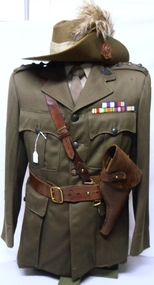
Uniform - Fyffe uniform & hat, 1945 circa
... Fine example of a uniform worn by a well known grazier and citizen soldier of the Tocumwal district, southern NSW, in both peace and war. uniform fyffe robert captain mc 20th light horse 9th division cavalry regiment military cross Khaki wool serge officer's tunic with leather Sam Browne belt and revolver holster, and slouch hat with emu plumes and 20th Light Horse hat badge against red backing. Tunic has 20th Light Horse colour patches. overseas service chevrons and ribbon bar for Military Cross, 39-45 Star, Africa Star, Defence medal, British War Medal and Australian Service Medal 1939-45; metal Australia shoulder titles captain's rank stars and Rising Sun collar badges. ...VX 42774 Captain Robert (Bob) Fyffe, a grazier from Tocumwal, NSW, served with the Tocumwal troop of the 20th Light Horse prior to WWII (1939-46). He enlisted at the outbreak of war and served with the 9th Division Cavalry Regiment in North Africa. During the attack on Trig 22 on 17 July 1942 Captain Fyffe commanding a composite squadron manoeuvred his tanks to knock out machine guns and anti-tank guns enabling 2/32 Battalion to capture the objective. Captain Fyffe was awarded the Military Cross for his leadership and courage in the action. This was 9th Division Cavalry's first tank action of the war.Fine example of a uniform worn by a well known grazier and citizen soldier of the Tocumwal district, southern NSW, in both peace and war.Khaki wool serge officer's tunic with leather Sam Browne belt and revolver holster, and slouch hat with emu plumes and 20th Light Horse hat badge against red backing. Tunic has 20th Light Horse colour patches. overseas service chevrons and ribbon bar for Military Cross, 39-45 Star, Africa Star, Defence medal, British War Medal and Australian Service Medal 1939-45; metal Australia shoulder titles captain's rank stars and Rising Sun collar badges. Uniform worn by Captain Robert Fyffe MC, 20th Light Horse and 6th Division Cavalry Regiment AIF.. uniform, fyffe robert captain mc, 20th light horse, 9th division cavalry regiment, military cross -
 8th/13th Victorian Mounted Rifles Regimental Collection
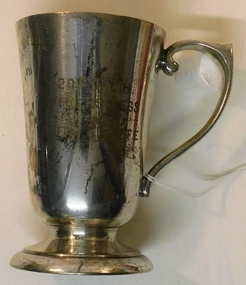
Functional object - Mug
... 9th Division Cavalry's first tank action of the war. This is one of a collection of mugs presented by Officers of a Light Horse regiment drawn from rural and regional Victoria in the period between the World Wars officers' mess 20th light horse fyffe h g "20th Australian Light Horse Officer's Mess. ...The 20th Light Horse (Victorian Mounted Rifles) was raised in 1920 as part of the 3rd Cavalry Brigade, 2nd Cavalry Division, Citizen Military Forces, with Headquarters at Seymour and depots along the Goulburn Valley from Mansfield to Tocumwal in southern NSW. In December 1941, 20th Light Horse (Victorian Mounted Rifles) converted from horse to mechanised, initially as 20th Motor Regiment. In 1943 redesignated 20th Pioneer Battalion and deployed to Merauke, Dutch New Guinea. The regiment was disbanded at the end of the war, 1945. 20th Light horse was the only light horse unit to serve overseas in WWII. Lieutenant Fyffe enlisted at the outbreak of war and served as VX 42774 with the 9th Division Cavalry Regiment in North Africa and was promoted to captain. During the attack on Trig 22 on 17 July 1942, Captain Fyffe, commanding a composite squadron, manoeuvred his tanks to knock out machine guns and anti-tank guns enabling 2/32 Battalion to capture the objective. Captain Fyffe was awarded the Military Cross for his leadership and courage in the action. This was 9th Division Cavalry's first tank action of the war. This is one of a collection of mugs presented by Officers of a Light Horse regiment drawn from rural and regional Victoria in the period between the World WarsSilver plated mug with handle and inscribed on side"20th Australian Light Horse Officer's Mess. Presented by Lieutenant H.G. Fyffe" and on base "Rigert EPNSAI 10 "officers' mess, 20th light horse, fyffe h g -
 8th/13th Victorian Mounted Rifles Regimental Collection
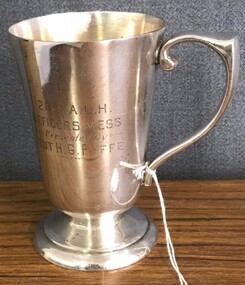
Functional object - tankard Fyffe
... 9th Division Cavalry's first tank action of the war. The 20th Light Horse (Victorian Mounted Rifles) was raised in 1920 as part of the 3rd Cavalry Brigade, 2nd Cavalry Division, Citizen Military Forces, with Headquarters at Seymour and depots along the Goulburn Valley from Mansfield to Tocumwal in southern NSW. In December 1941, 20th Light Horse (Victorian Mounted Rifles) converted from horse to mechanised, as 20th Motor Regiment. In 1943 the regiment was deployed to Merauke, Dutch New Guinea. Upon return to Australia...9th Division Cavalry's first tank action of the war. The 20th Light Horse (Victorian Mounted Rifles) was raised in 1920 as part of the 3rd Cavalry Brigade, 2nd Cavalry Division, Citizen Military Forces, with Headquarters at Seymour and depots along the Goulburn Valley from Mansfield to Tocumwal in southern NSW. In December 1941, 20th Light Horse (Victorian Mounted Rifles) converted from horse to mechanised, as 20th Motor Regiment. In 1943 the regiment was deployed to Merauke, Dutch New Guinea. Upon return to Australia ...VX 42774 Captain H G (Bob) Fyffe, a grazier from Tocumwal, NSW, served with the Tocumwal troop of the 20th Light Horse prior to WWII (1939-46). He enlisted at the outbreak of war and served with the 9th Division Cavalry Regiment in North Africa. During the attack on Trig 22 on 17 July 1942 Captain Fyffe commanding a composite squadron manoeuvred his tanks to knock out machine guns and anti-tank guns enabling 2/32 Battalion to capture the objective. Captain Fyffe was awarded the Military Cross for his leadership and courage in the action. This was 9th Division Cavalry's first tank action of the war. The 20th Light Horse (Victorian Mounted Rifles) was raised in 1920 as part of the 3rd Cavalry Brigade, 2nd Cavalry Division, Citizen Military Forces, with Headquarters at Seymour and depots along the Goulburn Valley from Mansfield to Tocumwal in southern NSW. In December 1941, 20th Light Horse (Victorian Mounted Rifles) converted from horse to mechanised, as 20th Motor Regiment. In 1943 the regiment was deployed to Merauke, Dutch New Guinea. Upon return to Australia in 1945 it was redesignated 20th Pioneer Battalion and disbanded at the end of the war. 20th Light Horse was the only light horse unit to serve overseas in WWII.Silver plated tankard with engraving on side.20th LH / Officers Mess / Presented by Lieutenant H G Fyffe fyffe, 20th, light horse
