
Showing 6 items matching "aberdeenshire"
-
 Federation University Historical Collection
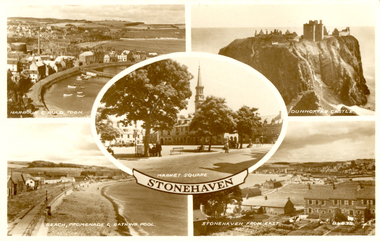
Postcard - black and white, Stonehaven, Scotland
... ...aberdeenshire...Stonehaven is a town in Aberdeenshire on the northeast coast of Scotland....Stonehaven is a town in Aberdeenshire on the northeast coast of Scotland. stonehaven aberdeenshire scotland A photographic postcard showing 5 views of Stonehaven including Dunnottar Castle. ...Stonehaven is a town in Aberdeenshire on the northeast coast of Scotland.A photographic postcard showing 5 views of Stonehaven including Dunnottar Castle.stonehaven, aberdeenshire, scotland -
 Uniting Church Archives - Synod of Victoria
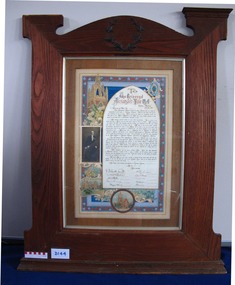
Artwork, other - Illuminated art work, Rev Alexander Yule MA presentation art work
... Alexander Yule was born in 1830 in Aberdeenshire, Scotland becoming licenced in the Free Church of Scotland in 1854. ...Alexander Yule was born in 1830 in Aberdeenshire, Scotland becoming licenced in the Free Church of Scotland in 1854. ...This was presented to the Rev Yule on 22 February 1907. Alexander Yule was born in 1830 in Aberdeenshire, Scotland becoming licenced in the Free Church of Scotland in 1854. He came to Australia in 1870 where he became Minister of Erskine church, Carlton. In 1892 College Church Parkville was established by members of the Erskine congregation. In 1891 he was moderator of Victoria. He died on 18 April 1907.Framed illuminated composite presentation art work which has illuminated text, the Presbyterian symbol of the burning bush, a photograph and illustrations of the College Church, Ormond College, University of Melbourne. It is signed by ten people.presbyterian miniter rev alexander yule ma, r. johnston smith, m. reid robertson, john mather, adam kennedy, maggie adam, h. s. richardson, lily v. grant, david j. scott, m. e. downes, j. downes., the college church parkville, alexander yule 1830-1907 -
 Federation University Art Collection
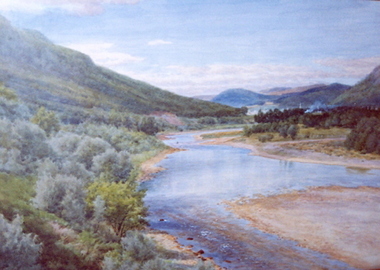
Painting - Watercolour, Mitchell, John, [Scottish Scene], 1981
... His landscapes of Aberdeenshire are highly prized especially in the area in which he lived. ...His landscapes of Aberdeenshire are highly prized especially in the area in which he lived. ...John MITCHELL (1837 - 14 July 1926) Born Woodside, Donside, Scotland John Mitchell attended evening classes under James Giles in Aberdeen, and was also taught by his uncle the Peterhead artist John Mitchell. After an apprenticeship at a local lithographic company (Keith and Gibb) John Mitchell went to London to study at the Slade under Legros. Returning to Aberdeen he painted many scenes around the city and Aberdeenshire, including Balmoral, under the patronage of Queen Victoria. John Mitchell gave lessons in painting to the Royal Family. His landscapes are highly coloured with dominant blues and purples in the hills and with vivid greens and yellows in the foreground, subtly fused and never garish. He lithographed sketches for John Stewart's 'The Sculptured Stones of Scotland', 2 vols 1856-57, illustrated 'Under Lochnagar' 1894. His landscapes of Aberdeenshire are highly prized especially in the area in which he lived. His painting in the Mearns is regarded by some as his best work. In 1875 he painted an interior of Culter Castle and its Chapel which was subsequently purchased by the owner and in 1883 showed a portrait of his mother. Lived latterly at 10 Gladstone Place, Queen's Cross, Aberdeen. This item is part of the Federation University Art Collection. The Art Collection features over 2000 works and was listed as a 'Ballarat Treasure' in 2007.Framed watercolour of a creek in Scotland.art, artwork, art, artwork, john mitchell, mitchell, scotland, scottish -
![Painting - Watercolour, Mitchell, John, [Scottish Scene] by John Mitchell](/media/collectors/530576742162ef0fa09a2288/items/534748159821f420f8c036b5/item-media/534f6bb72162ef12d4dd1a07/item-fit-380x285.jpg?cb=6) Federation University Art Collection
Federation University Art CollectionPainting - Watercolour, Mitchell, John, [Scottish Scene] by John Mitchell
... His landscapes of Aberdeenshire are highly prized especially in the area in which he lived. ...His landscapes of Aberdeenshire are highly prized especially in the area in which he lived. ...John MITCHELL (1837 - 14 July 1926) Born Woodside, Donside, Scotland John Mitchell attended evening classes under James Giles in Aberdeen, and was also taught by his uncle the Peterhead artist John Mitchell. After an apprenticeship at a local lithographic company (Keith and Gibb) John Mitchell went to London to study at the Slade under Legros. Returning to Aberdeen he painted many scenes around the city and Aberdeenshire, including Balmoral, under the patronage of Queen Victoria. John Mitchell gave lessons in painting to the Royal Family. His landscapes are highly coloured with dominant blues and purples in the hills and with vivid greens and yellows in the foreground, subtly fused and never garish. He lithographed sketches for John Stewart's 'The Sculptured Stones of Scotland', 2 vols 1856-57, illustrated 'Under Lochnagar' 1894. His landscapes of Aberdeenshire are highly prized especially in the area in which he lived. His painting in the Mearns is regarded by some as his best work. In 1875 he painted an interior of Culter Castle and its Chapel which was subsequently purchased by the owner and in 1883 showed a portrait of his mother. Lived latterly at 10 Gladstone Place, Queen's Cross, Aberdeen. This item is part of the Federation University Art Collection. The Art Collection features over 2000 works and was listed as a 'Ballarat Treasure' in 2007.Framed watercolour of a Scottish Scene by John Mitchellart, artwork, john mitchell, mitchell, scotland, scottish, art, artwork, john mitchell, mitchell, scotland, scottish -
 Eltham District Historical Society Inc
Folder, James Johnston
... "Johnston, James - Kangaroo Ground, is a scotchman by birth, born in Aberdeenshire in 1812. Arriving in Melbourne in 1840, and spending twelve months on the Plenty, and another similar period on the Darebin Creek, he went in 1842, to the Kangaroo Ground, where he rented a farm from Mr Donaldson for seven years, subsequently purchasing 160 acres of land from the Government at one pound 13s per acre, and also owning 60 acres adjoining, where he carries on farming. ..."Johnston, James - Kangaroo Ground, is a scotchman by birth, born in Aberdeenshire in 1812. Arriving in Melbourne in 1840, and spending twelve months on the Plenty, and another similar period on the Darebin Creek, he went in 1842, to the Kangaroo Ground, where he rented a farm from Mr Donaldson for seven years, subsequently purchasing 160 acres of land from the Government at one pound 13s per acre, and also owning 60 acres adjoining, where he carries on farming. ..."Johnston, James - Kangaroo Ground, is a scotchman by birth, born in Aberdeenshire in 1812. Arriving in Melbourne in 1840, and spending twelve months on the Plenty, and another similar period on the Darebin Creek, he went in 1842, to the Kangaroo Ground, where he rented a farm from Mr Donaldson for seven years, subsequently purchasing 160 acres of land from the Government at one pound 13s per acre, and also owning 60 acres adjoining, where he carries on farming. Mr Johnston has a family of three sons and four daughters." Sutherland, Alexander Victoria and its Metropolis, v.2 1888 page 434. Folder of information on James Johnston, Kangaroo Ground pioneerjames johnston, pioneer, kangaroo ground -
 City of Greater Bendigo - Civic Collection
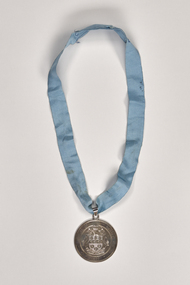
Ceremonial object - Shire of Huntly Medallion
... It was named after the Huntly parish (1854) which was probably named after Huntly, Aberdeenshire, Scotland. The shire’s south-west corner adjoined Epsom (Bendigo), its eastern boundary was the Campaspe River and its northern boundary ran through Diggora West. ...It was named after the Huntly parish (1854) which was probably named after Huntly, Aberdeenshire, Scotland. The shire’s south-west corner adjoined Epsom (Bendigo), its eastern boundary was the Campaspe River and its northern boundary ran through Diggora West. ...Huntly Shire (1866-1994), north of Bendigo, was proclaimed on 13 July 1866, the successor to a road district which had been created in 1861. It was named after the Huntly parish (1854) which was probably named after Huntly, Aberdeenshire, Scotland. The shire’s south-west corner adjoined Epsom (Bendigo), its eastern boundary was the Campaspe River and its northern boundary ran through Diggora West. Its area was 878 sq km, unchanged since the shire was created. The administrative centre of the shire was Huntly, nearly on the edge of Bendigo’s urban fringe. In the south of the shire there were former gold mining areas at Huntly, Fosterville and Bagshot. The Midland Highway and railway line (1864) running north-east through the shire connected Goornong and Elmore to Bendigo. Elmore was the shire’s largest town, situated in a wheat/sheep farming area. The Kamerooka State Park was in the north-west of the shire. It was amalgamated with Bendigo, Marong, Eaglehawk and Strathfieldsaye in 1994 and is now part of the City of Greater Bendigo.Shire of Huntly stirling silver hand engraved drop suspended from a ling blue masonic ribbon. Front; SHIRE OF HUNGLY / 1886 / UNITA FORTIOR. Verso; PRESENTED TO THE SHIRE OF HUNTLY / BY CR. THE HON. M. A. CLARKE / 12TH AUGUST 1981shire of huntly, city of greater bendigo ceremonial item
