
Showing 6 items matching "aboriginal hand axe"
-
 Phillip Island and District Historical Society Inc.
Drawing
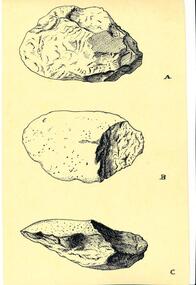
... ...aboriginal hand axe...Black & White Pen drawing depicting three views of the same Aboriginal Hand Axe. Drawn by Dr L Adam, University of Melbourne....One of several drawings included in a collection of over 400 photographs in an album commenced in 1960 and presented to the Phillip Island & Westernport Historical Society by the Shire of Phillip Island local history illustrations pen & ink aboriginal hand axe aboriginal tools John Jenner Bryant West Dr L Adam Black & White Pen drawing depicting three views of the same Aboriginal Hand Axe. ...One of several drawings included in a collection of over 400 photographs in an album commenced in 1960 and presented to the Phillip Island & Westernport Historical Society by the Shire of Phillip IslandBlack & White Pen drawing depicting three views of the same Aboriginal Hand Axe. Drawn by Dr L Adam, University of Melbourne.local history, illustrations, pen & ink, aboriginal hand axe, aboriginal tools, john jenner, bryant west, dr l adam -
 Orbost & District Historical Society
axe head
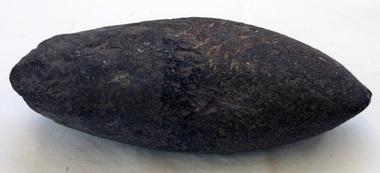
... axe would able to withstand repeated impact. The stone would have been dug or found and then roughly shaped into a tool blank with blows from a hammerstone. The edges were then sharpened and refined by grinding the tool against a coarse, gritty rock. Ground-edge tools could be held in the hand, or fashioned to be fixed onto a haft or handle. The necessary tools and equipment for hunting, fishing and warfare were one of the very few items that Aboriginals ...Inspected by Joanna Freslov, archaeologist 2.6.2008. -unusual axe head. Ground-edge tools are made from fracture-resistant stone, such as basalt. This axe would able to withstand repeated impact. The stone would have been dug or found and then roughly shaped into a tool blank with blows from a hammerstone. The edges were then sharpened and refined by grinding the tool against a coarse, gritty rock. Ground-edge tools could be held in the hand, or fashioned to be fixed onto a haft or handle.The necessary tools and equipment for hunting, fishing and warfare were one of the very few items that Aboriginals carried with them from place to place. Most were used for a multiplicity of purposes. Because many were made from raw natural materials, such as wood, generally only partial remains are found today. This stone axe head is an example of a ground-edge tool used by the early Indigenous people in Eastern Australia.A handmade stone Aboriginal axe head.aboriginal tool aboriginal stone-artefact -
 Eltham District Historical Society Inc
Negative - Photograph, Charles Bertie, Sketch; Sweeney's Cottage, Culla Hill, Eltham (n.d.), c.1905
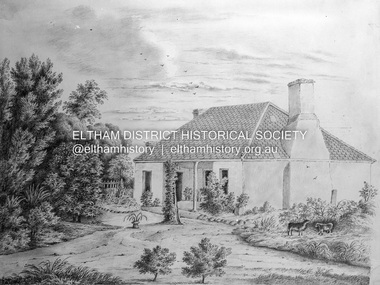
... axes, grinding stones, and anvil stones have been found in the gullies around Research and canoe trees and artifacts were found on the Kangaroo Ground hills. Early settlers remembered a tribe that camped on the site of the present railway bridge at Eltham. They held corroborees there and visited settlers for hand-outs of 'flour and bacca’. There was an aboriginal...axes, grinding stones, and anvil stones have been found in the gullies around Research and canoe trees and artifacts were found on the Kangaroo Ground hills. Early settlers remembered a tribe that camped on the site of the present railway bridge at Eltham. They held corroborees there and visited settlers for hand-outs of 'flour and bacca’. There was an aboriginal ...In the early 1900s, Mary Sweeney commissioned artist Charles Bertie to paint the main house at Culla Hill. He charged her 5 shillings for the picture and 18 pence for the frame She took this painting with her when she married Michael Carrucan in 1910 and it hung in the Dalton Street farmhouse for many years. At a later time (1960s), the Burstons (the then owners of Culla Hill) had a card printed from the painting. The original sketch was photographed in 1970 for reproduction in the Shire history publication Pioneers & Painters (1971). The very fragile original was kept in the Council strongroom and suffered significant damage to its edges over the years, no doubt it has also yellowed. A comparison of the original as digitised (2022) with the negative taken 50 years earlier also reveals that the left 20% of the sketch has been cut off, probably due to damage. In June 1842 Thomas Sweeney applied to the Superintendent, C.J. La Trobe, asking permission to purchase a portion of the recently surveyed ‘Parish of Nillumbik'. His request was allowed and handed to the sub-treasurer and Land Board. He paid £110 for 110 acres and called the land 'Culla Hill'. He first built a temporary house, a slab hut 12 feet by 10 feet, in which he lived with his wife, an Irish girl whom he had married in 1838. (His first wife had been drowned at Port Jackson.) Some time later he built a permanent residence on the model of a Tipperary farmhouse. It was a rectangular building of hand-made bricks and stone quarried from the Western Hill with a recessed verandah in front, and bore a slate roof. The out-buildings consisted of a detached kitchen, stable and a barn. It was in this house that succeeding generations of Sweeneys were reared. The original slab hut became a washhouse and survived till recent years. 'Culla Hill' became a social centre for the district, church services being held there on various occasions. The first wheat crop in the district was planted by Sweeney who also supplied the first grain for a mill that later was built at Eltham. He took an active interest in the development of the district. At this time travelling people--many of them runaway sailors or convicts--often passed the settlement, and some of them stayed and worked with Sweeney. A tribe of aborigines living on the river below 'Culla Hill' were apparently on good terms with Sweeney, for it is said that they helped him with the building of his house. Very little is known about the aborigines who originally lived in the Eltham district. There must have been many of them; their stone axes, grinding stones, and anvil stones have been found in the gullies around Research and canoe trees and artifacts were found on the Kangaroo Ground hills. Early settlers remembered a tribe that camped on the site of the present railway bridge at Eltham. They held corroborees there and visited settlers for hand-outs of 'flour and bacca’. There was an aboriginal reserve on the Yarra, upstream from Eltham, but most of those who had collected there later went to live on the Pound Reserve at Warrandyte, where the last aborigines in the area finally ended their days. The Pound Reserve, of 1,103 acres, was established at Pound Bend in 1841. The chief protector, George Robinson, and his four assistants, were given instructions to care for the aged and sick, to provide blankets and rations for all who lived there, to train the able-bodied men in agriculture and other trades and to find them jobs. The Yarra blacks, who later came under the protection of William Thomas, have been described as a 'fine race, well made and above the average height'. Thomas Sweeney died on 6 September 1867 and was buried in the Eltham Cemetery. To his wife Margaret and his son John, he left the entire property of 'Culla Hill'. To his other son Patrick, he left 150 acres, including a small two-roomed wooden cottage. He had five daughters: Kate and Margaret (twins) who were born in 1842, Ellen 1846, Annie 1848 and Johanna 1851. John Sweeney farmed 'Culla Hill' until his death in 1909. He had ten children; one of them, Mary, became Mrs M. Carrucan whose son, Mr John Carrucan, still lives at Eltham. 'Culla Hill' passed out of the Sweeneys possession in 1939 and was renamed by its new owners, 'Sweeneys', in memory of its pioneers. - Pioneers & Painters: One Hundred Years of Eltham and its Shire, Alan Marshall 1971, pp10-12 Original colour sketch artwork 4 x 5 inch black and white negative of original colour sketchculla hill, art, charles bertie, drawing, mary carrucan (nee sweeney), sketches, sweeney's cottage -
 National Vietnam Veterans Museum (NVVM)
Plaque, Vendetta
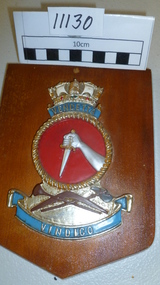
... Wooden shield with metal detail of a crown above a hand holding a dagger over Aboriginal weapons - boomerang, axe and nulla nulla...Plaque Vendetta Plaque Ship Vindigo Wooden shield with metal detail of a crown above a hand holding a dagger over Aboriginal weapons - boomerang, axe and nulla nulla Vendetta Plaque Plaque Badges and Crests ...Wooden shield with metal detail of a crown above a hand holding a dagger over Aboriginal weapons - boomerang, axe and nulla nullaVindigoplaque, vendetta plaque ship -
 Lakes Entrance Historical Society
Postcard - Charlie Green, Lake Tyers Victoria, Bulmer H D, 1920
... Black and white photographic postcard showing Charlie Green, an Aboriginal man of Lake Tyers, climbing a tree with the aid of a harness. Has an axe in his right hand. ...Reference: Page 237 'The Kurnai of Gippsland' by Phillip Pepper Waterways Vegetation Aboriginals Black and white photographic postcard showing Charlie Green, an Aboriginal man of Lake Tyers, climbing a tree with the aid of a harness. Has an axe in his right hand. ...Charlie Green climbs a tree, using traditional bark sling. Reference: Page 237 'The Kurnai of Gippsland' by Phillip PepperBlack and white photographic postcard showing Charlie Green, an Aboriginal man of Lake Tyers, climbing a tree with the aid of a harness. Has an axe in his right hand. Lake and bush covered bank in background Lake Tyers Victoriawaterways, vegetation, aboriginals -
Emerald Museum & Nobelius Heritage Park
Tool - Axe
... axe head was often hafted with resin on to a hard-wood stick. The implement is of diorite or greenstone (although black in appearance), which was obtained from an aboriginal quarry at Mount William in the Lancefield area. Stone from this quarry was often traded for other goods and has been found as distant as Queensland. A piece of greestone this size, unground, was considered worth a possum-skin cloak (a cloak took approximately 28 possum skins). Trading in greenstone therefore had social significance. This type of implement was often handed...axe head was often hafted with resin on to a hard-wood stick. The implement is of diorite or greenstone (although black in appearance), which was obtained from an aboriginal quarry at Mount William in the Lancefield area. Stone from this quarry was often traded for other goods and has been found as distant as Queensland. A piece of greestone this size, unground, was considered worth a possum-skin cloak (a cloak took approximately 28 possum skins). Trading in greenstone therefore had social significance. This type of implement was often handed ...Comment from Andrea Murphy, aboriginal heritage consultant, Upper Beaconsfield, January 2006: This is an axe head, which was most common and the most important implement in the aboriginal stone "assemblage". The implement was a man's tool and would have been in daily use to cut wood off trees, cut notches for foot-holds for climbing trees, or to dispatch game. The axe head was often hafted with resin on to a hard-wood stick. The implement is of diorite or greenstone (although black in appearance), which was obtained from an aboriginal quarry at Mount William in the Lancefield area. Stone from this quarry was often traded for other goods and has been found as distant as Queensland. A piece of greestone this size, unground, was considered worth a possum-skin cloak (a cloak took approximately 28 possum skins). Trading in greenstone therefore had social significance. This type of implement was often handed down from one generation to the next. It was sometimes buried with the dead. The edge of the axe was formed by grinding on a rougher stone. Working with greenstone more recent techonology [than the other stones]. This implement is reasonably small but is a good example of symmetrical grinding. There is minor damage to the edge; otherwise it is in good condition.Aboriginal stone axe found circa 1921 and donated by R. DouglasStoneemerald, victoria, australia, aboriginal culture, hunting, burial grounds, r. douglas
