
Showing 36 items matching "ac power"
-
 Tatura Irrigation & Wartime Camps Museum
Rectifier, McKenzie & Holland, 1925
... This object was installed at the Victory Hall, Tatura, to change main power (AC 240 v), to DC (direct current 30 volts). ...An electrical devise which changes AC power supply to DC supply....This object was installed at the Victory Hall, Tatura, to change main power (AC 240 v), to DC (direct current 30 volts). ...This object was installed at the Victory Hall, Tatura, to change main power (AC 240 v), to DC (direct current 30 volts). This supply was required to run the hall's picture show.An electrical devise which changes AC power supply to DC supply.Makers name; title object; Ref. to voltage, amps. AC and DC.rectifier, victory hall tatura, electrical converters -
 Federation University Historical Collection
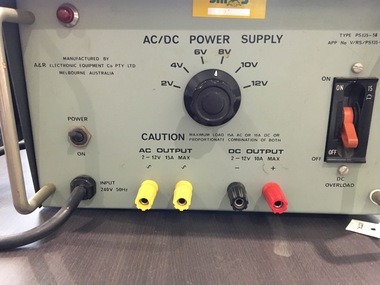
Electrical Equipment, AC/DC Power Supply Unit - Rectifier
... AC/DC Power Supply Unit - Rectifier...Two switches for turning on and off. AC/DC Power Supply Unit - Rectifier Electrical Equipment A & R Electronic Equipment Co. ...What device converts AC to DC? rectifier A rectifier is an electrical device that converts alternating current (AC), which periodically reverses direction, to direct current (DC), which flows in only one direction. The process is known as rectification, since it "straightens" the direction of current. The unit was used at Ballarat School of Mines in the Maths, Science and Physics Departments.Grey metal unit with Dials on the front and vents at the back. Handle for carrying. Two switches for turning on and off. Yellow sticker - SMB - with number 116071. Engraved on back - S.M.B.. Maths / Science / Physics Sticker on cord indicating inspection of unit - 13/04/2005. Tag Number - 032735alternating current, direct current, ac, dc, rectifier, electrical, ballarat school of mines, science, maths, physics -
Moorabbin Air Museum
Manual - Lockheed Hercules technical training, Customer Training Electrical
... ...AC power...Lockheed Hercules technical training Wiring & circuits AC power DC power system Lighting systems Propeller synchrophaser Misc.electrical systems Electronic test receptacles Flight instruments Engine instruments Misc.instruments Technical overview of Hercules electrical systems & instruments, circa 1976 Customer Training Electrical Manual Lockheed Hercules technical training ...Technical overview of Hercules electrical systems & instruments, circa 1976non-fictionTechnical overview of Hercules electrical systems & instruments, circa 1976wiring & circuits, ac power, dc power system, lighting systems, propeller synchrophaser, misc.electrical systems, electronic test receptacles, flight instruments, engine instruments, misc.instruments -
The Ed Muirhead Physics Museum
Photograph, Cyclotron accelerator
... Sticky typed labels on back from top and left to right: “MAIN SWITCHBOARD” Handwritten in pencil on upper left hand corner: “9” Handwritten in pen on bottom right hand corner: “AC power in from substation” ...Sticky typed labels on back from top and left to right: “MAIN SWITCHBOARD” Handwritten in pencil on upper left hand corner: “9” Handwritten in pen on bottom right hand corner: “AC power in from substation” Black and white photo of cyclotron (nuclear physics accelerator): Main switchboard. ...Builit in 1950s and used till the mid 1970s within the Physics Department used in Melbourne. John Rouse and David Caro was involved in the construction.Black and white photo of cyclotron (nuclear physics accelerator): Main switchboard. Sticky typed labels on back from top and left to right: “MAIN SWITCHBOARD” Handwritten in pencil on upper left hand corner: “9” Handwritten in pen on bottom right hand corner: “AC power in from substation” -
 Anglesea and District Historical Society
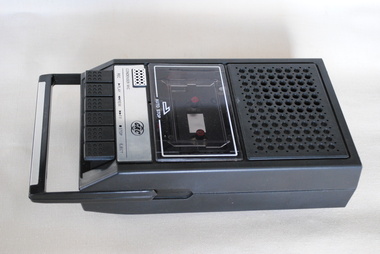
Cassette Recorder, GAC, Not known
... It can be operated directly from batteries or AC power (cord included). Also has Automatic Recording Level Control Circuitry (ALC), thus no need to adjust volume while recording. ...It can be operated directly from batteries or AC power (cord included). Also has Automatic Recording Level Control Circuitry (ALC), thus no need to adjust volume while recording. ...Six key portable cassette recorder/player with rotary volume control. It can be operated directly from batteries or AC power (cord included). Also has Automatic Recording Level Control Circuitry (ALC), thus no need to adjust volume while recording. In original box with instructions and power cord. (Purchased at Waltons for 29.99).Auto Stop / GAC - logo Top: Condenser mic Rec / Play / Rewind / FF / Eject Left side: Ear O / Remote Mike 00 / Volume Bottom markings: Model No. SW-201 AC: 240V 50HZ 6W DC: 6V (UM - 2x4) Made in Hong Kong Warning: To prevent fire or electrical shock hazard, do not expose this appliance to rain or moisture, do not remove cover, no user serviceable parts inside, refer servicing to qualified service personnel. cassette recorder, gac -
 Ballarat Tramway Museum
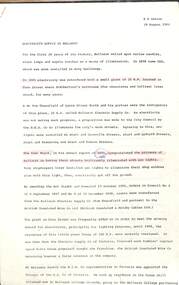
Document - Report, A. D. Senior, "Electricity Supply in Ballarat', Aug. 1984
... Gives a background to power supply in Ballarat from 1885, takeover by ESCo, DC and AC power supply, generators, Buniyong, SEC, A and B power stations, farm supply, illumination or lighting, tramways and tram braking systems. ...Gives a background to power supply in Ballarat from 1885, takeover by ESCo, DC and AC power supply, generators, Buniyong, SEC, A and B power stations, farm supply, illumination or lighting, tramways and tram braking systems. ...Ten page report or article written by A. D. Senior, dated 29 August 1984 titled "Electricity Supply in Ballarat". Gives a background to power supply in Ballarat from 1885, takeover by ESCo, DC and AC power supply, generators, Buniyong, SEC, A and B power stations, farm supply, illumination or lighting, tramways and tram braking systems. Photocopied from original on foolscap sheets with staple in top left hand corner. See also Reg Item 1701 and 1702.Pink highlights on page 1, ink notes, pencil notes on page 3 re Creswick and ink corrections on page 7.trams, tramways, power supply, ballarat, sec, power station, esco -
 Whitehorse Historical Society Inc.
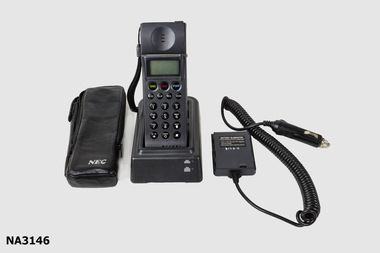
Domestic object - Mobile Phone & Accessories, c1993
... |Also included is a charging console, an in-car charging attachment and a book of instructions with original contract and receipt..|Missing is an AC power adaptor. Unit includes the NiCad battery....|Also included is a charging console, an in-car charging attachment and a book of instructions with original contract and receipt..|Missing is an AC power adaptor. Unit includes the NiCad battery. ...The first mobile phone - analog - used by donors husband, Noel Webster. Noel was a Nunawading Councillor 1969 -75, Mayor 1973-74. He grew up with his family in Canterbury Road Vermont from mid 1930s.Early model analog (1993) N E C mobile phone pre digital. Plastic with LCD display screen, function & dialling keys, receiver earpiece and microphone/loudspeaker. All enclosed in a zippered leather carrying case with a zipper enclosed detachable portable antenna. Mobile phone includes a soft carrying handle.|Also included is a charging console, an in-car charging attachment and a book of instructions with original contract and receipt..|Missing is an AC power adaptor. Unit includes the NiCad battery.NEC and key pad codes and figures.communication, radio, telephonic -
 Melbourne Tram Museum
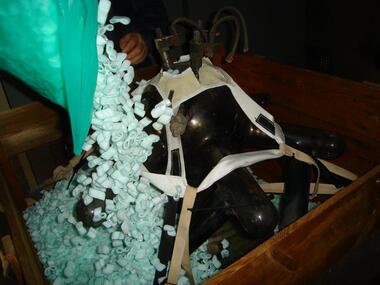
Photograph, Peter Rufus, images of decommissioning mercury arc equipment or bulbs, 2005
... Shows the removal and packing of the bulbs used in sub-stations to rectify or change the electrical power from AC to DC for tram use....Shows the removal and packing of the bulbs used in sub-stations to rectify or change the electrical power from AC to DC for tram use. Demonstrates the removal and packing of mercury arc rectifier bulbs Trams tramways Substation Mercury Arc Yarra Trams Set of five digital images of decommissioning mercury arc equipment or bulbs at a sub station during 2005. images of decommissioning mercury arc equipment or bulbs Photograph Peter Rufus ...Shows the removal and packing of the bulbs used in sub-stations to rectify or change the electrical power from AC to DC for tram use.Demonstrates the removal and packing of mercury arc rectifier bulbsSet of five digital images of decommissioning mercury arc equipment or bulbs at a sub station during 2005. trams, tramways, substation, mercury arc, yarra trams -
 Melbourne Tram Museum
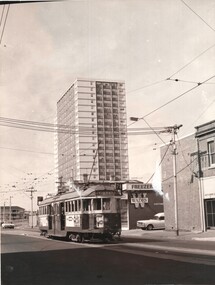
Photograph - Black & White Photograph/s, Gennaro Esposito Photographer, c1960
... The tram has adverts for Power AC spark plugs. In the background are the then relatively new housing towers, advertising for Pepsi-Cola and Wades Freezer....The tram has adverts for Power AC spark plugs. In the background are the then relatively new housing towers, advertising for Pepsi-Cola and Wades Freezer. ...Black and white photograph of W2 554 (St Kilda Beach, Route 78) leaving North Richmond terminus, Church St, c1960. The tram has adverts for Power AC spark plugs. In the background are the then relatively new housing towers, advertising for Pepsi-Cola and Wades Freezer.Has the stamp of "Gennaro Esposito Photographer, 22 Church St North Richmond"trams, tramways, north richmond, w2 class, church st, route 78, tram 554 -
 Anglesea and District Historical Society
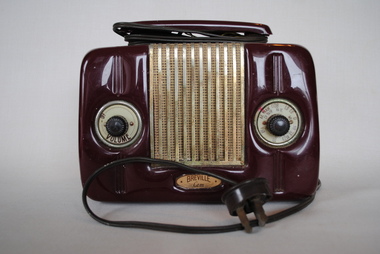
Radio, Breville Sydney, Breville Gem, 1950
... Valves and tubes - GAN7, EBF35, GM5, 6x4 Principle: Super-Heterodyne ZF/IF 452KHz Wave Bands: Broadcast only (MW) Power: AC 220/240 Volt Loudspeakers: Permanent Magnetic Dynamic (PDyn) Loudspeaker (moving coil) Colour: Red...Valves and tubes - GAN7, EBF35, GM5, 6x4 Principle: Super-Heterodyne ZF/IF 452KHz Wave Bands: Broadcast only (MW) Power: AC 220/240 Volt Loudspeakers: Permanent Magnetic Dynamic (PDyn) Loudspeaker (moving coil) Colour: Red Breville Gem Radio Breville Sydney ...Model 903 - Broadcast Receiver - past WW2 Tuner. Valves and tubes - GAN7, EBF35, GM5, 6x4 Principle: Super-Heterodyne ZF/IF 452KHz Wave Bands: Broadcast only (MW) Power: AC 220/240 Volt Loudspeakers: Permanent Magnetic Dynamic (PDyn) Loudspeaker (moving coil) Colour: RedBack: Internal Aerial Socket Model 903 Front: Left Dial - OFF VOLUME. Front: Right Dial - AK, MAAW, C SDB, LO, CO, G1, AR UZ, KZSR, XY BN CV; BATR HA UL WV -
 Orbost & District Historical Society
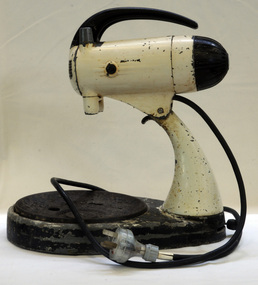
cake mixer, circa 1948
... It is worked on AC or Dc power 240 ...It is worked on AC or Dc power 240 cake mixer Sunbeam Corporation ...The Mixmaster 9B in 1948 was the first Sunbeam appliance to be made in Australia. It was designed in the USA.After years of rationing and shortages, the 1950s were a period of economic prosperity, high employment and great technological development. During this period, Australians enthusiastically adorned their homes with a dazzling range of new domestic appliances. Hire-purchase schemes allowed people to take products home and pay for them in instalments. The American-designed Mixmaster 9B was the first Sunbeam appliance manufactured and sold in Australia in 1948. An early Sunbeam Mixmaster. It is an electronic stand mixer with a black metal base in the shape of a rounded teardrop with two holes for the turntable. It has a cream enameled metal arm, cream coloured metal motor housing with a black plastic handle on the top. On the back of the motor housing is a black plastic knob with ten speed options for the mixer, and the "OFF" position. a black electric cord is attached under the motor housing with a black switch beneath the cord. The motor housing is able to tilt backwards on a hinge which is attached to the top of the stand arm. It is worked on AC or Dc power 240 On the bottom are the words "MODEL 9B". mixmaster sunbeam kitchen-appliance food-technology -
 Federation University Historical Collection
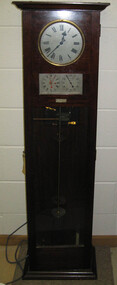
Object, Synchronome Co. Ltd, Synchronome Frequency Checking Master Clock No. 2191, c1930
... A rectifier is a device that is used to convert AC power to more stable DC current....A rectifier is a device that is used to convert AC power to more stable DC current. synchronome frequency checking master clock electricity state electricity commission wendouree parade power station secv clock time pendulum electric supply company of victoria norman f. dalton ballarat power station rectifier slave clock Front below main clock face on front of case: "Patented Sychronome Brisbane" Lower left-hand clock face: "Frequency time" Lower right-hand clock face: "Standard Seconds" Synchronous electric clock mechanism on door (Frequency time clock): >200/250 V. 50~ >"Synchronomains" Made in England >Direction indicator for clock starting switch >"To start move lever in direction of arrow and release" >"Patent applied for" Mechanism for "standard seconds" clock: >"English Made" >"Patented" >Serial number "321" >0 above right-hand pillar on front-plate Mechanism for "standard seconds" clock: >"English Made" >"Patented" >Serial number "321" >0 above right-hand pillar on front-plate Mechanism for main clock face: >"English Made" >"Patented" >Serial number "8751" >0 above right-hand pillar on front-plate Inside case, back panel, top enamel plate: >Seconds Battery + Pos ...Information from Norman F. Dalton: Ballarat had a reticulated DC supply in the early part of last century and in 1905 had sufficient generating capacity to enable the trams to be changed from horse drawn to DC electricity. The use of electricity increased with the main power station located on Wendouree Parade, near Webster Street, under the ownership of The Electric Supply Company of Victoria. AC generating plant was installed in 1925 and conversion to AC proceeded. In 1934 the company was taken over by the State Electricity Commission Victoria (SECV) and more AC generation was installed and the changeover of customers was accelerated. This is around the time that the Synchronome Frequency Checking Mast Clock was installed at the Wendouree Parade Power Station. The SECV Annual Report of 1921 states: ::Section 11 of the act directed the COmmission to enquire into the question of securing the adoption of such standards of plant and equipment of a system, frequency and pressure for the generation and distribution of electricity as will admit of the efficient interconnection of undertakings throughout the State. In 1934 when the SECV took over the Ballarat operations the question of linking with the State grid had been a planned operation for some years but due to financial considerations had hindered it and in fact would continue to do so for a further 10 years. So while the need for close frequency control for interconnection was hardly an issue, the need to keep electric clocks correct was important, particularly as this item was a frequent sales point to cover the inconvenience and sometimes expense of converting from DC to AC. The clock is a very accurate pendulum clock with provision for varying effective length during operation for precise time regulation. There are two normal time dials and one is controlled by the pendulum and the other is operated by the system frequency. When the clock was in use it was installed by the MEter and Tests Laboratory and the time was checked daily by radio time signals. The two dials were repeated in the operators control panel in the Power Station. A maximum deviation between the two dials was set in the operating instructions (eg 5 seconds) and the operator would correct this when necessary by remote manual alteration of the turbine governor set point. The clock was used to drive and regulate a system of "slave" clocks which were used to display the time in various locations around the power station. A slave clock is a simple clock which is driven by a small electric motor, its accuracy is regulated by the master clock every 30 seconds to ensure that it and all the other slave clocks in the station are on exactly the right time; slave clocks were placed in various locations, from common rooms to workshops. A master clock could potentially run thousands of slave clocks at one plant. The clock also contains a rectifier. A rectifier is a device that is used to convert AC power to more stable DC current.Two clocks in a timber case. Both are electric, one is powered by the main pendulum mechanism, the other is a self contained electric clock. The main mechanism is of the gravity arm and roller type, which sends an impulse to the slave clocks every 30 seconds. The This Synchronome Frequency Checking Master Clock was used at the Ballarat Power Station. Below the main section of the case is a smaller cabinet containing a rectifier to provide consistent DC power for the clock. The rectifier was made by the Victorian company Hilco, which was located in Burwood. There is a high chance this is not the original rectifier from this clock as there appears to be brackets to hold a larger device in the space the rectifier occupies.Front below main clock face on front of case: "Patented Sychronome Brisbane" Lower left-hand clock face: "Frequency time" Lower right-hand clock face: "Standard Seconds" Synchronous electric clock mechanism on door (Frequency time clock): >200/250 V. 50~ >"Synchronomains" Made in England >Direction indicator for clock starting switch >"To start move lever in direction of arrow and release" >"Patent applied for" Mechanism for "standard seconds" clock: >"English Made" >"Patented" >Serial number "321" >0 above right-hand pillar on front-plate Mechanism for "standard seconds" clock: >"English Made" >"Patented" >Serial number "321" >0 above right-hand pillar on front-plate Mechanism for main clock face: >"English Made" >"Patented" >Serial number "8751" >0 above right-hand pillar on front-plate Inside case, back panel, top enamel plate: >Seconds Battery + Pos. > Battery Common or - Neg. >1/2 min dials Inside case, back panel, bottom enamel plate: external seconds dial Inside case, right hand side, electrical knobs: two switches, both "A.C. mains" Pendulum rod, below suspension spring: Serial number (?) 0000005 Rectifier in bottom cabinet: >"Hilco Rectifier" >"A.C. Volts 230/240" >"Model 1060/S" >"A.C. Amperes" >"Serial No. 1060/S >"Phases 1" >"D.C. Volts 6" >"C.P.S. 50" >"D.C. Amperes 1" >"Made in Australia by Hilco Transformers McIntyre St., Burwood, Victoria." Bakelite electrical plug: makers mark Lower cabinet, RH side panel, pressed tin plate: "AC" (upside down) Brass speed adjustment, outer right RH side: "S" and "F" Ivory and wood pendulum beat ruler: >Ruler, with 0 in centre and numbers 1-5 in ascending order from centre on left and right. > "Synchronome Patent." Steel plate, back panel, inside case, right hand side: >N R A" (descending) >"2191" serial number/part number Face of main clock: "Synchronome Electric" synchronome frequency checking master clock, electricity, state electricity commission, wendouree parade power station, secv, clock, time, pendulum, electric supply company of victoria, norman f. dalton, ballarat power station, rectifier, slave clock -
 Ballarat Tramway Museum
Document - Folder with papers, Robert Ashley, "Ballarat SEC History", 1989
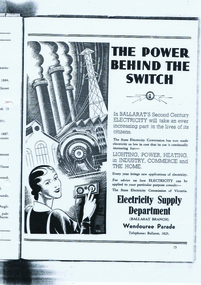
... The paper gives the history of power supply in Ballarat, including street lighting, ESCo, AC and DC power supplies, the takeover by the SEC, Ballarat A and B power stations, a copy of an advertisement for the SEC in Ballarat. ...The paper gives the history of power supply in Ballarat, including street lighting, ESCo, AC and DC power supplies, the takeover by the SEC, Ballarat A and B power stations, a copy of an advertisement for the SEC in Ballarat. ...Samizone flat file, made from manila card with blue printing for file details and a Dymo machine label on the spine (red background with white printing) titled "Ballarat SEC History". On inside of folder is a "Post It" note with handwriting "Robert Ashley Ex Employee" in blue ink. Contained within folder is" 1. "Ballarat, Electricity and the State Electricity Commission" photocopied from an original. Has typed under the heading over white out correction fluid "Notes - Draft notes prepared by Robert W. P. Ashley 1989." The paper gives the history of power supply in Ballarat, including street lighting, ESCo, AC and DC power supplies, the takeover by the SEC, Ballarat A and B power stations, a copy of an advertisement for the SEC in Ballarat. (See btm1701i3.jpg) titled "The Power Behind the Switch" 2. Paper by A. D. Senior, titled "Electricity Supply in Ballarat" - see Reg. Item No. 1700. (see btm1700i.pdf) 3. Photocopied onto foolscap paper of an extract from possibly a large report on power supply in Victoria. Pages 155 to 158. Reports on the history of the power supply system in Ballarat until the takeover of ESCo by the SEC. Further details are referred to another section of the Report on the SEC itself. On page 158 are details of Beaufort Council operated supply and the start of notes on Beechworth. (see btm1701i2.pdf) Images of files added 6-8-15 For an image of the advert itself see btm1701i3.pdfSee notes above.trams, tramways, secv, power supply, esco, beaufort -
 Federation University Historical Collection
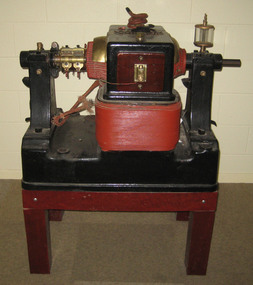
Equipment, Elwell-Powell, Elwell-Parker AC Generator
... ac generator...elwell-parker ltd...state electricity commission...sec...ballarat north power...This AC generator operated for the State Electricity Commission in the Ballarat North Power Station prior to World War Two. ...This AC generator operated for the State Electricity Commission in the Ballarat North Power Station prior to World War Two...This AC generator operated for the State Electricity Commission in the Ballarat North Power Station prior to World War Two Elwell-Parker AC Generator Equipment Elwell-Powell ...This AC generator operated for the State Electricity Commission in the Ballarat North Power Station prior to World War Two. James Oddie of Ballarat has an association with Thomas Parker of Elswell-Parker. In early 1887 Oddie arrived in England seeking information on electrical knowledge and its developments. At this time Henry Sutton was teaching Electricity and Magnetism at the Ballarat School of Mines. Oddie stayed in the United Kingdom for around three years and during that time became a close friend of Thomas Parker and his family. The two first met at the first official running of the Blackpool tram, and Oddie was invited to visit Parker at Wolverhampton. Over the years Thomas Parker kept newspaper cuttings (mainly Australian) relating to James Oddie and his work. The following article is a description of the Wolverhampton works by James Oddie, and was collected by Thomas Parker. After the dinner at Blackpool, Mr. Parker visited me, and cordially invited me to see his extensive works at Wolverhampton, an invitation I was not slow to avail myself of. This was the keynote of the best friendship I made in England. I went shortly afterwards and stayed several days, visiting the works daily, as Mr. Parker gave me the run of the whole works. There I ordered the installation of a 60 light dynamo, with a 28 cell storage battery and paraphernalia, now doing duty at the Observatory. I subsequently visited the works frequently, sometimes for a week at a time, and I regard it as the brightest spot in my English constellation. Mr. Parker started his works in 1880, with one man beside himself. He never had a single day’s instruction in electricity in his life; now he daily instructs between 300 and 400 employees, who worship him as a father. He is said to be now the most practical electrical engineer and mechanist in Europe. During one of my visits I took with me an artist, who is painting for me a portrait, 6 feet by 5 feet, of Mr. Parker, surrounded by dynamos, secondary batteries, measuring instruments etc. Electric tram cars are going to be a big thing in England. Parker’s Company Limited, is now, with three other companies, in the hands of the Electric Construction Company, with Mr. Parker as manager of the lot. The whole of the works will be taken to Wolverhampton. Before I left, a tender for £50,000 was accepted for the construction of new works.AC Generator painted read and black on a stand. This AC generator operated for the State Electricity Commission in the Ballarat North Power Station prior to World War Twogenerator, ac generator, elwell-parker ltd, state electricity commission, sec, ballarat north power station, james oddie, wolverhampton -
 Federation University Historical Collection
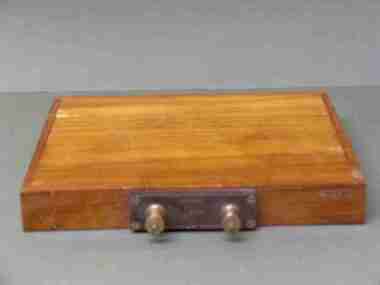
Scientific Instument, Capacitor
... power) farad. The microfarad is a moderate unit of capacitance. In utility alternating-current (AC) and audio-frequency (AF) circuits, capacitors with values on the order of 1 µF or more are common. ...power) farad. The microfarad is a moderate unit of capacitance. In utility alternating-current (AC) and audio-frequency (AF) circuits, capacitors with values on the order of 1 µF or more are common. ...DEFINITION microfarad Posted by: Margaret Rouse WhatIs.com Contributor(s): Kenda, Jack Clements The microfarad (symbolized µF) is a unit of capacitance, equivalent to 0.000001 (10 to the -6th power) farad. The microfarad is a moderate unit of capacitance. In utility alternating-current (AC) and audio-frequency (AF) circuits, capacitors with values on the order of 1 µF or more are common. At radio frequencies (RF), a smaller unit, the picofarad (pF), is often used. This unit is equal to .000000000001 (10^-12) µF. In RF scenarios, capacitances range from about 1 pF to 1,000 pF in tuned circuits, and from about 0.001 µF to 0.1 µF for blocking and bypassing. At audio frequencies (AF), capacitances range from about 0.1 µF to 100 µF. In power-supply filters, capacitances can be as high as 10,000 µF. Capacitor, 1/3 M.F.D. (microfarad) within wooden insulating box. Two terminal posts set in an insulating box. Maker's name and place 1/3 M.F.D No. 34402scientific instrument, capacitor, electrical engineering, laboratory -
 Kiewa Valley Historical Society
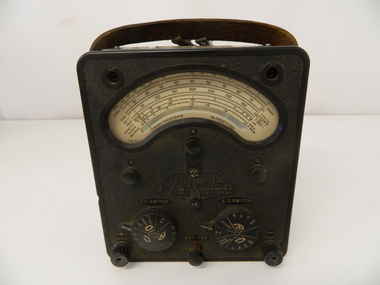
Meter AVO, circa 1930 to 1951
... power being tested. There are two big dial switches, detailing Direct Current(DC) and Alternating Current(AC) when reading measurements of Ampere, Voltage and Ohms for power. ...power being tested. There are two big dial switches, detailing Direct Current(DC) and Alternating Current(AC) when reading measurements of Ampere, Voltage and Ohms for power. ...When this AVOMETER was being utilised in the early 1950's it was at the "leading" edge of electrical measuring instrumentation.The first meter was produced by Automatic Coil Winder and Electrical Equipment Co. in 1923. This model was produced in the time from 1933 to 1951 when it was superseded by the most popular model, Model 8 (1951 to 2008).This AVO meter brought the measuring of three electrical power indicators i.e., amps, volts and ohms into one measuring unit. By using a "one fits all" unit, the carrying of separate measuring devices was reduced considerably. The need for a mountainous and a large area of operational requirements, such as the SEC Vic Kiewa Hydro Electricity Scheme, to minimise the weight of equipment carried by electricians and technicians was of the utmost relevance. The significance of this meter to the Kiewa Valley region relates to the impact of modern technology (at that time) upon a mainly rural environment. This equipment shows how the boost of "modern" equipment into the area because of the "Hydro Scheme" was facilitated a lot faster than would have taken under "normal" evolutionary time. The speed of information on all "new technology" had a relatively slow assimilation rate to those living in rural communities. This AVOMETER is a Model 7 MKII, production pre 1951. This meter measures electrical Amps, Volts and Ohms and has two internal batteries for its power. The main casing is made from aluminium with a bake-lite front. The front has a "window" detailing, with a needle pointer, the amount of electrical power being tested. There are two big dial switches, detailing Direct Current(DC) and Alternating Current(AC) when reading measurements of Ampere, Voltage and Ohms for power. This meter took the place of three or four meters used earlier. Modern meters (2000 onwards) have become digilised and are considerably lighter in weight and smaller. There are two electrical connection leads (one black and one red) each has a removable clasp and is 125cm long.Molded on the front centre panel " UNIVERSAL AVOMETER". Below this and above the left hand dial "D.C. SWITCH" .Above the right hand switch the right "A.C. SWITCH". On the left of each switch is an arrow pointing to it.The left switch is marked with a "+" and the right one with a "-". There is a "divisional 2" mark. Between and below the dials is "CUT OUT" plunger.electrical meters, electrical equipment, sec vic., state electricity commission of victoria, mt beauty, bogong village -
 Deaf Children Australia
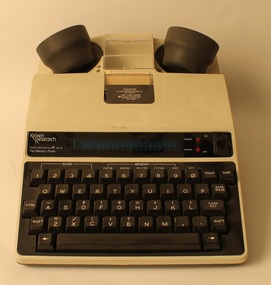
Krown Research Porta printer Plus - Phone TTY Printer, Krown Research Inc, after 1984
... OPTIONS: Time/date stamping and ASCII capability are available. POWER: Rechargeable battery and AC adapter. DIMENSIONS: 9.5 x 12.5 x 2.75 inches. ...OPTIONS: Time/date stamping and ASCII capability are available. POWER: Rechargeable battery and AC adapter. DIMENSIONS: 9.5 x 12.5 x 2.75 inches. ...The Memory Printer MP20 is a telecommunication device for the deaf (TDD or text telephone) with a 20-column LED display and a 20- column built-in printer. The MP20 has an 8,000 character memory for saving and sending messages, upper and lower case printing to distinguish incoming from outgoing messages, and four message buffers. The MP20 uses standard Baudot TDD code. OPTIONS: Time/date stamping and ASCII capability are available. POWER: Rechargeable battery and AC adapter. DIMENSIONS: 9.5 x 12.5 x 2.75 inches. WEIGHT: 5.75 pounds. Instructions for printer and keyboard, etc. " KROWN / Research / PORTA PRINTER PLUS® MP 20 / The Memory Printer" on screen -
 Tramway Heritage Centre
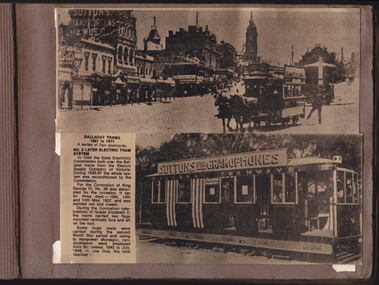
Photograph Album (part of), Ray Pearson's Photo Album - Trams of Victorian Railways, Ballarat, Bendigo, Geelong
... power shortages, con- / doctresses were employed / from September, 1942 to July, 1946. At one time, the total / reached 23. Printed text to back of bottom postcard: BALLARAT TRAMS / 1887 to 1971 / A series of four postcards. / In the early fifties, loading / on the trams was heavy. When / the lag in housing was over- / taken, however, breadwinners / started to leave the trams and / travel to work in cars. Increas- / ing affluence in the sixties ac...power shortages, con- / doctresses were employed / from September, 1942 to July, 1946. At one time, the total / reached 23. Printed text to back of bottom postcard: BALLARAT TRAMS / 1887 to 1971 / A series of four postcards. / In the early fifties, loading / on the trams was heavy. When / the lag in housing was over- / taken, however, breadwinners / started to leave the trams and / travel to work in cars. Increas- / ing affluence in the sixties ac ...Page 3 of Ray Pearson's Photo Album. Brown card page with two metallic look postcards (landscape format) placed on page using clear plastic photo corners. Both postcard images depict trams in Ballarat. The bottom postcard has come loose of two of it's photo corners (top and bottom on the right) and is not secure on the page. A hand written inscription is written in pencil behind the bottom photograph.Hand written inscription in pencil behind postcard at base of page: W.4. Printed text to left of image on bottom postcard: BALLARAT TRAMS / 1887 to 1971 / A series of four postcards. / NO. 3 LATER ELECTRIC TRAM SYSTEM / In 1934 the State Electricity / Commission took over the Bal- / larat trams from the Electric / Supply Company of Victoria. / During 1935-37 the whole sys- / tem was reconditioned by the / Commission. / For the Coronation of King / George VI, No. 28 was decor- / ated for the occasion. It ran / for three days – 12th, 13th / and 14th May, 1937, and was / painted red and cream. / During the Coronation cele- / brations of Queen Elizabeth II, / the trams carried two flags / mounted vertically fore and aft / on the roof. / Some huge loads were / carried during the second / World War period and owing / to man power shortages, con- / doctresses were employed / from September, 1942 to July, 1946. At one time, the total / reached 23. Printed text to back of bottom postcard: BALLARAT TRAMS / 1887 to 1971 / A series of four postcards. / In the early fifties, loading / on the trams was heavy. When / the lag in housing was over- / taken, however, breadwinners / started to leave the trams and / travel to work in cars. Increas- / ing affluence in the sixties ac- / centuated the trend. Soon the / trams were running with mount- / ing annual losses. Most of the / passengers travelling in these / times were concession holders: / students, pensioners, deserted / wives and T.P.I.'s A fine printed vertical line runs down the centre of the blank writing space to the left of the body text. Above is written: POSTCARD postcard, coronation, ray pearson, vintage trams, ballarat tramway, tram postcard, female conductors, suttons, ballarat tram -
Eltham District Historical Society Inc
Document - Folder, Mitchell, Harold
... Harold Mitchell appointed AC Companion of the Order of Australia in the Queen's Birthday honours. Newspaper article: "The Power and the Passion", The Weekly Review, 23 November 2011. ...Harold Mitchell appointed AC Companion of the Order of Australia in the Queen's Birthday honours. Newspaper article: "The Power and the Passion", The Weekly Review, 23 November 2011. ...Harold Mitchel, advertising businessman, was the son of a saw miller in Stawell and recounted his childhood in "Living Large". He eventually lived at St Andrews, was appointed an Officer (AO) of the Order of Australia in 2004 and a Companion (AC) of the Order of Australian in the Queen's Birthday honours 2010, for his community service, leadership, philanthropic contribution to art, heath and education, and support of humanitarian aid in East Timor and Indigenous communities. He also held board positions on a number of arts organisations. He died from complications following knee surgery in February 2024. Contents Newspaper article: "Gong for Mitchell", Diamond Valley Leader, 23 June 2010. Harold Mitchell appointed AC Companion of the Order of Australia in the Queen's Birthday honours. Newspaper article: "The Power and the Passion", The Weekly Review, 23 November 2011. Interview of Harold Mitchell. Newspaper article: "Break point", GoodWeekend, 7 November 2020. Interview of Harold Mitchell. Newspaper article: "Ad man, philanthropist dies at 81", The Age, 12 February 2024. Two obituaries of Harold Mitchell, noting his Order of Australia 2010, his philanthropic interests, his seats on boards of cultural organisations, his business Mitchell & Partners. Newspaper article: Notice of state memorial service for Harold Mitchell AC, The Age, 4 May 2024. Newspaper article: "Farewell for 'a giver, not a taker' who helped others", The Age, 14 May 2024. Report of state memorial service for Harold Mitchell. Newspaper article: "Mitchell's luxury city penthouse yours for 46.25m", The Age, 7 June 2024. Harold Mitchell's penthouse in Park Tower, Spring Street, for sale. Newspaper clippings, A4 photocopies, etcharold mitchell, mitchell & partners, "living large" book, park tower spring street melbourne -
 Kiewa Valley Historical Society
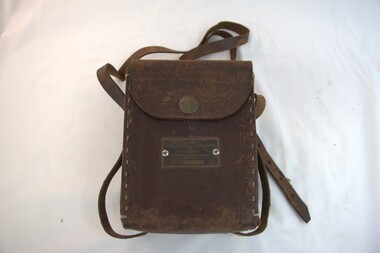
Electric Megger (Insulation Tester) and its case
... AC 240volt plugs leads were touching the metal case (earth). The output leads of the megger would be connected with one to the earth (metal case) and the other to each of the power connections in turn. ...AC 240volt plugs leads were touching the metal case (earth). The output leads of the megger would be connected with one to the earth (metal case) and the other to each of the power connections in turn. ...Megger as the device was called, is in fact its brand name. It is a device that supplies a DC (direct current as per car batteries) voltage to enable testing of electrical apparatus. This particular device produces 250volts DC when the handle is turned vigorously. If an electrical device, such as a kettle or toaster, blew a fuse or tripped a circuit breaker, when switched on, then it must be checked electrically before any more use. Following the repair of the faulty item a megger would be used to check if either of the AC 240volt plugs leads were touching the metal case (earth). The output leads of the megger would be connected with one to the earth (metal case) and the other to each of the power connections in turn. A good megger reading of 50,000 ohms (resistance) would enable the device to be returned to service. A reading of zero ohms resistance would mean that it would again blow a fuse, and was therefore unsafe to use. In the electrical industry e.g. the former State Electricity Commission, a megger would be used to test lots of similar item in sequence. Because of the vigorous job of winding the handle, two persons were often used to save time. One would crank madly whilst the other shifted the leads. This particular megger is of a small voltage, but other meggers are bigger and have a few ranges of DC voltages able to be selected. The optimal megger for large Generating machines was motor driven megger. This was applied to the device being tested for a duration of approximately 30 minutes with reading of the resistance taken at regular intervals.All equipment belonging to the State Electricity Commission of Victoria was labelled with a metal plaque attached to it. The SECV constructed the Kiewa Hydro Electric Scheme in the Upper Kiewa Valley and on the Bogong High Plains. The scheme began in 1938 and finished in 1961 when this megger was used and also possibly later as the SECV remained to maintain and operate the Scheme. This megger is of significance in relation to the advancement of technology.A rectangular box in dark brown bakerlite casing. It has an agent's plaque fixed to the left of the face and on the right is the marker's recessed stamp. In the middle in a transparent window so the level of ohms can be read. The front also has two recessed fixing knobs in black. On one side is a crank handle with a knob that lifts up and is turned vigorously to create the voltage. The back has four recessed screws and four small leather pads. There is a hole on each side to insert wires. There are two copper insulated wires. The SECV Plaque states: State/Electricity Commission/of/Victoria/ Electrical Engineer's Section/ No.1747 The Agent's Plaque states: H. Rowe & Co. Pty Ltd/Melbourne & Sydney/Sole Agents/in Australia for/Evershed & Vignoles Ltd Maker's states: 500 volts/Megger/Regd Trade Mark/Made in England/Patent No/400728electrical meters, electrical equipment, fuses, safety, state electricity commission of victoria, mt beauty, bogong village -
 Anglesea and District Historical Society
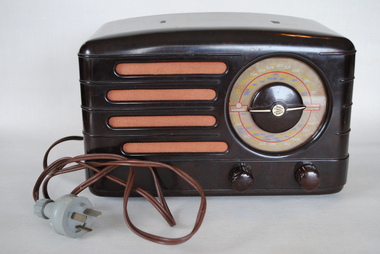
Radio, AWA (Amalgamated Wireless (Australasia) Ltd), AWA Radiolette 500MY, 1946-47
... Tuned circuits: 6AM Wavebands: Broadcast only (MW) Power: 200-230; 230-260 Volt AC. Loudspeaker: Electro Magnetic Dynamic LS ...Tuned circuits: 6AM Wavebands: Broadcast only (MW) Power: 200-230; 230-260 Volt AC. Loudspeaker: Electro Magnetic Dynamic LS AWA Radiolette 500MY Radio AWA (Amalgamated Wireless (Australasia) Ltd) ...Australian bakelite valve tube radio. Type: Broadcast receiver or past WW2 Tuner. Valves 4:6A8G 6G8g 6V6GT 6x5GT. Principle: Super Heterodyne ZF/IF 455 KHz 1AF stage. Tuned circuits: 6AM Wavebands: Broadcast only (MW) Power: 200-230; 230-260 Volt AC. Loudspeaker: Electro Magnetic Dynamic LS Front Dial: AWA Radiolette / Radio stations for each stateradio, radiolette -
 Ballarat Tramway Museum
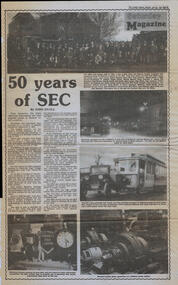
Newspaper, The Courier Ballarat, "50 years of the SEC", 30/06/1984 12:00:00 AM
... Newspaper clipping from the Saturday Magazine of The Courier 30/6/1984 titled "50 years of the SEC", looking at the history of the SEC in Ballarat, includes the conversion of plant from DC to AC which was not completed until 1968. Notes the two power stations and SEC offices have been moved to Norman St. ...Yields information about the SEC in Ballarat and in particular the conversion from DC power to AC. SEC Ballarat A Power Station SEC Crews Electrical Engineering Electrical Systems Electricity Supply Newspaper clipping from the Saturday Magazine of The Courier 30/6/1984 titled "50 years of the SEC", looking at the history of the SEC in Ballarat, includes the conversion of plant from DC to AC which was not completed until 1968. ...Yields information about the SEC in Ballarat and in particular the conversion from DC power to AC.Newspaper clipping from the Saturday Magazine of The Courier 30/6/1984 titled "50 years of the SEC", looking at the history of the SEC in Ballarat, includes the conversion of plant from DC to AC which was not completed until 1968. Notes the two power stations and SEC offices have been moved to Norman St. Has five photos, including a staff photograph with many names, a photo of Bridge St, a collision between a truck and tram 14, SEC advertising and an interior view of Ballarat A. Written by John Dyallsec, ballarat a power station, sec crews, electrical engineering, electrical systems, electricity supply -
 Ballarat Tramway Museum
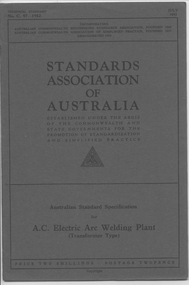
Book, Australian Commonwealth Engineering Standards Association, "AC Electric Arc Welding Plant - Transformer type", "Brass water fittings - stop, bib, globe and ferrule or main taps", "Vegetable tanned leather belting", "Rubber Conveyor and Power Transmission Belting", "Maintenance of Portable Chemical Fire Extinguishers of the Acid-Alkali and Foam Types", "Copper Tubes", "Portland Cement", 1928 - 1942
... "AC Electric Arc Welding Plant - Transformer type", "Brass water fittings - stop, bib, globe and ferrule or main taps", "Vegetable tanned leather belting", "Rubber Conveyor and Power Transmission Belting", "Maintenance of Portable Chemical Fire Extinguishers of the Acid-Alkali and Foam Types", "Copper Tubes", "Portland Cement"....1 - Book - 12 pages + brown covers, side stapled, issued by the Australian Standards Association, "AC Electric Arc Welding Plant - Transformer type", C97-1942, July 1942. .2 - Book - 40 pages + grey covers, side stapled, issued by the Australian Commonwealth Engineering Standards Association, Tentative Australian Standard B1 - "Brass water fittings - stop, bib, globe and ferrule or main taps", B1-1928, August 1928. .3 - Book - 20 pages + grey covers, side stapled, issued by the Australian Commonwealth Engineering Standards Association, Tentative Australian Standard B4 - "Vegetable tanned leather belting", B4 - 1929, January 1929. .4 - Book - 16 pages + grey covers, side stapled, issued by the Australian Commonwealth Engineering Standards Association, Tentative Australian Standard B3 - Rubber Conveyor and Power Transmission Belting", B3 - 1929, March 1929. .5 - Book - 8 pages + green covers, side stapled, issued by the Australian Standards Association, "Maintenance of Portable Chemical Fire Extinguishers of the Acid-Alkali and Foam Types", CA 18-1941, May 1941. .6 - Book - 16 pages + grey covers, side stapled, issued by the Australian Commonwealth Engineering Standards Association, Tentative Australian Standard B2 - "Copper Tubes", B2 - 1928, July 1928. .7 - Book - 28 pages + grey covers, side stapled, issued by the Australian Commonwealth Engineering Standards Association, Australian Standard A2 - "Portland Cement", includes tests, A2-1926, December 1926. ..."AC Electric Arc Welding Plant - Transformer type", "Brass water fittings - stop, bib, globe and ferrule or main taps", "Vegetable tanned leather belting", "Rubber Conveyor and Power Transmission Belting", "Maintenance of Portable Chemical Fire Extinguishers of the Acid-Alkali and Foam Types", "Copper Tubes", "Portland Cement" Book Australian Commonwealth Engineering Standards Association ....1 - Book - 12 pages + brown covers, side stapled, issued by the Australian Standards Association, "AC Electric Arc Welding Plant - Transformer type", C97-1942, July 1942. .2 - Book - 40 pages + grey covers, side stapled, issued by the Australian Commonwealth Engineering Standards Association, Tentative Australian Standard B1 - "Brass water fittings - stop, bib, globe and ferrule or main taps", B1-1928, August 1928. .3 - Book - 20 pages + grey covers, side stapled, issued by the Australian Commonwealth Engineering Standards Association, Tentative Australian Standard B4 - "Vegetable tanned leather belting", B4 - 1929, January 1929. .4 - Book - 16 pages + grey covers, side stapled, issued by the Australian Commonwealth Engineering Standards Association, Tentative Australian Standard B3 - Rubber Conveyor and Power Transmission Belting", B3 - 1929, March 1929. .5 - Book - 8 pages + green covers, side stapled, issued by the Australian Standards Association, "Maintenance of Portable Chemical Fire Extinguishers of the Acid-Alkali and Foam Types", CA 18-1941, May 1941. .6 - Book - 16 pages + grey covers, side stapled, issued by the Australian Commonwealth Engineering Standards Association, Tentative Australian Standard B2 - "Copper Tubes", B2 - 1928, July 1928. .7 - Book - 28 pages + grey covers, side stapled, issued by the Australian Commonwealth Engineering Standards Association, Australian Standard A2 - "Portland Cement", includes tests, A2-1926, December 1926. On top right hand corner has the date stamp of the "The Electric Supply Co. of Victoria Ltd Ballarat" .2 - 3 Sep 1928 .3 - 19 Jan 1929 .4 - 3 Apr 1929 .5 - SEC Stamp - ? 1941 .6 - 20 July 1928 .7 - 17 Apr 1934trams, tramways, power station, standards, materials -
 Ballarat Tramway Museum
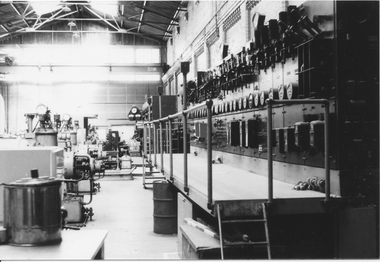
Photograph - Black & White Photograph/s - set of 4, Richard Gilbert, 20/08/1971 12:00:00 AM
... All photos on Kodak paper. 1144.1 - Looking along building at main distribution switch panel - used on page 24 of trolley wire. 1144.2 - a view across the main steam generator section of the power station - and AC plant - used on page 23. 1144.3 - of the British Thomson Houston rotary converters in used at the time of the photo - used on page 23. 1144.4 - a view from the opposite end of the building shown in 1144.1 - showing the rotary converters are in the front of the photo, AC generators in the middle and foreman's cabin - used on page 22. ...All photos on Kodak paper. 1144.1 - Looking along building at main distribution switch panel - used on page 24 of trolley wire. 1144.2 - a view across the main steam generator section of the power station - and AC plant - used on page 23. 1144.3 - of the British Thomson Houston rotary converters in used at the time of the photo - used on page 23. 1144.4 - a view from the opposite end of the building shown in 1144.1 - showing the rotary converters are in the front of the photo, AC generators in the middle and foreman's cabin - used on page 22. ...Set of four black and white photographs of interior and equipment of the former ESCo / SECV Wendouree Parade Ballarat A power station sent to the Editor of Trolley Wire - used in the November 1997 issue of Trolley Wire. All photos by Richard Gilbert. Photos taken on 20/8/1971. All photos on Kodak paper. 1144.1 - Looking along building at main distribution switch panel - used on page 24 of trolley wire. 1144.2 - a view across the main steam generator section of the power station - and AC plant - used on page 23. 1144.3 - of the British Thomson Houston rotary converters in used at the time of the photo - used on page 23. 1144.4 - a view from the opposite end of the building shown in 1144.1 - showing the rotary converters are in the front of the photo, AC generators in the middle and foreman's cabin - used on page 22. All have yellow stickers with photo number for magazine printer, and white sticky labels with photo number and words "photo xx same size" written on black ink and photo numbers in pencil from Richard.trams, tramways, trolley wire, esco, power station, ballarat a power station, rotary converters -
 Ballarat Tramway Museum
Document - Photocopy, "Progress in Ballarat", May 1936
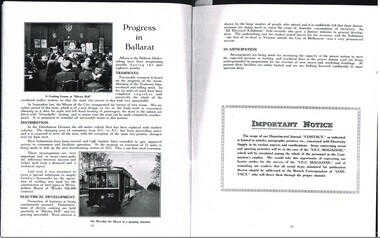
... Notes the progress in Ballarat in the last 18 months, reconditioning of the tram lines, the "new" trams, the changeover from DC to AC, new sub-stations, distribution networks and electrical development, including work at the power station. ...Notes the progress in Ballarat in the last 18 months, reconditioning of the tram lines, the "new" trams, the changeover from DC to AC, new sub-stations, distribution networks and electrical development, including work at the power station. ...Features a photo of a cooking lesson in Electra Hall and the Mayor of Ballarat driving No. 30, following its conversion to the Ballarat style of trams in September the previous year at the time of the inauguration of the new rolling stock. Notes the progress in Ballarat in the last 18 months, reconditioning of the tram lines, the "new" trams, the changeover from DC to AC, new sub-stations, distribution networks and electrical development, including work at the power station. Has an "Important Notice" advising readers of the scope of the Departmental Journal "CONTACT" and its relationship with the social and sporting activities magazine "SEC MAGAZINE". See Reg Item 3011 for a print of the photo of No. 30. Record revised 3/4/2019 to add digital images with those from Andrew Cook CD and to include an item titled "A Page from Geelong" about a fractured pole, two minutes of silence and the impact on power generation and a thankyou letter. Demonstrates the reporting and promotion of SEC activities to its staff and public in Ballarat.Photocopy of an article in the State Electricity Commission of Victoria Magazine, Contact, Vol 1, No. 1, May 1936 titled "Progress in Ballarat". trams, tramways, sec, ballarat, electricity supply, tramcars, power station, electra hall, geelong, poles -
 Ballarat Tramway Museum
Document - Photocopy, M. Sayers, "The Development of Ballarat's Electricity Supply", 2000?
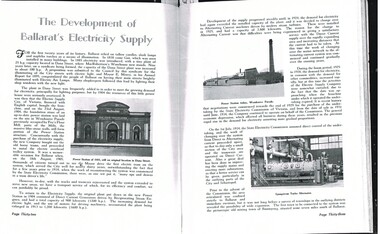
... Details development of the initial power supply in Dana St, the take over by ESCo, DC power initially, expansion, introduction of AC in 1925 to Ballarat, the takeover by the SEC in 1934, changeover from DC to AC, expansion to outlying areas, Buninyong, Creswick etc. ...Details development of the initial power supply in Dana St, the take over by ESCo, DC power initially, expansion, introduction of AC in 1925 to Ballarat, the takeover by the SEC in 1934, changeover from DC to AC, expansion to outlying areas, Buninyong, Creswick etc. ...Photocopy of an article in the State Electricity Commission of Victoria Magazine, Contact, Vol 3, No. 2, Aug 1938 titled "The Development of Ballarat's Electricity Supply". Two A3 sheets. The item with six photographs details the history of the development of Ballarat's Power Supply. Details development of the initial power supply in Dana St, the take over by ESCo, DC power initially, expansion, introduction of AC in 1925 to Ballarat, the takeover by the SEC in 1934, changeover from DC to AC, expansion to outlying areas, Buninyong, Creswick etc. Gives description of installed plan, boilers, storerooms and the stores systems. Has photos of the Dana St. building, Ballarat A power station, Ljungstrom Turbo Alternator and three of the stores area. Record revised 3/4/2019 to add digital images with those from Andrew Cook CD. Each item had a thin strip of paper attached by staple to the top left hand corner, giving the Vol. No. details.On rear of 2nd A3 sheet in blue ink details of contact with the BTM by M. Sayers prior to sending the material.trams, tramways, sec, power supply, power station, ballarat a power station, esco -
 Moorabbin Air Museum
Book (item) - (SP) World Air Power Journal 09 Summer 1992
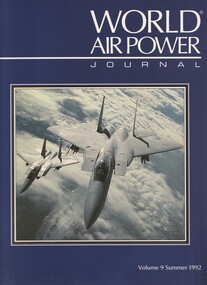
... AC-130U an MC-130H...J-STARS – the Boeing/Grumman E-8A feature...Attack ‘Flanker’ new Su-27 variant...Indian AF MiG-21 photo feature...Focus Aircraft: F-15 Eagle (64 pages)...Variant Briefing: Bell AH-1 Cobra...Soviet Withdrawal from Europe Part 2 – Poland...Air Power...Briefings: Ilyushin A-50 ‘Mainstay’ SH-60F Ocean Hawk Malta’s Helicopter Flight Schweizer RG-8A Lockheed AC-130U an MC-130H J-STARS – the Boeing/Grumman E-8A feature Attack ‘Flanker’ new Su-27 variant Indian AF MiG-21 photo feature Focus Aircraft: F-15 Eagle (64 pages) Variant Briefing: Bell AH-1 Cobra Soviet Withdrawal from Europe Part 2 – Poland Air Power Analysis: US Navy Book (SP) World Air Power Journal 09 Summer 1992 ...briefings: ilyushin a-50 ‘mainstay’, sh-60f ocean hawk, malta’s helicopter flight, schweizer rg-8a, lockheed ac-130u an mc-130h, j-stars – the boeing/grumman e-8a feature, attack ‘flanker’ new su-27 variant, indian af mig-21 photo feature, focus aircraft: f-15 eagle (64 pages), variant briefing: bell ah-1 cobra, soviet withdrawal from europe part 2 – poland, air power analysis: us navy -
RMIT GSBL Justice Smith Collection
Report, Kirby, Michael, The judiciary in federation centenary year - good news, bad news, no news : eleventh AIJA oration in judicial administration, 2001
... judges -- australia judicial power -- australia ISBN: 1875527435 Eleventh AIJA oration in judicial administration Delivered by The Hon. Justice Michael Kirby AC ...Eleventh AIJA oration in judicial administration Delivered by The Hon. Justice Michael Kirby AC CMG High Court of Australia at The Banco Court, Supreme Court of New South Wales, Queen's Square, Sydney Friday 22 June 2001ISBN: 1875527435judges -- australia, judicial power -- australia -
 Ballarat Heritage Services
Photograph - Digital photographs, L.J. Gervasoni, Interior of St Brigid's Crossley, 2018
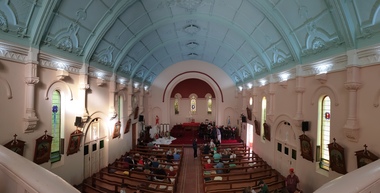
... power, learning or anything calculated to enable them to do anything striking in the world's history. The success of the first morning after pentecost was not confined to those first days when the plentitude of the Holy Ghost sat upon the .Apostles, but it continued age after age until the whole world was brought within the sphere of ac tion of the Church. ...power, learning or anything calculated to enable them to do anything striking in the world's history. The success of the first morning after pentecost was not confined to those first days when the plentitude of the Holy Ghost sat upon the .Apostles, but it continued age after age until the whole world was brought within the sphere of ac tion of the Church. ..."LARGE GATHERINGNG AT - CROSSLEY DEDICATION AND OPENING SERVICES. SERMON BY DR. MANNIX. Yesterday was an important and historic day for the Roman Catholic community of Crossley and Koroit, in as much as it will be always associated in the memories of all con cerned with the opening of the new St. Brigid's Church, Crossley. This building is far above the average standard of sacred edifices in country towns, and is certainly superior to any ercted in this district outside the churches in the two larger centres - Warrnambool and Koroit. The style of architecture chosen is a free treatment of the Romanesque, which is something quite original in the Western District. This noble style, from which, with its near re lative the Byzantine, spring the great Gothic school of architecture, is characterised by a special charm of its own, one of its chief features being graceful and sweeping circular curves in roof, window heads and in the ar rangenent of the ground plan. The building is of brick finished off with true Romanesqiue pillared pinnacles in concrete and plaster, the brick and concrete producing a pleasing contrast. The main characteristic of the front is a large rose window filled with Romlanesque circular tracery, and below a bold porch and entrance. The two sides are pierced with long circular-headed windows between graceful buttresses and the wall line is pleasingly broken by the projecting bays of the confessionals and also by the vestries. The main building is 80 feet by 30 feet' and the Sanctuary is spacious and semi-circular in shape, and lighted by three windows. The interior of the church is most artistic. The ceiling is semi-circular and of fibrous plaster in ornate designs. All the windows are lead lighted, throwing a rich and mellow harmony of' color throughout the interior and the white wails, mouldings, architraves and other fibrous plaster decorations: are further relieved by the rich coloring: in the stations of.the Cross arrranged around the nave. The central window of the Sanctuary contains a splendidly executed stained glass representation of St. Brigid. At.the western end is a room gallery. The altar is a choice piece of Gothic woodwork, in light, soft coloring, and there are two altars on either side of the Sanctuary in oak, and above whlch are very fine colored figures of Christ; and the Madonna. On either side of the altar are life-size figures of angels holding high brass candalabra. The whole of the furnishings of the church are on a sumptuous scale, and the edifice reflects credit on all concerned. The church can seat nearly 500 people. The architect was Mr. A. A. Fritsch. of Melbourne, and the contractors Messrs F. and E. Deagne, of North Fitzroy. The contract price for the building was £5,500. THE OPENING SERVICE. After the cereimony of solemnly blesssing the church was performed by His Lordship the Bishop of the Diocese, Dr. Higgins, assisted by His Grace the Coadjutor Archbishop of Melbourne. Dr. Mannix, the great gatheiring from all parts of the district entered the church, which was soon completely filled. The members of the H.A.C.B.S. attended wearing their green and gold regalia, and acted as a 'guard of honor' to the Co-adjlutor Arclhbishop and Bishop. Mass was celebrated by the Rev. Father Phelan, of Koroit, and a feature of the solemn service was the singing of a choir which consisted of picked voices from St. Carthage's choir, with friends from Warrnam bool and assisted by some of the mem bers of the Koroit choir, with Miss Logan as organist and Mr. Arthur H. Renwick as conductor. They rendered the music in splendid style throghonut. The "Kyrie," "Gloria." "Agnus Dei' and Dona Nobis" were from Farmer's Mass in B flat, and the "Credo" and "Sanctus" from Webbe's Mass in G. The soloists in the Mass were Mrs. Ryan, the Misses McEntee. Miss Katie O'Brien. and Messrs. J. M. Crowley, W. J. Callaghan; B. McEntee and W. Mahony. The chorus sang with great precision, special attention being paid to at tack. At the offertory Mrs. Dan Ryan gave a beautiful rendering of Gounod's "Ava Maria." After the Elevation that fine duet "Tantum Ergo." by Rossi, was sung by Messrs. Crowley and Renwick in an artistic manner, their fine voices blending splendidly. During the collection, Mr. Renwick sang with much feeling that devotional solo, "Lead Thou Me On,", after which Mr Crowley gave .an ex cellent rendering of Weissi's "0 Salu taris Hostia;" and the choir sang several hymns." It might here be mentioned that at the request of Fa ther Kerin, the same choir will repeat the music.at the Koroit Church on Sunday next, on the occasion of the ceremnly of laying the foundation stone of the cormpletion of the church. Dr. Mannix preachled the sermon for the occasion, taking his text from St. Luke first 11 verses. He re viewed the Gospel story of Christ preaching to the multitude from a boat on Lake Gennesaret and the miraculous draught of fish. The obedi ence of the poor fishermen in casting their nets at Christ's bidding was richly rewarded, and the miraculous occurrence was a striking example of what was to happen when Christ established His Church and built it up on those twelve apostles. When they came to think of it, nothing so re markable and marvellous had happened before or since in the history of mankind. The world at that time was for the most part a Pagan world steeped in iniquity and sin. The chosen people of God had God's re velation, but they worshipped with their lips and not with their hearts. When Christ was to establish His Church upon earth and leave an or gantisation that would continue His work, did He select learned men, powerful men, rich men, or a time that would seem propituous? No. He selected twelve poor, igorant simple fishermen, without money, power, learning or anything calculated to enable them to do anything striking in the world's history. The success of the first morning after pentecost was not confined to those first days when the plentitude of the Holy Ghost sat upon the .Apostles, but it continued age after age until the whole world was brought within the sphere of ac tion of the Church. Greece, Rome Europe Asia and America, and now Australia had been brought into the net. This must be a consolation to them all as well as it was to him (the preacher), when they remembered that they came from a land which of all others had been faithful to the Gospel of Jesus Christ. It was a consolation to them that in that great work that had been accomplished in bringing men into the meshes of the Church, and bringing them to God the nation to which they belontged had taken so great a part. Their religion flourished in England, Scotland, America and Australia. Surely it was due to the sons of St. Patrick, the sons and daughters of Ireland to find consolation in these great facts might It might seem hard that so many had to leave their native-land for England, Scotland, America and Australia. But if hard it was the means of keeping the Catholic faith living in England and Scotland. If to-day the Irish Catholics and Catholics of Irish de scent were taken out of the English and Scotch population there would be little left of the true Church of God. It seemed hard to emigrate to distant lands, but the result had been the new magnificent church in the United States, the flourishing churches in Canada and South Africa. Those Irish emigrants were a cornparatively small band. Perhaps they had not the learning of other nations. Certainly they had not the wealth and it did not fall to their lot to have the power of the sword, but God was with them, and the faith they took from Ireland flourished in those distant lands. In this fair land of Australia they had a glorious herit age handed down from the pioneer Irish Catholics, who came to this fair Austral land. There was a time when those who were opposed to God and God's Church,thought that Australia should be a wholly Protestant land. They had lived to see whether God or His enemies were the stronger. They had lived to see that those who in distant days would have stamped out the Catholic religion in Australia, had not prevailed. Their names had been forgotten because of their persecution of the Catholic Church, and they had lived - to see the glorious success that now, in every part of the Common wealth, rested upon the Catholic Church in Australia. Might God bless that Church and those Irish people, and the people of Irish descent, who had built it up. In that locality, and there was no place in.the Common wealth where the Catholic Church was held in higher esteem, the people would always be faithful to God and His Church. That beautiful building, and all it signified in loyalty and faithfulness, was a credit and a consolation to the Bishop and people of the diocese, to the architect who had done his work so artistically and skil fully. to the priests and the zealous administration of the parish. There was surely hope and inspiration in that day's celebration, that as time went on the Catholic faith would sink deeper and deeper into ther coming generation, and that the Catholic progress of the past 50 years would be small in comparison to the great progress of the future. He congratulated the Bishop priests and people who had raised that temple. He congratulated the people of Crossley; upon their generosity and self-sacrifice, and he prayed that God's blessing and the blessing of St. Brigid would rest upon them; their children and children's children. And when those who had received the sacraments and had been instructed in that Church were called before the Judgment Seat he pray ed that not one would be missing, and St. Peter aind St. Brigid would be able to count them all into the en joyment .of Eternal bliss. THE CELEBRATION The Rev. Father Kerin, Adninistra tor of the Parish, after the collection, read a lengthy list of the principal donations, headed by the Bishop, Dr. Higgins, with £250. All the furnish ings of the Church were also donations, and the Coadjutor-Archbishop added £5 to the list. The Rev. Father Kerin stated that the total to hand was £1245/10/7, which was an other proof of the generosity of the Crossley and district people. The amount previously received in donations was £1077/3. They started buildiing with a credit balance of £262 10/5 and ther now had a debit balance of £2,728/18/5. The total cost of the Church was £6,250, so that they would see the greater part of the indebtedness had already been wiped out. The Bishop (Dr. Higgins) delivered a brief address, in the course of which he congratulated the priests and people upon the completion of their magnificent Church. He congratulated the people on their magnificent generosity. He expressed his of deep indebtedness to the Coadjutor Archbishop of Melbourne for the services he had rendered to them. He had attended at considerable sacrifice to himself, and they were extremely grateful for the presence of so distinguished a champion who had shown such zeal and interest in their Church in this new land. He (the Bishop) trusted that his splendid talents would long be devoted to the defence of the Church." (Warrnambul Standard, 02 July 1914)Digital panoramic image of the interior of St Brigid's Crossley.st brigid's crossley, st brigid's, catholic church, catholic, church, community, ceiling, stations of the cross, confessional, statues, windows -
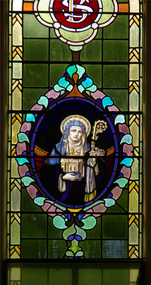 Ballarat Heritage Services
Photograph, Lisa Gervasoni, St Brigid Stained Glass Window, Crossley, 18/08/2013
... power, learning or anything calculated to enable them to do anything striking in the world's history. The success of the first morning after pentecost was not confined to those first days when the plentitude of the Holy Ghost sat upon the .Apostles, but it continued age after age until the whole world was brought within the sphere of ac tion of the Church. ...power, learning or anything calculated to enable them to do anything striking in the world's history. The success of the first morning after pentecost was not confined to those first days when the plentitude of the Holy Ghost sat upon the .Apostles, but it continued age after age until the whole world was brought within the sphere of ac tion of the Church. ..."LARGE GATHERINGNG AT - CROSSLEY DEDICATION AND OPENING SERVICES. SERMON BY DR. MANNIX. Yesterday was an important and historic day for the Roman Catholic community of Crossley and Koroit, in as much as it will be always associated in the memories of all con cerned with the opening of the new St. Brigid's Church, Crossley. This building is far above the average standard of sacred edifices in country towns, and is certainly superior to any ercted in this district outside the churches in the two larger centres - Warrnambool and Koroit. The style of architecture chosen is a free treatment of the Romanesque, which is something quite original in the Western District. This noble style, from which, with its near re lative the Byzantine, spring the great Gothic school of architecture, is characterised by a special charm of its own, one of its chief features being graceful and sweeping circular curves in roof, window heads and in the ar rangenent of the ground plan. The building is of brick finished off with true Romanesqiue pillared pinnacles in concrete and plaster, the brick and concrete producing a pleasing contrast. The main characteristic of the front is a large rose window filled with Romlanesque circular tracery, and below a bold porch and entrance. The two sides are pierced with long circular-headed windows between graceful buttresses and the wall line is pleasingly broken by the projecting bays of the confessionals and also by the vestries. The main building is 80 feet by 30 feet' and the Sanctuary is spacious and semi-circular in shape, and lighted by three windows. The interior of the church is most artistic. The ceiling is semi-circular and of fibrous plaster in ornate designs. All the windows are lead lighted, throwing a rich and mellow harmony of' color throughout the interior and the white wails, mouldings, architraves and other fibrous plaster decorations: are further relieved by the rich coloring: in the stations of.the Cross arrranged around the nave. The central window of the Sanctuary contains a splendidly executed stained glass representation of St. Brigid. At.the western end is a room gallery. The altar is a choice piece of Gothic woodwork, in light, soft coloring, and there are two altars on either side of the Sanctuary in oak, and above whlch are very fine colored figures of Christ; and the Madonna. On either side of the altar are life-size figures of angels holding high brass candalabra. The whole of the furnishings of the church are on a sumptuous scale, and the edifice reflects credit on all concerned. The church can seat nearly 500 people. The architect was Mr. A. A. Fritsch. of Melbourne, and the contractors Messrs F. and E. Deagne, of North Fitzroy. The contract price for the building was £5,500. THE OPENING SERVICE. After the cereimony of solemnly blesssing the church was performed by His Lordship the Bishop of the Diocese, Dr. Higgins, assisted by His Grace the Coadjutor Archbishop of Melbourne. Dr. Mannix, the great gatheiring from all parts of the district entered the church, which was soon completely filled. The members of the H.A.C.B.S. attended wearing their green and gold regalia, and acted as a 'guard of honor' to the Co-adjlutor Arclhbishop and Bishop. Mass was celebrated by the Rev. Father Phelan, of Koroit, and a feature of the solemn service was the singing of a choir which consisted of picked voices from St. Carthage's choir, with friends from Warrnam bool and assisted by some of the mem bers of the Koroit choir, with Miss Logan as organist and Mr. Arthur H. Renwick as conductor. They rendered the music in splendid style throghonut. The "Kyrie," "Gloria." "Agnus Dei' and Dona Nobis" were from Farmer's Mass in B flat, and the "Credo" and "Sanctus" from Webbe's Mass in G. The soloists in the Mass were Mrs. Ryan, the Misses McEntee. Miss Katie O'Brien. and Messrs. J. M. Crowley, W. J. Callaghan; B. McEntee and W. Mahony. The chorus sang with great precision, special attention being paid to at tack. At the offertory Mrs. Dan Ryan gave a beautiful rendering of Gounod's "Ava Maria." After the Elevation that fine duet "Tantum Ergo." by Rossi, was sung by Messrs. Crowley and Renwick in an artistic manner, their fine voices blending splendidly. During the collection, Mr. Renwick sang with much feeling that devotional solo, "Lead Thou Me On,", after which Mr Crowley gave .an ex cellent rendering of Weissi's "0 Salu taris Hostia;" and the choir sang several hymns." It might here be mentioned that at the request of Fa ther Kerin, the same choir will repeat the music.at the Koroit Church on Sunday next, on the occasion of the ceremnly of laying the foundation stone of the cormpletion of the church. Dr. Mannix preachled the sermon for the occasion, taking his text from St. Luke first 11 verses. He re viewed the Gospel story of Christ preaching to the multitude from a boat on Lake Gennesaret and the miraculous draught of fish. The obedi ence of the poor fishermen in casting their nets at Christ's bidding was richly rewarded, and the miraculous occurrence was a striking example of what was to happen when Christ established His Church and built it up on those twelve apostles. When they came to think of it, nothing so re markable and marvellous had happened before or since in the history of mankind. The world at that time was for the most part a Pagan world steeped in iniquity and sin. The chosen people of God had God's re velation, but they worshipped with their lips and not with their hearts. When Christ was to establish His Church upon earth and leave an or gantisation that would continue His work, did He select learned men, powerful men, rich men, or a time that would seem propituous? No. He selected twelve poor, igorant simple fishermen, without money, power, learning or anything calculated to enable them to do anything striking in the world's history. The success of the first morning after pentecost was not confined to those first days when the plentitude of the Holy Ghost sat upon the .Apostles, but it continued age after age until the whole world was brought within the sphere of ac tion of the Church. Greece, Rome Europe Asia and America, and now Australia had been brought into the net. This must be a consolation to them all as well as it was to him (the preacher), when they remembered that they came from a land which of all others had been faithful to the Gospel of Jesus Christ. It was a consolation to them that in that great work that had been accomplished in bringing men into the meshes of the Church, and bringing them to God the nation to which they belontged had taken so great a part. Their religion flourished in England, Scotland, America and Australia. Surely it was due to the sons of St. Patrick, the sons and daughters of Ireland to find consolation in these great facts might It might seem hard that so many had to leave their native-land for England, Scotland, America and Australia. But if hard it was the means of keeping the Catholic faith living in England and Scotland. If to-day the Irish Catholics and Catholics of Irish descent were taken out of the English and Scotch population there would be little left of the true Church of God. It seemed hard to emigrate to distant lands, but the result had been the new magnificent church in the United States, the flourishing churches in Canada and South Africa. Those Irish emigrants were a cornparatively small band. Perhaps they had not the learning of other nations. Certainly they had not the wealth and it did not fall to their lot to have the power of the sword, but God was with them, and the faith they took from Ireland flourished in those distant lands. In this fair land of Australia they had a glorious herit age handed down from the pioneer Irish Catholics, who came to this fair Austral land. There was a time when those who were opposed to God and God's Church,thought that Australia should be a wholly Protestant land. They had lived to see whether God or His enemies were the stronger. They had lived to see that those who in distant days would have stamped out the Catholic religion in Australia, had not prevailed. Their names had been forgotten because of their persecution of the Catholic Church, and they had lived - to see the glorious success that now, in every part of the Common wealth, rested upon the Catholic Church in Australia. Might God bless that Church and those Irish people, and the people of Irish descent, who had built it up. In that locality, and there was no place in.the Common wealth where the Catholic Church was held in higher esteem, the people would always be faithful to God and His Church. That beautiful building, and all it signified in loyalty and faithfulness, was a credit and a consolation to the Bishop and people of the diocese, to the architect who had done his work so artistically and skil fully. to the priests and the zealous administration of the parish. There was surely hope and inspiration in that day's celebration, that as time went on the Catholic faith would sink deeper and deeper into ther coming generation, and that the Catholic progress of the past 50 years would be small in comparison to the great progress of the future. He congratulated the Bishop priests and people who had raised that temple. He congratulated the people of Crossley; upon their generosity and self-sacrifice, and he prayed that God's blessing and the blessing of St. Brigid would rest upon them; their children and children's children. And when those who had received the sacraments and had been instructed in that Church were called before the Judgment Seat he prayed that not one would be missing, and St. Peter aind St. Brigid would be able to count them all into the enjoyment of Eternal bliss. THE CELEBRATION The Rev. Father Kerin, Adninistra tor of the Parish, after the collection, read a lengthy list of the principal donations, headed by the Bishop, Dr. Higgins, with £250. All the furnishings of the Church were also donations, and the Coadjutor-Archbishop added £5 to the list. The Rev. Father Kerin stated that the total to hand was £1245/10/7, which was an other proof of the generosity of the Crossley and district people. The amount previously received in donations was £1077/3. They started building with a credit balance of £262 10/5 and they now had a debit balance of £2,728/18/5. The total cost of the Church was £6,250, so that they would see the greater part of the indebtedness had already been wiped out. The Bishop (Dr. Higgins) delivered a brief address, in the course of which he congratulated the priests and people upon the completion of their magnificent Church. He congratulated the people on their magnificent generosity. He expressed his of deep indebtedness to the Coadjutor Archbishop of Melbourne for the services he had rendered to them. He had attended at considerable sacrifice to himself, and they were extremely grateful for the presence of so distinguished a champion who had shown such zeal and interest in their Church in this new land. He (the Bishop) trusted that his splendid talents would long be devoted to the defence of the Church." (Warrnambul Standard, 02 July 1914)Colour photograph of a portrait of St Brigid in stained glass. The depiction of St Brigid is located at St Brigid's former Catholic Church, Crossley. The stained glass window of St. Brigid in St. Brigid's Church, Crossley, Victoria, is a significant feature of the church, which was built by the local community in 1914. The church itself is notable for its "sumptuous scale" and the community's efforts to preserve it as a cultural heritage center. The central window in the sanctuary is a "splendidly executed stained glass representation of St. Brigid". st brigid, stained glass, st brigid's crossley
