
Showing 12 items matching "adhesive paste"
-
 Emerald Museum & Nobelius Heritage Park
Container - Container of Lox Adhesive Paste, Caldwell's Pty Ltd, mid 20th century
... Container of Lox Adhesive Paste......Adhesive Paste...Container of Lox Adhesive Paste. White circular ceramic container with dark green label and dark green metal lid. ...On front: 'Lox / Adhesive / Paste / Caldwell's Pty. Ltd. / Melbourne On back: 'For / office, home / and general / use / Photo mounting / and / crepe paper /work'...This is an example of domestic objects used in the mid-20th century. Lox Adhesive Paste Melbourne Caldwell's Pty Ltd Alexander On front: 'Lox / Adhesive / Paste / Caldwell's Pty. ...Donated by Karen Alexander from small property in Emerald which was first bought by C. T. Alexander in 1920 and operated as a small, mixed farm. Karen has donated a range of obects from her childhood and from this farm to the Museum.This is an example of domestic objects used in the mid-20th century.Container of Lox Adhesive Paste. White circular ceramic container with dark green label and dark green metal lid. Inside has a compartment which would hold a brush.On front: 'Lox / Adhesive / Paste / Caldwell's Pty. Ltd. / Melbourne On back: 'For / office, home / and general / use / Photo mounting / and / crepe paper /work'lox, adhesive paste, melbourne, caldwell's pty ltd, alexander -
 Flagstaff Hill Maritime Museum and Village
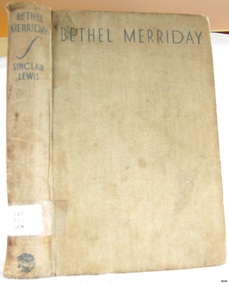
Book, Jonathan Cape, Bethel Merriday, 1940
... The spine also has the book’s title, a symbol and a white adhesive label with a typed library call number. Inside the front cover pasted down endpaper are two printed labels. ...Adhesive label - “PAT / FIC / LEW” Front pasted down endpaper has a printed label from Corangamite Regional Library Service Front pasted down endpaper has a printed label from the Warrnambool Public Library Front loose endpaper has a stamp from the Corangamite Regional Library Service...The spine also has the book’s title, a symbol and a white adhesive label with a typed library call number. Inside the front cover pasted down endpaper are two printed labels. ...This book “Bethel Merriday” is a novel written by Sinclair Lewis and published in 1940. It is part of Flagstaff Hill’s group of books belonging to the Pattison Collection. About SINCLAIR LEWIS (1885-1951) The author was born as Harry Sinclair Lewis in 1885 in Sauk Centre, Minnesota. He was renowned as an American novelist, playwright and short story writer. His first writings were romantic poems and short stories. Six of his novels were published by the time Lewis was 36. Lewis won the 1926 Pulitzer Prize for his book “Arrowsmith” but declined because he had been helped in the writing of it by science writer Paul de Kruif, who received 25% of royalties on the sales. However, Lewis is listed as the sole author. Lewis received the Nobel Prize for Literature in 1930 for his “vigorous and graphic art of description and his ability to create, with wit and humour, new types of characters." He was the first author from the United States to receive this award. Lewis graduated from university in 1907. He worked as a reporter and editor for several publications. He was a prolific writer, publishing dozens of works and numerous articles, and became popular for his satire. Lewis married and divorced twice and died alone from a heart attack due to advanced alcoholism) near Rome on 10th January 1951, aged 66. This book was part of a large group of books referred to as the Pattison Collection, which belonged to the Warrnambool Public Library, part of the Warrnambool Mechanics’ Institute. About RALPH ERIC PATTISON and the ‘PATTISON COLLECTION’ The ‘Pattison Collection’ is a collection of books and records that was originally owned by the Warrnambool Mechanics’ Institute, founded in Warrnambool in 1853. By 1886 the Warrnambool Mechanics’ Institute (WMI) had grown to have a Library, Museum and Fine Arts Gallery, with a collection of “… choice productions of art and valuable specimens in almost every branch and many wonderful national curiosities are now to be seen there, including historic relics of the town and district.” It later included a School of Design. Although it was very well patronised, the WMI was led to ask the City Council to take it over in 1911 due to lack of financial support. In 1935 Ralph Pattison was appointed as City Librarian to establish and organise the Warrnambool Public Library as it was then called. Ralph Eric Pattison was born in Rockhampton, Queensland, in 1891. He married Maude Swan from Warrnambool in 1920 and they set up home in Warrnambool. In 1935 when Pattison accepted the position as City Librarian for the Warrnambool City Council his huge challenge was to make a functional library within two rooms of the Mechanics’ Institute. He tirelessly cleaned, cleared and sorted a disarrayed collection of old books, jars of preserved specimens and other items reserved for exhibition in the city’s museum. He developed and updated the library with a wide variety of books for all tastes, including reference books for students; a difficult task to fulfil during the years following the Depression. He converted all of the lower areas of the building into a library, reference room and reading room for members and the public. The books were sorted and stored using a cataloguing and card index system that he had developed himself. He also prepared the upper floor of the building and established the Art Gallery and later the Museum, a place to exhibit the many old relics that had been stored for years for this purpose. One of the treasures he found was a beautiful ancient clock, which he repaired, restored and enjoyed using in his office during the years of his service there. Ralph Pattison was described as “a meticulous gentleman whose punctuality, floorless courtesy and distinctive neat dress were hallmarks of his character, and ‘his’ clock controlled his daily routine and his opening and closing of the library’s large heavy doors to the minute.” Pattison took leave from 1942 to 1945 to serve in the Royal Australian Navy, Volunteer Reserve as Lieutenant. A few years later he converted one of the Museum’s rooms into a Children’s Library, stocking it with suitable books for the younger generation. This was an instant success. In the 1950’s he had the honour of being appointed to the Victorian Library Board and received more inspiration from the monthly conferences in Melbourne. He was sadly retired in 1959 after over 23 years of service, due to the fact that he had gone over the working age of council officers. However, he continued to take a very keen interest in the continual development of the Library until his death in 1969. THE NEW WARRNAMBOOL LIBRARY When the WMI building was pulled down in 1963 a new civic building was erected on the site and the new Warrnambool Library, on behalf of the City Council, took over all the holdings of the WMI. At this time some of the items were separated and identified as the ‘Pattison Collection’, named after Pattison. Eventually, the components of the WMI were distributed from the Warrnambool Library to various places, including the Art Gallery, Historical Society and Flagstaff Hill. Later some were even distributed to other regional branches of Corangamite Regional Library and passed to and fro. It is difficult now to trace just where all of the items have ended up. The books at Flagstaff Hill Maritime Village generally display stamps and markings from Pattison as well as a variety of other institutions including the Mechanics’ Institute itself.Lewis’s book is significant for its association with the writer, who was the first American to be awarded the Nobel Prize for Literature (1930). This book is significant for its connection with the Pattison Collection which, along with other items at Flagstaff Hill Maritime Village, was originally part of the Warrnambool Mechanics' Institute’s collection. The Warrnambool Mechanics’ Institute collection is primarily significant in its totality, rather than for the individual objects it contains. Its contents are highly representative of the development of Mechanics' Institute libraries across Australia, particularly Victoria. A diversity of publications and themes has been amassed, and these provide clues to our understanding of the nature of and changes in the reading habits of Victorians from the 1850s to the middle of the 20th century. The collection also highlights the Warrnambool community’s commitment to the Mechanics’ Institute, reading, literacy and learning in the regions, and proves that access to knowledge was not impeded by distance. These items help to provide a more complete picture of our community’s ideals and aspirations. The Warrnambool Mechanics Institute book collection has historical and social significance for its strong association with the Mechanics Institute movement and the important role it played in the intellectual, cultural and social development of people throughout the latter part of the nineteenth century and the early twentieth century. The collection of books is a rare example of an early lending library and its significance is enhanced by the survival of an original collection of many volumes. The Warrnambool Mechanics' Institute’s publication collection is of both local and state significance. Title: Bethel Merriday Author: Sinclair Lewis Publisher: Jonathan Cape, London Date: 1940 Hardback board book covered with cream-brown linen. The author’s name is printed in black on the front cover and on the spine. The spine also has the book’s title, a symbol and a white adhesive label with a typed library call number. Inside the front cover pasted down endpaper are two printed labels. On the front loose endpaper is an imprint of a stamp. The book, a novel, is part of the Pattison Collection originally belonging to the Warrnambool Public Library.Adhesive label - “PAT / FIC / LEW” Front pasted down endpaper has a printed label from Corangamite Regional Library Service Front pasted down endpaper has a printed label from the Warrnambool Public Library Front loose endpaper has a stamp from the Corangamite Regional Library Serviceflagstaff hill, warrnambool, shipwrecked coast, flagstaff hill maritime museum, maritime museum, shipwreck coast, flagstaff hill maritime village, great ocean road, book, pattison collection, warrnambool library, warrnambool public library, warrnambool mechanics’ institute, ralph eric pattison, warrnambool books and records, corangamite regional library service, warrnambool city librarian, mechanics’ institute library, victorian library board, warrnambool children’s library, american novel, jonathan cape, sinclair lewis, harry sinclair lewis, 1930 nobel prize for literature, bethel merriday -
 Flagstaff Hill Maritime Museum and Village
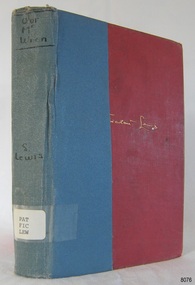
Book - Fiction, Jonathan Cape, Our Mr. Wrenn, 1930
... On the spine is a handwritten title and author, and a white adhesive label with a typed library call number. Inside the front cover are pasted labels and stamps. ...On the spine is a handwritten title and author, and a white adhesive label with a typed library call number. Inside the front cover are pasted labels and stamps. ...The fictional novel “Our Mr. Wrenn: The Romantic Adventures of a Gentle man” was written by Sinclair Lewis. It was originally published in America in 1914 by Harper & Brothers. It was the first of Sinclair Lewis’ novels published in his real name. His first published book, “Hike and the Aeroplane was” published in 1912 using the pseudonym of Tom Graham. Flagstaff Hill’s copy of “Our Mr. Wrenn” was published in 1930 by Jonathan Cape of London. About SINCLAIR LEWIS (1885-1951) The author was born Harry Sinclair Lewis in 1885 in Sauk Centre, Minnesota. He was renowned as an American novelist, playwright and short story writer. His first writings were romantic poems and short stories. Six of his novels were published by the time Lewis was 36. Lewis won the 1926 Pulitzer Prize for his book “Arrowsmith” but declined because he had been helped in the writing of it by science writer Paul de Kruif, who received 25% of royalties on the sales. However, Lewis is listed as the sole author. Lewis received the Nobel Prize for Literature in 1930 for his “vigorous and graphic art of description and his ability to create, with wit and humour, new types of characters." He was the first author from the United States to receive this award. Lewis graduated from university in 1907. He worked as a reporter and editor for several publications. He was a prolific writer, publishing dozens of works and numerous articles, and became popular for his satire. Lewis married and divorced twice and died alone from a heart attack due to advanced alcoholism) near Rome on 10th January 1951, aged 66. This book is part of a large group of books referred to as the Pattison Collection, which belonged to the Warrnambool Public Library, part of the Warrnambool Mechanics’ Institute. About RALPH ERIC PATTISON and the ‘PATTISON COLLECTION’ The ‘Pattison Collection’ is a collection of books and records that was originally owned by the Warrnambool Mechanics’ Institute, founded in Warrnambool in 1853. By 1886 the Warrnambool Mechanics’ Institute (WMI) had grown to have a Library, Museum and Fine Arts Gallery, with a collection of “… choice productions of art and valuable specimens in almost every branch and many wonderful national curiosities are now to be seen there, including historic relics of the town and district.” It later included a School of Design. Although it was very well patronised, the WMI was led to ask the City Council to take it over in 1911 due to a lack of financial support. In 1935 Ralph Pattison was appointed as City Librarian to establish and organise the Warrnambool Public Library as it was then called. Ralph Eric Pattison was born in Rockhampton, Queensland, in 1891. He married Maude Swan from Warrnambool in 1920 and they set up a home in Warrnambool. In 1935 when Pattison accepted the position as City Librarian for the Warrnambool City Council his huge challenge was to make a functional library within two rooms of the Mechanics’ Institute. He tirelessly cleaned, cleared and sorted a disarrayed collection of old books, jars of preserved specimens and other items reserved for exhibition in the city’s museum. He developed and updated the library with a wide variety of books for all tastes, including reference books for students; a difficult task to fulfil during the years following the Depression. He converted all of the lower areas of the building into a library, reference room and reading room for members and the public. The books were sorted and stored using a cataloguing and card index system that he had developed himself. He also prepared the upper floor of the building and established the Art Gallery and later the Museum, a place to exhibit the many old relics that had been stored for years for this purpose. One of the treasures he found was a beautiful ancient clock, which he repaired, restored and enjoyed using in his office during the years of his service there. Ralph Pattison was described as “a meticulous gentle man whose punctuality, floorless courtesy and distinctive neat dress were hallmarks of his character, and ‘his’ clock controlled his daily routine and his opening and closing of the library’s large heavy doors to the minute.” Pattison took leave from 1942 to 1945 to serve in the Royal Australian Navy, Volunteer Reserve as Lieutenant. A few years later he converted one of the Museum’s rooms into a Children’s Library, stocking it with suitable books for the younger generation. This was an instant success. In the 1950’s he had the honour of being appointed to the Victorian Library Board and received more inspiration from the monthly conferences in Melbourne. He was sadly retired in 1959 after over 23 years of service because he had gone over the working age of council officers. However, he continued to take a very keen interest in the continual development of the Library until his death in 1969. THE NEW WARRNAMBOOL LIBRARY When the WMI building was pulled down in 1963 a new civic building was erected on the site and the new Warrnambool Library, on behalf of the City Council, took over all the holdings of the WMI. At this time some of the items were separated and identified as the ‘Pattison Collection’, named after Pattison. Eventually, the components of the WMI were distributed from the Warrnambool Library to various places, including the Art Gallery, Historical Society and Flagstaff Hill. Later some were even distributed to other regional branches of Corangamite Regional Library and passed to and fro. It is difficult now to trace just where all of the items have ended up. The books at Flagstaff Hill Maritime Village generally display stamps and markings from Pattison as well as a variety of other institutions including the Mechanics’ Institute itself.Lewis’s book is significant for its association with the writer, who was the first American to be awarded the Nobel Prize for Literature (1930). This book is also significant for its connection with the Pattison Collection which, along with other items at Flagstaff Hill Maritime Village, was originally part of the Warrnambool Mechanics' Institute’s collection. The Warrnambool Mechanics’ Institute collection is primarily significant in its totality, rather than for the individual objects it contains. Its contents are highly representative of the development of Mechanics' Institute libraries across Australia, particularly Victoria. A diversity of publications and themes has been amassed, and these provide clues to our understanding of the nature of and changes in the reading habits of Victorians from the 1850s to the middle of the 20th century. The collection also highlights the Warrnambool community’s commitment to the Mechanics’ Institute, reading, literacy and learning in the regions, and proves that access to knowledge was not impeded by distance. These items help to provide a more complete picture of our community’s ideals and aspirations. The Warrnambool Mechanics Institute book collection has historical and social significance for its strong association with the Mechanics Institute movement and the important role it played in the intellectual, cultural and social development of people throughout the latter part of the nineteenth century and the early twentieth century. The collection of books is a rare example of an early lending library and its significance is enhanced by the survival of an original collection of many volumes. The Warrnambool Mechanics' Institute’s publication collection is of both local and state significance. Title: Our Mr. Wrenn: the romantic adventures of a gentle man Author: Sinclair Lewis Publisher: Jonathan Cape, London Date: 1930 Hardback board book covered with red linen, spine reinforced with blue. The author’s name is embossed in gold on the front cover. On the spine is a handwritten title and author, and a white adhesive label with a typed library call number. Inside the front cover are pasted labels and stamps. The book is part of the Pattison Collection originally belonging to the Warrnambool Public Library. It was once held by the Warrnambool Mechanics Institute and Free Library and the Corangamite Regional Library Service.Label on spine cover with typed text “PAT / FIC / LEW” Black handwriting on the spine “Our M- Wren” and “s. Lewis” Pastedown front endpaper has a label from Warrnambool Mechanics Institute and Free Library, covered by another from the Corangamite Regional Library Service Front loose endpaper has a stamp from Corangamite Regional Library Serviceflagstaff hill, warrnambool, shipwrecked coast, flagstaff hill maritime museum, maritime museum, shipwreck coast, flagstaff hill maritime village, great ocean road, book, pattison collection, warrnambool library, warrnambool public library, warrnambool mechanics’ institute, ralph eric pattison, warrnambool books and records, corangamite regional library service, warrnambool city librarian, mechanics’ institute library, victorian library board, warrnambool children’s library, american novel, jonathan cape, harry sinclair lewis, sinclair lewis, tom graham, 1930 nobel prize for literature, sinclair lewis’ debut novel, fiction, romance, our mr wrenn -
 Flagstaff Hill Maritime Museum and Village
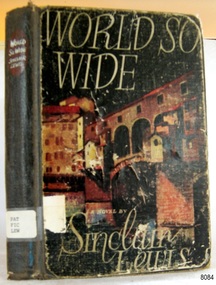
Book, William Heinemann Ltd, World So Wide, 1951
... pasted onto front cover. The book title and author’s name is on the coloured picture on the front cover along with a picture of buildings and a dark sky. The spine also has the title and author’s name, handwritten in white. On the spine is a white adhesive...On the spine is a white adhesive label with a typed library call number. Inside the front cover is a printed label. The front pasted down endpaper has one label covering another label. ...This book “World So Wide” is a novel written by Sinclair Lewis. It is part of Flagstaff Hill’s historic book collection, known as the Pattison Collection. About SINCLAIR LEWIS (1885-1951) The author was born as Harry Sinclair Lewis in 1885 in Sauk Centre, Minnesota. He was renowned as an American novelist, playwright and short story writer. His first writings were romantic poems and short stories. Six of his novels were published by the time Lewis was 36. Lewis won the 1926 Pulitzer Prize for his book “Arrowsmith” but declined because he had been helped in the writing of it by science writer Paul de Kruif, who received 25% of royalties on the sales. However, Lewis is listed as the sole author. Lewis received the Nobel Prize for Literature in 1930 for his “vigorous and graphic art of description and his ability to create, with wit and humour, new types of characters." He was the first author from the United States to receive this award. Lewis graduated from university in 1907. He worked as a reporter and editor for several publications. He was a prolific writer, publishing dozens of works and numerous articles, and became popular for his satire. Lewis married and divorced twice and died alone from a heart attack due to advanced alcoholism) near Rome on 10th January 1951, aged 66. This book was part of a large group of books referred to as the Pattison Collection, which belonged to the Warrnambool Public Library, part of the Warrnambool Mechanics’ Institute. About RALPH ERIC PATTISON and the ‘PATTISON COLLECTION’ The ‘Pattison Collection’ is a collection of books and records that was originally owned by the Warrnambool Mechanics’ Institute, founded in Warrnambool in 1853. By 1886 the Warrnambool Mechanics’ Institute (WMI) had grown to have a Library, Museum and Fine Arts Gallery, with a collection of “… choice productions of art and valuable specimens in almost every branch and many wonderful national curiosities are now to be seen there, including historic relics of the town and district.” It later included a School of Design. Although it was very well patronised, the WMI was led to ask the City Council to take it over in 1911 due to lack of financial support. In 1935 Ralph Pattison was appointed as City Librarian to establish and organise the Warrnambool Public Library as it was then called. Ralph Eric Pattison was born in Rockhampton, Queensland, in 1891. He married Maude Swan from Warrnambool in 1920 and they set up home in Warrnambool. In 1935 when Pattison accepted the position as City Librarian for the Warrnambool City Council his huge challenge was to make a functional library within two rooms of the Mechanics’ Institute. He tirelessly cleaned, cleared and sorted a disarrayed collection of old books, jars of preserved specimens and other items reserved for exhibition in the city’s museum. He developed and updated the library with a wide variety of books for all tastes, including reference books for students; a difficult task to fulfil during the years following the Depression. He converted all of the lower areas of the building into a library, reference room and reading room for members and the public. The books were sorted and stored using a cataloguing and card index system that he had developed himself. He also prepared the upper floor of the building and established the Art Gallery and later the Museum, a place to exhibit the many old relics that had been stored for years for this purpose. One of the treasures he found was a beautiful ancient clock, which he repaired, restored and enjoyed using in his office during the years of his service there. Ralph Pattison was described as “a meticulous gentleman whose punctuality, floorless courtesy and distinctive neat dress were hallmarks of his character, and ‘his’ clock controlled his daily routine and his opening and closing of the library’s large heavy doors to the minute.” Pattison took leave from 1942 to 1945 to serve in the Royal Australian Navy, Volunteer Reserve as Lieutenant. A few years later he converted one of the Museum’s rooms into a Children’s Library, stocking it with suitable books for the younger generation. This was an instant success. In the 1950’s he had the honour of being appointed to the Victorian Library Board and received more inspiration from the monthly conferences in Melbourne. He was sadly retired in 1959 after over 23 years of service, due to the fact that he had gone over the working age of council officers. However, he continued to take a very keen interest in the continual development of the Library until his death in 1969. THE NEW WARRNAMBOOL LIBRARY When the WMI building was pulled down in 1963 a new civic building was erected on the site and the new Warrnambool Library, on behalf of the City Council, took over all the holdings of the WMI. At this time some of the items were separated and identified as the ‘Pattison Collection’, named after Pattison. Eventually, the components of the WMI were distributed from the Warrnambool Library to various places, including the Art Gallery, Historical Society and Flagstaff Hill. Later some were even distributed to other regional branches of Corangamite Regional Library and passed to and fro. It is difficult now to trace just where all of the items have ended up. The books at Flagstaff Hill Maritime Village generally display stamps and markings from Pattison as well as a variety of other institutions including the Mechanics’ Institute itself.Lewis’s book is significant for its association with the writer, who was the first American to be awarded the Nobel Prize for Literature (1930). This book is significant for its connection with the Pattison Collection which, along with other items at Flagstaff Hill Maritime Village, was originally part of the Warrnambool Mechanics' Institute’s collection. The Warrnambool Mechanics’ Institute collection is primarily significant in its totality, rather than for the individual objects it contains. Its contents are highly representative of the development of Mechanics' Institute libraries across Australia, particularly Victoria. A diversity of publications and themes has been amassed, and these provide clues to our understanding of the nature of and changes in the reading habits of Victorians from the 1850s to the middle of the 20th century. The collection also highlights the Warrnambool community’s commitment to the Mechanics’ Institute, reading, literacy and learning in the regions, and proves that access to knowledge was not impeded by distance. These items help to provide a more complete picture of our community’s ideals and aspirations. The Warrnambool Mechanics Institute book collection has historical and social significance for its strong association with the Mechanics Institute movement and the important role it played in the intellectual, cultural and social development of people throughout the latter part of the nineteenth century and the early twentieth century. The collection of books is a rare example of an early lending library and its significance is enhanced by the survival of an original collection of many volumes. The Warrnambool Mechanics' Institute’s publication collection is of both local and state significance. Title: World So Wide Author: Sinclair Lewis Publisher: William Heinemann Ltd Date: 1951 Hardback board book covered with dark linen, and a coloured picture pasted onto front cover. The book title and author’s name is on the coloured picture on the front cover along with a picture of buildings and a dark sky. The spine also has the title and author’s name, handwritten in white. On the spine is a white adhesive label with a typed library call number. Inside the front cover is a printed label. The front pasted down endpaper has one label covering another label. The front loose endpaper as a purple stamp impression. The book, a novel, is part of the Pattison Collection originally belonging to the Warrnambool Public Library.Adhesive label - “PAT / FIC / LEW” Handwritten on spine “WORLD SO WIDE” and “SINCLAIR LEWIS” Printed labels on front endpaper of both the Corangamite Regional Library Service and the Warrnambool Public Library. Stamp in purple ink on inside front loose endpaper of the Corangamite Regional Library Serviceflagstaff hill, warrnambool, shipwrecked coast, flagstaff hill maritime museum, maritime museum, shipwreck coast, flagstaff hill maritime village, great ocean road, book, pattison collection, warrnambool library, warrnambool public library, warrnambool mechanics’ institute, ralph eric pattison, warrnambool books and records, corangamite regional library service, warrnambool city librarian, mechanics’ institute library, victorian library board, warrnambool children’s library, american novel, jonathan cape, sinclair lewis, harry sinclair lewis, 1930 nobel prize for literature, world so wide, william heinemann ltd -
 Flagstaff Hill Maritime Museum and Village
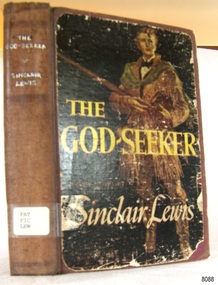
Book, William Heinemann Ltd, The God-Seeker, 1949
... pasted onto front cover. The book title and author’s name is on the coloured picture on the front cover along with a picture of a man standing. The spine also has the title and author’s name, handwritten in white. On the spine is a white adhesive...On the spine is a white adhesive label with a typed library call number. Inside the front cover is a printed label. The front pasted down endpaper has one label covering another label. ...This book “The God-Seeker” is a novel written by Sinclair Lewis. It is part of Flagstaff Hill’s historic book collection, known as the Pattison Collection. About SINCLAIR LEWIS (1885-1951) The author was born as Harry Sinclair Lewis in 1885 in Sauk Centre, Minnesota. He was renowned as an American novelist, playwright and short story writer. His first writings were romantic poems and short stories. Six of his novels were published by the time Lewis was 36. Lewis won the 1926 Pulitzer Prize for his book “Arrowsmith” but declined because he had been helped in the writing of it by science writer Paul de Kruif, who received 25% of royalties on the sales. However, Lewis is listed as the sole author. Lewis received the Nobel Prize for Literature in 1930 for his “vigorous and graphic art of description and his ability to create, with wit and humour, new types of characters." He was the first author from the United States to receive this award. Lewis graduated from university in 1907. He worked as a reporter and editor for several publications. He was a prolific writer, publishing dozens of works and numerous articles, and became popular for his satire. Lewis married and divorced twice and died alone from a heart attack due to advanced alcoholism) near Rome on 10th January 1951, aged 66. This book was part of a large group of books referred to as the Pattison Collection, which belonged to the Warrnambool Public Library, part of the Warrnambool Mechanics’ Institute. About RALPH ERIC PATTISON and the ‘PATTISON COLLECTION’ The ‘Pattison Collection’ is a collection of books and records that was originally owned by the Warrnambool Mechanics’ Institute, founded in Warrnambool in 1853. By 1886 the Warrnambool Mechanics’ Institute (WMI) had grown to have a Library, Museum and Fine Arts Gallery, with a collection of “… choice productions of art and valuable specimens in almost every branch and many wonderful national curiosities are now to be seen there, including historic relics of the town and district.” It later included a School of Design. Although it was very well patronised, the WMI was led to ask the City Council to take it over in 1911 due to lack of financial support. In 1935 Ralph Pattison was appointed as City Librarian to establish and organise the Warrnambool Public Library as it was then called. Ralph Eric Pattison was born in Rockhampton, Queensland, in 1891. He married Maude Swan from Warrnambool in 1920 and they set up home in Warrnambool. In 1935 when Pattison accepted the position as City Librarian for the Warrnambool City Council his huge challenge was to make a functional library within two rooms of the Mechanics’ Institute. He tirelessly cleaned, cleared and sorted a disarrayed collection of old books, jars of preserved specimens and other items reserved for exhibition in the city’s museum. He developed and updated the library with a wide variety of books for all tastes, including reference books for students; a difficult task to fulfil during the years following the Depression. He converted all of the lower areas of the building into a library, reference room and reading room for members and the public. The books were sorted and stored using a cataloguing and card index system that he had developed himself. He also prepared the upper floor of the building and established the Art Gallery and later the Museum, a place to exhibit the many old relics that had been stored for years for this purpose. One of the treasures he found was a beautiful ancient clock, which he repaired, restored and enjoyed using in his office during the years of his service there. Ralph Pattison was described as “a meticulous gentleman whose punctuality, floorless courtesy and distinctive neat dress were hallmarks of his character, and ‘his’ clock controlled his daily routine and his opening and closing of the library’s large heavy doors to the minute.” Pattison took leave from 1942 to 1945 to serve in the Royal Australian Navy, Volunteer Reserve as Lieutenant. A few years later he converted one of the Museum’s rooms into a Children’s Library, stocking it with suitable books for the younger generation. This was an instant success. In the 1950’s he had the honour of being appointed to the Victorian Library Board and received more inspiration from the monthly conferences in Melbourne. He was sadly retired in 1959 after over 23 years of service, due to the fact that he had gone over the working age of council officers. However, he continued to take a very keen interest in the continual development of the Library until his death in 1969. THE NEW WARRNAMBOOL LIBRARY When the WMI building was pulled down in 1963 a new civic building was erected on the site and the new Warrnambool Library, on behalf of the City Council, took over all the holdings of the WMI. At this time some of the items were separated and identified as the ‘Pattison Collection’, named after Pattison. Eventually, the components of the WMI were distributed from the Warrnambool Library to various places, including the Art Gallery, Historical Society and Flagstaff Hill. Later some were even distributed to other regional branches of Corangamite Regional Library and passed to and fro. It is difficult now to trace just where all of the items have ended up. The books at Flagstaff Hill Maritime Village generally display stamps and markings from Pattison as well as a variety of other institutions including the Mechanics’ Institute itself.Lewis’s book is significant for its association with the writer, who was the first American to be awarded the Nobel Prize for Literature (1930). This book is significant for its connection with the Pattison Collection which, along with other items at Flagstaff Hill Maritime Village, was originally part of the Warrnambool Mechanics' Institute’s collection. The Warrnambool Mechanics’ Institute collection is primarily significant in its totality, rather than for the individual objects it contains. Its contents are highly representative of the development of Mechanics' Institute libraries across Australia, particularly Victoria. A diversity of publications and themes has been amassed, and these provide clues to our understanding of the nature of and changes in the reading habits of Victorians from the 1850s to the middle of the 20th century. The collection also highlights the Warrnambool community’s commitment to the Mechanics’ Institute, reading, literacy and learning in the regions, and proves that access to knowledge was not impeded by distance. These items help to provide a more complete picture of our community’s ideals and aspirations. The Warrnambool Mechanics Institute book collection has historical and social significance for its strong association with the Mechanics Institute movement and the important role it played in the intellectual, cultural and social development of people throughout the latter part of the nineteenth century and the early twentieth century. The collection of books is a rare example of an early lending library and its significance is enhanced by the survival of an original collection of many volumes. The Warrnambool Mechanics' Institute’s publication collection is of both local and state significance. Title: The God-Seeker Author: Sinclair Lewis Publisher: William Heinemann Ltd Date: 1949 Hardback board book covered with brown linen, and a coloured picture pasted onto front cover. The book title and author’s name is on the coloured picture on the front cover along with a picture of a man standing. The spine also has the title and author’s name, handwritten in white. On the spine is a white adhesive label with a typed library call number. Inside the front cover is a printed label. The front pasted down endpaper has one label covering another label. The front loose endpaper as a purple stamp impression. The book, a novel, is part of the Pattison Collection originally belonging to the Warrnambool Public Library.Adhesive label - “PAT / FIC / LEW” Printed labels on front endpaper of both the Corangamite Regional Library Service and the Warrnambool Public Library. Stamp in purple ink on inside front loose endpaper “WARRNAMBOOL PUBLIC LIBRARY”flagstaff hill, warrnambool, shipwrecked coast, flagstaff hill maritime museum, maritime museum, shipwreck coast, flagstaff hill maritime village, great ocean road, book, pattison collection, warrnambool library, warrnambool public library, warrnambool mechanics’ institute, ralph eric pattison, warrnambool books and records, corangamite regional library service, warrnambool city librarian, mechanics’ institute library, victorian library board, warrnambool children’s library, american novel, jonathan cape, sinclair lewis, harry sinclair lewis, 1930 nobel prize for literature, the god-seeker, william heinemann ltd -
 Flagstaff Hill Maritime Museum and Village
Book - Historical, Warrnambool, Richard Osburne, The History of Warrnambool, 1887
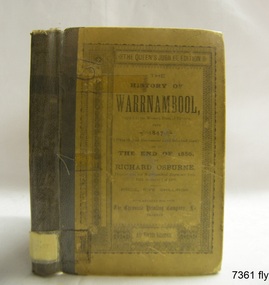
... Dust jacket front has been pasted over front hard cover. The hardcovers are covered with clear adhesive plastic covering. ...Dust jacket front has been pasted over front hard cover. The hardcovers are covered with clear adhesive plastic covering. ...This little book is one of only 1000 books published of the original Queen's Jubilee Edition. It spans fifty years of the history of Warrnambool from the time that the first Government Land Sales commenced. It also deliberately coincides with the 1887 celebrations of Queen Victoria's Jubilee Year of her ascension to the British Throne. The book is an invaluable reference for researchers of local Warrnambool history and has been used as a text book and reference book for local students. The book had two owners before it became part of the Warrnambool Public Library, and when the library closed down, the book was held by the Warrnambool City Council until, in 1974, it was transferred to the newly established Flagstaff Hill Maritime Museum and Village. The author, Richard Osburne, (1825-1895) was born in Australia. He moved to Warrnambool in 1847 as the first local Journalist. In 1851 he founded the Warrnambool Examiner newspaper which he operated until the end of 1880. Osburne was much involved in civic and community affairs of the town, and he set himself the task of recording the history of the city's early pioneers. In the introductory pages of the book the author refers to himself as "The Father of the Warrnambool Press". Only 1,000 copies of this edition of the book were printed. In September 1980 a facsimile edition was printed with the addition of illustrations from the period, an index and relevant annotations by local historian T.A. Wicking (Tom Wicking). This later book was named the Premier Town Edition, due to Warrnambool being awarded the title of Premier Town in Victoria in 1979-82 by the Premier of Victoria; it also received the inaugural award in 1959 and a later award in 1988-91. This book is rare. It is one of only 1000 copies printed, and one of three in the Collection of Flagstaff Hill Maritime Museum and Village. The book was dedicated to the early colonists as well as to the new arrivals by the writer, Richard Osburne, who entitles himself as "The father of the Warrnambool Press". The content of the book is invaluable as a reference for Warrnambool and District's local history in its early colonial and pioneering days. It provides the information that helps in an understanding the foundation that the city was built on, connecting the people of today to the pioneers of the past. The inscriptions of two previous owners of the book, at least one of whom was a local resident, gives additional significance to this copy. The History of Warrnambool: Capital of the Western Ports of Victoria From1847 (when the first Government Land Sales took place) up to the end of 1886, By Richard Osburne, Proprietor of the Warrnambool Examiner from 1851 to the close of 1880. Author: Richard Osburne Publisher: Prahran: The Chronicle Printing & Publishing Company Limited Date: 1887 (MDCCCLXXXVII) Edition: Original: Queen's Jubilee Edition Small book with hard cover and reinforced spine. Dust jacket front has been pasted over front hard cover. The hardcovers are covered with clear adhesive plastic covering. Inscriptions include a typed label on the spine, a stamp at base of the fly page, on the loose page inside front cover, on inside back cover, and two hand written names on the second fly page; Jackson Giblett and G. M. Potter. The first fly page has a message to the readers, as shown in the Inscriptions of this record.Label on spine "R.A. 994.57 OSB" Inscriptions on second fly page: "Jackson Giblett / 1886" and "G.M. Potter, 70 Japan Street" Printed on fly page: "PRICE, FIVE SHILLINGS" Stamp of front end paper: WARRNAMBOOL / PUBLIC LIBRARY", "000336" and in a rectangular border " - - - - - - / WARRNAMBOOL / PUBLIC LIBRARY" First fly page: "THE QUEEN'S JUBILEE EDITION. TO OLD COLONISTS AND YOUNG AUSTRALIANS, OR NEW ARRIVALS, THIS HISTORY OF THE RISE AND PROGRESS OF THE CAPITAL OF WESTERN VICTORIA, IS DEDICATED AS INTERESTING AND USEFUL, BY "THE FATHER OF THE WARRNAMBOOL PRESS" RICHARD OSBURNE." Stamp inside back cover: "WARRNAMBOOL LIBRARY/ Liebig Street / Warrnambool 3280 / (055) 6- 2258"warrnambool, shipwreck coast, flagstaff hill, maritime museum, maritime village, the history of warrnambool, richard osburne, osturne's history of warrnambool, queen's jubilee edition, 1847-1887, warrnambool history, the chronicle printing and publishing company, capital of the western ports of victoria, first government land sales, warrnambool examiner, five shillings, warrnambool's first reporter, warrnambool public library, 1887, 1979, premier town, premier edition, queen's jubliee, queen victoria's jubilee, western ports of victoria, 1847, government land sales, chronicle publishing and printing co., g m potter, 1000 copies, t a wicking, jackson giblett, 1886, japan street, old colonists, young australians, new arrivals, rise and progress, capital of western victoria, interesting and useful, the father of the warrnambool press -
 Warrnambool and District Historical Society Inc.
Book, Royal Readers No V1 - Royal school series, Late 19th century
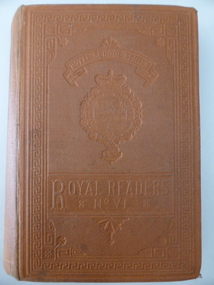
... adhesive tape. Some pages at the front and back are missing. The book has a contents page and three sections of text. There are many black and white illustrations. The inscription is handwritten in blue ink. The cover is somewhat faded and rubbed and some pages are stained. There is a printed label of the seller of the book pasted...adhesive tape. Some pages at the front and back are missing. The book has a contents page and three sections of text. There are many black and white illustrations. The inscription is handwritten in blue ink. The cover is somewhat faded and rubbed and some pages are stained. There is a printed label of the seller of the book pasted ...This school reader was used by Edmond and Mary Grace at Laang State School. Laang is in the Western District and is eight kilometres from Garvoc and ten kilometres from Panmure. The Laang State School opened in 1875 with a new building being erected in 1876 and additions being added in 1889. The school is now closed. Edmond Morgan Grace was born to William and Mary Grace in 1886 and died in 1953. Mary was his sister. Charles Hider, with his brother James, were early settlers in Warrnambool and both ran book shops in the town. This book is of moderate interest as an example of a late 19th century school reader and as one used at Laang State School by the Grace family. This is a brown hard cover book of 398 pages. The cover has an embossed patterning and lettering. The binding has come apart and has been mended with white adhesive tape. Some pages at the front and back are missing. The book has a contents page and three sections of text. There are many black and white illustrations. The inscription is handwritten in blue ink. The cover is somewhat faded and rubbed and some pages are stained. There is a printed label of the seller of the book pasted onto the inside of the front cover. ‘Edmond M. Grace Laang State School’ ‘Mary Grace Laang S.S.’ ‘C.Hider Opposite Court House Warrnambool’ edmond and mary grace, laang state school, charles and james hider -
 Warrnambool and District Historical Society Inc.
Top Hat and Bowler Hat, Woodrow & Sons, Early 20th century (.1 Top Hat)
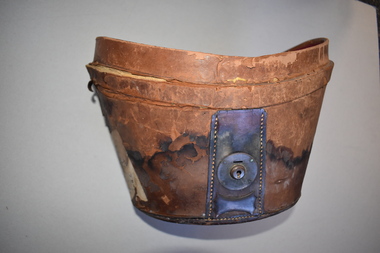
... pasted on to the lid. .4 This is a hat box made of leather with a metal lock on one side. It has remnants of paper travel labels on the sides. Inside the box is an insert made of maroon-coloured cardboard for storing the top hat. This insert has a leather strap to stabilize the hat. There is a name on the base of the box written on a piece of adhesive...pasted on to the lid. .4 This is a hat box made of leather with a metal lock on one side. It has remnants of paper travel labels on the sides. Inside the box is an insert made of maroon-coloured cardboard for storing the top hat. This insert has a leather strap to stabilize the hat. There is a name on the base of the box written on a piece of adhesive ...This top hat, with the initials J.H.H., belonged to John Hunter Henderson, a doctor who practised in Warrnambool from 1904 to 1939. For many years he was a member of the Warrnambool Hospital Board of Management. On his retirement in 1939 he went to live in Melbourne where he died aged 81. The John Hunter Henderson fund was established at the Warrnambool Hospital to develop the training facilities for medical and nursing staff. The bowler hat belonged to his driver (name unknown) and it is presumed that he drove a horse and buggy in the early years of the 20th century. These items are of considerable significance as they are associated with Dr Henderson, a long-serving doctor in Warrnambool and they show the status and comparative affluence of doctors in the first half of the 20th century. .1 This is a black top hat with the crown covered in beaver fur or felt of some kind. The upturned brim is slightly worn on one edge. The crown has a black corded band with a bow on one side. There is a stud with an air hole on the crown. Inside there is a brown leather lining with information on the maker on the inside base and a crown image. .2 This is a bowler hat made of black felt with lining on the edges of black cotton material. The brim is slightly turned up on the sides. The crown has a black corded band with a bow at one side. There is a circle of air holes on the side of the hat. Inside there is leather lining with some information on the maker on the inside base. .3 This is a hat box lid with a leather covering over cardboard. It is a spherical shape with some side damage where the leather is peeling. There is a leather strap handle with a metal buckle. There are remnants of travel labels pasted on to the lid. .4 This is a hat box made of leather with a metal lock on one side. It has remnants of paper travel labels on the sides. Inside the box is an insert made of maroon-coloured cardboard for storing the top hat. This insert has a leather strap to stabilize the hat. There is a name on the base of the box written on a piece of adhesive plaster. .1 J.H.H. Woodrow & Sons Hat Manufacturers to H.M. the King 13 Market St Manchester, 8 Castle St Liverpool, 45 Piccadilly London, 42 Cornhill, London, 11 Gordon St Glasgow, 40 Westmoreland St Dublin, Made in England Lincoln, Stuart & Coy Proprietary Limited Flinders St Melbourne .2 The Tropical Hat .3 Midland Railway .4 Dunedin, F.H.Moreton doctor john henderson, warrnambool, history of warrnambool, top hat -
 Westbourne Grammar Heritage Collection
Memorabilia - Year 12 Art and Signatures Book 1983 - 2018, 1983
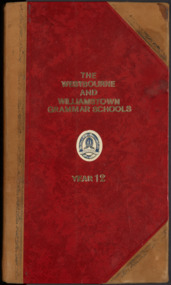
... paste it across the fold of each consecutive double page spread. The book, opened at the entry of the graduating class, would then be displayed at the Year 12 Valedictory Dinner each year. This books commemorates each graduating year 12 class since the establishment of the secondary campus at Truganina. It is an example of beginning community building traditions for the new school. year 12 graduation valedictory art community student work prefects Red vinyl bound book with tan-coloured suede corners and spine. The front cover features gold embossed lettering of the school name above a school logo (self-adhesive ...In 1978 a new campus for Williamstown Grammar, named Westbourne, was established at Truganina to accommodate the new secondary school. The first year 12 class graduated in 1983 and to commemorate this historic event, the Year 12 art and signature book was begun. Since 1983, each Year 12 group has nominated a student to create an artwork, which in many cases represents a theme that was important to the Year 12 cohort at the time, to be signed by each student of Year 12. The practice quickly became to create the artwork on a separate sheet of paper and paste it across the fold of each consecutive double page spread. The book, opened at the entry of the graduating class, would then be displayed at the Year 12 Valedictory Dinner each year.This books commemorates each graduating year 12 class since the establishment of the secondary campus at Truganina. It is an example of beginning community building traditions for the new school.Red vinyl bound book with tan-coloured suede corners and spine. The front cover features gold embossed lettering of the school name above a school logo (self-adhesive applied after manufacture) with further embossed gold lettering 'Year 12' below. Artworks on paper have been adhered across bifold pages of the book, using unknown adhesive, each year between 1983 and 2018. Adhered pages contain mixed media. Pages at the back of the book contain lists with senior student office holder names and signatures for each year 1983-2018.year 12, graduation, valedictory, art, community, student work, prefects -
 Melbourne Legacy
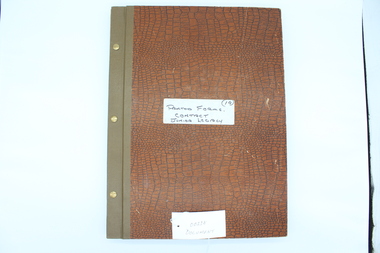
Book, Printed Forms. Junior Legacy
... adhesive label, the figure 19 is circled. Brown patterned cardboard cover. Spine reinforced with brown tape. Cover and pages bound together by three evenly spaced brass screws. Copies of reports, letters and forms pasted ...This portfolio of printed forms, letters and reports has been assembled to show how Melbourne Legacy, in the past, has kept in contact with Legatees, widows, their families and the records of the above mentioned. The information would be typed or handwritten, then posted and delivered to Legacy Melbourne, Legatees or widows and families. Types of form include 'First Contact Form' to record the details of the families. Also printed cards for noting dental appointments. A typical letter that is sent to the widow on Legacy receiving news of the death of an ex-serviceman. One of the proforma letters is signed by Legatee A Dore who was President in 1965 so the forms are from the 1960s.A record of work practices within Legacy.Brown patterned cardboard cover. Spine reinforced with brown tape. Cover and pages bound together by three evenly spaced brass screws. Copies of reports, letters and forms pasted onto brown paper pages.Front cover, title hand written in black on rectangular, white adhesive label, the figure 19 is circled. contact records, register, proformas -
University of Melbourne, Burnley Campus Archives
Book - Register and Student Records, Record of Students and Spray Records, 1910-1947
... adhesive label on cover "STUDENT'S ADDRESSES" Inside front cover Egg Records scored out with three red lines. Beneath is hand inscribed "Records of Students" Inside back cover "Spray Records" Bound register divided into 2 sections. Each is hand rulled columns in red ink with handwritten black ink. The front register is of students enrolled in Horticultural courses from 1911-1941 and their subsequent history. Also records of part-time students. Inserts Includes (1) B.H.P.S.A. (2) Staff and students of School of Horticulture, Burnley. (3) Pasted ...This record of student addresses was compiled between 1911 and 1947 during the principalships of the College of Horticulture and Primary Agriculture Burnley - Pescott, E.E. (1909-1916), McLennan, J.P. (1917-21), Rae, F.J. (1922-25), Jessep, A.W. (1926-41), Provan, J.L. (1942-46) and Kneen, T.H. (1946-67).Bound register divided into 2 sections. Each is hand rulled columns in red ink with handwritten black ink. The front register is of students enrolled in Horticultural courses from 1911-1941 and their subsequent history. Also records of part-time students. Inserts Includes (1) B.H.P.S.A. (2) Staff and students of School of Horticulture, Burnley. (3) Pasted insert, Presbyterian Girls Hostel, Parliament Place, C2. Probably used by the B.H.P.S.A. Upside down and beginning from the rear are Spray Records 1910-1916 including columns headed Name, Company, Date, Source, fruit trees sprayed and trial dates, remarks and results, and report. A special section in the centre gives list of Training of Returned Soldiers (22) in Horticulture, Poultry management (1918-1921) - the nature of the work, fees and subsequent career . Typed adhesive label on cover "STUDENT'S ADDRESSES" Inside front cover Egg Records scored out with three red lines. Beneath is hand inscribed "Records of Students" Inside back cover "Spray Records" register, students, horticultural courses, sprays, fruit trees, bhpsa, staff, school of horticulture, burnley, presbyterian girls hostel, part-time students, jobs, burnley horticultural past students association, returned soldiers, careers -
 Melbourne Tram Museum
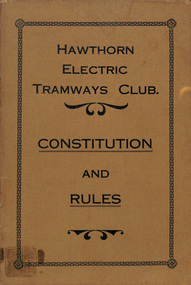
Document - Rule Book, Hawthorn Electric Tramways Club, "Hawthorn Electric Tramways Club - Constitution and Rules", 1930s
... Sets out Membership, Contributions, office bearers, voting, committee, general meetings, duties of offices, auditors, funds, sick and accident benefits, funeral benefits, conduct of members - fines, alterations of the rules and standing orders. .2 - two sheet update to be pasted in the book, has an adhesive area on the rear advising that Camberwell Depot would be included, that the MMTB would collect the levy now 1/- per week and the additional levy of 2/6 per member when a member retired at the age of 65 or was retired by the Board due to ill health or death. ...Sets out Membership, Contributions, office bearers, voting, committee, general meetings, duties of offices, auditors, funds, sick and accident benefits, funeral benefits, conduct of members - fines, alterations of the rules and standing orders. .2 - two sheet update to be pasted in the book, has an adhesive area on the rear advising that Camberwell Depot would be included, that the MMTB would collect the levy now 1/- per week and the additional levy of 2/6 per member when a member retired at the age of 65 or was retired by the Board due to ill health or death. ....1 - Rule book - 16 pages + card cover, centre stapled, titled "Hawthorn Electric Tramways Club - Constitution and Rules" undated. Club founded 23/10/1916. Notes that the book must be returned if the employee leaves the MMTB. Sets out Membership, Contributions, office bearers, voting, committee, general meetings, duties of offices, auditors, funds, sick and accident benefits, funeral benefits, conduct of members - fines, alterations of the rules and standing orders. .2 - two sheet update to be pasted in the book, has an adhesive area on the rear advising that Camberwell Depot would be included, that the MMTB would collect the levy now 1/- per week and the additional levy of 2/6 per member when a member retired at the age of 65 or was retired by the Board due to ill health or death. Dated 1936 and signed by the Secretary - A Y PorteousOn the inside front cover of .1 and on the rear of .2 has a stamp "Bob Prentice Collection No. B175167A (or B). Reproduction only with consent of B. J. Brooks".trams, tramways, hawthorn depot, camberwell depot, retirements, gratuity scheme, medical
