
Showing 32 items matching "administration and organization"
-
 University of Melbourne, Burnley Campus Archives
Document, Organization - administration files, 1950-1961
... Organization - administration files...Refer to paper catalogues Organization - administration files Document ...Notes and notices on re-organisation of College grounds and staffing. Refer to paper cataloguesburnley horticultural college, college grounds, staff -
 Bendigo Military Museum
Photograph - PHOTOGRAPH, BENNETTS, c.1948
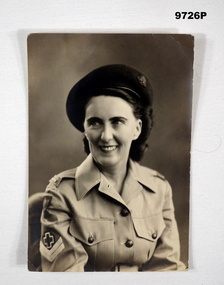
... From 23.3.1944 to 1.4.1944 she attended an Administration and Organizational Course and passed. ...From 23.3.1944 to 1.4.1944 she attended an Administration and Organizational Course and passed. transferred to LHQ Medical and Veterinary Stores. ...Alva Marie Bennetts. Alva initially enlisted as V515106 in the CMF, age 20 years on 19.2.1944 in the 4th Aust. AWS Training Battalion. From 23.3.1944 to 1.4.1944 she attended an Administration and Organizational Course and passed. transferred to LHQ Medical and Veterinary Stores. Transfers to No. 128 AGH QLD on 28.8.1944. On turning 21 she transfers to the AIF as VFX128835 on 1.9.1944 in AMC graded group 11. 12.11.1945 transfers to the Inter Services Medical Wing Demobilization Centre. promoted to the rank of Corporal on 24.9.1946. Embarks for Kure Japan with BCOF on 19.4.1947. Embarks for Australia 16.2.1949. Discharged from the Army on 13.4.19949 with the rank of Corporal in No. 130 AGH. Part of the Bennetts Collection - which also contains items of her father, William John Leslie Bennetts No.4433 1st AIF. Also her future husband Edward W Callaghan No. 147354 RAAF.Black and white photograph of a lady in uniform. She has a Corporal's rank insignia on her right sleeve below a Red Cross symbol. She is wearing a dark coloured beret with a Rising Sun badge attached. Mottled background to photograph.Handwritten on back of photograph, in black ink: 'Lots of love from Alva, Eta Jima, 18/8/48.'bennetts collection, alva bennetts, photograph, aaws, bcof -
 Glen Eira Historical Society
Album - Page 1 of folder D-F, Caulfield Municipality Photo Slide Collection, c.1976 - c.1994
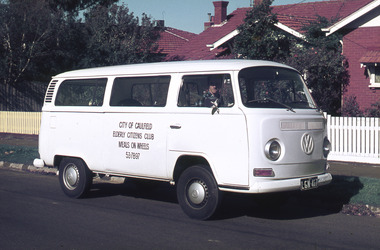
... By 1974 Caulfield Council assumed responsibility for the administration of the service which by then was the largest in Victoria, supplying 300 meals each weekday. ...By 1974 Caulfield Council assumed responsibility for the administration of the service which by then was the largest in Victoria, supplying 300 meals each weekday. ...The photographs for the slides are believed to have been taken by the inaugural Editor for the Caulfield Contact - the official newspaper of the former City of Caulfield from 1976-1994. The Editor was also Council's Community Liaison Officer and she (and her successor) took many photographs of official events and Council-related services and locations in connection with both these official roles. The City of Caulfield was the Municipal Council for an area of the South Eastern suburbs of Melbourne, including Brighton East, Carnegie, Caulfield, Elsternwick, Gardenvale, Glen Huntly, McKinnon, Murrumbeena, Ormond and St Kilda East. Credit: Glen Eira Historical Society - This item was digitised and made available through the Glen Eira Heritage Digitisation Strategy 2019-2023. Glen Eira Historical Society acknowledges the support of Glen Eira City Council. Caulfield’s Meals on wheels project started in 1958 and was run by volunteers. By 1974 Caulfield Council assumed responsibility for the administration of the service which by then was the largest in Victoria, supplying 300 meals each weekday. By 1987 with a combination of both paid and volunteer staff up to 136,000 meals were distributed each year to individual homes and to various clubs and organizations. Page 1 of slide album D to F, in a polypropylene slide sleeve containing 19 x 35mm colour slides. A sample of 8 images from this page is included. meals on wheels, glen eira city council, local government, caulfield city council, caulfield council, city of caulfield, council services, brighton east, carnegie, caulfield, elsternwick, gardenvale, glen huntly, mckinnon, murrumbeena, ormond, st kilda east, caulfield municipality photo slide collection -
 Bendigo Historical Society Inc.
Administrative record - Sandhurst Trustees Bendigo Easter Festival Administration Documents - Legal and Insurance, 2003
... Sandhurst Trustees Bendigo Easter Festival Administration Documents - Legal and Insurance This Item includes the following Documents: 11213.7a Sandhurst Trustees Bendigo Easter Festival - Logo 2003 11213.7b Sub Lease Agreement between the Bendigo Easter Fair Inc and The Rotary club of Bendigo - Town Hall 2005-2006 - Contact the BHS for Details 11213.7c Certificate of Currency Jan 2003 - McCormick Harris and Associates PTY LTD - Contact the BHS for Details 11213.7d Schedule of Insurances Feb 2003 - McCormick Harris and Associates PTY LTD - Contact the BHS for Details 11213.7e This document from Russell Kennedy Solicitors addresses the legal liability, insurance, and risk management considerations for the Bendigo Easter Fair Committee (BEF) and its members. ...Contact the BHS for details. 11213.7f This letter from McCormick Harris Associates to Bendigo Easter Fair Inc. outlines several key points regarding the organization's insurance arrangements. Recommendation to Transition Insurance coverage to the City of Greater Bendigo March 2003 - Contact the BHS for details 11213.7g This document is a confirmation of insurance coverage provided by the Victorian Managed Insurance Authority (VMIA) for the Crown in right of the State of Victoria and associated entities; 30 June 2002 - Contact the BHS for Details 11213.7h Assorted tax invoices and statements - Contact the BHS for Details 11213.7i Insurance Documents May and June 2003 - Contact the BHS for Details Administrative record Sandhurst Trustees Bendigo Easter Festival Administration Documents - Legal and Insurance ...Sandhurst Trustees Bendigo Easter Festival. The aim of The Bendigo Easter Festival is to increase awareness of, and attendance at the Bendigo Easter Festival amongst regional, intrastate, and interstate audiences by 2006. Bendigo Easter Festival - Australia's oldest festival ... .... .. Gold, gold, gold. The year of 1871 was a great year for Bendigo. Parks were laid out, trees lined the streets. Although acknowledged as starting in 1869 the Easter Festival was considered an annual event by 1871. Under brilliant illumination the whole of the Camp Reserve (now Rosalind Park) was filled with a bewildering variety of groups, exhibits and individuals all eager to be involved in such a worthwhile cause. There were sports meetings, theatricals, bazaars and instrumental items as well as dancing and carnival rides. On Easter Monday, as it is today, there was a grand procession that included a variety of bands. 1871 also marked the first year that the Chinese joined in the festivities. Originally the Chinese participated in the procession by dressing in richly embroidered costumes, and carrying colourful banners in all shapes and sizes, which were specially made for them in China. In 1889, the Chinese were given their traditional place in the Parade, the end. They created a wonderful spectacle with their colourful costumes, banners and flags, and in 1892, Loong, the dragon appeared. The Bendigo Easter Festival had been fortunate in that it bad such a lively Chinese community in its midst. At the time of course, Bendigo was known as Sandhurst, and it was not until twenty years after the first Easter Festival that the town was known as Bendigo. These days with sponsorship from the Sandburst Trustees, the Festival is known as the Sandhurst Trustees Bendigo Easter Festival. 132 years later, the Sandburst Trustees Bendigo Easter Festival has had many changes. But loyal followers have never been disappointed. This year people saw the traditions upheld with family entertainments and not Loong, but Sun Loong, meaning new dragon, a 100m long Imperial Dragon who was created to take the place of the aging Loong. Sandhurst Trustees Bendigo Easter Festival Administration Documents - Legal and Insurance This Item includes the following Documents: 11213.7a Sandhurst Trustees Bendigo Easter Festival - Logo 2003 11213.7b Sub Lease Agreement between the Bendigo Easter Fair Inc and The Rotary club of Bendigo - Town Hall 2005-2006 - Contact the BHS for Details 11213.7c Certificate of Currency Jan 2003 - McCormick Harris and Associates PTY LTD - Contact the BHS for Details 11213.7d Schedule of Insurances Feb 2003 - McCormick Harris and Associates PTY LTD - Contact the BHS for Details 11213.7e This document from Russell Kennedy Solicitors addresses the legal liability, insurance, and risk management considerations for the Bendigo Easter Fair Committee (BEF) and its members. Contact the BHS for details. 11213.7f This letter from McCormick Harris Associates to Bendigo Easter Fair Inc. outlines several key points regarding the organization's insurance arrangements. Recommendation to Transition Insurance coverage to the City of Greater Bendigo March 2003 - Contact the BHS for details 11213.7g This document is a confirmation of insurance coverage provided by the Victorian Managed Insurance Authority (VMIA) for the Crown in right of the State of Victoria and associated entities; 30 June 2002 - Contact the BHS for Details 11213.7h Assorted tax invoices and statements - Contact the BHS for Details 11213.7i Insurance Documents May and June 2003 - Contact the BHS for Detailsbendigo easter festival, bendigo easter fair -
 Northern District School of Nursing. Managed by Bendigo Historical Society Inc.
Administrative record - Northern District School of Nursing Graduates Association - 10th and 11th Annual Reports, 1959-1961
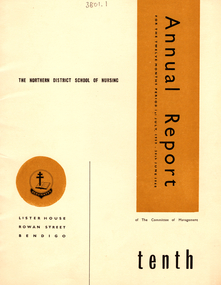
... Senior positions require further experience and additional certificates (e.g., Midwifery, Infant Welfare).Diploma courses available in administration, teaching, and specialized nursing fields. ...Senior positions require further experience and additional certificates (e.g., Midwifery, Infant Welfare).Diploma courses available in administration, teaching, and specialized nursing fields. ...The Northern District School of Nursing in Victoria, Australia Graduates Association: History of the School Managed by a committee including hospital administrators, medical professionals, and nursing leaders from several regional hospitals. Associated with major hospitals in the Northern District, including Bendigo Base, Mildura Base, Castlemaine, Echuca, Swan Hill, St. Arnaud, and Kyneton District Hospitals. Provide high-quality theoretical and practical nursing training. Raise the standard of nursing education in the region. Maintain the highest principles of nursing practice. Applicants must be at least 17 years old and hold a Proficiency Certificate or higher educational qualification. Application involves submitting forms, certificates, an interview, an aptitude test, and a medical examination. A three-month probationary period follows initial acceptance. Preliminary Training School: Four-week introductory course covering basic nursing, anatomy, hygiene, and practical skills. Practical experience in various hospital departments, guided by senior staff. Study Block Plan: Includes several blocks of theoretical and practical instruction throughout the three-year program. Regular school exams and two state exams (First Professional and Final State) are required for progression and graduation. Nurses work a 40-hour week with at least one or two days off per week and three weeks of annual leave. Accommodation is provided in comfortable hostels with good facilities. Uniforms are supplied free; nurses provide their own shoes and stockings. Salaries and allowances are regulated, with deductions for board and free medical care. Additional Information Post-Graduate Opportunities. Senior positions require further experience and additional certificates (e.g., Midwifery, Infant Welfare).Diploma courses available in administration, teaching, and specialized nursing fields. Bursaries are available for advanced study.Career Prospects: Graduates can pursue roles in administration, teaching, ward and departmental leadership, district and visiting nursing, industrial and school nursing, and more. Opportunities existed both within hospitals and in community or specialized settings.FAQs and Practical Details. Minimal training costs (mainly exam fees and personal items).Living out allowances and travel expenses are covered. Four training intakes per year; waiting periods are short if qualifications are met. 10th ANNUAL REPORT Here are the key points from the annual report of the Northern District School of Nursing for the year ending June 30, 1960:1. The Committee of Management included medical, nursing, and educational leaders from regional hospitals and schools. Dr. Peter Slater, a founding member and major contributor, passed away in 1960 and was honored for his service. The tutorial and clerical staff lists reflect several changes, with notable resignations and new appointments. The School celebrated its tenth anniversary in March 1960, marking a decade since its first intake in 1950. It was the first independent nursing school in Australia, contributing significantly to nursing education history. A new kitchen-dining block was completed, improving meal services and social spaces.Upgrades included a second demonstration classroom, improved lighting and heating, and renovations to hostels and administrative areas. Some maintenance issues remained, particularly with older hostels and the need for a new administrative block.4. A post-graduate Staff Nurse Training Course was introduced to retain and further develop graduates within the region. The study block plan was revised to distribute nurse absences more evenly, increasing the number of study blocks from 9 to 14 per year. The School faced challenges balancing educational needs with hospital staffing requirements. Certificates were awarded to several graduates who completed the new Staff Nurse Training Course. The report details causes of student attrition, including exam failures, personal reasons, health, marriage, and disciplinary actions. The School hosted significant conferences, including the Royal Victorian College of Nursing's tutors' conference, fostering professional development and networking. The School's finances were stable, with government grants as the main income source and detailed accounts of expenditures and assets provided. The report expresses gratitude to staff, the Hospitals and Charities Commission, and associated hospitals for their support and cooperation. 11th ANNUAL REPORT Here are the key points from the Eleventh Annual Report (1960-1961) of the Committee of Management for the Northern District School of Nursing, Bendigo: Ongoing issues with deteriorating retaining walls and outbuildings at school residences. Committee sought approval for a staged building program: administrative/classroom unit, hostel accommodation, and demonstration/practical classroom unit. Urgent need for improved office and classroom facilities due to inadequate current conditions. Routine repairs and upgrades (painting, new heaters, floor coverings, clothes dryers). Plans for garage repairs and replacement of retaining walls at hostels. Significant improvements with new anatomical models and demonstration equipment, enhancing teaching quality. No major changes to the basic curriculum; continued use of study block plan across all years. Ongoing challenges in teaching Invalid Cookery due to lack of facilities and qualified teachers. Concerns about overloading introductory courses and the impact of staff shortages on student preparedness. 74 students sat the First Professional Examination: 63 passed initially, 5 passed supplementary, 2 failed and terminated, 3 did not re-sit.65 students sat the Final State Examination: 2 failed whole exam, 4 failed Medical Nursing, 2 failed Surgical Nursing; all passed supplementary exams. Recommendation that students struggling by the 15th month consider Nursing Aide work.Staff Nurse CoursePostgraduate courses held for staff nurses, including visits to metropolitan and local hospitals and organizations. High standard of lectures and appreciation from students. Staff attended post-graduate courses; Miss Bannfield-Smith awarded Florence Nightingale Scholarship. Miss Long received a Rockefeller Foundation grant for study in the US and Canada.Recruitment and Student Demographics 69 new recruits from various regional hospitals.2 07 students in training as of June 30, 1961, with diverse educational backgrounds. 33 students left due to exam failure, marriage, dislike of nursing, personal or health reasons, or family needs. Several resignations and new appointments among tutorial, supervisory, and domestic staff. Total expenditure: £37,561; total income: £36,898, resulting in a deficit of £663 for the year. Main expenses: salaries, provisions, domestic costs, repairs, and administration. Dr. P. R. Slater MemorialA memorial ceremony and placement of a commemorative painting in honor of Dr. Slater, the first chairman.Hosted meetings for medical and nursing associations, and provided hospitality for visiting nurses during the International Nursing Congress.Northern District School of Nursing Graduates Association - 10th and 11th Annual Reports, 1959-1960 and 1960-61 This item contains the following documents: 3801.1a 10th Annual Report Front Cover 3801.1b The annual report of the Northern District School of Nursing for the year ending June 30, 1960 3801.1c 11th Annual Report Front Cover 3801.1d The Eleventh Annual Report (1960-1961) of the Committee of Management for the Northern District School of Nursing, Bendigo 3801.1e Copy of Above 3801.1f Copy of Above 3801.1g Copy of Abovenurse training, lister house, annual reports -
Bendigo Historical Society Inc.
Administrative record - Commercial Egg Producers' Association of Victoria (CEPA) Central Council Correspondence, 1983
... The Central Victoria Group Apprenticeship Scheme is a non-profit organization designed to address the decline in apprentice numbers by providing a flexible, shared apprenticeship model for employers in Central Victoria. 8504.39aaaa This document is a notice for the upcoming meeting of the Coliban Water Investigation Committee, and previous minutes. ...The Central Victoria Group Apprenticeship Scheme is a non-profit organization designed to address the decline in apprentice numbers by providing a flexible, shared apprenticeship model for employers in Central Victoria. 8504.39aaaa This document is a notice for the upcoming meeting of the Coliban Water Investigation Committee, and previous minutes. ...The Commercial Egg Producers' Association of Victoria was active by the 1930s, engaging in industry management and lobbying.The Commercial Egg Producer's Association (CEPA) had branches in Bendigo, South Bendigo, Eaglehawk, Wedderburn, Murrabit and Euroa.CEPA Commercial Egg Producer's Association (Bendigo Region) correspondence, for the year 1983. This item includes the following documents: 8504.39a The Commercial Egg Producers' Association of Victoria contacted the office of David Kennedy, M.L.A., regarding eggs purchased by VicRail. 8504.39b From David Kennedy MLA to CEPA re representation. 8504.39c This letter from the Minister of Agriculture to the Secretary of the Commercial Egg Producers' Association of Victoria addresses the following key points:Acknowledgement of Correspondence:The Minister thanks the Association for their letter regarding the Discussion Paper on the proposed Egg Industry Stabilization Bill. 8504.39d This formal letter from the Minister of Agriculture communicates the following: The Governor in Council has officially appointed the Chairman, Deputy Chairman, and two additional Members to the Victorian Egg Marketing Board.The appointments are for various terms of office.The letter follows up on earlier communications regarding these appointments. A statement detailing the specifics of the appointments is included with the letter. 8504.39e From the Minister of Agriculture - outlines the upcoming Victorian Egg Marketing Board's appointment process and communication regarding the Chairman's position. 8504.39f This document is a formal letter from the Minister of Agriculture requesting nominations for qualified producers to be appointed to the Victorian Egg Marketing Board. Expiration of Current Terms:The terms of Mr. P. J. Carter and Mr. D. J. Foster as producer members will expire on 30 June 1983. 8504.39g The Victorian Egg Marketing Board shared a report on an experimental trial conducted in Gippsland focusing on Brown Eggs, with plans to discuss findings with producer organizations soon 8504.39h This document is a formal invitation from the Victorian Egg Marketing Board to representatives of the Commercial Egg Producers Association of Victoria. The Board requests a meeting to discuss several important industry issues: Egg Pricing and Cost of Production PoliciesReview and discussion of current pricing strategies and production costs affecting the Victorian egg industry.Hen Quotas for 1983/84Consideration of quota allocations for egg-laying hens in the upcoming year.Future Policy for Brown Egg Marketing Evaluation and planning for marketing brown eggs, including insights from recent marketing trials. 8504.39i This document is a formal letter from the Victorian Egg Marketing Board to the Commercial Egg Producers' Association of Victoria. The Board is sending two copies of a sales presenter to the Association for distribution to executives and members. The sales presenter is intended for the retail trade in Victoria.The sales presenter contains all relevant information about the upcoming "Plant-a-Herb" promotion. The Board expects this material will help the Association's executives by consolidating all details in one place.The letter is signed by Selwyn M. Hall, Deputy General Manager, and dated 25th February 1983. 8504.39j The Chairman of the Victorian Egg Marketing Board is circulating information about tenderizing spent hens to industry stakeholders. The letter is addressed to Mr. K. Fitzgibbon, Secretary of the Commercial Egg Producers Association.The purpose is to encourage discussion among producers to potentially gain advantages from this information. 8504.39k This document is a formal letter from the Victorian Egg Marketing Board to the Commercial Egg Producers Association, proposing a meeting to discuss recent industry developments. 8504.39l Various Circulars from the Victorian Egg Marketing Board for during the year 1983 8504.39m The Victorian Egg Marketing Board is inviting the Commercial Egg Producers Association to a meeting to discuss egg pricing.The meeting is scheduled for Thursday, 26th May at 3:30 p.m.The Association may send up to four delegates. 8504.39n Here are the key points from the letter by the Victorian Egg Marketing Board regarding the proposed brown egg marketing scheme 8504.39o This document is a formal invitation from the Victorian Egg Marketing Board for a cocktail reception 8504.39p This letter from the Victorian Egg Marketing Board to the Secretary of the Commercial Egg Producers Association outlines the agenda for an upcoming board meeting scheduled for May 26, 1983. 8504.39q Victorian Egg Marketing Board Meeting Darft Summary of Discussions, May 1983 8504.39r This document is a formal communication from the Victorian Egg Marketing Board addressing concerns about egg cartons not fitting larger eggs. 8504.39s This document is a formal letter from the Department of Agriculture Victoria addressing the staffing and support for the poultry industry in the Bendigo district. The Department acknowledges Mr. Evans' valuable work as a poultry officer.Mr. Evans has been promoted to Assistant Principal Officer, Poultry Industry Services, and will continue contributing to the industry, eventually relocating to Melbourne. 8504.39t The document is a formal response from the Poultry Farmer Licensing Review Committee regarding a complaint about illegal hen quota transfer and egg trade matters. 8504.39u This document is an invitation and agenda overview for the 1983 Annual Conference of the Victorian Farmers & Graziers Association (VFGA) Egg Producers Group. 8504.39v The document is a formal letter from the Crystal Egg Company addressing industry concerns and operational updates. 8504.39w The document is a formal letter from Crysta Egg Company to the Commercial Egg Producers Association proposing a new system for grading fee increases. 8504.39x The Chrystal Egg Company has held extensive discussions with egg producers about increasing grading charges, as the last increase was in November 1981.The timing and size of the increase were considered, with efforts to minimize the impact on producers, especially due to drought-related feed price increases.The introduction of a sliding scale for service fees, effective July 11th, 1982, means larger consignments will have lower per-dozen fees, while smaller consignments will pay higher rates. 8504.39y The document is a formal letter from the Crystal Egg Company addressing operational challenges related to egg collection and grading schedules 8504.39z Crystal Egg Company letter. The document addresses concerns and recommendations regarding dockage and cartage subsidies for egg producers in Victoria, Australia, specifically focusing on the Bendigo franchise zone. 8504.39aa From Egg Farmers of Victoria: Various News Circulars for the year 1983 8504.39ab This document is a formal communication from the Victorian Egg Marketing Board regarding the distribution of a discussion paper on grading floors to egg producers and related organizations. 8504.39ac The document outlines the Victorian Egg Marketing Board's considerations and plans regarding egg education and donations to schools 8504.39ad The document outlines plans by the Egg Farmers of Victoria to improve egg production forecasting 8504.39ae Victorian Egg Marketing Board - Office of the Chairman - The document provides detailed surplus figures by grade (in thousands of dozens) for the last three months of the 1982/83 period 8504.39af Egg Farmers of Victoria letter - The Board is addressing inefficiencies and unnecessary costs related to egg dockage, specifically unnecessary double handling and excessive cartage of eggs. 8504.39ag This document is a formal letter from a Member of the Legislative Council (Mr. Dunn, M.L.C., Member for North Western Province) to Mr. K. Fitzgibbon, Secretary of the Commercial Egg Producers Association of Victoria. The National Party is open to discussing issues raised in the Minister of Agriculture's Discussion Paper on the Egg Industry with the Association. 8504.39ah The Minister of Agriculture, Eric Kent, responds to a letter from Eddie Hann, Deputy Leader of the National Party, regarding a submission by the Commercial Egg Producers' Association. The submission concerns dockage issues and was sent to the Victorian Egg Marketing Board following their discussion paper. 8504.39ai This document is a formal letter from Bruce Reid, a Victorian politician, addressed to Mr. K. Fitzgibbon, Secretary of the Commercial Egg Producers' Association of Victoria. Bruce Reid confirms receiving a letter and a submission from the Commercial Egg Producers' Association regarding the Victorian Egg Marketing Board's "Dockage Discussion Paper 8504.39aj The document discusses pooling return economy airfare costs for delegates attending an Australian Council of Egg Producers meeting in Sydney.The pooling is based on airfares effective as of October 3, 1983 8504.39ak From the Australian Council of Egg Producers - The document announces the establishment of a Senate Select Committee on Animal Welfare in Australia, outlining its purpose and structure 8504.39al Australian Council of Egg Producers outcomes from the poultry welfare meeting 8504.39am Australian Council of Egg Producers General Meeting Minutes October 1983 8504.39an Australian Council of Egg Producers Objectives and Purposes 8504.39ao This document is a formal letter from David Kennedy, Member for Bendigo in the Victorian Legislative Assembly, addressed to Mr. K. Fitzgibbon, Secretary of C.E.P.A. Acknowledgement: David Kennedy thanks Mr. Fitzgibbon for sharing his organization's views on a discussion paper regarding egg industry stabilization.Enclosure: Kennedy includes a letter from Eric Kent, Minister of Agriculture, which discusses a proposed review of transport subsidies for the egg industry. 8504.39ap Notice of The Central Council annual meeting is scheduled for Friday, 17th June 1983 at 1:00 p.m. at City Hall, Bendigo. 8504.39aq This document is a formal letter nominating candidates for two producer vacancies on the Victorian Egg Marketing Board. 8504.39ar The document is a formal letter from the Victorian Egg Marketing Association addressed to the Minister of Agriculture, Hon. Eric Kent. The Association is responding to notification that the current Chairman's term for the Victorian Egg Marketing Board will expire on June 30, 1983. 8504.39as The document is a formal letter from CEPA to the managing director of the Crystal Egg Company, addressing concerns about proposed fee increases. 8504.39at The document is a letter from K. Fitzgibbon, Secretary to the Victorian Egg Marketing Board, expressing opposition to the introduction of brown eggs into the market. 8504.39au To the Minister of Agriculture. CEPA opposes the Victorian Egg Marketing Board's plan to introduce brown eggs in August 1984. 8504.39av The executive meeting minutes of the Commercial Egg Producers Association of Victoria, held on June 10, 1983, focused on discussing proposed principles for an Egg Industry Stabilization policy. 8504.39aw CEPA Half Yearly Conference Nov 1983 Minutes 8504.39ax The document outlines proposed principles and regulations for stabilizing and managing the egg industry, focusing on licensing, quotas, exemptions, and industry funding. 8504.39ay CEPA Annual Conference June 1983 Business Paper 8504.39az CEPA Central Council Executive Meeting Minutes July 1983 8504.39aaa This document is a formal letter from John Bourchier, MP, addressing concerns raised by the Commercial Egg Producers Association regarding diesel rebate policies. The government currently does not plan to change its diesel rebate program, despite concerns from egg producers. 8504.39aab From the Crystal Egg Company letter:Grading Charges and Inflation 8504.39aac This document is a formal response from the Poultry Farmer Licensing Review Committee to a query about alleged illegal hen quota transfers 8504.39aad From the Department of Agriculture Victoria. This departmental letter addresses the staffing and support for the poultry industry in Victoria, focusing on the Bendigo District Centre. 8504.39aae This document outlines the handling and fee policies for Class B egg consignments from the Victorian Egg Marketing Board. 8504.39aaf This document is a formal letter from the Minister of Agriculture to David Kennedy MLA; addressing concerns from the Commercial Egg Producers' Association regarding hen quota transfers and regulations in the egg industry. 8504.39aag This document from the Victorian Egg Marketing Board outlines key industry standards and policies regarding egg handling and regulatory compliance 8504.39aah This document from the Victorian Egg Marketing Board outlines procedures and fees related to egg grading and consignments 8504.39aai This letter from the Minister of Agriculture addresses concerns about interstate egg marketing between Victoria and New South Wales. 8504.39aaj Four page circular 29/83 This document is an invitation and agenda for an egg industry meeting organized by the Victorian Egg Marketing Board, scheduled for April 6, 1983. The meeting focuses on maximizing profits through the production of larger eggs and addresses key industry topics 8504.39aak Notice of CEPA Annual Meeting May 1983 8504.39aal This document is a circular from the Victorian Egg Marketing Board, dated June 3, 1983, discussing dockage costs and egg transport logistics for the 1982/83 period. 8504.39aam The document is a formal statement by the directors of the Commercial Egg Producers' Association Co-operative Limited regarding the financial year ending March 31, 1983 8504.39aan Minutes of the CEPA Annual Conference 17 June 1983 8504.39aao This document is a formal letter from The Federation Insurance Limited to policyholders, outlining important amendments to the Workers' Compensation Act and the resulting responsibilities for employers. 8504.39aap Egg Farmer of Victoria four page newsletter June 1983 8504.39aaq Hand Written Letter to the Victorian Egg Marketing Board titled "Dockage Discussion Paper" from Joan Heard, Secretary CEPA 8504.39aar 11 pages The document proposes legislative reforms to consolidate and modernize the regulation of Victoria's poultry and egg industries. Poultry Industry LegislationConsolidation of LawsCombines the Poultry Processing Act and Broiler Chicken Industry Act into a single Act for streamlined administration. 8504.39aas This document outlines plans by the Egg Farmers of Victoria to improve egg production forecasting through enhanced data collection and computer modeling 8504.39aat This document is a formal letter from the Egg Farmers of Victoria to the Commercial Egg Producers Association regarding production forecasting 8504.39aau This document is a formal letter to the Victorian Egg Marketing Board, along with their relply; expressing concerns from the Bendigo and South Bendigo branches of the C.E.P.A. regarding the company's publicity and sales strategies for microwave oven demonstrations. 8504.39aav Minutes of the Half yearly CEPA Conference 24 Nov 1983 8504.39aaw This document is a letter from John Brumby, Federal Member for Bendigo, to the Minister for Finance. Small primary producers who purchase less than 1,000 litres of diesel fuel per year are not eligible for the diesel fuel rebate, while larger producers are eligible. 8504.39aax From John Cain, Victorian Attorney General, This document outlines the main legal principles regarding trespass 8504.39aay Seven pages. This document is a discussion paper from the Minister of Agriculture regarding egg industry stabilization policies and legislative considerations. The paper is intended to gather feedback from stakeholders in the egg industry on issues related to stabilization policies before drafting new legislation. 8504.39aaz Information sheet. The Central Victoria Group Apprenticeship Scheme is a non-profit organization designed to address the decline in apprentice numbers by providing a flexible, shared apprenticeship model for employers in Central Victoria. 8504.39aaaa This document is a notice for the upcoming meeting of the Coliban Water Investigation Committee, and previous minutes. Tuesday, December 7, 1982 Time: 8:00 p.m.Location: City Hall, Bendigo 8504.39aaab This document is a notice for the upcoming meeting of the Coliban Water Investigation Committee, and previous minutes. Tuesday, Feb 8, 1982 Time: 8:00 p.m.Location: City Hall, Bendigo 8504.39aaac This document is a notice for the upcoming meeting of the Coliban Water Investigation Committee, and previous minutes. Tuesday, Jan 27th 1982 Time: 8:00 p.m.Location: City Hall, Bendigo 8504.39aaad This document provides the essential daily nutrient requirements for laying hens consuming 115 grams of feed per dayegg producer's information, correspondence, cepa, commercial egg producers' association -
 Bendigo Historical Society Inc.
Journal - BHS ADMINISTRATION COLLECTION: MUSEUM REGISTER, 1970 - 1990
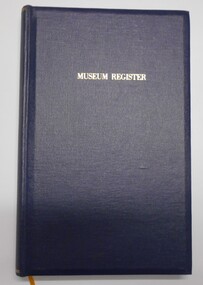
... ORGANIZATION Society bendigo historical society Black vinyl covered Museum Regster. ...Black vinyl covered Museum Regster. Contains records of the BHS items held at the BHS Museum in Eaglehawk. Five ruled columns across two pages. Headings: Registration Number, Object name and brief description, Acquisition Date, Acquisition Method, Name and Address. Forty seven pages filled in with only two columns completed - Registration Number and Object name and description. No other details completed. Approximately one third of the book used.organization, society, bendigo historical society -
 Bendigo Historical Society Inc.
Document - AILEEN AND JOHN ELLISON COLLECTION: CERTIFICATE
... ORGANIZATION Government Insitute of Municipal Administration Certificate. ...Certificate. The Institute of Municipal Administration incorporated 1936 Australia. This is to certify that Leslie John Ellison has been duly admitted as an Associate of the Victorian division of the Municipal Administrration Incorporated. In witness wherof we have hereunto set our hands and the seal of the Insitute. This 16th day of September, 1966. Signed by the President, Secretary, Divisional President and Divisional Secretary.organization, government, insitute of municipal administration -
 Bendigo Historical Society Inc.
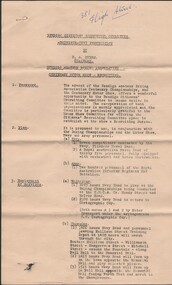
Document - 'ADMINISTRATION INSTRUCTION' - BENDIGO CITIZENS' RECRUITING COMMITTEE, 1951
... ORGANIZATION Military bendigo citizens' recruiting c'tee 'Administration Instruction' - Arrangements for Bendigo Citizens' Recruiting Committee. ...'Administration Instruction' - Arrangements for Bendigo Citizens' Recruiting Committee. Navy, Army personnel in conjunctions with Boxing Championships and the Motor Show. Five days of activities including instructions for Administratiion, Accom,modation, Transfer, Traffic. 5 pages; R A Myers, Chairman. Inscription: '381 High St' written on front page.organization, military, bendigo citizens' recruiting c'tee -
 Bendigo Historical Society Inc.
Document - BHS ADMINISTRATION COLLECTION: VISITORS' BOOK
... ORGANIZATION Society bendigo society Brown plastic covered Visitor's Book. ...Brown plastic covered Visitor's Book. Visitors; Book records visitors to Dudley House (Bendigo Historical Society) containing names signatures and addresses of visitor's dating from 20/11/1974 to 26/01/1998.organization, society, bendigo society -
 Bendigo Historical Society Inc.
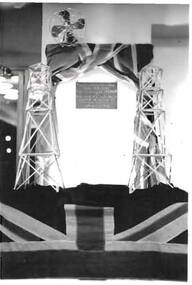
Photograph - S.E.C. VICTORIA, 1941
... ORGANIZATION Public utility electricity company S.E.C. ...Black and White Photo of Official Plaque, Opening of the new S.E.C. Victoria Administration Buildings March 14 1941, Plaque reads 'This Building was offically opened by the Hon. F.E. Old. MLA. Minister in Charge of Electrical Undertakings 14 March 1941'. Flag wrapped around a bar at the top of the display, and fan. Another flag at the front bottom of the display. Rear of photo Sec. opening 14 March 1941 written in biro and number 30 written in pencil.organization, public utility, electricity company, s.e.c. victoria, sec victoria, sec victoria offical opening, sec victoria offical plaque -
Warrnambool and District Historical Society Inc.
Book, City of Warrnambool 1961, 1961
... This includes the names and contact information on those who were involved in the administration of many clubs and community organizations at that time. ...This book has been produced by the Warrnambool City Council and gives details on the activities of the Council in 1961, the public facilities available in the city and the organizations and major industries operating in the City at that time. This book is important because it contains valuable historical information about the City of Warrnambool in 1961. This includes the names and contact information on those who were involved in the administration of many clubs and community organizations at that time. The book is also of significance as it belonged to Florence Collins, a noted educator in the city and the first female Warrnambool City Councillor. This is a soft-covered booklet bound with white plastic-covered metal rings in two sections. The pages are not numbered. The cover is cream and it is a little stained and rubbed. There are many black and white photographs. Each page has the city crest at the top of the page. ‘Florence J. Collins’ warrnambool city council, history of warrnambool, florence collins -
Koorie Heritage Trust
Book, Basedow, Herbert, The Australian Aboriginal, 1925
... Human Biology -- Physiology -- Reproduction -- Social Organisation -- Life Cycle -- Birth -- Childhood -- Religion and Magic -- Ritual -- Initiation -- Mortuary -- Politics Tribal Law and Social control -- Arts -- Performing arts -- Music -- Dance -- Language and communication -- Economics and Material Culture -- Economic life -- Division of labour -- Subsistence -- hunting -- gathering-- Weapons -- Spears -- Spearthrowers -- Tools -- Stone -- Contents: Introduction to an Australian Tribe; Racial characteristics; The breast and abdomen; The face and its skeleton; The mouth; The skull and brain; Colour of Aboriginal's skin; The hair; Likely origin of the Australian Aboriginal; An Aboriginal's Birth; Childhood; The Day's March; Camp life; Hunting; Vegetable Diet; Beverages; Pitjuri; Navigation; Duels; Warfare; Spears; Spear-Throwers; Burial and mourning customs; Tribal organizations; Tribal administration; Initiation; Religious ideas; Aboriginal art; Stone implements; Music and dance; Language. xx, 422 p., 55 leaves of plates : ill., map, ports. ; 22 cm. ...Contents: Introduction to an Australian Tribe; Racial characteristics; The breast and abdomen; The face and its skeleton; The mouth; The skull and brain; Colour of Aboriginal's skin; The hair; Likely origin of the Australian Aboriginal; An Aboriginal's Birth; Childhood; The Day's March; Camp life; Hunting; Vegetable Diet; Beverages; Pitjuri; Navigation; Duels; Warfare; Spears; Spear-Throwers; Burial and mourning customs; Tribal organizations; Tribal administration; Initiation; Religious ideas; Aboriginal art; Stone implements; Music and dance; Language.xx, 422 p., 55 leaves of plates : ill., map, ports. ; 22 cm.Contents: Introduction to an Australian Tribe; Racial characteristics; The breast and abdomen; The face and its skeleton; The mouth; The skull and brain; Colour of Aboriginal's skin; The hair; Likely origin of the Australian Aboriginal; An Aboriginal's Birth; Childhood; The Day's March; Camp life; Hunting; Vegetable Diet; Beverages; Pitjuri; Navigation; Duels; Warfare; Spears; Spear-Throwers; Burial and mourning customs; Tribal organizations; Tribal administration; Initiation; Religious ideas; Aboriginal art; Stone implements; Music and dance; Language.human biology -- physiology -- reproduction -- social organisation -- life cycle -- birth -- childhood -- religion and magic -- ritual -- initiation -- mortuary -- politics, tribal law and social control -- arts -- performing arts -- music -- dance -- language and communication -- economics and material culture -- economic life -- division of labour -- subsistence -- hunting -- gathering-- weapons -- spears -- spearthrowers -- tools -- stone -- -
Moorabbin Air Museum
Manual (item) - RAAF Standard Notebook for Initial Training Schools Publication No. 96
... Air Navigation Magnetism and Electricity Law Discipline Administration and Organization Hygiene and Sanitation Definitions The Principles of Flight Airframes Engines Mathematics Problems for Revision Foolscap size string bound folder loose leaf RAAF Standard Notebook for Initial Training Schools Publication No. 96 Manual RAAF Standard Notebook for Initial Training Schools Publication No. 96 ...air navigation, magnetism and electricity, law, discipline, administration and organization, hygiene and sanitation, definitions, the principles of flight, airframes, engines, mathematics problems for revision -
 Royal District Nursing Service (now known as Bolton Clarke)
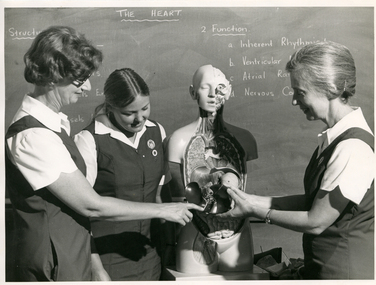
Photograph - Photograph, black and white, Barry Sutton, 25.03.1974
... Many of their senior Sisters received Postgraduate diplomas from the College of Nursing in Community Health Nursing, Education, and Administration, and several travelled overseas visiting nursing organizations viewing their public health and District nursing systems. ...The RDNS Sisters are named in the photograph, L-R - Sister Megan Margaret Day who works in the Domiciliary Infant Maternal Care (DIMC) section of RDNS. The next Sister's name is unknown, and on the right is Sister Ruth Eileen McKeon who is a Nurse Educator with RDNS. The photograph is taken in the Education Department of Royal District Nursing Service, and the two Sisters are receiving instruction on the function of the organs of the human body from Sister McKeon. The Sisters are wearing the RDNS summer uniform of a white short sleeve blouse under a royal blue V neck tunic style frock. Education was an integral part of Melbourne District Nursing Society (MDNS), from its inception in 1885, later, in 1966, called Royal District Nursing Service, (RDNS). From 1885, only Trained nurses (Nurses), through the Hospital training system, were employed by the Society, and on visits to patients they taught the necessity of hygiene and cleanliness, as well as the need for a good diet, to bring about good health. Doctor’s lectures were later given at the MDNS home to instruct patients and their families on prevention of disease. Education to patients continued throughout the years regarding health care and the use of equipment in the home. In 1961, Education programs commenced at MDNS with Trained nurses (Sisters) receiving In-service education. Sr. Pat (Paddy) Rowley was a leader in In-service Education and established the RDNS Department of Community Nursing Education in 1962. Staff could also apply for scholarships to further their education outside of RDNS. Many of their senior Sisters received Postgraduate diplomas from the College of Nursing in Community Health Nursing, Education, and Administration, and several travelled overseas visiting nursing organizations viewing their public health and District nursing systems. At RDNS many programs were run, including: a Post Basic Course, Cardiac Rehabilitation Nursing, Haematology/Oncology Nursing, Palliative Care program, Diabetic Stabilization Program, Leg Ulcer Management Program, Wound Care Specialist Program, HIV/AIDS Nursing Care, Cystic Fibrosis Home Support, Veterans Home Care Program, Breast Cancer Support Program, Continence Management Program, Stomal Therapy Program, In-Home Lactation Support Program and the Homeless Persons Program. RDNS staff attended several hospitals to observe and learn special care needed to some clients, e.g. to the Austin Hospital to learn the care required for paraplegic and quadriplegic patients at home, and to Mount Royal Hospital to observe the care of patients in the Rehabilitation ward. A Community Nursing Education Program was extended to student nurses from hospitals and to other nursing organizations. These Education programs kept the RDNS Sisters abreast of new techniques, such as changes in technology for e.g. new testing methods in detecting glucose levels in Diabetic patients. Sr. Nan Deakin obtained a Post Basic Certificate in Psychiatric Nursing and included this area in her Education lectures. Sr. Daphne Geldard specialized in the area of Alzheimer’s disease and Dementia. These Sisters visited patients in District areas with the regular RDNS Sister when required. Every member of staff, both professional and non professional staff, received regular education in the Education Department. In 1980, a Home Health Aide pilot study, funded by the Federal Government, the Brotherhood of St. Laurence and RDNS, with the program written and taught by Sr. Rowley, was evaluated as successful, and Home Health Aides were employed and worked in RDNS Centres under the supervision of the RDNS Sisters. On the left of this black and white photograph is Royal District Nursing Service (RDNS), Sister Megan Day, who has curled short dark hair and is wearing glasses. She is standing side-on facing to the right of the photograph. The index finger of her right hand is pointing to an area on the internal frontal view of a Human Torso Model which is sitting on a table to her right. Between her and the model is another Sister who has her long dark hair drawn back. She is looking at the internal organs in the Model. To the right of the Model is Sister Ruth McKeon, who has her long light colour hair drawn back into a French Twist. She is standing side-on facing to the left of the photograph, and is smiling as she holds one of the organs taken from the Model. When looking at the photograph, the left side of the Model's face is seen, and on the right side the Internal organs of the face are seen. The internal organs of the neck and torso of the Model are seen. A blackboard with writings about the function of 'The Heart' is In the background. The Sisters are all wearing their RDNS uniforms of a short sleeve white blouse under a V neck tunic style dress which has the RDNS logo on its upper left.Barry Sutton LY 66 namesrdns, rdns education, royal district nursing service, sister megan margaret day, sister ruth eileen mckeon -
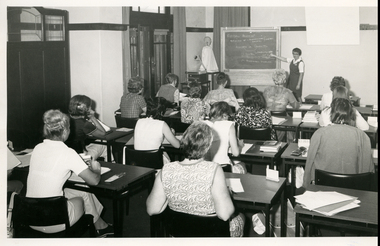 Royal District Nursing Service (now known as Bolton Clarke)
Photograph - Photograph, black and white, Barry Sutton, 25.03.1974
... Many of their senior Sisters received Postgraduate diplomas from the College of Nursing in Community Health Nursing, Education, and Administration, and several travelled overseas visiting nursing organizations viewing their public health and District nursing systems. ...The photograph shows a group of Royal District Nursing Service (RDNS) Sisters receiving a lecture on 'Physical Handicap' given by Sr. Rowley in the Education Department at RDNS Headquarters 452 St. Kilda Road, Melbourne. Sr. Rowley is the Principal Nurse Educator at RDNS.Education was an integral part of Melbourne District Nursing Society (MDNS), from its inception in 1885, later, in 1966, called Royal District Nursing Service, (RDNS). From 1885, only Trained nurses (Nurses), through the Hospital training system, were employed by the Society, and on visits to patients they taught the necessity of hygiene and cleanliness, as well as the need for a good diet, to bring about good health. Doctor’s lectures were later given at the MDNS home to instruct patients and their families on prevention of disease. Education to patients continued throughout the years regarding health care and the use of equipment in the home. In 1961, Education programs commenced at MDNS with Trained nurses (Sisters) receiving In-service education. Sr. Pat (Paddy) Rowley was a leader in In-service Education and established the RDNS Department of Community Nursing Education in 1962. Staff could also apply for scholarships to further their education outside of RDNS. Many of their senior Sisters received Postgraduate diplomas from the College of Nursing in Community Health Nursing, Education, and Administration, and several travelled overseas visiting nursing organizations viewing their public health and District nursing systems. At RDNS many programs were run, including: a Post Basic Course, Cardiac Rehabilitation Nursing, Haematology/Oncology Nursing, Palliative Care program, Diabetic Stabilization Program, Leg Ulcer Management Program, Wound Care Specialist Program, HIV/AIDS Nursing Care, Cystic Fibrosis Home Support, Veterans Home Care Program, Breast Cancer Support Program, Continence Management Program, Stomal Therapy Program, In-Home Lactation Support Program and the Homeless Persons Program. RDNS Sisters attended several hospitals to observe and learn special care needed to some patients, e.g. to the Austin Hospital to learn the care required for paraplegic and quadriplegic patients at home, and to Mount Royal Hospital to observe the care of patients in the Rehabilitation ward. A Community Nursing Education Program was extended to student nurses from hospitals and to other nursing organizations. These Education programs kept the RDNS Sisters abreast of new techniques, such as changes in technology for e.g. new testing methods in detecting glucose levels in Diabetic patients. Sr. Nan Deakin obtained a Post Basic Certificate in Psychiatric Nursing and included this area in her Education lectures. Sr. Daphne Geldard specialized in the area of Alzheimer’s disease and Dementia. These Sisters visited patients in District areas with the regular RDNS Sister when required. Every member of staff, both professional and non professional staff, received regular education in the Education Department. In 1980, a Home Health Aide pilot study, funded by the Federal Government, the Brotherhood of St. Laurence and RDNS, with the program written and taught by Sr. Rowley, was evaluated as successful, and Home Health Aides were employed and worked in RDNS Centres under the supervision of the RDNS Sisters. This black and white photograph shows the back view of four rows of Royal District Nursing Service (RDNS) Sisters sitting at small tables and looking toward Sister Pat (Paddy) Rowley who is facing them. She is in the rear centre of the photograph. The 16 Sisters, some partly hidden, are wearing a variety of summer day clothes. Spectacle cases, pens, sheets of paper, and some books are on the tables in front of them. Sister Rowley who wears glasses; has short straight dark hair, is wearing a white short sleeve blouse under a dark V neck tunic style dress. She is looking at the group and her right hand is pointing to writing on a large blackboard standing to her right. To the left of the blackboard, a draped Human Torso Model sits on a table. A long dark curtain hangs behind part of the blackboard. Running along the left of the photograph is a wooden door with glass panels at the top, some light colour wall with a dark picture rail, and a set of double glass doors with long grey curtains either side. To the right of Sr. Rowley part of a large white board is seen hanging above and below the dark picture rail on the wall.Barry Sutton LY 69rdns, royal district nursing service, rdns education, sister pat (paddy) rowley -
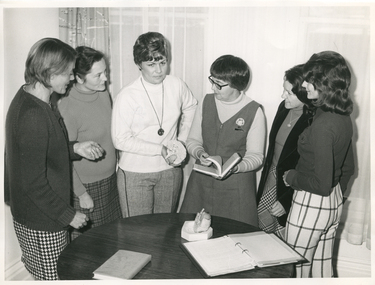 Royal District Nursing Service (now known as Bolton Clarke)
Photograph - Photograph, black and white, Barry Sutton, 1972
... Many of their senior Sisters received Postgraduate diplomas from the College of Nursing in Community Health Nursing, Education, and Administration, and several travelled overseas visiting nursing organizations viewing their public health and District nursing systems. ...This photograph is taken in the Education Department at Royal District Nursing Service (RDNS). Principal Nurse Educator, Sister Pat (Paddy) Rowley is instructing the group in the Anatomy of the Brain. Jan Turski is a Trained nurse (Sister) working in the Domiciliary Infant and Maternal Care (DIMC) section of RDNS. Pat Walker is a Sister from Geelong, Lynne Lambert is a Sister from Qld, Paula McBreen is a Sister from St. Vincent's Hospital and Liz Seymour-Smith is a Sister from Qld. Sister Pat (Paddy) Rowley is wearing the RDNS winter uniform of a blue/grey skivvie under a blue/grey V neck tunic style frock made out of herringbone winter material.Education was an integral part of Melbourne District Nursing Society (MDNS), from its inception in 1885, later, in 1966, called Royal District Nursing Service, (RDNS). From 1885, only Trained Nurses (Nurses), through the Hospital training system, were employed by the Society, and on visits to patients they taught the necessity of hygiene and cleanliness, as well as the need for a good diet, to bring about good health. Doctor’s lectures were later given at the MDNS home to instruct patients and their families on prevention of disease. Education to patients continued throughout the years regarding health care and the use of equipment in the home. In 1961, Education programs commenced at MDNS with Trained nurses (Sisters) receiving In-service education. Sr. Pat (Paddy) Rowley was a leader in In-service Education and established the RDNS Department of Community Nursing Education in 1962. Sisters could also apply for scholarships to further their education outside of RDNS. Many of their senior Sisters received Postgraduate diplomas from the College of Nursing in Community Health Nursing, Education, and Administration, and several travelled overseas visiting nursing organizations viewing their public health and District nursing systems. At RDNS many programs were run, including: a Post Basic Course, Cardiac Rehabilitation Nursing, Haematology/Oncology Nursing, Palliative Care program, Diabetic Stabilization Program, Leg Ulcer Management Program, Wound Care Specialist Program, HIV/AIDS Nursing Care, Cystic Fibrosis Home Support, Veterans Home Care Program, Breast Cancer Support Program, Continence Management Program, Stomal Therapy Program, In-Home Lactation Support Program and the Homeless Persons Program. RDNS Sisters attended several hospitals to observe and learn special care needed to some patients, e.g. to the Austin Hospital to learn the care required for paraplegic and quadriplegic patients at home, and to Mount Royal Hospital to observe the care of patients in the Rehabilitation ward. A Community Nursing Education Program was extended to student nurses from hospitals and to other nursing organizations. These Education programs kept the RDNS Sisters abreast of new techniques, such as changes in technology for e.g. new testing methods in detecting glucose levels in Diabetic patients. Sr. Nan Deakin obtained a Post Basic Certificate in Psychiatric Nursing and included this area in her Education lectures. Sr. Daphne Geldard specialized in the area of Alzheimer’s disease and Dementia. These Sisters visited patients in District areas with the regular RDNS Sister when required. Every member of staff, both professional and non professional staff, received regular education in the Education Department. In 1980, a Home Health Aide pilot study, funded by the Federal Government, the Brotherhood of St. Laurence and RDNS, with the program written and taught by Sr. Rowley, was evaluated as successful, and Home Health Aides were employed and worked in RDNS Centres under the supervision of the RDNS Sisters. This black and white photograph shows, standing L-R, a side-on view of Jan Turski, who has short, straight light hair and is wearing a dark cardigan and white and black hound's-tooth check skirt; she is facing right. Next is Pat Walker, who has short dark hair and is wearing a grey jumper over a check skirt. Then, Lynne Lambert, who has short wavy dark hair, and is wearing a white jumper, with a pendant hanging down it, over grey slacks. She is holding half of an Anatomical brain in her right hand. Next is Royal District Nursing Service (RDNS) Principal Nurse Educator, Pat (Paddy) Rowley, who is looking towards the left of the photograph at the Anatomical brain held by Lynne Lambert. She is wearing glasses, has short dark hair and is wearing a light grey skivvie under a darker V neck tunic style frock. She is holding an open book in her hands. Next is Paula McBreen, who has shoulder length dark hair and is wearing a dark cardigan over a grey skivvie, with a pendant hanging down it, and a check skirt. She is smiling and looking to her right toward the others. On the far right, side-on and facing the others on the left of the photograph, is Liz Seymour-Smith who has shoulder length dark hair and is wearing a dark grey skivvie, and white, with dark check, slacks. In front of the group is a round dark wooden top table, which has a book and open folder on it, as well as a round white plastic base with the other half of the anatomical brain sitting in it.Barry Sutton MB 30royal district nursing service, rdns, rdns education, sister jan turski, sister pat (paddy) rowley, sister lynne lambert, sister pat walker, sister paula mcbreen, sister liz seymour-smith -
Northern District School of Nursing. Managed by Bendigo Historical Society Inc.
Administrative record - Northern District School of Nursing List of Teaching Staff, 1950s-1989
... Senior positions require further experience and additional certificates (e.g., Midwifery, Infant Welfare).Diploma courses available in administration, teaching, and specialized nursing fields. ...Managed by a committee including hospital administrators, medical professionals, and nursing leaders from several regional hospitals. Associated with major hospitals in the Northern District, including Bendigo Base, Mildura Base, Castlemaine, Echuca, Swan Hill, St. Arnaud, and Kyneton District Hospitals. Provide high-quality theoretical and practical nursing training. Raise the standard of nursing education in the region. Maintain the highest principles of nursing practice. Applicants must be at least 17 years old and hold a Proficiency Certificate or higher educational qualification. Application involves submitting forms, certificates, an interview, an aptitude test, and a medical examination. A three-month probationary period follows initial acceptance. Preliminary Training School: Four-week introductory course covering basic nursing, anatomy, hygiene, and practical skills. Practical experience in various hospital departments, guided by senior staff. Study Block Plan: Includes several blocks of theoretical and practical instruction throughout the three-year program. Regular school exams and two state exams (First Professional and Final State) are required for progression and graduation. Nurses work a 40-hour week with at least one or two days off per week and three weeks of annual leave. Accommodation is provided in comfortable hostels with good facilities. Uniforms are supplied free; nurses provide their own shoes and stockings. Salaries and allowances are regulated, with deductions for board and free medical care. Additional Information Post-Graduate Opportunities. Senior positions require further experience and additional certificates (e.g., Midwifery, Infant Welfare).Diploma courses available in administration, teaching, and specialized nursing fields. Bursaries are available for advanced study.Career Prospects: Graduates can pursue roles in administration, teaching, ward and departmental leadership, district and visiting nursing, industrial and school nursing, and more. Opportunities exist both within hospitals and in community or specialized settings.FAQs and Practical Details. Minimal training costs (mainly exam fees and personal items).Living out allowances and travel expenses are covered. Four training intakes per year; waiting periods are short if qualifications are met.Northern District School of Nursing List of Teaching Staff - three pages This item contains the following documents: 3791.3a This document is a comprehensive listing of teaching staff and alumni associated with N.D.S.N. It includes the following key points: Lists numerous individuals, specifying their roles such as Deputy Dean, Acting Dean, Graduate, and other teaching or administrative positions. Some entries note if the individual is deceased or has moved to another location or institution. Provides home or work addresses for many staff and alumni, often including street, suburb, and sometimes postal codes.Years of Association. Many entries include years of graduation, employment, or tenure (e.g., 1960-64, 1974-75, 1953-54), indicating the period of their involvement with N.D.S.N.Additional Some entries mention further details such as subsequent career moves (e.g., went to England), university affiliations, or special notes like 'deceased.'Occasional references to related institutions or organizations (e.g., B.C.A.E., Central Gippsland Hospital).Document StructureThe information is organized in a tabular format, grouped by staff and alumni, and sometimes by role or year. 3791.3b Typed copy of above 3791.3c Typed copy of abovenurse training, lister house, northern district school of nursing, teaching staff -
Northern District School of Nursing. Managed by Bendigo Historical Society Inc.
Administrative record - Northern District School of Nursing List of Clerical, Domestic and Maintenance Staff, 1950s-1989
... Senior positions require further experience and additional certificates (e.g., Midwifery, Infant Welfare).Diploma courses available in administration, teaching, and specialized nursing fields. ...Managed by a committee including hospital administrators, medical professionals, and nursing leaders from several regional hospitals. Associated with major hospitals in the Northern District, including Bendigo Base, Mildura Base, Castlemaine, Echuca, Swan Hill, St. Arnaud, and Kyneton District Hospitals. Provide high-quality theoretical and practical nursing training. Raise the standard of nursing education in the region. Maintain the highest principles of nursing practice. Applicants must be at least 17 years old and hold a Proficiency Certificate or higher educational qualification. Application involves submitting forms, certificates, an interview, an aptitude test, and a medical examination. A three-month probationary period follows initial acceptance. Preliminary Training School: Four-week introductory course covering basic nursing, anatomy, hygiene, and practical skills. Practical experience in various hospital departments, guided by senior staff. Study Block Plan: Includes several blocks of theoretical and practical instruction throughout the three-year program. Regular school exams and two state exams (First Professional and Final State) are required for progression and graduation. Nurses work a 40-hour week with at least one or two days off per week and three weeks of annual leave. Accommodation is provided in comfortable hostels with good facilities. Uniforms are supplied free; nurses provide their own shoes and stockings. Salaries and allowances are regulated, with deductions for board and free medical care. Additional Information Post-Graduate Opportunities. Senior positions require further experience and additional certificates (e.g., Midwifery, Infant Welfare).Diploma courses available in administration, teaching, and specialized nursing fields. Bursaries are available for advanced study.Career Prospects: Graduates can pursue roles in administration, teaching, ward and departmental leadership, district and visiting nursing, industrial and school nursing, and more. Opportunities exist both within hospitals and in community or specialized settings.FAQs and Practical Details. Minimal training costs (mainly exam fees and personal items).Living out allowances and travel expenses are covered. Four training intakes per year; waiting periods are short if qualifications are met.Northern District School of Nursing List of Clerical Staff - two pages, and List of Domestic and Maintenance Staff, three pages This item contains the following documents: 3791.4a This document is a comprehensive listing of clerical staff and alumni associated with N.D.S.N. The document provides names, addresses, and sometimes additional notes for a large group of people, including both staff and possibly members or affiliates. Many entries include full addresses, indicating the document's use for contact or organizational purposes. Some individuals are identified with specific roles, such as clerical staff, or are listed as being 'C/-N.D.S.N.' There are references to both current and possibly former members (e.g., 'deceased' noted for one individual). Most addresses are located in Bendigo and surrounding areas in Victoria, Australia, indicating a regional focus. 3791.4b This document is a comprehensive roster of domestic and maintenance staff, including both current employees and recent retirees as of early 1989. Staff Listings:Contains names, addresses, and roles of staff members.Includes both domestic (D) and maintenance (M) staff, as well as specialized roles such as night porters (N.P.), residence supervisors (R.S.), cooks, chefs, gardeners, and carpenters. Some entries note if the staff member is retired or deceased. Employment status is indicated (e.g., current, retired, deceased).Some entries include years of service or employment periods.Roles are sometimes abbreviated (e.g., D for Domestic, M for Maintenance, N.P. for Night Porter, H.K. for Housekeeper, Gdnr for Gardener). Most staff entries include home addresses, often with town or suburb and postal codes. Locations are primarily in Bendigo and surrounding areas. Some entries include family relationships or additional notes (e.g., "Like father").Occasional mention of staff studying or having moved to other locations.nurse training, lister house, northern district school of nursing, domestic and maintenance staff, clerical staff -
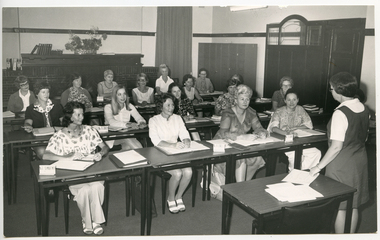 Royal District Nursing Service (now known as Bolton Clarke)
Photograph - Photograph, black and white, Barry Sutton, 1974
... Many of their senior Sisters received Postgraduate diplomas from the College of Nursing in Community Health Nursing, Education, and Administration, and several travelled overseas visiting nursing organizations viewing their public health and District nursing systems. ...Sr. Pat (Paddy) Rowley is the Principal Nurse Educator at RDNS and is giving a lecture to RDNS Sisters in the Education Department at 452 St. Kilda Rd, Melbourne. She is wearing the RDNS summer uniform of a white short sleeve blouse under a royal blue V neck tunic style frock with the RDNS insignia on the upper left.Education was an integral part of Melbourne District Nursing Society (MDNS), from its inception in 1885, later, in 1966, called Royal District Nursing Service, (RDNS). From 1885, only Trained Nurses (Nurses), through the Hospital training system, were employed by the Society, and on visits to patients they taught the necessity of hygiene and cleanliness, as well as the need for a good diet, to bring about good health. Doctor’s lectures were later given at the MDNS home to instruct patients and their families on prevention of disease. Education to patients continued throughout the years regarding health care and the use of equipment in the home. In 1961, Education programs commenced at MDNS with Trained nurses (Sisters) receiving In-service education. Sr. Pat (Paddy) Rowley was a leader in In-service Education and established the RDNS Department of Community Nursing Education in 1962. Staff could also apply for scholarships to further their education outside of RDNS. Many of their senior Sisters received Postgraduate diplomas from the College of Nursing in Community Health Nursing, Education, and Administration, and several travelled overseas visiting nursing organizations viewing their public health and District nursing systems. At RDNS many programs were run, including: a Post Basic Course, Cardiac Rehabilitation Nursing, Haematology/Oncology Nursing, Palliative Care program, Diabetic Stabilization Program, Leg Ulcer Management Program, Wound Care Specialist Program, HIV/AIDS Nursing Care, Cystic Fibrosis Home Support, Veterans Home Care Program, Breast Cancer Support Program, Continence Management Program, Stomal Therapy Program, In-Home Lactation Support Program and the Homeless Persons Program. RDNS Sisters attended several hospitals to observe and learn special care needed to some patients, e.g. to the Austin Hospital to learn the care required for paraplegic and quadriplegic patients at home, and to Mount Royal Hospital to observe the care of patients in the Rehabilitation ward. A Community Nursing Education Program was extended to student nurses from hospitals and to other nursing organizations. These Education programs kept the RDNS Sisters abreast of new techniques, such as changes in technology for e.g. new testing methods in detecting glucose levels in Diabetic patients. Sr. Nan Deakin obtained a Post Basic Certificate in Psychiatric Nursing and included this area in her Education lectures. Sr. Daphne Geldard specialized in the area of Alzheimer’s disease and Dementia. These Sisters visited patients in District areas with the regular RDNS Sister when required. Every member of staff, both professional and non professional staff, received regular education in the Education Department. In 1980, a Home Health Aide pilot study, funded by the Federal Government, the Brotherhood of St. Laurence and RDNS, with the program written and taught by Sr. Rowley, was evaluated as successful, and Home Health Aides were employed and worked in RDNS Centres under the supervision of the RDNS Sisters. This black and white photograph shows Royal District Nursing Service (RDNS) Sister Pat (Paddy) Rowley and seventeen (some partly hidden), Royal District Nursing Service (RDNS) Sisters. The bulk of the photograph shows the front view of three rows of RDNS Sisters sitting at tables which have books and sheets of paper on them. The Sisters are wearing a variety of day clothes. In the right foreground of the Photograph is a table containing papers, and standing to its right, facing the group, is the back view of Sr. Rowley, who has short dark hair and glasses. She has her left hand on a sheet of paper on the table. She is wearing her RDNS uniform of a white short sleeve blouse under a dark tunic style frock. In the rear of the photograph a brick fireplace can be seen with some books and a vase of flowers on the mantelpiece. On the right is a long curtain, some lockers and an open wooden door with glass panel. Some of the Sisters named are:- Ann Greenwood, Judy Peter, Ethel Fullarton, Barbara Lovell, Shirley Lewis, Jane Ball..Barry Sutton Stamp. Quote LY 68royal district nursing service (1966-2017), rdns, rdns education, sister ethel fullerton, sister barbara lovell, sister shirley lewis, sister jane ball, sister pat (paddy) rowley, sister ann greenwood, sister judy peter -
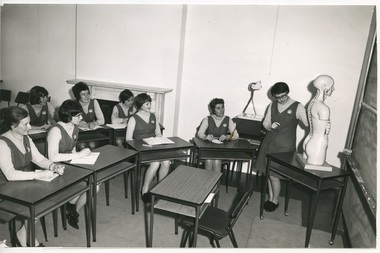 Royal District Nursing Service (now known as Bolton Clarke)
Photograph - Photograph, black and white, Barry Sutton, 14.09.1972
... Many of their senior Sisters received Postgraduate diplomas from the College of Nursing in Community Health Nursing, Education, and Administration, and several travelled overseas visiting nursing organizations viewing their public health and District nursing systems. ...This black and white photograph shows a group of RDNS Sisters who are part of the Post Basic Community Nursing Course. They are receiving education from Sr. Pat (Paddy) Rowley, RDNS Principal Nurse Educator. The session is being held in the Education Department at the Royal District Nursing Service Headquarters, 452 St. Kilda Rd, Melbourne.The RDNS winter uniform worn is a blue/grey skivvie under a blue/grey V neck tunic style herringbone winter material frock.Melbourne District Nursing Service ran its first Post-Basic Course for community nurses in 1962. Sisters attended the course for 12 weeks. The course ran annually until the mid 1990s. Education was an integral part of Melbourne District Nursing Society (MDNS), from its inception in 1885, later, in 1966, called Royal District Nursing Service, (RDNS). From 1885, only Trained nurses (Nurses) through the Hospital training system, were employed by the Society, and on visits to patients they taught the necessity of hygiene and cleanliness, as well as the need for a good diet, to bring about good health. Doctor’s lectures were later given at the MDNS home to instruct patients and their families on prevention of disease. Education to patients continued throughout the years regarding health care and the use of equipment in the home. In 1961, Education programs commenced at MDNS with their Trained nurses (Sisters) receiving In-service education. Sr. Pat (Paddy) Rowley was a leader in In-service Education and established the RDNS Department of Community Nursing Education in 1962. Staff could also apply for scholarships to further their education outside of RDNS. Many of their senior Sisters received Postgraduate diplomas from the College of Nursing in Community Health Nursing, Education, and Administration, and several travelled overseas visiting nursing organizations viewing their public health and District nursing systems. At RDNS many programs were run, including: a Post Basic Course, Cardiac Rehabilitation Nursing, Haematology/Oncology Nursing, Palliative Care program, Diabetic Stabilization Program, Leg Ulcer Management Program, Wound Care Specialist Program, HIV/AIDS Nursing Care, Cystic Fibrosis Home Support, Veterans Home Care Program, Breast Cancer Support Program, Continence Management Program, Stomal Therapy Program, In-Home Lactation Support Program and the Homeless Persons Program. RDNS staff attended several hospitals to observe and learn special care needed to some patients, e.g. to the Austin Hospital to learn the care required for paraplegic and quadriplegic patients at home, and to Mount Royal Hospital to observe the care of patients in the Rehabilitation ward. A Community Nursing Education Program was extended to student nurses from hospitals and to other nursing organizations. These Education programs kept the RDNS Sisters abreast of new techniques, such as changes in technology for e.g. new testing methods in detecting glucose levels in Diabetic patients. Sr. Nan Deakin obtained a Post Basic Certificate in Psychiatric Nursing and included this area in her Education lectures. Sr. Daphne Geldard specialized in the area of Alzheimer’s disease and Dementia. These Sisters visited patients in District areas with the regular RDNS Sister when required. Every member of staff, both professional and non professional staff, received regular education in the Education Department. In 1980, a Home Health Aide pilot study, funded by the Federal Government, the Brotherhood of St. Laurence and RDNS, with the program written and taught by Sr. Rowley, was evaluated as successful, and Home Health Aides were employed and worked in RDNS Centres under the supervision of RDNS Sisters. This black and white photograph is of a group of seven Royal District Nursing Service (RDNS) Sisters sitting in a semi-circle in two rows at single small two shelf tables. There are open white paged books or papers on each table and some of the Sisters have pens in their hands. The Sister sitting in the front far right is Sr. Affleck, who has dark short curly hair. The other Sisters have dark short hair in various styles. Further right in the photograph stands Sr. Rowley, who has dark short hair and is wearing glasses. She has her left hand supporting a torso of an anatomical model which is sitting on a table slightly to her left. She and the Sisters are looking at the vertebrae down the spine of the model. Another empty table is in front of the semi-circle and it sits in the centre foreground of the photograph. In the rear between Sr. Affleck and Sr. Rowley, a piece of equipment stands on a table. To the right of the photograph part of a large blackboard can be seen. The Sisters are wearing light grey skivvies under a darker V neck tunic style frock with the RDNS insignia on its upper left.Photographers stamp. Quote No. LD 8rdns education, rdns uniform, royal district nursing service, sister pat (paddy) rowley, sister margaret affleck -
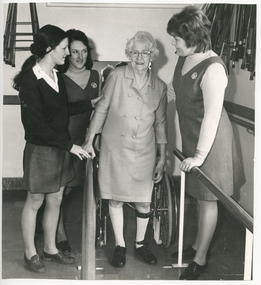 Royal District Nursing Service (now known as Bolton Clarke)
Photograph - Photograph, black and white, Barry Sutton, 20.07.1972
... Many of their senior Sisters received Postgraduate diplomas from the College of Nursing in Community Health Nursing, Education, and Administration, and several travelled overseas visiting nursing organizations viewing their public health and district nursing systems. ...The photograph is taken in the Physiotherapy Department at Mount Royal Hospital. RDNS Sr. Sue Revill is from RDNS Moorabbin Centre and Sr. Helen Watt is from Footscray Centre, They are attending an Education session on Rehabilitation at Mount Royal. Hospital. They are wearing the RDNS winter uniform of a blue/grey skivvie under a V neck tunic style herringbone winter material dress with the RDNS insignia emblazoned on its upper left.Education was an integral part of Melbourne District Nursing Society (MDNS), from its inception in 1885, later, in 1966, called Royal District Nursing Service, (RDNS). From 1885, only Trained Nurses (Nurses) who trained through the Hospital training system were employed by the Society, and on visits to patients they taught the necessity of hygiene and cleanliness, as well as the need for a good diet, to bring about good health. Doctor’s lectures were later given at the MDNS home to instruct patients and their families on prevention of disease. Education to patients continued throughout the years regarding health care and the use of equipment in the home. In 1961, Education programs commenced at MDNS with their Trained nurses (Sisters) receiving In-service education. Sister Pat (Paddy) Rowley was a leader in this In-service Education and established the MDNS, later called RDNS, Department of Community Nursing Education in 1962. Staff could also apply for scholarships to further their education outside of RDNS. Many of their senior Sisters received Postgraduate diplomas from the College of Nursing in Community Health Nursing, Education, and Administration, and several travelled overseas visiting nursing organizations viewing their public health and district nursing systems. Many programs were run at RDNS, including: a Post Basic Course, Cardiac Rehabilitation Nursing, Haematology/Oncology Nursing, Palliative Care program, Diabetic Stabilization Program, Leg Ulcer Management Program, Wound Care Specialist Program, HIV/AIDS Nursing Care, Cystic Fibrosis Home Support, Veterans Home Care Program, Breast Cancer Support Program, Continence Management Program, Stomal Therapy Program, In-Home Lactation Support Program and the Homeless Persons Program. RDNS staff attended several hospitals to observe and learn special care needed to some clients, e.g. to the Austin Hospital to learn the care required for paraplegic and quadriplegic clients at home, and to Mount Royal Hospital to observe the care of clients in the Rehabilitation ward. A Community Nursing Education Program was extended to Student nurses from Hospitals and to other nursing organizations. These Education programs kept the RDNS Sisters abreast of new techniques, such as changes in technology for e.g. new testing methods in detecting glucose levels in Diabetic patients. Sr. Nan Deakin did a Post Basic Course in Psychiatric Nursing and included this area in her education lectures. Sr. Daphne Geldard specialized in the area of Alzheimer’s disease and Dementia. These Sisters visited patients in District areas with the regular RDNS Sister when required. Every member of staff, both professional and non professional staff, received regular education in the Education Department. In 1980, a Home Health Aide pilot study, funded by the Federal Government, the Brotherhood of St. Laurence and RDNS, with the program written and taught by Sr. Rowley, was evaluated as successful, and Home Health Aides were employed and worked in RDNS Centres under the supervision of the RDNS Registered Nurses. Black and white photograph depicting, on the left, a side-on view of a Hospital Physiotherapist with her long hair drawn back in a pony tail, and wearing a grey V neck dress over a white blouse and a dark cardigan who is facing right. She has her left hand on the arm of a standing lady and her right hand on the lady's hand which is on a walking rail. To the right rear of the Physiotherapist is Royal District Nursing Service (RDNS) Sister Sue Revill who has shoulder length dark hair and is looking at the lady. To her right the elderly lady who is wearing glasses; has wavy white hair and is wearing a light grey frock, is standing in front of a wheelchair with her right hand on the walking rail. Her left arm hangs loosely by her side. To her right is a walking rail and standing to its right is Sr. Helen Watt who is looking towards the lady. She has short dark wavy hair, and has her right arm around the back of the lady and her left hand is on the walking rail. In the background of the photograph, the lower section of several 4 prong walking stick are seen hanging on the wall. Barry Sutton photographer's stamp. Quote KY 78rdns, royal district nursing service, rdns uniform, rdns education, sister sue revill, sister helen watt -
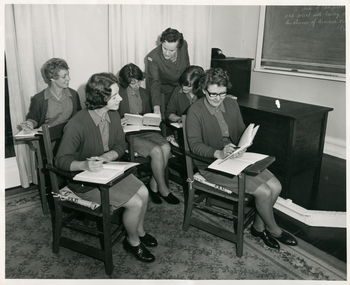 Royal District Nursing Service (now known as Bolton Clarke)
Photograph - Photograph, black and white, 07 06 1967
... Many of their senior trained nurses received Postgraduate diplomas from the College of Nursing in Community Health Nursing, Education, and Administration and several travelled overseas visiting nursing organizations viewing their public health and district nursing systems. ...Miss Evans, Director of Nursing of Royal District Nursing Service, (RDNS), is holding an Education session with RDNS staff. Her uniform is a grey skirt and jacket with the RDNS badge emblazoned on her right shoulder. The badge has a white background and black writing. The RDNS Sisters are wearing their grey uniform frocks and red cardigans. Education was an integral part of Melbourne District Nursing Society (MDNS), from its inception in 1885, later, in 1966, called Royal District Nursing Service, (RDNS). From 1885, only Trained Nurses, through the hospital training system, were employed by the Society, and on visits to patients they taught the necessity of hygiene and cleanliness, as well as the need for a good diet, to bring about good health. Doctor’s lectures were later given at the MDNS home to instruct patients and their families on prevention of disease. Education to patients continued throughout the years regarding health care and the use of equipment in the home. In 1961, Education programs commenced at MDNS with Sisters receiving In-service education. Sr. Pat (Paddy) Rowley was a leader in In-service Education and established the RDNS Department of Community Nursing Education in 1962. Staff could also apply for scholarships to further their education outside of RDNS. Many of their senior trained nurses received Postgraduate diplomas from the College of Nursing in Community Health Nursing, Education, and Administration and several travelled overseas visiting nursing organizations viewing their public health and district nursing systems. At RDNS many programs were run, including: a Post Basic Course, Cardiac Rehabilitation Nursing, Haematology/Oncology Nursing, Palliative Care program, Diabetic Stabilization Program, Leg Ulcer Management Program, Wound Care Specialist Program, HIV/AIDS Nursing Care, Cystic Fibrosis Home Support, Veterans Home Care Program, Breast Cancer Support Program, Continence Management Program, Stomal Therapy Program, In-Home Lactation Support Program and the Homeless Persons Program. RDNS staff attended several hospitals to observe and learn special care needed to some clients, e.g. to the Austin Hospital to learn the care required for paraplegic and quadriplegic clients at home, and to Mount Royal Hospital to observe the care of clients in the Rehabilitation ward. A Community Nursing Education Program was extended to student nurses from hospitals and to other nursing organizations. These Education programs kept the RDNS Sisters abreast of new techniques, such as changes in technology for e.g. new testing methods in detecting glucose levels in Diabetic patients. Sr. Nan Deakin obtained a Post Basic Certificate in Psychiatric Nursing and included this area in her education lectures. Sr. Daphne Geldard specialized in the area of Alzheimer’s disease and Dementia. These Sisters visited patients in District areas with the regular RDNS Sister when required. Every member of staff, both professional and non professional staff, received regular education in the Education Department. In 1980, a Home Health Aide pilot study, funded by the Federal Government, the Brotherhood of St. Laurence and RDNS, with the program written and taught by Sr. Rowley, was evaluated as successful, and Home Health Aides were employed and worked in RDNS Centres under the supervision of the RDNS Registered Nurses. Black and white photograph showing Miss Mary Evan standing in the centre rear of the photograph. She is with five RDNS Sisters who have short hair, three with curly hair and two with straight hair, who are sitting on chairs with white paged books resting on 'over the lap' tables. Three Sisters are seated in front of Miss Evans, and another two Sisters are sitting in the foreground. Miss Evans, who has short dark curled hair, is wearing her grey uniform jacket which can be seen with the RDNS cloth badge visible at the top of her right sleeve. She is bending over one of the Sisters and has her right hand pointing to something on the Sister's book. Closed light curtains are seen in the rear of the photograph and a dark desk to the right. On the wall above this, part of a blackboard can be seen.Photographers stamp. Quote No. GF 28rdns, royal district nursing service, rdns education, miss mary evans, rdns d.o.n -
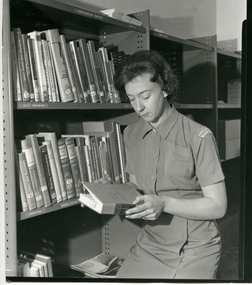 Royal District Nursing Service (now known as Bolton Clarke)
Photograph - Photograph, black and white, c.1967
... Many of their senior trained nurses received Postgraduate diplomas from the College of Nursing in Community Health Nursing, Education, and Administration, and several travelled overseas visiting nursing organizations viewing their public health and district nursing systems. ...Sister Rignall is undergoing In-service education at RDNS and is wearing the grey RDNS uniform of that era.Education was an integral part of Melbourne District Nursing Society (MDNS), from its inception in 1885, later, in 1966, called Royal District Nursing Service, (RDNS). From 1885, only Trained Nurses who trained through the Hospital training system were employed by the Society, and on visits to patients they taught the necessity of hygiene and cleanliness, as well as the need for a good diet, to bring about good health. Doctor’s lectures were later given at the MDNS home to instruct patients and their families on prevention of disease. Education to patients continued throughout the years regarding health care and the use of equipment in the home. In 1961, Education programs commenced at MDNS with nurses receiving In-service education. Sr. Pat (Paddy) Rowley was a leader in this In-service Education and established the MDNS, later called RDNS, Department of Community Nursing Education in 1962. Staff could also apply for scholarships to further their education outside of RDNS. Many of their senior trained nurses received Postgraduate diplomas from the College of Nursing in Community Health Nursing, Education, and Administration, and several travelled overseas visiting nursing organizations viewing their public health and district nursing systems. Many programs were run at RDNS, including: a Post Basic Course, Cardiac Rehabilitation Nursing, Haematology/Oncology Nursing, Palliative Care program, Diabetic Stabilization Program, Leg Ulcer Management Program, Wound Care Specialist Program, HIV/AIDS Nursing Care, Cystic Fibrosis Home Support, Veterans Home Care Program, Breast Cancer Support Program, Continence Management Program, Stomal Therapy Program, In-Home Lactation Support Program and the Homeless Persons Program. RDNS staff attended several hospitals to observe and learn special care needed to some clients, e.g. to the Austin Hospital to learn the care required for paraplegic and quadriplegic clients at home, and to Mount Royal Hospital to observe the care of clients in the Rehabilitation ward. A Community Nursing Education Program was extended to student nurses from hospitals and to other nursing organizations. These Education programs kept the RDNS Sisters abreast of new techniques, such as changes in technology for e.g. new testing methods in detecting glucose levels in Diabetic patients. Sr. Nan Deakin did a Post Basic Course in Psychiatric Nursing and included this area in her education lectures. Sr. Daphne Geldard specialized in the area of Alzheimer’s disease and Dementia. These Sisters visited patients in District areas with the regular RDNS Sister when required. Every member of staff, both professional and non professional staff, received regular education in the Education Department. Black and white photograph showing Royal District Nursing Service (RDNS), Sister J. Rignall using the Library facilities at RDNS. Sister Rignall has short curly hair and is wearing her short sleeve grey uniform frock; the RDNS insignia is seen at the top of her left sleeve. She is standing and looking down at a book she is holding. Shelves of library books are seen running behind her on her left hand side.Photographers Stamp and Quote No. GW 94melbourne district nursing society, mdns, royal district nursing service, rdns, rdns education, rdns library, sister j. rignall -
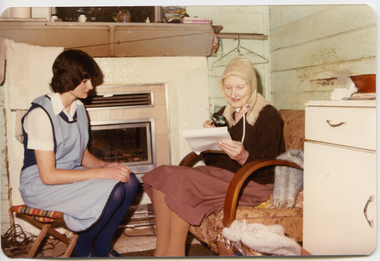 Royal District Nursing Service (now known as Bolton Clarke)
Photograph - Photograph, colour, c.1975
... Many of their senior Sisters received Postgraduate diplomas from the College of Nursing in Community Health Nursing, Education, and Administration, and several travelled overseas visiting nursing organizations viewing their public health and district nursing systems. ...This photograph is taken in Mrs. McDonald's home and she is reading information provided to her by Sister Faye Cook of the Royal District Nursing Service (RDNS) who is visiting to provide her with nursing care. Written communication is required between Mrs. McDonald and Sr. Cook. Sisters from the Royal District Nursing Service (RDNS) used various means to communicate with their patients who had various health conditions. Sometimes this was by written word, using interpreters or using digital devices. The RDNS Education department wrote instructions for patients to follow for various conditions and treatments to assist them in their care. The attending Sister discussed the instructions and left the leaflet with the patient. Examples of instruction included on how to sterilize dressings and equipment in the home and another giving information and instructions on diabetic care.. Education was an integral part of Melbourne District Nursing Society (MDNS), from its inception in 1885, later, in 1966, called Royal District Nursing Service, (RDNS). From 1885, only Trained Nurses (Nurses) who trained through the Hospital training system were employed by the Society, and on visits to patients they taught the necessity of hygiene and cleanliness, as well as the need for a good diet, to bring about good health. Doctor’s lectures were later given at the MDNS home to instruct patients and their families on prevention of disease. Education to patients continued throughout the years regarding health care and the use of equipment in the home. In 1961, Education programs commenced at MDNS with their Trained nurses (Sisters) receiving In-service education. Sr. Pat (Paddy) Rowley was a leader in this In-service Education and established the MDNS, later called RDNS, Department of Community Nursing Education in 1962. Staff could also apply for scholarships to further their education outside of RDNS. Many of their senior Sisters received Postgraduate diplomas from the College of Nursing in Community Health Nursing, Education, and Administration, and several travelled overseas visiting nursing organizations viewing their public health and district nursing systems. Many programs were run at RDNS, including: a Post Basic Course, Cardiac Rehabilitation Nursing, Haematology/Oncology Nursing, Palliative Care program, Diabetic Stabilization Program, Leg Ulcer Management Program, Wound Care Specialist Program, HIV/AIDS Nursing Care, Cystic Fibrosis Home Support, Veterans Home Care Program, Breast Cancer Support Program, Continence Management Program, Stomal Therapy Program, In-Home Lactation Support Program and the Homeless Persons Program. RDNS staff attended several hospitals to observe and learn special care needed to some clients, e.g. to the Austin Hospital to learn the care required for paraplegic and quadriplegic clients at home, and to Mount Royal Hospital to observe the care of clients in the Rehabilitation ward. A Community Nursing Education Program was extended to student nurses from hospitals and to other nursing organizations. These Education programs kept the RDNS Sisters abreast of new techniques, such as changes in technology for e.g. new testing methods in detecting glucose levels in Diabetic patients. Sr. Nan Deakin did a Post Basic Course in Psychiatric Nursing and included this area in her education lectures. Sr. Daphne Geldard specialized in the area of Alzheimer’s disease and Dementia. These Sisters visited patients in District areas with the regular RDNS Sister when required. Every member of staff, both professional and non professional staff, received regular education in the Education Department. In 1980, a Home Health Aide pilot study, funded by the Federal Government, the Brotherhood of St. Laurence and RDNS, with the program written and taught by Sr. Rowley, was evaluated as successful, and Home Health Aides were employed and worked in RDNS Centres under the supervision of the RDNS Registered Nurses. Coloured photograph of Sister Faye Cook of the Royal District Nursing Service (RDNS), sitting with Mrs McDonald who is reading the top page of a white writing pad. On the left, sitting 'side on' looking at Mrs McDonald, is Sister Cook who has short dark hair, and is wearing her pale blue RDNS apron over her RDNS royal blue V neck tunic style frock which is over her short sleeve white blouse; she is wearing blue stockings. She is seated on a striped low stool in Mrs. McDonald's room. Mrs.McDonald is to her right, and is seated in a bone and brown patterned lounge chair with wooden arms. She has a bone coloured wrap over her hair, and is wearing a dark brown V neck jumper over a deep pink frock. She is hoding a magnifying glass in her right hand and is reading information on a white writing pad which she is holding in her left hand. In the rear of the photograph is a gas type fire set into a fireplace. A white cupboard with a drawer is seen to the right hand side. The wall behind is vertical boards.Red coloured 'Kodak' stamps. Handwritten information.royal district nursing service, rdns, rdns education, mrs mcdonald, sister faye cook -
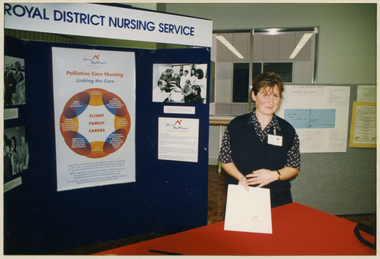 Royal District Nursing Service (now known as Bolton Clarke)
Photograph - Photograph, colour, c.2000
... Many of their senior Sisters received Postgraduate diplomas from the College of Nursing in Community Health Nursing, Education, and Administration and several travelled overseas visiting nursing organizations viewing their public health and district nursing systems. ...This photograph shows some of the information documents displayed on boards during an Education session on Palliative Care run by the Royal District Nursing Service Education Department.Education was an integral part of Melbourne District Nursing Society (MDNS), from its inception in 1885, later, in 1966, called Royal District Nursing Service, (RDNS). From 1885, only Trained Nurses (Nurses), through the Hospital training system, were employed by the Society, and on visits to patients they taught the necessity of hygiene and cleanliness, as well as the need for a good diet, to bring about good health. Doctor’s lectures were later given at the MDNS home to instruct patients and their families on prevention of disease. Education to patients continued throughout the years regarding health care and the use of equipment in the home. In 1961, Education programs commenced at MDNS with their Trained nurses (Sisters) receiving In-service education. Sr. Pat (Paddy) Rowley was a leader in In-service Education and established the RDNS Department of Community Nursing Education in 1962. Staff could also apply for scholarships to further their education outside of RDNS. Many of their senior Sisters received Postgraduate diplomas from the College of Nursing in Community Health Nursing, Education, and Administration and several travelled overseas visiting nursing organizations viewing their public health and district nursing systems. At RDNS many programs were run, including: a Post Basic Course, Cardiac Rehabilitation Nursing, Haematology/Oncology Nursing, Palliative Care program, Diabetic Stabilization Program, Leg Ulcer Management Program, Wound Care Specialist Program, HIV/AIDS Nursing Care, Cystic Fibrosis Home Support, Veterans Home Care Program, Breast Cancer Support Program, Continence Management Program, Stomal Therapy Program, In-Home Lactation Support Program and the Homeless Persons Program. RDNS staff attended several hospitals to observe and learn special care needed to some clients, e.g. to the Austin Hospital to learn the care required for paraplegic and quadriplegic clients at home, and to Mount Royal Hospital to observe the care of clients in the Rehabilitation ward. A Community Nursing Education Program was extended to student nurses from hospitals and to other nursing organizations. These Education programs kept the RDNS Sisters abreast of new techniques, such as changes in technology for e.g. new testing methods in detecting glucose levels in Diabetic patients. Sr. Nan Deakin obtained a Post Basic Certificate in Psychiatric Nursing and included this area in her Education lectures. Sr. Daphne Geldard specialized in the area of Alzheimer’s disease and Dementia. These Sisters visited patients in District areas with the regular RDNS Sister when required. Every member of staff, both professional and non professional staff, received regular education in the Education Department. In 1980, a Home Health Aide pilot study, funded by the Federal Government, the Brotherhood of St. Laurence and RDNS, with the program written and taught by Sr. Rowley, was evaluated as successful, and Home Health Aides were employed and worked in RDNS Centres under the supervision of the RDNS SistersColoured photograph of a Royal District Nursing Service (RDNS) Sister standing in front of a Palliative Nursing Display board. The board has a white banner across the top with the dark blue words 'Royal District Nursing Service' written in capital letters. There are several light coloured background posters displayed on the large dark coloured display board. The Sister, who has her dark hair drawn up, is wearing a RDNS blue and white patterned blouse and short sleeve V neck dark blue jumper with a name badge attached on the upper left. The Sister is holding.a white sheet of paper. Part of a red covered table is seen in front of her. A mid green board with documents attached to it is behind and to the right of the Sister. Behind this is a pale green wall with part of a bench and two large windows showing a room beyond.royal district nursing service, rdns, rdns palliative care nursing, rdns education -
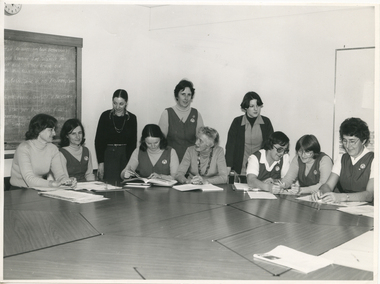 Royal District Nursing Service (now known as Bolton Clarke)
Photograph - Photograph, black and white, Barry Sutton, c.1970
... Many of their senior Sisters graduated from the College of Nursing in Community Health, Education and Administration and several travelled overseas visiting nursing organizations viewing their public health and district nursing systems. ...Miss Wright is the Education Director of Royal District Nursing Service (RDNS) and is giving a lecture to the RDNS staff. Two of the RDNS Sisters are wearing their summer uniform which was a royal blue V necked tunic style frock, with the RDNS badge emblazoned on the upper left hand side, over a short sleeved white blouse. Three of the Sisters are wearing their winter uniform of a blue/grey skivvy under a blue/grey herringbone V neck tunic style winter material dress.Education was an integral part of Melbourne District Nursing Society (MDNS), from its inception in 1885, later, in 1966, called Royal District Nursing Service, (RDNS). From 1885, only Trained nurses (Nurses), through the Hospital training system, were employed by the Society, and on visits to patients they taught the necessity of hygiene and cleanliness, as well as the need for a good diet, to bring about good health. Doctor’s lectures were later given at the MDNS home to instruct patients and their families on prevention of disease. Education to patients continued throughout the years regarding health care and the use of equipment in the home. In 1961, Education programs commenced at MDNS with their Trained nurses (Sisters) receiving In-service education. Sister Pat (Paddy) Rowley was a leader in In-service Education and established the RDNS Department of Community Nursing Education in 1962. Staff could also apply for scholarships to further their education outside of RDNS. Many of their senior Sisters graduated from the College of Nursing in Community Health, Education and Administration and several travelled overseas visiting nursing organizations viewing their public health and district nursing systems. At RDNS many programs were run, including: a Post Basic Course, Cardiac Rehabilitation Nursing, Haematology/Oncology Nursing, Palliative Care program, Diabetic Stabilization Program, Leg Ulcer Management Program, Wound Care Specialist Program, HIV/AIDS Nursing Care, Cystic Fibrosis Home Support, Veterans Home Care Program, Breast Cancer Support Program, Continence Management Program, Stomal Therapy Program, In-Home Lactation Support Program and the Homeless Persons Program. RDNS staff attended several hospitals to observe and learn special care needed to some clients, e.g. to the Austin Hospital to learn the care required for paraplegic and quadriplegic clients at home, and to Mount Royal Hospital to observe the care of clients in the Rehabilitation ward. A Community Nursing Education Program was extended to student nurses from hospitals and to other nursing organizations. These Education programs kept the RDNS Sisters abreast of new techniques, such as changes in technology for e.g. new testing methods in detecting glucose levels in Diabetic patients. Sr. Nan Deakin did a Post Basic Course in Psychiatric Nursing and included this area in her education lectures. Sr. Daphne Geldard specialized in the area of Alzheimer’s disease and Dementia. These Sisters visited patients in District areas with the regular RDNS Sister when required. Every member of staff, both professional and non professional staff, received regular education in the Education Department. In 1980, a Home Health Aide pilot study, funded by the Federal Government, the Brotherhood of St. Laurence and RDNS, with the program written and taught by Sr. Rowley, was evaluated as successful, and Home Health Aides were employed and worked in RDNS Centres under the supervision of the RDNS SistersBlack and white photograph showing Royal District Nursing Service (RDNS), Miss Ora Wright seated at a table in discussion amid a group of nine RDNS Educators, Physiotherapists and Clerical staff. Miss Wright has short light coloured hair and has her head turned to her right. She is wearing a long necklace of mixed coloured beads over a light coloured top. Three of the staff are standing behind the seated group. Three staff are seated either side of Miss Wright. Two of the RDNS Educators are wearing white short sleeve blouses under a V neck tunic style dress and the other three are wearing a light coloured skivvy under a V neck grey tunic style dress. The RDNS insignia on a white background can be seen on the upper left of each RDNS uniforms. A blackboard full of white writing can be seen in the left rear of the photograph and several tables joined together are in the foreground. Two books and several sheets of white paper are in front of the seated staff.Photographer stamp. Quote No. DR 12royal district nursing service, rdns, rdns education, rdns clerical staff, rdns physiotherapist, miss ora wright -
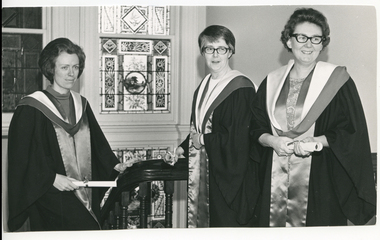 Royal District Nursing Service (now known as Bolton Clarke)
Photograph - Photograph, black and white, Barry Sutton, 13.07.1971
... Many of their senior trained nurses received postgraduate diplomas from the College of Nursing in Community Health Nursing, Education, and Administration, and several travelled overseas visiting nursing organizations viewing their public health and District nursing systems. royal district nursing service rdns fellows of acn sister joanne wilkinson miss norma bryan sister pat (paddy) rowley Photographer stamp. ...The photograph was taken on the stairs at the Royal District Nursing Service (RDNS), Headquarters, 452 St. Kilda Road, Melbourne, after Sister Joanne Wilkinson, Nurse Educator, Sister Pat (Paddy) Rowley, RDNS Principal Nurse Educator, and Miss Norma Bryan, RDNS Deputy Director of Nursing, were awarded Fellowships of the Australian College of Nursing. Their regalia worn as Fellows, was a black gown with the wide trim to the front edges of scarlet satin and the regalia hood of inner white and outer scarlet satin. The Australian College of Nursing (ACN) describes the award as follows:- "Fellowship of the Australian College of Nursing (ACN) is a prestigious member status awarded to nurses in recognition of significant professional achievement. Fellowship recognizes the experience and contribution of nurse leaders to ACN and the profession." RDNS senior nursing staff could apply for scholarships to further their education outside of RDNS. Many of their senior trained nurses received postgraduate diplomas from the College of Nursing in Community Health Nursing, Education, and Administration, and several travelled overseas visiting nursing organizations viewing their public health and District nursing systems.Black and white photograph of three Royal District Nursing Service (RDNS) staff members standing on stairs in front of a long stain glass window; left to right - Sister Joanne Wilkinson, Sister Pat (Paddy) Rowley and Miss Norma Bryan. The three members are wearing their black gowns with regalia of light coloured edges and their hood of a white V band with dark band edge. Sister Wilkinson, who has short dark hair, is wearing a grey coloured top under her regalia, and is holding her rolled certificate, with a ribbon and bow, in her right hand and has her left hand on the stair rail. Sister Rowley has short dark hair and is wearing dark rimmed glasses; she has a white top under her regalia and is standing side on towards Sr. Wilkinson with her head turned toward the front. She has her certificate in her right hand with her wrist resting on the stair rail. Miss Bryan, who is smiling, has dark curled hair and is wearing dark rimmed glasses. She is wearing a patterned top under her regalia and has her hands clasped to the front holding her certificate. Part of the stair rail can be seen to her right On the wall between Sister Wilkinson and Sister Rowley are three vertical stain glass windows.Photographer stamp. Quote No. KJ 58royal district nursing service, rdns, fellows of acn, sister joanne wilkinson, miss norma bryan, sister pat (paddy) rowley -
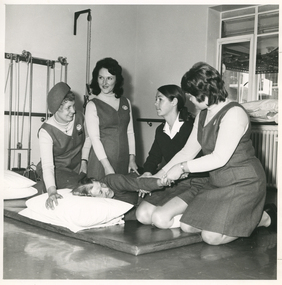 Royal District Nursing Service (now known as Bolton Clarke)
Photograph - Photograph, black and white, Barry Sutton, 20.07.1972
... Many of their senior Sisters received Postgraduate diplomas from the College of Nursing in Community Health Nursing, Education, and Administration, and several travelled overseas visiting nursing organizations viewing their Public health and District nursing systems. ...This photograph is taken in the Physiotherapy Department at Mount Royal Rehabilitation Hospital. The Physiotherapist is giving an Education session to RDNS Sisters. The Sisters are wearing the RDNS winter uniform, which was a blue/grey herringbone winter material V neck tunic style frock over a blue/grey skivvie. Sr. Peter is wearing the uniform beret style hat which was made of the herringbone winter material. Education was an integral part of Melbourne District Nursing Society (MDNS), from its inception in 1885, later, in 1966, called Royal Education was an integral part of Melbourne District Nursing Society (MDNS), from its inception in 1885, later, in 1966, called Royal District Nursing Service, (RDNS). From 1885, only Trained Nurses (Nurses) who trained through the Hospital training system were employed by the Society, and on visits to patients they taught the necessity of hygiene and cleanliness, as well as the need for a good diet, to bring about good health. Doctor’s lectures were later given at the MDNS home to instruct patients and their families on prevention of disease. Education to patients continued throughout the years regarding health care and the use of equipment in the home. In 1961, Education programs commenced at MDNS with their Trained nurses (Sisters) receiving In-service education. Sr. Pat (Paddy) Rowley was a leader in this In-service Education and established the MDNS, later called RDNS, Department of Community Nursing Education in 1962. Staff could also apply for scholarships to further their education outside of RDNS. Many of their senior Sisters received Postgraduate diplomas from the College of Nursing in Community Health Nursing, Education, and Administration, and several travelled overseas visiting nursing organizations viewing their Public health and District nursing systems. Many programs were run at RDNS, including: a Post Basic Course, Cardiac Rehabilitation Nursing, Haematology/Oncology Nursing, Palliative Care program, Diabetic Stabilization Program, Leg Ulcer Management Program, Wound Care Specialist Program, HIV/AIDS Nursing Care, Cystic Fibrosis Home Support, Veterans Home Care Program, Breast Cancer Support Program, Continence Management Program, Stomal Therapy Program, In-Home Lactation Support Program and the Homeless Persons Program. RDNS staff attended several hospitals to observe and learn special care needed to some clients, e.g. to the Austin Hospital to learn the care required for paraplegic and quadriplegic clients at home, and to Mount Royal Hospital to observe the care of clients in the Rehabilitation ward. A Community Nursing Education Program was extended to student nurses from hospitals and to other nursing organizations. These Education programs kept the RDNS Sisters abreast of new techniques, such as changes in technology for e.g. new testing methods in detecting glucose levels in Diabetic patients. Sr. Nan Deakin did a Post Basic Course in Psychiatric Nursing and included this area in her education lectures. Sr. Daphne Geldard specialized in the area of Alzheimer’s disease and Dementia. These Sisters visited patients in District areas with the regular RDNS Sister when required. Every member of staff, both professional and non professional staff, received regular education in the Education Department. In 1980, a Home Health Aide pilot study, funded by the Federal Government, the Brotherhood of St. Laurence and RDNS, with the program written and taught by Sr. Rowley, was evaluated as successful, and Home Health Aides were employed and worked in RDNS Centres under the supervision of the RDNS Registered Nurses. Black and white photograph showing Royal District Nursing Service (RDNS), Sisters observing in a Physiotherapy Department. Left to right - Sisters Judy Peter, who is wearing her uniform beret over her light coloured curly hair, and kneeling and leaning over, with her right hand resting on a white pillow which is on a large thick mat. Next is Sr. Sue Revill, who has dark shoulder length curled hair and is kneeling behind a lady who is lying on her left side on a the mat which is on the floor. She has her head on a white pillow and facing frontward. She has light coloured curled hair and is wearing a dark grey long sleeve top. Next is the Physiotherapist, who has long dark hair drawn back in a pony tail and is wearing a dark cardigan over a white blouse and grey frock. She is kneeling on the mat with her hands on the lady's side. Sister Helen Watt, who has collar length curled hair is kneeling to her right and is holding the lady's outstretched right arm and hand and looking toward the Physiotherapist. The Sisters are wearing the RDNS uniform of a light grey skivvie under a V neck tunic style dress with the RDNS insignia on the upper left. In the background are some some vertical bars attached to the wall and part of a pillow can be seen in front of these on the large mat. On the right of the photograph is a heater and above this windows are seen. Photographer stamp. Quote No. KY 82royal district nursing service, rdns, rdns education, sister judy peter, sister sue revill, sister helen watt -
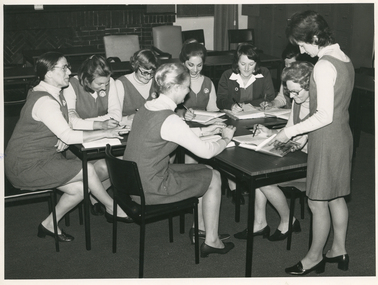 Royal District Nursing Service (now known as Bolton Clarke)
Photograph - Photograph, black and white, 24.04.1974
... Many of their senior Sisters graduated from the College of Nursing in Community Health, Education and Administration and several travelled overseas visiting nursing organizations viewing their public health and District nursing systems. ...Sister Gawith is a Nurse Educator with Royal District Nursing Service (RDNS) and she is instructing a group of RDNS Sisters during an Advanced Post Basic Course being held in a room in the Education Department at RDNS. Most of the Sisters are wearing the RDNS winter uniform, which at that time was a V neck tunic style dress made of blue/grey herringbone winter material, over a blue/grey skivvie. Sr. Moore is wearing the summer uniform of a royal blue V neck tunic style dress worn over a short sleeve white blouse and a dark blue cardigan.Education was an integral part of Melbourne District Nursing Society (MDNS), from its inception in 1885, later, in 1966, called Royal District Nursing Service, (RDNS). From 1885, only Trained Nurses (Nurses), through the Hospital training system, were employed by the Society, and on visits to patients they taught the necessity of hygiene and cleanliness, as well as the need for a good diet, to bring about good health. Doctor’s lectures were later given at the MDNS home to instruct patients and their families on prevention of disease. Education to patients continued throughout the years regarding health care and the use of equipment in the home. In 1961, Education programs commenced at MDNS with Trained nurses (Sisters) receiving In-service Education. Sr. Pat (Paddy) Rowley was a leader in In-service Education and established the RDNS Department of Community Nursing Education in 1962. Staff could also apply for scholarships to further their education outside of RDNS. Many of their senior Sisters graduated from the College of Nursing in Community Health, Education and Administration and several travelled overseas visiting nursing organizations viewing their public health and District nursing systems. At RDNS many programs were run, including: a Post Basic Course, Cardiac Rehabilitation Nursing, Haematology/Oncology Nursing, Palliative Care program, Diabetic Stabilization Program, Leg Ulcer Management Program, Wound Care Specialist Program, HIV/AIDS Nursing Care, Cystic Fibrosis Home Support, Veterans Home Care Program, Breast Cancer Support Program, Continence Management Program, Stomal Therapy Program, In-Home Lactation Support Program and the Homeless Persons Program. RDNS staff attended several hospitals to observe and learn special care needed to some clients, e.g. to the Austin Hospital to learn the care required for paraplegic and quadriplegic patients at home, and to Mount Royal Hospital to observe the care of patients in the Rehabilitation ward. A Community Nursing Education Program was extended to student nurses from Hospitals and to other nursing organizations. These Education programs kept the RDNS Sisters abreast of new techniques, such as changes in technology for e.g. new testing methods in detecting glucose levels in Diabetic patients. Sr. Nan Deakin did a Post Basic Course in Psychiatric Nursing and included this area in her Education lectures. Sr. Daphne Geldard specialized in the area of Alzheimer’s disease and Dementia. These Sisters visited patients in District areas with the regular RDNS Sister when required. Every member of staff, both professional and non professional staff, received regular education in the Education Department. In 1980, a Home Health Aide pilot study, funded by the Federal Government, the Brotherhood of St. Laurence and RDNS, with the program written and taught by Sr. Rowley, was evaluated as successful, and Home Health Aides were employed and worked in RDNS Centres under the supervision of the RDNS Sisters. The black and white photograph depicts a group of eight Royal District Nursing Service (RDNS) Sisters (Sr) seated and looking at, and some writing in, white paged books on tables in front of them. Seated in a semi-circle are. L - R: a Sister who is wearing glasses and has her dark shoulder length hair drawn back, then Sisters: Yvonne Laird, who has collar length dark hair, Anne Greenwood, who wears glasses and has short dark curled hair, a Sr with her long hair drawn back, then Sue Moore with shoulder length dark hair and wearing a dark V neck tunic style frock over a white blouse, and a dark cardigan. The next Sister, with dark hair, is partly hidden and next to her is Ethel Fullerton. who wears glasses and has curly hair. She is sitting with a pen in her right hand poised over white book. Sr. Mary Gawith, who has short dark curled hair, is standing in front of and slightly to the right of her. She is looking down at Sr. Fullerton and is holding an open book with the end of the spine resting on her table and showing the open pages to Sr. Fullerton. Sr. Judy Peter, who has her blonde hair drawn back, is sitting side-on in the centre foreground of the photograph with her arms resting on the other side of Sr. Fullerton's table. Most Sisters are wearing the RDNS winter uniform, of a V neck grey tunic style dress over a light grey skivvie. Photographer Stamp. Quote No. MA 22royal district nursing service, rdns, rdns education, sister mary gawith, sister yvonne laird, sister ethel fullerton, sister anne greenwood, sister sue moore (nee revill)
