



Historical information
The Northern District School of Nursing in Victoria, Australia Graduates Association:
History of the School
Managed by a committee including hospital administrators, medical professionals, and nursing leaders from several regional hospitals. Associated with major hospitals in the Northern District, including Bendigo Base, Mildura Base, Castlemaine, Echuca, Swan Hill, St. Arnaud, and Kyneton District Hospitals.
Provide high-quality theoretical and practical nursing training. Raise the standard of nursing education in the region. Maintain the highest principles of nursing practice. Applicants must be at least 17 years old and hold a Proficiency Certificate or higher educational qualification. Application involves submitting forms, certificates, an interview, an aptitude test, and a medical examination.
A three-month probationary period follows initial acceptance. Preliminary Training School: Four-week introductory course covering basic nursing, anatomy, hygiene, and practical skills. Practical experience in various hospital departments, guided by senior staff. Study Block Plan: Includes several blocks of theoretical and practical instruction throughout the three-year program.
Regular school exams and two state exams (First Professional and Final State) are required for progression and graduation. Nurses work a 40-hour week with at least one or two days off per week and three weeks of annual leave. Accommodation is provided in comfortable hostels with good facilities. Uniforms are supplied free; nurses provide their own shoes and stockings. Salaries and allowances are regulated, with deductions for board and free medical care.
Additional Information Post-Graduate Opportunities. Senior positions require further experience and additional certificates (e.g., Midwifery, Infant Welfare).Diploma courses available in administration, teaching, and specialized nursing fields. Bursaries are available for advanced study.Career Prospects: Graduates can pursue roles in administration, teaching, ward and departmental leadership, district and visiting nursing, industrial and school nursing, and more.
Opportunities existed both within hospitals and in community or specialized settings.FAQs and Practical Details. Minimal training costs (mainly exam fees and personal items).Living out allowances and travel expenses are covered. Four training intakes per year; waiting periods are short if qualifications are met.
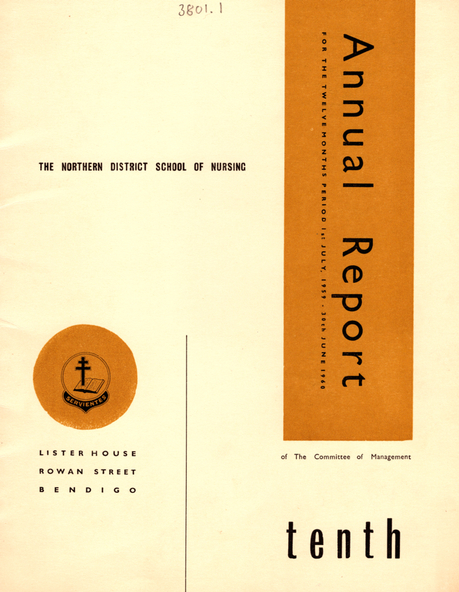
10th ANNUAL REPORT
Here are the key points from the annual report of the Northern District School of Nursing for the year ending June 30, 1960:1. The Committee of Management included medical, nursing, and educational leaders from regional hospitals and schools. Dr. Peter Slater, a founding member and major contributor, passed away in 1960 and was honored for his service.
The tutorial and clerical staff lists reflect several changes, with notable resignations and new appointments. The School celebrated its tenth anniversary in March 1960, marking a decade since its first intake in 1950. It was the first independent nursing school in Australia, contributing significantly to nursing education history.
A new kitchen-dining block was completed, improving meal services and social spaces.Upgrades included a second demonstration classroom, improved lighting and heating, and renovations to hostels and administrative areas. Some maintenance issues remained, particularly with older hostels and the need for a new administrative block.4.
A post-graduate Staff Nurse Training Course was introduced to retain and further develop graduates within the region. The study block plan was revised to distribute nurse absences more evenly, increasing the number of study blocks from 9 to 14 per year. The School faced challenges balancing educational needs with hospital staffing requirements. Certificates were awarded to several graduates who completed the new Staff Nurse Training Course.
The report details causes of student attrition, including exam failures, personal reasons, health, marriage, and disciplinary actions. The School hosted significant conferences, including the Royal Victorian College of Nursing's tutors' conference, fostering professional development and networking. The School's finances were stable, with government grants as the main income source and detailed accounts of expenditures and assets provided. The report expresses gratitude to staff, the Hospitals and Charities Commission, and associated hospitals for their support and cooperation.
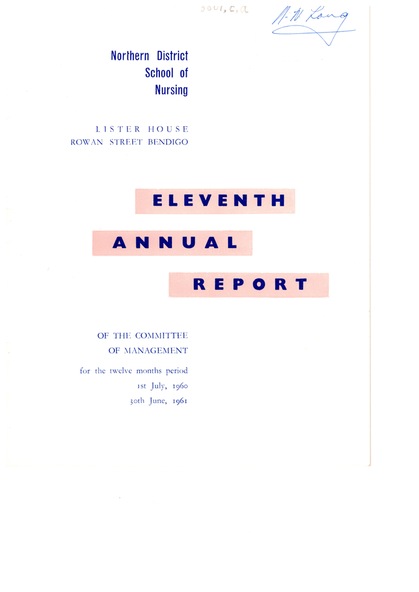
11th ANNUAL REPORT
Here are the key points from the Eleventh Annual Report (1960-1961) of the Committee of Management for the Northern District School of Nursing, Bendigo: Ongoing issues with deteriorating retaining walls and outbuildings at school residences. Committee sought approval for a staged building program: administrative/classroom unit, hostel accommodation, and demonstration/practical classroom unit.
Urgent need for improved office and classroom facilities due to inadequate current conditions. Routine repairs and upgrades (painting, new heaters, floor coverings, clothes dryers). Plans for garage repairs and replacement of retaining walls at hostels. Significant improvements with new anatomical models and demonstration equipment, enhancing teaching quality.
No major changes to the basic curriculum; continued use of study block plan across all years. Ongoing challenges in teaching Invalid Cookery due to lack of facilities and qualified teachers. Concerns about overloading introductory courses and the impact of staff shortages on student preparedness. 74 students sat the First Professional Examination: 63 passed initially, 5 passed supplementary, 2 failed and terminated, 3 did not re-sit.65 students sat the Final State Examination: 2 failed whole exam, 4 failed Medical Nursing, 2 failed Surgical Nursing; all passed supplementary exams.
Recommendation that students struggling by the 15th month consider Nursing Aide work.Staff Nurse CoursePostgraduate courses held for staff nurses, including visits to metropolitan and local hospitals and organizations. High standard of lectures and appreciation from students. Staff attended post-graduate courses; Miss Bannfield-Smith awarded Florence Nightingale Scholarship. Miss Long received a Rockefeller Foundation grant for study in the US and Canada.Recruitment and Student Demographics 69 new recruits from various regional hospitals.2 07 students in training as of June 30, 1961, with diverse educational backgrounds.
33 students left due to exam failure, marriage, dislike of nursing, personal or health reasons, or family needs. Several resignations and new appointments among tutorial, supervisory, and domestic staff.
Total expenditure: £37,561; total income: £36,898, resulting in a deficit of £663 for the year. Main expenses: salaries, provisions, domestic costs, repairs, and administration. Dr. P. R. Slater MemorialA memorial ceremony and placement of a commemorative painting in honor of Dr. Slater, the first chairman.Hosted meetings for medical and nursing associations, and provided hospitality for visiting nurses during the International Nursing Congress.
Physical description
Northern District School of Nursing Graduates Association - 10th and 11th Annual Reports, 1959-1960 and 1960-61
This item contains the following documents:
3801.1a 10th Annual Report Front Cover
3801.1b The annual report of the Northern District School of Nursing for the year ending June 30, 1960
3801.1c 11th Annual Report Front Cover
3801.1d The Eleventh Annual Report (1960-1961) of the Committee of Management for the Northern District School of Nursing, Bendigo
3801.1e Copy of Above
3801.1f Copy of Above
3801.1g Copy of Above
