
Showing 25 items matching "agricultural college graduates"
-
 University of Melbourne, Burnley Campus Archives
Administration, Agricultural Technologists of Australasia et al, Employment for Students S29, 1974-1977
... ...agricultural college graduates...List of Employers of Agricultural College Graduates compiled by Agricultural Technologists of Australasia and the Commonwealth Department of Primary Industry. 2. ...employment student employment employers agricultural college graduates Manila folder with a shoelace tie. 1. ...employment, student employment, employers, agricultural college graduates -
 Federation University Historical Collection
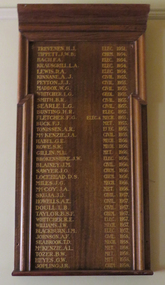
Photograph, Ballarat School of Mines Associates Board 1951-1957, c1984
... Agriculture which was two years. Each course was conducted in accordance with a prescribed curriculum and syllabus. During the 1910s there was an expectation that candidates for the Associate course should have attained the age of sixteen, and have received preparatory training equivalent to University Matriculation at least in the subjects of Elementary Mathematics, English Grammar and Composition, or have passed through Junior Technical School. In 1960 an new procedure for admission to graduate status as Associates was introduced to the Ballarat School of Mines where Associateship would be conferred at a public ceremony. After 01 July 1976 graduates of Ballarat College...Agriculture which was two years. Each course was conducted in accordance with a prescribed curriculum and syllabus. During the 1910s there was an expectation that candidates for the Associate course should have attained the age of sixteen, and have received preparatory training equivalent to University Matriculation at least in the subjects of Elementary Mathematics, English Grammar and Composition, or have passed through Junior Technical School. In 1960 an new procedure for admission to graduate status as Associates was introduced to the Ballarat School of Mines where Associateship would be conferred at a public ceremony. After 01 July 1976 graduates of Ballarat College ...In the early 1880s the Ballarat School of Mines Council introduced a three year course of training under the professors to qualify students in the following professions: 1. Mining Engineering 2. Metallurgy 3. Geology 4. Electricity [45] Each of these courses had an additional, but optional, fourth year of study. The prescribed subjects of study for an Associateship was set out in the Calendar of the Ballarat School of Mines in each year. Any student who passed the prescribed examinations in any of the above courses was issued with a Certificate of Competency, and conferred with the distinction of Associate. By the 1890s the professorial staff had drawn up a curriculum leading to an Associateship of the Ballarat School of Mines. The first two years work was to be common to all courses, but in the third and subsequent years the student wold be devoted to a specialised branch of study. The Associateship was to be conferred in one of another of the following Courses: Agriculture, Civil Engineering, Electrical Engineering, [Geology], Metallurgy and Mining Engineering. All were three year courses except for Agriculture which was two years. Each course was conducted in accordance with a prescribed curriculum and syllabus. During the 1910s there was an expectation that candidates for the Associate course should have attained the age of sixteen, and have received preparatory training equivalent to University Matriculation at least in the subjects of Elementary Mathematics, English Grammar and Composition, or have passed through Junior Technical School. In 1960 an new procedure for admission to graduate status as Associates was introduced to the Ballarat School of Mines where Associateship would be conferred at a public ceremony. After 01 July 1976 graduates of Ballarat College of Advanced Education and Ballarat College of Advanced Education were admitted in major studies relating to mining for Australian accreditation and overseas purposes. Ballarat School of Mines Associates could ascribe ASMB after their name.Black and white photograph of Associatedsof the Ballarat School of Mines from 1951-1957.Associates of the Ballarat School of Mines :Lists names 1989-1964ballarat school of mines, smb campus, electrical engineering 1958, brian w. schreenan civil engineering 1958, clifford j. restarick metallurgy 1958, john t h. clelland metallurgy 1958, donald c. stevens mining engineering 1958, john g. wolfe civil engineering 1959, james e. mcneil electrical engineering 1959, patrick h. nally civil engineering 1959, graham j. willey metallurgy 1959, stanley p. kisler civil engineering 1959, donald j. overall electrical engineering 1959, brian j. mclennan civil engineering 1959, philip j. davis art 1959, bruce v. mcdougall mining engineering 1959, lancelot j. matthews mechanical engineering 1959, alan w. wilson mechanical engineering 1959, alan w. wilson electrical engineering 1959, george a r. lewis art 1959, noel e. meagher electrical engineering 1960, john l. collier mining engineering 1960, john l. collier civil engineering 1960, frank andrewartha mechanical engineering 1960, norman leckie art 1960, lansell j. groat civil engineering 1960, boon thiam lu mining engineering 1960, oswyn n. hails civil engineering 1960, john a. watts applied chemistry 1960, thomas b. gallagher civil engineering 1960, brian a. bellingham civil engineering 1961, alan c leviston applied chemistry 1961, walter j wynd civil engineering 1961, francis d benjamin civil engineering 1961, leonard e fox mechanical engineering 1961, yan kai chung applied chemistry 1961, george d mcgrath mechanical engineering 1961, john r sawyer mechanical engineering 1961, ronald horgan applied chemistry 1961, douglas j vendy civil engineering 1961, john a barnes electrical engineering 1961, brian w smith metallurgy 1961, william r carlyon metallurgy 1961, chris p livitsanos metallurgy 1961, lawrence g trevan civil engineering 1961, richard g dunlop mechanical engineering 1961, ronald m ingleton mechanical engineering 1961, peter m robinson mechanical engineering 1961, david j jelbart mechanical engineering 1961, john g hollway mechanical engineering 1961, george m hetherington civil engineering 1961, david w brown mechanical engineering 1961, john r gowan civil engineering 1961, geoffrey a christian civil engineering 1961, arthur c burrow mechanical engineering 1961, john n mcarthur applied chemistry 1961, graeme r bromley mechanical engineering 1961, william davison civil engineering 1961, ben a johnson electrical engineering 1961, ben a johnson civil engineering 1961, allan j tinney civil engineering 1961, thomas h j coad applied chemistry 1961, brian h duthie civil engineering 1961, basil c bautovich mechanical engineering 1961, reece pullen electrical engineering 1961, john d carmichael electrical engineering 1961, william j spencer civil engineering 1961, neil a brogden civil engineering 1961, michael villani civil engineering 1961, ralph j hepburn mechanical engineering 1961, peter w linaker mechanical engineering 1961, peter j matthews mechanical engineering 1961, edgar mca bartrop mining engineering 1961, donald j stewart, brian schreenan -
 Kiewa Valley Historical Society
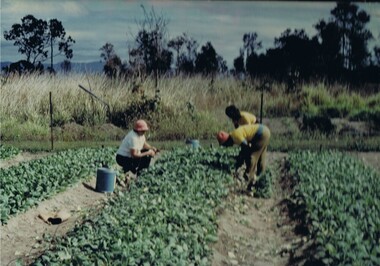
Photograph Tobacco seedlings, Pulling tobacco seedlings for Planting, Circa mid to late 1900s
... The majority of farm owners, up until Health authorities stepped in the later stages of 1900s, were skeptical of city scientists' "carcinogenic" health warnings and it was only after the younger generation of farmers, who had graduated from Agricultural colleges, encompassed the scientific approach to farm management. ...This promotional photograph by the Tobacco Growers Association was in response to a 1935 meeting of tobacco growers from Victoria, South Australia and Queensland which produced four major resolutions for the industry covering the remainder of the 1900s. These four resolutions were: (1) Adequate tariff protection (2) Control of pests and diseases (3) Orderly marketing (4) The formation of an advisory council of growers. History has produced the following results. (1) adequate tariff protection was never achieved,(2) control of disease through benzol vapour (CSIRO) breakthrough, was later identified as carcinogenic, (3) orderly marketing was achieved through (4) the establishment of the Tobacco Growers Association(19840. In October 2006, by way of Government buy back of tobacco leases from growers, resulted in the end of Tobacco farming in Australia (after 136 years of planting the first crop). It was also significant that the major tobacco companies such as Philip Morris and The British American Tobacco Australasia advised the industry that it would source its tobacco requirements overseas by 2009.The death of the tobacco industry(2006) resulted in the expansion of the dairy , sheep, beef cattle, venison and lama wool producers in the Kiewa Valley and surrounding regions. The remnants of the Tobacco Industry can still be viewed throughout the Kiewa Valley and adjacent regions on the former tobacco farms which still have the tobacco drying sheds and now converted into hay sheds. The problems from the large quantities of carcinogenic infused soil of farmlands in the region, still remains a problem now and for future generations. This particular photograph shows the lack of understanding by farmers and the contracted labour, at that time, and is demonstrated by the lack of protection of hands when handling seedlings and attached soil. Hand and foot protection was rarely used, even when later warnings were issued of the carcinogenic toxicity of the soil. The majority of farm owners, up until Health authorities stepped in the later stages of 1900s, were skeptical of city scientists' "carcinogenic" health warnings and it was only after the younger generation of farmers, who had graduated from Agricultural colleges, encompassed the scientific approach to farm management. The "she'll be right mate" attitude of the farming/rural community has since the 1970s been slowly dissipating. Stricter controls of herbicides and pesticides used in agriculture are now in force.Coloured photograph pasted onto a thick wood chip backing. Two galvanised eyelets at the top of the frame, 50mm from each end, with a twine cord stretch from each, for hanging purposes. See also KVHS 0054A, KVHS0054C to KVHS 0054FA sign, which has been removed from the picture at some previous point in time is "Pulling seedlings for planting"tobacco, farming, rural industry, licences, ollie mould, blue mould, benzol vapour, photograph -
 Kiewa Valley Historical Society
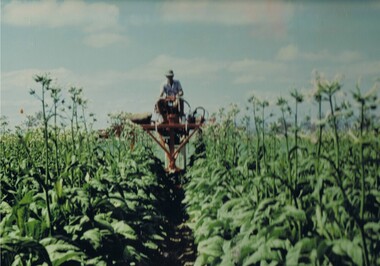
Photograph Topping Tobacco, Tobacco being topped (removal of flower), Circa mid to late 1900's
... The majority of farm owners, up until Health authorities stepped in the latter stages of 1900s, were skeptical of city scientists' "carcinogenic" health warnings and it was only after the younger generation of farmers, who had graduated from Agricultural colleges, encompassed the scientific approach to farm management. ...This promotional photograph by the Tobacco Growers Association was in response to a 1935 meeting of tobacco growers from Victoria, South Australia and Queensland which produced four major resolutions for the industry covering the remainder of the 1900s. These four resolutions were: (1) Adequate tariff protection (2) Control of pests and diseases (3) Orderly marketing (4) The formation of an advisory council of growers. History has produced the following results. (1) adequate tariff protection was never achieved,(2) control of disease through benzol vapour (CSIRO) breakthrough, was later identified as carcinogenic, (3) orderly marketing was achieved through (4) the establishment of the Tobacco Growers Association(1984). In October 2006, by way of Government buy back of tobacco leases from growers, resulted in the end of Tobacco farming in Australia (after 136 years of planting the first crop). It was also significant that the major tobacco companies such as Philip Morris and The British American Tobacco Australasia advised the industry that it would source its tobacco requirements overseas by 2009.The remnants of the Tobacco Industry can still be viewed throughout the Kiewa Valley and adjacent regions on the former tobacco farms which still have the tobacco drying sheds and now converted into hay sheds. The problems from the large quantities of carcinogenic infused soil of farmlands in the region, still remains a problem now and for future generations. This particular photograph shows the lack of understanding by farmers and the contracted labour, at that time, and is demonstrated by the lack of protection of hands when handling seedlings and attached soil. Hand and foot protection was rarely used, even when later warnings were issued of the carcinogenic toxicity of the soil. The majority of farm owners, up until Health authorities stepped in the latter stages of 1900s, were skeptical of city scientists' "carcinogenic" health warnings and it was only after the younger generation of farmers, who had graduated from Agricultural colleges, encompassed the scientific approach to farm management. The "she'll be right mate" attitude of the farming/rural community has since the 1970s been slowly dissipating. Stricter controls of herbicides and pesticides used in agriculture are now in force. The death of the tobacco industry(2006) resulted in the expansion of the dairy , sheep, beef cattle, venison and lama wool producers in the Kiewa Valley and surrounding regions.Coloured photograph pasted onto a thick wood chip backing. Two galvanised eyelets at the top of the frame, 50mm from each end, with a twine cord stretch from each, for hanging purposes. See also KVHS 0054A ,KVHS 0054B and KVHC 0054D to KVHS 0054F A sign, which has been removed from the picture at some previous point in time is "The Tobacco crop being topped (flower removed)". tobacco, farming, rural industry, licences, ollie mould, blue mould, benzol vapour -
 Kiewa Valley Historical Society
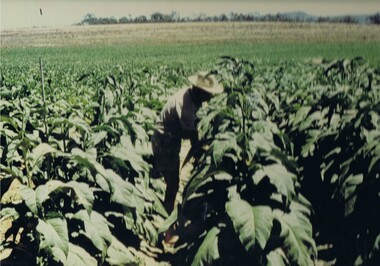
Photograph Tobacco plants, Tobacco fully grown prior to start picking, Circa mid to late 1900's
... The majority of farm owners, up until Health authorities stepped in the latter stages of 1900s, were skeptical of city scientists' "carcinogenic" health warnings and it was only after the younger generation of farmers, who had graduated from Agricultural colleges, encompassed the scientific approach to farm management. ...This promotional photograph by the Tobacco Growers Association was in response to a 1935 meeting of tobacco growers from Victoria, South Australia and Queensland which produced four major resolutions for the industry covering the remainder of the 1900s. These four resolutions were: (1) Adequate tariff protection (2) Control of pests and diseases (3) Orderly marketing (4) The formation of an advisory council of growers. History has produced the following results. (1) adequate tariff protection was never achieved,(2) control of disease through benzol vapour (CSIRO) breakthrough, was later identified as carcinogenic, (3) orderly marketing was achieved through (4) the establishment of the Tobacco Growers Association(1984). In October 2006, by way of Government buy back of tobacco leases from growers, resulted in the end of Tobacco farming in Australia (after 136 years of planting the first crop). It was also significant that the major tobacco companies such as Philip Morris and The British American Tobacco Australasia advised the industry that it would source its tobacco requirements overseas by 2009.The remnants of the Tobacco Industry can still be viewed throughout the Kiewa Valley and adjacent regions on the former tobacco farms which still have the tobacco drying sheds and now converted into hay sheds. The problems from the large quantities of carcinogenic infused soil of farmlands in the region, still remains a problem now and for future generations. This particular photograph shows the lack of understanding by farmers, at that time, and is demonstrated by the lack of protection of hands and no masks over their noses, when handling plants. Hand, nose and foot protection was rarely used, even when later warnings were issued of the carcinogenic toxicity of the soil. The majority of farm owners, up until Health authorities stepped in the latter stages of 1900s, were skeptical of city scientists' "carcinogenic" health warnings and it was only after the younger generation of farmers, who had graduated from Agricultural colleges, encompassed the scientific approach to farm management. The "she'll be right mate" attitude of the farming/rural community has since the 1970s been slowly dissipating. Stricter controls of herbicides and pesticides used in agriculture are now in force. The death of the tobacco industry(2006) resulted in the expansion of the dairy , sheep, beef cattle, venison and lama wool producers in the Kiewa Valley and surrounding regions.Coloured photograph pasted onto a thick wood chip backing. Two galvanised eyelets at the top of the frame, 50mm from each end, with a twine cord stretch from each, for hanging purposes. See also KVHS 0054A to KVHS 0054C and 0054E to KVHS 0054FA sign, which has been removed from the picture at some previous point in time is "The Tobacco fully grown prior to start picking"tobacco, farming, rural industry, licences, ollie mould, blue mould, benzol vapour -
 Kiewa Valley Historical Society
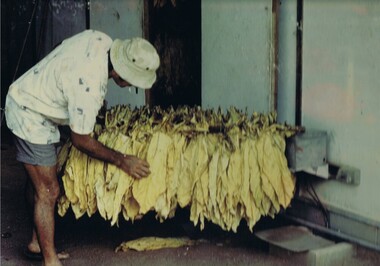
Photograph Tobacco drying leaves, Inspecting Drying tobacco leaves, 1950's to 1999
... The majority of farm owners, up until Health authorities stepped in the later stages of 1900s, were skeptical of city scientists' "carcinogenic" health warnings and it was only after the younger generation of farmers, who had graduated from Agricultural colleges, encompassed the scientific approach to farm management. ...This promotional photograph by the Tobacco Growers Association was in response to a 1935 meeting of tobacco growers from Victoria, South Australia and Queensland which produced four major resolutions for the industry covering the remainder of the 1900s. These four resolutions were: (1) Adequate tariff protection (2) Control of pests and diseases (3) Orderly marketing (4) The formation of an advisory council of growers. History has produced the following results. (1) adequate tariff protection was never achieved,(2) control of disease through benzol vapour (CSIRO) breakthrough, was later identified as carcinogenic, (3) orderly marketing was achieved through (4) the establishment of the Tobacco Growers Association(19840. In October 2006, by way of Government buy back of tobacco leases from growers, resulted in the end of Tobacco farming in Australia (after 136 years of planting the first crop). It was also significant that the major tobacco companies such as Philip Morris and The British American Tobacco Australasia advised the industry that it would source its tobacco requirements overseas by 2009.The remnants of the Tobacco Industry can still be viewed throughout the Kiewa Valley and adjacent regions on the former tobacco farms which still have the tobacco drying sheds and now converted into hay sheds. The problems from the large quantities of carcinogenic infused soil of farmlands in the region, still remains a problem now and for future generations. This particular photograph shows the lack of understanding by farmers and the contracted labour, at that time, and is demonstrated by the lack of protection of hands when handling the tobacco leaves and nose from tobacco dust. Hand and foot protection was rarely used, even when later warnings were issued of the carcinogenic toxicity of the soil. The majority of farm owners, up until Health authorities stepped in the later stages of 1900s, were skeptical of city scientists' "carcinogenic" health warnings and it was only after the younger generation of farmers, who had graduated from Agricultural colleges, encompassed the scientific approach to farm management. The "she'll be right mate" attitude of the farming/rural community has since the 1970s been slowly dissipating. Stricter controls of herbicides and pesticides used in agriculture are now in force. The death of the tobacco industry(2006) resulted in the expansion of the dairy , sheep, beef cattle, venison and lama wool producers in the Kiewa Valley and surrounding regions.Coloured photograph pasted onto a thick wood chip backing. Two galvanised eyelets at the top of the frame, 50mm from each end, with a twine cord stretch from each, for hanging purposes. See also KVHS 0054A to KVHS 0054D and KVHS 0054Ftobacco, farming, rural industry, licences, ollie mould, blue mould, benzol vapour, photograph -
 Wangaratta RSL Sub Branch
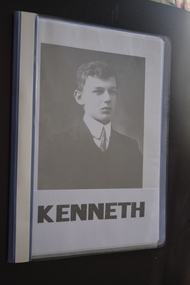
Literary work - Tribute, Capt. Kenneth Mortimer
... Agricultural High School in Wangaratta in 1912 before entering the Royal Military College Duntroon in 1913. He was killed in action on 20th July 1916, three months before his 21st birthday, at the Battle of Fleurbaix, Fromelles in France. His remains were unknown for 102 years when DNA testing confirmed the identity of nine Australian soldiers found buried in a mass grave near Pheasant Wood. The graves of these nine soldiers will be rededicated on July 19 2018. Mortimer entered the Royal Military College, Duntroon on 10 March 1913 and was graduated ...A tribute to Captain Kenneth Malcolm Mortimer by his nephew Dr Owen Campbell Mortimer. Kenneth was born on the 9th October 1895 at Leneva near Wodonga and went to Agricultural High School in Wangaratta in 1912 before entering the Royal Military College Duntroon in 1913. He was killed in action on 20th July 1916, three months before his 21st birthday, at the Battle of Fleurbaix, Fromelles in France. His remains were unknown for 102 years when DNA testing confirmed the identity of nine Australian soldiers found buried in a mass grave near Pheasant Wood. The graves of these nine soldiers will be rededicated on July 19 2018.Mortimer entered the Royal Military College, Duntroon on 10 March 1913 and was graduated early, along with the rest of his class, on 28 June 1915. Mortimer had been a member of the college's photography club and took numerous pictures of his fellow cadets. He was appointed as a Lieutenant with the 29th Battalion on 1 July 1915 and embarked with his unit for Egypt in November 1915. He was promoted to Captain in February 1916 and arrived in France four months later. Died (killed in action) on 20 July 1916 near Fromelles, France aged 20 yearsGrey plastic folder with clear front cover over image of young male.KENNETHkenneth malcolm mortimer, ww1, kia -
University of Melbourne, Burnley Campus Archives
Administrative record - Register, Victorian College of Agriculture and Horticulture et al, Advanced Education, 1984-2009
... graduates Handwritten register. Lists of names and signatures under various Diploma, Degree and Higher Degree courses. Probably signatures of those who had collected their graduation cewrtificates. Advanced Education Administrative record Register Victorian College of Agriculture ...postgraduate degrees, certificates, students, graduates -
University of Melbourne, Burnley Campus Archives
Photograph - Student ID, Victorian College of Agriculture and Horticulture, Student ID 1995, 1995
... Bachelor of Applied Science (Horticulture), Graduate Diploma in Horticulture, Associate Diploma of Applied Science (Horticulture) Student ID 1995 Photograph Student ID Victorian College of Agriculture and Horticulture ...bachelor applied science (horticulture), associate diploma of horticulture, associate diploma of applied science (horticulture), student id 1995 -
 University of Melbourne, Burnley Campus Archives
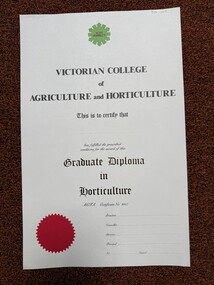
Certificate - Award Certificate, VCAH Burnley Graduate Diploma in Horticulture, 1983-1996
... VCAH BURNLEY VICTORIAN COLLEGE OF AGRICULTURE and HORTICULTURE This is to certify that ..... has fulfilled the prescribed conditions for the award of this Graduate Diploma in Horticulture ACTA Certificate No. 3357 President.... ...VCAH Burnley Graduate Diploma in horticulture Certificate VCAH BURNLEY VICTORIAN COLLEGE OF AGRICULTURE and HORTICULTURE This is to certify that ..... has fulfilled the prescribed conditions for the award of this Graduate Diploma in Horticulture ACTA Certificate No. 3357 President.... ...Unused certificate (1) buff coloured textured card with green VCAH Burnley logo, Red inked star, black print and gold print.VCAH BURNLEY VICTORIAN COLLEGE OF AGRICULTURE and HORTICULTURE This is to certify that ..... has fulfilled the prescribed conditions for the award of this Graduate Diploma in Horticulture ACTA Certificate No. 3357 President.... Councillor..... Director.... Principal.... No..... Issued.....vcah burnley, graduate diploma in horticulture, certificate -
 University of Melbourne, Burnley Campus Archives
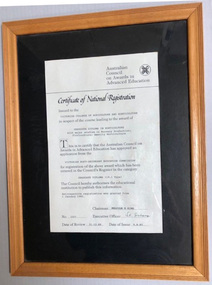
Certificate (item) - Graduate Diploma in Horticulture, Australian Council on Awards in Advanced Education, Certificate of National Registration, 09.08.1985
... Framed and glazed certificate issued to the Victorian College of Agriculture and Horticulture in respect of the course leading to the award of Graduate Diploma in Horticulture by the Australian Council on Awards in Advanced Education...awards horticulture teaching vcah Framed and glazed certificate issued to the Victorian College of Agriculture and Horticulture in respect of the course leading to the award of Graduate Diploma in Horticulture by the Australian Council on Awards in Advanced Education Certificate of National Registration Certificate Graduate Diploma in Horticulture Australian Council on Awards in Advanced Education Found ...awards, horticulture, teaching, vcah -
University of Melbourne, Burnley Campus Archives
Administrative record - Reports, The Victorian Institute of Colleges
... File containing various reports including: Destination and Employment of Recent Diploma of Agriculture Graduates from Longerenong Agricultural College 10.06.1982. ...employment students agriculture graduates longerenong burnley glenormiston dookie t.a.f.e. rural enrolments expenditure File containing various reports including: Destination and Employment of Recent Diploma of Agriculture Graduates from Longerenong Agricultural College 10.06.1982. ...employment, students, agriculture, graduates, longerenong, burnley, glenormiston, dookie, t.a.f.e., rural enrolments, expenditure -
 University of Melbourne, Burnley Campus Archives
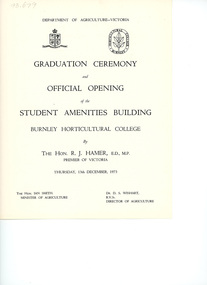
Programme - Graduation Ceremony Program, Department of Agriculture, Victoria, Graduation Ceremony & Official Opening of the Student Amenities Building, 1973
... graduates from Burnley College coinciding with the opening of the Student Amenities Block (5 copies). The 4 page brochure includes the Order of Proceedings, historical highlights of Burnley College and sketch of S.A. building. Brochure produced by Dept. Agriculture...Wishart, Director of Agriculture. graduation ceremony student amenities building sketch burnley horticultural college the hon. r. j. hamer ian smith premier of victoria minister for agriculture dr. d. s. wishart director of agriculture graduation ceremony programme Programme produced for the Graduation Ceremony of graduates from Burnley College coinciding with the opening of the Student Amenities Block (5 copies). ...The Student Amenities Building was officially opened by the Hon. R. J. Hamer, Premier of Victoria. Also present: Ian Smith, Minister for Agriculture and Dr. D. S. Wishart, Director of Agriculture.graduation ceremony, student amenities building, sketch, burnley horticultural college, the hon. r. j. hamer, ian smith premier of victoria, minister for agriculture, dr. d. s. wishart, director of agriculture, graduation ceremony programme -
University of Melbourne, Burnley Campus Archives
Newspaper - Newspaper Cutting, Il Globo dall'Australia, Certificato di Studi in Ortocultura, 1991
... il globo dall'australia giovanni ziccone dr greg moore peter esdale students 1991 vcah centenary victorian college of agriculture and horticulture Newspaper page from Il Globo dall'Australia, May 20, 1991, p.31. The graduates ...Newspaper page from Il Globo dall'Australia, May 20, 1991, p.31. The graduates in the photograph were of interest to the Italian community in Australia. This includes Giovanni Ziccone who graduated with a Certificate in Horticulture from VCAH Burnley in 1991. He is pictured with the director, Dr Greg Moore, and Peter Esdale, who directed the VCAH Burnley centenary celebrations in 1991. The translation of the text below the photograph is: Signor Giovanni Ziccone, a young man of the third age (67 years) has achieved brilliantly, after 5 years of study, a certificate at the VCAH Burnley in Richmond. In the photo, Signor Ziccone, on the right, is being congratulated by the director Gregory Moore and by the organiser of the centenary celebrations of the college, Peter Esdale. Very best wishes to Giovanni Ziccone, a native of Cassaro, from his wife Anna and from his children Vittorio and his wife Noemi, and Connie with her husband Angelo Casonato.il globo dall'australia, giovanni ziccone, dr greg moore, peter esdale, students, 1991, vcah, centenary, victorian college of agriculture and horticulture -
University of Melbourne, Burnley Campus Archives
Newspaper - Newspaper Cutting, Secrets of Seeds Their Study, c. 1953
... seed testing female students burnley horticultural college e. comben j. quarry careers for girls Newspaper article about female seed testers for the Department of Agriculture, 2 of whom are Burnley graduates - Mrs. ...Newspaper article about female seed testers for the Department of Agriculture, 2 of whom are Burnley graduates - Mrs. E. Comben and Miss J. Quarry (1952).seed testing, female students, burnley horticultural college, e. comben, j. quarry, careers for girls -
 University of Melbourne, Burnley Campus Archives
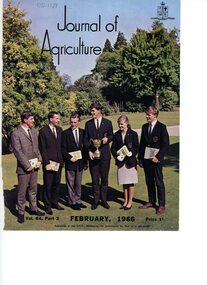
Journal - Journal Extract, Journal of Agriculture, February 1966
... Douglas Kneen designed a college logo. P.94 GGOG students journal of agriculture graduates 1965 burnley college geoff olive douglas kneen andrew guest ross james lucia pruis richard dare Cover and contents page of Journal of Agriculture, Feb. 1966, showing Burnley students on the College lawns receiving awards on Speech Day the previous December. ...Douglas Kneen designed a college logo. P.94 GGOGCover and contents page of Journal of Agriculture, Feb. 1966, showing Burnley students on the College lawns receiving awards on Speech Day the previous December. The contents page lists the students as L to R: Andrew Guest, Geoffrey Olive, Ross James (Dux), Douglas Kneen, Lucia Pruis, Richard Dare. students, journal of agriculture, graduates 1965 burnley college, geoff olive, douglas kneen, andrew guest, ross james, lucia pruis, richard dare -
University of Melbourne, Burnley Campus Archives
Photograph - Black and white photocopy, Victorian College of Agriculture and Horticulture, Student ID Photographs, 1996
... Named. (2) Photocopy of ID photographs of Graduate Diploma in Horticulture, First Year Students 1996 (and others.) Not scanned. Student ID Photographs Photograph Black and white photocopy Victorian College of Agriculture and Horticulture ...(1) Photocopy of black and white ID photographs of First Year Students 1996. Named. (2) Photocopy of ID photographs of Graduate Diploma in Horticulture, First Year Students 1996 (and others.) Not scanned.Handwritten list of names attached (by Joss Tonkin, Archivist) done prior to 2009.id photograph, first year, students, graduate diploma, horticulture, joss tonkin, archivist -
 University of Melbourne, Burnley Campus Archives
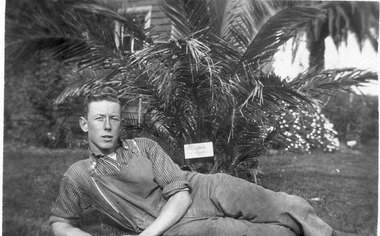
Photograph - Black and white prints and negatives, Athol Shmith Studio Illustrative Photography, Les Provan Collection, 1922-1946
... graduated B. Agr. Sc-and later 1942 became Principal Burnley and 1946 Principal Dookie Agricultural College."...graduated B. Agr. Sc-and later 1942 became Principal Burnley and 1946 Principal Dookie Agricultural College." les provan kentia palm chemistry classroom pavilion james leslie provan dookie agricultural college jack allen r. fred gillespie dahlias jack reid castell charlie stone geo. russ norm scable june bishop cows student group 1922-1923 football team 1922-1923 administration building construction mrs kneen kneen children athol shmith garden view dux calf main building construction (1) On reverse, "Student Les Provan 1922 &1923. ...Photographs donated by James Leslie (Les) Provan. (1) Note by T.H. Kneen 6 May 1992, "James Leslie Provan went to Melbourne University - graduated B. Agr. Sc-and later 1942 became Principal Burnley and 1946 Principal Dookie Agricultural College."Black and white photographs and negatives. (1) 2 photographs and negative. Les Provan reclining on the ground infront of a Kentia palm and part of the pavilion behind. (2) Includes negative. Les Provan and another male student seated on the lawn. (3) Note attached, "English lad, Fred ?, ?, Jack Allen." 4 male students seated on the lawn in front of the Pavilion. (4) Male student with calf. (5) 3 male students squatting on the lawn in front of the pavilion, one holding a football. Note by E.B. Littlejohn 6 May 1992, "Student on left is R. Fred Gillespie ? Jack Allen (centre) was later on staff as an Instructor. (6) Mrs Kneen and two children walking through the Administration Building under construction. (7) 4 men standing next to Dahlias judging them. (8) Student walking along path between ponds and Pavilion.(1) On reverse, "Student Les Provan 1922 &1923. Dux 1923. Background is Kentia Palm & the Chemistry classroom of the old Pavilion. (2) On reverse, "Les Provan & ? 1923." (3) On reverse, "Group of male students 1922 or 1923." (4) On reverse, "? name an English lad, student 1922 or '23." (5) On reverse, "The Football Team L to R. Fred---Jack Allen & ? 1923." (6) On reverse, "The new College building in course of construction early 1946. Mrs. Kneen & children." (7) On reverse,"Judges in trial Dahlias Burnley 1943. Left to right Jack Reid, Castell, Charlie Stone, Geo. Russ, Norm Scable." (8)) On reverse, "June Bishop-student," and, "Athol Shmith Studio Illustrative Photography 125 Collins Street, Melbourne C.1. Cent. 27. No 10383 Position J." Note by E.B. Littlejohn 4 March 1992, "June Bishop standing at junction of paths one of which leads to main entrance to Pavilion."les provan, kentia palm, chemistry classroom, pavilion, james leslie provan, dookie agricultural college, jack allen, r. fred gillespie, dahlias, jack reid, castell, charlie stone, geo. russ, norm scable, june bishop, cows, student group 1922-1923, football team 1922-1923, administration building construction, mrs kneen, kneen children, athol shmith, garden view, dux, calf, main building construction -
University of Melbourne, Burnley Campus Archives
Photograph - Black and white prints, Victorian College of Agriculture and Horticulture, Student ID Photographs, 1989
... graduate diploma horticulture bachelor of applied science student id Proofs of black and white Student ID photographs. Students holding up cardboard signs with names on them. (1) Associate Diploma in Horticultural Science 1989. (2) Grad. Dip. In Horticulture 1989. (3) Bachelor of Applied Science(Horticulture). Also handwritten list of names. Student ID Photographs Photograph Black and white prints Victorian College of Agriculture ...Proofs of black and white Student ID photographs. Students holding up cardboard signs with names on them. (1) Associate Diploma in Horticultural Science 1989. (2) Grad. Dip. In Horticulture 1989. (3) Bachelor of Applied Science(Horticulture). Also handwritten list of names.students, id photographs, associate diploma, horticultural science, graduate diploma, horticulture, bachelor of applied science, student id -
University of Melbourne, Burnley Campus Archives
Photograph - Black and white photocopies, Victorian College of Agriculture and Horticulture, Student ID 1994, 1994
... bachelor of applied science in horticulture graduate diploma of applied science (horticulture) associate diploma of applied science (horticulture) student id students 1994 Photocopies of black and white photographs of students doing Bachelor of Applied Science in Horticulture, Graduate Diploma of Applied Science (Horticulture), Associate Diploma of Applied Science (Horticulture) 1994. Name and Student Number printed underneath each photograph Student ID 1994 Photograph Black and white photocopies Victorian College of Agriculture and Horticulture ...Photocopies of black and white photographs of students doing Bachelor of Applied Science in Horticulture, Graduate Diploma of Applied Science (Horticulture), Associate Diploma of Applied Science (Horticulture) 1994. Name and Student Number printed underneath each photographbachelor of applied science in horticulture, graduate diploma of applied science (horticulture), associate diploma of applied science (horticulture), student id, students 1994 -
University of Melbourne, Burnley Campus Archives
Document, Graduate Diploma in Applied Science (Horticulture), 1989
... course Submission for course reaccreditation by the Victorian College of Agriculture and Horticulture September 1989 Graduate Diploma in Applied Science (Horticulture) Document Victorian College of Agriculture and Horticulture Found in Quad Classrooms 2018 ...course -
University of Melbourne, Burnley Campus Archives
Certificate - Award Certificate, Department of Agriculture, Victoria, Burnley Horticultural College, Certificate in Horticultural Studies, 1982
... Unclaimed and returned to the College. peter dwan students graduates Department of Agriculture Victoria Certificate in Horticultural Studies Department of Agriculture Victoria Burnley Horticultural College CERTIFICATE IN HORTICULTURAL STUDIES Awarded to PETER DWAN on the completion of eight units each of thirty hours part-time study at the levels shown below Plant Function A Plant Reproduction A Soil Studies A Plant Studies B Ornamental A Entomology A Propagation A Plant Pathology A Signed by the director General David Smith Principal James Davis dated this eighteenth day of December 1982 Certificate awarded to Peter Dwan 18.12.1982. ...Certificate awarded to Peter Dwan 18.12.1982. Unclaimed and returned to the College.Certificate awarded to Peter Dwan 18.12.1982. Signed and stamped Department of Agriculture Victoria with unclaimed postage mail tube "Return to Sender"Department of Agriculture Victoria Burnley Horticultural College CERTIFICATE IN HORTICULTURAL STUDIES Awarded to PETER DWAN on the completion of eight units each of thirty hours part-time study at the levels shown below Plant Function A Plant Reproduction A Soil Studies A Plant Studies B Ornamental A Entomology A Propagation A Plant Pathology A Signed by the director General David Smith Principal James Davis dated this eighteenth day of December 1982 peter dwan, students, graduates, department of agriculture victoria, certificate in horticultural studies -
University of Melbourne, Burnley Campus Archives
Certificate - Award diploma, Dept of Agriculture, Victoria, Department of Agriculture Victoria, College of Horticulture, Burnley Gardens, Diplomas - unused stocks, c. 1958-1983
... College unused stocks of award certificates diplomas certificates first class honours second class honours students female students graduates DEPARTMENT OF AGRICULTURE VICTORIA COLLEGE OF HORTICULTURE BURNLEY GARDENS Diploma AWARDED TO ......... as evidence that (1) (3) (5) she (2) (4) he has passed the prescribed final examinations of the Diploma Course with (1) First Class Honours (2) First Class Honours (3) Second Class Honours (4) Second Class Honours (5) Pass...........Director of Agriculture......Principal......Dated this .....day od......19.... ...College unused stocks of award certificates Multiple unused copies each of Diploma Certificates, (1) First Class Honours (female). (2) First Class Honours (male). (3) Second Class Honours (female). (4) Second Class Honours (male). (5) Pass (female). College of Horticulture Burnley emblem.DEPARTMENT OF AGRICULTURE VICTORIA COLLEGE OF HORTICULTURE BURNLEY GARDENS Diploma AWARDED TO ......... as evidence that (1) (3) (5) she (2) (4) he has passed the prescribed final examinations of the Diploma Course with (1) First Class Honours (2) First Class Honours (3) Second Class Honours (4) Second Class Honours (5) Pass...........Director of Agriculture......Principal......Dated this .....day od......19....diplomas, certificates, first class honours, second class honours, students, female students, graduates -
University of Melbourne, Burnley Campus Archives
Newspaper - Newspaper Cutting, The Sun, Down-to-earth-scientists, 1969
... Agriculture. Includes information about Melbourne University, LaTrobe University, Dookie, Longerenong and Burnley. Discusses possible employment for graduates and the cost of education at the colleges....Agriculture. Includes information about Melbourne University, LaTrobe University, Dookie, Longerenong and Burnley. Discusses possible employment for graduates and the cost of education at the colleges. ...Newspaper cutting from The Sun, September 18, 1969, p. 29. Includes photos of some young women with a tractor and feeding cows in a country setting, and of Mr Farrance (staff, 1952-1975). Article by John Farrance and Ian Anderson which discusses the range of educational possibilities for school leavers interested in Agriculture. Includes information about Melbourne University, LaTrobe University, Dookie, Longerenong and Burnley. Discusses possible employment for graduates and the cost of education at the colleges.the sun, john farrance, ian anderson, agricultural schools, girls education, agriculture, employment -
University of Melbourne, Burnley Campus Archives
Pamphlet (item), Victorian College of Agriculture and Horticulture, Bachelor of Applied Science (Horticulture); Graduate Diploma in Horticulture; Associate Diploma in Horticulture, 1985
... College of Agriculture & Horticulture...bachelor applied science (Horticulture)...associate diploma in horticulture...Graduate...VCAH Burnley College of Horticulture Victorian College of Agriculture & Horticulture bachelor applied science (Horticulture) associate diploma in horticulture Graduate Diploma in Horticulture 3 small pamphlets outlining courses, and including a location map Bachelor of Applied Science (Horticulture); Graduate Diploma in Horticulture; Associate Diploma in Horticulture Pamphlet Victorian College of Agriculture and Horticulture ...vcah, burnley college of horticulture, victorian college of agriculture & horticulture, bachelor applied science (horticulture), associate diploma in horticulture, graduate diploma in horticulture
