
Showing 6 items matching "agricultural colonies"
-
 Nhill and District Historical Society Inc.
Book - Tattyara, Leslie James Blake, A History of Kaniva and District, 1981
... ...Agricultural Colonies...Kaniva - History Author - Les Blake Australian History Tattyara L.J. Blake Agricultural Colonies Australia - Victoria This book has 373 pages of History of Kaniva and District containing maps, illustrations and portraits. ...This book has 373 pages of History of Kaniva and District containing maps, illustrations and portraits.The book has a yellow cover with black print and is in excellent condition.non-fictionThis book has 373 pages of History of Kaniva and District containing maps, illustrations and portraits.kaniva - history, author - les blake, australian history, tattyara, l.j. blake, agricultural colonies, australia - victoria -
 Flagstaff Hill Maritime Museum and Village
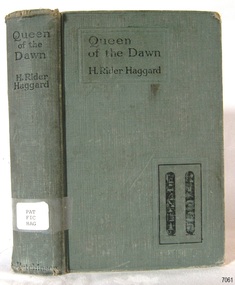
Book - Fictional Novel, H Rider Haggard, author, Queen of The Dawn, 1925
... Publicly, Haggard maintained that his novel-writing was purely for money, while considering his true work to be his writing and advising government on agriculture and the British colonies. He stood unsuccessfully as the Conservative parliamentary candidate for Eastern Norfolk in 1895, and was heavily involved in agricultural reform and land-use commissions for the Empire. ...Publicly, Haggard maintained that his novel-writing was purely for money, while considering his true work to be his writing and advising government on agriculture and the British colonies. He stood unsuccessfully as the Conservative parliamentary candidate for Eastern Norfolk in 1895, and was heavily involved in agricultural reform and land-use commissions for the Empire. ...Queen of the Dawn is a story of old Egypt, a historical fantasy/romance novel by H. Rider Haggard, set in Ancient Egypt during a period of war and political turmoil, as the invading Shepherd Kings challenge the Egyptian Pharaohs. The protagonist in the story is Nefra, Princess of Egypt, born amid this chaos with her fate tied to her royal lineage. Prophecies and blessings from Egyptian goddesses mark her birth, foreshadowing her significant role in events to come. After the death of King Kheperra, Queen Rima (Nefra's mother) must navigate a dangerous political landscape to protect herself and her child, aided by loyal allies like her nurse Kemmah. The story opens at a breakneck pace, with Pharaoh deposed and killed and his family in hiding, while a secret religious order raises the princess, who falls in love with the disguised son of the usurper. The climax delivers traditional adventure-fiction excitement with battles and torture. The novel leans heavily on themes of prophecy, destiny, and romance.Hard cover book,Queen of The Dawn Author: H Rider Haggard Publisher: Hutchinson & Co. London. W1. Date: 1925 Green Cloth hard covered book with a reinforced spine with a handwritten title, front cover has black text and Egyptian motif. Inscriptions include stickers and a stamp. fictionQueen of the Dawn is a story of old Egypt, a historical fantasy/romance novel by H. Rider Haggard, set in Ancient Egypt during a period of war and political turmoil, as the invading Shepherd Kings challenge the Egyptian Pharaohs. The protagonist in the story is Nefra, Princess of Egypt, born amid this chaos with her fate tied to her royal lineage. Prophecies and blessings from Egyptian goddesses mark her birth, foreshadowing her significant role in events to come. After the death of King Kheperra, Queen Rima (Nefra's mother) must navigate a dangerous political landscape to protect herself and her child, aided by loyal allies like her nurse Kemmah. The story opens at a breakneck pace, with Pharaoh deposed and killed and his family in hiding, while a secret religious order raises the princess, who falls in love with the disguised son of the usurper. The climax delivers traditional adventure-fiction excitement with battles and torture. The novel leans heavily on themes of prophecy, destiny, and romance.flagstaff hill, flagstaff hill maritime museum and village, warrnambool, maritime museum, maritime village, great ocean road, shipwreck coast, pattison collection, ralph eric pattison, warrnambool mechanics’ institute, mechanics’ institute library, warrnambool library, free library, corangamite regional library service, h. rider haggard, 1925, hutchinson & co., queen of the dawn -
 Federation University Historical Collection
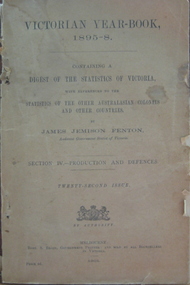
Book, Robert S. Brain, Government Printer, Victorian Year Book 1895-8, 1901
... The book contains a digest of the statistics of Victoria with reference to the other Australasian Colonies and other countries. Topics include the land system of Victoria, Crown lands, Agricultural statistics, cultivation, industry, livestock, wool, dairy farms, cattle, rabbits, manufactures, alcohol production, mining, defense. ...The book contains a digest of the statistics of Victoria with reference to the other Australasian Colonies and other countries. Topics include the land system of Victoria, Crown lands, Agricultural statistics, cultivation, industry, livestock, wool, dairy farms, cattle, rabbits, manufactures, alcohol production, mining, defense. ...This year book was published in the year of Australian Federation. It was the 22nd issue of the Victorian Year BookBrown soft covered book of 1000 page. The book contains a digest of the statistics of Victoria with reference to the other Australasian Colonies and other countries. Topics include the land system of Victoria, Crown lands, Agricultural statistics, cultivation, industry, livestock, wool, dairy farms, cattle, rabbits, manufactures, alcohol production, mining, defense. Statistics were provided by J.J. Fenton, Assistant Government Statist. -
 Flagstaff Hill Maritime Museum and Village
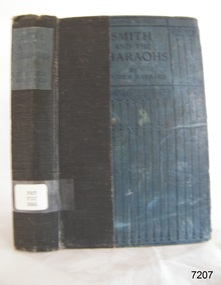
Book - Novel, H Rider Haggard, author, Smith and the Pharaohs and other tales, 1920
... agriculture, country life, social history, travel, novels and romances. This edition of the book was published for Laurie's Colonial Library by the firm T. Werner Laurie Limited of London. It was made specifically for the British Colonies...agriculture, country life, social history, travel, novels and romances. This edition of the book was published for Laurie's Colonial Library by the firm T. Werner Laurie Limited of London. It was made specifically for the British Colonies ...H. Rider Haggard (1856-1925) (Sir H. Rider Haggard), was a British author of fiction and non-fiction works and had letters and articles published in newspapers and journals. The page opposite the book's Fly page lists some of the topics Rider Haggard covered; Parliamentary Blue Book, political history, works on agriculture, country life, social history, travel, novels and romances. This edition of the book was published for Laurie's Colonial Library by the firm T. Werner Laurie Limited of London. It was made specifically for the British Colonies and India. This book is part of Flagstaff Hill's Pattison Collection.This edition of the book was published by T Werner Laurie as part of Laurie's Colonial Library, books destined only for the British Colonies and India, The book has additional importance for its connection to the Pattison Collection, which, along with other items at Flagstaff Hill Maritime Village, was originally part of the Warrnambool Mechanics' Institutes’ Collection. The Warrnambool Mechanics’ Institute book collection has historical and social significance for its strong association with the Mechanics Institute movement and its important role in people's intellectual, cultural and social development throughout the latter part of the nineteenth century and the early twentieth century. The collection of books is a rare example of an early lending library and its significance is enhanced by the survival of an original collection of many volumes. The Warrnambool Mechanics' Institute’s publication collection is of both local and state significance.Smith and the Pharaohs and other tales Author: H Rider Haggard Publisher: T Werner Laurie Ltd Date: 1st published 1920 Inscriptions include a label, stickers, stamp and a handwritten inscription. This book is part of the Pattison Collection.Label: "PAT FIC HAG" Sticker: "Warrnambool Mechanics Institute and Free Library" covered by a sticker"Corangamite Regional Library Service" Stamp: "Warrnambool Mechanics Institute" Handwritten: "1301" Fly page note: "COPYRIGHT EDITION / ALL RIGHTS RESERVED / This Edition is issued for sale and circulation in the British Colonies and India, and must not be imported into the Continent of Europe or the United States of America." flagstaff hill, flagstaff hill maritime museum and village, warrnambool, maritime museum, maritime village, great ocean road, shipwreck coast, pattison collection, ralph eric pattison, warrnambool mechanics’ institute, mechanics’ institute library, warrnambool library, free library, corangamite regional library service, smith and the pharaohs and other tales, smith and the pharohs, h rider haggard, sir h rider haggard, t werner laurie ltd, laurie's colonial library, british colonial books, 1950 -
 Flagstaff Hill Maritime Museum and Village
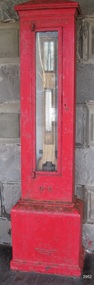
Instrument - Barometer, 1867
... agriculture. As a result, instruments made by the early instrument makers of Australia was of significant importance to the development and safe trading of companies operating during the Victorian colonies early days. ...Langlands Company History: Langlands foundry was Melbourne's first foundry and iron shipbuilder established in 1842, only 8 years after the founding of the Victorian colony by two Scottish immigrants, Robert Langlands and Thomas Fulton, who had formed a partnership before emigrating (1813–1859). The business was known as the 'Langlands Foundry Co'. Henry Langlands (1794-1863), left Scotland in 1846 with his wife Christian, née Thoms, and five surviving children to join his brother Robert. By the time he arrived in early January of 1847 the partnership of Robert Langlands and Fulton had dissolved as Fulton had gone off to establish his own works. It was at this time that the two brothers took over ownership of Langlands foundry. Several years later Robert retired and Henry became sole the proprietor. The foundry was originally located on Flinders Lane between King and Spencer streets. Their sole machine tool, when they commenced as a business, was a small slide rest lathe turned by foot. In about 1865 they moved to the south side of the Yarra River, to the Yarra bank near the Spencer Street Bridge and then in about 1886 they moved to Grant Street, South Melbourne. The works employed as many as 350 workers manufacturing a wide range of marine, mining, civil engineering, railway and general manufacturing components including engines and boilers. The foundry prospered despite high wages and the lack of raw materials. It became known for high-quality products that competed successfully with any imported articles. By the time Henry retired, the foundry was one of the largest employers in Victoria and was responsible for casting the first bell and lamp-posts in the colony. The business was carried on by his sons after Henry's death. The company was responsible for fabricating the boiler for the first railway locomotive to operate in Australia, built-in 1854 by Robertson, Martin & Smith for the Melbourne and Hobson's Bay Railway Company. Also in the 1860s, they commenced manufacture of cast iron pipes for the Board of Works, which was then laying the first reticulated water supply system in Melbourne. Langlands was well known for its gold mining equipment, being the first company in Victoria to take up the manufacture of mining machinery, and it played an important role in equipping Victoria's and Australia's first mineral boom in the 1850s and 1860s. Langlands Foundry was an incubator for several engineers including Herbert Austin (1866–1941) who worked as a fitter at Langlands and went on to work on the Wolesely Shearing machine. He also founded the Austin Motor Company in 1905. Around the 1890s Langlands Foundry Co. declined and was bought up by the Austral Otis Co. in about 1893. History for Grimoldi: John Baptist Grimoldi was born in London UK. His Father was Domeneck Grimoldi, who was born in Amsterdam with an Italian Father and Dutch mother. Domeneck was also a scientific instrument maker. John B Grimoldi had served his apprenticeship to his older brother Henry Grimoldi in Brooke Street, Holburn, London and had emigrated from England to Australia to start his own meteorological and scientific instrument makers business at 81 Queens St Melbourne. He operated his business in 1862 until 1883 when it was brought by William Samuel and Charles Frederick, also well known scientific instrument makers who had emigrated to Melbourne in 1875. John Grimoldi became successful and made a number of high quality measuring instruments for the Meteorological Observatory in Melbourne. The barometer was installed at Warrnambool's old jetty and then the Breakwater as part of the Victorian Government's insistence that barometers be placed at all major Victorian ports. This coastal barometer is representative of barometers that were installed through this government scheme that began in 1866. The collecting of meteorological data was an important aspect of the Melbourne Observatory's work from its inception. Just as astronomy had an important practical role to play in navigation, timekeeping and surveying, so the meteorological service provided up to date weather information and forecasts that were essential for shipping and agriculture. As a result, instruments made by the early instrument makers of Australia was of significant importance to the development and safe trading of companies operating during the Victorian colonies early days. The provenance of this artefact is well documented and demonstrates, in particular, the importance of the barometer to the local fishermen and mariners of Warrnambool. This barometer is historically significant for its association with Langlands’ Foundry which pioneered technology in the developing colony by establishing the first ironworks in Melbourne founded in 1842. Also, it is significant for its connection to John B Grimoldi who made the barometer and thermometer housed in the cast iron case. Grimoldi, a successful meteorological and scientific instrument maker, arrived in the colony from England and established his business in 1862 becoming an instrument maker to the Melbourne Observatory. Additional significance is its completeness and for its rarity, as it is believed to be one of only two extant barometers of this type and in 1986 it was moved to Flagstaff Hill Maritime Village as part of its museum collection. Coast Barometer No. 8 is a tall, red painted cast iron pillar containing a vertical combined barometer and thermometer. Half way down in the cast iron framed glass door is a keyhole. Inside is a wooden case containing a mercury barometer at the top with a thermometer attached underneath, each with a separate glass window and a silver coloured metal backing plate. Just below the barometer, on the right-hand side, is a brass disc with a hole for a gauge key in the centre. The barometer has a silvered tin backing plate with a scale, in inches, of "27 to 31" on the right side and includes a Vernier with finer markings, which is set by turning the gauge key. The thermometer has a silvered tin backing plate with a scale on the left side of "30 to 140". Each of the scales has markings showing the units between the numbers.Inscription at the top front of the pillar reads "COAST BAROMETER" Inscribed on the bottom of the pillar is "No 8". and "LANGLANDS BROS & CO ENGINEERS MELBOURNE " The barometer backing plate is inscribed "COAST BAROMETER NO. 8, VICTORIA" and printed on the left of the scale, has "J GRIMOLDI" on the top and left of the scale, inscribed "Maker, MELBOURNE". There is an inscription on the bottom right-hand side of the thermometer scale, just above the 30 mark "FREEZING" Etched into the timber inside the case are the Roman numerals "VIII" (the number 8)flagstaff hill, warrnambool, maritime village, maritime museum, flagstaff hill maritime museum & village, shipwreck coast, great ocean road, warrnambool breakwater, coast barometer, coastal barometer, barometer, weather warning, ports and harbours, fishery barometer, sea coast barometer, austral otis co, coast barometer no. 8, henry grimoldi, henry langlands, john baptist grimoldi, langlands foundry co, meteorological instrument maker, robert langlands, scientific instrument maker, thermometer, thomas fulton -
Friends of Ballarat Botanical Gardens History Group
Work on paper - City Father, George SMITH died 1896, Ballarat Star, 1st August 1896, page 4, 1 August, 1896
... agriculture and horticulture. He was also instrumental in making Ballarat famous in the other Colonies as well as overseas. ...George Smith was a noted nurseryman and seedsman who founded the Royal Exotic Nurseries at Lake Wendouree. He gave technical advice in the laying out of the Ballarat Botanical Gardens, the planting of street trees and in advancing numerous municipal works around Ballarat.George Smith advanced the interests of Ballarat and its inhabitants in numerous ways, especially in agriculture and horticulture. He was also instrumental in making Ballarat famous in the other Colonies as well as overseas. Three pages of photocopied newsprint in heavy black print. National Library of Australia reference number at the bottom of each pagejohn garner collection, garner, dr, smith, ballarat star, newspaper, 1896, ballarat botanical gardens, ballarat, gardens, george smith j.p., city father, baron von mueller, kew gardens, goldfields, city councillor, magistrate
