
Showing 6 items matching "aiming lamp"
-
 Bendigo Military Museum
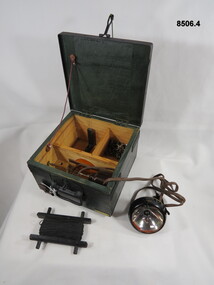
Equipment - LAMP, AIMING, LAWRENCE & HANSON, 1943
... LAMP, AIMING...Lamp...Aiming...LAMP AIMING M GMk III LAWREENCE & HANSON 1943...WW2 Passchendaele Barracks Trust Lamp Aiming Machine Gun LAMP AIMING M GMk III LAWREENCE & HANSON 1943 1. ...WW21. Army green wooden carry box LAWRENCE & HANSEN 1943. 2. Aiming light and cable for power. 3. Chain link and clip. 4. Nylon cord wrapped around winder and clip.LAMP AIMING M GMk III LAWREENCE & HANSON 1943passchendaele barracks trust, lamp, aiming, machine gun -
 Blacksmith's Cottage and Forge
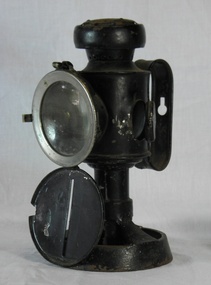
Lamp, 1900 (estimated)
... ...aiming lamp...They were also used as aiming lamps when they were placed in front of artillery posititions and used as a guide in aiming at night. ...They were also used as aiming lamps when they were placed in front of artillery posititions and used as a guide in aiming at night. ...This item type was used during the First World War throughout Europe. This item is an artillery siege lamp. It was used by artillery units. The lamps were powered by a single candle, the light being magnified by a lens. A shutter closes over the lens to give an illuminated vertical line. They were used originally in fortified siege artillery posititions as a general purpose lamp. They were also used as aiming lamps when they were placed in front of artillery posititions and used as a guide in aiming at night. Further research has suggested that this item may have been attached to bicycles for illuminating the way in the blackout.This item is considered rare and important. It is historically and technically siginficant at a national level. Painted black metal(tin) candle power, hand held or placed on flat area, open base so candle can be inserted and 'screwed' in, side door for lighting, fron magnifying glass, metal lens cover with vertical slit. There is considerable damage to the black paint in the external regions of the lamp.world war one, military, candle, artillery, europe, lamp, black, artillery siege lamp, artillery units, candle power, aiming lamp, wwi, 1900, australian war memorial, bike light, bike, bicycle, bicycle lamp, blackout -
 Orbost & District Historical Society
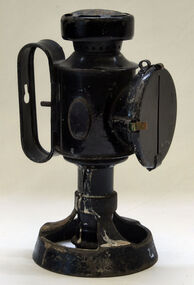
lantern, 1939?
... They were also used as aiming lamps when they were placed in front of artillery positions and used as a guide in aiming at night. ...They were also used as aiming lamps when they were placed in front of artillery positions and used as a guide in aiming at night. ...Blackout lantern used in WW11. This type of lantern was used during both World War. It is an artillery siege lamp and was originally used by artillery units. The lamps were powered by a single candle, the light being magnified by a lens. A shutter closes over the lens to give an illuminated vertical line. They were used originally in fortified siege artillery positions as a general purpose lamp. They were also used as aiming lamps when they were placed in front of artillery positions and used as a guide in aiming at night. These lamps were often used on the front of bicycles to guide at night. Donated by Clem Heather. Forestry Commision, carved faces on trees with axe., builder of tall. spliced single pole fire towers. This item is considered rare and important. It is historically and technically siginficant at a national level.Small black metal blackout lantern with handle. Front of lantern has round shield with small slit - small door at side for easy lighting of candle. It is hand held or placed on flat area, open base so candle can be inserted and 'screwed' in. Front is a magnifying glass and it has metal lens cover with vertical slit. lantern blackout ww11 military candle-power lamp -
 Bendigo Military Museum
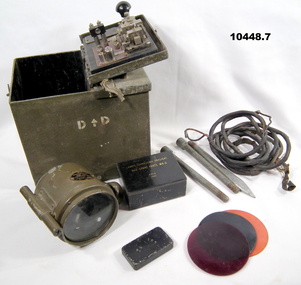
Equipment - LAMP SIGNALLING, PMG Melbourne, 1942
... Lamp signalling daylight assembly, lens width 8 cm. A pivoting base mount on bottom. On top is a small tube with cross hair sight for aiming. ...Lamp signalling daylight assembly, lens width 8 cm. A pivoting base mount on bottom. On top is a small tube with cross hair sight for aiming. ...1. Heavy aluminium case, two lids on top, colour drab olive. Belt loops both ends. Inside the smaller compartment, the sides are lined with cardboard. Inside the lid of the large compartment is a morse code key. Assembly case serial NR. 13155. 2. Lamp signalling daylight assembly, lens width 8 cm. A pivoting base mount on bottom. On top is a small tube with cross hair sight for aiming. Also there is a wire spring clip in front of lens for holding coloured filters. Lamp serial NR 13107. 3. Tin, black painted. Box spare parts MKII PMG 1942. 4. Tin small black - various plugs, nuts & bolts. 5. Stake set 3 piece Gal steel. Screw threaded ends (?) Stake end (1). 6. Filters celluloid - red. green Amber. 7. Cable rubber covered 2 core.1. Stencilled in white paint - on case - “D^D”signalling, lamps, morse code, ww2 -
 City of Ballarat Libraries
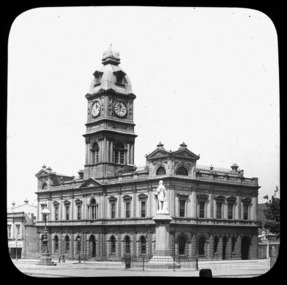
Glass Slide, Ballarat Town Hall
... The set and its subjects indicate these images were produced to promote Ballarat and were perhaps aimed at tourists. gas lamps statue Ballarat Town Hall, se corner Sturt and Armstrong Streets, image not dated. ...Town Hall completed 1872. Thomas Moore statue erected 1889. No evidence of electric trams indicates the photograph is pre-1905.Previously unknown image of Ballarat. The set and its subjects indicate these images were produced to promote Ballarat and were perhaps aimed at tourists.Ballarat Town Hall, se corner Sturt and Armstrong Streets, image not dated. gas lamps, statue -
 City of Ballarat Libraries
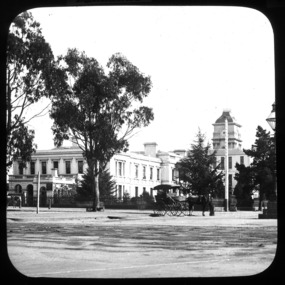
Glass Slide, Ballarat Hospital
... The set and its subjects indicate these images were produced to promote Ballarat and were perhaps aimed at tourists. gas lamps horse and cart Ballarat Hospital, nw corner Sturt and Drummond Streets, image not dated. ...The blue gums originally planted in Sturt St in the 1860s were grown from seed gifted by Baron von Mueller. About 20 years later shopkeepers complained that the trees shaded their shops too well, and made the street damp. The bluegums were then replaced with exotics.Previously unknown image of Ballarat. The set and its subjects indicate these images were produced to promote Ballarat and were perhaps aimed at tourists.Ballarat Hospital, nw corner Sturt and Drummond Streets, image not dated.gas lamps, horse and cart
