
Showing 30 items matching "air camera"
-
 Bendigo Military Museum
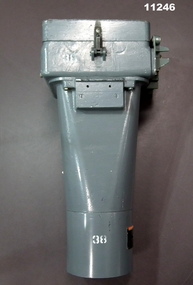
Equipment - AIR CAMERA ACCESSORY, UK Air Ministry, Unknown
... AIR CAMERA ACCESSORY......Air Camera...WW1 Sth Vietnam Air Camera Lens has dyno tape= TT 285126. F22 Assembly has brass plate - magazine camera type F22, Serial No. ...This Gear box universal, with its Cone assembly ( inc lens) in conjunction with Magazine 500 exposures unit ( see CAT 5561) is part of the F22 aerial camera assembly. As an assembly, the type F22 aerial camera came into RAF and RAAF service c1942. It was used by the RAF over Europe and by the RAAF extensively through the Sth. West Pacific area of operations, during WW2. This type of camera was used through the Vietnam war up to the early 1980's. The F22 camera assembly when mounted in the reliable Canberra aircraft, did aerial survey work in PNG, Indonesia, Malaysia and Sumatra and the Australian mainland. This type of camera was used in Spitfires, Mosquitos, Avro Lincolns and Canberra aircraft.Heavy, metal construction. The base is a rectangular box shape and mounted to that is a funnel shaped tube. Inside the tube are numerous small baffles around the sides painted matte black. The box has a 7 pin electrical connector. The box section can be opened by releasing catches. It has a timber base. Near the mouth of the tube, outside, is a panel with a slot and indentations F5.6 F8 F11 F16.Lens has dyno tape= TT 285126. F22 Assembly has brass plate - magazine camera type F22, Serial No. K144 RCF No. IMU. Inside assembly is plate = Body 14A/ 2788 Serial ?? 62.ww1, sth vietnam, air camera -
 Moorabbin Air Museum
Manual (Item) - Aerial cameras, Instruction Manual for Users of the O.S.C.Mark ii Photogrammetric Air Camera
... Instruction Manual for Users of the O.S.C.Mark ii Photogrammetric Air Camera...Ltd Instruction Manual for Users of the O.S.C.Mark ii Photogrammetric Air Camera Manual Aerial cameras ...Williamson Manufacturing Co. Ltd -
 Bendigo Military Museum
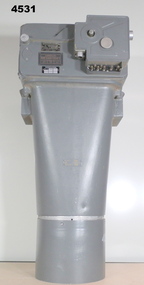
Equipment - AIR CAMERA ACCESSORY, Williamson Mfg. Co. Ltd
... AIR CAMERA ACCESSORY...Near the mouth of the tube, outside, is a panel with a slot and indentations F5.6 F8 F11 F16. Equipment AIR CAMERA ACCESSORY Williamson Mfg. Co. Ltd. ...This Gear box universal, with its Cone assembly ( inc lens) in conjunction with Magazine 500 exposures unit ( see CAT 5561) is part of the F22 aerial camera assembly. As an assembly, the type F22 aerial camera came into RAF and RAAF service c1942. It was used by the RAF over Europe and by the RAAF extensively through the Sth. West Pacific area of operations, during WW2. This type of camera was used through the Vietnam war up to the early 1980's. The F22 camera assembly when mounted in the reliable Canberra aircraft, did aerial survey work in PNG, Indonesia, Malaysia and Sumatra and the Australian mainland. This type of camera was used in Spitfires, Mosquitos, Avro Lincolns and Canberra aircraft.Heavy, metal construction. The base is a rectangular box shape and mounted to that is a funnel shaped tube. Inside the tube are numerous small baffles around the sides painted matte black. The box has a 7 pin electrical connector. The box section can be opened by releasing catches. It has a timber base. Near the mouth of the tube, outside, is a panel with a slot and indentations F5.6 F8 F11 F16.There is a tape label near mouth if tube with writing embossed "LENS S/NO 2767849" The box has a label "GEARBOX/UNIVERSAL. MODEL 14A/4249 SERIAL No. 1685"aviation, reconnaisance, camera, photography -
 Bendigo Military Museum
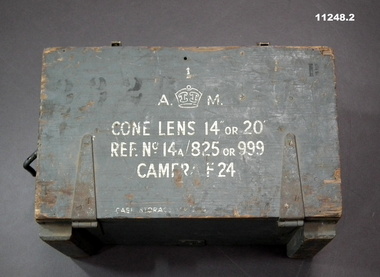
Equipment - AIR CAMERA LENS CONE, Air Ministry, Unknown
... AIR CAMERA LENS CONE...M." on either side. Equipment AIR CAMERA LENS CONE Air Ministry ...Suits Camera F24.1. Lens Cone - heavy aluminium tube with a sloght taper. One end is open, the other end is flanged and open. This end has 3 hex bolts sitting in it. Inside is a glass lens. There is a lever on the cone with four 'F' stops 5.6 - 80 - 11- 16, serial 6?94. The lens has anistigmat No. TT 286227 14 inch. 2. Heavy duty plywood box. Inside are padded cradles to hold the lens cone. It has a steel handle on one end, It has two catches to hold lid shut. Stencilled on top 15:- Cone Lens 14" or 20". Ref No. 14A/ 825 or 999. Camera F24. It has a crest with "A. M." on either side.On cone is a plate = Cone 14" B Ref No. 14A/23R Serial. There is 1/2 an RAAF Equipment ticket tied to a bolt.air photography, raaf, equipment -
 Bendigo Military Museum
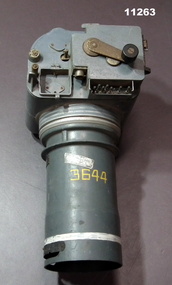
Equipment - AIR CAMERA, Air Ministry, Unknown
... AIR CAMERA...On the camera magazine side, where the gearbox is, are numerous knobs and gauges. Equipment AIR CAMERA Air Ministry ...Heavy aluminium construction camera with short lens cone. The camera section has a 7 pin electric socket. It has a steel rotating handle, mounted on a gearbox Type E. The rear of the film magazine has a faded perspex rectangle. 8 x 4.6 cm. On the camera magazine side, where the gearbox is, are numerous knobs and gauges. Painted on the side of the cone = 3644. Gearbox = Model 14A/2500 Serial No. 11076. Camera Film Housing = Title Film Magazine, Model 14A/730 Serial M16077.air photography, raaf, equipment -
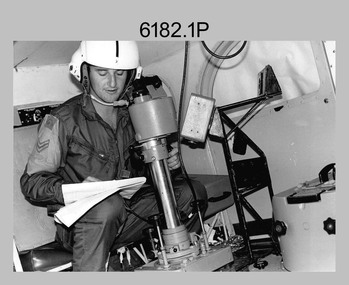 Bendigo Military Museum
Photograph - Royal Australian Survey Corps Aerial Surveys, c1980
... In photo .1P, CPL Steve Gloster was operating a RC10 air survey camera mounted in an Australian Army Pilatus Porter aircraft. ...This is a set of nine photographs of technicians from the Royal Australian Survey Corps operating aerial surveys equipment c1980s. .1P to .3P, .5P to .9P - Colour and black and white photos on photographic paper and scanned at 300 dpi. .4P - Colour photo on 35mm slide film and scanned at 96 dpi. .1) & .2) - Photo, black & white, c1980s, CPL Steve Gloster operating an RC10 air camera. .3) - Photo, colour, 1984, Roger Rees operating Air Profile Recorder (APR) equipment. .4) - Photo, colour, c1980s, Neil Jones at the door of an Airsearch Beechcraft Queen Air aircraft, typically used by RA Svy on air survey operations. .5) - Photo, colour, c1980s. ...In photo .1P, CPL Steve Gloster was operating a RC10 air survey camera mounted in an Australian Army Pilatus Porter aircraft. ...This is a set of nine photographs of technicians from the Royal Australian Survey Corps operating aerial surveys equipment c1980s. In photo .1P, CPL Steve Gloster was operating a RC10 air survey camera mounted in an Australian Army Pilatus Porter aircraft. The Wild RC10 super wide-angle air survey cameras were first introduced in 1971, were equipped with virtual distortion free lenses for supplementary, spot and special photography. In photo .2P, Roger Rees was operating Air Profile Recorder (APR) equipment. it was possibly taken during OP NERVOSE 84, sometime between June – August 1984 when based in Ngukurr, Northern Territory. The APR was operated at this time in unison with an RC10 camera. In 1963 the Royal Australian Survey Corps introduced the radar airborne profile recorder (Canadian Applied Research Ltd, Mark V, Airborne Profiler Recorder) was introduced for 1:100,000 mapping to replace terrain heighting by aneroid barometry. Later in 1974-1975, the Australian developed WREMAPS II airborne laser terrain profile recorder was introduced. In photo .3P, Neil Jones appears at the door of Airsearch Beechcraft Queen Air aircraft, Registration / Serial VH-MWX. This aircraft was typically used by RA Svy on air survey operations flying mission with Aerodist, APR and RC10 camera equipment. The Australian Army’s Pilatus Porter (short take-off and landing turbo propeller) was also equipped with a Wild RC10 aerial mapping camera for identification photography. The Pilatus Porter was also used on RA Svy’s map field checking operations. Photo .9P was taken at a survey station at an unknown location. In this photo an Australian Army Kiowa Light Observation Helicopter (LOH) is supporting a field survey party undertaking Magnavox AN/PRR-14 portable Doppler satellite observations. The satellite receiver’s antenna is plumbed over the survey ground mark surrounded by white plastic panels. The panels were used to identify the survey station on aerial photography. Introduced in 1974–1975, the Magnavox AN/PRR-14 portable Doppler satellite (US Navy Navigation Satellite System – TRANSIT) receivers and computing system provided independent three-dimensional point positions anywhere in the world, anytime, in any weather accurate to about 1.5metres with precise satellite ephemerides. The Bell OH-58 Kiowa LOH was a family of military helicopters used for observation, utility, and direct fire support. It was identified by RA Svy in the mid-1970s that considerable time was lost in replacing unserviceable remote equipment by road. Therefore Aerodist operations (pre-dating satellite receiver operations) were fully supported by Army’s Kiowa LOH aircraft. This is a set of nine photographs of technicians from the Royal Australian Survey Corps operating aerial surveys equipment c1980s. .1P to .3P, .5P to .9P - Colour and black and white photos on photographic paper and scanned at 300 dpi. .4P - Colour photo on 35mm slide film and scanned at 96 dpi. .1) & .2) - Photo, black & white, c1980s, CPL Steve Gloster operating an RC10 air camera. .3) - Photo, colour, 1984, Roger Rees operating Air Profile Recorder (APR) equipment. .4) - Photo, colour, c1980s, Neil Jones at the door of an Airsearch Beechcraft Queen Air aircraft, typically used by RA Svy on air survey operations. .5) - Photo, colour, c1980s. A Beechcraft King Air aircraft, also used by RA Svy on air survey operations. .6) - Photo, colour, c1980s. An Australian Army Pilatus Porter, used by RA Svy on air survey and map field checking operations. SGT Peter Mustart is possibly in the foreground. .7) to .8) - Photo, colour, c1980s. An Australian Army Pilatus Porter and unidentified personnel, used by RA Svy on air survey and map field checking operations. .9) - Photo, colour, c1980s. An Australian Army Kiowa helicopter supporting a field survey party undertaking Magnavox AN/PRR-14 portable Doppler satellite observations. There are biro marks on photos .4P to .9Proyal australian survey corps, rasvy, army survey regiment, asr, fortuna, aerial surveys -
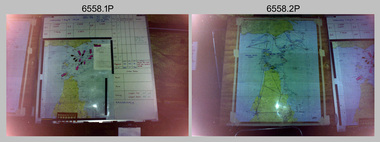 Bendigo Military Museum
Photograph - 4th Field Survey Squadron – Operation ARIGHT 91, Queensland, 1991
... Identification photography of control points was taken by air camera operators in AAAvn Pilatus Porter aircraft from 173 Gen Spt Sqn fitted with an RC10 aerial camera....Identification photography of control points was taken by air camera operators in AAAvn Pilatus Porter aircraft from 173 Gen Spt Sqn fitted with an RC10 aerial camera. ...This is a set of 16 photographs taken during 4th Field Survey Squadron’s deployment on Operation ARIGHT 91 in Queensland from the 8th of July to the 5th of September 1991. The area of operations was the top end of the Cape York Peninsula, islands of the Torres Strait and the southern coast of PNG. Field parties utilised Texas Instruments TI4100 Global Positioning System receivers. Concurrent with GPS operations Doppler point positioning observations were carried out by field parties using Magnavox MX 1502 receivers on six of the control points. Two Bell UH-1H Iroquois helicopters from RAAF’s 171 COMD and Liaison Squadron were primarily used to deploy GPS field parties. Identification photography of control points was taken by air camera operators in AAAvn Pilatus Porter aircraft from 173 Gen Spt Sqn fitted with an RC10 aerial camera.This is a set of 16 photographs taken in 1991 during 4th Field Survey Squadron’s deployment on Operation ARIGHT in Queensland. The colour photographs are on 35mm negative film and are part of the Army Survey Regiment’s Collection. The photographs were scanned at 96 dpi. .1) to .3) - Photo, colour, 1991. Area of Operations (AO) coordination maps. .4) - Photo, colour, 1991. GPS acquisition post-processing. L to R: LT Simon Buckpitt, SSGT Steve Winner, WO2 Ken Talbot-Smith. .5) to .6) - Photo, colour, 1991. Base camp unidentified personnel. .7) - Photo, colour, 1991. L to R: OPS WO - WO2 Ken Talbot-Smith, DET SSM WO1 Stevo Hinic. .8) - Photo, colour, 1991. Base camp unidentified personnel. .9) - Photo, colour, 1991. Base camp L to R: unidentified (x2), OPS WO - WO2 Ken Talbot-Smith. .10) - Photo, colour, 1991. Base camp unidentified soldier. .11) - Photo, colour, 1991. Base camp L to R: CPL Andy Love, unidentified, SGT Steve McGuiness. .12) - Photo, colour, 1991. Base camp at Horn Island Army Compound. .13 to .16) - Photo, colour, 1991. Unknown locations in Area of Operations..1P to .16P – There are no personnel identified. ‘1991 OP ARIGHT’ annotated on negative sleeve.royal australian survey corps, rasvy, 4 fd svy sqn, op aright 91 -
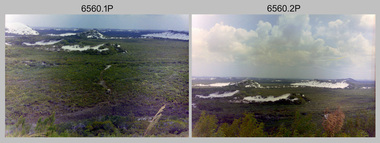 Bendigo Military Museum
Photograph - 4th Field Survey Squadron – Operation ARIGHT 93, Queensland, 1993
... Supplementary and Vital Asset Protection photography was taken by air camera operators in AAAvn Nomad aircraft from 173 Survl Sqn fitted with an RC10 aerial camera....Supplementary and Vital Asset Protection photography was taken by air camera operators in AAAvn Nomad aircraft from 173 Survl Sqn fitted with an RC10 aerial camera. ...This is a set of 42 photographs taken during 4th Field Survey Squadron’s deployment on Operation ARIGHT 93 in North Queensland from the 30th of August to the 8th of October 1993. The Survey Field Completion area of operations was Weipa near the top end of the Cape York Peninsula. Survey parties conducted field checking of topographic maps covering Bamaga, Heathlands, Weipa, Lockhart River and Strathgordon in Perentie 110 Series Survey variant FFR Land Rovers. Hand-held Trimble and Magellan GPS receivers were used to assist with navigation and to position remote isolated features. Three Bell Kiowa LOH helicopters provided by 162 Recce Sqn supported field checking operations. Supplementary and Vital Asset Protection photography was taken by air camera operators in AAAvn Nomad aircraft from 173 Survl Sqn fitted with an RC10 aerial camera.This is a set of 42 photographs taken in 1993 durin8g 4th Field Survey Squadron’s deployment on Operation ARIGHT in North Queensland. The colour photographs are on 35mm negative film and are part of the Army Survey Regiment’s Collection. The photographs were scanned at 96 dpi. .1) - Photo, colour, 1993. Survey party in Perentie 110 Series Land Rover navigates through Cape York Peninsula sand hills. .2) - Photo, colour, 1993. Cape York Peninsula sand hills. .3) - Photo, colour, 1993. Cape York Peninsula Island. .4) - Photo, colour, 1993. Survey party in Perentie 110 Series Land Rover enters a Cape York Peninsula beach. .5) - Photo, colour, 1993. SPR Kim Baker takes a break on a Cape York Peninsula beach. .6) - Photo, colour, 1993. L to R: MAJ Andy Cordova (USA Exchange) from the Army Survey Regiment and unidentified civilians. .7) to .14) - Photo, colour, 1993. Cape York Peninsula topography. .15) - Photo, colour, 1993. Unidentified surveyor in Bell Kiowa LOH helicopter. .16) - Photo, colour, 1993. Bell Kiowa LOH helicopter circles base camp. .17) to .18) - Photo, colour, 1993. Cape York Peninsula topography. .19) - Photo, colour, 1993. Vehicle convoy taking a break. L to R: LT John Bath (Detachment OC), unidentified (x2), SPR Chris Pearse. .20) - Photo, colour, 1993. Vehicle convoy taking a break. .21) - Photo, colour, 1993. Vehicle convoy ready to go. SPR Chris Pearse. .22) - Photo, colour, 1993. Vehicle convoy on the move. .23) - Photo, colour, 1993. Cape York Peninsula topography. .24) - Photo, colour, 1993. Unidentified personnel. .25) - Photo, colour, 1993. SGT Neale ‘Tex’ Houston. .26) - Photo, colour, 1993. Ground below a Bell Kiowa LOH helicopter .27) - Photo, colour, 1993. L to R: SPR Mark Sinderberry and CPL Stuart Adrain in a Bell Kiowa LOH helicopter. .28) & .29) - Photo, colour, 1993. Ground below a Bell Kiowa LOH helicopter. .30) - Photo, colour, 1993. Base camp viewed from a Bell Kiowa LOH helicopter. .31) - Photo, colour, 1993. Cape York Peninsula topography in recovery after burn-off. .32) & .33) - Photo, colour, 1993. SPR Kim Baker contemplates crossing this bridge in his Land Rover. .34) - Photo, colour, 1993. SPR Kim Baker takes a break next to a billabong. .35) - Photo, colour, 1993. Survey party in Perentie 110 Series Land Rover crosses a creek. .36) - Photo, colour, 1993. Cape York Peninsula bush fire in distance. .37) - Photo, colour, 1993. Survey party in Perentie 110 Series Land Rover traverses a sand hill. .38) - Photo, colour, 1993. SPR Kim Baker. .39) - Photo, colour, 1993. Cape York Peninsula bush fire. .40) - Photo, colour, 1993. Cape York Peninsula topography. .41) & .42) - Photo, colour, 1993. Cape York Peninsula sand hills..1P to .42P – There are no personnel identified. ‘1993 OP ARIGHT’ annotated on negative sleeve.royal australian survey corps, rasvy, 4 fd svy sqn, op aright 93 -
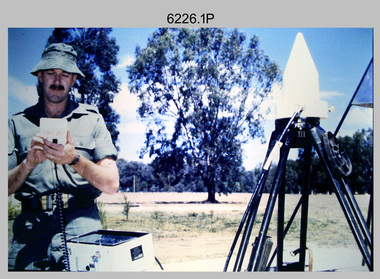 Bendigo Military Museum
Photograph - Demonstration of TI4100 GPS Receiver, Royal Australian Survey Corps, c1988
... The equipment was deployed to establish the baseline for a GPS controlled air camera and photogrammetric system to significantly reduce the requirement for ground survey to accurately control air photography for topographic mapping. ...The equipment was deployed to establish the baseline for a GPS controlled air camera and photogrammetric system to significantly reduce the requirement for ground survey to accurately control air photography for topographic mapping. ...This is a set of four photographs of WO2 Graham Ragless from the Royal Australian Survey Corps demonstrating the operation of Global Positioning System equipment in c1988. The photos were probably taken at the School of Military Survey (SMS), Bonegilla, VIC. Texas Instruments TI4100 portable Global Positioning System (GPS) geodetic receivers were introduced from 1986–1988. The GPS receivers and Ferranti FILS3 helicopter and vehicle mounted Inertial Positioning System (IPS) replaced the TRANSIT satellite receivers. The equipment was deployed to establish the baseline for a GPS controlled air camera and photogrammetric system to significantly reduce the requirement for ground survey to accurately control air photography for topographic mapping. Personnel from the four field survey squadrons at this time were trained at the SMS to operate the TI4100 receivers. Field survey operations using GPS and IPS equipment followed in the late 1980s. This technology is described in more detail in the RA Svy booklet titled An Introduction to Topographic Mapping. See record ID - 6010. WO2 Graham Ragless progressed to the rank of WO1 and was appointed as RSM of the Army Survey Regiment from 1990 to 1992. Refer to item 6186.2P for more photographs of WO2 Graham Ragless demonstrating the TI4100.This is a set of four photographs of a technician from the Royal Australian Survey Corps demonstrating the operation of Global Positioning System equipment in c1988. Colour photos are on 35mm slide film and were scanned at 96 dpi. .1) to .4) - Photo, colour, c1988, WO2 Graham Ragless demonstrating the operation of a TI4100 GPS receiverThere are no annotations.royal australian survey corps, rasvy, army survey regiment, army svy regt, fortuna, asr, surveying -
 Bendigo Military Museum
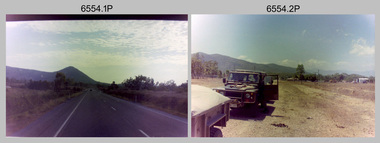
Photograph - 4th Field Survey Squadron deployed on Operation NERIGHT, Queensland & Northern Territory, 1989
... Identification photography of control points was taken by air camera operators in AAAvn Pilatus Porter aircraft from 173 Gen Spt Sqn fitted with an RC10 aerial camera. ...Identification photography of control points was taken by air camera operators in AAAvn Pilatus Porter aircraft from 173 Gen Spt Sqn fitted with an RC10 aerial camera. ...This is a set of 19 photographs taken in 1989 during 4th Field Survey Squadron’s deployment on Operation NERIGHT 89 in Queensland and the Northern Territory. It was a two-part operation in 1989 with work conducted in the areas of Camooweal and Weipa. Part 1 was the field completion of topographic maps conducted near Camooweal QLD, along the Barkley Highway on the border between NT and QLD, from the 12th of September to the 20th of October 1989. A Bell Kiowa LOH helicopter from 162 Recce Sqn supported topographic field completion. Operation NERIGHT 89 Part 2 was the acquisition of mapping control by GPS field parties utilising Texas Instruments TI4100 Global Positioning System receivers around Weipa on Cape York Peninsula from the 22nd of September to the 22nd of October 1989. Part 2 Two Bell UH-1H Iroquois helicopters from RAAF’s 35 Squadron were principally used to deploy GPS field parties. Identification photography of control points was taken by air camera operators in AAAvn Pilatus Porter aircraft from 173 Gen Spt Sqn fitted with an RC10 aerial camera. The two parts of the operation were conducted concurrently. This is a set of 19 photographs taken in 1989 during 4th Field Survey Squadron’s deployment on Operation Neright in Queensland & the Northern Territory. The colour photographs are on 35mm negative film and are part of the Army Survey Regiment’s Collection. The photographs were scanned at 96 dpi. .1) to .3) - Photo, colour, 1989. En-route to areas of survey operations. .4) to .5) - Photo, colour, 1989. Unidentified personnel relax next to river/waterhole. .6) - Photo, colour, 1989. Two Bell UH-1H Iroquois helicopters from RAAF’s 35 SQN utilised in the movement of GPS parties. .7) to .9) - Photo, colour, 1989. Unidentified soldier practices repelling from a UH1H Iroquois helicopter. .10) - Photo, colour, 1989. Inside the cockpit of a UH1H Iroquois helicopter. .11) - Photo, colour, 1989. Field Party camp with GPS equipment in foreground. Unidentified soldier prepares a meal. .12) - Photo, colour, 1989. GPS antenna plumbed over a survey ground mark. Witness post on left. .13) & .14) - Photo, colour, 1989. Unknown Cape York Peninsula beaches. .15) & .16) - Photo, colour, 1989. Dramatic fire next to base camp. .17) - Photo, colour, 1989. Aboriginal rock art at unknown location. .18) - Photo, colour, 1989. Aboriginal rock art at unknown location. L to R: unidentified, SPR Andrew Quin. .19) - Photo, colour, 1989. Aboriginal rock art at unknown location. LT Chris Topovsek..1P to .19P – There are no personnel identified. ‘1989 OP NERIGHT’ annotated on negative sleeve.royal australian survey corps, rasvy, 4 fd svy sqn, op neright 89 -
 Bendigo Military Museum
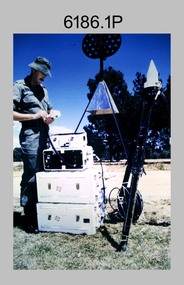
Photograph - Demonstration of TI4100 GPS Receiver, Royal Australian Survey Corps, c1988
... The equipment was deployed to establish the baseline for a GPS controlled air camera and photogrammetric system to significantly reduce the requirement for ground survey to accurately control air photography for topographic mapping. ...The equipment was deployed to establish the baseline for a GPS controlled air camera and photogrammetric system to significantly reduce the requirement for ground survey to accurately control air photography for topographic mapping. ...This is a set of two photographs of WO2 Graham Ragless from the Royal Australian Survey Corps demonstrating the operation of Global Positioning System equipment in c1988. The photos were probably taken at the School of Military Survey (SMS), Bonegilla, VIC. Texas Instruments TI4100 portable Global Positioning System (GPS) geodetic receivers were introduced from 1986–1988. The GPS receivers and Ferranti FILS3 helicopter and vehicle mounted Inertial Positioning System (IPS) replaced the TRANSIT satellite receivers. The equipment was deployed to establish the baseline for a GPS controlled air camera and photogrammetric system to significantly reduce the requirement for ground survey to accurately control air photography for topographic mapping. Personnel from the four field survey squadrons at this time were trained at the SMS to operate the TI4100 receivers. Field survey operations using GPS and IPS equipment followed in the late 1980s. This technology is described in more detail in the RA Svy booklet titled An Introduction to Topographic Mapping. See record ID - 6010. WO2 Graham Ragless progressed to the rank of WO1 and was appointed as RSM of the Army Survey Regiment from 1990 to 1992. Refer to item 6226.4P for more photographs of WO2 Graham Ragless demonstrating the TI4100.This is a set of two photographs of a technician from the Royal Australian Survey Corps demonstrating the operation of Global Positioning System equipment in c1988. Colour photos are on 35mm slide film and were scanned at 96 dpi. .1) and .2) - Photo, colour, c1988, WO2 Graham Ragless demonstrating the operation of a TI4100 GPS receiverThere are no annotations.royal australian survey corps, rasvy, army survey regiment, army svy regt, fortuna, asr, surveying -
Frankston RSL Sub Branch
Recorder, Camera
... air force...gun...fighter...photography...ww2...world war 2...camera...raaf royal australian air force gun fighter photography ww2 world war 2 camera aircraft bomber aerial The recorder enclosure is inscribed with the Department of Defence mark and the following, "14A/3629, G.G.S., RECORDER, Mk2, 24V., XX 12012". ...This is a Camera Gun Recorder used in conjunction with a Gyro Gun Sight type 14A, G. G. S. Recorder Mk2 contained in a wooden box with hinged lid and retaining catch. The recorder consists of a metal enclosure with an electrical power supply cable fitted with a three pole female plug connector. A small access cover in the enclosure can be opened to replace the Recorder Magazine. There is a transparent aperture window on the underside of the enclosure.The recorder enclosure is inscribed with the Department of Defence mark and the following, "14A/3629, G.G.S., RECORDER, Mk2, 24V., XX 12012". There are small controls on the narrow side of the recorder which are marked "START, 0, 5, 10, 15, END" and "DULL, S.S. BRIGHT". The recorder magazine is inscribed with the Department of Defence mark and the following "14A/4008, G.G.S., RECORDER, MAGAZINE, MKII". raaf, royal australian air force, gun, fighter, photography, ww2, world war 2, camera, aircraft, bomber, aerial -
 Nhill Aviation Heritage Centre
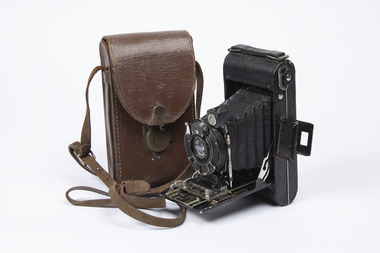
Memorabilia - Camera and case, No.1 Pocket Kodak Special, 1922 to 1931
... This camera belonged to Stan Guilfoyle who was a wireless operator air gunner (WAG) here at Nhill Air Navigation School, December 1943....This camera belonged to Stan Guilfoyle who was a wireless operator air gunner (WAG) here at Nhill Air Navigation School, December 1943. ...This camera belonged to Stan Guilfoyle who was a wireless operator air gunner (WAG) here at Nhill Air Navigation School, December 1943.This item is of great significance being here at the air school during it's operation. Some of the photos in Kevin O'Reilly's book In Just Five Years were taken with this camera. Folding Kodak Camera, metal casing with paper concertina folding body and lens assembly, comes with leather carry case. Has various lens adjusters and a scribing pin attached.Kodamatic, No.1 Pocket Kodak Special, Made in USA by Kodak Company Rochester NY, 26980camera, kodak, guilfoyle, stan guilfoyle, wag, -
 Federation University Historical Collection
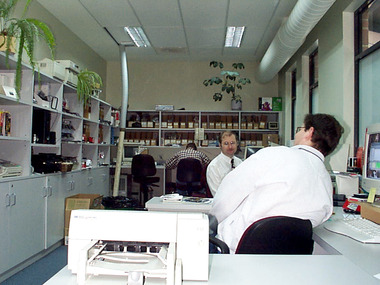
Photograph, Ballarat School of Mines Information Technology Staff, 12/1997
... Nicholas Dore stares towards the camera, and Ballarat School of Mines Information Technology Staff Phil Brokenshire works at the back bench. The pipe leading to the roof connects to a portable air conditioner. ...Nicholas Dore stares towards the camera, and Ballarat School of Mines Information Technology Staff Phil Brokenshire works at the back bench. The pipe leading to the roof connects to a portable air conditioner. ...This image was on a CD-ROM which was placed in a time capsule in December 1997, just before the Ballarat School of Mines merged with the University of Ballarat (now Federation University Australia). The time capsule should have been opened in 2020, the 150th anniversary of the establishment of the Ballarat School of Mines, but was postponed due to successive lockdowns during the Covid19 pandemic. The time capsule was opened in 2022.Three men in the Information Technology Room in the top floor of the Brewery Building at the Ballarat School of Mines. Greg Eames is in the foreground with his back to the camera. Nicholas Dore stares towards the camera, and Ballarat School of Mines Information Technology Staff Phil Brokenshire works at the back bench. The pipe leading to the roof connects to a portable air conditioner. The top floor rooms were very hot. ballarat school of mines, time capsule, information technology, greg eames, phil brokenshire, nicholas dore, covid19 -
 Bendigo Military Museum
Photograph - Map Production and Technical Services – Army Survey Regiment, Fortuna, Bendigo, July 1986
... Royal Australian Survey Corps RASvy Army Survey Regiment Army Svy Regt Fortuna ASR air survey Litho carto .1P – Annotated on back ‘JUL 86 SPR Rob Jones Barcro’ .2P – Annotated on back ‘JUL 86 SSGT Greg Buckingham Aerotrig’ .3P – Annotated on back ‘JUL 86 SSGT Andy Wilson, Mr Tony Spurling, Mr Pat Thwaites. Tech Services’ .4P – Annotated on back ‘JUL 86 SGT Paul Leskovec CSM, SPR Tony Martin, FLT LT Don Stebbings RAAF Charting’ .5P – Annotated on back ‘JUL 86 CPL John ‘Junior’ Whaling Camera Section LITHO’ .6P – Annotated on back ‘JUL 86 SPR Daryl South LITHO SQN’ This is a set of six photographs of Army Survey Regiment personnel and civilians undertaking technical activities at Fortuna, Bendigo, in July 1986. ...This is a collection of six photos of personnel and civilians undertaking technical tasks from Technical Services and the Air Survey, Cartographic and Lithographic Squadrons. The photos were taken at the Army Survey Regiment, Fortuna, Bendigo in July 1986. This is a set of six photographs of Army Survey Regiment personnel and civilians undertaking technical activities at Fortuna, Bendigo, in July 1986. The photographs were printed on photographic paper and are part of the Army Survey Regiment’s Collection. The photographs were scanned at 300 dpi. .1) - Photo, black & white, 1986, BARCRO work area WILD U4A Diapositive Camera, SPR Rob Jones. .2) - Photo, black & white, 1986, Aerotriangulation work area, SSGT Greg Buckingham. .3) - Photo, black & white, 1986, Technical Services in Building 16A. L to R: SSGT Andy Wilson, Tony Spurling, Pat Thwaites. .4) - Photo, black & white, 1986, RAAF Charting, L to R: SGT Paul Leskovec, SPR Toni Martin, FLT LT Don Stebbings .5) - Photo, black & white, 1986, Camera Section, CPL John Whaling. .6) - Photo, black & white, 1986, Print Troop, SPR Daryl South..1P – Annotated on back ‘JUL 86 SPR Rob Jones Barcro’ .2P – Annotated on back ‘JUL 86 SSGT Greg Buckingham Aerotrig’ .3P – Annotated on back ‘JUL 86 SSGT Andy Wilson, Mr Tony Spurling, Mr Pat Thwaites. Tech Services’ .4P – Annotated on back ‘JUL 86 SGT Paul Leskovec CSM, SPR Tony Martin, FLT LT Don Stebbings RAAF Charting’ .5P – Annotated on back ‘JUL 86 CPL John ‘Junior’ Whaling Camera Section LITHO’ .6P – Annotated on back ‘JUL 86 SPR Daryl South LITHO SQN’royal australian survey corps, rasvy, army survey regiment, army svy regt, fortuna, asr, air survey, litho, carto -
 Bendigo Military Museum
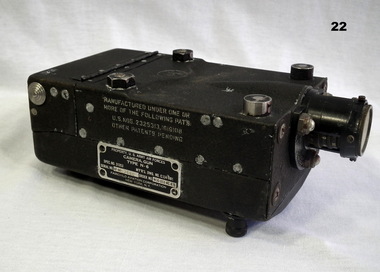
Equipment - GUN SIGHT CAMERA, c.WWII
... U.S Camera Gun Type N - 6 in black metal casing with knobs and lens, Fairchild Aviation Corp New York. Property of U.S Army Air Forces....Information supplied stated these were used in Kittyhawks of No 80 Sqd RAAF during WW2. military history airforce equipment photography cameras U.S Camera Gun Type N - 6 in black metal casing with knobs and lens, Fairchild Aviation Corp New York. Property of U.S Army Air Forces. ...Information supplied stated these were used in Kittyhawks of No 80 Sqd RAAF during WW2.U.S Camera Gun Type N - 6 in black metal casing with knobs and lens, Fairchild Aviation Corp New York. Property of U.S Army Air Forces.military history, airforce, equipment, photography, cameras -
 Bendigo Military Museum
Equipment - CAMERA LENS, Pentax, c1939-1945
... Has Dept of Defence arrow, 14a/780 aIR mINISTRY LENS. Camera WW2 1. Pentax 8"small F/2.9. ...Unknown origin. Has Dept of Defence arrow, 14a/780 aIR mINISTRY LENS.1. Camera Lens - Black metal, glass lens. 2. Small camera lens - black metal, glass lens.1. Pentax 8"small F/2.9. No. 023069. N.O.C.camera, ww2 -
 Bendigo Military Museum
Container - TIN, BISCUIT, est 1920's onwards
... This tin held hundreds of his nitrate negative photos for many years that he took during the Great War which remained virtually intact as away from light and air until rediscovered early 21st century. This collection became part of the exhibition “A Camera on the Somme”which was 80 selected photos to make a story with 7 story boards with photos to compliment. ...This tin held hundreds of his nitrate negative photos for many years that he took during the Great War which remained virtually intact as away from light and air until rediscovered early 21st century. This collection became part of the exhibition “A Camera on the Somme”which was 80 selected photos to make a story with 7 story boards with photos to compliment. ...The tin was owned by Jack Grinton No 1043, 38th Batt AIF. This tin held hundreds of his nitrate negative photos for many years that he took during the Great War which remained virtually intact as away from light and air until rediscovered early 21st century. This collection became part of the exhibition “A Camera on the Somme”which was 80 selected photos to make a story with 7 story boards with photos to compliment. A book was also produced to accompany the travelling exhibition. The framed collection are Cat No’s 7100P to 7179P and 7180 to 7187. Part of the Grinton collection.Refer Cat No 1280 for Jacks service details. Refer 1317P, 1320P.Biscuit tin, rectangular with coloured floral arrangement on front. Used by jack Grinton to hold nitrate negative photos taken during WWI. Original biscuit manufacturing label on front in one corner.containers-commercial, domestic items-containers, food storage, metalcraft -
 B-24 Liberator Memorial Restoration Australia Inc
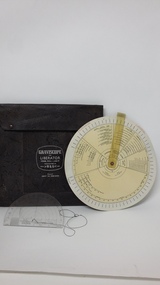
Graviscope, W&G, Graviscope for Liberator, circa 1942
... air crew with a computer to calculate individual aircraft's weight and balance. GRAVISCOPE FOR LIBERATOR. MODEL B24J, L AND M. MANUFACTURED BY MELB. >W&G< AUST. R.A.A.F IDENT NO G6B/2396 2 Circular plastic manual computing discs with black print on a white background with areas for calculating Centre of gravity, Armament, Bomb loadings,Fuel, oil,Crew, Miscel., Oxygen and Camera. ...Standard crew issue for pilots and flight engineers.The equipment supplied air crew with a computer to calculate individual aircraft's weight and balance.2 Circular plastic manual computing discs with black print on a white background with areas for calculating Centre of gravity, Armament, Bomb loadings,Fuel, oil,Crew, Miscel., Oxygen and Camera. Clear plastic protractor with string attached. Enclosed in a leather envelope.GRAVISCOPE FOR LIBERATOR. MODEL B24J, L AND M. MANUFACTURED BY MELB. >W&G< AUST. R.A.A.F IDENT NO G6B/2396 -
Moorabbin Air Museum
Document (Item) - Includes letters on the Jindivik project Nomad Turana Wretar cameras Viper, Air letters London January 1974 to December 1975
... Air letters London January 1974 to December 1975 Document Includes letters on the Jindivik project Nomad Turana Wretar cameras Viper ... -
Moorabbin Air Museum
Manual (Item) - Ground Camera , Type S92 Air Ministry AP 1355E, Vol.1
... Ground Camera , Type S92 Air Ministry AP 1355E, Vol.1...Ground Camera , Type S92 Air Ministry AP 1355E, Vol.1...Ground Camera , Type S92 Air Ministry AP 1355E, Vol.1 Manual Ground Camera , Type S92 Air Ministry AP 1355E, Vol.1 ... -
Moorabbin Air Museum
Manual (Item) - RAF Ground Cameras and Accessories Repair Manual, Ground Cameras and Accessories
... Air Publication 1355E, Volume 1 Tan hard-cover manual Ground Cameras and Accessories Manual RAF Ground Cameras and Accessories Repair Manual ...Air Publication 1355E, Volume 1 -
 Bendigo Military Museum
Photograph - Lithographic Squadron Personnel and Equipment, Army Survey Regiment, Fortuna, Bendigo, 1990
... Air Survey Support Section (BARCRO), Carl Zeiss Rectifying Enlarger. .6) - Photo, black & white, 1990. L to R: unidentified camera, Beseler Model 4SAF Autofocus Enlarger. .7) - Photo, colour, c1990. ...Air Survey Support Section (BARCRO), Carl Zeiss Rectifying Enlarger. .6) - Photo, black & white, 1990. L to R: unidentified camera, Beseler Model 4SAF Autofocus Enlarger. .7) - Photo, colour, c1990. ...This is a set of 10 photographs of Lithographic personnel and equipment taken at the Army Survey Regiment, Fortuna, Bendigo in 1990. Equipment shown includes the Carl Zeiss Rectifying Enlarger, the Beseler Model 4SAF Autofocus Enlarger, Pakotone film development processors, a film contact frame and the AGFA- Gevaert Gevalux Separation & Gevarex Halftone Console.This is a set of 10 photographs of Lithographic Squadron personnel and equipment taken at the Army Survey Regiment, Fortuna, Bendigo in 1990. The photographs are on 35mm negative film and were scanned at 2400 dpi. They are part of the Army Survey Regiment’s Collection. .1) - Photo, black & white, 1990. L to R: Photo Troop’s SGT Brian Fauth, SGT Frank Lenane. .2) - Photo, black & white, 1990. L to R: Photo Troop’s SSGT Di Chalmers, unidentified. .3) - Photo, black & white, 1990. SSM WO2 Rob Bogumil rearranges the contents of a clipboard. OC Bob Coote in the background is amused. .4) to .5) - Photo, colour, 1990. Air Survey Support Section (BARCRO), Carl Zeiss Rectifying Enlarger. .6) - Photo, black & white, 1990. L to R: unidentified camera, Beseler Model 4SAF Autofocus Enlarger. .7) - Photo, colour, c1990. Air Survey Support Section (BARCRO), Pakotone film development processors. .8) - Photo, black & white, 1991, Focus large format colour film/paper processor. .9) - Photo, colour, 1990. Air Survey Support Section (BARCRO), film contact frame. .10) - Photo, colour, 1990. AGFA- Gevaert Gevalux Separation & Gevarex Halftone Console. There are no personnel identified.royal australian survey corps, rasvy, army survey regiment, army svy regt, fortuna, litho, litho sqn -
 Bendigo Military Museum
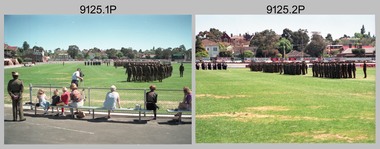
Photograph - Army Survey Regiment Freedom of Entry Parade, Bendigo CBD, 1990
... Air Survey 2IC MAJ Duncan Burns at left Squadron commanded by OC MAJ Peter Clark advances in quick time. WO1 Graham Ragless is closest to camera. .27) & .28) - Photo, colour, 1990. ...Air Survey 2IC MAJ Duncan Burns at left Squadron commanded by OC MAJ Peter Clark advances in quick time. WO1 Graham Ragless is closest to camera. .27) & .28) - Photo, colour, 1990. ...The Freedom of Entry to the City on the 26th of October 1990 was an honour first conferred by the Bendigo City Council to the Army Survey Regiment in 1970. This was the fifth time the unit exercised its freedom of marching into the city with swords drawn, bayonets fixed and drums beating. The honour is usually bestowed upon local regiments, in recognition of their dedicated service, and it is common for military units to periodically exercise their freedom by arranging a parade through the city. The event began with a ceremonial parade at the Queen Elizabeth II Oval. The RAAF Central Command Band provided the music at the parade. After formal inspections of the troops, the Army Survey Regiment saluted as it marched past the Reviewing Officer - Mayor of Bendigo Councillor James Douglass, military dignitaries and guests. Led by the Regiment’s CO – LTCOL Rene van den Tol, the unit marched down View St, along Pall Mall and to Gaol Rd. Regiment members were treated to a civic reception at the City Hall after the ceremony. The Regiment also exercised its Freedom of Entry with anniversary parades in 1977, 1980, 1985, 1992 and 1996. See items 9124.28P and 9126.24P for additional sets of photos taken at the event. The formal booklet covering the event is catalogued under item 9123.This set of 54 photographs of the Army Survey Regiment were taken at the Freedom of Entry parade, held at the City of Bendigo’s Queen Elizabeth Oval (QEO) on the 26th of October 1990. The colour photographs are on 35mm negative film and scanned at 2400 dpi. They are part of the Army Survey Regiment’s Collection. .1) - Photo, colour, 1990. Army Survey Regiment marches on to the QEO. .2) - Photo, colour, 1990. Army Survey Regiment formed up at the start of the parade. .3) & .4) - Photo, colour, 1990. Lithographic Squadron fixes bayonets. Centre rank: LCPL Damien Cole, remainder unidentified. Rear rank R to L: CPL Peter Swandale, SPR Andrew Arman, remainder unidentified. SSM WO1 Bill Jones at far right. .5) - Photo, colour, 1990. Army Survey Regiment await the order to take posts. .6) - Photo, colour, 1990. Army Survey Regiment standing at ease await the arrival of the Parade Host. .7) - Photo, colour, 1990. Arrival of the Parade Host - D-SVY COL Don Swiney MBE. L to R: CPL Mick McConnell, CPL Warren ‘Waldo’ Shirley, unidentified. .8) - Photo, colour, 1990. The Parade Host - D-SVY COL Don Swiney MBE and MAJ John South at his right returns the Regiment’s salute. .9) - Photo, colour, 1990. Arrival of dignitaries: L to R: CPL Mick McConnell, City of Bendigo Mayor - Councillor James Douglass, City of Bendigo Chief Executive Officer - Mr. R. J. Burton, CPL Warren ‘Waldo’ Shirley, unidentified. .10) - Photo, colour, 1990. Arrival of dignitaries: L to R: CPL Mick McConnell, Chief Superintendent F. Fox (presumed), unidentified, D-SVY COL Don Swiney MBE, CPL Warren ‘Waldo’ Shirley, unidentified. .11) - Photo, colour, 1990. Arrival of dignitaries: L to R: CPL Mick McConnell, Bishop of Sandhurst most Reverend N. Daly DD, unidentified padre, CPL Warren ‘Waldo’ Shirley, unidentified, D-SVY COL Don Swiney MBE. .12) - Photo, colour, 1990. L to R: City of Bendigo Mayor - Councillor James Douglass, City of Bendigo Chief Executive Officer - Mr. R. J. Burton view the parade from the dias. .13) - Photo, colour, 1990. CO of the Army Survey Regiment greets the parade dignitaries. L to R: CO LTCOL Rene van den Tol, D-SVY COL Don Swiney MBE, City of Bendigo Mayor - Councillor James Douglass, City of Bendigo Chief Executive Officer - Mr. R. J. Burton. .14) - Photo, colour, 1990. Headquarters Squadron inspection L to R: CO LTCOL Rene van den Tol, Chief Executive Officer - Mr. R. J. Burton, D-SVY COL Don Swiney MBE, Mayor - Councillor James Douglass, 2nd from right SGT Brendan McKinless, supernumerary WO2 Steve Hansen in background, remainder unidentified. .15) - Photo, colour, 1990. Unidentified squadron inspection L to R: D-SVY COL Don Swiney MBE, Chief Executive Officer - Mr. R. J. Burton, Mayor - Councillor James Douglass, CO LTCOL Rene van den Tol. .16) - Photo, colour, 1990. Air Survey Squadron inspection L to R: unidentified, SSGT Bob Garritty, CPL Craig Kellet, CPL Raelene (Munting) Brodie, unidentified, SPR Jodi Seath, remainder ranks unidentified, Mayor - Councillor James Douglass, Chief Executive Officer - Mr. R. J. Burton, CO LTCOL Rene van den Tol. .17) - Photo, colour, 1990. Lithographic Squadron inspection L to R: CO LTCOL Rene van den Tol, SGT Brian Paul, Mayor - Councillor James Douglass, SGT Steve Burke, D-SVY COL Don Swiney MBE. .18) - Photo, colour, 1990. The official party pass behind Headquarters Squadron and head towards the RAAF Central Command Band. L to R: Chief Executive Officer - Mr. R. J. Burton, Mayor - Councillor James Douglass, D-SVY COL Don Swiney MBE. .19) - Photo, colour, 1990. RAAF Central Command Band inspection L to R: Deputy Music Director Flying Officer S. Wright, Mayor - Councillor James Douglass, remainder unidentified. .20) - Photo, colour, 1990. RAAF Central Command Band inspection L to R: Chief Executive Officer - Mr. R. J. Burton, Deputy Music Director Flying Officer S. Wright, Mayor - Councillor James Douglass, remainder unidentified. .21) - Photo, colour, 1990. Cartographic Squadron commanded by OC MAJ Neil Taylor performs left form in slow time. .22) - Photo, colour, 1990. RAAF Central Command Band performs drill manoeuvre. .23) - Photo, colour, 1990. Air Survey Squadron commanded by OC MAJ Peter Clark performs left form. .24) - Photo, colour, 1990. Headquarters Squadron commanded by OC MAJ Ray Redman marches forward in slow time. .25) - Photo, colour, 1990. Army Survey Regiment in formation commanded by CO LTCOL Rene van den Tol advances in slow time. 2IC MAJ Duncan Burns at left. MAJ Bob Williams at right. .26) - Photo, colour, 1990. Air Survey 2IC MAJ Duncan Burns at left Squadron commanded by OC MAJ Peter Clark advances in quick time. WO1 Graham Ragless is closest to camera. .27) & .28) - Photo, colour, 1990. Lithographic Squadron commanded by OC MAJ Bob Coote advances before left form. LT Marty Lyons at left. LT Derek Bell at right. .29) - Photo, colour, 1990. Army Survey Regiment salutes as it marches past the Reviewing Officer Mayor - Councillor James Douglass, Chief Executive Officer - Mr. R. J. Burton and D-SVY COL Don Swiney MBE at the dias. .30) - Photo, colour, 1990. Parade official guests L to R: unidentified, MAJ John South, unidentified (x5), MAJ B.J. Donaldson – US Exchange, unidentified, unidentified padres (x2), Bishop of Sandhurst most Reverend N. Daly DD. .31) - Photo, colour, 1990. Army Survey Regiment salutes as it marches past the dias. .32) - Photo, colour, 1990. Lithographic Squadron commanded by OC MAJ Bob Coote performs left form. .33) - Photo, colour, 1990. Deputy Music Director Flying Officer S. Wright conducts the RAAF Central Command Band. .34) - Photo, colour, 1990. The RAAF Central Command Band performs during the parade. All musicians are unidentified. .35) - Photo, colour, 1990. Lithographic Squadron commanded by OC MAJ Bob Coote marches forward in quick time. .36) - Photo, colour, 1990. Cartographic Squadron commanded by OC MAJ Neil Taylor marches forward in quick time. .37) - Photo, colour, 1990. Lithographic Squadron commanded by OC MAJ Bob Coote marches forward in quick time. .38) - Photo, colour, 1990. Army Survey Regiment salutes as it marches past the dias. .39) - Photo, colour, 1990. L to R: Reviewing Officer Mayor - Councillor James Douglass, Chief Executive Officer - D-SVY COL Don Swiney MBE, Mr. R. J. Burton and at the dias. Parade official guests L to R: unidentified (x2), MAJ John South, unidentified (x5), MAJ B.J. Donaldson – US Exchange, unidentified, unidentified padres (x2), Bishop of Sandhurst most Reverend N. Daly DD. .40) - Photo, colour, 1990. Army Survey Regiment salutes as it marches past the Reviewing Officer Mayor - Councillor James Douglass, Chief Executive Officer - Mr. R. J. Burton and D-SVY COL Don Swiney MBE at the dias. MAJ P.G. Dinwiddie – UK Exchange is seen among the guests. .41) - Photo, colour, 1990. Air Survey Squadron commanded by OC MAJ Peter Clark stands at attention. .42) - Photo, colour, 1990. Headquarters Squadron commanded by OC MAJ Ray Redman stands at ease. 2IC MAJ Duncan Burns at far left. .43) - Photo, colour, 1990. Cartographic Squadron commanded by OC MAJ Neil Taylor stands at ease. CO LTCOL Rene van den Tol in foreground. .44) & .45) - Photo, colour, 1990. The Parade Host: D-SVY COL Don Swiney MBE addresses the Parade. .46) - Photo, colour, 1990. The Reviewing Officer: Mayor - Councillor James Douglass addresses the Parade. .47) - Photo, colour, 1990. L to R: City of Bendigo Chief Executive Officer - Mr. R. J. Burton, Reviewing Officer Bendigo Mayor - Councillor James Douglass. .48) - Photo, colour, 1990. Parade official guests Middle row L to R: MAJ P.G. Dinwiddie – UK Exchange, Chief Superintendent F. Fox, unidentified MAJ B.J. Donaldson – US Exchange, remainder unidentified. Front row L to R: unidentified (x2), MAJ John South, unidentified (x4). .49) - Photo, colour, 1990. Unidentified padre addresses the Parade. On his left: City of Bendigo Chief Executive Officer - Mr. R. J. Burton, Bishop of Sandhurst most Reverend N. Daly DD. .50) - Photo, colour, 1990. Unidentified padre addresses the Parade. On his right: Bishop of Sandhurst most Reverend N. Daly DD, City of Bendigo Chief Executive Officer - Mr. R. J. Burton, Reviewing Officer Bendigo Mayor - Councillor James Douglass. .51) - Photo, colour, 1990. Departure of Chief Superintendent F. Fox at conclusion of Parade. .52) - Photo, colour, 1990. Departure of unidentified padres (x2), Bishop of Sandhurst most Reverend N. Daly DD at conclusion of Parade. .53) & .54) - Photo, colour, 1990. Departure of Parade Host - D-SVY COL Don Swiney MBE at conclusion of Parade. No personnel or civilians are identified. ‘Freedom of Entry Parade ‘90’ is annotated on plastic negative sleeve.royal australian survey corps, rasvy, army survey regiment, army svy regt, fortuna -
 Bendigo Military Museum
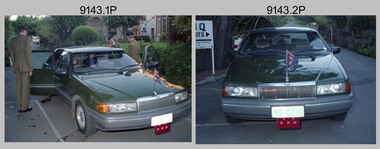
Photograph - CGS LTGEN Coates and RSM-A WO1 Wendt Visit to the Army Survey Regiment, Fortuna, Bendigo, 1990
... camera. .12) - Photo, colour, 1990. Descending the external stairway L to R: 2IC Maj Duncan Burns, CGS LTGEN John Coates AC MBE, unidentified aide de camp officer, CO LTCOL Rene van den Tol. .13) - Photo, colour, 1990. Air...camera. .12) - Photo, colour, 1990. Descending the external stairway L to R: 2IC Maj Duncan Burns, CGS LTGEN John Coates AC MBE, unidentified aide de camp officer, CO LTCOL Rene van den Tol. .13) - Photo, colour, 1990. Air ...This set of 43 photographs was taken in August 1990 during the Australian Army Chief of the General Staff (CGS) and Regimental Sergeant-Major of the Australian Army (RSM-A) visit to the Army Survey Regiment, Fortuna, Bendigo. Lieutenant General Henry John Coates AC MBE was a senior officer in the Australian Army who served as Chief of the General Staff from 1990 to 1992. RSM-A WO1 Kevin ‘Lofty’ Wendt OAM BEM was the 2nd RSM to be appointed to the position of RSM-A, the most senior Warrant Officer position in the Australian Army. His appointment was from 1987 to 1990. The name of the CGS’s aide de camp officer is unknown. The CGS and RSM-A visit to the Army Survey Regiment is covered on page 145 of Valerie Lovejoy’s book 'Mapmakers of Fortuna – A history of the Army Survey Regiment’ ISBN: 0-646-42120-4. See Item 6154.6P for additional photos taken during the visit.This is a set of 43 photographs taken on the occasion of the Chief of the General Staff - Lieutenant General Henry John Coates AC MBE visit to the Army Survey Regiment, Bendigo in August 1990. Colour photographs are on 35mm negative film and scanned at 2400 dpi. They are part of the Army Survey Regiment’s Collection. .1) - Photo, colour, 1990. Arrival of the CGS at Fortuna Villa. L to R: unidentified RACT driver, CO LTCOL Rene van den Tol., unidentified aide de camp officer. .2) - Photo, colour, 1990. The CGS’s staff car, noting the 3 stars on red plate below the number plate. .3) - Photo, colour, 1990. Partners accompanying the tour delegation arrive at Fortuna Villa. Mrs Ruth van den Tol is 2nd from right, remainder unidentified. .4) - Photo, colour, 1990. The visitors gather at Fortuna Villa’s front steps. L to R: unidentified (x2), RSM-A WO1 Kevin ‘Lofty’ Wendt OAM BEM, unidentified (x2), Mrs Ruth van den Tol, unidentified. In background L to R: CGS LTGEN John Coates AC MBE, CO LTCOL Rene van den Tol. .5) - Photo, colour, 1990. The visitors gather at Fortuna Villa’s front steps. L to R: RSM WO1 Neville Stone, unidentified, RSM-A WO1 Kevin ‘Lofty’ Wendt OAM BEM, Mrs Ruth van den Tol, unidentified (x2). .6) - Photo, colour, 1990. The visitors gather at Fortuna Villa’s front steps. L to R: unidentified, RSM-A WO1 Kevin ‘Lofty’ Wendt OAM BEM, Mrs Ruth van den Tol, unidentified (x4). In background – RSM WO1 Neville Stone. .7) - Photo, colour, 1990. The visitors gather at Fortuna Villa’s front steps. L to R: RSM WO1 Neville Stone. unidentified, RSM-A WO1 Kevin ‘Lofty’ Wendt OAM BEM, unidentified (x4). Mrs Ruth van den Tol. .8) - Photo, colour, 1990. At Fortuna Villa’s front steps. L to R: RSM WO1 Neville Stone. RSM-A WO1 Kevin ‘Lofty’ Wendt OAM BEM. .9) - Photo, colour, 1990. CO LTCOL Rene van den Tol at left invites CGS LTGEN John Coates AC MBE to sign the Visitors’ Book outside the Messes. .10) - Photo, colour, 1990. Production Control Office. L to R: CO LTCOL Rene van den Tol, CAPT Roger Hancock, CGS LTGEN John Coates AC MBE, WO1 Colin Cuskelly. .11) - Photo, colour, 1990. Fortuna Villa Historic Tour. Unidentified visitors in the entrance foyer guided by CPL Le-Anne (Smallshaw) Shirley at far right. Mrs Ruth van den Tol faces the camera. .12) - Photo, colour, 1990. Descending the external stairway L to R: 2IC Maj Duncan Burns, CGS LTGEN John Coates AC MBE, unidentified aide de camp officer, CO LTCOL Rene van den Tol. .13) - Photo, colour, 1990. Air Survey Squadron brief L to R: LT Simon Buckpitt, OC MAJ Peter Clark, CO LTCOL Rene van den Tol, CGS LTGEN John Coates AC MBE, unidentified aide de camp officer. .14) - Photo, colour, 1990. Air Survey Squadron tour. CGS LTGEN John Coates AC MBE watches as CPL Darren Wilkinson operates a B8 stereo plotter on the AUTOMAP 2 system. .15) - Photo, colour, 1990. Air Survey Squadron tour. CGS LTGEN John Coates AC MBE views stereo aerial photography on a Wild B8 stereo plotter. .16) - Photo, colour, 1990. Air Survey Squadron tour. L to R: SSGT Andy Boath guides the CGS LTGEN John Coates AC MBE’s operation of a Wild B8 stereo plotter fitted with dual optics on the AUTOMAP 2 system. .17) - Photo, colour, 1990. Air Survey Squadron tour. L to R: SSGT Andy Boath explains a AUTOMAP 2 system feature coding menu to the CGS LTGEN John Coates AC MBE next to a Wild B8 stereo plotter. .18) - Photo, colour, 1990. Air Survey Squadron tour. L to R: SPR Paula (Golding) Brinsmead explains off-table map editing procedure to RSM-A WO1 Kevin ‘Lofty’ Wendt OAM BEM. RSM WO1 Neville Stone stands on the background. .19) - Photo, colour, 1990. Air Survey Squadron tour. L to R: SPR Paula (Golding) Brinsmead explains off-table map editing procedure to RSM-A WO1 Kevin ‘Lofty’ Wendt OAM BEM. .20) - Photo, colour, 1990. Cartographic Squadron brief. L to R: CGS LTGEN John Coates AC MBE, CAPT Dave McLachlan, CO LTCOL Rene van den Tol. .21) - Photo, colour, 1990. Cartographic Squadron tour. SPR Ian Baldwin demonstrates AUTOMAP 2 system cartographic editing on a Graphic Editing Workstation. Standing L to R: CAPT Dave McLachlan, CGS LTGEN John Coates AC MBE, CO LTCOL Rene van den Tol. .22) - Photo, colour, 1990. Cartographic Squadron tour. AUTOMAP 2 system cartographic editing demonstrated on a Graphic Editing Workstation. Standing L to R: LT Steve Hledik, unidentified aide de camp officer CAPT Dave McLachlan, 2IC MAJ Duncan Burns, CGS LTGEN John Coates AC MBE. .23) - Photo, colour, 1990. Lithographic Squadron brief. L to R: OC MAJ Bob Coote, CGS LTGEN John Coates AC MBE. .24) - Photo, colour, 1990. Lithographic Squadron tour. Aerial photograph film processing brief. L to R: CGS LTGEN John Coates AC MBE. OC MAJ Bob Coote, LT Marty Lyons in background. .25) - Photo, colour, 1990. Lithographic Squadron tour. Map separation film processing brief. L to R: OC MAJ Bob Coote, CGS LTGEN John Coates AC MBE. .26) - Photo, colour, 1990. Lithographic Squadron tour. Production of an orthophotomap proof brief. L to R: CGS LTGEN John Coates AC MBE. OC MAJ Bob Coote .27) - Photo, colour, 1990. Lithographic Squadron tour. KLIMCH large format camera brief. L to R: CGS LTGEN John Coates AC MBE, WO1 Bill Jones. .28) - Photo, colour, 1990. Lithographic Squadron tour. KLIMCH large format camera brief. L to R: CO LTCOL Rene van den Tol, CGS LTGEN John Coates AC MBE. .29) - Photo, colour, 1990. Lithographic Squadron tour. KLIMCH large format camera brief. L to R: CGS LTGEN John Coates AC MBE, WO1 Bill Jones, SPR Gavin Craggs. .30) - Photo, colour, 1990. Lithographic Squadron tour. Film enlargement/reduction process brief. L to R: WO1 Bill Jones, CGS LTGEN John Coates AC MBE, OC MAJ Bob Coote. Unidentified aide de camp officer, 2IC MAJ Duncan Burns in background. .31) - Photo, colour, 1990. Lithographic Squadron tour. Colour topographic map proof production brief. L to R: OC MAJ Bob Coote, CGS LTGEN John Coates AC MBE, WO1 Bill Jones. .32) - Photo, colour, 1990. Lithographic Squadron tour. L to R: CGS LTGEN John Coates AC MBE, OC MAJ Bob Coote. .33) - Photo, colour, 1990. Lithographic Squadron entrance. L to R: RSM WO1 Neville Stone, RSM-A WO1 Kevin ‘Lofty’ Wendt OAM BEM, unidentified, WO2 Rob Bogimul. .34) - Photo, colour, 1990. Lithographic Squadron entrance. L to R: RSM-A WO1 Kevin ‘Lofty’ Wendt OAM BEM. .35) - Photo, colour, 1990. Lithographic Squadron entrance. L to R: RSM-A WO1 Kevin ‘Lofty’ Wendt OAM BEM, WO2 Rob Bogimul. .36) - Photo, colour, 1990. Lithographic Squadron entrance. L to R: RSM WO1 Neville Stone, RSM-A WO1 Kevin ‘Lofty’ Wendt OAM BEM, WO2 Rob Bogimul. .37) - Photo, colour, 1990. Lithographic Squadron tour. Print Room introductions. L to R: in background – WO2 Rob Bogimul, Unidentified aide de camp officer. In foreground - CGS LTGEN John Coates AC MBE, OC MAJ Bob Coote, WO2 Jeff Willey, 2IC MAJ Duncan Burns. .38) & .39) - Photo, colour, 1990. Lithographic Squadron. RSM-A WO1 Kevin ‘Lofty’ Wendt OAM BEM addresses Army Survey Regiment personnel in the Print Room. .40) - Photo, colour, 1990. Lithographic Squadron. Presentation of the Army Survey Regiment unit plaque. L to R: RSM-A WO1 Kevin ‘Lofty’ Wendt OAM BEM, RSM WO1 Neville Stone. .41) to .43) - Photo, colour, 1990. Lithographic Squadron. RSM-A WO1 Kevin ‘Lofty’ Wendt OAM BEM addresses Army Survey Regiment personnel in the Print Room..1P to .43P – Not annotated. Stored with ‘CMDR 3MD Visit Mar 90’ film negative sleeve sets.royal australian survey corps, rasvy, army survey regiment, army svy regt, fortuna -
 Hume City Civic Collection
Photograph, early 1980s
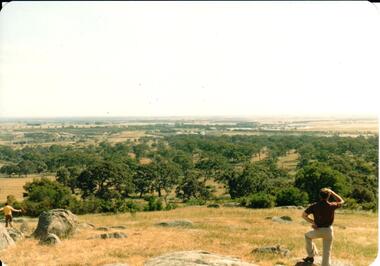
... Tullamarine became Melbourne's main air terminal in 1970 and replaced Essendon Airport. gellibrand hill tullamarine airport george evans collection A coloured landscape photograph with rounded corners of the Tullamarine Airport taken from Gellibrand Hill. A man with his back to the camera ...Gellibrand Hill along with the surrounding 3 properties: Attwood, Cumberland and Woodlands were incorporated into Gellibrand Park during the 1980s. Tullamarine became Melbourne's main air terminal in 1970 and replaced Essendon Airport.A coloured landscape photograph with rounded corners of the Tullamarine Airport taken from Gellibrand Hill. A man with his back to the camera is on the RHS and another person is running down the hill on the LHS. The area in the middle distance is lightly treed and the airport is in the distance to the right of the photograph.gellibrand hill, tullamarine airport, george evans collection -
 Vision Australia
Photograph - Image, Portraits of elderly residents, 1970-1980s
... A woman sits a wheelchair as she watches to the right of camera. Her hands are poised in the air, as she waits to clap them together. 2. ...A woman sits a wheelchair as she watches to the right of camera. Her hands are poised in the air, as she waits to clap them together. 2. ...1. A woman sits a wheelchair as she watches to the right of camera. Her hands are poised in the air, as she waits to clap them together. 2. A man sits on the edge of a hospital bed and looks to camera. 3. Seated woman holds her fingers as she moves them, possibly during a therapy session. 4. Near the window looking towards a large bush, a woman fiddles with her beaded necklace. 5. A man sits on the edge of his made up bed, with a small television, cassette player and cassettes stacked in his bedside table. A family portrait hangs on the wall. 6. Sunlight warms a woman talking to another whilst seated. 6 B/W photographs of nursing home residentsassociation for the blind, elanora home (brighton) -
 Whitehorse Historical Society Inc.
Photograph - Frame
... Air Force uniform. The photo was removed and kept for safety in the photographic department of the Society. The frame is kept for Regimental display. PHOTOGRAPHY Camera ...The frame belonged to the Till family and had a photo of Alwyn Till in Royal Australian Air Force uniform. The photo was removed and kept for safety in the photographic department of the Society. The frame is kept for Regimental display.Brass frame with RAAF insignia on top of the frame which has a leaf pattern stamped on it.photography, camera accessories -
 Department of Energy, Environment and Climate Action
PCM Portable aerial radio FM322
... But it was the convergence of separate technologies such as 5G mobile phones, high-capacity and light-weight lithium batteries, Wi-Fi, the ever-expanding internet, cloud data storage, digital cameras, GPS, personal organisers and hundreds of supporting Apps into powerful smartphones and tablets which revolutionised bushfire communications from the mid-2000s. Bushfire Radios Forests Commission Victoria (FCV) CNR Air ...After the 1939 bushfires, the Forests Commission Victoria invested heavily in a radically new communications network. After suffering some inevitable delays due to the war, radio VL3AA switched into full operation in October 1945 proudly beaming out 200 watts across the State. But by today’s standards, the technology was primitive and the reception poor unless the user was on a high point somewhere. The radio signal was "line-of-sight" and bounced between fire towers and relay transmitters across the mountains back to the District offices. The advent of solid-state electronics in the 1960s replaced the more delicate valve sets which enabled greater use of vehicle mounted radios. The Commission continued to research, develop and build new radios at its many workshops around Victoria. The network was supported by a large team of skilled radio technicians. The more secure and versatile State Mobile Radio (SMR) digital trunk system came into operation in about 1995. Upgraded Tait Radios were purchased in 2014 after recommendations of the 2009 Bushfires Royal Commission. But it was the convergence of separate technologies such as 5G mobile phones, high-capacity and light-weight lithium batteries, Wi-Fi, the ever-expanding internet, cloud data storage, digital cameras, GPS, personal organisers and hundreds of supporting Apps into powerful smartphones and tablets which revolutionised bushfire communications from the mid-2000s. Portable radioCNR Air Operationsbushfire, radios, forests commission victoria (fcv) -
 Department of Energy, Environment and Climate Action
Portable radio Philips BC34
... But it was the convergence of separate technologies such as 5G mobile phones, high-capacity and light-weight lithium batteries, Wi-Fi, the ever-expanding internet, cloud data storage, digital cameras, GPS, personal organisers and hundreds of supporting Apps into powerful smartphones and tablets which revolutionised bushfire communications from the mid-2000s. Bushfire Radios Forests Commission Victoria (FCV) Air ...After the 1939 bushfires, the Forests Commission Victoria invested heavily in a radically new communications network. After suffering some inevitable delays due to the war, radio VL3AA switched into full operation in October 1945 proudly beaming out 200 watts across the State. But by today’s standards, the technology was primitive and the reception poor unless the user was on a high point somewhere. The radio signal was "line-of-sight" and bounced between fire towers and relay transmitters across the mountains back to the District offices. The advent of solid-state electronics in the 1960s replaced the more delicate valve sets which enabled greater use of vehicle mounted radios. The Commission continued to research, develop and build new radios at its many workshops around Victoria. The network was supported by a large team of skilled radio technicians. The more secure and versatile State Mobile Radio (SMR) digital trunk system came into operation in about 1995. Upgraded Tait Radios were purchased in 2014 after recommendations of the 2009 Bushfires Royal Commission. But it was the convergence of separate technologies such as 5G mobile phones, high-capacity and light-weight lithium batteries, Wi-Fi, the ever-expanding internet, cloud data storage, digital cameras, GPS, personal organisers and hundreds of supporting Apps into powerful smartphones and tablets which revolutionised bushfire communications from the mid-2000s. Portable radio with handset, aerial and chargerAir Operations Ballarat Vickers stbushfire, radios, forests commission victoria (fcv)
