University of Melbourne, School of Chemistry
Microbalance
... density of a gas by the shift in the balancing beam due to a change in pressure of the gas in the balance case. The quartz balancing beam was made by Bertram Steele who was particularly skilled in glassblowing.
A quartz beam is the beam of the Aston microbalance based on the Steele/Grant instrument, and described by F.W. Aston, the inventor of the mass spectrometer. The bulb at one end of the beam contained a fixed amount of air...density of a gas by the shift in the balancing beam due to a change in pressure of the gas in the balance case. The quartz balancing beam was made by Bertram Steele who was particularly skilled in glassblowing.
A quartz beam is the beam of the Aston microbalance based on the Steele/Grant instrument, and described by F.W. Aston, the inventor of the mass spectrometer. The bulb at one end of the beam contained a fixed amount of air ...
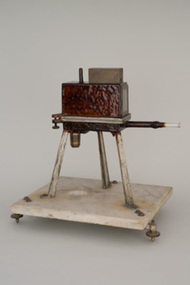
An original Kerr-Grant Microbalance, modified by E.J.Hartung
This balance was invented in the chemistry department by Bertram Dillon Steele, later first Professor of Chemistry at the University of Queensland 1910-1930, in collaboration with Professor Kerr Grant, Physics. The design was widely used by other chemists, including Masson's mentor, Professor Ramsay, working in London on newly discovered rare gases (especially Radon), and Professor Hartung in Melbourne, investigating the chemistry of the decomposition of silver salts in photographic processes.
The principle of the microbalance was to measure the change in density of a gas by the shift in the balancing beam due to a change in pressure of the gas in the balance case. The quartz balancing beam was made by Bertram Steele who was particularly skilled in glassblowing.
A quartz beam is the beam of the Aston microbalance based on the Steele/Grant instrument, and described by F.W. Aston, the inventor of the mass spectrometer. The bulb at one end of the beam contained a fixed amount of air, so that a change in the pressure of gas in the balance case changed the buoyancy of the beam, yielding a displacement in the beam which could be measured. By this means, differences in weight of about 10 nanogram could be measured, in amounts of up to 0.1 gram. Such differences are significant the increase in weight of a metal sample due to surface oxidation (Steele's interest) in the weight loss due to radioactive decay of Radium (Ramsay's work), and in the estimates of density change due to the isotopic distribution of Neon (Aston).
Ernst Johannes Hartung was a chemist and astronomer. Educated at the University of Melbourne (BSc 1913, DSc 1919), he became lecturer in 1919, associate professor in 1924, and succeeded Rivett as chair of chemistry in 1928, remaining in this position until 1953.
Hartung?s lecturing style surged with enthusiasm and he employed the use of screen projections to demonstrate chemical phenomena to large undergraduate classes. In 1935 he recorded Brownian movement in colloidal solutions on 35 mm cinefilm, which was later copied onto 16 mm film for the Eastman Kodak Co. World Science Library. This can be viewed in the Chemistry laboratory. He researched the photo decomposition of silver halides, and was awarded the David Syme Prize in 1926. He devoted time to the design and construction of a large, new chemistry building for the School of Chemistry (built 1938?1939).
During World War II he was approached by Professor Thomas Laby, chairman of the Optical Munitions Panel, to chair the advisory committee on optical materials, to produce high quality optical glass in Australia. This was successful, with large-scale production achieved within ten months at a reasonable cost.
Hartung served three terms as general President of the (Royal) Australian Chemical Institute, was an ex-officio councillor of the Council for Scientific and Industrial Research, and a Trustee of the Museum of Applied Science (now part of Museum Victoria).An original Kerr-Grant Microbalance, modified by E.J. Hartung.

 Moorabbin Air Museum
 Robin Boyd Foundation
 University of Melbourne, School of Chemistry