
Showing 170 items matching "air-to air operation"
-
 Moorabbin Air Museum
Book - Aircraft radar systems, Introduction to Airborne Radar
... ...Air-to air operation...Aircraft radar systems Overview of airborne radar Essential groudwork Primary design considerations Detection & ranging Extracting doppler information Return from the ground Air-to air operation High resolution ground mapping Future developments Technical history of airborne radar, circa 1983 Introduction to Airborne Radar Book Aircraft radar systems ...Technical history of airborne radar, circa 1983non-fictionTechnical history of airborne radar, circa 1983overview of airborne radar, essential groudwork, primary design considerations, detection & ranging, extracting doppler information, return from the ground, air-to air operation, high resolution ground mapping, future developments -
Moorabbin Air Museum
Document (item) - Roland Jahne Collection - See Description for details
... Air Classics. Manilla folder Various Hawker Seahawk. Manilla folder Various Hawker Hunter. Manilla folder Various Hawker Kestrel Harrier. Manilla folder 1/4/1977 Hawker Pacific. Manilla folder Various Hawker Siddeley, Beechcraft, The Budgie, Horizon Manilla folder Various Douglas A4 Skyhawk. Manilla folder No dates Douglas C-133B. Manilla folder July/August 1989 B66 - Aviation World. Manilla folder Mar-73 Dyott Battleplane. Air Pictorial. Brochures No dates Department of Defence - Global Hawk, Virtual Air Environment, Airframes & Engines, Air Operations...Air Classics. Manilla folder Various Hawker Seahawk. Manilla folder Various Hawker Hunter. Manilla folder Various Hawker Kestrel Harrier. Manilla folder 1/4/1977 Hawker Pacific. Manilla folder Various Hawker Siddeley, Beechcraft, The Budgie, Horizon Manilla folder Various Douglas A4 Skyhawk. Manilla folder No dates Douglas C-133B. Manilla folder July/August 1989 B66 - Aviation World. Manilla folder Mar-73 Dyott Battleplane. Air Pictorial. Brochures No dates Department of Defence - Global Hawk, Virtual Air Environment, Airframes & Engines, Air Operations ... -
Moorabbin Air Museum
Document (series) - Nomad Development Material - Collection of Vilem Gottlieb
... 106 Nomad Nomad Series N22 Maintenance Manual figure 203 - Horizontal Stabiliser Trim Control System 107 Nomad Nomad series N22 - N24 108 Map of Portartlington 109 Folder Nomad GAF Nomad N22B Float Plan - Performance Summary 1981 110 Disc Case Nomad 5 computer discs 111 Disc Case 5 computer discs 112 Metal Plate Nomad GAF N24A - 98F 113 Folder Engineering Standard Method for Weighing Aircraft with Portable Electronic Weighing Kits 1988 114 Stapled book Hartzell Propellor Inc Blade Specifications 1981 115 Nomad GAF Brochure: Nomad - The Australian N22B and N24A Turboprop 116 Bound book Nomad ASTA Nomad Performance Torque Charts - N24A-21021 1992 117 Photocopy Nomad SFTE Copy of article: Australian Searchmaster II Delivered to United States - Volume 21, January 1990 1990 118 Photography Nomad Air Safaris Nomad N24A near Mt Cook New Zealand 119 Bound book Nomad GAF N22C - Nomad Performance Summary for DOA Normal Catagory (sic) Operations 120 Stapled book Nomad GAF N24A - Performance Summary for Air Taxi and Commercial Operations to United States FAA/FAR 135 121 Technical Drawings Nomad N22A 122 Bound book Nomad ASTA Acceptance Test Schedule for Nomad N22S Searchmaster Series II Aircraft (does not include radar or FLIR) 1989 123 Manila Folder Nomad GAF Folder of paperwork pertaining to the delivery of aircraft to US Customs 1987 124 Suspension folder Nomad ASTA Project Note N2/120 - Nomad Horizontal stabiliser report 1991 125 Nomad ASTA Army Nomad Modification Program - Acceptance Test Plan 1991 126 Nomad ASTA Memo: Discussion points raised by ARDU 1991 127 Nomad ASTA Minute: NMP Acceptance Test Plan (ATP) 1991 128 Suspension folder Copies of the Civil Aviation Regulations 129 Blank Aircraft weighing and balance sheets 130 Print out of the Computerised track and balance for the H60 helicopter 1989 131 ASTA Letter: Seahawk Flying program 1990 132 ASTA Letter: Training for panel operator 1990 133 ASTA Memo: RAN Seahawk flight operations role 1990 134 Memo: Avionics Course detail 1990 135 Bound book Jetstream Handley Page Flight Manual 1972 136 Bound book Jetstream Handley Page Flight Manual 1969 137 Folder Jetstream Lots of Jetstream data and papers 138 Suspension folder American Jet Industries Publication/brochure 139 Metro II Swearingen Brochure: Metro II by Swearingen 140 Cheyenne IIIA Piper Aircraft Specifications and Performance 19855 141 Australian Light Wing Howard Huges Engineering Brochure: Australian Light Wing 1993 142 SAAB MFI 15 SAAB Brochure: SAAB MFI 15 King Air Exec-Liner Beechcraft Brochure: Beechcraft King Air Exec-Liner 1986 International Corporate Aviation Publication: British Aerospace 125-800 Turbine Islander Article: Turbine Islander in the air 1981 ...Fincher 1979 10 Bound book Nomad ASTA Nomad model N22S - Certification Report N22S2-21022 - Flight Test Certification Report - AF36 Documentation 1988 11 Bound book Nomad GAF GAF Project Report RN2/4 - Nomad N22 - Detail Specification - Part 1 Basic Aircraft 1973 12 Bound book Nomad GAF Nomad Aircraft - Model N22-B - With icing spray system fitted - Development flight test schedule 1978 13 Stapled book Nomad GAF N22B - Nomad Performance Summary for Air Taxi and Commercial Operations 14 Manila Folder Nomad Civil Aviation Authority (Commonwealth of Australia) Copy of Certificate of Approval for aeroplanes type known as GAF models N2, N22, N22B, N22C, N22S, N24 and N24A 1992 15 Nomad Photograph of a Nomad with what looks like smoke underneath 16 Nomad GAF Brochure - STRETCHED Nomad N24 17 Suspension folder General Motors - Allison Gas Turbine Operations Engineering Department Report No.11910A - Instructions for the use of a program, in the form of a source deck of digital computer cards, tape, or floppy diskette to calculate steady state performance of the Allison Gas Turbine Model 250-B17E Turboprop Engine 1987 18 General Motors - Allison Gas Turbine Operations Supplement 1 to the above 19 Fax - very feint - From: Woodward Governor Company Small Aircraft Controls - To: Hawker Pacific - About: propellor synchrophasing systems availability 1992 20 Various pages, some handwritten or faxed about engines, propellor synchronising, and installation charts 1987 21 Manila Folder Nomad Newspaper article: Another Nomad Scare 22 Bulldog Newspaper article: Undercarriage Jams on Test Flight - The Daily Telegraph 1976 23 Jetstream Photograph of a Jetstream 24 Nomad GAF/Department of Productivity Memo re Nomad Ground Training Certificate awarded to Vilem K Gottlieb 25 Avalon Memo congratulating V K Gottlieb on successfully passing the Avalon B17B Engine Course 1978 26 Nomad ASTA Aircraft Weighing Summary - N22B - VH-AUN 1992 27 ASTA/Litton Systems Canada Ltd Fax - very feint - USCS Radar Trials 1990 28 Gippsland Aeronautics Email trail GA18 Bill of Material 2011 29 ASTA Instrument of Appointment - delegate Patrick Larcey 2002 30 Certificate of Competency in Winching Operations for Endorsement in a Helicopter Winch Operator’s/Aircrewman’s Log Book 1986 31 CASA Email: Mod 953 SB 2008 32 Gippsland Aeronautics Email trail: Nomad Technical Publications - Flight manuals for the Mod N953 2011 33 Gippsland Aeronautics Publication “What’s News at GippsAero” Issue 13 October 2012 2011 34 A page from an illustrated parts catalogue - Figure 8 Flap Control, Actuation, Post-Mod N953 35 Nomad A page from a Nomad - Series N24 Maintenance Manual 36 Gippsland Aeronautics Email trail re BOM creation for GA18 2011 37 Nomad Nomad N24A - Draft list of composite parts and accompanying handwritten notes 38 Nomad Gippsland Aeronautics Nomad product support - Service bulletins 2009 39 Nomad Gippsland Aeronautics Email asking for document listing the major modifications and customer options 40 Nomad Gippsland Aeronautics Handwritten notes about spare parts 41 Jetstream Jetstream CEntral Jetstream 31 Commuter Performance Information 42 Nomad Avalon Aircraft Weighing Summary - N24A-60 - ZK-NMD 43 Photograph of a Learjet cockpit 44 Photograph of a cabin of an unknown aircraft - could be the Learjet in the previous photo 45 Manila Folder ASTA Newspaper article: ASTA bids for $500m Orion deal 46 Newspaper article: re Hornet fighter jet rescue helicopter 47 Newspaper article: ASTA returns profit despite poor times 48 Newspaper article: Government to sell ASTA 49 Newspaper employment ad: ASTA Defence - Integrated Logistics Support Personnel 50 Newspaper article: ASTA to cut staff 51 Newspaper employment ad: Test Pilot at the Flying Operations Airworthiness Division (DoT) 52 GAF Job application: Flight Test Observer (No.138) 1976 53 Australian High Commission Letter re recruitment for GAF position 1977 54 Australian High Commission Letter re interview for GAF position 1977 55 Australian High Commission Letter advising of successful application for GAF position 1977 56 Australian High Commission Letter re successful medical examination 1977 57 Australian High Commission Memos regarding start date in Australia 1977 58 Memos confirming appointment as Deputy Chief Flight Test Engineer 1969 59 Australian Department of Foreign Affairs International Message Form: Nomad Icing UK 1978 60 Australian Consolate Advice re interview for application to migrate to Australia 1977 61 GAF Copy of a job ad for Flight Development Engineer 1984 62 GAF Memo: expressing interest in the Flight Development Engineer position 1984 63 GAF Memo: acknowledgement of above memo expressing interest in the Flight Development Engineer position 1984 64 Menu: 94th Aero Squadron - 1st Pursuit Group - unsure of the specific event 65 Avalon Memo: GAF Helicopter Crew - Compensation/Insurance and Additional Payments 1986 66 Aeronautical Development Associates Ltd Letter and list of installation projects 1983 67 Certificate of Competency in Winching Operations for Endorsement in a Helicopter Winch Operator’s/Aircrewman’s Log Book - DoT Air Navigation Orders on Air Service Operations - Helicopter winching and rappelling operations 1986 68 ASTA Memo: appointment of George Stuart to the position of CEO 1987 69 ASTA Various letters and memos re termination of employment and retrenchment 70 GAF Duty Statement - Senior Technical Officer (Engineering) Grade 2 1973 71 Nomad ASTA Letter to Field Aviation Company Limited requesting support services as required for Nomad N22S-164 1988 72 GAF Letter to Avalon Workforce: re GAF ceasing operations on 30/6, recommencing operations as ASTA on 1/7 1987 73 GAF Attached to #72 a copy of a newspaper obituary - GAF passing away! ...Donation from Anna Gottlieb -
 Federation University Historical Collection
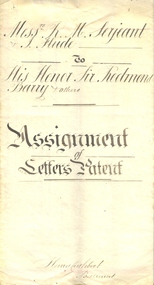
Document, Indenture Between Robert M. Serjeant, Joseph Flude and the Trustees of the Ballarat School of Mines regarding Letters of Patents for the Benefit of the Ballarat School of Mines, 1877, 04/03/1875
... air. The inner covering is pierced to admit of the heated air being brought into contact with the pyrites on the face of the revolving hearth. The discharge of the roasted substance is affected by means of a scraper at the base of the cone. It was claimed that this was a new mode of introducing heated air, and the exclusion of flame during the operation...air. The inner covering is pierced to admit of the heated air being brought into contact with the pyrites on the face of the revolving hearth. The discharge of the roasted substance is affected by means of a scraper at the base of the cone. It was claimed that this was a new mode of introducing heated air, and the exclusion of flame during the operation ...R.M. Serjeant was listed as a mining manager and Joseph Flude as a metallurgist. In 1875 they were both living in Ballarat. The patent number is A.D.1875, 4th March. No 2031. According to the patent the hearth of the furnace is in the form of a cone revolving horizontally. The feed is supplied to the apex of the cone by an archimedian screw. The crown of the furnace comprises a double covering or roof with an intermediate chamber for receiving heated air. The inner covering is pierced to admit of the heated air being brought into contact with the pyrites on the face of the revolving hearth. The discharge of the roasted substance is affected by means of a scraper at the base of the cone. It was claimed that this was a new mode of introducing heated air, and the exclusion of flame during the operation of roasting pyrites. The self-acting charge and discharge of the furnace and the peculiar construction of the hot air chambers, and the use of perforated bricks through which the supply of air is affected were also new. (http://patentsvictoria.net/002031.html) From the Goulburn Herald, 14 September 1878 "A feature connected with the school of mines is the yet unfinished pyrites works. The extraction of the gold from pyrites and the utilization for commercial purposes of other substances connected with pyrites are peculiarly important to Ballarat, because were a simple and inexpensive method devised there are millions and millions of tons of quartz that would then be made remunerative. With this thought in their minds two scientific gentlemen invented the school of mines self-acting rotatory furnace. This, for lack of funds, has not been completed as yet, but the amount in hand for the purpose is daily increasing, and it will eventually be an accomplished fact. It is in contemplation also to erect machinery shops in connection with the school, and it is purposed to con struct a steam-engine to do at once the work of the pyrites treatment and the ma chine room. A model shaft and mine too are being prepared for on the reserve, so that practical mining of the most thorough character may be taught on the ground.'Large indenture on red bordered vellum. The indenture was regarding a patent for the benefit of the Ballarat School of Mines. Letters Patent for an Invention for Roasting Pyrites to be called 'the Ballarat School of Mines self-Acting Pyrites Furnace" to Robery Malachy Serjeant and Joseph Flude. The large document is on a vellum type paper complete with stamps and seal. The document is signed by Acting-Governor William Stawell. Inscriptions and Markings Written on verso: "Date of Patent 4th March 1875 No 2031 Letters Patent for An invention for roasting pyrities to be called "The Ballarat School of Mines Self-acting Pyrities Furnace" to Robert Malachy Serjeant and Joseph Flude Melbourne, Victoriaballarat school of mines, serjeant, r.m. serjeant, robert m. serjeant, flude, joseph flude, patent, barry, redmond barry, rogers, judge rogers, bland, rivett henry bland, john airy, warrington rogers, establishment, indenture, legal, cuthbert, ballarat school of mines trustees, william stawell, john warrington rogers -
 Federation University Historical Collection
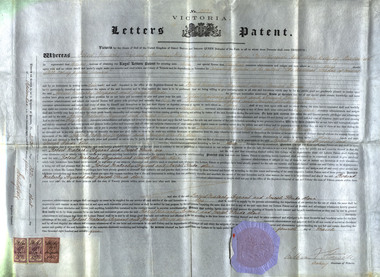
Document, Letters Patent for an Invention for Roasting Pyrites, 1875, 1875
... air. The inner covering is pierced to admit of the heated air being brought into contact with the pyrites on the face of the revolving hearth. The discharge of the roasted substance is affected by means of a scraper at the base of the cone. It was claimed that this was a new mode of introducing heated air, and the exclusion of flame during the operation...air. The inner covering is pierced to admit of the heated air being brought into contact with the pyrites on the face of the revolving hearth. The discharge of the roasted substance is affected by means of a scraper at the base of the cone. It was claimed that this was a new mode of introducing heated air, and the exclusion of flame during the operation ...R.M. Serjeant was listed as a mining manager and Joseph Flude as a metallurgist. In 1875 they were both living in Ballarat. The patent number is A.D.1875, 4th March. No 2031. According to the patent the hearth of the furnace is in the form of a cone revolving horizontally. The feed is supplied to the apex of the cone by an archimedian screw. The crown of the furnace comprises a double covering or roof with an intermediate chamber for receiving heated air. The inner covering is pierced to admit of the heated air being brought into contact with the pyrites on the face of the revolving hearth. The discharge of the roasted substance is affected by means of a scraper at the base of the cone. It was claimed that this was a new mode of introducing heated air, and the exclusion of flame during the operation of roasting pyrites. The self-acting charge and discharge of the furnace and the peculiar construction of the hot air chambers, and the use of perforated bricks through which the supply of air is affected were also new. (http://patentsvictoria.net/002031.html) From the Goulburn Herald, 14 September 1878 "A feature connected with the school of mines is the yet unfinished pyrites works. The extraction of the gold from pyrites and the utilization for commercial purposes of other substances connected with pyrites are peculiarly important to Ballarat, because were a simple and inexpensive method devised there are millions and millions of tons of quartz that would then be made remunerative. With this thought in their minds two scientific gentlemen invented the school of mines self-acting rotatory furnace. This, for lack of funds, has not been completed as yet, but the amount in hand for the purpose is daily increasing, and it will eventually be an accomplished fact. It is in contemplation also to erect machinery shops in connection with the school, and it is purposed to con struct a steam-engine to do at once the work of the pyrites treatment and the ma chine room. A model shaft and mine too are being prepared for on the reserve, so that practical mining of the most thorough character may be taught on the ground.'Letters Patent for an Invention for Roasting Pyrites to be called 'the Ballarat School of Mines Self-Acting Pyrites Furnace' to Robert Malachy Serjeant and Joseph Flude. The large document is on a vellum type paper complete with stamps and seal. The document is signed by Acting-Governor William Stawell.Written on verso: "Date of Patent 4th March 1875 No 2031 Letters Patent for An invention for roasting pyrities to be called "The Ballarat School of Mines Self-acting Pyrities Furnace" to Robert Malachy Serjeant and Joseph Flude Melbourne, Victoriaballarat school of mines, serjeant, r.m. serjeant, robert m. serjeant, flude, joseph flude, richard gibbs, stawell, william stawell, pyrities furnace, philately, statute stamp, seal (victoria), ballarat school of mines self-acting pyrities furnace, ballarat school of mines self-acting pyrites furnace -
Frankston RSL Sub Branch
Medal Set (set of 3)
... Air Force - entry into a theatre of war on duty, or who left places of residence and rendered approved overseas service between 5 August 1914 and 11 November 1918. • Mercantile Marine - at least six months service between 5 August 1914 and 11 November 1918. 3) The Victory medal. Awarded for service as follows: • Navy - those who were mobilised and rendered approved service either at sea between 5 August 1914 and 11 November 1918 or on the establishment of a unit within a theatre of military operations. • Army - those who served on the establishment of a unit in a theatre of war. • Air Force - those who served on the establishment of a unit in a theatre of war outside the UK, served with an operational unit in the UK or overseas and had been actively engaged against the enemy, been employed in flying new aircraft to France or served on the complement of aircraft-carrying ships. ...Air Force - entry into a theatre of war on duty, or who left places of residence and rendered approved overseas service between 5 August 1914 and 11 November 1918. • Mercantile Marine - at least six months service between 5 August 1914 and 11 November 1918. 3) The Victory medal. Awarded for service as follows: • Navy - those who were mobilised and rendered approved service either at sea between 5 August 1914 and 11 November 1918 or on the establishment of a unit within a theatre of military operations. • Army - those who served on the establishment of a unit in a theatre of war. • Air Force - those who served on the establishment of a unit in a theatre of war outside the UK, served with an operational unit in the UK or overseas and had been actively engaged against the enemy, been employed in flying new aircraft to France or served on the complement of aircraft-carrying ships. ...Thomas Richard Cook Service number: 1732 Rank: Private Roll title: 1 Infantry Battalion - 1 to 8 Reinforcements (December 1914 - August 1915) Conflict: First World War, 1914-1918 Date of embarkation: 10 April 1915 Place of embarkation: Sydney Ship embarked on: HMAT Argyllshire Ship number: A8 Set of WW1 medals issued to T. R. Cook, note DCM + MM not included. 1) The 1914-1915 Star. Awarded for service on the establishment of a ship or unit in a theatre of war. A member awarded the 1914 Star could not be awarded the 1914-15 Star (this award). 2) British War Medal. Awarded for service as follows: • Navy - for 28 days mobilised service or to those who lost their lives in active operations before completing that period, between 5 August 1914 and 11 November 1918. • Army and Air Force - entry into a theatre of war on duty, or who left places of residence and rendered approved overseas service between 5 August 1914 and 11 November 1918. • Mercantile Marine - at least six months service between 5 August 1914 and 11 November 1918. 3) The Victory medal. Awarded for service as follows: • Navy - those who were mobilised and rendered approved service either at sea between 5 August 1914 and 11 November 1918 or on the establishment of a unit within a theatre of military operations. • Army - those who served on the establishment of a unit in a theatre of war. • Air Force - those who served on the establishment of a unit in a theatre of war outside the UK, served with an operational unit in the UK or overseas and had been actively engaged against the enemy, been employed in flying new aircraft to France or served on the complement of aircraft-carrying ships. A member Mentioned in Dispatches for service during World War 1 wears a bronze oak leaf on the ribbon. Only one emblem is worn no matter how many times a member may have been 'mentioned' 1) 1914-15 Star: Star with crown on top, with crossed swords, embossed with "1914-15" on obverse side, "1768/ Gnr T R Cook/ 1/Bn. A.I.F." 2)King George head and mounted warrioir on obverse. 3)Winged Brittania and obverse "The Great/war for/civilisation/1914-1919"medals, 1914 15 star, british war medal, victory medal, ww1 medals -
 Nhill Aviation Heritage Centre
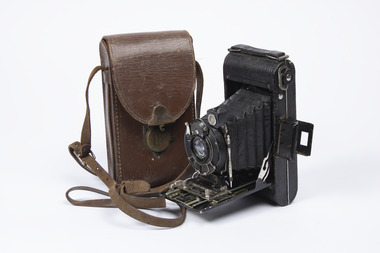
Memorabilia - Camera and case, No.1 Pocket Kodak Special, 1922 to 1931
... This camera belonged to Stan Guilfoyle who was a wireless operator air gunner (WAG) here at Nhill Air Navigation School, December 1943. This item is of great significance being here at the air school during it's operation. ...This camera belonged to Stan Guilfoyle who was a wireless operator air gunner (WAG) here at Nhill Air Navigation School, December 1943.This item is of great significance being here at the air school during it's operation. Some of the photos in Kevin O'Reilly's book In Just Five Years were taken with this camera. Folding Kodak Camera, metal casing with paper concertina folding body and lens assembly, comes with leather carry case. Has various lens adjusters and a scribing pin attached.Kodamatic, No.1 Pocket Kodak Special, Made in USA by Kodak Company Rochester NY, 26980camera, kodak, guilfoyle, stan guilfoyle, wag, -
Federation University Historical Collection
Document - Document - Letter, Ballarat Junior Technical School: Character reference for Grahame L Reeve, 1956
... operation from students. Participated and assisted in school cricket and tennis teams. Welcome him as an officer of the School Air Training Corps. ballarat junior technical school headmaster l garner character reference grahame l reeve woodwork teacher trade instructor temporary teacher geelong junior technical school school air training corps Cream paper, typed Ballarat Junior Technical School: Character reference for Grahame L Reeve, 1956. ...Reference for Grahame Reeve, teacher at Ballarat Junior Technical School since the beginning of the year. Trained for two years to obtain his certificate as a trade instructor. Temporary teacher at Geelong Junior Technical School. Competent instructor who gained interest and co-operation from students. Participated and assisted in school cricket and tennis teams. Welcome him as an officer of the School Air Training Corps. Cream paper, typed ballarat junior technical school, headmaster, l garner, character reference, grahame l reeve, woodwork teacher, trade instructor, temporary teacher, geelong junior technical school, school air training corps -
 Lara RSL Sub Branch
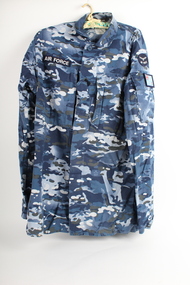
Uniform, Fatigue Jacket, September 2015
... Air Force General Purpose Uniform was adopted by the RAAF in July 2014. It is worn as dress of the day for non-combat operations. These were worn by Bob Schouten. This jacket represents the every day experiences of Australian air force members since 2014. military raaf air force uniform jacket camouflage 'Australia' 'Air Force' Blue/white/grey/green urban camouflage jacket. ...The Air Force General Purpose Uniform was adopted by the RAAF in July 2014. It is worn as dress of the day for non-combat operations. These were worn by Bob Schouten.This jacket represents the every day experiences of Australian air force members since 2014.Blue/white/grey/green urban camouflage jacket. Made of cotton. With velcro sections to attach labels. Plastic buttons.'Australia' 'Air Force'military, raaf, air force, uniform, jacket, camouflage -
 Lara RSL Sub Branch
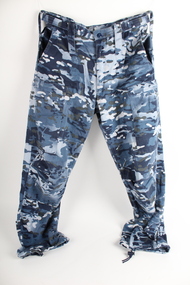
Uniform, Fatigue Trousers, 2014
... The Air Force General Purpose Uniform was adopted by the RAAF in July 2014. It is worn as dress of the day for non-combat operations. These were worn by Bob Schouten. air ...The Air Force General Purpose Uniform was adopted by the RAAF in July 2014. It is worn as dress of the day for non-combat operations. These were worn by Bob Schouten.Trousers with a blue/grey/white/green camouflage pattern. Pockets on the sides, a metal zip at the front and plastic button at the top.Drawstring hems at the ankles.air force, raaf, fatigues, uniform -
 Lara RSL Sub Branch
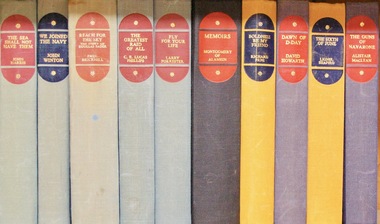
Book, The Sea shall not have them Author John Harris, N/A
... Air-Sea Rescue - 13,269 lives were saved from the sea often under the enemy's guns. Of these 8,604 were air crew. The Sea will not have them' was the motto of Air Sea Rescue High Speed Launch Flotillas. This book was made into a Movie with the same title in 1954 Recount of Air Sea rescue in WWII air sea rescue wwii lancasters flotilla sea operation The Sea shall not have them Author John Harris Book ...During the war 13,269 lives were saved from the sea by Air-Sea Rescue - 13,269 lives were saved from the sea often under the enemy's guns. Of these 8,604 were air crew. The Sea will not have them' was the motto of Air Sea Rescue High Speed Launch Flotillas. This book was made into a Movie with the same title in 1954Recount of Air Sea rescue in WWIIair sea rescue, wwii, lancasters, flotilla, sea operation -
 Lara RSL Sub Branch
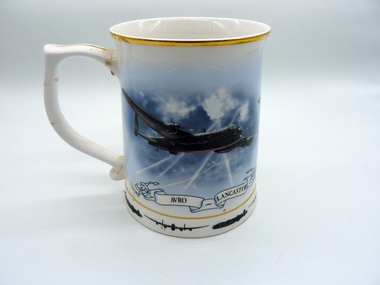
tankard, Royal Air Force
... Air Force Association - The World War II Commemorative Tankards with Royal Air force Association Logo in centre. On base The Battle of Berlin by Gordon Davies. Tankard 2 Picture of Supermarine Spitfire on one side and Battle of Britain the other with RAF logo in centre. On base written The Royal Air Force Association - The World War II Commemorative Tankards with Royal Air force Association Logo in centre. The Battle of Britain Tankard by Gordon Davies. Tankard 3 Picture of Hawker Typoon on one side and Operation...Air Force Association - The World War II Commemorative Tankards with Royal Air force Association Logo in centre. On base The Battle of Berlin by Gordon Davies. Tankard 2 Picture of Supermarine Spitfire on one side and Battle of Britain the other with RAF logo in centre. On base written The Royal Air Force Association - The World War II Commemorative Tankards with Royal Air force Association Logo in centre. The Battle of Britain Tankard by Gordon Davies. Tankard 3 Picture of Hawker Typoon on one side and Operation ...Commemorative tankards from WW2 celebrating RAFCommemorative tankards from World War 2 produced by the RAF AssociationSet of 6 Royal Air Forces Association The World War II Commemorative Tankards BY Gordon DaviesTankard 1 Picture of Avro Lancaster on one side and Battle of Berlin the other with RAF logo in centre. On bottom written The Royal Air Force Association - The World War II Commemorative Tankards with Royal Air force Association Logo in centre. On base The Battle of Berlin by Gordon Davies. Tankard 2 Picture of Supermarine Spitfire on one side and Battle of Britain the other with RAF logo in centre. On base written The Royal Air Force Association - The World War II Commemorative Tankards with Royal Air force Association Logo in centre. The Battle of Britain Tankard by Gordon Davies. Tankard 3 Picture of Hawker Typoon on one side and Operation Overlord the other with RAF logo in centre. On base written The Royal Air Force Association - The World War II Commemorative Tankards with Royal Air force Association Logo in centre. Operation Overlord by Gordon Davies. Tankard 4 Picture of Vickers Wellington on one side and Battle Over Germany the other with RAF logo in centre. On base written The Royal Air Force Association - The World War II Commemorative Tankards with Royal Air Force Association Logo in centre. The Battle Over Germany by Gordon Davies Tankard 5 Picture of Short Sunderland on one side and Battle of the Atlantic on the other with RAF logo in centre. On base written The Royal Air Force Association - The World War II Commemorative Tankards with Royal Air Force Association Logo in centre. The Battle of the Atlantic by Gordon Davies. Tankard 6 Picture of Hawker Hurricane on one side and Battle of El Alamein on the other with RAF logo in centre. On base written The Royal Air Force Association - The World War II Commemorative Tankards with Royal Air Force Association Logo in centre. The Battle of El Alamein by Gordon Daviesraf, royal air force, tankard, hurricane, spitfire, sunderland, lancaster, wellington, typhoon, gordon davies -
 Lara RSL Sub Branch
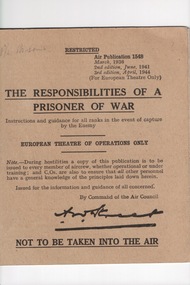
Booklet, Air Publications 1548, The responsibilities of a prisoner of war, 1944
... Air service personal for use in the European theatre of operations only. Issued for the information and guidance of all concerned. Restricted.The responsibilities of a prisoner of war.European theatre of war.Not to be taken into the air. Card folder - The Responsibilities of a Prisoner of War. Khaki in colour.Folded into three pages. The responsibilities of a prisoner of war. Booklet Air ...Issued to Air service personal for use in the European theatre of operations only. Issued for the information and guidance of all concerned.Card folder - The Responsibilities of a Prisoner of War. Khaki in colour.Folded into three pages.Restricted.The responsibilities of a prisoner of war.European theatre of war.Not to be taken into the air. -
 Lara RSL Sub Branch
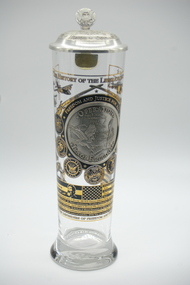
U.S. Iraqi Freedom Operations glass with pewter lid, Operation Iraqi Freedom, 2008
... Air Force, Army National Guard, Air National Guard. On the top of this circle of emblems is a pair of crossed swords, on the blade of one the swords "Proud to serve" and the other sword "All gave some, some gave all" under the crossed swords is an inscription "Freedom and Justice for All" The center of this area is a pewter medallion labeled "Operation Iraqi Freedom" in the center of the medallion is map of Iraq with city centers mentioned and below is an eagle clutching a feather and sword. ...Air Force, Army National Guard, Air National Guard. On the top of this circle of emblems is a pair of crossed swords, on the blade of one the swords "Proud to serve" and the other sword "All gave some, some gave all" under the crossed swords is an inscription "Freedom and Justice for All" The center of this area is a pewter medallion labeled "Operation Iraqi Freedom" in the center of the medallion is map of Iraq with city centers mentioned and below is an eagle clutching a feather and sword. ...Commemorates operation Iraqi Freedom, U.S. forces involved in Iraqi and details losses incurred.Glass Mug Operation Iraqi Freedom with pewter lid contain Certificate of Authenticity U.S. Heritage Glass Series Number 2289 of 9000Certificate of Authenticity. US-Heritage Glass Series, The History of the U.S. Operation. Iraqi Freedom Column Crystal Glass with Pewter Lid.Pewter Lid is decorated with an inscription around the edge "Democracy, Freedom, Liberty, Honour, Courage. in the center is an eagle, two crossed U.S. Flags, A five pointed badge surrounded by a laurel wreath and in the center of the badge is a five pointed star. The thumb button has a congressional seal embossed there on.on the front of the glass is an area of gold leaf that has a heading "The History of the Liberation of Iraq" There are emblems of the U.S. armed forces that were involved in the conflict: U.S. Coast Guard, U.S. Marine Corp, U.S. Navy, Dept of Army, U.S. Air Force, Army National Guard, Air National Guard. On the top of this circle of emblems is a pair of crossed swords, on the blade of one the swords "Proud to serve" and the other sword "All gave some, some gave all" under the crossed swords is an inscription "Freedom and Justice for All" The center of this area is a pewter medallion labeled "Operation Iraqi Freedom" in the center of the medallion is map of Iraq with city centers mentioned and below is an eagle clutching a feather and sword. On the outside of this area is small pictures of: plane, helicopter, Parachute, jeep, soldier, large jet, aircraft carrier, oasis scene, truck, soldier, and tank. on the lower section is a representation of an American flag The bars contain details of the number and type of U.S. forces involved. The bottom is embossed with "God Bless the Defenders of Freedom and Democracy of Iraq" -
 Orbost & District Historical Society
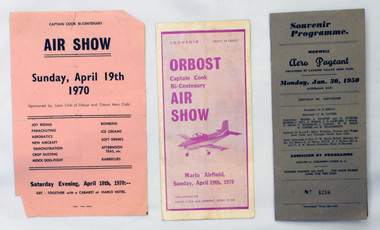
souvenir programs, 1950 ; 1970
... operation and development of the airport over the years. Orbost-Aero-Club Captain-Cook-Bicentenary 2406.28 - on back - Bruce Ham......(?) Yarram Tiger Moth Two souvenir programs and one advertising flyer. 2406.27 is a souvenir program for the Orbost Captain Cook Bi-Centenary Air Show 1970. It is purple print on a white background. It has seven folded glossy pages and cost 20c. On the cover is a photograph of a small plane. 2406.28 is a flyer for the Captain Cook Bi-Centenary Air ...Orbost Aero Club began in 1969 with Basil Dowie as Chair, David Nixon as Secretary/Treasurer. The group went into recess from 1977-1991 closing in 1997. The mid 1960s were boom years in flying training in Australia and the number of Aero Clubs grew rapidly. The Club played a significant role in the establishment of the small airport at Marlo and in the ongoing operation and development of the airport over the years particularly for patient transfer by aerial ambulance. The Orbost Aero Club Club played a significant role in the establishment of the small airport at Marlo and in the ongoing operation and development of the airport over the years.Two souvenir programs and one advertising flyer. 2406.27 is a souvenir program for the Orbost Captain Cook Bi-Centenary Air Show 1970. It is purple print on a white background. It has seven folded glossy pages and cost 20c. On the cover is a photograph of a small plane. 2406.28 is a flyer for the Captain Cook Bi-Centenary Air Show, Sunday, April 19th 1970. It is black print on a pink background, 2406.29 is a souvenir program for Morwell Aero Pageant, Monday, January 30, 1950. Cost 3/-. No 4216. It is a grey/brown coloured card folder with black print.2406.28 - on back - Bruce Ham......(?) Yarram Tiger Moth orbost-aero-club captain-cook-bicentenary -
 Australian Commando Association - Victoria
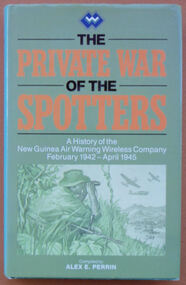
Book, The Private War of the Spotters: A history of the New Guinea Air Warning Wireless Company, February 1942-April 1945
... World War II Special operations New Guinea New Guinea air warning Wireless Company The history of the New Guinea Air Warning Wireless Company. ...The history of the New Guinea Air Warning Wireless Company. This reprinted version contains a map of the dispositions of Spotting Stations August 1943, additional MID awards listed and some additions to the nominal roll. The New Guinea Air Warning Wireless Company was formed in Port Moresby in late January 1942 and was granted “Separate Independent Establishment” status in October 1943. The company’s “founding father” was Major Don Small, who had witnessed Japanese air raids on Rabaul and realised that having lacked an effective early-warning system around New Britain meant that the defenders were taken by surprise. At the time, gaps had also appeared in the coast-watching communications network because the territory administration ordered the withdrawal of civilian wireless operators when Japan entered the war. The first influx of men into the company consisted largely of volunteers from the 39th Infantry Battalion, which was stationed at Port Moresby. Initial training was rudimentary, hasty, and was sometimes even carried out on en route to a new station. The first party of company personnel, or “spotters”, left Port Moresby as early as 1 February 1942, bound for the strategically important Samarai area, at the tip of Papua. In the first month of the company’s existence 16 spotter stations were established on the coast of Papua and in the mountains around Port Moresby. At the end of 1942 there were 61 operational stations being run by 180 men. The company’s high-water mark was in late 1944, by which time over 150 stations had been set up in Papua and New Guinea behind enemy lines. On 3 February 1942 the company issued its first air warning in Papua, when spotters at Tufi saw Japanese aircraft about to attack Port Moresby for the first time. The following month the company was responsible for the first Japanese killed in action in Papua by Australian ground forces, when spotters from Gona engaged the crew of a downed Japanese bomber. And in July 1942 the station at Buna signalled Port Moresby with news of the Japanese landings in Papua, marking the beginning of the Kokoda campaign. The dangers involved in the company’s work had also been made clear by this time. In July 1942 a party of spotters attempting to set up a station at Misima Island, off Milne Bay, was intercepted by a Japanese destroyer, resulting in the company’s first operational losses. Anticipating the direction of the campaign as a whole, the company’s focus moved north and north-west over the three years of its existence. In May 1942 a network was set up in the Wau area in association with the activities of Kanga Force. As part of the Wau network, spotter Ross Kirkwood audaciously constructed an observation post overlooking the Japanese airstrip at Salamaua. Kirkwood’s position was photographed by Damian Parer on the understanding that the pictures would not be published. They nevertheless appeared in a Sydney newspaper. The day after the publication of the photographs the observation post was attacked by the Japanese and Kirkwood was lucky to escape. In June 1944 the company’s headquarters were moved to Nadzab. By that time, spotter stations existed behind Japanese lines, as far north as Hollandia, and the company began to train Americans to perform similar work in the Philippines. In early 1945 the company moved to Balcombe, Victoria, where its members were posted to other units of the Australian Corps of Signals.gray plasticnon-fictionThe history of the New Guinea Air Warning Wireless Company. This reprinted version contains a map of the dispositions of Spotting Stations August 1943, additional MID awards listed and some additions to the nominal roll. The New Guinea Air Warning Wireless Company was formed in Port Moresby in late January 1942 and was granted “Separate Independent Establishment” status in October 1943. The company’s “founding father” was Major Don Small, who had witnessed Japanese air raids on Rabaul and realised that having lacked an effective early-warning system around New Britain meant that the defenders were taken by surprise. At the time, gaps had also appeared in the coast-watching communications network because the territory administration ordered the withdrawal of civilian wireless operators when Japan entered the war. The first influx of men into the company consisted largely of volunteers from the 39th Infantry Battalion, which was stationed at Port Moresby. Initial training was rudimentary, hasty, and was sometimes even carried out on en route to a new station. The first party of company personnel, or “spotters”, left Port Moresby as early as 1 February 1942, bound for the strategically important Samarai area, at the tip of Papua. In the first month of the company’s existence 16 spotter stations were established on the coast of Papua and in the mountains around Port Moresby. At the end of 1942 there were 61 operational stations being run by 180 men. The company’s high-water mark was in late 1944, by which time over 150 stations had been set up in Papua and New Guinea behind enemy lines. On 3 February 1942 the company issued its first air warning in Papua, when spotters at Tufi saw Japanese aircraft about to attack Port Moresby for the first time. The following month the company was responsible for the first Japanese killed in action in Papua by Australian ground forces, when spotters from Gona engaged the crew of a downed Japanese bomber. And in July 1942 the station at Buna signalled Port Moresby with news of the Japanese landings in Papua, marking the beginning of the Kokoda campaign. The dangers involved in the company’s work had also been made clear by this time. In July 1942 a party of spotters attempting to set up a station at Misima Island, off Milne Bay, was intercepted by a Japanese destroyer, resulting in the company’s first operational losses. Anticipating the direction of the campaign as a whole, the company’s focus moved north and north-west over the three years of its existence. In May 1942 a network was set up in the Wau area in association with the activities of Kanga Force. As part of the Wau network, spotter Ross Kirkwood audaciously constructed an observation post overlooking the Japanese airstrip at Salamaua. Kirkwood’s position was photographed by Damian Parer on the understanding that the pictures would not be published. They nevertheless appeared in a Sydney newspaper. The day after the publication of the photographs the observation post was attacked by the Japanese and Kirkwood was lucky to escape. In June 1944 the company’s headquarters were moved to Nadzab. By that time, spotter stations existed behind Japanese lines, as far north as Hollandia, and the company began to train Americans to perform similar work in the Philippines. In early 1945 the company moved to Balcombe, Victoria, where its members were posted to other units of the Australian Corps of Signals.world war ii, special operations, new guinea, new guinea air warning wireless company -
 Seaworks Maritime Museum
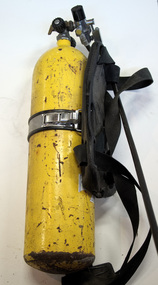
Air tank & respirator, U.S. Divers
... OPERATION WITH AMBULANCE SERVICE/ AQUA-LUNG U.S. DIVERS/ MODEL NO. 119/ U.S. DIVERS CO. SANTA ANNA CAL/ ON OFF/780/3AA250 USD 60 ICC3AA2 CO/U.S. DIVERS/ MHT PORPOISE AUSTRALIA/PORPOISE Yellow air tank with black respirator and backstrap Air tank & respirator U.S. ...Yellow air tank with black respirator and backstrapU.S DIVERS/ AQUA-LUNG/A AND BASS STRAIT MEDICAL CENTRE OPERATION WITH AMBULANCE SERVICE/ AQUA-LUNG U.S. DIVERS/ MODEL NO. 119/ U.S. DIVERS CO. SANTA ANNA CAL/ ON OFF/780/3AA250 USD 60 ICC3AA2 CO/U.S. DIVERS/ MHT PORPOISE AUSTRALIA/PORPOISE -
 Flagstaff Hill Maritime Museum and Village
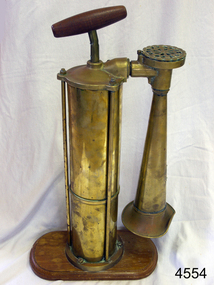
Equipment - Foghorn, 20th century
... air intake "TYFON PATENT" Replica foghorn; portable marine, plunger operation. It has a brass cylinder and adjustable brass horn. The plunger handle and base are wooden. Inscriptions are on the plaque on the horn and moulded into the air ...A marine foghorn gives an audible navigational signal to warn vessels of dangers, hazards and the presence of other vessels in fog conditions. The foghorn signal is a series of long and short sounds with short or long pauses between them. These common signals conform to a code called the International Regulations for Preventing Collisions at Sea and provide such information as whether the vessel is under sail or motor, large or small, aground or at anchor. The designs of foghorns vary but they all use a column of air to make a loud sound. Some use vibrating plates or metal reeds, others force air through holes in a revolving cylinder or disc, sounding like a siren, and some use a clockwork mechanism to open the valves that let the air into the horn. They are usually built to meet particular specifications e.g. U.S.C.G. (US Coast Guard). This Tyfon plunger foghorn has a horizontal handle attached to a vertical rod that moves up and down inside a cylinder. When the handle is plunged down, in a similar way to a bicycle pump, the air is forced out of the bottom of the cylinder into a pipe with a bell-shaped horn on the end, making a loud, low sound. The wider base of the cylinder helps to keep it stable. The original type Tyfon foghorns were manufactured in about 1910 by Kochums Mechanical Workshop (Kockums Mechanical Werkstad, Ltd.), Malmo, Sweden. The company was established in 1840, became a Limited company in 1866, and established a shipyard at the Port of Malmo, Sweden, in 1870. The civilian ship production in Malmo ceased in 1987. As well as building ships the company built large industrial and agricultural machinery and maritime goods.this replica foghorn represents the design of a Swedish, Tyfon model 1910. It is an example of the type of safety equipment used on marine vessels to signal other vessels and signal to land. Replica foghorn; portable marine, plunger operation. It has a brass cylinder and adjustable brass horn. The plunger handle and base are wooden. Inscriptions are on the plaque on the horn and moulded into the air intake. Facsimile of a Kockums of Malmo, Sweden, Tyfon model 1910 Fog Horn.Impressed into the attached plaque "KOCKUMS MLK. VERKSTAD / MALMO SWEDEN" and "TRADE TYFON MARK" Also added to the plaque individually "288938" Molded around the circumference of the air intake "TYFON PATENT"flagstaff hill, warrnambool, shipwrecked coast, flagstaff hill maritime museum, maritime museum, shipwreck coast, flagstaff hill maritime village, great ocean road, foghorn, fog horn, tyfon foghorn, kockums mlk verkstad, malmo sweden, replica, warning signal, safety equipment, ship's equipment -
 Bendigo Military Museum
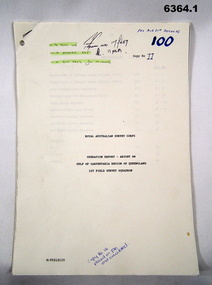
Administrative record - Royal Australian Survey Corps Report on Operation Aright 88 conducted by 1 Field Survey Squadron 1988, 1 Fd Svy Sqn, 9 Feb 1989
... There are four Annexes, Area of Operations, Technical Summary, Nominal Roll, Det 1 Fd Svy Sqn and Air Support Contact Details. Royal Australian Survey Corps RASvy Fortuna Army Survey Regiment Army Svy Regt ASR 6364.1 is copy number 11, "FOR AIR SURVEY RECORDS" "Tech WO", "Aero Trig", "ADJ", "SGT REES for Records" 6364.2 is copy number 12 "Placed on File and circulated", "Circular Received 15 Feb 1989" on back page. ...Comprehensive Operation Report containing all aspects of OP Aright 88 in the Gulf of Carpentaria region of Queensland. Chapters include: General Information, Operations, Operational Support, Admin and Logistics, Communications, Conclusion and Recommendations. There are four Annexes, Area of Operations, Technical Summary, Nominal Roll, Det 1 Fd Svy Sqn and Air Support Contact Details.Unbound A4 Paper Report held together by a staple top LH corner. Typed pages and diagrams. 6364.1 is copy number 11, 6364.2 is copy number 12 6364.1 is copy number 11, "FOR AIR SURVEY RECORDS" "Tech WO", "Aero Trig", "ADJ", "SGT REES for Records" 6364.2 is copy number 12 "Placed on File and circulated", "Circular Received 15 Feb 1989" on back page. royal australian survey corps, rasvy, fortuna, army survey regiment, army svy regt, asr -
 Bendigo Military Museum
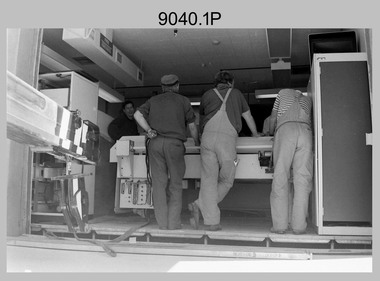
Photograph - Removal of AUTOMAP 1’s Gerber Optical Line Following (OLF) scanner from Army Survey Regiment, Fortuna, Bendigo, c1982-1983
... operation. Royal Australian Survey Corps RASvy Fortuna Army Survey Regiment automap 1 .1P to .8P – There are no annotations This is a set of eight photographs of the removal of AUTOMAP 1’s Gerber Optical Line Following (OLF) scanner Sub-System from Air Survey Squadron’s Building 16, at the Army Survey Regiment at Fortuna, Bendigo, circa 1982-1983. The photographs are on 35mm negative film and scanned at 96 dpi. They are part of the Army Survey Regiment’s Collection. .1) to .8) - Photo, black & white, c1982-1983, - Gerber Optical Line Follow (OLF) removal from Air ...This collection of eight photos was most likely taken in circa 1982-1983, featuring the removal of AUTOMAP 1’s Gerber Optical Line Following (OLF) scanner Sub-System from Air Survey Squadron’s Building 16, in preparation for the installation of the replacement AUTOMAP 2 system. Introduced in 1975, the AUTOMAP 1 computer assisted cartography and mapping system was the first computer assisted cartography and mapping system utilised by the Survey Corps and the first system used by Australian mapping organisations. The Gerber OLF scanner was mainly used to digitise contours on a map sheet separation with individual lines at least 0.125 mm wide and no closer than 0.25 mm to the next line. The operator initiated the OLF by placing its light sensitive digitizing head on a contour line. The OLF could digitise up to 50 mm per second on straight lines and complete an average density contour sheet in approximately 8 hours. The operator occasionally intervened to restart the OLF to allow it to continue if it failed to correctly discriminate the contours. The history of the AUTOMAP 1 system is covered in more detail with additional historic photographs, in pages 116-118 of Valerie Lovejoy’s book 'Mapmakers of Fortuna – A history of the Army Survey Regiment’ ISBN: 0-646-42120-4. See items 6122.20P, 6183.19P, and 6184.20P for additional photographs of AUTOMAP 1’s Gerber OLF in operation.This is a set of eight photographs of the removal of AUTOMAP 1’s Gerber Optical Line Following (OLF) scanner Sub-System from Air Survey Squadron’s Building 16, at the Army Survey Regiment at Fortuna, Bendigo, circa 1982-1983. The photographs are on 35mm negative film and scanned at 96 dpi. They are part of the Army Survey Regiment’s Collection. .1) to .8) - Photo, black & white, c1982-1983, - Gerber Optical Line Follow (OLF) removal from Air Survey Squadron’s Building 16..1P to .8P – There are no annotationsroyal australian survey corps, rasvy, fortuna, army survey regiment, automap 1 -
 Bendigo Military Museum
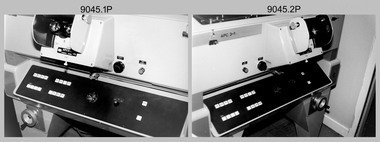
Photograph - Aerotriangulation Production – Army Survey Regiment, Fortuna, Bendigo, c1989
... operation in map production. Royal Australian Survey Corps RASvy Fortuna Army Survey Regiment air survey aerotrig .1P to .17P – There are no annotations This is a set of 17 photographs of Air Survey Squadron aerotriangulation equipment and personnel taken at the Army Survey Regiment at Fortuna, Bendigo, circa 1989. ...This collection of 17 photographs of Air Survey Squadron aerotriangulation equipment and personnel was taken at the Army Survey Regiment, Fortuna, Bendigo, circa 1989. The PDP 11/70 minicomputer was the operating system introduced in 1977 as the mainframe system for the control of the APC4, aerial triangulation block adjustments, SORA OP Analytical Orthophoto control, APR Analytical Terrain Profile Recorder computation, graphics, and general computing. The OMI/Nistri AP/C-3 analytical plotter shown in photo .1P to .6P and .9P was introduced in 1972–1973. The Zeiss (Jena) Stecometer analytic stereocomparator for air photography shown in photo .16P was introduced at Air Survey Squadron in 1963. Aerotriangulation production was expedited using computers for analytical photogrammetric processes. The technician accurately measured between pass, tie, and survey control points on aerial photographs. Wild PUG4 point transfer devices as shown in photo .17P, were introduced in c1968 superseding the PUG2 devices. PUG4 devices were used by technicians to stereoscopically view the photography containing the survey control points and the mapping aerial photography. The Control points were transferred from the control photography to the mapping diapositives of aerial photography by drilling their locations into the photographic emulsion. See item 6195.19P for more photos of aerotriangulation equipment and their operation in map production.This is a set of 17 photographs of Air Survey Squadron aerotriangulation equipment and personnel taken at the Army Survey Regiment at Fortuna, Bendigo, circa 1989. The photographs are on 35mm negative film and scanned at 96 dpi. They are part of the Army Survey Regiment’s Collection. .1) to .7) - Photo, black & white, c1989, OMI/Nistri APC/3-1 analytical stereoplotter. .8) - Photo, black & white, c1989, miscellaneous aerotriangulation equipment. .9) to.10) - Photo, black & white, c1989, Digital Equipment Corporation (DEC) 11 VO3-L Superminicomputer, with VT52 DECScope terminal. .11) to .15) - Photo, black & white, c1989, miscellaneous aerotriangulation equipment. .16) - Photo, colour, c1989, Zeiss (Jena) Stecometer, unidentified technician. .17) - Photo, black & white, c1989, Wild PUG4 point transfer device, unidentified technician..1P to .17P – There are no annotationsroyal australian survey corps, rasvy, fortuna, army survey regiment, air survey, aerotrig -
 Bendigo Military Museum
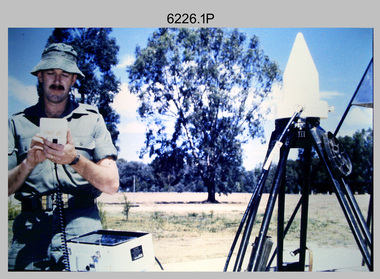
Photograph - Demonstration of TI4100 GPS Receiver, Royal Australian Survey Corps, c1988
... operation of Global Positioning System equipment in c1988. The photos were probably taken at the School of Military Survey (SMS), Bonegilla, VIC. Texas Instruments TI4100 portable Global Positioning System (GPS) geodetic receivers were introduced from 1986–1988. The GPS receivers and Ferranti FILS3 helicopter and vehicle mounted Inertial Positioning System (IPS) replaced the TRANSIT satellite receivers. The equipment was deployed to establish the baseline for a GPS controlled air camera and photogrammetric system to significantly reduce the requirement for ground survey to accurately control air...operation of Global Positioning System equipment in c1988. The photos were probably taken at the School of Military Survey (SMS), Bonegilla, VIC. Texas Instruments TI4100 portable Global Positioning System (GPS) geodetic receivers were introduced from 1986–1988. The GPS receivers and Ferranti FILS3 helicopter and vehicle mounted Inertial Positioning System (IPS) replaced the TRANSIT satellite receivers. The equipment was deployed to establish the baseline for a GPS controlled air camera and photogrammetric system to significantly reduce the requirement for ground survey to accurately control air ...This is a set of four photographs of WO2 Graham Ragless from the Royal Australian Survey Corps demonstrating the operation of Global Positioning System equipment in c1988. The photos were probably taken at the School of Military Survey (SMS), Bonegilla, VIC. Texas Instruments TI4100 portable Global Positioning System (GPS) geodetic receivers were introduced from 1986–1988. The GPS receivers and Ferranti FILS3 helicopter and vehicle mounted Inertial Positioning System (IPS) replaced the TRANSIT satellite receivers. The equipment was deployed to establish the baseline for a GPS controlled air camera and photogrammetric system to significantly reduce the requirement for ground survey to accurately control air photography for topographic mapping. Personnel from the four field survey squadrons at this time were trained at the SMS to operate the TI4100 receivers. Field survey operations using GPS and IPS equipment followed in the late 1980s. This technology is described in more detail in the RA Svy booklet titled An Introduction to Topographic Mapping. See record ID - 6010. WO2 Graham Ragless progressed to the rank of WO1 and was appointed as RSM of the Army Survey Regiment from 1990 to 1992. Refer to item 6186.2P for more photographs of WO2 Graham Ragless demonstrating the TI4100.This is a set of four photographs of a technician from the Royal Australian Survey Corps demonstrating the operation of Global Positioning System equipment in c1988. Colour photos are on 35mm slide film and were scanned at 96 dpi. .1) to .4) - Photo, colour, c1988, WO2 Graham Ragless demonstrating the operation of a TI4100 GPS receiverThere are no annotations.royal australian survey corps, rasvy, army survey regiment, army svy regt, fortuna, asr, surveying -
 Bendigo Military Museum
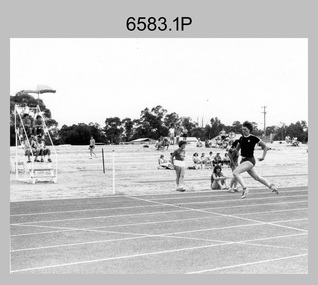
Photograph - Army Survey Regiment Inter-Squadron Athletics Competition, Bendigo, 1982
... Air Survey, Cartographic and Lithographic Squadrons took part in traditional athletics events, wheelbarrow race, sack race, fireman’s carry and tug-of-war novelty events. Photo .1P caption: FORTUNA RECORDS TUMBLE. ‘Super Sapper Annette Wilson of Air Survey Squadron broke a total of 4 records at the Army Svy Regt annual athletics carnival. She bettered the shot put by an amazing 5.10 metres, while also creating new records for the long jump, discus and javelin. The above photograph shows her winning the Womens 100 metre event.’ Photo .2P caption: ‘SPR Barry Miller of Headquarters/Operations Squadron leads CPL Keith Quinton of Lithographic Squadron out of the turn in the 200 metre mens open. SPR Barry Miller ran on strongly to win the vent.’ Photo .3P caption: ‘CPL Laurie Justin of Lithographic Squadron surges on to the straight to win the 800 metres mens open event.’ Photo .4P caption: ‘CPL Mick Hogan shows how to gain more distance in the air...Air Survey, Cartographic and Lithographic Squadrons took part in traditional athletics events, wheelbarrow race, sack race, fireman’s carry and tug-of-war novelty events. Photo .1P caption: FORTUNA RECORDS TUMBLE. ‘Super Sapper Annette Wilson of Air Survey Squadron broke a total of 4 records at the Army Svy Regt annual athletics carnival. She bettered the shot put by an amazing 5.10 metres, while also creating new records for the long jump, discus and javelin. The above photograph shows her winning the Womens 100 metre event.’ Photo .2P caption: ‘SPR Barry Miller of Headquarters/Operations Squadron leads CPL Keith Quinton of Lithographic Squadron out of the turn in the 200 metre mens open. SPR Barry Miller ran on strongly to win the vent.’ Photo .3P caption: ‘CPL Laurie Justin of Lithographic Squadron surges on to the straight to win the 800 metres mens open event.’ Photo .4P caption: ‘CPL Mick Hogan shows how to gain more distance in the air ...This is a set of six photographs of an Army Survey Regiment inter-squadron athletics competition held at Epsom, Bendigo in 1982. Personnel from Headquarters, Air Survey, Cartographic and Lithographic Squadrons took part in traditional athletics events, wheelbarrow race, sack race, fireman’s carry and tug-of-war novelty events. Photo .1P caption: FORTUNA RECORDS TUMBLE. ‘Super Sapper Annette Wilson of Air Survey Squadron broke a total of 4 records at the Army Svy Regt annual athletics carnival. She bettered the shot put by an amazing 5.10 metres, while also creating new records for the long jump, discus and javelin. The above photograph shows her winning the Womens 100 metre event.’ Photo .2P caption: ‘SPR Barry Miller of Headquarters/Operations Squadron leads CPL Keith Quinton of Lithographic Squadron out of the turn in the 200 metre mens open. SPR Barry Miller ran on strongly to win the vent.’ Photo .3P caption: ‘CPL Laurie Justin of Lithographic Squadron surges on to the straight to win the 800 metres mens open event.’ Photo .4P caption: ‘CPL Mick Hogan shows how to gain more distance in the air – as he wins the Triple Jump competition for Air Survey Squadron.’ Photo .5P caption: GET WITH THE STRENGTH – GO CARTO ‘Cartographic Squadron won the Tug-of-War competition after a desperate struggle provided by Headquarters/Operations Squadron. Pictured I the final heat of the competition, in which Carto Sqn were the eventual winners, 2 tugs to 1.’ Photo .6P caption: PROTEST UPHELD. ‘As a result of a protest in the running of the wheelbarrow race, a re-run was called for, much to the disappointment of the original winners. MAJ Stan Vote and WO1 Ken Slater of Lithographic Squadron. After wheel chocks had been removed from the wheelbarrow of the protesters, the race was re-run and first place went to MAJ Graham Baker and LT Chris Mazur of Air Survey Squadron.’This is a set of six photographs of an Army Survey Regiment inter-squadron athletics competition held at Bendigo in 1982. The photographs were printed on photographic paper and mounted on A4 paper, with typed captions underneath. The black and white photographs were scanned at 300 dpi. They are part of the Army Survey Regiment’s Collection. .1) - Photo, black & white, 1982, 100m sprint race. Foreground: SPR Annette (Wilson) Godden. Background L to R: SPR Chris Gordon, SPR Sherri (Dally) Burke, SPR Kristin (Isaac) Skidmore – obscured. .2) - Photo, black & white, 1982, 200m sprint race. L to R: CPL Keith Quinton, SPR Barry Miller. .3) - Photo, black & white, 1982, 800m distance. Foreground: CPL Laurie Justin. Background: CPL Graham Johnston. .4) - Photo, black & white, 1982, Triple jump. Foreground: CPL Mick Hogan. Background L to R: SPR Dave Lawler, SPR Barry Hogan, SPR Steve Coulson, WO1 Andy Wilson, SPR Robin Marshall – obscured. .5) - Photo, black & white, 1982, Tug-of-War. Coaches L to R: SPR Barry Hogan, SPR Steve Winner. Cartographic Squadron L to R: CPL Ian McKenzie, SGT Dennis Learmonth, CPL Dan Cirsky, SGT Dave Critchlow – UK Exchange, SPR Peter McCurdy, SPR Robin Marshall, SPR Geunther Ebenwaldner. Spectators L to R: WO1 John Bennett, SPR Steve Burke. .6) - Photo, black & white, 1982, Wheelbarrow race. L to R: 1st wheelbarrow – unidentified. 2nd wheelbarrow – MAJ Graham Baker, LT Chris Mazur. 3rd wheelbarrow - MAJ Stan Vote, WO1 Ken ‘Sluggo’ Slater. 4th wheelbarrow in foreground – CAPT Roger Rix, LT Terry Lord..1P to .6P – Featured personnel are identified on captions below each photograph. ‘Unit Athletics 1980-81??’ annotated on cover sleeve. *Note the 1982 date is more likely, due to the dates of enlistments of junior personnel appearing in the photos.royal australian survey corps, rasvy, army survey regiment, army svy regt, fortuna -
 Running Rabbits Military Museum operated by the Upwey Belgrave RSL Sub Branch
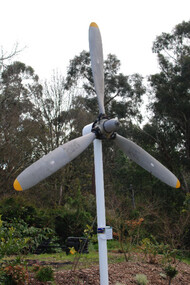
Propeller for a DHC-4 Caribou light transport
... air transport in support of the Australian Army. The Caribou was last operated by No 38 Squadron from RAAF Base Townsville in December 2009. The Caribou is a twin-engined high-wing monoplane with full-span double-slotted Fowler flaps and fully-reversible propellers, which allow it to achieve its trademark steep approach with very short take-offs and landings on unprepared runways. The high wing and distinctive high placement of the tail provide easy access to a large cargo compartment, while the low-pressure tyres permit operation on unprepared runways. It was the last piston-engined aircraft in the Air ...DHC-4 Caribou light transport The Royal Australian Air Force DHC-4 Caribou was a versatile tactical light transport aircraft . Its main operational role was tactical air transport in support of the Australian Army. The Caribou was last operated by No 38 Squadron from RAAF Base Townsville in December 2009. The Caribou is a twin-engined high-wing monoplane with full-span double-slotted Fowler flaps and fully-reversible propellers, which allow it to achieve its trademark steep approach with very short take-offs and landings on unprepared runways. The high wing and distinctive high placement of the tail provide easy access to a large cargo compartment, while the low-pressure tyres permit operation on unprepared runways. It was the last piston-engined aircraft in the Air Force and was our only aircraft to employ the Low Altitude Parachute Extraction System (LAPES), where up to 2000kg of sled-mounted cargo is extracted from the aircraft by a parachute from a metre above the ground. The Caribou is equipped with GPS satellite navigation and night-vision equipment, giving it the capability to operate in any weather, day or night, to either land or drop soldiers and equipment by parachute with pinpoint accuracy. The Caribou is not pressurised and is not fitted with auto-pilot or weather radar. The first Caribou arrived in Australia in April 1964 and they were deployed to Vietnam from July 1964 to February 1972 and carried over 600,000 passengers and a huge quantity of cargo while they were there. Since 1997 the Caribou participated in famine-relief operations in Papua New Guinea and Irian Jaya during Operations SIERRA, PLES DRAI and AUSINDO JAYA, as well as the tsunami-relief operation in PNG in 1999 and operations in East Timor and the Solomon Islands since 1999. Their service life was over 40 years. raaf caribou aircraft -
 Bendigo Military Museum
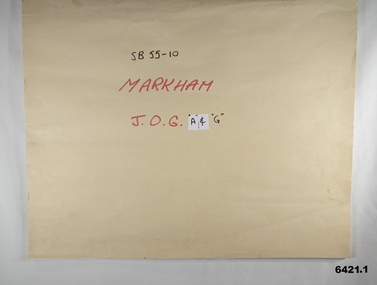
Map - SB55-10 Markham Joint Operations Graphics Air and Ground print separations, Royal Australian Survey Corps, Bendigo, Dec 1981
... Operations Graphic (JOG) JOG Ground and JOG Air versions. This map series was produced in two versions to help coordinate military Ground Operations and Air Operations. ...Operations Graphic (JOG) JOG Ground and JOG Air versions. This map series was produced in two versions to help coordinate military Ground Operations and Air Operations. ...This set of map prints was assembled as a training aid. The collection is a complete set of individual color prints of each colour used on the final printed maps for each map Joint Operations Graphic (JOG) JOG Ground and JOG Air versions. This map series was produced in two versions to help coordinate military Ground Operations and Air Operations. The ground users required that heights and measurements were in Metres, whilst air users required height information in Feet for altimeters. The Air Version also contained more Aeronautical information including safe flying height information called Maximum Elevation Figures (MEF). Later printing of JOG incorporated printing in just four colours Cyan, Magenta, Yellow and Black (CMYK). Item 6421.1 is an example of a JOG Ground and item 6421.2 is an example of its matching JOG Air version.1:250,000 SB55-10 Markham JOG A and G colour separations bound together in a manilla card covered folder bound with a timber edge. royal australian survey corps, rasvy, fortuna, army survey regiment, army svy regt, asr -
 Bendigo Military Museum
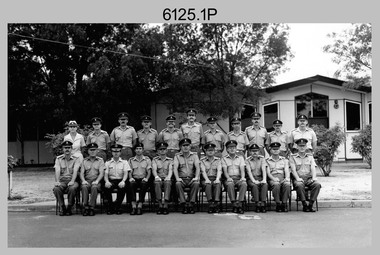
Photograph - Army Survey Regiment’s Officers, Warrant Officers and Sergeants and Squadrons, at Fortuna, Bendigo, 1982
... Air Survey Squadron’s photo was probably taken in July 1982 as they appear in winter dress. Air Survey Squadron was responsible for aerotriangulation, photogrammetric feature extraction and the AUTOMAP 1 system. Typical tasks were flight planning the acquisition of aerial photography, pugging, mensuration and block adjustments, photogrammetric extraction of topographic features from aerial photography, digital feature editing, map compilation, operating the scanner/plotter, operating the AUTOMAP 1 system and computer programming by civilians. Cartographic Squadron was responsible for the production of the following military products: Joint Operation Graphics, small-scale RAAF Air...Air Survey Squadron’s photo was probably taken in July 1982 as they appear in winter dress. Air Survey Squadron was responsible for aerotriangulation, photogrammetric feature extraction and the AUTOMAP 1 system. Typical tasks were flight planning the acquisition of aerial photography, pugging, mensuration and block adjustments, photogrammetric extraction of topographic features from aerial photography, digital feature editing, map compilation, operating the scanner/plotter, operating the AUTOMAP 1 system and computer programming by civilians. Cartographic Squadron was responsible for the production of the following military products: Joint Operation Graphics, small-scale RAAF Air ...This is a set of six staff photographs of the Army Survey Regiment’s Officers, Warrant Officers and Sergeants, and each of its four Squadrons at Fortuna, Bendigo in December 1982. Note - Air Survey Squadron’s photo was probably taken in July 1982 as they appear in winter dress. Air Survey Squadron was responsible for aerotriangulation, photogrammetric feature extraction and the AUTOMAP 1 system. Typical tasks were flight planning the acquisition of aerial photography, pugging, mensuration and block adjustments, photogrammetric extraction of topographic features from aerial photography, digital feature editing, map compilation, operating the scanner/plotter, operating the AUTOMAP 1 system and computer programming by civilians. Cartographic Squadron was responsible for the production of the following military products: Joint Operation Graphics, small-scale RAAF Air Charts, large-scale topographic line maps and orthophotomaps. Cartographic technician tasks were scribing, compiling, retouching, masking, type setting, type stickup, terrain embossing, correcting and proving quality control. Headquarters Squadron was responsible for the planning and coordination of map production and contracts. It also performed administrative and support functions such as personnel administration, pay, finance, transportation, records, map Library, kitchens, messes and facility maintenance. It was staffed by Army personnel from RASvy, RACT, AACC, RAAOC and RAEME corps. Other supporting staff at this time included the RAAF Liaison Officer, RAN Liaison Officer and several civilians employed in administration, the Q-Store and grounds maintenance. A component of the Army Svy Regt’s cartographic map production was carried out by the Detachment, a sub-unit located at Bonegilla next to the School of Military Survey. Lithographic Squadron was responsible for the reproduction of map materials and printing of military map products. The main tasks undertaken by photographic technicians were photographic enlargements, reductions and duplication of map reproduction material and processing of aerial photography. Printing technician tasks included platemaking, offset printing, map stock despatching and proofing.This is a set of six staff photographs of the Army Survey Regiment’s Officers, Warrant Officers and Sergeants, and its four Squadrons, at Fortuna, Bendigo, 1982. The black and white photographs were printed on photographic paper and are part of the Army Survey Regiment’s Collection. The photograph was scanned at 300 dpi. No personnel are identified. No personnel are identified. .1P – Annotated on front “OFFICERS MESS DEC ’82” .2P – Annotated on back “SGTS MESS DEC ’82” .4P– Annotated on front “CARTO SQN DEC ’82” .5P– Annotated on front “HQ SQN DEC ’82”royal australian survey corps, rasvy, army survey regiment, army svy regt, fortuna, asr, air survey, carto, litho -
 Bendigo Military Museum
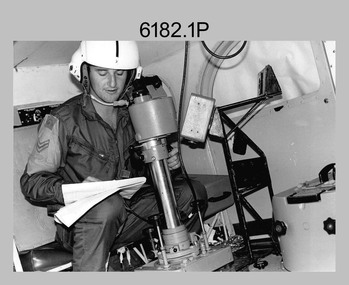
Photograph - Royal Australian Survey Corps Aerial Surveys, c1980
... In photo .3P, Neil Jones appears at the door of Airsearch Beechcraft Queen Air aircraft, Registration / Serial VH-MWX. This aircraft was typically used by RA Svy on air survey operations flying mission with Aerodist, APR and RC10 camera equipment. ...A Beechcraft King Air aircraft, also used by RA Svy on air survey operations. .6) - Photo, colour, c1980s. An Australian Army Pilatus Porter, used by RA Svy on air survey and map field checking operations. ...A Beechcraft King Air aircraft, also used by RA Svy on air survey operations. .6) - Photo, colour, c1980s. An Australian Army Pilatus Porter, used by RA Svy on air survey and map field checking operations. ...This is a set of nine photographs of technicians from the Royal Australian Survey Corps operating aerial surveys equipment c1980s. In photo .1P, CPL Steve Gloster was operating a RC10 air survey camera mounted in an Australian Army Pilatus Porter aircraft. The Wild RC10 super wide-angle air survey cameras were first introduced in 1971, were equipped with virtual distortion free lenses for supplementary, spot and special photography. In photo .2P, Roger Rees was operating Air Profile Recorder (APR) equipment. it was possibly taken during OP NERVOSE 84, sometime between June – August 1984 when based in Ngukurr, Northern Territory. The APR was operated at this time in unison with an RC10 camera. In 1963 the Royal Australian Survey Corps introduced the radar airborne profile recorder (Canadian Applied Research Ltd, Mark V, Airborne Profiler Recorder) was introduced for 1:100,000 mapping to replace terrain heighting by aneroid barometry. Later in 1974-1975, the Australian developed WREMAPS II airborne laser terrain profile recorder was introduced. In photo .3P, Neil Jones appears at the door of Airsearch Beechcraft Queen Air aircraft, Registration / Serial VH-MWX. This aircraft was typically used by RA Svy on air survey operations flying mission with Aerodist, APR and RC10 camera equipment. The Australian Army’s Pilatus Porter (short take-off and landing turbo propeller) was also equipped with a Wild RC10 aerial mapping camera for identification photography. The Pilatus Porter was also used on RA Svy’s map field checking operations. Photo .9P was taken at a survey station at an unknown location. In this photo an Australian Army Kiowa Light Observation Helicopter (LOH) is supporting a field survey party undertaking Magnavox AN/PRR-14 portable Doppler satellite observations. The satellite receiver’s antenna is plumbed over the survey ground mark surrounded by white plastic panels. The panels were used to identify the survey station on aerial photography. Introduced in 1974–1975, the Magnavox AN/PRR-14 portable Doppler satellite (US Navy Navigation Satellite System – TRANSIT) receivers and computing system provided independent three-dimensional point positions anywhere in the world, anytime, in any weather accurate to about 1.5metres with precise satellite ephemerides. The Bell OH-58 Kiowa LOH was a family of military helicopters used for observation, utility, and direct fire support. It was identified by RA Svy in the mid-1970s that considerable time was lost in replacing unserviceable remote equipment by road. Therefore Aerodist operations (pre-dating satellite receiver operations) were fully supported by Army’s Kiowa LOH aircraft. This is a set of nine photographs of technicians from the Royal Australian Survey Corps operating aerial surveys equipment c1980s. .1P to .3P, .5P to .9P - Colour and black and white photos on photographic paper and scanned at 300 dpi. .4P - Colour photo on 35mm slide film and scanned at 96 dpi. .1) & .2) - Photo, black & white, c1980s, CPL Steve Gloster operating an RC10 air camera. .3) - Photo, colour, 1984, Roger Rees operating Air Profile Recorder (APR) equipment. .4) - Photo, colour, c1980s, Neil Jones at the door of an Airsearch Beechcraft Queen Air aircraft, typically used by RA Svy on air survey operations. .5) - Photo, colour, c1980s. A Beechcraft King Air aircraft, also used by RA Svy on air survey operations. .6) - Photo, colour, c1980s. An Australian Army Pilatus Porter, used by RA Svy on air survey and map field checking operations. SGT Peter Mustart is possibly in the foreground. .7) to .8) - Photo, colour, c1980s. An Australian Army Pilatus Porter and unidentified personnel, used by RA Svy on air survey and map field checking operations. .9) - Photo, colour, c1980s. An Australian Army Kiowa helicopter supporting a field survey party undertaking Magnavox AN/PRR-14 portable Doppler satellite observations. There are biro marks on photos .4P to .9Proyal australian survey corps, rasvy, army survey regiment, asr, fortuna, aerial surveys -
 Bendigo Military Museum
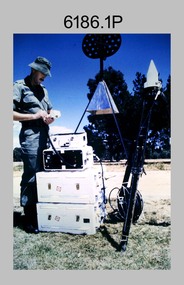
Photograph - Demonstration of TI4100 GPS Receiver, Royal Australian Survey Corps, c1988
... operation of Global Positioning System equipment in c1988. The photos were probably taken at the School of Military Survey (SMS), Bonegilla, VIC. Texas Instruments TI4100 portable Global Positioning System (GPS) geodetic receivers were introduced from 1986–1988. The GPS receivers and Ferranti FILS3 helicopter and vehicle mounted Inertial Positioning System (IPS) replaced the TRANSIT satellite receivers. The equipment was deployed to establish the baseline for a GPS controlled air camera and photogrammetric system to significantly reduce the requirement for ground survey to accurately control air...operation of Global Positioning System equipment in c1988. The photos were probably taken at the School of Military Survey (SMS), Bonegilla, VIC. Texas Instruments TI4100 portable Global Positioning System (GPS) geodetic receivers were introduced from 1986–1988. The GPS receivers and Ferranti FILS3 helicopter and vehicle mounted Inertial Positioning System (IPS) replaced the TRANSIT satellite receivers. The equipment was deployed to establish the baseline for a GPS controlled air camera and photogrammetric system to significantly reduce the requirement for ground survey to accurately control air ...This is a set of two photographs of WO2 Graham Ragless from the Royal Australian Survey Corps demonstrating the operation of Global Positioning System equipment in c1988. The photos were probably taken at the School of Military Survey (SMS), Bonegilla, VIC. Texas Instruments TI4100 portable Global Positioning System (GPS) geodetic receivers were introduced from 1986–1988. The GPS receivers and Ferranti FILS3 helicopter and vehicle mounted Inertial Positioning System (IPS) replaced the TRANSIT satellite receivers. The equipment was deployed to establish the baseline for a GPS controlled air camera and photogrammetric system to significantly reduce the requirement for ground survey to accurately control air photography for topographic mapping. Personnel from the four field survey squadrons at this time were trained at the SMS to operate the TI4100 receivers. Field survey operations using GPS and IPS equipment followed in the late 1980s. This technology is described in more detail in the RA Svy booklet titled An Introduction to Topographic Mapping. See record ID - 6010. WO2 Graham Ragless progressed to the rank of WO1 and was appointed as RSM of the Army Survey Regiment from 1990 to 1992. Refer to item 6226.4P for more photographs of WO2 Graham Ragless demonstrating the TI4100.This is a set of two photographs of a technician from the Royal Australian Survey Corps demonstrating the operation of Global Positioning System equipment in c1988. Colour photos are on 35mm slide film and were scanned at 96 dpi. .1) and .2) - Photo, colour, c1988, WO2 Graham Ragless demonstrating the operation of a TI4100 GPS receiverThere are no annotations.royal australian survey corps, rasvy, army survey regiment, army svy regt, fortuna, asr, surveying -
 Bendigo Military Museum
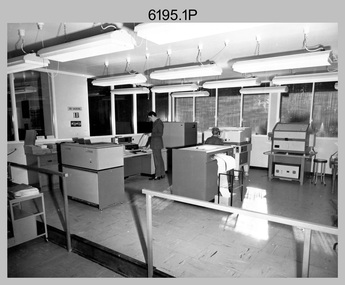
Photograph - Aerotriangulation Production – Army Survey Regiment, Fortuna, Bendigo, c1979
... operation in map production. Royal Australian Survey Corps RASvy Army Survey Regiment Army Svy Regt Fortuna ASR aerotrig air survey .5P is annotated ‘OMI-Nistri AP/C Analytical Plotter’ and ’Topo 36’. .12P is annotated ‘Zeiss Jena Stecometer Stereocomparator’ and ’Topo 35’. There are no annotations on the other photos. This is a set of 19 photographs of Air ...This collection of 19 photos was most likely taken in 1979 in Air Survey Squadron. The PDP 11/70 minicomputer shown in photos .2P to .3P was the operating system introduced in 1977 as the mainframe system for the control of the APC4, aerial triangulation block adjustments, SORA OP Analytical Orthophoto control, APR Analytical Terrain Profile Recorder computation, graphics, and general computing. The Zeiss (Jena) Stecometer analytic stereocomparator for air photography shown in photos .5P to .9P was introduced at Air Survey Squadron in 1963. Aerotriangulation production was expedited using computers for analytical photogrammetric processes. The technician accurately measured between pass, tie, and survey control points on aerial photographs. The OMI/Nistri AP/C-3 analytical plotter shown in photos .10P and .11P was introduced in 1972–1973. Photo .11P shows a coordinatorgraph attached to the AP/C-3. The Zeiss D2 Planimat Stereoplotter shown in photo .12P was used for analytical orthophoto control. Wild PUG4 point transfer devices shown in photos .17P to .19P were introduced in c1968 superseding the PUG2 devices. PUG4 devices were used by technicians to stereoscopically view the photography containing the survey control points and the mapping aerial photography. The Control points were transferred from the control photography to the mapping diapositives of aerial photography by drilling their locations into the photographic emulsion.See item 9045.17P for more photos of aerotriangulation equipment and their operation in map production.This is a set of 19 photographs of Air Survey Squadron personnel operating aerotriangulation equipment at the Army Survey Regiment at Fortuna, Bendigo, c1979. Black and white photos are on photographic paper and were scanned at 300 dpi. They are part of the Army Survey Regiment’s Collection. .1) - Photo, black & white, c1979, Aerotriangulation tasks, unidentified technicians. .2) to .3) - Photo, black & white, c1979, PDP-11 minicomputers tasks, unidentified technician. .4) - Photo, black & white, c1979, Aerotriangulation tasks, unidentified technician. .5) - Photo, colour, c1979, Zeiss (Jena) Stecometer, unidentified technician. .6) to.9) - Photo, black & white, c1979, Zeiss (Jena) Stecometer, unidentified technician. .10) - Photo, black & white, c1984, OMI/Nistri APC/3-1 analytical stereoplotter, SPR Kristin (Isaac) Skidmore. .11) - Photo, colour, c1979, OMI/Nistri APC/3-1 analytical stereoplotter, unidentified technician. .12) - Photo, colour, c1979, Zeiss D2 Planimat Stereoplotter, unidentified technician. .13) - Photo, black & white, c1979, Aerotriangulation tasks, unidentified technician. .14) - Photo, black & white, c1979, Aerotriangulation tasks, unidentified technician. .15) - Photo, black & white, c1979, Aerotriangulation tasks, CPL Ken Talbot-Smith .16) - Photo, black & white, c1979, Aerotriangulation tasks, SPR David Jobe. .17) - Photo, black & white, c1979, Wild PUG4 point transfer device, WO2 Brian Mead. .18) - Photo, black & white, c1979, Wild PUG4 point transfer device, CPL Andy Wilson. .19) - Photo, black & white, c1979, Wild PUG4 point transfer device, unidentified technician..5P is annotated ‘OMI-Nistri AP/C Analytical Plotter’ and ’Topo 36’. .12P is annotated ‘Zeiss Jena Stecometer Stereocomparator’ and ’Topo 35’. There are no annotations on the other photos.royal australian survey corps, rasvy, army survey regiment, army svy regt, fortuna, asr, aerotrig, air survey -
4th/19th Prince of Wales's Light Horse Regiment Unit History Room
Medal, 1939-45 Star
... air crew personnel a period of two months operational service for air crew personnel a period of six months service at sea for Merchant Navy provided at least one voyage was made through one of the specified areas of active operations The 1939-45 Star is awarded to Australian Civilian Personnel who served afloat with the United States Army Small Ships Section between 8 December 1941 and 2 September 1945. Eligibility is the same as that for Merchant Navy personnel. See required evidence to support a claim. The Medal The 1939-45 Star is a six–pointed star of yellow copper zinc alloy. The obverse has a central design of the Royal and Imperial cypher, surmounted by a crown. The cypher is surrounded by a circlet containing the words ‘The 1939-45 Star'. Stars issued to Australian personnel have recipient names engraved on the plain reverse. The Ribbon The 1939-45 Star ribbon has three vertical stripes of dark blue, red and light blue. The dark blue stripe represents the Naval Forces and the Merchant Navy, the red stripe the Armies and the light blue stripe the Air...air crew personnel a period of two months operational service for air crew personnel a period of six months service at sea for Merchant Navy provided at least one voyage was made through one of the specified areas of active operations The 1939-45 Star is awarded to Australian Civilian Personnel who served afloat with the United States Army Small Ships Section between 8 December 1941 and 2 September 1945. Eligibility is the same as that for Merchant Navy personnel. See required evidence to support a claim. The Medal The 1939-45 Star is a six–pointed star of yellow copper zinc alloy. The obverse has a central design of the Royal and Imperial cypher, surmounted by a crown. The cypher is surrounded by a circlet containing the words ‘The 1939-45 Star'. Stars issued to Australian personnel have recipient names engraved on the plain reverse. The Ribbon The 1939-45 Star ribbon has three vertical stripes of dark blue, red and light blue. The dark blue stripe represents the Naval Forces and the Merchant Navy, the red stripe the Armies and the light blue stripe the Air ...The 1939-45 Star may be awarded for those who undertook operational service during World War II. Eligibility The 1939-45 Star is awarded for service between 3 September 1939 and 2 September 1945 for: a period of six months (180 days) operational service for RAN and Army personnel and RAAF non-air crew personnel a period of two months operational service for air crew personnel a period of six months service at sea for Merchant Navy provided at least one voyage was made through one of the specified areas of active operations The 1939-45 Star is awarded to Australian Civilian Personnel who served afloat with the United States Army Small Ships Section between 8 December 1941 and 2 September 1945. Eligibility is the same as that for Merchant Navy personnel. See required evidence to support a claim. The Medal The 1939-45 Star is a six–pointed star of yellow copper zinc alloy. The obverse has a central design of the Royal and Imperial cypher, surmounted by a crown. The cypher is surrounded by a circlet containing the words ‘The 1939-45 Star'. Stars issued to Australian personnel have recipient names engraved on the plain reverse. The Ribbon The 1939-45 Star ribbon has three vertical stripes of dark blue, red and light blue. The dark blue stripe represents the Naval Forces and the Merchant Navy, the red stripe the Armies and the light blue stripe the Air Forces. Clasps The ‘BATTLE OF BRITAIN' clasp was awarded to eligible air crew involved in the Battle of Britain. When the ribbon is worn alone a gilt rosette ribbon emblem is worn to denote the award of the ‘BATTLE OF BRITAIN' clasp. The ‘BOMBER COMMAND’ clasp was introduced in 2012 and is awarded to eligible Bomber Command aircrew. When the ribbon is worn alone the standard silver rosette ribbon emblem is worn to denote the award of the ‘BOMBER COMMAND’ clasp. Full size and miniature medals with ribbons. Miniature has clasp : Battle of Britainnilmedal 1939-45 star
