
Showing 30 items matching "albury-wodonga corporation"
-
 Wodonga & District Historical Society Inc
Booklet - ALBURY - WODONGA, Albury Wodonga Corporation
... Albury-Wodonga Corporation...A black covered booklet featuring part of the Albury-Wodonga Corporation emblem. It features information, coloured photos, graphs and text about key locations and development in the area....Albury Wodonga Corporation...ALBURY - WODONGA Booklet ALBURY - WODONGA Albury Wodonga Corporation ...A publication of the Albury-Wodonga Development Corporation to promote its work and progress in the area. It outlines the background of the organisation, its developments and progress for the future.A black covered booklet featuring part of the Albury-Wodonga Corporation emblem. It features information, coloured photos, graphs and text about key locations and development in the area.A publication of the Albury-Wodonga Development Corporation to promote its work and progress in the area. It outlines the background of the organisation, its developments and progress for the future.albury-wodonga corporation, wodonga district -
 Wodonga & District Historical Society Inc
Book - Planning for Albury-Wodonga: An environmental assessment, Albury-Wodonga Development Corporation, October 1975
... albury-wodonga corporation... Albury-Wodonga Development Corporation...albury-wodonga corporation environmental issues Albury-Wodonga development This report is part of an ongoing series of documents on the work of the Albury-Wodonga Development Corporation. ...This report is part of an ongoing series of documents on the work of the Albury-Wodonga Development Corporation. It reflects the growing awareness of our environment and the need to conserve our heritage now and in the future. The report identified the environmental assets of the region and formed guidelines for their protection in the future.non-fiction This report is part of an ongoing series of documents on the work of the Albury-Wodonga Development Corporation. It reflects the growing awareness of our environment and the need to conserve our heritage now and in the future. The report identified the environmental assets of the region and formed guidelines for their protection in the future.albury-wodonga corporation, environmental issues, albury-wodonga development -
 Wodonga & District Historical Society Inc
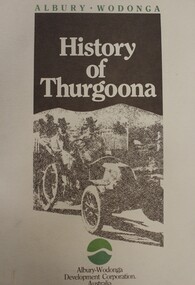
Book - History of Thurgoona, Howard C Jones, 1989
... Albury-Wodonga Development Corporation...It was commissioned by the Albury-Wodonga Development Corporation as a community service. ...A short history of Thurgoona, New South Wales. It was commissioned by the Albury-Wodonga Development Corporation as a community service.non-fiction A short history of Thurgoona, New South Wales. It was commissioned by the Albury-Wodonga Development Corporation as a community service.thurgoona, thurgoona nsw history -
 Wodonga & District Historical Society Inc
Book - Development of Albury Wodonga Initial Proposals, Albury-Wodonga Development Corporation, June 1974
... Albury-Wodonga Development Corporation...City planning Wodonga City Planning Albury decentralisation This report documents the initial policies and plans of the Albury-Wodonga Development Corporation for the growth of the city. ...This report documents the initial policies and plans of the Albury-Wodonga Development Corporation for the growth of the city. It outlines the intitial proposals and long term goals set down for the development of the Albury -Wodonga area to establish it as a major Australian city. The Albury- Wodonga Development Agreement was signed on October 23. 1973 by Sir Robert Asking, Premier of New South Wales, Rupert Hamer, Premier of Victoria and Gough Whitlam, Prime Minister of Australia.non-fictionThis report documents the initial policies and plans of the Albury-Wodonga Development Corporation for the growth of the city. It outlines the intitial proposals and long term goals set down for the development of the Albury -Wodonga area to establish it as a major Australian city. The Albury- Wodonga Development Agreement was signed on October 23. 1973 by Sir Robert Asking, Premier of New South Wales, Rupert Hamer, Premier of Victoria and Gough Whitlam, Prime Minister of Australia.city planning wodonga, city planning albury, decentralisation -
 Wodonga & District Historical Society Inc
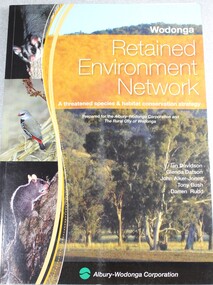
Book - Wodonga Retained Environment Network, Albury-Wodonga Development Corporation, 2006
... Albury-Wodonga Development Corporation...endangered species -- victoria conservation albury wodonga threatened species victoria threatened habitats environmental protection A threatened species and habitat conservation strategy prepared for the Albury Wodonga Corporation and the Rural City of Wodonga, Wodonga Retained Environment Network Book Wodonga Retained Environment Network Albury-Wodonga Development Corporation Ian Davidson et al ...A threatened species and habitat conservation strategy prepared for the Albury Wodonga Corporation and the Rural City of Wodonga,non-fictionA threatened species and habitat conservation strategy prepared for the Albury Wodonga Corporation and the Rural City of Wodonga,endangered species -- victoria, conservation albury wodonga, threatened species victoria, threatened habitats, environmental protection -
 Wodonga & District Historical Society Inc
Book - A Baranduda History, Howard C Jones, 1988
... ...Albury Wodonga Development Corporation...Spiral bound A Baranduda History Book A Baranduda History Howard C Jones Albury Wodonga Development Corporation ...A history of Baranduda in Northeast Victoria. Baranduda is a rural area and, since the 1970s, a rural and residential locality formed under the authority of the Albury Wodonga Development Corporation. It is near the junction of Yackandandah Road and the Kiewa Valley Highway, 10 km south-east of Wodonga. This publication traces the history of the area from its earliest know indigenous inhabitants, through the days of the earlier establishment of pastoral runs to more recent developments.Spiral boundnon-fictionA history of Baranduda in Northeast Victoria. Baranduda is a rural area and, since the 1970s, a rural and residential locality formed under the authority of the Albury Wodonga Development Corporation. It is near the junction of Yackandandah Road and the Kiewa Valley Highway, 10 km south-east of Wodonga. This publication traces the history of the area from its earliest know indigenous inhabitants, through the days of the earlier establishment of pastoral runs to more recent developments.baranduda, pioneers victoria, huon family, wodonga pioneers -
 Wodonga & District Historical Society Inc
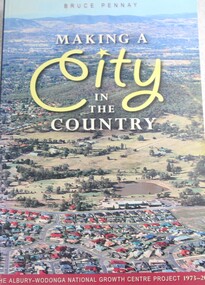
Book - Making a City in the Country: The Albury-Wodonga National Growth Centre Project, 1973-2003, Bruce J Pennay, 2005
... albury-wodonga corporation...albury-wodonga corporation city planning decentralisation whitlam government decentralisation A case study of what began as one of the Whitlam Governments boldest ventures to make a new city in the country so as to relieve the pressure on capital cities. ...A case study of what began as one of the Whitlam Governments boldest ventures to make a new city in the country so as to relieve the pressure on capital cities. This book explains what was involved in that venture what went right and what went wrong. It relates a specific case study to shifts in the wider political and economic context. It is fresh in perspective in that it views the growth centre strategy from an actual site rather than from government offices.non-fictionA case study of what began as one of the Whitlam Governments boldest ventures to make a new city in the country so as to relieve the pressure on capital cities. This book explains what was involved in that venture what went right and what went wrong. It relates a specific case study to shifts in the wider political and economic context. It is fresh in perspective in that it views the growth centre strategy from an actual site rather than from government offices.albury-wodonga corporation, city planning, decentralisation, whitlam government decentralisation -
 Wodonga & District Historical Society Inc
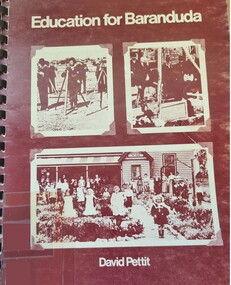
Book - Education for Baranduda, David Pettit, 1976
... ...Albury-Wodonga Development Corporation...This book is significant because it documents some of the planning carried out by the Albury-Wodonga Development Corporation. Baranduda Albury-Wodonga Development Corporation Education North East Victoria This book is the result of research commissioned by the Albury-Wodonga Development Corporation in 1976 to investigate future educational needs for the Baranduda community, Baranduda was established as a pastoral run around 1846. ...This book is the result of research commissioned by the Albury-Wodonga Development Corporation in 1976 to investigate future educational needs for the Baranduda community, Baranduda was established as a pastoral run around 1846. It developed as a rural community in the late 19th century—with a school opening in 1880. In 1974 The Albury-Wodonga Development Corporation was established to transform the twin-town border region into a major inland city, aiming for a population of 300,000 by 2000. It was created by federal and state governments to decentralise population from capital cities, manage regional land development, and boost local industry. As part of its recommendations Baranduda was designated for development as a modern satellite township. This report was commissioned as part of the planning for the future development of the Baranduda community.A spiral bound publication of 110 pages investigating potential plans and developments of education in Baranduda, Victoria. Cover features 3 photographs and diagrams are included.This book is the result of research commissioned by the Albury-Wodonga Development Corporation in 1976 to investigate future educational needs for the Baranduda community, Baranduda was established as a pastoral run around 1846. It developed as a rural community in the late 19th century—with a school opening in 1880. In 1974 The Albury-Wodonga Development Corporation was established to transform the twin-town border region into a major inland city, aiming for a population of 300,000 by 2000. It was created by federal and state governments to decentralise population from capital cities, manage regional land development, and boost local industry. As part of its recommendations Baranduda was designated for development as a modern satellite township. This report was commissioned as part of the planning for the future development of the Baranduda community.baranduda, albury-wodonga development corporation, education north east victoria -
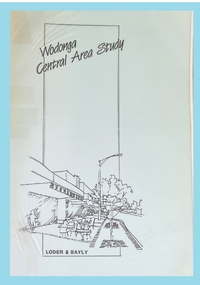 Wodonga & District Historical Society Inc
Book - Wodonga Central Area Study 1989, Loder and Bayly, Planning & Engineering Consultants, 1989
... The report was presented to the Albury-Wodonga Development Corporation and the Rural City of Wodonga....The report was presented to the Albury-Wodonga Development Corporation and the Rural City of Wodonga. ...This report was the result of an investigation into the potential future development and planning for commercial areas in Wodonga. Chapters of the final report are:- Chapter 1: Summary and Recommendations, Chapter 2: Wodonga Centre and its retail functioning, Chapter 3: Growth, Change and the need for a strategy, Chapter 4: Building a strategy for the Centre, Chapter 5: Components of a regional strategy, Chapter 6: A retail structure within Wodonga, Chapter 7: Future Road networks, Chapter 8: An urban design framework, Chapter 9: An overview of the emerging structure, Chapter 10: Planning scheme provisions and Chapter 11 Appendice (refer separate reports).A report of 134 pages, including illustrations and maps. The report was presented to the Albury-Wodonga Development Corporation and the Rural City of Wodonga.non-fictionThis report was the result of an investigation into the potential future development and planning for commercial areas in Wodonga. Chapters of the final report are:- Chapter 1: Summary and Recommendations, Chapter 2: Wodonga Centre and its retail functioning, Chapter 3: Growth, Change and the need for a strategy, Chapter 4: Building a strategy for the Centre, Chapter 5: Components of a regional strategy, Chapter 6: A retail structure within Wodonga, Chapter 7: Future Road networks, Chapter 8: An urban design framework, Chapter 9: An overview of the emerging structure, Chapter 10: Planning scheme provisions and Chapter 11 Appendice (refer separate reports).wodonga development planning, albury wodonga development -
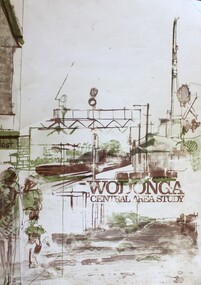 Wodonga & District Historical Society Inc
Book - Wodonga Central Area Study, Loder and Bayly, Planning & Engineering Consultants, March 1975
... The report was presented to the Albury-Wodonga Development Corporation and the Rural City of Wodonga....Albury-Wodonga development Rural City of Wodonga This report was the result of an investigation into the potential future development and town planning for the central area of Wodonga. Chapters of the final report are:- Chapter 1: Summary: Conclusions and Recommendations, Chapter 2: Setting the scene, Chapter 3: Possible futures, Chapter 4: Objectives, Chapter 5: Growth Options, Chapter 6: Recommended approaches, Chapter 7: Plan elements and Chapter 8: Ways and Means. A report of 134 pages, including illustrations and maps. The report was presented to the Albury-Wodonga Development Corporation ...This report was the result of an investigation into the potential future development and town planning for the central area of Wodonga. Chapters of the final report are:- Chapter 1: Summary: Conclusions and Recommendations, Chapter 2: Setting the scene, Chapter 3: Possible futures, Chapter 4: Objectives, Chapter 5: Growth Options, Chapter 6: Recommended approaches, Chapter 7: Plan elements and Chapter 8: Ways and Means.A report of 134 pages, including illustrations and maps. The report was presented to the Albury-Wodonga Development Corporation and the Rural City of Wodonga.This report was the result of an investigation into the potential future development and town planning for the central area of Wodonga. Chapters of the final report are:- Chapter 1: Summary: Conclusions and Recommendations, Chapter 2: Setting the scene, Chapter 3: Possible futures, Chapter 4: Objectives, Chapter 5: Growth Options, Chapter 6: Recommended approaches, Chapter 7: Plan elements and Chapter 8: Ways and Means.wodonga town planning, albury-wodonga development, rural city of wodonga -
 Wodonga & District Historical Society Inc
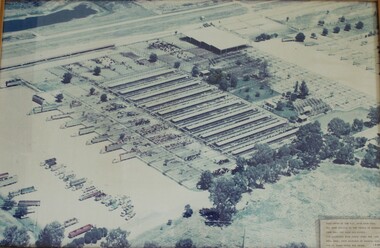
Photograph - W. G. Page Saleyards, Wodonga, c1980
... He often had to argue and campaign with the Albury-Wodonga Corporation to push for the interests of development in Wodonga. ...He often had to argue and campaign with the Albury-Wodonga Corporation to push for the interests of development in Wodonga. ...William George Page was Shire and City Engineer in Wodonga from 1965 until 1989. When he arrived the Shire of Wodonga had a population of 17,000 people. In 1966 Wodonga was selected as a city for special growth assistance. In 1972 Bill Page presented a new Town Plan to the Wodonga Council. Over the ensuing years he dedicated himself to bring this plan to fruition. He often had to argue and campaign with the Albury-Wodonga Corporation to push for the interests of development in Wodonga. This included winning a planning appeal to allow the saleyards to be relocated to Bandiana on the outskirts of Wodonga. Bill Page retired on health grounds in July 1989. The Council honoured him with a farewell dinner and renamed the saleyards at Bandiana the W.G. Page Saleyards in his honour.The Mayor , Cr Valentina Gillard, said "Every development in Wodonga in the past 24 years has a bit of Bill Page in it". William Page died 3 months later at 58 years old.This image depicts an important centre in the development and support of the livestock industry around Wodonga.An aerial photograph of the W. G. Page Saleyards in Wodonga. It has been mounted in a wooden frame.On a sign attached to the photo frame: "This photo of the W.G. Page Saleyards has been donated to the people of Wodonga from Mrs Pat Page and Family. The saleyards were named after the late Bill Page, City Engineer of Wodonga Council for 25 years until his death".w. g. page saleyards, wodonga saleyards, william george page -
 Wodonga & District Historical Society Inc
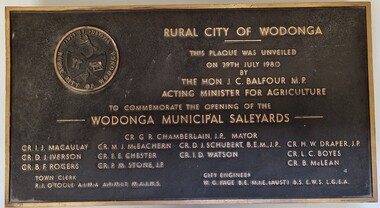
Plaque - Opening of Wodonga Municipal Saleyards 1980
... He often had to argue and campaign with the Albury-Wodonga Corporation to push for the interests of development in Wodonga. ...He often had to argue and campaign with the Albury-Wodonga Corporation to push for the interests of development in Wodonga. ...This plaque commemorates the opening of the Wodonga Municipal Saleyards, named the W. G. Page Saleyards, in 1980. The last sales at this facility took place in February 2015 before being replaced by the privately-run Barnawartha North's Northern Victoria Livestock Exchange. William George Page was Shire and City Engineer in Wodonga from 1965 until 1989. When he arrived the Shire of Wodonga had a population of 17,000 people. In 1966 Wodonga was selected as a city for special growth assistance. In 1972 Bill Page presented a new Town Plan to the Wodonga Council. Over the ensuing years he dedicated himself to bring this plan to fruition. He often had to argue and campaign with the Albury-Wodonga Corporation to push for the interests of development in Wodonga. This included winning a planning appeal to allow the saleyards to be relocated to Bandiana on the outskirts of Wodonga. Bill Page retired on health grounds in July 1989. The Council honoured him with a farewell dinner and renamed the saleyards at Bandiana the W.G. Page Saleyards in his honour.The Mayor , Cr Valentina Gillard, said "Every development in Wodonga in the past 24 years has a bit of Bill Page in it". William Page died 3 months later at 58 years old.This plaque commemorates an important centre in the development and support of the livestock industry around Wodonga.A bronze plaque bearing the symbol of the Rural City of Wodonga in the upper left corner and an inscription to commemorate the opening of the Wodonga Municipal Saleyards. It includes a detailed inscription.RURAL CITY OF WODONGA / THIS PLAQUE WAS UNVEILED / ON 29TH JULY 1980 / BY /THE HON. J. C. BALFOUR M.P. / ACTING MINISTER FOR AGRICULTURE /TO COMMEMORATE THE OPENING OF THE / WODONGA MUNICIPAL SALEYARDS CR. G. R. CHAMBERLAIN, J.P. MAYOR CR. I . J. MACAULAY CR. M. J. McEACHERN CR. D. I. SCHUBERT, B'E'N', J.P CR. H. W. DRAPER, J.P. CR. D.J .IVERSON CR. E. E. CHESTER CR I. D. WATSON CR. L. C. BOYES CR. B. F. ROGERS CR. P. M. STONE. J.P CR. B. McLEAN TOWN CLERK R. I. O"TOOLE A.I.M.A., A.R.M.I.T, M.A.I.H.S CITY ENGINEER W. G. PAGE, B.E, M.I.E (AUST) B.S .E.W.S L. G. E. A saleyards wodonga, w. g. page saleyards, livestock sales wodonga -
 Wodonga & District Historical Society Inc
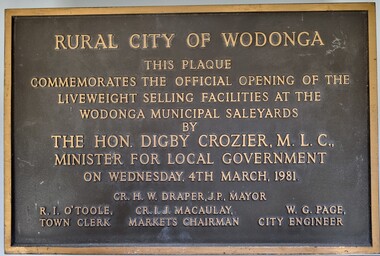
Plaque - Commemoration of the Opening of Liveweight Sales Wodonga Municipal Saleyards 1981
... He often had to argue and campaign with the Albury-Wodonga Corporation to push for the interests of development in Wodonga. ...He often had to argue and campaign with the Albury-Wodonga Corporation to push for the interests of development in Wodonga. ...This plaque commemorates the official opening of the liveweight selling facilities at the Wodonga Municipal Saleyards, named the W. G. Page Saleyards, in 1980. Liveweight selling usually involves a curfew where cattle have to be at the saleyard by a specific time before the sale in order for them to be weighed prior to auction. Cattle that do not make the curfew time are sold on a $/head basis. The last sales at this facility took place in February 2015 before being replaced by the privately-run Barnawartha North's Northern Victoria Livestock Exchange. William George Page was Shire and City Engineer in Wodonga from 1965 until 1989. When he arrived the Shire of Wodonga had a population of 17,000 people. In 1966 Wodonga was selected as a city for special growth assistance. In 1972 Bill Page presented a new Town Plan to the Wodonga Council. Over the ensuing years he dedicated himself to bring this plan to fruition. He often had to argue and campaign with the Albury-Wodonga Corporation to push for the interests of development in Wodonga. This included winning a planning appeal to allow the saleyards to be relocated to Bandiana on the outskirts of Wodonga. Bill Page retired on health grounds in July 1989. The Council honoured him with a farewell dinner and renamed the saleyards at Bandiana the W.G. Page Saleyards in his honour.The Mayor , Cr Valentina Gillard, said "Every development in Wodonga in the past 24 years has a bit of Bill Page in it". William Page died 3 months later at 58 years old.A bronze forged metal plaque with detailed inscription. Bolts to fix plaque to the wall are still attached.RURAL CITY OF WODONGA / THIS PLAQUE/ COMMEMORATES THE OFFICIAL OPENING OF THE/ LIVEWEIGHT SELLING FACILITIES AT / THE WODONGA MUNICIPAL SALEYARDS /BY/THE HON. DIGBY CROZIER, M.L.C., / MINISTER FOR LOCAL GOVERNMENT/ ON WEDNESDAY, 4TH MARCH, 1981 CR. H. W, DRAPER, J.P. MAYOR R. I. O'TOOLE TOWN CLERK , CR. I. J. MACAULAY MARKETS CHAIRMAN W. G. PAGE CITY ENGINEERlivestock sales wodonga, liveweight cattle sales, municipal saleyards wondonga -
 Wodonga & District Historical Society Inc
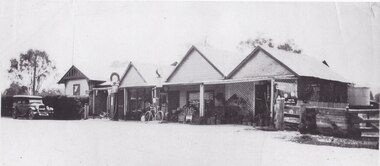
Photograph - Little River (Lone Pine) Store, c1940
... It was eventually acquired by Albury Wodonga Development Corporation in about1980. A bid to retain the name Lone Pine as a locality failed. ...It was eventually acquired by Albury Wodonga Development Corporation in about1980. A bid to retain the name Lone Pine as a locality failed. ...Little River (Lone Pine) Store at Killara was built in late 1920s by Harold Harris. Harold and his mother Emily Harris nee Farrell owned Killara Station. He had served at Lone Pine during World War 1 so named the area in honour of that field of battle. Bill Hart added a lubritorium or service station in the late 1950s. It was then also a general store and sub agency for Bank of NSW and also served as a post office. Mrs Hart also operated a small telephone exchange. In 1974 it was for put up for sale for $39,000 plus SAV. It was eventually acquired by Albury Wodonga Development Corporation in about1980. A bid to retain the name Lone Pine as a locality failed. These images are significant because they capture a building which served the community in the Wodonga area and has since been demolished.Two black and white images of the Lone Pine Store and Service Station at Killara.Lone Pine Store and advertising postershistoric sites wodonga, lone pine killara -
 Wodonga & District Historical Society Inc
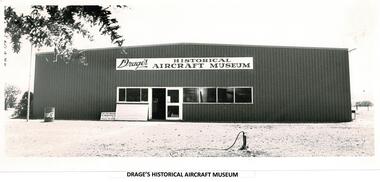
Photograph - Drage's Historical Aircraft Museum, Wodonga
... The land occupied by the Museum was compulsorily acquired by the Albury-Wodonga Development Corporation and Wangaratta council bought the aircraft collection for about $2 million. ...The land occupied by the Museum was compulsorily acquired by the Albury-Wodonga Development Corporation and Wangaratta council bought the aircraft collection for about $2 million. ...Born on 10 July 1931 in Walwa, Joseph Gordon (Joe) Drage operated a timber mill and earthmoving business, but his great passion was aviation. After obtaining his pilot’s licence at the age of 19, Mr. Drage set about buying vintage aircraft that he feared would be sold overseas. He bought his first aircraft, a Tiger Moth in 1965. In 1972 he established Drage Historical Aircraft Museum on about 60 ha of land in Wodonga, with 5 planes. Over time this grew to 21 planes which Joe maintained so that they were all in flying order. His museum was the location for several air shows which included fly-ins by members of the Antique Aeroplane Association. The land occupied by the Museum was compulsorily acquired by the Albury-Wodonga Development Corporation and Wangaratta council bought the aircraft collection for about $2 million. They opened Drage Airworld in 1984. The cost of maintaining the collection became too much for the council which closed it down in 2002. Joe Drage died on 9 August 2017.This image is significant because it depicts a popular Wodonga business which brought many people to the region over more than a decade.A black and white photo of building used as aircraft museum in Wodongaaircraft museum wodonga, joe drage, joe drage airworld -
 Wodonga & District Historical Society Inc
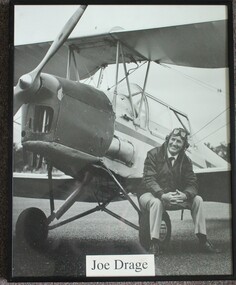
Photograph - Joe Drage and his Tiger Moth, Rob Elliott, 1993
... The land occupied by the Museum was compulsorily acquired by the Albury-Wodonga Development Corporation and Wangaratta council bought the aircraft collection for about $2 million. ...The land occupied by the Museum was compulsorily acquired by the Albury-Wodonga Development Corporation and Wangaratta council bought the aircraft collection for about $2 million. ...This image is one from a series of portraits taken by Rob Elliott to record the character of the Border District through the faces if its identities. Born on 10 July 1931 in Walwa, Joseph Gordon (Joe) Drage operated a timber mill and earthmoving business, but his great passion was aviation. After obtaining his pilot’s licence at the age of 19, Mr. Drage set about buying vintage aircraft that he feared would be sold overseas. He bought his first aircraft, a Tiger Moth in 1965. In 1972 he established Drage Historical Aircraft Museum on about 60 ha of land in Wodonga, with 5 planes. Over time this grew to 21 planes which Joe maintained so that they were all in flying order. His museum was the location for several air shows which included fly-ins by members of the Antique Aeroplane Association. The land occupied by the Museum was compulsorily acquired by the Albury-Wodonga Development Corporation and Wangaratta council bought the aircraft collection for about $2 million. They opened Drage Airworld in 1984. The cost of maintaining the collection became too much for the council which closed it down in 2002. Joe Drage died on 9 August 2017.This portrait depicts a person who made a significant contribution to the Wodonga community.A portrait of Joe Drage sitting on the wheel of his Tigermoth. The photo has been mounted in a metal frame.joe drage airworld, aircraft museum wodonga, joe drage -
 Wodonga & District Historical Society Inc
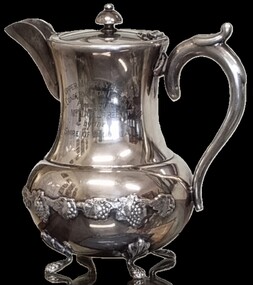
Functional object - Silver Teapot - Upper Murray Region Conservation Award
... They dissolved their partnership in 1941 but the Street family continued to farm the land until much of the property was acquired by the Albury Wodonga Development Corporation. Mr. J. A. E. Street was a community minded man. ...They dissolved their partnership in 1941 but the Street family continued to farm the land until much of the property was acquired by the Albury Wodonga Development Corporation. Mr. J. A. E. Street was a community minded man. ...This jug was awarded to John Albert Edward Street for his work in soil conservation at his property, Bandiana Park. John Albert Edward Street was born on the 8th November 1895 in Wodonga, Victoria to George Street and Theresa Emily Davis. He was a grandson of Frederic Street and his wife Sarah nee Kinchington, one of the earliest pioneering families in . On arrival in the Kiewa Valley, Frederic was engaged to run Gundowring Station. In 1852 Frederic took up land at Baranduda. Over the years he consolidated his holdings including land acquired by his seven sons. They established both Bandiana Park and the old Baranduda Homestead. Most of the sons stayed in the Baranduda area. The Street family continued working to farm the original property and John and his brother Clarence were pioneers in implementing soil conservation practices to improve their pastures from the mid1920s. They dissolved their partnership in 1941 but the Street family continued to farm the land until much of the property was acquired by the Albury Wodonga Development Corporation. Mr. J. A. E. Street was a community minded man. He was a member of the provisional committee which formed to establish a Show Society and was a Foundation Member of the Wodonga Show Society s first Committee. He continued to serve the Committee for 30 years. Mr Street also served on the Wodonga Shire Council. After many years of service to the Wodonga community, John Albert Edward Street passed away in Wodonga in 1976.This teapot is significant because it was presented to a prominent Wodonga and district family for their pioneering work in soil conservation.It features grape vine motifs and has lions paw feet.UPPER MURRAY REGION SOIL CONSERVATION COMPETITION Presented to MR. J.A.E. STREET by the SHIRE OF WODONGA Underneath base, in a circle - Kenson Plate EPNS A1soil conservation upper murray, wodonga shire soil conservation -
 Wodonga & District Historical Society Inc
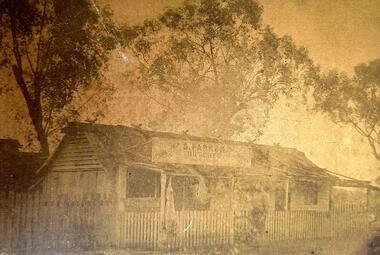
Photograph - Samuel Skelton Parker's Butchery and Bakery, Barnawartha, Victoria
... Samuel and Jack continued to successfully manage the farm until 1974 when the Albury Wodonga Development Corporation acquired the land for the planned development of the region. ...Samuel and Jack continued to successfully manage the farm until 1974 when the Albury Wodonga Development Corporation acquired the land for the planned development of the region. ...Samuel Skelton Parker was a native of Ballymena in the County of Antrim, Ireland and came to Melbourne, Australia in 1854. He was engaged for two years as a storeman. After mining in the Ovens district for five years he next became overseer on a station in New South Wales. He was married to Bridget Cusack in 1865 and they had a family of 4 sons and a daughter. After returning to Victoria Samuel Skelton Parker started a butchering business at Barnawartha and in 1881 he combined it with a bakery. This was the first business established in Barnawartha. Samuel had several properties in the township as well as his business premises and private residence. His horse drawn butchers cart made a run to Wodonga three days a week supplying the wayside pubs and Railway Gate House owners. Bread was sold for five loaves for one shilling, meat was two pennies per pound. In 1890 Skelton decided to give up butchering and baking and moved to Wodonga. He bought a 'Bush Block' of 150 acres on Fergusons Lane, now Parkers Road. Skelton called the property 'Park Hall' after his home in Ireland. On this new property Skelton raised sheep and he also sold chaff around the district. When Skelton died on 14 October 1897 the farm was split up with two sons Sam and Jack continuing the running of the farm, whilst the other two sons William and James joined the Victorian railways. Samuel and Jack continued to successfully manage the farm until 1974 when the Albury Wodonga Development Corporation acquired the land for the planned development of the region. In 2026 this is the location of Park Hall Retirement Village and the Wodonga Golf Club are situated on Parkers Road.This image is significant because it records one of the earliest businesses established in Barnawartha, Victoria.Two black and white images of Samuel Parker's business in Barnawartha, Northeast Victoria.parker family wodonga, early wodonga settlers, barnawartha, samuel skelton parker -
 Wodonga & District Historical Society Inc
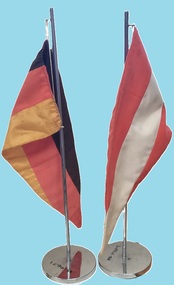
Memorabilia - German and Austrian miniature flags, Unknown
... This became reality in July 1979, when the Committee purchased land from the Albury Wodonga Development Corporation at 5 McFarland Road, Wodonga. ...This became reality in July 1979, when the Committee purchased land from the Albury Wodonga Development Corporation at 5 McFarland Road, Wodonga. ...Thousands of German migrants started a new life at Bonegilla, Victoria in the 1950s. Among them were five men who met each other in Wodonga, became friends and decided to form a German Austrian Club, where they could enjoy the company of likeminded individuals. They were Kurt Mueller, Willi Klimt, Toni Krischa and Erwin Klein from Germany and Manfred Teissl from Austria. On the 16th July 1960, after advertising in the Border Morning Mail, the German Austrian Club in Wodonga was born. Office bearers were Paul Peters as President. Gerhard Ziermann as Secretary and Günter Schmehl as Treasurer. Their aim was "To promote the upkeep of the German language in written and spoken form and to promote good German fellowship, while enjoying functions of a cultural and entertaining nature". By 1963 the Club boasted 40 members, holding meetings at the RSL Clubrooms and other suitable locations before they found a house in Hovell Street, Wodonga. It was used for meetings, Skat meetings, film nights and "Sonnabendschule” or Saturday school where children of members could continue to learn German. The Committee organised a wide range of activities and functions in their small rooms but dreamed of having a bigger home. This became reality in July 1979, when the Committee purchased land from the Albury Wodonga Development Corporation at 5 McFarland Road, Wodonga. The first brick was laid on the Club's land in May 1980, and the double-storey brick building was completed within 12 months voluntarily by Club members. At the same time members supported other organisations and charities in the Wodonga and wider community. The first Oktoberfest in Wodonga was held in 1975, drawing 4,000 attendees. The event was organized to promote German culture, and the profits from the first year were donated to the Wodonga District Hospital, raising $20,000. In 2001 the German Austrian Club was presented with the Certificate of Meritorious Service by the Government of Victoria for Community Works in Wodonga and district. The Club raised $23,000 for the Wodonga Hospital, had numerous fundraisers to assist in bushfires and drought situations and was involved in the Red Cross Calling campaign for many years. After much fundraising, hard work and making their way through extensive government red tape, the Club moved to its new premises in McFarland Road on 1st August 1981. The members continued to make necessary internal adjustments and sought an alcohol licence. The building was officially opened in May 1983. The Club prospered and had 300 members, making it necessary for new applicants to be put on a waiting list to be accepted as members. Interest groups consisted of Competition Air Rifle Shooting Group, a Skat (German Card game) Group, Folk Dancing Group, Ladies Group, Table Tennis Group, Darts Group, Chess Group and the Billiard Group. In later years, as so many Australians became members, the Club’s name was changed to the German Austrian Australian Club. Over recent years patronage and interest in the Club and its activities changed. Children of the original members had become “real Aussies” and did not always want to carry on traditions. Aging membership and lack of volunteers forced the Club to disband in 2025. The Club building has been gifted to the Albury Wodonga Theatre Company.These items are significant because they are representative of an important cultural organisation which operated in Wodonga for over 60 years.Two small flags of Germany and Austria attached to metal stands with string. Each stand has a metal circular base. "Lufthansa" is inscribed on the base.On base: Lufthansagerman austrian australian club, german austrian club -
 Wodonga & District Historical Society Inc
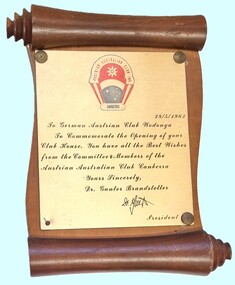
Plaque - German-Austrian Club Wodonga Opening, 1983
... This became reality in July 1979, when the Committee purchased land from the Albury Wodonga Development Corporation at 5 McFarland Road, Wodonga. ...This became reality in July 1979, when the Committee purchased land from the Albury Wodonga Development Corporation at 5 McFarland Road, Wodonga. ...Thousands of German migrants started a new life at Bonegilla, Victoria in the 1950s. Among them were five men who met each other in Wodonga, became friends and decided to form a German Austrian Club, where they could enjoy the company of likeminded individuals. They were Kurt Mueller, Willi Klimt, Toni Krischa and Erwin Klein from Germany and Manfred Teissl from Austria. On the 16th July 1960, after advertising in the Border Morning Mail the German Austrian Club in Wodonga was born. Office bearers were Paul Peters as President. Gerhard Ziermann as Secretary and Günter Schmehl as Treasurer. Their aim was "To promote the upkeep of the German language in written and spoken form and to promote good German fellowship, while enjoying functions of a cultural and entertaining nature". By 1963 the Club boasted 40 members, holding meetings at the RSL Clubrooms and other suitable locations before they found a house in Hovell Street, Wodonga. It was used for meetings, Skat meetings, film nights and Sonnabendschule” or Saturday school where children of members could continue to learn German. The Committee organised a wide range of activities and functions in their small rooms but dreamed of having a bigger home. This became reality in July 1979, when the Committee purchased land from the Albury Wodonga Development Corporation at 5 McFarland Road, Wodonga. The first brick was laid on the Club's land in May 1980, and the double-story brick building was completed within 12 months voluntarily by Club members. At the same time members supported other organisations and charities in the Wodonga and wider community. The first Oktoberfest in Wodonga was held in 1975, drawing 4,000 attendees. The event was organized to promote German culture, and the profits from the first year were donated to the Wodonga District Hospital, raising $20,000. In 2001 the German Austrian Club was presented with the Certificate of Meritorious Service by the Government of Victoria for Community Works in Wodonga and district. The Club raised $23,000 for the Wodonga Hospital, had numerous fundraisers to assist in bushfires and drought situations and was involved in the Red Cross Calling campaign for many years. After much fundraising, hard work and making their way through extensive government red tape, the Club moved to its new premises in McFarland Road on 1st August 1981. The members continued to make necessary internal adjustments and sought an alcohol licence. The building was officially opened in May 1983. The Club prospered and had 300 members, making it necessary for new applicants to be put on a waiting list to be accepted as members. Interest groups formed consisted of Competition Air Rifle Shooting Group, a Skat (German Card game) Group, Folk Dancing Group, Ladies Group, Table Tennis Group, Darts Group, Chess Group and the Billiard Group. In later years, as so many Australians became members, the Club’s name was changed to the German Austrian Australian Club. Over recent years patronage and interest in the Club and its activities changed. Children of the original members had become “real Aussies” and did not always want to carry on traditions. Aging membership and lack of volunteers forced the Club to disband in 2025. The Club building has been gifted to the Albury Wodonga Theatre Company. These items are significant because they are representative of an important cultural organisation which operated in Wodonga for over 60 years.A metal plaque attached to a wooden backing shaped like a scroll. The text is in the form of a letter.Emblem of the Austrian - Australian Clubs Inc. Canberra 28/5/1983 To German Austrian Club Wodonga To Commemorate the Opening of your Club House. You have all the Best Wishes from the Committee & Members of the Austrian Australian Club Canberra Yours Sincerely, Dr. Gunter Brandstetter Presidentgerman austrian australian club, german migrants wodonga -
 Wodonga & District Historical Society Inc
Plaque - German-Austrian Club Wodonga 30th Anniversary, 1990
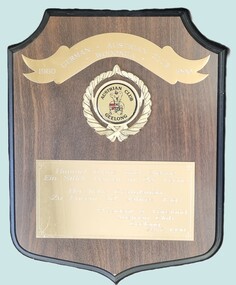
... This became reality in July 1979, when the Committee purchased land from the Albury Wodonga Development Corporation at 5 McFarland Road, Wodonga. ...This became reality in July 1979, when the Committee purchased land from the Albury Wodonga Development Corporation at 5 McFarland Road, Wodonga. ...Thousands of German migrants started a new life at Bonegilla, Victoria in the 1950s. Among them were five men who met each other in Wodonga, became friends and decided to form a German Austrian Club, where they could enjoy the company of likeminded individuals. They were Kurt Mueller, Willi Klimt, Toni Krischa and Erwin Klein from Germany and Manfred Teissl from Austria. On the 16th July 1960, after advertising in the Border Morning Mail the German Austrian Club in Wodonga was born. Office bearers were Paul Peters as President. Gerhard Ziermann as Secretary and Günter Schmehl as Treasurer. Their aim was "To promote the upkeep of the German language in written and spoken form and to promote good German fellowship, while enjoying functions of a cultural and entertaining nature". By 1963 the Club boasted 40 members, holding meetings at the RSL Clubrooms and other suitable locations before they found a house in Hovell Street, Wodonga. It was used for meetings, Skat meetings, film nights and Sonnabendschule” or Saturday school where children of members could continue to learn German. The Committee organised a wide range of activities and functions in their small rooms but dreamed of having a bigger home. This became reality in July 1979, when the Committee purchased land from the Albury Wodonga Development Corporation at 5 McFarland Road, Wodonga. The first brick was laid on the Club's land in May 1980, and the double-story brick building was completed within 12 months voluntarily by Club members. At the same time members supported other organisations and charities in the Wodonga and wider community. The first Oktoberfest in Wodonga was held in 1975, drawing 4,000 attendees. The event was organized to promote German culture, and the profits from the first year were donated to the Wodonga District Hospital, raising $20,000. In 2001 the German Austrian Club was presented with the Certificate of Meritorious Service by the Government of Victoria for Community Works in Wodonga and district. The Club raised $23,000 for the Wodonga Hospital, had numerous fundraisers to assist in bushfires and drought situations and was involved in the Red Cross Calling campaign for many years. After much fundraising, hard work and making their way through extensive government red tape, the Club moved to its new premises in McFarland Road on 1st August 1981. The members continued to make necessary internal adjustments and sought an alcohol licence. The building was officially opened in May 1983. The Club prospered and had 300 members, making it necessary for new applicants to be put on a waiting list to be accepted as members. Interest groups formed consisted of Competition Air Rifle Shooting Group, a Skat (German Card game) Group, Folk Dancing Group, Ladies Group, Table Tennis Group, Darts Group, Chess Group and the Billiard Group. In later years, as so many Australians became members, the Club’s name was changed to the German Austrian Australian Club. Over recent years patronage and interest in the Club and its activities changed. Children of the original members had become “real Aussies” and did not always want to carry on traditions. Aging membership and lack of volunteers forced the Club to disband in 2025. The Club building has been gifted to the Albury Wodonga Theatre Company.This item is significant because it is representative of an important cultural organisation which operated in Wodonga for over 60 years.A wooden plaque with metal insignia and a plate with text in German. This plaque was presented by the German Austrian Club of Geelong on the occasion of the 30th Anniversary of the Wodonga Club and bears its insignia.Himmel Glanz und Sterne Ein Stuck Heimat in Der Fern Herzliche Gratulation Zu Eurem 30 Jahres Tag President and Vorstand Translation Sky, splendour and stars A piece of home away from home Congratulations On your 30th anniversary President and Board of Directorsgerman austrian australian club, german migrants wodonga -
 Wodonga & District Historical Society Inc
Plaque - German-Austrian Club Wodonga 40th Anniversary, 2000
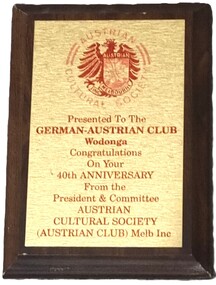
... This became reality in July 1979, when the Committee purchased land from the Albury Wodonga Development Corporation at 5 McFarland Road, Wodonga. ...This became reality in July 1979, when the Committee purchased land from the Albury Wodonga Development Corporation at 5 McFarland Road, Wodonga. ...Thousands of German migrants started a new life at Bonegilla, Victoria in the 1950s. Among them were five men who met each other in Wodonga, became friends and decided to form a German Austrian Club, where they could enjoy the company of likeminded individuals. They were Kurt Mueller, Willi Klimt, Toni Krischa and Erwin Klein from Germany and Manfred Teissl from Austria. On the 16th July 1960, after advertising in the Border Morning Mail the German Austrian Club in Wodonga was born. Office bearers were Paul Peters as President. Gerhard Ziermann as Secretary and Günter Schmehl as Treasurer. Their aim was "To promote the upkeep of the German language in written and spoken form and to promote good German fellowship, while enjoying functions of a cultural and entertaining nature". By 1963 the Club boasted 40 members, holding meetings at the RSL Clubrooms and other suitable locations before they found a house in Hovell Street, Wodonga. It was used for meetings, Skat meetings, film nights and Sonnabendschule” or Saturday school where children of members could continue to learn German. The Committee organised a wide range of activities and functions in their small rooms but dreamed of having a bigger home. This became reality in July 1979, when the Committee purchased land from the Albury Wodonga Development Corporation at 5 McFarland Road, Wodonga. The first brick was laid on the Club's land in May 1980, and the double-story brick building was completed within 12 months voluntarily by Club members. At the same time members supported other organisations and charities in the Wodonga and wider community. The first Oktoberfest in Wodonga was held in 1975, drawing 4,000 attendees. The event was organized to promote German culture, and the profits from the first year were donated to the Wodonga District Hospital, raising $20,000. In 2001 the German Austrian Club was presented with the Certificate of Meritorious Service by the Government of Victoria for Community Works in Wodonga and district. The Club raised $23,000 for the Wodonga Hospital, had numerous fundraisers to assist in bushfires and drought situations and was involved in the Red Cross Calling campaign for many years. After much fundraising, hard work and making their way through extensive government red tape, the Club moved to its new premises in McFarland Road on 1st August 1981. The members continued to make necessary internal adjustments and sought an alcohol licence. The building was officially opened in May 1983. The Club prospered and had 300 members, making it necessary for new applicants to be put on a waiting list to be accepted as members. Interest groups formed consisted of Competition Air Rifle Shooting Group, a Skat (German Card game) Group, Folk Dancing Group, Ladies Group, Table Tennis Group, Darts Group, Chess Group and the Billiard Group. In later years, as so many Australians became members, the Club’s name was changed to the German Austrian Australian Club. Over recent years patronage and interest in the Club and its activities changed. Children of the original members had become “real Aussies” and did not always want to carry on traditions. Aging membership and lack of volunteers forced the Club to disband in 2025. The Club building has been gifted to the Albury Wodonga Theatre Company.This item is significant because it is representative of an important cultural organisation which operated in Wodonga for over 60 years.A small metal plaque on a wooden backing with red text. It includes the insignia of the Austrian Cultural Society of Melbourne.Presented To The GERMAN-AUSTRIAN CLUB Wodonga Congratulations On Your 40th ANNIVERSARY From the President & Committee AUSTRIAN CULTURAL SOCIETY (AUSTRIAN CLUB) Melb Incgerman austrian australian club, german migrants wodonga -
 Wodonga & District Historical Society Inc
Plaque - German-Austrian Club Wodonga 50th Anniversary, 2010
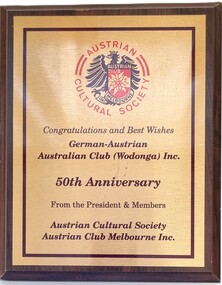
... This became reality in July 1979, when the Committee purchased land from the Albury Wodonga Development Corporation at 5 McFarland Road, Wodonga. ...This became reality in July 1979, when the Committee purchased land from the Albury Wodonga Development Corporation at 5 McFarland Road, Wodonga. ...Thousands of German migrants started a new life at Bonegilla, Victoria in the 1950s. Among them were five men who met each other in Wodonga, became friends and decided to form a German Austrian Club, where they could enjoy the company of likeminded individuals. They were Kurt Mueller, Willi Klimt, Toni Krischa and Erwin Klein from Germany and Manfred Teissl from Austria. On the 16th July 1960, after advertising in the Border Morning Mail the German Austrian Club in Wodonga was born. Office bearers were Paul Peters as President. Gerhard Ziermann as Secretary and Günter Schmehl as Treasurer. Their aim was "To promote the upkeep of the German language in written and spoken form and to promote good German fellowship, while enjoying functions of a cultural and entertaining nature". By 1963 the Club boasted 40 members, holding meetings at the RSL Clubrooms and other suitable locations before they found a house in Hovell Street, Wodonga. It was used for meetings, Skat meetings, film nights and Sonnabendschule” or Saturday school where children of members could continue to learn German. The Committee organised a wide range of activities and functions in their small rooms but dreamed of having a bigger home. This became reality in July 1979, when the Committee purchased land from the Albury Wodonga Development Corporation at 5 McFarland Road, Wodonga. The first brick was laid on the Club's land in May 1980, and the double-story brick building was completed within 12 months voluntarily by Club members. At the same time members supported other organisations and charities in the Wodonga and wider community. The first Oktoberfest in Wodonga was held in 1975, drawing 4,000 attendees. The event was organized to promote German culture, and the profits from the first year were donated to the Wodonga District Hospital, raising $20,000. In 2001 the German Austrian Club was presented with the Certificate of Meritorious Service by the Government of Victoria for Community Works in Wodonga and district. The Club raised $23,000 for the Wodonga Hospital, had numerous fundraisers to assist in bushfires and drought situations and was involved in the Red Cross Calling campaign for many years. After much fundraising, hard work and making their way through extensive government red tape, the Club moved to its new premises in McFarland Road on 1st August 1981. The members continued to make necessary internal adjustments and sought an alcohol licence. The building was officially opened in May 1983. The Club prospered and had 300 members, making it necessary for new applicants to be put on a waiting list to be accepted as members. Interest groups formed consisted of Competition Air Rifle Shooting Group, a Skat (German Card game) Group, Folk Dancing Group, Ladies Group, Table Tennis Group, Darts Group, Chess Group and the Billiard Group. In later years, as so many Australians became members, the Club’s name was changed to the German Austrian Australian Club. Over recent years patronage and interest in the Club and its activities changed. Children of the original members had become “real Aussies” and did not always want to carry on traditions. Aging membership and lack of volunteers forced the Club to disband in 2025. The Club building has been gifted to the Albury Wodonga Theatre Company.This item is significant because it is representative of an important cultural organisation which operated in Wodonga for over 60 years.A small metal plaque on a wooden backing with red text. It includes the insignia of the Austrian Cultural Society of Melbourne.Congratulations and Best Wishes German-Austrian Australian Club (Wodonga) Inc. 50th Anniversary From the President & Members Austrian Cultural Society Austrian Club Melbourne Inc.german austrian australian club, german migrants wodonga -
 Wodonga & District Historical Society Inc
Photograph - Les Stone, Last Shire President and first Mayor of the Rural City of Wodonga
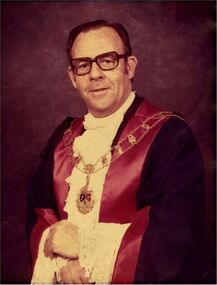
... Albury on 28th December 1974 at 54 years of age. He left behind an enduring legacy which included the proactive encouragement of industry to Wodonga. He also championed the selection of Wodonga as a Growth Centre. A champion and defender of local government, Les served as Chairman of the North East Region of Municipalities which comprised 13 Councils including Wodonga and Wangaratta. He also played a critical role on the Albury Wodonga Development Corporation...Albury on 28th December 1974 at 54 years of age. He left behind an enduring legacy which included the proactive encouragement of industry to Wodonga. He also championed the selection of Wodonga as a Growth Centre. A champion and defender of local government, Les served as Chairman of the North East Region of Municipalities which comprised 13 Councils including Wodonga and Wangaratta. He also played a critical role on the Albury Wodonga Development Corporation ...Les Stone was the last Shire President of Wodonga and first Mayor of the Rural City of Wodonga. Born in Collingwood, Victoria on 24th August 1919, he was the first of his family to obtain a post-secondary education. He became a Christian Brother but left the ministry after 10 years and became a trained primary school teacher. Les held various teaching appointments in and around country Victoria and Wodonga, the last as Principal of Wodonga West Primary School. It was in Wodonga that Les and his wife Pam settled with their family. Their contribution to the Wodonga community and local government was outstanding. Les established a strong network in the local migrant community, helping many new arrivals at Bonegilla Migrant Reception Centre with language issues and settling them into their new environment. He worked in support of all underprivileged people in the community. In 1967 Les was elected as a Councillor for the West Riding of Wodonga Council. The following year he was elected Deputy Shire President. He was the last Shire President of Wodonga and in 1971 became the inaugural Mayor of the Rural City of Wodonga. The City of Wodonga was proclaimed on 14th March 1973 and Les was re-elected as Mayor. He chose to serve one full term as Mayor having previously served two terms as Shire President. Les Stone passed away at the Mercy Hospital Albury on 28th December 1974 at 54 years of age. He left behind an enduring legacy which included the proactive encouragement of industry to Wodonga. He also championed the selection of Wodonga as a Growth Centre. A champion and defender of local government, Les served as Chairman of the North East Region of Municipalities which comprised 13 Councils including Wodonga and Wangaratta. He also played a critical role on the Albury Wodonga Development Corporation for five years in the early period of the Whitlam decentralization scheme. Les Stone’s life of giving wasn’t just about local government and teaching. He was an old-fashioned community activist who gave far more than he took from the community. Les worked tirelessly for numerous organizations including the Royal Children’s Hospital, Royal Melbourne Hospital (he was made a Life Governor of both), the Wodonga Good Neighbour Council, and Knights of the Southern Cross, Rotary, the St. Vincent de Paul Society and St. Augustine’s Parish Council. However it is in local government that he remains best remembered. He was an active and vocal councillor and gave over 16 years of service to the people of Wodonga - his election and re-election was never once opposed. Les Stone was interned in the Lawn Cemetery in Wodonga. He was aged 54 years. The naming and dedication of the Les Stone Park in West Wodonga is an important acknowledgement of Les Stone’s life. The inscription reads: '’Leslie Edwin Stone JP was the first Mayor of Wodonga from 1972 to 1974 and a former Shire President (1972). A school teacher and principal by profession Les had a long history of involvement with the migrant community and Catholic Church. He was an acknowledged champion of decentralisation’’. These photos are significant because they document the service of an important civic leader in Wodonga.A collection of coloured images related to Les Stone, Mayor of Wodongales stone, wodonga civic leaders, wodonga council -
 Wodonga & District Historical Society Inc
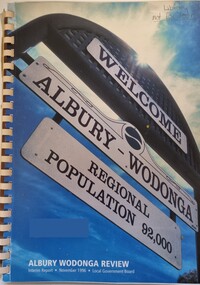
Book - Albury Wodonga Review - Interim Report, Local Govenment Board, 1996
... Albury Wodonga. Albury Wodonga development Albury Wodonga governance This book is the interim report for the review into the future development of the Albury Wodonga region. It was conducted by the Local Government Board and followed extensive investigation into cross border issues following the abolition of the Albury Wodonga Corporation, The overall recommendation was that Albury Wodonga's best interests would be served by a single-cross border municipality capable of governing the whole city on both sides of the Murray River. ...This book is the interim report for the review into the future development of the Albury Wodonga region. It was conducted by the Local Government Board and followed extensive investigation into cross border issues following the abolition of the Albury Wodonga Corporation, The overall recommendation was that Albury Wodonga's best interests would be served by a single-cross border municipality capable of governing the whole city on both sides of the Murray River.A spiral bound report of A4 size created by the Local Government Board. It features the Welcome ti Albury-Wodonga road sign showing a regional population of 92,000.non-fictionThis book is the interim report for the review into the future development of the Albury Wodonga region. It was conducted by the Local Government Board and followed extensive investigation into cross border issues following the abolition of the Albury Wodonga Corporation, The overall recommendation was that Albury Wodonga's best interests would be served by a single-cross border municipality capable of governing the whole city on both sides of the Murray River.albury wodonga development, albury wodonga governance -
 Wodonga & District Historical Society Inc
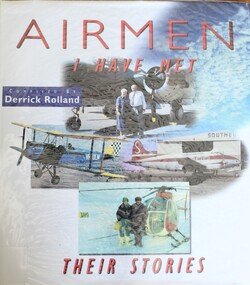
Book - Airmen I have Met - Their Stories, Derrick Rolland, 1999
... The land occupied by the Museum was compulsorily acquired by the Albury-Wodonga Development Corporation and Wangaratta council bought the aircraft collection for about $2 million. ...This book includes biographies of 16 different airmen with whom the compiler has come in contact. They have had their own uniques experiences in aviation. 12 of them served in the Royal Australian Air Force (RAAF). One of the aviators featured in this publication is Joe Drage, Born on 10 July 1931 in Walwa, Joseph Gordon (Joe) Drage operated a timber mill and earthmoving business, but his great passion was aviation. After obtaining his pilot’s licence at the age of 19, Mr. Drage set about buying vintage aircraft that he feared would be sold overseas. He bought his first aircraft, a Tiger Moth in 1965. In 1972 he established Drage Historical Aircraft Museum on about 60 ha of land in Wodonga, with 5 planes. Over time this grew to 21 planes which Joe maintained so that they were all in flying order. His museum was the location for several air shows which included fly-ins by members of the Antique Aeroplane Association. The land occupied by the Museum was compulsorily acquired by the Albury-Wodonga Development Corporation and Wangaratta council bought the aircraft collection for about $2 million. They opened Drage Airworld in 1984. The cost of maintaining the collection became too much for the council which closed it down in 2002. Joe Drage died on 9 August 2017.This publication has a hard cover with a dust jacket. It consists of 191 pages, including 85 black and white and 12 coloured images.This book includes biographies of 16 different airmen with whom the compiler has come in contact. They have had their own uniques experiences in aviation. 12 of them served in the Royal Australian Air Force (RAAF). One of the aviators featured in this publication is Joe Drage, Born on 10 July 1931 in Walwa, Joseph Gordon (Joe) Drage operated a timber mill and earthmoving business, but his great passion was aviation. After obtaining his pilot’s licence at the age of 19, Mr. Drage set about buying vintage aircraft that he feared would be sold overseas. He bought his first aircraft, a Tiger Moth in 1965. In 1972 he established Drage Historical Aircraft Museum on about 60 ha of land in Wodonga, with 5 planes. Over time this grew to 21 planes which Joe maintained so that they were all in flying order. His museum was the location for several air shows which included fly-ins by members of the Antique Aeroplane Association. The land occupied by the Museum was compulsorily acquired by the Albury-Wodonga Development Corporation and Wangaratta council bought the aircraft collection for about $2 million. They opened Drage Airworld in 1984. The cost of maintaining the collection became too much for the council which closed it down in 2002. Joe Drage died on 9 August 2017.air pilots australia, aviation history, joe drage, joe drage airworld -
 Wodonga & District Historical Society Inc
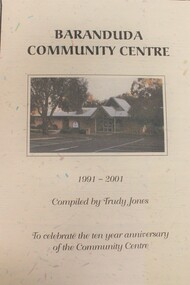
Booklet - Baranduda Community Centre 1991 - 2001, Trudy Jones
... Baranduda Communiity Centre Baranduda Baranduda is a rural area and, since the 1970s, a rural and residential locality formed under the authority of the Albury Wodonga Development Corporation. It is near the junction of Yackandandah Road and the Kiewa Valley Highway, 10 km south-east of Wodonga. ...Baranduda is a rural area and, since the 1970s, a rural and residential locality formed under the authority of the Albury Wodonga Development Corporation. It is near the junction of Yackandandah Road and the Kiewa Valley Highway, 10 km south-east of Wodonga. This publication was compiled to celebrate the first 10 years of the Baranduda Community Centre. It documents the Centre's origins and anecdotes about its establishment and key personalities involved. Today it provides a variety of educational, recreational, leisure, cultural, social and community support programs including children's services, maternal and child health and immunisation clinics.non-fictionBaranduda is a rural area and, since the 1970s, a rural and residential locality formed under the authority of the Albury Wodonga Development Corporation. It is near the junction of Yackandandah Road and the Kiewa Valley Highway, 10 km south-east of Wodonga. This publication was compiled to celebrate the first 10 years of the Baranduda Community Centre. It documents the Centre's origins and anecdotes about its establishment and key personalities involved. Today it provides a variety of educational, recreational, leisure, cultural, social and community support programs including children's services, maternal and child health and immunisation clinics.baranduda communiity centre, baranduda -
 Wodonga & District Historical Society Inc
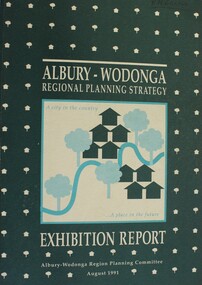
Book - Albury-Wodonga Regional Planning Strategy - Exhibition Report, Albury-Wodonga Planning Committee, August 1991
... City planning Wodonga City Planning Albury regional planning This report outlining the Albury-Wodonga Regional Planning Strategy was prepared as a component of a Ministerial Review of the ALbury-Wodonga Development Corporation. ...This report outlining the Albury-Wodonga Regional Planning Strategy was prepared as a component of a Ministerial Review of the ALbury-Wodonga Development Corporation. The Planning Committee included representatives of the N.S.W. and Victorian Planning Departments, the Albury-Wodonga Planning Corporation. the City of Albury, Rural City of Wodonga and Hume Shire Council and a representative of the four Victorian rural Councils of Beechworth, Chiltern, Tallangatta and Yackandandah.non-fictionThis report outlining the Albury-Wodonga Regional Planning Strategy was prepared as a component of a Ministerial Review of the ALbury-Wodonga Development Corporation. The Planning Committee included representatives of the N.S.W. and Victorian Planning Departments, the Albury-Wodonga Planning Corporation. the City of Albury, Rural City of Wodonga and Hume Shire Council and a representative of the four Victorian rural Councils of Beechworth, Chiltern, Tallangatta and Yackandandah.city planning wodonga, city planning albury, regional planning -
 Wodonga & District Historical Society Inc
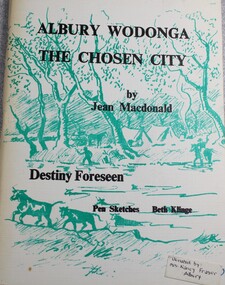
Book - Albury Wodonga - The Chosen City: Destiny Foreseen, Jean Macdonald et al, 1981
... new south wales. albury-wodonga albury wodonga history albury wodonga to 1972 albury history wodonga history This is a sequel to Albury Wodonga The Chosen city: The first Ninety Years. It traces developments in the region up to the development of the Albury Wodonga Corporation in 1972. ...This is a sequel to Albury Wodonga The Chosen city: The first Ninety Years. It traces developments in the region up to the development of the Albury Wodonga Corporation in 1972.non-fictionThis is a sequel to Albury Wodonga The Chosen city: The first Ninety Years. It traces developments in the region up to the development of the Albury Wodonga Corporation in 1972.new south wales. albury-wodonga, albury wodonga history, albury wodonga to 1972, albury history, wodonga history -
 Wodonga & District Historical Society Inc
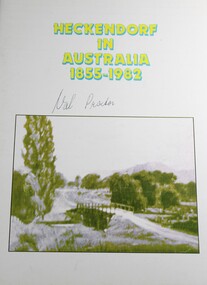
Book - Heckendorf in Australia 1855 - 1982
... In the 1970s the land was acquired by the Albury-Wodonga Development Corporation, which had the goal of developing Albury-Wodonga into a major inland city. ...A Genealogical study of the Families of Frederick Heckendorf and a Record of Their Descendants, 1808-1982, 127 Years in Australia. In 1855, Frederick and Julianna Heckendorf and their children departed Hamburg on the SS Steinwarder for a new life in Australia. In 1869, they moved to Wodonga and it wasn't long before they set up a dairy farm at Willow Park. One hundred years later, the farm was in the hands of Fredrick's great grandson Les Boyes. In the 1970s the land was acquired by the Albury-Wodonga Development Corporation, which had the goal of developing Albury-Wodonga into a major inland city.non-fictionA Genealogical study of the Families of Frederick Heckendorf and a Record of Their Descendants, 1808-1982, 127 Years in Australia. In 1855, Frederick and Julianna Heckendorf and their children departed Hamburg on the SS Steinwarder for a new life in Australia. In 1869, they moved to Wodonga and it wasn't long before they set up a dairy farm at Willow Park. One hundred years later, the farm was in the hands of Fredrick's great grandson Les Boyes. In the 1970s the land was acquired by the Albury-Wodonga Development Corporation, which had the goal of developing Albury-Wodonga into a major inland city.heckendorf family, wodonga pioneers, german migration to australia
