
Showing 51 items matching "alexander hall and son"
-
 Flagstaff Hill Maritime Museum and Village
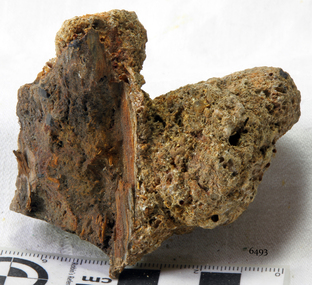
Wood sample, 1855
... ...alexander hall and son...She was owned by the Black Ball Line and launched in 1855. Alexander Hall & Son were renowned builders of sleek and fast 1,000 ton clippers for the China trade (opium in, tea out) and were keen to show they could also outclass the big North American ships built by Donald Mackay. ...Alexander Hall and Son...One end of the timber has been cut or sawn off across the grain, presenting a smooth and shiny surface. Wood sample Alexander Hall and Son ...The artefact is a piece of ship’s timber from the wreck-site of the SCHOMBERG, a vessel which collided with the Peterborough reef on her maiden voyage in December 1855. This small wooden remnant of the disaster has been concreted on one side by the accrual of marine sediment while submerged. The build-up of sediment over the remains of the vessel is typical of the site as a whole. This artefact illustrates the reclaiming power of the ocean and the gradual disappearance of timber constructed vessels that have come to grief along this coastline (for example, the THISTLE in 1837, and the CHILDREN in 1838). The SCHOMBERG was a 2,000 ton clipper ship, specifically designed for the Australian immigration trade (back-loading wool for Britain’s mills), and constructed in Hall’s shipyard in Aberdeen, Scotland. She was owned by the Black Ball Line and launched in 1855. Alexander Hall & Son were renowned builders of sleek and fast 1,000 ton clippers for the China trade (opium in, tea out) and were keen to show they could also outclass the big North American ships built by Donald Mackay. Consequently the SCHOMBERG was ‘overbuilt’. Her hull featured five ‘skins’ of Scotch Larch and Pitch Pine overlaying each other in a diagonal pattern against a stout frame of British Oak. Oak has been favoured by builders of wooden ships for centuries. Its close, dense grain made it harder to work, but also gave it great strength and durability. In addition, the lateral spread of its branches supplied a natural curvature for the ribs of a vessel’s hull, as well as providing the small corner or curved pieces (‘knees’ and ‘elbows’) that fit them together. The shape and texture of this wood sample suggests a dense hardwood like Oak. The timber has been cut off at one end since its recovery from the sea, exposing a smooth and almost shiny surface. Seasoned English Oak has a similar light brown colour and tight grained finish. At the launch the SCHOMBERG’s 34 year old master, Captain ‘Bully’ Forbes, had promised Melbourne in 60 days, "with or without the help of God." James Nicol Forbes was born in Aberdeen in 1821 and rose to fame with his record-breaking voyages on the famous Black Ball Line ships; MARCO POLO and LIGHTNING. In 1852 in the MARCO POLO he made the record passage from London to Melbourne in 68 days. There were 53 deaths on the voyage but the great news was of the record passage by the master. In 1954 Captain Forbes took the clipper LIGHTNING to Melbourne in 76 days and back in 63 days, this was never beaten by a sailing ship. He often drove his crew and ship to breaking point to beat his own records. He cared little for the comfort of the passengers. On this, the SCHOMBERG’s maiden voyage, he was going to break records. SCHOMBERG departed Liverpool on her maiden voyage on 6 October 1855 flying the sign “Sixty Days to Melbourne”. She departed with 430 passengers and 3000 tons cargo including iron rails and equipment intended to build the Melbourne to Geelong Railway and a bridge over the Yarra from Melbourne to Hawthorn. She also carried a cow for fresh milk, pens for fowls and pigs, 90,000 gallons of water for washing and drinking. It also carried 17,000 letters and 31,800 newspapers. The ship and cargo was insured for $300,000, a fortune for the time. The winds were poor as she sailed across the equator, slowing SCHOMBERG’s journey considerably. Land was first sighted on Christmas Day, at Cape Bridgewater near Portland, and Captain Forbes followed the coastline towards Melbourne. Forbes was said to be playing cards when called by the Third Mate Henry Keen, who reported land about 3 miles off, Due in large part to the captain's regarding a card game as more important than his ship, it eventually ran aground on a sand spit near Curdie's Inlet (about 56 km west of Cape Otway) on 26 December 1855, 78 days after leaving Liverpool. The sand spit and the currents were not marked on Forbes’s map. Overnight, the crew launched a lifeboat to find a safe place to land the ship’s passengers. The scouting party returned to SCHOMBERG and advised Forbes that it was best to wait until morning because the rough seas could easily overturn the small lifeboats. The ship’s Chief Officer spotted SS QUEEN at dawn and signalled the steamer. The master of the SS QUEEN approached the stranded vessel and all of SCHOMBERG’s passengers and crew were able to disembark safely. The SCHOMBERG was lost and with her, Forbes’ reputation. The Black Ball Line’s Melbourne agent sent a steamer to retrieve the passengers’ baggage from the SCHOMBERG. Other steamers helped unload her cargo until the weather changed and prevented the salvage teams from accessing the ship. Later one plunderer found a case of Wellington boots, but alas, all were for the left foot! Local merchants Manifold & Bostock bought the wreck and cargo, but did not attempt to salvage the cargo still on board the ship. They eventually sold it on to a Melbourne businessman and two seafarers. In 1864 after two of the men drowned when they tried to reach SCHOMBERG, salvage efforts were abandoned. Parts of the SCHOMBERG were washed ashore on the south island of New Zealand in 1870, nearly 15 years after the wreck. The wreck now lies in almost 9 metres of water. Although the woodwork is mostly disintegrated the shape of the ship can still be seen due to the remaining railway irons, girders and the ship’s frame. A variety of goods and materials can be seen scattered about nearby. Flagstaff Hill holds many items salvaged from the SCHOMBERG including a ciborium (in which a diamond ring was concealed), communion set, ship fittings and equipment, personal effects, a lithograph, tickets and photograph from the SCHOMBERG. One of the SCHOMBERG bells is in the Warrnambool Library. The SCHOMBERG collection as a whole is of historical and archaeological significance at a State level, listed on the Victorian Heritage Register VHR S612. Flagstaff Hill’s collection of artefacts from the SCHOMBERG is significant for its association with the Victorian Heritage Registered shipwreck. The collection is primarily significant because of the relationship between the objects, as together they have a high potential to interpret the story of the SCHOMBERG. The SCHOMBERG collection is archaeologically significant as the remains of an international passenger ship. The shipwreck collection is historically significant for representing aspects of Victoria’s shipping history and its potential to interpret sub-theme 1.5 of Victoria’s Framework of Historical Themes (living with natural processes). The collection is also historically significant for its association with the shipwreck and the ship, which was designed to be fastest and most luxurious of its day. The SCHOMBERG collection meets the following criteria for assessment: Criterion A: Importance to the course, or pattern, of Victoria’s cultural history. Criterion B: Possession of uncommon, rare or endangered aspects of Victoria’s cultural history. Criterion C: Potential to yield information that will contribute to an understanding of Victoria’s cultural history. A piece of wood, concreted in sediment, from the wreck of the SCHOMBERG (1855). The limestone accretion includes sand, shell grit and marine worm casings. The exposed surface of the wood is broken and worn smooth along the grain. One end of the timber has been cut or sawn off across the grain, presenting a smooth and shiny surface.flagstaff hill, warrnambool, shipwrecked-coast, flagstaff-hill, flagstaff-hill-maritime-museum, maritime-museum, shipwreck-coast, flagstaff-hill-maritime-village, wood segment, schomberg, shipwreck timber, alexander hall and son, limestone concretion, oak-framed hull -
 Flagstaff Hill Maritime Museum and Village
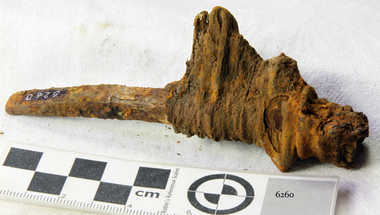
Nail, 1855
... She was owned by the Black Ball Line and launched in 1855. Alexander Hall & Son were renowned builders of sleek and fast 1,000 ton clippers for the China trade (opium in, tea out) and were keen to show they could also outclass the big North American ships built by Donald Mackay. ...Alexander Hall and Son...The artefact is from the wreck of the SCHOMBERG (1855) and was retrieved from part of the ship’s bow which was carried by sea currents to the South Island of New Zealand. Nail Alexander Hall and Son ...The artefact is the lower portion of a rectangular shanked ‘planking nail’ with a straight-edged ‘flat point’. The distinctive ‘point’ of a planking/skirting nail was designed to be driven into timber across the grain in order to prevent the wood from splitting. This relic is from the shipwreck of the SCHOMBERG, which ran aground near Peterborough in 1855. It was retrieved in 1875 from a large section of the ship’s bow which had been carried by ocean currents to the western coast of New Zealand’s South Island. The nail is still fixed in a fragment of the original timber that it secured in the SCHOMBERG. The top portion, or ‘head’ of the nail, has corroded away but the pronounced rectangular shank and its flat point indicate its likely purpose and position on the vessel. Most fastenings used in sailing ship construction were either wooden treenails or copper bolts, which were relatively resistant to seawater corrosion. In addition, the preferred hull-frame timber of British Oak has a high content of gallic acid which rapidly corrodes unprotected iron work. The ferrous composition of this planking nail suggests it came from an internal and upper portion of the ship’s bow (protected from exposure to the sea or oak). According to an 1855 edition of the Aberdeen Journal, the five outer layers, or ‘skins’, of the SCHOMBERG’s pine hull were “combined by means of patent screw treenails”. However the “beams of her two upper decks” were of “malleable iron”, and “part of the forecastle” was “fitted for the accommodation of the crew”. It is therefore possible that iron nails of this description were used by the ship’s builders to secure floor and wall planks in enclosed areas of the crew’s quarters. (The same reasoning would apply to officer and passenger accommodation amidships and at the stern of the vessel, but it was the bow that floated to New.Zealand.) The SCHOMBERG was a 2,000 ton clipper ship, specifically designed for the Australian immigration trade (back-loading wool for Britain’s mills), and constructed in Hall’s shipyard in Aberdeen, Scotland. She was owned by the Black Ball Line and launched in 1855. Alexander Hall & Son were renowned builders of sleek and fast 1,000 ton clippers for the China trade (opium in, tea out) and were keen to show they could also outclass the big North American ships built by Donald Mackay. Consequently the SCHOMBERG was ‘overbuilt’. Her hull featured five ‘skins’ of Scotch Larch and Pitch Pine overlaying each other in a diagonal pattern against a stout frame of British Oak. Oak has been favoured by builders of wooden ships for centuries. Its close, dense grain made it harder to work, but also gave it great strength and durability. In addition, the lateral spread of its branches supplied a natural curvature for the ribs of a vessel’s hull, as well as providing the small corner or curved pieces (‘knees’ and ‘elbows’) that fit them together. At the launch the SCHOMBERG’s 34 year old master, Captain ‘Bully’ Forbes, had promised Melbourne in 60 days, "with or without the help of God." James Nicol Forbes was born in Aberdeen in 1821 and rose to fame with his record-breaking voyages on the famous Black Ball Line ships; MARCO POLO and LIGHTNING. In 1852 in the MARCO POLO he made the record passage from London to Melbourne in 68 days. There were 53 deaths on the voyage but the great news was of the record passage by the master. In 1954 Captain Forbes took the clipper LIGHTNING to Melbourne in 76 days and back in 63 days, this was never beaten by a sailing ship. He often drove his crew and ship to breaking point to beat his own records. He cared little for the comfort of the passengers. On this, the SCHOMBERG’s maiden voyage, he was going to break records. SCHOMBERG departed Liverpool on her maiden voyage on 6 October 1855 flying the sign “Sixty Days to Melbourne”. She departed with 430 passengers and 3000 tons cargo including iron rails and equipment intended to build the Melbourne to Geelong Railway and a bridge over the Yarra from Melbourne to Hawthorn. She also carried a cow for fresh milk, pens for fowls and pigs, 90,000 gallons of water for washing and drinking. It also carried 17,000 letters and 31,800 newspapers. The ship and cargo was insured for $300,000, a fortune for the time. The winds were poor as she sailed across the equator, slowing SCHOMBERG’s journey considerably. Land was first sighted on Christmas Day, at Cape Bridgewater near Portland, and Captain Forbes followed the coastline towards Melbourne. Forbes was said to be playing cards when called by the Third Mate Henry Keen, who reported land about 3 miles off, Due in large part to the captain's regarding a card game as more important than his ship, it eventually ran aground on a sand spit near Curdie's Inlet (about 56 km west of Cape Otway) on 26 December 1855, 78 days after leaving Liverpool. The sand spit and the currents were not marked on Forbes’s map. Overnight, the crew launched a lifeboat to find a safe place to land the ship’s passengers. The scouting party returned to SCHOMBERG and advised Forbes that it was best to wait until morning because the rough seas could easily overturn the small lifeboats. The ship’s Chief Officer spotted SS QUEEN at dawn and signalled the steamer. The master of the SS QUEEN approached the stranded vessel and all of SCHOMBERG’s passengers and crew were able to disembark safely. The SCHOMBERG was lost and with her, Forbes’ reputation. The Black Ball Line’s Melbourne agent sent a steamer to retrieve the passengers’ baggage from the SCHOMBERG. Other steamers helped unload her cargo until the weather changed and prevented the salvage teams from accessing the ship. Later one plunderer found a case of Wellington boots, but alas, all were for the left foot! Local merchants Manifold & Bostock bought the wreck and cargo, but did not attempt to salvage the cargo still on board the ship. They eventually sold it on to a Melbourne businessman and two seafarers. In 1864 after two of the men drowned when they tried to reach SCHOMBERG, salvage efforts were abandoned. Parts of the SCHOMBERG were washed ashore on the south island of New Zealand in 1870, nearly 15 years after the wreck. The wreck now lies in almost 9 metres of water. Although the woodwork is mostly disintegrated the shape of the ship can still be seen due to the remaining railway irons, girders and the ship’s frame. A variety of goods and materials can be seen scattered about nearby. Flagstaff Hill holds many items salvaged from the SCHOMBERG including a ciborium (in which a diamond ring was concealed), communion set, ship fittings and equipment, personal effects, a lithograph, tickets and photograph from the SCHOMBERG. One of the SCHOMBERG bells is in the Warrnambool Library. This nail is a registered artefact from the wreck of the SCHOMBERG, Artefact Reg No S/35 and is significant because of its association with the SCHOMBERG. The SCHOMBERG collection as a whole is of historical and archaeological significance at a State level, listed on the Victorian Heritage Register VHR S612. Flagstaff Hill’s collection of artefacts from the SCHOMBERG is significant for its association with the Victorian Heritage Registered shipwreck. The collection is primarily significant because of the relationship between the objects, as together they have a high potential to interpret the story of the SCHOMBERG. The SCHOMBERG collection is archaeologically significant as the remains of an international passenger ship. The shipwreck collection is historically significant for representing aspects of Victoria’s shipping history and its potential to interpret sub-theme 1.5 of Victoria’s Framework of Historical Themes (living with natural processes). The collection is also historically significant for its association with the shipwreck and the ship, which was designed to be fastest and most luxurious of its day. The SCHOMBERG collection meets the following criteria for assessment: Criterion A: Importance to the course, or pattern, of Victoria’s cultural history. Criterion B: Possession of uncommon, rare or endangered aspects of Victoria’s cultural history. Criterion C: Potential to yield information that will contribute to an understanding of Victoria’s cultural history. The object is the bottom end of a slightly curved iron planking nail with remnant of timber still attached, recovered from the wreck of the SCHOMBERG (1855). The shank of the nail is rectangular and it narrows to a flat (chisel like) ‘point’. The ‘head’ is missing although there is a quantity of dark red corrosion within the top of the surrounding wood, suggesting where it might have been. The artefact is from the wreck of the SCHOMBERG (1855) and was retrieved from part of the ship’s bow which was carried by sea currents to the South Island of New Zealand. flagstaff hill, warrnambool, shipwrecked-coast, flagstaff-hill-maritime-museum, maritime-museum, shipwreck-coast, flagstaff-hill-maritime-village, schomberg, planking nail, rectangular ship’s nail, cast iron nail -
 Flagstaff Hill Maritime Museum and Village
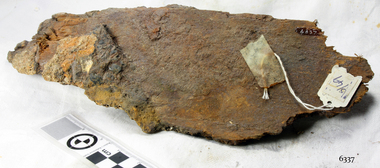
Wood encrustation, 1855
... ...alexander hall and son...She was owned by the Black Ball Line and launched in 1855. Alexander Hall & Son were renowned builders of sleek and fast 1,000 ton clippers for the China trade (opium in, tea out) and were keen to show they could also outclass the big North American ships built by Donald Mackay. ...Alexander Hall and Son...Wood encrustation Alexander Hall and Son ...The object is a mass of small shipwreck debris that has been concreted together by sediment and marine growth. It was retrieved from the wreck-site of the SCHOMBERG, which ran aground near the mouth of the Curdies River near Peterborough in 1855. The conglomerate of preserved wood impressions, rusted metal pieces, a small square of copper alloy, and black glass-like stones, presents too disjointed a collection to provide information on their purpose or function on the ship. The natural and gradual process of limestone accretion is a significant feature of the wreck-site, which was rediscovered by fishermen and skindivers in 1973. In his book “Exploring Shipwrecks of Western Victoria”, experienced diver and former director at Flagstaff Hill, Peter Ronald writes that the SCHOMBERG’s “triple layered wooden hull has disintegrated almost without trace…The turbulent shallow waters have promoted particularly heavy marine growth which tend to disguise the wreckage…the most prominent feature being a corroded mass of railway iron…Close inspection reveals small artefacts firmly embedded in the marine concretion which…is quite literally as hard as iron”. The huge oblong mass of concretion that now distinguishes the site covers the remains of this heavy cargo. A contemporary account of the SCHOMBERG’s fate (told by two of her passengers to the Melbourne Argus) alleges the ship “was overloaded, drawing over 25 feet when she left, and the cargo was chiefly iron and plant for the Geelong Railway”. The SCHOMBERG was a 2,000 ton clipper ship, specifically designed for the Australian immigration trade (back-loading wool for Britain’s mills), and constructed in Hall’s shipyard in Aberdeen, Scotland. She was owned by the Black Ball Line and launched in 1855. Alexander Hall & Son were renowned builders of sleek and fast 1,000 ton clippers for the China trade (opium in, tea out) and were keen to show they could also outclass the big North American ships built by Donald Mackay. Consequently the SCHOMBERG was ‘overbuilt’. Her hull featured five ‘skins’ of Scotch Larch and Pitch Pine overlaying each other in a diagonal pattern against a stout frame of British Oak. Oak has been favoured by builders of wooden ships for centuries. Its close, dense grain made it harder to work, but also gave it great strength and durability. In addition, the lateral spread of its branches supplied a natural curvature for the ribs of a vessel’s hull, as well as providing the small corner or curved pieces (‘knees’ and ‘elbows’) that fit them together. The shape and texture of this wood sample suggests a dense hardwood like Oak. The timber has been cut off at one end since its recovery from the sea, exposing a smooth and almost shiny surface. Seasoned English Oak has a similar light brown colour and tight grained finish. At the launch the SCHOMBERG’s 34 year old master, Captain ‘Bully’ Forbes, had promised Melbourne in 60 days, "with or without the help of God." James Nicol Forbes was born in Aberdeen in 1821 and rose to fame with his record-breaking voyages on the famous Black Ball Line ships; MARCO POLO and LIGHTNING. In 1852 in the MARCO POLO he made the record passage from London to Melbourne in 68 days. There were 53 deaths on the voyage but the great news was of the record passage by the master. In 1954 Captain Forbes took the clipper LIGHTNING to Melbourne in 76 days and back in 63 days, this was never beaten by a sailing ship. He often drove his crew and ship to breaking point to beat his own records. He cared little for the comfort of the passengers. On this, the SCHOMBERG’s maiden voyage, he was going to break records. SCHOMBERG departed Liverpool on her maiden voyage on 6 October 1855 flying the sign “Sixty Days to Melbourne”. She departed with 430 passengers and 3000 tons cargo including iron rails and equipment intended to build the Melbourne to Geelong Railway and a bridge over the Yarra from Melbourne to Hawthorn. She also carried a cow for fresh milk, pens for fowls and pigs, 90,000 gallons of water for washing and drinking. It also carried 17,000 letters and 31,800 newspapers. The ship and cargo was insured for $300,000, a fortune for the time. The winds were poor as she sailed across the equator, slowing SCHOMBERG’s journey considerably. Land was first sighted on Christmas Day, at Cape Bridgewater near Portland, and Captain Forbes followed the coastline towards Melbourne. Forbes was said to be playing cards when called by the Third Mate Henry Keen, who reported land about 3 miles off, Due in large part to the captain's regarding a card game as more important than his ship, it eventually ran aground on a sand spit near Curdie's Inlet (about 56 km west of Cape Otway) on 26 December 1855, 78 days after leaving Liverpool. The sand spit and the currents were not marked on Forbes’s map. Overnight, the crew launched a lifeboat to find a safe place to land the ship’s passengers. The scouting party returned to SCHOMBERG and advised Forbes that it was best to wait until morning because the rough seas could easily overturn the small lifeboats. The ship’s Chief Officer spotted SS QUEEN at dawn and signalled the steamer. The master of the SS QUEEN approached the stranded vessel and all of SCHOMBERG’s passengers and crew were able to disembark safely. The SCHOMBERG was lost and with her, Forbes’ reputation. The Black Ball Line’s Melbourne agent sent a steamer to retrieve the passengers’ baggage from the SCHOMBERG. Other steamers helped unload her cargo until the weather changed and prevented the salvage teams from accessing the ship. Later one plunderer found a case of Wellington boots, but alas, all were for the left foot! Local merchants Manifold & Bostock bought the wreck and cargo, but did not attempt to salvage the cargo still on board the ship. They eventually sold it on to a Melbourne businessman and two seafarers. In 1864 after two of the men drowned when they tried to reach SCHOMBERG, salvage efforts were abandoned. Parts of the SCHOMBERG were washed ashore on the south island of New Zealand in 1870, nearly 15 years after the wreck. The wreck now lies in almost 9 metres of water. Although the woodwork is mostly disintegrated the shape of the ship can still be seen due to the remaining railway irons, girders and the ship’s frame. A variety of goods and materials can be seen scattered about nearby. Flagstaff Hill holds many items salvaged from the SCHOMBERG including a ciborium (in which a diamond ring was concealed), communion set, ship fittings and equipment, personal effects, a lithograph, tickets and photograph from the SCHOMBERG. One of the SCHOMBERG bells is in the Warrnambool Library. This object is listed on the Shipwreck Artefact Register, No S/49, and is significant because of its association with the ship SCHOMBERG. The SCHOMBERG collection as a whole is of historical and archaeological significance at a State level, listed on the Victorian Heritage Register VHR S612. Flagstaff Hill’s collection of artefacts from the SCHOMBERG is significant for its association with the Victorian Heritage Registered shipwreck. The collection is primarily significant because of the relationship between the objects, as together they have a high potential to interpret the story of the SCHOMBERG. The SCHOMBERG collection is archaeologically significant as the remains of an international passenger ship. The shipwreck collection is historically significant for representing aspects of Victoria’s shipping history and its potential to interpret sub-theme 1.5 of Victoria’s Framework of Historical Themes (living with natural processes). The collection is also historically significant for its association with the shipwreck and the ship, which was designed to be fastest and most luxurious of its day. The SCHOMBERG collection meets the following criteria for assessment: Criterion A: Importance to the course, or pattern, of Victoria’s cultural history. Criterion B: Possession of uncommon, rare or endangered aspects of Victoria’s cultural history. Criterion C: Potential to yield information that will contribute to an understanding of Victoria’s cultural history. The object is an aggregate of limestone sediment that formed at the wreck-site of the SCHOMBERG (1855). It is an irregularly shaped conglomerate of sand, shell-grit and marine worm casings from the ocean floor, but also incorporates an assortment of manufactured metal pieces and pipe fittings (corroded with red rust), a small rectangular piece of copper sheet, some ‘petrified’ wood remains (hardened and a soft brown colour), and pieces of black shiny stone (roughly cube shaped and possibly glass or porcelain remnants). There is an impression left in the stone of a joist or plank end but the original timber that the sediment formed around has since been dispersed by the sea.flagstaff hill, warrnambool, shipwrecked-coast, flagstaff-hill, flagstaff-hill-maritime-museum, maritime-museum, shipwreck-coast, flagstaff-hill-maritime-village, schomberg, shipwreck timber, alexander hall and son, shipwreck debris, black ball line, 1855 shipwreck, aberdeen clipper ship, captain forbes, peterborough shipwreck, ss queen -
 Flagstaff Hill Maritime Museum and Village
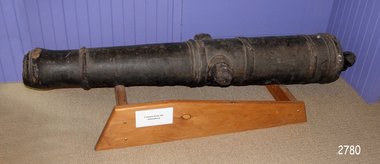
Weapon - Cannon, Alexander Hall and Son, c. 1855
... Alexander Hall and Son...Weapon Cannon Alexander Hall and Son ...The Schomberg Cannon was recovered from the 1855 wreck of the SCHOMBERG in 1974 by Flagstaff Hill divers Peter Ronald, Colin Goodall and Gary Hayden. The wreck site was discovered in August 1973 by Stan McPhee and John Laidlaw. ABOUT THE SCHOMBERG When SCHOMBERG was launched in 1855, she was considered the “Noblest ship that ever floated on water.” SCHOMBERG’s owners, the Black Ball Line, commissioned the ship for their fleet of passenger liners. The ship was built by Alexander Hall of Aberdeen at a cost of £43,103. It was constructed with three skins: one planked fore and aft and two diagonally planked, fastened together with screw-threaded trunnels (wooden rails). Its first-class accommodation was simply luxurious; velvet pile carpets, large mirrors, rosewood, birds-eye maple, mahogany, soft furnishings of satin damask; an oak-lined library and a piano. Overall she had accommodation for 1000 passengers. At the launch, the SCHOMBERG’s 34-year-old master, Captain ‘Bully’ Forbes, had promised Melbourne in 60 days, "with or without the help of God." James Nicol Forbes was born in Aberdeen in 1821 and rose to fame with his record-breaking voyages on the famous Black Ball Line ships; MARCO POLO and LIGHTNING. In 1852 in the MARCO POLO he made the record passage from London to Melbourne in 68 days. There were 53 deaths on the voyage but the great news was of the record passage by the master. In 1954 Captain Forbes took the clipper LIGHTNING to Melbourne in 76 days and back in 63 days, this was never beaten by a sailing ship. He often drove his crew and ship to breaking point to beat his own records. He cared little for the comfort of the passengers. On this, the SCHOMBERG’s maiden voyage, he was going to break records. SCHOMBERG departed Liverpool on her maiden voyage on 6 October 1855 flying the sign “Sixty Days to Melbourne”. The ship departed with 430 passengers and 3000 tons of cargo including iron rails and equipment intended to build the Melbourne to Geelong Railway and a bridge over the Yarra from Melbourne to Hawthorn. She also carried a cow for fresh milk, pens for fowls and pigs, and 90,000 gallons of water for washing and drinking. It also carried 17,000 letters and 31,800 newspapers. The ship and the cargo was insured for $300,000, a fortune in those times. The winds were poor as she sailed across the equator, slowing SCHOMBERG’s journey considerably. Land was first sighted on Christmas Day, at Cape Bridgewater near Portland, and Captain Forbes followed the coastline towards Melbourne. Forbes was said to be playing cards when called by the Third Mate Henry Keen, who reported land about 3 miles off, Due in large part to the captain's regarding a card game as more important than his ship, it eventually ran aground on a sand spit near Curdie's Inlet (about 56 km west of Cape Otway) on 26 December 1855, 78 days after leaving Liverpool. The sand spit and the currents were not marked on Forbes’s map. Overnight, the crew launched a lifeboat to find a safe place to land the ship’s passengers. The scouting party returned to SCHOMBERG and advised Forbes that it was best to wait until morning because the rough seas could easily overturn the small lifeboats. The ship’s Chief Officer spotted SS QUEEN at dawn and signalled the steamer. The master of the SS QUEEN approached the stranded vessel and all of SCHOMBERG’s passengers and crew were able to disembark safely. The SCHOMBERG was lost and with her, Forbes’ reputation. The Black Ball Line’s Melbourne agent sent a steamer to retrieve the passengers’ baggage from the SCHOMBERG. Other steamers helped unload her cargo until the weather changed and prevented the salvage teams from accessing the ship. Later one plunderer found a case of Wellington boots, but alas, all were for the left foot! Local merchants Manifold & Bostock bought the wreck and cargo, but did not attempt to salvage the cargo still on board the ship. They eventually sold it on to a Melbourne businessman and two seafarers. In 1864 after two of the men drowned when they tried to reach SCHOMBERG, salvage efforts were abandoned. Parts of the SCHOMBERG were washed ashore on the south island of New Zealand in 1870, nearly 15 years after the wreck. The wreck now lies in almost 9 metres of water. Although the woodwork is mostly disintegrated the shape of the ship can still be seen due to the remaining railway irons, girders and the ship’s frame. A variety of goods and materials can be seen scattered about nearby. Flagstaff Hill holds many items salvaged from the SCHOMBERG including a ciborium (in which a diamond ring was concealed), communion set, ship fittings and equipment, personal effects, a lithograph, tickets and a photograph from the SCHOMBERG. One of the SCHOMBERG bells was in the old Warrnambool Library. The Schomberg cannon is currently on loan to the Port Campbell Visitor Information Centre.The SCHOMBERG collection is of historical and archaeological significance at a State level, listed on the Victorian Heritage Register VHR S612. Flagstaff Hill’s collection of artefacts from the SCHOMBERG is significant for its association with the Victorian Heritage Registered shipwreck. The collection is primarily significant because of the relationship between the objects, as together they have a high potential to interpret the story of the SCHOMBERG. The SCHOMBERG collection is archaeologically significant as the remains of an international passenger ship. The shipwreck collection is historically significant for representing aspects of Victoria’s shipping history and its potential to interpret sub-theme 1.5 of Victoria’s Framework of Historical Themes (living with natural processes). The collection is also historically significant for its association with the shipwreck and the ship, which was designed to be the fastest and most luxurious of its day. The SCHOMBERG collection meets the following criteria for assessment: Criterion A: Importance to the course, or pattern, of Victoria’s cultural history. Criterion B: Possession of uncommon, rare or endangered aspects of Victoria’s cultural history. Criterion C: Potential to yield information that will contribute to an understanding of Victoria’s cultural history.Cannon; 6-POUNDER (6pdr) smooth bore cannon, mounted on a wooden frame. The cannon has a metal lug on each side. It is commonly known as the Schomberg cannon. It was recovered from the wreck of the Schomberg in 1974.warrnambool, flagstaff-hill, flagstaff-hill-maritime-museum, maritime-museum, shipwreck-coast, flagstaff-hill-maritime-village, schomberg, shipwrecked-artefact, clipper ship, black ball line, 1855 shipwreck, aberdeen clipper ship, captain forbes, peterborough shipwreck, ss queen, cannon, the schomberg cannon, schomberg cannon, peterborough, 1855, sailing ship -
 Flagstaff Hill Maritime Museum and Village
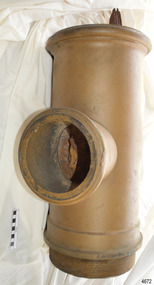
Equipment - Bilge Pump Barrel, Alexander Hall and Son, 1855
... Alexander Hall and Son...Equipment Bilge Pump Barrel Alexander Hall and Son ...This bilge pump barrel is part of the ship's bilge pump machinery. Bilge or water can find its way into the hull of a ship and if it is not removed the ship will eventually sink. The bilge pump is designed to efficiently remove the bilge water. The Schomberg was a large three-masted full-ship rigged wooden ship built in 1855 by Alexander Hall and Co in Aberdeen, Scotland for James Baines' famous Black Ball Line at £43,103. The vessel was 288 feet (88 meters) in length, with a beam of 45 feet (14 meters), a depth of 29.5 feet (8.99 meters) of 2,284 tons. The mainmast was 210 feet (64 meters) high and she carried 3.3 acres of sail. The vessel was constructed with three skins. One planked fore and aft, and two diagonally planked, fastened together with screw-threaded trunnels (wooden rails). The Schomberg is one of only three clipper wrecks in Victorian waters that operated the England to Australia run. While the other two, Empress of the Sea and Lightning, were built by the famous American shipbuilder, Donald Mac Kay. Schomberg was an attempt to build a faster ship than Mac Kay and a vessel fast enough to break the sailing record to Australia. The Schomberg sailed on her maiden voyage from Liverpool on 6 October 1855, under the command of Captain James Forbes, on its maiden voyage to Australia with general cargo, jewellery, spirits, machinery, and 2,000 tons of iron rails and equipment intended to build the Melbourne to Geelong Railway and a bridge over the Yarra from Melbourne to Hawthorn. She also carried a cow for fresh milk, pens for fowls and pigs, plus 90,000 gallons of water for washing and drinking. She also carried 17,000 letters and 31,800 newspapers. There were approximately 473 passengers and a crew of 105. It was hoped that Schomberg would make Melbourne in sixty days, setting a record for the voyage, but light winds at the equator dashed those expectations. The ship sighted Moonlight Head in southwest Victoria on Christmas Day but through a deadly combination of wind, currents and unmarked sand spits, the vessel gently ran aground on 26 December 1855 on a spit that juts into Newfield Bay, just east of Curdies Inlet, and the present town of Peterborough. Fortunately, the SS Queen was nearby and managed to save all passengers and crew. The steamers Keera and Maitland were dispatched to salvage the passenger's baggage and the more valuable cargo. Other salvage attempts were made, but deteriorating weather made the work impossible, and within two weeks the Schomberg's hull was broken up and the vessel abandoned. The wrecking of the Schomberg caused quite a public stir, particularly in light of the fact the vessel was supposed to be, the most perfect clipper ship ever built. Captain Forbes was charged in the Supreme Court under suspicion that he was playing cards with two female passengers below decks when his ship ran aground. Despite a protest meeting, two inquiries and the court proceedings, he was found not guilty and cleared of all charges. In 1975, divers from Flagstaff Hill, including Peter Ronald, found an ornate communion set at the wreck. The set comprised a jug, two chalices, a plate and a lid. The lid did not fit any of the other objects and in 1978 a piece of the lid broke off, revealing a glint of gold. As museum staff carefully examined the lid and removed marine growth, they found a diamond ring, which is currently on display in the Great Circle Gallery at the Flagstaff Hill Maritime museum that also displays ship fittings and equipment, and personal effects. The Schomberg has historical significance as one of the first luxurious ships built to bring emigrants to Australia to cash in on the gold rush era. And is included on the Victorian Heritage Register (VHR S612). The collection of Schomberg artefacts held at Flagstaff Hill Museum is primarily significant because of the relationship between these recovered items having a high potential to interpret the story of the Schomberg and its foundering during a storm. The shipwreck is of additional historically significance for representing aspects of Victoria’s shipping history and for its association with the first passenger ship, which was designed not only to be the fastest and most luxurious of its day but foundered on its maiden voyage to Australia.Bilge pump barrel,; brass cylinder with screw thread at the base and fittings on one side. A piece of the ship's timber is attached. The object was recovered from the wreck of the shipo Schomberg. Nonewarrnambool, flagstaff-hill, flagstaff-hill-maritime-museum, shipwreck-coast, flagstaff-hill-maritime-village, schomberg, shipwrecked-artefact, clipper ship, black ball line, 1855 shipwreck, aberdeen clipper ship, captain forbes, peterborough shipwreck, ss queen, bilge pump, ship's plumbing, bilge pump barrel, bilge -
 Flagstaff Hill Maritime Museum and Village
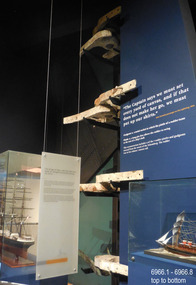
Equipment - Rudder Pintles and Gudgeons, Alexander Hall and Son, ca. 1855
... Alexander Hall and Son...Equipment Rudder Pintles and Gudgeons Alexander Hall and Son ...This set of pairs of pintles and gudgeons was recovered from the wreck of the sailing ship Schomberg and was part of its rudder steering system. A reconstruction that includes four pairs is currently on display at Flagstaff Hill. The rudder installation of the Schomberg was almost seven metres tall. A pintle and gudgeon pair is a mechanical fitting that works like a pair of door hinges. One of the uses for this type of fitting is for ships’ rudders. On a ship, one or several gudgeons would be attached to the vertical rudder stempost on the rear of the ship’s hull. On the ship's rudder, an equal number of pintles would be fitted onto it. The rudder assembly would then fit down into the gudgeons on the ship and would be connected to its steering mechanism, allowing it to be moved from side to side and steer the vessel. The SCHOMBERG- The three-masted clipper ship Schomberg was built in 1855 by Alexander Hall and Co in Aberdeen, Scotland, for James Baines' famous Black Ball line. It measured 288 feet (88 meters) in length, with a beam of 45 feet (14 meters), a depth of 29.5 feet (8.99 meters) and 2,284 tons. The mainmast was 210 feet (64 meters) high and the ship carried 3.3 acres of sail. The wooden vessel was constructed with three skins; one planked fore and aft, and two diagonally planked. All skins were fastened together with screw-threaded trunnels (wooden rails). The Schomberg was one of only three clippers wrecked in Victorian waters that operated the England-to-Australia run. It was built to outrun Donald MacKay’s two American-built ships, the Empress of the Sea and the Lightning. It was hoped that Schomberg would make Liverpool to Melbourne voyage in sixty days, setting a record for the voyage. The Schomberg sailed from Liverpool on 6 October 1855 on her maiden voyage, under the command of Captain James Forbes. Her general cargo for Australia included jewellery, spirits, machinery, and 2,000 tons of iron rails and equipment for building the Melbourne to Geelong Railway and a bridge over the Yarra from Melbourne to Hawthorn, and17,000 letters and 31,800 newspapers. She also carried a cow for fresh milk, pens for fowls and pigs, plus 90,000 gallons of water for washing and drinking on board. There were approximately 473 passengers, including migrants for Australia, and a crew of 105. Light winds encountered at the equator dashed the expectations of a record-breaking voyage. On Christmas day the ship sighted Moonlight Head in southwest Victoria and even though there was a deadly combination of wind, currents and unmarked sand spits, the vessel continued on. Then the next day, December 26th 1855, the huge ship gently ran aground on a spit that juts into Newfield Bay, east of Curdies Inlet and the present town of Peterborough. Fortunately, the coastal trader, SS Queen, was nearby and managed to save all passengers and crew. In 1975 Flagstaff Hill’s former Director Peter Ronald and the team of divers recovered many objects and artefacts from the wreck of the Schomberg such as the ship’s fittings, equipment and personal effects including a diamond hidden for years in a communion set. This set of pintles and gudgeons is an example of steering equipment used on ships over 150 years ago, equipment that is still in use in today's shipping industry as well as many other everyday hardware applications.. The equipment is significant for its association with the ill-fated vessel Schomberg, which was wrecked in the local water in 1855 on its maiden voyage. The ship was built for speed and luxury, to sail on journeys with passengers, including migrants, travelling from Liverpool to Melbourne.Pintles and gudgeons, six pairs, plus one single pintle, from the wreck of the SCHOMBERG. Cast iron horse-shoe-shaped fittings with tapered ends. each with metal bars between the long sides. One piece of each pair has a round hollow cylinder and the other has a round solid shank. The single pintle has a tall shank with a pintle hook through it. Some pieces have remnants of grey paint.flagstaff hill, warrnambool, maritime village, maritime museum, shipwreck coast, great ocean road, schomberg, shipwreck, pintles, gudgeons, ship's rudder, ship's steering, clipper ship, james bain, black ball line, alexander hall and co., capt. james bully forbes, rudder pintles and gudgeons, rudder steering, pintles and braces, immigrant ship, maiden voyage, peterborough, 1855, marine technology -
 Flagstaff Hill Maritime Museum and Village
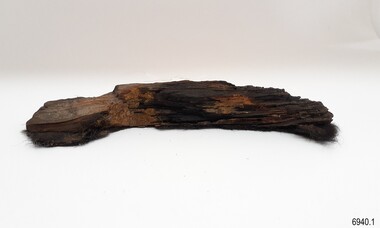
Plant specimen - Wood Sample, Alexander Hall and Son, ca. 1855
... Alexander Hall and Son...Plant specimen Wood Sample Alexander Hall and Son ...The wood sample is one of two pieces in the Collection from the wreck of the sailing ship Schomberg that were carried on the tides and discovered on a New Zealand beach along the coast. The samples have been positively identified scientifically as part of the timber from the Schomberg. ABOUT THE SCHOMBERG (October 6 to December 27, 1855)- When the ship Schomberg was launched in 1855, she was considered the most perfect clipper ship ever to be built. James Baines Black Ball Line had commissioned her for their fleet of passenger liners. The Aberdeen builders designed her to sail faster than the clippers designed the three-masted wooden clipper ship to be fast. The timber used for the diagonal planking was British oak with layers of Scottish larch. This luxury emigrant vessel was designed for superior comfort. She had ventilation ducts to provide air to the lower decks and a dining saloon, smoking room, library and bathrooms for the first-class passengers. The master for Schomberg’s maiden voyage was Captain ‘Bully’ Forbes. He drunkenly predicted at her launch that he would make the journey between Liverpool and Melbourne in 60 days. Schomberg departed Liverpool on 6 October 1855 with 430 passengers and 3000 tons of cargo including iron rails and equipment intended the build the Geelong Railway and a bridge over the Yarra from Melbourne to Hawthorn. The poor winds slowed Schomberg’s sail across the equator. She was 78 days out of Liverpool when she ran aground on a sand spit near Peterborough, Victoria, on 27 December; the sand spit and currents were not marked on Forbes’s map. The ship’s Chief Officer spotted the coastal steamer SS Queen at dawn and sent a signal. The master of the SS Queen approached the stranded vessel and all of Schomberg’s passengers safely disembarked. In 1975, 120 years after the Schomberg was wrecked, divers from Flagstaff Hill found an ornate communion set at the wreck site along with many other artefacts. In 1978 a diamond ring was discovered under the concretion in the lid of the communion set, which is currently on display. Former Director of Flagstaff Hill, Peter Ronald, had salvaged most of the artefacts from the wreck. This wood sample is significant for its connection with the wreck of the Schomberg, as part of the vessel's structure. It is scientifically important as evidence that shipwreck relics can move a long way for the site of the wreck. The Schomberg collection as a whole is of historical and archaeological significance at a State level. Flagstaff Hill’s collection of artefacts from the Schomberg is also significant for its association with the Victorian Heritage Registered shipwreck (VHR S 612). The collection is of prime significance because of the relationship between the objects salvaged, as together they help us to interpret the story of the Schomberg. The collection as a whole is historically significant for representing aspects of Victoria's maritime history and its potential to interpret social and historical themes.Wood sample with layers of different coloured timber. The sample has holes along a portion of the edge and a fur-like appearance along one side. In places it has the appearance of charcoal. The sample is a piece of the hull from the wreck of the Schomberg. The sample was washed up on a beach on the coast of New Zealand. flagstaff hill, flagstaff hill maritime museum and village, warrnambool, maritime museum, maritime village, great ocean road, shipwreck coast, schomberg, 1855, clipper ship, black ball line, luxury ship, emigrant ship, captain forbes, bully forbes, ss queen, wood sample, new zealand, james baines & co -
 Flagstaff Hill Maritime Museum and Village
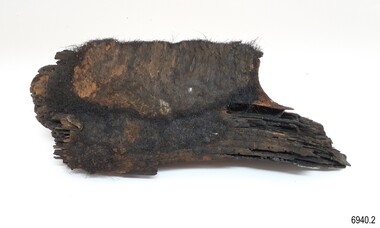
Plant specimen - Wood Sample, Alexander Hall and Son, ca. 1855
... Alexander Hall and Son...Plant specimen Wood Sample Alexander Hall and Son ...The wood sample is one of two pieces in the Collection from the wreck of the sailing ship Schomberg that were carried on the tides and discovered on a New Zealand beach along the coast. The samples have been positively identified scientifically as part of the timber from the Schomberg. ABOUT THE SCHOMBERG (October 6 to December 27, 1855)- When the ship Schomberg was launched in 1855, she was considered the most perfect clipper ship ever to be built. James Baines Black Ball Line had commissioned her for their fleet of passenger liners. The Aberdeen builders designed her to sail faster than the clippers designed the three-masted wooden clipper ship to be fast. The timber used for the diagonal planking was British oak with layers of Scottish larch. This luxury emigrant vessel was designed for superior comfort. She had ventilation ducts to provide air to the lower decks and a dining saloon, smoking room, library and bathrooms for the first-class passengers. The master for Schomberg’s maiden voyage was Captain ‘Bully’ Forbes. He drunkenly predicted at her launch that he would make the journey between Liverpool and Melbourne in 60 days. Schomberg departed Liverpool on 6 October 1855 with 430 passengers and 3000 tons of cargo including iron rails and equipment intended the build the Geelong Railway and a bridge over the Yarra from Melbourne to Hawthorn. The poor winds slowed Schomberg’s sail across the equator. She was 78 days out of Liverpool when she ran aground on a sand spit near Peterborough, Victoria, on 27 December; the sand spit and currents were not marked on Forbes’s map. The ship’s Chief Officer spotted the coastal steamer SS Queen at dawn and sent a signal. The master of the SS Queen approached the stranded vessel and all of Schomberg’s passengers safely disembarked. In 1975, 120 years after the Schomberg was wrecked, divers from Flagstaff Hill found an ornate communion set at the wreck site along with many other artefacts. In 1978 a diamond ring was discovered under the concretion in the lid of the communion set, which is currently on display. Former Director of Flagstaff Hill, Peter Ronald, had salvaged most of the artefacts from the wreck. This wood sample is significant for its connection with the wreck of the Schomberg, as part of the vessel's structure. It is scientifically important as evidence that shipwreck relics can move a long way for the site of the wreck. The Schomberg collection as a whole is of historical and archaeological significance at a State level. Flagstaff Hill’s collection of artefacts from the Schomberg is also significant for its association with the Victorian Heritage Registered shipwreck (VHR S 612). The collection is of prime significance because of the relationship between the objects salvaged, as together they help us to interpret the story of the Schomberg. The collection as a whole is historically significant for representing aspects of Victoria's maritime history and its potential to interpret social and historical themes.Wood sample with layers of different coloured timber. The sample has holes along a portion of the edge and a fur-like appearance along one side. In places it has the appearance of charcoal. The sample is a piece of the hull from the wreck of the Schomberg. The sample was washed up on a beach on the coast of New Zealand. flagstaff hill, flagstaff hill maritime museum and village, warrnambool, maritime museum, maritime village, great ocean road, shipwreck coast, schomberg, 1855, clipper ship, black ball line, luxury ship, emigrant ship, captain forbes, bully forbes, ss queen, wood sample, new zealand, james baines & co -
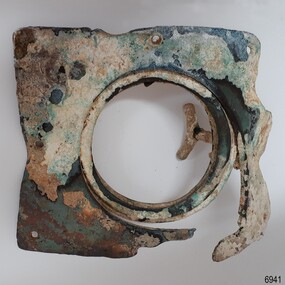 Flagstaff Hill Maritime Museum and Village
Functional object - Porthole Frame, Alexander Hall and Son, ca. 1855
... Alexander Hall and Son...Functional object Porthole Frame Alexander Hall and Son ...The porthole was recovered from the wreck of the clipper ship Schomberg. ABOUT THE SCHOMBERG (October 6 to December 27, 1855)- When the ship Schomberg was launched in 1855, she was considered the most perfect clipper ship ever to be built. James Baines Black Ball Line had commissioned her for their fleet of passenger liners. The Aberdeen builders designed her to sail faster than the clippers designed the three-masted wooden clipper ship to be fast. The timber used for the diagonal planking was British oak with layers of Scottish larch. This luxury emigrant vessel was designed for superior comfort. She had ventilation ducts to provide air to the lower decks and a dining saloon, smoking room, library and bathrooms for the first-class passengers. The master for Schomberg’s maiden voyage was Captain ‘Bully’ Forbes. He drunkenly predicted at her launch that he would make the journey between Liverpool and Melbourne in 60 days. Schomberg departed Liverpool on 6 October 1855 with 430 passengers and 3000 tons of cargo including iron rails and equipment intended the build the Geelong Railway and a bridge over the Yarra from Melbourne to Hawthorn. The poor winds slowed Schomberg’s sail across the equator. She was 78 days out of Liverpool when she ran aground on a sand spit near Peterborough, Victoria, on 27 December; the sand spit and currents were not marked on Forbes’s map. The ship’s Chief Officer spotted the coastal steamer SS Queen at dawn and sent a signal. The master of the SS Queen approached the stranded vessel and all of Schomberg’s passengers safely disembarked. In 1975, 120 years after the Schomberg was wrecked, divers from Flagstaff Hill found an ornate communion set at the wreck site along with many other artefacts. In 1978 a diamond ring was discovered under the concretion in the lid of the communion set, which is currently on display. Former Director of Flagstaff Hill, Peter Ronald, had salvaged most of the artefacts from the wreck. This porthole is significant as an example of an ship's fitting in common use in the mid-19th century. The Schomberg collection as a whole is of historical and archaeological significance at a State level. Flagstaff Hill’s collection of artefacts from the Schomberg is also significant for its association with the Victorian Heritage Registered shipwreck (VHR S 612). The collection is of prime significance because of the relationship between the objects salvaged, as together they help us to interpret the story of the Schomberg. The collection as a whole is historically significant for representing aspects of Victoria's maritime history and its potential to interpret social and historical themes.Porthole frame. Square thick metal plate with formed holes for fixing. Central round opening in the plate is fitted with a hinged round frame with a handle opposite the hinge. Bolts are embedded in the inner frame. The surface is encrusted and the plate is broken near one corner. The frame was recovered from the wreck of the Schomberg.flagstaff hill, flagstaff hill maritime museum and village, warrnambool, maritime museum, maritime village, great ocean road, shipwreck coast, schomberg, 1855, clipper ship, black ball line, luxury ship, emigrant ship, captain forbes, bully forbes, ss queen, james baines & co, porthole frame -
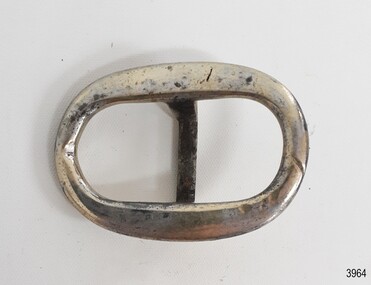 Flagstaff Hill Maritime Museum and Village
Equipment - Harness Buckle, Alexander Hall and Son, Ca. 1855
... Alexander Hall and Son...Equipment Harness Buckle Alexander Hall and Son ...Harness fittings like this buckle were amongst the cargo on the sailing ship Schomberg. ABOUT THE SCHOMBERG (October 6 to December 27, 1855)- When the ship Schomberg was launched in 1855, she was considered the most perfect clipper ship ever to be built. James Baine’s Black Ball Line had commissioned her for their fleet of passenger liners. The Aberdeen builders designed her to sail faster than the clippers designed the three-masted wooden clipper ship to be fast. The timber used for the diagonal planking was British oak with layers of Scottish larch. This luxury emigrant vessel was designed for superior comfort. She had ventilation ducts to provide air to the lower decks and a dining saloon, smoking room, library and bathrooms for the first-class passengers. The master for Schomberg’s maiden voyage was Captain ‘Bully’ Forbes. He drunkenly predicted at her launch that he would make the journey between Liverpool and Melbourne in 60 days. Schomberg departed Liverpool on 6 October 1855 with 430 passengers and 3000 tons of cargo including iron rails and equipment intended the build the Geelong Railway and a bridge over the Yarra from Melbourne to Hawthorn. The poor winds slowed Schomberg’s sail across the equator. She was 78 days out of Liverpool when she ran aground on a sand spit near Peterborough, Victoria, on 27 December; the sand spit and currents were not marked on Forbes’s map. The ship’s Chief Officer spotted the coastal steamer SS Queen at dawn and sent a signal. The master of the SS Queen approached the stranded vessel and all of Schomberg’s passengers safely disembarked. In 1975, 120 years after the Schomberg was wrecked, divers from Flagstaff Hill found an ornate communion set at the wreck site along with many other artefacts. In 1978 a diamond ring was discovered under the concretion in the lid of the communion set, which is currently on display. Former Director of Flagstaff Hill, Peter Ronald, had salvaged most of the artefacts from the wreck.This object is significant as an example of an item in common use in the mid-19th century. The Schomberg collection as a whole is of historical and archaeological significance at a State level. Flagstaff Hill’s collection of artefacts from the Schomberg is also significant for its association with the Victorian Heritage Registered shipwreck (VHR S 612). The collection is of prime significance because of the relationship between the objects salvaged, as together they help us to interpret the story of the Schomberg. The collection as a whole is historically significant for representing aspects of Victoria's maritime history and its potential to interpret social and historical themes.Buckle for a horse harness, oval. The silver-plated surface has damage from exposure to the sea. It has been lacquered since its recovery from the wreck of the Schomberg.flagstaff hill, flagstaff hill maritime museum and village, warrnambool, maritime museum, maritime village, great ocean road, shipwreck coast, schomberg, 1855, clipper ship, james baines & co, black ball line, luxury ship, emigrant ship, captain forbes, bully forbes, ss queen, peterborough shipwreck, harnes fitting, horse brass, buckle, horse harness, horse harness buckle -
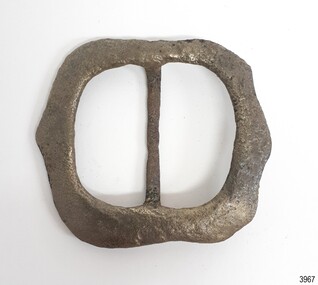 Flagstaff Hill Maritime Museum and Village
Equipment - Harness Buckle, Alexander Hall and Son, Ca. 1855
... Alexander Hall and Son...Equipment Harness Buckle Alexander Hall and Son ...Harness fittings like this buckle were amongst the cargo on the sailing ship Schomberg. ABOUT THE SCHOMBERG (October 6 to December 27, 1855)- When the ship Schomberg was launched in 1855, she was considered the most perfect clipper ship ever to be built. James Baine’s Black Ball Line had commissioned her for their fleet of passenger liners. The Aberdeen builders designed her to sail faster than the clippers designed the three-masted wooden clipper ship to be fast. The timber used for the diagonal planking was British oak with layers of Scottish larch. This luxury emigrant vessel was designed for superior comfort. She had ventilation ducts to provide air to the lower decks and a dining saloon, smoking room, library and bathrooms for the first-class passengers. The master for Schomberg’s maiden voyage was Captain ‘Bully’ Forbes. He drunkenly predicted at her launch that he would make the journey between Liverpool and Melbourne in 60 days. Schomberg departed Liverpool on 6 October 1855 with 430 passengers and 3000 tons of cargo including iron rails and equipment intended the build the Geelong Railway and a bridge over the Yarra from Melbourne to Hawthorn. The poor winds slowed Schomberg’s sail across the equator. She was 78 days out of Liverpool when she ran aground on a sand spit near Peterborough, Victoria, on 27 December; the sand spit and currents were not marked on Forbes’s map. The ship’s Chief Officer spotted the coastal steamer SS Queen at dawn and sent a signal. The master of the SS Queen approached the stranded vessel and all of Schomberg’s passengers safely disembarked. In 1975, 120 years after the Schomberg was wrecked, divers from Flagstaff Hill found an ornate communion set at the wreck site along with many other artefacts. In 1978 a diamond ring was discovered under the concretion in the lid of the communion set, which is currently on display. Former Director of Flagstaff Hill, Peter Ronald, had salvaged most of the artefacts from the wreck.This object is significant as an example of an item in common use in the mid-19th century. The Schomberg collection as a whole is of historical and archaeological significance at a State level. Flagstaff Hill’s collection of artefacts from the Schomberg is also significant for its association with the Victorian Heritage Registered shipwreck (VHR S 612). The collection is of prime significance because of the relationship between the objects salvaged, as together they help us to interpret the story of the Schomberg. The collection as a whole is historically significant for representing aspects of Victoria's maritime history and its potential to interpret social and historical themes.Buckle for a horse harness, square. The silver-plated surface has damage from exposure to the sea. It has been lacquered since its recovery from the wreck of the Schomberg.flagstaff hill, flagstaff hill maritime museum and village, warrnambool, maritime museum, maritime village, great ocean road, shipwreck coast, schomberg, 1855, clipper ship, james baines & co, black ball line, luxury ship, emigrant ship, captain forbes, bully forbes, ss queen, peterborough shipwreck, harnes fitting, horse brass, buckle, horse harness, horse harness buckle -
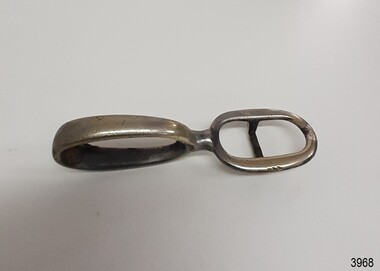 Flagstaff Hill Maritime Museum and Village
Equipment - Harness Buckle, Alexander Hall and Son, Ca. 1855
... Alexander Hall and Son...Equipment Harness Buckle Alexander Hall and Son ...Harness fittings like this buckle were amongst the cargo on the sailing ship Schomberg. ABOUT THE SCHOMBERG (October 6 to December 27, 1855)- When the ship Schomberg was launched in 1855, she was considered the most perfect clipper ship ever to be built. James Baine’s Black Ball Line had commissioned her for their fleet of passenger liners. The Aberdeen builders designed her to sail faster than the clippers designed the three-masted wooden clipper ship to be fast. The timber used for the diagonal planking was British oak with layers of Scottish larch. This luxury emigrant vessel was designed for superior comfort. She had ventilation ducts to provide air to the lower decks and a dining saloon, smoking room, library and bathrooms for the first-class passengers. The master for Schomberg’s maiden voyage was Captain ‘Bully’ Forbes. He drunkenly predicted at her launch that he would make the journey between Liverpool and Melbourne in 60 days. Schomberg departed Liverpool on 6 October 1855 with 430 passengers and 3000 tons of cargo including iron rails and equipment intended the build the Geelong Railway and a bridge over the Yarra from Melbourne to Hawthorn. The poor winds slowed Schomberg’s sail across the equator. She was 78 days out of Liverpool when she ran aground on a sand spit near Peterborough, Victoria, on 27 December; the sand spit and currents were not marked on Forbes’s map. The ship’s Chief Officer spotted the coastal steamer SS Queen at dawn and sent a signal. The master of the SS Queen approached the stranded vessel and all of Schomberg’s passengers safely disembarked. In 1975, 120 years after the Schomberg was wrecked, divers from Flagstaff Hill found an ornate communion set at the wreck site along with many other artefacts. In 1978 a diamond ring was discovered under the concretion in the lid of the communion set, which is currently on display. Former Director of Flagstaff Hill, Peter Ronald, had salvaged most of the artefacts from the wreck.This object is significant as an example of an item in common use in the mid-19th century. The Schomberg collection as a whole is of historical and archaeological significance at a State level. Flagstaff Hill’s collection of artefacts from the Schomberg is also significant for its association with the Victorian Heritage Registered shipwreck (VHR S 612). The collection is of prime significance because of the relationship between the objects salvaged, as together they help us to interpret the story of the Schomberg. The collection as a whole is historically significant for representing aspects of Victoria's maritime history and its potential to interpret social and historical themes.Horse harness buckle, plated brass, two oval shapes joined at a 180 degrees angle on one of the short sides. One ring has a bar between the long sides. Recovered from the wreck of the Schomberg.flagstaff hill, flagstaff hill maritime museum and village, warrnambool, maritime museum, maritime village, great ocean road, shipwreck coast, schomberg, 1855, clipper ship, james baines & co, black ball line, luxury ship, emigrant ship, captain forbes, bully forbes, ss queen, peterborough shipwreck, harnes fitting, horse brass, buckle, horse harness, horse harness buckle -
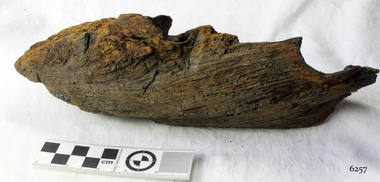 Flagstaff Hill Maritime Museum and Village
Wood Sample, 1854
... Alexander Hall and Son...The artefact is in fragile condition. Wood Sample Alexander Hall and Son ...This timber fragment is from the shipwreck of the SCHOMBERG (1855). The bow of the ship broke off after an unsuccessful salvage attempt to tow her off the Peterborough reef. At the wreck-site the submerged hull points north towards the beach but the front section is missing. Parts of the bow have been carried away by the eastward bearing ocean currents and have come ashore on the western coast of New Zealand’s South Island. Don Charlwood writes in Wrecks & Reputations (1977) that in 1871 “a piece of wreckage over 20 feet long and 12 feet wide was brought out” by land from its remote location at Tauperika Creek. In 1875 “an even larger section was brought out by sea”. It was suggested at the time that these relics of a large wooden sailing ship were from the wreck of the SCHOMBERG some 20 years earlier on the Victorian coast. “To corroborate the theory”, Charlwood continues, “a piece was sent to Halls of Aberdeen [the ship’s builders in Scotland]. They identified it as having come from the ship they had launched with such pride in 1852.” Charlwood, whose great-grandparents were passengers on the SCHOMBERG’s fateful maiden voyage, acquired some samples of the wreckage timber recovered in New Zealand, and brought them back with him to Australia. In 1976 “comparison was made of timbers from the New Zealand find and timber from the remains of the hull at Peterborough. They proved to be from the same ship.” The extraordinary journey of these pieces of wood from the once mighty clipper ship SCHOMBERG came to an end in 1984, when they were given to Flagstaff Hill by the author, and reunited with other shipwreck timbers and copper bolts from the vessel that are on display at the Maritime Village. The shipwreck of the SCHOMBERG is of State significance - Victorian Heritage Register S612The artefact is a small piece of wood that was broken from the timbers of the shipwreck of the SCHOMBERG (1855) and carried by the eastern currents to New Zealand (1875). It has 2 drilled holes that show faint screw marks and no metallic residue (possibly for patent treenails). The top surface is rounded, of a dark colour, and showing clear grains that have been worn smooth by the action of the sea. There is a reddish stain on the timber where breakage has occurred. The wood appears to have been strong in its original condition but is now light to lift and soft and crumbly at its exposed edges. The artefact is in fragile condition.flagstaff hill, warrnambool, shipwrecked-coast, flagstaff-hill, flagstaff-hill-maritime-museum, maritime-museum, shipwreck-coast, flagstaff-hill-maritime-village, schomberg, shipwreck timber, don charlwood, ‘wrecks & reputations’ -
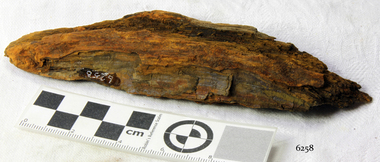 Flagstaff Hill Maritime Museum and Village
Wood Sample, 1854
... Alexander Hall and Son...It presents as a lighter less dense wood than oak, but may have lost mass through submersion. Wood Sample Alexander Hall and Son ...This timber fragment is from the shipwreck of the SCHOMBERG (1855). The bow of the ship broke off after an unsuccessful salvage attempt to tow her off the Peterborough reef. At the wreck-site the submerged hull points north towards the beach but the front section is missing. Parts of the bow have been carried away by the eastward bearing ocean currents and have come ashore on the western coast of New Zealand’s South Island. Don Charlwood writes in Wrecks & Reputations (1977) that in 1871 “a piece of wreckage over 20 feet long and 12 feet wide was brought out” by land from its remote location at Tauperika Creek. In 1875 “an even larger section was brought out by sea”. It was suggested at the time that these relics of a large wooden sailing ship were from the wreck of the SCHOMBERG some 20 years earlier on the Victorian coast. “To corroborate the theory”, Charlwood continues, “a piece was sent to Halls of Aberdeen [the ship’s builders in Scotland]. They identified it as having come from the ship they had launched with such pride in 1852.” Charlwood, whose great-grandparents were passengers on the SCHOMBERG’s fateful maiden voyage, acquired some samples of the wreckage timber recovered in New Zealand, and brought them back with him to Australia. In 1976 “comparison was made of timbers from the New Zealand find and timber from the remains of the hull at Peterborough. They proved to be from the same ship.” The extraordinary journey of these pieces of wood from the once mighty clipper ship SCHOMBERG came to an end in 1984, when they were given to Flagstaff Hill by the author, and reunited with other shipwreck timbers and copper bolts from the vessel that are on display at the Maritime Village. The shipwreck of the SCHOMBERG is of State significance - Victorian Heritage Register S612A small piece of wood broken from the timbers of the shipwrecked clipper SCHOMBERG (1855, Peterborough) and retrieved from the southwest coast of New Zealand’s South Island. The artefact bears a reddish stain on exposed parts but the main surface is grey coloured. It appears to have been split off other wood fragments in the Flagstaff Hill collection (6257, 6259). It presents as a lighter less dense wood than oak, but may have lost mass through submersion.flagstaff hill, warrnambool, shipwrecked-coast, flagstaff-hill, flagstaff-hill-maritime-museum, maritime-museum, shipwreck-coast, flagstaff-hill-maritime-village, schomberg, shipwreck timber, don charlwood, ‘wrecks & reputations’ -
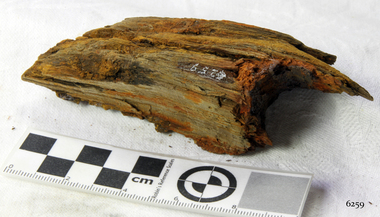 Flagstaff Hill Maritime Museum and Village
Wood Sample, 1854
... Alexander Hall and Son...The piece appears to have split off from other fragments that are in the Flagstaff Hill collection (6257, 6258) and it is in fragile condition. Wood Sample Alexander Hall and Son ...This timber fragment is from the shipwreck of the SCHOMBERG (1855). The bow of the ship broke off after an unsuccessful salvage attempt to tow her off the Peterborough reef. At the wreck-site the submerged hull points north towards the beach but the front section is missing. Parts of the bow have been carried away by the eastward bearing ocean currents and have come ashore on the western coast of New Zealand’s South Island. Don Charlwood writes in Wrecks & Reputations (1977) that in 1871 “a piece of wreckage over 20 feet long and 12 feet wide was brought out” by land from its remote location at Tauperika Creek. In 1875 “an even larger section was brought out by sea”. It was suggested at the time that these relics of a large wooden sailing ship were from the wreck of the SCHOMBERG some 20 years earlier on the Victorian coast. “To corroborate the theory”, Charlwood continues, “a piece was sent to Halls of Aberdeen [the ship’s builders in Scotland]. They identified it as having come from the ship they had launched with such pride in 1852.” Charlwood, whose great-grandparents were passengers on the SCHOMBERG’s fateful maiden voyage, acquired some samples of the wreckage timber recovered in New Zealand, and brought them back with him to Australia. In 1976 “comparison was made of timbers from the New Zealand find and timber from the remains of the hull at Peterborough. They proved to be from the same ship.” The extraordinary journey of these pieces of wood from the once mighty clipper ship SCHOMBERG came to an end in 1984, when they were given to Flagstaff Hill by the author, and reunited with other shipwreck timbers and copper bolts from the vessel that are on display at the Maritime Village. The shipwreck of the SCHOMBERG is of State significance - Victorian Heritage Register S612A piece of wood broken from the timbers of the shipwrecked SCHOMBERG (1855, Peterborough) and retrieved from the southwest coast of New Zealand’s South Island. The artefact is a light grey colour with plain long grain and bears a reddish stain on parts. Part of a drilled hole is red stained with traces of corroded metal still evident. The piece appears to have split off from other fragments that are in the Flagstaff Hill collection (6257, 6258) and it is in fragile condition.flagstaff hill, warrnambool, shipwrecked-coast, flagstaff-hill, flagstaff-hill-maritime-museum, maritime-museum, shipwreck-coast, flagstaff-hill-maritime-village, schomberg, shipwreck timber, don charlwood, ‘wrecks & reputations’ -
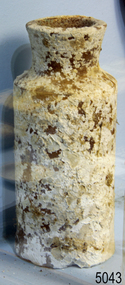 Flagstaff Hill Maritime Museum and Village
Ceramic - Stoneware Bottle, Alexander Hall and Son, ca. 1855
... Alexander Hall and Son...Ceramic Stoneware Bottle Alexander Hall and Son ...Schomberg was a large three-masted full-ship rigged wooden ship built in 1855 by Alexander Hall and Co in Aberdeen, Scotland for James Baines' famous Black Ball Line at £43,103. The vessel was 288 feet (88 meters) in length, with a beam of 45 feet (14 meters), a depth of 29.5 feet (8.99 meters) of 2,284 tons. The mainmast was 210 feet (64 meters) high and she carried 3.3 acres of sail. The vessel was constructed with three skins. One planked fore and aft, and two diagonally planked, fastened together with screw-threaded trunnels (wooden rails). The Schomberg is one of only three clipper wrecks in Victorian waters that operated the England to Australia run. While the other two, Empress of the Sea and Lightning, were built by the famous American shipbuilder, Donald Mac Kay. Schomberg was an attempt to build a faster ship than Mac Kay and a vessel fast enough to break the sailing record to Australia. The Schomberg sailed on her maiden voyage from Liverpool on 6 October 1855, under the command of Captain James Forbes, on its maiden voyage to Australia with a general cargo, jewellery, spirits, machinery, and 2,000 tons of iron rails and equipment intended to build the Melbourne to Geelong Railway and a bridge over the Yarra from Melbourne to Hawthorn. She also carried a cow for fresh milk, pens for fowls and pigs, plus 90,000 gallons of water for washing and drinking. She also carried 17,000 letters and 31,800 newspapers. There were approximately 473 passengers and a crew of 105. It was hoped that Schomberg would make Melbourne in sixty days, setting a record for the voyage, but light winds at the equator dashed those expectations. The ship sighted Moonlight Head in south west Victoria on Christmas Day but through a deadly combination of wind, currents and unmarked sand spits, the vessel gently ran aground on 26 December 1855 on a spit that juts into Newfield Bay, just east of Curdies Inlet, and the present town of Peterborough. Fortunately, the SS Queen was nearby and managed to save all passengers and crew. The steamers Keera and Maitland were dispatched to salvage the passenger's baggage and the more valuable cargo. Other salvage attempts were made, but deteriorating weather made the work impossible, and within two weeks the Schomberg's hull was broken up and the vessel abandoned. The wrecking of the Schomberg caused quite the public stir particularly in light of the fact the vessel was supposed to be, the most perfect clipper ship ever built. Captain Forbes was charged in the Supreme Court under suspicion that he was playing cards with two female passengers below decks when his ship ran aground. Despite a protest meeting, two inquiries and the court proceedings, he was found not guilty and cleared of all charges. In 1975, divers from Flagstaff Hill, including Peter Ronald, found an ornate communion set at the wreck. The set comprised a jug, two chalices, a plate and a lid. The lid did not fit any of the other objects and in 1978 a piece of the lid broke off, revealing a glint of gold. As museum staff carefully examined the lid and removed marine growth, they found a diamond ring, which is currently on display in the Great Circle Gallery at the Flagstaff Hill Maritime museum that also displays ship fittings and equipment, personal effects. Most of the artefacts were salvaged from the wreck by Peter Ronald, former director of Flagstaff Hill.The Schomberg has historical significance as one of the first luxurious ships built to bring emigrants to Australia to cash in on the gold rush era. And is included on the Victorian Heritage Register (VHR S612). The collection of Schomberg artefacts held at Flagstaff Hill Museum is primarily significant because of the relationship between these recovered items having a high potential to interpret the story of the Schomberg and its foundering during a storm. The shipwreck is of additional historically significance for representing aspects of Victoria’s shipping history and for its association with the first passenger ship, which was designed not only to be the fastest and most luxurious of its day but foundered on its maiden voyage to Australia.Stoneware Bottle, wide mouthed, covered in white encrustation, recovered from the wreck of the Schomberg. warrnambool, flagstaff-hill, flagstaff-hill-maritime-museum, shipwreck-coast, flagstaff-hill-maritime-village, schomberg, shipwrecked-artefact, clipper ship, black ball line, 1855 shipwreck, aberdeen clipper ship, captain forbes, peterborough shipwreck, stoneware bottle, james baines, black ball, container, clay bottle -
 Federation University Historical Collection
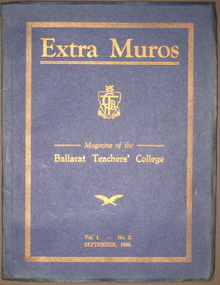
Magazine - Book, Extra Muros, 1930, 1930
... Extra Muros, 1930 Magazine Book J.A. Hoskin & Son ...Ballarat Teachers’ College commenced at Ballarat East Library in 1926 and stayed at that location until temporary closure in December 1931. In 1926 Sixty one students enrolled, and the staff consisted of Mr W.H. Ellwood, Miss A. Bouchier, Mr A.B. Jones. (The Flag, Nov 1997; The Flag, Nov 1996; BTC Handbook 1965)Blue soft cover booklet with gold titles relating to the Ballarat Teachers College, 62 pages with illustrations and advertisements. Includes information on current and ex students. Staff and student activities throughout the year.On the first page written in red pencil "M Miller" [Monica Miller]btc, ballarat teachers college, j weir, v bellingham, em smith, c cox, g rosehain, cm hall, m ocallaghan, m giles, d roscoe, o hateley, c inglis, a curtis, g bolster, joyce thomas, c cummins, j conway, r row, w augustini, n prendergast, d carroll, n larkan, m fogarty, m murray, a vickers, e forster, c mccullough, k curley, m bainbridge, t stuart, mollie quinn, mildred graham, hazel henderson, norman cocks, george carey, colin hall, jessie higgins, r bowman, a coto, v mckenzie, g dunstan, thomas alexander maclean, j mckerbery, r warriner, edna jones, ina dickman, wi young, jh mcnaughton, re moosman, f hickey, q kerby, r watson, c goltz, ab jones, ballarat east library, physical culture -
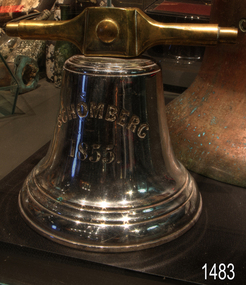 Flagstaff Hill Maritime Museum and Village
Functional object - Bell, Schomberg 1855, Before 1855
... ...alexander hall and son...Flagstaff Hill Flagstaff Hill Maritime Museum and Village Warrnambool Maritime Museum Maritime Village Great Ocean Road Shipwreck Coast Schomberg silver plated bell mess bell bell stands captain ‘bully’ Forbes alexander hall and son James Baines and company Liverpool’s black ball line bell Schomberg bell ship's bell small bell St Joseph's church Briggs Marine John Manning John Logan Warrnambool Museum Briggs Foundry silver bell Bell's front; “SCHOMBERG” with “1855” below. ...The Rescue and Journey of the Schomberg Bells: This bell was the smaller of two rescued by the crew of the Schomberg following the ship’s wreck in 1855. While the specific purpose of the smaller bell is unknown, it may have served to assemble the crew or signal mealtimes on board. After surviving the shipwreck, the crew carried both bells as they made their way along the coastline. Their journey eventually led them to the home of settler John Manning, located at Hopkins Point near Warrnambool. Manning took possession of the bells and subsequently presented them to two churches in Warrnambool. The smaller bell went to St Joseph’s Catholic Church, while the larger bell went to St John’s Presbyterian Church. After around a year, the small bell at St Joseph’s developed a crack and became unusable. Thomas Manifold imported a replacement bell for the church, and the damaged bell was stored at his farm. Years later, when the property was sold to John Logan, the discarded bell was donated to the old Warrnambool Museum upon its opening in 1886. The Curator, Joseph Archibald, placed the bell on display in the entry. In 1975, it was transferred from the Warrnambool Art Gallery to Flagstaff Hill. The ’Mystery’ of the small bell solved: Despite numerous attempts by the staff at Flagstaff Hill to restore the bell’s lustre, the bell remained dull and tarnished. In October 1986, Director Peter Ronald decided to send the bell for professional advice. The bell was entrusted to Briggs Marine Products, a renowned brass founder established in 1912. Upon examination, the specialists at Briggs discovered the reason behind the bell’s persistent lack of shine: it had originally been silver-plated, but most of the plating had worn away over time. The experts at Briggs then undertook the task of restoring the bell, successfully returning it to a gleaming silver surface. The Sailing Ship Schomberg: Launched in 1855, the Schomberg was regarded as the “Noblest” ship afloat at the time. Owned by the Black Ball Line, it was built for their passenger fleet by Alexander Hall of Aberdeen at a cost of £43,103. The construction featured three skins: one planked fore and aft and two diagonally planked, all fastened with screw-threaded trunnels (wooden rails). The ship’s First Class accommodation was luxurious, boasting velvet pile carpets, large mirrors, rosewood, birds-eye maple and mahogany timbers, satin damask soft furnishings, and an oak-lined library with a piano. Schomberg had a capacity for 1,000 passengers. The ship’s master, Captain James Nicol Forbes—also known as ‘Bully’ Forbes—was only 34 years old at the launch. He had a reputation for setting and breaking speed records on the Black Ball Line’s Marco Polo and Lightning. In 1852, Forbes completed the London to Melbourne journey on the Marco Polo in 68 days, a record at the time, though 53 passengers died during the voyage. In 1854, he sailed the Lightning to Melbourne in 76 days and returned in only 63 days—a record that stood among sailing ships. Forbes was known for driving his ship and crew to their limits, often prioritising speed over passenger comfort. Determined to set new records, he promised to reach Melbourne in sixty days, declaring he would do so “with or without the help of God.” The Maiden Voyage and the Wreck: Schomberg departed Liverpool on 6th October 1855, flying a banner that read “Sixty Days to Melbourne”. The vessel carried 430 passengers and 3,000 tons of cargo, including materials to build the Melbourne to Geelong Railway and a bridge over the Yarra River. Among the cargo were a cow for fresh milk, pens for fowls and pigs, and 90,000 gallons of water for drinking and washing. Additionally, it transported 17,000 letters and 31,800 newspapers. The ship and cargo were insured for $300,000, a considerable sum for the era. Poor winds while crossing the equator delayed Schomberg’s progress. Land was first sighted on Christmas Day at Cape Bridgewater near Portland. Captain Forbes followed the coastline towards Melbourne, but was reportedly playing cards when the third mate, Henry Keen, reported land only three miles away. The ship ran aground on a sand spit near Curdie’s Inlet (approximately 56 km west of Cape Otway) on 26th December 1855, after 78 days at sea. The sand spit and nearby currents were not marked on Forbes’s map. During the night, the crew launched a lifeboat to search for a safe landing spot for the passengers. The scouting party advised Forbes to wait until morning, as rough seas posed a danger to the lifeboats. At dawn, the ship’s Chief Officer spotted the SS Queen and signalled for help. The master of the Queen brought his vessel alongside, and all passengers and crew disembarked safely. The Black Ball Line’s Melbourne agent sent another steamer to collect the passengers’ baggage, and other steamers assisted with cargo salvage until worsening weather forced operations to cease. Notably, a plunderer later recovered a case of Wellington boots, but all were for the left foot. The wreck and its cargo were sold to local merchants Manifold & Bostock, who did not attempt further salvage. They later sold their interest to a Melbourne businessman and two seafarers. In 1864, after two men drowned in their attempt to reach the Schomberg, salvage efforts were abandoned. By 1870, parts of the ship had washed ashore on New Zealand’s South Island. Today, the wreck is about nine metres below the surface. Although most woodwork has disintegrated, the vessel’s shape remains discernible due to the railway irons, girders, and framework. Various goods and materials from the ship are scattered nearby. The bell is particularly significant in that along with other items from the wreck helped in part to having the legislation changed to protect shipwrecks, with far tighter controls being employed to oversee the salvaging of wreck sites. This bell forms part of the Schomberg collection at Flagstaff Hill maritime museum. The collection as a whole is of historical and archaeological significance at a State level. Flagstaff Hill’s collection of artefacts from the Schomberg is also significant for its association with the Victorian Heritage Registered Schomberg shipwreck (VHR S 612). The collection is of additional significance because of the relationship between the objects salvaged, as together they help us to interpret the story of the Schomberg. The collection as a whole is historically significant for representing aspects of Victoria's maritime history and its potential to interpret social and historical themes from society at the time of the wreck. A small ship’s bell. The silver-plated metal bell bears the ship’s name and year of construction on one side and the name and address of the ship’s builders on the other. These details are deeply engraved into the metal and formed in bold, upper-case lettering. The bell has two bell stands: the left and the right. Both stands have an Iron pipe bent into an inverted ‘Y’ shape, with a hole along its length and feet attached to a rectangular metal plate at the other two ends. Feet are bolted to a timber base that has a hole drilled through the centre for mounting. Bell's front; “SCHOMBERG” with “1855” below. Bell's back “HALL & SONS (crack splits letter “N”) / BUILDERS (in italics) / ABERDEEN” (crack splits letter “B”).flagstaff hill, flagstaff hill maritime museum and village, warrnambool, maritime museum, maritime village, great ocean road, shipwreck coast, schomberg, silver plated bell, mess bell, bell stands, captain ‘bully’ forbes, alexander hall and son, james baines and company, liverpool’s black ball line, bell, schomberg bell, ship's bell, small bell, st joseph's church, briggs marine, john manning, john logan, warrnambool museum, briggs foundry, silver bell -
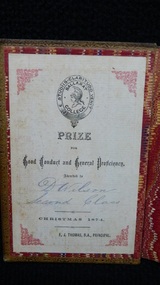 Ballarat Clarendon College
Book, George Routledge and Sons, The Crofton boys
... The Crofton boys Book George Routledge and Sons Harriet Martineau ...Book prize awarded to David Wilson (1885) for excellence in conduct and general proficiency. Book donated back to school after purchase in a junk shop. Handwritten inscription reveals details of family tree. Significant to the school social history because it was awarded by F J Thomas who led the school for a brief period during 1874 - 1875 and left under undignified circumstances (see Mein's history p. 19). Small calf bound novel with gold detailing on covers and spine; college crest embossed on front cover; marbled endpapers; colour frontispiece with interleave; book plate on front cover verso.Book plate inside front cover: College crest / Prize / for / Good conduct and general proficiency / awarded to / D Wilson / Second class / Chrostmas 1874 / F J Thomas BA, Principal. Handwritten inscription on back of title page: To Alexander (Lal) Wilson (my Godson) from your Uncle Alex Wilson as a keepsake from your father David Wilson, who pressed me to take a book from the first collection of books acquired from your grandfather David Wilson of the (?) Hall Hotel, Armstrong St Ballarat. But as (?) knew he had attended this school and that it was his own merited book received as a prize. I took it in preference to any other of the (?) books he offered me. This gift (/) just previous to his passing away and it was the last time I was priveledged (sic) to see him alive. It might interest you and yours to know that he died as a Christian Gentleman. I have that on the word of the Rev Frank (Menzies?), presbyterian Minister. Being sent by favour of Stewart Wilson. f-j-thomas, ballarat-college. book-prize, 1874, david-wilson -
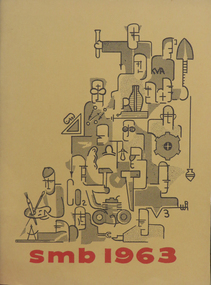 Federation University Historical Collection
Booklet, Ballarat School of Mines Students' Magazine, 1963, 1963
... Ballarat School of Mines Students' Magazine, 1963 Booklet Booklet J. A. Hoskin & Son ...Ballarat School of Mines Students' Magazine, 1963. Editorial, Prominent Personalities, King Island - Vacation Wonderland, Look back in Wonder, The Sensible Enemy, Diploma Conferring Ceremony, R. W. Richards Medal, Diplomas Conferred, Personality Tests and the Individual, Poison to Poison - Students' Revue for 1963, Malaya, Income Tax, Rustling Rags, Where Mankind has Failed, Sports Awards 1963, Sports, School Council, Members of Staff, Roll Call Yellow soft cover with red inscriptions and black figures on front cover, 104 pages including advertisements.ballarat school of mines students' magazine 1963, staff, sports, tony brauer, bob coutts, paul pusari, jeni milbourne, kerry penna brian mclennan, bob grub, john davis, netta walta, kevin brady, oscar rogers, kuo yiew see, h. e. arblaster, stanley white, quentin reynolds smyth, l. p. coombes - chief superintendent aeronautical research laboratories melbourne, graeme george redman, robert skewes, chookiat tanaksaranond, alan james bethune, lachlan stewart campbell, graham william hall, john rash, alan kenneth webb, peter agrums, sr. mary chanel fitzsimmons, david ewan clarke kirton, william joseph lannen, neil frances menz, keith houston alexander, john alexander pollock, john peter russell, francis william hunting, chookiate sirivongse, chong thung tay, keith stanley waller, bryan magson, anne moorehouse, stephen drew, gerry liston, gary roberts, ray megee, peter smith, daila berzins, don yates, kelvin whitford, greg hunter, david bell, michael moissinac, neil mudge, arthur patterson, edward scull, joseph heller, g. roberts, j. humphreys, bobby ong, alan cox, p. l. day, r. coutts, wayne johnson, prasert mahattanakul, l. t. negri, ooi kok hai, photography -
 Ringwood and District Historical Society
Document - Property Rental Records, Midway Arcade Tenancies, Ringwood, Victoria - 1956-60
... Hall … Corsetry Salon Shop 13 – C. H. Garrett & Sons ("Checkles") … Frock Shop Shop 14 – J. W. Gillespie / Alexanders … Tailor & Mercer Shop 15 – Alexanders … Mens Clothing Store Office 1 – F. ...Hall … Corsetry Salon Shop 13 – C. H. Garrett & Sons ("Checkles") … Frock Shop Shop 14 – J. W. Gillespie / Alexanders … Tailor & Mercer Shop 15 – Alexanders … Mens Clothing Store Office 1 – F. ...Nine pages of yellowed handwritten notes and typed carbon copies summarising tenancies and rental arrangements for shops and offices in with Midway Arcade, 145-147 Whitehorse Road, Ringwood for various occupancies - 1956-60.Agents: C.E. Carter & Son Summary of Tenant Lists (sic.) Shop 1 – V. Gordon & H. Kwong) … Cafe Shop 2 – B. T. Purser / L. C. Bartling … Shoe Shop Shop 3 – N. Maller … Chemist Shop 4 – Mrs J. A. Davies / C. H. Garrett & Sons … Home Furnishings Shop 5 – Mrs C. E. Peacock & Mrs C. M. Pullen / L. E. Gibson ... Children’s Wear Shop 6 – Rona Industries Pty Ltd … Sewing Machines & Frock Materials Shop 7 – J. & B. Russo … Greengrocers Shop 8 – W. H. Oliver … Butcher Shop 9 – Rankin & Pyke / C. O. Isbel … Cake Shop Shop 10 – W. Hanlon & J. Owen (Owen Radio) … Radio & Electrical Shop 11 – H. F. Gill (Faye French) … Ladies Beauty Salon Shop 12 – W. Hall … Corsetry Salon Shop 13 – C. H. Garrett & Sons ("Checkles") … Frock Shop Shop 14 – J. W. Gillespie / Alexanders … Tailor & Mercer Shop 15 – Alexanders … Mens Clothing Store Office 1 – F. D. Ray & Assoc. / M. A. Gibson … Accountant Office 2 – E. L. Moran … Solicitor Office 3 – Aust. Pastoral Equipment Co. / Progress Press … Pastoral Equipment / Printing Office 4 – D. R. James & Johnston … Solicitors Office 5 & 6 – Geoffrey Baker / J. Johnston … Solicitor Office 7 – T. W. Peters & D. Lush … Dentist Office 8 – Dunn & Schroder / Hillcrest Constructions … Real Estate / Builders Office 9 – J. Crittenden & C. S. Pascoe / Whitaker … Accountants Office 10 – Strobel Construction Pty Ltd / D. J. Hughes … Solicitor Office 11 – L. H. Reid … Drafting Office Office 12, 13 & 14 – Department of the Interior … Government Office Office 15 – H. S. Dixon …Solicitor -
Ringwood and District Historical Society
Document - Property Rental Records, Midway Arcade Tenancy, Ringwood, Victoria - 1961
... Agents: C.E. Carter & Son 1961 Tenant summary: Shops Shop 1 – Alexanders Shop 2 – Paddle / Bartling Shop 3 – Maller Shop 4 – Davies / Garrett Shop 5 – Gibson Shop 6 – Rona Industries Shop 7 – Russo Shop 8 – Oliver Shop 9 – Isbel Shop 10 – Hanlon Shop 11 – Gill Shop 12 – Hall Shop 13 – Garrett Shop 14 & 15 – Gillespie / Alexanders Offices Office 1 – Gibson Office 2 – Moran Office 3 – Rona Industries Office 4 – James & Johnston / James Office 5 – Baker Office 6 – Baker / Johnston (later months) Office 7 – Peters & Lush Office 8 – Rees / Hillcrest Office 9 – Pascoe & Whitaker Office 10 – Hughes Office 11 – Reid Office 12 – Department of Interior Office 13 – Department of Interior Office 14 – Department of Interior Office 15 – Dixon...Agents: C.E. Carter & Son 1961 Tenant summary: Shops Shop 1 – Alexanders Shop 2 – Paddle / Bartling Shop 3 – Maller Shop 4 – Davies / Garrett Shop 5 – Gibson Shop 6 – Rona Industries Shop 7 – Russo Shop 8 – Oliver Shop 9 – Isbel Shop 10 – Hanlon Shop 11 – Gill Shop 12 – Hall Shop 13 – Garrett Shop 14 & 15 – Gillespie / Alexanders Offices Office 1 – Gibson Office 2 – Moran Office 3 – Rona Industries Office 4 – James & Johnston / James Office 5 – Baker Office 6 – Baker / Johnston (later months) Office 7 – Peters & Lush Office 8 – Rees / Hillcrest Office 9 – Pascoe & Whitaker Office 10 – Hughes Office 11 – Reid Office 12 – Department of Interior Office 13 – Department of Interior Office 14 – Department of Interior Office 15 – Dixon Yellow typed carbon copies and handwritten notations (22 pages) - 1961 bookkeeping records associated with Midway Arcade/Ringwood Investments Pty. ...Yellow typed carbon copies and handwritten notations (22 pages) - 1961 bookkeeping records associated with Midway Arcade/Ringwood Investments Pty. Ltd., 517 Flinders Lane, Melbourne, including monthly rental amounts and routine property management expenses for each shop and office tenant.Agents: C.E. Carter & Son 1961 Tenant summary: Shops Shop 1 – Alexanders Shop 2 – Paddle / Bartling Shop 3 – Maller Shop 4 – Davies / Garrett Shop 5 – Gibson Shop 6 – Rona Industries Shop 7 – Russo Shop 8 – Oliver Shop 9 – Isbel Shop 10 – Hanlon Shop 11 – Gill Shop 12 – Hall Shop 13 – Garrett Shop 14 & 15 – Gillespie / Alexanders Offices Office 1 – Gibson Office 2 – Moran Office 3 – Rona Industries Office 4 – James & Johnston / James Office 5 – Baker Office 6 – Baker / Johnston (later months) Office 7 – Peters & Lush Office 8 – Rees / Hillcrest Office 9 – Pascoe & Whitaker Office 10 – Hughes Office 11 – Reid Office 12 – Department of Interior Office 13 – Department of Interior Office 14 – Department of Interior Office 15 – Dixon -
Ringwood and District Historical Society
Document - Property Rental Records, Midway Arcade Tenancy, Ringwood, Victoria - 1962
... Agents: C.E. Carter & Son MIDWAY ARCADE – Tenant List (Shops & Offices, 1962) Shops Shop 1 – Alexanders Shop 2 – Bartling Shop 3 – Maller Shop 4 – Garrett Shop 5 – Gibson Shop 6 – Rona Industries Shop 7 – Russo Shop 8 – Oliver Shop 9 – Isbel Shop 10 – Hanlon Shop 11 – Gill Shop 12 – Hall Shop 13 – Garrett Shop 14 – Alexanders Shop 15 – Alexanders Kiosk – Nor West Dry Cleaners Offices Office 1 – Gibson / Midway Secretarial Service Office 2 – Moran Office 3 – Maller Office 4 – James Office 5 – Johnston Office 6 – Johnston Office 7 – Peters & Lush Office 8 – Hillcrest Office 9 – Pascoe & Whitaker Office 10 – Hughes Office 11 – Reid / Stoney Office 12 – Department of Interior Office 13 – Department of Interior Office 14 – Department of Interior Office 15 – Dixon...Agents: C.E. Carter & Son MIDWAY ARCADE – Tenant List (Shops & Offices, 1962) Shops Shop 1 – Alexanders Shop 2 – Bartling Shop 3 – Maller Shop 4 – Garrett Shop 5 – Gibson Shop 6 – Rona Industries Shop 7 – Russo Shop 8 – Oliver Shop 9 – Isbel Shop 10 – Hanlon Shop 11 – Gill Shop 12 – Hall Shop 13 – Garrett Shop 14 – Alexanders Shop 15 – Alexanders Kiosk – Nor West Dry Cleaners Offices Office 1 – Gibson / Midway Secretarial Service Office 2 – Moran Office 3 – Maller Office 4 – James Office 5 – Johnston Office 6 – Johnston Office 7 – Peters & Lush Office 8 – Hillcrest Office 9 – Pascoe & Whitaker Office 10 – Hughes Office 11 – Reid / Stoney Office 12 – Department of Interior Office 13 – Department of Interior Office 14 – Department of Interior Office 15 – Dixon Yellow typed carbon copies and handwritten notations (20 pages) - 1962 bookkeeping records associated with Midway Arcade/Ringwood Investments Pty. ...Yellow typed carbon copies and handwritten notations (20 pages) - 1962 bookkeeping records associated with Midway Arcade/Ringwood Investments Pty. Ltd., 517 Flinders Lane, Melbourne, including monthly rental amounts and routine property management expenses for each shop and office tenant.Agents: C.E. Carter & Son MIDWAY ARCADE – Tenant List (Shops & Offices, 1962) Shops Shop 1 – Alexanders Shop 2 – Bartling Shop 3 – Maller Shop 4 – Garrett Shop 5 – Gibson Shop 6 – Rona Industries Shop 7 – Russo Shop 8 – Oliver Shop 9 – Isbel Shop 10 – Hanlon Shop 11 – Gill Shop 12 – Hall Shop 13 – Garrett Shop 14 – Alexanders Shop 15 – Alexanders Kiosk – Nor West Dry Cleaners Offices Office 1 – Gibson / Midway Secretarial Service Office 2 – Moran Office 3 – Maller Office 4 – James Office 5 – Johnston Office 6 – Johnston Office 7 – Peters & Lush Office 8 – Hillcrest Office 9 – Pascoe & Whitaker Office 10 – Hughes Office 11 – Reid / Stoney Office 12 – Department of Interior Office 13 – Department of Interior Office 14 – Department of Interior Office 15 – Dixon -
Ringwood and District Historical Society
Document - Property Rental Records, Midway Arcade Tenancy, Ringwood, Victoria - 1963
... Agents: C.E. Carter & Son MIDWAY ARCADE – Tenant List (Shops & Offices, 1963) Shops Shop 1 – Alexanders Shop 2 – Bartling Shop 3 – Maller Shop 4 – Garrett Shop 5 – Gibson Shop 6 – Rona Industries Shop 7 – Russo Shop 8 – Oliver Shop 9 – Isbel Shop 10 – Hanlon Shop 11 – Orbit Agencies Shop 12 – Hall Shop 13 – Garrett Shop 14 & 15 – Alexanders Shop 4 (from August) – Glengarre Fabrics Shop 13 (from August) – Checkles Notes: – Glengarre Fabrics replaces Garrett in Shop 4 from August 1963. – Checkles replaces Garrett in Shop 13 from August 1963. ...Agents: C.E. Carter & Son MIDWAY ARCADE – Tenant List (Shops & Offices, 1963) Shops Shop 1 – Alexanders Shop 2 – Bartling Shop 3 – Maller Shop 4 – Garrett Shop 5 – Gibson Shop 6 – Rona Industries Shop 7 – Russo Shop 8 – Oliver Shop 9 – Isbel Shop 10 – Hanlon Shop 11 – Orbit Agencies Shop 12 – Hall Shop 13 – Garrett Shop 14 & 15 – Alexanders Shop 4 (from August) – Glengarre Fabrics Shop 13 (from August) – Checkles Notes: – Glengarre Fabrics replaces Garrett in Shop 4 from August 1963. – Checkles replaces Garrett in Shop 13 from August 1963. ...Yellow typed carbon copies and handwritten notations (14 pages) - 1963 bookkeeping records associated with Midway Arcade/Ringwood Investments Pty. Ltd., 517 Flinders Lane, Melbourne, including monthly rental amounts and routine property management expenses for each shop and office tenant.Agents: C.E. Carter & Son MIDWAY ARCADE – Tenant List (Shops & Offices, 1963) Shops Shop 1 – Alexanders Shop 2 – Bartling Shop 3 – Maller Shop 4 – Garrett Shop 5 – Gibson Shop 6 – Rona Industries Shop 7 – Russo Shop 8 – Oliver Shop 9 – Isbel Shop 10 – Hanlon Shop 11 – Orbit Agencies Shop 12 – Hall Shop 13 – Garrett Shop 14 & 15 – Alexanders Shop 4 (from August) – Glengarre Fabrics Shop 13 (from August) – Checkles Notes: – Glengarre Fabrics replaces Garrett in Shop 4 from August 1963. – Checkles replaces Garrett in Shop 13 from August 1963. Offices Office 1 – Midway Secretarial Office 2 – Moran Office 3 – Maller Office 4 – James Office 5 & 6 – Johnston / Johnstone Office 7 – Peters & Lush Office 8 – Hillcrest Office 9 – Pascoe & Whitaker Office 10 – Hughes Office 11 – Stoney Office 12, 13 & 14 – Department of Interior Office 15 – Dixon Kiosk – (unnamed operator, fixed rent) -
Ringwood and District Historical Society
Document - Property Rental Records, Midway Arcade Tenancy, Ringwood, Victoria - 1964
... Agents: C.E. Carter & Son MIDWAY ARCADE – Tenant List (Shops & Offices, 1964) Shops Shop 1 – Alexanders Shop 2 – Bartling Shop 3 – Maller Shop 4 – Glengarre Fabrics Shop 5 – Gibson Shop 6 – Rona Industries Shop 7 – McDonald Shop 8 – Oliver Shop 9 – Isbel Shop 10 – Hanlon Shop 11 – Orbit Agencies Shop 12 – Hall Shop 13 – Garrett / Checkles (Checkles appears from July onward) Shop 14 & 15 – Alexanders Offices Office 1 – Secretarial Service Office 2 – Moran Office 3 – Maller Office 4 – James Office 5 & 6 – Johnston / Johnston & Co. ...Agents: C.E. Carter & Son MIDWAY ARCADE – Tenant List (Shops & Offices, 1964) Shops Shop 1 – Alexanders Shop 2 – Bartling Shop 3 – Maller Shop 4 – Glengarre Fabrics Shop 5 – Gibson Shop 6 – Rona Industries Shop 7 – McDonald Shop 8 – Oliver Shop 9 – Isbel Shop 10 – Hanlon Shop 11 – Orbit Agencies Shop 12 – Hall Shop 13 – Garrett / Checkles (Checkles appears from July onward) Shop 14 & 15 – Alexanders Offices Office 1 – Secretarial Service Office 2 – Moran Office 3 – Maller Office 4 – James Office 5 & 6 – Johnston / Johnston & Co. ...Yellow typed carbon copies and handwritten notations (27 pages) - 1964 bookkeeping records associated with Midway Arcade/Ringwood Investments Pty. Ltd., 517 Flinders Lane, Melbourne, including monthly rental amounts and routine property management expenses for each shop and office tenant.Agents: C.E. Carter & Son MIDWAY ARCADE – Tenant List (Shops & Offices, 1964) Shops Shop 1 – Alexanders Shop 2 – Bartling Shop 3 – Maller Shop 4 – Glengarre Fabrics Shop 5 – Gibson Shop 6 – Rona Industries Shop 7 – McDonald Shop 8 – Oliver Shop 9 – Isbel Shop 10 – Hanlon Shop 11 – Orbit Agencies Shop 12 – Hall Shop 13 – Garrett / Checkles (Checkles appears from July onward) Shop 14 & 15 – Alexanders Offices Office 1 – Secretarial Service Office 2 – Moran Office 3 – Maller Office 4 – James Office 5 & 6 – Johnston / Johnston & Co. Office 7 – Peters & Lush Office 8 – Hillcrest / Hillcrest Construction Office 9 – Pascoe & Whitaker Office 10 – Hughes Office 11 – Stoney / Stoneys Office 12, 13 & 14 – Department of Interior Office 15 – Dixon Kiosk – (unnamed operator) -
Ringwood and District Historical Society
Document - Property Rental Records, Midway Arcade Tenancy, Ringwood, Victoria - 1965
... Agents: C.E. Carter & Son MIDWAY ARCADE – Tenant List (Shops & Offices, 1965) Shops Shop 1 – Alexanders Shop 2 – Bartling Shop 3 – Maller Shop 4 – Glengarre Fabrics Shop 5 – Gibson Shop 6 – Alexanders Shop 7 – McDonald Shop 8 – Oliver Shop 9 – Isbel Shop 10 – Hanlon Shop 11 – Orbit Agencies Shop 12 – Hall Shop 13 – Checkles Shop 14 – Alexanders Shop 15 – Alexanders Kiosk – (Unnamed kiosk tenant) Offices Office 1 – Secretarial Office 2 – Moran Office 3 – Maller Office 4 – James Office 5 & 6 – J. ...Agents: C.E. Carter & Son MIDWAY ARCADE – Tenant List (Shops & Offices, 1965) Shops Shop 1 – Alexanders Shop 2 – Bartling Shop 3 – Maller Shop 4 – Glengarre Fabrics Shop 5 – Gibson Shop 6 – Alexanders Shop 7 – McDonald Shop 8 – Oliver Shop 9 – Isbel Shop 10 – Hanlon Shop 11 – Orbit Agencies Shop 12 – Hall Shop 13 – Checkles Shop 14 – Alexanders Shop 15 – Alexanders Kiosk – (Unnamed kiosk tenant) Offices Office 1 – Secretarial Office 2 – Moran Office 3 – Maller Office 4 – James Office 5 & 6 – J. ...Typed carbon copies and handwritten notations (25 pages) - 1965 bookkeeping records associated with Midway Arcade/Ringwood Investments Pty. Ltd., 517 Flinders Lane, Melbourne, including monthly rental amounts and routine property management expenses for each shop and office tenant.Agents: C.E. Carter & Son MIDWAY ARCADE – Tenant List (Shops & Offices, 1965) Shops Shop 1 – Alexanders Shop 2 – Bartling Shop 3 – Maller Shop 4 – Glengarre Fabrics Shop 5 – Gibson Shop 6 – Alexanders Shop 7 – McDonald Shop 8 – Oliver Shop 9 – Isbel Shop 10 – Hanlon Shop 11 – Orbit Agencies Shop 12 – Hall Shop 13 – Checkles Shop 14 – Alexanders Shop 15 – Alexanders Kiosk – (Unnamed kiosk tenant) Offices Office 1 – Secretarial Office 2 – Moran Office 3 – Maller Office 4 – James Office 5 & 6 – J. McE. Johnston & Co. Office 7 – Peters & Lush Office 8 & 9 – Pascoe & Whitaker Office 10 – Hughes Office 11 – Stoney Office 12, 13 & 14 – Department of Interior Office 15 – Dixon -
Ringwood and District Historical Society
Document - Property Rental Records, Midway Arcade Tenancy, Ringwood, Victoria - 1966
... Agents: C.E. Carter & Son MIDWAY ARCADE – Tenant List (Shops & Offices, 1966) Shops Shop 1 – Alexanders Shop 2 – Bartling Shop 3 – Maller Shop 4 – Glengarre Fabrics Shop 5 – Gibson Shop 6 – Alexanders Shop 7 – McDonald Shop 8 – Oliver Shop 9 – Isbel Shop 10 – Hanlon Shop 11 – Bennett Shop 12 – Hall Shop 13 – Checkles Shop 14 – Alexanders Shop 15 – Alexanders Kiosk – (unnamed kiosk tenant) Offices Office 1 – Dixon Office 2 – Moran Office 3 – Maller Office 4 – James Office 5 – Johnston Office 6 – Johnston Office 7 – Peters & Lush Office 8 & 9 – Pascoe & Whitaker Office 10 – Hughes Office 11 – Stoney Office 12, 13 & 14 – Dept. of Interior Office 15 – Dixon...Agents: C.E. Carter & Son MIDWAY ARCADE – Tenant List (Shops & Offices, 1966) Shops Shop 1 – Alexanders Shop 2 – Bartling Shop 3 – Maller Shop 4 – Glengarre Fabrics Shop 5 – Gibson Shop 6 – Alexanders Shop 7 – McDonald Shop 8 – Oliver Shop 9 – Isbel Shop 10 – Hanlon Shop 11 – Bennett Shop 12 – Hall Shop 13 – Checkles Shop 14 – Alexanders Shop 15 – Alexanders Kiosk – (unnamed kiosk tenant) Offices Office 1 – Dixon Office 2 – Moran Office 3 – Maller Office 4 – James Office 5 – Johnston Office 6 – Johnston Office 7 – Peters & Lush Office 8 & 9 – Pascoe & Whitaker Office 10 – Hughes Office 11 – Stoney Office 12, 13 & 14 – Dept. of Interior Office 15 – Dixon Typed carbon copies and handwritten notations (33 pages) - 1966 bookkeeping records associated with Midway Arcade/Ringwood Investments Pty. ...Typed carbon copies and handwritten notations (33 pages) - 1966 bookkeeping records associated with Midway Arcade/Ringwood Investments Pty. Ltd., 517 Flinders Lane, Melbourne, including monthly rental amounts and routine property management expenses for each shop and office tenant.Agents: C.E. Carter & Son MIDWAY ARCADE – Tenant List (Shops & Offices, 1966) Shops Shop 1 – Alexanders Shop 2 – Bartling Shop 3 – Maller Shop 4 – Glengarre Fabrics Shop 5 – Gibson Shop 6 – Alexanders Shop 7 – McDonald Shop 8 – Oliver Shop 9 – Isbel Shop 10 – Hanlon Shop 11 – Bennett Shop 12 – Hall Shop 13 – Checkles Shop 14 – Alexanders Shop 15 – Alexanders Kiosk – (unnamed kiosk tenant) Offices Office 1 – Dixon Office 2 – Moran Office 3 – Maller Office 4 – James Office 5 – Johnston Office 6 – Johnston Office 7 – Peters & Lush Office 8 & 9 – Pascoe & Whitaker Office 10 – Hughes Office 11 – Stoney Office 12, 13 & 14 – Dept. of Interior Office 15 – Dixon -
Ringwood and District Historical Society
Document - Property Rental Records, Midway Arcade Tenancy, Ringwood, Victoria - 1967
... Agents: C.E. Carter & Son MIDWAY ARCADE – Tenant List (Shops & Offices, 1967) Shops Shop 1 – Alexanders Shop 2 – Bartling Shop 3 – Maller Shop 4 – Glengarre Fabrics Shop 5 – Gibson Shop 6 – Alexanders Shop 7 – McDonald Shop 8 – Oliver Shop 9 – Isbel Shop 10 – Hanlon Shop 11 – Bennett Shop 12 – Hall Shop 13 – Checkles Shop 14 – Alexanders Shop 15 – Alexanders Kiosk – (unnamed kiosk tenant) Shops 4, 5 & 6 (combined) – Garrett (appears from March 1967 onward) Offices Office 1 – Dixon Office 2 – Moran Office 3 – Maller Office 4 – James Office 5 – Johnston Office 6 – Johnston Office 7 – Peters & Lush Office 8 – Pascoe & Whitaker Office 9 – Pascoe & Whitaker / James (James occupies Office 9 from mid‑1967) Office 10 – Hughes Office 11 – Stoney Office 12 – Dept. of Interior Office 13 – Dept. of Interior Office 14 – Dept. of Interior Office 15 – Dixon...Agents: C.E. Carter & Son MIDWAY ARCADE – Tenant List (Shops & Offices, 1967) Shops Shop 1 – Alexanders Shop 2 – Bartling Shop 3 – Maller Shop 4 – Glengarre Fabrics Shop 5 – Gibson Shop 6 – Alexanders Shop 7 – McDonald Shop 8 – Oliver Shop 9 – Isbel Shop 10 – Hanlon Shop 11 – Bennett Shop 12 – Hall Shop 13 – Checkles Shop 14 – Alexanders Shop 15 – Alexanders Kiosk – (unnamed kiosk tenant) Shops 4, 5 & 6 (combined) – Garrett (appears from March 1967 onward) Offices Office 1 – Dixon Office 2 – Moran Office 3 – Maller Office 4 – James Office 5 – Johnston Office 6 – Johnston Office 7 – Peters & Lush Office 8 – Pascoe & Whitaker Office 9 – Pascoe & Whitaker / James (James occupies Office 9 from mid‑1967) Office 10 – Hughes Office 11 – Stoney Office 12 – Dept. of Interior Office 13 – Dept. of Interior Office 14 – Dept. of Interior Office 15 – Dixon Typed carbon copies and handwritten notations (38 pages) - 1967 bookkeeping records associated with Midway Arcade/Ringwood Investments Pty. ...Typed carbon copies and handwritten notations (38 pages) - 1967 bookkeeping records associated with Midway Arcade/Ringwood Investments Pty. Ltd., 517 Flinders Lane, Melbourne, including monthly rental amounts and routine property management expenses for each shop and office tenant.Agents: C.E. Carter & Son MIDWAY ARCADE – Tenant List (Shops & Offices, 1967) Shops Shop 1 – Alexanders Shop 2 – Bartling Shop 3 – Maller Shop 4 – Glengarre Fabrics Shop 5 – Gibson Shop 6 – Alexanders Shop 7 – McDonald Shop 8 – Oliver Shop 9 – Isbel Shop 10 – Hanlon Shop 11 – Bennett Shop 12 – Hall Shop 13 – Checkles Shop 14 – Alexanders Shop 15 – Alexanders Kiosk – (unnamed kiosk tenant) Shops 4, 5 & 6 (combined) – Garrett (appears from March 1967 onward) Offices Office 1 – Dixon Office 2 – Moran Office 3 – Maller Office 4 – James Office 5 – Johnston Office 6 – Johnston Office 7 – Peters & Lush Office 8 – Pascoe & Whitaker Office 9 – Pascoe & Whitaker / James (James occupies Office 9 from mid‑1967) Office 10 – Hughes Office 11 – Stoney Office 12 – Dept. of Interior Office 13 – Dept. of Interior Office 14 – Dept. of Interior Office 15 – Dixon -
Ringwood and District Historical Society
Document - Property Rental Records, Midway Arcade Tenancy, Ringwood, Victoria - 1968
... Agents: C.E. Carter & Son MIDWAY ARCADE — 1968 TENANCY LIST (Shop & Office Numbers + Tenant + Remarks) SHOPS Shops 1 & 14/15 – Alexanders Shops 2 & 3 – Maller Shop 4 – Garrett → Hill (Change 9 Aug 1968) Garrett (Glengarree Fabrics) - vacated 9 Aug 1968. ...Agents: C.E. Carter & Son MIDWAY ARCADE — 1968 TENANCY LIST (Shop & Office Numbers + Tenant + Remarks) SHOPS Shops 1 & 14/15 – Alexanders Shops 2 & 3 – Maller Shop 4 – Garrett → Hill (Change 9 Aug 1968) Garrett (Glengarree Fabrics) - vacated 9 Aug 1968. ...Typed carbon copies and handwritten notations (51 pages) - 1968 bookkeeping records and correspondence associated with Midway Arcade/Ringwood Investments Pty. Ltd., 517 Flinders Lane, Melbourne, including monthly rental amounts and routine property management expenses for each shop and office tenant.Agents: C.E. Carter & Son MIDWAY ARCADE — 1968 TENANCY LIST (Shop & Office Numbers + Tenant + Remarks) SHOPS Shops 1 & 14/15 – Alexanders Shops 2 & 3 – Maller Shop 4 – Garrett → Hill (Change 9 Aug 1968) Garrett (Glengarree Fabrics) - vacated 9 Aug 1968. New tenants: Roy & Phyllis Hill (Gentlemen’s hairdresser, tobacconist, gifts). Shop 5 & 6 – Bartling (Double Shoe Shop) Shop 7 – McDonald Shop 8 – Oliver (Butcher) Shop 9 – Isbel Shop 10 – Hanlon Shop 11 – Bennett Shop 12 – Hall → Wilson - Mrs Hall retired/vacated 31 Aug 1968. New tenants: Ivan & Joan Wilson (Bulk & Health Food Shop). Shop 13 – Alexanders Kiosk – Brennan OFFICES Office 1 & 15 – Dixon Office 2 – Moran Office 3 – Maller Office 4 – Morris Office 5 & 6 – Johnston Office 7 – Peters & Lush Office 8 – Kohlman Office 9 – James Office 10 – Hughes Offices 11, 12, 13, 14 – Dept. of Interior -
 Glen Eira Historical Society
Album - Album page, Caulfield Town Hall cnr Hawthorn & Glen Eira Rds, Circa 1972
... The hall was completed in 1890 to the design of Alexander Rankin and the present hall, foyer and portico completed to the design of Goldsmith and Jenkin, architects, in 1931. ...This photograph is part of the Caulfield Historical Album 1972. This album was created in approximately 1972 as part of a project by the Caulfield Historical Society to assist in identifying buildings worthy of preservation. The album is related to a Survey the Caulfield Historical Society developed in collaboration with the National Trust of Australia (Victoria) and Caulfield City Council to identify historic buildings within the City of Caulfield that warranted the protection of a National Trust Classification. Principal photographer thought to be Trevor Hart, member of Caulfield Historical Society. Most photographs were taken between 1966-1972 with a small number of photographs being older and from unknown sources. All photographs are black and white except where stated, with 386 photographs over 198 pages. Caulfield Town Hall is now known as Glen Eira Town Hall.From Victorian Heritage Database: Citation for Town Hall, Corner Glen Eira and Hawthorn Roads - HO106 https://vhd.heritagecouncil.vic.gov.au/places/43613 as at (19/10/2020) The former City of Caulfield (now City of Glen Eira) Municipal Offices, located at the south-west corner of Hawthorn and Glen Eira Roads, Caulfield South, were commenced for the Borough of Caulfield in 1884 when they also included a Post and Telegraph Office and Court of Petty Sessions. They were designed by the Borough surveyor, Sydney Smith. The hall was completed in 1890 to the design of Alexander Rankin and the present hall, foyer and portico completed to the design of Goldsmith and Jenkin, architects, in 1931. The complex is historically, aesthetically and socially significant. It is historically significant {Criterion A) as the centre of Local Government services in the area since 1885 and as a centre of post and telegraph and legal services for a period. Its association with architect and Borough surveyor, Sydney W. Smith is important in that the east elevation and facade (ground floor level only)as far west as the tower (lower two stages) survive as evidence of his work, the practice which his son continued after his death in 1886, becoming highly successful. The work of Goldsmith and Jenkin is historically important in that it indirectly demonstrates the growth of the City sustained during the Inter-war period, the work proceeding in spite of the Depression. It compares with other similar work of that time including the refurbishment of the Malvern Municipal Offices and Hall in 1927 (Hudson and Wardrop), the Melbourne Corporation Offices and Hall in 1925-28 (Stephenson and Meldrum, A. and K. Henderson) and the Camberwell Offices and Council Chamber in 1924 (Leighton Irwin and Roy Stevenson), other comparable municipal projects being undertaken during the 1930s. Finally, the Goldsmith and Jenkin works are important as a project of the Depression years organised specifically to alleviate unemployment problems in the Municipality. The complex is aesthetically important (Criterion E) as a prominent and imposing Classically derived complex of its type with individually noteworthy interior spaces being the entry hall and staircase, main Hall, Foyer and Council Chamber. The Adamesque plasterwork, timber panelling and furniture, Art Nouveaux enrichment and Classically derived treatment with sparing use of Australian decorative motifs are contributory elements. Exterior .elements of note include the remains of the original design prepared by Sydney Smith and the clock tower and portico which have come to symbolise important Municipal complexes erected prior to the Second World War. The complex is socially important (Criterion G) for the value placed on it by the community which has made use of it for activities including that of Local government for well over a century.Page 74 of Photograph Album with four photographs (three portrait and one landscape) of different views of the Caulfield Town Hall.Hand written: Caulfield Town Hall cnr Hawthorn & Glen Eira Rds [top right] / 74 [bottom right] trevor hart, caulfield, glen eira, caulfield town hall, sydney smith, sydney w smith, municipal, adamesque plasterwork, adamesque, art nouveaux, portico, council chambers, alexander rankin, foyer, local government, timber panelling, tower, unemployment, clock tower, hawthorn road, glen eira road, city of glen eira, municipal offices, post and telegraph office, goldsmith and jenkin, courthouses, surveyors, architects, classical architectural style, streetscapes, gardens, cars, glen eira town hall, depression 1929-1939
