
Showing 8 items matching "alexander pope"
-
 Flagstaff Hill Maritime Museum and Village
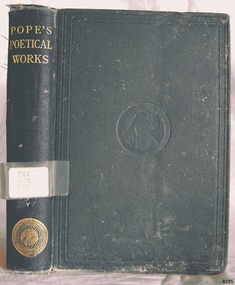
Book, The Poetical Works of Alexander Pope
... The Poetical Works of Alexander Pope......Alexander Pope...The Poetical Works of Alexander Pope Edited with Notes and Introductory Memoir by Adolphus W Ward Publisher: MacMillian & Co Date: 1889 Edition: The Globe Edition...The Warrnambool Mechanics' Institute’s publication collection is of both local and state significance. flagstaff hill warrnambool shipwrecked coast flagstaff hill maritime museum maritime museum shipwreck coast flagstaff hill maritime village great ocean road book pattison collection warrnambool library warrnambool mechanics’ institute ralph eric pattison corangamite regional library service warrnambool city librarian mechanics’ institute library victorian library board warrnambool books and records warrnambool children’s library The Poetical Works of Alexander Pope Alexander Pope Adolphus W Ward The label on spine cover with typed text 821 POP Pastedown front endpaper has a sticker from Warrnambool Mechanics Institute and Free Library Front loose endpaper has a sticker from Corangamite Regional Library Service Inside front, loose endpaper has a stamp from Warrnambool Public Museum The Poetical Works of Alexander Pope Edited with Notes and Introductory Memoir by Adolphus W Ward Publisher: MacMillian & Co Date: 1889 Edition: The Globe Edition The Poetical Works of Alexander Pope Book ...This book was part of a large group of books referred to as the Pattison Collection, which belonged to the Warrnambool Public Library, part of the Warrnambool Mechanics’ Institute. About RALPH ERIC PATTISON and the ‘PATTISON COLLECTION’ The ‘Pattison Collection’ is a collection of books and records that was originally owned by the Warrnambool Mechanics’ Institute, founded in Warrnambool in 1853. By 1886 the Warrnambool Mechanics’ Institute (WMI) had grown to have a Library, Museum and Fine Arts Gallery, with a collection of “… choice productions of art and valuable specimens in almost every branch and many wonderful national curiosities are now to be seen there, including historic relics of the town and district.” It later included a School of Design. Although it was very well patronised, the WMI was led to ask the City Council to take it over in 1911 due to lack of financial support. In 1935 Ralph Pattison was appointed as City Librarian to establish and organise the Warrnambool Public Library as it was then called. Ralph Eric Pattison was born in Rockhampton, Queensland, in 1891. He married Maude Swan from Warrnambool in 1920 and they set up home in Warrnambool. In 1935 when Pattison accepted the position as City Librarian for the Warrnambool City Council his huge challenge was to make a functional library within two rooms of the Mechanics’ Institute. He tirelessly cleaned, cleared and sorted a disarrayed collection of old books, jars of preserved specimens and other items reserved for exhibition in the city’s museum. He developed and updated the library with a wide variety of books for all tastes, including reference books for students; a difficult task to fulfil during the years following the Depression. He converted all of the lower areas of the building into a library, reference room and reading room for members and the public. The books were sorted and stored using a cataloguing and card index system that he had developed himself. He also prepared the upper floor of the building and established the Art Gallery and later the Museum, a place to exhibit the many old relics that had been stored for years for this purpose. One of the treasures he found was a beautiful ancient clock, which he repaired, restored and enjoyed using in his office during the years of his service there. Ralph Pattison was described as “a meticulous gentleman whose punctuality, floorless courtesy and distinctive neat dress were hallmarks of his character, and ‘his’ clock controlled his daily routine and his opening and closing of the library’s large heavy doors to the minute.” Pattison took leave from 1942 to 1945 to serve in the Royal Australian Navy, Volunteer Reserve as Lieutenant. A few years later he converted one of the Museum’s rooms into a Children’s Library, stocking it with suitable books for the younger generation. This was an instant success. In the 1950’s he had the honour of being appointed to the Victorian Library Board and received more inspiration from the monthly conferences in Melbourne. He was sadly retired in 1959 after over 23 years of service, due to the fact that he had gone over the working age of council officers. However, he continued to take a very keen interest in the continual development of the Library until his death in 1969. THE NEW WARRNAMBOOL LIBRARY When the WMI building was pulled down in 1963 a new civic building was erected on the site and the new Warrnambool Library, on behalf of the City Council, took over all the holdings of the WMI. At this time some of the items were separated and identified as the ‘Pattison Collection’, named after Pattison. Eventually, the components of the WMI were distributed from the Warrnambool Library to various places, including the Art Gallery, Historical Society and Flagstaff Hill. Later some were even distributed to other regional branches of Corangamite Regional Library and passed to and fro. It is difficult now to trace just where all of the items have ended up. The books at Flagstaff Hill Maritime Village generally display stamps and markings from Pattison as well as a variety of other institutions including the Mechanics’ Institute itself. WARRNAMBOOL MECHANICS’ INSTITUTE Warrnambool's Mechanics' Institute (or Institution as it was sometimes called) was one of the earliest in Victoria. On 17th October 1853, a meeting was held where it was resolved to request the Lieutenant Governor of the Colony to grant land for the erection of a Mechanics' Institutes building. A committee was formed at the meeting and Richard Osburne chaired the first meeting of this committee. The land on the North West corner of Banyan and Merri Streets was granted but there were no funds to erect the building. The Formal Rights of the Warrnambool Mechanics' Institute's encompassed its aims and these were officially adopted in1859; "This Institution has for its object the diffusion of literary, scientific, and other useful knowledge amongst its members, excluding all controversial subjects, religious or political. These objects are sought to be obtained by means of a circulating library, a reading room, the establishment of classes, debates, and the occasional delivery of lectures on natural and experimental philosophy, mechanics, astronomy, chemistry, natural history, literature, and the useful and ornamental arts, particularly those which have a more immediate reference to the colony." The Warrnambool Mechanics' Institute opened its first reading room in November 1884 in the National School building at the corner of Banyan and Timor Streets. The Institute was funded by member subscription, payable on a quarterly, half-yearly or yearly basis. Samuel Hannaford, the Manager of the Warrnambool Bank of Australasia, was the first Honorary Secretary of the Mechanics' Institutes, and an early President and Vice-President. He also gave several of the early lectures in the Reading Room. Another early Secretary, Librarian and lecturer was Marmaduke Fisher, the teacher at the National School. Lecture topics included The Poets and Poetry of Ireland', 'The Birth and Development of the Earth', 'The Vertebrae - with Remarks on the pleasures resulting from the study of Natural History' and 'Architecture'. In 1856 the Reading Room was moved to James Hider's shop in Timor Street, and by 1864 it was located in the bookshop of Davies and Read. In the 1860's the Mechanics' Institute struggled as membership waned but in 1866, after a series of fundraising efforts, the committee was able to purchase land in Liebig Street, on a site then called Market Square, between the weighbridge and the fire station. A Mechanics' Institute building was opened at this site in August 1871. The following year four more rooms were added to the main Reading Room and in 1873 the Artisan School of Design was incorporated into the Institute. The same year Joseph Archibald established a Museum; however, it deteriorated when he was transferred to Bendigo in 1877. In 1880, with Archibald's return to Warrnambool, the Museum was re-established, and in 1885 a new building was built at the back of the Institute to accommodate the re-created School of Design, the Art Gallery and the Museum. In 1887 the Museum section was moved to the former courthouse in Timor Street (for some time the walls of the building formed part of the TAFE cafeteria but all is now demolished)). In 1911 the Museum was transferred back to the original building and the management of the Mechanics' Institute was handed over to the Warrnambool City Council. The Museum and Art Gallery became one and housed many fine works of art, and the Library continued to grow. The building was well patronised, with records showing that at the beginning of the 20th century there were between 500 and 800 visitors. During World War One the monthly figures were in the thousands, with 3,400 people visiting in January 1915. The Museum was a much loved Institution in Warrnambool until the contents of the Museum and Art Gallery were removed to make room for the Warrnambool City Council Engineers' Department. The contents were stored but many of the items were scattered or lost. When the original building was demolished the site became occupied by the Civic Centre, which included the new City Library. (The library was temporarily located in the old Palais building in Koroit Street.) In the process of reorganisation the Collection was distributed amongst the community groups: -The new City Library took some of the historical books and some important documents, historic photographs and newspapers. -The Art Gallery kept the 19th Century art collection and some of the artefacts from the museum. -The Historical Society has some items -The State Museum has some items -Some items were destroyed -Flagstaff Hill Maritime Village has old newspapers, Government Gazettes, most of the Mechanics' Institute Library, ledgers and documents connected to the Mechanics' Institute Library, some framed and unframed artworks and some photographs. The Warrnambool Mechanics' Institute Library book collection is deemed to be of great importance because it is one of the few collections in an almost intact state, and many of the books are now very rare and of great value. The Pattison Collection, along with other items at Flagstaff Hill Maritime Village, was originally part of the Warrnambool Mechanics' Institute’s collection. The Warrnambool Mechanics’ Institute Collection is primarily significant in its totality, rather than for the individual objects it contains. Its contents are highly representative of the development of Mechanics' Institute libraries across Australia, particularly Victoria. A diversity of publications and themes has been amassed, and these provide clues to our understanding of the nature of and changes in the reading habits of Victorians from the 1850s to the middle of the 20th century. The collection also highlights the Warrnambool community’s commitment to the Mechanics’ Institute, reading, literacy and learning in the regions, and proves that access to knowledge was not impeded by distance. These items help to provide a more complete picture of our community’s ideals and aspirations. The Warrnambool Mechanics Institute book collection has historical and social significance for its strong association with the Mechanics Institute movement and the important role it played in the intellectual, cultural and social development of people throughout the latter part of the nineteenth century and the early twentieth century. The collection of books is a rare example of an early lending library and its significance is enhanced by the survival of an original collection of many volumes. The Warrnambool Mechanics' Institute’s publication collection is of both local and state significance. The Poetical Works of Alexander Pope Edited with Notes and Introductory Memoir by Adolphus W Ward Publisher: MacMillian & Co Date: 1889 Edition: The Globe EditionThe label on spine cover with typed text 821 POP Pastedown front endpaper has a sticker from Warrnambool Mechanics Institute and Free Library Front loose endpaper has a sticker from Corangamite Regional Library Service Inside front, loose endpaper has a stamp from Warrnambool Public Museumflagstaff hill, warrnambool, shipwrecked coast, flagstaff hill maritime museum, maritime museum, shipwreck coast, flagstaff hill maritime village, great ocean road, book, pattison collection, warrnambool library, warrnambool mechanics’ institute, ralph eric pattison, corangamite regional library service, warrnambool city librarian, mechanics’ institute library, victorian library board, warrnambool books and records, warrnambool children’s library, the poetical works of alexander pope, alexander pope, adolphus w ward -
 Greensborough Historical Society
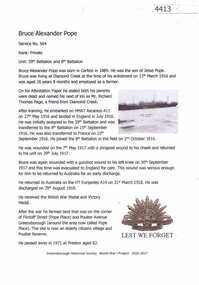
Article, Greensborough Historical Society et al, Bruce Alexander Pope, 1914-1918
... Bruce Alexander Pope......bruce alexander pope...A short article about Bruce Alexander Pope and his service in World War 1. ...A short article about Bruce Alexander Pope and his service in World War 1. At the time of his enlistment he was living at Diamond Creek. ...A short article about Bruce Alexander Pope and his service in World War 1. At the time of his enlistment he was living at Diamond Creek. Bruce Pope farmed in the Greensborough area post-war.One page, text and colour images.world war 1 project, bruce alexander pope -
 Ballarat Clarendon College
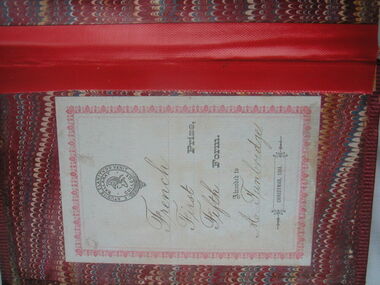
Book, William P.Nimmo, The poetical works of Alexander Pope, 1878 (exact)
... The poetical works of Alexander Pope......alexander pope...The poetical works of Alexander Pope Book William P.Nimmo ...This beautifully bound book was awarded to A. Tunbridge in 1884 for his prowess in French studies during the fifth form. At some stage the book has been donated to Mentone Girls High School and added to their library collection before being donted to Ballarat Clarendon College. A leather bound book with Ballarat College crest and borders embossed in gold on front cover. Page edges have gold-leaf. There is a bookplate fixed to inside front cover. Binding has been re-inforced with tape inside front and back covers.Circular Ballarat College crest on front cover with 'E studiis - Claritudo venit around outer edge; Minerva Head in centre with 'Ballarat College' printed around it. Printed book plate inside the front cover 'BC crest / French / First prize / Fifth form / Awarded to / A. Tunbridge / Christas, 1884. Title page has been stamped 'Mentone Girls High School Library 2922' Handwritten on second page 'Donated by E. Payne'book, a tunbridge, prize, 1884, alexander pope, christmas 1884 -
 Federation University Historical Collection
Book, John Drinkwater, Outline of Literature, c1940
... ...Alexander pope...Ballarat School of Mines library literature homer Book of the dead first books Bible Sacred books of the East greek mythology roman renaissance William Shakespeare john milton marvill walton john bunyan pepys john dryden Samuel dryden pierre corneille charles Perrault Alexander pope daniel defoe samuel richardson henry fielding tobias smollett maria edgeworth samuel johnson edmund burke jean mielot Edward Gibbon Robert Burns james hogg French revolution Goethe schiller lessing wordsworth southey coleridge hood Thomas Moore William Blake Byron Shelley keats Walter scott Aleandre Dumas victor hugo charles lamb alfred Tennyson william morris edward fitzgerald charles dickens William Thackeray Anthony trollope edward lytton wilkie collins charles read charles Kinglsey Bronte george eliot charlott yonge mark rutherford ralph emerson nathaniel hawthorne edgar Allan Poe mark Twain George Sand balzac James Froude george borrow richard jeffereis winston churchill nietsche hans anderson lewis carroll may sinclair Inside front "Office No 71" Stamped The School of Miens Industries and Science Ballarat Red cloth covered book with red leather spline and marbled papers. ...Red cloth covered book with red leather spline and marbled papers.non-fictionballarat school of mines library, literature, homer, book of the dead, first books, bible, sacred books of the east, greek mythology, roman, renaissance, william shakespeare, john milton, marvill, walton, john bunyan, pepys, john dryden, samuel dryden, pierre corneille, charles perrault, alexander pope, daniel defoe, samuel richardson, henry fielding, tobias smollett, maria edgeworth, samuel johnson, edmund burke, jean mielot, edward gibbon, robert burns, james hogg, french revolution, goethe, schiller, lessing, wordsworth, southey, coleridge, hood, thomas moore, william blake, byron, shelley, keats, walter scott, aleandre dumas, victor hugo, charles lamb, alfred tennyson, william morris, edward fitzgerald, charles dickens, william thackeray, anthony trollope, edward lytton, wilkie collins, charles read, charles kinglsey, bronte, george eliot, charlott yonge, mark rutherford, ralph emerson, nathaniel hawthorne, edgar allan poe, mark twain, george sand, balzac, james froude, george borrow, richard jeffereis, winston churchill, nietsche, hans anderson, lewis carroll, may sinclair -
 Warrnambool and District Historical Society Inc.
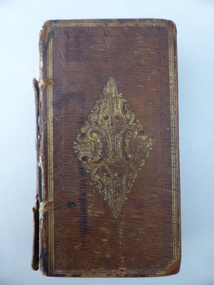
Book, Popes The Iliad of Homer, 1818
... This copy of Alexander Pope’s early 18th century translation of Homer’s Iliad dates from 1818. ...This copy of Alexander Pope’s early 18th century translation of Homer’s Iliad dates from 1818. ...This copy of Alexander Pope’s early 18th century translation of Homer’s Iliad dates from 1818. It has two signatures – Thomas Smith and Mary Riley. Nothing is known of the latter person. There were two people named Thomas Smith who were prominent in the Warrnambool district in the 19th century. One was Thomas Smith the printer and the other was Thomas Smith, a farmer from Wangoom who had a daughter named Mary. It is not clear which of these may have owned the book but the signature suggests an educated person and we know that the son of Thomas Smith the farmer was illiterate so it is unlikely that the father owned a copy of Homer’s Iliad. This book is of interest because of its age (1818) and because of the inscriptions. There may be no connection between Thomas Smith and Mary Riley – merely two owners of the book. The book will have greater interest when its exact provenance can be established. This is a brown leather-bound book of 536 pages. The front cover and spine have gold ornamentation with gold lettering. The spine covering is partly torn away and the binding is coming apart. The pages show some staining. The two inscriptions are handwritten in black ink. The front pages have two black and white illustrations separated with tissue paper. ‘Tho. Smith’ ‘Mary G. Riley, Tillside, 20 George Street, East Melbourne, 24/5/1900’ homer’s iliad, history of warrnambool, thomas smith, mary riley -
 Flagstaff Hill Maritime Museum and Village
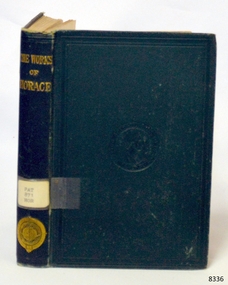
Book - Lyrical Poems, Samuel Lee (Translator), The Works of Horace, 1890
... Their Globe Edition translations of Horace and Virgil deliberately avoided the rhyming embellishments of earlier 18th-century translators (like Alexander Pope or John Dryden). Instead, Lee and Lonsdale provided clean, running prose analyses, introductions, and historical notes that allowed Victorian readers and students to understand exactly what the original Latin text stated, line by line....Their Globe Edition translations of Horace and Virgil deliberately avoided the rhyming embellishments of earlier 18th-century translators (like Alexander Pope or John Dryden). Instead, Lee and Lonsdale provided clean, running prose analyses, introductions, and historical notes that allowed Victorian readers and students to understand exactly what the original Latin text stated, line by line. ...The original author of this work was Quintus Horatius Flaccus, one of the leading Roman lyric poets during the time of Augustus Caesar (1st century BCE). This volume features the complete surviving works of Horace, rendered entirely into English prose. It includes his famous Odes, or lyrical poems, as well as his earlier poems on politics and social issues of the time. It also features his Satires, which offer humorous commentaries on Roman life, and his Epistles, or letters in verse, which include his highly influential work on literary criticism, the Ars Poetica (or The Art of Poetry).The Works of Horace Author: James Lonsdale and Samuel Lee Publisher: Macmillan And Co Date: 1890 Further Information: non-fictionThe original author of this work was Quintus Horatius Flaccus, one of the leading Roman lyric poets during the time of Augustus Caesar (1st century BCE). This volume features the complete surviving works of Horace, rendered entirely into English prose. It includes his famous Odes, or lyrical poems, as well as his earlier poems on politics and social issues of the time. It also features his Satires, which offer humorous commentaries on Roman life, and his Epistles, or letters in verse, which include his highly influential work on literary criticism, the Ars Poetica (or The Art of Poetry).flagstaff hill, warrnambool, shipwrecked coast, flagstaff hill maritime museum, maritime museum, shipwreck coast, flagstaff hill maritime village, great ocean road, book, pattison collection, warrnambool library, warrnambool mechanics’ institute, ralph eric pattison, corangamite regional library service, warrnambool city librarian, mechanics’ institute library, victorian library board, warrnambool books and records, warrnambool children’s library, the works of horace, samuel lee, james lonsdale, latin translated text -
 Ringwood and District Historical Society
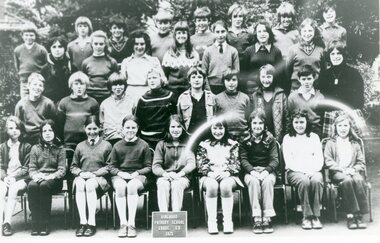
Photograph, Ringwood State School - Grade 6B, 1973
... Alexander 2nd Row- L to R: ?, Deidre Taylor, Gaye Bacon, Roslyn Conlan, Terasa Taggart, Marina McNeil, Fiona Weeks. 3rd Row- L to R: Peter Stortenbeker, ?, Cal Harris, Colin McCord, Lyal Tan, Stephen Graham, Jeffrey James, John O'Sullivan. Front Row- L to R: Elizabeth Cuzens, Vicki Jacobs, Julie Griffith, Jenny Walters, Kim Pope...Alexander 2nd Row- L to R: ?, Deidre Taylor, Gaye Bacon, Roslyn Conlan, Terasa Taggart, Marina McNeil, Fiona Weeks. 3rd Row- L to R: Peter Stortenbeker, ?, Cal Harris, Colin McCord, Lyal Tan, Stephen Graham, Jeffrey James, John O'Sullivan. Front Row- L to R: Elizabeth Cuzens, Vicki Jacobs, Julie Griffith, Jenny Walters, Kim Pope ...Black and white photograph - Grade 6B, 1973."Attached to photograph" Back Row- L to R: ?, Craig Lucas, ?, Leslie Weller, ?, ?, Gary Love, Gavin Alexander 2nd Row- L to R: ?, Deidre Taylor, Gaye Bacon, Roslyn Conlan, Terasa Taggart, Marina McNeil, Fiona Weeks. 3rd Row- L to R: Peter Stortenbeker, ?, Cal Harris, Colin McCord, Lyal Tan, Stephen Graham, Jeffrey James, John O'Sullivan. Front Row- L to R: Elizabeth Cuzens, Vicki Jacobs, Julie Griffith, Jenny Walters, Kim Pope, Rhonda Henry, Cathy Withers, ?, Ruth Beattie. Teacher: Mrs J.Parks. -
 Bendigo Historical Society Inc.
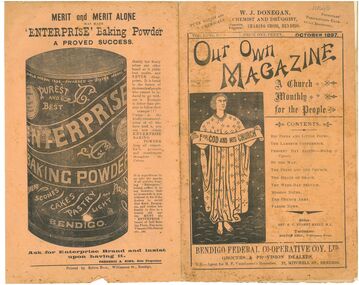
Magazine - Our Own Magazine Vol. 1 - No. 6 (published 1 October 1897), 1 October 1897
... The magazine includes articles pertaining to The Pope, the Lambeth Conference, Alexander Mackay of Uganda, the death of W. ...The magazine includes articles pertaining to The Pope, the Lambeth Conference, Alexander Mackay of Uganda, the death of W. ...The magazine was edited by Reverand R.C. Nugent Kelly as an Anglican Church publication. Reverend Kelly: Born in 1858 to Robert George and Mary Kelly (nee. Walker) of Birkenhead, England. Married Emma Louisa Edith Cremer in 1882 in England Died 11 Oct 1936 in Hornsby Shire, New South Wales, Australia Kelly joined All Saints Bendigo in 1896 where he edited the 'Our Own Magazine' and established a reputation for effective financial management. He left Bendigo in 1901. Much of his life was spent dedicated to church work which was documented as early as 1890. Now known as Old All Saints Cathedral, the church is located on the Northern corner of Mackenzie Street and Forest Street. The church was closed in 2015 and has remained abandoned. The church is located across the street from Bendigo Historical Society on Mackenzie Street. The Lambeth Conference: "The first Lambeth Conference took place in 1867 when the Archbishop of Canterbury, Charles Thomas Longley, invited the bishops of what would become the Anglican Communion to gather for a conference at Lambeth Palace.... There were two main issues that led to this invitation: First, a growing desire, expressed by many bishops around the world, to gather in order to pray, to study scripture and to confer together and, second, to address difficult pastoral and theological issues that were causing divisions between bishops around the world. These issues related to how the Christian gospel was and should be expressed in different cultures... Over successive Lambeth Conferences the mind of the bishops was expressed through published resolutions. These resolutions have touched on every area of the life and mission of the church... It has encouraged and enabled significant decisions to be made by the member churches" The 1897 conference resulted in 62 resolutions including the desire and establishment of regular conferences every ten years.1 October 1897 Edition of 'Our Own Magazine: A Church Monthly for the People'. The front cover contains the phrasing "registered as a newspaper" directly under the 'O' of "Our" though has been categorised as a magazine. Printed in black and white, the 10 page (not including covers) contains several advertisements for local Bendigo businesses. The cover showcases a hand drawn image of a robed man holding a ribbon "For God and His Church". The back cover shows a large black and white image of Enterprise Baking Powder. Other images include logos for local business and an ornate header on the front page. There are also ornate drop caps throughout the publication. The magazine includes articles pertaining to The Pope, the Lambeth Conference, Alexander Mackay of Uganda, the death of W. Walsham How (Bishop of Wakefield, C of E), the establishment of a press committee by the Anglican church, summaries of important sermons, mission notes, Parish news, baptisms, marriages and deaths. Centre fold and stapled together, each page is presented in a two-column layout. There is only one staple in the spine. Some pages extend past the edge of the cover. Printed on orange paper.reverand richard charles nugent kelly, all saints cathedral, bendigo, anglican church, lambeth conference, 1897, old all saints curch, local businesses
