
Showing 21 items matching "alien internment"
-
 Tatura Irrigation & Wartime Camps Museum
Book, The Interment of Aliens
... Alien Internment...Alien Internment F.Lafitte World War II Refugee Deportation Penguin Special A5 paperback book. ...A5 paperback book. Cream with orange stripes and black letters small penguin on bottom of front cover. Advertisment for other penguin special paperbacks on back cover.Penguin Special alien internment, f.lafitte, world war ii, refugee, deportation -
Tatura Irrigation & Wartime Camps Museum
Book, Enemy Aliens, 1005
... Enemy Aliens The internment of Italian Migrants in Australia during the second world war....On Jun 10th, 1940 the Australian authorities carried out the bigget round-up of civilians of an Italian descent. enemy aliens franklin j italian migrants camp 14a (loveday) camp 3 tatura Enemy Aliens The internment of Italian Migrants in Australia during the second world war. ...Tells of the plight of Italian migrants in Australia during WW2. On Jun 10th, 1940 the Australian authorities carried out the bigget round-up of civilians of an Italian descent.Navy blue soft cover with lines of green barb wire and red and white textEnemy Aliens The internment of Italian Migrants in Australia during the second world war.enemy aliens, franklin j, italian migrants, camp 14a (loveday), camp 3, tatura -
 Orbost & District Historical Society
poison pot, Smith, R. & E, 1940's
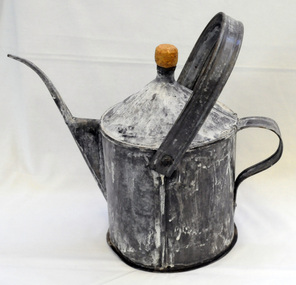
... aliens' and prisoners of war. The British government felt that it could not afford to feed large numbers of prisoners and it was believed that once in Australia the internees would have no chance of escape. Eager to show solidarity with Britain's cause, Australia readily agreed and decided to place the prisoners in a number of different camps scattered around the country and guard them with reservists and soldiers too unfit to serve overseas. There was an internment ...This item was used on P.C. Toby Nixon and Grace Nixon's farm, "Rolling Downs" at Bete Bolong. During WW11 the farm grew carrots, red beet, cabbages, beans and maize. Because of labour shortages the government built a Prisoner of War Camp on Russell's Hill. The manager, Dick Northrope, used three Italian prisoners to frill ring small trees and shrubs between crop harvesting. The introduction of ‘frill ringing’ and poisoning with arsenical tree killers in the 1940's and 1950's helped reduce the amount of labour required and trees on more country were treated. This enabled the hill country at Bete Bolong to become more productive. The dead trees and shrubs were later cleared by Erle Broome's D7 caterpillar bulldozer. This was the first big area of 230 acres to be cleared in the Orbost district. Soon after entering World War 11 Australia was asked by Britain to accept and guard large numbers of 'enemy aliens' and prisoners of war. The British government felt that it could not afford to feed large numbers of prisoners and it was believed that once in Australia the internees would have no chance of escape. Eager to show solidarity with Britain's cause, Australia readily agreed and decided to place the prisoners in a number of different camps scattered around the country and guard them with reservists and soldiers too unfit to serve overseas. There was an internment camp at Bete Bolong, Orbost. This item is an example of an item used by the Italian P.O.W.'s residing there. It is also an example of an agricultural tool not commonly used today.A galvanized iron watering can which has been used to hold poison for ring barking trees (possibly arsenic). It has a narrow spout. There is a handle at the back and a folding handle on the top. The top is conical with an opening for a cork. agriculture prisoner-of-war-camp tree-removal land-clearing -
 Narre Warren and District Family History Group
Book, Vittorio Tolaini, Voyage of an alien
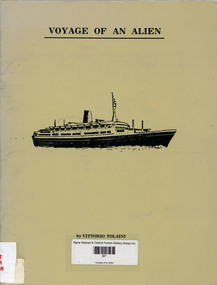
... Following the disaster of the sinking of the "Arandora Star" on July 2nd 1940, the survivors were transported to Australia on the "Dunera" and kept in internment camps until the end of the war. Vittorio Tolaini Voyage of an alien Book Vittorio Tolaini ...This is a true story of Italians interned in England during the war years of 1940-1945. Following the disaster of the sinking of the "Arandora Star" on July 2nd 1940, the survivors were transported to Australia on the "Dunera" and kept in internment camps until the end of the war. Vittorio Tolaininon-fictionThis is a true story of Italians interned in England during the war years of 1940-1945. Following the disaster of the sinking of the "Arandora Star" on July 2nd 1940, the survivors were transported to Australia on the "Dunera" and kept in internment camps until the end of the war. Vittorio Tolaini"dunera", world war 1939-1945, internees, italian internees, "arandora star" -
 Tatura Irrigation & Wartime Camps Museum
Book, Hidden Lives: war, internment and Australia's Italians, 2018
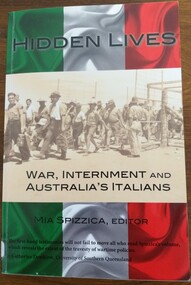
... aliens in these allied nations. Some Italian families whose husbands were arrested as "security risks" were sent to internment camps such as Loveday S.A hundreds of miles away leaving their wives and families to cope alone during W.W.2...aliens in these allied nations. Some Italian families whose husbands were arrested as "security risks" were sent to internment camps such as Loveday S.A hundreds of miles away leaving their wives and families to cope alone during W.W.2 world war two italian internees For our surrogate mother, Lurline Knee. ...Tells the stories of those immigrants who experienced detention during World War 2 as enemy aliens in these allied nations. Some Italian families whose husbands were arrested as "security risks" were sent to internment camps such as Loveday S.A hundreds of miles away leaving their wives and families to cope alone during W.W.2Cover has colours of the Italian flag, green, white and red. Across the centre of the flag is a photo of Italian internees arriving at a camp.For our surrogate mother, Lurline Knee. Thank you for bringing the Tatura story to us. beast wishes from Claudia (Marsella) Barker may 2018.world war two, italian internees -
 Tatura Irrigation & Wartime Camps Museum
Model - Doll House, Koch's Doll House, 1941.1942
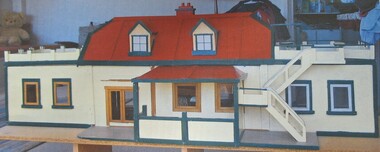
... ...Tatura internment camp...Civil Alien... camp Tatura internment camp Civil Alien Corp Wooden, painted dolls house, made from packing crates. 5 main pieces with additional pieces (roof, chimney, stairs, outside roof area, furniture) which go together to form this long single story dolls house. ...The dolls house and furniture was made by Heinrich August Ernst KOCH, who was interned at Orange NSW on the 6 June 1940. In 1941 was taken to Tatura VIC for an appeals tribunal hearing. He was released in 1943 to the Civil Alien Corp. The donor of the dolls house, John Smiles, is the grandson of Heinrich. Heinrich made the dolls house and furniture which he made for his daughters in Sydney NSW. It was sent to them whilst interned. The furniture is copies of real life size items and the house has features common with the family home in Sydney.Wooden, painted dolls house, made from packing crates. 5 main pieces with additional pieces (roof, chimney, stairs, outside roof area, furniture) which go together to form this long single story dolls house. Painted in cream with green features and red roof. Windows and doors open. Several windows have glass in them. Original piece of Lino in kitchen area. 2 rooms are wallpapered. Original pieces of furniture are included (see list attached to worksheet). These include dining table and four chairs, side board, dressing table, bed, tall boy, low boy, entrance table, entrance bench, entrance hall stand, kitchen table, 4 chairs and 2 benches.heinrich august ernst koch, john smiles, orange internment camp, tatura internment camp, civil alien corp -
Tatura Irrigation & Wartime Camps Museum
Folio, Records of Hans Zuckermandel, 1940-1944
... A research project by the Local History Officer, Daina Pocius, of the Tea Tree Gully Library. local german internee camp 1 tatura aliens tribunal hearing books biography Records of Hans Zuckermandel, Camp 1. Sixty photocopied pages held in plastic sleeves in black three ring folder containing the internment records of Hans Zuckermandel. ...A research project by the Local History Officer, Daina Pocius, of the Tea Tree Gully Library.Sixty photocopied pages held in plastic sleeves in black three ring folder containing the internment records of Hans Zuckermandel.Records of Hans Zuckermandel, Camp 1.local german internee, camp 1, tatura, aliens tribunal hearing, books, biography -
Tatura Irrigation & Wartime Camps Museum
Document, Neumann G & Muller Fritz - translated by Young W, A graphic account of the complaints, organisations and privileges, 5 June to 5 December 1940
... internment camps...alien...A graphic account of the complaints, organisations and privileges during the hectic round up of alien internees obtained by Arthur and Lurline Knee from Canberra. internment camps alien internees australian archives early internment organisation as above Australian archives - folios - attached to this. ...A graphic account of the complaints, organisations and privileges during the hectic round up of alien internees obtained by Arthur and Lurline Knee from Canberra.Australian archives - folios - attached to this. Sheet have been copied from ASIO Security Service, etc. Clear plastic folder - Australian Archives - ACT Regional Office - inc. booklet found in Sydney Hotel - the chronicle of the German Internment Camps in Australia - branded SECRET 19 May 1941. From 5 June to 15 December 1940as aboveinternment camps, alien internees, australian archives, early internment organisation -
Tatura Irrigation & Wartime Camps Museum
Document, Australian Manuscripts Collection La Trobe Library Melbourne, My Experience in an Australian Internment Camp, 1991
... The 1st 2 pages list manuscripts correspondence of the activities at Tatura Internment Camps. A 39 page account on the experiences of alien internee B. ...The 1st 2 pages list manuscripts correspondence of the activities at Tatura Internment Camps. A 39 page account on the experiences of alien internee B. ...The 1st 2 pages list manuscripts correspondence of the activities at Tatura Internment Camps. A 39 page account on the experiences of alien internee B. Goener. A simply told, fascinating record. His philosophical outlook makes this story a treasured addition to our archives.Clear plastic folder, red margin and red back with the inscription "Tatura Internment Camp - M.S. 11610 - Guide to Records held in the Australian Manuscripts Collection - La Trobe Library - State Library of Victoria. On the margin - "My experience in an Australian Internment Camp" by B. Goener. La Trobe Library. Acquired 1991as aboveb. goener, australian alien internees, hsk kormoran -
Tatura Irrigation & Wartime Camps Museum
Document - Autobiography, The Voyage of an Alien
... This is a photocopy of the original book C vittorio tolaini italian internees dunera loveday internment camp The Voyage of an Alien by Vittorio Tolaini 14 Monash University Library A4 copy of the book The Voyage of an Alien, an autobiography written by internee Vittoria Tolaini. ...Vittorio was a internee in camp. This is a photocopy of the original book C A4 copy of the book The Voyage of an Alien, an autobiography written by internee Vittoria Tolaini. The Voyage of an Alien by Vittorio Tolaini 14 Monash University Libraryvittorio tolaini, italian internees, dunera, loveday internment camp -
Tatura Irrigation & Wartime Camps Museum
Book, To Set the Record Straight, 2008
... He spent 3 1/2 years in Internment Camps at Tatura, Hay and Loveday as Italians were classed as Enemy Aliens...He spent 3 1/2 years in Internment Camps at Tatura, Hay and Loveday as Italians were classed as Enemy Aliens ww2 camp 1 hay loveday books history local White/green soft cover book, black and red text To Set the Record Straight Book ...Tells of the Author's Father who migrated to Australia in 1925. He spent 3 1/2 years in Internment Camps at Tatura, Hay and Loveday as Italians were classed as Enemy AliensWhite/green soft cover book, black and red textww2, camp 1, hay, loveday, books, history, local -
 Tatura Irrigation & Wartime Camps Museum
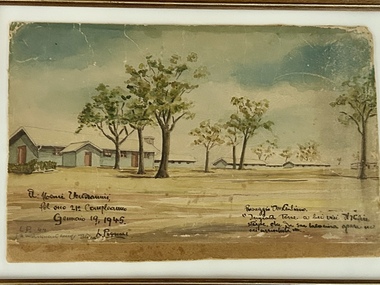
Painting - Painting - watercolour, No 2 Internment Camp, 1945
... She is the Wife of Vittorio Tolaini who was on the Dunera and wrote of his experiences in "Voyage of an Alien" June 1991. camp 2 mrs tolaini noemi vendramini luigi poggioli dunera boy tolaini Front bottom left side: "To Noemi Vendramini for her 21st birthday, January 19,1945. L Poggioli, LP44 No. 2 Internment ...This painting is for the Museum. It was a gift to me by an ex prisoner, whom I met when he came to Melbourne with Vic, Nicky and others. His name is Luigi Poggioli and he was a most distinguished gentleman, so distinct and well educated that I still remember him clearly (and I do not have a good memory). Perhaps I remember so well because of his kind words in verse on the painting which read :(Translation) "Ungrateful land with handsome race of Italian blood who with their hard work enriched you". Yes I believe I remember so well because of this verse. Extract from a letter from Mrs Tolaini now living in London. She is the Wife of Vittorio Tolaini who was on the Dunera and wrote of his experiences in "Voyage of an Alien" June 1991. Framed watercolour painting - 11 trees in foreground, one small hut facing towards bottom right hand corner, 4 large huts Centre of painting, black writing in Italian left and right foreground. Painting by L Poggioli. Frame is a wooden medium brown colour with a gold thin line.Front bottom left side: "To Noemi Vendramini for her 21st birthday, January 19,1945. L Poggioli, LP44 No. 2 Internment Camp, Tatura Front bottom right side: 4 lines of Italian writing translated "Ungrateful land with handsome race of Italian blood who with their hard work enriched you"camp 2, mrs tolaini, noemi vendramini, luigi poggioli, dunera boy, tolaini -
Tatura Irrigation & Wartime Camps Museum
Booklet, Treatment of Aliens in Australia During World War 2, 1988
... An interesting comment of the treatment of Aliens, Australian Government attitude and Major Layton. tatura internment camps internment camps Frank Pronesti Major Layton Treatment of Aliens in Australia during WW2 (1939-1945) by Frank Pronesti. ...Presented to the Museum by the Author, Frank Pronesti. An interesting comment of the treatment of Aliens, Australian Government attitude and Major Layton.A4 sized document in plastic cover, Clear front cover with a blue grey margin 1.7 cm wide extending to the back page. A vague photocopy of Murchison camp 3, Dept of Social Science - Gippsland College of Advanced Education 9 December 1988Treatment of Aliens in Australia during WW2 (1939-1945) by Frank Pronesti. Research project history/politics.tatura internment camps, internment camps, frank pronesti, major layton -
Tatura Irrigation & Wartime Camps Museum
DVD, Beyond Barbed Wire, 2017
... aliens". They were transported to Australia on the "Queen Elizabeth" which was being used at that time, as a troop ship. As part of a group of approximately 650 men, women and children from Palestine,they were held in internment Camp 3, Tatura, from 1941 until 1947. ...aliens". They were transported to Australia on the "Queen Elizabeth" which was being used at that time, as a troop ship. As part of a group of approximately 650 men, women and children from Palestine,they were held in internment Camp 3, Tatura, from 1941 until 1947. ...Interview of three persons, members of the Temple Society, who were arrested in Palestine during World War 2 as "enemy aliens". They were transported to Australia on the "Queen Elizabeth" which was being used at that time, as a troop ship. As part of a group of approximately 650 men, women and children from Palestine,they were held in internment Camp 3, Tatura, from 1941 until 1947. Those internees who chose to remain in Australia after the war were released at such time as they were able to obtain employment and accommodation. Also interviewed is Lurline Knee, Researcher for the Tatura Wartime Camps Museum. Interviewees: Hans Minzemay; Manfred Haering and Herta Uhlerr..Personal experiences of three members of the Temple Society, arrested as enemy aliens and brought to Australia for internment during World War 2.Standard DVD in plastic case.Not for distribution, assessment purposes only. Run time 6 minutes.tatura internment camp;, camp 3, palestine group of internees., temple society -
Tatura Irrigation & Wartime Camps Museum
Document, Recollections of Eberhard Schuster, Post WW2
... Describes initial internment in temporary camps then mainly in Camp 1, Tatura, where he relates the conditions therein, and the activities which the prisoners undertook in order to relieve the monotony of imprisonment.older donated by E. Schuster. Written by a former German held as an enemy alien ...Written post war by a German National who was working as a wool-buyer in Sydney when WW2 was declared. Describes initial internment in temporary camps then mainly in Camp 1, Tatura, where he relates the conditions therein, and the activities which the prisoners undertook in order to relieve the monotony of imprisonment.older donated by E. Schuster.Written by a former German held as an enemy alien in Camp 1, Tatura, The work is of historic, social and educational significance. it provides a complete description, of how German males working in Australia at the outbreak of war were captured and held in internment. It describes the conditions and many of the features existing in Camp 1. printed matter in plastic sleeves. CD included.Eberhard Schustereberhard schuster, german woolbuyers -
Tatura Irrigation & Wartime Camps Museum
Folio, Wartime Internment of German Aliens
... Wartime Internment of German Aliens Folio ...Written by Ellie Eggerking, daughter of "Dunera" internee as a research project.Black side bound folder with printed matter in plastic sleeves.documents, reports, dunera -
 Tatura Irrigation & Wartime Camps Museum
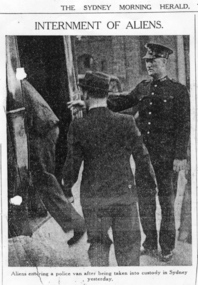
Photograph, Internment of Aliens
... photograph people Internment of Aliens Photograph ...photograph, people -
 Jewish Museum of Australia
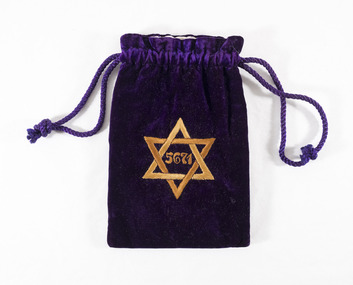
Tefillin bag, 1910
... aliens’ by the British Government and sent to Australia without their families. The ‘Dunera Boys’ were interned in camps at Tatura and Hay. Although some internees were released after two years because they possessed specific industry skills which would aid the nation, others were interned for the entire duration of the war. This collection brings together objects, personal effects and documents relating to the journey, internment...aliens’ by the British Government and sent to Australia without their families. The ‘Dunera Boys’ were interned in camps at Tatura and Hay. Although some internees were released after two years because they possessed specific industry skills which would aid the nation, others were interned for the entire duration of the war. This collection brings together objects, personal effects and documents relating to the journey, internment ...At the end of August 1940 the Hired Military Transport Dunera, a boat carrying around 2,500 European male internees, the majority of which were Jewish, arrived on Australian shores after two arduous months at sea. Although many had made England their home, their German or Austrian background caused these men to be classified as ‘enemy aliens’ by the British Government and sent to Australia without their families. The ‘Dunera Boys’ were interned in camps at Tatura and Hay. Although some internees were released after two years because they possessed specific industry skills which would aid the nation, others were interned for the entire duration of the war. This collection brings together objects, personal effects and documents relating to the journey, internment and subsequent military service in the 8th regiment experienced by the ‘Dunera Boys’. Also included are artworks and poems created by the internees during their interment, which express the thoughts and feelings of the men and document the daily life in the camps. Velvet, silk, silk embroidery thread, cotton thread, silk cord, leather, cotton and wood -
 Jewish Museum of Australia
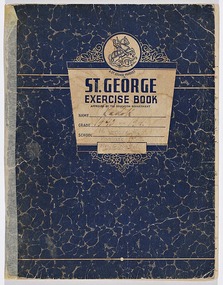
diary, Diary of Rainer Radok, 6/1940 - 5/05/1942
... internment in Australia, following his arrival by ship on the HMT Dunera. At the end of August 1940 the Hired Military Transport Dunera, a boat carrying around 2,500 European male internees, the majority of which were Jewish, arrived on Australian shores after two arduous months at sea. Although many had made England their home, their German or Austrian background caused these men to be classified as ‘enemy aliens ...Diary kept during Prof. Rainer Radok's internment in Australia, following his arrival by ship on the HMT Dunera.At the end of August 1940 the Hired Military Transport Dunera, a boat carrying around 2,500 European male internees, the majority of which were Jewish, arrived on Australian shores after two arduous months at sea. Although many had made England their home, their German or Austrian background caused these men to be classified as ‘enemy aliens’ by the British Government and sent to Australia without their families. The ‘Dunera Boys’ were interned in camps at Tatura and Hay. Although some internees were released after two years because they possessed specific industry skills which would aid the nation, others were interned for the entire duration of the war. This collection brings together objects, personal effects and documents relating to the journey, internment and subsequent military service in the 8th regiment experienced by the ‘Dunera Boys’. Also included are artworks and poems created by the internees during their interment, which express the thoughts and feelings of the men and document the daily life in the camps.This is an A5 size notebook of 90 pages, all handwritten in German. Pages are numbered on the upper corners and each entry is dated. Back cover is titled: "Arithmetical Tables" and "Multiplication Table". The blue cover is attached with yellow adhesive tape and is very loose from the inner pages. There are a few drawings throughout.Handwritten in ink on the front cover is the inscription "Radok 1940-1941." Written below in pencil is the address "16 Grove St. Passaie N.J." -
 Tatura Irrigation & Wartime Camps Museum
Photograph, Kiessling Collection, 1939-1946
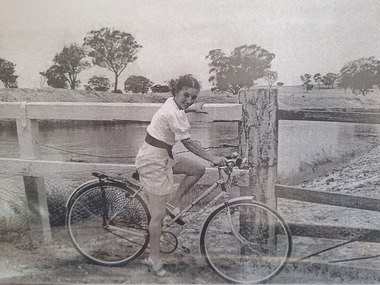
... The photos tell the story. 4 photographs: Rosa riding her bicycle; Walter holding baby Walter at his christening x 2; Rosa holding baby Walter with a girl behind holding flowers, standing next to Camp 1 Commandant Colonel Schrader and internee friend standing in front of a camp hut; Group of internees and Colonel Schrader in front of a hut at the Christening; the DRW car that Rosa and friend came up in for visits; The humane treatment given to enemy aliens by the Australian Army during World War 2. internment camp 1 tatura, Walter Kiessling Rosa Kieslling Camp 1 Commandant Colonel Schrader DRW car Plastic sleeves containing photos Kiessling Collection. ...German National, Walter Kiessling snr. an employee of a German firm was interned in Camp 1, Tatura. His wife remained in Melbourne where there son Walter was born. The father was immediately taken to Melbourne under escort to see his wife and baby son. Subsequently his wife would travel to Murchison by train and ride her bicycle, with the baby in a basket, out to the camp to visit her husband. Later visits were with a friend in their DKW car. Young Walter was christened by a Lutheran Pastor in the camp, under the supervision of Major Schrader, the Garrison Commandant. The photos tell the story. 4 photographs: Rosa riding her bicycle; Walter holding baby Walter at his christening x 2; Rosa holding baby Walter with a girl behind holding flowers, standing next to Camp 1 Commandant Colonel Schrader and internee friend standing in front of a camp hut; Group of internees and Colonel Schrader in front of a hut at the Christening; the DRW car that Rosa and friend came up in for visits; The humane treatment given to enemy aliens by the Australian Army during World War 2.Plastic sleeves containing photos internment camp 1 tatura,, walter kiessling, rosa kieslling, camp 1 commandant, colonel schrader, drw car -
 Tatura Irrigation & Wartime Camps Museum
Programme - Internment Camp Christmas Program, Phillharmonisches Orchester Internierungs-Lager Tatura, 1941
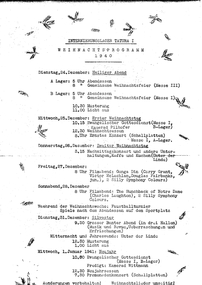
... The program indicates the caring attitude of the Australian authorities in permitting the acquisition of musical instruments, and the encouragement offered to the internees in order to produce the concert. german camp orchestra New Guinea Missionaries ww2 enemy aliens Camp 1 orchestra Original single page paper program with printed list of orchestral items to be performed by the camp orchestra,19th.and 20th. July 1941, in Internment ...The orchestra consisted of German male civilians interned as "Enemy Aliens" during World War 2. Those interned in 1941 were former Australian residents and New Guinea missionaries.The program indicates the caring attitude of the Australian authorities in permitting the acquisition of musical instruments, and the encouragement offered to the internees in order to produce the concert. Original single page paper program with printed list of orchestral items to be performed by the camp orchestra,19th.and 20th. July 1941, in Internment Camp 1, Tatura. Also lists the names of the members of the orchestra and their instruments.german camp orchestra, new guinea missionaries, ww2 enemy aliens, camp 1 orchestra
