
Showing 556 items matching "all but central"
-
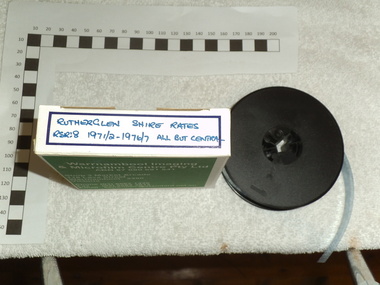 Rutherglen Historical Society
Digitised 16mm Microfilm, Rutherglen Shire Rates 1970-71 to 1976-77 all but Central, 1988
... Rutherglen Shire Rates 1970-71 to 1976-77 all but Central......all but central...This microfilm produced in 1988 is a duplicate of the original Microfilm rates public records shire 1970-71 to 1976-77 all but central spooled roll of 16mm film in a cardboard box Rutherglen Shire Rates 1970-71 to 1976-77 all but Central Digitised 16mm Microfilm ...This microfilm produced in 1988 is a duplicate of the original Microfilmspooled roll of 16mm film in a cardboard boxrates, public records, shire, 1970-71 to 1976-77, all but central -
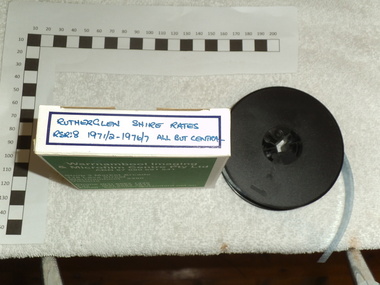 Rutherglen Historical Society
Digitised 16mm Microfilm, Rutherglen Shire Rates 1970-71 to 1976-77 All But Central, 1988
... Rutherglen Shire Rates 1970-71 to 1976-77 All But Central......all but central...This microfilm produced in 1988 is a duplicate of the original Microfilm rates public records shire 1970-71 to 1976-77 all but central spooled roll of 16mm film in a cardboard box Rutherglen Shire Rates 1970-71 to 1976-77 All But Central Digitised 16mm Microfilm ...This microfilm produced in 1988 is a duplicate of the original Microfilmspooled roll of 16mm film in a cardboard boxrates, public records, shire, 1970-71 to 1976-77, all but central -
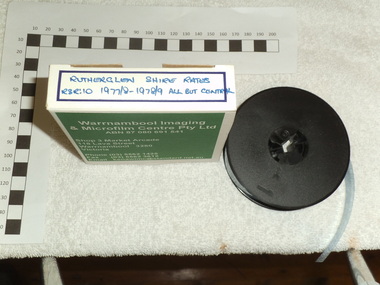 Rutherglen Historical Society
Digitised 16mm Microfilm, Rutherglen Shire Rates 1987-88 to 1978-79 All But Central, 1988
... Rutherglen Shire Rates 1987-88 to 1978-79 All But Central......all but central...This microfilm produced in 1988 is a duplicate of the original Microfilm rates public records shire 10 1987-88 to 1978-79 all but central spooled roll of 16mm film in a cardboard box Rutherglen Shire Rates 1987-88 to 1978-79 All But Central Digitised 16mm Microfilm ...This microfilm produced in 1988 is a duplicate of the original Microfilmspooled roll of 16mm film in a cardboard boxrates, public records, shire, 10 1987-88 to 1978-79, all but central -
 Glenelg Shire Council Cultural Collection
Souvenir - Ruler, n.d
... Plants, dark teal - all on central part of ruler. Gradations in cm one edge of ruler, inches the other....Plants, dark teal - all on central part of ruler. Gradations in cm one edge of ruler, inches the other. ...White plastic 30cm ruler. Advertising 'PORTLAND ALUMINIUM' in dark teal, below logo; 'SMELTER IN PARK' - orange. Plants, dark teal - all on central part of ruler. Gradations in cm one edge of ruler, inches the other. -
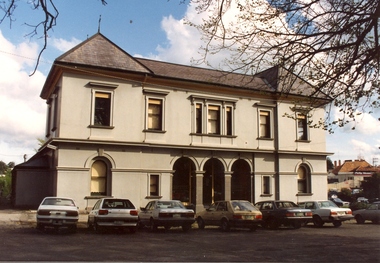 Federation University Historical Collection
Photograph - Black and white sketch, Former Ballarat Supreme Courthouse (later Courthouse Theatre), c1994
... The central court room and the flanking wings were all two storey with hipped roofs. ...Central court room and adjacent wings are all two storey. The central section is recessed with ground floor arcade and arched windows. ...Central court room and adjacent wings are all two storey. The central section is recessed with ground floor arcade and arched windows. ...The former Ballarat Supreme Court building was unique in design for the time. The central court room and the flanking wings were all two storey with hipped roofs. This made this building different from other Public Works designs. The building was erected by the Public Works Department in 1868. Early in the 1940s the former Supreme Court was abandoned. Today the building is used as a performing arts centre.Colour photograph of the former Ballarat Supreme Court. This building did not follow the regular design for Public Works design. Central court room and adjacent wings are all two storey. The central section is recessed with ground floor arcade and arched windows. ballarat school of mines, former ballarat supreme courthouse, courthouse theatre, hipped roof, public works department, performing arts centre, legal -
 Bendigo Historical Society Inc.
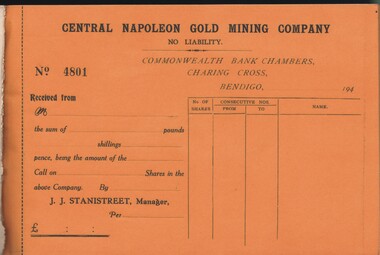
Document - MCCOLL, RANKIN AND STANISTREET COLLECTION: CENTRAL NAPOLEON GOLD MINING CO. N.L, 1940's
... Document: Hardcover Crocodile design, blue binding, unused reciept book for monies on shares in Central Napoleon Gold Mining Company, 2 loose Carbon pages, all unused, markings read 'Central Napoleon Gold Mine' on label glued on spine....ORGANIZATION Business industrial - mining McColl Rankin & Stanistreet mining gold mining Central Napoleon Document: Hardcover Crocodile design, blue binding, unused reciept book for monies on shares in Central Napoleon Gold Mining Company, 2 loose Carbon pages, all unused, markings read 'Central Napoleon Gold Mine' on label glued on spine. ...Document: Hardcover Crocodile design, blue binding, unused reciept book for monies on shares in Central Napoleon Gold Mining Company, 2 loose Carbon pages, all unused, markings read 'Central Napoleon Gold Mine' on label glued on spine.organization, business, industrial - mining, mccoll rankin & stanistreet, mining, gold mining, central napoleon -
 Whitehorse Historical Society Inc.
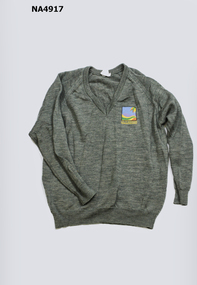
Clothing - Jumper City of Nunawading Parks and Recreation
... Jumper size 18 Grey/Pale Olive Green colour -Emblem on left breast -Square outlined in black, pale blue sky, 5 undulating stripes along bottom of square; purple yellow, green yellow orange : 6 gum leaves in upper right corner of square, yellow/ orange/Green/orange/yellow/yellow all with green central vein. Yellow stitched writing underneath emblem City of Nunawading parks ans Recreation...costume male uniform civilian Jumper size 18 Grey/Pale Olive Green colour -Emblem on left breast -Square outlined in black, pale blue sky, 5 undulating stripes along bottom of square; purple yellow, green yellow orange : 6 gum leaves in upper right corner of square, yellow/ orange/Green/orange/yellow/yellow all with green central vein. Yellow stitched writing underneath emblem City of Nunawading parks ans Recreation Clothing Jumper City of Nunawading Parks and Recreation ...Jumper size 18 Grey/Pale Olive Green colour -Emblem on left breast -Square outlined in black, pale blue sky, 5 undulating stripes along bottom of square; purple yellow, green yellow orange : 6 gum leaves in upper right corner of square, yellow/ orange/Green/orange/yellow/yellow all with green central vein. Yellow stitched writing underneath emblem City of Nunawading parks ans Recreationcostume, male uniform, civilian -
 Whitehorse Historical Society Inc.
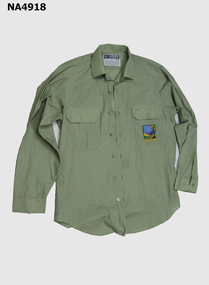
Clothing - Shirt
... Square outlined in Black; pale blue sky, 5 undulating stripes along bottom of square Purple, Yellow, green ,yellow, orange, 6 gum leaves upper right corner of square Yellow, orange.green, orange ,yellow, yellow, all with green central vein. Yellow stitched writing underneath City of Nunawading Parks and Recreation...Square outlined in Black; pale blue sky, 5 undulating stripes along bottom of square Purple, Yellow, green ,yellow, orange, 6 gum leaves upper right corner of square Yellow, orange.green, orange ,yellow, yellow, all with green central vein. Yellow stitched writing underneath City of Nunawading Parks and Recreation Clothing Shirt ...Shirt. Pale olive green long sleeved two pockets on breast with buttoned flaps Emblem on left breast . Square outlined in Black; pale blue sky, 5 undulating stripes along bottom of square Purple, Yellow, green ,yellow, orange, 6 gum leaves upper right corner of square Yellow, orange.green, orange ,yellow, yellow, all with green central vein. Yellow stitched writing underneath City of Nunawading Parks and RecreationMakers label Cushen Clothing Cocostume, male uniform, civilian -
 Whitehorse Historical Society Inc.
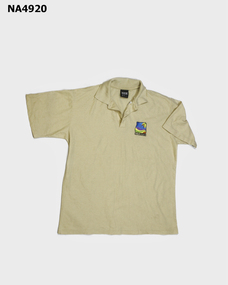
Clothing - Shirt - City of Nunawading
... Six 'gum' leaves upper right corner of square - yellow/orange/green/orange/yellow/yellow - all with green central vein. Black stitching under square: 'City of Nunawading Parks And Recreation'...Six 'gum' leaves upper right corner of square - yellow/orange/green/orange/yellow/yellow - all with green central vein. Black stitching under square: 'City of Nunawading Parks And Recreation' Clothing Shirt - City of Nunawading ...Polo Shirt: collar, short sleeves, 3 buttons from neck, cream/beige colour Emblem from left breast: square outlined in black; blue sky; five undulating stripes along bottom of square: purple/yellow/green/yellow/orange. Six 'gum' leaves upper right corner of square - yellow/orange/green/orange/yellow/yellow - all with green central vein. Black stitching under square: 'City of Nunawading Parks And Recreation'shirt, nunawading -
 Bendigo Military Museum
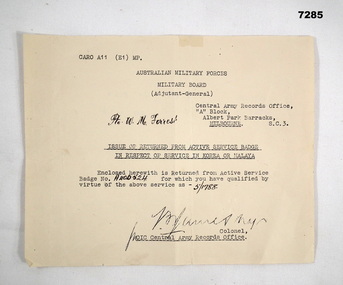
Letter - LETTER, RETURNED FROM ACTIVE SERVICE, Australian Military Forces, No date
... Letter, paper yellowed, "CARO A11 (E1) MP", all print in black from Central Army Records Office to Pte W.M. ..."Malaya 8.10.55 - 20.4.56" Letter, paper yellowed, "CARO A11 (E1) MP", all print in black from Central Army Records Office to Pte W.M. ...William Malcom (Bill) Forrest. Refer Cat No 7281P for the details of his two periods of engagement. The figures "Korea 19.3.53 - 31.8.54" are a different figure from what is in the DVA file.Letter, paper yellowed, "CARO A11 (E1) MP", all print in black from Central Army Records Office to Pte W.M. Forrest relating to the issue of the "Returned from Active Service Badge"Main points; "Pte W.M. Forrest - A400524", "5/1788". On rear hand written in blue pen. "Korea 19.3.53 - 31.8.1954". "Malaya 8.10.55 - 20.4.56"letter, badge, active service, korea, malaya -
Bacchus Marsh & District Historical Society
Plaque, Shire of Bacchus Marsh Coat of Arms
... This earlier coat of arms described in 1910 featured two cows standing on two bales of lucerne hay, with lucerne fields and fruit trees and rolling hills all round a central valley with two rivers running through it. ...This earlier coat of arms described in 1910 featured two cows standing on two bales of lucerne hay, with lucerne fields and fruit trees and rolling hills all round a central valley with two rivers running through it. ...Coat of Arms used by the Shire of Bacchus Marsh in the 1980s and 1990s. A coat of arms has been in use in the Shire at least from the early 20th century. This earlier coat of arms described in 1910 featured two cows standing on two bales of lucerne hay, with lucerne fields and fruit trees and rolling hills all round a central valley with two rivers running through it. This early coat of arms was superseded by the slightly different design shown here. When this change took place is not known. When the Bacchus Marsh Shire amalgamated with other Shires to form Moorabool Shire in 1994 this design was superseded.The plaque showing the Bacchus Marsh Shire Coat of Arms is in near perfect condition and as such is an excellent example of the physical symbols used to demonstrate the presence of local government in the Bacchus Marsh region. The images on the coat of arms also depict key economic and agricultural activities in the region which provides historical information about the region in a visual and artistic way.Painted cast bronze plaque with inscription on outer white band in black capital lettering: SHIRE OF BACCHUS MARSH. Inner circle painted blue with shield and decorative branches bearing yellow leaves on either side. Shield quartered and surmounted by stylised sunrise. In four quarters, representations of significant local primary and secondary industries. SHIRE OF BACCHUS MARSH.coats of arms, shire of bacchus marsh -
Port Melbourne Historical & Preservation Society
Photograph - Long serving employees, J Kitchen & Sons, Port Melbourne, 1928
... Background is a high hedge. All are men except for central figure front row - a woman in light dress with darker hat. ...Background is a high hedge. All are men except for central figure front row - a woman in light dress with darker hat. ...Narrow brown wooden framed photograph of long service recipients. Background is a high hedge. All are men except for central figure front row - a woman in light dress with darker hat. Reverse has paper copy of photo plus names and photos of 4 men unable to be present.Recipients of long-service gold watches, 1928. Port Melbourne J Kitchen & Sons Pty Ltdindustry, manufacturing, workers, j kitchen & sons pty ltd -
 Melbourne Tram Museum
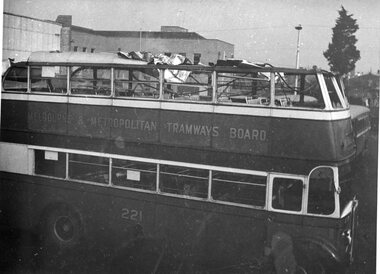
Photograph - set of 3 Black and White photographs, Melbourne & Metropolitan Tramways Board (MMTB), Jun. 1948
... Set of three Black and white photograph of a MMTB Leyland double decker bus No. 221 after striking the Vere St (Abbotsford) bridge on Saturday 19-6-1948, during a Collingwood - Fitzroy Football match. All photos taken at the Central Bus Garage, North Fitzroy. ...tramways Buses North Fitzroy Accidents Leyland Double Deck Buses Football TD5c class MMTB Buses bus 221 Written on the rear of each photo in pencil "Collided with Vere St Railway Bridge Sat 19th June 1948" Set of three Black and white photograph of a MMTB Leyland double decker bus No. 221 after striking the Vere St (Abbotsford) bridge on Saturday 19-6-1948, during a Collingwood - Fitzroy Football match. All photos taken at the Central Bus Garage, North Fitzroy. ...Set of three Black and white photograph of a MMTB Leyland double decker bus No. 221 after striking the Vere St (Abbotsford) bridge on Saturday 19-6-1948, during a Collingwood - Fitzroy Football match. All photos taken at the Central Bus Garage, North Fitzroy. Bus has the destination of FootballWritten on the rear of each photo in pencil "Collided with Vere St Railway Bridge Sat 19th June 1948" tramways, buses, north fitzroy, accidents, leyland, double deck buses, football, td5c class, mmtb buses, bus 221 -
 Bendigo Military Museum
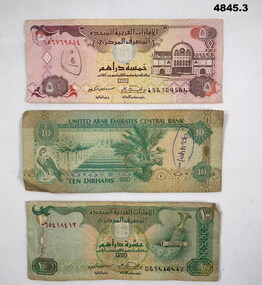
Currency - CURRENCY, UNITED ARAB EMERATES, C.1939 - 42
... .1) Currency note United Arab Emirates 5 Dirhams, front has a sketch of a building, colours red, brown, yellow, pink. .2) .3) Currency note United Arab Emirates 10 Dirhams, Arabic writing with image of a dagger, colours greens and black. All have “United Arab Emirates central Bank in large print”...Souvenired by WO Albert Corrie VX47191, refer Cat No 4847 for service Currency notes Arabic .1) In black, “156769584” .3) In black, “065418412” .1) Currency note United Arab Emirates 5 Dirhams, front has a sketch of a building, colours red, brown, yellow, pink. .2) .3) Currency note United Arab Emirates 10 Dirhams, Arabic writing with image of a dagger, colours greens and black. All have “United Arab Emirates central Bank in large print” Currency CURRENCY, UNITED ARAB EMERATES ...Souvenired by WO Albert Corrie VX47191, refer Cat No 4847 for service.1) Currency note United Arab Emirates 5 Dirhams, front has a sketch of a building, colours red, brown, yellow, pink. .2) .3) Currency note United Arab Emirates 10 Dirhams, Arabic writing with image of a dagger, colours greens and black. All have “United Arab Emirates central Bank in large print”.1) In black, “156769584” .3) In black, “065418412”currency, notes, arabic -
 Broadmeadows Historical Society & Museum
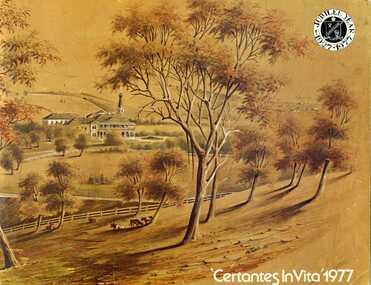
Booklet - School Yearbook, Salesian College, Rupertswood, "Certantes in Vita" 1977, 1977
... Academic excellence, spiritual growth, and active participation in co-curricular life were all central to the student experience. Highlights of the year included inter-house competitions, musical and dramatic performances, leadership initiatives, and community outreach programs—all of which contributed to a vibrant and inclusive school culture. ...Academic excellence, spiritual growth, and active participation in co-curricular life were all central to the student experience. Highlights of the year included inter-house competitions, musical and dramatic performances, leadership initiatives, and community outreach programs—all of which contributed to a vibrant and inclusive school culture. ...School yearbook, presenting details of the events and students of Salesian College, Rupertswood, Sunbury.A stapled, card-covered, sixty-four-page book with loose card cover.non-fictionSchool yearbook, presenting details of the events and students of Salesian College, Rupertswood, Sunbury.salesian college, rupertswood, sunbury, yearbook, "certantes in vita", 1977 -
 Broadmeadows Historical Society & Museum
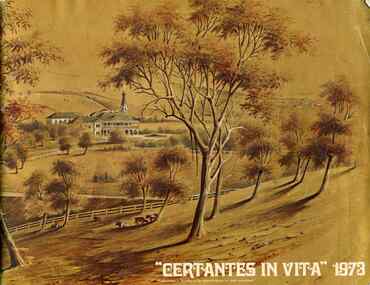
Booklet - School Yearbook, Salesian College, Rupertswood, "Certantes in Vita" 1973, 1973
... This year was characterised by a strong sense of camaraderie among students and staff, with academic pursuits, sporting achievements, and cultural activities all playing a central role in college life. Students participated in a wide range of events, from inter-house competitions and drama productions to community service initiatives and spiritual retreats. ...This year was characterised by a strong sense of camaraderie among students and staff, with academic pursuits, sporting achievements, and cultural activities all playing a central role in college life. Students participated in a wide range of events, from inter-house competitions and drama productions to community service initiatives and spiritual retreats. ...School yearbook, presenting details of the events and students at Salesian College, Rupertswood, Sunbury.A stapled, card-covered, fifty-two page book with loose card cover.non-fictionSchool yearbook, presenting details of the events and students at Salesian College, Rupertswood, Sunbury.salesian college, rupertswood, sunbury, yearbook, "certantes in vita", 1973 -
Bendigo Historical Society Inc.
Photograph - VAL CAMPBELL COLLECTION: PHOTOGRAPH OF ANNE M SUTHERLAND
... Sutherland On the back of the photo is written: Anne Maree Sutherland State Medalist Country & District A copy of the photo has written on the back: Anne Maree Sutherland State Medalist All Junior Country Medalist Central District Late 70 80s...Sutherland On the back of the photo is written: Anne Maree Sutherland State Medalist Country & District A copy of the photo has written on the back: Anne Maree Sutherland State Medalist All Junior Country Medalist Central District Late 70 80s Photograph VAL CAMPBELL COLLECTION: PHOTOGRAPH OF ANNE M SUTHERLAND ...Black and white head and shoulders photograph of Anne M Sutherland in a patterned swim suit. On the front of the photo is written: 1978 100m brst 2nd countries 1079 Countries 16yrs brst 2nd Countries 1976 WMB 200 Brst 3rd 12 YRS 100m Brst 1st Ind mdly 2nd 100m Fly 3rd 1974-75-78 Anne M. Sutherland On the back of the photo is written: Anne Maree Sutherland State Medalist Country & District A copy of the photo has written on the back: Anne Maree Sutherland State Medalist All Junior Country Medalist Central District Late 70 80srecreations, sports, swimming -
Moorabbin Air Museum
Equipment (item) - Graviscope for Lincoln (Australian) RAAF Ident No G6C/3972, Graviscope for Lincoln
... Plastic graviscope consists of a 277mm white disc, printed on both sides, overlaid on one side by a 224mm disc and the other side by a 175mm disc. All discs located by central screw, to which is attached a 160mm long x 25mm wide clear celluloid strip. ...Plastic graviscope consists of a 277mm white disc, printed on both sides, overlaid on one side by a 224mm disc and the other side by a 175mm disc. All discs located by central screw, to which is attached a 160mm long x 25mm wide clear celluloid strip. ...Description White plastic doubled sided Graviscope stored in protective leather carry case. Case is fitted with pair of press studs, pocket in front for holding instructions and is stamped "Graviscope / for / Lincoln / (Australian) / Manufactured by / Melb > W & G < Aust / R.A.A.F / Ident. No G6C/3972". Plastic graviscope consists of a 277mm white disc, printed on both sides, overlaid on one side by a 224mm disc and the other side by a 175mm disc. All discs located by central screw, to which is attached a 160mm long x 25mm wide clear celluloid strip. History / Summary The graviscope is a computing device, which in aircraft was used for measuring the centre of gravity in an aircraft. This would vary depending on crew, bomb load, fuel and stores carried. It was used in the British designed but Australian manufactured, Government Aircraft Factory (GAF) Lincoln heavy bomber, which was operated by the Royal Australian Air Force (RAAF) in the years following the Second World War. This aircraft was originally a derivative of the famous Avro Lancaster bomber. The Lincoln was used by both the RAAF and the Royal Air Force in operations against Malayan Communist terrorists during the Malayan Emergency, 1948-1960. This graviscope is of the type designed for and used by RAAF and RAF aircrew who operated this aircraft.Many by W and G Australia -
![Photo of the front of a The 1939-1945 Star medal. Made from yellow copper zinc alloy, the medal itself is cool-to-touch, with somewhat sharp 6 points. The obverse has a central and textured design of the Royal Cypher 'GRJ VI', surmounted by a crown. A circlet, the top of which is covered by the crown, surrounds the cypher and is inscribed 'THE 1939 - 1945 STAR'. The ribbon is tactile, feeling ribbed under finger. This photograph is taken upon a black background, with a scale card and object number included. [It appears the ribbons from this medal and 202508.260 have been added to the wrong medal.]](/media/collectors/64a5077bc83bd7b7b94f4211/items/68a50ebdc440dfc18c4a2f95/item-media/68a513dfc440dfc18c4aefd1/item-fit-380x285.jpg?cb=6) Returned Nurses RSL Sub-branch
Returned Nurses RSL Sub-branchMedal - The 1939-1945 Star
... central and textured design of the Royal Cypher 'GRJ VI', surmounted by a crown. A circlet, the top of which is covered by the crown, surrounds the cypher and is inscribed 'THE 1939 - 1945 STAR'. The reverse is engraved with: 'VFX53656 J.G. GIBSON'. The ribbon is tactile with red, navy, green, yellow and light blue stripes. The red edges and blue stripes symbolise engagement levels, while the green and gold centre represents the jungle and beaches. The dark blue, red, and light blue stripes signify equal contributions of the Navy, Army, and Air Force across all...central and textured design of the Royal Cypher 'GRJ VI', surmounted by a crown. A circlet, the top of which is covered by the crown, surrounds the cypher and is inscribed 'THE 1939 - 1945 STAR'. The reverse is engraved with: 'VFX53656 J.G. GIBSON'. The ribbon is tactile with red, navy, green, yellow and light blue stripes. The red edges and blue stripes symbolise engagement levels, while the green and gold centre represents the jungle and beaches. The dark blue, red, and light blue stripes signify equal contributions of the Navy, Army, and Air Force across all ...Medal belonged to Joan Grace Gibson (Mitchell) Service numbers: VFX53656 VX53656 VX38752. The 1939–1945 Star is a military campaign medal instituted by the United Kingdom on 8 July 1943 for award to British and Commonwealth forces for service in the Second World War. The reverse is plain, however Stars issued to Australian personnel typically have recipient names engraved on the reverse.The medal is of high significance and should be kept in the collection. Made from yellow copper zinc alloy with somewhat sharp six points. The obverse has a central and textured design of the Royal Cypher 'GRJ VI', surmounted by a crown. A circlet, the top of which is covered by the crown, surrounds the cypher and is inscribed 'THE 1939 - 1945 STAR'. The reverse is engraved with: 'VFX53656 J.G. GIBSON'. The ribbon is tactile with red, navy, green, yellow and light blue stripes. The red edges and blue stripes symbolise engagement levels, while the green and gold centre represents the jungle and beaches. The dark blue, red, and light blue stripes signify equal contributions of the Navy, Army, and Air Force across all fronts. The blue central stripe represents the traditional nurse's uniform, with red stripes signifying the Red Cross and military service. It is worth noting that typically the Pacific Star ribbon would be matched with a medal that also states The Pacific Star. However, this Pacific Star ribbon is matched with a medal that denotes the Second World War 1939-45 Star. [I believe that the ribbon on 202508.259 and 202508.260 have been swapped at some point.]. 'VFX53656 / J.G. GIBSON' [Engraved on reverse of medal]wwii, ww2, world war two, commonwealth forces, joan grace gibson -
Federation University Historical Collection
Booklet, GIAE Official Opening, 1976, 11/1976
... Central to the campus plan was the concept of an internal pedestrian street connecting all academic divisions to the central facilities. ...Central to the campus plan was the concept of an internal pedestrian street connecting all academic divisions to the central facilities. ...The Gippsland Institute of Advanced Education was established by an Order-in-Council in September 1968. On its establishment, the Institute assumed responsibility for the diploma coursed previously offered at Yallourn Technical College. In 1972 the Institute transferred part of its operations to the first of its permanent buildings on a large campus in rural surrounding near the township of Churchill, ten kilometres south of Morwell, and 160 kilometres east of Melbourne. The campus site plan report prepared in 1970 by the Institute's campus planners, Yuncken Freeman Architects Pty Ltd, provided the conceptual base for the development of a new campus at Churchill. All facilities were planned to converge on a central space; all having the ability to expand outwards. Central to the campus plan was the concept of an internal pedestrian street connecting all academic divisions to the central facilities. The first building was completed in 1972. The Administration Building, Visual Art & Maintenance Workshops, Multi-Purpose Building, and Student residences were designed by Yuncken Freeman Architects. The central Facilities Building (cafeteria and Union) were designed by Chancellor and Patrick, the Education Building and Applied Science Building is designed by Eggleston, McDonald and Secomb.Grey and yellow soft covered booklet prepared for the official opening of Gippsland Institute of Advanced Education.gippsland institute of advanced education, gippsland campus, churchill, m.w. hopper, c.h. ford, lindsay thompson, j.l. carrick, r.w. muncey -
 Flagstaff Hill Maritime Museum and Village
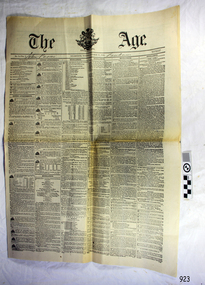
Newspaper - The Age, Francis Cooke, printer and publisher, 17-10-1854
... The central shield has the words "COLONY OF VICTORIA" printed below it. the handwritten script has the name John Pascoe, and the location of Fawner, a suburb of Melbourne. There are eight pages comprising of two large sheets, folded one inside the other and all sides printed on. ...The central shield has the words "COLONY OF VICTORIA" printed below it. the handwritten script has the name John Pascoe, and the location of Fawner, a suburb of Melbourne. There are eight pages comprising of two large sheets, folded one inside the other and all sides printed on. ...The newspaper is the very first edition of The Age. The central shield has the words "COLONY OF VICTORIA" printed below it. the handwritten script has the name John Pascoe, and the location of Fawner, a suburb of Melbourne. There are eight pages comprising of two large sheets, folded one inside the other and all sides printed on. This edition was printed and published by Francis Cooke, for the publishers Francis Cooke & Co. at The Age Newspaper and General Printing Office, 21 Elizabeth Street, South Melbourne, in the Colony of Victoria, which came into being on July 1st, 1851.This edition of The Age newspaper is very significant as it is the first edition, printed 17th October 1854, and contains shipping news amongst may other topics in its eight pages. Newspapers were very significant in Colonial times for a meas of communication throughout the colony. Newspaper, The Age newspaper, Vol. 1, No. 1, first edition, Tuesday October 17th 1854. eight pages. Large format. Inscription in script on top of first and last page. Handwritten in script "John Pascoe" "Fawkner" "COLONY OF VICTORIA" "PRINTED DAILY" "PRICE SIXPENCEflagstaff hill, warrnambool, shipwrecked-coast, flagstaff-hill, flagstaff-hill-maritime-museum, maritime-museum, shipwreck-coast, flagstaff-hill-maritime-village, the age, newspaper, melbourne, colony of victoria, first edition, 1854, john pascoe, fawkner -
 Federation University Historical Collection
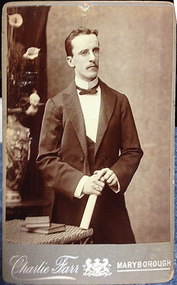
Photograph - Black and White, Charlie Farr, Duncan McDougall
... all the students in these classes to take up the study of this subject. I have every confidence that Mr. McDou gall will handle these large classes as successfully as the classes he had last year." By 1925 McDougall is being reported in the Perth Daily News: "Duncan McDougall, lecturer on electrical engineering and physics at the W.A. School of Mines, put forward a scheme for reducing the cost of mining in Kalgoorlie. He contended it was the duty of the State and Federal Governments to establish a central...all the students in these classes to take up the study of this subject. I have every confidence that Mr. McDou gall will handle these large classes as successfully as the classes he had last year." By 1925 McDougall is being reported in the Perth Daily News: "Duncan McDougall, lecturer on electrical engineering and physics at the W.A. School of Mines, put forward a scheme for reducing the cost of mining in Kalgoorlie. He contended it was the duty of the State and Federal Governments to establish a central ...Duncan McDougall was associated with the pioneering X-rays conducted by the Ballarat School of Mines in 1896. He was in the Mendelssohn Choir, and was associated with Professor Ross from University of Western Australia. The Ballarat Courier reported on 20 July 1896:"The Ballarat Courier reported on 20 July 1896 Thanks to the energy of the staff of the School of Mines Ballarat and particularly to Messers F J Martell and Duncan McDougall the assistance of Roentgen xrays will soon be available, for the relief of suffering at this institution. On Wednesday evening 22 July 1896 a number of ladies and gentlemen witnessed a series of experiments with the Roentgen x rays." Duncan McDougall later worked at the Kalgoorlie School of Mines as a lecturer in physics and mathematics. on 19 February 1905 the 'West australian' newspaper announced: " Mr Duncan McDougall, formerly of the Ballarat, and later of the Maryborough Schools of Mines, was appointed to succeed Mr. Hart. Mr. McDougall had also charge of the branch class at Midland Junction. In both cases his work proved thoroughly good. The alterations in the trades class regulations will cause all the students in these classes to take up the study of this subject. I have every confidence that Mr. McDou gall will handle these large classes as successfully as the classes he had last year." By 1925 McDougall is being reported in the Perth Daily News: "Duncan McDougall, lecturer on electrical engineering and physics at the W.A. School of Mines, put forward a scheme for reducing the cost of mining in Kalgoorlie. He contended it was the duty of the State and Federal Governments to establish a central electricity generation plant in Kalgoorlie and supply power to the mines at not more than 1/2d a unit, at 3/4d per unit for winding only, and at 2d per unit for lighting. He suggested, the transmission of this power over a radius of 25 miles from Kalgoorlie." (06 May 1925)Photograph of a man in a shirt, bow tie and jacket, holding a scroll and wearing glasses. He has two books beside him on a table. The man is Duncan McDougall, and is portrait was taken in the Charlie Farr studio at Maryborough, Victoriaduncan mcdougall, mcdougall, x-ray, xray, xray, ballarat school of mines, choir, mendelssohn, kalgoorlie -
 Federation University Historical Collection
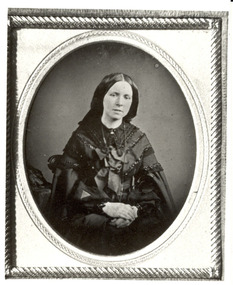
Photograph, Catherine Coghill, 1860s
... Tragically all three, and the gold sovereigns they were carrying to purchase same, were lost when the steamship struck rocks and was wrecked off the rugged Green Cape Coast, just south of Bega, New South Wales [Jane Dyer, 15 June 2024] catherine coghill catherine holmes william coghill william coghill junior holmes family collection chatham-holmes family collection ly-ee-moon mourning shipwreck women pioneer women family history Black and white photograph of a seated woman wearing black clothing, a cap with centrally parted hair. ...Catherine Holmes married William Coghill Junior. William died in 1884. This is possibly a photo of Catherine in her mourning clothes. They had no children. His estate passed to Catherine. In 1886 Catherine accompanied by her brother, Edward Carter Holmes, Mr. Holmes a farmer at Ascot and her companion Mrs. Mark Gardiner [Gardner], wife of the contractor for laying down the wood pavement in Elizabeth- street, sailed for Queensland aboard the elegant steamship, ‘Ly-ee-Moon’ to visit her sister Adelaide Reid and purchase a property in the Darling Downs, Qld. Tragically all three, and the gold sovereigns they were carrying to purchase same, were lost when the steamship struck rocks and was wrecked off the rugged Green Cape Coast, just south of Bega, New South Wales [Jane Dyer, 15 June 2024]Black and white photograph of a seated woman wearing black clothing, a cap with centrally parted hair. The woman is Catherine Coghill (formerly Holmes), who married William Coghill Jnr. catherine coghill, catherine holmes, william coghill, william coghill junior, holmes family collection, chatham-holmes family collection, ly-ee-moon, mourning, shipwreck, women, pioneer women, family history -
 Federation University Historical Collection
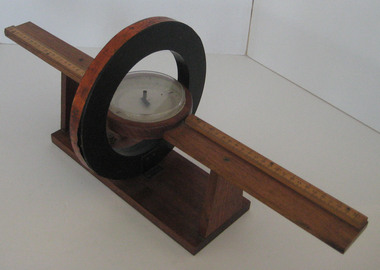
Equipment - Scientific Instrument, Tangent Galvanometer
... centrally wired to a vertical coil. Horizontal distance scales, one each side and perpendicular to the core. All...centrally wired to a vertical coil. Horizontal distance scales, one each side and perpendicular to the core. All ...Used for measuring electric current. It works by using a compass needle to compare a magnetic field generated by the known current to the magnetic field of the Earth.A "compass rose" type of horizontal full-circle scale, with 4 0-90 unit quandrants. Balanced, free-floating needle. Located centrally wired to a vertical coil. Horizontal distance scales, one each side and perpendicular to the core. All mounted on polished wood base, equipped with 3 terminal posts. Materials: glass, wood, metal.elementary, physics, experiment, galvanonometer, ballarat school of mines, scientific instruments -
 Flagstaff Hill Maritime Museum and Village
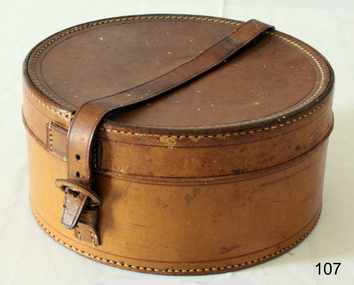
Container - Collar Box, Rexbilt Leather Company, 1924-1930
... The advent of central heating, lighter weight fabrics, and a more relaxed social attitude to fashion all contributed to making men’s clothes more comfortable and less formal....The advent of central heating, lighter weight fabrics, and a more relaxed social attitude to fashion all contributed to making men’s clothes more comfortable and less formal. ...The evolution of the stiff shirt collar occurred in the 1830s when the detachable collar was "invented." At this time, the detachable collars were simply normal shirt collars like you’d see today, but sold separately from the shirt itself and needed to be kept in a container to keep them clean and accessible. The detachable collars were a way to avoid the weekly laundry. Because collars and cuffs were both the most visible parts of shirts and the parts most likely to get dirty, separating them allowed people to do the shirt equivalent of only washing your armpits after you go to the gym. That meant that the main body of the shirt could remain soft while the collar and cuffs that were visible could be starched and shaped. The popularity of detachable collars and starched collars, in general, began to fade in the 1920s and 30s. As shirt styles began to change. The advent of central heating, lighter weight fabrics, and a more relaxed social attitude to fashion all contributed to making men’s clothes more comfortable and less formal.An item that was used to store detachable men’s shirt collars from the early 20th century at a time when men's fashion was more formal and how a person dressed especially for formal occasions dictated a person's social standing. The subject item comes from a time that gives a snapshot into the past at the social norms of the time.Collar box, leather, cylindrical, includes strap, buckle, stitching and cardboard lining and man's white collarCollar inside box marked "CF652 Rexbilt Size 16 1/2 x 1 3/4" flagstaff hill, warrnambool, shipwrecked coast, flagstaff hill maritime museum, shipwreck coast, flagstaff hill maritime village, great ocean road, collar box, men's collar box, men's collar, leather collar box -
 Flagstaff Hill Maritime Museum and Village
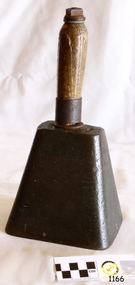
Functional object - Bell, Probably second half of 19th Century or first half of the 20th Century for this particular item
... In larger schools it was positioned in a central area, and one bell was used to signal to all classrooms. In North America it was more usual to find a large bell on a stand located in a central area of the school where it could be heard by everyone throughout the premises. ...In larger schools it was positioned in a central area, and one bell was used to signal to all classrooms. In North America it was more usual to find a large bell on a stand located in a central area of the school where it could be heard by everyone throughout the premises. ...The school bell has been used in various forms for several centuries. In Australia and the UK it was often a hand bell, located on the teacher's desk in a small school. In larger schools it was positioned in a central area, and one bell was used to signal to all classrooms. In North America it was more usual to find a large bell on a stand located in a central area of the school where it could be heard by everyone throughout the premises. More recently, the school bell has become wall located, and electrically activated, using a mechanical timing apparatus. Now the same bell is computer programmed and activated, although there are many older bells still in operation. The school bell was rung at the beginning at the school day, often to summon students to the morning assembly in larger schools. It was then rung throughout the day to signal the start and end of specific lesson periods, the beginning and end of school morning and afternoon breaks, the lunch period, and the end of the school day, no doubt eagerly awaited by many students! The school bell was used as a timing device in schools to signal the start and end of specific activities.Bell brass with heavy metal square shaped base and wooden handle-hand held, Kel(?)her Melbourne on the topInscribed on the metal at the top of the bell are the letters "Kel(?)her Melbourne" flagstaff hill, warrnambool, shipwrecked-coast, flagstaff-hill, flagstaff-hill-maritime-museum, maritime-museum, shipwreck-coast, flagstaff-hill-maritime-village, bell, school, lessons -
 The Beechworth Burke Museum
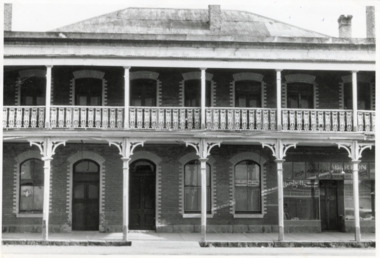
Photograph - Two Photographs, Saunders, 1864-1972
... Situated on a road once synonymous with Melbourne to Sydney roadtrips, and the allure of the gold mines, the popularity of the Star drew all manner of clientele from across the country. As such a central hub, the ‘Star Assembly Rooms’ were used as a meeting place for debates, discussions, festivities, and problem solving among the various working sects of the area. ...Situated on a road once synonymous with Melbourne to Sydney roadtrips, and the allure of the gold mines, the popularity of the Star drew all manner of clientele from across the country. As such a central hub, the ‘Star Assembly Rooms’ were used as a meeting place for debates, discussions, festivities, and problem solving among the various working sects of the area. ...Taken some time after 1864, these photographs depict the Star Hotel both directly (8674.1) and from the Hotel north west down Ford Street (8674.2). The images depict the building with its modern exterior, having settled for this brick form after several other building designs. The Star Hotel was the first hotel opened in Beechworth, and would go through a series of dramatic changes under its first three owners. The original timber structure was built by W.H. Neuber, though at the time it was only known as ‘The Beechworth Hotel’. The site was later purchased in 1855 by mining entrepreneur, and prolific business owner, John Alston “Six Stars” Wallace. He would go on to extend the established hotel, rebuilding much of it with weatherboard and a shingled roof, adding a two storey structure with a verandah and a theatre capable of supporting 400-500 people, which was often used for international performances. Renamed as the Star Hotel, it was the second in a chain franchise, eventually leading to the “Six Stars” moniker Wallace went by, with hotels at Rutherglen, Chiltern, Yackandandah, Bright, Snake Valley, and of course, Beechworth. Under his ownership, it developed into a popular location for merchants, wayfarers, and locals alike, with the help of his brother Peter as manager. Situated on a road once synonymous with Melbourne to Sydney roadtrips, and the allure of the gold mines, the popularity of the Star drew all manner of clientele from across the country. As such a central hub, the ‘Star Assembly Rooms’ were used as a meeting place for debates, discussions, festivities, and problem solving among the various working sects of the area. These meetings included shareholder discussions for prospecting companies, railway planning, council meetings, and discussions surrounding the interactions between European and Chinese miners, both good and bad. By late 1856, John had the Beechworth at auction through J.H. Grey & Co. It was most likely due to the high profile murder of the manager, Robert Murdoch, during an altercation in relation to a dine and dash event by a Swedish miner, Charles Jansen, who had been ‘excited by drink’ on November 17th. He had refused to pay for his meal and waiter James Mitchell failed to persuade him otherwise. Mitchell, or possibly Murdoch himself, forced him out as tempers and threats escalated. As the photos tell, there are a number of doors which may be entered through, and Jansen used an alternate entrance to access the building. Murdoch was investigating the noise when he encountered the furious man. He was subsequently stabbed with no warning by a small clasp knife, as he tried to stop the intrusion. His exclamations, "I’m stabbed, I’m stabbed!” alerting other occupants, and Jansen was restrained and arrested. Murdoch died the next day from his injuries, with the inquest carried out on the theatre stage. Some 3000 members of the town attended the funeral, and the Star hung black cloth in memory of Robert and his death. Afterwards, an auction caw the property pass to Messrs Robertson and Quirk, though would return shortly thereafter to Six Stars’ portfolio. Six Stars would later sell off his properties from 1862, with the Beechworth Star purchased by 1864 by John Sitch Clark. This allowed Clark to redevelop a significant portion of the Hotel, stripping a central section and constructing the brick structure that survives today, reopening the Star in July that year. It was after this time that our photographs were taken. Clark would later sell the property to Frank Mitchell, shortly before his own death. The next owner, Frederick Allen, lived on the property before the deed was sold to him in the 1880s. He would later sell the property to William Carroll in 1890, with proprietorship eventually moving to Mr. W.H. Porter, and transferring to a Mr. Marendaz by 1913 and Mr. Holly in 1915. Licensing disputes would arise 1917 between Margaret Carroll and a Mrs. McDonald, before it became delicenced some years prior to 1935. It was around this year that the property was bought by Mr. W.J. Pemberton at the meagre price of £500, down from the £13,000 Six Stars originally auctioned it for. It served as a Youth Hostel for a period of time around 1972, and currently the building serves as a private accommodation on the second floor, with shops taking up the ground floor level.These photographs of the Beechworth Star Hotel as they depict a form of Beechworth's first hotel, and also the site of a high profile murder. Two black and white rectangular photographs printed on matte photographic paper.8674.1 (reverse) Beechworth/ 734/ Tanswell’s Hotel [crossed out]/? Old Star/ Hotel,/[small pencil scratching]/ Saunders/ BMM 8674.1 8674.2 (reverse) Beechworth/ 60%[circled]/ Old Star Hotel/Building etc.,/ 12 ½ cm/ 3"[circled, arrows extending horizontally to edges]/[arrows extending top to bottom mid-right of reverse]/ Saunders/ 734[circled]/ BMM 867.2,/ [thin scribbled bordering around top, right, and bottom edges]star hotel, beechworth hotel, john alston wallace, ja wallace, john sitch clark, frederick allen, robert murdoch, meeting place, tragedy, theatre, mining town -
 The Beechworth Burke Museum
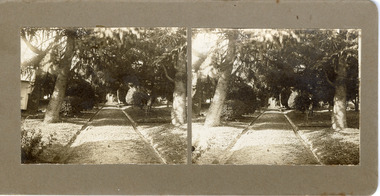
Photograph - Stereoscopic Photograph, c1900
... all of north-east Victoria, including Indigo Shire. Ovens Hospital Hospital garden Gardens and Parks Ovens District Hospital Reverse: 97-2292 / View up centre path of Hospital / A03177 / BMM3177 / Note: A03178 / View of the central path of the Ovens Hospital / (Church St) Beechworth Black and white stereoscopic photograph mounted on card. ...The gardens of Ovens District Hospital were laid out and planted by R H Jenkyns in 1874. Over 200 species of trees and shrubs were planted, including several large Himalayan Cedars (Cedrus deodora), a Coast Redwood (Sequoia sempervirens), rare Scots Pine (Pinus sylvestris), Pencil Cedar (Juniperus virginiana), Bunya Bunya Pines (Araucaria bidwillii), a Purple-leaved Dutch Elm (Ulmus x hollandica 'Purpurascens'), American Ash (Fraxinus americana), Pinus radiata, and numerous Populus alba trees and suckers. The gardens were considered integral to the healing process, also including orchards and kitchen gardens. In the 1880s, tourists flocked to Beechworth as the area became recognised as a health resort and picturesque beauty spot. Although the hospital closed in 1940, and parts were subsequently demolished, the gardens remain and form part of the site's listing on the Victorian Heritage Register. This photograph is part of a collection of items held by the Burke Museum relating to Ovens District Hospital. At the time of being built, the Ovens District Hospital was the only hospital between Melbourne, Victoria, and Goulburn, New South Wales, treating patients from all of north-east Victoria, including Indigo Shire.Black and white stereoscopic photograph mounted on card.Reverse: 97-2292 / View up centre path of Hospital / A03177 / BMM3177 / Note: A03178 / View of the central path of the Ovens Hospital / (Church St) Beechworthovens hospital, hospital garden, gardens and parks, ovens district hospital -
 Mission to Seafarers Victoria
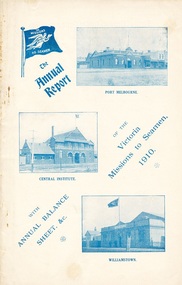
Administrative record (item) - Annual report, The Victoria Missions to Seamen, 1910 Annual Report of the Victoria Missions to Seamen, 1911
... A white booklet with blue printed text, the Missions to Seamen's logo and photographs of the Port Melbourne, Central Institute and Williamstown locations. It contains the annual report for all the Missions to Seamen and associated organisations in Victoria. ...all seamen's missions and organisations in Victoria, as well as associated groups, such as the Ladies Harbour Lights Guild. These reports provide documentation of the activities conducted by the Mission, as well recording the people involved. 1910 annual report Victorian seamen's mission williamstown sailors' rest port melbourne siddeley street central institute seamen's institute mission to seafarers melbourne administrative document-annual report written in pencil: MTS0235 (Front cover) A white booklet with blue printed text, the Missions to Seamen's logo and photographs of the Port Melbourne, Central Institute and Williamstown locations. ...The report was produced by and distributed to members, containing reports from the Committee, Chaplain, the Ladies Harbours Lights Guild, as well as a list of subscriptions and rules for the 1910 period. This copy is the first to feature images of all three main Mission venues established in Port Phillip pre WW1.Annual reports were published by the Mission to Seamen each year, and included reports from all seamen's missions and organisations in Victoria, as well as associated groups, such as the Ladies Harbour Lights Guild. These reports provide documentation of the activities conducted by the Mission, as well recording the people involved.written in pencil: MTS0235 (Front cover)1910, annual report, victorian seamen's mission, williamstown, sailors' rest, port melbourne, siddeley street, central institute, seamen's institute, mission to seafarers, melbourne, administrative document-annual report -
 Mission to Seafarers Victoria
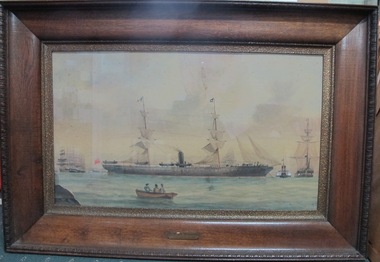
Painting, George Frederick Gregory (1821-1887), P&O S.S. Bangalore, 1867 - 1886
... Backing paper and seal has all been removed except for hanging wire. Central at front lower edge of frame is a small chipped wood plaque with inscription....Backing paper and seal has all been removed except for hanging wire. Central at front lower edge of frame is a small chipped wood plaque with inscription. ...This ship was number 1 of 2 ships named Bangalore and run by P & O. This ship has listed the same tonnage as that on the inscription on the frame of this work. The ship was subsequently sold in 1886 sold to Hajee Cassum Joosub and used for passengers on pilgrimage into Jeddah. Another view of the history of the Bangalore is that to be found at the Maritime Museums of Sydney listing of another painting of the Bangalore which provides a somewhat different history. It is possible that the story of Bangalore 1 and Bangalore 2 have become conflated further research is needed to verify. see Links field. SS BANGALORE was built in 1867 by William Denny of Dumbarton. Owned by P&O, SS BANGALORE operated from Bombay and Galle to Melbourne and Sydney from 1872 to 1886 as a passenger and mail ship. In 1891 BANGALORE was sold to Wilh. Wilhelmsen, Norway and renamed SS CORINGA.Marine art, Maritime artP&O S.S. Bangalore by George Frederick Gregory (1821-1887)Thinly painted image on board featuring centrally a moored, at anchor, 19th C dual masted steamship with black funnel and flying at the stern a red ensign. To either side are conventional rigged clippers or sailing ships. Near the bow of the steamship there seems to be a tug or paddle steamer face on. In the foreground is a small rowing boat with boatman and two passengers, a male and a female. The painting on board is mounted in a large polished or varnished cedarwood frame with edge carving and a decorative pitted slip which holds in place a thin piece of glazing. Backing paper and seal has all been removed except for hanging wire. Central at front lower edge of frame is a small chipped wood plaque with inscription.Painted in black on plaque and coloured black: "P & O S.S. "BANGALORE" / 2342 tons Built 1867"s.s. bangalore, marine painting, sailing ships, 1867, william denny, artwork-paintings, peninsular and oriental steam navigation company, steamship, p&o, sandridge, port melbourne, hobson's bay, charles dickson gregory, centenary maritime exhibition, george frederick gregory (1821-1887), ss bangalore
