
Showing 11 items matching "all purpose band"
-
 Federation University Historical Collection
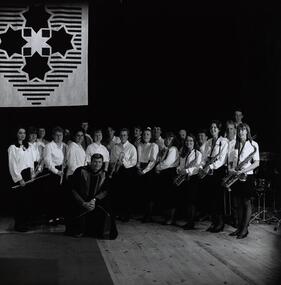
Photograph - Black and White, Warren Tiller and the All Purpose Band Graduation, c1995
... Warren Tiller and the All Purpose Band Graduation...all purpose band...The All Purpose Band Graduation with the conductor Warren Tiller. ...The All Purpose Band Graduation with the conductor Warren Tiller. ...The All Purpose Band Graduation with the conductor Warren Tiller. Lloyd Stinton is on the cornet, back row, fourth from the right.Formal grouping of students and conductor Warren Tiller. They are standing on the stage in the Mt Helen Campus Founders Hall, with the Ballarat College of of Advanced Education weaving in the background. all purpose band, warren tiller, lloyd stinton, music, band, brass instruments -
 Warrnambool and District Historical Society Inc.
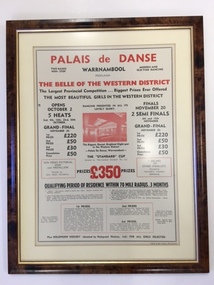
Document - Palais de Dance Warrnambool, 1954
... band leaders such as Tommy Davidson and Vin Mills. In 1974 the Warrnambool City Council bought the building and it was used only intermittently for entertainment purposes. Today the building is in private hands and is used for commercial and business purposes. This advertisement is of considerable significance as it comes from the Palais de Danse dance theatre which was important as a social institution in Warrnambool for over 30 years. The advertisement also reminds us of the era (1940s, 50s, 60s) when beauty pageants and Belle of the Ball competitions were popular all ...Warrnambool’s first Palais was established in the Hotel Mansions on the corner of Koroit and Kepler Streets and destroyed by fire in 1929. The second Palais was established at the Liberty Theatre in Lava Street. The third Palais was established in the Oddfellows Hall building in Koroit Street in 1939. Dances were held weekly and sometimes more often and attracted musical talent from the Warrnambool district and even from Melbourne with band leaders such as Tommy Davidson and Vin Mills. In 1974 the Warrnambool City Council bought the building and it was used only intermittently for entertainment purposes. Today the building is in private hands and is used for commercial and business purposes. This advertisement is of considerable significance as it comes from the Palais de Danse dance theatre which was important as a social institution in Warrnambool for over 30 years. The advertisement also reminds us of the era (1940s, 50s, 60s) when beauty pageants and Belle of the Ball competitions were popular all over Australia. This is a document in a brown plastic frame with a gold-coloured metal inside edging. The frame has a glass front. The document is a 1954 advertisement for the Palais de Danse dance floor in the Oddfellows Hall in Koroit Street, Warrnambool. The advertisement has black and red printing on a buff-coloured background. The advertisement has an ornamental edge around the printing and a red-coloured photograph of the dance floor. ‘Palais de Danse, Warrnambool, proclaims The Belle of the Western District, The Largest Provincial Competition, Biggest Prizes Ever Offered, The Most Beautiful Girls in the Western District’ etc etcpalais de danse, warrnambool, beauty pageants, warrnambool -
 Bendigo Historical Society Inc.
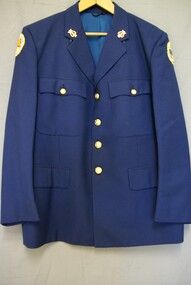
Clothing - MARONG MUNICIPAL BAND BLAZER, 1980's -2000
... All buttons have a metal back, and metal loop, which enables the buttons to be pinned to the garment, enabling removal for cleaning purposes. Clothing MARONG MUNICIPAL BAND ...Clothing. Pointed lapel collar, with underside of collar lined with felt. Two brass metal badges in a Leidertafel style - one on each side of collar. Cloth circular badges at the top of each sleeve are embroidered with a coat-of-arms, below which are two shields, one blue, and embroidered with a bunch of grapes, one red embroidered with a sheaf of wheat, a sheep, and perhaps a symbol of the landscape. Two breast pockets, rectangular with rounded lower corners and a shield shaped flap, closed with a 2 cm brass button impressed with a laurel wreath, and horn, suspended by a cord, and triple loop-a replica of British Light Infantry buttons. Two lower ''pockets'' are flaps only, giving the impression of a pocket only. Jacket lined with blue taffeta-like fabric-possibly polyester. One internal bound pocket inside right front. Four 2.5cm brass buttons (as on pockets) at centre front opening. All buttons have a metal back, and metal loop, which enables the buttons to be pinned to the garment, enabling removal for cleaning purposes.On inside breast pocket: A Quality Garment by Australian Government Clothing Factory. On back of buttons : Stokes Australia.costume, male ceremonial, marong municipal band blazer -
 Anglesea and District Historical Society
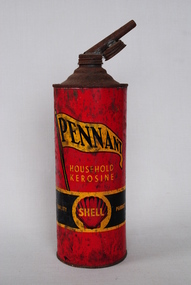
Can - Household Kerosine, Shell Company of Australia, Probably 1948 to 1955 (when logo changed)
... Front: FILL THIS CONTAINER WITH PENNANT KEROSINE ONLY / PENNANT - HOUSEHOLD KEROSINE FOR LIGHTING, HEATING, COOKING , REFRIGERATORS AND ALL HOUSHOLD PURPOSES / 1 IMPERIAL QUART - THE SHELL COMPANY OF AUSTRALIA LIMITED / INCORPORATED IN GREAT BRITAIN. Back: PENNANT HOUSHOLD KEROSINE / QUALITY SHELL PRODUCT (in Shell logo). Red tin with yellow flag (black writing). Yellow writing and black band...household kerosine pennant the shell company of australia Front: FILL THIS CONTAINER WITH PENNANT KEROSINE ONLY / PENNANT - HOUSEHOLD KEROSINE FOR LIGHTING, HEATING, COOKING , REFRIGERATORS AND ALL HOUSHOLD PURPOSES / 1 IMPERIAL QUART - THE SHELL COMPANY OF AUSTRALIA LIMITED / INCORPORATED IN GREAT BRITAIN. Back: PENNANT HOUSHOLD KEROSINE / QUALITY SHELL PRODUCT (in Shell logo). Red tin with yellow flag (black writing). Yellow writing and black band ...Kerosine can with pourer painted red with yellow lettering and black band around bottom of can. Shell logo and yellow Pennant flag on pole. Includes pouring spout.Front: FILL THIS CONTAINER WITH PENNANT KEROSINE ONLY / PENNANT - HOUSEHOLD KEROSINE FOR LIGHTING, HEATING, COOKING , REFRIGERATORS AND ALL HOUSHOLD PURPOSES / 1 IMPERIAL QUART - THE SHELL COMPANY OF AUSTRALIA LIMITED / INCORPORATED IN GREAT BRITAIN. Back: PENNANT HOUSHOLD KEROSINE / QUALITY SHELL PRODUCT (in Shell logo). Red tin with yellow flag (black writing). Yellow writing and black band around bottom of tin. Includes cap with spout.household kerosine, pennant, the shell company of australia -
 Ballarat Tramway Museum
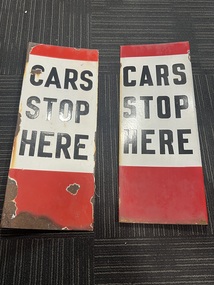
Sign, "CARS STOP HERE", 1960's
... Small red band at top, white band with letters CARS STOP HERE and large red band underneath, on both sides to indicate to drivers a compulsory stop. That is, all tram to stop at the location. The same sign was used for the same purpose in Melbourne. ...Small red band at top, white band with letters CARS STOP HERE and large red band underneath, on both sides to indicate to drivers a compulsory stop. That is, all tram to stop at the location. The same sign was used for the same purpose in Melbourne. ...Small red band at top, white band with letters CARS STOP HERE and large red band underneath, on both sides to indicate to drivers a compulsory stop. That is, all tram to stop at the location. The same sign was used for the same purpose in Melbourne. Has three holes for screws on the upstand or folded section. See item 9570 for a "HAIL CARS HERE" version. Demonstrates the signage used by the SEC (and the MMTB) to indicate tram stops and in particular compulsory tram stops. Piece of sheet steel folded to give an upstand or method of attachment to a pole, enameled with red, white, and black paint for use at tram stops. Two copies held.trams, tramways, ballarat, secv, tram stops, furniture -
 Ballarat Tramway Museum
Sign, "CARS STOP HERE", 1960's
... Small red band at top, white band with letters CARS STOP HERE and large red band underneath, on both sides to indicate to drivers a compulsory stop- That is all tram to stop at the location. Same sign used for same purpose...Small red band at top, white band with letters CARS STOP HERE and large red band underneath, on both sides to indicate to drivers a compulsory stop- That is all tram to stop at the location. Same sign used for same purpose ...Piece of sheet steel, enamelled with red, white and black paint for use at tram stops. Small red band at top, white band with letters CARS STOP HERE and large red band underneath, on both sides to indicate to drivers a compulsory stop- That is all tram to stop at the location. Same sign used for same purpose in Melbourne. Two copies held. See also Reg Item 7395 for another sample.trams, tramways, ballarat, secv, tram stops, furniture -
 Beechworth RSL Sub-Branch
Boots General Purpose (GP)
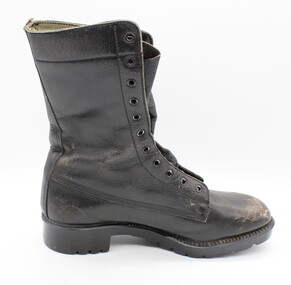
... all exposed for a quick and easy cutting to release the boot in case of injury to wearer. These boots were typically worn on parade,training and in combat during the Vietnam war era and after. boots general purpose g.p. vietnam war “Dunlop made in Australia” and “5/5” on sole in front of heel. Inscribed on top reinforced inside leather band ...These boots had a metal plate inserted in sole to protect the feet of personnel wearing boot. This was after earlier boots without this protection did not protect the wearer from sharpened spikes eg bamboo set in pits or “punji” pits, during the Vietnam war. The laces were done up by knotting one end,threading from bottom hole across to opposite hole,up next hole on same side,across to opposite hole etc. This meant that only one loop per opposite holes was all exposed for a quick and easy cutting to release the boot in case of injury to wearer.These boots were typically worn on parade,training and in combat during the Vietnam war era and after.The LEFT boot solid black leather uppers with split leather tongue sewn to sides - making the boot semi water and insect proof.The sole is hard black rubber compound with 7 cleats on sole and 3 cleats on heel,all part of rubber sole. Woven black cotton laces. 30 mm leather reinforcing strip sewn on inside top of boot. 11 by 5mm metal holes per boot for laces. Sole is welded on. “Dunlop made in Australia” and “5/5” on sole in front of heel. Inscribed on top reinforced inside leather band is- “ B 22 R.B.T 1439 188” on one side and “ 5/6” on the other.boots, general purpose, g.p., vietnam war -
 Beechworth RSL Sub-Branch
Boots General Purpose (GP)
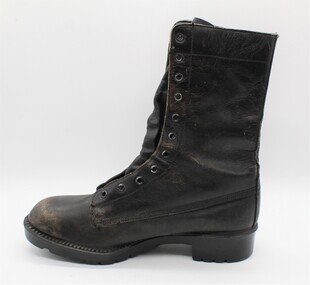
... all exposed for a quick and easy cutting to release the boot in case of injury to wearer. These boots were typically worn on parade,training and in combat during the Vietnam war era and after. boots general purpose g.p. vietnam war “Dunlop made in Australia” and “5/5” on sole in front of heel. Inscribed on top reinforced inside leather band ...These boots had a metal plate inserted in sole to protect the feet of personnel wearing boot. This was after earlier boots without this protection did not protect the wearer from sharpened spikes eg bamboo set in pits or “punji” pits, during the Vietnam war. The laces were done up by knotting one end,threading from bottom hole across to opposite hole,up next hole on same side,across to opposite hole etc. This meant that only one loop per opposite holes was all exposed for a quick and easy cutting to release the boot in case of injury to wearer.These boots were typically worn on parade,training and in combat during the Vietnam war era and after.The RIGHT boot solid black leather uppers with split leather tongue sewn to sides - making the boot semi water and insect proof.The sole is hard black rubber compound with 7 cleats on sole and 3 cleats on heel,all part of rubber sole. Woven black cotton laces. 30 mm leather reinforcing strip sewn on inside top of boot. 11 by 5mm metal holes per boot for laces. Sole is welded on. “Dunlop made in Australia” and “5/5” on sole in front of heel. Inscribed on top reinforced inside leather band is- “ B 22 R.B.T 1439 188” on one side and “ 5/6” on the other.boots, general purpose, g.p., vietnam war -
 Victorian Bands' League
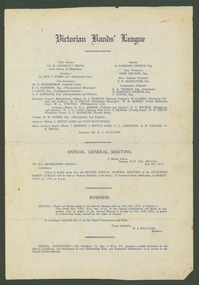
Document, Victorian Bands' League : Annual General Meeting (14/07/1933), 1933
... all bands and delegates. It outlines the business of the league up until this date and the financial details. It is evident that a number of bandsmen from all over Victoria took an interest in the league given the locations and bands of the office bearers. This AGM notice is extremely significant to the history of the Victorian Bands' League due to the information that's contained and the style of presentation. It is unclear whether other AGM notices still survive which makes this rare notice very valuable for research purposes ...This is an extremely significant document highlighting the operations of the Victorian Bands' League in only its third year. Here we have an Annual General Meeting notice and report which would have been sent to all bands and delegates. It outlines the business of the league up until this date and the financial details. It is evident that a number of bandsmen from all over Victoria took an interest in the league given the locations and bands of the office bearers.This AGM notice is extremely significant to the history of the Victorian Bands' League due to the information that's contained and the style of presentation. It is unclear whether other AGM notices still survive which makes this rare notice very valuable for research purposes.Printed on stiff papervictorian bands' league, brunswick city, warrnambool municipal, collingwood citizens', warracknabeal and district, mentone citizens', northcote citizens' and soldiers', heidelberg municipal, south melbourne city, williamstown city, yallourn and district, shepparton and district, geelong west city, terang brass, hamilton town, stawell brass, metropolitan fire brigade -
 Melbourne Legacy
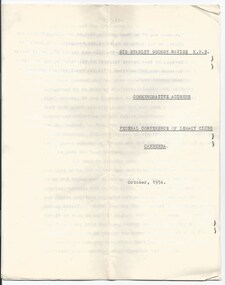
Document - Speech, Commemorative Address - Sir Stanley Savige K.B.E. Federal Conference of Legacy Clubs, Canberra, 10/1954
... This small band adopted the name of “Legacy”, but its purpose then was, in the main, to assist in safeguarding the interests of ex-servicemen in this country. Worthy although the case undoubtedly was, the conception and ideal which was to distinguish Legacy from all kindred post-war movements did not emerge until two years later. ...This small band adopted the name of “Legacy”, but its purpose then was, in the main, to assist in safeguarding the interests of ex-servicemen in this country. Worthy although the case undoubtedly was, the conception and ideal which was to distinguish Legacy from all kindred post-war movements did not emerge until two years later. ...After the death of Stan Savige this address was given at the Canberra Conference in October 1954. It is tribute to his life. Sir Stanley Savige KBE : Commemorative Address Federal Conference of Legacy Clubs, Canberra : October 1954. On the 15th of May this year Legacy learned to its enduring sorrow of the death of its Founder, Lieut. General Stanley George Savige KBE, CB, CBE, DSO, MC, ED, for more than 30 years affectionately known to us all as Legatee Stan Savige. He was the embodiment of all those things for which Legacy stands, and each one of us who knew him and worked with him feels a great and abiding sense of personal loss. It is proper, therefore, that those of us at this Conference, the first after his passing, representative of Legacy throughout the Commonwealth, and comprising so many who were his friends, so many who knew the depth of his love for Legacy, should acknowledge our debt to our Founder and ensure, so far as we may, that the inspiration of his life and work in this Cause shall not be lost to those who follow after. It was not ordained that Stanley George Savige - should enjoy a long life, but it was to prove a life of outstanding service. Born at Morwell in Victoria some 63 years ago, he received with his brothers and sisters such education as was then available to a lad in a mining district. He had no particular opportunities of advancement, but from his early days he cherished a strong ambition to make a success of his life, and with this in view he lost no opportunity of adding to his knowledge. Always a lover of the open country, a good bushman and a fine shot, he became as a young man, a Scoutmaster with a keen following of boys. Even in those early days he attracted youth and showed undoubted promise of the quality of leadership which later was to make him famous. Opportunity came with the first World War, and he took his place as a private soldier in the original 24th Battalion AIF. Followed Gallipoli and Anzac where his marksmanship and bush craft stood him in good stead. Conscious that his early training was not sufficient to secure the promotion he desired, he set himself to enlarge it. Only a man of fine fibre and rare determination could apply himself to study on that war torn Peninsula, where our men, hitherto untested, suffered every known hardship and no man knew, from hour to hour, whether he would survive. But Savige achieved it. Himself then a Corporal he found another Corporal who was a former Schoolmaster and learned from him all that he had to teach. Savige was on his way. He was commissioned on the Field and allotted the heroic task of leading the last party off that desperate coast during the famous evacuation. In France he became the Adjutant of his Battalion and one of the best known officers in the 6th Brigade. He won the Military Cross and was mentioned in despatches. Early in 1918 he received a signal distinction, He was included in a small but distinguished band of Officers and Non-Commissioned Officers from the British and Dominion Forces most carefully selected for individual courage and proved qualities of leadership, and was sent to Persia, under the command of Major-General Dunsterville, Kipling’s famous Stalky, to assist and mobilise the friendly tribes with a view to protecting the road to India, left wide open by the withdrawal of Russia. The story of the Dunsterforce, its suffering and achievements in the face of incredible hardships and difficulties, was later to be told by Savige in his book “Stalky’s Forlorn Hope”. He emerged, finally, unscathed, despite his active participation in several of the bloodiest battles of all time, with the rank of Captain and a DSO and MC to his credit, to say nothing of three mentions in despatches. In later years, further decorations were to be conferred upon him, but I believe he valued none of these so highly as his awards for outstanding personal bravery won in the Field when he was an Officer of comparatively junior rank. Such was the man who in August 1923, at the instance of his former Commander, Major-General Sir John Gellibrand, gathered around him a handful of men who had fought and laughed with him over four well remembered years. This small band adopted the name of “Legacy”, but its purpose then was, in the main, to assist in safeguarding the interests of ex-servicemen in this country. Worthy although the case undoubtedly was, the conception and ideal which was to distinguish Legacy from all kindred post-war movements did not emerge until two years later. The torch had not been lit. Legacy had not yet found its soul. What has been achieved since then is known to you all. The Legacy ideal, unique in its conception, with no known counterpart elsewhere, is now accepted, welcomed and honoured throughout the Commonwealth and abroad. But in those early days the achievements of our Founder in the face of all manner of difficulties and frustrations are worthy of our lasting memory and thankfulness. As the source of every river lies in the hills, so must the inspiration from which stems a great conceptions of service to one’s fellow men be lofty and above reproach. Savige was the embodiment of this new expression of comradeship, as he was the central figure and driving force of the little group that sponsored it. But for his zeal, his faith and determination, it is likely that the flame, newly kindled, might have flickered and died. The idea of men returned from active service pledging for the sake of their former comradeship, their personal assistance to the widows, and above all, to the children of those who had fought beside them and paid the full price of War, was so completely new and unexpected that it was by no means readily accepted. There were no funds, no precedents to guide the new adventurers, only the clear bright flame of an ideal just envisaged, and the conviction that the Cause was unassailable. Nor were there lacking many who said that the community held no place for Legacy, that it was born of sentiment only, and would quickly pass. The scoffers are gone and one since forgotten, but the torch remains and burns brighter than ever. Down the years of Legacy there are many names deserving of honour, men from all States and all stations of life, but no name stands out in such clear and bold relief as does the name of our Founder. By his works you shall know him. He was, in truth, the Soul of Legacy. He sought no office and preferred to work as one of the team. Six years went by before he accepted the Presidency of Melbourne Club, and then only because his fellows would book no further delay. “The Spirit of Legacy is Service” - so runs the Charter, and that was Savige’s Creed. By virtue of his attainments he was called upon to take a leading part in the administration of Legacy, first within his own club and later, as Chairman of the Co-ordinating Council of Legacy in Australia. But always it was the essentially human character of the work which enthralled and upheld him, and the tasks which gave him most joy were those which brought him into close personal contact with the youngsters and their home life. Like their elders they recognised his goodwill and his leadership and responded to it. It was Savige who made possible the first camps held for the boys and girls by Melbourne Club. These were erected on his own seaside property, and were originally conducted under his personal direction and largely with the aid of funds he had collected. There was hardly an important post in his own Club that Savige did not at some time occupy and adorn. He was happiest in the company of those men with whom he had served in the field, and cherished always the comradeship born of active service which is of the essence of Legacy. He was a man of strong convictions but attentive always to another’s point of view. As a Legatee he played a leading part in bringing hope and encouragement to many a mother on whom the whole responsibility of a young family had been suddenly and tragically laid; in the attainment of the ambitions of many an orphan child, which not so long since had seemed to him or her to be mere dreams, impossible of realisation. Comfort for the bereaved, new hope for the children’s physical and educational welfare, assistance with the home, aid for the sick, money for the needy and a new courage to face a future that hitherto had held no promise, all these facets of Legacy endeavour combine to present a living and enduring memorial to the man we honour as our Founder today. Between the two World Wars in addition to establishing himself successfully in civilian life and answering the constant calls of Legacy on his energy and time, Savige maintained an active association with the Army. He was convinced that a Second AIF would one day be urgently called upon, and as a Battalion Commander he spared no effort to train the Officers under his charge during the uneasy years of peace for the trial that he felt must come. These men have all subsequently had distinguished military careers, their names are well known and many of the serve in Legacy today. When the second crisis came, Savige himself was one of the first to offer, and although his youth was spent, he proudly carried the number VX13 throughout the terrible years that followed. This time he was to command, first the 17th Australian Infantry Brigade in the first action of the Second AIF against the enemy at Barida, and subsequently at Tobruk and Derna - all famous names now. It was his patrols which gave the warning - unheeded at the time - that Rommel’s reinforcements were reaching North Africa far earlier than was expected. Then followed the grim days of Greece and Crete when the fine qualities of his leadership were put to the utmost test. I have been told by those who were closest to him it was typical of Savige that when his convoys were on the move back and were being blasted from the air by the unopposed Luftwaffe, he should sit by the side of the open road, wearing his red banded cap, to steady the morale of men who had then no chance of hitting back at the enemy. Unorthodox no doubt, but here was a man indeed. Throughout the whole campaign and later when he commended the 3rd division in New Guinea and later still when with the rank of Lieutenant-General he became a Corps Commander in New Guinea and Bouganville, it was at all times characteristic of him that he should see for himself the situation in the forward areas. He dealt personally with his subordinate commanders whenever it was possible to do so. No one says his G.S.O. 1. understood better than he did the importance of front line troops seeing their G.O.C. frequently, and knowing that he was aware of and prepared to share their hardships and dangers. He took many risks that he should not have taken, exhausted himself physically and mentally times without number, and considered himself not at all in order to secure the success of his operations. Finally, in Bouganville, he brought his campaign to a victorious conclusion and accepted the personal surrender of the Japanese Commander. Savige is known as one of Australia’s most human military leaders, but let no one believe that he did not ask and receive the utmost of his men. He trained them in a hard school but he was ever conscious of their needs and observant and thoughtful of their welfare. Fearless and untiring under conditions which brought younger men down, he asked nothing that he was not himself prepared to give and do. The close of the Second World War left him with the same brave heart; but a vitality greatly impaired. He was called up again and again to perform important national tasks, notably that of Co-ordinator of Demobilisation and Dispersal. But his interest in Legacy never flagged it was in fact more personal than ever, for under his command many junior legatees, sons of former comrades had proved themselves worthy of their Fathers in war and in peace. In the bearing and achievements of the young men of the Second A.I.F. he took a particular and justifiable pride. He applied himself to the Extension of Legacy to areas where it had not previously been practicable to operate. His record of service and close personal contact with the men of both wars made him a most welcome pioneer and many new Clubs and Groups resulted from his efforts. He founded, and I doubt whether any one else could have done so, the Club in the great Capital of our Empire. His reputation and obvious sincerity surmounted obstacles that might well have daunted lesser man. Legacy’s debt to him visibly increased. But he was ever a simple man, with a great love and understanding of his fellow men and a true Legatee at heart. Much that he did will never be known or recognised, save by those who benefitted. His service in Legacy ranged from the humble kitchen of cottage and farm to our representation in Westminster Abbey itself. A knighthood set the seal upon an outstanding career. None the less when upon the death of Field Marshall Sir Thomas Blamey, Lieut. General Sir Stanley Savige became the Patron of the Melbourne Club, he retained at his own express desire, the title of Legatee Savige, and when on that final day we bade him farewell, when the Flags he had served so well were lowered and the guns which had formed a grim final salute, it was apparent to all who had eyes to see that this great and simple man had won such a place in the hearts and affection of his fellow country men as is given to few men indeed. From the packed Cathedral, escorted by his fellow Generals, followed by men of his own Units, by Legatees and a great company of others who had cause to honour and esteem him, he made his last journey. But that is not the end. His voice and presence are lost to us but his memory and inspiration must ever remain. As he has bequeathed to the National War Memorial yonder his diaries, records and battle plans, so he has bequeathed to us his fellow Legatees his greatest achievement and his trust, Legacy itself. Never was the Torch passed by worthier hands. Now it is ours to hold it high. Whatever material memorial the future many hold for him, Legacy owes its Founder a livelier recompense. It is within our power to implement what I believe to be his greatest wish, that Legacy and its ideal of comradeship and service shall flourish and endure. Let each one of us then resolve that we shall, within our Clubs, in all tasks to which we are assigned, both great and small, keep in our minds the life and spirit of Stanley George Savige, so that we may be proud at all times to say of Legacy to those who follow after - “If you would see his memorial - Look around you”.The tribute to Stanley Savige shows how greatly he was regarded by the Legatees.Off white quarto paper with black type, address given about Stan Savige to the Canberra Conference, x 12 pages.savige, speech, obituary -
 City of Melbourne Libraries
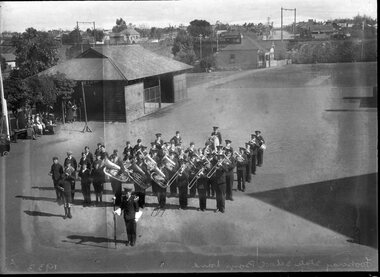
Photograph, Bull, Hugh Jones, 1897-1993, Footscray State School Boys Band
... band music, and the best conductor in the Southern Hemisphere. He still retains the romance and Bohemianism of the old German bandsmen he played with in the streets of Melbourne 50 years ago.” In 1925, a bequest of £10,000 from the estate of the late writer, William Gillies was made to the Education Department of Victoria. It was devoted to three purposes - “1) The encouragement of instrumental music (school bands or orchestras) in the State schools of Victoria, leading, it is hoped, to an increase in the number of village bands and orchestras, and, most important of all, family orchestras; (2) The encouragement of the art of reading aloud, leading, it is hoped, to an increase of the admirable pastime of reading aloud in the family circle; and (3) The encouragement of any branch of nature study, the aim of all three being to make home life, especially in the country, more attractive.” ...band music, and the best conductor in the Southern Hemisphere. He still retains the romance and Bohemianism of the old German bandsmen he played with in the streets of Melbourne 50 years ago.” In 1925, a bequest of £10,000 from the estate of the late writer, William Gillies was made to the Education Department of Victoria. It was devoted to three purposes - “1) The encouragement of instrumental music (school bands or orchestras) in the State schools of Victoria, leading, it is hoped, to an increase in the number of village bands and orchestras, and, most important of all, family orchestras; (2) The encouragement of the art of reading aloud, leading, it is hoped, to an increase of the admirable pastime of reading aloud in the family circle; and (3) The encouragement of any branch of nature study, the aim of all three being to make home life, especially in the country, more attractive.” ...Photographer notations on slide: Footscray State School Boys Band 1933 B5 Published: JUNIOR BAND CHAMPIONS--BEFORE THE HOLIDAYS--BELGIAN CARNIVAL--A ROYAL YACHTSMAN. (1933, September 1). The Age (Melbourne, Vic. : 1854 - 1954), p. 3. Published caption: “Proud Champions.- The drum-major of the band of the Hyde-street State School, Footscray, leads his players in a march past for visitors during Music Week. Under Mr. Frank Johnston’s conductorship this band has held the championship for two years.” Trove article identifier: http://nla.gov.au/nla.news-article205116143 Scope and Content: Footscray’s Hyde Street State School Band, led by their drum major, prepare to march past a group of mothers while playing their instruments. The band held the record for winning the most Victorian State Schools Association Championships between 1931 and 1966. Research by project volunteer, Fiona Collyer: Description: A large group of boys, most of whom are dressed in long trousers and peaked band hats, led by their drum major, prepare to march past a group of women dressed in overcoats and hats and an infant in a pram. In the background is a school shelter shed, a railway line, houses and a netball ring on a wooden stand. The Hyde Street State School Band was formed in 1928 as the school band for Hyde Street State School No. 1912 at 10 Hyde Street Footscray (now Footscray City Primary School). Their bandmaster, Francis Charles Johnston,(1880-1953) nicknamed “Massa” as a boy for his love and admiration of southern American jazz music, also conducted the Victorian Police Band, Collingwood Citizens Band, and the Melbourne Metropolitan Fire Brigade Band, amongst others, leading to scores of wins in brass band competitions. Even into his sixties, “Massa” ran three laps around the South Melbourne Oval every morning in order to maintain fitness for his busy conducting schedule. He was a cornetist and horn player, and performed in and lead brass bands for more than fifty years including bands that farewelled Australian troops from the Boer War to the Second World War. The Argus 13 December 1947, described “Massa” - “Bandsmen say he is a genius in brass band music, and the best conductor in the Southern Hemisphere. He still retains the romance and Bohemianism of the old German bandsmen he played with in the streets of Melbourne 50 years ago.” In 1925, a bequest of £10,000 from the estate of the late writer, William Gillies was made to the Education Department of Victoria. It was devoted to three purposes - “1) The encouragement of instrumental music (school bands or orchestras) in the State schools of Victoria, leading, it is hoped, to an increase in the number of village bands and orchestras, and, most important of all, family orchestras; (2) The encouragement of the art of reading aloud, leading, it is hoped, to an increase of the admirable pastime of reading aloud in the family circle; and (3) The encouragement of any branch of nature study, the aim of all three being to make home life, especially in the country, more attractive.” The Director of Education, Mr. M.P. Hansen wrote in his book “Thoughts That Breathe” published in 1932, that, as a result of the Gillies Bequest- “£3,030 has already been made available for the purchase of band instruments, and thanks largely to the encouragement given by this fine bequest, there are now in State schools in Victoria, each under expert tuition, 31 brass bands, 9 orchestras, 13 fife bands and 23 violin classes. That the effect of such work has a significant bearing on the right use of leisure, is undeniable.” By 1937, at least 50 State school bands had been set up in Victoria and the Victorian State Schools Association Championships were hotly contested. Frank quickly and skilfully brought the inexperienced boys of the Hyde Street Brass Band to A grade level, winning their first Victorian State Schools Association Championships in 1931. The band went on to win multiple times, holding the record for winning the most Victorian State Schools Association Championships between 1931 and 1966. The band soon became an integral part of community events. Whenever the Footscray Football Team played a home game at the perpetually blustery Western Oval, (Whitten Oval since 1995) the band performed at half time, marching around the boundary line, belting out the Footscray Football Team theme song- “Sons of the ’Scray” played to the tune of “Sons of the Sea” by British music hall songwriter Felix McGlennon. Volunteers walked behind the band carrying a large tarpaulin to catch the shower of coins thrown by fans from both teams, which helped pay for new instruments, repairs and uniforms. The old footy joke goes- Q. Who played on the wing at the Western Oval for 20 years, but never kicked a goal? A. The Hyde Street Band. Now called the Hyde Street Youth Band Inc, it is a not-for-profit organisation, supported by the City of Maribyrnong. Their aim is to make brass music accessible to young people aged from 5-25 years, by supplying the instruments and lessons for a modest annual membership fee. The traditional British brass band comprises of three musical ensembles according to ability. The Hyde Street Youth Band Inc. play at community events including the AFL Grand Final Parade, ANZAC Day March at the Shrine of Remembrance, Moomba Parade and Yarraville Carols by Candlelight. Their repertoire includes classical, marches, hymns, contemporary music and movie themes. https://bandblastsfromthepast.blog/2018/04/08/victorian-state-school-brass-bands-their-legacy-lives-on/ Massa" and His Musical Firemen (1947, December 13). The Argus (Melbourne, Vic. : 1848 - 1957), p. 2 (The Argus Week-end Magazine). Retrieved May 5, 2025, from http://nla.gov.au/nla.news-article22532344 http://www.hydestreethistory.8m.net/photo2.html MUSIC AND MUSICIANS (1932, March 9). The Mercury (Hobart, Tas. : 1860 - 1954), p. 2. Retrieved May 8, 2025, from http://nla.gov.au/nla.news-article29946674 https://hsyb.org.au/about/history-2/ https://hsyb.org.au/about/ MUSIC AND READING ALOUD. (1925, June 1). The Argus (Melbourne, Vic. : 1848 - 1957), p. 10. Retrieved May 5, 2025, from http://nla.gov.au/nla.news-article2122525 Shake! Narrow Escape From Shark The Birdcage Walk Champion Schoolboy's Band (1931, December 24). The Sun News-Pictorial (Melbourne, Vic. : 1922 - 1954; 1956), p. 14-15. Retrieved April 8, 2025, from http://nla.gov.au/nla.news-article276259073 AROUND THE SCHOOLS: THE ARGUS JUNIOR (1947, September 23). The Argus (Melbourne, Vic. : 1848 - 1957), p. 6 (The Argus Super Comic). Retrieved April 20, 2025, from http://nla.gov.au/nla.news-article22509356 https://bandblastsfromthepast.blog/tag/hyde-street-youth-band/ THE GILLIES BEQUEST (1933, September 2). The Argus (Melbourne, Vic. : 1848 - 1957), p. 22. Retrieved May 5, 2025, from http://nla.gov.au/nla.news-article11688410 https://adb.anu.edu.au/biography/johnston-francis-charles-massa-13009 Hyde Street, Footscray, State School Children (1930, March 8). Weekly Times (Melbourne, Vic. : 1869 - 1954), p. 40. Retrieved May 8, 2025, from http://nla.gov.au/nla.news-article223899955Photographer notations on slide: Footscray State School Boys Band 1933 B5bands, 1930-1939, musical instruments, schools, state schools, uniforms, footscray
