Showing 134 items matching "anaesthesia history"
-
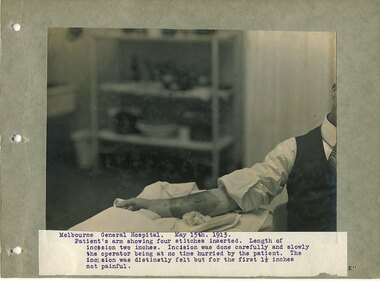
Geoffrey Kaye Museum of Anaesthetic HistoryAlbum - Photograph album, Rupert Hornabrook
... ...anaesthesia history...This album is of historic significance as it not only documents a specific period in the professional life of a full-time anaesthetist in Australia, it also documents anaesthetic equipment, and the way it was used. anaesthesia anaesthesia history medical history dentistry dental history ethyl chloride ether Blue photograph album with vinyl wrapped heavy card cover. ...This photo album depicts a small period of time during 1919, and highlights some of the anaesthetic work conducted by Dr Rupert Hornabrook. There is no record as to the reason for the construction of the album, but it appears to offer insight into his work the Dental School, as well as experimentation with different types of anaesthetic agents, using himself as a test subject.Rupert Hornabrook was an early full-time anaesthetist in Australia. He helped to develop anaesthesia into a specialised field of medicine by conducting research into the way anaesthesia worked, and its effects on the body. This album is of historic significance as it not only documents a specific period in the professional life of a full-time anaesthetist in Australia, it also documents anaesthetic equipment, and the way it was used.Blue photograph album with vinyl wrapped heavy card cover. A three ringed binder is attached to the inside of the album and sixteen (16) photographs are inside, mounted on heavy card. Each photograph has a typed label on white paper in blue ink adhered to the front describing the events of the photograph. Photographs depict various administrations of ethyl chloride as anaesthesia and analgesia, with many photographs of Rupert Hornabrook.anaesthesia, anaesthesia history, medical history, dentistry, dental history, ethyl chloride, ether -
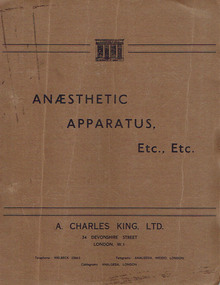
Geoffrey Kaye Museum of Anaesthetic HistoryBooklet - Book, Catalogue, A. Charles King Ltd, Anaesthetic Apparatus, Etc., Etc
... anaesthesia...medical history...Geoffrey Kaye Museum of Anaesthetic History ANZCA House 630 St Kilda Road Melbourne melbourne Undated catalogue outlining all anaesthetic equipment available through A. Charles King Ltd. catalogue anaesthetic anaesthetic machine anaesthetic device anaesthetic apparatus anaesthesia medical history medical device Brown cardboard covered book with white glossy pages, held together by a star clip. ...Undated catalogue outlining all anaesthetic equipment available through A. Charles King Ltd.Brown cardboard covered book with white glossy pages, held together by a star clip.catalogue, anaesthetic, anaesthetic machine, anaesthetic device, anaesthetic apparatus, anaesthesia, medical history, medical device -
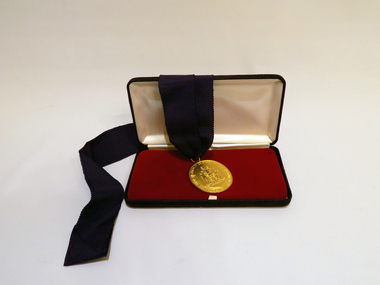
Geoffrey Kaye Museum of Anaesthetic HistoryMedal - Medal, Dean, c. 1986
... anaesthesia...anaesthetic history...The Orton Medal was awarded posthumously. medal medallion dean anaesthetist anaesthesia anaesthetic history Royal Australasian College of Surgeons Engraved on reverse of medal: R.W. ...Robin William Smallwood was Dean of the Faculty of Anaesthetists at the Royal Australasian College of Surgeons from 1986 - 1987. Smallwood died 6 October 1987 after a brief illness. Smallwood completed medicine at the University of Melbourne in 1958 and decided on anaesthesia as a career, attaining his FFARACS in 1964. The Orton Medal was awarded posthumously.Gold coloured oval shaped medal with the Faculty of Anaesthetists coat of arms on the obverse in relief. The owner's name has been engraved into the reverse. There is a thick, ribbed, navy blue ribbon connected to the medal by a circular ring at the top. The medal and ribbon are encased in a black velvet box with white satin lining on the inside of the lid and a red velvet cushion resting in the base.Engraved on reverse of medal: R.W. SMALLWOOD / 1986 - 1987medal, medallion, dean, anaesthetist, anaesthesia, anaesthetic history, royal australasian college of surgeons -
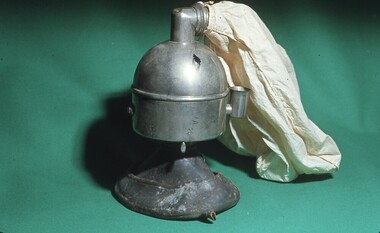
Geoffrey Kaye Museum of Anaesthetic HistorySlide
... anaesthesia...medical history...Geoffrey Kaye Museum of Anaesthetic History ANZCA House 630 St Kilda Road Melbourne melbourne Clover inhaler inhaler ether anaesthesia medical history anaesthetic history Handwritten in pencil: EMBLEY'S / 9448 Colour slide mounted in white slide case. ...Colour slide mounted in white slide case. Image depicts Clover Inhaler with cloth rebreather bag and leather facemask attachedHandwritten in pencil: EMBLEY'S / 9448clover inhaler, inhaler, ether, anaesthesia, medical history, anaesthetic history -
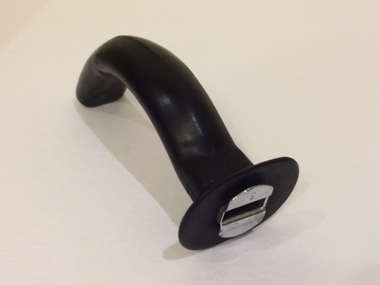
Geoffrey Kaye Museum of Anaesthetic HistoryEquipment - Guedel's Airway
... anaesthesia...ventilation...medical history...Geoffrey Kaye Museum of Anaesthetic History ANZCA House 630 St Kilda Road Melbourne melbourne Oral airways, such as the Guedel, make it easier for patients to be ventilated with manual resuscitators, such as the Porton and the Ambu bag. They depress the tongue and prevent it from falling to the back of the throat where it would obstruct the airway. Guedel anaesthesia ...Oral airways, such as the Guedel, make it easier for patients to be ventilated with manual resuscitators, such as the Porton and the Ambu bag. They depress the tongue and prevent it from falling to the back of the throat where it would obstruct the airway.Black rubber curved tube with metal insert at baseHallmarked on metal: [BRITISHMADE / 3]guedel, anaesthesia, ventilation, medical history -
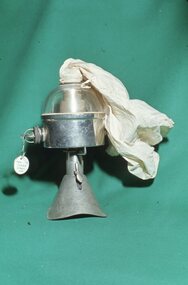
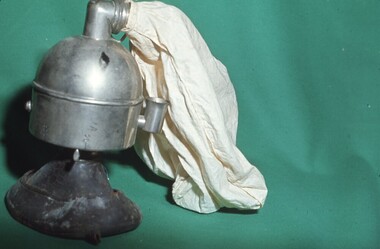
Geoffrey Kaye Museum of Anaesthetic HistorySlide
... anaesthesia...anaesthetic...anaesthetic history...Geoffrey Kaye Museum of Anaesthetic History ANZCA House 630 St Kilda Road Melbourne melbourne Clover inhaler ether anaesthesia anaesthetic anaesthetic history medical history Handwritten in pencil: EMBLEY'S / 9448 Colour slide mounted in white slide case. ...Colour slide mounted in white slide case. Image depicts modified Clover Inhaler with glass chamber, cloth rebreather bag and metal facemask against a green background.Handwritten in pencil: EMBLEY'S / 9448clover inhaler, ether, anaesthesia, anaesthetic, anaesthetic history, medical history -
Geoffrey Kaye Museum of Anaesthetic HistoryPhotograph
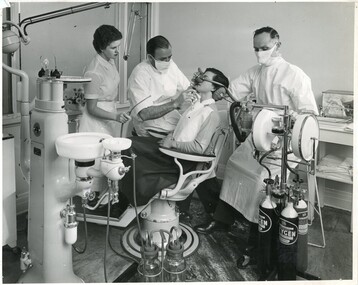
... This photograph was reproduced in the book One Grand Chain : The History of Anaesthesia in Australia 1846 - 1962 : Volume 2 1934 - 1962, Gwen Wilson, edited by Jeanette Thirlwell Jones, on page 89....Geoffrey Kaye Museum of Anaesthetic History ANZCA House 630 St Kilda Road Melbourne melbourne This photograph was reproduced in the book One Grand Chain : The History of Anaesthesia in Australia 1846 - 1962 : Volume 2 1934 - 1962, Gwen Wilson, edited by Jeanette Thirlwell Jones, on page 89. ...This photograph was reproduced in the book One Grand Chain : The History of Anaesthesia in Australia 1846 - 1962 : Volume 2 1934 - 1962, Gwen Wilson, edited by Jeanette Thirlwell Jones, on page 89.Black and white photograph depicting a dentist's office with a woman patient sitting in a chair receiving anaesthesia. Behind the chair is a fully gowned and masked anaesthetist operating a DM Machine with CIG oxygen cylinders. The male dentist is seated to the left of the patient holding equipment near the patient's mouth. A woman dental nurse is standing to the left of the dentist holding a suction tool.•Stamped in red ink on reverse: C.I.G. Equipment Pty. Ltd. •Handwritten in blue ink on reverse: CG13 •Handwritten in grey pencil on reverse: Dr H.N. Matthews / Essendon / Return to F Biggs •Handwritten in grey pencil on reverse: 6 [in a circle]dentist, anaesthetist, dental nurse, patient, cig, oxygen cylinder, shipway, dm machine -
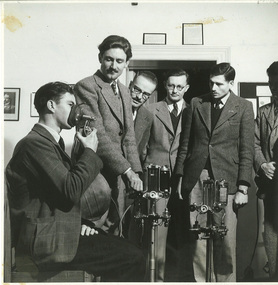
Geoffrey Kaye Museum of Anaesthetic HistoryPhotograph, c1940s
... The photograph was reproduced in the book One Grand Chain : The History of Anaesthesia in Australia 1846 - 1962 : Volume 2 1934 - 1962, Gwen Wilson, edited by Jeanette Thirlwell Jones, on page 459....The photograph was reproduced in the book One Grand Chain : The History of Anaesthesia in Australia 1846 - 1962 : Volume 2 1934 - 1962, Gwen Wilson, edited by Jeanette Thirlwell Jones, on page 459. ...Possibly part of a series of photographs taken at the Geoffrey Kaye Museum when it was located at the University of Melbourne in the late 1940s, photographer unknown. The photograph was reproduced in the book One Grand Chain : The History of Anaesthesia in Australia 1846 - 1962 : Volume 2 1934 - 1962, Gwen Wilson, edited by Jeanette Thirlwell Jones, on page 459.Black and white photography depicting a group of six male students rehearsing with anaesthetic apparatus. Five of the students are standing and one student on the left of the photograph is sitting and holding an inhaler to his face. There are two apparatus displayed.•Handwritten in grey pencil on reverse: Frame 17 •Handwritten in blue ink on reverse: sample. •Handwritten in grey pencil on reverse: 2 [in a circle] •Handwritten in grey pencil on reverse: 15 [in a circle, with the 5 crossed out] •Label which was originally glued to bottom on photograph which has since detached, written in all capitals with white ink on black paper: Students rehearsing with current apparatus, displayed in functional order and in sectionstudents, training session, anaesthetic machine -
Geoffrey Kaye Museum of Anaesthetic HistoryAccessory - Facemask
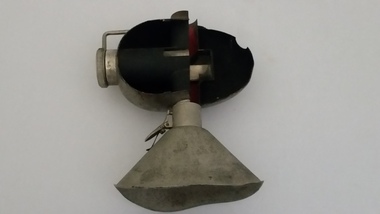
... Geoffrey Kaye Museum of Anaesthetic History ANZCA House 630 St Kilda Road Melbourne melbourne Anaesthesia Inhalational Probyn Williams Facemask Pear shaped metal mask for attaching to Probyn Williams inhaler. ...Pear shaped metal mask for attaching to Probyn Williams inhaler. The edge of the facemask is surrounded by a black leather cushion, with a tube on the top. The facemask is metal with a thumb action lever on connector.anaesthesia, inhalational, probyn williams, facemask -
Geoffrey Kaye Museum of Anaesthetic HistoryEquipment - Vaporiser, Penthrane, Cyprane Ltd, c. 1982
... Geoffrey Kaye Museum of Anaesthetic History ANZCA House 630 St Kilda Road Melbourne melbourne Penthrane Vaporizer Anaesthesia Anaesthetic machine Inscribed on top plate: KEEP UPRIGHT/ PENTEC 2/ WHEN CHARGED •Inscribed on inlet & oulet valve plate: PENTEC 2/ SERIAL NO 252939/ PATENTS PENDING •MADE IN / ENGLAND BY/ CYPRANE LTD / KEIGHLEY •Metal dial has inscribed: OFF/.2 .5 1 1.5 2 Max •Inscribed on front plate in green writing: USE ONLY/ PENTHRANE/ (METHOXYFLURANE) This vaporiser has a main cylindrical body with a step up to the dial plate with a small red latch to lock dial in to place.On the front of the body sits a square gauge to indicate the level FULL along with a long rectangular shape.There is an Inlet and outlet valve that sits behind the metal dial.There is a manufacturers plate sitting on top of the dial and the inlet/outlet valve. ...This vaporiser has a main cylindrical body with a step up to the dial plate with a small red latch to lock dial in to place.On the front of the body sits a square gauge to indicate the level FULL along with a long rectangular shape.There is an Inlet and outlet valve that sits behind the metal dial.There is a manufacturers plate sitting on top of the dial and the inlet/outlet valve. Inscribed on top plate: KEEP UPRIGHT/ PENTEC 2/ WHEN CHARGED •Inscribed on inlet & oulet valve plate: PENTEC 2/ SERIAL NO 252939/ PATENTS PENDING •MADE IN / ENGLAND BY/ CYPRANE LTD / KEIGHLEY •Metal dial has inscribed: OFF/.2 .5 1 1.5 2 Max •Inscribed on front plate in green writing: USE ONLY/ PENTHRANE/ (METHOXYFLURANE)penthrane, vaporizer, anaesthesia, anaesthetic machine -
Geoffrey Kaye Museum of Anaesthetic HistoryCeremonial object - Medal, Companion of the Third Class of the Order of St Michael and St George, Circa 1966
... Geoffrey Kaye Museum of Anaesthetic History ANZCA House 630 St Kilda Road Melbourne melbourne In 1966 Harry Daly was admitted to the Order of St Michael and St George in recognition of over 35 years of service to medicine and anaesthesia. ...In 1966 Harry Daly was admitted to the Order of St Michael and St George in recognition of over 35 years of service to medicine and anaesthesia.Large white enamelled seven armed Maltese Cross set around a dark blue ring bearing the Latin motto 'Auspicium Melioris Aevi'. The obverse depicting St Michael standing on the devil and the reverse St George on horseback killing a dragon. The medal comes with its blue-crimson-blue ribbon folded and stored under the velour badge holder. Medal and ribbon are set and stored in its custom made black case with the badge acronym in gold lettering on the top of the case [C.M.G.]. There is a card with instructions for wearing the medal under the velour holder along with a note from Geoffrey Kaye to Harry Daley.Printed on internal satin lining: BY APPOINTMENT / TO HER MAJESTY THE QUEEN / MEDALLISTS / BY APPOINTMENT / H.R.H. THE DUKE OF EDINBURGH / MEDALLISTS. / SPINK & SON, LTD. / 5 - 7, KING STREET, ST. JAMES'S, / LONDON, S.W.1.medal, st michael, st george, anaesthesia, harry daly -
Geoffrey Kaye Museum of Anaesthetic HistoryEquipment - Mask, Ramsay Surgical Limited
... Geoffrey Kaye Museum of Anaesthetic History ANZCA House 630 St Kilda Road Melbourne melbourne One of a range of metal face masks designed to have a cover which helps protect the patient's face. Facemask Anaesthesia ...One of a range of metal face masks designed to have a cover which helps protect the patient's face.Wire frame mask designed to cover mouth and nose. There is a metal hook on the left hand side protuding from the base of the mask and wire mesh raised from the base with a circle in the middle.facemask, anaesthesia, ramsay surgical -
Geoffrey Kaye Museum of Anaesthetic HistoryMachine - Waveform Ventilator, 1970
... Geoffrey Kaye Museum of Anaesthetic History ANZCA House 630 St Kilda Road Melbourne melbourne Professor Arthur Barrington (Barry) Baker was the first Australian anaesthetist to gain a DPhil in anaesthesia. ...Professor Arthur Barrington (Barry) Baker was the first Australian anaesthetist to gain a DPhil in anaesthesia. He completed his DPhil at Oxford University at the Nuffield Department of Anesthesia in 1971, titled, Physiological Responses to Artificial Ventilation. The Waveform Ventilator is the machine developed to illustrate his DPhil. The waveform ventilator was used in several scientific studies on 'the effects of varying inspiratory flow waveforms and time in intermittent positive pressure ventilation (IPPV)', published in the 'British Journal of Anaesthesia'. Professor Arthur Barrington Baker had an extensive career in research and clinical practice including holding the position as the Nuffield Professor of Anaesthetics at Sydney university (1992 - 2005) and also as the Dean of the Australian and New Zealand College of Anaesthetists (ANZCA) (1987-1990).The variable waveform ventilator is of national significance, due to its association with Professor Arthur Barrington Baker (Prof. Baker) the first Australian academic anaesthetist, and the representation of historical social themes and research and design, in anaesthesia. Historic significance – It is a rare type of ventilator in good condition and well provenanced. It is a tangible record of the beginning of the long established and distinguished career of Prof. Baker, the first anaesthetist in Australia to gain a DPhil. Prof Baker has a strong involvement in the Australian and New Zealand College of Anaesthetists (ANZCA) organisation. The object is a product of Prof Baker’s Doctorate of Philosophy (DPhil) on respiratory physiology and is associated with the prestigious Oxford University and the well-known Nuffield Department of Anaesthetics. It also represents the social theme of migration to England from Australia in the 1960s and 1970s to access and experience academic and artistic opportunities limited in Australia at the time. Scientific Value – The object is of scientific value as it offers major potential for education and interpretation in anaesthesia. Although ventilators are common equipment, this specific design and construct prototype is one of a kind, designed and used specifically for research purposes. A rectangular shaped object on a trolley with four wheels. The top half of the object consists of two panels, one of cream coloured painted wood, the other black plastic, both containing several dials of different shapes and sizes. The wood surface also contains several gauges and a safety pressure clear plastic box. The plastic surface also contains a pin board. The bottom half of the object consists of two shelves. The whole object's perimeter is lined with perforated metals. The top wooden surface has several metal pieces of equipment and a long tube. The rear of the object contains numerous types of tubing and wire, a gas cylinder and two leather straps with buckles. The bottom half of one side of the objects has 3 electrical power outlets.Waveform Generator, Drs Colliss N Cowie, Dr Baker Dr Murray Willson, Dr Babbington, Safety Pressure, Error POS F/B, Position, Feedback, Set Balance, Reset, Full Stroke, Velocity, Converter Current, line Pressure, Low Pressure, Bias Pressure, Start, Stop, Stop, Reset Press, Max Press, W/G Output, A/CRO B/2.baker, arthur barrington, baker, barry, professor, academic anaesthetist, oxford university, nuffield department of anaesthesia -
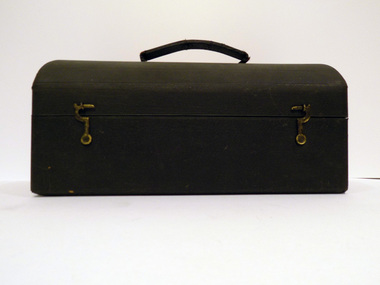
Geoffrey Kaye Museum of Anaesthetic HistoryContainer - Medical Carry Box, Allen & Hanbury Ltd
... He apparently committed suicide in 1935, there are references that he 'could not make a living from anaesthesia'. (Norman, 2002, 'An informal history of the first 25 years', The British Journal of Anaesthesia, 88 (3): 445-450) The maker of this medical box, Allen and Hanburys Ltd., was a British pharmaceutical manufacturer, founded in 1715, absorbed by Glaxo Laboratories in 1958....He apparently committed suicide in 1935, there are references that he 'could not make a living from anaesthesia'. (Norman, 2002, 'An informal history of the first 25 years', The British Journal of Anaesthesia, 88 (3): 445-450) The maker of this medical box, Allen and Hanburys Ltd., was a British pharmaceutical manufacturer, founded in 1715, absorbed by Glaxo Laboratories in 1958. dr. ...A characteristic black, round topped box, to carry medical equipment with a divider which would have held a square, plain glass bottle. The donor, Dr. Holloway is known to have acquired much of Dr. Howard Jones' equipment. In 1930 Dr Howard Jones, M.B., B.S., (Lond.). Surgeon Anaesthetist to Charing Cross Hospital first described percaine in an article in the British Journal of Anaesthesia. According to Norman, J. in the British Journal of Anaesthesia, Jones was the first honorary secretary of the Association of Great Britain and Ireland, 'of spinal anaesthesia fame', and a leading practitioner in his day. He apparently committed suicide in 1935, there are references that he 'could not make a living from anaesthesia'. (Norman, 2002, 'An informal history of the first 25 years', The British Journal of Anaesthesia, 88 (3): 445-450) The maker of this medical box, Allen and Hanburys Ltd., was a British pharmaceutical manufacturer, founded in 1715, absorbed by Glaxo Laboratories in 1958.Black cardboard box with handle and simple border decoration on top. Brass hinges at the rear and two brass hook clasps at the front. Interior is lined with black linen. Cardboard divider inside and square compartment in corner would have been used to hold a bottle of ether in place.Printed in gold leaf inside lid: ALLEN & HANBURYS LTD / LONDON.W. / 48.WIGMORE STdr. [e.s.] holloway, medical box, carry kit, allen & hanbury's ltd. -
Geoffrey Kaye Museum of Anaesthetic HistoryContainer - Bottle, Ethyl Chloride, Medicinal Chemicals Corporation Pty. Ltd, c. 1932
... History ANZCA House 630 St Kilda Road Melbourne melbourne Ethyl chloride was first used as a general anaesthetic in 1847, by Johann Ferdinand Heyfelder (1798-1869), a German surgeon. Once ethyl chloride became readily available, it was again taken up as a general anaesthetic in the late 1890s (USA). Ethyl chloride evaporates very quickly so that when it is sprayed onto the skin it produces very cold temperatures. “Refrigeration anesthesia”, or cryoanesthesia, refers to the anesthesia produced when the skin is significantly cooled.Due to its rapid onset, ethyl chloride was often used to induce general anaesthesia ...Ethyl chloride was first used as a general anaesthetic in 1847, by Johann Ferdinand Heyfelder (1798-1869), a German surgeon. Once ethyl chloride became readily available, it was again taken up as a general anaesthetic in the late 1890s (USA). Ethyl chloride evaporates very quickly so that when it is sprayed onto the skin it produces very cold temperatures. “Refrigeration anesthesia”, or cryoanesthesia, refers to the anesthesia produced when the skin is significantly cooled.Due to its rapid onset, ethyl chloride was often used to induce general anaesthesia. It would be followed by a second anaesthetic, such as ether or nitrous oxide, which would be used for the remainder of the procedure. (The Wood Library Museum, 2016) The bottle has clear side and base mould seams which indicate it was made using a cup bottom mould.Glass bottle with paper label, metal fastening at the top and cream coloured plastic sealant at the neck. The bottle has clear side and base mould seams which indicate it was made using a cup bottom mould.Printed on main label at front: 100 c.c. 3 1/2 fl. ozs. / MEDICINAL CHEMICALS CORP [illegible] / MEDCO / ETHYL CHLORIDE / PURE / This Product conforms to all the re-/quirements of the BRITISH PHARMA-/COPCEIA, 1932, for / GENERAL ANAESTHESIA / Manufactured by / MEDICINAL CHEMICALS CORPORATION PTY. LIMITED / 39 Martin Place, Sydney Printed on round label on reverse side: 6d. / Cred [illegible]this container if returned in good order and condition. Stamped into underside of bottle: CM / S99ethyl chloride, medco, medicinal chemicals corporation pty. ltd, dr [e.s] holloway, bottle -
Geoffrey Kaye Museum of Anaesthetic HistoryEquipment - Mask, Yankauer, c. 1904
... Geoffrey Kaye Museum of Anaesthetic History ANZCA House 630 St Kilda Road Melbourne melbourne Sidney Yankauer, M.D. (1872-1932), an ear, nose and throat specialist and pioneer in bronchoscopy, practiced at the Mount Sinai Hospital in New York. Dr. Yankauer, a prolific inventor of medical equipment, might best be known for the tube he designed for suctioning the mouth and throat. Yankauer introduced the wire-mesh anaesthesia ...Sidney Yankauer, M.D. (1872-1932), an ear, nose and throat specialist and pioneer in bronchoscopy, practiced at the Mount Sinai Hospital in New York. Dr. Yankauer, a prolific inventor of medical equipment, might best be known for the tube he designed for suctioning the mouth and throat. Yankauer introduced the wire-mesh anaesthesia mask around 1904. The drop method involved placing the mask over the patient’s nose and mouth, and then placing gauze over the mesh of the mask. Next, liquid anaesthetic, such as ether or chloroform, was applied in drops or lightly poured onto the gauze so that the patient breathed in evaporated anesthetic as well as air. The gutter around the base of the mask was designed to catch any residue of the harmful anaesthetic. (The Wood Library Museum, 2016; Museum of Healthcare Kingston, 2016)A metal tear-shaped mask with gauze wire dome, gutter around the base and detachable spring piece with open circular handle to secure cloth over gauze. Found inside medical carry box #899Stamped underneath neck of circular handle: HATRICKdr [e.s.] holloway, hatrick, yankauer, drop method, mask, gauze -
Geoffrey Kaye Museum of Anaesthetic HistoryEquipment - Stopcock, Hewitt, George Barth & Co. Ltd, c. 1895
... History ANZCA House 630 St Kilda Road Melbourne melbourne When Hewitt introduced his regulating stopcock in 1887, attempts were made to dilute the nitrous oxide with air and so obviate the element of asphyxiation. The method was to be seen in London, mainly in dentistry and minor surgery, so late as 1930. It was not very successful. To give even 10% of oxygen (which is not enough) the gas-mixture must contain 55% of air and 45% of nitrous oxide. The latter is thus so diluted by atmospheric nitrogen as to be incapable of producing anaesthesia ...When Hewitt introduced his regulating stopcock in 1887, attempts were made to dilute the nitrous oxide with air and so obviate the element of asphyxiation. The method was to be seen in London, mainly in dentistry and minor surgery, so late as 1930. It was not very successful. To give even 10% of oxygen (which is not enough) the gas-mixture must contain 55% of air and 45% of nitrous oxide. The latter is thus so diluted by atmospheric nitrogen as to be incapable of producing anaesthesia except by asphyxiation. "Gas-air" was confined to analgesia, for example in midwifery. (Source: Penn catalogue)Brown leather facemask attached to metal inhaler and stopcock device that has been sectioned to reveal its inner workings. The various exposed channels have been painted either green, red, blue or purple.Engraved into side of stopcock: HEWITT'S / N20-02 / 1895 / G. Kaye sect. 1952. •Stamped into other side of stopcock: [indecipherable] BARTH & CO. / SOLE MAKERS / 54. POLAND STREET LONDON.W.frederic hewitt, stopcock, nitrous oxide, oxygen, gas-air -
Geoffrey Kaye Museum of Anaesthetic HistoryDecorative object - Beaker (Tumbler), 1977
... Geoffrey Kaye Museum of Anaesthetic History ANZCA House 630 St Kilda Road Melbourne melbourne This beaker (tumbler) was presented to the Faculty in 1977 by Professor Arthur Bull, as a token of esteem and friendship, from the Faculty of Anaesthetists College of Medicine of South Africa. It was in this year that Professor Bull was also awarded an honorary fellowship from ANZCA. Professor Arthur Barclay Bull was a pioneer of South African Anaesthesia ...This beaker (tumbler) was presented to the Faculty in 1977 by Professor Arthur Bull, as a token of esteem and friendship, from the Faculty of Anaesthetists College of Medicine of South Africa. It was in this year that Professor Bull was also awarded an honorary fellowship from ANZCA. Professor Arthur Barclay Bull was a pioneer of South African Anaesthesia, having played a major role in the specialty and research in anaesthesia from 1954. One of his achievements include the use of prolonged curarisation and IPPV for treating tetanus. In 1965 - 1967 the Taurus Blood Warmer was developed - named after Professor Bull - to prevent hypothermia after major blood transfusion. Not only was Professor Bull the presenter of this beaker, but also its maker. It is hand wrought from sterling silver recovered from discarded tracheostomy tubes. The maker has hallmarked the beaker with the initials A B. Hand wrought sterling silver beaker made from the silver recovered from discarded tracheostomy tubes.To / The Faculty of Anaesthetists / R.A.C.S. / from / The Faculty of Anaesthetists / C.M. of S.A. / 1977 [hallmark in maker's logo] A Btracheostomy, taurus blood warmer, the college of medicine of south africa, faracs -
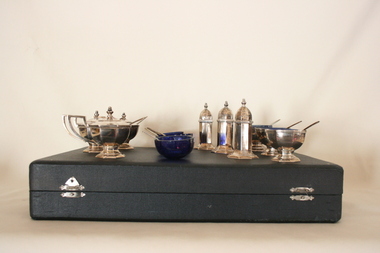
Geoffrey Kaye Museum of Anaesthetic HistoryDomestic object - Muffineer Set with Tray, Nanking Store, 1900c
... history of ANZCA as a board member of the first ANZCA Council. In the late 1980s Professor Gibbs was President of the New Zealand Society of Anaesthetists and in 2004 received the ANZCA medal for his major contributions to the status of anaesthesia. ...history of ANZCA as a board member of the first ANZCA Council. In the late 1980s Professor Gibbs was President of the New Zealand Society of Anaesthetists and in 2004 received the ANZCA medal for his major contributions to the status of anaesthesia. ...The donor of this gift, Professor John Gibbs, has played an important role in the history of ANZCA as a board member of the first ANZCA Council. In the late 1980s Professor Gibbs was President of the New Zealand Society of Anaesthetists and in 2004 received the ANZCA medal for his major contributions to the status of anaesthesia. The muffineer set was presented in a custom made box bearing the manufacturer's mark 'Nanking Store', active in Shanghai, China from the late 19th century until early 20th century. Each item in the set is stamped with the makers mark and character of a rooster. It is unknown as to the symbolism of the rooster, however, it may have represented the Chinese year of the rooster. It is possible this is a Chinese export silver piece, as a result of increased export trade to the West in the early 20th century. Chinese export silver were made in foreign taste for export, in particular common items such as tea and coffee sets. A Muffineer is a small container with a pierced top for sprinkling sugar, salt, spice, or other powder. It gained its name from its early use for sprinkling sugar or salt on muffins and were part of the Victorian tableware. After the First World War and the change of life style, this was later referred to as sugar shakers.A sterling silver muffineer set of Queen Anne revival with tray. Muffiner set contains 3 silver shakers (muffineer), 6 silver condiment dishes on stand 3 with lid and handle, 10 small, rounded spoons, 10 blue, glass inserts for condiment dishes. The set comes with a custom made presentation box, lined with beige silk. The box proper is lined in dark blue velour with individual sections cut out to sit each set piece. Each piece is hallmarked except four spoons. Large heavy oval shaped silver tray with extended loop rope designed handle on either side decorated with a very ornate fern leaf pattern design etched into the entire base of the tray. [printed in gold lettering on beige fabric inside lid cover] Chinese name of manufacturer in Chinese characters / NANKING STORE / GOLD AND SILVER SMITHS / 444 SZECHUEN ROAD / SHANGHAI / markers mark and Chinese characters [hallmarks on condiments dishes] NKSTERLING / SILVER / character of rooster [hallmarks on muffineer] NANKING / SILVER / character of rooster [hallmarks on spoons - 6 only] NANKING / character of rooster [hallmarks on tray reverse] 19722 number scratched into surface.professor john gibbs, nanking store, chinese export silver, muffineer, sterling silver -
Geoffrey Kaye Museum of Anaesthetic HistoryTool - Manometer, Mercury, Elliotts & Australian Drug Pty. Ltd
... History ANZCA House 630 St Kilda Road Melbourne melbourne In the 1600s, William Harvey realised a finite amount of blood circulates in one direction through the body. Jean Léonard Marie Poiseuille introduced the mercury hydrodynometer in the early 1800s for measuring blood pressure. Karl von-Vierordt created the sphygmograph in 1855 and, in 1881, Samuel von Basch created the sphygmomanometer, distinct improvements on the hydrodynometer. In 1896, Scipione Riva-Rocci developed the mercury sphygmomanometer. American neurosurgeon, Harvey Cushing, was an early adopter, and advocate for monitoring patients during surgery and anaesthesia ...In the 1600s, William Harvey realised a finite amount of blood circulates in one direction through the body. Jean Léonard Marie Poiseuille introduced the mercury hydrodynometer in the early 1800s for measuring blood pressure. Karl von-Vierordt created the sphygmograph in 1855 and, in 1881, Samuel von Basch created the sphygmomanometer, distinct improvements on the hydrodynometer. In 1896, Scipione Riva-Rocci developed the mercury sphygmomanometer. American neurosurgeon, Harvey Cushing, was an early adopter, and advocate for monitoring patients during surgery and anaesthesia. Blood pressure monitoring is still an essential component of evaluating a patient’s condition.This blood pressure kit is housed in a rectangular, vinyl covered box with metal handle and press-stud lid release mechanism. The lid opens upwards and the glass blood pressure valve and plastic scale is attached to the underside of the lid. The measurements are written in black and go up in increments of ten, from 0 to 300. The glass valve has unidentified increments labelled in red, which is housed within a metal cylinder. The bellows is attached to the measuring valve via a dark green pressure cuff and rubber hose.Blue sticker affixed inside the kit: JOHN MARUM Ornate manufacturer's label: THE ARMOURED / ELLISCO / SPHYGMOMANOMETER / MADE BY / ELLIOTTS & AUSTRALIA DRUG / [indecipherable] LTD / CENTEN[indecipherable] MODELharvey cushing, blood pressure, measurement, anaesthetics, john marum, sphygmomanometer, elliotts & australian drug pty ltd, centenary model, cuff, bellows, ellisco, armoured -
Geoffrey Kaye Museum of Anaesthetic HistoryDecorative object - Decanter, Waterford Crystal
... Geoffrey Kaye Museum of Anaesthetic History ANZCA House 630 St Kilda Road Melbourne melbourne This object was presented by Dr Dennis Moriarty (Dean of the Irish Faculty of the RCSI) to Professor A B Baker (Dean of the Faculty RACS) at the 6th International Conference of Reciprocating Examination Boards of Anaesthesia (CIREBA) in Wellington, New Zealand 1990. ...This object was presented by Dr Dennis Moriarty (Dean of the Irish Faculty of the RCSI) to Professor A B Baker (Dean of the Faculty RACS) at the 6th International Conference of Reciprocating Examination Boards of Anaesthesia (CIREBA) in Wellington, New Zealand 1990. The crystal decanter, made by the manufacturer Waterford, is well known as the first glass making factory in Ireland. The hallmarks on the sterling silver plaque also verify this piece was made in Dublin.Large Waterford Ship's crystal cut decanter with ball-shaped stopper and Irish sterling silver plaque and chain around neck.[on plaque] FACULTY OF ANAESTHETISTS RACS / FROM FACULTY OF ANAESTHETISTS RCSI / MAY 1990 [hallmarks on plaque] TW / Dublin hallmarks / cursive script Dmoriaty, dennis, rcsi, baker, ab, cireba, waterford, crystal -
Geoffrey Kaye Museum of Anaesthetic HistoryDomestic object - Wine coaster, MAPPIN & WEBB, 1985
... History ANZCA House 630 St Kilda Road Melbourne melbourne In February 1984, Dean WM Crosby of ANZCA, admitted Dr. William Derek Wylie to the Honorary Fellowship of the Faculty of Anaesthetists of the Royal Australasian College of Surgeons. Derek Wylie is one of the best known British Anaethetists and during his career devoted much of his attention to medical negligence and its prevention. He lectured and wrote extensively and is noted as the co-author of one of the most widely read textbooks on anaesthesia ...In February 1984, Dean WM Crosby of ANZCA, admitted Dr. William Derek Wylie to the Honorary Fellowship of the Faculty of Anaesthetists of the Royal Australasian College of Surgeons. Derek Wylie is one of the best known British Anaethetists and during his career devoted much of his attention to medical negligence and its prevention. He lectured and wrote extensively and is noted as the co-author of one of the most widely read textbooks on anaesthesia, 'A Practice of Anaesthesia', which was translated into several languages.Sterling silver wine coaster with ribbed pattern on top border and turned wooden base.With gratitude DEREK WYLIE HON. FFARACS, 1984 Engraved on base: MAPPIN & WEBB LTD. Hallmarks [Makers mark/ image of lion passant/ image of lion head / cursive script L]wylie, derek, mappin & webb -
Geoffrey Kaye Museum of Anaesthetic HistoryPainting - Portrait, Ben Joel, Presidential Portrait of Professor Teik Oh, 2004
... Geoffrey Kaye Museum of Anaesthetic History ANZCA House 630 St Kilda Road Melbourne melbourne Professor Teik Oh was appointed ANZCA president in 2000 until 2002. The portrait was commissioned by ANZCA to commemorate the presidential term of Professor Teik Oh and was presented at the Anaesthesia Western Australia Annual Winter Scientific Meeting on the 7th August, 2004. ...Professor Teik Oh was appointed ANZCA president in 2000 until 2002. The portrait was commissioned by ANZCA to commemorate the presidential term of Professor Teik Oh and was presented at the Anaesthesia Western Australia Annual Winter Scientific Meeting on the 7th August, 2004. The artist Ben Joel is a Western Australian artist, well known for his commissioned portraits and contemporary pieces in most media. Joel's artworks are represented in national private and public art collections. Oil painting on canvas of Professor Teik Oh seated on a chair at an angle facing left, wearing the Presidential badge without the Presidential gown. Mounted in a plain gold frame.painting, anzca president, oh, teik, joel, ben -
Geoffrey Kaye Museum of Anaesthetic HistoryBook, Longman, Brown, Green and Longmans, Physical Description of New South Wales and Van Diemen's Land. Accompanied by a geological map, sections, and diagrams, and figures of the organic remains, 1845
... History ANZCA House 630 St Kilda Road Melbourne melbourne Dr. Gwen Wilson, Emeritus historian, gifted this book at ANZCA's first independent Annual Scientific Meeting held in Launceston in 1994. Dr Wilson presented this gift after her speech about the life of William Russ Pugh and his significant contribution to anaesthesia in Australia. ...Dr. Gwen Wilson, Emeritus historian, gifted this book at ANZCA's first independent Annual Scientific Meeting held in Launceston in 1994. Dr Wilson presented this gift after her speech about the life of William Russ Pugh and his significant contribution to anaesthesia in Australia. It is unclear as to how the book came into Dr Wilson's possession. Published in London, 1845, for Longman, Brown, Green and Longmans, this book was formally owned by general practitioner Dr William Russ Pugh, being the first medical practitioner in Australia to administer ether anaesthetic on 7 June 1847, in Launceston. The author of the book, P E De Strzelecki acknowledges Pugh for his assistance during his stay in Launceston and for allowing him the use of his laboratory for the analysis of the soils and minerals that were subsequently reported in this book (Page 131). Tan coloured cloth book with an embossed circular motif on the centre of the front and back cover. The same embossed motif is repeated four times along the spine of the book. An embossed design of small, four petal flowers borders the edge of the front and back cover. The title of the book 'Strzelecki's New South Wales and Van Diemen's Land' is printed in gold on the spine. The cloth has come unstuck at various places around the spine and a small section is missing from the base of the spine. The cover is worn and has numerous dark stains possibly from mould. The book contains 19 engraved and lithographed plates. This includes a handcoloured octavo folding, geological map, bound as a frontispiece, depicting the NSW coast down to Gippsland and Tasmania, a fold out single colour geological cross section of the Newcastle Coal Basin, 14 plates illustrating shellfish and flora and three tinted lithographs. Single page maps at the back illustrate wind patterns around Australia. [front title page, two black ink stamps that have bled through to the next page] W R.PUGH [front title page, black ink, cursive writing] H Grant \ 5 May 1910 [front title page, pencil, cursive writing, written around Pugh's stamp] Purchased from \ (unrecognizable script) [front title page, previous owner's name was rubbed out and consequently tore the page making the entry unreadable] [Inner back cover, bottom LHS, blue stamp] BOUND BY \ WESTLEYS & \ CLARK \ LONDON [Inner front cover, bottom LHS, black and purple ink] P65 \ 76 \ 78 \ 98 \ 163 \ 164 \ 217strzelecki, van diemen's land, wilson, gwen, pugh, william, launceston, green and longmans -
Geoffrey Kaye Museum of Anaesthetic HistoryPhotograph
... Geoffrey Kaye Museum of Anaesthetic History ANZCA House 630 St Kilda Road Melbourne melbourne The image, without a blackened out background was reproduced on page 21 in 'Practical Anaesthesia'. ...The image, without a blackened out background was reproduced on page 21 in 'Practical Anaesthesia'. Practical Anaesthesia was the first text book on anaesthesia produced in Australia. Geoffrey Kaye was one of the contributors to this book, which included a foreword by F.H. McMechan, Secretary General, International Anesthesia Research Society. Blood pressure measuring enabled medicine to develop a greater understanding of shock and begin to develop more appropriate measures for resuscitation. Shock was not really understood until the introduction of routine blood pressure measuring in the early 20th century.This item is historically significant because it is a rare photograph of Dr Geoffrey Kaye, as well as being reproduced in Practical Anaesthesia, the first textbook on anaesthesia to be produced in Australia.Black and white photograph showing Dr Geoffrey Kaye during a demonstration of monitoring during anaesthesia in 1932. Dr Kaye is fully gowned and masked and is seated behind the head of the patient who is lying down. Dr Kaye is holding a blood pressure monitor in his right hand which is attached to the patient's arm. Handwritten in grey pencil on reverse: Fig 1 new bookgeoffrey kaye, blood pressure measuring, surgical gown, patient safety -
Geoffrey Kaye Museum of Anaesthetic HistoryPhotograph, c1940s
... Geoffrey Kaye Museum of Anaesthetic History ANZCA House 630 St Kilda Road Melbourne melbourne Students anaesthetic equipment carbon dioxide absorbers •Black paper label glued on top of photograph with caption written in all caps in white ink: Demonstration of apparatus (Carbon Dioxide absorbers, in section). •Handwritten in black ink on reverse: Frame 14. •Handwritten in grey pencil on reverse: 16. 14 has been crossed out. Black and white photograph showing ten unidentified male students standing around a lecture theatre table watching the unidentified male instructor as he points to one of four anaesthesia ...Black and white photograph showing ten unidentified male students standing around a lecture theatre table watching the unidentified male instructor as he points to one of four anaesthesia apparatus, carbon dioxide absorbers.•Black paper label glued on top of photograph with caption written in all caps in white ink: Demonstration of apparatus (Carbon Dioxide absorbers, in section). •Handwritten in black ink on reverse: Frame 14. •Handwritten in grey pencil on reverse: 16. 14 has been crossed out.students, anaesthetic equipment, carbon dioxide absorbers -
Geoffrey Kaye Museum of Anaesthetic HistoryPhotograph
... Geoffrey Kaye Museum of Anaesthetic History ANZCA House 630 St Kilda Road Melbourne melbourne Geoffrey Kaye Anaesthesia Dental procedure Patient Anaesthetist •Printed text in black ink on paper label glued under photo: Opening Mouth without a Gag. ...Black and white photograph of a demonstration of a dental procedure on a patient who is receiving anaesthesia. Dr Geoffrey Kaye, wearing a white gown, is holding the patient's mouth open with one hand and is holding medical equipment in the other. The anaesthetist's hands are supporting the patient's head and administering anaesthesia to the patient through an inhaler. The background of the photo has been covered with black ink so that only the anaesthetist's hands, Dr Kaye, and the patient are visible.•Printed text in black ink on paper label glued under photo: Opening Mouth without a Gag. •Handwritten with blue ink on reverse and underlined: Photo. 1.geoffrey kaye, anaesthesia, dental procedure, patient, anaesthetist -
Geoffrey Kaye Museum of Anaesthetic HistoryPhotograph
... Geoffrey Kaye Museum of Anaesthetic History ANZCA House 630 St Kilda Road Melbourne melbourne anaesthesia dental procedure anaesthetist patient geoffrey kaye •Printed text in black ink on paper label glued under photo: Inserting the Gag under Vision. ...Black and white photograph of a demonstration of a dental procedure on a patient who is receiving anaesthesia. Dr Geoffrey Kaye, wearing a white gown, is inserting a mouth gag dental instrument into the patient's mouth. The anaesthetist's hands are supporting the patient's head and administering anaesthesia to the patient through an inhaler. The background of the photo has been covered with black ink so that only Dr Kaye, the patient, and hands of the anaesthetist are visible.•Printed text in black ink on paper label glued under photo: Inserting the Gag under Vision. •Handwritten with blue ink on reverse and underlined: Photo. 2.anaesthesia, dental procedure, anaesthetist, patient, geoffrey kaye -
Geoffrey Kaye Museum of Anaesthetic HistoryPhotograph
... Geoffrey Kaye Museum of Anaesthetic History ANZCA House 630 St Kilda Road Melbourne melbourne dental instrument dental procedure geoffrey kaye anaesthesia anaesthetist patient •Printed text in black ink on paper label glued under photo: Inserting the Mouth-Pack. ...Black and white photograph of a demonstration of a dental procedure on a patient who is receiving anaesthesia. Dr Geoffrey Kaye, wearing a white gown, is inserting a mouth-pack into the patient's mouth. The anaesthetist's hands are supporting the patient's head and administering anaesthesia to the patient through an inhaler. A fourth person's hand is holding the patient's mouth open with a mouth gag dental instrument. The background of the photo has been covered with black ink so that only Dr Kaye, the patient, and the hands of the anaesthetist and the fourth person are visible.•Printed text in black ink on paper label glued under photo: Inserting the Mouth-Pack. •Handwritten with blue ink on reverse: Photograph 3. / (Frame 16).dental instrument, dental procedure, geoffrey kaye, anaesthesia, anaesthetist, patient -
Geoffrey Kaye Museum of Anaesthetic HistoryPhotograph
... Geoffrey Kaye Museum of Anaesthetic History ANZCA House 630 St Kilda Road Melbourne melbourne Dental procedure Dental instrument Anaesthesia Anaesthetist Patient Geoffrey Kaye •Printed text in black ink on paper label glued under photo: Changing-Over the Gag. ...Black and white photograph of a demonstration of a dental procedure on a patient who is receiving anaesthesia. Dr Geoffrey Kaye, wearing a white gown, is changing a mouth gag dental instrument in the patient's mouth. The anaesthetist's hands are supporting the patient's head and administering anaesthesia to the patient through an inhaler. The background of the photo has been covered with black ink so that only Dr Kaye, the patient, and the hands of the anaesthetist are visible.•Printed text in black ink on paper label glued under photo: Changing-Over the Gag. •Handwritten with blue ink on reverse: Photo. 4. / (Frame 20).dental procedure, dental instrument, anaesthesia, anaesthetist, patient, geoffrey kaye