
Showing 64 items matching "anchored cross"
-
 Flagstaff Hill Maritime Museum and Village
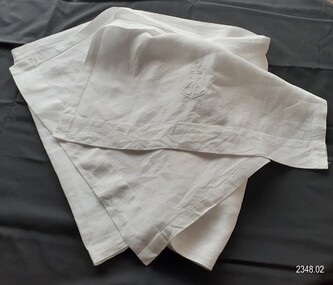
Textile - Altar Cloth
... ...anchor cross...MARINER'S CROSS symbol: - The symbol of an anchor that also looks like a cross is called the Mariner’s Cross (also called the Anchored Cross or Cross of Hope). ...The long rectangular cloth has the symbol of a Mariner's Cross (anchor and cross) embroidered with white silk thread on each short end. ...MARINER'S CROSS symbol: - The symbol of an anchor that also looks like a cross is called the Mariner’s Cross (also called the Anchored Cross or Cross of Hope). ...This altar cloth is representative of ecclesiastical linen in use in the early to mid-20th century. It is decorated with the Mariner's Cross symbol, connecting it to the history of the early Christian church. The cover for the cloth shows the respect the maker had for the cloth and what it stands for. The Mariner's Cross symbol also makes it appropriate as an altar cloth for the St Nicholas Seamen's Church at Flagstaff Hill Maritime Village. MARINER'S CROSS symbol: - The symbol of an anchor that also looks like a cross is called the Mariner’s Cross (also called the Anchored Cross or Cross of Hope). It looks like a ‘plus’ sign with anchor flukes at the base and a ring at the top. The anchor is one of the earliest symbols used in Christianity and represents faith, hope and salvation in times of trial. The Mariner’s Cross is linked to the scripture in Hebrews 6:19, which says, “Which hope we have as an anchor of the soul, both sure and steadfast, and which entereth into that within the veil”. This particular Mariner’s Cross also has the letter ‘X’ under the post of the anchor. In Greek, the language of the New Testament, the word for Christ is ‘Christos’, which begins with the Greek letter ‘X’ or ‘Chi’. Together, the elements on this Mariner’s Cross - anchor, cross and ‘X’ - symbolise to the Christian that Jesus Christ the Saviour gives security and safety, hope and salvation. Many church organisations still use various forms of the Mariner’s Cross. THE MISSIONS TO SEAMEN (Brief History): - The Missions to Seamen was an Anglican charity that has served seafarers of the world since 1856 in Great Britain. Its symbol is a Flying Angel, inspired by a Bible verse. Today, there are centres in over 200 ports worldwide where seamen of all backgrounds are offered a warm welcome and provided with a wide range of facilities. In Victoria, the organisation began in Williamstown in 1857 as a Sailors’ Church, also known as ‘Bethel’ or the ‘Floating Church’ in an old hulk floating in Hobson’s Bay, Port of Melbourne. It soon became part of the Missions to Seamen, Victoria. In the year 2000, the organisation, now named Mission to Seafarers, still operated locally in Melbourne, Portland, Geelong and Hastings. The Ladies’ Harbour Lights Guild was formed in 1906 to support the Missions to Seamen in Melbourne and other centres, such as Williamstown. Two of the most significant ladies of the Guild were founder Ethel Augusta Godfrey and foundation member Alice Sibthorpe Tracy (who established a branch of the Guild in Warrnambool in 1920). The Guild continued its work until the 1960s. In 1943, a former Williamstown bank was purchased for the Missions to Seaman Club. The chapel was named St Nicholas’ Seamen’s Church and was supported by the Ladies’ Harbour Lights Guild, the Williamstown Lightkeepers’ Auxiliary and the League of Soldiers’ and Sailors’ Friends. It ceased operation in 1966. A Missions to Seamen Chapel and Recreation Room was a significant feature of ports during the late 1800s and into the 1900s. It seemed appropriate for Flagstaff Hill to include such a representation within the new Maritime Village, so the Melbourne Board of Management of Missions to Seamen Victoria gave its permission on 21st May 1979 for the entire furnishings of the Williamstown chapel to be transferred to Flagstaff Hill. The St Nicholas Seamen’s Church was officially opened on October 11, 1981, and closely resembles the Williamstown chapel. The altar cloth is representative of the ecclesiastical linen in use in the early to mid-20th century, when the original St Nicholas Seamen's Church was opened in Williamstown, Victoria. The Mariner's Cross embroidered onto the altar cloth gives it a connection with the early Christian church and with the Missions to Seamen. The fine hand stitching and embroidery are examples of traditional handcraft skills used over the centuries and continuing in use today.Altar cloth, white linen, with custom-made white cotton cover. The long rectangular cloth has the symbol of a Mariner's Cross (anchor and cross) embroidered with white silk thread on each short end. The wide hems are hand-stitched. The cover has two white tape ties and embroidered text in blue silk thread. This cloth and cover is part of the St. Nicholas Seamen's Church Collection. On cloth: symbol of (anchor with an 'X' stitched behind the centre of it). On cover, text "FLAGSTAFF/ HILL" flagstaff hill, warrnambool, shipwrecked coast, flagstaff hill maritime museum, maritime museum, shipwreck coast, flagstaff hill maritime village, great ocean road, religion, religious service, st nicholas seamen’s church flagstaff hill, altar cloth, church linen, ecclesiastical linen, mariner’s cross, anchor cross, cross of hope, symbol of christianity, anchored cross, flagstaff hill maritime museum and village, maritime village, religious worship, worship service, st nicholas seamen’s church, williamstown, missions to seamen victoria, mission to seafarers, st nicholas missions to seamen’s church williamstown, missions to seamen, st nicholas missions to seamen’s church flagstaff hill, 139 nelson place williamstown, anglican church -
 National Vietnam Veterans Museum (NVVM)
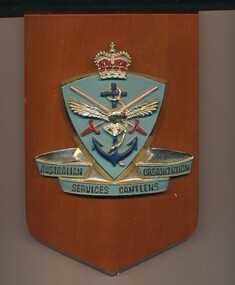
Plaque - Canteen Services plaque
... The emblem has a crown above an anchor, crossed swords and an eagle above the words Australian Services Canteens Organization....The emblem has a crown above an anchor, crossed swords and an eagle above the words Australian Services Canteens Organization. ...This item commemorates the war in Vietnam (1962-1975). A wooden plaque with metal emblem attached. The emblem has a crown above an anchor, crossed swords and an eagle above the words Australian Services Canteens Organization.Australian Services Organization Canteenaustralian canteen services organization, plaque, vietnam, canteen -
 Seaworks Maritime Museum
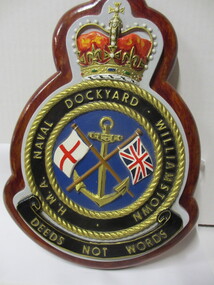
Plaque, HMA Naval Dockyard Williamstown
... Painted wooden plaque featuring anchor and crossed flags on blue background with gold outline ..."H.M.A Naval Dockyard Williamstown/ Deeds not words" Painted wooden plaque featuring anchor and crossed flags on blue background with gold outline HMA Naval Dockyard Williamstown Plaque ...Painted wooden plaque featuring anchor and crossed flags on blue background with gold outline "H.M.A Naval Dockyard Williamstown/ Deeds not words" -
 Beechworth RSL Sub-Branch
naval unit patch
... blue shield patch with white and gold embroidery. white crossed anchors ...Vietnam blue shield patch with white and gold embroidery. white crossed anchors naval unit patch ...blue shield patch with white and gold embroidery. white crossed anchors Hai Guan Hoa-KY.79 Naval Advisory Team. Vietnampatch, navel, unit patch, 79 naval advisory team -
 Waverley RSL Sub Branch
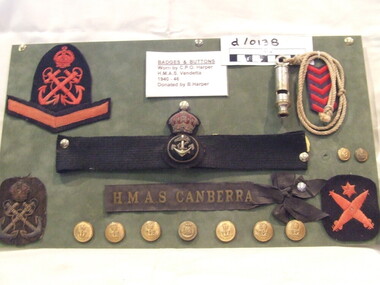
Badge Board Naval
... Whistle and lanyard Rank insignia Hat band with crown and anchor Insignia Crown and crossed anchors Cap ribbon H.M.A.S. ...Whistle and lanyard Rank insignia Hat band with crown and anchor Insignia Crown and crossed anchors Cap ribbon H.M.A.S. ...Badges and insignia worn by C.P.O. Harper on HMAS Vendetta 1940 - 1946 Photo C.P.O. Harper d/178Badge board displaying Rank insignia C.P.O. Whistle and lanyard Rank insignia Hat band with crown and anchor Insignia Crown and crossed anchors Cap ribbon H.M.A.S. Canberra Cloth Badge crow and crossed torpedoes and 9 brass buttons -
 Seaworks Maritime Museum
Badge
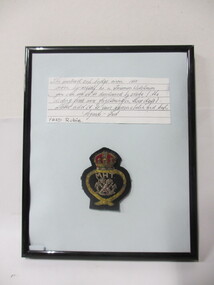
... Badge has the Melbourne Harbour Trust acronym and a symbol of two crossed anchors....Badge has the Melbourne Harbour Trust acronym and a symbol of two crossed anchors. Badge ...Small badge in black frame with blue paper backing. Badge has the Melbourne Harbour Trust acronym and a symbol of two crossed anchors."MHT" Attached note "The enclosed Cao badge circa 1950 / worn by myself as a Fireman Watchman/ you can see it is discoloured by smoke (the/ decking fires were frightening in those days)/ Please add it to your memorabilia and keep/ regards- Fred/ Fred Rubie" -
 Mission to Seafarers Victoria
Painting, C V Wright, RMS Queen Mary, 1971
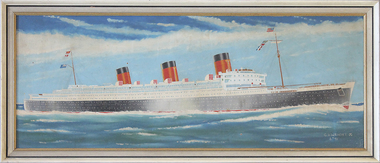
... at lower right corner single uc word in white paint : "CV WRIGHT (artist symbol of crossed anchors) / 3 ? '71"...Fulfills previous MTSV acquisition policy regarding collection of modern, historic and contemporary marine paintings. marine painting ocean liners rms queen mary royal mail ships p & o steamships ww2 artwork-paintings hobbies bosun c.v. wright at lower right corner single uc word in white paint : "CV WRIGHT (artist symbol of crossed anchors) / 3 ? '71" Long framed unglazed landscape format painting predominantly depicting in foreground an ocean liner painted black hull and white superstructure with three funnel stacks painted red with black trim, under full sail against a blue sky. ...RMS Queen Mary a retired ocean liner by 1971 that sailed primarily on the North Atlantic Ocean from 1936 to 1967 for the Cunard Line (known as Cunard-White Star Line when the vessel entered service ( Wikipedia) Maritime ArtLong framed unglazed landscape format painting predominantly depicting in foreground an ocean liner painted black hull and white superstructure with three funnel stacks painted red with black trim, under full sail against a blue sky. The back of the painting is covered with brown paper in places damaged. Hangs on a cotton cord threaded between two screw in eyelet hooks. Brown paper backingat lower right corner single uc word in white paint : "CV WRIGHT (artist symbol of crossed anchors) / 3 ? '71"marine painting, ocean liners, rms queen mary, royal mail ships, p & o steamships, ww2, artwork-paintings, hobbies, bosun, c.v. wright -
 Mission to Seafarers Victoria
Painting, RMS Queen Elizabeth, 1971
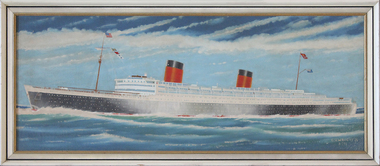
... at lower right corner single uc word in white paint : "CV WRIGHT (artist symbol of crossed anchors) / 3 ? '71"...Fulfills previous MTSV acquisition policy regarding collection of modern, historic and contemporary marine paintings. marine painting ocean liners rms queen mary royal mail ships p & o steamships ww2 artwork-paintings hobbies bosun c.v.wright at lower right corner single uc word in white paint : "CV WRIGHT (artist symbol of crossed anchors) / 3 ? '71" Long framed unglazed landscape format painting predominantly depicting in foreground an ocean liner painted black hull and white superstructure with two funnel stacks painted red with black trim, under full sail against a blue sky. ...RMS Queen Elizabeth that sailed primarily on the North Atlantic Ocean from 1939 to 1968 for the Cunard Line , later owned by the Queen Corpration and then the Seawise University. Queen Elizabeth was a slightly larger ship (than the Queen Mary) , the largest passenger liner ever built at that time and for 56 years thereafter. She also has the distinction of being the largest-ever riveted ship by gross tonnage. She first entered service in February 1940 as a troopship in World War II, and it was not until October 1946 that she served in her intended role as an ocean liner. With the decline in popularity of the transatlantic route, both ships were replaced by the smaller. Queen Elizabeth was sold to a succession of buyers, and finally was sold to Hong Kong businessman of the Orient Overseas line in 1970. In 1972, whilst she was undergoing refurbishment in Hong Kong harbour, fire broke out aboard under unexplained circumstances, and the ship was capsized by the water used to fight the fire.Marine artLong framed unglazed landscape format painting predominantly depicting in foreground an ocean liner painted black hull and white superstructure with two funnel stacks painted red with black trim, under full sail against a blue sky. The back of the painting is covered with brown paper in places damaged. Hanging cord missing . Remnant Brown paper backing.at lower right corner single uc word in white paint : "CV WRIGHT (artist symbol of crossed anchors) / 3 ? '71"marine painting, ocean liners, rms queen mary, royal mail ships, p & o steamships, ww2, artwork-paintings, hobbies, bosun, c.v.wright -
 Dandenong/Cranbourne RSL Sub Branch
Artwork, other - Wooden framed tapestry
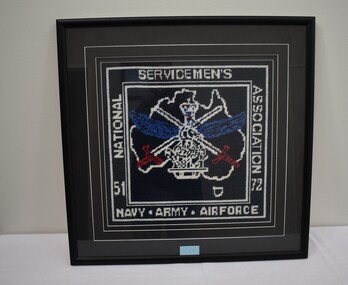
... Centre depicts map of Australia with "wings - airforce" -"anchor - navy" - "crossed swords - army". Surrounded by the words National Servicemens Association 51 72 with Navy Army Airforce. ...Centre depicts map of Australia with "wings - airforce" -"anchor - navy" - "crossed swords - army". Surrounded by the words National Servicemens Association 51 72 with Navy Army Airforce. ...The National Servicemen's Association of Australian was formed in 1987 to represent the interests of National Servicemen to promote their health welfare and legacy. 212 Servicemen died in conflicts in Borneo and Vietnam.Ebonised framed tapestry.Centre depicts map of Australia with "wings - airforce" -"anchor - navy" - "crossed swords - army". Surrounded by the words National Servicemens Association 51 72 with Navy Army Airforce. Small plaque at bottom "Donated by John K Quick 3/743827". -
 National Vietnam Veterans Museum (NVVM)
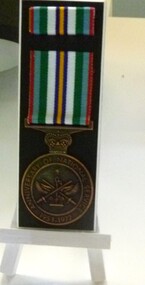
Medal, Anniversary of National Service medal
... Bronze round medal depicting crossed swords, anchor and wings with a star above. ...The ANSM was introduced on 2001 to recognise those who completed their obligation under the two National Service Schemes that operated in Australia between 1951 and 1972 Australian Medal National Service Anniversary Anniversary of National Service 1951-1972 Bronze round medal depicting crossed swords, anchor and wings with a star above. ...tis replica Anniversary of National Service 1951-1975 Medal. The ANSM was introduced on 2001 to recognise those who completed their obligation under the two National Service Schemes that operated in Australia between 1951 and 1972Bronze round medal depicting crossed swords, anchor and wings with a star above. Ribbon is striped brown, blue, green, white, navy and gold.Anniversary of National Service 1951-1972australian medal, national service, anniversary -
 Bendigo Historical Society Inc.
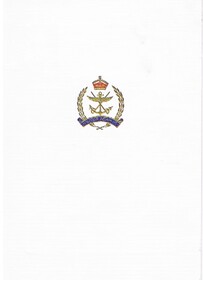
Document - MALONE COLLECTION: GREETING CARDS
... White card with gold anchor, two crossed swords and wings near the top of the anchor. ...White card with gold anchor, two crossed swords and wings near the top of the anchor. ...Document. Greeting Cards. White card with gold anchor, two crossed swords and wings near the top of the anchor. Above the anchor is a red, gold & black crown. At each side is a gold spray of leaves. At the bottom is a blue curved banner with gold edging. Printed in gold is 'Uniter Agamus'. Printed on the left side of the insert is 'The Naval and Military Club Melbourne, Victoria.'The Naval and Military Club Melbourne Victoriaperson, greeting cards, malone collection, malone collection, greeting cards -
 Bendigo Military Museum
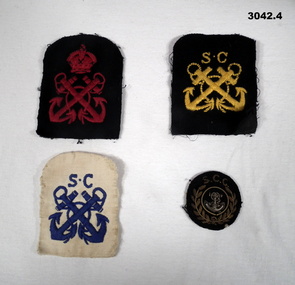
Uniform - BADGES, RAN, SEA CADETS, Post WW2
... .1) Cloth badge patch, black background with x 2 red cotton crossed sea anchors surmounted by a crown. .2) Cloth badge patch, black background with x 2 gold cotton crossed sea anchors with letters SC above them. .3) Cloth badge patch, white background with x 2 blue cotton crossed sea anchors with letters SC above them. .4) Badge combination, dome shaped, black cloth. ...Schilling collection. numismatics-badges-military military history - navy Cadets .4) Has number “541” on rear. .1) Cloth badge patch, black background with x 2 red cotton crossed sea anchors surmounted by a crown. .2) Cloth badge patch, black background with x 2 gold cotton crossed sea anchors with letters SC above them. .3) Cloth badge patch, white background with x 2 blue cotton crossed sea anchors with letters SC above them. .4) Badge combination, dome shaped, black cloth. ...L. Schilling collection..1) Cloth badge patch, black background with x 2 red cotton crossed sea anchors surmounted by a crown. .2) Cloth badge patch, black background with x 2 gold cotton crossed sea anchors with letters SC above them. .3) Cloth badge patch, white background with x 2 blue cotton crossed sea anchors with letters SC above them. .4) Badge combination, dome shaped, black cloth. Gold laurel wreath, gold stylized rope around a silver anchor rope. Letters SCC in gold thread above the centre section..4) Has number “541” on rear.numismatics-badges-military, military history - navy, cadets -
 Wangaratta RSL Sub Branch
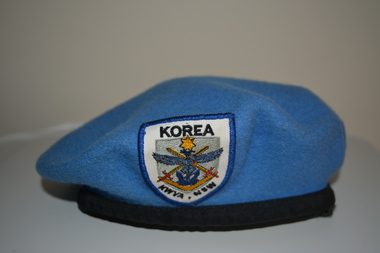
Headwear - Beret
... At front affixed with multi coloured fabric badge consisting of an anchor, boomerang, wings and crossed swords below a yellow star. ...At front affixed with multi coloured fabric badge consisting of an anchor, boomerang, wings and crossed swords below a yellow star. ...Blue Royal Australian Navy Beret with Badge issued/belonged to Errol Ivan DREHER born 30/4/1926 at Numerkah. Enlisted in the RAN on 6/5/1946 Service No R30435 and served on HMAS Sydney 1951-2 during the Korean WarBlue wool beret with black braid band. At front affixed with multi coloured fabric badge consisting of an anchor, boomerang, wings and crossed swords below a yellow star. Inside - Kent pure wool Large/ Christie’s Sydney Badge - Korea KWVA NSWran, korean war, hmas sydney -
 Bendigo Military Museum
Decorative object - BADGES, 1930s
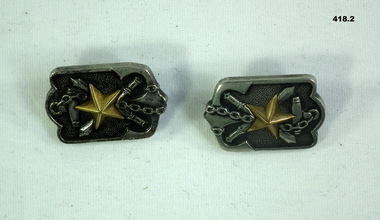
... .1) Badge, Japanese, Metal, Rectangular shape with crossed swords, Anchor and chain, centre is a brass star. ...Refer Cat No 432.2 for his service history and 937P. numismatics -badges - military japan .1) Badge, Japanese, Metal, Rectangular shape with crossed swords, Anchor and chain, centre is a brass star. ...Items souvenired by Frederick Ernest ADDLEM VX142253. Refer Cat No 432.2 for his service history and 937P. .1) Badge, Japanese, Metal, Rectangular shape with crossed swords, Anchor and chain, centre is a brass star. Rear has Japanese writing and pin clasp .2) Same as abovenumismatics -badges - military, japan -
 National Vietnam Veterans Museum (NVVM)
Uniform - Shirt, Navy
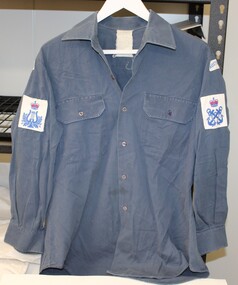
... Cotton patches on left and right sleeve of blue and red embroidery on white: right is a lyre beneath a crown, left is crossed anchors beneath a crown....Cotton patches on left and right sleeve of blue and red embroidery on white: right is a lyre beneath a crown, left is crossed anchors beneath a crown. Uniform Shirt, Navy ...Standard issue work shirt worn by members of the Royal Australian Navy during the war in Vietnam. This item was issued to Leading Musician Eric Raymond Cross : HMAS Sydney 21 May 1968 -13 Jun 1968 and Royal Australian Navy Fleet Band 26 May 1970 - 04 Jun 1970.Blue cotton drill shirt with collar, long sleeves and button-flap patch pockets. Front fastens with 6 buttons. Cotton patches on left and right sleeve of blue and red embroidery on white: right is a lyre beneath a crown, left is crossed anchors beneath a crown.navy, vietnam, shirt, uniforn, ran, musician, cross, eric cross, e r cross -
 Bendigo Military Museum
Uniform - OVERALLS, RAN, Proban - National Textiles Pty Ltd, 1994
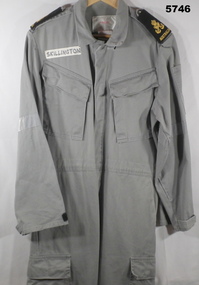
... Epaulettes - embroidered gold crown, crossed anchors, and "Australia" on black fabric. ...Epaulettes - embroidered gold crown, crossed anchors, and "Australia" on black fabric. ...Handwritten black ink - "PO B SKILLINGTON R115634" .Overalls - mid grey cotton fabric with 'DURABLE FLAME RETARDANT FINISH' . Metal press stud closure. Elastic waist back. Epaulettes - embroidered gold crown, crossed anchors, and "Australia" on black fabric. Name label on front right side and inside back waistband. Makers label - below collar - back.Name label on front - "SKILLINGTON" Inside waist back - handwritten in black ink "PO B. SKILLINGTON R115634". Makers label - black and red print - top label - "National Textiles Pty Ltd/ Proban" with extensive information on the Flame Retardant Finish and laundry care. Lower label - red print - CAN'T/ TEAR/ 'EM/ AUSTRALIAN WORKWEAR/ 100% Cotton/ Size 95R/1994".uniforms, ran, workwear -
 Whitehorse Historical Society Inc.
Souvenir - Playing cards
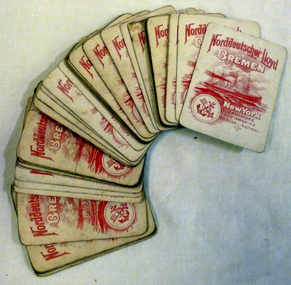
... Reverse has sailing ship and insignia in circle bottom left of crossed anchor and key. Writing at top: Norddeutscher, Lloyd, Bremen, at bottom right corner: New York, Baltimore Sud America Ost-Asien Australien. (53) Paper envelope (brown) in which cards were stored....Reverse has sailing ship and insignia in circle bottom left of crossed anchor and key. Writing at top: Norddeutscher, Lloyd, Bremen, at bottom right corner: New York, Baltimore Sud America Ost-Asien Australien. (53) Paper envelope (brown) in which cards were stored. ...Pack of cards used by Mary Schwerkolt on her journey on the Seydlitz from New York via Bremen in 1908 to Melbourne to claim her inheritance. Bremer was the departure point for migrants leaving Germany.Complete set of (1-52) playing cards. Reverse has sailing ship and insignia in circle bottom left of crossed anchor and key. Writing at top: Norddeutscher, Lloyd, Bremen, at bottom right corner: New York, Baltimore Sud America Ost-Asien Australien. (53) Paper envelope (brown) in which cards were stored.whalen, rosalie, schwerkolt, mary, playing cards, games, seydlitz, bremen, new york, baltimore -
 Dandenong/Cranbourne RSL Sub Branch
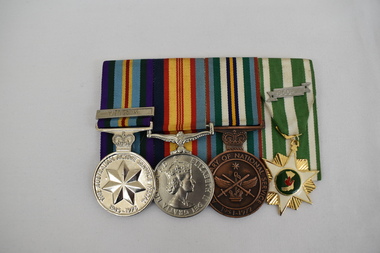
Medal - Vietnam Service Medals
... Anniversary of National Service Medal surrounds wings beneath an anchor with crossed swords on obverse. The reverse shows the Southern Cross on spreading rays surrounded by a cog. ...Anniversary of National Service Medal surrounds wings beneath an anchor with crossed swords on obverse. The reverse shows the Southern Cross on spreading rays surrounded by a cog. ...Set of 4 Vietnam Service Medals. Court mounted. Australian Active Service Medal. With Vietnam Bar. Vietnam Military Medal. Anniversary of National Service Medal. Republic of Vietnam Campaign Medal. With 1960 Bar.AASM. Has central star. with date 1945 - 1975. Vietnam Medal has HM Elizabeth 2nd on obverse with reverse showing mythological figure of the Greek God Hermes. Anniversary of National Service Medal surrounds wings beneath an anchor with crossed swords on obverse. The reverse shows the Southern Cross on spreading rays surrounded by a cog. Republic of Vietnam Campaign Medal obverse shows a gold and white enamelled star with a green- red and gold centre motif. The ribbon is green with 3 white stripes. Reverse shows CHIEN _ DICH over central VIETNAM with BOI - TINH beneath. -
 Bendigo Military Museum
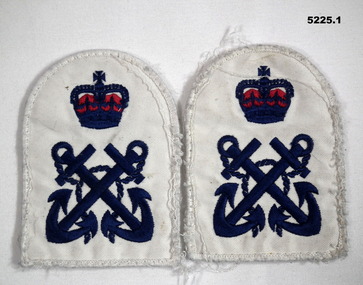
Uniform - ARM RANK BADGES, NAVY
... Two Rank badges - Petty Officer, embroidered navy blue colour, crossed anchors with red and navy blue crown above. 2. ...Two Rank badges - Petty Officer, embroidered navy blue colour, crossed anchors with red and navy blue crown above. 2. ...Items in collection re David Dixon RAN R112262, refer Cat No 5215.5 for his service details.1. Two Rank badges - Petty Officer, embroidered navy blue colour, crossed anchors with red and navy blue crown above. 2. Two Category badges - Petty Officer Bosun, embroidered navy blue colour and red crown with navy blue crossed cannons. 3. On category badge - Quartermaster Gunner, embroidered navy blue and red crown above navy blue crossed cannons and three letters "QMG" . 4. Australian flag, white ensign, embroidered red,white and blue. uniform, badges, navy ran -
 Bendigo Military Museum
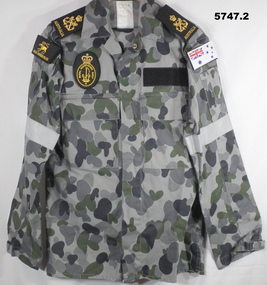
Uniform - UNIFORM, DISRUPTIVE PATTERN, NAVY, CTE Pty Ltd, 2010 - 2011
... Epaulettes - gold embroidered crown, crossed anchors and "AUSTRALIA" unit shoulder flashes - both embroidered with gold, white and red thread - R. three headed dog/ "HMAS CERBERUS" - ships badge. ...Epaulettes - gold embroidered crown, crossed anchors and "AUSTRALIA" unit shoulder flashes - both embroidered with gold, white and red thread - R. three headed dog/ "HMAS CERBERUS" - ships badge. ...Naval Uniform - brand new. 1. Jacket - 75% cotton, 25% polyester fabric. Grey, dark grey and dark green disruptive pattern. Metal stud closures. Epaulettes - gold embroidered crown, crossed anchors and "AUSTRALIA" unit shoulder flashes - both embroidered with gold, white and red thread - R. three headed dog/ "HMAS CERBERUS" - ships badge. L. Australian Navy White Ensign. Chest patch - embroidered gold, red and white RAN Patch - Crown, Anchor and R.A.N. logo. 2. Trousers - 75% cotton, 25% polyester fabric, grey, dark grey and dark green disruptive pattern.Both - Maker's label - black print on white label "CTE PTY LTD/ JUNE 2010/2011" / "75% cotton 25% polyester/ FR treated". Then extensive information on laundering care of fabric. "MADE IN AUSTRALIA" .uniforms, dpnu, ran -
 Geelong Naval and Maritime Museum
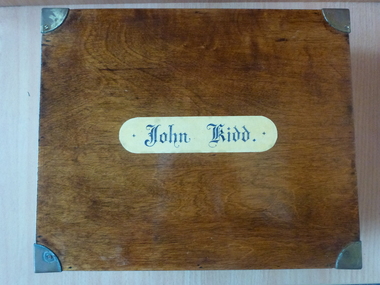
Ditty Box, John Kidd's Ditty Box, c.1915-1930
... Cadman & Sons, Sheffield England), black and white bakelite buttons with embossed crown and anchor and brass shank (either for war time or junior officers), gold naval buttons with embossed naval anchor and 2 piece shank (from a coat and cuffs), a bullet casing (Webley '45), a petty officers cloth badge (crossed anchors with a Crown), 4 shells, a good conduct badge (black with gold embroidery) and a red/brown vulcanized asbestos fibre fireproof dog- tag with rope attached....Cadman & Sons, Sheffield England), black and white bakelite buttons with embossed crown and anchor and brass shank (either for war time or junior officers), gold naval buttons with embossed naval anchor and 2 piece shank (from a coat and cuffs), a bullet casing (Webley '45), a petty officers cloth badge (crossed anchors with a Crown), 4 shells, a good conduct badge (black with gold embroidery) and a red/brown vulcanized asbestos fibre fireproof dog- tag with rope attached. ...There is a single record with the RAN for a John Kidd, who commenced service in 1909 and left in 1912. Kidd was born in 1885 in Sydney and his mother lived in Queenscliff. He served on the HMAS Parramatta from 1911-1912. There is no evidence of him having served on the HMAS Melbourne. Kidd served from 1911-1912 on the HMAS Parramatta, the first ship launched for the Royal Australian Navy (RAN).A wooden box with mortise and tenon joins, brass fittings, circular handles, silver hinges and a name plate on the front. The box has a lift out section creating compartments. On the inside lid of the box is a postcard of the HMAS Melbourne surrounded by small rope decoration. A number of keepsakes are inside including a fidd for splicing ropes, a Capstan Wills tobacco tin, 3 postcards, a "Bengall Imperial" cut throat razor (T.R. Cadman & Sons, Sheffield England), black and white bakelite buttons with embossed crown and anchor and brass shank (either for war time or junior officers), gold naval buttons with embossed naval anchor and 2 piece shank (from a coat and cuffs), a bullet casing (Webley '45), a petty officers cloth badge (crossed anchors with a Crown), 4 shells, a good conduct badge (black with gold embroidery) and a red/brown vulcanized asbestos fibre fireproof dog- tag with rope attached."John Kidd" on front of box. "20171" stamped on edge of box. Tobacco tin: "Medium/"Capstan"/Registered/Ready Rubbed Fine Cut Tobacco/-1 oz net weight when packed/W.D. & H.O. Wills/(Australia) Ltd., Sydney. Postcard: Main Street, Samarai. Postcard: Sydney from Lavender Bay Kerry (Copyright) Sydney. Postcard: "Docks showing cathedral, Bristol BL 193. Copyright Lilywhite (1932) Ltd, Sowerby Bridge". Buttons: "AUSTRALIA/Y6-298", "Buttons Ltd B'HAM mark trade" "AUSTRALIA Stokes & Son Melbourne". Bullet casing "WEB WRA 45". Dog-Tag may read "L/Ford" written in ink?ditty box, john kidd, dog-tag, wwi identification tag, lilywhite ltd, w.d & h.o wills, stokes & son melbourne, naval buttons, hmas melbourne -
 Bendigo Military Museum
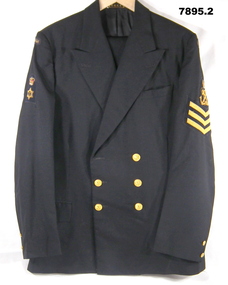
Uniform - JACKET, TROUSERS - RAN, Unknown
... in middle of sleeve black fabric with gold thread embroidered Queen's Crown, with real inserts and crossed anchors. Attached below are three gold stripe chevrons on black fabric. ...Shoulder patches/flashes at top - black fabric, gold lettering "AUSTRALIA". in middle of sleeve black fabric with gold thread embroidered Queen's Crown, with real inserts and crossed anchors. Attached below are three gold stripe chevrons on black fabric. indicates Petty Officer with years of service. ...Name on drycleaning ticket - "SHARPE".RAN Winter ceremonial uniform Officers. 1. Jacket, black colour wool/polyester fabric. Double breasted with six buttons, collar, two inset lower pockets with flap. Shoulder patches/flashes at top - black fabric, gold lettering "AUSTRALIA". in middle of sleeve black fabric with gold thread embroidered Queen's Crown, with real inserts and crossed anchors. Attached below are three gold stripe chevrons on black fabric. indicates Petty Officer with years of service. Buttons - gold colour metal buttons with shank with raised lettering and emblem - Queen's Crown, Anchor and "AUSTRALIA" (one missing). Lining - black colour polyester/ cotton fabric. Two concealed pockets. Sleeves - two gold buttons. Right sleeve - shoulder patch - black colour fabric with gold embroidery "S" in six pointed star surmounted by Queens crown with red inserts. Petty Officer - Steward. 2. Trousers - black colour wool/polyester fabric with fob pocket, two inset side pockets, one inset back pocket. Black and white colour buttons for waist adjustment and braces. cream colour cotton fabric lining waistband and pockets. Black colour ribbon stripe down outside seam. Metal zipper fly. Manufacturers information - gold embroidery. 1. "C.G.C.F.", on back of metal buttons "STOKES & SONS/ MELB".ran, uniform, steward -
 Flagstaff Hill Maritime Museum and Village
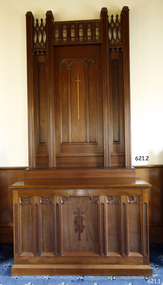
Furniture - Altar and Reredos, Hadwen and Houghton, ca 1944
... The base has a detachable vertical panel with the decoration of a sword and two anchors, the reredos has a cross on a panel. It was made by Hadwen and Houghton, Malvern, Victoria. ...The base has a detachable vertical panel with the decoration of a sword and two anchors, the reredos has a cross on a panel. It was made by Hadwen and Houghton, Malvern, Victoria. ...This altar and rear reredos were part of the original furnishings of the St Nicholas' Mission to Seamen's Church at 139 Nelson Place, Williamstown, Victoria. The Mission to Seamen organisation operated the Church. The reredos was donated to the Williamstown chapel by Miss. M. Breaks, in memoriam Miss. L.A. Breaks, who served a very active part in the Seamen's Mission, and the altar was donated by Mrs and Miss J R Schutt. THE MISSIONS TO SEAMEN (Brief History): - The Missions to Seamen was an Anglican charity in Great Britain that has served the world's seafarers since 1856. Its symbol is a Flying Angel, inspired by a Bible verse. Today, there are centres in over 200 ports worldwide where seamen of all backgrounds are offered a warm welcome and provided with a wide range of facilities. In Victoria, the organisation began in Williamstown in 1857 as a Sailors’ Church, also known as ‘Bethel’ or the ‘Floating Church’ in an old hulk floating in Hobson’s Bay, Port of Melbourne. It soon became part of the Missions to Seamen, Victoria. In 2000, the organisation, now named Mission to Seafarers, still operated locally in Melbourne, Portland, Geelong and Hastings. The Ladies’ Harbour Lights Guild was formed in 1906 to support the Missions to Seamen in Melbourne and other centres, such as Williamstown. Two of the most significant ladies of the Guild were founder Ethel Augusta Godfrey and foundation member Alice Sibthorpe Tracy (who established a branch of the Guild in Warrnambool in 1920). The Guild continued its work until the 1960s. In 1943, a former Williamstown bank was purchased for the Missions to Seamen Club. The chapel was named St Nicholas’ Seamen’s Church and was supported by the Ladies’ Harbour Lights Guild, the Williamstown Lightkeepers’ Auxiliary and the League of Soldiers’ and Sailors’ Friends. It ceased operation in 1966. A Missions to Seamen Chapel and Recreation Room was a significant feature of ports during the late 1800s and 1900s. It seemed appropriate for Flagstaff Hill to include such a representation within the new Maritime Village, and the Melbourne Board of Management of Missions to Seamen Victoria gave its permission on 21st May 1979 for the entire furnishings of the Williamstown chapel to be transferred to Flagstaff Hill. The St Nicholas Seamen’s Church was officially opened on October 11, 1981, and resembles the Williamstown chapel.This altar and reredos are significant historically for its origin in the St Nicholas Mission to Seamen's Church in Williamstown, established in 1857 to cater for the physical, social, and spiritual needs of seafarers. It originated in Bristol, England when a Seamen's Mission was formed in 1837. They are historically significant for their connection to the Ladies Lightkeepers’ Auxiliary, an organisation of women, formed to support seafarers. The connection of this furniture to the Mission to Seamen and to the Ladies Lightkeepers’ Auxiliary highlights the strong community awareness of the life of people at sea, their dangers and hardships, and their need for physical, financial, spiritual and moral support. Altar and reredos or altar panel, wooden. The timber is panelled, stained and has a varnished finish. The base has a detachable vertical panel with the decoration of a sword and two anchors, the reredos has a cross on a panel. It was made by Hadwen and Houghton, Malvern, Victoria. A plaque at the bottom right edge is marked with the maker's name. The altar is part of the St Nicholas Seamen's Church collection.On removable panel; logo of [sword and two anchors] On bottom right of base: "Hadwen and Houghton, Malvern"flagstaff hill maritime museum and village, flagstaff hill, warrnambool, maritime museum, maritime village, shipwreck coast, great ocean road, religion, religious service, st nicholas seamen’s church, williamstown, missions to seamen victoria, altar, reredos, church furniture, religious furniture, miss m breaks, miss l a breaks, worship service, mrs and miss j.r. schutt -
 Flagstaff Hill Maritime Museum and Village
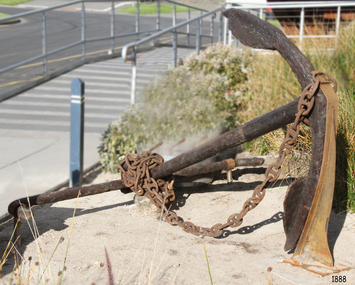
Equipment - Anchor, Before 1831
... anchor from the wreck of the CHILDREN. Flat hammer-welded flukes on opposing curved arms and a peaked crown. It has a metal, elbowed stock or cross-bar and a heavy-duty pinned, flat-ring shackle for the anchor chain. ...anchor from the wreck of the CHILDREN. Flat hammer-welded flukes on opposing curved arms and a peaked crown. It has a metal, elbowed stock or cross-bar and a heavy-duty pinned, flat-ring shackle for the anchor chain. ...The anchor is from the wooden sailing ship CHILDREN, which was wrecked at Childers Cove east of Warrnambool on the 14th of January 1839 with the loss of 16 lives. The Children anchor was raised from the wreck site by Flagstaff Hill Divers: Peter Ronald, Garry Hayden (Terang, still), Tim Goodall (now Warrnambool), and Colin Goodall (now Warrnambool), on Sunday, 3rd January 1974. A week or so later, it was dragged up the cliffs and taken to Warrnambool. It is now on display near the entrance to the Maritime Museum and Village. It appears to be a Pering’s Improved Anchor, developed at Portsmouth after 1813. The addition of broad curvature to the anchor arms provided a stronger purchase than the pre-existing Admiralty Old Pattern Long Shanked Anchor with straight arms. However, the evidence of hammer-welding of the separate pieces of the arms and palms to the central shank, peaked crown and flat palms, suggests the manufacture is before the 1831 Rodger’s Anchor design, which cast both arms and their flukes as one piece that was then attached to the shank by a bolt through the crown. This identification seems consistent with the date of the CHILDREN’s construction in 1824. The CHILDREN was a three-masted barque with a wooden hull built at Liverpool in England. The vessel was bought by the Henty family of Portland (Australia Felix) in 1837 for regular coastal trading between Van Diemens Land (now Tasmania), the Port Phillip District of New South Wales and South Australia. Only 255 tons burden (92 feet in length, with a beam of 25 feet and depth of 17 feet), it sailed from Launceston bound for Adelaide in late December 1838, on its first Australian voyage and under the English master who had brought the barque out, Captain H. Browne. On board the CHILDREN were 24 passengers, including 9 children, the captain and 14 crew; livestock of 1500 sheep, 8 bullocks and 7 horses; general cargo of beef, pork, tobacco, tripe, butter, limejuice, horse hair, currants, lead shot, beer and spirits; 5,000 house bricks from London; and six whaling boats with associated whaling gear. The vessel was battered by gale-force north-westerly winds shortly after setting out from Launceston on 11 January 1839, and adverse sailing conditions persisted for the next four days. At 11 pm on the 14th of January 1839, and many miles north and east of the captain’s navigated position, the CHILDREN struck the Pinnacle, a limestone stack off what is now called Childers Cove. Within half an hour, the ship was destroyed. As well as the loss of livestock and cargo, 16 passengers and crew perished, including the captain, six men, one woman and nine children. In 1931, shifting sands at Childers Cove uncovered the skeleton of an adult male. In 1951, another two skeletons were exposed by storms, an adult male and a child. In 1963, some district scuba divers retrieved a small signal cannon from the site. And in 1974, Flagstaff Hill recovered the anchor and some house bricks. The anchor recovered from the Children's wreck is significant as part of the equipment of the early 19th-century barque. The 1839 wreck and recovered artefacts are examples of the construction methods and materials used in that era and can be used to study the evolution of shipbuilding methods and principles. The wreck of the Children is of state significance as one of colonial Victoria’s earliest and most significant maritime disasters, and one of the first vessels lost in the Western District. This is recognised by its inclusion on the Victorian Heritage Register, VHR No. S116. Little is left on the seabed to mark the tragedy, apart from some of the house bricks intended for the Henty settlement. A large forged, wrought iron anchor from the wreck of the CHILDREN. Flat hammer-welded flukes on opposing curved arms and a peaked crown. It has a metal, elbowed stock or cross-bar and a heavy-duty pinned, flat-ring shackle for the anchor chain. It is in fair condition but extensively corroded after 135 years on the seabed. flagstaff hill, flagstaff hill maritime museum and village, warrnambool, maritime museum, maritime village, great ocean road, shipwreck coast, shipwreck artefact, children, barque, three-masted, liverpool, childer’s cove, port campbell, 1839 shipwreck, 1939 wreck, james henty and co, henty brothers, captain h. browne, first mate t. gay, second mate w. wentworth, portland, portland bay, anchor, ship’s anchor, peter ronald, garry hayden, tim goodall, colin goodall, pering’s improved anchor -
 Flagstaff Hill Maritime Museum and Village
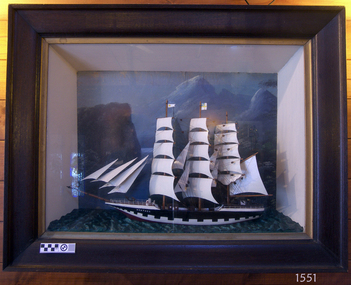
Craft - Ship Model, Heather, before Dec 1983
... Ship is flying two pennants, top one is blue with 'JRE" on it, bottom one is plain white with a red disc and a swallow-tailed end; the rectangular flag is divided by a yellow cross on white, and the top left corner is blue with a yellow anchor symbol on it. ...Ship is flying two pennants, top one is blue with 'JRE" on it, bottom one is plain white with a red disc and a swallow-tailed end; the rectangular flag is divided by a yellow cross on white, and the top left corner is blue with a yellow anchor symbol on it. ...The blue pennant with the white letters "J R E" flag of the Ellerman Wilson Line Pty. Ltd. of Hull. The letters refer to the founder of the Ellerman Group, John Reeves Ellerman. Ship model of the vessel "Heather", a three masted tall ship. Model is painted black and white with a brown deck. Sails are raised. The name "HEATHER" is painted in white on it black bow. The ship is displayed as a diorama in a glass fronted, wide edged timber frame with deep sides. The back of the frame is painted pale green. The base of the frame depicts textured sea and the back has a seascape with a cliff and other sailing vessels. Ship is flying two pennants, top one is blue with 'JRE" on it, bottom one is plain white with a red disc and a swallow-tailed end; the rectangular flag is divided by a yellow cross on white, and the top left corner is blue with a yellow anchor symbol on it. "HEATHER" on bow. "JRE" on blue pennant.flagstaff hill, warrnambool, shipwrecked-coast, flagstaff-hill, flagstaff-hill-maritime-museum, maritime-museum, shipwreck-coast, flagstaff-hill-maritime-village, ship model, sailing ship heather, tall ship diorama, diorama, sailing vessel, john reeves ellerman., jre, ellerman wilson line pty. ltd -
 Mission to Seafarers Victoria
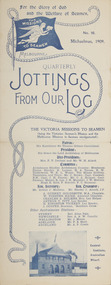
Magazine (sub-item) - Newsletter, The Victoria Missions to Seamen, Jottings From Our Log, Issue 16 - Michaelmas 1909, 1909
... cross...crotonhurst...myrniong...s.s. waratah...Seamen's guild...wendur...leslie mumford...matthew hummelsheim...blue anchor...Content: Page 1: - The Missions Patron, President, Committee - Photograph of the Siddeley Street Mission Page 2: - Lost ship SS Waratah (from the Blue Anchor Line founded by Wilhelm Lund - Death of able seaman, Leslie Mumford of the ship Wendur - Death of German seaman, Matthew Hummelsheim after 3 months in hospital - Visit of Rev. Gurney Goldsmith to the Sydney Mission - News from the Newcastle Mission and Port Adelaide - News from the LHLG (drawing room meetings) - League of the Souther Cross Page 3: - 3rd Annual Seafarers Service - Thanks for gifts - Ships and Sailors Collections list - Address and timetable of activities in the 3 missions - Advertising from Inglis, SMith & Co. ...Content: Page 1: - The Missions Patron, President, Committee - Photograph of the Siddeley Street Mission Page 2: - Lost ship SS Waratah (from the Blue Anchor Line founded by Wilhelm Lund - Death of able seaman, Leslie Mumford of the ship Wendur - Death of German seaman, Matthew Hummelsheim after 3 months in hospital - Visit of Rev. Gurney Goldsmith to the Sydney Mission - News from the Newcastle Mission and Port Adelaide - News from the LHLG (drawing room meetings) - League of the Souther Cross Page 3: - 3rd Annual Seafarers Service - Thanks for gifts - Ships and Sailors Collections list - Address and timetable of activities in the 3 missions - Advertising from Inglis, SMith & Co. ...Content: Page 1: - The Missions Patron, President, Committee - Photograph of the Siddeley Street Mission Page 2: - Lost ship SS Waratah (from the Blue Anchor Line founded by Wilhelm Lund - Death of able seaman, Leslie Mumford of the ship Wendur - Death of German seaman, Matthew Hummelsheim after 3 months in hospital - Visit of Rev. Gurney Goldsmith to the Sydney Mission - News from the Newcastle Mission and Port Adelaide - News from the LHLG (drawing room meetings) - League of the Souther Cross Page 3: - 3rd Annual Seafarers Service - Thanks for gifts - Ships and Sailors Collections list - Address and timetable of activities in the 3 missions - Advertising from Inglis, SMith & Co. Page 4: - Advertising from Robur Tea, Jas. F. McKenzie & Co. , Diocesan Books Society The Mission holds a photograph of this publication being packed in calico by the members of the 'Ladies Harbour Lights Guild' for distribution to branches and supporters.Published for some 30 years by the Victorian Missions to Seamen issued to supporters the series contributes to the history of the organisation. It is a key cross reference supplying many details and dates of Chaplain and LHLG activities in both Melbourne, Port Phillip and other States where Missions were gradually established and information not able to be included in Annual Reports. It is also a source of images.newsletter, victorian seamen's mission, melbourne misson to seamen, jottings from our log, lhlg, rope, flying angel, seagull, advertising, port melbourne, williamstown, sailors' home, australian wharf, seamen's institute, sailors' rest, services, concerts, events, socials, deaths, w.h.c. darvall, motor boat, geelong, woolies, michaelmas, quarterly, ladies harbour lights guild, reverend alfred gurney goldsmith, charles arthur holmes, reverend a.t. pitt, harold kingston vickery, boatman, southern cross, crotonhurst, myrniong, s.s. waratah, seamen's guild, wendur, leslie mumford, matthew hummelsheim, blue anchor line, wilhelm lund -
 Mission to Seafarers Victoria
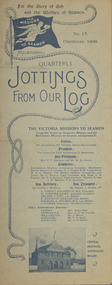
Magazine (sub-item) - Newsletter, The Victoria Missions to Seamen, Jottings From Our Log, Issue 17 - Christmas 1909, 1909
... cross...crotonhurst...myrniong...s.s. waratah...Seamen's guild...wendur...leslie mumford...matthew hummelsheim...blue anchor...Content: Page 1: - The Missions Patron, President, Committee - Photograph of the Siddeley Street Mission Page 2: - Lost ship SS Waratah (from the Blue Anchor Line founded by Wilhelm Lund - Death of able seaman, Leslie Mumford of the ship Wendur - Death of German seaman, Matthew Hummelsheim after 3 months in hospital - Visit of Rev. Gurney Goldsmith to the Sydney Mission - News from the Newcastle Mission and Port Adelaide - News from the LHLG (drawing room meetings) - League of the Souther Cross Page 3: - 3rd Annual Seafarers Service - Thanks for gifts - Ships and Sailors Collections list - Address and timetable of activities in the 3 missions - Advertising from Inglis, SMith & Co. ...Content: Page 1: - The Missions Patron, President, Committee - Photograph of the Siddeley Street Mission Page 2: - Lost ship SS Waratah (from the Blue Anchor Line founded by Wilhelm Lund - Death of able seaman, Leslie Mumford of the ship Wendur - Death of German seaman, Matthew Hummelsheim after 3 months in hospital - Visit of Rev. Gurney Goldsmith to the Sydney Mission - News from the Newcastle Mission and Port Adelaide - News from the LHLG (drawing room meetings) - League of the Souther Cross Page 3: - 3rd Annual Seafarers Service - Thanks for gifts - Ships and Sailors Collections list - Address and timetable of activities in the 3 missions - Advertising from Inglis, SMith & Co. ...Content: Page 1: - The Missions Patron, President, Committee - Photograph of the Siddeley Street Mission Page 2: - Lost ship SS Waratah (from the Blue Anchor Line founded by Wilhelm Lund - Death of able seaman, Leslie Mumford of the ship Wendur - Death of German seaman, Matthew Hummelsheim after 3 months in hospital - Visit of Rev. Gurney Goldsmith to the Sydney Mission - News from the Newcastle Mission and Port Adelaide - News from the LHLG (drawing room meetings) - League of the Souther Cross Page 3: - 3rd Annual Seafarers Service - Thanks for gifts - Ships and Sailors Collections list - Address and timetable of activities in the 3 missions - Advertising from Inglis, SMith & Co. Page 4: - Advertising from Robur Tea, Jas. F. McKenzie & Co. , Diocesan Books Society The Mission holds a photograph of this publication being packed in calico by the members of the 'Ladies Harbour Lights Guild' for distribution to branches and supporters.Published for some 30 years by the Victorian Missions to Seamen issued to supporters the series contributes to the history of the organisation. It is a key cross reference supplying many details and dates of Chaplain and LHLG activities in both Melbourne, Port Phillip and other States where Missions were gradually established and information not able to be included in Annual Reports. It is also a source of images.newsletter, victorian seamen's mission, melbourne misson to seamen, jottings from our log, lhlg, rope, flying angel, seagull, advertising, port melbourne, williamstown, sailors' home, australian wharf, seamen's institute, sailors' rest, services, concerts, events, socials, deaths, w.h.c. darvall, motor boat, geelong, woolies, michaelmas, quarterly, ladies harbour lights guild, reverend alfred gurney goldsmith, charles arthur holmes, reverend a.t. pitt, harold kingston vickery, boatman, southern cross, crotonhurst, myrniong, s.s. waratah, seamen's guild, wendur, leslie mumford, matthew hummelsheim, blue anchor line, wilhelm lund -
 Flagstaff Hill Maritime Museum and Village
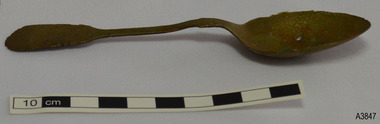
Domestic object - Spoon, William Page & Co, Circa 1853-1878
... anchor’ because the metal used for the spoons is not silver. William Page used various Maker’s Marks on his cutlery. The pattern of five embossed marks on this spoon is a typical example, with the embossed sunken crown containing ‘W P’ being the first in the column of symbols. - ‘W P’, within raised diamond outline, within sunken crown - ‘Cross...anchor’ because the metal used for the spoons is not silver. William Page used various Maker’s Marks on his cutlery. The pattern of five embossed marks on this spoon is a typical example, with the embossed sunken crown containing ‘W P’ being the first in the column of symbols. - ‘W P’, within raised diamond outline, within sunken crown - ‘Cross ...This spoon, made by William Page & Co., is electroplated nickel-silver and was recovered during the late 1960s to early 1970s from an unnamed shipwreck along the coast of Victoria. The shipwrecks in the area range from around the 1840s to the early 1930s. The spoon is part of the John Chance Collection. This spoon is likely to have been recovered be from the wreck of the Loch Ard (1873-1878) as other cutlery in the Flagstaff Hill’s Shipwreck Collection made by William Page was also recovered from the Loch Ard. The ship’s Manifest included a large quantity of cutlery. Also, other objects in the John Chance Collection were also recovered from wreck of the Loch Ard. In the mid-1800s electroplated cutlery became a popular substitute for the traditional but more costly sterling silver pieces. The ‘new’ cutlery was made from a more common base metal, such as nickel or a nickel alloy, then electroplated (coated) with a very thin layer of silver. The eating utensils looked like the expensive, pure silver version but eventually, through use and wear, the base metal would show. Some producers warranted their electroplated silver to be ‘white throughout’. WILLIAM PAGE & CO., BIRMINGHAM, ENGLAND - Although the electroplated cutlery of William Page & Co. was made in Birmingham, it does not include the embossed Birmingham Assay’s mark of an ‘anchor’ because the metal used for the spoons is not silver. William Page used various Maker’s Marks on his cutlery. The pattern of five embossed marks on this spoon is a typical example, with the embossed sunken crown containing ‘W P’ being the first in the column of symbols. - ‘W P’, within raised diamond outline, within sunken crown - ‘Cross above Triangle’ symbol within sunken oval - ‘Maltese Cross’ symbol within sunken, six-sided shape - ‘crab-like’ symbol within sunken oval - ‘R D’ within sunken diamond William Page established his business in 1834, according to the text around a printed Trademark. The firm William Page & Co. began electroplating in 1855, and from 1880 it operated from Cranemore Street, Cattle’s Grove and also at 55 Albion St, Birmingham. The firm registered a new Trademark [‘W P’ within a diamond boarder within a sunken diamond] in 1897; previously the Mark were the initials WP within a crown, but the British legislation prohibited the use of a ‘crown’ mark on electroplated ware in 1895. In 1936 the firm became William Page & Co. Ltd and became a supplier of spoons to the British Government in 1938, marking its products with the ‘broad arrow’ symbol. The firm also traded with the brand names Armour, Asrista, Bolivian Silver, Roman Silver, Roumanian Silver, Silverite and Trevor Plate. Although this spoon is not linked to a particular shipwreck, it is very likely to have come from the wreck of the Loch Ard; the ship’s Manifest includes a large quantity of cutlery. Regardless, it is recognised as being historically significant as an example of cutlery carried onboard a ship as either personal belongings or cargo and brought into Colonial Victoria in the 19th to early 20th century; through this we have added opportunity to interpret Victoria’s social and historical themes of those times. The spoon also has significance for its connection with many similar William Page pieces of cutlery in our collection that were recovered from the wreck of the sailing ship Loch Ard (1873-1878). William Page & Co. of Birmingham is one of the renowned 19th century manufacturers and electroplaters and was supplier of spoons to the British Government in 1938. The spoon has added significance, as it was recovered by John Chance, a diver of wrecks, including the Loch Ard, in Victoria’s coastal waters in the late 1960s to early 1970s. Items that come from several wrecks have since been donated to the Flagstaff Hill Maritime Village’s museum collection by his family, illustrating this item’s level of historical value.Spoon; teaspoon, electroplate nickel-silver, discoloured to green and red-brown in places. Fiddle design. Bowl has indents and holes. Five embossed Maker’s Marks on back of handle, arranged in a column from tip towards bowl. Made by William Page and Co., Birmingham. The spoon no longer has its silver plating. The surface has encrustations. Bowl has nicks, indents and holes. Stem is very bent at the shoulder. Discoloured to green and red-brown in places. Embossed Maker Marks - ‘W P’, within raised diamond outline, within sunken crown - ‘Cross above Triangle’ symbol within sunken oval - ‘Maltese Cross’ symbol within sunken, six-sided shape - ‘crab-like’ symbol within sunken oval - ‘R D’ within sunken diamondflagstaff hill maritime museum, maritime museum, shipwreck coast, flagstaff hill maritime village, great ocean road, shipwreck artefact, john chance, loch ard, cutlery, flatware, silverware, tableware, eating utensils, dining, spoon, electroplated cutlery, william page & co, william page & co. ltd., birmingham plate, silversmith, antique, vintage, fiddle design, fiddle pattern, teaspoon -
 Flagstaff Hill Maritime Museum and Village
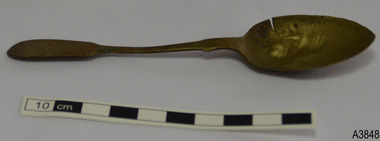
Domestic object - Spoon, William Page & Co, Circa 1853-1878
... anchor’ because the metal used for the spoons is not silver. William Page used various Maker’s Marks on his cutlery. The pattern of five embossed marks on this spoon is a typical example, with the embossed sunken crown containing ‘W P’ being the first in the column of symbols. - ‘W P’, within raised diamond outline, within sunken crown - ‘Cross...anchor’ because the metal used for the spoons is not silver. William Page used various Maker’s Marks on his cutlery. The pattern of five embossed marks on this spoon is a typical example, with the embossed sunken crown containing ‘W P’ being the first in the column of symbols. - ‘W P’, within raised diamond outline, within sunken crown - ‘Cross ...This spoon, made by William Page & Co., is electroplated nickel-silver and was recovered during the late 1960s to early 1970s from an unnamed shipwreck along the coast of Victoria. The shipwrecks in the area range from around the 1840s to the early 1930s. The spoon is part of the John Chance Collection. This spoon is likely to have been recovered be from the wreck of the Loch Ard (1873-1878) as other cutlery in the Flagstaff Hill’s Shipwreck Collection made by William Page was also recovered from the Loch Ard. The ship’s Manifest included a large quantity of cutlery. Also, other objects in the John Chance Collection were also recovered from wreck of the Loch Ard. In the mid-1800s electroplated cutlery became a popular substitute for the traditional but more costly sterling silver pieces. The ‘new’ cutlery was made from a more common base metal, such as nickel or a nickel alloy, then electroplated (coated) with a very thin layer of silver. The eating utensils looked like the expensive, pure silver version but eventually, through use and wear, the base metal would show. Some producers warranted their electroplated silver to be ‘white throughout’. WILLIAM PAGE & CO., BIRMINGHAM, ENGLAND - Although the electroplated cutlery of William Page & Co. was made in Birmingham, it does not include the embossed Birmingham Assay’s mark of an ‘anchor’ because the metal used for the spoons is not silver. William Page used various Maker’s Marks on his cutlery. The pattern of five embossed marks on this spoon is a typical example, with the embossed sunken crown containing ‘W P’ being the first in the column of symbols. - ‘W P’, within raised diamond outline, within sunken crown - ‘Cross above Triangle’ symbol within sunken oval - ‘Maltese Cross’ symbol within sunken, six-sided shape - ‘crab-like’ symbol within sunken oval - ‘R D’ within sunken diamond William Page established his business in 1834, according to the text around a printed Trademark. The firm William Page & Co. began electroplating in 1855, and from 1880 it operated from Cranemore Street, Cattle’s Grove and also at 55 Albion St, Birmingham. The firm registered a new Trademark [‘W P’ within a diamond boarder within a sunken diamond] in 1897; previously the Mark were the initials WP within a crown, but the British legislation prohibited the use of a ‘crown’ mark on electroplated ware in 1895. In 1936 the firm became William Page & Co. Ltd and became a supplier of spoons to the British Government in 1938, marking its products with the ‘broad arrow’ symbol. The firm also traded with the brand names Armour, Asrista, Bolivian Silver, Roman Silver, Roumanian Silver, Silverite and Trevor Plate. Although this spoon is not linked to a particular shipwreck, it is very likely to have come from the wreck of the Loch Ard; the ship’s Manifest includes a large quantity of cutlery. Regardless, it is recognised as being historically significant as an example of cutlery carried onboard a ship as either personal belongings or cargo and brought into Colonial Victoria in the 19th to early 20th century; through this we have added opportunity to interpret Victoria’s social and historical themes of those times. The spoon also has significance for its connection with many similar William Page pieces of cutlery in our collection that were recovered from the wreck of the sailing ship Loch Ard (1873-1878). William Page & Co. of Birmingham is one of the renowned 19th century manufacturers and electroplaters and was supplier of spoons to the British Government in 1938. The spoon has added significance, as it was recovered by John Chance, a diver of wrecks, including the Loch Ard, in Victoria’s coastal waters in the late 1960s to early 1970s. Items that come from several wrecks have since been donated to the Flagstaff Hill Maritime Village’s museum collection by his family, illustrating this item’s level of historical value.Spoon; teaspoon, electroplate nickel-silver, silver discoloured to brown. Fiddle design. Five embossed Hallmarks. Five embossed Maker’s Marks on back of handle, arranged in a column from tip towards bowl. Made by William Page and Co., Birmingham. The spoon no longer has its silver plating. Bowl has a cut in the side, and is nicked and dented. Embossed Maker Marks - ‘W P’, within raised diamond outline, within sunken crown - ‘Cross above Triangle’ symbol within sunken oval - ‘Maltese Cross’ symbol within sunken, six-sided shape - ‘crab-like’ symbol within sunken oval - ‘R D’ within sunken diamondflagstaff hill maritime museum, maritime museum, shipwreck coast, flagstaff hill maritime village, great ocean road, shipwreck artefact, john chance, loch ard, cutlery, flatware, silverware, tableware, eating utensils, dining, spoon, electroplated cutlery, william page & co, william page & co. ltd., birmingham plate, silversmith, antique, vintage, fiddle design, fiddle pattern, teaspoon -
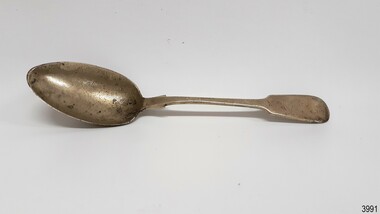 Flagstaff Hill Maritime Museum and Village
Domestic object - Spoon, Prior to 1878
... Crown with diamond with W P inside Oval with anchor or key Square with cut corners with fancy cross inside Circle with lion Diamond with "P"...The collections historically significance is that it is associated unfortunately with the worst and best-known shipwreck in Victoria's history. flagstaff hill warrnambool shipwrecked coast flagstaff hill maritime museum maritime museum shipwreck coast flagstaff hill maritime village great ocean road loch line loch ard captain gibbs eva carmichael tom pearce glenample station mutton bird island loch ard gorge dessert spoon petrified timber conglomerated cutlery silverware dining utensil spoons conglomeration of spoons spoon tablespoon cutlery Crown with diamond with W P inside Oval with anchor or key Square with cut corners with fancy cross inside Circle with lion Diamond with "P" Spoon, tablespoon; nickel silver plated spoon with fiddle-back design handle, narrow stem with flared collar and elongated bowl. ...This tablespoon was recovered from the wreck of the Loch Ard that sailed from Gravesend, London. The manifest listed an array of manufactured goods being exported to the Colony of Victoria. Included in the cargo manifest was a large number of hardware and cutlery items. These spoons are representative of similar items of silver electro-plated cutlery salvaged from the Loch Ard wreck site, comprising nickel silver electroplated spoons and forks of various sizes but all sharing the same general shape and design. History of the Loch Ard: - The Loch Ard got its name from ”Loch Ard” a loch that lies to the west of Aberfoyle, and the east of Loch Lomond. It means "high lake" in Scottish Gaelic. The vessel belonged to the famous Loch Line which sailed many vessels from England to Australia. The Loch Ard was built in Glasgow by Barclay, Curdle and Co. in 1873, the vessel was a three-masted square-rigged iron sailing ship that measured 79.87 meters in length, 11.58 m in width, and 7 m in depth with a gross tonnage of 1693 tons with a mainmast that measured a massive 45.7 m in height. Loch Ard made three trips to Australia and one trip to Calcutta before its fateful voyage. Loch Ard left England on March 2, 1878, under the command of 29-year-old Captain Gibbs, who was newly married. The ship was bound for Melbourne with a crew of 37, plus 17 passengers. The general cargo reflected the affluence of Melbourne at the time. Onboard were straw hats, umbrellas, perfumes, clay pipes, pianos, clocks, confectionery, linen and candles, as well as a heavier load of railway irons, cement, lead and copper. There were other items included that were intended for display in the Melbourne International Exhibition of 1880. The voyage to Port Phillip was long but uneventful. Then at 3 am on June 1, 1878, Captain Gibbs was expecting to see land. But the Loch Ard was running into a fog which greatly reduced visibility. Captain Gibbs was becoming anxious as there was no sign of land or the Cape Otway lighthouse. At 4 am the fog lifted and a lookout aloft announced that he could see breakers. The sheer cliffs of Victoria's west coast came into view, and Captain Gibbs realised that the ship was much closer to them than expected. He ordered as much sail to be set as time would permit and then attempted to steer the vessel out to sea. On coming head-on into the wind, the ship lost momentum, the sails fell limp and Loch Ard's bow swung back towards land. Gibbs then ordered the anchors to be released in an attempt to hold their position. The anchors sank some 50 fathoms - but did not hold. By this time the ship was among the breakers and the tall cliffs of Mutton Bird Island rose behind. Just half a mile from the coast, the ship's bow was suddenly pulled around by the anchor. The captain tried to tack out to sea, but the ship struck a reef at the base of Mutton Bird Island, near Port Campbell. Waves subsequently broke over the ship and the top deck became loosened from the hull. The masts and rigging came crashing down knocking passengers and crew overboard. When a lifeboat was finally launched, it crashed into the side of Loch Ard and capsized. Tom Pearce, who had launched the boat, managed to cling to its overturned hull and shelter beneath it. He drifted out to sea and then on the flood tide came into what is now known as Loch Ard Gorge. He swam to shore, bruised and dazed, and found a cave in which to shelter. Some of the crew stayed below deck to shelter from the falling rigging but drowned when the ship slipped off the reef into deeper water. Eva Carmichael a passenger had raced onto the deck to find out what was happening only to be confronted by towering cliffs looming above the stricken ship. In all the chaos, Captain Gibbs grabbed Eva and said, "If you are saved Eva, let my dear wife know that I died like a sailor". That was the last Eva Carmichael saw of the captain. She was swept off the ship by a huge wave. Eva saw Tom Pearce on a small rocky beach and yelled to attract his attention. He dived in and swam to the exhausted woman and dragged her to shore. He took her to the cave and broke the open case of brandy which had washed up on the beach. He opened a bottle to revive the unconscious woman. A few hours later Tom scaled a cliff in search of help. He followed hoof prints and came by chance upon two men from nearby Glenample Station three and a half miles away. In a complete state of exhaustion, he told the men of the tragedy. Tom then returned to the gorge while the two men rode back to the station to get help. By the time they reached Loch Ard Gorge, it was cold and dark. The two shipwreck survivors were taken to Glenample Station to recover. Eva stayed at the station for six weeks before returning to Ireland by steamship. In Melbourne, Tom Pearce received a hero's welcome. He was presented with the first gold medal of the Royal Humane Society of Victoria and a £1000 cheque from the Victorian Government. Concerts were performed to honour the young man's bravery and to raise money for those who lost family in the disaster. Of the 54 crew members and passengers on board, only two survived: the apprentice, Tom Pearce and the young woman passenger, Eva Carmichael, who lost her family in the tragedy. Ten days after the Loch Ard tragedy, salvage rights to the wreck were sold at auction for £2,120. Cargo valued at £3,000 was salvaged and placed on the beach, but most washed back into the sea when another storm developed. The wreck of Loch Ard still lies at the base of Mutton Bird Island. Much of the cargo has now been salvaged and some items were washed up into Loch Ard Gorge. Cargo and artefacts have also been illegally salvaged over many years before protective legislation was introduced in March 1982. One of the most unlikely pieces of cargo to have survived the shipwreck was a Minton majolica peacock- one of only nine in the world. The peacock was destined for the Melbourne 1880 International Exhibition. It had been well packed, which gave it adequate protection during the violent storm. Today the Minton peacock can be seen at the Flagstaff Hill Maritime Museum in Warrnambool. From Australia's most dramatic shipwreck, it has now become Australia's most valuable shipwreck artifact and is one of very few 'objects' on the Victorian State Heritage Register.The shipwreck of the Loch Ard is of significance for Victoria and is registered on the Victorian Heritage Register ( S 417). Flagstaff Hill has a varied collection of artefacts from Loch Ard and its collection is significant for being one of the largest accumulation of artefacts from this notable Victorian shipwreck. The collections object is to also give us a snapshot into history so we can interpret the story of this tragic event. The collection is also archaeologically significant as it represents aspects of Victoria's shipping history that allows us to interpret Victoria's social and historical themes of the time. The collections historically significance is that it is associated unfortunately with the worst and best-known shipwreck in Victoria's history. Spoon, tablespoon; nickel silver plated spoon with fiddle-back design handle, narrow stem with flared collar and elongated bowl. Marker's marks are impressed on the back of the handle. It was recovered from the wreck of the Loch Ard.Crown with diamond with W P inside Oval with anchor or key Square with cut corners with fancy cross inside Circle with lion Diamond with "P"flagstaff hill, warrnambool, shipwrecked coast, flagstaff hill maritime museum, maritime museum, shipwreck coast, flagstaff hill maritime village, great ocean road, loch line, loch ard, captain gibbs, eva carmichael, tom pearce, glenample station, mutton bird island, loch ard gorge, dessert spoon, petrified timber, conglomerated cutlery, silverware, dining utensil, spoons, conglomeration of spoons, spoon, tablespoon, cutlery
